



|
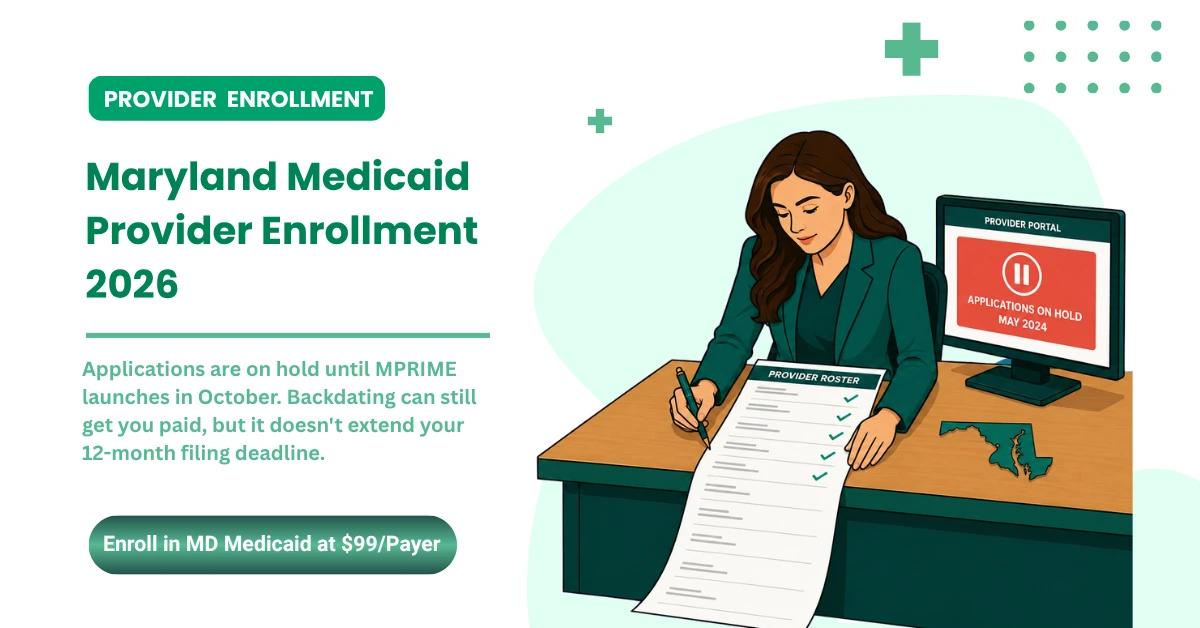
Status as of August 13, 2026: Maryland Medicaid is not accepting enrollment applications right now. The hold started July 1 for moderate and high risk provider types and August 1 for limited risk types. It lifts when MPRIME goes live in October 2026. |
Maryland Medicaid provider enrollment is how a clinician, group, or facility registers with the Maryland Department of Health so they can order, refer, prescribe, or bill for Medicaid participants. Applications run through ePREP today. In October 2026, a new portal called MPRIME replaces it, and submissions are paused until then.
Quick reference
|
Question |
Short answer |
|---|---|
|
Current portal |
ePREP, the Electronic Provider Revalidation and Enrollment Portal |
|
New portal |
MPRIME, the Maryland Provider Registration and Information Management Enterprise |
|
Go-live |
October 2026 |
|
Applications right now |
On hold. New and updated applications are returned without processing |
|
Backdating deadline |
December 31, 2026, for a complete application filed in MPRIME |
|
What comes after state approval |
Separate credentialing with each HealthChoice MCO |
|
Who this guide is for |
Office managers, credentialing coordinators, and practice owners in Maryland |
Here's the part that costs money. A provider who sees Medicaid patients during the hold is stacking up claims nobody can submit yet. The timely filing clock keeps running the whole time.
Most guides on this topic still describe a portal that retires in a few weeks. This one covers what MDH has actually published about the transition, cited to the transmittal it came from.
What Is Maryland Medicaid Provider Enrollment?
Maryland Medicaid provider enrollment is registration with the Maryland Medicaid Provider Enrollment program so you can participate in Medical Assistance. Federal law requires it before a provider can order, refer, prescribe, or bill. No enrollment means no payment, and there's no workaround.
Every state runs its own program with its own portal and its own rules. Our Medicaid enrollment in all states guide covers the federal requirements that apply everywhere. Everything below is Maryland.
Enrollment, credentialing, and contracting are three different things
- Enrollment: Your billing relationship with the Maryland Medical Assistance Program. It assigns your Medicaid provider number.
- Credentialing: A health plan verifying your license, training, and history against its own standards.
- Contracting: The signed agreement and fee schedule that puts you in a network.
A provider can clear all three with an MCO and still get denials, because state enrollment is a separate layer underneath. Federal rules require MCO providers to enroll with the state Medicaid agency. You enroll with Maryland Medical Assistance even if you only ever see HealthChoice patients.
We see this most often with a new hire. She's credentialed with the plan, she's seeing patients, and a portion of her claims keeps rejecting. Nobody enrolled her at the state level, and the denial code doesn't say so.
ePREP Is Being Replaced by MPRIME in October 2026
Maryland Medicaid is moving from ePREP, the Electronic Provider Revalidation and Enrollment Portal, to MPRIME, the Maryland Provider Registration and Information Management Enterprise. Go-live is October 2026. Once MPRIME is live, ePREP stops being used for new applications and updates to existing enrollment.
All the functions you use today move with it. New enrollments, update applications, Changes of Ownership, and revalidations all land in the new system.
What transfers to MPRIME, and what doesn't
- Provider records transfer: Existing accounts are preloaded into MPRIME ahead of go-live.
- Your login does not: Business profiles won't carry over per user. You have to create a new account inside MPRIME before you can get in.
- Access has to be re-established: You must re-associate yourself with every existing account to regain access and administrative rights.
- Affiliations survive: Provider affiliations stay intact and appear once you associate with the respective provider account.
Source: MDH MPRIME transition page and FAQ.
Build your provider roster before the switch
MDH was asked whether it would publish a comprehensive list of enrolled accounts and their affiliated providers. The answer was no. Providers were told to build their own roster of everyone they're responsible for credentialing. Details are on the MDH MPRIME transition page.
Your roster needs every NPI you're responsible for, every tax ID those NPIs sit under, every affiliation, and the administrative contact for each account. Build it now, while ePREP still opens.
Re-associating one provider is a task. Re-associating 30 across four tax IDs, with a go-live date attached, is a project. That's usually the point where practices hand it to Maryland Medicaid enrollment services rather than absorb it into someone's week.
Maryland Medicaid Enrollment Timeline: Every Date That Matters in 2026
Seven dates control what you can and can't do this year. Find the one that applies to your provider type before you plan anything.
|
Date |
What happens |
What it means for you |
|---|---|---|
|
February to April 2026 |
Early revalidation notices issued on a rolling basis |
Providers due between May and October were moved up and given 90 days |
|
July 1, 2026 |
ePREP hold begins for moderate and high risk provider types |
Applications submitted after this are returned without processing |
|
August 1, 2026 |
Hold extends to limited risk provider types |
Every risk category is now paused |
|
August to October 1, 2026 |
MDH runs MPRIME training sessions |
Four class types, registration through the MPRIME page |
|
October 2026 |
MPRIME goes live and the holds end |
Create your new account and re-associate your records |
|
December 1, 2026 |
Deferred termination date for suspended providers |
Fix the suspension in MPRIME first or the account terminates |
|
December 31, 2026 |
Backdating deadline |
Last day to file a complete application and keep a backdated effective date |
Find your risk category before you assume a date applies to you
Risk levels are assigned by provider type, not by practice size. MDH published the lists as attachments to MDH Transmittal PT 59-26. Attachment 1 covers high and moderate risk types, which were held July 1. Attachment 2 covers limited risk, held August 1.
Look up your own provider type in that transmittal. Guessing is how practices misjudge which deadline they already missed.
Can You Bill Maryland Medicaid During the Application Hold?
No. Providers who didn't submit before their hold date aren't eligible to bill for services rendered. There's a path back, though, and it has a hard deadline attached.
How the backdated effective date works
Submit a complete and processable application in MPRIME on or before December 31, 2026, and Maryland Medicaid may set your enrollment effective date backward.
- Two dates, whichever is later: The backdate is set to the start of your application hold, or your license issuance date.
- Hold start dates: July 1, 2026 for high and moderate risk provider types. August 1, 2026 for limited risk types.
- The deadline: December 31, 2026. Applications that are incomplete, incorrect, or otherwise unapprovable get returned for corrections.
- Miss it and the backdate is gone: Providers who don't file a complete, correct application before that date get a standard effective date instead.
The backdate does not extend your filing deadline
This is the part that catches practices, and it's worth reading twice. All claims still have to be submitted within 12 months of the date of service, regardless of any backdated enrollment effective date.
Do the arithmetic on a July date of service. If your approval lands in December, roughly six months of filing window is already gone, and every held claim from that period releases at once.
|
One more thing MDH said plainly: providers who render services to Medicaid participants without enrolling do so at risk. Those who fail to take action after the hold lifts won't be paid, and they may not bill the participant either. |
Source: MDH Transmittal PT 94-26, June 18, 2026.
A pile of held claims released in one week isn't an enrollment problem anymore. It's an AR problem, and most practices aren't staffed for the surge. Catch-up AR recovery is the piece that decides how much of that backlog actually converts.
How to Request an Emergency Enrollment Hold Exception
Maryland Medicaid set up a limited emergency process that lets certain applications through during the hold. It's narrow. It applies only where failure to enroll immediately would affect the health, safety, and wellbeing of Maryland Medicaid participants.
A tight hiring timeline doesn't qualify. A gap in access to care for participants might.
What to include in your request
Email mdh.mprimegolive@maryland.gov with the subject line "Request for Emergency Enrollment Hold Exception". Include four things:
- Provider NPI
- Provider type
- Service address
- The specific circumstances warranting the emergency enrollment
MDH responds with an approval, a denial, or a request for more information. Requests that don't clearly explain the health and safety impact get denied. Approved providers receive separate instructions on how to submit.
Pay-to address changes use the same route
If you need to change your pay-to address during the hold, MDH directs you to this same emergency process using a paper application workflow, so payments aren't interrupted. Practice address changes and correspondence address changes work differently. See MDH Transmittal PT 94-26 for the full breakdown.
Why Your SDAT Number Can Block Your MPRIME Application
Effective October 2026, providers without a State Department of Assessments and Taxation identification number in good standing will be unable to submit applications in MPRIME. Maryland Medicaid passed the underlying regulations effective July 21, 2025.
Most credentialing staff have never touched SDAT, because it lives in a state business registry rather than anywhere in healthcare. That's exactly why it catches people.
The "L" prefix rule for individual billing providers
- Organizations: Your SDAT identification number has to appropriately identify your organizational structure.
- Individual billing providers: Your SDAT identification number should begin with the letter "L".
- Standing matters as much as existence: An SDAT number that exists but isn't in good standing blocks submission the same way a missing one does.
Source: MDH Transmittal PT 80-26, April 20, 2026.
Check your SDAT standing before you submit
A lapsed filing is common, especially at solo practices and small groups that registered years ago and never looked at it again. It's like an expired registration on a car. Everything runs fine until somebody checks. Full detail sits in MDH Transmittal PT 80-26.
Fixing SDAT standing takes days. Discovering the problem at submission costs weeks, because you're back at the end of a queue that's about to get very long.
How to Enroll as a Maryland Medicaid Provider, Step by Step
This is the sequence once MPRIME is live in October. The field requirements below come from Maryland Medicaid's published enrollment guidance and don't change with the portal.
Step 1. Confirm SDAT standing and gather identifiers
You'll need your Type 1 NPI, your Type 2 NPI if you're enrolling a group or facility, your Tax ID as either an SSN or FEIN, and your SDAT registration number if you're an organization.
Step 2. Create your account and accept administrator rights
Enter your NPI and Tax ID to begin. Accept administrator responsibilities for the account, and the system generates your provider account. If you were an ePREP user, this is where you re-associate with existing records.
Step 3. Complete the enrollment application
Expect sections covering provider information, addresses, contact information, logistics including hours and service details, and rendering provider affiliations. Affiliations are optional at initial enrollment, so a missing one won't block your submission.
Step 4. Sign the Provider Agreement and upload addenda
All Maryland Medicaid providers sign the Provider Agreement at enrollment and again at revalidation. Certain provider types also have to complete a provider-type addendum. In ePREP those upload under the Applications tab, then Additional Information, then Practice Information. The current forms live on the MDH Provider Agreement and addenda page.
Step 5. Register for eMedicaid after approval
eMedicaid is a separate, post-approval step. Once you have your Medicaid provider number, register at the Maryland eMedicaid Portal to verify recipient eligibility, pull remittance advice, and submit claims.
|
Address rule worth flagging: Maryland Medicaid requires three address types on your record, and your pay-to address has to match your W-9 exactly. A mismatch here doesn't reject the application. It routes your money to the wrong place months later. |
Commercial payers and the MCOs will pull from CAQH rather than your state file, and a lapsed attestation stalls an application that otherwise looks complete. Our CAQH ProView attestation guide walks the 120 day cycle.
Documents You Need for Maryland Medicaid Provider Enrollment
Applications stall on document mismatches far more often than on clinical qualifications. Reviewers compare the name on your W-9 against NPPES, the taxonomy against the provider type you selected, and the banking details against your tax record.
|
Document |
What makes it acceptable |
|---|---|
|
NPI, Type 1 and Type 2 |
Active in NPPES, taxonomy and address matching the application |
|
SDAT identification number |
Active and in good standing. Individual billing providers need an "L" prefix |
|
Maryland professional license |
Current and unrestricted with the licensing board |
|
IRS Form W-9 |
Signed, with the legal name that matches the EIN record |
|
IRS 147C letter |
Official IRS tax status confirmation, not a self-typed letterhead |
|
Professional liability certificate |
Shows policy number and active coverage dates |
|
Banking details or voided check |
Account name maps to the SDAT and IRS records |
|
DEA and Maryland CDS registration |
Both required for prescribers, with matching addresses |
The taxonomy mismatch that gets applications returned
Provider type classification and specialty taxonomy have to match your NPPES record. One mismatched digit is enough to trigger a return, and mismatched taxonomy is among the most common reasons a Maryland application comes back.
If you're reconciling identifiers across a dozen clinicians before a deadline, state Medicaid documentation standards covers how that reconciliation runs across multiple states at once.
What the Provider Agreement actually commits you to
- Record retention: Keep records for at least six years from the date of payment.
- Exclusion screening: Screen against OIG and SAM exclusion lists, plus Maryland's excluded provider lists.
- Signature authority: The agreement is signed at enrollment and again at every revalidation.
EDI, ERA, and EFT enrollment is a separate track
Getting your Maryland Medicaid provider number doesn't turn on electronic remittance or electronic funds transfer. Those need their own enrollment. Line it up with your clearinghouse before go-live, or you'll be posting remits by hand while everything else works fine.
How to Check Your Maryland Medicaid Provider Enrollment Status
There are three ways to check where a Maryland Medicaid application or enrollment stands: a public lookup that needs no login, the enrollment portal itself, and the provider call center. Which one you want depends on whether you're checking your own file or somebody else's.
Check enrollment status without logging in
The Provider Verification System is a public search engine for Maryland Medicaid fee-for-service provider enrollment. Search by NPI, provider number, or name, along with a date of service. Details are on the Maryland Provider Verification System page.
- Quick provider check: Confirms active enrollment plus provider type, specialties, provider number, revalidation date, and whether the provider is enrolled as an individual, group, or facility.
- Past enrollment verification: Confirms whether a provider was actively enrolled on a date in the past. This is the one your AR team wants.
- Facility or group status: Administrators can see whether each service location is active.
That past-date function matters more than it looks. Before you appeal a denial on a referring or rendering provider, check whether that provider was actually enrolled on the date of service. Half the time the appeal isn't the fix.
Check application status inside the portal
Through October 2026, application status lives in ePREP. After go-live it moves to MPRIME, and you'll need the new account before you can see anything. Enrolled providers can find enrollment status information by logging into their portal account.
Check status by phone
The Maryland ePREP Hotline is 1-844-463-7768, open Monday through Friday from 9:00 a.m. to 5:00 p.m. and closed on state holidays. Automated Health Services runs provider enrollment business services for Maryland Medicaid, and MDH has confirmed the call center keeps the same number after the transition to MPRIME.
Have your NPI, provider type, tax ID, and submission date ready before you dial. The queue moves faster when the specialist doesn't have to wait while you look things up.
Maryland Medicaid Revalidation Rules Every Five Years
Maryland Medicaid providers revalidate at least every five years. Four mechanics around that cycle trip up practices, and none of them are obvious from the outside.
- Revalidation is notice-triggered: It starts when MDH mails you a notice prompting you to enter the portal and submit the specific revalidation application. You can't start it on your own schedule.
- A supplemental update doesn't count: Submitting a supplemental or update application does not satisfy revalidation. This one is expensive and common.
- Who signs matters: The signer has to be the rendering provider or solo practitioner, or an appropriately disclosed managing employee, owner, control interest holder, or agent.
- Miss the window and you're suspended: Providers who don't complete revalidation within 90 days of the notice may be suspended.
What the MPRIME transition did to revalidation schedules
Providers scheduled for revalidation between July 1, 2026 and the October go-live were rescheduled earlier. MDH began issuing early notices on a rolling basis in February 2026 and expected the last of them in April, so everyone had the full 90 days before the hold started. That sequence is set out in MDH Transmittal PT 65-26.
Suspended providers face a December 1, 2026 termination date
MDH deferred termination for providers whose one-year suspension would have ended between July 1 and November 30, 2026. Those accounts now carry a termination date of December 1, 2026. Fail to make the necessary updates in MPRIME before then and the account terminates automatically.
Revalidation dates are the easiest thing in credentialing to lose, because nothing happens for five years and then everything happens at once. If you're carrying more than a handful of providers, credentialing and revalidation management on a tracked calendar beats another reminder email nobody opens.
State Enrollment Is Not the Same as MCO Credentialing
Maryland Medicaid runs on two layers. Layer one is enrollment with the Maryland Medical Assistance Program, which establishes your billing relationship with the state. Layer two is credentialing and contracting with each Maryland HealthChoice program MCO you want to join. Both are required.
MCOs won't start until state enrollment clears
Plans generally can't finalize an in-network contract until your record is validated in the state system. That sequencing explains a complaint we hear constantly: the practice applied to the MCO three months ago and heard nothing. The plan was waiting on the state the whole time.
Network participation does not enroll you in fee-for-service
This is the gap that produces denials nobody can explain. A practice assumes network participation covers everything, bills a fee-for-service claim, and it bounces. Both layers have to be verified separately, for every participating provider, every time.
A behavioral health group we worked with added two therapists, cleared them through the MCO, and spent four months wondering why roughly a third of their claims kept rejecting. The state file was the missing piece, and the remit never said so.
All Nine Maryland HealthChoice MCOs
Maryland delivers Medicaid through nine managed care organizations under the HealthChoice program. Getting this list right matters more than it sounds, because several published guides still name plans that don't operate here.
|
HealthChoice MCO |
Notes for providers |
|---|---|
|
Aetna Better Health of Maryland |
Statewide. Runs its own credentialing intake |
|
CareFirst BlueCross BlueShield Community Health Plan Maryland |
Strong Central Maryland and Baltimore presence |
|
Jai Medical Systems |
Concentrated in the Baltimore metro |
|
Kaiser Permanente |
Central Maryland and the DC suburbs |
|
Maryland Physicians Care |
Statewide, with strong rural and suburban networks |
|
MedStar Family Choice |
DC suburbs, Southern Maryland, and Baltimore |
|
Priority Partners |
Baltimore City and Central Maryland counties |
|
UnitedHealthcare Community Plan |
Statewide |
|
Wellpoint Maryland |
Statewide. Formerly Amerigroup Maryland |
One naming trap is worth flagging. Amerigroup Maryland is now Wellpoint Maryland, and older guides still list the old name. A federal source counts eight Maryland MCOs while MDH counts nine, so use the state list, which is current. The Hilltop Institute Medicaid DataPort maintains an independent roster if you want a second check.
Don't apply to all nine at once
Networks vary by county. Prioritize the three to five plans that dominate your service area instead of submitting everywhere and waiting on nine timelines.
At least one plan gates entry with a non-binding letter of intent, then weighs geographic need, existing coverage in the area, specialty need, and member accessibility before it contracts with anyone. Primary care practices and OB/GYN groups should also expect a site audit and medical chart review.
Plan-specific requirements differ enough to matter. Our Aetna network enrollment guide covers that intake in detail.
For the UnitedHealthcare side, the UnitedHealthcare credentialing steps walkthrough covers Onboard Pro and the CAQH handoff.
Enrollment Gaps Cause Denials That Look Like Coding Problems
A denial that reads like a coverage or coding issue is often an enrollment issue wearing a different code. Three patterns show up over and over in Maryland.
The capitation denial when you bill the wrong layer
Bill fee-for-service Medicaid for a member enrolled in a HealthChoice MCO and the claim comes back indicating the charges are covered under a capitation or managed care agreement. The claim isn't wrong. It went to the wrong payer layer. Our CO-24 capitation denial guide walks the resolution path.
The suspended rendering provider denial
Maryland Medicaid claims can return a message indicating the rendering provider ID is suspended and that ePREP enrollment must be reviewed. When that appears, the fix is in the enrollment record, not the claim. Check the provider in PVS for the date of service before you touch anything else.
The unenrolled or lapsed provider denial
A provider who isn't actively enrolled can't be paid, and the claim denies for the provider not being certified for that date of service. During the current hold, this is the single most likely denial a Maryland practice will see. A lapse mid-cycle produces the same pattern, which our PR-27 coverage terminated guide covers.
Work the pattern, not the claim
If the same denial repeats across several providers, resubmitting claims one at a time is the wrong move. Pull the aging report, group it by rendering NPI, and check enrollment status for each one before anybody appeals anything.
Most of these are workable once someone identifies the enrollment defect and resubmits against a corrected record. That's the difference between enrollment-driven denial recovery and writing the balance off as uncollectible.
Behavioral Health Enrollment Moratorium: Which Counties Are Closed
Separate from the MPRIME hold, Maryland Medicaid has a standing moratorium on new enrollments for certain behavioral health provider types in certain jurisdictions. It was extended again on June 24, 2026.
The extension runs from July 1, 2026, for six months. It's part of MDH's work on fraud, waste, and abuse in the Public Behavioral Health System, and it applies to new organizations entering the market, not to patients receiving care.
Which programs are affected
Four program types licensed under COMAR 10.63 and 10.09 are covered:
- Psychiatric Rehabilitation Programs (PRP)
- Psychiatric Rehabilitation Programs (Health Home)
- Level 2.5 Partial Hospital Programs (PHP)
- Level 2.1 Intensive Outpatient Treatment Programs (IOP)
The 10 jurisdictions where new enrollment is closed
|
Jurisdiction |
Jurisdiction |
|---|---|
|
Anne Arundel County |
Howard County |
|
Baltimore City |
Montgomery County |
|
Baltimore County |
Prince George's County |
|
Carroll County |
Washington County |
|
Frederick County |
Harford County |
Maryland's other jurisdictions remain open for these provider types. The moratorium was lifted in the state's rural and underserved counties in 2025 and has stayed lifted there since.
What the moratorium does not block
MDH continues the licensure process for anyone seeking to become a licensed community behavioral health provider. It also maintains the enrollment process for existing provider Medicaid revalidations, relocations, mergers, and acquisitions. The full notice is in MDH Transmittal PT 88-26.
If you're already enrolled, you can still take new patients and deliver your full range of services. Our behavioral health credentialing requirements guide covers how carve-out networks and program-level licensing interact across states.
The PRP Referring Provider Rule That Started July 1, 2026
Effective July 1, 2026, Psychiatric Rehabilitation Program providers must submit claims carrying the NPI of an actively enrolled referring practitioner. Maryland Medicaid denies PRP claims for dates of service where the referring practitioner isn't actively enrolled.
- Field 17b: The referring practitioner's NPI goes in the Referring Provider field.
- Individual only: Claims aren't reimbursable if the referring practitioner's NPI belongs to a group or facility.
- Verify before you bill: Check the referring practitioner's enrollment status in PVS for the date of service.
- The referrer has to enroll too: Referring practitioners enroll through the same state portal, even if they never bill Maryland Medicaid.
Source: MDH Ordering, Referring, and Prescribing (ORP) Providers page.
This sits on top of the broader federal ORP requirement. If a claim includes an ordering, referring, or prescribing provider, that provider has to be an active enrolled individual practitioner in the program. It reaches attending physicians supervising care in hospitals, nursing facilities, and residential treatment centers. Details are on the MDH ORP providers page.
The billing consequence lands on someone else, which is what makes it dangerous. You did the work, their enrollment lapsed, and you're the one chasing the appeal.
Out-of-State Providers and Maryland Medicaid
Out-of-state providers have to enroll to receive reimbursement from Maryland Medicaid. There's no reciprocity shortcut, and enrollment in a neighboring state's program doesn't carry over.
License updates work differently across the state line
Maryland Medicaid maintains interfaces with in-state professional licensing boards, so an in-state renewal updates automatically and the provider doesn't roll into suspended status. Those interfaces don't cover out-of-state licenses. Out-of-state providers submit license updates through supplemental applications in the enrollment system.
License expiration relief during the transition
MDH deferred suspension for out-of-state licensed providers whose licenses expire during the transition window, extending it to November 15, 2026. Providers who don't submit updated license information in MPRIME before that date have their accounts suspended automatically. Worth knowing: MDH published two versions of the window's start date, in PT 80-26 and again in PT 94-26. Plan against the later transmittal and confirm your own date with the enrollment call center.
If you cross more than one border
Maryland borders DC, Virginia, Pennsylvania, Delaware, and West Virginia, and provider groups routinely span those lines. Our DC Medicaid enrollment guide covers the DHCF side.
For Virginia, the Virginia DMAS enrollment process runs through PRSS and Cardinal Care.
Pennsylvania is its own animal, with a behavioral health carve-out that catches practices constantly. That's covered in our Pennsylvania Medicaid enrollment guide.
Verifying Maryland Medicaid Eligibility With EVS
The Eligibility Verification System confirms a participant's Maryland Medicaid eligibility before you render service. Only authorized users can access it. Full instructions are on the Maryland Eligibility Verification System page.
Two limits worth knowing before you rely on it
- No future dates: EVS cannot be used to check future dates of eligibility.
- One year backward: EVS can verify a recipient's past eligibility status for services rendered up to one year ago.
Ways to verify eligibility
- eMedicaid portal: Log in and search by participant identifiers. This is the primary route for most practices.
- By phone: Call the Maryland Medicaid EVS at 1-866-710-1447. You'll need an NPI or provider number to access the system.
- EDI transactions: Practices with clearinghouse connectivity typically run eligibility as a 270 inquiry and read the 271 response inside their billing software.
- MCO assignment: Confirm which HealthChoice MCO the member is assigned to, because assignment decides where the claim goes.
Verification habits that prevent denials
Check eligibility on or immediately before the date of service, because coverage changes month to month. Don't rely on a physical card, which confirms identity and not active coverage. Save the confirmation or transaction number, since that record is your protection when a claim denies later.
That last bullet in the previous list connects straight back to the capitation denial. Eligibility verification and that denial are the same problem caught at two different moments, which is why eligibility verification support sits at the front of the revenue cycle rather than the back.
What Maryland Medicaid Provider Enrollment Costs
There's no Maryland-specific enrollment fee to plan around for most clinicians. The cost that does exist is federal, and it only reaches certain provider categories.
The federal application fee
CMS sets a provider enrollment application fee each calendar year for institutional providers enrolling or revalidating in Medicare, Medicaid, or CHIP. If you're an institutional provider subject to that fee, confirm the current-year amount and whether your specific provider type and enrollment action trigger it before you submit. Our Medicare enrollment fee rules guide covers how the federal side is structured.
What individual practitioners typically pay
Physicians and many non-institutional practitioners generally don't pay a federal enrollment application fee. Federal rules also exempt providers already enrolled in Medicare, or in another state's Medicaid or CHIP program, along with anyone who already paid the fee elsewhere for the same period.
The costs nobody puts on an invoice
- Staff hours: Document reconciliation, portal work, and follow-up calls across weeks.
- Delayed billing: Every week a provider is unenrolled is a week of claims that can't go out.
- Filing deadlines burned: Dates of service accumulated during a wait keep aging against the 12 month window.
Handling Maryland Medicaid Enrollment In House or Outsourcing It
A solo practitioner with two or three payer contracts and an organized office manager can handle SDAT status, a CAQH attestation, and one Maryland application without outside help. If that describes you, do it yourself. Anyone telling you otherwise is selling rather than advising.
When practices usually bring in help
- Roster size: MPRIME re-association across a dozen NPIs and several tax IDs is a project, not a task.
- Speed pressure: A new provider who needs to bill in weeks rather than months.
- Multi-state footprint: Enrollment running in Maryland and other states on separate portals and calendars.
- Ongoing upkeep: Revalidation and recredentialing treated as a standing job rather than an annual scramble.
- A denial pile: Rejections that trace back to enrollment defects rather than coding.
In house versus outsourced, side by side
|
Task |
In house |
With an RCM partner |
|---|---|---|
|
SDAT and identifier verification |
Staff checks each record manually |
Audited against NPPES and IRS before submission |
|
MPRIME account setup and re-association |
Someone learns the new portal in October |
Configured across every tax ID and affiliation |
|
Application preparation |
Built per provider, often more than once |
Pre-submission review catches returns early |
|
Follow-up and escalation |
Fits around billing and front desk work |
Weekly contact until a decision lands |
|
MCO credentialing across nine plans |
Nine timelines, nine document sets |
Prioritized by geography and tracked together |
|
Revalidation tracking |
Notice-driven and easy to miss |
Calendared per provider with advance alerts |
|
EDI, ERA, and EFT setup |
Often discovered after approval |
Handled alongside enrollment |
What Maryland Medicaid enrollment support costs with MedSole
|
Service |
Price |
What's included |
|---|---|---|
|
Provider enrollment and credentialing |
$99 per payer |
Flat rate. No percentage of revenue, no hidden fees. Applications submitted within 48 hours, weekly status updates until a decision |
|
Full-cycle revenue cycle management |
From 2.99% of collections |
Eligibility through reporting, including denial work and AR recovery |
|
Coverage |
All 50 states |
Medicare, Medicaid, and commercial payers across 75 plus specialties |
|
Service model |
Dedicated specialist |
One person owns your file from intake to approval |
Flat per-payer pricing is uncommon in credentialing, where hourly billing and percentage-of-revenue models are more typical. Set $99 per payer against what credentialing costs to run internally, and our in-house vs outsourced enrollment analysis puts the internal figure above $77,000 a year once you count staff hours, repeat submissions, and revenue delayed while applications sit.
If you're staring at a roster and a calendar right now, that's the point where a second set of hands starts paying for itself. We'll tell you where it helps and where it doesn't.
Maryland Medicaid Provider Enrollment Contacts and Escalation
Most people searching this topic aren't researching. They're stuck, and they want a human. Here's every published route, with what each one is actually for. Current listings are on the MDH Provider Services contacts page.
|
What you need |
Contact |
Notes |
|---|---|---|
|
ePREP and enrollment questions |
1-844-463-7768 |
Maryland ePREP Hotline. Monday to Friday, 9:00 a.m. to 5:00 p.m. Closed state holidays |
|
General provider services |
410-767-5503 or 1-800-445-1159 |
Monday 8:30 a.m. to noon. Tuesday, Wednesday, and Friday 8:30 a.m. to 4:00 p.m. |
|
Provider enrollment help other than ePREP |
410-767-5340 |
Application and password support |
|
MPRIME transition questions |
mdh.mprimegolive@maryland.gov |
Check the published FAQ first. MDH redirects duplicate questions back to it |
|
Emergency enrollment hold exception |
mdh.mprimegolive@maryland.gov |
Subject line: Request for Emergency Enrollment Hold Exception |
|
Public status lookup, no login |
Provider Verification System |
Search by NPI, provider number, or name plus a date of service |
|
Eligibility verification by phone |
1-866-710-1447 |
Requires an NPI or provider number |
|
Institutional claims, UB-04 |
410-767-5457 |
Claims questions rather than enrollment |
Maryland Medicaid claims addresses
|
Purpose |
Mailing address |
|---|---|
|
Claims Processing Division |
P.O. Box 1935, Baltimore, MD 21203 |
|
Institutional Provider Relations, EB-04 |
P.O. Box 22751, Baltimore, MD 21203 |
|
Professional Provider Relations, CMS-1500 |
P.O. Box 22811, Baltimore, MD 21203 |
|
Medical Assistance Adjustment Unit |
P.O. Box 13045, Baltimore, MD 21203 |
What to Do Before MPRIME Goes Live
Seven things, in the order they'll cost you money if you skip them.
- Check your SDAT status. Confirm the number is active and in good standing, and that individual billing providers carry an identifier beginning with "L".
- Build your provider roster. MDH won't supply one. Capture every NPI, tax ID, affiliation, and administrative contact.
- Get CAQH current and attested. A lapsed attestation stalls MCO credentialing after your state file clears.
- List every pending application. Note the submission date and which portal it went through.
- Verify both enrollment layers. State fee-for-service and each MCO, separately, for every provider.
- Calendar December 31, 2026. That's the backdating deadline, and it doesn't move.
- Register for MDH's MPRIME training. Sessions run through October 1 with four class types.
If you only do three
SDAT status, the roster, and an honest list of open applications. All three are fixable in days right now. All three get expensive in October, when everyone in the state is trying to do them at the same time.
If your team doesn't have room to take this on alongside everything else, MPRIME enrollment support is the specific job we run weekly for Maryland practices. We'll look at what you're carrying and give you a straight read on where you stand.
Frequently Asked Questions About Maryland Medicaid Provider Enrollment
How do I become a Maryland Medicaid provider?
Enroll through the state provider enrollment portal, which is ePREP today and becomes MPRIME in October 2026. You'll need a Type 1 NPI, a Type 2 NPI for groups and facilities, a Tax ID, an SDAT identification number in good standing, a current Maryland license, a signed W-9, and your IRS 147C letter. You also sign the Provider Agreement at enrollment. Applications are on hold until MPRIME goes live.
How can I check my Maryland Medicaid provider enrollment status?
Three ways. Use the Provider Verification System for a public lookup by NPI, provider number, or name plus a date of service, with no login required. Log into the enrollment portal to see your own application status. Or call the Maryland ePREP Hotline at 1-844-463-7768, Monday through Friday from 9:00 a.m. to 5:00 p.m. PVS also confirms whether a provider was enrolled on a past date, which is what you want before appealing a denial.
Can I bill Medicaid while my Maryland application is pending?
No. Providers can't bill or be paid for claims before the enrollment application is approved. If you submit a complete and processable application in MPRIME on or before December 31, 2026, Maryland Medicaid may backdate your effective date to the later of your hold start date or your license issuance date. Even with a backdate, all claims still have to be submitted within 12 months of the date of service.
How long does Maryland Medicaid provider enrollment take?
Right now the answer is governed by the hold rather than by processing time, because new and updated applications are being returned without processing until MPRIME goes live in October 2026. After go-live, plan for the state review first and MCO credentialing second, since plans generally don't begin until state enrollment is confirmed. Treat any published range as typical rather than promised, since queue times move and no vendor controls them.
Do I need to enroll separately with each HealthChoice MCO?
Yes. State enrollment and MCO credentialing are two separate layers, and one doesn't substitute for the other. Federal rules require MCO providers to enroll with the state Medicaid agency, so you enroll with Maryland Medical Assistance even if you only see HealthChoice patients. There are nine HealthChoice MCOs. Rather than applying to all nine, prioritize the three to five that dominate your service area.
How often do Maryland Medicaid providers revalidate?
At least every five years. Revalidation is notice-triggered, meaning MDH mails you a notice prompting you to submit the specific revalidation application. A supplemental or update application does not satisfy revalidation, which is a common and expensive mistake. Providers who don't complete revalidation within 90 days of the notice may be suspended. The signer must be the provider or an appropriately disclosed managing employee, owner, control interest holder, or agent.
What is the Maryland Medicaid provider enrollment phone number?
The Maryland ePREP Hotline is 1-844-463-7768, open Monday through Friday from 9:00 a.m. to 5:00 p.m. and closed on state holidays. Automated Health Services operates it, and MDH has confirmed the number stays the same after the transition to MPRIME. For provider enrollment help other than ePREP, call 410-767-5340. General Provider Services is 410-767-5503 or 1-800-445-1159 on a reduced weekly schedule.
What is ePREP and what is replacing it?
ePREP is the Electronic Provider Revalidation and Enrollment Portal, the system Maryland Medicaid has used for new enrollments, revalidations, and information updates. It's being replaced in October 2026 by MPRIME, the Maryland Provider Registration and Information Management Enterprise. Existing records preload into MPRIME, but user profiles don't transfer. You'll create a new account and re-associate with each of your existing provider accounts to regain administrative rights.
Do out-of-state providers have to enroll in Maryland Medicaid?
Yes. Out-of-state providers must enroll to receive reimbursement from Maryland Medicaid, and there's no reciprocity shortcut. Maryland maintains license interfaces with in-state licensing boards only, so out-of-state providers submit license updates through supplemental applications rather than having renewals post automatically. MDH deferred suspension for out-of-state providers whose licenses expire during the transition window, extending that relief to November 15, 2026.
How much does Maryland Medicaid enrollment support cost?
MedSole RCM handles Maryland Medicaid provider enrollment and credentialing at $99 per payer. That's a flat rate with no percentage of revenue and no hidden fees, applications submitted within 48 hours, and weekly status updates until a decision lands. The same rate covers Medicare, Medicaid, and commercial payers in all 50 states. Full-cycle revenue cycle management is priced separately from 2.99% of collections, and practices can take enrollment support on its own.
Disclaimer
MedSole RCM is not the Maryland Department of Health or any Maryland state agency. MDH controls all enrollment decisions and approvals. This guide explains published state and federal requirements and is not legal or compliance advice. Dates and requirements in a portal transition move, so verify current requirements with MDH before you file. MedSole RCM's only official domain is medsolercm.com.