



Quick reference
|
Question |
Short answer |
|---|---|
|
State system |
PROMISe (Provider Reimbursement and Operations Management Information System) |
|
Where you apply |
provider.enrollment.dhs.pa.gov |
|
Typical state timeline |
At least 60 to 90 days after a complete submission |
|
What comes after approval |
Separate HealthChoices MCO contracting |
|
The trap most practices hit |
Behavioral health is carved out. Physical health MCO contracts do not cover it |
|
Who this guide is for |
Office managers, credentialing coordinators, and practice owners in Pennsylvania |
Written by [AUTHOR NAME], [CREDENTIAL], provider enrollment lead at MedSole RCM. Reviewed by [REVIEWER NAME], [CREDENTIAL]. Published [DATE]. Last updated [DATE].
First, Make Sure You Are on the Right Page
PA Medicaid provider enrollment is the process a clinician, group, or facility uses to join Pennsylvania Medical Assistance so they can bill for covered services. Patients apply for Medicaid coverage through a different system called COMPASS. Both get called PA Medicaid enrollment, and they run on separate portals with separate phone numbers.
The abbreviation adds to the confusion. In billing, PA stands for Pennsylvania, prior authorization, and physician assistant, and Google mixes all three into the same results. This guide covers provider enrollment in the state of Pennsylvania.
Find your row before you read further.
|
If you are looking for |
You want |
This page |
|---|---|---|
|
A clinician or facility joining PA Medical Assistance |
PROMISe provider enrollment |
Yes |
|
A patient applying for Medicaid coverage |
COMPASS, 1-866-550-4355, or your County Assistance Office |
No |
|
Prior authorization, also abbreviated PA |
Payer-specific prior authorization rules |
No |
|
Physician assistant credentialing, also PA |
Provider-type-specific enrollment |
No |
What PA Medicaid Provider Enrollment Is and Who Runs It
Pennsylvania Medicaid, known as Medical Assistance or MA, is the program the Department of Human Services administers through its PROMISe system. Pennsylvania Medicaid provider enrollment is how DHS screens you, assigns your provider ID, and clears you to bill. State enrollment stays separate from joining any HealthChoices managed care network.
Who Runs Pennsylvania Medicaid
DHS runs Medical Assistance through the Office of Medical Assistance Programs, shortened to OMAP. You’ll do your work in PROMISe, short for Provider Reimbursement and Operations Management Information System. PROMISe handles three jobs: claims processing, provider enrollment, and user management.
Those three jobs sharing one system explains something you’ll hit later. A mistake you make during enrollment doesn’t stay in enrollment. It follows your provider record into claims processing, which is why a wrong taxonomy code shows up four months later as a denial.
DHS spells out who can apply on its Pennsylvania DHS enrollment overview. Pennsylvania practitioners need an active license and current registration with the right state agency. Out-of-state practitioners need the same in their home state, plus documentation that they participate in that state’s Medicaid program.
How Big Pennsylvania Medicaid Is
Medicaid covers roughly 3 million people in Pennsylvania, about 23% of the state. Some populations run much higher. Medicaid covers 39% of Pennsylvania children and pays for 34% of all births in the state.
For an OB practice, a midwifery service, or a pediatric group, that last figure settles the question of whether Medicaid participation is optional, and it removes the option.
Pennsylvania is one of 50 state programs, and each one has its own portal, its own forms, and its own timeline. If you’re enrolling in more than one state, our Medicaid provider enrollment guide covers the federal rules that apply everywhere. Everything below is specific to Pennsylvania Medical Assistance provider enrollment.
Who Has to Enroll, and Who Wrongly Assumes They Do Not
Any provider who bills Pennsylvania Medical Assistance has to enroll. So does any provider who orders, refers, or prescribes for an MA beneficiary, even if that provider never submits a claim to DHS. Federal rule at 42 CFR 455.410 requires states to enroll ordering and referring practitioners as participating providers.
That second group is where practices trip. The DHS enrollment portal puts it in one sentence: enrollment applies to providers who aren’t billing PA Medicaid or CHIP but who provide services to beneficiaries.
Do Ordering, Referring, and Prescribing Providers Have to Enroll in PA Medicaid
Yes. 42 CFR 455.410 requires the state Medicaid agency to enroll all ordering or referring physicians and other professionals who provide services under the State plan. Ordering, referring, or prescribing triggers the requirement on its own.
The billing consequence lands on someone else. If the referring physician on a claim has no active enrollment, the claim from the provider who did the work can deny. You did your part, their enrollment lapsed, and you’re the one chasing the appeal.
Radiology, laboratory, durable medical equipment, and home health see this more than anyone, because their claims carry a referring provider almost every time.
Do Residents Need a PROMISe ID
Residents have to enroll with DHS before they can prescribe medications or order services for MA beneficiaries. Teaching hospitals and graduate medical education programs cycle a new class through every July, and each one needs enrollment finished before those orders start landing on claims.
Individual, Group, Facility, or Service Location
These four enrollment types aren’t alternatives. A group practice usually needs a group enrollment plus an individual enrollment for every clinician who renders services, and a separate service location record for each site where care happens.
|
PA Medicaid enrollment type |
What it establishes |
Billing role |
|---|---|---|
|
Individual, own SSN or FEIN |
Identifies who rendered the service |
Listed as the rendering provider |
|
Group |
Identifies the entity that gets paid |
Carries the payment assignment |
|
Facility or agency |
Identifies an enrolled organization or site |
Bills under provider-type rules |
|
Service location |
Identifies where care is delivered |
Must match what is on the claim |
Skip the individual enrollments and your group claims won’t carry a valid rendering provider. Miss a service location and every claim from that address denies. On an aging report both mistakes look the same, which is part of why nobody catches them for months.
What to Have Ready Before You Open the Application
Before starting a PA Medicaid provider enrollment application, gather your NPI, taxonomy code, active Pennsylvania license, FEIN or SSN, a signed W-9, the service location address with ZIP+4, ownership disclosures for anyone holding 5% or more, and EFT banking details. Applications stall on document mismatches far more often than on clinical qualifications.
DHS reviewers are not judging your medical training. They are comparing the name on your W-9 against the name in NPPES, the address on your license against the address in the application, and the taxonomy you selected against the provider type you picked. Find a gap in any of those and a reviewer sends the whole thing back.
Assemble the packet so those fields agree with each other before anyone opens the portal, and most of the delay never happens. If your practice is enrolling several clinicians at once and nobody owns that reconciliation work, provider enrollment and credentialing is what that job looks like when someone does it full time.
Required Documents Checklist for PA Medicaid Enrollment
The DHS Provider Enrollment Information page lists the eligibility rules. The table below adds the part DHS does not publish, which is what makes each document acceptable once a reviewer looks at it.
|
Document required for PA Medicaid enrollment |
Why DHS wants it |
What makes it acceptable |
|---|---|---|
|
NPI (Type 1, Type 2, or both) |
Primary provider identifier |
Active in NPPES, with taxonomy and address matching the application |
|
Taxonomy code |
Defines specialty within PROMISe |
Matches both NPPES and the provider type you selected |
|
Pennsylvania professional license |
Confirms eligibility to practice |
Active, current, and unrestricted with the licensing board |
|
FEIN or SSN |
Tax identity of the enrolling entity |
Matches the W-9 and the IRS record character for character |
|
IRS Form W-9 |
Confirms legal name and tax ID |
Signed in the current calendar year, with the legal name from the EIN letter |
|
EIN confirmation letter |
Verifies the legal entity name |
IRS CP-575 or LTR 147C, not a self-typed letterhead |
|
Service location address |
Ties enrollment to a physical site |
Full ZIP+4, suite number included, matching NPPES |
|
Mailing, payment, and 1099 address |
Routes notices and payments |
Monitored by someone who is still employed there |
|
Ownership and control disclosure |
Federal program integrity requirement |
Lists every person at 5% or greater direct or indirect interest |
|
Managing employee information |
Screening requirement |
Completed per service location, not once per tax ID |
|
EFT banking details |
Enables electronic payment |
Voided check or bank letter, account name matching the entity |
|
DEA registration, where applicable |
Prescribing authority |
Current, with a Pennsylvania address on the registration |
|
CLIA certificate, where applicable |
Laboratory authorization |
Certificate address matching the enrolling service location |
|
Medicare certification, where applicable |
Required for some provider types |
Active certification number for the same entity |
|
Professional liability coverage |
Standard credentialing requirement |
Certificate showing active policy limits and dates |
|
CAQH ProView profile |
Feeds MCO credentialing later |
Attested within 120 days and authorized for release |
CAQH sits in that list for a reason that has nothing to do with DHS. PROMISe enrollment doesn’t use CAQH, but the HealthChoices plans you’ll contract with afterward do, and a plan reviewer will park your file until you re-attest. Our CAQH ProView profile setup walkthrough covers the attestation cycle.
Which Provider Types Need Extra Paperwork
Provider type drives the rest of the packet. Home health agencies and hospices need Medicare certification. Clinics split into FQHC, RHC, and non-FQHC paths with different requirement sheets. Laboratories need CLIA information tied to the service location. DME suppliers need supplier documentation, and behavioral health providers need program-specific licensing.
Pick the wrong provider type at the start and the portal hands you the wrong requirement list. You’ll build a complete packet for a category you don’t belong in, submit it, and hear about it weeks later.
What DHS No Longer Makes You Upload
DHS has trimmed the attachment burden. Where a license verifies from the primary source, including DEA, CLIA, and the Pennsylvania Department of State, you no longer need to upload a copy. The portal checks those against the source.
Scanning documents nobody asked for costs you a few minutes on one application, and most of an afternoon across a 12-provider group.
Which Portal to Use for PA Medicaid Enrollment
The PA Medicaid provider enrollment application lives at provider.enrollment.dhs.pa.gov. The PROMISe claims and eligibility portal lives at promise.dhs.pa.gov. New providers start an application without logging in. Active providers, and those closed less than two years, have to log into the portal first. DHS moved both off the old dpw.state.pa.us domain in 2024.
Two pa.gov pages disagree on this point. The service page tells you to apply on the PROMISe Provider Portal. The DHS Online Provider Enrollment page points at a different address. Both describe the same landing screen, and the enrollment application sits on its own subdomain.
Knowing which one you need saves you a login attempt that was never going to work.
New Provider, or Closed More Than Two Years
If you’ve never enrolled with PA Medicaid or CHIP, or your service location has been closed for more than two years, you use the enrollment links without signing in. New Application and Reactivation both sit on the left side of the landing page at provider.enrollment.dhs.pa.gov.
Active Provider, or Closed Less Than Two Years
Active providers, and providers whose service location closed less than two years ago, have to log on before starting anything. The unauthenticated links won’t work for you. One routing rule, and it costs practices weeks, because the failure looks like a broken portal instead of a wrong door.
Adding a service location to an existing enrollment falls in this group. You log into the PROMISe Provider Portal and start the electronic enrollment application from the Provider Services section of your home page.
Why the Old dpw.state.pa.us Links Still Show Up
DHS moved PROMISe off the dpw.state.pa.us naming convention to dhs.pa.gov in phased releases between August and October 2024. Those old links still sit in search results, vendor documentation, and internal practice manuals, which is why people land on pages that no longer resolve.
If a link in your credentialing binder starts with dpw.state.pa.us, it’s stale. Replace it with promise.dhs.pa.gov for the claims portal and provider.enrollment.dhs.pa.gov for enrollment.
Why the PROMISe Login Asks for a Passphrase
The registration flow stops people cold the first time. PROMISe asks for your 13-digit provider number plus your SSN or EIN, then walks you through creating a user ID and password, answering three challenge questions, choosing a site key token, and entering a passphrase.
Staring at a screen demanding a passphrase and a token image, plenty of billers assume they’ve hit a phishing page and back out. That screen is the real PROMISe login, not a spoof.
How to File the PA Medicaid Provider Enrollment Application
Filing a PA Medicaid provider enrollment application takes seven steps: choose the application type, select your provider type and specialty, enter identifiers, complete ownership disclosures, enter the service location, upload documents, and submit from the Summary page. DHS assigns an Application Tracking Number when you start, and deletes applications that are started but never submitted.
- Choose the application type. Pick New Application, Reactivation, Revalidation, or Change Request based on your current enrollment status.
- Select provider type and specialty. This choice controls every requirement the portal shows you afterward, so get it right before you go further.
- Enter identifiers. NPI, taxonomy, FEIN or SSN, and license details, matching what NPPES already holds.
- Complete ownership disclosures. List anyone with 5% or greater direct or indirect ownership, plus managing employees for each service location.
- Enter the service location. Full street address with ZIP+4, suite number included, and the date you started or will start providing services there.
- Upload required documents. The portal asks only for what your provider type needs, which is why step two matters so much.
- Submit from the Summary page. Nothing reaches DHS until you click Submit Application on that final screen.
What an Application Tracking Number Is
DHS assigns an Application Tracking Number, or ATN, the moment you start a New Application, Revalidation, Change Request, or Reactivation. Four action types, and some published guides list only two.
Write the ATN down before you close the browser. You’ll need it to resume the application or check status later, and DHS doesn’t send it to you in an email you can search for six weeks from now.
Why Every Application Has Its Own Password
Each application carries its own password, created by whoever started it. When that person leaves the practice, you lose the ability to resume or check that specific file. Nobody notices until an application goes quiet and the only person who can open it works somewhere else.
Settle on a convention before anyone opens the portal. One shared credentialing mailbox as the contact address, one password format your credentialing lead controls, both recorded in the same place you log the ATN.
Can You Save a PA Medicaid Application and Come Back Later
Both answers floating around online are half right. You can resume an application using the ATN, the tax ID, and the password you created. DHS will also delete the application if you never finish it, attach the documentation, and click Submit on the Summary page.
So resuming works, and DHS erases the file if you walk away from it. The portal won’t hold a half-finished draft for you.
The Application Fee, and How to Pay It Once Instead of Five Times
Pennsylvania collects the CMS-set enrollment application fee from certain institutional providers. DHS assesses one fee for multiple applications submitted by the same provider within a 7-day period, when the provider uses the Initiate Additional Application feature. A group enrolling five service locations can pay one fee instead of five.
CMS resets the amount every year, so check the current figure before you budget for it. For most enrolling clinicians the amount never comes up, because the exemptions cover them.
The 7-Day Rule That Saves Multi-Site Groups Money
Picture a group opening five service locations. Spread those applications across a month and you owe the fee five times. Use the Initiate Additional Application feature and get all five submitted inside 7 days, and DHS charges one fee for the batch.
The applications are identical either way. The calendar is the only variable, and nobody at DHS is going to point this out to you mid-application.
Who Is Exempt From the PA Medicaid Application Fee
42 CFR 455.460 tells states to collect the fee from prospective and re-enrolling providers, with three exceptions.
|
Exempt category |
Covers |
Source |
|---|---|---|
|
Individual physicians and non-physician practitioners |
Most solo clinicians, NPs, PAs, and therapists |
42 CFR 455.460 |
|
Providers enrolled in Medicare, or another state’s Medicaid or CHIP |
Anyone already screened by another program |
42 CFR 455.460 |
|
Providers who already paid the fee to a Medicare contractor or another state |
Multi-state and dual-enrolled entities |
42 CFR 455.460 |
That second exemption catches practices out. If your entity already holds Medicare enrollment, you are exempt from the Medicaid fee for the same period, and our Medicare provider enrollment guide covers how that enrollment is structured.
How the Hardship Exception Works
Providers who owe the fee can request a hardship exception through the enrollment portal and upload supporting documentation. CMS makes the determination. DHS holds your application while that decision is pending, then notifies you of the outcome.
Practices burn calls chasing DHS for a hardship answer that only CMS can give. Ask DHS where the application sits in the queue, and wait on the decision itself, because DHS passes it along once CMS issues it.
Risk Levels, Site Visits, and Fingerprint Background Checks
Pennsylvania screens every enrollment application at one of three categorical risk levels: limited, moderate, or high. If a provider fits more than one level, the highest applies. Providers DHS assigns to high risk must complete fingerprint-based FBI and Pennsylvania State Police criminal background checks, and so must anyone holding 5% or greater ownership.
The Three Categorical Risk Levels
42 CFR 455.450 sets the federal framework that Pennsylvania applies. The table below shows what each tier adds.
|
Categorical risk level |
Screening the state performs |
What it means for your timeline |
|---|---|---|
|
Limited |
License verification and database checks |
Standard processing |
|
Moderate |
Everything at limited, plus a site visit |
Add time for scheduling the visit |
|
High |
Everything at moderate, plus fingerprint-based criminal background checks |
Add time for fingerprinting and results |
The rule that catches people: if your provider type could sit in more than one tier, the state applies the highest one. You don’t get to choose the lighter path.
What High Risk Screening Requires
The requirement is a fingerprint-based criminal background check, and the fingerprint part is what most write-ups leave out. Someone has to go get printed in person. Pennsylvania requires both an FBI check and a Pennsylvania State Police Criminal Record Check.
The ownership threshold surprises people more than the fingerprinting does. Anyone with 5% or greater direct or indirect ownership in a high-risk provider submits fingerprint-based background check information too. A silent investor with 6% has to go get printed.
Under 42 CFR 455.450, a provider or 5% owner who is asked for fingerprints and doesn’t supply them can have enrollment denied or terminated.
How to Find Out If Pennsylvania Calls You High Risk
DHS assigns specific Pennsylvania provider types and specialties to the high risk category, and those assignments don’t always track the federal defaults. MA Bulletin 99-17-03 carries the Pennsylvania list.
Check your provider type against that bulletin before you assume you’re in the limited tier. Assuming wrong means you budget 60 days and need 120.
How Long PA Medicaid Provider Enrollment Takes
PA Medicaid provider enrollment typically takes at least 60 to 90 days after DHS receives a completed application. Moderate and high risk screening, site visits, and correction requests extend that. HealthChoices MCO contracting runs after state approval, so total time to first payment usually runs longer than the state timeline suggests.
DHS doesn’t publish one processing time that covers every provider type, and some guides stop at that observation. State guidance puts the floor at 60 to 90 days for a complete submission, and that number is the one worth planning against.
Three Things That Push the Timeline Out
Risk level comes first. A moderate or high risk provider adds a site visit, fingerprint results, or both, and neither one moves at your pace.
Corrections come second, and they hurt more than people expect. A correction request doesn’t pause your place in the queue while you fix it. You resubmit and rejoin the line behind everything filed since.
MCO contracting comes third. HealthChoices plans start their review after state approval lands, not alongside it, which stacks another cycle on top of the state timeline.
|
PA Medicaid enrollment pathway |
Typical state processing |
What comes after |
|---|---|---|
|
Limited risk, single service location |
60 to 90 days |
MCO contracting for your zone |
|
Moderate or high risk |
Longer, driven by site visits and fingerprint results |
MCO contracting for your zone |
|
Multi-location group |
60 to 90 days per location, batched if filed together |
MCO contracting plus BH-MCO where applicable |
Treat every figure here as typical rather than promised. DHS queue times move, and no service, ours included, controls them.
What the Wait Costs You
The billing problem starts before approval does. A provider seeing patients during the wait is building a pile of claims nobody can submit yet, and the timely filing clock on those dates of service doesn’t pause for DHS.
If you’re already seeing patients before enrollment clears, it’s worth mapping which claims you can hold and which ones are burning filing deadlines right now. That’s usually the first thing we look at when a practice calls mid-enrollment.
How to Check Your PA Medicaid Application Status
Check PA Medicaid application status at provider.enrollment.dhs.pa.gov using your Application Tracking Number, your FEIN or SSN, the password created for that application, and the captcha. The status screen shows where the application sits, and when DHS needs corrections, it carries comments explaining what’s missing and where to fix it.
Four credentials, and the captcha is the one people forget to mention. Billers sit there wondering why the form won’t submit when the box just needs checking.
What Each PA Medicaid Application Status Means
Eight statuses run through the enrollment portal. Most guides map them to a provider action and stop there, which leaves out the part that shows up on your aging report.
|
PA Medicaid application status |
What DHS means |
What you do |
What it costs you |
|---|---|---|---|
|
Application Incomplete |
Started, never submitted |
Resume and submit it |
Your clock hasn’t started yet |
|
Application Submitted |
Sitting in the review queue |
Monitor |
Day 1 of 60 to 90 |
|
Application Under Review |
A reviewer has it |
Wait unless DHS contacts you |
Normal processing |
|
Application Corrections Required |
Something is missing or wrong |
Read the comments, fix, resubmit |
Resets your queue position |
|
Application Resubmitted |
DHS has your corrections |
Monitor again |
Back in line behind newer files |
|
Application Expired |
The correction window closed |
Usually a full restart |
60 to 90 days gone |
|
Application Approved |
Enrollment granted |
Record the ID, effective date, and revalidation date |
You can start billing |
|
Application Denied |
DHS declined it |
Read the reason, call enrollment |
Full restart |
The fourth column is why credentialing and billing shouldn’t sit in separate silos. A corrections status looks harmless on a checklist and expensive on a cash flow forecast.
What to Do When DHS Asks for Corrections
DHS sends an automated email when an application needs corrections. That email goes to the contact address entered on that specific application, not your practice’s general inbox and not whoever manages credentialing today.
Picture the sequence. A biller files the application in March using her work address. She leaves in June. DHS emails a correction request in July. Nobody opens it, the window runs out, and the application dies without anyone at the practice knowing it existed.
Use a shared credentialing mailbox as the contact address on every application. One inbox, monitored by more than one person, so turnover doesn’t kill a file without anyone noticing.
What Happens If a PA Medicaid Application Expires
An expired application usually means starting over. You go back to day one of a 60 to 90 day cycle, and the dates of service you accumulated during the first attempt keep aging.
Tracking status is unglamorous work that nobody has time for until it costs them a quarter of revenue. If your applications keep going quiet, enrollment follow-up and tracking is the piece of the job we handle on a weekly cadence.
What You Get When You Are Approved
An approved PA Medicaid provider enrollment application returns a 13-digit PROMISe ID, a provider effective date, and a revalidation date. The first 9 digits come from the Master Provider Index and identify the provider. The last 4 digits are a Service Location Code built from provider type, specialty, and physical location.
How to Read Your 13-Digit PROMISe ID
Your PROMISe ID splits into two parts, and knowing where the split falls explains a lot of downstream billing behavior.
|
Segment |
Digits |
What it identifies |
|---|---|---|
|
Master Provider Index base |
First 9 |
You, as a provider, tied to one FEIN or SSN across every DHS program |
|
Service Location Code |
Last 4 |
Provider type, specialty, and physical location for one site |
The Master Provider Index assigns that 9-digit base once and reuses it regardless of which program you register for. The 4-digit Service Location Code changes per site.
One physical location for a provider with one provider type equals one service location. Open a second office and you get a second 13-digit ID sharing the same 9-digit base. Add a second provider type at the same address and you get another one.
Practices that treat the 13-digit ID as a single permanent number for the whole group send claims with the wrong service location on them for months.
What Your Effective Date and Revalidation Date Mean
Your approved application summary carries three pieces of information worth copying somewhere permanent: the 13-digit provider ID, the provider effective date, and the revalidation date.
The effective date tells you the earliest date of service you can bill. The revalidation date is a deadline five years out that nobody will remind you about twice. Put it on a calendar the day approval lands, because the version living in a portal you log into twice a year is the version you forget.
How to Pull an Extract of All Your Service Locations
Log into the DHS Provider Enrollment FAQ portal path and you can download an extract of every active service location tied to your 9-digit provider ID.
The extract returns the 13-digit provider ID, NPI, revalidation date, provider type, name, address, specialties, and taxonomy codes for each location. Group providers can also pull a fee assignment extract listing every individual attached to a group service location.
Run that extract once a quarter and reconcile it against what your billing software has on file. Two things surface every time: a location nobody enrolled, and a revalidation date closer than anyone thought.
State Enrollment Is Not MCO Contracting
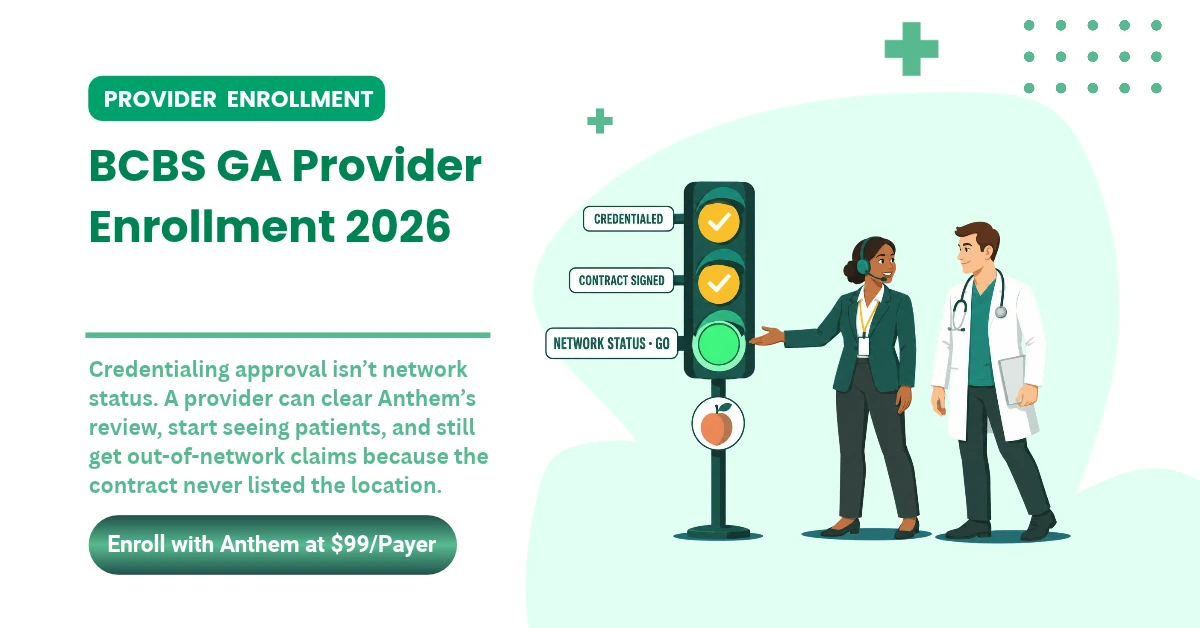
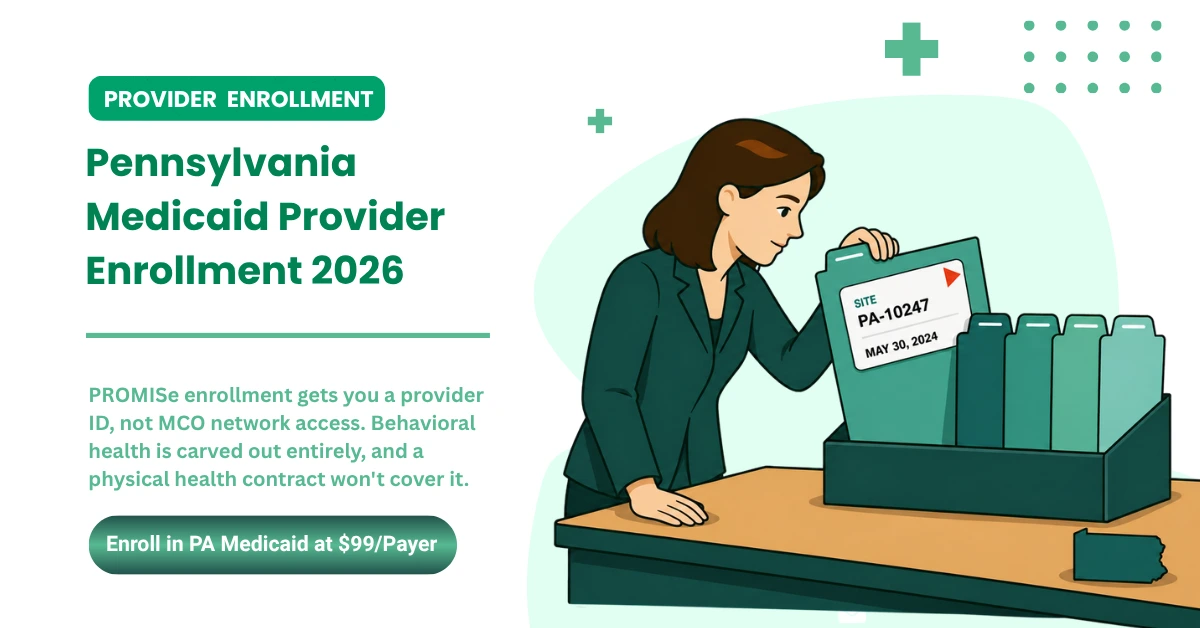
Enrolling with Pennsylvania Medical Assistance does not put a provider in any HealthChoices managed care network. DHS states that state Medicaid enrollment does not guarantee enrollment in individual MCO networks, and some networks may be closed for network adequacy. Providers contract with each managed care organization separately, after state enrollment is confirmed.
That last clause deserves more attention than it gets. A closed panel means the plan can tell you no, and a spotless PROMISe approval doesn’t change the answer.
The Five HealthChoices Zones
Pennsylvania splits into five HealthChoices zones: Southeast, Southwest, Lehigh/Capital, Northeast, and Northwest. You contract with the plans active in the zone where you operate, rather than with every plan in the state.
Telehealth practices hit this harder than anyone. Your license covers Pennsylvania, and your contracts still have to line up with the zones your patients live in.
The Behavioral Health Carve-Out That Costs Practices the Most
Pennsylvania separates behavioral health from physical health, and the separation is absolute. A physical health MCO contract will not cover behavioral health claims.
A therapy practice that panels with a physical health plan and stops there watches every behavioral claim reject. Those services belong to a contract the practice never signed, and the plan is applying its contract as written.
Behavioral health runs through county-designated BH-MCOs. You contract with the BH-MCO managing the county where the member lives, which means a practice drawing patients from four counties may need four separate agreements.
Our behavioral health credentialing services guide covers how carve-out networks work across states, and Pennsylvania sits at the strict end of that range.
Which Managed Care Plans Operate in Pennsylvania
[BEFORE PUBLISHING: verify the current HealthChoices and Community HealthChoices plan roster against pa.gov. Plan participation and zone coverage change by contract year.]
|
Pennsylvania managed care plan |
Parent organization |
Notes |
|---|---|---|
|
Keystone First |
AmeriHealth Caritas |
Southeast zone |
|
AmeriHealth Caritas Pennsylvania |
AmeriHealth Caritas |
Multiple zones |
|
UPMC for You |
UPMC Health Plan |
Strong western and central presence |
|
Geisinger Health Plan Family |
Geisinger |
Central and northeastern presence |
|
Highmark Wholecare |
Highmark Health |
Formerly Gateway Health |
|
UnitedHealthcare Community Plan |
UnitedHealth Group |
Multiple zones |
|
Aetna Better Health of Pennsylvania |
CVS Health |
Multiple zones |
|
Jefferson Health Plans |
Jefferson Health |
Formerly Health Partners Plans |
|
PA Health and Wellness |
Centene |
Community HealthChoices, long-term services and supports |
One naming trap worth flagging. Highmark’s Pennsylvania Medicaid brand is Highmark Wholecare, formerly Gateway Health. Highmark Health Options is the Delaware entity, and published guides mix the two. Contracting with the wrong named entity wastes a full credentialing cycle.
What Happens If You Skip MCO Contracting
State enrollment with no MCO contract leaves you able to bill fee-for-service and nothing else. Most Pennsylvania Medicaid members sit in managed care, so most of your claims land at a plan you have no agreement with.
Running two tracks at once takes coordination, because the state file and the plan applications draw on the same documents at different times and reject for different reasons. MCO contracting and credentialing is what that coordination looks like when one team owns both.
Turning On ERA and EFT After Approval
PA Medicaid ERA and EFT enrollment is a separate step from provider enrollment. Approval gets you a provider ID, and electronic remittance and payment still need enrollment of their own.
ERA enrollment uses your assigned 13-digit Medical Assistance identification number as the Trading Partner ID, and processing runs about four weeks. Multiple service locations can go on one enrollment form.
Line this up with whatever clearinghouse carries your remits, because a PROMISe approval with no ERA feed means posting by hand. Our top medical billing clearinghouses comparison covers which ones handle state Medicaid feeds without trouble.
Revalidation: The Deadline That Closes Service Locations
Every PA Medical Assistance provider must revalidate each service location every 5 years. DHS tells providers to log into PROMISe, check the revalidation date for each service location, and submit the revalidation application at least 60 days prior to the due date. Missing the deadline can close that service location in PROMISe.
Read that first sentence again for the phrase "each service location." The cycle attaches to locations, not to providers. A practice with four sites tracks four revalidation dates, and they won’t fall on the same day.
How Often PA Medicaid Providers Must Revalidate
The cycle runs 5 years across the board. The DHS ACA provider requirements page states the rule and the 60-day submission window, and DHS repeats both in bulletin after bulletin.
You will find published guides claiming high-risk providers revalidate every 3 years in Pennsylvania. No DHS document supports that. Plan against the 5-year cycle DHS publishes, and submit at least 60 days prior either way.
Revalidating Multiple Locations With One Application
DHS allows a group or individual provider to revalidate several service locations through a single application when the provider meets specific criteria, including a limited risk level, an active NPI, no sanctions, and no outstanding payments due.
For a group carrying eight locations, that difference is one submission instead of eight. Check your criteria before you start filing them one at a time.
Groups running locations in several states carry several of these calendars at once, which is where our multi-state Medicaid credentialing guide picks up.
What Happens When You Miss the Deadline
Failure to submit revalidation by the due date can close the service location in PROMISe. Getting it back means filing a Reactivation application and waiting through another processing cycle.
Claims for that location stop paying in the meantime, and the denials you get won’t say "revalidation." They show up as terminated coverage and eligibility problems, so your AR team hunts in the wrong direction. Our PR-27 coverage terminated denials guide covers that pattern.
DHS has posted a portal notice warning that a high volume of revalidation applications is coming and advising providers to review due dates and submit early. Act on that before the queue fills.
Revalidation dates are the easiest thing in credentialing to lose track of, because nothing happens for 5 years and then everything happens at once. If you’re carrying more than a handful of service locations, a tracked calendar beats another reminder email.
What Changed in Pennsylvania for 2026
Three Pennsylvania enrollment changes matter in 2026. DHS began enrolling certified community health workers on April 18, 2026, under Provider Type 13 and Specialty Code 139. DHS paused new hospice enrollments for six months effective May 15, 2026. And since June 27, 2025, nurses with a multistate compact license can enroll without a separate Pennsylvania license.
[BEFORE PUBLISHING: confirm the MA Bulletin PDF citations for the community health worker and hospice changes resolve, and link each one beside its claim.]
Community Health Workers Can Now Enroll
DHS began enrolling certified community health workers effective April 18, 2026. Enrollment maps to Provider Type 13, Non-Traditional Provider, with Specialty Code 139, Certified Community Health Worker. Certification has to come from the Pennsylvania Certification Board.
The billing nuance sits underneath that. Enrollment doesn’t authorize fee-for-service payment, because CHWs aren’t a distinct provider in Pennsylvania’s Medicaid State Plan. This change serves the managed care side.
And a CHW who won’t appear as the rendering provider on a claim submitted to a physical health MCO doesn’t need to enroll at all. The claim role triggers the requirement, so start by asking whose NPI lands in the rendering field.
New Hospice Enrollments Are Paused
DHS imposed a six-month moratorium on MA enrollment of newly enrolling hospices effective May 15, 2026, tied to a nationwide CMS Medicare hospice enrollment moratorium. Hospices still have to hold Medicare certification to enroll in PA Medical Assistance.
If you were planning a Pennsylvania hospice enrollment this year, check the moratorium status with DHS before you assemble anything. Published exceptions and end dates are the two things worth confirming with the department rather than a guide.
Compact Nurse Licenses Now Count in Pennsylvania
Effective June 27, 2025, nurses holding a valid multistate license from a Nurse Licensure Compact participating state can enroll with Pennsylvania Medical Assistance without obtaining a separate Pennsylvania license from the Department of State.
One selection rule inside the application trips people up, and DHS states it on the enrollment portal. Choose the multistate license option only if you live outside Pennsylvania and plan to practice in multiple compact states. If Pennsylvania is your primary state, select the Department of State provider license instead.
Nurse practitioners feel this change more than anyone, and our nurse practitioner credentialing guide covers how compact licensure interacts with payer enrollment across states.
|
2026 Pennsylvania enrollment change |
Effective date |
Who it affects |
|---|---|---|
|
Certified community health worker enrollment opens |
April 18, 2026 |
CHWs billed as rendering providers through PH-MCOs |
|
Six-month moratorium on new hospice enrollments |
May 15, 2026 |
Hospices not already enrolled in PA MA |
|
Nurse Licensure Compact multistate licenses accepted |
June 27, 2025 |
Out-of-state nurses practicing in multiple compact states |
Why Enrollment Problems Show Up as Denials
Pennsylvania Medicaid provider enrollment defects stay invisible until claims start denying. Pennsylvania processes claims on the 13-digit PROMISe ID internally, and when a claim arrives without that ID, DHS and the HealthChoices MCOs match on NPI, taxonomy, and the 9-digit ZIP code to find it. A mismatch on any one of those three stops the claim.
The Crosswalk That Decides Whether Your Claim Pays
DHS explains the mechanism in its DHS NPI crosswalk guidance. The department uses NPI, taxonomy, and the five or nine digit ZIP code to make a one-to-one connection to your existing 13-digit PROMISe provider ID. Claims process on the PROMISe ID internally, then crosswalk back to the NPI on outgoing communication.
The managed care plans do the same thing. PA Health and Wellness verifies enrollment using the 13-digit PROMISe ID carried on the claim, and falls back to NPI, taxonomy, and ZIP+4 when that field is empty.
So three data points decide whether a clean claim finds your enrollment record. A taxonomy code that drifted out of sync with NPPES, a ZIP entered as 5 digits instead of 9, or a service location nobody enrolled all produce the same denial with three different fixes.
Your biller sees one symptom. The correction lives in the enrollment file, which is a system most billing teams never open.
The Gap Between State Approval and MCO Contracting
Bill fee-for-service for a HealthChoices member and the claim comes back CO-24, charges covered under a capitation agreement. Our CO-24 capitation denial code guide walks the resolution path.
Send a behavioral health service to a physical health MCO and it rejects under the carve-out. Let an enrollment lapse mid-cycle and the same dates of service move into terminated coverage territory.
Underneath all three, timely filing keeps running. Every week a claim sits in the gap narrows what you can still recover, and the payers with 90-day windows close first.
Most of these denials are workable when someone identifies the enrollment defect and resubmits against a corrected record, which is the whole point of denial management and appeals rather than writing them off as uncollectible.
What Retroactive Effective Dates Do and Do Not Fix
A retroactive effective date can make dates of service billable that were not billable before. It won’t reset timely filing with every payer, and it won’t reprocess the claims that already denied.
Somebody has to pull those claims, match them against the corrected enrollment record, and resubmit inside whatever window is left. Enrollment approval doesn’t reach backward and fix your accounts receivable on its own.
The pattern looks like this. A practice opens a second office in February and starts seeing patients in March. Nobody enrolls the location. Denials begin in April, scattered across payers, and read like a coding problem for two months. By the time someone matches the address on the aging report against the enrollment summary, four months of claims from that office are unpaid and part of that balance has aged past filing.
If you’re looking at a cluster of denials that trace back to one location or one provider, that is usually an enrollment problem wearing a denial code. Pull the enrollment summary before anyone appeals anything, and work the accounts receivable recovery services side against a corrected record.
MedSole RCM runs full-cycle revenue cycle management at 2.99% of collections, and catching this category of problem before it ages out is part of what that covers.
Handling Enrollment In House Versus Handing It Off
A solo practitioner enrolling one Pennsylvania service location can usually complete Pennsylvania Medicaid provider enrollment without help. Outsourcing tends to pay for itself with multiple service locations, parallel HealthChoices and BH-MCO contracting, or multi-state operations. MedSole RCM handles PA Medicaid provider enrollment and credentialing at $99 per payer, with applications submitted within 48 hours.
When Doing It Yourself Makes Sense
One clinician, one location, limited risk level, no managed care complications. The application is long and the portal walks you through most of it. Set aside an afternoon, assemble the packet first, and you can file it yourself.
Practices in that position don’t need a credentialing vendor, and any company telling them otherwise is selling rather than advising.
When Outsourcing Usually Pays for Itself
Four situations change the math.
- Multiple service locations, because each one is its own application, its own 13-digit ID, and its own revalidation date
- Parallel HealthChoices and BH-MCO contracting, which run on separate timelines with separate document requirements
- Multi-state operations, where revalidation calendars multiply and no two states use the same portal
- Staff turnover, when the person who filed the original application and created its password has left
Our enrollment outsourcing ROI analysis puts the in-house cost of credentialing above $77,000 a year once you count staff hours, repeat submissions, and the revenue delayed while applications sit.
What PA Medicaid Enrollment Support Costs
MedSole RCM charges $99 per payer for provider enrollment and credentialing. Applications go out within 48 hours, you get weekly status updates, and the same rate covers Medicare, Medicaid, and commercial payers across all 50 states.
Set that against the in-house figure above and the arithmetic answers itself for most multi-provider groups. One enrollment that stalls 90 days past its expected approval costs more in delayed collections than a full year of outsourced credentialing.
Full-cycle billing is priced on its own at 2.99% of collections, covering claim submission through denial work and AR recovery. Practices that want PA Medicaid enrollment support on its own can take it without the billing side.
If you’re running enrollments across several locations and the revalidation calendar keeps slipping, that’s the point where handing it off starts paying for itself. We’ll look at what you’re carrying and tell you where outsourcing helps and where it doesn’t. MedSole RCM medical billing company works with practices in all 50 states, and Pennsylvania enrollment is one of the files we run weekly.
Who to Call at PA DHS
Call PA DHS Provider Enrollment at 1-800-537-8862, select option 2, then option 4. Enrollment specialists are available Monday through Friday, 8:00 a.m. to 4:30 p.m. For questions about an enrollment application by email, use RA.PROVAPP@pa.gov. Change of ownership documents go to a separate DHS mailbox.
The option path matters as much as the number. Calling the main line and picking wrong drops you into a queue that can’t see provider enrollment records.
One correction worth making, because search results get it wrong. A 1-844 number belonging to a managed care plan circulates as the PA Medicaid provider enrollment line. That number reaches plan member services. Provider enrollment sits with the Department of Human Services at 1-800-537-8862.
|
What you need |
Where to go |
|---|---|
|
PA Medicaid provider enrollment questions |
1-800-537-8862, option 2, then option 4 |
|
Enrollment application questions by email |
RA.PROVAPP@pa.gov |
|
Change of ownership or control interest |
RA-pwProvCHOW@pa.gov |
|
ERA enrollment status |
RA-835-ERA@PA.gov |
|
Provider Assistance Center |
800-248-2151 |
|
Routing by provider type |
Medical Assistance Desk Reference |
DHS routes some questions by provider type rather than by topic, and the MA Desk Reference carries that routing. Check it before a long hold turns into a transfer.
[BEFORE PUBLISHING: verify every number and mailbox above against the current Medical Assistance Desk Reference.]
Frequently Asked Questions About PA Medicaid Provider Enrollment
How do I enroll as a Medicaid provider in Pennsylvania?
Apply through the DHS online enrollment application at provider.enrollment.dhs.pa.gov. Select your application type, choose the correct provider type and specialty, enter your NPI, taxonomy, tax ID, and license details, complete ownership disclosures for anyone at 5% or greater, enter the service location with ZIP+4, upload the documents the portal requests, and submit from the Summary page. DHS assigns an Application Tracking Number when you start, so record it before closing the browser. Providers already enrolled, or closed less than two years, log into PROMISe first instead of using the unauthenticated links.
What is the phone number for Medicaid PA provider enrollment?
PA DHS Provider Enrollment answers at 1-800-537-8862, option 2, then option 4, Monday through Friday from 8:00 a.m. to 4:30 p.m. Email questions about an application to RA.PROVAPP@pa.gov. A 1-844 number circulates online as the PA Medicaid provider enrollment line, and it belongs to a managed care plan’s member services department rather than to the Department of Human Services. DHS also routes certain questions by provider type through the Medical Assistance Desk Reference.
What is the email address for Pennsylvania Medicaid provider enrollment?
Send enrollment application questions to RA.PROVAPP@pa.gov. Change of ownership and control interest documents go to a different mailbox, RA-pwProvCHOW@pa.gov, and DHS asks that ownership paperwork route there rather than through general enrollment. ERA enrollment status questions go to RA-835-ERA@PA.gov. Using the wrong mailbox adds days, because the receiving team forwards rather than answers.
How can I check my Medicaid provider enrollment status in Pennsylvania?
Check PA Medicaid provider enrollment status at provider.enrollment.dhs.pa.gov. You need four things: the Application Tracking Number assigned when the application started, the FEIN or SSN on the application, the password created for that specific application, and the captcha on the screen. The status page shows one of eight states, from Application Incomplete through Application Approved or Denied. When DHS returns an application, the status reads Application Corrections Required and the comments field lists what is missing and where to fix it.
What documents are needed for PA enrollment?
PA Medicaid enrollment requires an active NPI, a taxonomy code matching your provider type, a current Pennsylvania license, your FEIN or SSN, a signed W-9, the service location address with ZIP+4, ownership disclosures for anyone at 5% or greater, and EFT banking details. Provider type drives the rest. Home health and hospice need Medicare certification, laboratories need CLIA information, and DME suppliers need supplier documentation. DHS no longer requires uploads where a license verifies from the primary source, including DEA, CLIA, and the Pennsylvania Department of State.
What if my PA enrollment is denied?
Read the denial reason on the status screen first, then call PA DHS Provider Enrollment at 1-800-537-8862 to confirm what the department needs. A denial differs from Application Corrections Required, which means DHS wants more information and will accept a resubmission. A denied application usually means filing again from the start. The most common causes are a provider type mismatch, a legal name that disagrees with the W-9 or NPPES record, an expired or unverifiable license, and incomplete ownership disclosure. Fix the underlying data before refiling, because the same application submitted twice returns the same answer.
Do providers need to enroll in PA Medicaid?
Yes, if you bill Pennsylvania Medical Assistance. You also have to enroll if you order, refer, or prescribe for an MA beneficiary, even when you never submit a claim yourself. Federal rule at 42 CFR 455.410 requires states to enroll ordering and referring practitioners as participating providers, and the DHS enrollment portal extends that to providers who serve beneficiaries without billing. Residents fall under the same requirement, because they order services and prescribe medications. When an ordering provider is unenrolled, the claim from the provider who performed the service can deny.
How long does PA Medicaid provider enrollment take?
PA Medicaid provider enrollment typically takes at least 60 to 90 days after DHS receives a complete application. Moderate and high risk provider types run longer, because site visits and fingerprint-based background check results add time nobody controls. Correction requests extend it further, since resubmitting puts the application back in the queue rather than restoring its original position. HealthChoices MCO contracting starts after state approval rather than alongside it, so time to first payment from a managed care member runs longer than the state figure suggests.
Is PROMISe enrollment the same as MCO credentialing?
No. PROMISe enrollment registers you with Pennsylvania Medical Assistance and assigns your 13-digit provider ID. MCO credentialing is a separate application to each HealthChoices managed care plan you want to join. DHS states that state Medicaid enrollment does not guarantee enrollment in individual MCO networks, and some networks close for network adequacy. Plans begin their review after state enrollment is confirmed. Behavioral health adds a third layer, because physical health MCO contracts do not cover behavioral health claims and those services run through county-designated BH-MCOs.
How often do PA Medicaid providers have to revalidate?
Every 5 years, for each service location. DHS instructs providers to log into PROMISe, check the revalidation date on each service location, and submit the revalidation application at least 60 days prior to the due date. The cycle attaches to locations rather than to providers, so a practice with four sites tracks four dates. Missing a due date can close that service location in PROMISe, and reopening it requires a Reactivation application. DHS also allows revalidation of multiple locations through one application when the provider meets criteria including a limited risk level and an active NPI.
How much does PA Medicaid enrollment help cost?
MedSole RCM handles PA Medicaid provider enrollment and credentialing at $99 per payer, with applications submitted within 48 hours and weekly status updates until a decision lands. The same rate covers Medicare, Medicaid, and commercial payers in all 50 states. Handling credentialing in house runs well past $77,000 a year for most groups once you count staff hours, repeat submissions, and revenue delayed while applications sit in a queue. Full-cycle revenue cycle management runs separately at 2.99% of collections, and practices can take enrollment support without the billing side.
Can an out-of-state provider enroll with PA Medicaid?
Yes. Out-of-state practitioners must hold an active license and current registration with the appropriate agency in their home state, and they have to supply documentation showing they participate in that state’s Medicaid program. Nurses add one option here. Since June 27, 2025, a nurse holding a valid multistate license from a Nurse Licensure Compact participating state can enroll with Pennsylvania Medical Assistance without obtaining a separate Pennsylvania license. Select the multistate option only when you live outside Pennsylvania and practice in multiple compact states.
Disclaimer
MedSole RCM is not PA DHS or any Pennsylvania state agency. DHS controls all enrollment decisions and approvals. This guide explains published state and federal requirements and does not constitute legal or compliance advice. Verify current requirements with the Department of Human Services before filing.