



DC medicaid provider enrollment changed twice in 2026, and both changes are still showing up in provider AR.
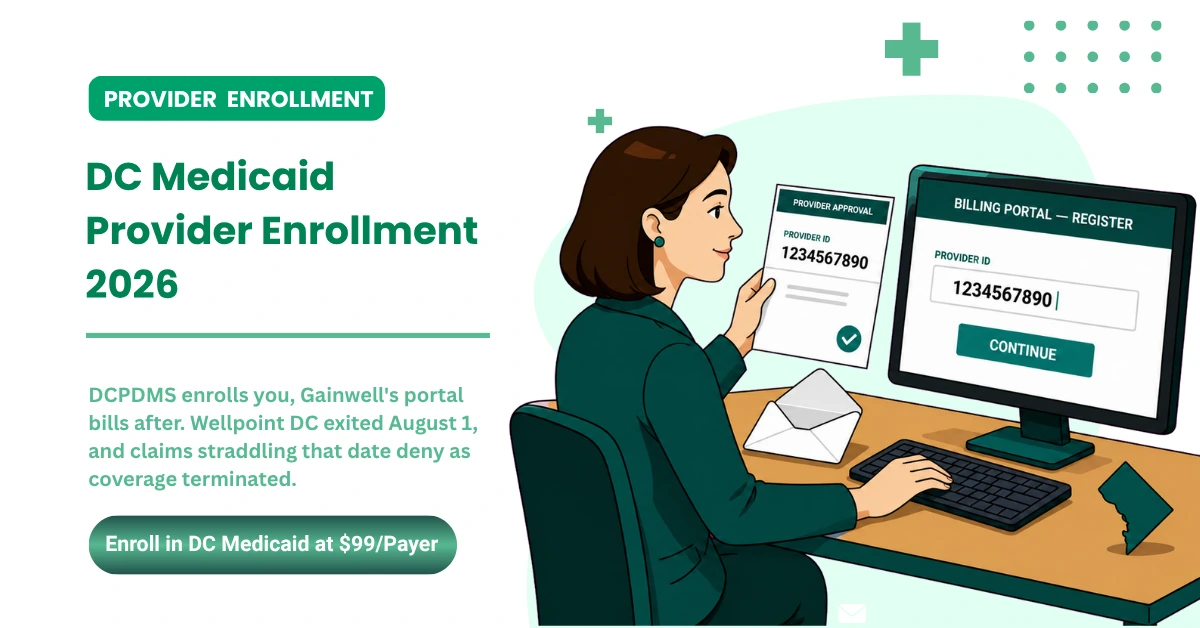
Wellpoint DC left the District's Medicaid managed care program on August 1, 2026. DHCF moved its enrollees to AmeriHealth Caritas DC. Claims that straddle that date come back as coverage terminated, which lands in your system as a PR-27 denial code.
Earlier in the year, on March 1, DHCF switched fiscal agents from Conduent to Gainwell, retired dc-medicaid.com, and moved the claims portal to medicaid.dc.gov.
A bill before the DC Council would go further. If it passes, a single credentialing application would cover every DC Medicaid managed care plan by January 1, 2027.
This guide covers all 13 application types in the DC Provider Data Management System, which phone number handles which problem, the behavioral health certification rule most published guides state backwards, and the managed care roster as it stands today. Washington DC medicaid provider enrollment and district of columbia medicaid provider enrollment describe the same DHCF process.
Every fact below was verified against DHCF, DCPDMS, and DC Council sources on August 10, 2026.
Pick the wrong application type and you start over.
What Changed in DC Medicaid Enrollment in 2026
Seven changes hit DC Medicaid providers between March and August 2026. Two of them moved the systems you log into. One of them removed a managed care plan. The rest changed how prior authorization and eligibility checks work. DHCF published each one separately, so most providers caught some and missed others.
|
Date |
What changed |
What it means for you |
|---|---|---|
|
March 1, 2026 |
DHCF launched a new MMIS. Fiscal agent moved from Conduent to Gainwell. The dc-medicaid.com portal was decommissioned and replaced by medicaid.dc.gov. |
Old bookmarks and old mailing addresses stop working. Conduent physical mailboxes are inactive. |
|
March 1, 2026 |
DHCF refreshed the Long Term Care and EPD waiver enrollment framework, adding a revised financial viability assessment and structured site visits run by Maximus. |
Site visits apply to existing EPD providers, not only to applicants. |
|
March 25, 2026 |
The DC Council held a public hearing on the Streamlining Medicaid Credentialing Amendment Act of 2025. |
Separate credentialing with each managed care plan could end by January 1, 2027. |
|
May 4, 2026 |
Prior authorization for acute care hospital surgical procedures, transplants, medical procedures, and testing moved to the Comagine Health Provider Portal. |
Requests submitted the old way get returned. |
|
May 20, 2026 |
270 EDI transactions began supporting future eligibility dates up to 90 days out. |
You can verify coverage for scheduled visits before the date of service. |
|
August 1, 2026 |
Wellpoint DC exited the DC Medicaid Managed Care Program. DHCF assigned its enrollees to AmeriHealth Caritas DC. |
Claims around the cutover route to the wrong plan and deny. |
|
August 3, 2026 |
Comagine added an auto-approval pathway for eyewear and contact lens prior authorization requests. |
Vision authorizations clear faster through the CHPP. |
Two items on that list cause more damage than the rest. The EPD site visits reach providers who enrolled years ago, so an agency that has billed the District since 2019 can still get a Maximus visit. Nothing in the announcement says otherwise, and nobody sends a warning letter first.
The mailbox change is quieter and more expensive. Paper claims and forms mailed to a Conduent address don't bounce. They sit. By the time you follow up on a claim that never posted, you've burned weeks you can't get back.
What DC Medicaid Provider Enrollment Means
DC medicaid provider enrollment is the process the Department of Health Care Finance uses to register a provider to bill DC Medicaid, or to order and refer for DC Medicaid beneficiaries. District of columbia medicaid provider enrollment describes the identical process. You complete it through the DC Provider Data Management System at dcpdms.com. Until DHCF approves it, your claims and your referrals both deny.
Who administers DC Medicaid
Four organizations run different parts of DC Medicaid, and each one answers a different question. Calling the wrong one costs you a week.
- DHCF is the single state Medicaid agency. It sets policy, screens applications, and makes the enrollment decision.
- Maximus operates DCPDMS, the provider screening and enrollment system at dcpdms.com.
- Gainwell is the fiscal agent. It runs the MMIS and the claims portal at medicaid.dc.gov, a role it took over on March 1, 2026.
- Comagine Health handles utilization management and prior authorization through the Comagine Health Provider Portal.
The split matters because the two portals look interchangeable and aren't. You enroll with Maximus. You bill through Gainwell. DHCF writes the rules both follow, and the DC Medicaid Online Portal carries the current announcements for the claims side.
You are not applying for coverage
District residents apply for Medicaid coverage through District Direct or DC Health Link. Providers enroll through DCPDMS. The two systems share a name and nothing else, and DC Healthy Families is the managed care program those residents enroll into, not a provider pathway. If you landed here looking for coverage, the DHCF beneficiary pages are where you want to be.
One more thing worth settling early. Washington dc medicaid provider enrollment means the District of Columbia under DHCF. It does not mean Washington State, which runs Apple Health through the Health Care Authority and a portal called ProviderOne. If you're enrolling on the west coast, our Washington State Apple Health guide covers that process, and our Medicaid enrollment across 50 states guide maps every other portal.
Which DC Medicaid Phone Number You Need
For dc medicaid provider enrollment, call the District of Columbia Provider Screening and Enrollment Customer Service Center, operated by Maximus, at 1-844-218-9700. That line handles applications, DCPDMS account problems, and application status. Six other numbers serve DC Medicaid, and each one handles something different.
Search results conflate these. A provider with an enrollment question gets routed to the Gainwell EDI help desk, waits on hold, and gets told to call somebody else. This table is the routing map. The dc medicaid provider phone number you need depends on what's broken.
|
What you need |
Who handles it |
Phone |
|
|---|---|---|---|
|
Enrollment applications, DCPDMS account issues, application status |
Maximus (DCPDMS) |
1-844-218-9700 TTY 1-844-436-8333 |
DCMedicaidPDMS@maximus.com |
|
Claims, eligibility, prior authorization status, payment status, portal registration |
Gainwell Provider Inquiry |
202-906-8319 inside DC metro 866-752-9233 outside |
dcproviderinquiry@gainwelltechnologies.com |
|
Electronic claims setup, EDI enrollment, missing PIN letter |
Gainwell EDI Contact Center |
844-366-4237 866-407-2005 |
dcedi@gainwelltechnologies.com |
|
Policy questions, transmittals, general program questions |
DHCF |
202-442-5988 Fax 202-442-4790 TTY 711 |
Listed on dhcf.dc.gov |
|
Behavioral health certification before you apply |
DBH Office of Accountability |
202-673-2292 |
Listed on dbh.dc.gov |
|
EPD waiver, ADHP, and PERS pre-approval |
DHCF Long Term Care |
202-442-9533 |
dhcf.epdproviderenrollment@dc.gov |
|
IDD and IFS waiver pre-approval |
DDS Developmental Disabilities Administration |
202-730-1781 |
letterofintent.potentialproviders@dc.gov |
Enrollment correspondence goes to the Screening and Enrollment Customer Service Center at PO Box 34086, Washington, DC 20043-4086. Claims go to Gainwell at PO Box 33428, Washington, DC 20033. Provider inquiry correspondence goes to Gainwell at PO Box 33458. Sending enrollment paperwork to a claims box is a common way to lose a month.
Gainwell also runs an interactive voice response system called Gabby on the provider inquiry line, available around the clock, which returns eligibility, prior authorization status, and payment status without waiting for an agent. Have your NPI or Medicaid ID, Tax ID, and servicing location address ready before you call.
Every number above was checked against the DCPDMS portal and DHCF sources on August 10, 2026. DC Medicaid contacts changed twice this year, so confirm before you rely on one.
DCPDMS or medicaid.dc.gov: Two Portals, Two Jobs
DC Medicaid runs two provider systems. You enroll at dcpdms.com, operated by Maximus. You bill at medicaid.dc.gov, operated by Gainwell. Enrollment comes first, and the sequence isn't optional: you can't register as a Trading Partner on the Gainwell portal until you're an enrolled DC Medicaid provider.
The dc medicaid provider portal question has two answers depending on what you're trying to do. Each system owns a different half of the relationship, and the dc medicaid portal you need depends on which half you're working on.
|
DCPDMS (dcpdms.com), run by Maximus |
DC Medicaid Online Portal (medicaid.dc.gov), run by Gainwell |
|---|---|
|
Create your provider account |
Verify member eligibility |
|
Select your application type |
Submit and check claims |
|
Upload licenses and disclosures |
Test electronic X12 837 submissions |
|
Respond to requests for information |
Pull remittance advice |
|
Check application status |
Look up prior authorization status |
|
Search enrolled DC Medicaid providers |
Generate your Trading Partner ID |
The trap catches new practices about once a month. A practice manager creates a Gainwell portal account first, because that's the dc medicaid provider portal everyone talks about. Registration asks for a Provider Identification Number from a PIN letter. No letter ever arrives. She calls the EDI help desk, and they can't help, because DHCF only issues the PIN letter after enrollment.
She's stuck in a loop she can't see from inside. The fix is going back to dcpdms.com and enrolling. Once you're through, our clearinghouse payer ID setup guide covers routing your 837 files correctly.
Plan around the maintenance windows too. The Gainwell portal goes down Tuesday evenings from 7 p.m. until roughly midnight EST, and Sunday mornings from midnight to 6 a.m. EST. Friday afternoon submissions and Tuesday night portal work don't mix.
The 13 DCPDMS Application Types and How to Pick Yours
DHCF offers 13 application types in DCPDMS, and picking the wrong one gets your file returned before anyone reviews the substance. Most guides skip this entirely. Some tell you to select the Streamlined application, which is wrong for almost every billing provider: Streamlined exists only for providers who order or refer without billing, plus medical residents.
This is the full list, taken from the DCPDMS portal itself. The dc medicaid provider enrollment application you need depends on how you bill and which administration has to clear you first.
|
Application type |
Who uses it |
Pre-approval needed first |
|---|---|---|
|
Standard |
New or re-enrolling physicians and dentists, non-physician practitioners, groups, facilities, and institutional providers including hospitals, clinics, dialysis centers, and DME suppliers |
None, except certain behavioral health provider types |
|
IDD/IFS Waiver |
Providers of intellectual and developmental disability or individual and family support waiver services |
Pre-approval notice from DDA |
|
EPD-Waiver |
Elderly and Persons with Physical Disabilities waiver providers |
Pre-approval from DHCF Long Term Care |
|
ADHP 1915(i) |
Adult day health program providers under the 1915(i) state plan HCBS benefit |
Pre-approval from DHCF Long Term Care. Primary service address must be in the District |
|
Streamlined |
Providers enrolling solely to order or refer. Medical residents use this type |
None |
|
Crossover/QMB |
Providers rendering services to Qualified Medicare Beneficiaries only. Claims accepted up to 365 days from date of service |
Medicare enrollment |
|
Emergency-OOS |
One-time use by a provider who already rendered reimbursable services. Covers only the dates of service on the submitted claim |
None |
|
PCA Aide |
Personal care assistant aides working through a home health agency or EPD provider |
Agency affiliation |
|
Physician Assistant |
PAs working with a physician, dentist, podiatrist, or group |
Supervising provider on file |
|
MCO Only |
Managed care organization rendering providers |
MCO network participation |
|
PDW |
Participant directed workers under EPD Waiver Services My Way or IFS Waiver My Life My Way |
Program enrollment |
|
PERS |
Durable medical equipment personal emergency response system providers |
Pre-approval from DHCF Long Term Care |
|
DBH Streamlined |
Non-billing individual rendering providers affiliated only with a DBH-related program or facility |
DBH affiliation |
Thirteen options, and four of them need a pre-approval letter you have to request before you can start the application at all. If you'd rather not work out which one fits your practice, our DC Medicaid enrollment specialists file DC Medicaid enrollment at $99 per payer and pick the application type for you.
Standard, Streamlined, and Physician Assistant applications
Standard covers most of the market. A solo physician, a five-provider group, an FQHC, a dialysis center, and a DME supplier all file Standard. So does a dentist. The application asks for your NPI, taxonomy, licensure, addresses, and ownership disclosures, and DHCF screens it against your assigned risk level.
Streamlined is narrower than its name suggests. A cardiologist who orders cardiac imaging for a dual-eligible patient and bills Medicare, never DC Medicaid, uses Streamlined. That same cardiologist, if she also bills DC Medicaid for office visits, needs Standard instead. Ordering and billing are two different relationships with the program.
Physician Assistant is its own track rather than a variant of Standard. A PA working with a physician, dentist, podiatrist, or group files under that type with supervision documentation. New Hampshire runs a similar multi-track system, and our NH Medicaid application types guide walks through how the same logic plays out there.
Waiver and long-term care application types
Four types share one rule: you can't start them in DCPDMS. IDD/IFS Waiver, EPD-Waiver, ADHP 1915(i), and PERS all require a pre-approval notice from the responsible administration before the portal will accept an application.
Providers lose weeks here by working in the wrong order. They open DCPDMS, start the waiver application, get partway through, and discover they needed a letter of intent months earlier. ADHP adds one more constraint: newly enrolling adult day health program providers must have a primary service address inside the District.
Atypical provider and participant-directed application types
PCA Aide, PDW, and PERS serve a population most enrollment guides never mention. Personal care assistant aides working through a home health agency or EPD provider file under PCA Aide. Participant directed workers under EPD Waiver Services My Way or IFS Waiver My Life My Way file under PDW.
Some of these providers are atypical providers, meaning they don't qualify for an NPI because they don't furnish health care under HIPAA's definition. DC Medicaid accommodates them with an Atypical ID in place of an NPI. If you're enrolling home care aides or participant directed workers, ask about Atypical ID before you assume the NPI application failed.
Crossover, MCO Only, and Emergency out-of-state applications
Crossover/QMB limits you to rendering services for Qualified Medicare Beneficiaries. Claims are accepted up to 365 days from the date of service, which is longer than most DC timely filing windows. It's a narrow enrollment and it pairs with Medicare enrollment, not a substitute for it.
Emergency-OOS is a one-time application for a provider who already delivered reimbursable services to a DC Medicaid beneficiary. The enrollment term covers only the dates of service on the submitted claim, with the same 365-day filing window. It's the enrollment equivalent of a single case agreement process, and it won't cover the next patient.
MCO Only carries a trap worth knowing before you file. A provider enrolled as MCO Only who later wants to bill for DC Health Care Alliance beneficiaries has to convert the DCPDMS account to a Standard Medicaid application, and complete an EFT application as part of that conversion. Practices discover this when Alliance claims start denying.
Crossover/QMB also assumes your Medicare side is already in order. Our Medicare enrollment through PECOS guide covers that sequence, including the CY 2026 application fee that applies to institutional providers in both programs.
Creating Your DCPDMS Account: The Tax ID Cannot Be Changed
The Tax ID you enter when you create a DCPDMS account is permanent. DCPDMS states this during account setup, and it means what it says: no correction request, no phone call, no support ticket changes it afterward. Individual providers enter an SSN as the primary tax identifier. Groups, institutions, and facilities enter an EIN.
Fixing a mistake means abandoning the account and building a new one from scratch.
A solo practitioner opens the account under her practice EIN, because that's what feels correct for a business. She uploads her license, her disclosures, her W-9. Three weeks later the application won't attach to an individual enrollment record, and Maximus tells her the Tax ID is locked. She starts again, and the second application enters the queue behind everything filed since.
Before you touch the portal, line up the data that has to match. Your legal name, service address, and tax identification number need to agree across NPPES, your DCPDMS profile, and your ownership disclosure form. A mismatch on any one of those sends the file back.
Two formatting rules catch people on the disclosure form. P.O. Boxes are not acceptable as practice locations, and every practice location has to be listed, not only the primary one. If your CAQH ProView setup already carries a clean address history, pull the data from there rather than retyping it.
Check the Tax ID twice before you go further.
Documents Required for DC Medicaid Provider Enrollment
Every DCPDMS application type asks for the same core set: an NPI or Atypical ID, a Tax ID or SSN, an active District professional license, a taxonomy code, service and pay-to addresses, ownership and managing control disclosures, and a signed DC Medicaid Provider Agreement. Provider type determines what gets added on top.
Individual providers
Individual dc medicaid provider enrollment requirements start with an NPI Type 1 whose taxonomy matches your District license specialty. A mismatch there triggers a manual specialty review and adds weeks.
- Active, unrestricted District of Columbia professional license
- DEA certificate if you prescribe controlled substances
- Current malpractice coverage with no gaps in the coverage history
- CV with month and year work history
- Government-issued photo identification
- Completed Disclosure of Ownership and Control Interest Statement
Advanced practice providers carry an extra layer. Collaboration or supervision documentation varies by discipline, and our nurse practitioner credentialing guide covers what payers ask for beyond the license itself.
Groups, facilities, and organizations
Organizational applications add entity-level documentation on top of the individual files for every rendering provider on the roster.
- NPI Type 2 for the organization
- IRS EIN documentation matching the W-9 exactly, character for character
- Active District of Columbia business license
- Entity-level malpractice or general liability coverage
- Articles of incorporation, partnership agreement, or LLC operating agreement
- Provider roster listing individual NPIs, taxonomies, and license information
- CLIA certificate if you perform in-house testing
The disclosure form is where DHCF returns the most organizational files. Direct or indirect ownership interest must be reported at 5 percent or more. You submit the form at initial enrollment, at revalidation, at re-enrollment, whenever ownership changes, and any time DHCF asks. Federal screening rules under 42 CFR 455.410 sit behind all of it.
Institutional providers may owe the CY 2026 federal application fee. The part almost nobody publishes is that the DCPDMS application lets you request a waiver on three grounds: financial hardship, the fee was already paid to Medicare, or the fee was already paid to another state's Medicaid program. Check before you pay it twice.
Behavioral Health Providers: When DBH Certification Is Required
Certain behavioral health provider types must obtain certification from the DC Department of Behavioral Health before submitting a DC Medicaid application through DCPDMS. Other behavioral health providers do not. The DCPDMS portal draws the line by provider type, not by whether you treat mental health or substance use conditions.
Several published guides state this backwards and tell licensed clinicians they need DBH certification. They don't. Here's the split as DCPDMS states it.
|
DBH certification required before you apply |
DBH certification not required |
|---|---|
|
Free Standing Mental Health Clinics (FSMHC) |
Licensed independent social workers (LISW) |
|
Mental Health Rehabilitation Services (MHRS) providers |
Licensed professional counselors (LPC) |
|
Recovery Support Services (RSS) providers |
Psychologists |
|
Psychosocial Rehabilitation, known as Clubhouse programs |
Licensed marriage and family therapists (LMFT) |
|
Similar behavioral health service organizations |
Similar individual and group practitioners |
The DCPDMS portal states that individual and group mental health and substance abuse providers in the second column enroll through the Standard application without DBH involvement. Organizations in the first column reach the DBH Office of Accountability at 202-673-2292 before they open a DCPDMS application.
Getting this backwards costs real time in both directions. An LPC who chases a certification she never needed loses months waiting on a process that doesn't apply to her. A clinic that skips certification and files in DCPDMS gets the application returned, and the second submission starts at the back of the queue.
DBH Streamlined is a separate type for non-billing individual rendering providers affiliated only with a DBH-related program or facility. Our behavioral health credentialing guide covers the multi-layer structure across payers, and ABA credentialing requirements covers behavior analysts specifically.
Waiver and Long-Term Care Enrollment in the District
Waiver and long-term care providers can't start in DCPDMS. Each track requires a pre-approval notice from the responsible administration first, and DHCF refreshed the long-term care framework on March 1, 2026. District of columbia medicaid provider enrollment for waiver services runs on a different clock than every other track in this guide.
IDD and IFS waiver providers
The Department on Disability Services and its Developmental Disabilities Administration run a three-step review with DHCF before any waiver provider bills a dollar.
- Send a letter of interest to letterofintent.potentialproviders@dc.gov and attend the mandatory Prospective Providers Meeting. DDA reviews your package for completeness. If documentation is missing, you get a letter requesting it within three business days. Miss that window and DDA denies the application, and you cannot resubmit for one year.
- Sit for a face-to-face interview with owners and key personnel, scheduled within 10 business days. A review panel scores your knowledge of DDA policy, procedure, and best practice in the intellectual and developmental disability field. You need a minimum score in the 70th percentile to pass. Failure carries the same one-year resubmission bar.
- DHCF conducts final review within 30 days of receiving the recommendation from DDA, then issues an approval or denial letter.
The application package has formatting requirements that cause returns on their own. DDA asks for a three-ring binder with sections labeled in checklist order, signatures in blue ink, no staples anywhere in the package, and no blank fields. Enter N/A rather than leaving a line empty.
Anticipated processing time for step one alone runs about 15 business days. Out-of-state waiver applicants add a District of Columbia Certificate of Authority and registered agent information to the package.
EPD waiver and adult day health providers
DHCF rebuilt this framework effective March 1, 2026. The refresh brought updated enrollment policy and procedures, a revised financial viability assessment, and a structured pre-enrollment and post-enrollment site visit process run by Maximus. DHCF applies the site visits to prospective and existing EPD providers alike, which is the part current enrollees keep missing. The DHCF long-term care enrollment page carries the current sequence.
The Long Term Care Administration works from an expression of interest, then a mandatory provider enrollment information session, then a DCPDMS application inside the stated window. LTCA responds to a complete expression of interest within 10 business days with next steps and checklists.
One procedural rule ends more applications than any documentation gap. DHCF begins formal review only after a complete packet arrives through DCPDMS. Informal inquiries by email or phone don't start the clock and don't count as submission.
Waiver enrollment has more failure points than any other track in the District, and a denial locks you out for a year. If you're going through it, it's worth having someone who has done it before assemble the package. Our team handles payer enrollment and credentialing for waiver and LTSS agencies at $99 per payer, including the pre-approval correspondence.
What Happens After You Submit Your Application
After submission, DHCF and Maximus screen your application against the federal risk level assigned to your provider type. Screening can include database checks, a fingerprint-based criminal background check, and a site visit. Applications move through defined review stages, and a file can be sent back to any earlier stage at any point.
DCPDMS tracks files through named review stages. Knowing them tells you what's happening when your status changes.
- Screening: license verification and exclusion database checks
- Provider review: substantive review of the application content
- Site visit: an announced or unannounced visit to your service location
- Fingerprint-based criminal background check, referred to in the system as FCBC
- DHCF review for FCBC: DHCF adjudicating the background check result
Risk level drives how much of that applies to you. Limited risk means licensure verification and exclusion database checks. Moderate risk adds a site visit. High risk adds fingerprint-based criminal background checks for owners and managing employees, which is why high-risk applications take longer no matter how clean the paperwork is.
When a file stalls, three habits move it. Respond to any request for information inside the stated window, because the review clock effectively stops while DHCF waits on you. Send a complete submission rather than an informal email. Check status in DCPDMS instead of waiting for mail, since correspondence addresses went stale when the Conduent mailboxes closed.
Once DHCF approves you, confirm the enrollment is live rather than assuming it. The DC Medicaid provider search on DCPDMS lists actively enrolled District providers by provider type, and it's the fastest dc medicaid provider lookup available. Check yourself there before you release a single claim.
How Long DC Medicaid Provider Enrollment Takes
DC medicaid provider enrollment timelines vary by application type and risk level. A clean Standard application moves faster than any waiver track. Managed care credentialing runs separately and starts only after DHCF approves you. Anyone quoting a single number for the whole process is guessing.
Beneficiary coverage applications take up to 45 days, or 60 for a disabled applicant. That figure dominates search results for provider timeline questions, and it has nothing to do with provider enrollment. The provider side runs through six stages instead.
|
Stage |
What's happening |
What drives the timeline |
|---|---|---|
|
Document preparation and DCPDMS account setup |
Gathering NPI, license, disclosures, W-9, and the EFT application |
How current your credentialing file already is |
|
Initial review by DHCF and Maximus |
Completeness check before substantive review begins |
Whether the packet arrived complete |
|
Screening |
License verification, exclusion database checks, and any site visit or fingerprint-based background check |
Your assigned federal risk level |
|
Requests for additional information |
DHCF asking for what's missing |
Provider response speed. The clock effectively stops here |
|
Waiver pre-approval, where applicable |
Letter of intent, information session, interview, and administration review |
DDA and LTCA scheduling |
|
Managed care credentialing |
Plan-level review after DHCF approval |
MedStar Family Choice DC states its process completes within 120 days of receiving a complete application |
One variable outweighs the rest, and it isn't the DHCF queue. It's how fast you answer a request for information. Files sit for weeks because the request landed in a portal nobody checks and a mailbox nobody monitors. Our cost of enrollment delays analysis breaks down what those idle weeks cost a practice in unbillable revenue.
Sequence matters as much as speed in dc medicaid provider enrollment. DHCF enrollment gates the plans. You cannot start managed care credentialing until you hold an active DC Medicaid provider number, so a practice that waits for plan approval before filing with DHCF has the order backwards and loses the whole DHCF timeline on top of the plan timeline.
DC Medicaid MCOs in 2026 and the Wellpoint Transition
Wellpoint DC, formerly Amerigroup DC, exited the District of Columbia Medicaid Managed Care Program effective August 1, 2026. DHCF automatically assigned its enrollees to AmeriHealth Caritas DC. That leaves two managed care plans serving the general DC Healthy Families population, plus one specialty plan.
|
Plan |
Population served |
Status as of August 10, 2026 |
|---|---|---|
|
AmeriHealth Caritas DC |
DC Healthy Families Program, Alliance, and Immigrant Children's Program |
Active. Receiving the former Wellpoint DC membership |
|
MedStar Family Choice DC |
DC Healthy Families Program, Alliance, and Immigrant Children's Program |
Active |
|
Health Services for Children with Special Needs (HSCSN) |
Child and Adolescent Supplemental Security Income Program (CASSIP) |
Active under a separate contract |
|
Wellpoint DC (formerly Amerigroup DC) |
Formerly DC Healthy Families Program |
Exited August 1, 2026 |
Worth noting for anyone cross-checking: the DHCF managed care plans page still listed Wellpoint DC among the contracted plans when this guide was verified on August 10, 2026, because that page reflects the April 2023 contract rather than the August transition. Confirm with DHCF before you build a contracting plan around any published roster, including this one.
What the Wellpoint exit means for your claims
Five dates govern the transition, and billing teams need all five.
- Wellpoint remains responsible for reimbursement of covered services rendered through July 31, 2026 at 11:59 p.m., including inpatient admissions extending past that date.
- Active referrals and prior authorizations issued before August 1, 2026 stay valid through October 31, 2026, whether or not you're contracted with the receiving plan.
- Ongoing authorized treatment must be honored for up to 60 days or through the end of the transition period.
- Prescriptions continue through October 31, 2026, or until they transfer to an in-network provider.
- Enrollees have until January 31, 2027 to switch to MedStar Family Choice DC if they don't want to stay with AmeriHealth.
One operational note that saves patients a wasted visit: specialty providers are expected and authorized to initiate their own referrals for additional tests and procedures during the transition. Don't send the patient back to the PCP for a referral the initial referral already covers.
The revenue risk lives in the payer field. Claims for services around the cutover route to Wellpoint, come back as coverage terminated, and sit in AR until somebody notices the plan changed underneath the patient. Capitation-related CO-24 capitation denials show up in the same window when the managed care assignment and the billed payer disagree.
Plan transitions are where clean claims go missing. If your DC Medicaid AR has aged past 60 days since the cutover, that's a payer routing problem rather than a coding problem, and it's recoverable. Our accounts receivable follow-up team works those buckets by payer and aging rather than by claim age alone.
Credentialing with the remaining plans
DHCF enrollment comes first, then plan contracting. Being enrolled with DC Medicaid isn't the same as being in a plan's network, and being in a plan's network doesn't substitute for DC Medicaid enrollment. Providers get caught on both halves of that sentence.
MedStar Family Choice DC won't begin credentialing until you hold an active DC Medicaid provider number. Filing plan applications in parallel with your DHCF application feels efficient and stalls anyway. File with DHCF, get your provider number, then move to the plans.
Ordering, Referring, and Prescribing Enrollment in DC Medicaid
Claims denied for an unenrolled ordering provider get fixed by enrolling that provider, not by appealing. Federal regulation requires state Medicaid agencies to enroll ordering and referring professionals, and DHCF denies claims based on orders or referrals from providers who aren't enrolled. The fix runs through the Streamlined application type in DCPDMS.
The rule reaches providers who never intended to touch DC Medicaid. A cardiologist ordering imaging for a dual-eligible patient and billing Medicare. A VA or military-system physician referring a patient into the community. A resident writing orders. A specialist ordering DME. None of them bill DC Medicaid, and all of them can trigger a denial on somebody else's claim.
DHCF published four conditions for the streamlined pathway in its streamlined ORP enrollment notice.
- Be currently licensed under District law to order or refer the medical services in question.
- Be employed by the Department of Veterans Affairs, the Public Health Service, the Department of Defense or TRICARE, the Indian Health Service, a Tribal Organization, a Medicaid-enrolled FQHC, or a similar organization that serves Medicaid beneficiaries without submitting claims. Interns, residents, and fellows in approved residency programs also qualify.
- Submit no claims to Medicaid for payment of any service.
- Complete and submit the enrollment form including your NPI.
Organizations that aren't enrolled Medicaid providers can file on behalf of their ordering and referring physicians by supplying the organization's NPI.
When denials start referencing an unenrolled referring or ordering provider, verify the NPI against the DHCF ordering, referring, and prescribing provider validation tool before you build an appeal. The tool accepts an NPI alone with no additional criteria. Missing-information denials of this type often surface as CO-16 denial code fixes in your worklist, which sends teams down an appeals path that can't resolve the underlying problem.
Appealing an enrollment gap wastes the appeal. Our denial management services team works root cause first, because a denial that traces back to an unenrolled ordering physician keeps recurring until somebody enrolls him.
The managed care rule sits on top of all of it. Under the 21st Century Cures Act, providers must be enrolled with DC Medicaid to participate in a managed care network, and that requirement reaches ordering, referring, and prescribing provider types. DHCF has stated that payments to unenrolled network providers past the applicable deadline are treated as overpayments.
Out-of-State and DMV Providers Enrolling in DC Medicaid
DHCF has stated there is no blanket exemption for out-of-state providers. Provider types delivering services to DC Medicaid beneficiaries are required to enroll. Limited exceptions exist for payment of specific claims, and they don't replace enrollment for anyone treating District residents on a regular basis.
The District covers 68 square miles. Practices in Bethesda, Silver Spring, Arlington, and Alexandria see District residents every week, which makes washington dc medicaid provider enrollment a routine requirement across the DMV rather than an edge case.
DHCF points to the CMS Medicaid Provider Enrollment Compendium for the narrow exceptions. All of these conditions have to hold together.
- The service is covered under the DC state plan
- The provider location is out of state
- The NPI appears on the claim
- The provider is enrolled or approved in Medicare or in another state's Medicaid program
- The situation falls within a single instance, or multiple instances for one participant, over a 180-day period
Three situations account for most out-of-state questions, and they resolve differently.
A Maryland or Virginia practice with a standing District patient panel needs full DC Medicaid enrollment. The exception framework doesn't cover an ongoing patient panel. A practice that treated one DC Medicaid patient once uses the Emergency-OOS application, which covers only the dates of service on the submitted claim, with claims accepted up to 365 days from the date of service.
A telehealth practice treating District residents needs appropriate District licensure, because the patient's location governs which license applies. Our telemedicine credentialing rules guide covers how multi-state licensure and payer enrollment interact across jurisdictions.
Out-of-state waiver applicants carry an added requirement. DDA asks for a District of Columbia Certificate of Authority, obtained through the District's business regulator, plus registered agent name and contact information inside the District.
A DMV practice is running three separate Medicaid enrollments across three portals with three different vendors and three different timelines. Virginia runs through DMAS and PRSS, and our Virginia Medicaid enrollment guide covers that side. Maryland runs its own system again.
Running DC, Maryland, and Virginia enrollments at once is where most practices lose track of a payer. We file all three in parallel at $99 per payer, so your start dates don't stagger across the DMV.
EFT, Trading Partner Setup, and Getting Your First Claim Paid
All new and re-enrolling DC Medicaid providers must complete and submit an EFT application. DCPDMS states this as a mandatory step, not a recommendation. Individual providers who bill under an affiliated group may submit a waiver document to opt out. Skipping EFT delays payment even after DHCF approves your enrollment.
Approval is the halfway point. Six steps sit between an approved application and a paid claim.
- Confirm your effective date and your DC Medicaid provider number.
- Submit the EFT application in DCPDMS if you haven't already.
- Watch for the Provider Identification Number letter, which you need to register on the Gainwell portal.
- Register at medicaid.dc.gov and establish your user IDs.
- Generate a Trading Partner ID and test electronic X12 837 claim submission.
- Configure the correct payer ID in your billing software or clearinghouse.
Four operational rules cause most first-cycle payment failures, and none of them appear in the enrollment paperwork.
- Electronic claims must transmit by 3:00 p.m. EST on Fridays to make the weekly payment cycle.
- Span billing isn't supported for codes limited to one unit per date of service. Bill each date on a separate line.
- Conduent physical mailboxes are inactive, so paper sent to an old address causes significant delays.
- If your portal registration confirmation email doesn't arrive, call the Gainwell Contact Center rather than resubmitting the registration.
The Friday cutoff catches practices that batch on Friday afternoon. A file transmitted at 4:00 p.m. waits a full week for the next cycle, and that lag compounds across every claim in the batch. Our unpaid claim follow-up process builds payer-specific cycle timing into the AR calendar for exactly this reason.
One enhancement worth using now that it exists: since May 20, 2026, 270 EDI transactions support future eligibility dates up to 90 days out. You can verify coverage for scheduled appointments well before the visit, which shortens the runway on authorization work. Our prior authorization support team uses that window to submit before the eligibility question becomes urgent.
The DC Medicaid Fee Schedule and Where to Find It
DHCF publishes an interactive Fee Schedule Search tool on the DC Medicaid portal. You look up rates by procedure code, date of service, rate indicator, and provider specialty. Rate changes arrive through numbered transmittals posted on the DHCF Rates and Reimbursements page rather than through portal announcements.
The dc medicaid fee schedule isn't one document. Understanding how it splits saves a lot of searching.
- Professional services bill on the CMS-1500 form and cover physician services, laboratory, DME, and physician-administered drugs.
- Standard physician and professional services have historically been benchmarked to a percentage of federal Medicare rates and adjusted through policy transmittals.
- Separate adjunct schedules exist for dental codes, anesthesia conversion factors, ambulatory surgical centers, and institutional providers.
The district of columbia medicaid fee schedule carries one caveat that costs practices money when they miss it. Managed care plans aren't obligated to use the fee-for-service schedule DHCF publishes, though at least one District plan has chosen to align with it. Verify rates against your plan contract instead of assuming the fee-for-service schedule applies to managed care volume.
Two current items are worth pulling. Transmittal 26-10, dated March 31, 2026, covered pricing updates to the Medicaid fee-for-service professional fee schedule. Separately, DHCF updated the Dental Billing Manual with new CDT codes effective January 1, 2026, which matters for any practice billing dc medicaid dental. Our dental credentialing services team tracks CDT updates alongside enrollment.
Washington dc medicaid fee schedule searches also surface Medicare rate tables, since the two are benchmarked. Confirm you're reading the DHCF transmittal rather than a Medicare fee file before you load rates into your billing system.
Revalidation and Staying Enrolled in DC Medicaid
Federal regulation requires state Medicaid agencies to revalidate every enrolled provider at least once every five years. DHCF can also request revalidation sooner. Missing a revalidation deadline suspends payment and denies claims while your enrollment record sits inactive, and nothing about the practice looks wrong until the money stops.
Staying enrolled means maintaining seven things, not one.
- Revalidate on the DHCF cycle and respond to any revalidation request when it arrives.
- Report ownership changes and material changes to the disclosure information.
- Maintain active District licensure, since an expired license fails primary source verification.
- Maintain continuous malpractice coverage, because gaps create denials for services rendered during the gap.
- Screen against the OIG List of Excluded Individuals and Entities. The DC Medicaid Provider Agreement obligates enrolled providers to conduct quarterly comparisons of employees against exclusion databases.
- Keep records for the period the provider agreement requires.
- Confirm your enrollment shows as active using the DCPDMS public provider search.
The quarterly exclusion screening obligation surprises people. It sits in the provider agreement you signed at enrollment, and DHCF can ask for evidence of it. Most practices that get caught weren't ignoring the rule. They never read that page.
Revalidation notices are easy to miss when the mailing address on file is stale, and the Conduent mailbox closure made that worse across the District. Confirm the correspondence address in DCPDMS is current, then check the Medicaid credentialing management calendar for every other payer while you're in there.
Revalidation is the quietest way to lose billing privileges. We track revalidation dates for every payer we enroll, so the deadline isn't sitting in an inbox nobody opens.
What Changes in DC Medicaid Credentialing in 2027 and 2028
The Streamlining Medicaid Credentialing Amendment Act
The Streamlining Medicaid Credentialing Amendment Act of 2025, introduced as B26-0523, would require DHCF to implement a single consolidated credentialing application for all DC Medicaid managed care organizations by January 1, 2027. Councilmember Christina Henderson introduced it on December 1, 2025, and the Council held a public hearing on March 25, 2026. The bill has not passed.
If the Council enacts it, five things change for District providers.
- A provider credentialed by DHCF would be deemed credentialed with all managed care organizations, and an MCO could not require separate credentialing as a condition of reimbursement.
- DHCF would return incomplete applications within 10 days and identify exactly what's missing.
- DHCF would issue a temporary credential within 30 days of a complete application from a provider holding a valid District license, effective on issuance, unless the provider reported malpractice claims, a criminal record, or licensing board or federal program discipline.
- Recredentialing would no longer be required when a provider's tax ID changes, an employer's tax ID changes, or the provider changes employers, as long as the new employer participates on an MCO panel.
- Managed care plans would upload provider information to all billing platforms within seven business days of DHCF issuing temporary credentials.
The supporting rationale points to Ohio and Maryland, where consolidated credentialing already operates. Until the Council acts, plan for the current process and watch the bill.
Federal changes under the One Big Beautiful Bill Act
Congress passed the One Big Beautiful Bill Act on July 4, 2025, and two provisions land on provider enrollment. Beginning January 1, 2028, states must screen enrolled providers monthly against terminations from Medicare, other state Medicaid programs, and CHIP. States must also conduct quarterly Death Master File reviews of enrolled providers.
Monthly screening changes the maintenance burden more than it changes enrollment. A provider terminated elsewhere gets caught faster, which raises the stakes on keeping your own record clean and your exclusion screening current.
On the beneficiary side, six-month eligibility redeterminations and reduced retroactive coverage both push more verification work to the front desk. Practices that verify eligibility once at intake will find that isn't enough once redetermination cycles tighten.
Handling DC Medicaid Enrollment In-House or Outsourcing It
A single-provider Standard application in DCPDMS is manageable in-house if somebody owns it and checks the portal daily. A waiver track, a multi-provider group, or a DMV practice running three state enrollments at once is where in-house handling stops working. The variable isn't difficulty. It's whether anyone has time to watch the file.
|
Situation |
Workable in-house |
Worth bringing in help |
|---|---|---|
|
Solo provider, Standard application |
Yes, if someone checks DCPDMS weekly |
Only if the practice has no admin capacity |
|
Group practice with a rendering roster |
Possible, but roster linkage errors are common |
Yes, once the roster passes three providers |
|
Behavioral health organization needing DBH certification |
Rarely |
Yes. Two agencies, two sequences, one wrong order costs months |
|
Waiver or LTSS provider |
No |
Yes. A denial bars resubmission for one year |
|
Out-of-state or DMV multi-state |
No |
Yes. Three portals, three vendors, three timelines |
|
Application already returned or stalled |
Sometimes |
Yes. Returned files need diagnosis before resubmission |
In-house handling isn't free. It's staff hours plus the revenue that doesn't exist while a credentialed clinician sits unenrolled. Every week a physician sees District patients she can't bill for is a week of delivered care the practice writes off.
MedSole RCM handles provider enrollment and credentialing at $99 per payer, with applications submitted within 48 hours of receiving a complete file. Full revenue cycle management runs at 2.99% of collections. Standalone accounts receivable follow-up runs at 4.49% of recovered revenue.
- No setup fees, no long-term contracts, and no percentage-of-revenue credentialing model.
- Enrollment handled across all 50 states and the District of Columbia.
- More than 4,000 providers credentialed to date.
- A dedicated credentialing specialist per practice rather than a shared ticket queue.
Typical market pricing for payer enrollment runs between $150 and $300 per payer. At $99 per payer, MedSole RCM is the most affordable structured credentialing rate in the United States market, and 2.99% of collections sits below the common 4% to 8% range for full-service medical billing.
For DC specifically, that covers application type selection, DCPDMS account setup with Tax ID verification, document assembly, DBH coordination where the provider type requires it, submission and status monitoring, responses to requests for information, EFT setup, managed care credentialing after DHCF approval, and revalidation tracking. Practices that want the billing side handled too can pair it with full revenue cycle management at 2.99%.
If you're comparing options, our guide on choosing a credentialing partner covers the questions worth asking any vendor, including ours. When you're ready, our credentialing services at $99 per payer page has the full scope and the intake form.
DC Medicaid Provider Enrollment FAQs
What is the phone number for DC Medicaid provider enrollment?
Call the District of Columbia Provider Screening and Enrollment Customer Service Center, operated by Maximus, at 1-844-218-9700. The TTY line is 1-844-436-8333 and the email is DCMedicaidPDMS@maximus.com. That team handles applications, DCPDMS account problems, and application status.
Claims and portal registration go to Gainwell Provider Inquiry at 866-752-9233, and EDI setup goes to 844-366-4237. Those are different departments, and calling the wrong one is the most common reason providers report getting nowhere.
How do I enroll as a DC Medicaid provider?
Complete dc medicaid provider enrollment by creating an account at dcpdms.com, selecting the correct application type from the 13 DHCF offers, upload your NPI, District license, taxonomy, addresses, and ownership disclosures, sign the DC Medicaid Provider Agreement, and submit the EFT application. DHCF and Maximus then screen the file against your federal risk level.
Waiver and long-term care providers add a step in front: those tracks require a pre-approval notice from DDA or DHCF Long Term Care before DCPDMS will accept an application.
What is the DC Medicaid provider portal?
DC Medicaid runs two systems, and the dc medicaid provider portal you need depends on the task. DCPDMS at dcpdms.com, operated by Maximus, handles enrollment. The DC Medicaid Online Portal at medicaid.dc.gov, operated by Gainwell, handles claims, eligibility, and remittance. You enroll in the first, then bill through the second.
You cannot register as a Trading Partner on the Gainwell portal until DHCF has enrolled you, because the Provider Identification Number letter you need for registration only issues after enrollment.
How long does DC Medicaid provider enrollment take?
Timelines depend on application type and federal risk level. A clean Standard application at limited risk moves faster than a moderate-risk application requiring a site visit, and both move faster than a waiver track with a mandatory interview and pre-approval sequence.
Managed care credentialing runs after DHCF approval, not alongside it. MedStar Family Choice DC states its credentialing process completes within 120 days of receiving a complete application.
Do I need to enroll with DHCF if I only contract with a managed care plan?
Yes. Under the 21st Century Cures Act, providers must be enrolled with DC Medicaid to participate in a managed care network. Network participation doesn't substitute for enrollment, and DHCF has stated that payments to unenrolled network providers past the applicable deadline are treated as overpayments.
The requirement reaches ordering, referring, and prescribing provider types, not only providers who submit claims.
Do ordering and referring providers need to enroll in DC Medicaid?
Yes. Federal regulation requires state Medicaid agencies to enroll ordering and referring professionals, and DHCF denies claims based on orders or referrals from providers who aren't enrolled. Providers who order or refer without billing use the Streamlined application type in DCPDMS.
Interns, residents, and fellows in approved residency programs use the same pathway. Organizations that aren't enrolled providers can submit on behalf of their ordering physicians using the organization's NPI.
Can out-of-state providers enroll in DC Medicaid?
Yes, and DHCF has stated there is no blanket exemption for out-of-state providers. Provider types delivering services to DC Medicaid beneficiaries are required to enroll. Limited claim-payment exceptions exist through the CMS Medicaid Provider Enrollment Compendium, bounded to single instances or multiple instances for one participant over a 180-day period.
A Maryland or Virginia practice with an ongoing District patient panel needs full enrollment. A practice that treated one DC Medicaid patient once uses the Emergency-OOS application.
Is there an application fee for DC Medicaid provider enrollment?
Institutional providers may owe the federal enrollment application fee for calendar year 2026. Individual practitioners are not institutional providers in most cases, so the fee often doesn't apply to them.
The DCPDMS application lets you request a waiver on three grounds: financial hardship, the fee was already paid to Medicare, or the fee was already paid to another state's Medicaid program. Check the waiver options before paying, above all if you enrolled in Medicare this year.
Where do I find the DC Medicaid fee schedule?
DHCF publishes an interactive Fee Schedule Search tool on the DC Medicaid portal at medicaid.dc.gov, searchable by procedure code, date of service, rate indicator, and provider specialty. Rate changes post as numbered transmittals on the DHCF Rates and Reimbursements page.
Managed care plans aren't obligated to use the fee-for-service schedule, so verify rates against your plan contract for managed care volume.
How do I check if a provider is enrolled in DC Medicaid?
Use the public provider search on DCPDMS at dcpdms.com. It lists actively enrolled District providers and lets you filter by provider type, covering everything from acupuncturist to assisted living facility to adult hospice.
Run that dc medicaid provider lookup before releasing claims for a newly approved provider, and again before you rely on a referring provider's enrollment status.
How often do I have to revalidate my DC Medicaid enrollment?
Federal regulation requires revalidation at least once every five years. DHCF may also request revalidation sooner at its discretion, so the five-year cycle is a floor rather than a schedule you can set and forget.
Missing the deadline suspends payment and denies claims while the record sits inactive. Confirm your correspondence address in DCPDMS is current, since notices go to the address on file.
Is DC Medicaid the same as Washington State Medicaid?
No. Washington dc medicaid provider enrollment serves the District of Columbia and runs through the Department of Health Care Finance and DCPDMS. Washington State runs a separate program called Apple Health, administered by the Health Care Authority, with enrollment through ProviderOne.
Search results mix the two constantly because both use the word Washington. If you meant Washington State, our state Medicaid enrollment guide covers every portal including ProviderOne.
Primary sources
Every operational claim in this guide traces to a government source. District of columbia medicaid provider enrollment rules change often enough that secondary sources go stale within months.
- DC Provider Data Management System (dcpdms.com), operated by Maximus, for application types, EFT requirements, DBH certification rules, and provider search
- DC Medicaid Online Portal (medicaid.dc.gov), operated by Gainwell, for portal registration, EDI, claims operations, and fee schedule tools
- DC Department of Health Care Finance (dhcf.dc.gov) for managed care, long-term care enrollment, transmittals, and the ORP pathway
- DC Council Legislation Information Management System for B26-0523, the Streamlining Medicaid Credentialing Amendment Act of 2025
- 42 CFR Part 455 Subpart E for federal provider screening, enrollment, and revalidation requirements
Accuracy and verification
DC Medicaid contacts, portal systems, and managed care plan participation all changed during 2026. The fiscal agent moved in March. A managed care plan exited in August. Contact numbers moved with both. Every fact above was checked against the sources listed on August 10, 2026.
Where a source is in transition or not publicly confirmed, this guide says so rather than guessing. The managed care roster in Section 13 carries that caveat, because the DHCF plan listing had not caught up to the August transition at the time of verification.
Confirm current details with DHCF or DCPDMS before you act on anything here. A guide is a map, not a substitute for the portal.
Questions about your own enrollment, or an application that's been sitting too long? Talk to our enrollment team. Credentialing runs $99 per payer, and full revenue cycle management runs 2.99% of collections.