



Neurology CPT codes change in two places on January 1, 2027: the American Medical Association's CPT 2027 code set and Medicare's 2027 Physician Fee Schedule. Most of what a neurology practice bills keeps its code. EEG, EMG, nerve conduction studies, and office visits look the same on the claim.
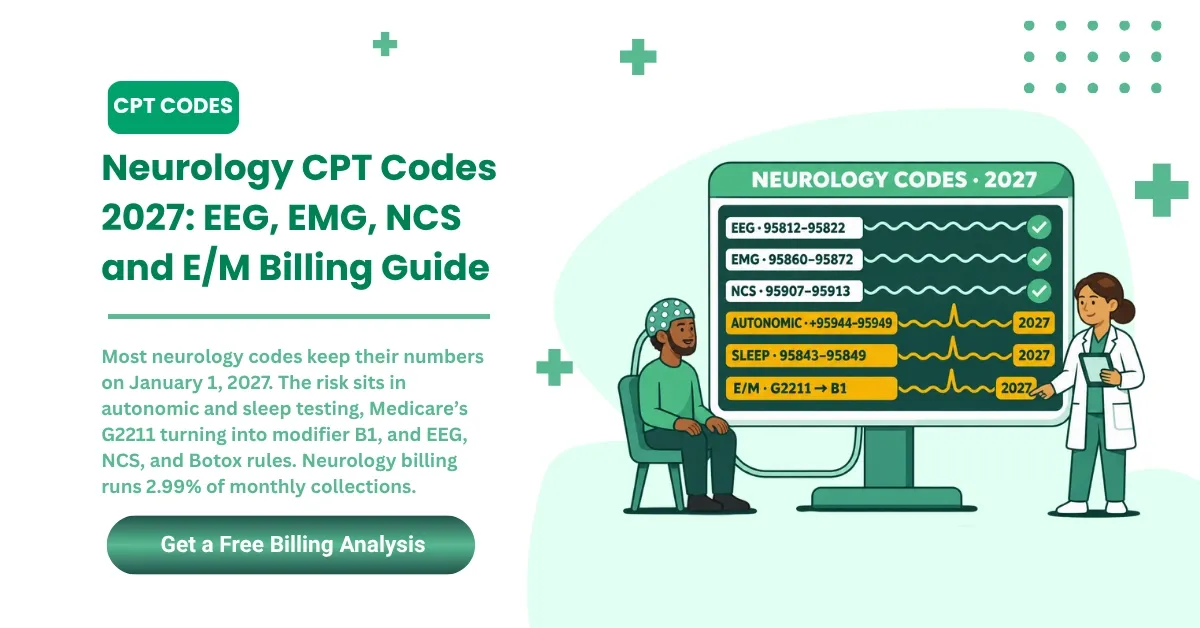
The 2027 changes are smaller, and they're easy to miss. Autonomic testing and home sleep testing get new codes, and Medicare turns the G2211 add-on into modifier B1. Some visits pay at 80% when a minor procedure shares the date.
If you handle neurology billing and coding, the 2027 risk sits in a handful of rules: component splits on EEG, study counts on nerve conduction studies, drug units on Botox, and the new Medicare modifiers.
What Are Neurology CPT Codes?
Neurology CPT codes are the five-digit codes from the American Medical Association (AMA) that a neurologist uses to report visits, tests, and procedures on a claim. Most neurodiagnostic testing sits in the CPT Medicine range 95700 to 96020: EEG, EMG, nerve conduction studies, evoked potentials, and neurostimulator programming. Visits use E/M codes such as 99202 to 99215.
What Is Neurology Coding?
Neurology medical coding turns a neurology encounter into three code sets: CPT for what the neurologist did, HCPCS Level II for drugs and Medicare-specific services, and ICD-10-CM for why the patient needed it. Payers read neurology billing codes as one set, and they'll deny a correct CPT code when the diagnosis falls outside their coverage policy.
|
Code set |
Maintained by |
Tells the payer |
Neurology example |
|---|---|---|---|
|
CPT |
AMA CPT Editorial Panel |
What service the neurologist performed |
95886, needle EMG with NCS |
|
HCPCS Level II |
Centers for Medicare & Medicaid Services (CMS) |
Drugs, supplies, and Medicare-only services |
J0585 (Botox, per unit), G0453 (remote IONM) |
|
ICD-10-CM |
CDC's National Center for Health Statistics, with CMS |
Why the patient needed the service |
G40.909, epilepsy, unspecified |
Billing teams mix up two neighboring searches. "Neuro re-ed" is CPT code 97112, a physical therapy code for neuromuscular reeducation. "Nervous system CPT codes" points to the CPT Surgery section, 61000 to 64999, which holds lumbar puncture (62270), nerve blocks such as 64405, and chemodenervation (64612 to 64647).
The American Academy of Neurology (AAN) publishes neurology coding guidelines and payer updates in its AAN coding resources.
Neurology CPT Codes Cheat Sheet for 2027
The common CPT codes for neurology in 2027 are office visits 99202 to 99215, EEG 95812 to 95822 and 95700 to 95726, needle EMG 95860 to 95872 with add-ons 95885 to 95887, nerve conduction studies 95907 to 95913, and Botox injection 64615 with J0585. They also apply to 2026 dates, except where the last column flags a change.
Use the table as your neurology coding cheat sheet. Find the family, then read the rule column before you pick an EEG CPT code, an EMG CPT code, or a visit level.
Neurology billing cheat sheet: 2027 code families
|
Family |
Codes |
What they cover |
The rule that matters |
2027 status |
|---|---|---|---|---|
|
Office E/M |
99202 to 99205 new; 99211 to 99215 established |
Clinic visits |
Level by MDM or total time |
Medicare: G2211 becomes modifier B1 or B2 |
|
Consults |
99242 to 99245 office; 99252 to 99255 hospital |
Requested opinions |
Medicare doesn't pay consult codes |
Same codes |
|
Hospital E/M |
99221 to 99223; 99231 to 99233; 99238, 99239 |
Inpatient and observation care |
Discharge code depends on time |
Same codes |
|
Routine and extended EEG |
95812, 95813, 95816, 95819, 95822 |
Recordings under two hours |
95812 is 41 to 60 minutes; 95813 is 61 to 119 |
Same codes |
|
Long-term EEG |
95700; 95705 to 95716 technical; 95717 to 95726 professional |
Video or ambulatory EEG, two hours or more |
Technical and professional are separate codes |
Same codes; 95951 deleted in 2020 |
|
Needle EMG |
95860 to 95872 |
EMG with no NCS that day |
Don't pair with an NCS code |
Same codes |
|
EMG with NCS |
+95885, +95886, +95887 |
EMG done with NCS |
One unit per extremity, four maximum |
Same codes |
|
Nerve conduction |
95907 to 95913 |
NCS by total study count |
One code per date |
Same codes |
|
Evoked potentials |
95925 to 95939 |
SSEP, MEP, VEP |
95928 and 95929 are motor studies |
Same codes |
|
Autonomic |
95921 to 95924; +95944 to 95949 |
Autonomic function tests |
Code the components performed |
Four revised, six new |
|
IONM |
+95940; +95941; G0453 |
Surgical monitoring |
Medicare pays G0453; 95941 is invalid |
Same codes |
|
Neurostimulators |
95970 to 95984 |
VNS, DBS, and spinal cord stimulator programming |
Code by device type and time |
Same codes |
|
Chemodenervation |
64612, 64615 to 64617, 64642 to 64647; J0585 |
Botox and other toxins |
64615 is one unit, no modifier 50 |
Same codes |
|
Sleep |
95810, 95811; 95843, 95844, 95846 to 95849 |
Attended and unattended sleep tests |
Tech work and interpretation have their own codes |
95800, 95801, 95806 deleted |
|
Neuropsych and cognitive |
96116, 96121, 96132, 96133, 96136 to 96139, 99483 |
Testing and care planning |
Evaluation and administration are separate codes |
Same codes |
CPT is a registered trademark of the American Medical Association. This table paraphrases the CPT descriptors.
What Changed for Neurology Coding in 2026 and on January 1, 2027
For neurology, CPT 2027 revises the four autonomic function testing codes, adds six new ones (+95944 to 95949), and replaces three home sleep test codes with six unattended sleep testing codes. Medicare's 2027 fee schedule lowers the conversion factor and turns G2211 into modifier B1 or B2. Both changes apply to dates of service from January 1, 2027.
Most neurology CPT codes don't change in 2027, so your risk sits in the few that do.
CPT 2026 Changes Still in Effect
The AMA's CPT 2026 code set made 418 changes: 288 new codes, 84 deletions, and 46 revisions, effective January 1, 2026. Three groups touch neurology practices:
- Remote monitoring: 99445 covers 2 to 15 days of device data in a 30-day period, and 99470 covers the first 10 minutes of monthly management.
- Sub-scalp EEG: Category III codes 1004T to 1009T report analysis, programming, event review, and remote monitoring for implanted sub-scalp EEG systems.
- Algorithm-assisted EEG: since July 1, 2026, Category III code 1041T reports algorithm-assisted analysis of a recorded EEG to locate epileptiform activity, once per uploaded EEG.
New and Revised Neurology Codes in CPT 2027
The neurology CPT code changes for 2027 fall into four areas. Across the whole code set, the AMA counts 453 changes: 299 new codes, 74 revisions, and 80 deletions, according to the AMA's CPT 2027 release.
|
Area |
What changes on January 1, 2027 |
Codes |
|---|---|---|
|
Autonomic testing |
Four codes revised; six new codes split out tilt, thermoregulatory sweat, sympathetic skin response, and combined testing |
95921 to 95924 revised; +95944 to 95949 new |
|
Unattended sleep testing |
Six codes by complexity, with technical work and interpretation on separate codes |
95843, 95844, 95846 to 95849 new; 95800, 95801, 95806 deleted |
|
Vestibular testing |
Video head impulse testing and rotational chair testing |
92513, 92514, 92527, +92528 new; 92546 deleted |
|
Brain-computer interface (Category III) |
Implant, revision, removal, and replacement |
1123T to 1127T |
Other specialties' updates are in our breakdown of all 2027 CPT changes.
Medicare's 2027 Fee Schedule Changes for Neurologists
CMS released the 2027 Medicare Physician Fee Schedule final rule (CMS-1848-F) on November 4, 2026. These five changes affect neurology CPT codes:
- Conversion factor: $32.63 for most clinicians, down 2.31% from $33.40, and $32.95 for qualifying APM participants, down 1.83% from $33.57, per the CMS 2027 fee schedule fact sheet. CMS ties the drop to the end of the one-year 2.50% increase for 2026.
- G2211: becomes modifier B1, which raises the E/M payment 16%. Modifier B2 raises it 32% for clinicians in a Shared Savings Program ACO or LEAD Model ACO.
- Same-day E/M and procedure: if an office E/M shares a date with a 0-day global procedure, the higher-paid service pays 100% and the other pays 80%. EEG, EMG, and NCS carry an XXX global, so they fall outside the rule. A greater occipital nerve block (64405) carries a 0-day global, so it falls under it.
- Remote monitoring: CMS limits RTM to established patients, requires an initiating visit, and pushes the employed-staff requirement to January 1, 2029.
- RVUs: per-code neurology RVU values sit in the final rule's Addenda, which CMS updated on November 5, 2026.
Loading new codes, the B1 modifier, and payer edits before January 1 takes real hours for a small team. In neurology medical billing, practices hand that setup work to outsourced medical billing services when the team is stretched.
Want someone to check your neurology claims against the 2027 changes? Request a free RCM review, and MedSole's team will look at your revenue cycle within 48 hours.
E/M and Consultation Codes for Neurology Visits
Neurology CPT codes for office visits are 99202 to 99205 for new patients and 99211 to 99215 for established patients, leveled by medical decision making (MDM) or total time on the date of service. No standalone code exists for a neurological exam. Medicare doesn't pay consultation codes, so consults go to office or hospital visit codes.
Office Visit Codes 99202 to 99215 for Neurology
Neurology office visit CPT codes follow the same MDM and time rules as other specialties. Since 2024, each code lists a minimum time that you must meet or exceed.
|
Codes (new / established) |
MDM level |
Total time to meet or exceed |
|---|---|---|
|
99202 / 99212 |
Straightforward |
15 / 10 minutes |
|
99203 / 99213 |
Low |
30 / 20 minutes |
|
99204 / 99214 |
Moderate |
45 / 30 minutes |
|
99205 / 99215 |
High |
60 / 40 minutes |
|
99211 |
No MDM or time requirement |
Clinical staff visit |
Picture an epilepsy follow-up where seizures aren't controlled and the neurologist changes an antiseizure prescription. Two of the three MDM elements reach moderate: a poorly controlled chronic illness, and prescription drug management. That supports 99214, and our 99213 billing guide covers the level below it.
Add prolonged time when a visit runs long. CPT's +99417 starts at 75 minutes for 99205 and 55 minutes for 99215, while Medicare's G2212 starts at 89 and 69 minutes. Our CPT 99215 guide covers the top established-patient level.
Is There a CPT Code for a Neurological Exam?
No. The neurological exam is part of the E/M visit, and since 2021 MDM or total time sets the office visit level. Counting exam elements no longer changes the level.
A neurological evaluation with formal testing has its own codes. The neurobehavioral status exam is 96116 for the first hour and +96121 for each added hour, and a cognitive assessment with a care plan is 99483.
Neurology Consult CPT Codes: Medicare vs. Commercial Payers
CPT's consultation codes are 99242 to 99245 in the office and 99252 to 99255 in the hospital; the AMA deleted 99241 and 99251 in 2023. Medicare stopped paying consultation codes in 2010. For a Medicare consult, bill a new or established office visit, or initial hospital care with 99221 to 99223.
Commercial plans set their own rules on CPT codes for neurology consultation, and some Medicare Advantage plans follow Medicare. Check the contract before you bill a neurology consult CPT code to a commercial plan.
Inpatient Neurology Codes: 99221 to 99239
- Initial hospital or observation care: 99221 (straightforward or low MDM, 40 minutes), 99222 (moderate, 55 minutes), and 99223 (high, 75 minutes).
- Subsequent care: 99231 (straightforward or low, 25 minutes). 99232 is moderate MDM or 35 minutes, and 99233 is high MDM or 50 minutes.
- Discharge: 99238 for 30 minutes or less, and 99239 for more than 30 minutes.
- Observation stays have used these same codes since 2023.
G2211 Becomes Modifier B1 or B2 in 2027
For 2027 Medicare claims, the G2211 add-on becomes modifier B1 on the E/M code itself and raises that visit's payment 16%. Modifier B2 raises it 32% for Shared Savings Program ACO or LEAD Model ACO clinicians. Both fit the ongoing care neurologists give for epilepsy, multiple sclerosis, and Parkinson's disease.
CMS posted a B1 and B2 adjusted RVU file on November 12, 2026. Modifier 25 still applies when a visit shares a date with a procedure, and with a 0-day global procedure the higher-paid service pays 100% while the other pays 80%. Each commercial plan sets its own G2211 and B1 policy, so check yours before you change charge entry.
A new neurologist can't bill any of these codes until each payer approves them. MedSole's payer credentialing page lists approval windows of 30 to 45 days for Medicare and Aetna and about 90 days for Medicaid. Enrollment forms and many Medicaid claims also ask for the neurology taxonomy code, 2084N0400X.
EEG CPT Codes: Routine, Extended, and Long-Term Monitoring
EEG CPT codes depend on how long the recording runs. Routine EEGs of 20 to 40 minutes use 95816 for awake and drowsy, 95819 for awake and asleep, or 95822 for sleep or coma only. Extended EEGs use 95812 for 41 to 60 minutes and 95813 for 61 to 119 minutes. Two-hour and longer recordings use 95700 to 95726.
None of the core EEG CPT codes for 2027 changed, so your risk sits in recorded time, sleep state, and component billing. EEG is also where many neurology CPT codes split between two billers.
Routine and Extended EEG: 95812 to 95822
|
Code |
What it covers |
Billing note |
|---|---|---|
|
95812 |
Extended EEG, 41 to 60 minutes |
Recorded time sets the code |
|
95813 |
Extended EEG, 61 to 119 minutes |
Time-based, not a code for comparing with a prior study |
|
95816 |
Routine EEG, awake and drowsy |
20 to 40 minutes |
|
95819 |
Routine EEG, awake and asleep |
20 to 40 minutes, with sleep recorded |
|
95822 |
EEG in sleep or coma only |
20 to 40 minutes |
|
95957 |
Digital analysis of EEG, such as spike analysis |
Not for built-in automated spike detection |
Once a recording passes 40 minutes, bill the extended code in place of the routine code. A 48-minute awake and asleep study bills as 95812 alone, and a 75-minute study bills as CPT code 95813 alone. Record the technologist's start and stop times so the chart supports the code.
95816 vs. 95819: Awake and Drowsy or Awake and Asleep
CPT code 95819 needs both awake and asleep recording in the tracing, while 95816 covers awake and drowsy states. If the patient never falls asleep, bill the 95816 CPT code instead. Document the states your technologist captured. A reviewer can downcode a 95819 that shows no recorded sleep.
Long-Term EEG Monitoring Codes 95700 to 95726
Long-term EEG monitoring CPT codes separate the technologist's work from the neurologist's read:
- 95700: setup, patient education, and takedown by the technologist, billed once per recording.
- 95705 to 95716 (technical): chosen by duration (2 to 12 hours, or each increment over 12 up to 26 hours), video or no video, and monitoring level (unmonitored, intermittent, or continuous real-time).
- 95717 to 95726 (professional): 95717 and 95718 cover 2 to 12 hours, and 95719 and 95720 cover each increment over 12 up to 26 hours with a report after each 24 hours. 95721 to 95726 cover studies over 36 hours, reported once at the end. The even-numbered codes include video.
- No separate ambulatory EEG CPT code exists; home studies use this same family. In its jurisdictions, Palmetto GBA article A56771 requires a routine EEG within one year before an ambulatory EEG. The rule isn't national.
- 95951 was deleted on January 1, 2020. If a reference tells you to bill 95951 for 24-hour video EEG, it's out of date. The professional read for each 12 to 26 hours of video EEG is now 95720.
Modifier 26, TC, and the New EEG Category III Code
Split billing on 95812 to 95822 follows the usual rules. For a modifier 26 EEG interpretation, the neurologist who reads a hospital study bills only the professional component, and the hospital bills the technical portion on its facility claim.
A practice that owns the equipment but sends studies to an outside reader uses TC modifier billing. Practices that record and read the study bill it globally with no modifier.
Long-term monitoring codes already separate the technical and professional work, so don't add 26 or TC to 95700 to 95726. Bill only the codes for the part you performed.
Since July 1, 2026, Category III code 1041T reports a physician's or qualified health care professional's review of computer-analyzed data from a recorded EEG to find seizure-related activity. Many payers price Category III codes case by case or don't cover them, so check coverage before you bill it.
EMG and Nerve Conduction Study CPT Codes
Bill needle EMG performed alone with 95860 to 95872. If EMG and nerve conduction studies happen on the same date, report add-on codes 95885 to 95887 with one NCS code from 95907 to 95913, chosen by the total number of studies. A standalone EMG code paired with an NCS code on one date draws a bundling denial.
Needle EMG Without NCS: 95860 to 95872
Each EMG CPT code in this range describes where the needle went:
|
Code |
What it covers |
|---|---|
|
95860, 95861, 95863, 95864 |
One, two, three, or four extremities, with related paraspinal areas |
|
95865 / 95866 |
Larynx / hemidiaphragm |
|
95867 / 95868 |
Cranial nerve supplied muscles, one side / both sides |
|
95869 |
Thoracic paraspinal muscles |
|
95870 |
Limited study: one extremity or non-limb (axial) muscles |
|
95872 |
Single fiber EMG |
A full one-limb study with no same-day NCS takes CPT code 95860. CPT code 95870 fits a limited study of one limb or of axial muscles.
EMG and NCS Billed Together: 95885 to 95887
+95885 is a limited study of one extremity, and +95886 is a complete study: five or more muscles from three or more nerves or four or more spinal levels. +95887 covers non-extremity muscles. Bill one unit of 95885 or 95886 per extremity, with four combined units as the daily cap. Add RT or LT where the payer asks.
Standalone codes such as 95860 to 95864 billed with 95907 to 95913 on one date are a common source of CO-97 bundling denials. For more same-day claims coded line by line, see our EMG CPT codes guide.
How to Count Nerve Conduction Studies for 95907 to 95913
The AANEM model policy, revised in August 2026, sets the counting rules:
- One study is one sensory test, one motor test with or without an F wave, or one H-reflex.
- Stimulating or recording at several sites on the same nerve still counts as one study.
- Inching along a nerve adds no units.
- The physician reviews waveforms and prepares the report on site.
The total sets the nerve conduction study CPT code: 95907 for 1 to 2 studies, 95908 for 3 to 4, 95909 for 5 to 6, 95910 for 7 to 8, 95911 for 9 to 10, 95912 for 11 to 12, and the 95913 CPT code for 13 or more.
Say a study confirms left carpal tunnel syndrome (G56.02). The neurologist runs left median motor with F wave, left median sensory, left ulnar motor, left ulnar sensory, and left radial sensory. That's five studies, so the claim shows 95909 x1. Four needled muscles in the left arm add +95885 x1 with LT, a limited study since it's under five muscles.
CPT's maximum-studies table allows up to seven nerve conduction studies and one needle EMG extremity for unilateral carpal tunnel syndrome. In Florida, Puerto Rico, and the U.S. Virgin Islands, First Coast denies studies above that daily maximum and wants same-day NCS and EMG on one claim, per First Coast article A57123.
Automated devices with preconfigured electrodes report 95905 per limb. You can't bill 95905 with 95885, 95886, or 95907 to 95913.
Why EMG and NCS Claims Get Audited
EMG and NCS are the neurology CPT codes with their own federal audit report. For 2011 claims, the HHS Office of Inspector General found Medicare paid about $486 million to 21,700 physicians for electrodiagnostic tests. In the OIG electrodiagnostic billing report (OEI-04-12-00420, published in 2014), investigators flagged 4,901 of those physicians for questionable billing worth $139 million.
Keep these five items in each electrodiagnostic report:
- Nerves tested and study type (sensory, motor, F wave, or H-reflex)
- Sides tested
- Muscles needled
- Who performed the study and who interpreted it
- The diagnosis that justifies the test
In neurology medical billing, EMG and NCS denials tend to trace back to counting or pairing, and a coder can catch both before the claim goes out. MedSole handles neurology billing at 2.99% of monthly collections, with EMG, NCS, and EEG component billing in scope and no setup fee.
Evoked Potential, Autonomic, IONM, and Neurostimulator Codes
Neurology CPT codes for evoked potentials run from 95925 to 95939: 95925 to 95927 and 95938 for somatosensory studies, 95928, 95929, and 95939 for motor studies, and 95930 for visual evoked potentials. Autonomic testing gets revised and new codes on January 1, 2027. Neurostimulator analysis and programming use 95970 to 95984, chosen by device type and time.
Evoked Potential Codes 95925 to 95939
|
Code |
What it covers |
|---|---|
|
95925 / 95926 / 95927 |
Somatosensory evoked potentials (SSEP): upper limbs / lower limbs / trunk or head |
|
95938 |
SSEP, upper and lower limbs in one session |
|
95928 / 95929 |
Motor evoked potentials: upper limbs / lower limbs |
|
95939 |
Motor evoked potentials, upper and lower limbs |
|
95930 |
Visual evoked potentials, central nervous system (not glaucoma) |
If you test upper and lower limbs on the same date, bill the combined code, 95938 or 95939, in place of the two single-limb codes. Auditory evoked potentials sit in the audiology range, 92650 to 92653.
Autonomic Function Testing Codes for 2027
The AMA's CPT Editorial Panel accepted six new codes and revisions to 95921 to 95924 at its February 2025 meeting, effective January 1, 2027. These autonomic function testing CPT codes for 2027 split the work by test:
- 95923: sudomotor testing by QSART or silastic sweat imprint only.
- 95945: thermoregulatory sweat testing, which 95923 no longer covers.
- 95946: sympathetic skin response.
- +95944: tilt table add-on, reported only with 95921 or 95947.
- 95947: parasympathetic and sudomotor testing together.
- 95948: sympathetic adrenergic testing with tilt, plus sudomotor testing.
- 95949: parasympathetic, sympathetic adrenergic with tilt, and sudomotor testing together.
Each new descriptor includes the interpretation and report. Your documentation has to show each component performed and the signed report.
Intraoperative Neuromonitoring: 95940, 95941, and G0453
Intraoperative neuromonitoring CPT codes are add-ons, reported with the base test codes the monitoring uses, such as SSEP or EMG. +95940 covers continuous monitoring in the operating room with attention on one patient, per 15 minutes. The 95941 CPT code covers monitoring from outside the room, or of more than one case at once, per hour.
For Medicare, 95941 isn't valid; bill G0453 per 15 minutes for one patient monitored from outside the operating room.
Neurostimulator Analysis and Programming: 95970 to 95984
|
Code |
What it covers |
|---|---|
|
95970 |
Analysis without programming, any implanted neurostimulator |
|
95971 / 95972 |
Simple / complex programming, spinal cord or peripheral nerve stimulator |
|
95976 / 95977 |
Simple / complex programming, cranial nerve stimulator, such as vagus nerve stimulation |
|
95983 / +95984 |
Deep brain stimulator programming, first 15 minutes / each added 15 minutes |
|
95836 |
Electrocorticogram from an implanted brain stimulator, such as responsive neurostimulation, up to 30 days |
The 95970 CPT code fits a visit where the neurologist checks the device and changes nothing. For deep brain stimulator programming, record face-to-face programming time, since CPT 95984 counts each 15 minutes after the first.
The 95999 CPT code is the unlisted neurological or neuromuscular diagnostic procedure. Payers price it by hand, so send a full procedure note and name a comparable code with the claim.
Botox and Chemodenervation Billing: 64615 and J0585
Bill Botox for chronic migraine with 64615 for the injection and J0585 for the drug, reported per 1 unit. Noridian's billing article says to report one unit of 64615 with no modifier 50. Discarded drug from a single-dose vial goes on its own line with modifier JW, and JZ attests that you discarded nothing.
Chemodenervation is the family of neurology CPT codes that pairs a procedure code with a drug code, so both lines have to agree.
Chemodenervation Codes by Muscle Group
The Botox chronic migraine CPT code, 64615, is one of the chemodenervation CPT codes neurology practices pick by muscle group:
|
Code |
Muscles |
Typical use |
|---|---|---|
|
64612 |
Facial nerve muscles, one side |
Blepharospasm, hemifacial spasm |
|
64615 |
Facial, trigeminal, cervical spinal, and accessory nerve muscles, both sides |
Chronic migraine |
|
64616 |
Neck muscles excluding the larynx, one side |
Cervical dystonia |
|
64617 |
Larynx, one side, needle EMG guidance included |
Spasmodic dysphonia |
|
64642 / +64643 |
One extremity, 1 to 4 muscles / each added extremity |
Limb spasticity |
|
64644 / +64645 |
One extremity, 5 or more muscles / each added extremity |
Limb spasticity |
|
64646 / 64647 |
Trunk, 1 to 5 muscles / 6 or more |
Trunk spasticity |
Don't bill 64615 with the other chemodenervation codes on the same date. For guidance, 64615 takes one code: +95873 for electrical stimulation or +95874 for needle EMG, not both. In California, Hawaii, Nevada, and the Pacific territories, Noridian billing article A57185 is the Jurisdiction E source for the one-unit rule on 64615.
Drug Units, JW, and JZ
J0585 reports onabotulinumtoxinA per 1 unit. The FDA label dose for chronic migraine is 155 units, given as 5 units per site at 31 sites across seven head and neck muscle areas.
From a 200-unit vial with 155 units injected, the claim shows J0585 x155 on one line and J0585-JW x45 on a second line. If you discard nothing, add JZ to the drug line; CMS has required it since July 1, 2023.
Other toxins carry their own codes and unit sizes: J0586 (abobotulinumtoxinA) per 5 units, J0587 (rimabotulinumtoxinB) per 100 units, and J0588 (incobotulinumtoxinA) per 1 unit. State Medicaid programs also require the NDC on physician-administered drug lines.
Prior Authorization for Botulinum Toxin
Traditional Medicare requires prior authorization for botulinum toxin injections only in hospital outpatient departments, under the OPD prior authorization program that started July 1, 2020, and only with 64612 or 64615. A physician office billing traditional Medicare doesn't need it. Many Medicare Advantage and commercial plans do, often with proof of earlier treatments.
On the claim, pair 64615 with a chronic migraine code such as G43.709 or G43.719, and pair 64616 with G24.3 for spasmodic torticollis.
If Botox claims stall at authorization, fix the front end first. MedSole's prior authorization services team files the payer request before the injection date, so the approved units match what you bill.
Sleep Testing and Neuropsychological Testing Codes
Attended sleep studies keep codes 95810 and 95811 in 2027. On January 1, 2027, unattended sleep tests move to six codes: 95843, 95844, and 95846 for the technical work and 95847, 95848, and 95849 for interpretation, each by complexity. Neuropsychological evaluation by a physician or psychologist uses 96132 for the first hour and +96133 for each added hour.
Sleep Study Codes and the 2027 Unattended Testing Change
Sleep study CPT codes for 2027 fall into two groups:
- Attended: 95810 (polysomnography with sleep staging, age 6 and older), 95811 (with CPAP titration), 95782 and 95783 (younger than 6), and 95805 (multiple sleep latency or maintenance of wakefulness testing).
- Unattended, from January 1, 2027: 95843, 95844, and 95846 (technical) and 95847, 95848, and 95849 (professional), tiered as low (3 to 4 channels), moderate (5 to 10), and high (11 or more).
- Valuation: the American Academy of Sleep Medicine reports that CMS valued 95843 and 95847 from deleted 95800, and 95844 and 95848 from deleted 95806.
- Deleted January 1, 2027: 95800, 95801, and 95806. Check whether each payer still accepts HCPCS G0398 to G0400 in 2027.
If your practice reads home sleep tests, load 95847 to 95849 into charge entry before January 1, 2027.
What Are CPT Codes 96132 and 96133?
CPT 96132 is neuropsychological evaluation by a physician or other qualified health care professional, first hour, and +96133 is each additional hour. The evaluation covers integrating test results with clinical data, interpretation, clinical decision making, treatment planning, the report, and interactive feedback to the patient or family.
These neuropsychological testing CPT codes keep evaluation apart from test administration. You bill administration separately, in 30-minute units: 96136 and +96137 if the physician or psychologist gives the tests, and 96138 and +96139 if a technician does.
96130 vs. 96132, and Who Can Bill 96136 and 96138
96130 and +96131 report psychological evaluation. 96132 and +96133 report neuropsychological evaluation, focused on cognition and brain-behavior relationships. The supervising physician or psychologist bills 96138 for a technician's administration time, and the technician doesn't bill it.
Neurologists can also bill the neurobehavioral status exam, 96116 and +96121. Use neuropsychological testing CPT codes only when the documented time and report support them.
Cognitive Assessment and Care Planning: 99483
99483 covers a cognitive assessment with a written care plan for a patient with cognitive impairment, and Medicare pays it once every 180 days. Pair it with documented diagnoses such as G31.84 (mild cognitive impairment of uncertain or unknown etiology) or a G30 Alzheimer's disease code.
Chronic Care, Telehealth, and Remote Monitoring for Neurology
Medicare telehealth flexibilities, including visits in the patient's home anywhere in the U.S., run through December 31, 2027, under CMS's October 2026 telehealth FAQ. Use POS 10 if the patient is home and POS 02 elsewhere. Starting January 1, 2027, Medicare also requires modifier BB or BC on the telehealth claims those modifiers describe.
CCM and PCM for Epilepsy, MS, and Parkinson's
Chronic care management (CCM) covers patients with two or more chronic conditions expected to last at least 12 months:
- 99490: first 20 minutes of clinical staff time in a calendar month, with +99439 for each added 20.
- 99491: first 30 minutes by the physician or other qualified health care professional, with +99437 for each added 30.
- 99487 and +99489: complex CCM, first 60 minutes of clinical staff time and each added 30.
Principal care management (PCM) fits one high-risk condition, such as poorly controlled epilepsy. Bill 99424 and +99425 for physician time, or 99426 and +99427 for clinical staff time, each in 30-minute units. Both programs need documented patient consent and a care plan. These neurology CPT codes pay for the monthly calls, refills, and care coordination your team handles between visits.
Tele-Neurology Billing Through December 31, 2027
For neurology telehealth billing in 2027, the CMS telehealth FAQ lists these Medicare rules:
- The patient's home counts as the originating site, with no geographic limits, through December 31, 2027.
- Audio-only telehealth in the home is allowed through December 31, 2027.
- POS 02 covers telehealth outside the patient's home, and POS 10 covers telehealth in the home. Our telehealth CPT codes guide covers the visit codes.
- BB: telehealth furnished through a virtual platform owned by an entity the practitioner contracts with.
- BC: telehealth furnished incident to a physician's or practitioner's service. CMS requires BB and BC from January 1, 2027, and says neither changes payment.
- Commercial payers set their own modifier rules, such as modifier 95, so check each contract.
MedSole's telehealth billing services team applies these POS and modifier rules payer by payer.
RPM and RTM Rules for 2027
Under its 2027 rule, CMS requires a separately billable initiating visit before remote physiologic monitoring (RPM) or remote therapeutic monitoring (RTM) starts, and it limits RTM to established patients. CMS also delayed the rule that only practice-employed staff can furnish these services to January 1, 2029.
The 2026 short-duration RPM codes still apply: 99445 for 2 to 15 days of device supply in 30 days and 99470 for the first 10 minutes of treatment management. For setup and monthly tracking, see MedSole's RPM billing support.
Neurology Modifiers and NCCI Bundling Rules
Neurology CPT codes use a few modifiers: 25 for a separate E/M on a procedure day, 26 and TC to split the read from the technical work, 59 or an X modifier for a distinct service on an NCCI pair, RT and LT for laterality, and JW or JZ for drug waste. Medicare adds B1 and B2 in 2027.
|
Modifier |
Neurology use |
Mistake that gets denied |
|---|---|---|
|
25 |
A significant, separately identifiable E/M on the same day as a test or minor procedure |
Adding it to each visit on a test day without separate work |
|
26 / TC |
Reading vs. equipment and technologist for 95812 to 95822, EMG, and NCS |
Adding them to 95700 to 95726, which already split the components |
|
59, XS, XU, XE, XP |
A distinct service on a code pair NCCI bundles |
Using it to report extra nerves, which roll into one NCS code |
|
RT, LT, 50 |
Sides for EMG extremities and nerve blocks |
Modifier 50 on 64615 |
|
52 |
A reduced service, where the payer's policy allows it |
Using it in place of the correct lower code |
|
JW, JZ |
Botulinum toxin wastage, or none |
Leaving JZ off when nothing was discarded |
|
B1, B2 |
Medicare visit complexity, 2027 |
Billing G2211 on 2027 Medicare claims |
|
BB, BC |
Medicare telehealth, 2027 |
Assuming commercial plans want them |
Payers send a missing or mismatched modifier back as one of the CO-4 modifier denials, so check modifiers at charge entry.
CMS updates NCCI procedure-to-procedure edits and Medically Unlikely Edits each quarter. The NCCI Policy Manual Chapter XI covers Medicine and E/M codes and limits modifier 25 to a significant, separately identifiable E/M service.
Add modifier 59 or an X modifier only after you've confirmed the services were distinct, and not as a way to clear an edit. These neurology coding guidelines also hold for commercial plans that use NCCI edits, though some plans write their own.
ICD-10-CM Codes That Support Neurology Claims (FY2027)
Payers cover neurology CPT codes only when the ICD-10-CM code supports them, and FY2027 codes apply to dates of service from October 1, 2026, through September 30, 2027. Multiple sclerosis needs a type, G35.A to G35.D, because G35 alone isn't billable. Parkinson's disease works the same way, using G20.A1 to G20.C.
We checked each of these neurology ICD-10 codes against the FY2027 code set on November 15, 2026:
|
Service |
Diagnosis codes it pairs with |
|---|---|
|
EEG |
G40.909 epilepsy, unspecified, not intractable, without status epilepticus; R56.9 unspecified convulsions |
|
EMG and NCS |
G56.03 carpal tunnel syndrome, bilateral; M54.16 lumbar radiculopathy; G62.9 polyneuropathy, unspecified. See our neuropathy ICD-10 codes guide. |
|
Botox |
G43.709 chronic migraine without aura, not intractable; G43.719 the intractable version; G24.3 spasmodic torticollis |
|
MS visits |
G35.A relapsing-remitting; G35.B0 to G35.B2 primary progressive; G35.C0 to G35.C2 secondary progressive; G35.D unspecified |
|
Parkinson's visits |
G20.A1, G20.A2, G20.B1, and G20.B2 by dyskinesia and fluctuations; G20.C parkinsonism, unspecified |
|
Sleep testing |
G47.33 obstructive sleep apnea. See our sleep apnea ICD-10 codes guide. |
|
Cognitive testing and 99483 |
G31.84 mild cognitive impairment of uncertain or unknown etiology; G30 Alzheimer's disease codes |
For a multiple sclerosis ICD-10 code in 2027, pick the type the neurologist documented. G35.D is the fallback when the record doesn't name a type, and G20.C plays the same role for unspecified parkinsonism.
The FY2027 ICD-10-CM guidelines let you report signs and symptoms when the provider hasn't confirmed a definitive diagnosis. On outpatient claims, don't code a diagnosis documented as probable, suspected, or rule out; code the symptoms instead. Each payer's LCD and billing article list the covered codes for each test, so check the list before scheduling.
Prior Authorization for Neurology Services
Each plan sets its own prior authorization list for neurology services, and many include Botox, sleep testing, and some long-term EEG monitoring. Since January 1, 2026, Medicare Advantage, Medicaid, and CHIP plans under the CMS prior authorization rule (CMS-0057-F) must decide expedited requests within 72 hours and standard requests within seven calendar days.
Three more parts of that rule shape neurology prior authorization in 2027:
- Since 2026, those plans must give a specific reason when they deny a request.
- By January 1, 2027, they must offer a Prior Authorization API, so requests and status updates move electronically.
- The rule doesn't cover traditional Medicare fee-for-service. There, the main neurology requirement is the hospital outpatient program for botulinum toxin covered above.
Give your front desk this five-point checklist:
- Put the authorization number on the claim.
- Match the CPT codes and units to what the plan approved.
- Keep the date of service inside the approval window.
- Confirm the rendering provider and location match the request.
- Set a reminder to renew before a Botox series runs out.
A claim that misses any of these can come back as a CO-197 denial for missing authorization, and some plans won't grant approval after the service date.
Common Neurology Claim Denials and How to Fix Them
Neurology denials tend to come back under a short list of reason codes: CO-50 for medical necessity, CO-97 for bundling, CO-4 for a missing or wrong modifier, CO-197 for missing authorization, and CO-16 for missing information. Each code points to a different fix, so read the remark code before you rebill.
These neurology denial codes map to common triggers on EEG, EMG, Botox, and visit claims:
|
Code |
What it means |
Typical neurology trigger |
Fix |
|---|---|---|---|
|
CO-50 |
The payer doesn't consider the service medically necessary |
Diagnosis not on the LCD list; repeat testing past a MAC's frequency limit |
Check the LCD and billing article before scheduling, then appeal with notes. See CO-50 necessity denials. |
|
CO-97 |
Payment is included in another service already adjudicated |
Standalone EMG with NCS; a second 95700 for one recording |
Use 95885 to 95887; bill one setup per recording |
|
CO-4 |
The modifier is missing or doesn't fit the procedure code |
No 26 on a hospital EEG read; no 25 on a same-day E/M |
Correct the modifier and resubmit |
|
CO-197 |
Authorization is absent |
Botox or sleep testing without approval |
Request retro authorization if the plan allows it, or appeal |
|
CO-16 |
The claim lacks information or has a billing error |
No NDC on a Medicaid drug line; missing referring provider |
Add the data and resubmit |
|
CO-11 |
The diagnosis doesn't fit the procedure |
A symptom code that doesn't support the test |
Recode from the documentation |
These denials tend to start upstream, at scheduling, eligibility, or charge entry, which is the ground full revenue cycle management covers. Fixing one claim won't stop the next. Track denials by reason code each month to see which neurology CPT codes and which neurology billing errors repeat.
If the same denial keeps coming back, look upstream before you appeal again. MedSole's denial management services team traces each denial to its root cause before anyone resubmits.
What Neurology Billing Costs and How to Choose a Billing Partner
Full-service medical billing companies publish rates of 4% to 10% of collections in their own pricing guides, based on MedSole's review. Compare the effective rate after minimums and setup fees, not the headline percentage. MedSole RCM bills at 2.99% of monthly collections and credentials providers at $99 per payer application.
Percentage of Collections: What the Market Charges
That 4% to 10% range comes from billing companies' own pricing pages, not a government survey, and our medical billing cost guide breaks it down. Minimums and flat fees change the real rate. A $1,000 monthly minimum on $10,000 in collections works out to 10%, whatever the headline says.
|
Monthly collections |
At 2.99% |
At 5% |
At 8% |
|---|---|---|---|
|
$25,000 |
$747.50 |
$1,250 |
$2,000 |
|
$50,000 |
$1,495 |
$2,500 |
$4,000 |
|
$100,000 |
$2,990 |
$5,000 |
$8,000 |
For neurology revenue cycle management, the fee matters less than whether the team gets neurology billing and coding right: TC and PC splits, NCS counts, and drug units.
What to Ask a Neurology Billing Company
Before you outsource neurology billing, put these seven questions to any company that will bill your neurology CPT codes:
- How do you bill EEG and long-term monitoring when the hospital owns the equipment?
- Who counts nerve conduction studies, and how do you check the daily maximum?
- How do you handle Botox units, JW and JZ, and prior authorization?
- What's the rate, and is there a minimum, setup fee, or long contract?
- Is credentialing included, or priced per application?
- Which reports will we see each month: denial rate, days in AR, and collections?
- Will a certified neurology coder review our claims?
Write down each answer so you can compare neurology billing companies side by side.
How MedSole RCM Prices Billing and Credentialing
MedSole RCM is a full-service revenue cycle management company in Mesa, Arizona. It bills at 2.99% of monthly collections and credentials providers at $99 per payer application.
|
Item |
MedSole RCM |
|---|---|
|
2.99% of monthly collections |
|
|
Setup, software, or clearinghouse fees |
None |
|
Monthly minimum |
None |
|
Contract |
Month to month |
|
Denial management or AR follow-up only |
4.49% of what's recovered |
|
Credentialing |
$99 per payer application, charged after approval |
|
Stated turnaround |
Claims filed within 24 hours; credentialing applications filed within 48 hours of complete documents |
At $50,000 in monthly collections, 2.99% is $1,495. The $99 fee sits below the $100 to $500 per application published by the eight credentialing companies MedSole checked in October 2026. Approval windows by payer are on the $99 per payer credentialing page.
MedSole's neurology billing services cover EEG monitoring, EMG and NCV studies, and split professional and technical billing, the places where neurology CPT codes get complicated. Read what practices say in our provider reviews.
Want to see what 2.99% would look like on your neurology medical billing? Talk to an RCM specialist and get a free RCM review.
Neurology CPT Codes FAQ
What are the CPT codes for neurology services in 2026?
The core 2026 families are office visits 99202 to 99215, EEG 95812 to 95822 with long-term monitoring 95700 to 95726, needle EMG 95860 to 95872 with add-ons 95885 to 95887, and nerve conduction studies 95907 to 95913. Each neurology CPT code in those families carries into 2027. The 2027 changes hit autonomic testing, unattended sleep testing, and Medicare's G2211 add-on.
What is a neurology CPT codes cheat sheet?
A neurology CPT codes cheat sheet is a one-page table of code families with the billing rule that matters for each. Ours lists 15 families with their 2027 status, from office visits and EEG to Botox, sleep testing, and neurostimulator programming. Print it for your coders and front desk, and check each row against payer policy.
Can a neurologist bill an E/M visit and an EMG on the same day?
Yes, with modifier 25 on the E/M when the visit is significant and separately identifiable from the test. On modifier 25 neurology 2027 claims to Medicare, the new 80% rule applies only when the E/M shares a date with a 0-day global procedure. EMG and NCS carry an XXX global indicator, so the rule doesn't reduce either service.
Is CPT 95951 still a valid code?
No. The AMA deleted 95951 on January 1, 2020. Long-term EEG monitoring now uses 95700 for setup, 95705 to 95716 for the technical recording, and 95717 to 95726 for the professional review and report. A neurologist reading each 12 to 26 hours of video EEG bills 95720 for that professional work.
What does a neurology billing company do?
A neurology billing company codes visits and tests, submits claims, checks eligibility, handles prior authorization, posts payments, works denials, and follows up on AR. Many also handle credentialing. In neurology, the specialty work is splitting professional and technical components on EEG, counting nerve conduction studies against daily maximums, and reporting Botox units with JW or JZ.
How much does neurology billing and credentialing cost?
Full-service billing companies publish rates of 4% to 10% of collections, and the eight credentialing companies MedSole checked in October 2026 publish $100 to $500 per application. MedSole RCM is a full-service revenue cycle management company in Mesa, Arizona. It bills at 2.99% of monthly collections and credentials providers at $99 per payer application.
Sources and Update Log
Update log: November 15, 2026, written for CPT 2027, the CY2027 Medicare Physician Fee Schedule final rule, and FY2027 ICD-10-CM.
Sources checked for this guide:
- AMA, CPT 2027 code set release, and AMA, CPT 2026 code set release
- AMA, CPT Category III code descriptors, and AMA, February 2025 CPT Editorial Panel summary (autonomic testing codes)
- CMS, CY2027 Physician Fee Schedule final rule (CMS-1848-F) and fact sheet, November 4, 2026
- CMS, Medicare telehealth FAQ, updated October 2026, and CMS-0057-F prior authorization fact sheet
- CMS, NCCI Policy Manual Chapter XI, revised January 1, 2026, and FY2027 ICD-10-CM Official Guidelines
- Noridian billing article A57185, Palmetto GBA billing article A56771, and First Coast billing article A57123
- AANEM, model policy for nerve conduction studies and needle EMG, revised August 2026
- HHS OIG, Questionable Billing for Medicare Electrodiagnostic Tests, OEI-04-12-00420, 2014
- AASM, notice on CMS's final values for unattended sleep testing codes
CPT is a registered trademark of the American Medical Association.