



|
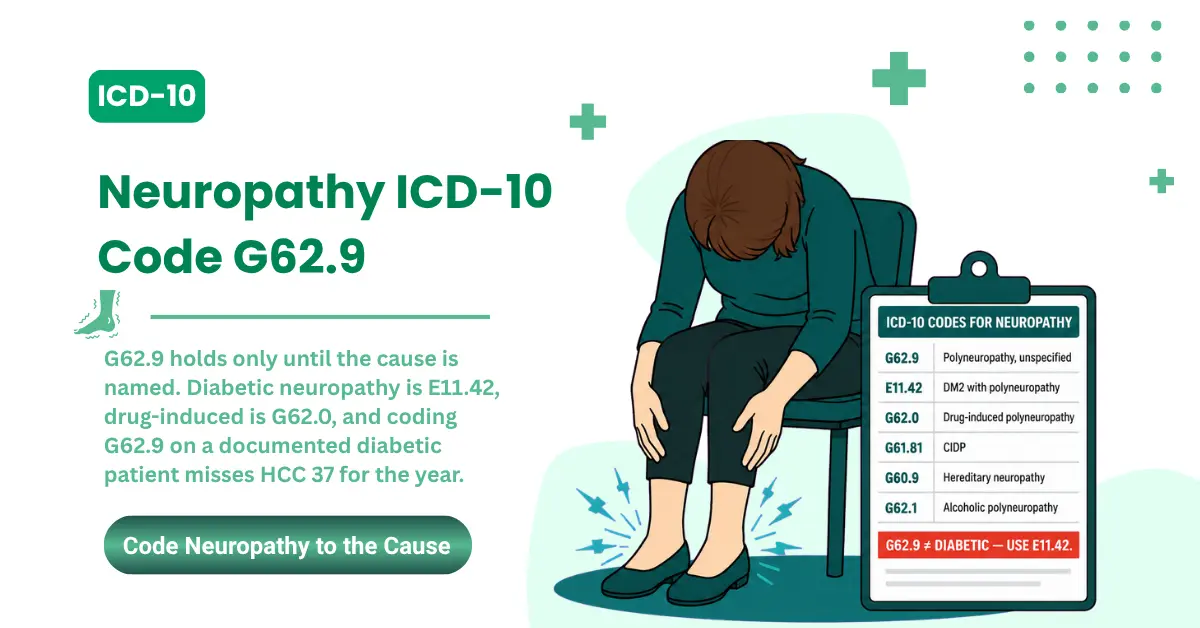
Key Takeaways The primary neuropathy ICD-10 code is G62.9, Polyneuropathy, unspecified, effective October 1, 2025 under FY2026 ICD-10-CM. G62.9 is a placeholder. It fits only when the cause of the neuropathy is undocumented or unknown. When the cause is documented, a more specific code is required. Diabetic neuropathy codes as E11.42 for Type 2 diabetes with polyneuropathy, not as G62.9. Using G62.9 on a documented diabetic neuropathy patient is a coding error that drives denials. The FY2026 update did not change the core neuropathy codes. G62.9, G60.9, and the E11.4x family carry over from FY2025 unchanged. Using G62.9 when E11.42 is the correct code under-codes the visit, lowers Medicare Advantage risk-adjustment capture, and can trigger a CO-50 medical necessity denial. |
The neuropathy ICD-10 code for unspecified polyneuropathy is G62.9, effective October 1, 2025 under FY2026 ICD-10-CM. That single code carries the largest share of neuropathy claims billed to Medicare, Medicaid, and commercial payers. For a narrow set of cases, it's the correct choice.
For most neuropathy patients on your schedule, a more specific code applies. Send G62.9 when E11.42 is the right code, and the claim does more than risk a denial. It under-codes the visit and gives up revenue on every submission.
CMS put the Medicare fee-for-service improper payment rate at 6.55% for FY2025, or $28.83 billion, with insufficient documentation as the leading cause. Neuropathy sits among the higher-denial areas. The diagnosis code, and the note behind it, decides whether the claim clears review.
Coding accuracy here drives first-pass payment, risk-adjustment capture, and audit exposure at the same time. Practices that pair clean documentation with expert medical billing services catch these code mismatches before submission, not after a denial arrives.
Three questions decide every neuropathy ICD-10 coding call: which code fits the encounter, what the provider note has to document to support it, and what happens to the claim when the wrong code goes out. This guide works through all three, with the FY2026 codes and the CPT pairings your billing team submits.
What Is Neuropathy: The Clinical Foundation Every Biller Needs
Neuropathy Definition and Clinical Scope
Neuropathy is damage or dysfunction in the peripheral nerves, the wiring that runs between the brain and spinal cord and the rest of the body. It shows up in three patterns: mononeuropathy, where one nerve is affected; mononeuropathy multiplex, where several separate nerves are; and polyneuropathy, where the damage is diffuse and length-dependent.
That pattern is a billing decision, not only a clinical one. Polyneuropathy codes to the G62.x family. Mononeuropathy codes to G56.x for the upper extremity and G57.x for the lower extremity, and both require laterality on the claim.
An estimated 20 million Americans live with some form of peripheral neuropathy, and more than 100 distinct types exist. Up to half of people with diabetes develop it, which makes diabetes the most common cause. Several hundred ICD-10-CM codes map to neuropathy and the conditions that produce it.
Each of these clinical distinctions changes the ICD-10 code on the claim. The same coding logic carries across nerve and spine conditions, and our ICD-10 billing guide for back pain walks the parallel specificity rules for the M54 family.
The Three Causes That Drive Most Neuropathy Coding Decisions
Three causes account for most neuropathy coding decisions, and each one points to a different code path.
- Diabetes. This is the most common cause, and it never uses G62.9. Diabetic neuropathy takes a combination code from the E10.x through E13.x family that captures the diabetes and the nerve complication together.
- Drug or chemotherapy exposure. A drug-induced polyneuropathy codes to G62.0, paired with a T-code that identifies the drug and the adverse effect.
- Idiopathic or unknown cause. When a full workup turns up no cause, or the workup isn't complete yet, G62.9 is the right code. This is the one scenario where the unspecified code belongs.
Read the cause first, then pick the code. That order is what separates a clean neuropathy claim from a medical necessity denial, and the rest of this guide follows it.
Neuropathy ICD-10 Codes: The Complete FY2026 Reference Table
This is the reference every neuropathy ICD-10 coding decision comes back to. Each code below carries its official descriptor, billable status, and a plain note on when to use it, the part most code databases leave out.
Unspecified and Peripheral Neuropathy Codes (G60 to G62 Family)
The G60 to G65 block covers polyneuropathies and other disorders of the peripheral nervous system. Most outpatient neuropathy coding lives here.
|
Code |
Official descriptor |
Billable |
When to use |
|---|---|---|---|
|
G62.9 |
Polyneuropathy, unspecified |
Yes |
Neuropathy is confirmed, but the cause is not yet documented or identified |
|
G60.9 |
Hereditary and idiopathic neuropathy, unspecified |
Yes |
Hereditary or idiopathic neuropathy with no specific subtype documented |
|
G60.3 |
Idiopathic progressive neuropathy |
Yes |
A progressive neuropathy of unknown origin is documented |
|
G60.8 |
Other hereditary and idiopathic neuropathies |
Yes |
Small fiber neuropathy, idiopathic sensory neuropathy, and other specified types |
|
G62.81 |
Critical illness polyneuropathy |
Yes |
Neuropathy acquired during ICU admission or critical illness |
|
G62.82 |
Radiation-induced polyneuropathy |
Yes |
Radiation therapy is the documented cause of the nerve damage |
|
G62.89 |
Other specified polyneuropathies |
Yes |
Sensorimotor and other specified types without a dedicated code |
|
G63 |
Polyneuropathy in diseases classified elsewhere |
Yes (manifestation) |
Secondary code when an underlying disease causes the neuropathy; code that disease first |
G60 to G62 neuropathy codes. All codes effective October 1, 2025 under FY2026 ICD-10-CM.
G63 is a manifestation code. The underlying disease that causes the neuropathy always sequences first, and G63 never leads as the first-listed diagnosis. These descriptors and effective dates come from the CMS FY2026 ICD-10-CM Official Guidelines, published by CMS and CDC/NCHS.
Diabetic Neuropathy Codes: The Combination Code Family
Diabetic neuropathy never uses G62.9. ICD-10-CM has a separate combination-code family that captures the diabetes diagnosis and the neuropathy complication in one code.
Per the FY2026 Official Guidelines, when a patient with documented diabetes develops neuropathy, the provider uses the E-code family for diabetes with neurological complications. That single E-code replaces both a standalone diabetes code and a standalone G-code.
|
Code |
Official descriptor |
Billable |
When to use |
|---|---|---|---|
|
E11.40 |
Type 2 diabetes mellitus with diabetic neuropathy, unspecified |
Yes |
DM2 causes the neuropathy, but no specific subtype is documented |
|
E11.42 |
Type 2 diabetes mellitus with diabetic polyneuropathy |
Yes |
Multiple peripheral nerves are affected; the most commonly billed diabetic neuropathy code |
|
E11.41 |
Type 2 diabetes mellitus with diabetic mononeuropathy |
Yes |
A single nerve is affected in a Type 2 diabetic patient |
|
E11.43 |
Type 2 diabetes mellitus with diabetic autonomic (poly)neuropathy |
Yes |
Autonomic involvement (GI, cardiac, or urinary) is documented |
|
E11.44 |
Type 2 diabetes mellitus with diabetic amyotrophy |
Yes |
Proximal motor neuropathy with thigh weakness or muscle wasting is documented |
|
E11.49 |
Type 2 diabetes mellitus with other diabetic neurological complication |
Yes |
Neurological complications not captured by E11.40 through E11.44 |
Type 2 diabetes neuropathy codes (E11.4x). All effective October 1, 2025.
Type 1 and other diabetes types follow the same structure. The table below covers the codes billing teams reach for most.
|
Code |
Official descriptor |
|---|---|
|
E10.40 |
Type 1 diabetes mellitus with diabetic neuropathy, unspecified |
|
E10.42 |
Type 1 diabetes mellitus with diabetic polyneuropathy |
|
E10.43 |
Type 1 diabetes mellitus with diabetic autonomic (poly)neuropathy |
|
E08.40 |
Diabetes due to underlying condition with diabetic neuropathy, unspecified |
|
E09.40 |
Drug or chemical induced diabetes with diabetic neuropathy, unspecified |
|
E13.40 |
Other specified diabetes mellitus with diabetic neuropathy, unspecified |
One FY2026 change touches diabetic patients directly. A new code, E11.A (Type 2 diabetes mellitus in remission), took effect October 1, 2025. When a Type 2 patient reaches remission, normal glucose without medication for a sustained period per provider documentation, the diabetes coding changes and the neuropathy pathway needs a fresh review before E11.42 carries forward on follow-up claims.
The official 2026 descriptor for the unspecified code is confirmed at the icd10data entry for G62.9. Practices with heavy diabetic panels lean on neurology billing specialists who verify combination-code accuracy on every neuropathy encounter.
Drug-Induced and Chemotherapy Neuropathy Codes
Chemotherapy-induced peripheral neuropathy, or CIPN, is one of the most miscoded neuropathy types, because the default G62.9 looks close enough and pays on first submission. It isn't the right code, and it doesn't hold up on audit.
|
Code |
Official descriptor |
Billable |
When to use |
|---|---|---|---|
|
G62.0 |
Drug-induced polyneuropathy |
Yes |
A drug, including chemotherapy, causes the polyneuropathy; pair with a T-code |
|
G62.1 |
Alcoholic polyneuropathy |
Yes |
Chronic alcohol use is the documented cause; pair with an F10.x alcohol use code |
|
G62.2 |
Polyneuropathy due to other toxic agents |
Yes |
Heavy metal, industrial chemical, or pesticide exposure is documented |
Drug-induced and toxic neuropathy codes. All effective October 1, 2025.
When neuropathy follows a drug given as prescribed, such as a chemotherapy agent, two codes are required, in this order:
- G62.0, Drug-induced polyneuropathy. This sequences first as the nature of the adverse effect.
- A T36 to T50 adverse-effect code. A code with a 5 in the fifth or sixth character sequences second, identifying the drug. For a chemotherapy agent, that's T45.1X5A, adverse effect of antineoplastic and immunosuppressive drugs, initial encounter.
G62.0 leads, then T45.1X5A follows. Reverse the order, or drop the T-code, and the claim loses the documentation trail a RADV audit looks for.
Inflammatory and Autoimmune Neuropathy Codes (G61 Family)
The G61 family covers inflammatory and autoimmune neuropathies. These are lower-volume codes, but several are among the most denial-prone in neurology because of the treatments they trigger.
|
Code |
Official descriptor |
Billable |
When to use |
|---|---|---|---|
|
G61.0 |
Guillain-Barre syndrome |
Yes |
Acute autoimmune polyneuropathy; often requires hospitalization and IVIG |
|
G61.81 |
Chronic inflammatory demyelinating polyneuritis (CIDP) |
Yes |
Long-term autoimmune neuropathy needing repeated IVIG or plasmapheresis |
|
G61.82 |
Multifocal motor neuropathy |
Yes |
Motor-only neuropathy with no sensory loss |
|
G61.9 |
Inflammatory polyneuropathy, unspecified |
Yes |
Confirmed inflammation, type undetermined |
Inflammatory and autoimmune neuropathy codes (G61 family). All effective October 1, 2025.
CIDP (G61.81) is one of the most denial-prone codes in the set, because IVIG carries a prior-authorization requirement tied to documented clinical criteria. The authorization has to be secured before the infusion date. Our prior authorization services handle those payer approvals so a high-cost infusion never goes out without coverage in place.
When to Use G62.9 and When Not To: The Decision Framework Billers Need
G62.9 is the most over-used code in neuropathy ICD-10 billing. The fix is a simple test on every encounter: is the cause documented? The scenarios below show where the unspecified code belongs and where it quietly costs the practice.
When G62.9 Is the Correct Code
Initial visit, cause pending. A 65-year-old presents with bilateral foot numbness in a stocking distribution. The provider orders HbA1c, CBC, CMP, B12, TSH, and folate, and results aren't back yet. Exam confirms neuropathy, but the cause is still open. Code G62.9 today, then update it once the labs name the cause.
Idiopathic neuropathy, workup complete. EMG confirms an axonal sensorimotor polyneuropathy. Every lab is normal: no diabetes, no B12 deficiency, no toxin exposure, no alcohol history. The cause stays unknown. Code G62.9. This is the one case where G62.9 is permanent rather than a placeholder, because the diagnosis is idiopathic.
Patient declined the workup. The provider recommends bloodwork to evaluate for diabetes, and the patient declines over needle phobia. The provider documents the refusal and treats the symptoms. Code G62.9, with the declined workup noted in the chart.
In all three, document the reason for the unspecified code. An unspecified code with no supporting note is the audit exposure. The phrase that defends G62.9 is right there in the chart: cause pending, workup complete and idiopathic, or patient declined workup.
When G62.9 Is the Wrong Code, and What It Costs
Diabetic patient, G62.9 instead of E11.42. The payer sees G62.9 on a chart that already carries Type 2 diabetes. Medicare's automated edits and many commercial payers flag that mix for medical necessity review, and the claim comes back CO-50. The deeper cost is risk adjustment: the encounter misses HCC 37, the diabetes-with-chronic-complications category, and drops to the lower-weighted HCC 38.
CIPN patient, G62.9 instead of G62.0 plus a T-code. The oncology note documents chemotherapy-induced neuropathy. The biller defaults to G62.9, and the claim pays on first submission. On a RADV audit, the record doesn't support the unspecified code, and overpayment recoupment follows. The defensible pairing was G62.0 plus T45.1X5A.
Alcoholic neuropathy, G62.9 instead of G62.1. The note documents chronic alcohol use disorder and peripheral neuropathy. G62.9 pays, but payer pattern analysis flags the F10.20 and G62.9 combination as a possible under-code, and a records request follows. The correct code was G62.1 with F10.20.
Before any neuropathy claim goes out, answer one question: does the record document a known cause? If yes, the cause picks the code. G62.9 is never the right choice when the cause is documented.
Practices that run a pre-submission specificity check catch each of these patterns early. Our neuropathy claim denial management team reviews neuropathy claims for code specificity before submission, not after the denial.
Neuropathy ICD-10 Codes by Sub-Type: Peripheral, Sensory, Motor, and More
Neuropathy sub-types map to different codes, and the search terms providers use rarely match the code they need. Each sub-type below resolves to a specific code or a short decision.
Peripheral Neuropathy ICD-10 Code
Peripheral neuropathy is the umbrella term, and its code depends on the cause and how many nerves are involved. Cause unknown codes to G62.9. Hereditary codes to G60.9. Diabetic codes to E11.42, the most common case. Drug-induced codes to G62.0. The cause drives the code every time.
Neuropathy Unspecified ICD-10
G62.9 is the ICD-10-CM code for neuropathy, unspecified. The official descriptor is Polyneuropathy, unspecified, and the alphabetic index also lists it as Neuropathy NOS. It's billable and effective October 1, 2025. Use it only when the cause is undocumented or unknown after a full workup, never when diabetes, a drug, alcohol, or another documented condition is in play.
Diabetic Peripheral Neuropathy ICD-10
Diabetic peripheral neuropathy codes to E11.42, not G62.9. The trigger sits in one word in the provider note: “with.” “Type 2 diabetes mellitus with diabetic peripheral neuropathy” supports the combination code. List the diabetes and the neuropathy as two separate lines with no linking language, and the coder has to default to G62.9 and query the provider.
Leg Neuropathy ICD-10 and Lower Extremity Neuropathy
Lower-extremity neuropathy isn't a single code. It depends on whether the damage is diffuse or in one nerve. A polyneuropathy of the lower extremities codes to G62.9, or to the cause-specific code such as E11.42 for a diabetic patient.
Mononeuropathy of a specific leg nerve needs laterality, and the exact nerve has to be named. The peroneal nerve, also called the lateral popliteal nerve, is G57.30 unspecified, G57.31 right, and G57.32 left.
The sciatic nerve is G57.00, G57.01, and G57.02. Foot and Morton's neuroma queries map to G57.6x, the plantar nerve. Mixing up the peroneal and sciatic codes triggers automatic rejections.
Sensory Neuropathy ICD-10 and Motor Neuropathy ICD-10
ICD-10-CM has no standalone codes for “sensory neuropathy” or “motor neuropathy.” Those terms describe the fiber type, not the cause, and coding stays cause-based.
A sensory-predominant neuropathy of unknown cause codes to G62.9, or G60.8 if it's idiopathic. A sensory neuropathy from diabetes codes to E11.42. A confirmed motor-only multifocal pattern codes to G61.82. The fiber type guides the specificity question, but it doesn't override the cause.
Idiopathic Peripheral Neuropathy ICD-10
Idiopathic peripheral neuropathy means the cause is unknown after a complete evaluation, and two codes are in play. G60.9 fits when the neuropathy is established as idiopathic or hereditary after a full workup. G62.9 fits when the cause is unknown but not yet fully investigated. G60.3 is the specific code for idiopathic progressive neuropathy.
Read the provider's wording closely. “Idiopathic” isn't always spelled out. When the note says only “cause unknown,” G62.9 is the safer choice unless the provider documents a hereditary or progressive idiopathic pattern.
Mononeuropathy ICD-10
Mononeuropathy is damage to a single peripheral nerve, and it never uses G62.9. These codes live in the G56 family for the upper extremity and the G57 family for the lower extremity, and every one of them requires laterality.
|
Common mononeuropathy |
Code family |
Laterality required |
|---|---|---|
|
Carpal tunnel syndrome |
G56.0x |
Yes (right, left, bilateral, unspecified) |
|
Ulnar nerve lesion |
G56.2x |
Yes |
|
Radial nerve lesion |
G56.3x |
Yes |
|
Peroneal (lateral popliteal) nerve lesion |
G57.3x |
Yes |
|
Sciatic nerve lesion |
G57.0x |
Yes |
|
Tarsal tunnel syndrome |
G57.5x |
Yes |
|
Morton's neuroma (plantar nerve lesion) |
G57.6x |
Yes |
Using G62.9 for any of these is a coding error. G62.9 is polyneuropathy. These conditions are mononeuropathies, and the payer's edits treat them as two different things.
FY2026 ICD-10-CM Update Status for Neuropathy Codes: What Changed and What Did Not
What the FY2026 Update Means for Neuropathy Billing
FY2026 ICD-10-CM codes, effective October 1, 2025, did not change the core neuropathy families. G62.9, G60.9, G60.3, the G62.0 through G62.82 family, and the E11.4x combination codes all carry over from FY2025 unchanged. G62.9 has been valid and stable since the first edition of ICD-10-CM.
The wider update was substantial. CMS and CDC/NCHS added 487 new diagnosis codes, revised 38, and deleted 28 across the full set for FY2026. The biggest neurology change wasn't in neuropathy at all: the old multiple sclerosis code G35 was deleted and expanded into the G35.A, G35.B, and G35.C series, which now require the MS subtype and activity status.
One FY2026 change does touch diabetic panels. E11.A, Type 2 diabetes mellitus in remission, is new as of October 1, 2025. When a patient's Type 2 diabetes reaches remission, the diabetes codes shift and the neuropathy pathway needs a fresh look.
Verify annually that your EHR superbill templates point to the current fiscal-year code set. A claim submitted with a deleted or revised code triggers an automatic rejection. CMS posts the update files, including each fiscal year's effective-date window, on the official CMS ICD-10-CM update files page.
FY2027 Preview: What Billing Teams Should Monitor Now
The FY2027 ICD-10-CM files were released in mid-2026 and take effect October 1, 2026. FY2027 adds 238 new codes, revises 4, and removes 21. The core neuropathy families aren't among the revisions, but billing teams should still pull the files and check their neuropathy superbill templates before the October 1 cutover.
Two fiscal years matter to your team right now: FY2026 codes apply to dates of service through September 30, 2026, and FY2027 codes apply from October 1, 2026 forward. The CDC ICD-10-CM files page hosts the full FY2027 download.
Neuropathy ICD-10 Codes and CPT Pairings: What Gets Submitted on the Actual Claim
The Deleted CPT Codes That Still Cause Denials
CPT codes 95900, 95903, and 95904 were deleted from the code set effective January 1, 2013. Any claim that carries them on a date of service from then on gets rejected at the clearinghouse or denied by the payer. More than a decade later, they still sit in legacy EHR templates and old superbills across neurology and primary care.
The current nerve conduction study family is 95907 through 95913. These are counted per study, not per nerve. One motor conduction study and one sensory conduction study on the same nerve count as two separate studies for code selection in the 95907 through 95913 range. The combined needle EMG with NCS family is 95885 through 95887.
Billing a deleted code is one of the fastest paths to an automatic rejection with no appeal, because the code no longer exists in the payer's set. If your EHR auto-populates 95900, 95903, or 95904 on a neuropathy encounter, fix the template before the next submission cycle.
When a denial pairs a procedure-code error with a medical necessity edit, our CO-50 denial code guide walks the resolution step by step.
ICD-10 to CPT Pairing Table for Neuropathy Encounters
The diagnosis code on the claim has to match the rationale for the procedure billed. This table maps the common neuropathy codes to the CPT codes that pay alongside them, with the medical necessity link for each.
|
Clinical scenario |
ICD-10 code |
CPT code |
Code description |
Medical necessity connection |
|---|---|---|---|---|
|
New neuropathy patient, office visit |
G62.9 or E11.42 |
99204, 99205 |
New patient E/M, moderate to high |
MDM and workup support the complexity level |
|
Established neuropathy follow-up |
E11.42 or G62.9 |
99213 to 99215 |
Established patient E/M |
Level set by stability, med changes, data reviewed |
|
Nerve conduction study, 1 to 2 studies |
G62.9 or E11.42 |
95907 |
NCS, 1 to 2 studies |
Symptoms plus rationale required by the LCD |
|
NCS, 3 to 4 studies |
G62.9 or E11.42 |
95908 |
NCS, 3 to 4 studies |
Same LCD; level by study count, not nerve count |
|
NCS, 5 to 6 studies |
G62.9 or E11.42 |
95909 |
NCS, 5 to 6 studies |
Study count drives the code selection |
|
NCS, 7 to 8 studies |
G62.9 or E11.42 |
95910 |
NCS, 7 to 8 studies |
Study count drives the code selection |
|
Needle EMG plus NCS |
G62.9 or E11.42 |
95885 |
EMG with NCS, per extremity |
EMG documented separately; not bundled with NCS |
|
Comprehensive NCS evaluation |
G62.9 or E11.42 |
95911 to 95913 |
NCS, 9 or more studies |
Extensive bilateral evaluation documented |
|
CIPN evaluation |
G62.0 plus T45.1X5A |
95908 to 95911 |
NCS per study count |
G62.0 sequences first, the T-code second |
|
Autonomic neuropathy evaluation |
E11.43 or G90.09 |
95923 |
Autonomic function testing |
Documented autonomic symptoms required |
Neuropathy ICD-10 and CPT pairing reference, FY2026. Study counts and code selection follow current AMA CPT guidance.
Payers use Local Coverage Determinations to define which diagnosis codes support medical necessity for each NCS and EMG code. Submit G62.9 with a high-study-count NCS like 95913, and the claim draws a medical necessity review, because an unspecified diagnosis doesn't justify an extensive bilateral study on its own.
CMS put the FY2025 Medicare fee-for-service improper payment rate at 6.55%, or $28.83 billion, with insufficient documentation among the top causes.
Does Medicare Pay for Neuropathy Testing: The LCD Answer
Medicare does cover nerve conduction studies and needle EMG for neuropathy, when the encounter meets the medical necessity criteria in the applicable Local Coverage Determination. The NCS and EMG LCD varies by Medicare Administrative Contractor, and each MAC publishes its own.
Those documents spell out which diagnosis codes support coverage, what the note has to show, and how many studies are covered.
Three requirements show up across nearly every MAC LCD. First, the note documents neuropathy symptoms, numbness, tingling, weakness, or pain, of enough duration and severity to justify the study. Second, the note states the clinical reason for ordering the study, not only the procedure name. Third, the diagnosis code appears on the LCD's covered list.
G62.9 is typically covered, though E11.42 and the specific diabetic codes often draw closer scrutiny, because payers expect the note to tie the neuropathy to the diabetes plan.
Medicare Advantage plans can set their own medical policy, stricter or looser than the MAC LCD. Before any NCS or EMG claim goes out, confirm the diagnosis code sits on the applicable LCD covered list. That 30-second check heads off the most common medical necessity denial in neurology billing.
Our ICD-10 coding guide for dysphagia covers another neurology claim type with the same LCD discipline.
Neuropathy Coding and HCC Risk Adjustment: The Revenue Impact of Getting It Right
CMS-HCC Model V28 and What It Means for Neuropathy Practices
CMS-HCC Model V28 runs 100% of Medicare Advantage risk scoring as of January 1, 2026. The blended V24 and V28 scoring period is over, and every MA patient is now scored under V28 alone.
V28 sorts diabetes risk into three categories. HCC 36 covers diabetes with severe acute complications. HCC 37 covers diabetes with chronic complications, which includes neuropathy, nephropathy, and retinopathy, and it carries a higher weight. HCC 38 covers diabetes with glycemic, unspecified, or no complications, at the lowest weight.
The code choice shows up directly in the payment. A patient coded E11.9 maps to HCC 38. A patient coded E11.42 maps to HCC 37, the higher-weighted category.
Code the diabetes and the neuropathy as E11.9 plus G62.9 on separate lines, and under V28's constraining rule those two don't add up to HCC 37. The only path to HCC 37 for a diabetic neuropathy patient is the combination code, E11.42.
That's the constraining rule, and it reversed the old V24 habit. Under V24, separate codes could each add their own credit. Under V28, related conditions in a disease family share a coefficient, so stacking E11.9 and G62.9 no longer captures the chronic-complication value. The combination code is the only way to reach it.
Annual HCC Recapture: The Requirement Every Billing Team Must Know
HCC values don't carry forward on their own. Every chronic condition has to be documented, coded, and submitted on at least one claim each calendar year to count toward that patient's risk score for that year.
A neuropathy patient coded E11.42 in 2025 doesn't automatically generate an HCC 37 credit in 2026. If the 2026 notes fall back to E11.9 or G62.9 because the provider didn't link the neuropathy to the diabetes that year, the HCC drops off. For an MA plan, that's lost revenue. On a value-based contract tied to risk scores, the gap compounds.
Annual recapture takes three things from the billing team:
- Prior-year review. Check each Medicare Advantage patient's prior-year HCC codes before the first encounter of the new calendar year.
- A CDI prompt. Flag patients with prior E11.4x codes in the EHR for explicit re-documentation at the next visit.
- A post-submission audit. Confirm the HCC-bearing codes landed on at least one clean claim before December 31.
Miss recapture on a panel of diabetic neuropathy patients, and the lost risk-adjusted revenue for that year can't be recovered retroactively. Integrated revenue cycle management for Medicare Advantage populations builds HCC recapture into the annual billing cycle as a standard step.
Documentation Requirements for Neuropathy ICD-10 Coding: What the Provider Note Must Say
The Five Documentation Elements That Determine the Code
Every neuropathy ICD-10 code selection rests on five elements in the provider note. Each maps to a step in the coding hierarchy. Miss one, and the coder either defaults to an unspecified code or sends a query.
- Cause or association. The note states whether the neuropathy is caused by or tied to a documented condition: diabetes, chemotherapy, alcohol use, radiation, critical illness, or a hereditary condition. No documented cause means the code defaults to G62.9.
- Pattern or distribution. Mononeuropathy (one nerve) versus polyneuropathy (multiple nerves). A note that says only “peripheral neuropathy” codes as polyneuropathy, G62.9, unless a cause narrows it. “Carpal tunnel syndrome” codes to G56.0x, not G62.9.
- Fiber type when documented. Sensory, motor, or autonomic involvement. This doesn't change the primary code, but it shapes the CPT selection for diagnostic studies and the medical necessity argument on audit.
- Laterality for mononeuropathy. Right, left, bilateral, or unspecified, required on every G56.x and G57.x code. Missing laterality on a mononeuropathy claim triggers an automatic rejection.
- Linkage language for diabetes. The words “with” or “due to” connecting the diabetes and the neuropathy are the trigger for the combination code. “Type 2 diabetes mellitus with diabetic peripheral neuropathy” supports E11.42. The two listed as separate problems need a query first.
These elements come straight from the FY2026 ICD-10-CM Official Guidelines, published by CDC/NCHS and CMS, which require the documentation to support the assigned code at the specificity level chosen.
Poor Documentation vs. Good Documentation: Side-by-Side Examples
The gap between a defensible neuropathy code and a denial usually comes down to four or five words in the assessment. The examples below show it across the common scenarios.
Example 1, unspecified neuropathy (G62.9).Poor: “Assessment: Neuropathy. Plan: Gabapentin.” No cause or distribution, so a diabetic patient still can't reach E11.42 here. Good: “Peripheral polyneuropathy, bilateral lower extremities, likely idiopathic. Diabetes, B12, thyroid, and alcohol screening negative. Progressive over six months.” Idiopathic is stated, causes excluded, distribution set. G62.9 is auditable.
Example 2, diabetic neuropathy (E11.42).Poor: “1. Type 2 Diabetes. 2. Neuropathy. Plan: Continue metformin, gabapentin for neuropathy.” Two separate diagnoses, no linkage, no E11.42 without a query. Good: “Type 2 diabetes mellitus with diabetic peripheral polyneuropathy. A1c 9.4%. Stocking-glove sensory loss, bilateral feet.” “With” does the work, polyneuropathy is specified, distribution is clear. E11.42 is supported.
Example 3, CIPN (G62.0 plus T45.1X5A).Poor: “Neuropathy. History of breast cancer, finished chemotherapy six months ago.” A cancer history next to neuropathy doesn't link them for coding. Good: “Chemotherapy-induced peripheral neuropathy. Completed a taxane regimen six months ago. Bilateral hand tingling consistent with CIPN.” “Chemotherapy-induced” is the link. G62.0 first, then the adverse-effect T-code.
Example 4, idiopathic progressive neuropathy (G60.3).Poor: “Progressive neuropathy. Cause unknown.” Valid for G62.9, but G60.3 is more specific when a progressive pattern is documented. Good: “Idiopathic progressive sensorimotor polyneuropathy. Eighteen-month workup negative for diabetes, B12, TSH, SPEP, and paraneoplastic panel. EMG confirms axonal polyneuropathy with proximal-to-distal progression.” G60.3 is the correct, most specific code.
The Provider Query Template for Neuropathy Coding
When the note lacks the linkage language a specific code needs, the coder queries the provider. Coders code what's documented for that visit. They can't infer a link or carry forward a prior-visit diagnosis without current documentation. A clean query looks like this.
|
Sample provider query Encounter date: [Date] Patient: [Identifier] The note documents both Type 2 diabetes mellitus and peripheral neuropathy. To assign the most specific ICD-10 code for this encounter, please confirm: 1. Are the neuropathy symptoms related to or caused by the Type 2 diabetes? If yes, please add: “Type 2 diabetes mellitus with diabetic peripheral neuropathy.” 2. Does the neuropathy involve multiple peripheral nerves (polyneuropathy) or one specific nerve? 3. Are there findings from today that support updating the code from unspecified (G62.9) to a more specific type? Your clarification supports accurate coding, prevents denials, and captures the condition for risk adjustment. Thank you, [Coder Name], [Credential]. |
Answering this takes the provider about 45 seconds. Skipping it costs the practice the HCC 37 contribution for the year. Document the link once, early in the year, and the revenue follows. These standards carry across neurology, endocrinology, oncology, and pain management, and our neurology billing by specialty team runs each lane to its own payer rules.
Neuropathy ICD-10 Coding: Frequently Asked Questions
What Is the ICD-10 Code for Neuropathy?
The ICD-10 code for unspecified neuropathy is G62.9, Polyneuropathy, unspecified, effective October 1, 2025 under FY2026 ICD-10-CM. It's billable and valid for HIPAA-covered transactions. When the cause is documented, a more specific code applies: diabetic neuropathy codes as E11.42, and drug-induced neuropathy codes as G62.0. G62.9 is used only when the cause is undocumented.
How Do You Code Neuropathy in ICD-10?
Coding neuropathy takes two steps. First, determine whether the cause is documented. If it's diabetes, use E11.40 through E11.49 by involvement. If it's chemotherapy, use G62.0 paired with a T-code. If it's alcohol, use G62.1. If the cause is unknown after a full workup, use G62.9. Never use G62.9 when a documented cause exists.
What Is the ICD-10 Code for Neuropathy Due to Treatment?
The ICD-10 code for neuropathy caused by drug treatment, including chemotherapy, is G62.0, Drug-induced polyneuropathy. Two codes are required. G62.0 sequences first as the nature of the adverse effect. A T36 to T50 code with a 5 in the fifth or sixth character sequences second to identify the drug. For a chemotherapy agent, that's T45.1X5A for the initial encounter.
What Is the ICD-9 Code for Peripheral Neuropathy Unspecified?
The ICD-9-CM code was 356.9, unspecified hereditary and idiopathic peripheral neuropathy. ICD-9 was replaced by ICD-10-CM for all HIPAA-covered transactions on October 1, 2015, and claims with ICD-9 codes on or after that date are rejected. Code 356.9 crosswalks to ICD-10-CM G60.9. When the neuropathy isn't characterized as hereditary or idiopathic, the unspecified polyneuropathy code G62.9 applies.
What Are the Four Types of Neuropathy?
The four types are classified by the nerve fibers affected. Sensory neuropathy affects sensation, causing numbness, tingling, and pain. Motor neuropathy affects muscle movement, causing weakness and poor coordination. Autonomic neuropathy affects involuntary functions like heart rate and digestion. Combination neuropathy involves more than one fiber type. Each type shapes the documentation and the code.
What Is Diabetic Neuropathy Called in ICD-10?
In clinical terms it's called diabetic peripheral neuropathy or diabetic polyneuropathy. In ICD-10-CM, it's captured as a combination code that names both the diabetes type and the neuropathy complication. The most commonly billed code is E11.42, Type 2 diabetes mellitus with diabetic polyneuropathy. That one code replaces a separate diabetes code and a separate neuropathy code.
Does Medicare Pay for Neuropathy Testing?
Yes. Medicare covers nerve conduction studies and needle EMG when the encounter meets the applicable Local Coverage Determination criteria. The note must document symptoms, clinical rationale, and a covered diagnosis code. The current NCS codes are 95907 through 95913, billed per study. Codes 95900, 95903, and 95904 were deleted in 2013. Medicare Advantage plans may set separate policies.
For neuropathy practices with Medicare Advantage volume, accurate HCC coding plus systematic accounts receivable follow-up for neuropathy claims protects both this year's collections and next year's risk-adjustment payments.
Why Accurate Neuropathy Coding Matters for Your Practice's Bottom Line
What Neuropathy Coding Errors Cost Your Practice
Inaccurate neuropathy coding leaks revenue in four predictable ways, and none of them are rare.
Missed risk adjustment. Billing G62.9 for diabetic neuropathy patients instead of E11.42 misses HCC 37 on each one, the chronic-complications category that carries the higher weight. Across a panel, that's risk-adjusted revenue the practice never captures.
RADV recoupment. A single CIPN claim coded G62.9 instead of G62.0 plus the T-code can trigger full recoupment of that claim's payment on a RADV audit. For infusion-adjacent claims, the per-encounter exposure runs high.
Reset filing clocks. NCS claims denied for deleted CPT codes don't only get denied. They reject at the clearinghouse and reset the timely filing clock. One billing cycle of rejections on a legacy template can push cash flow back by weeks.
Under-coded visits. Under-coded E/M visits with neuropathy diagnoses cost roughly $35 to $44 per visit when 99213 is billed instead of 99214 for an encounter that supports moderate MDM. These aren't edge cases. They're the patterns MedSole's certified coders find in the first 30 days on a new neurology or endocrinology account.
MedSole RCM: Full Revenue Cycle Management for Neuropathy Practices
MedSole RCM provides full-service outsourced medical billing starting at 2.99% of collections. Many national RCM firms charge 7% to 10% of collections for comparable work. Provider credentialing and payer enrollment run $99 per payer, so a neurologist enrolling with five new commercial payers pays $495 total.
The certified coding team, AAPC-credentialed, covers more than 100 specialties, including neurology, endocrinology, oncology, and pain management, the four that drive the most neuropathy volume. Active accounts run a 99% first-pass claim acceptance rate and 99.8% coding accuracy, with accounts receivable averaging 24 days and more than $200 million in claims managed across 50-plus EHR systems, in all 50 states.
Autonomic neuropathy screening guidance in the American Diabetes Association Standards of Care in Diabetes supports E11.43 coding when the documentation is there.
Neuropathy billing is specialty billing. It takes coders who know the G62.9 decision framework, the E11.42 combination code, the CIPN sequencing rule, and the HCC recapture calendar. If you're billing neuropathy encounters and you aren't sure the codes capture what they should, MedSole runs a free billing assessment, no commitment required.
Neuropathy ICD-10 Coding in 2026: The Decision That Determines Your Revenue
Accurate neuropathy ICD-10 coding comes down to three decisions on every encounter: which code matches the documented cause, whether the note carries the linkage language to support it, and whether the code lines up with the right CPT pairing for the procedure ordered.
Get all three right, and the claim pays on first submission, the HCC is captured, and the revenue cycle closes clean.
Get any one wrong, and the practice absorbs the denial, the rework, and the delayed cash flow. In Medicare Advantage populations, it also absorbs the annual loss of HCC 37 revenue that can't be recovered retroactively.
MedSole RCM manages neuropathy billing for neurology and endocrinology practices across all 50 states, starting at 2.99% of collections with credentialing at $99 per payer. If your practice bills neuropathy encounters, start with a free billing assessment to find where the coding gaps are. There's no commitment required.
Sources
- CMS and CDC/NCHS, FY2026 ICD-10-CM Official Guidelines for Coding and Reporting.
- ICD10Data, 2026 ICD-10-CM Diagnosis Code G62.9.
- CMS, ICD-10 code update files (FY2026 and FY2027 effective-date windows).
- CMS, Comprehensive Error Rate Testing (CERT), FY2025 Medicare fee-for-service improper payment data.
- CDC/NCHS, ICD-10-CM Files (FY2027 release).
- CMS-HCC Model V28 risk adjustment, payment year 2026 (diabetes HCC 36, 37, and 38 categories).
- American Diabetes Association, Standards of Care in Diabetes (autonomic neuropathy screening).