



Ohio Medicaid provider enrollment runs through one system. You apply to the Ohio Department of Medicaid (ODM) inside the Provider Network Management module, known as PNM, and you sign in with an OH|ID. Ohio doesn't accept paper applications. The whole process is electronic.
Enrollment covers more than fee-for-service. ODM screens and enrolls every provider who gets paid for treating a Medicaid member, including providers who only see managed care patients. Skip the state step and your claims stop before a plan ever sees them.
Portal: Every Ohio Medicaid provider enrollment application goes through the PNM module.
Login: You need an OH|ID, written OHID in some ODM materials, to reach PNM.
Paper applications: Ohio doesn't accept them. Enrollment is electronic only.
Required for: Both fee-for-service and managed care participation and payment.
This guide is written for providers, office managers, and credentialing staff who need to bill Ohio Medicaid. If you're an Ohio resident applying for coverage, that's a separate process. Apply through the Ohio Benefits Self-Service Portal or call the consumer hotline at 800-324-8680.
Ohio has more than 200,000 active Medicaid providers, and 2026 changed the rules for a lot of them. Two enrollment moratoriums are running at the same time. An emergency executive order cut the inactivity termination threshold from two years to one. Managed care plans start denying claims with ORP NPI errors on January 1, 2027.
Our credentialing team at MedSole RCM revenue cycle management submits payer enrollments across all 50 state Medicaid programs, and Ohio raises more questions than most. The state stacks its own requirements on the federal floor covered in our 50-state Medicaid enrollment guide.
What Ohio Medicaid Provider Enrollment Actually Means
Ohio Medicaid provider enrollment produces two things: a signed Medicaid provider agreement and an Ohio Medicaid provider number. Until you hold both, a claim has nowhere to land. Think of the provider number as your billing identity inside the state system. Without it, the claim you submit doesn't map to anyone ODM recognizes.
What you get at the end of enrollment
ODM issues the provider agreement and the Medicaid provider number together. The agreement sets the terms of your participation. The number identifies you on claims, on remittance, and in every managed care plan's provider file.
PNM replaced MITS in October 2022
PNM went live on October 1, 2022 and took over provider enrollment from the old MITS system. Maximus operates the module for ODM. If you find guidance that tells you to enroll through the MITS provider portal, that guidance predates the change and won't get you anywhere.
Older ODM pages and payer notices still mention MITS in passing, so the name hasn't vanished. Every new application, every specialty addition, and every revalidation now runs inside PNM.
Managed care participation still requires state enrollment
Federal managed care rules require ODM to screen and enroll all network providers who receive payment for Medicaid members. Signing a contract with a plan doesn't replace that step. The plan can put you in its network and still be unable to pay you.
What usually happens next is a rejection nobody expects. The EDI front door stops claims from unenrolled providers before adjudication, and the plan can't accept the encounter either.
Your biller sees a rejection code and starts troubleshooting the claim, so the team spends weeks looking in the wrong place. You can confirm the electronic-only rule and the current application path on Ohio Department of Medicaid enrollment.
Enrollment, Credentialing, and MCO Contracting Are Three Different Things
Most Ohio Medicaid billing problems trace back to one confusion. Providers treat enrollment, credentialing, and contracting as a single task. Ohio treats them as three, owned by different parties, finishing on different dates.
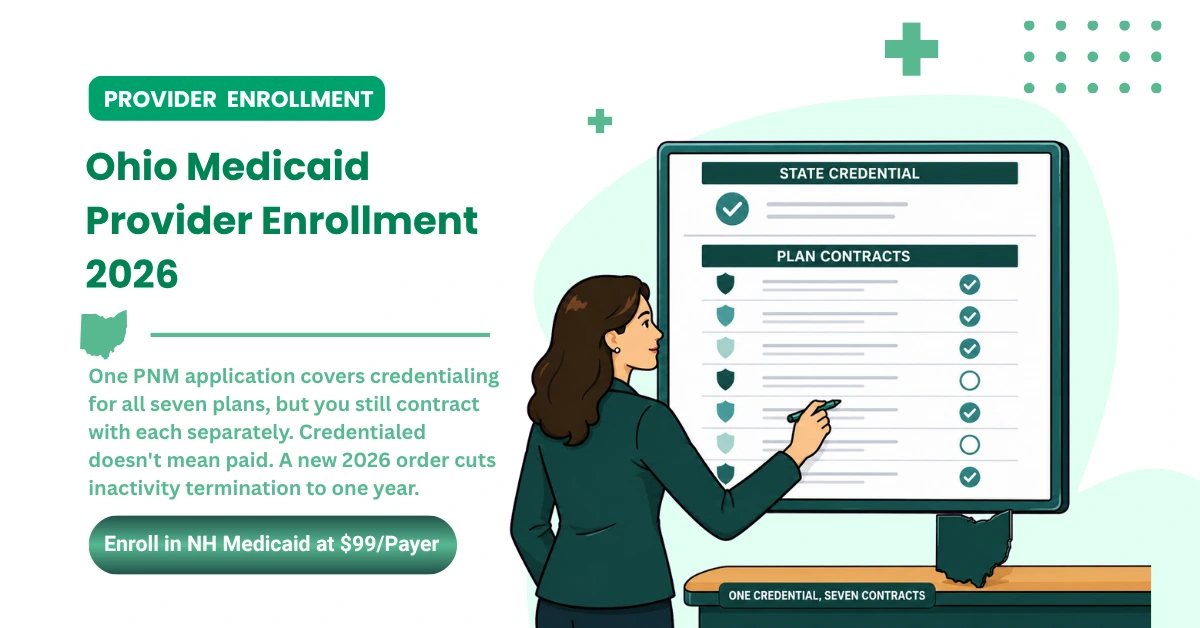
You enroll once with ODM. ODM credentials you once, at the state level. Then you contract separately with each managed care plan whose members you want to see.
|
Layer |
Who owns it |
What it produces |
|---|---|---|
|
Enrollment |
ODM |
Provider agreement and Ohio Medicaid provider number |
|
Credentialing |
ODM through its CVO |
Approval to participate in Ohio Medicaid |
|
Contracting |
Each managed care plan |
In-network status and your rate with that plan |
ODM enrollment gives you a number, not a network
Enrollment is the state-level registration. It establishes that ODM recognizes you as an eligible provider and issues the number your claims carry. Nothing about network participation is decided here.
Centralized credentialing covers the whole program
Credentialing is the qualification review. ODM has run it centrally since October 1, 2022, using a credentials verification organization to collect primary source verifications and monitor sanctions. In Ohio, you don't credential separately with each managed care plan. One application covers the review for the whole program.
Why you still contract with each plan
Contracting is the network agreement, and ODM doesn't sign it for you. The plan does. That contract sets your participation status, your rates, and your effective date with that plan. A member belongs to one plan at a time, so the plans you contract with decide which patients you can see in network.
Credentialed but denied: what that usually means
A practice finishes enrollment, PNM shows the provider as credentialed, and sessions start. Three plans pay without issue. The fourth denies every claim as out of network. Nothing in the ODM record looks broken, and the billing team starts hunting for a coding error that isn't there.
That pattern points to a missing contract. Same state credential, different network status. If your ODM record is active and one plan denies as out of network, check your contract status with that plan before you touch the codes. State enrollment gets you the number; the contract gets you paid. Our guide on credentialing versus enrollment explained walks through the same distinction outside Ohio. ODM's own ODM Credentialing Guide confirms credentialing sits apart from enrollment even though one application covers both.
Who Has to Enroll With Ohio Medicaid
Enrollment is mandatory for any provider who wants payment for services to an Ohio Medicaid member. That includes providers serving managed care, Next Generation MyCare, OhioRISE, and pharmacy benefit members. Fee-for-service isn't the dividing line.
Ohio sorts applicants into numbered provider types, and the number drives your screening level, your documentation, and sometimes whether you can enroll at all right now. Pick the wrong one and the correction costs weeks.
|
Provider category |
Who it covers |
NPI type |
Notes |
|---|---|---|---|
|
Individual practitioners |
Physicians, PAs, APRNs, psychologists, therapists, dentists, optometrists, podiatrists, chiropractors |
Type 1 |
Credentialing is mandatory for many of these types |
|
Groups and organizations |
Group practices, agencies, clinics billing under a business EIN |
Type 2 |
Affiliate rendering providers to the group in PNM |
|
Facilities |
Hospitals, psychiatric hospitals, PRTFs, nursing facilities, ICFs |
Type 2 |
Attending practitioner NPI required on institutional claims |
|
Waiver and HCBS |
Waivered services individuals and organizations, personal care aides, home care attendants |
Type 1 or 2 |
Several of these types sit under an active moratorium |
|
Atypical providers |
Non-medical service providers |
None |
Enroll without an NPI under a separate pathway |
|
ORP only |
Ordering, referring, and prescribing providers |
Type 1 |
Reporting-only enrollment, no billing rights |
What is an atypical provider in Ohio Medicaid
An atypical provider delivers services that aren't health care under federal definitions, so the provider doesn't qualify for an NPI. Transportation providers and some home and community-based service providers fall into this group.
Atypical providers still enroll with ODM and still receive a Medicaid provider number. They skip the NPI requirement that governs standard provider types. Choosing atypical status when you should have an NPI creates a claims problem that surfaces at the first submission.
Ordering, referring, and prescribing only enrollment
ORP enrollment, meaning ordering or referring only, lets a practitioner appear on someone else's claim without billing Ohio Medicaid directly. A physician who orders imaging for a patient they don't bill for still needs an active Ohio Medicaid record so the imaging claim pays.
ODM recognizes reporting-only enrollment for a defined list of provider types under Ohio Administrative Code 5160-1-17.9. Physicians, physician assistants, chiropractors, dentists, optometrists, podiatrists, licensed psychologists, and several advanced practice nurse types can enroll this way.
Behavioral health and OhioRISE providers
Behavioral health agencies and the practitioners affiliated with them enroll like other Ohio providers, then face a second layer if they treat youth in OhioRISE. That program runs on its own network and its own billing path, which we cover in our guide to behavioral health provider enrollment.
Your provider type selection matters more than you think
ODM says the provider type response is extremely important, and the agency means it. Your selection sets the screening risk level ODM applies and the documents the agency asks for. Call the Integrated Help Desk at 800-686-1516 before you submit if you're unsure. Fixing the type after approval is slower than asking first.
The full list of practitioners ODM must credential appears in Ohio Administrative Code 5160-1-42.
Ohio Medicaid Provider Enrollment Requirements: What to Gather First
Applications stall on document mismatches far more often than on eligibility. A legal name on the W-9 that doesn't match the IRS file. A practice address that reads one way in NPPES and another way on the application. An ownership disclosure with a blank field nobody noticed.
None of those are hard problems. They're the reason a file sits in manual review for a month. Ohio's requirements aren't unusual, but the state checks them against outside systems, and those systems have to agree.
|
Requirement |
Individual practitioners |
Groups, organizations, and facilities |
|---|---|---|
|
NPI |
Type 1, active in NPPES with correct taxonomy |
Type 2 for the entity, plus Type 1 for each rendering provider |
|
Tax identity |
SSN |
EIN with IRS CP-575 or 147C letter |
|
W-9 |
Legal name matching IRS records |
Legal entity name, not the DBA |
|
License |
Active, unrestricted Ohio license |
Facility licenses for every licensed service |
|
Liability insurance |
Current declarations page |
$1 million per occurrence and $3 million aggregate |
|
Ownership disclosure |
As applicable |
All owners and managing employees at 5% or greater |
|
Service locations |
Every location you bill under |
Every location, disclosed at enrollment |
|
Banking |
Voided check or bank letter for EFT |
Same, tied to the billing entity |
Ownership and control disclosure and the 5% rule
ODM requires you to disclose owners, board members, and managing employees, including Social Security numbers and dates of birth. The agency states this on its own provider enrollment page, and the requirement isn't optional for organizational applicants.
ODM also warns that entering a fake Social Security number causes automatic rejection. Practices sometimes place a filler number in a field they can't complete, expecting to correct it later. That choice ends the application. Ohio Administrative Code 5160-1-17.3 governs the disclosure rule and lets ODM deny enrollment when an affiliation poses undue risk.
Service locations must all be disclosed
Screening applies to every service location, so every location goes on the application. When you add a location later, you have 30 days to report it. Miss that window and services delivered at the new address may not be reimbursable, which turns a paperwork lapse into a claims problem.
CAQH attestation: ODM requires every 150 days
CAQH asks providers to attest every 180 days. ODM requires attestation every 150 days. That 30-day gap catches practices who set their reminder to the CAQH standard and assume they're covered.
An out-of-date attestation gets your application returned. Set the reminder at 120 days and you'll never test the edge of either window. You can review the attestation requirement and the credentialing document list in ODM's ODM provider assistance guidance.
How to get a Medicaid provider number in Ohio
The Medicaid provider number arrives with your approved provider agreement. There's no separate application for it. Complete enrollment in PNM, clear screening, sign the agreement, and ODM issues the number in your welcome notice.
Most of these documents fail on small mismatches rather than missing paperwork. Our credentialing team audits every field against NPPES, CAQH, and the IRS record before an application leaves the office, at $99 per payer enrollment through our Medicaid credentialing services. If your last application came back for corrections, a mismatch is usually where it started.
How to Enroll in Ohio Medicaid: Step by Step in the PNM Module
Ohio Medicaid provider enrollment follows nine steps inside PNM. Work them in order. Steps 1 and 2 happen outside the module, and skipping either one stops you at the login screen.
Nothing here is complicated on its own. The process trips people up because the screens change by provider type, so the application you completed in another state won't look like this one.
Before you start: OH|ID and NPI
Your OH|ID is a personal state login tied to you as an individual, not to your practice. You create it first, then use it to reach PNM and act on behalf of any organization you're associated with.
The nine steps in PNM
- Create your OH|ID. Register at the state single sign-on site, verify your identity, and keep the credentials somewhere your team can reach them.
- Confirm your NPI in NPPES. Check that Type 1 is active for the individual and Type 2 exists for the entity, with taxonomy that matches the provider type you're about to select.
- Open PNM and select New Provider. The button sits at the top right of the home screen and appears for provider administrators, not agents. A new practitioner starting fresh signs in as an administrator.
- Choose your application type. Standard Application covers individual practitioners such as physicians and nurses. Medicaid Waiver (ODM) covers someone delivering waiver services in a member's home.
- Select your provider type. This drives your screening, your documents, and your billable services. Call 800-686-1516 before you pick if you're unsure.
- Record your Registration ID. PNM issues the Reg ID after you enter demographic information. Write it down that minute, because it's how you return to an unfinished application and how you track it later.
- Complete the application screens. The sequence changes by provider type, so read each question rather than pattern-matching from a previous application.
- Upload required documentation. Missing documents can stop processing and send you back to the start of the application.
- Submit and pay the fee if it applies. Organizational providers pay inside the portal before the application completes.
Choosing the right application type
The application type question comes early and shapes everything after it. A physician joining a group picks Standard Application. An individual providing ODM waiver services in someone's home picks Medicaid Waiver (ODM). The screens diverge from that point forward.
Save your Registration ID
Providers lose more time to a missing Reg ID than to any single document. The number is your key back into a partially completed application and your reference when you check status later. Store it with the application file, not in someone's inbox.
ODM warns on the application itself that anyone who knowingly makes false statements may be prosecuted under federal or state law. Read the attestation before you sign it. The step-by-step application walkthrough and provider type guidance live in the ODM New Provider Enrollment FAQ.
The Ohio Medicaid Provider Enrollment Fee in 2026
The Ohio Medicaid provider enrollment fee for 2026 is $750 per application, and ODM doesn't refund it. The amount tracks the federal figure CMS sets each year and adjusts for inflation.
Who pays the $750 fee and who doesn't
The fee applies to organizational providers only. Individual providers and practitioner groups don't pay it. That exemption sits in federal rule and appears again in Ohio Administrative Code 5160-1-17.8, which ties the state amount to the CMS figure.
Practices misread this line in both directions. A solo physician budgets $750 and never owes it. An agency assumes the practitioner exemption covers the entity, then gets stopped at the payment screen.
How to pay the fee in PNM
Payment happens inside the application by credit card. ODM accepts Discover, MasterCard, and Visa. No check, no ACH.
Your application can't complete until the fee clears or you upload proof of a prior payment. Have the card ready before you start the payment screen, because an incomplete session sends you back through it.
The exemption window: two years or five years
ODM publishes two different exemption windows, and both are correct for their own scenario. Read the wrong one and you either pay $750 you didn't owe or claim an exemption ODM rejects.
|
Scenario |
Exemption window |
Proof required |
|---|---|---|
|
New enrollment |
Fee paid to Medicare or another state Medicaid within the past 5 years |
Yes, submit with the application |
|
Revalidation |
Fee paid to Medicare or another state Medicaid within the past 2 years |
Yes, submit with the revalidation |
Don't harmonize those numbers. Use the window that matches the action you're taking, and keep the proof of payment where you can retrieve it. The revalidation window, the non-refundable rule, and the credit card requirement all appear in the ODM 2026 Revalidation FAQ. Our breakdown of who pays the $750 fee covers the same exemption logic for individual practitioners.
How Long Ohio Medicaid Provider Enrollment Takes
ODM doesn't publish a guaranteed processing time for Ohio Medicaid provider enrollment. Any vendor who quotes you a firm approval date is guessing, because the state doesn't give one to us either.
Ohio does publish the individual windows, though, and stacking them gives you a realistic picture.
The 30 business day rule before you call
ODM's credentialing guidance asks providers to allow 30 business days before inquiring about an application. That's the closest thing Ohio offers to an official expectation. Calling on day 8 doesn't move your file up the queue, and it burns a call your team could use later.
|
Phase |
Published timing |
Source |
|---|---|---|
|
Application preparation |
You control this |
Practice |
|
Submission and fee payment |
Same day inside PNM |
ODM |
|
State review before status inquiry |
30 business days |
ODM Credentialing Guide |
|
Waiver applicant document response |
30 calendar days from notice |
OAC 5160-45-04 |
|
High-risk fingerprint submission |
Within 30 days of application |
OAC 5160-1-17.8 |
|
Site visit, moderate and high risk |
Unannounced, timing varies |
OAC 5160-1-17.8 |
What drives your timeline: risk level
Federal and state rules sort applicants into three categorical risk levels, and the level you land in decides how much screening you go through. Two applications filed the same morning can finish months apart for this reason alone.
Limited, moderate, and high risk screening
Limited risk covers most physicians and mid-level practitioners. ODM verifies your license with the board and runs database checks against federal exclusion sources.
Moderate risk adds a site visit. Home health agencies, hospice providers, behavioral health agencies, and outpatient therapy clinics land here, and the visit can happen after enrollment rather than before it.
High risk adds fingerprint-based criminal background checks for the provider and for every owner holding 5% or greater interest. Ohio processes those through the Bureau of Criminal Identification and Investigation using the WebCheck system. Fingerprints are due within 30 days of the application.
Site visits happen without warning
ODM conducts some on-site screening visits with no prior notification, and the agency uses a contractor for part of that work. Failing to cooperate affects your enrollment status. Tell your front desk what a screening visit looks like before one shows up, because a receptionist turning away an unannounced visitor creates a problem nobody planned for.
Retroactive effective dates go back 12 months
Ohio allows a provider agreement to carry an effective date up to 12 months (365 days) before the application date, as long as you held the right license or certification during that period. Ohio Administrative Code 5160-1-17.4(B) sets that window.
Worth knowing: that window is the difference between deferred revenue and lost revenue on services you've already delivered.
Applications don't move on their own. Somebody has to call, log the reference number, and answer the state's follow-up questions the same week they arrive. Our team contacts the state weekly on every enrollment we manage at $99 per payer enrollment, and you can see how that weekly payer follow-up service works. We won't promise you an approval date, because ODM doesn't publish one.
How to Check Your Ohio Medicaid Provider Enrollment Status
Check your Ohio Medicaid provider enrollment status inside PNM. Sign in with your OH|ID, open the enrollment tracking search, and enter your Registration ID. That's the Reg ID from step 6, which is why it's worth writing down.
When to call and when to wait
Wait 30 business days before you call about a pending application. ODM asks for that window, and calling earlier gets you the same answer with a longer hold time. Past 30 business days, call 800-686-1516 with your Reg ID in front of you.
Check your correspondence folder in PNM
ODM posts enrollment notices inside PNM in the correspondence folder, and you filter by correspondence type to find them. Providers who never open that folder miss notices the state considers delivered.
Once ODM enrolls you, the agency emails confirmation to the address on the application. Put an address somebody monitors daily in that field. A confirmation sitting in a former office manager's inbox helps nobody.
Ohio Medicaid provider number lookup
PNM maintains a public provider search you can use to confirm active status without logging in. Billing teams use it to check whether a referring or ordering provider holds an active Ohio Medicaid record before a claim goes out.
|
Contact |
Detail |
|---|---|
|
ODM Integrated Help Desk |
800-686-1516 |
|
|
IHD@medicaid.ohio.gov |
|
Hours |
8 a.m. to 4:30 p.m., Monday through Friday, Eastern time |
|
Provider Enrollment Unit |
P.O. Box 1461, Columbus, OH 43216-1461 |
|
Member hotline, not for providers |
800-324-8680 |
Somebody on your team has to own the file: hold the Reg ID, watch the correspondence folder, and answer state requests inside a week. When no one owns it, the application sits. Our who tracks enrollment status guide describes in detail.
Centralized Credentialing in Ohio: One Application, Not Seven
In Ohio, you don't credential separately with each managed care plan. ODM has credentialed Ohio Medicaid providers once, at the state level, since October 1, 2022. One application covers the review for the entire program.
Providers coming from states that credential plan by plan get this backwards, and so does a fair amount of the advice online. Ohio runs closer to the opposite of that model, and it changes how you sequence enrollment against your contracting work.
What ODM's centralized credentialing replaced
Before the Next Generation overhaul, every managed care plan credentialed providers on its own. A practice joining five plans completed five credentialing packets with five sets of follow-up. ODM consolidated that into one review.
Maximus is the credentials verification organization
ODM contracted with Maximus, an NCQA-accredited credentials verification organization, to collect primary source verifications and monitor sanctions. Maximus also serves as ODM's single point of contact for credentialing and recredentialing reviews, and it operates the PNM module itself.
Get the vendor right when you're reading guidance elsewhere. Gainwell Technologies handles a different job in Ohio, which the next section covers, and several published guides assign Gainwell work that belongs to Maximus.
PNM is the source of truth, and the plans read from it
Provider data in PNM flows to the managed care entities on a daily cycle. The plans consume your ODM record rather than verifying it a second time. Keeping your PNM data current isn't housekeeping. It's what stops downstream claim disruptions and inaccurate directory listings.
Recredentialing happens every 36 months
ODM recredentials providers every 36 months. Your provider agreement revalidates on a separate five-year clock, and ODM pairs the two dates where it can to cut down on duplicate paperwork. Two clocks, one calendar entry, if you set it up right.
Delegated credentialing under OAC 5160-1-42.1
Organizations holding a delegated credentialing agreement with ODM sit outside the standard credentialing process. Every practitioner inside a delegated organization still faces five-year revalidation, so delegation changes who reviews the credentials, not whether the provider agreement expires.
What centralized credentialing does not cover
Credentialing answers whether you're qualified to serve Ohio Medicaid members. It says nothing about which plans will pay you as an in-network provider. That question belongs to the contracts, and the plans decide it one at a time. The mechanics of the centralized model are documented in ODM centralized credentialing, and the CVO arrangement appears in the ODM Centralized Credentialing FAQ.
The Seven Ohio Managed Care Plans, OhioRISE, and MyCare
Seven general statewide managed care organizations operate under Next Generation of Ohio Medicaid, which launched February 1, 2023. Most Ohio Medicaid members belong to one of them, and enrollment with ODM is what makes you eligible to join their networks.
The seven Next Generation managed care organizations
- AmeriHealth Caritas Ohio
- Anthem Blue Cross and Blue Shield
- Buckeye Health Plan
- CareSource
- Humana Healthy Horizons in Ohio
- Molina Healthcare of Ohio
- UnitedHealthcare Community Plan of Ohio
Aetna runs OhioRISE, not a general plan
Aetna Better Health of Ohio administers OhioRISE only and is not one of the seven general managed care plans. OhioRISE serves Medicaid-enrolled youth with complex behavioral health needs, and eligibility runs through the Ohio Children's Initiative CANS assessment.
List Aetna among the seven and you'll send contracting effort somewhere that can't help your adult population. For a child enrolled in OhioRISE, specialized behavioral health billing goes to Aetna while physical health stays with the member's general plan or fee-for-service.
Next Generation MyCare is a separate program
MyCare covers people eligible for both Medicare and Medicaid. ODM launched the Next Generation MyCare program on January 1, 2026 and finished the statewide rollout by August 1, 2026. Contracting with the seven general plans doesn't cover MyCare, and the plan list differs.
Build a contract status grid
Make a grid before you make calls. Rows are the seven plans, plus fee-for-service, OhioRISE, and MyCare where they apply to your patients. Columns are contract status and effective date.
That grid is the difference between a practice that spots a missing contract in a spreadsheet and a practice that discovers it through a stack of out-of-network denials three months later. When those denials do arrive, they need root-cause work rather than resubmission, which is how our denial management services approach a contracting failure. Plan-level participation requirements sit on the ODM PNM and credentialing hub.
|
Plan |
Corporate parent |
Provider contact |
|---|---|---|
|
AmeriHealth Caritas Ohio |
AmeriHealth Caritas |
833-764-7700 |
|
Anthem Blue Cross and Blue Shield |
Elevance Health |
844-912-0938 |
|
Buckeye Health Plan |
Centene |
866-246-4358 |
|
CareSource |
CareSource |
800-488-0134 |
|
Humana Healthy Horizons in Ohio |
Humana |
877-856-5702 |
|
Molina Healthcare of Ohio |
Molina Healthcare |
800-642-4168 |
|
UnitedHealthcare Community Plan |
UnitedHealthcare |
800-895-2017 |
|
OhioRISE, Aetna Better Health |
CVS Health |
833-711-0773 |
Fee-for-Service or Managed Care: Two Lanes, One Front Door
Ohio consolidated Medicaid claims behind a single EDI front door inside the Ohio Medicaid Enterprise System, with Gainwell Technologies serving as fiscal intermediary. One connection point, two lanes behind it.
Keep the two vendors straight. Gainwell runs the fiscal intermediary and single pharmacy benefit manager functions. Maximus runs PNM and the credentialing verification work. Guides that swap the two tend to describe the enrollment path incorrectly as well.
The EDI front door and the two billing lanes
Fee-for-service claims and prior authorizations move through PNM, including direct data entry, meaning claims keyed straight into the portal. Managed care claims and prior authorizations go to each plan's own portal instead.
The same CPT code, for the same service, routes and pays differently depending on which lane your patient sits in on the date of service. That single fact is why eligibility checks in Ohio aren't a formality.
How to verify Ohio Medicaid eligibility as a provider
Portal: Recipient eligibility lookup runs inside PNM and returns coverage detail and remaining service units for fee-for-service members.
Phone: The interactive voice response line at 800-686-1516 returns eligibility status followed by managed care plan enrollment details.
A managed care lookup returns active enrollment status for the dates you request, which tells you where to send the claim. Run the check before every visit rather than once at intake, because plan assignment changes and nobody calls to tell you. Practices that outsource this step to our eligibility verification services do it for one reason: catching a plan mismatch before the visit costs minutes, and catching it after the denial costs weeks.
What Changed for Ohio Medicaid Providers in 2026
Five developments reshaped Ohio Medicaid provider enrollment this year. Two of them stop new applications outright. One puts existing providers at risk of termination for doing nothing at all.
Two enrollment moratoriums are active right now
Home Health and Hospice: ODM stopped accepting new enrollment applications for the listed provider types from May 14, 2026 to November 14, 2026, under CMS-6101-N and 42 CFR 455.470.
DMEPOS: ODM stopped accepting new DMEPOS supplier enrollments from June 10, 2026 to December 10, 2026, aligned to CMS-6099-N.
Home Health and Hospice: provider types 16 through 60
The moratorium blocks eight specific ODM provider types. If your type appears below, a new application filed today gets denied.
|
Type |
Provider type |
Status through November 14, 2026 |
|---|---|---|
|
16 |
Other Accredited Home Health Agency |
New enrollment blocked |
|
25 |
Non-Agency Personal Care Aide |
New enrollment blocked |
|
26 |
Non-Agency Home Care Attendant |
New enrollment blocked |
|
38 |
Private Duty Nurse, RN and LPN |
New enrollment blocked |
|
44 |
Hospice |
New enrollment blocked |
|
45 |
Waivered Services Organization |
New enrollment blocked |
|
55 |
Waivered Services Individual |
New enrollment blocked |
|
60 |
Medicare Certified Home Health Agency |
New enrollment blocked |
Applications filed before May 14, 2026 that ODM hasn't processed will be denied under Ohio Administrative Code 5160-1-17.6(G)(28). Applicants receive a denial notice and can reapply once the moratorium lifts, so filing ahead of the start date protected nobody.
Providers already enrolled in those types keep operating. They can't add new service locations during the moratorium, but ODM continues processing demographic changes and revalidations as usual.
DMEPOS enrollment paused through December 10, 2026
The DMEPOS moratorium follows the same pattern on a different calendar. Ohio Medicaid DME provider enrollment for new suppliers stops through December 10, 2026, while enrolled DMEPOS providers keep billing and keep updating their records. Revalidations continue.
Executive Order 2026-01D and the one-year inactivity rule
Governor DeWine signed Executive Order 2026-01D on May 18, 2026, amending three enrollment rules through emergency rulemaking: OAC 5160-1-17.4, 5160-1-42, and 5160-1-17.6.
Inactivity termination: ODM can now terminate a provider agreement when the provider hasn't furnished services or billed Medicaid in more than one year, down from two years.
Moratorium denials: ODM can deny an application during an active federally approved moratorium even when the provider filed before it began.
Higher-risk revalidation: ODM can require providers at higher fraud risk to revalidate more often, and the Medicaid Director can require recredentialing.
That first change catches providers who did nothing wrong. Think of the physician who enrolled for a hospital affiliation that ended two years ago, or the locums group sitting between assignments. Fourteen months without a claim now puts that agreement at risk of termination.
ORP claim denials begin January 1, 2027
ODM updated its ordering, referring, and prescribing guidance on April 20, 2026 and set an enforcement date. Beginning January 1, 2027, managed care entities must deny pending and new claims that carry ORP NPI errors.
DME items, radiology imaging, lab services, and skilled therapy services each require an ordering provider NPI on the claim. Institutional provider types report an attending practitioner NPI. If the ordering physician on your claims isn't enrolled with Ohio Medicaid, you have until the end of 2026 to fix it.
Prior authorization and fraud analytics
ODM added prior authorization requirements for high-risk services during 2026 and continues building analytics that flag outliers in billing patterns. Both sit inside a broader program integrity push that also produced the moratoriums and the executive order.
You're now tracking a moratorium end date, a revalidation clock, a one-year inactivity threshold, and an ORP deadline, and none of them send you a reminder. Deadline tracking comes with credentialing management at $99 per payer enrollment, which is worth checking against whatever calendar your practice keeps today.
Revalidation, Recredentialing, and Staying Enrolled
Two clocks run on every enrolled Ohio provider, and most practices only know about one. Your provider agreement expires no later than five years from its effective date. Credentialed providers also recredential every 36 months.
ODM pairs those dates where it can, so one notice often covers both. Ohio Medicaid provider enrollment revalidation isn't a renewal you request. The state initiates it, and your job is to respond inside the window.
When ODM sends the notice and what follows
Ohio Administrative Code 5160-1-17.4 says ODM sends the revalidation notice 90 days before expiration. ODM's own revalidation FAQ describes the notice as arriving approximately 120 days out. Plan for 90 and you're covered either way.
Reminders follow on a schedule after the first notice. ODM issues additional notices at 90 days, 60 days, and a final notice at 30 days before proposed termination. Four warnings, and practices still miss them.
Three places the notice lands
- Mailed to the correspondence address on record with ODM
- Emailed to the email address on record
- Posted in the PNM correspondence folder under enrollment notices
Filter by correspondence type inside PNM to find revalidation notices. A notice sitting unopened in that folder still counts as delivered, which is how a provider gets terminated while insisting nothing ever arrived.
Do not start revalidation before you get the notice
ODM tells providers not to take any steps to revalidate until the notice arrives. Starting early doesn't speed anything up. Providers holding multiple Medicaid provider numbers revalidate each number on its own, and ODM sends a separate notice for each one.
What happens if you miss the window
ODM terminates providers who don't revalidate. Reactivating after the window closes gets you an effective date based on when you completed the action, which opens a gap where claims can't be submitted.
Worth knowing: providers in that position are ineligible for retroactive enrollment. The 12-month reach-back that covers a normal application doesn't rescue a lapsed one.
Ongoing changes you report within 30 days
Report address changes to ODM within 30 days. The same 30-day window covers changes in licensure, certification or registration status, ownership, specialty, and additions or deletions in group membership. An Ohio Medicaid provider enrollment change of ownership follows its own process, and it starts with that notification.
The Ohio Medicaid provider exclusion list
ODM publishes a Medicaid provider exclusion and suspension list naming providers barred from the program. Screening against the Ohio Medicaid exclusion list belongs in your compliance routine alongside the federal OIG exclusion database, because employing or contracting with an excluded person creates liability on its own.
Check the Ohio Medicaid exclusion list before you hire, before you add a rendering provider to a group, and at a set interval after that. Our state Medicaid revalidation tracking guide covers how the same calendar problem plays out across multiple states. ODM's revalidation rules and notice cadence appear in ODM revalidation requirements.
What an Enrollment Delay Actually Costs Your Practice
Ohio Medicaid provider enrollment delays never show up as a line item. They show up as charges sitting in a bill-hold queue, days in accounts receivable creeping up, and a monthly report nobody can quite explain.
Where enrollment lag shows up in your A/R
A provider seeing patients before an enrollment finishes generates charges the practice can't submit to that payer. The work happened. The documentation exists. The claim has nowhere to go until the state issues an effective date.
Those charges don't disappear from your system, which is what makes the problem hard to spot. They sit in a hold status, and your A/R aging report ages them like any other claim while your denial rate stays flat.
The retroactive window separates deferred revenue from lost revenue
Ohio lets a provider agreement carry an effective date up to 12 months (365 days) before the application date, provided the license was in place. Resolve the enrollment inside that window and the held charges become billable.
Miss the window and those charges convert from deferred revenue into a write-off. Most practices don't know the 12-month reach-back exists, so they never build a plan around it.
Denials caused by contracting, not coding
The second cost hides in your denial report. Claims denied as out of network by one plan while three others pay look like a claims problem, so your team works them like one. They appeal, they resubmit, and the denials keep coming.
No amount of appeal work fixes a missing contract. Your staff burns hours on claims that were never payable, and your denial rate climbs for a reason that has nothing to do with your coding.
Revalidation lapse stops everything
Termination for a missed revalidation ends claim submission outright, and reactivation carries a fresh effective date with no retroactive relief. That combination turns a calendar oversight into a hard revenue gap you can't recover.
Enrollment belongs inside the revenue cycle, not in an administrative folder next to the licenses. Practices that treat it as paperwork find the cost in their A/R aging report a quarter later. Our full revenue cycle management runs at 2.99% of collections and includes credentialing at $99 per payer enrollment, so the enrollment calendar and the claims that depend on it sit with one team.
Handling Ohio Medicaid Enrollment In-House or Outsourcing It
Handling Ohio Medicaid enrollment in-house works fine in one situation: a solo provider enrolling with one or two payers in a single state, with an administrator who has time to follow up. Past that, the arithmetic changes.
Signals that outsourcing makes sense
- You're onboarding more than two providers in a 12-month window
- An application has sat past 30 business days with no movement
- A revalidation notice arrived and nobody owns the response
- Your provider type falls under one of the 2026 moratoriums
- You have ORP compliance work to finish before January 1, 2027
- You hold multiple Medicaid provider numbers with separate revalidation dates
In-house compared with outsourced enrollment
MedSole RCM charges $99 per payer enrollment and 2.99% of collections for full-service billing. Both numbers are published, and neither carries a setup fee or a long-term contract.
|
Factor |
In-house |
MedSole RCM |
|---|---|---|
|
Cost per payer enrollment |
Administrative time only |
$99 per payer enrollment |
|
Medical billing rate |
Staff salary plus overhead |
2.99% of collections |
|
Setup fees |
None |
None |
|
Long-term contract |
Not applicable |
None |
|
Follow-up cadence |
As staff time allows |
Weekly contact with the state |
|
Revalidation tracking |
Manual calendar |
Tracked inside credentialing management |
|
Coverage |
Your team's experience |
All 50 state Medicaid programs |
|
Providers credentialed |
n/a |
More than 4,000 |
Questions to ask any Ohio credentialing vendor
Four questions separate vendors who work Ohio regularly from vendors who work everywhere and know nowhere.
- Can you name the module and the login Ohio uses for provider enrollment?
- Does Ohio credential centrally, or does each managed care plan credential separately?
- Which provider types sit under an enrollment moratorium right now?
- Do you track revalidation notices, or do you wait for me to forward one?
A vendor who answers PNM and OH|ID, explains centralized credentialing correctly, names the eight blocked provider types, and tracks notices without being asked has worked Ohio recently. One who can't do the first two hasn't.
No credentialing partner controls payer processing times. Any vendor promising you a specific approval date is overstating what they control, and Ohio publishes no processing guarantee to hold them to. What a partner can control is submission quality and follow-up frequency. If you want a second opinion on your current setup, our how to evaluate credentialing partners guide lists the standards worth measuring against, and our Ohio Medicaid enrollment support team handles the state's applications end to end at $99 per payer enrollment.
Ohio Medicaid Provider Enrollment Contacts and Resources
Providers call 800-686-1516. Ohio residents applying for Medicaid coverage call 800-324-8680. Mixing the two costs you 20 minutes on hold at the wrong desk.
|
Contact |
Detail |
|---|---|
|
ODM Integrated Help Desk |
800-686-1516 |
|
Help desk email |
IHD@medicaid.ohio.gov |
|
Hours |
8 a.m. to 4:30 p.m., Monday through Friday, Eastern time |
|
Provider Enrollment Unit, mail |
P.O. Box 1461, Columbus, OH 43216-1461 |
|
Ohio Medicaid Consumer Hotline, members only |
800-324-8680 |
|
Ohio Medicaid EDI payer ID |
MMISODJFS |
The Ohio Administrative Code rules that govern enrollment
|
Rule |
What it governs |
|---|---|
|
OAC 5160-1-17 |
Eligible providers and enrollment |
|
OAC 5160-1-17.3 |
Provider disclosure requirements |
|
OAC 5160-1-17.4 |
Revalidation and retroactive effective dates |
|
OAC 5160-1-17.6 |
Denial and termination grounds |
|
OAC 5160-1-17.8 |
Screening, risk levels, and application fee |
|
OAC 5160-1-17.9 |
Ordering, referring, and prescribing providers |
|
OAC 5160-1-42 |
Provider credentialing |
|
OAC 5160-1-42.1 |
Delegated credentialing |
|
OAC 5160-45-04 |
Waiver provider enrollment |
Dates to keep on your 2026 and 2027 calendar
|
Date |
What happens |
|---|---|
|
November 14, 2026 |
Home Health and Hospice enrollment moratorium ends |
|
December 10, 2026 |
DMEPOS enrollment moratorium ends |
|
January 1, 2027 |
Managed care plans begin denying claims with ORP NPI errors |
|
90 days before expiration |
ODM sends your revalidation notice |
|
Every 36 months |
Recredentialing comes due |
|
Every 150 days |
CAQH attestation must be refreshed for ODM |
Out-of-state groups asking about Ohio Medicaid out of state provider enrollment start in the same place as everyone else: an OH|ID, then PNM. Licensure is where the path diverges, and that's covered in the FAQ below.
Ohio Medicaid Provider Enrollment FAQ
How do I enroll as a Medicaid provider in Ohio?
Create an OH|ID, confirm your NPI in NPPES, sign in to the PNM module as a provider administrator, and complete the electronic application. Ohio doesn't accept paper applications. Inside PNM you select an application type, choose your provider type, record the Registration ID the system issues, upload your documents, and pay the $750 fee if you're an organizational provider. Individual practitioners and practitioner groups don't pay that fee. Call the Integrated Help Desk at 800-686-1516 before you submit if you're unsure which provider type applies, because correcting it afterward takes longer than asking first.
How long does Ohio Medicaid provider enrollment take?
ODM doesn't publish a guaranteed processing time. The agency asks providers to allow 30 business days before inquiring about an application, which is the closest thing to an official expectation. Your screening risk level drives the rest. Limited risk covers license verification and database checks. Moderate risk adds a site visit that can occur after enrollment. High risk adds fingerprint-based background checks for owners at 5% or greater, due within 30 days of application. Effective dates can reach back up to 12 months (365 days) before the application date when you held the right license during that period.
How much is the Ohio Medicaid provider enrollment fee?
The fee is $750 for 2026, and ODM doesn't refund it. It applies to organizational providers only, so individual providers and practitioner groups are exempt. Payment happens inside the application by credit card, and ODM accepts Discover, MasterCard, and Visa. Your application can't complete until the fee clears or you upload proof of prior payment. Two exemption windows exist, and they differ by scenario: new enrollment looks back 5 years for a fee paid to Medicare or another state Medicaid, while revalidation looks back 2 years. Submit proof either way.
What is the phone number for Ohio Medicaid provider enrollment?
Call the ODM Integrated Help Desk at 800-686-1516, open 8 a.m. to 4:30 p.m. Monday through Friday, Eastern time. You can also email IHD@medicaid.ohio.gov. Written correspondence goes to the Provider Enrollment Unit, P.O. Box 1461, Columbus, OH 43216-1461. Don't confuse this with 800-324-8680, which is the Ohio Medicaid Consumer Hotline for members applying for coverage. Have your Registration ID ready before you call about a pending application, and wait until 30 business days have passed, because ODM asks providers to allow that window before inquiring.
How do I check my Ohio Medicaid provider enrollment status?
Sign in to PNM with your OH|ID and open the enrollment tracking search, then enter the Registration ID the system issued when you started the application. Check the correspondence folder inside PNM as well, filtering by correspondence type, because ODM posts enrollment notices there and treats them as delivered whether you open them or not. Once ODM enrolls you, the agency emails confirmation to the address on the application, so use an address somebody monitors. PNM also offers a public provider search for confirming active status without logging in.
Do I have to credential separately with each Ohio managed care plan?
No. ODM has credentialed Ohio Medicaid providers centrally since October 1, 2022, using Maximus as its NCQA-accredited credentials verification organization. One application covers the credentialing review for the whole program, and the managed care plans read your record from PNM rather than verifying it again. You still contract separately with each plan, though. Credentialing establishes that you're qualified. A contract establishes that a specific plan will pay you as an in-network provider. Those are different decisions made by different parties, which is why credentialed providers still see out-of-network denials from plans they never contracted with.
Is Aetna one of the Ohio Medicaid managed care plans?
Not as a general plan. Aetna Better Health of Ohio administers OhioRISE only, which serves Medicaid-enrolled youth with complex behavioral health needs identified through the Ohio Children's Initiative CANS assessment. The seven general statewide managed care organizations are AmeriHealth Caritas Ohio, Anthem Blue Cross and Blue Shield, Buckeye Health Plan, CareSource, Humana Healthy Horizons in Ohio, Molina Healthcare of Ohio, and UnitedHealthcare Community Plan of Ohio. Treating Aetna as a general plan sends your contracting effort somewhere that can't serve your adult population, and it's one of the more common mistakes in Ohio contracting.
Which providers are affected by the Ohio Medicaid enrollment moratorium?
Two moratoriums run concurrently. The Home Health and Hospice moratorium blocks new enrollment for provider types 16, 25, 26, 38, 44, 45, 55, and 60 from May 14, 2026 to November 14, 2026, covering home health agencies, hospice, private duty nurses, personal care aides, home care attendants, and waivered services individuals and organizations. A separate DMEPOS moratorium runs from June 10, 2026 to December 10, 2026. Enrolled providers in either category keep operating and keep revalidating, but they can't add new service locations. Applications filed before the start date that ODM hasn't processed get denied.
How often do I revalidate with Ohio Medicaid?
Your provider agreement expires no later than five years from its effective date, so revalidation runs on a 5-year cycle. Credentialed providers also recredential every 36 months, and ODM pairs the two dates where it can. ODM sends the revalidation notice 90 days before expiration under Ohio Administrative Code 5160-1-17.4, followed by reminders at 90, 60, and a final notice 30 days before proposed termination. Don't start revalidation before the notice arrives, because ODM asks providers to wait for it. Providers holding multiple provider numbers revalidate each one separately.
Can my Ohio Medicaid enrollment be retroactive?
Yes. Ohio Administrative Code 5160-1-17.4(B) allows a provider agreement to carry an effective date up to 12 months (365 days) before the application date, as long as you held the required license or certification throughout that period. That window matters when a provider has been seeing Medicaid patients while an application was pending, because it turns held charges into billable claims. One exception applies: providers terminated for missing a revalidation deadline are ineligible for retroactive enrollment, and reactivation carries an effective date based on when the provider completed the action.
What is an atypical provider in Ohio Medicaid?
An atypical provider delivers services that don't meet the federal definition of health care, so the provider doesn't qualify for an NPI. Transportation providers and some home and community-based service providers fall into this category. Atypical providers still enroll with ODM and still receive an Ohio Medicaid provider number. They follow a separate pathway that skips the NPI requirement applying to standard provider types. Selecting atypical status when your services do require an NPI creates a claims problem that surfaces on your first submission, so confirm the classification with the Integrated Help Desk before you submit.
Can I enroll with Ohio Medicaid from out of state?
Yes, with conditions. Out-of-state providers enroll through the same path: an OH|ID, then an application in PNM. Licensure is the constraint that trips groups up, because Ohio expects the credentials that match the services you'll deliver to Ohio members. Telehealth adds another layer, since most state Medicaid programs require licensure in the state where the patient is located at the time of the visit. Border-state practices in Kentucky, Indiana, Michigan, Pennsylvania, and West Virginia run into this often. Our guide to multi-state telehealth licensure rules covers how that requirement works across programs.
If your Ohio applications keep coming back for corrections, or a revalidation notice is sitting in a PNM folder nobody checks, that's the point where a second set of hands pays for itself. Our credentialing team handles Ohio Medicaid provider enrollment end to end at $99 per payer enrollment.