



|
The short answer The CHAMPVA timely filing limit is one year. VA must receive the claim within one year of the date of service, or within one year of discharge for inpatient care. Two exceptions give 180 days after notice of a retroactive authorization or retroactive eligibility, under 38 CFR 17.276. |
CHAMPVA, the Civilian Health and Medical Program of the Department of Veterans Affairs, covers spouses, surviving spouses, and children of eligible veterans. In most offices it shows up as the secondary payer on a patient you already see, and that's where its deadline catches billing teams.
Lost CHAMPVA revenue tends to die in a work queue. A secondary claim waits on the primary's EOB until month 11, a batch of retroactive claims never gets rebilled, or a code 124 sits on a remit until someone pulls the write-off report.
Every rule below comes from VA's provider pages and the current eCFR text of 38 CFR 17.276, checked on October 4, 2026. You'll get each deadline and how VA counts it, the one exception VA will weigh, what denial code 124 means, the current appeal routes, and where to send the claim.
CHAMPVA Timely Filing Limit at a Glance (2026)
As of October 2026, 38 CFR 17.276 still sets the CHAMPVA timely filing limit at one year, with two 180-day windows for retroactive approvals. The table puts every clock your billing team works with in one place, along with the source behind each one.
CHAMPVA timely filing deadlines by claim type (38 CFR 17.276, verified October 2026)
|
Situation |
Deadline |
Clock starts |
Source |
|---|---|---|---|
|
Outpatient and professional claims |
1 year (count 365 days) |
Date of service |
38 CFR 17.276(a)(1) |
|
Inpatient facility claims |
1 year |
Date of discharge |
38 CFR 17.276(a)(2) |
|
Retroactive approval of a service or supply |
180 days |
Patient notified of the authorization |
38 CFR 17.276(a)(3) |
|
Retroactive CHAMPVA eligibility |
180 days |
Patient notified of eligibility (Guidebook: first ID card issued) |
38 CFR 17.276(a)(4); CHAMPVA Guidebook |
|
Primary insurer delayed the claim |
Written good-cause exception, case by case |
No fixed clock |
38 CFR 17.276(b) |
|
VA asks for more information |
1 year |
Date on the EOB or letter |
VA CHAMPVA claim page |
|
Higher-Level Review of a denial |
1 year |
Date of the decision |
VA decision reviews page |
|
Electronic claims |
CHAMPVA payer ID 84146 (dental 84147) through Optum Insight |
Not a clock |
VA CHAMPVA provider page |
One rule costs practices more than the rest: the clock keeps running while a primary insurer works the claim. Waiting on another plan's EOB doesn't buy extra time, and the secondary claims section below shows how to protect those claims.
VA can accept a late claim for good cause, but delays inside your own billing process don't qualify under 17.276(b). That's the CHAMPVA timely filing rule most payer summaries skip, and it should shape how you run your secondary queue.
How the 1-Year CHAMPVA Filing Rule Works
The one-year rule covers almost every CHAMPVA claim you'll send, and the only question is which date starts it. Under 38 CFR 17.276, the CHAMPVA timely filing limit runs from the date of service for professional claims and from discharge for inpatient claims.
Outpatient and Professional Claims Start on the Date of Service
Professional claims go on the CMS-1500 billing form for CHAMPVA, or the 837P if you file electronically. VA wants the specific date of each service, and it accepts date ranges only when they match the number of units billed.
Each line carries its own deadline, so the earliest date of service on a claim decides how fast that claim has to go out. An office visit on March 10, 2026 gives your team until March 10, 2027 to get it to VA.
Inpatient Claims Start on the Discharge Date
Timely filing for CHAMPVA inpatient facility claims, billed on the UB-04 or 837I, runs from discharge instead of admission. A patient admitted January 4, 2026 and discharged January 19 gives the facility until January 19, 2027. VA pays the hospital directly for inpatient stays.
VA ties the discharge rule to inpatient care and doesn't spell out how it treats professional fees billed during a stay. The safe practice is to count each professional claim from its own date of service, so the hospitalist's January 4 visit works to January 4, 2027.
VA Counts the Day It Receives the Claim
For the CHAMPVA claims timely filing limit, the date that matters is receipt. VA's CHAMPVA provider fact sheet says claims "must be received within one year," so your transmission date and a postmark won't count. VA adds that paper claims take about 20 extra days to pay.
A clearinghouse rejection means VA never received the claim, and the clock kept running while it sat in your rejection report. Save the claim-level 277CA for each CHAMPVA claim, since a 999 only proves the clearinghouse took your file. Our claims submission tracking keeps that record for you.
Billers who work Medicare already have this habit. The Medicare timely filing limit also counts the day the contractor receives the claim, so the same discipline carries over to CHAMPVA without retraining.
Why Billers Count 365 Days Instead of One Year
CHAMPVA timely filing in practice means a 365-day count. The regulation says "one year," while VA's denial code guidance says 365 days. Both land on the same date unless the window crosses February 29.
The next leap day falls on February 29, 2028. A visit on March 1, 2027 hits day 365 on February 29, 2028, one day earlier than a calendar-year count suggests. Set your practice management system to 365 days and you won't have to think about it.
Calculating the CHAMPVA filing deadline: four examples
|
Claim |
Start date |
Work-to date (365 days) |
Why |
|---|---|---|---|
|
Office visit |
March 10, 2026 (date of service) |
March 10, 2027 |
Standard outpatient rule |
|
Inpatient facility claim, stay January 4 to 19, 2026 |
January 19, 2026 (discharge) |
January 19, 2027 |
Discharge rule |
|
Hospitalist visit on January 4, 2026, same stay |
January 4, 2026 (date of service) |
January 4, 2027 |
Count professional fees from their own date |
|
Office visit |
March 1, 2027 (date of service) |
February 29, 2028 |
Leap day inside the window |
The Two 180-Day Retroactive Filing Windows
Two situations give you a 180-day window that starts when VA notifies the patient. Both sit beside the standard CHAMPVA timely filing limit, and the safe move is to file before whichever date comes first.
Retroactive Approval of a Service or Supply
Under 38 CFR 17.276(a)(3), the claim is due 180 days after VA notifies the patient that it approved the service after the fact. Get a copy of the approval notice, and put day 180 on the calendar the day it arrives.
Does CHAMPVA require prior authorization? Only for a short list of services. VA's provider page names dental care, organ and bone marrow transplants, and most mental health or substance abuse services, with requests going to 833-930-0816. For care already delivered, VA routes retroactive requests through its decision review process.
Retroactive CHAMPVA Eligibility
CHAMPVA can pay older claims when VA grants eligibility retroactively. Under 17.276(a)(4), claims for care on or after the first eligibility date are due 180 days after VA notifies the patient.
The CHAMPVA Guidebook describes the same window as 180 days after VA issues the first CHAMPVA ID card. If the notice date and the card date differ, work from the earlier of the two and keep copies of both.
Retroactive eligibility often follows a veteran's permanent and total disability rating that VA approves with an earlier effective date. Say VA notifies the family and issues the card on October 1, 2026, with coverage effective July 1, 2025.
A visit on August 10, 2025 passed its normal one-year date on August 10, 2026. Under the 180-day rule, your team can still file that claim until March 30, 2027, as long as the service is otherwise covered.
To verify CHAMPVA eligibility as a provider, send a 270 inquiry to payer ID VAHAC or call the 24-hour line at 888-820-1756, and record the effective date. Benefit verification before visits flags these patients before their old claims age out.
Care Before the Qualifying Event Is Never Payable
Under 17.276(c), CHAMPVA won't reimburse services from before the event that made the patient eligible, however far back VA sets the effective date. Retroactive eligibility doesn't override coverage or preauthorization rules either. Before rebilling, sort old claims into care on or after the effective date and care before it.
CHAMPVA Timely Filing Limit for Secondary Claims
CHAMPVA pays after almost every other plan, but the one-year clock from the date of service keeps running while the primary works the claim. Waiting for the primary's EOB doesn't start a new year for you.
When Can CHAMPVA Be Primary Insurance?
CHAMPVA pays first against four payers: Medicaid, State Victims of Crime Compensation Programs, the Indian Health Service, and CHAMPVA supplemental policies, under 38 CFR 17.272. Against any other plan, CHAMPVA works as secondary insurance and pays last under 17.276(d).
For a patient with Medicare and CHAMPVA, Medicare pays first. A patient with CHAMPVA and Medicare Advantage gets the plan's decision before CHAMPVA's, and so does a patient with employer coverage through a spouse or a job.
The Clock Keeps Running While the Primary Processes
CHAMPVA generally won't pay until the other insurer issues its final decision or EOB. VA's CHAMPVA provider page asks for EOBs from every primary and secondary plan, adjudicated ones only, with each billed service shown even when the plan didn't cover it.
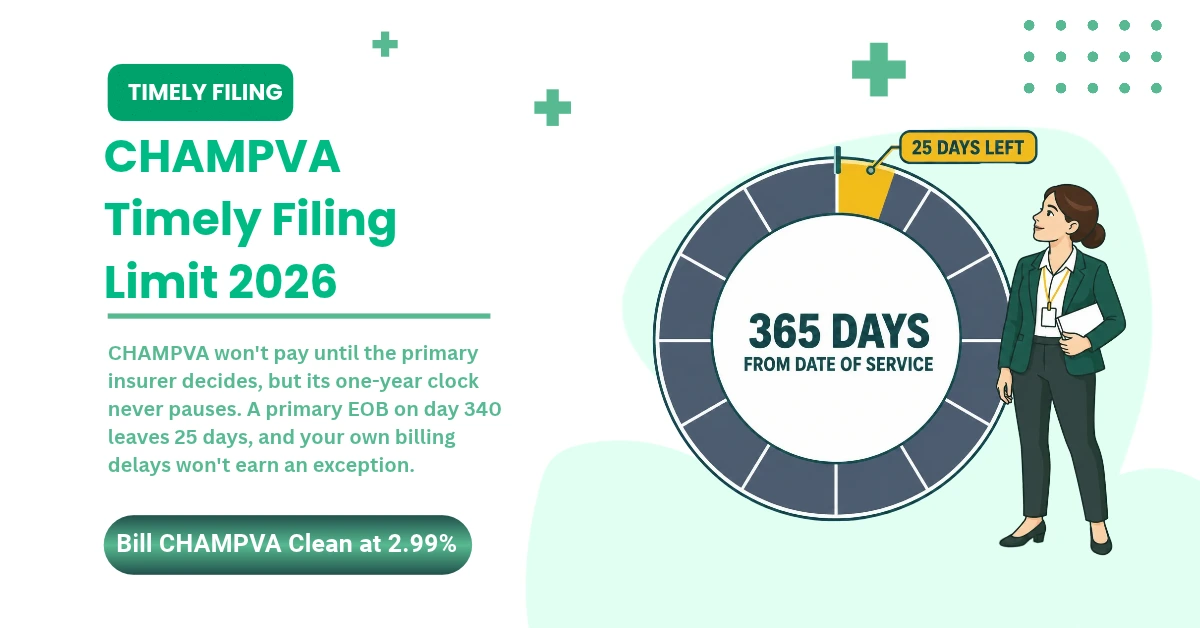
Run the numbers on a real one. The primary's EOB posts on day 340 after the date of service. Your team has 25 days left to get the CHAMPVA claim to VA, and a single clearinghouse rejection could use up most of that time.
Stale OHI records stall these claims too. If CHAMPVA's OHI file lists a plan the patient dropped, the patient updates it with VA Form 10-7959c, the Other Health Insurance Certification. Ask for that form at check-in, before you send the claim.
If the primary's delay pushes the claim past day 365, your route is the written good-cause exception covered below. VA's CHAMPVA Policy Manual has also asked for the claim within 90 calendar days of the other insurer's decision in these cases, so confirm the current rule with VA before relying on it.
Medicare Crossover Claims and the Name-Match Trap
For patients with Medicare Parts A and B, Medicare forwards the claim to CHAMPVA on its own once VA has the Medicare number on file. The names on both cards have to match letter for letter, or Medicare won't forward it.
Check the Medicare remittance to confirm the claim crossed over. VA describes crossover for Parts A and B and DME claims, so file Medicare Advantage secondaries to CHAMPVA yourself with the plan's EOB. If a payer denies over payment order, our guide to CO-22 coordination denials covers the fix.
Secondary CHAMPVA claims usually go late in a work queue, waiting on an EOB nobody chased. If that sounds like your secondary list, our outsourced medical billing services track the CHAMPVA clock from the date of service on each claim.
When VA Accepts a Late CHAMPVA Claim: The Good-Cause Exception
VA accepts a late claim only through a written request that shows good cause, and it reviews each request case by case under 38 CFR 17.276(b). An approved exception excuses one claim. The CHAMPVA timely filing limit stays the same for everything else you bill.
Delays VA Will Consider
The regulation gives one example. With dual coverage, CHAMPVA can't figure its payment until the primary adjudicates the claim, so VA may grant an exception when the primary's delay wasn't the patient's fault.
VA doesn't publish a full list beyond that example, and its code 124 guidance refers to "exceptional circumstances." Outside the primary-delay case, approval depends on your facts and the paper trail you can show a reviewer.
Delays VA Won't Excuse
The regulation says "delays due to provider billing procedures do not constitute a valid basis" for an exception. In a billing office, that rules out the usual reasons a claim goes late:
- A claim held for a coding question
- Charge entry that ran behind
- Staff turnover or vacation coverage gaps
- A clearinghouse rejection nobody worked
- Other insurance nobody captured at check-in
None of these will move a reviewer, so the fix belongs in your workflow before a claim ages, as the checkpoints later in this guide lay out.
What a Written Exception Request Needs
A reviewer should understand your delay from the first page. Build the request around these six items:
- Patient name, claim number, date of service or discharge, and the deadline you missed
- A dated timeline of what happened and when
- Proof of when you billed the primary plan, such as its claim number or acknowledgment
- The primary's correspondence and your call log, with representative names and reference numbers
- The primary EOB showing its decision date
- The date you filed with CHAMPVA after the obstacle cleared
Call logs win these requests, so start keeping them before you need one. Our guide to documented payer follow-up shows what to record on each call. VA's code 124 guidance sends written appeals to VHA Office of Integrated Veteran Care, ATTN: Appeals, PO Box 600, Spring City, PA 19475.
Denial Code 124: What a CHAMPVA Timely Filing Denial Looks Like
VA's family member denial code 124 means "claim not timely filed." According to VA's family member denial codes, claims must reach VA within 365 days of the date of service, and you may send a written appeal if there were exceptional circumstances.
Code 124 on the CHAMPVA EOB is how the CHAMPVA timely filing limit shows up in your remits. Your clearinghouse ERA may carry the industry code CARC 29, which means the filing time limit has expired. Check both the EOB and the 835 before assuming one maps to the other.
How to Triage a Code 124
- Recount the deadline from the date of service or discharge, using 365 days.
- Pull proof that VA received the claim in time, such as a VA claim number or a claim-level 277CA, and request review with it.
- Check whether a primary insurer caused the delay, and send the written exception if one did.
- Write off the claim if none of that applies, then fix the step that let it age. The patient can't be billed for it.
Related CHAMPVA Denial Codes That Turn Into Late Claims
These codes don't mean late yet, but each one burns days off the 365 while you fix it.
CHAMPVA denial codes that threaten the filing deadline (VA family member claim denial codes, updated June 3, 2026)
|
VA code |
What VA says it means |
What to do |
Why it threatens the deadline |
|---|---|---|---|
|
78 |
EOB from other insurance required |
Resubmit with the primary EOB, from each plan |
Each week spent chasing the EOB comes off the 365 days |
|
218 or 220 |
Other health insurance information missing or incomplete |
Patient submits VA Form 10-7959c or updates OHI |
VA won't process the claim until it arrives |
|
278 |
More than one primary plan |
Resubmit with EOBs from each primary |
The second EOB is often the slow one |
|
137 |
Not eligible on the date of service |
Verify eligibility and dates; check for retroactive eligibility |
A later approval may open the 180-day window |
|
224 |
Additional documentation required |
Resubmit with documents and the CHAMPVA EOB |
The resubmission still has to reach VA in time |
|
65, 159, or 177 |
Duplicate claim |
Don't resubmit unless told to; call if it isn't a duplicate |
Repeat submissions waste days and draw more denials |
|
CARC 299 with RARC N24 |
Payment held until EFT enrollment |
Enroll in EFT; don't resubmit |
No filing risk, but resubmitting creates duplicates |
A stack of code 124s isn't always a write-off. If a primary payer caused the delay, you can still recover some of those claims, and our denial management services sort the recoverable ones from the dead ones before anyone builds a packet.
CHAMPVA Appeal Timely Filing Limit and Decision Review Options
The CHAMPVA appeal timely filing limit depends on the route you pick. A Higher-Level Review must reach VA within one year of the decision, while a Supplemental Claim can go in anytime with new and relevant evidence. Under VA decision review options, you pursue one route at a time.
Higher-Level Review, Supplemental Claim, or Board Appeal
CHAMPVA decision review routes for providers (VA decision reviews and appeals, family member care)
|
Route |
Form |
Deadline |
What it needs |
|---|---|---|---|
|
Higher-Level Review |
VA Form 20-0996 |
Within 1 year of the decision |
No new evidence; a senior reviewer looks for an error |
|
Supplemental Claim |
VA Form 20-0995 |
Anytime |
New and relevant evidence, or a change in law |
|
Board of Veterans' Appeals |
Board appeal |
Per VA's Board appeal instructions |
A Veterans Law Judge reviews the decision |
Mail Higher-Level Review and Supplemental Claim requests to VFMP Appeals, PO Box 600, Spring City, PA 19475. You won't find a single CHAMPVA appeal form; VA Form 20-0998 explains your review rights and each option.
Picking the Right Route for a Code 124
A 277CA or VA claim number the reviewer never saw counts as new evidence, which points to a Supplemental Claim. If VA had your dates and counted them wrong, a Higher-Level Review fits. Date the request from the CHAMPVA EOB or decision letter.
A claim that missed the deadline with no proof of timely receipt belongs in the written good-cause exception instead. Sending it through a review only adds weeks before you get the same answer.
The Old 1-Year Reconsideration Rule Applies Only to Legacy Claims
38 CFR 17.277 still describes a written reconsideration within one year of the EOB, followed by a second review within 90 days. Its first paragraph limits the section to legacy claims, so payer references that list it as the current process are out of date for new denials.
Requests That Don't Need an Appeal
VA says you don't need a decision review to send missing documents, an OHI EOB, or proof of payment. If VA sends an EOB or letter asking for information, VA's CHAMPVA claim page gives you one year from the date on it to respond. An appeal only slows those claims down.
CHAMPVA Timely Filing Limit for Corrected Claims
VA's provider materials don't publish a separate deadline for corrected CHAMPVA claims, so treat the original 365 days from the date of service or discharge as your limit. A correction doesn't restart the clock.
Can you resubmit with a CHAMPVA EOB? Yes, and VA expects it. Its provider page tells you to include the CHAMPVA EOB with each resubmission and warns that a claim number alone can delay processing or create a duplicate. Denial codes 224 and 391 carry the same instruction.
A claim rejected at the clearinghouse never reached VA, so VA treats it as a first submission on the day it lands. A denied claim did reach VA, and its receipt date becomes your proof if the corrected version later draws a code 124.
VA's public provider pages don't spell out claim frequency codes for CHAMPVA corrections; the published instruction is the EOB attachment. Confirm with Optum Insight before relying on a replacement code alone, and fix known errors the day you find them instead of waiting for the remit.
Can You Bill the Patient After a Missed CHAMPVA Deadline?
No. VA's CHAMPVA Policy Manual says a provider can't seek payment from the beneficiary when the provider misses the filing deadline and VA doesn't grant a waiver. The loss stays with the practice.
A separate rule covers balance billing. Under 38 CFR 17.272(b)(3), a provider who accepts a CHAMPVA patient agrees to take the CHAMPVA allowable as full payment, which ends the patient's liability. Trying to collect more can get a provider excluded from federal benefit programs.
VA's provider fact sheet allows one exception to balance billing. You tell the patient before any service that you don't accept CHAMPVA, collect the full charge up front, and let the patient file the claim. That choice happens before the visit, so it can't rescue a claim your office filed late.
Write the claim off, then find the step that let it age, because the same gap will cost you on the next CHAMPVA patient.
CHAMPVA vs TRICARE, Medicare, VA Community Care, and FMP Deadlines
There's no single VA timely filing limit. The veterans affairs timely filing limit depends on which program pays, and the CHAMPVA timely filing limit is one of five deadlines a front desk can mix up.
Filing deadlines across VA and military health programs
|
Program |
Who it covers |
Filing deadline |
Clock starts |
Rule source |
|---|---|---|---|---|
|
CHAMPVA |
Spouses, surviving spouses, and children of eligible veterans |
1 year (count 365 days); 180 days after retroactive approvals |
Date of service or discharge |
38 CFR 17.276 |
|
TRICARE |
Service members, retirees, and their families |
1 year; 3 years overseas |
Date of service or discharge |
32 CFR 199.7 |
|
Original Medicare |
Medicare beneficiaries |
12 months |
Date of service |
42 CFR 424.44 |
|
VA Community Care Network |
Veterans VA refers to community care |
180 days |
Date care was furnished |
38 U.S.C. 1703D |
|
Foreign Medical Program |
Veterans with service-connected conditions treated abroad |
2 years |
Date of service or discharge |
VA FMP Policy Manual |
CHAMPVA and TRICARE share a one-year window, but a patient eligible for TRICARE isn't eligible for CHAMPVA, and a claim sent to the wrong one still burns days. Our breakdown of the TRICARE timely filing limit covers its regional contractors and overseas rule.
The 180-day VA Community Care deadline applies to care VA refers for the veteran. If someone in your office quotes a 180-day veterans timely filing limit for a family member, check which program is on the card. Our page on VA Community Care filing rules explains that clock.
How to Build a CHAMPVA Filing Workflow That Keeps Claims on Time
Late CHAMPVA claims tend to be queue problems more than rule problems. Timely filing for CHAMPVA comes down to seven checkpoints your team runs on each claim, starting at the front desk.
Seven Checkpoints That Keep CHAMPVA Claims Inside 365 Days
- Capture CHAMPVA and any other plan at check-in. The patient's name must match the CHAMPVA card, and the member ID is the patient's Social Security number, not the veteran's.
- Verify eligibility before the visit with a 270 to payer ID VAHAC or the 24-hour line at 888-820-1756, and note the effective date.
- Bill the primary plan within days of the visit, since the CHAMPVA clock started on the date of service.
- Submit electronically to payer ID 84146. VA says paper adds about 20 days to payment.
- Work clearinghouse rejections the day they appear, and save each claim-level 277CA.
- Check CHAMPVA claim status with 276/277 transactions, and set alerts at days 180, 270, 300, and 330. Those thresholds are our workflow targets, not VA rules.
- Enroll in EFT through VA's Financial Services Center, or payments sit on hold under CARC 299 and RARC N24.
Building the queue around day 365, instead of the 30, 60, and 90-day buckets most aging reports use, takes the CHAMPVA timely filing limit off your risk list. Our AR follow-up by deadline works claims in that order.
When Outsourcing CHAMPVA Billing Makes Sense
Outsourcing makes sense once secondary CHAMPVA claims start aging past day 300, code 124s show up each quarter, or nobody owns the rejection queue. A practice with one or two providers and a steady biller can often keep CHAMPVA in-house.
MedSole RCM is a full-service revenue cycle management company that bills at 2.99% of monthly collections, with no setup fees and no long-term contracts, and credentials providers for $99 per insurance enrollment. Many billing companies charge between 4% and 7% of collections.
Standalone AR follow-up and denial management run 4.49% of what we recover, and both come included in the 2.99% rate. See what medical billing at 2.99% covers, from eligibility checks through appeals.
CHAMPVA has no provider contracts, so you have nothing to credential with CHAMPVA itself. The $99 enrollment matters for the primary payers, Medicare and commercial plans, that must pay before CHAMPVA will. Our credentialing at $99 per payer covers the application, weekly payer follow-up, and approval tracking.
If CHAMPVA claims are aging in your queue, send us the aging report, and we'll tell you what's still recoverable before you commit to anything.
CHAMPVA Claim Submission Quick Reference for Providers
Your billing team needs these details to get a CHAMPVA claim in front of VA. We checked each one against VA's CHAMPVA provider page on October 4, 2026.
CHAMPVA claim submission details for providers (verified October 2026)
|
What you need |
Detail |
|---|---|
|
Electronic medical claims |
84146 payer ID through Optum Insight (837P or 837I) |
|
Electronic dental claims |
Payer ID 84147 |
|
Real-time eligibility |
Payer ID VAHAC (270/271) |
|
Claim status |
276/277 through VA's clearinghouse |
|
Optum Insight support |
866-678-8646, Monday to Friday, 8 a.m. to 8 p.m. ET |
|
Provider paper claims |
VHA Office of Integrated Veteran Care, CHAMPVA Claims, PO Box 30750, Tampa, FL 33630-3750 |
|
Patient-filed claims only |
VHA Office of Integrated Veteran Care, CHAMPVA Claims, PO Box 500, Spring City, PA 19475 |
|
Appeals and decision reviews |
PO Box 600, Spring City, PA 19475 |
|
Eligibility by phone |
888-820-1756, 24 hours a day |
|
Preauthorization |
833-930-0816 |
|
CHAMPVA phone number for providers and patients |
800-733-8387, Monday to Friday, 8:05 a.m. to 7:30 p.m. ET |
|
Claim forms |
CMS-1500 or UB-04; VA Form 10-7959a is for patient claims only |
CHAMPVA Provider Claims Mailing Address (2026)
The CHAMPVA claims address for providers is PO Box 30750, Tampa, FL 33630-3750. Patients mail their own reimbursement claims to PO Box 500, Spring City, PA 19475, which explains why both addresses appear on VA pages.
Mail sent to the wrong box loses days you may not have. Filing electronically to the CHAMPVA payer ID avoids the question, and VA's provider page lists no fax number for provider claims.
CHAMPVA Timely Filing FAQs
What is the CHAMPVA timely filing limit?
The CHAMPVA timely filing limit is one year from the date of service, or one year from discharge for inpatient care, under 38 CFR 17.276. Retroactive approvals of services and retroactive eligibility get 180 days from the date VA notifies the patient. VA counts the day it receives the claim, so set your system to a 365-day count.
How far back can I submit claims to CHAMPVA?
Under the standard CHAMPVA timely filing limit, you can submit claims up to 365 days after the date of service or discharge. After retroactive eligibility, you can file care on or after the effective date within 180 days of VA's notice. Care before the event that made the patient eligible isn't payable.
Does CHAMPVA backdate coverage?
Yes. If VA approves eligibility retroactively, coverage reaches back to the effective date VA sets, often after a veteran's disability rating comes through with an earlier effective date. Claims for that older care are due within 180 days of VA's notice. Normal coverage rules still apply, including preauthorization, and VA won't pay for care before the qualifying event.
Does waiting for the primary insurance EOB extend the CHAMPVA deadline?
No. The one-year clock runs from the date of service, and a late primary EOB doesn't start a new one. If the primary's delay pushes a claim past the deadline and the delay wasn't the patient's fault, you can send VA a written good-cause exception with the primary's dates and correspondence. Delays in your own billing process won't qualify.
What is the CHAMPVA timely filing limit for secondary claims?
Secondary claims follow the same rule: one year from the date of service or discharge. CHAMPVA pays after the other insurer's final decision and needs adjudicated EOBs from each primary plan. Bill the primary within days of the visit so its EOB arrives well before day 365. Medicare crossover handles some of these when the names on both cards match.
Do corrected CHAMPVA claims get a new filing deadline?
No. VA publishes no separate window for corrected CHAMPVA claims, so the original 365 days still apply. VA asks for the CHAMPVA EOB with every resubmission, because a claim number alone can cause a delay or a duplicate. A claim rejected at the clearinghouse never reached VA, so it counts as new on the day VA receives it.
What is the CHAMPVA appeal timely filing limit?
For a Higher-Level Review, VA must receive your request within one year of the decision. A Supplemental Claim has no deadline but needs new and relevant evidence, and a Board appeal is the third route. The one-year reconsideration in 38 CFR 17.277 applies only to legacy claims, so don't rely on it for new denials.
Can you bill a patient for a CHAMPVA timely filing denial?
No. VA's CHAMPVA Policy Manual bars providers from seeking payment from the patient when the provider misses the filing deadline and VA doesn't grant a waiver. Separately, 38 CFR 17.272(b)(3) says that accepting a CHAMPVA patient means accepting the CHAMPVA allowable as full payment. Write the claim off, and fix the step in your workflow that let it age.
Who pays first, CHAMPVA or Medicare?
Medicare pays first, and CHAMPVA pays second. For patients with Medicare Parts A and B, Medicare forwards the claim to CHAMPVA once VA has the Medicare number on file and the names on both cards match. CHAMPVA pays first only against Medicaid, the Indian Health Service, State Victims of Crime Compensation Programs, and CHAMPVA supplemental policies.
Who processes CHAMPVA claims?
The VHA Office of Integrated Veteran Care processes CHAMPVA claims. Providers submit electronic claims through Optum Insight to payer ID 84146, or 84147 for dental, and mail paper claims to PO Box 30750, Tampa, FL 33630-3750. Patients filing their own claims use PO Box 500 in Spring City, PA.
Do all hospitals have to accept CHAMPVA?
Medicare-participating hospitals must accept the CHAMPVA allowable as payment in full for inpatient services, under 38 CFR 17.272(b)(2). CHAMPVA has no contract network, so other providers decide for themselves whether to take it. Once a provider accepts a CHAMPVA patient, it takes the allowable and can't bill the difference.
How much does it cost to outsource CHAMPVA billing and credentialing?
MedSole RCM is a full-service revenue cycle management company that bills at 2.99% of monthly collections, with no setup fees and no long-term contracts, and credentials providers for $99 per insurance enrollment. Full-service billing at that rate covers eligibility checks, claims, denials, and AR follow-up.
CHAMPVA has no provider contracts, so the $99 enrollment applies to the primary payers that must pay before CHAMPVA does.
Protect Every CHAMPVA Claim Before Day 365
Three habits keep almost every claim inside the CHAMPVA timely filing limit: count 365 days in your system, bill primaries the same week as the visit, and clear rejections daily.
If your queue has outgrown your team, full revenue cycle management puts one team on every payer clock, CHAMPVA included, and reports on each claim against its deadline.
Want a second set of eyes on your CHAMPVA aging? MedSole RCM offers a free billing analysis. Send the report, and we'll tell you which claims are still inside the window.
Sources
- 38 CFR 17.276, Claim filing deadline (eCFR)
- 38 CFR 17.277, Appeals (eCFR)
- 38 CFR 17.272, Benefits limitations and exclusions (eCFR)
- VA CHAMPVA provider page, Community Care (updated September 10, 2026)
- VA family member claim denial codes (updated June 3, 2026)
- VA decision reviews and appeals, family member care (updated June 3, 2026)
- VA CHAMPVA provider fact sheet IB 10-1587 (updated September 20, 2023)
- VA CHAMPVA Guidebook (March 2026 file)
- VA, How to file a CHAMPVA claim (updated July 15, 2026)
- Cited by name: VA CHAMPVA Policy Manual and VA Foreign Medical Program Policy Manual
Rules checked against the sources above on October 4, 2026.