



Key Takeaways
-
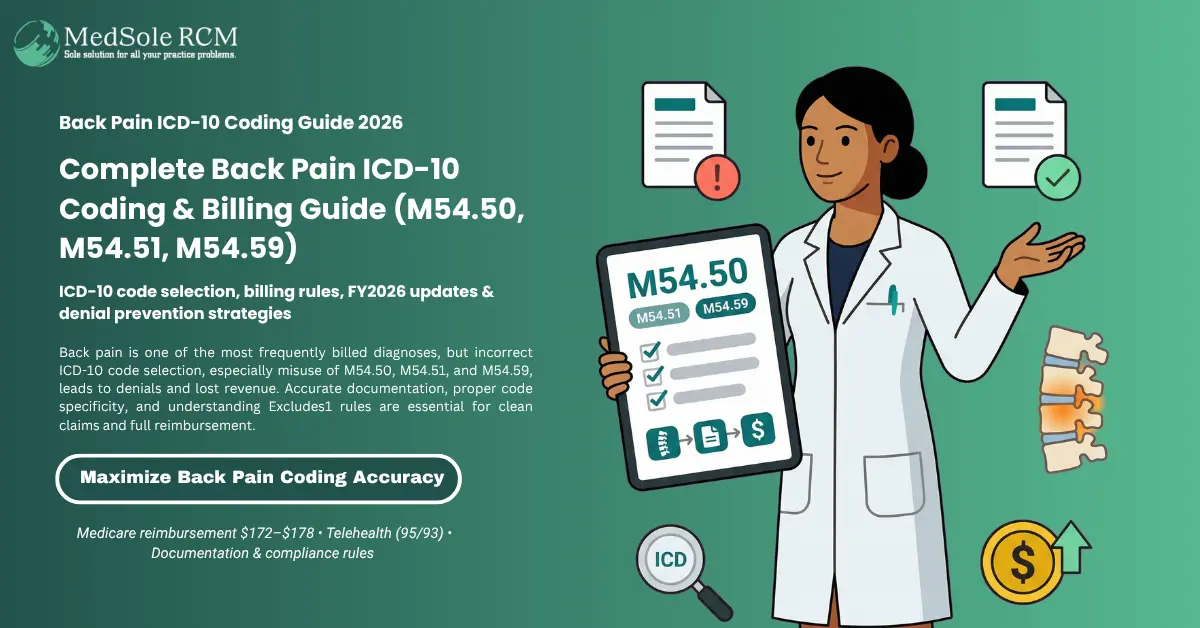
M54.50 is the ICD-10-CM code for low back pain, unspecified: the default code when no specific etiology has been documented.
-
CMS retired M54.5 effective October 1, 2021, replacing it with three codes: M54.50, M54.51, and M54.59. Submitting M54.5 on a claim today triggers automatic denials.
-
M54.51 is the code for vertebrogenic low back pain (NOT left-sided pain) and requires imaging confirming Modic changes or vertebral endplate damage.
-
M54.9 (dorsalgia, unspecified) covers general back pain NOS; M54.50 is specific to the low back region.
-
For chronic back pain ICD-10 coding, assign the site-specific M54.5x code as primary diagnosis with G89.29 (Other chronic pain) as secondary.
-
This guide covers all back pain ICD-10 codes for FY2026 (October 1, 2025, through September 30, 2026), including the April 1, 2026, mid-year update.
Why Accurate Back Pain ICD-10 Coding Matters for Your Practice in 2026
Low back pain affected 619 million people globally in 2020, making it the single leading cause of disability worldwide (The Lancet Rheumatology, GBD 2021). Here in the U.S., 39% of adults reported back pain within the past three months (CDC NHIS). Those numbers translate directly into claim volume, and claim volume means coding accuracy matters at scale.
Back pain is one of the highest-volume diagnoses submitted to payers every single day. Yet coding errors in the M54 dorsalgia category contribute to billions in improper payments annually (CMS OIG). The root cause is almost always a lack of specificity, and that's exactly where back pain claim denials start compounding.
Here's the problem most practices run into. ICD-10-CM now demands granular detail for back pain ICD-10 code selection. M54.50, M54.51, and M54.59 each describe distinct clinical pictures, and payers expect the correct one on every claim.
Choosing M54.50 when documentation supports M54.51 or M54.59 can trigger denials or downcoded reimbursement.
On top of that, the retired M54.5 code still sits in EHR templates and superbills across the country. Every claim submitted with it gets rejected automatically. That's revenue walking out the door, and it's entirely preventable.
Back pain is classified under ICD-10-CM category M54 (Dorsalgia), with the most commonly used code being M54.50 for low back pain, unspecified. But M54.50 isn't always the right choice. Vertebrogenic pain requires M54.51. Characterized mechanical pain maps to M54.59. Selecting the wrong code leads to denials, delays, and underpayments that compound month after month.
This guide covers every ICD-10 code for back pain used in FY2026 (CMS ICD-10-CM): lumbar and thoracic dorsalgia, sciatica, radiculopathy, chronic pain modifiers, Excludes1 rules, documentation requirements, and denial prevention strategies. All ICD-10 back pain codes are organized for quick reference, and every section applies across provider specialties.
Whether you manage your own revenue cycle management or work with an outsourced medical billing partner, accurate back pain ICD-10 coding is the foundation of clean claims and full reimbursement.
Struggling with back pain claim denials? MedSole RCM's certified coders ensure every claim is coded correctly the first time, starting at just 2.99% of collections. Learn about our billing services →
FY2026 ICD-10-CM Updates: What's New for Back Pain Coding
FY2026 ICD-10-CM codes took effect October 1, 2025, and remain active through September 30, 2026. CMS released 487 new codes, deleted 28, and revised 38 for this fiscal year (CMS ICD-10-CM FY2026). If you haven't verified your EHR and practice management systems are running the current code set, do that now.
There's also a mid-year update effective April 1, 2026. CMS occasionally adds or revises codes mid-cycle, and practices that skip this update risk submitting invalid codes for the second half of the fiscal year. Your PM vendor should push it automatically, but it's worth confirming with your IT team.
For back pain ICD-10 coding guidelines in 2026, here's the good news: the M54 dorsalgia category hasn't undergone major structural changes this cycle. M54.50 (low back pain, unspecified), M54.51 (vertebrogenic low back pain), and M54.59 (other low back pain) all remain defined exactly as they were (CDC/NCHS ICD-10-CM Guidelines). No new subcategories. No deleted codes within M54.
The back pain ICD-10 code changes worth watching involve disc degeneration. CMS introduced expanded sixth-character detail for lumbar (M51.36x) and lumbosacral (M51.37x) disc degeneration in FY2025. These codes differentiate between back pain only, leg pain only, combined back and leg pain, and no specified pain location.
Why this matters for M54 coders: M51.360 (disc degeneration with discogenic back pain, lumbar region) carries an Excludes1 relationship with M54.50. You can't bill both on the same claim. Even if your daily coding lives in the M54 range, knowing these disc degeneration codes is essential for avoiding Excludes1 violations.
Your M54.5x codes haven't changed, but the codes around them have. Stay current.
Complete Back Pain ICD-10 Code Reference Table [2026]
Below is a comprehensive reference of every ICD-10-CM code used for back pain conditions in FY2026. Bookmark this table for quick reference during coding and billing workflows.
This is your complete list of ICD-10 back pain codes. It covers every billable option from the dorsalgia family through related diagnostic categories. Whether you need the most common back pain ICD-10 codes for everyday billing or a specific ICD-10 code for back pain tied to imaging findings, it's all here.
Codes are organized by region and condition type. The dorsalgia (M54) codes cover primary back pain diagnoses, while M51 handles disc disorders, M43 to M48 covers structural conditions, S39 captures strain injuries, and G89 addresses chronic pain modifiers.
In the "Billable?" column, "Yes" means the code goes directly on a claim. Codes marked "Yes*" need a sixth character specifying the pain type before submission: 0 for back pain, 1 for leg pain, 2 for both, or 9 for unspecified. Your EHR should flag these, but always double-check.
The "Common CPT Pairings" column shows procedures typically billed with each diagnosis. These aren't guarantees of reimbursement. LCD/NCD policies and payer-specific edits determine what actually gets paid, so verify medical necessity before pairing any CPT code with a diagnosis.
Lumbar
|
Code |
Description |
Billable? |
When to Use |
Common CPT Pairings |
|
M54.50 |
Low back pain, unspecified |
Yes |
No specific etiology identified or documented |
99213, 99214, 72148, 97140 |
|
M54.51 |
Vertebrogenic low back pain |
Yes |
MRI confirms Modic changes or vertebral endplate pathology |
99214, 72148, 20552, 97140 |
|
M54.59 |
Other low back pain |
Yes |
Mechanical or muscular pattern identified on clinical exam |
99213, 99214, 97140, 97110 |
Thoracic
|
Code |
Description |
Billable? |
When to Use |
Common CPT Pairings |
|
M54.6 |
Pain in thoracic spine |
Yes |
Mid-back pain localized to thoracic region |
99213, 99214, 72146, 97140 |
|
M54.14 |
Radiculopathy, thoracic region |
Yes |
Thoracic nerve root involvement confirmed on exam or imaging |
99214, 72146, 64490, 95907 |
Cervical
|
Code |
Description |
Billable? |
When to Use |
Common CPT Pairings |
|
M54.2 |
Cervicalgia |
Yes |
Neck pain without radiculopathy or myelopathy |
99213, 99214, 72141, 97140 |
|
M54.12 |
Radiculopathy, cervical region |
Yes |
Cervical nerve root compression documented |
99214, 72141, 64490, 95907 |
General Dorsalgia
|
Code |
Description |
Billable? |
When to Use |
Common CPT Pairings |
|
M54.9 |
Dorsalgia, unspecified (backache, NOS) |
Yes |
Back pain documented without specifying region or type |
99213, 72080, 97140 |
|
M54.89 |
Other dorsalgia |
Yes |
Back pain that doesn't fit other specific dorsalgia codes |
99213, 99214, 72080, 97140 |
Sciatica and Lumbago with Sciatica
|
Code |
Description |
Billable? |
When to Use |
Common CPT Pairings |
|
M54.30 |
Sciatica, unspecified side |
Yes |
Radiating leg pain along sciatic nerve, side not documented |
99214, 72148, 64483, 95907 |
|
M54.31 |
Sciatica, right side |
Yes |
Right-sided sciatic nerve pain confirmed |
99214, 72148, 64483, 95907 |
|
M54.32 |
Sciatica, left side |
Yes |
Left-sided sciatic nerve pain confirmed |
99214, 72148, 64483, 95907 |
|
M54.40 |
Lumbago with sciatica, unspecified side |
Yes |
Low back pain with radiating leg pain, side not stated |
99214, 72148, 64483, 97110 |
|
M54.41 |
Lumbago with sciatica, right side |
Yes |
Low back pain with right-sided radiating leg pain |
99214, 72148, 64483, 97110 |
|
M54.42 |
Lumbago with sciatica, left side |
Yes |
Low back pain with left-sided radiating leg pain |
99214, 72148, 64483, 97110 |
Radiculopathy
|
Code |
Description |
Billable? |
When to Use |
Common CPT Pairings |
|
M54.10 |
Radiculopathy, site unspecified |
Yes |
Nerve root involvement confirmed, region not documented |
99214, 72148, 95907 |
|
M54.11 |
Radiculopathy, occipito-atlanto-axial region |
Yes |
Upper cervical (C0 to C2) nerve root pathology |
99214, 72141, 95907 |
|
M54.12 |
Radiculopathy, cervical region |
Yes |
Cervical (C3 to C6) nerve root compression |
99214, 72141, 64490, 95907 |
|
M54.13 |
Radiculopathy, cervicothoracic region |
Yes |
C7 to T1 junction nerve root involvement |
99214, 72141, 95907 |
|
M54.14 |
Radiculopathy, thoracic region |
Yes |
Thoracic nerve root involvement |
99214, 72146, 64490, 95907 |
|
M54.15 |
Radiculopathy, thoracolumbar region |
Yes |
T12 to L1 junction nerve root involvement |
99214, 72146, 95907 |
|
M54.16 |
Radiculopathy, lumbar region |
Yes |
Lumbar nerve root compression confirmed |
99214, 72148, 64483, 95907 |
|
M54.17 |
Radiculopathy, lumbosacral region |
Yes |
L5 to S1 nerve root involvement documented |
99214, 72148, 64483, 95907 |
|
M54.18 |
Radiculopathy, sacral and sacrococcygeal |
Yes |
Sacral nerve root pathology confirmed |
99214, 72148, 64483, 95907 |
Disc Disorders
|
Code |
Description |
Billable? |
When to Use |
Common CPT Pairings |
|
M51.16 |
IVD disorders with radiculopathy, lumbar |
Yes |
Disc herniation with lumbar nerve compression on imaging |
99214, 72148, 62322, 64483 |
|
M51.17 |
IVD disorders with radiculopathy, lumbosacral |
Yes |
Disc herniation with L5 to S1 nerve compression on imaging |
99214, 72148, 62322, 64483 |
|
M51.26 |
Other IVD degeneration, lumbar region |
Yes |
Lumbar disc degeneration without nerve involvement |
99214, 72148, 97140, 20552 |
|
M51.27 |
Other IVD degeneration, lumbosacral region |
Yes |
Lumbosacral disc degeneration without nerve involvement |
99214, 72148, 97140, 20552 |
|
M51.36x |
Disc degeneration, discogenic back pain, lumbar |
Yes |
*Degenerative disc confirmed as lumbar pain source; add 6th character |
992* |
Structural Conditions
|
Code |
Description |
Billable? |
When to Use |
Common CPT Pairings |
|
M48.06 |
Spinal stenosis, lumbar region |
Yes |
Lumbar spinal canal narrowing confirmed on imaging |
99214, 99215, 72148, 63047 |
|
M47.816 |
Spondylosis without myelopathy, lumbar |
Yes |
Lumbar degenerative spine disease, no cord compression |
99214, 72148, 20552, 97140 |
|
M47.817 |
Spondylosis without myelopathy, lumbosacral |
Yes |
Lumbosacral degenerative changes, no cord compression |
99214, 72148, 20552, 97140 |
|
M43.16 |
Spondylolisthesis, lumbar region |
Yes |
Vertebral slippage confirmed on imaging, lumbar |
99214, 99215, 72148, 22612 |
|
M43.17 |
Spondylolisthesis, lumbosacral region |
Yes |
Verteb |
Strain and Injury
|
Code |
Description |
Billable? |
When to Use |
Common CPT Pairings |
|
S39.012A |
Low back strain, initial encounter |
Yes |
Acute muscle or tendon strain, first visit |
99213, 99214, 72100, 97140 |
|
S39.012D |
Low back strain, subsequent encounter |
Yes |
Follow-up visit for known low back strain |
99213, 97110, 97140 |
|
S39.012S |
Low back strain, sequela |
Yes |
Late effect of prior low back strain injury |
99214, 72148, 97110 |
Chronic Pain
|
Code |
Description |
Billable? |
When to Use |
Common CPT Pairings |
|
G89.29 |
Other chronic pain |
Yes |
Pain persisting over three months; use as secondary with site-specific M54.5x |
99214, 97140, 64493, 20552 |
|
G89.4 |
Chronic pain syndrome |
Yes |
Chronic pain with documented psychological or behavioral components |
99215, 97140, 64493, 90834 |
Pregnancy-Related
|
Code |
Description |
Billable? |
When to Use |
Common CPT Pairings |
|
O26.891 |
Other specified pregnancy-related conditions, first trimester |
Yes |
Back pain attributed to pregnancy; select trimester-specific variant |
99214, 72100, 97140 |
How to Choose Between Overlapping Codes
When documentation supports more than one code, go with the most specific option. Payers reward precision, and defaulting to M54.50 when imaging reveals a structural cause creates unnecessary denial risk. Match the code to the confirmed diagnosis.
Watch for Excludes1 restrictions across these families. Certain combinations can't appear on the same claim, like M54.50 with any code from M54.40 through M54.42. The M54.50 deep dive below breaks down the most critical Excludes1 rules in detail.
M54.50 Low Back Pain, Unspecified: Complete ICD-10 Code Breakdown
What M54.50 Means: Character-by-Character
M54.50 is the ICD-10-CM diagnosis code for low back pain, unspecified. It's used when a patient presents with lower back pain but no specific etiology, mechanism, or cause has been identified or documented. This is a billable code that can be submitted directly on a claim without additional characters.
Here's how the M54.50 ICD-10 code breaks down character by character:
-
M = Musculoskeletal system and connective tissue (Chapter 13)
-
54 = Dorsalgia, the ICD-10-CM category covering all back pain diagnoses
-
.5 = Low back pain specifically
-
0 = Unspecified type, meaning no etiology has been documented
This code replaced the retired M54.5 on October 1, 2021. CMS split M54.5 into three more specific options: M54.50 (unspecified), M54.51 (vertebrogenic low back pain), and M54.59 (other low back pain). If your EHR or superbill still references M54.5 without a fifth digit, it needs to be updated. That code hasn't been valid for over four years.
When to Use M54.50
M54.50 is the right ICD-10 code for low back pain when documentation says "low back pain" or "lumbago" and nothing more. It's the most commonly billed low back pain ICD-10 code across primary care, urgent care, and chiropractic settings, and most searches for LBP ICD-10 codes land here for good reason.
Use M54.50 in these clinical scenarios:
-
Initial visit before any diagnostic workup has been performed
-
Documentation states only "low back pain" or "lumbago" without identifying a cause
-
No imaging has been ordered or reviewed yet
-
Physical exam shows no neurological deficits, red flags, or radicular symptoms
Clinical Scenario: Patient is a 40-year-old with a two-week history of intermittent lower back discomfort. No trauma history, no radicular symptoms. Physical exam reveals mild paraspinal tenderness with full strength and intact reflexes. Code: M54.50.
Once the diagnostic workup reveals a specific cause, transition to a more precise code. M54.50 is a starting point, not a final destination.
When NOT to Use M54.50
This is where coding errors cost practices real money. M54.50 only applies when no identifiable cause exists. The moment documentation or imaging reveals something specific, a different code takes over.
MRI shows Modic changes or vertebral endplate pathology: Use M54.51 (vertebrogenic low back pain). The difference between M54.50 and M54.51 is imaging confirmation. M54.51 requires MRI evidence of Modic changes at the vertebral endplate. Without that imaging proof, you can't use M54.51.
Clinical exam identifies a mechanical or muscular pattern: Use M54.59 (other low back pain). The difference between M54.50 and M54.59 is diagnostic specificity. M54.59 applies when the provider documents a recognizable pattern or mechanism, even without imaging. M54.50 is reserved for truly unidentified pain.
Sciatica is documented: Use M54.30 through M54.32 for sciatica alone, or M54.40 through M54.42 for lumbago with sciatica. Once radiating leg pain enters the clinical picture, M54.50 no longer applies.
Disc herniation confirmed on imaging: Use M51.16 (lumbar) or M51.17 (lumbosacral) for disc disorders with radiculopathy. For degeneration without nerve involvement, use M51.26 or M51.27. The disc pathology becomes the primary diagnosis.
Acute strain from a documented injury: Use S39.012A for the initial encounter. A clear mechanism of injury, like lifting a heavy object, points to strain rather than unspecified pain.
Excludes1 Rules for M54.50
Code these pairs together and the claim will be denied.
Excludes1 means these conditions can't coexist on the same claim because one diagnostically supersedes the other. If you've coded the more specific condition, M54.50 becomes redundant.
|
M54.50 Cannot Be Coded With |
Description |
Reason |
|
M51.360 |
Disc degeneration with discogenic back pain, lumbar |
Disc pathology identified as pain source |
|
M51.370 |
Disc degeneration with discogenic back pain, lumbosacral |
Disc pathology identified as pain source |
|
S39.012 |
Low back strain (any encounter type) |
Strain diagnosis supersedes unspecified pain |
|
M51.2- |
Lumbago due to intervertebral disc displacement |
Disc displacement is a specific etiology |
|
M54.4- |
Lumbago with sciatica (all lateralities) |
Sciatica component supersedes unspecified LBP |
Submitting M54.50 alongside any of these codes tells the payer two contradictory things: the pain has no known cause, and the pain has a confirmed cause. The claim gets denied every time.
Documentation Requirements for M54.50
Clean documentation is what keeps M54.50 claims from getting flagged on audit. Your provider notes should include five elements:
-
Pain location: Specifically identified as the lumbar region, not just "back pain"
-
Onset and duration: When it started and whether it's acute, subacute, or chronic
-
Aggravating and relieving factors: What makes it worse, what helps
-
Objective findings: Tenderness on palpation, range-of-motion limitations, or gait observations
-
No specific etiology identified: An explicit statement that the cause hasn't been determined
That last point is the one providers miss most often. Without a statement confirming no specific cause has been found, an auditor can argue the documentation supports a more specific code, and that the practice should have used it.
M54.51 Vertebrogenic Low Back Pain (NOT Left-Sided Pain)
What Vertebrogenic Means in ICD-10
M54.51 is the ICD-10-CM diagnosis code for vertebrogenic low back pain: pain originating from the vertebral endplates or bony structures of the spine. It is NOT a code for left-sided back pain, despite what some online coding references claim.
Vertebrogenic pain comes from a specific source: damage or degeneration at the vertebral endplate. Think of it as the bone itself generating the pain signal, not the muscles, discs, or nerves surrounding it. That distinction matters because treatments targeting soft tissue or nerve compression won't address the underlying cause.
Diagnosis typically requires MRI or CT imaging showing Modic changes (Type 1 or Type 2) or direct vertebral endplate damage. The pain pattern is usually axial, midline, and deep-seated. Patients describe it worsening with sustained postures like prolonged sitting or standing.
CMS created this code when it expanded M54.5 in October 2021. Before that split, every type of low back pain got grouped under one catch-all code. Tracking vertebrogenic outcomes or justifying treatments tied specifically to endplate pathology was nearly impossible.
Documentation and Imaging Requirements
Getting M54.51 past a payer requires specific clinical evidence. Vague documentation won't cut it. Your provider notes need four elements:
-
Imaging confirmation of vertebral endplate findings, specifically Modic Type 1 or 2 changes on MRI
-
Axial, midline pain description consistent with vertebrogenic origin
-
Conservative treatment failure if the payer's LCD requires it
-
Explicit diagnosis statement reading "vertebrogenic low back pain"
That fourth point gets missed constantly. Providers write "low back pain" in the assessment without specifying "vertebrogenic," and the coder defaults to M54.50. A simple wording change in the diagnosis line makes the difference between a properly coded claim and an undercoded encounter.
Here's where this code connects to reimbursement strategy. It's increasingly tied to coverage for basivertebral nerve (BVN) ablation procedures. MAC LCDs reference it for medical necessity when reviewing BVN ablation claims. Without the correct M54.51 diagnosis code on the claim, coverage often gets denied.
Common Misconception: M54.51 Is NOT About Laterality
Some online resources incorrectly describe M54.51 as "left-sided low back pain." This is a factual error that leads to miscoded claims.
ICD-10-CM defines this code exclusively as vertebrogenic low back pain, related to vertebral endplate pathology. There is no laterality component. The "1" in M54.51 doesn't indicate a side; it identifies the pain as vertebrogenic in origin.
If you've been coding based on incorrect sources that assign laterality to this code, those claims are technically miscoded. Review your encounter data and correct any claims still within your timely filing window before they age out.
M54.59 Other Low Back Pain: When to Use This Code
M54.59 is the ICD-10-CM diagnosis code for other low back pain. Use it when the clinician has described or characterized the pain, such as mechanical, muscular, or facetogenic, but it doesn't meet vertebrogenic criteria and isn't explained by another specific diagnosis code.
Here's the direct comparison, because this question comes up constantly in coding departments. When people search M54.50 vs M54.59, they're really asking: what's the difference between "unspecified" and "other"?
M54.50 (unspecified) = documentation says only "low back pain" or "lumbago." No characterization of the pain type at all.
M54.59 (other) = documentation describes the pain as strain-like, mechanical, or muscular in nature, but it's not vertebrogenic and no other specific code applies.
The difference comes down to what the provider wrote. If the note just says "low back pain" with nothing else, that's M54.50. Once the note adds "mechanical low back pain" or "muscular low back pain," you've got enough characterization for the M54.59 diagnosis code.
Clinical Scenario: Patient presents with localized right-sided mechanical low back pain. Exam shows paraspinal muscle tightness without disc or nerve findings. No imaging abnormalities. Code: M54.59.
M54.59 is NOT a code for right-sided low back pain. Some sources incorrectly assign laterality to this code, just like the M54.51 error described above. ICD-10-CM defines it as "other low back pain" without any laterality component. The "9" means "other specified type," not "right side."
Don't default to M54.50 when your providers are documenting pain characteristics. Using an unspecified code when the chart supports something more precise invites audit questions. If the documentation describes the pain type, the more specific code is the better choice.
M54.5 to M54.50: What Changed and How to Code Correctly in 2026
Why CMS Retired M54.5
M54.5 was the original ICD-10 code for "low back pain." From October 2015 through September 2021, this single M54.5 diagnosis code covered everything: vertebrogenic endplate pain, mechanical strain, nonspecific lumbago.
That caused two problems. One code couldn't separate patients needing targeted spinal procedures from those with everyday soreness. And without distinguishing vertebrogenic cases, CMS had no way to track treatment outcomes or build evidence for coverage decisions on specific interventions.
The 3 Replacement Codes
So what replaced the M54.5 ICD-10 code? Effective October 1, 2021, CMS retired it and created three specific replacements:
-
M54.50: Low back pain, unspecified, for documentation that says only "low back pain" or "lumbago"
-
M54.51: Vertebrogenic low back pain, for imaging-confirmed vertebral endplate pathology
-
M54.59: Other low back pain, for characterized pain types (mechanical, muscular) that don't meet vertebrogenic criteria
Using M54.5 on claims submitted today will result in automatic rejection. If your EHR templates or superbills still contain this code, update them immediately to M54.50, M54.51, or M54.59.
I still run into practices with old superbills that have the retired M54 5 diagnosis code printed on them. Every claim goes out, bounces back invalid, and creates rework that delays payment. Takes two minutes to fix your templates. Do it today.
Code History Timeline
|
Year |
What Happened |
|
October 2015 |
ICD-10-CM implemented; M54.5 active for all low back pain |
|
October 1, 2021 |
M54.5 retired; replaced by M54.50, M54.51, and M54.59 |
|
October 2024 |
New disc degeneration codes (M51.36x/M51.37x) added |
|
October 2025 |
FY2026 code set takes effect (current) |
If you're still searching for M54.5 today, you're looking at a retired code. Map it to the correct replacement based on what your provider documented.
M54.9 Dorsalgia, Unspecified: When and Why to Use This Code
M54.9 is the ICD-10-CM code for dorsalgia, unspecified. It covers back pain not otherwise specified, including what's classified as backache unspecified in ICD-10. Unlike M54.50, which is specific to the lumbar region, the M54.9 diagnosis code applies when the spinal region of the pain isn't documented at all.
Dorsalgia literally means "back pain": dorso- (back) plus -algia (pain). When this dorsalgia ICD-10 code shows up on a claim, it tells the payer the patient has back pain but the provider didn't specify where along the spine.
M54.9 vs M54.50: Which to Use?
This comparison trips up coders all the time, but once you understand the logic behind it, the distinction is simple.
M54.50 applies when the pain is clearly in the lower back. Documentation needs to say "low back pain," "lumbar pain," "lumbago," or something pointing directly to the lumbar spine.
Use M54.9 when documentation just says "back pain" without specifying the region, or when the pain involves multiple spinal areas without more specific coding for each.
Think of it like a mailing address. M54.50 gives you the street: you know it's the lumbar spine. The unspecified code gives you the city: back pain, somewhere. That gap in precision matters when payers review the claim.
A provider who charts "diffuse back pain" without narrowing it to a spinal region is handing you an unspecified dorsalgia case. That should trigger a provider query, not become your default coding habit.
When M54.9 Triggers Payer Audits
Here's the thing: M54.9 is a red flag when it shows up on too many of your claims. Heavy reliance on unspecified codes signals weak documentation to payers. That pattern invites medical record audits nobody wants to deal with.
A handful of these claims per month won't draw attention. But when too many of your back pain encounters carry this code, you're signaling that providers aren't documenting spinal regions. That's an audit trigger most practices don't see coming until the letter arrives.
The fix is upstream. Work with providers to specify the region in every note: cervical, thoracic, lumbar, or sacral. Once that detail is in the chart, coders can assign more specific M54 subcategories and keep unspecified codes where they belong, as rare exceptions.
Not sure if your practice is using the right codes? MedSole RCM's coding audit identifies specificity gaps before payers do. At just 2.99% of collections, we're the most affordable billing partner in the market. Get a free coding audit →
Chronic Back Pain ICD-10 Codes: Coding Chronic vs. Acute Correctly
There's no single ICD-10 code for chronic back pain. This catches a lot of coders off guard. Instead, you code the site-specific pain as the primary diagnosis using M54.50, M54.51, or M54.59 for the lumbar region, then add G89.29 (Other chronic pain) as a secondary code to show chronicity.
That combination is how you should build every chronic low back pain ICD-10 claim, regardless of which payer you're billing.
Using G89.29 as a Secondary Code
G89.29 never stands alone on a claim. It always pairs with a code that identifies the pain location. Think of it as a flag you attach to M54.5x, signaling the payer that this isn't a brand-new complaint.
Without that flag, every visit looks acute. Payers may limit authorization for treatments like physical therapy or advanced imaging that they typically reserve for chronic conditions. Your provider must document pain lasting 12 weeks or more. Vague chart language like "longstanding pain" won't satisfy an auditor looking for a specific timeframe.
Acute vs Chronic: How Documentation Drives Code Selection
No separate acute back pain ICD-10 code exists in the M54 family. The code set doesn't offer built-in acute or chronic modifiers for dorsalgia. M54.51 looks exactly the same on paper whether the pain started last week or three years ago.
Chronicity lives entirely in the provider's documentation. The chart must state the duration, and your coder has to translate that into the correct secondary G89 code. Miss this step, and a patient with years of chronic pain gets processed like a first-time visit.
Acute-on-Chronic Back Pain Coding
Patients with documented chronic conditions still get flare-ups. Someone tweaks their back doing yard work, and now you're dealing with an acute on chronic back pain ICD-10 scenario.
Code the acute exacerbation first. M54.5x goes in the primary slot. Then attach G89.29 as the secondary code to reflect the underlying chronic condition. What matters most is the provider's narrative linking the two: this acute episode is a worsening of an existing, documented problem. Without that connection in the chart, the codes look unrelated, and payers may question the secondary diagnosis.
Code Sequencing Rules
The FY2026 Official Guidelines make sequencing for chronic back pain ICD-10 claims straightforward. It comes down to one question: why did the patient show up? If the visit focuses on evaluating or treating the back condition, the ICD-10 code for chronic low back pain (M54.5x) goes first with the chronic pain code second.
When the encounter is strictly for pain management, like a nerve block or epidural injection, the order reverses. The chronic pain code moves to the primary position, and M54.5x becomes secondary. Swapping these creates a sequencing error that invites payer scrutiny.
One more thing to keep on your radar: Medicare acupuncture for chronic low back pain ICD-10 diagnoses follows strict NCD rules. CMS only accepts M54.50 and M54.59 for these claims.
Documentation must confirm 12 or more weeks of pain, nonspecific etiology, functional status, and prior treatment history. Initial coverage allows 12 visits in 90 days, with up to eight additional sessions if the provider documents measurable improvement.
Upper Back Pain & Mid Back Pain ICD-10 Codes (Thoracic Region)
The ICD-10-CM code for upper back pain and mid back pain is M54.6, Pain in thoracic spine. This thoracic back pain ICD-10 code covers dorsalgia across the entire thoracic region, including both the upper and middle portions of the back.
M54.6: Pain in Thoracic Spine
The thoracic spine spans T1 to T12, from just below the neck to the bottom of the ribcage. Upper back complaints generally involve T1 through T4. Mid back pain covers the T5 to T8 area, and the lower thoracic zone extends from T9 to T12. All of these segments map to the same code.
Whether your provider writes "upper thoracic pain," "interscapular pain," or "pain between the shoulder blades," you're using M54.6. There's no additional specificity within this code to separate upper from middle thoracic.
One critical rule applies here. M54.6 carries an Excludes1 note for pain in the thoracic spine caused by an intervertebral disc disorder (M51.-). If imaging confirms disc pathology as the source, you can't bill the general thoracic pain code. Assign the appropriate M51 code instead. Using both on the same claim triggers a rejection.
ICD-10 for Mid Back Pain
Coders sometimes hesitate when a chart says "mid back pain" because that exact phrase doesn't appear in the ICD-10 index. The ICD-10 code for mid back pain is still M54.6. It's simply a clinical description for the middle thoracic region, and it maps directly to pain in thoracic spine.
Some providers write "middle back pain" on the superbill, leading coders to wonder if a separate middle back pain ICD-10 code exists. It doesn't. Without documented disc problems or radiculopathy, the thoracic back pain ICD-10 code covers it.
Cervicalgia (M54.2): When Pain Extends to the Neck
Pain doesn't always respect anatomical boundaries. When upper back pain ICD-10 complaints extend upward past the cervicothoracic junction, you may need to add M54.2 for cervicalgia.
Documentation drives this decision. If the provider identifies pain in both the thoracic and cervical regions as separate findings, code both M54.6 and M54.2. But the chart must clearly support two distinct pain areas. A note that simply says "upper back pain" without mentioning the neck doesn't justify adding the cervicalgia code.
ICD-10 Codes for Back Pain with Sciatica & Radiculopathy
When nerve involvement drives the complaint, coding demands more precision. Payers expect laterality, a clear distinction between symptom descriptions and confirmed pathology, and strict adherence to Excludes1 rules.
M54.3x: Sciatica (with Laterality)
Sciatica describes radiating leg pain caused by sciatic nerve irritation. The ICD-10 code structure requires you to specify laterality: M54.31 for the right side, M54.32 for the left.
M54.30 covers unspecified laterality, but don't default to it when the chart identifies a side. For right back pain ICD-10 cases involving right-sided sciatica, use M54.31. When documentation points to left-sided symptoms, the left back pain ICD-10 code is M54.32. Payers reject unspecified codes more frequently when clinical notes clearly state which leg is affected.
M54.4x: Lumbago with Sciatica
Low back pain with sciatica ICD-10 coding uses a separate code family from standalone sciatica, and the distinction matters. Sciatica alone (M54.3x) captures radiating leg pain from nerve irritation. Lumbago with sciatica (M54.4x) captures active low back pain plus sciatic leg symptoms occurring together.
Laterality applies here too: M54.41 for the right, M54.42 for the left, and M54.40 when unspecified. For bilateral lower back pain ICD-10 cases where the provider documents bilateral sciatic symptoms, code each affected side separately on the claim.
Here's the critical piece: both the M54.3x and M54.4x families carry Excludes1 notes that trip up coders regularly. You can't use these codes when sciatica results from an intervertebral disc disorder. If a herniated disc is the documented cause, ICD-10 back pain with sciatica must be coded under M51.1- instead. The symptom code gets replaced by the disease code, and billing both together violates Excludes1.
Lumbar Radiculopathy (M54.16/M54.17)
Low back pain with radiculopathy ICD-10 coding requires a clear distinction from sciatica. They're related but not interchangeable. Sciatica describes a symptom pattern. Radiculopathy indicates confirmed nerve root compression, typically verified through MRI or EMG testing.
M54.16 covers lumbar radiculopathy, and M54.17 covers lumbosacral radiculopathy. These codes tell the payer the provider has identified a structural nerve issue, not just a clinical symptom.
When to Use Disc-Disorder Codes Instead
Anytime imaging confirms a disc problem is driving the nerve symptoms, you move away from the M54 family entirely. The M51.1- series covers lumbar disc disorders with radiculopathy, and these codes take priority.
Don't code the symptom when the cause is confirmed. If the chart documents a herniated L4-L5 disc causing left leg radiculopathy, use the specific M51 code for that disc level. M54 sciatica and radiculopathy codes are only appropriate when no structural cause has been identified.
Laterality in Back Pain Coding: Right-Sided vs. Left-Sided ICD-10 Codes
This trips up coders more than almost anything else. A provider writes "right-sided low back pain," and the coder goes looking for a laterality option under M54.5x. It doesn't exist.
M54.50, M54.51, and M54.59 have no laterality options. Neither does M54.6 for thoracic pain. Whether you're coding right side back pain or left side back pain, the ICD-10 code stays M54.5x when no nerve involvement is documented.
Laterality lives in the clinical note, not the code. Payers won't reject the claim for lacking a side designation, but your documentation should still specify it for clinical accuracy.
That changes when nerves enter the picture. Right lower back pain with sciatica codes to M54.41. On the other side, left lower back pain with sciatica becomes M54.42. When a right lumbar pain case involves radiculopathy rather than sciatica, you'd use the lateralized radiculopathy codes instead.
Here's how it plays out in practice. A patient presents with left-sided low back pain, no radiating symptoms. You code M54.50 or M54.59 and document "left-sided" in the note. That same patient returns with right-leg sciatica, and now it's M54.41, lumbago with sciatica, right side.
Bilateral low back pain without sciatica or radiculopathy still codes to M54.5x. There's no bilateral modifier anywhere in the dorsalgia family. Document the bilateral presentation in the chart and let the note carry that detail.
Laterality Quick-Reference
|
Code Family |
Has Laterality? |
Right |
Left |
Unspecified |
|
M54.5x (Low back pain) |
No |
N/A |
N/A |
N/A |
|
M54.6 (Thoracic pain) |
No |
N/A |
N/A |
N/A |
|
M54.3x (Sciatica) |
Yes |
M54.31 |
M54.32 |
M54.30 |
|
M54.4x (Lumbago with sciatica) |
Yes |
M54.41 |
M54.42 |
M54.40 |
|
M54.1x (Radiculopathy) |
Yes |
Varies by level |
Varies by level |
Varies by level |
If there's no sciatica or radiculopathy documented, the code doesn't change based on which side hurts. Put the laterality where it belongs: in the provider's note.
Coding Acute, Intractable & Severe Back Pain: ICD-10 Guidelines
ICD-10-CM doesn't have separate codes for pain severity or intractability when it comes to back pain. There's no modifier that distinguishes mild from severe, manageable from intractable.
For an intractable back pain ICD-10 scenario, you use the same site-specific code you'd use for any back pain encounter: M54.50, M54.51, or M54.59 for lumbar, M54.6 for thoracic, M54.9 for unspecified dorsalgia. The clinical note carries the severity detail, not the code.
Severe back pain ICD-10 coding follows the same principle. What justifies higher-level treatment isn't the code itself; it's what the provider writes in the note. Document intensity levels, functional limitations, and why the treatment plan matches the severity. Payers lean heavily on that clinical narrative when reviewing medical necessity.
Acute back pain ICD-10 claims work no differently. Remember, the M54 family doesn't distinguish between acute and chronic presentations. An acute visit uses the identical site-specific code as a chronic one. The difference shows up in the secondary G89 codes and the provider's narrative.
When the encounter focuses specifically on managing pain that's intractable or severe, consider whether a G89 code belongs in the primary position. Pain management visits, like injections or nerve blocks for uncontrolled pain, may warrant sequencing the appropriate G89 code first to signal the encounter's purpose to the payer.
ICD-10 Codes for Back Pain During Pregnancy
Pregnancy-related back pain doesn't code under the M54 family at all. It uses obstetric codes, which means a completely different section of ICD-10-CM.
The primary ICD-10 back pain in pregnancy code is O26.89, Other specified pregnancy-related conditions. This is where pregnancy-related low back pain lives. The 7th character indicates trimester: O26.891 for first, O26.892 for second, O26.893 for third. Miss that trimester character and you'll get an incomplete code and a rejected claim.
When back pain during pregnancy involves a pre-existing spinal condition that's worsened by the pregnancy rather than caused by it, look at O99.89 instead. That code covers other specified diseases complicating pregnancy, childbirth, and the puerperium. The distinction matters: pain caused by pregnancy goes to O26.89x, while pain from a pre-existing condition complicated by pregnancy goes to O99.89.
For low back pain pregnancy ICD-10 claims, documentation should specify the trimester and state whether the pain is pregnancy-related or pre-existing. That's what drives code selection and keeps the claim clean on first submission.
New Disc Degeneration ICD-10 Codes: M51.36x & M51.37x Explained
CMS expanded disc degeneration coding starting October 1, 2024. The new M51.36x and M51.37x codes add sixth-character detail for lumbar and lumbosacral disc degeneration that didn't exist before.
Here's what changed. Each code now specifies the pain presentation:
-
x0: Discogenic back pain only
-
x1: Leg pain only
-
x2: Both back and leg pain
-
x9: Unspecified or no specific pain documented
So M51.360 captures lumbar disc degeneration with back pain only, while M51.371 covers lumbosacral disc degeneration with leg pain only. Every combination follows the same logical pattern across both code families.
Why This Creates New Denial Risk
M51.360 carries an Excludes1 relationship with M54.50. You can't report both on the same encounter. When a provider documents lumbar disc degeneration as the source of back pain, code M51.360 alone. Pairing it with M54.50 triggers an automatic denial.
Before these expanded codes existed, practices often reported disc degeneration alongside low back pain without issues. That's over. Your claim scrubber needs updated logic to catch this new Excludes1 conflict, or you'll see rejections on claims that used to process clean.
What Providers Need to Document Differently
Providers now need to specify whether disc degeneration is causing back pain, leg pain, or both. Vague documentation that just says "pain" without a location forces coders into the unspecified x9 code. That weakens medical necessity support and invites audit scrutiny.
One more code worth knowing: M62.85, multifidus muscle degeneration. It captures paraspinal muscle wasting that frequently accompanies chronic disc degeneration. If imaging reports mention multifidus atrophy, make sure this code is available in your charge capture workflow.
Related Conditions That Cause Back Pain: ICD-10 Reference
When a provider documents a specific diagnosis behind the back pain, code the diagnosis, not the symptom. M54.5x is a symptom code. Whenever imaging, examination, or testing reveals an underlying cause, that etiology code takes priority over general low back pain.
Degenerative Disc Disease (M51.x)
The degenerative disc disease ICD-10 code family starts at M51, with specific codes depending on the affected level and nerve involvement. M51.36x covers lumbar degeneration, M51.37x handles lumbosacral. When DDD is the documented cause of back pain, it replaces M54.5x entirely.
Lumbar Disc Herniation (M51.16, M51.26)
Lumbar disc herniation ICD-10 codes split by region: M51.16 for lumbar and M51.26 for lumbosacral intervertebral disc disorders with radiculopathy. A documented herniation with nerve compression always takes coding priority over a general low back pain code.
Spinal Stenosis (M48.06)
The spinal stenosis ICD-10 code for the lumbar region is M48.06. When canal narrowing is documented as the pain source, this code replaces M54.5x. Stenosis frequently presents with radiculopathy, so check whether lateralized nerve codes should also be reported.
Lumbar Spondylosis (M47.816, M47.817)
Lumbar spondylosis ICD-10 codes differentiate by level: M47.816 for lumbar, M47.817 for lumbosacral. Spondylosis describes age-related vertebral degeneration and is one of the most common underlying diagnoses behind nonspecific low back pain complaints.
Spondylolisthesis (M43.16, M43.17)
Spondylolisthesis occurs when one vertebra slips forward over the one below it. M43.16 covers the lumbar region, M43.17 handles lumbosacral. When imaging confirms vertebral slippage as the pain generator, code the spondylolisthesis rather than M54.5x.
Lumbosacral Strain (S39.012)
The lumbosacral strain ICD-10 code S39.012 applies to acute muscle or ligament injuries of the lower back. Whether the chart says back strain or back injury, the ICD-10 mapping stays in the S39 family. S-codes require a 7th character: A for initial encounter, D for subsequent, S for sequela.
Sacroiliac Joint Dysfunction (M53.3)
SI joint dysfunction codes to M53.3. Providers often document SI joint pain alongside low back pain, but when the SI joint is identified as the primary source, M53.3 is the correct code rather than M54.5x. Both can be reported if independently evaluated and treated.
Excludes1 Violations: Back Pain Code Combinations That Trigger Automatic Denials
Excludes1 means two codes can never appear on the same claim. ICD-10-CM treats them as mutually exclusive conditions that can't coexist in the same patient at the same encounter. Violate this rule and the claim gets denied automatically, with no human review.
What makes this dangerous is that not every clearinghouse or practice management system catches Excludes1 conflicts before submission. Some pairings get flagged, but payers catch the rest on their end and reject without explanation beyond a denial code.
Back Pain Excludes1 Master Reference
|
Code |
Cannot Be Paired With |
Why |
Code Instead |
|
M54.50/51/59 (Low back pain) |
M54.40/41/42 (Lumbago with sciatica) |
Lumbago with sciatica already includes the low back pain component |
M54.4x alone |
|
M54.50/51/59 (Low back pain) |
M51.36x (Lumbar disc degeneration with back pain) |
Disc degeneration code captures the pain etiology |
M51.36x alone |
|
M54.50/51/59 (Low back pain) |
M51.37x (Lumbosacral disc degeneration with back pain) |
Same principle, different spinal level |
M51.37x alone |
|
M54.30/31/32 (Sciatica) |
M54.40/41/42 (Lumbago with sciatica) |
M54.4x already includes the sciatica component |
M54.4x when both are documented |
|
M54.30/31/32 (Sciatica) |
M51.16/17 (Disc disorder with radiculopathy) |
Disc disorder explains the nerve involvement |
M51.1x alone |
|
M54.40/41/42 (Lumbago with sciatica) |
M51.16/17 (Disc disorder with radiculopathy) |
Disc disorder explains both the lumbago and sciatica |
M51.1x alone |
|
M54.6 (Thoracic spine pain) |
M51.x4 (Thoracic disc disorders) |
Disc disorder explains the thoracic pain |
Appropriate M51 thoracic code |
The pattern is consistent. When a more specific diagnosis explains the symptom, the symptom code can't ride alongside it. Think of it this way: you wouldn't report "cough" and "pneumonia" on the same claim when the pneumonia is causing the cough. Same logic here.
Run a Self-Audit Before Payers Do
Pull your last 30 days of back pain claims and check them against this table. Look for any encounter where M54.50 was paired with an M51 code, or where M54.3x appeared alongside M54.4x. Matches mean those claims are either already denied or sitting in a queue waiting to be. Correcting them proactively is faster and cheaper than appealing after the fact.
Top 10 Back Pain ICD-10 Coding Mistakes That Cause Denials
I've audited enough back pain claims to recognize a pattern. The same ten mistakes show up in practices of every size, every specialty, every payer mix. Each one is preventable.
1. Using the retired M54.5 code. This code hasn't been valid since October 1, 2021. Claims carrying it reject on submission, no exceptions. Update to M54.50, M54.51, or M54.59 based on what's documented.
2. Defaulting to M54.50 when documentation supports M54.51 or M54.59. Unspecified codes invite payer scrutiny and raise audit risk. Read the chart before picking the path of least resistance.
3. Pairing M54.50 with Excludes1 codes. Reporting M54.50 alongside M51.360 or M54.4x guarantees a denial. Your scrubber should catch these conflicts before the claim ever leaves the building.
4. Missing laterality on sciatica codes. When the chart says "left-sided sciatica," M54.30 is wrong. Use M54.31 for left, M54.32 for right. Payers reject unspecified laterality when documentation clearly identifies a side.
5. Coding M54.9 when the pain region is documented. M54.9 means unspecified dorsalgia, which tells the payer nothing useful. If the provider wrote "low back pain," code it as M54.5x, not M54.9.
6. Failing to add G89.29 for chronic pain. When documentation states "chronic low back pain," G89.29 belongs as a secondary code. Leaving it off undersells clinical complexity and can reduce reimbursement for pain management services.
7. Sequencing primary and secondary codes incorrectly. The encounter's chief complaint drives the primary diagnosis. A patient presenting for sciatica management who also has low back pain gets sciatica as the primary code. Reversing the sequence changes how payers evaluate medical necessity.
8. Not updating codes after diagnostic results come back. A patient presents with M54.50, then imaging reveals a disc herniation. If follow-up visits still carry M54.50 instead of the herniation code, you're undercoding and misrepresenting the clinical picture.
9. Submitting S-codes without the 7th character. S39.012 alone is incomplete. Every injury code requires A for initial encounter, D for subsequent, or S for sequela. A missing character means the claim bounces before a human ever reviews it.
10. Insufficient documentation to support code specificity. Codes are only as defensible as the chart notes behind them. If the provider documents "back pain" without further clinical detail, you can't code M54.51. Code what's documented, not what you think the provider meant.
These aren't rare edge cases. They happen on claims going out daily, and they compound fast when denial management services aren't catching them before submission. Even one expert medical billing review per week can surface patterns your team is missing.
These coding errors cost practices thousands in denied revenue every month. MedSole RCM's certified coders catch and correct these mistakes before claims go out the door, at just 2.99% of collections, the most affordable rate in the industry. We also handle provider enrollment at $99 per payer, the fastest and most affordable credentialing in the market. Eliminate coding errors →
CPT Code Cross-Reference for Back Pain ICD-10 Diagnoses
Getting the ICD-10 code right is only half the equation. Pairing it with the correct CPT code, and having documentation that supports both, is what actually gets the claim paid. When either side is weak, the claim either denies or gets downcoded.
Here's a reference for the most common back pain ICD-10 to CPT pairings.
|
ICD-10 Code |
Common CPT Pairings |
Documentation Required |
|
M54.50 (Low back pain, unspecified) |
99213/99214 (E/M), 97140 (manual therapy), 97110 (therapeutic exercise) |
Medical necessity for each service, functional limitations noted |
|
M54.51 (Vertebrogenic low back pain) |
99213/99214 (E/M), 64628 (BVN ablation), 72148 (lumbar MRI) |
Imaging showing Modic type 1 or 2 endplate changes |
|
M54.59 (Other low back pain) |
99213/99214 (E/M), 97140 (manual therapy), 97112 (neuromuscular re-education) |
Specific pain characteristics documented in chart notes |
|
M54.40 to M54.42 (Lumbago with sciatica) |
99213/99214 (E/M), 64483 (lumbar epidural injection), 95907 to 95913 (NCS/EMG) |
Laterality, radicular symptoms, failed conservative care for injections |
|
M54.30 to M54.32 (Sciatica) |
99213/99214 (E/M), 64483 (epidural injection), 72148 (lumbar MRI) |
Laterality, dermatomal distribution, neurological exam find |
What Determines Whether These Pairings Get Paid
The ICD-10 code establishes why the service was needed. The CPT code describes what was performed. Documentation connects the two. When any piece is missing or vague, the payer has grounds to deny.
Watch for payer-specific LCD and NCD policies. What one payer considers medically necessary for M54.51 and 64628, another might reject without six months of documented conservative treatment. Always verify coverage criteria before scheduling procedures tied to specific back pain diagnoses.
One common trap worth flagging: billing 97140 or 97110 under M54.50 without documenting functional deficits. Payers want to see what the patient can't do, what you're treating, and how therapy addresses the limitation. A diagnosis code alone won't carry the claim through review.
Provider Documentation Checklist for Clean Back Pain Claims
Clean back pain claims start in the exam room, not the billing department. If the provider's note doesn't include the right details, coders are forced into vague codes that invite denials. Here's a seven-point documentation framework that makes every back pain claim defensible.
What Every Back Pain Note Must Include
1. Region. Specify cervical, thoracic, lumbar, or lumbosacral. "Back pain" alone forces the coder to use M54.9, which payers routinely question.
2. Laterality. Document right, left, bilateral, or midline. Sciatica codes require laterality, and leaving it out means defaulting to an unspecified code that weakens the claim.
3. Onset and duration. Note whether pain is acute (under six weeks), subacute (six to 12 weeks), or chronic (over 12 weeks). Chronic pain documentation supports adding G89.29 as a secondary code.
4. Etiology or type. Identify the pain as vertebrogenic, mechanical, muscular, discogenic, facetogenic, or nonspecific if the cause is truly unknown. This distinction drives whether the claim carries M54.50, M54.51, or M54.59.
5. Objective findings. Record range of motion, tenderness location, muscle spasm, neurological exam results, and imaging findings. Payers deny claims when subjective complaints aren't backed by clinical evidence.
6. Encounter intent. Clarify whether the visit is for evaluation and treatment of the condition or for pain management. The answer affects whether G89.29 sequences as primary or secondary.
7. Red flags. Screen for fever, unexplained weight loss, neurological deficits, bowel or bladder changes, and trauma history. These findings can shift coding from M54.5x to more specific diagnoses or referral pathways. The VA/DoD Low Back Pain Clinical Practice Guideline provides a solid clinical pathway reference for red flag screening.
Documentation Drives Code Selection: Examples
A note reading "patient reports back pain" gives the coder almost nothing to work with. That's M54.9 at best, and payers can reject it for lack of specificity.
Compare that to: "Patient presents with chronic low back pain, left-sided, vertebrogenic origin confirmed by MRI showing Modic Type 1 changes at L4-L5. ROM limited to 40 degrees flexion. No neurological deficits." That note supports M54.51 with G89.29, backed by objective findings and imaging.
The difference between these two notes isn't clinical skill. It's documentation habit. Providers who document with coding specificity in mind don't just get cleaner claims; they get paid faster and face fewer audits.
How to Appeal Denied Back Pain Claims: Step-by-Step Guide
Back pain claims get denied for predictable reasons. Once you know the pattern, building an effective appeal becomes straightforward. Here are the five most common denial triggers and how to overturn each one.
1. Non-covered diagnosis (unspecified code). Payers reject M54.9 or M54.50 when clinical documentation supports a more specific code. Appeal by resubmitting with the correct specific code and attach the chart notes that support it. If the provider's note clearly describes vertebrogenic pain, swap M54.50 for M54.51 on the corrected claim.
2. Excludes1 violation. The claim paired M54.50 with a code that can't be reported alongside it, like M51.16. Appeal by selecting the single code that most accurately reflects the documented condition and dropping the conflicting one.
3. Medical necessity not established. The payer doesn't see clinical justification for the service billed. Attach notes showing objective findings, failed conservative treatments, and the clinical rationale connecting the diagnosis to the procedure performed.
4. Missing documentation. The claim went out without supporting records. This is the easiest appeal to win. Resubmit with complete chart notes, imaging reports, and any referral documentation the payer originally requested.
5. Incorrect sequencing. Primary and secondary diagnoses were flipped, changing how the payer evaluated the claim. Resubmit with corrected code sequencing and a brief statement explaining the encounter's chief complaint.
Every denied back pain claim deserves a root cause review before the appeal goes out. If the same denial reason keeps appearing across claims, the problem isn't the payer. It's a workflow gap that denial management services or tighter AR follow-up processes need to address.
Tired of fighting denied claims? MedSole RCM handles denial management end-to-end, from root cause analysis to appeal submission. Our team recovers revenue that other billing companies leave on the table, all at 2.99% of collections. We also handle provider credentialing at $99 per insurance payer, the fastest and most affordable in the industry. No setup fees. No long-term contracts. Schedule a free consultation →
Clinical Coding Scenarios: Choosing the Right Back Pain ICD-10 Code
The right ICD-10 code for back pain depends on the clinical details in front of you. Here's a quick-reference table matching common patient presentations to the correct code, with the reasoning behind each selection.
|
Clinical Scenario |
Recommended Code |
Rationale |
|
Intermittent low back pain for two weeks, no trauma history |
M54.50 |
Acute nonspecific LBP with no identifiable cause; unspecified is appropriate when no etiology is documented |
|
MRI confirms Modic Type 2 changes at L4-L5 with concordant pain |
M54.51 |
Imaging evidence of vertebrogenic origin meets M54.51 criteria |
|
Right-sided mechanical low back pain, no disc or nerve findings on exam |
M54.59 |
Documented mechanical origin without vertebrogenic or radicular component supports "other" low back pain |
|
Low back pain with right leg sciatica |
M54.41 |
Lumbago with sciatica, right side; laterality documented and specified |
|
Imaging confirms L4-L5 disc herniation with radiculopathy |
M51.16 |
Disc disorder with radiculopathy takes precedence; don't use M54.5x when disc pathology is confirmed |
|
Chronic low back pain, encounter for pain management injection |
G89.29 + M54.50 |
Pain management visit; G89.29 sequences first when encounter intent is pain control |
|
Mid-back pain after prolonged sitting, no trauma |
M54.6 |
Thoracic spine pain maps to M54.6, not the lumbar M54.5x family |
|
Provider documents "back pain" with no region specified |
M54.9 |
No region, laterality, or etiology documented; M54.9 is the only defensible option |
|
Acute low back pain from lifting injury at work |
S39.012A |
Injury mechanism documented; S-code with 7th character "A" for initial encounter is required |
|
Pregnancy-related low back pain, second trimester |
O26.892 + M54.50 |
Obstetric code sequences first; M54.50 specifies the pain location |
What makes this table valuable is the rationale column. Knowing which code to pick matters less than understanding why it fits the clinical scenario. When your coders can explain the reasoning behind each selection, audit responses write themselves.
Lumbago ICD-10 Codes: Understanding the Terminology
"Lumbago" is a clinical term that simply means low back pain. You'll see it in older medical records, referral notes, and some EMR templates. In ICD-10-CM, the lumbago diagnosis code maps directly to M54.50 (Low back pain, unspecified) when no further specification is documented.
The ICD-10 index lists "lumbago NOS" (not otherwise specified) as an inclusion term under M54.50. So if a provider's note says "lumbago" without additional clinical detail, M54.50 is the correct lumbago ICD-10 code to assign.
"Lumbalgia" works the same way. The lumbalgia ICD-10 mapping also points to M54.50 under the same inclusion terms.
When lumbago presents with sciatica, coding shifts to the M54.4x family. "Lumbago with sciatica, right side" maps to M54.41, left side to M54.42, and unspecified side to M54.40.
The terminology doesn't change the coding logic. Whether the chart says "lumbago," "lumbalgia," or "low back pain," match the documented specificity to the right M54 code and you'll be fine.
Unspecified Back Pain ICD-10 Codes: When Specificity Isn't Possible
Not every back pain encounter comes with a clear diagnosis. Sometimes the ICD-10 code for back pain unspecified is the most honest option available.
Unspecified codes are acceptable in a few specific situations: the patient presents for an initial encounter before any workup is complete, the provider's documentation truly lacks detail about region or etiology, or the patient reports pain across multiple regions without a clear primary site.
Here's what matters: there's a hierarchy within unspecified codes, and most coders miss it. M54.50 (low back pain, unspecified) is more specific than M54.9 (dorsalgia, unspecified). When the provider documents "low back pain" without further detail, the back pain unspecified ICD-10 code is M54.50, not M54.9.
That distinction matters. M54.9 covers any region of the back, while M54.50 at least narrows it to the lumbar spine.
The lower back pain unspecified ICD-10 code M54.50 should be a temporary placeholder, not a permanent habit. Once imaging, exam findings, or clinical history reveal more detail, the code should get more specific. Payers expect to see back pain ICD-10 unspecified codes transition to specific ones as the workup progresses.
Always code to the highest level of specificity the documentation supports. If that's M54.50 on day one, fine. Three visits later, with imaging and a full exam completed, a note that still says "back pain" points to a documentation problem, not a coding limitation.
Back Pain Coding Best Practices for Revenue Cycle Management
Improving First-Pass Clean Claim Rate
Five practical steps can cut back pain claim rejections before they ever reach a payer's adjudication queue. Most take minutes to implement but save hours in rework.
Validate codes against FY2026 official guidelines before submission. ICD-10-CM updates go live every October 1. Codes that were valid last year can be deleted or revised, and submitting an outdated code triggers an automatic rejection.
Run Excludes1 checks on every back pain claim. Pairing M54.50 with M51.16 on the same claim violates ICD-10 Excludes1 rules. Your clearinghouse should flag these, but don't rely on it alone. Manual spot checks catch what automated scrubbers miss.
Ensure documentation supports code specificity. If the note says "low back pain" but the coder selects M54.51, there's no documentation backing that vertebrogenic designation. Coders can only code what's written, regardless of what the clinical picture suggests.
Update EHR templates quarterly to reflect CMS changes. Outdated templates with retired or revised codes create systematic errors across every provider who uses them. One bad template can generate dozens of preventable denials before anyone notices.
Train front-office staff on intake documentation that supports coding. When intake forms capture pain location, onset, and laterality upfront, providers start with better data for their clinical notes. Coding accuracy begins at check-in, not in the billing department.
Payer-Specific Considerations
Not every payer applies the same rules to back pain claims. Medicare, Medicaid, and commercial carriers each maintain their own coverage requirements for back pain treatments. Medicare's National Coverage Determination for acupuncture, for example, limits coverage to chronic low back pain and requires specific diagnosis codes to qualify.
Before submitting claims for procedures like injections, imaging, or physical therapy, verify the payer's specific coverage requirements for the diagnosis code you're billing. What passes with one carrier can get denied by another for the same procedure and same code. Build payer-specific verification into your pre-submission workflow.
How MedSole RCM Ensures Coding Accuracy
MedSole RCM's revenue cycle management approach builds coding accuracy into every stage of the claim lifecycle. Certified CPC coders review back pain claims for specificity, Excludes1 compliance, and proper sequencing before submission. Pre-submission claim scrubbing catches the errors that lead to denials before the claim goes out, not after.
For practices that need deeper support, MedSole offers coding audit services and denial root-cause analysis across all specialties. Whether it's a solo pain management practice or a multi-location orthopedic group, the same medical billing standadrs apply.
MedSole RCM partners with healthcare practices across all specialties to maximize clean claim rates and minimize denials. With medical billing at just 2.99% of collections and provider credentialing at $99 per payer, the most affordable rates in the industry, expert RCM becomes accessible to practices of every size. No setup fees. No long-term contracts. See our pricing → | Schedule a free consultation →
Frequently Asked Questions About Back Pain ICD-10 Codes
These are the back pain ICD-10 coding questions that come up most often in billing departments and provider offices. Each answer reflects current FY2026 ICD-10-CM guidelines.
Q1: What is the ICD-10 code for back pain?
The most commonly used ICD-10 code for back pain is M54.50, which covers low back pain, unspecified. For general back pain where no specific region is documented, M54.9 (Dorsalgia, unspecified) applies. Always code to the highest level of specificity that your documentation supports.
Q2: What is diagnosis code M54.50?
M54.50 is the ICD-10-CM code for low back pain, unspecified. It's a billable code used when a patient presents with lumbar pain but no specific cause or mechanism has been identified. CMS introduced M54.50 in October 2021 when it retired the previous code, M54.5.
Q3: What is the difference between M54.50 and M54.51?
M54.50 covers unspecified low back pain when no cause has been identified. M54.51 is specifically for vertebrogenic low back pain, meaning pain originating from the vertebral endplates, typically confirmed by MRI showing Modic changes. M54.51 requires imaging documentation to support the diagnosis; M54.50 doesn't.
Q4: What is the difference between M54.50 and M54.9?
M54.50 is specific to the lower back, covering lumbar pain only. M54.9, Dorsalgia unspecified, is a broader code for back pain when no specific spinal region is documented. Use M54.50 when the provider notes lumbar pain; use M54.9 only when the region isn't specified at all.
Q5: What replaced ICD-10 code M54.5?
CMS retired M54.5 (Low back pain) on October 1, 2021. Three more specific codes replaced it: M54.50 for unspecified low back pain, M54.51 for vertebrogenic low back pain, and M54.59 for other low back pain. Submitting M54.5 today results in an automatic claim denial.
Q6: What is the ICD-10 code for chronic low back pain?
There's no single ICD-10 code for chronic low back pain. Use the appropriate site-specific code, such as M54.50, M54.51, or M54.59, as the primary diagnosis and add G89.29 (Other chronic pain) as a secondary code to indicate chronicity. Document that pain has persisted 12 or more weeks.
Q7: Can M54.50 and M54.41 be coded together?
No. M54.50 and M54.41 can't appear on the same claim. ICD-10 Excludes1 rules prohibit pairing low back pain codes (M54.5-) with lumbago with sciatica codes (M54.4-). If the patient has lumbago with sciatica, report only M54.41 or M54.42, depending on the side affected.
Q8: What is the ICD-10 code for upper back pain?
The ICD-10 code for upper back pain is M54.6, Pain in thoracic spine. This code covers pain in the upper and mid back across the thoracic region, T1 through T12. Use M54.6 when the provider documents thoracic dorsalgia without identifying a structural cause like a fracture or disc herniation.
Q9: What is the correct ICD-10 code for severe back pain?
ICD-10-CM doesn't have separate codes based on pain severity. Use the appropriate site-specific code: M54.50 for lumbar, M54.6 for thoracic, or M54.9 when no region is specified. Document severity in the clinical note, and for pain management encounters, consider adding a G89 secondary code.
Q10: What is the most affordable medical billing company for back pain coding?
MedSole RCM offers expert medical billing at 2.99% of collections, with certified CPC coders who handle musculoskeletal and back pain coding daily. Provider credentialing is available at $99 per insurance payer, the most competitive rate in the industry, with no setup fees and no long-term contracts.
Partner with MedSole RCM for Accurate Medical Coding & Maximum Reimbursement
Accurate back pain ICD-10 coding requires current code knowledge, documentation that supports specificity, and awareness of Excludes1 rules. The difference between a clean claim and a denial often comes down to choosing M54.50 vs. M54.51 vs. M54.59 correctly. One wrong selection can stall reimbursement for weeks.
MedSole RCM takes the complexity out of medical coding and billing. Our team of certified coders ensures every back pain claim is coded with maximum specificity for maximum reimbursement.
Ready to eliminate coding errors and protect your revenue cycle? MedSole RCM offers:
-
Expert medical billing at just 2.99% of collections
-
No setup fees | No long-term contracts | All specialties
Schedule Your Free Consultation Today →
This complete guide to back pain ICD-10 codes is updated quarterly to reflect CMS changes. Bookmark this page and check back for FY2027 updates.