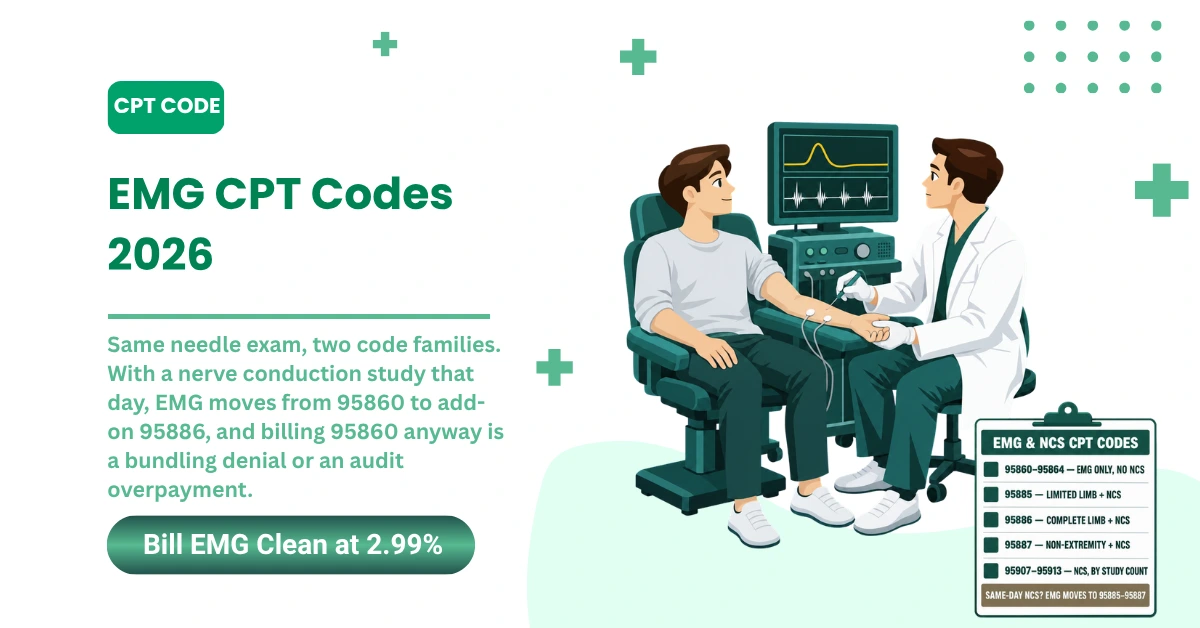




EMG CPT codes turn on one fact: whether the practice billed a nerve conduction study (NCS) on the same date. Without one, needle EMG goes on the standalone codes 95860 to 95872. With an NCS that day, EMG moves to add-on codes 95885, 95886, and 95887, billed alongside one NCS code from 95907 to 95913.
Neurology, PM&R, and pain practices lose EMG revenue in two familiar places: the wrong code family for the date, and nerve studies counted per stimulation site, which inflates the tier. Your team can fix both at charge entry.
You'll find the full set of electromyography CPT codes here, with NCS counting, units, modifiers, Medicare contractor policies, and 2026 national payment amounts, checked against CMS files and contractor articles, including revisions effective October 1, 2026.
|
Key takeaways
|
What are EMG CPT codes?
EMG CPT codes are the CPT codes for needle electromyography, the physician's needle exam of muscle electrical activity. The CPT code for electromyography comes from 95860 to 95872 when you bill EMG alone and from 95885 to 95887 when the patient has a nerve conduction study the same day. Medicare contractors decide coverage, and the AMA maintains the code set.
WPS spells out this date rule in its WPS billing article A57478, and Noridian's article A54969 says the same thing. Some published answers mix up two of these codes: 95886 is an extremity code, and 95887 is the non-extremity code.
Picking the right EMG CPT code starts with the date on the claim, and our specialty billing for neurology team codes EMG and NCV studies by that rule.
EMG vs nerve conduction study: two tests, two code families
Needle EMG records a muscle's electrical activity through a thin needle electrode. Your physician checks insertional and spontaneous activity first, then motor unit potentials and recruitment as the patient contracts the muscle.
An NCS, which older orders call NCV (nerve conduction velocity), stimulates a nerve through surface electrodes and measures latency, amplitude, and conduction velocity. Patients who want to know what to expect can read the MedlinePlus EMG overview and the MedlinePlus nerve conduction overview.
Coders count the two tests in different ways. NCS goes by the number of studies, while EMG goes by limbs or sites, and the CPT code for an electromyogram changes once both tests happen on the same date.
What is the CPT code for an EMG test?
No single code covers the whole EMG family. For a typical office visit with both tests, you bill one NCS code plus 95886 for each limb tested. EMG alone takes one code from 95860 to 95864 based on the number of limbs, and the extremity chart further down shows the CPT code for EMG in each combination.
EMG codes for the larynx, diaphragm, face, and trunk appear in the full list below, along with the add-on codes for same-day testing.
Complete list of EMG CPT codes for 2026
CPT codes for EMG and related electrodiagnostic (EDX) tests fall into three groups, based on how they land on a claim. Each electromyography CPT code below carries a short summary in plain language, and the AMA's CPT book holds the full descriptor wording.
Standalone needle EMG codes (no NCS that day)
Table 1. Picking the CPT code for needle electromyography without a same-day NCS
|
Code |
What it reports |
Units |
|---|---|---|
|
95860 |
Needle EMG, one extremity, related paraspinals included when tested |
1 per exam |
|
95861 |
Needle EMG, two extremities, any combination of arms and legs |
1 per exam |
|
95863 |
Needle EMG, three extremities |
1 per exam |
|
95864 |
Needle EMG, four extremities |
1 per exam |
|
95865 |
Needle EMG of the larynx |
1 |
|
95866 |
Needle EMG of one hemidiaphragm |
1 per side |
|
95867 |
Cranial nerve supplied muscles, one side |
1 |
|
95868 |
Cranial nerve supplied muscles, both sides |
1 (replaces 95867) |
|
95869 |
Thoracic paraspinal muscles, excluding T1 and T12 |
1, any levels or sides |
|
95870 |
Limited study: under five muscles in one limb, or axial muscles |
1 per extremity |
|
95872 |
Single fiber EMG measuring jitter, blocking, or fiber density |
1 per muscle studied |
Add-on needle EMG codes (NCS on the same date)
Table 2. Add-on needle EMG codes billed with a same-day NCS code (95907 to 95913)
|
Code |
What it reports |
Units |
|---|---|---|
|
95885 |
Limited needle EMG, one extremity, related paraspinals when tested |
1 per extremity |
|
95886 |
Complete needle EMG, one extremity: five or more muscles, three or more nerves or four or more spinal levels |
1 per extremity; 95885 plus 95886 capped at 4 combined |
|
95887 |
Non-extremity muscles: cranial nerve supplied or axial |
Check the current unit limit (MUE) and your MAC before billing more than 1 |
All three are add-on codes, so each one needs a primary NCS code on the same date. You'll pick that code from the NCS tiers covered further down.
Surface EMG, sphincter EMG, and other related codes
Table 3. Related codes that aren't standard diagnostic needle EMG
|
Code |
What it reports |
Billing note |
|---|---|---|
|
95905 |
Automated nerve conduction with preconfigured electrodes |
Once per limb; not with another NCS code (Noridian article A54969) |
|
95937 |
Neuromuscular junction testing, repetitive stimulation, each nerve |
Paid in addition to NCS |
|
95873, 95874 |
Electrical stimulation or needle EMG guidance for chemodenervation |
Add-on to botulinum toxin injection codes |
|
51784, 51785 |
Anal or urethral sphincter EMG; 51785 is the needle study |
Urology and urogynecology |
|
96002 to 96004 |
Dynamic surface or fine wire EMG during motion analysis |
Motion analysis in gait labs, outside diagnostic EDX |
|
S3900 |
Surface EMG (HCPCS Level II) |
Commercial plans; often noncovered |
|
G0255 |
Sensory nerve conduction threshold test |
Medicare noncovered (Medicare NCD 160.23) |
There's no surface EMG CPT code for diagnostic EDX work, and WPS A57478 lists surface and macro EMG among the tests it won't pay. The CPT code for EMG of the anal sphincter is 51785 for a needle study and 51784 for other techniques.
Billing EMG without a same-day nerve conduction study (95860 to 95872)
Without a same-day NCS, you bill complete extremity EMG with one code from 95860 to 95864, based on the number of limbs tested. Each limb that falls short of a complete study goes on 95870. Site studies use 95865 to 95869, and single fiber EMG uses 95872.
95860 to 95864: count the limbs, report one unit
A limb counts as a complete study when the physician tests five or more muscles, drawn from three nerves or four spinal levels. WPS article A57478 names the nerves it means: radial, median, ulnar, tibial, peroneal, and femoral, and branches don't count as separate nerves. Related paraspinal muscles stay inside the limb's code.
You report one unit per exam, as the AAPM&R electrodiagnostic billing guide notes, because the code number already carries the limb count. One limb is CPT code 95860. CPT code 95861 covers two extremities in any combination: two arms, two legs, or one of each. RT and LT aren't needed on these codes.
95870: limited limbs and axial muscles
Testing fewer than five muscles in a limb makes it a limited study, and CPT code 95870 covers it at one unit per extremity under A57478. Paraspinals that belong to a limb already billed with 95860 to 95864 don't get a separate 95870.
CPT code 95870 also covers axial muscles such as intercostals, the abdominal wall, and cervical or lumbar paraspinals tested without their limb.
EMG coding gets messy when one limb is complete and the other isn't. A complete right arm plus three muscles in the left arm means 95860 plus 95870. If the NCCI (National Correct Coding Initiative) edit table pairs those codes, XS on 95870 shows a separate limb, and our guide to modifier 59 and XS covers the edit rules.
95869 and the thoracic paraspinal rule
CPT code 95869 covers the thoracic paraspinal muscles, and WPS defines that range as T3 to T11. You bill one unit regardless of how many levels or sides the physician tests.
A57478 also keeps an older sentence that sends exams limited to hand or foot muscles to 95869, which doesn't match the CPT descriptor. If WPS adjusts one of your claims on that line, ask the contractor for written guidance before you change your coding.
95865 to 95868 and 95872: site and single fiber studies
ENT and voice clinics bill 95865 for the larynx, and 95866 reports one hemidiaphragm for phrenic nerve work. For cranial nerve muscles, 95867 covers one side and 95868 covers both, so you bill 95868 alone for a bilateral facial exam.
You bill 95872 per muscle studied for single fiber EMG. Your report needs the jitter, blocking, or fiber density values, since Medicare pays 95872 for that measurement.
CPT codes for EMG with a nerve conduction study: 95885, 95886, and 95887
On a date with a billed nerve conduction study, needle EMG moves to add-on codes: 95885 for a limited extremity study, 95886 for a complete one, and 95887 for non-extremity muscles. Each add-on needs a primary NCS code from 95907 to 95913 on the same claim and date of service.
Standalone codes come off the claim on NCS days
The EMG CPT code changes the moment an NCS code lands on the same date. WPS and Noridian both tell you to use 95885, 95886, and 95887 on NCS days. An add-on works like a trailer: it needs an NCS code on the same date as its hitch. That's why payers deny 95886 on any date without an NCS line.
CPT lists all three as add-ons to a primary procedure, CMS gives them a ZZZ global period, and they're exempt from modifier 51.
Some published guides still pair 95860 to 95864 with an NCS code, and that EMG NCS CPT code combination is wrong. Payers tend to return it as a bundling denial, and our guide to CO-97 bundling denials covers that fix. If a payer's edits miss it, you're holding an overpayment that an audit can pull back later.
95887: non-extremity muscles on an NCS day
CPT code 95887 covers cranial nerve muscles, such as the face and tongue, and axial muscles: thoracic paraspinals, cervical or lumbar paraspinals examined without their limb, the diaphragm, and abdominal muscles. CPT's instruction not to report 95887 with 95867 to 95870 or 95905 appears in the AAN EMG coding summary from 2012.
That 2012 AAN guidance values 95887 per site, so EMG of both sides of the face can support two units. Payer unit limits can differ, though. Check the current Medically Unlikely Edit (MUE) file and your MAC's article before you bill a second unit.
EMG and NCS on different days
You code each date on its own. Your NCS day claim carries the NCS code alone. On the EMG day, you bill a standalone code from 95860 to 95870, since that date has no NCS.
Put the reason for the split in the report: the patient couldn't tolerate the needle that day, needed an anticoagulant hold, or came back for a scheduling reason. Example 3 in the worked claims below shows the claim lines.
If add-on errors keep sending EMG claims back, the fix sits in charge entry, where someone checks the date before choosing the code. MedSole RCM's full-service medical billing starts at 2.99% of collections, with denial management included, and our outsourced medical billing team runs that date check before claims go out.
CPT code 95886: description, complete study rules, and units
EMG CPT code 95886 reports a complete needle EMG of one extremity, with related paraspinal muscles when tested, done on the same date as a nerve conduction study. Each limb needs five or more muscles, innervated by three or more nerves or four or more spinal levels. You bill one unit per extremity with a primary NCS code.
The 95886 CPT code description sets two thresholds, and the report has to prove both. Before you bill it, check the report for these four items:
- An NCS code from 95907 to 95913 on the same date
- At least five muscles in the limb, each one named
- The nerve or root level for each muscle, showing three nerves or four levels
- Findings for each muscle: insertional and spontaneous activity, motor unit shape, and recruitment
In 2026, CPT code 95886 carries 0.84 work relative value units (RVUs) and a national Medicare amount of $99.87, or $45.43 with modifier 26. Those figures come from CMS's 2026 RVUs at the $33.4009 conversion factor, and you can check your locality in the CMS PFS Look-Up Tool.
Rate tables that still list 1.56 work RVUs for 95886, or call it a code for four limbs, are wrong on both counts.
CPT 95886 vs 95885: what's the difference?
CPT 95886 is a complete study, and 95885 is a limited one. A limb needs five or more muscles plus three nerves or four spinal levels to reach 95886, and anything short of that is 95885. Both are add-ons, and each limb gets one of the two codes.
Table 4. CPT 95885 vs 95886 at a glance
|
Factor |
95885 |
95886 |
|---|---|---|
|
Study type |
Limited |
Complete |
|
Muscles per limb |
Fewer than five, or five without the nerve or level spread |
Five or more |
|
Nerve or level spread |
Not required |
Three or more nerves, or four or more spinal levels |
|
Units |
1 per extremity |
1 per extremity (4 combined with 95885) |
|
2026 national amount |
$64.46 |
$99.87 |
|
With modifier 26 |
$18.37 |
$45.43 |
The 95885 CPT code description says "limited" and nothing more. Five muscles aren't enough on their own: if they come from two nerves and three spinal levels, CPT code 95885 is the right code.
Reporting more than one unit of 95886
Units count per extremity, so you bill two units of 95886 for a study of both legs. Many payers want those units on separate lines with RT and LT, and a missing side modifier often triggers CO-4 modifier denials.
Modifier 76 describes repeating the same procedure, which a second limb isn't. Add modifier 50 only when a payer's written policy asks for it.
Medicare's unit limits sit in the practitioner CMS MUE tables, with the latest file effective October 1, 2026. A commercial plan's "maximum quantity" denial on the third or fourth unit often reflects the plan's own limit, so read its policy before you change the codes.
Nerve conduction study CPT codes: 95907 to 95913 and how to count studies
Nerve conduction studies take one CPT code from 95907 to 95913, set by the total number of studies done that date: 95907 for one or two studies, up to 95913 for 13 or more. One study is a sensory test, a motor test with or without an F-wave, or an H-reflex on one named nerve.
Table 5. Nerve conduction study CPT codes and 2026 national Medicare amounts (CMS 2026 RVUs × $33.4009)
|
Code |
Studies |
2026 national amount |
With modifier 26 |
|---|---|---|---|
|
95907 |
1 to 2 |
$94.19 |
$53.44 |
|
95908 |
3 to 4 |
$118.24 |
$67.14 |
|
95909 |
5 to 6 |
$141.95 |
$80.16 |
|
95910 |
7 to 8 |
$184.71 |
$106.21 |
|
95911 |
9 to 10 |
$220.11 |
$132.60 |
|
95912 |
11 to 12 |
$254.85 |
$158.32 |
|
95913 |
13 or more |
$299.94 |
$187.71 |
The 95911 CPT code description covers nine or 10 studies, so CPT code 95911 is one unit whether the tests span one limb or four. At the top, the 95913 CPT code description starts at 13 with no ceiling, and you still bill 16 studies as one unit.
How to count nerve conduction studies
Your NCS CPT code comes from one total for the date, so the CPT code for a nerve conduction test goes on the claim once. WPS article A57478 sets the counting rules below, and the American Association of Neuromuscular & Electrodiagnostic Medicine (AANEM) backs them with nerve lists through its AANEM coding resources.
- A sensory test on one nerve counts as one study.
- A motor test counts as one study, with or without an F-wave.
- An H-reflex counts as its own study.
- Stimulating several sites along one nerve still counts once per test type.
- Motor and sensory tests on the same nerve count as two studies.
Take a carpal tunnel workup on the right hand. The physician runs six tests, and the count works like this:
- Right median motor with F-wave
- Right median sensory
- Right ulnar motor with F-wave
- Right ulnar sensory
- Right radial sensory
- Left median sensory, for comparison
You bill those six studies as one unit of 95909. Those two F-waves added zero studies, and counting them as studies would push this claim to 95910. All seven nerve conduction CPT codes work off the same kind of total.
What is the CPT code for two nerve conduction studies?
The CPT code for a nerve conduction study with one or two tests is 95907, such as a median motor test and a median sensory test on one hand. You still bill CPT code 95907 as one unit. Older orders that say NCV mean the same range, so the CPT code for NCV is 95907 to 95913.
95905, 95937, and NCS without a needle exam
CPT code 95905 covers automated nerve conduction with preconfigured electrode arrays. Noridian's A54969 allows it once per limb and bars it alongside any other NCS code, and physical therapists can't bill it.
CPT code 95937 covers repetitive stimulation testing, billed per nerve. A57478 pays it on top of the NCS code, and the report must show the stimulation rate and any decrement or increment.
An NCS without a needle exam can still go on a claim, but Noridian's LCD L36524 notes that NCS alone may give only part of the diagnostic picture.
If the physician skips the needle exam, the report should say why, such as a patient refusal, an anticoagulant, or lymphedema. Neuropathy workups run into this, and our guide to neuropathy ICD-10 codes covers the diagnosis side.
EMG CPT code by extremity: upper, lower, and bilateral studies
Find the limbs tested in the first column, then read across for the NCS status and whether each limb met the complete study threshold.
Table 6. Needle EMG codes by number of extremities, with and without a same-day NCS
|
Limbs tested |
No NCS, complete |
No NCS, limited (under five muscles per limb) |
Same-day NCS, complete |
Same-day NCS, limited |
|---|---|---|---|---|
|
One arm or one leg |
95860 × 1 |
95870 × 1 |
95886 × 1 |
95885 × 1 |
|
Both arms |
95861 × 1 |
95870 × 2 |
95886 × 2 (RT, LT) |
95885 × 2 |
|
Both legs |
95861 × 1 |
95870 × 2 |
95886 × 2 (RT, LT) |
95885 × 2 |
|
One arm and one leg |
95861 × 1 |
95870 × 2 |
95886 × 2 |
95885 × 2 |
|
Three limbs |
95863 × 1 |
95870 × 3 |
95886 × 3 |
95885 × 3 |
|
All four limbs |
95864 × 1 |
95870 × 4 |
95886 × 4 |
95885 × 4 |
- Judge each limb on its own; a mixed exam combines columns.
- Keep 95885 plus 95886 at four units or fewer.
- Add one NCS code from 95907 to 95913 on NCS days.
- Check the current MUE file before billing several units of 95870.
What is the CPT code for EMG of bilateral upper extremities?
Without a same-day NCS, EMG of both arms is one unit of 95861 when each arm meets the complete study threshold. With an NCS, it's 95886 twice, on RT and LT lines, plus the NCS code. Limited arms use 95870 or 95885 twice instead.
What is the CPT code for EMG of bilateral lower extremities?
Both legs follow the same pattern as the arms: 95861 once without an NCS, or 95886 twice with one. For EMG/NCV of bilateral lower extremities, the claim carries one NCS code for the total study count plus 95886-RT and 95886-LT. Example 2 in the worked claims follows this layout.
What is the CPT code for EMG of one upper or lower extremity?
The EMG CPT code for one lower extremity or one upper extremity is 95860 without a same-day NCS, or 95886 with one. A limb with fewer than five muscles tested moves to 95870 without an NCS or 95885 with one.
How to bill EMG and NCS together: three worked claims
Each example below takes one visit from the study list to the claim lines, showing which EMG CPT code goes on each line with its units, modifiers, covered diagnosis, and 2026 national Medicare amount. Swap in your own counts, and the logic behind clean EMG billing stays the same.
Example 1: Right carpal tunnel study with NCS and one limb
You bill 95909 plus 95886-RT for this visit. Numbness in the right hand and thenar weakness brought the patient in.
Across six studies, the physician tested right median motor with F-wave, right median sensory, right ulnar motor, right ulnar sensory, right radial sensory, and left median sensory for comparison. Needle EMG of the right arm covered six muscles from three nerves.
Example 1 claim lines
|
Line |
CPT |
Modifier |
Units |
ICD-10 |
2026 national amount |
|---|---|---|---|---|---|
|
1 |
95909 |
None |
1 |
G56.01 |
$141.95 |
|
2 |
95886 |
RT |
1 |
G56.01 |
$99.87 |
That claim totals $241.82. CPT Appendix J allows one limb and seven studies for carpal tunnel on one side, and this claim uses one limb and six studies.
Example 2: EMG/NCV of both legs for diabetic polyneuropathy
Both legs get 95886 here, and the NCS count lands on 95910. A patient with type 2 diabetes came in with burning feet and early distal weakness.
Across both legs, the physician performed eight nerve conduction studies plus a complete needle EMG in each leg. The CPT code for EMG nerve conduction study work like this keeps one shape: one NCS line, then one EMG line per limb.
Example 2 claim lines
|
Line |
CPT |
Modifier |
Units |
ICD-10 |
2026 national amount |
|---|---|---|---|---|---|
|
1 |
95910 |
None |
1 |
E11.42 |
$184.71 |
|
2 |
95886 |
RT |
1 |
E11.42 |
$99.87 |
|
3 |
95886 |
LT |
1 |
E11.42 |
$99.87 |
Those three lines total $384.45. For polyneuropathy, Appendix J allows three limbs and 10 studies, so this claim stays inside the table.
Example 3: NCS on Monday, needle EMG on Thursday
Monday gets 95908 alone, and Thursday gets 95860. A patient with left foot drop had four studies on Monday: left peroneal motor, left tibial motor, left sural sensory, and left superficial peroneal sensory.
Needle testing had to wait: the patient couldn't tolerate the exam that day and came back Thursday for needle EMG of the left leg, six muscles from three nerves, with no NCS that day.
Example 3 claim lines
|
Date |
CPT |
Modifier |
Units |
ICD-10 |
2026 national amount |
|---|---|---|---|---|---|
|
Monday |
95908 |
None |
1 |
G57.32, M21.372 |
$118.24 |
|
Thursday |
95860 |
None |
1 |
G57.32, M21.372 |
$119.58 |
For a mononeuropathy, Appendix J allows one limb and eight studies. Split testing doesn't create a combined CPT code for EMG NCS work, so each date stands on its own.
All amounts are 2026 national Medicare physician fee schedule values at the $33.4009 conversion factor, calculated from CMS relative value units. They don't include locality adjustment, the patient's 20% coinsurance, or the 2% sequestration reduction.
None of these examples includes an evaluation and management (E/M) visit. A separately identifiable visit goes on its own line with modifier 25, which the modifiers section below covers.
Want to see how your own EMG and NCS claims compare with these three? Our practice audit and analysis reviews recent electrodiagnostic claims line by line, checking units per limb, add-on pairing, and whether each diagnosis sits on your MAC's covered list.
Modifiers for EMG and NCS claims: 26, TC, 25, XS, RT, and LT
EMG and NCS codes split into a professional component (modifier 26) and a technical component (TC). You bill the global code, with no modifier, when your practice owns the equipment and the physician reads the study. Modifier 25 goes on a same-day E/M only when it's separately identifiable. RT, LT, and XS mark separate limbs.
Modifier 26 and TC: who owns the equipment
Place of service tells you how to split it. In an office (POS 11) where the practice owns the machine, you bill the global code. Hospital outpatient departments (POS 22 or 19) split it: the physician bills modifier 26, and the hospital bills the technical side on its facility claim.
Mobile vendors and independent diagnostic testing facilities split the codes by who performs each part, and our guide to place of service codes lists each setting. Billing the global code in a facility setting bills the technical component twice, and payers deny or recoup it.
Tables 4 and 5 above list the modifier 26 amounts. Once the EMG CPT code is right, the modifier tells the payer which half you're billing, and our modifier 26 guide covers the edge cases.
Modifier 25 for a same-day E/M visit
WPS A57478 treats an E/M service as part of the exam done before and during EMG and NCS in most cases. You bill the E/M on its own line only when the record shows separately identifiable, medically necessary work.
Say a neurologist evaluates new weakness, reviews outside imaging, changes a medication, and then performs the study. That visit can support a new patient E/M with modifier 25 alongside the EDX codes, and our guide to 99204 new patient visits covers the documentation.
XS, RT, LT, and modifier 51 on EMG claims
For EMG in medical billing, RT and LT tell the payer which limb each extremity code covers. XS tells the payer that two codes the edit table bundles both belong on the claim, and you should use it only when the current NCCI table pairs the codes and allows a modifier.
You can't fix the wrong code family for the date with a modifier. Add-on codes 95885 to 95887 are exempt from modifier 51, so leave 51 off those lines.
Medical necessity for EMG and NCS: LCDs, ICD-10 codes, and study limits
Medicare pays for EMG CPT codes when the reason for testing matches your Medicare contractor's LCD and the diagnosis appears on the covered list in its billing article. Each contractor publishes its own pair of documents. Limb and study counts should stay within the maximum studies table unless the report explains why the physician needed more.
Find your MAC's LCD and billing article
Seven Medicare contractors publish EMG and NCS policy. Noridian merged its two versions on October 23, 2025, which retired A54992 and L36526, and both Noridian jurisdictions now use L36524 and A54969.
Table 7. Medicare contractor LCDs and billing articles for EMG and NCS
|
Contractor |
Jurisdictions and states |
LCD |
Billing article |
Current revision |
|---|---|---|---|---|
|
WPS |
J5: Iowa, Kansas, Missouri, Nebraska. J8: Indiana, Michigan |
L34594 |
A57478 |
October 1, 2026 |
|
Noridian |
JE: California, Hawaii, Nevada, American Samoa, Guam, Northern Mariana Islands. JF: Alaska, Arizona, Idaho, Montana, North Dakota, Oregon, South Dakota, Utah, Washington, Wyoming |
L36524 |
A54969 |
October 23, 2025 |
|
Novitas |
JH: Arkansas, Colorado, Louisiana, Mississippi, New Mexico, Oklahoma, Texas. JL: Delaware, District of Columbia, Maryland, New Jersey, Pennsylvania |
L35081 |
October 1, 2025 |
|
|
Palmetto GBA |
JJ: Alabama, Georgia, Tennessee. JM: North Carolina, South Carolina, Virginia, West Virginia |
L35048 |
October 1, 2025 |
|
|
CGS |
J15: Kentucky, Ohio |
L35897 |
May 7, 2026 |
|
|
First Coast |
JN: Florida, Puerto Rico, U.S. Virgin Islands |
L34859 |
October 1, 2025 |
|
|
Wellpoint Federal (National Government Services until April 2026) |
J6: Illinois, Minnesota, Wisconsin. JK: Connecticut, Maine, Massachusetts, New Hampshire, New York, Rhode Island, Vermont |
L35098 |
April 1, 2026 |
We checked these revision dates on September 28, 2026. Contractors often revise these articles on October 1 for ICD-10 updates, so confirm the date on your contractor's page before you rely on it.
Commercial plans write their own rules. Aetna policy 0502, last reviewed July 29, 2026, is one example, and it carries its own maximum studies table.
ICD-10 codes that support EMG and NCS
Your claim's diagnosis has to appear on your contractor's covered list. Each code in the table below sits on WPS A57478's list, so confirm it on your own contractor's list before you bill it.
Table 8. ICD-10 codes on WPS A57478's covered list for EMG and NCS
|
ICD-10 |
Condition |
|---|---|
|
G56.01 to G56.03 |
Carpal tunnel syndrome, right, left, or bilateral |
|
G56.21 to G56.23 |
Ulnar nerve lesion |
|
G57.31 to G57.33 |
Lateral popliteal (peroneal) nerve lesion |
|
G57.51 to G57.53 |
Tarsal tunnel syndrome |
|
E11.42 |
Type 2 diabetes with polyneuropathy |
|
G61.0 |
Guillain-Barre syndrome |
|
G61.81 |
Chronic inflammatory demyelinating polyneuritis |
|
G12.21 |
Amyotrophic lateral sclerosis |
|
G70.00, G70.01 |
Myasthenia gravis |
|
G54.0 |
Brachial plexus disorders |
|
G54.2, G54.4 |
Cervical and lumbosacral root disorders |
|
M21.371, M21.372 |
Foot drop |
Two unspecified codes fail on both the WPS and Noridian lists: G62.9 (polyneuropathy, unspecified) and G56.00 (carpal tunnel, unspecified limb). Code the side and the type instead.
If you code radiculopathy with an M54.1 code, confirm it on your contractor's list first. Our guide to radiculopathy ICD-10 codes walks through the choices.
Maximum number of studies by diagnosis
CPT's Appendix J table, which WPS A57478 and Noridian A54969 both reproduce, lists the limbs and studies a physician needs to reach a diagnosis in 90% of patients. Going past it takes supplementary documentation. A57478 also allows testing an opposite limb without symptoms for comparison when the report explains why.
Table 9. Maximum studies by diagnosis (CPT Appendix J, as reproduced in WPS A57478 and Noridian A54969)
|
Indication |
Needle EMG limbs |
NCS studies |
Repetitive stimulation |
|---|---|---|---|
|
Carpal tunnel, one side |
1 |
7 |
None |
|
Carpal tunnel, both sides |
2 |
10 |
None |
|
Radiculopathy |
2 |
7 |
None |
|
Mononeuropathy |
1 |
8 |
None |
|
Polyneuropathy or mononeuropathy multiplex |
3 |
10 |
None |
|
Myopathy |
2 |
4 |
2 |
|
Motor neuronopathy (for example, ALS) |
4 |
6 |
2 |
|
Plexopathy |
2 |
12 |
None |
|
Neuromuscular junction |
2 |
4 |
3 |
|
Tarsal tunnel, one side |
1 |
8 |
None |
|
Tarsal tunnel, both sides |
2 |
11 |
None |
|
Weakness, fatigue, cramps, or twitching (focal) |
2 |
7 |
2 |
|
Weakness, fatigue, cramps, or twitching (general) |
4 |
8 |
2 |
|
Pain, numbness, or tingling (one side) |
1 |
9 |
None |
|
Pain, numbness, or tingling (both sides) |
2 |
12 |
None |
EMG and NCS documentation that holds up in an audit
Auditors match EMG CPT codes to the report, so the report has to show the numbers along with the conclusion: latency, amplitude, and conduction velocity for each nerve, each muscle tested with its findings, the clinical question from the referring provider, and the reason for any repeat or extra studies.
WPS's reasons for denial
WPS A57478 lists these reasons for denial on top of the LCD criteria, and each one traces back to something missing from the report or the claim:
- The report left out amplitude, latency, and velocity data.
- An F-wave appeared without its motor study data.
- A separate E/M went out without the referral documentation.
- The claim included surface or macro EMG.
- No clinical history showing the need for testing arrived on request.
- Nothing supported repeat testing on the same patient.
- The practice tested every patient referred for pain.
Audit history for electrodiagnostic claims
In its OIG electrodiagnostic billing report, the HHS Office of Inspector General found that Medicare paid about $486 million in 2011 to 21,700 physicians for electrodiagnostic tests on 877,000 beneficiaries. Of those physicians, 4,901 showed questionable billing totaling $139 million, and the OIG asked CMS to increase its monitoring.
Recovery auditors can still review these claims under CMS RAC issue 0187, "Nerve Conduction Studies: Excessive Units," an approved complex review of outpatient hospital claims for 95905 and 95907 to 95913 across all Medicare contractors. Medicare also requires the treating provider to order the test.
Put study counts and limb fields on your EDX charge form so the coder doesn't have to infer them from the narrative. Our guide to the superbill in medical billing covers the layout.
Common EMG and NCS denials and how to fix them
Denials on EMG billing codes trace to five causes: the wrong EMG CPT code family for the date, units above the limit, a diagnosis missing from the contractor's list, a missing or mismatched modifier, and a report without numeric data. Each one costs less to stop at charge entry than to appeal.
Table 10. Common EMG and NCS denial codes and fixes
|
Denial code |
What it tends to mean on EMG and NCS claims |
Fix |
|---|---|---|
|
CO-97 or CO-234 |
Standalone EMG billed on an NCS day, or an add-on with no NCS code that date (CO-234 denial guide) |
Recode by date; a modifier won't fix it |
|
CO-50 |
Diagnosis doesn't support the test, often G62.9, G56.00, or a symptom code alone (CO-50 medical necessity denials) |
Code the specific diagnosis from the contractor's list and appeal with the referral history |
|
CO-151, often with remark N362 |
Units above the MUE or the plan's limit |
Check the current MUE file and send documentation for medically necessary extra units |
|
CO-4 |
RT or LT missing, or modifier 26 missing in a facility setting |
Add the right modifier and resubmit a corrected claim |
|
OA-18 |
A second 95886 line read as a duplicate |
Split the units into RT and LT lines |
|
CO-197 |
The plan required prior authorization |
Ask about retro authorization and add the check at scheduling |
Prior authorization and commercial plan rules
Some commercial and Medicare Advantage plans require prior authorization for EMG and NCS or apply their own electrodiagnostic policy. Verify at scheduling with the CPT codes and the expected limb count. If a CO-197 comes back anyway, ask about retro authorization. Our prior authorization support team handles those requests as part of the 2.99% rate.
Your EMG or NCS appeal packet
Medicare gives you 120 days from the date you receive the initial determination to request a redetermination. Send the referral history, the full report with numeric data, the LCD and billing article citation, and a note on the maximum studies table if the claim went past it.
At MedSole RCM, the 2.99% billing rate includes denial management, AR follow-up, prior authorization, and benefit verification. If EMG denials are stacking up at your practice, our denial management services team can start with the open ones.
2026 Medicare reimbursement for EMG and NCS
In 2026, Medicare's national amounts for extremity EMG CPT codes run from $64.46 for 95885 to $240.49 for 95864, and NCS codes span $94.19 to $299.94. Our three sample claims above total $237.82 to $384.45 before locality adjustment. All figures use CMS 2026 RVUs at the $33.4009 conversion factor.
Does Medicare cover EMG testing?
Yes. Medicare Part B covers needle EMG and NCS when the patient meets your contractor's LCD criteria and a treating provider orders the test. Patients owe 20% coinsurance after the Part B deductible. Medicare reimbursement for EMG excludes surface EMG and sensory nerve conduction threshold testing (G0255).
2026 amounts for standalone EMG and related codes
These EMG RVU values and payment amounts cover the codes that the earlier tables leave out. EMG reimbursement for the technical component equals the global amount minus the modifier 26 amount.
Table 11. 2026 national Medicare amounts and work RVUs for standalone EMG and related codes (CMS 2026 RVUs × $33.4009; TC shown as global minus modifier 26)
|
Code |
Work RVU |
Global |
Modifier 26 |
TC |
|---|---|---|---|---|
|
95860 |
0.94 |
$119.58 |
$51.44 |
$68.14 |
|
95861 |
1.50 |
$161.99 |
$81.16 |
$80.83 |
|
95863 |
1.82 |
$220.45 |
$98.87 |
$121.58 |
|
95864 |
1.94 |
$240.49 |
$104.88 |
$135.61 |
|
95869 |
0.36 |
$95.19 |
$19.71 |
$75.48 |
|
95870 |
0.36 |
$86.51 |
$19.71 |
$66.80 |
|
95887 |
0.69 |
$88.18 |
$37.07 |
$51.11 |
|
95937 |
0.63 |
$106.55 |
$34.07 |
$72.48 |
2026 fee schedule changes behind these numbers
CMS set two conversion factors for 2026: $33.4009 for most clinicians, up 3.26%, and $33.5675 for qualifying alternative payment model (APM) participants, up 3.77%, per the CMS 2026 fee schedule fact sheet.
CMS also applied a 2.5% efficiency adjustment that lowers work RVUs for all codes except time-based services such as E/M. EMG and NCS codes aren't time-based, so the adjustment applies to them.
Commercial EMG/NCV reimbursement follows each contract, and some contracts pay a percentage of the Medicare fee schedule. Compare each remittance to your contracted rate, and our AR follow-up team chases the underpayments.
What changed for EMG CPT codes in 2026
EMG and NCS codes carried into 2026 without corrections: the AMA's CPT 2026 errata, updated June 2, 2026, lists none for 95860 to 95913 or 95937. Change came from around the codes, in payment values, quarterly MUE files, FY 2027 ICD-10 codes, and several Medicare contractor documents.
- September 11, 2025: the AMA released CPT 2026 with 288 new codes, 84 deletions, and 46 revisions, per the AMA CPT 2026 announcement.
- October 23, 2025: Noridian retired L36526 and A54992 and moved both jurisdictions to L36524 and A54969.
- October 31, 2025: CMS finalized the 2026 fee schedule with two conversion factors and a 2.5% work RVU efficiency adjustment.
- January 1, 2026: the NCCI Policy Manual kept 95860 to 95872 from separate billing with biofeedback that uses EMG.
- April 1, 2026: National Government Services documents took the Wellpoint Federal name (L35098 and A57668).
- June 2, 2026: the AMA CPT errata page posted its 2026 update with no EMG or NCS corrections.
- October 1, 2026: effective date for a new practitioner MUE file, FY 2027 ICD-10-CM codes from the CMS ICD-10 page, and a WPS A57478 revision.
Therapy practices that use EMG in biofeedback shouldn't add 95860 to 95872 to those sessions. Our 97112 billing guide covers the neuromuscular reeducation side.
Who can perform and bill needle EMG and NCS
Medicare pays for needle EMG that physicians perform, and it lets certified physical therapists handle parts of the testing where state law allows. AANEM's position is that only physicians should perform the needle exam. Enrollment with each payer has to be active before the performing provider bills the study.
Physicians, nurse practitioners, and physician assistants
Both the AANEM qualification statement, reapproved in April 2024, and the AANEM recommended policy from 2023 say only physicians should perform any part of the exam that uses a needle. For nurse practitioners and physician assistants, state scope of practice law and payer policy decide, so check both before you bill under an NP or PA NPI.
Physical therapists and the 6A and 7A indicators
CMS assigns supervision indicators that set who may perform each part of a test. Needle EMG codes 95860 to 95870 and 95885 to 95887 carry indicator 6A for the technical portion, and 95872 carries 66.
NCS codes 95907 to 95913 have carried 7A since January 1, 2013, so a physical therapist certified by the American Board of Physical Therapy Specialties (ABPTS) may bill both components where state law allows. CPT code 95905 has no PT designation.
42 CFR 410.32 defines the supervision levels, and PT practices can find their codes in our guide to physical therapy CPT codes.
Enrollment comes before the first claim
Before anyone bills an EMG CPT code, the performing provider needs active enrollment with Medicare through PECOS (the Provider Enrollment, Chain, and Ownership System) and with each commercial plan. Our guide to Medicare enrollment in 2026 walks through PECOS step by step.
MedSole RCM handles credentialing and payer enrollment from $99 per insurance payer and files applications within 48 hours of receiving complete documents. Our credentialing and payer enrollment team can start as soon as your new neurologist's documents are ready.
Outsourcing EMG and NCS billing: scope and cost
A team that handles EMG codes for medical billing well checks the date before the code family, matches the NCS code to the report's study count, caps units per limb against the current MUE, sets modifier 26 or global billing by place of service, confirms each diagnosis against your contractor's list, and works each denial to closure.
For practices that want EMG CPT codes handled end to end, MedSole RCM's full-service medical billing starts at 2.99% of collections. That rate includes denial management, AR follow-up, prior authorization, and benefit verification. Credentialing and payer enrollment start at $99 per insurance payer.
MedSole RCM bills for 75+ specialties, including neurology practices that run EMG and NCV studies in the office or at a hospital outpatient department. Practices that want eligibility through reporting under one team can look at our revenue cycle management services.
If you're comparing billing companies, ask each one for its percentage, what that percentage includes, and how it handles the EMG checks listed above.
EMG CPT codes: frequently asked questions
What are the CPT codes for EMG in 2026?
EMG CPT codes for 2026 are the same code family you billed in 2025: 95860 to 95872 without a same-day NCS and 95885 to 95887 with one. Each procedure code for a nerve conduction study comes from 95907 to 95913. As of June 2, 2026, the AMA's errata lists no corrections to these codes.
Is there an ICD-10 code for EMG?
No. EMG is a procedure, so it goes on the claim as a CPT code, and the ICD-10 code explains why the physician ordered the test. G56.01 for right carpal tunnel and E11.42 for diabetic polyneuropathy are two examples. Unspecified G62.9 isn't on the WPS or Noridian covered lists.
Does insurance cover EMG and nerve conduction studies?
Medicare Part B covers them when the patient meets your contractor's LCD criteria. Commercial plans follow their own policies, such as Aetna's policy 0502, and some require prior authorization. WPS won't pay for surface EMG, and some commercial policies treat it as investigational.
How much does a nerve conduction study cost?
Medicare's 2026 national amount for the NCS alone runs from $94.19 for one or two studies (95907) to $299.94 for 13 or more (95913), before locality adjustment. A Medicare patient's share of the cost of nerve conduction studies is 20% after the Part B deductible. Commercial rates follow each contract.
How often can you repeat EMG and NCS for the same patient?
WPS's article sets no fixed interval and ties frequency to clinical justification. A repeat study needs documentation of what changed, such as new symptoms or a treatment response. WPS also lists missing support for repeat testing among its denial reasons.
How do you choose a billing company for EMG and NCS claims?
Look for four things: checks built for EDX work before billing, diagnosis checks against your contractor's list, published pricing that shows what's included, and denial follow-up to closure. Checks before billing should cover the date, the study count, units per limb, and 26 versus global. MedSole RCM bills neurology EMG and NCV studies at 2.99% of collections, denial management included.
What does it cost to outsource EMG and NCS billing?
MedSole RCM's full-service medical billing starts at 2.99% of collections, and that rate includes denial management, AR follow-up, prior authorization, and benefit verification. Credentialing and payer enrollment start at $99 per insurance payer. You can review the scope on our billing at 2.99% page and our $99 payer enrollment page.
Sources checked for this guide
- WPS LCD L34594 and WPS billing article A57478, revision effective October 1, 2026
- Noridian LCD L36524 and Noridian article A54969, October 23, 2025, plus Medicare NCD 160.23
- CMS 2026 fee schedule fact sheet, October 31, 2025, and CMS 2026 fee schedule RVU data, July 2026 release
- NCCI Policy Manual, January 1, 2026, and CMS MUE tables, file effective October 1, 2026
- AMA CPT 2026 announcement, September 11, 2025, and AMA CPT errata page, June 2, 2026
- OIG electrodiagnostic billing report, April 2014, and CMS RAC issue 0187
- AANEM recommended policy, 2023; AAPM&R electrodiagnostic billing guide, 2019; AAN EMG coding summary, 2012