



Quick Reference: POS Codes
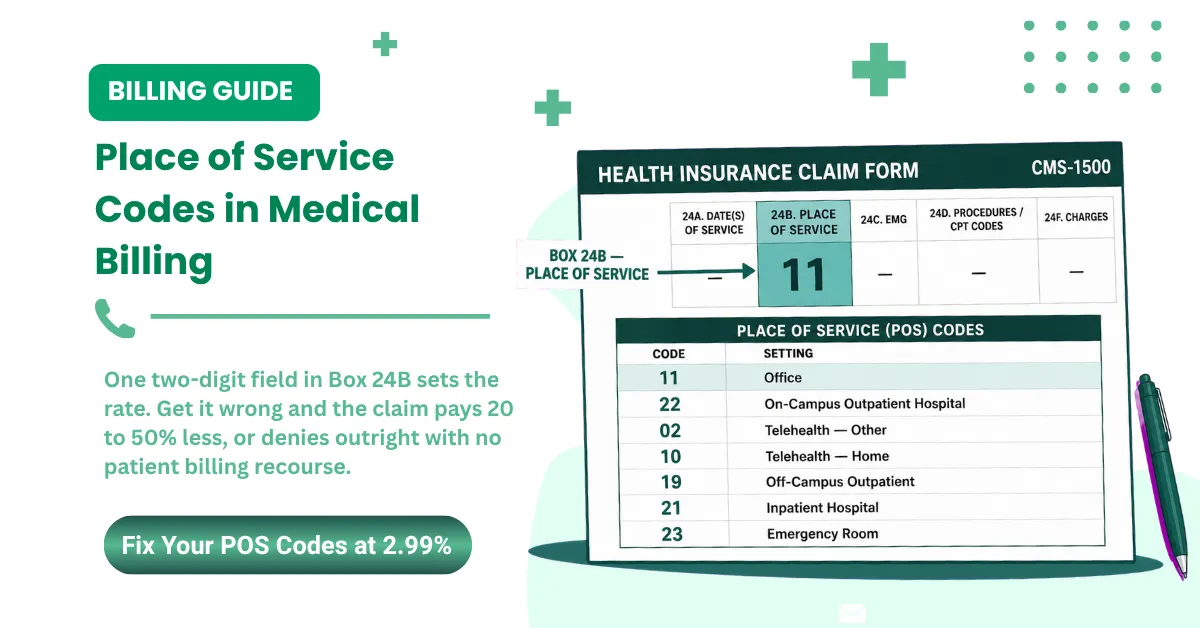
Place of service codes are two-digit identifiers maintained by CMS that appear on professional claims and dictate payment eligibility and reimbursement rates. Submitting the wrong code can reduce reimbursement by 20 to 50% or trigger an outright claim denial.
Commonly Used POS Codes
|
POS Code |
Setting |
|---|---|
|
02 |
Telehealth Provided Other than in Patient's Home |
|
10 |
Telehealth Provided in Patient's Home |
|
11 |
Office |
|
12 |
Home |
|
19 |
Off Campus-Outpatient Hospital |
|
21 |
Inpatient Hospital |
|
22 |
On Campus-Outpatient Hospital |
|
23 |
Emergency Room, Hospital |
|
24 |
Ambulatory Surgical Center |
Where they appear: Box 24B on the CMS-1500 claim form; Loop 2400 SV105 segment on the electronic 837P transaction, the HIPAA standard for professional claims.
Practices that outsource billing to a specialist eliminate POS defaults before the claim leaves the system. MedSole RCM handles outsourced medical billing at 2.99% with a 99% clean claim rate.
A two-digit field in Box 24B of every professional claim controls whether your practice collects the non-facility rate or a facility rate that pays 20 to 50% less. Get it wrong and the payer returns a CO-4 or CO-16 denial, both contractual adjustments you can't bill the patient for.
This guide covers the complete 2026 CMS place of service codes list, the facility versus non-facility rate engine, and every comparison practices get wrong: POS 11 versus 22, POS 02 versus 10, and POS 31 versus 32.
It also covers the 2026 CMS updates, including POS 66 Medicare denials and the CY 2026 Physician Fee Schedule facility PE RVU change.
Practices that can't absorb POS-related revenue losses outsource billing to specialists who catch these errors before submission. MedSole RCM provides outsourced medical billing at 2.99% with a 99% clean claim rate across 75 specialties.
What Are Place of Service Codes in Medical Billing?
POS codes are two-digit codes placed on health care professional claims to indicate the setting where a service was provided, as defined by CMS and required under HIPAA for the ASC X12N 837P electronic transaction. CMS last modified the full CMS Place of Service Code Set on February 17, 2026.
These codes belong in one field: Box 24B of the CMS-1500 paper claim form, or Loop 2400 data element SV105 in the electronic 837P transaction. Each service line has its own Box 24B entry, so a claim with multiple procedures can carry a different POS code on each line.
Watch for CMS-1500 Box 24B errors when lines share one default.
Is There a Place of Service Code on a UB-04?
No. There's no place of service code on a UB-04. The institutional UB-04 claim uses Type of Bill in Form Locator 4, a four-digit code identifying facility type, claim sequence, and frequency, plus Revenue Codes in Form Locator 42 to identify the department or service.
In the electronic world, the UB-04 maps to the 837I transaction, not the 837P. If a payer rejects a UB-04 claiming a missing POS, the error is almost always in the clearinghouse's claim-type routing, not the code itself.
How POS Codes Drive Reimbursement: Facility vs Non-Facility Rates
Under the Medicare Physician Fee Schedule, every CPT code carries two separate payment rates: a non-facility rate and a facility rate. The POS code on the claim determines which one applies.
Non-facility settings, led by POS 11 (Office), pay more because the practice absorbs all the overhead. Facility settings pay less because the hospital bills separately for its piece.
|
POS Code |
Setting Name |
Rate Type |
Who Absorbs Overhead |
2026 Rate Impact |
|---|---|---|---|---|
|
POS 11 |
Office |
Non-facility |
Provider |
Higher payment |
|
POS 22 |
On-Campus Outpatient Hospital |
Facility |
Hospital |
Reduced payment |
|
POS 23 |
Emergency Room, Hospital |
Facility |
Hospital |
Reduced payment |
|
POS 24 |
Ambulatory Surgical Center |
Facility |
Facility |
Reduced payment |
|
POS 31 |
Skilled Nursing Facility |
Facility |
SNF (Part A) |
Reduced payment |
POS 32 (Nursing Facility) is the counter-intuitive exception: it pays the non-facility rate. More on that in the long-term care section below.
Take CPT 99213 as the example. The Medicare non-facility rate (POS 11) runs about $93. The facility rate (POS 22) runs about $74. That's a $19 difference on a single visit. For a practice seeing 20 patients a day at that level, the wrong POS code compounds to about $3,000 in lost revenue per week.
The CY 2026 Physician Fee Schedule Final Rule (CMS-1832-F) introduced the largest facility PE RVU change in MPFS history.
For services valued in facility settings, CMS cut the indirect practice expense RVU allocation to half the amount allocated in non-facility settings, starting January 1, 2026. Read the CY 2026 Physician Fee Schedule Final Rule for the full detail.
Physicians employed by hospitals and billing under facility POS codes now see lower practice expense payments than at any prior point. The gap between POS 11 revenue and POS 22 revenue widened again in 2026.
The Most Common Place of Service Codes: When to Use Each Code and When Not To
The CMS code set includes over 40 active codes, but most professional claims use a small subset. Here are the POS codes you'll see most, each with the denial trigger that fires when it's misused.
POS 11 - Office
CMS defines POS 11 as a non-hospital, non-SNF location where the provider delivers routine exams, diagnosis, and treatment on an ambulatory basis. Use it for independent physician-owned clinics and standalone offices where the provider pays the overhead.
Don't use it for hospital-owned clinics; those are POS 22. CO-4 fires when POS 11 pairs with a CPT code NCCI flags as facility-only.
Payers also audit POS 11 claims from hospital-employed physicians for recoupment. The full POS 11 billing rules guide covers the edge cases.
POS 22 - On-Campus Outpatient Hospital
CMS defines POS 22 as part of a hospital's main campus providing outpatient services. Use it for hospital-owned outpatient departments on the main campus and hospital-employed physicians in hospital clinic space.
Don't use it for off-campus locations more than 250 yards from the main buildings; those need POS 19. Billing POS 22 for an off-campus clinic triggers site-neutral payment adjustments under the Bipartisan Budget Act.
POS 21 - Inpatient Hospital
CMS defines POS 21 as a facility that provides diagnostic, therapeutic, and rehabilitation services to admitted patients. Use it after a physician admits a patient and the patient stays overnight.
Don't use it for observation-status patients; observation is outpatient and uses POS 22. CO-16 fires when POS 21 is submitted without documentation of a formal inpatient admission.
POS 19 - Off-Campus Outpatient Hospital
CMS defines POS 19 as part of an off-campus, provider-based hospital department delivering outpatient services. Use it for hospital-owned clinics more than 250 yards from the hospital's main buildings, the boundary effective January 1, 2016.
Don't use it for clinics on the main campus. Site-neutral payment caps apply, and billing at HOPD rates instead of MPFS rates when POS 19 applies triggers payer adjustments.
POS 23 - Emergency Room, Hospital
CMS defines POS 23 as a hospital area where emergency diagnosis and treatment is provided. Use it for unscheduled, acute care in a 24/7 emergency department, including pre-admission treatment before inpatient admission.
Don't use it for standalone urgent care (POS 20), scheduled outpatient follow-ups (POS 22), or telehealth. CO-50 fires when POS 23 pairs with CPT codes that need medical necessity documentation the claim lacks.
POS 20 - Urgent Care Facility
CMS defines POS 20 as a location, separate from a hospital ER, office, or clinic, for unscheduled ambulatory patients needing immediate attention. Use it for independent freestanding urgent care clinics that aren't hospital-owned or affiliated.
Don't use it for any hospital-affiliated or hospital-campus clinic (POS 22 or POS 19). CO-4 fires when POS 20 pairs with CPT codes that need urgent care modifiers the claim is missing.
POS 24 - Ambulatory Surgical Center
CMS defines POS 24 as a freestanding facility, other than a physician's office, where surgical and diagnostic services happen on an ambulatory basis. Use it for outpatient surgery at a licensed ASC.
Don't use it for in-office minor procedures or hospital outpatient surgery departments. Billing POS 11 for an ASC procedure inflates the professional fee; payers recoup the difference and may flag it for OIG audit.
POS 12 - Home
CMS defines POS 12 as a location, other than a hospital or facility, where the patient receives care in a private residence. Use it for home health visits where the provider travels to the patient's home.
Don't use it for telehealth delivered to a patient at home; that's POS 10, the most common 2026 misapplication. POS 12 with telehealth modifier 95 triggers CO-4 because the modifier and POS conflict.
POS 11 vs POS 22: The Difference That Costs Practices Thousands Per Month
Two clinics can look identical from the waiting room and still require different POS codes. The difference is ownership. And ownership decides whether the practice collects the non-facility rate or loses up to 30% on every visit.
|
Feature |
POS 11 (Office) |
POS 22 (On-Campus Outpatient Hospital) |
|---|---|---|
|
Setting |
Physician-owned independent clinic |
Hospital-owned outpatient department on main campus |
|
Overhead |
Provider pays all costs (rent, staff, supplies) |
Hospital covers facility costs; provider pays professional costs only |
|
Reimbursement |
Higher non-facility MPFS rate |
Lower facility MPFS rate; hospital bills a separate facility fee |
|
Claim Structure |
One claim from the provider |
Two claims: provider professional fee, hospital facility fee |
|
Patient Out-of-Pocket |
Lower, single bill |
Higher, separate copays for facility and professional fees |
Here's the ownership test. If the physician or group independently owns or leases the space, POS 11 applies. If a hospital system acquired the practice, POS 22 applies even when the address, staff, and physical space are identical.
The Tax ID on the claim settles it: if it matches the hospital's EIN, the code is POS 22. Mixing the two invites claim audits and, under OIG scrutiny, potential fraud exposure.
For the full POS 11 guide with reimbursement examples, see POS 11 vs POS 22 differences.
POS 19 vs POS 22: The 250-Yard Rule and What It Costs to Get It Wrong
POS 19 and POS 22 both describe hospital outpatient settings. The difference is physical distance from the main campus, and that distance has a name: the 250-yard rule. Get it wrong and you bill the wrong rate for every service at that location.
|
Feature |
POS 19 (Off-Campus) |
POS 22 (On-Campus) |
Why It Matters |
|---|---|---|---|
|
Location |
More than 250 yards from main hospital buildings |
Within 250 yards of the main campus |
Sets which payment rule applies |
|
Reimbursement |
Site-neutral payment rates (MPFS level) |
Higher hospital outpatient department rates |
Direct revenue difference |
|
Regulatory Authority |
Bipartisan Budget Act, Section 603 (2015) |
Standard HOPD payment rules |
Legislative basis |
|
Who Bills the Facility Fee |
Hospital, at the lower site-neutral rate |
Hospital, at the full HOPD rate |
Determines facility revenue |
When a hospital system employs a physician in an off-campus clinic, the physician bills professional fees at the same MPFS rate an independent office would, but the hospital loses the HOPD facility fee premium. That's the biggest financial consequence of the POS 19 versus POS 22 distinction for hospital-employed physicians in their first year.
New hires who set up panel credentialing before understanding their clinic's POS status overbill or underbill for months. MedSole's provider enrollment and credentialing services align enrollment with the correct POS from day one.
POS 31 vs POS 32 vs POS 13: The Long-Term Care Coding Decision Providers Get Backwards
Here's the counter-intuitive truth: POS 32 (Nursing Facility) pays more than POS 31 (Skilled Nursing Facility) for physician services under Medicare. The two place of service codes that cost long-term care billers the most are POS 31 and POS 32, and most teams get the reimbursement backwards.
POS 31 is a facility rate. The SNF separately bills Medicare Part A for patient care during an active stay, so CMS assigns the physician's professional claim the lower facility rate.
POS 32 is a non-facility rate. The nursing facility doesn't bill a separate facility fee under Part B, so the physician collects the higher non-facility payment.
|
Code |
Facility Name |
Medicare Coverage |
Payment Rate |
When to Switch |
|---|---|---|---|---|
|
POS 31 |
Skilled Nursing Facility |
Active Medicare Part A stay |
Facility rate (lower) |
When Part A benefits exhaust, switch to POS 32 |
|
POS 32 |
Nursing Facility |
Part A exhausted, or long-term custodial care |
Non-facility rate (higher) |
Patient never had a qualifying hospital stay, or days are gone |
|
POS 13 |
Assisted Living Facility |
Not typically Medicare-covered (private pay or Medicaid) |
Varies by payer |
When the patient is in residential ALF, not skilled care |
In March 2025, the OIG found Medicare paid millions more than it should have for physician services at SNFs, because providers used POS 32 (non-facility, higher) when POS 31 (facility, lower) was correct. CMS answered with a July 2025 PALTC compliance reminder.
As of January 2026, MACs are auditing SNF claims with POS 32 on dates that overlap an active Part A stay, applying CMS NCCI edits to the pairing. The wrong POS code is now an audit trigger, not a billing slip.
Telehealth Place of Service Codes in 2026: POS 02 vs POS 10 and the Rate Difference That Changes Everything
Start with the money. POS 10 pays the non-facility MPFS rate. POS 02 pays the facility rate. That one-digit difference costs practices 20 to 40% on every telehealth claim where the patient is at home, depending on the CPT code.
Teams using POS 02 for all telehealth leave that revenue on the table daily. CMS Transmittal R12671CP established this, effective for dates of service on and after January 1, 2024.
POS 02 vs POS 10: The Decision Rule
Which POS code for telehealth? If the patient is at home during the encounter, use POS 10. If the patient is anywhere else that isn't their private residence, a clinic, a facility, a hotel room, use POS 02.
The provider's location doesn't change the code. A physician working from a home office still bills POS 10 when the patient is at home, because the POS describes the patient's setting, not the provider's.
|
Payer |
POS for Home Telehealth |
POS for Non-Home Telehealth |
Modifier Required |
|---|---|---|---|
|
Medicare |
POS 10 |
POS 02 |
Modifier 95 (audio-video) or 93 (audio-only) |
|
Medicaid (general) |
POS 10 |
POS 02 |
Varies by state |
|
UnitedHealthcare Commercial |
POS 10 |
POS 02 |
Modifier 95 |
|
BCBS Commercial |
POS 02 (most plans) |
POS 02 |
Modifier 95 |
|
Aetna Commercial |
Verify per contract |
POS 02 |
Modifier 95 |
Verify your specific payer contract before submitting. Payer rules change mid-year without notice.
Modifier 93, Modifier 95, and the Death of Modifier GT
Modifier 95 flags synchronous audio-video telehealth. Modifier 93 flags synchronous audio-only telehealth. Both pair with POS 02 or POS 10 to complete the telehealth claim. Modifier GT, which practitioners used for years on Medicare Part B claims, is now obsolete for all Medicare professional claims.
CMS retired GT for Medicare Part B in 2018. The one surviving use case: Critical Access Hospitals billing under Method II institutional claims. Nothing else. Practices still using GT on professional Medicare claims trigger CO-4 denials because the modifier conflicts with current NCCI guidance.
Starting February 1, 2026, Medicare requires an in-person, non-telehealth visit within the six months before the first mental health telehealth service. This applies to behavioral health billed with POS 02 or POS 10. Miss it and Medicare returns CO-50 on the telehealth claim that follows, not the in-person visit.
Providers adding behavioral telehealth must meet state licensing rules; see telemedicine credentialing requirements before billing.
The Consolidated Appropriations Act of 2026 extended Medicare telehealth flexibilities through December 31, 2027. Both POS 02 and POS 10 stay valid for Medicare telehealth through that date.
MedSole RCM handles telehealth billing at 2.99% of collections with payer-specific POS and modifier validation on every claim. See telehealth CPT codes and modifiers for the full 2026 code list.
POS Coding Errors That Trigger CO-4, CO-16, and CO-50 Denials
The OIG found that incorrect POS coding contributed to billions in Medicare improper payments in its most recent payment integrity review. A wrong POS code isn't a minor formatting error. It's the sole trigger for specific denial codes that require provider write-off under contractual obligation.
|
Denial Code |
What It Means |
POS Error Pattern That Fires It |
NCCI Involvement |
How to Correct |
|---|---|---|---|---|
|
CO-4 |
Procedure code inconsistent with modifier, or required modifier missing |
Modifier and POS conflict (POS 12 + modifier 95 pairs with the wrong setting) |
Yes, procedure-to-procedure edits |
Correct POS to match the setting; verify modifier-to-POS compatibility before resubmission |
|
CO-16 |
Claim lacks information needed for adjudication |
POS field blank, invalid, or doesn't match documentation |
No direct edit; payer intake editing |
Complete the POS field; ensure the note documents the setting |
|
CO-50 |
Not medically necessary |
POS creates a medical necessity conflict (POS 23 ER for a scheduled routine service; POS 66 on a Medicare claim) |
Sometimes, depends on CPT/POS pair |
Correct POS to the actual setting; re-verify medical necessity documentation |
|
CO-97 |
Payment included in another service |
POS 24 (ASC) billed when the procedure bundles into a global period payment at POS 11 |
Yes, bundling edit |
Verify global period status; correct the setting |
|
PR-50 |
Patient responsibility denial |
POS error creates a split-billing gap where the patient gets billed for the provider-absorbed portion |
No |
Internal correction; you can't bill the patient for CO-group adjustments |
|
OA-18 |
Duplicate claim |
Same service billed under two POS codes (POS 11, then corrected POS 22) without frequency code 7 |
No |
Resubmit the corrected claim with claim frequency code 7 |
The National Correct Coding Initiative edits, published quarterly by CMS, define which CPT and POS combinations generate automatic CO-4 rejections. The Modifier Indicator for each pair decides whether a modifier can override the edit. An indicator of 0 means no modifier overrides it; the claim denies regardless. An indicator of 1 means a correct modifier rescues the claim.
For the full resolution workflows on each denial, see CO-4 denial code, CO-16 denial code, and CO-50 denial code.
MedSole RCM's denial management services recover POS-related denials with 48-hour turnaround and root-cause correction on every claim.
2026 POS Code Updates: What CMS Changed and What It Means for Your Claims
CMS has made five changes to the place of service codes since 2023 that affect professional claims. Each one creates a billing trap for practices that haven't updated their workflows.
POS 27 - Outreach Site and Street (Effective October 1, 2023)
CMS created POS 27 for street medicine, care delivered in non-permanent outdoor environments to unsheltered homeless individuals. The key billing rule: Medicare processes POS 27 claims at the same rate as POS 12 (Home). Practices billing outreach medicine that haven't updated their systems default to POS 99 (Other) and lose the rate equivalency.
POS 66 - PACE Center (Effective August 1, 2024, Medicare Denies All Claims)
CMS created POS 66 for Programs of All-Inclusive Care for the Elderly centers, effective August 1, 2024, with implementation in Medicare systems on January 6, 2025. The CMS instruction is unambiguous: POS 66 is for Medicaid claims only, per CMS Transmittal R12779CP.
Medicare claims containing POS 66 will be denied. Multi-payer billing teams that standardize POS codes across systems hit this denial on every Medicare claim for that patient.
CY 2026 PFS Final Rule Changes Affecting POS Codes
The CY 2026 Physician Fee Schedule finalized three changes with direct POS consequences. First, the facility PE RVU reduction: for services valued in facility settings, CMS cut the indirect PE RVU allocation to half the non-facility rate, widening the gap between facility POS codes (21, 22, 23, 24) and non-facility codes (11, 12, 20).
Second, two conversion factors apply in 2026: $33.57 for APM participants and $33.40 for everyone else, the first time in MPFS history that one service under the same POS code yields two different payments based on the provider's APM status.
Third, CPT codes 99324 through 99337 for home services merged into the 99341 through 99350 family, affecting claims billed under POS 12 and POS 13. Providers who haven't updated their home-visit CPT crosswalk hit automatic denials. The CY 2026 Physician Fee Schedule Final Rule has the specifics.
How to Validate Place of Service Codes Before Every Claim Submission
POS errors are the most preventable class of claim denial. Prevention is a pre-submission workflow, not a post-denial fix.
Step 1 - Confirm the Patient's Registration Status
Is the patient a registered inpatient, a registered outpatient, or neither? That single question decides whether POS 21, POS 22, or an independent code applies.
Step 2 - Confirm the Setting Ownership
Who owns the clinic where the service happened? If a hospital system owns it, POS 22 applies regardless of physical appearance. A Tax ID check takes 90 seconds.
Step 3 - Confirm Telehealth Location
For telehealth claims only: where was the patient? At home means POS 10. Anywhere else means POS 02. The provider's location doesn't change the code.
Step 4 - Confirm CPT-to-POS Compatibility
Run the CPT code against the NCCI Modifier Indicator table. If the indicator is 0 for this setting, no modifier rescues the claim; the POS must change.
Step 5 - Confirm Modifier Alignment
Does the modifier on the claim match the POS? POS 12 with modifier 95 fires CO-4. POS 10 with modifier GT fires CO-4. Verify the pair before submission.
MedSole RCM runs this five-step check on every claim before submission as part of outsourced medical billing services that start at 2.99% of collections, among the most affordable full-service rates in the United States.
For practices that also need provider enrollment and credentialing services, MedSole handles payer credentialing at $99 per payer, with no minimum volume and no long-term contracts. Both services include dedicated account management and a 99% clean claim rate guarantee.
Frequently Asked Questions About Place of Service Codes
What is the difference between POS 31 and POS 32?
POS 32 (Nursing Facility) pays more than POS 31 (Skilled Nursing Facility) for physician services under Medicare, because POS 32 is a non-facility rate and POS 31 is a facility rate. Use POS 31 for active Medicare Part A SNF stays. Switch to POS 32 when Part A benefits are exhausted or the patient is in custodial care.
Is there a place of service code on a UB-04?
No. POS codes appear on professional CMS-1500 claims only. UB-04 institutional claims use Type of Bill in Form Locator 4 and Revenue Codes in Form Locator 42 to describe the setting. In electronic transactions, the UB-04 maps to the 837I file, not the 837P.
What is POS 66 in medical billing?
POS 66 is the PACE Center code, effective August 1, 2024. It applies to Medicaid claims only. Medicare claims containing POS 66 will be denied, per CMS Transmittal R12779CP. For PACE patients, apply POS 66 only on Medicaid claims and use the appropriate facility code on Medicare claims.
What happens when you use the wrong POS code?
The wrong POS code triggers CO-4 when a modifier conflicts with the setting, CO-16 when the POS field is missing or invalid, or CO-50 when the setting conflicts with the service's medical necessity rules. All three are contractual obligation adjustments; the provider absorbs the denial and can't bill the patient.
What is the difference between POS 19 and POS 22?
POS 19 applies to hospital-owned outpatient clinics more than 250 yards from the main hospital campus. POS 22 applies to outpatient departments on the hospital's main campus. The 250-yard boundary decides which site-neutral payment rules apply under the Bipartisan Budget Act.
What is POS 10 in medical billing?
POS 10 is the code for telehealth provided in the patient's home. Per CMS Transmittal R12671CP, effective January 1, 2024, Medicare pays POS 10 claims at the non-facility MPFS rate, which runs 20 to 40% higher than the facility rate applied to POS 02.
Where does the POS code appear on the CMS-1500 claim form?
The place of service code appears in Box 24B of the CMS-1500 form, one entry per service line. In the electronic 837P transaction, it maps to Loop 2400, data element SV105. Each service line carries its own POS code, so a multi-service claim can report different settings for different procedures on the same date.
References
CMS Place of Service Code Set: cms.gov/medicare/coding-billing/place-of-service-codes/code-sets (last modified 02/17/2026)
CMS Transmittal R12671CP (telehealth POS 10 non-facility rate; effective January 1, 2024): cms.gov/medicare/regulations-guidance/transmittals/2024-transmittals/r12671cp
CMS Transmittal R12779CP (POS 66 PACE Center Medicare denial; implementation January 6, 2025): cms.gov/medicare/regulations-guidance/transmittals/2024-transmittals/r12779cp
CY 2026 Medicare Physician Fee Schedule Final Rule (CMS-1832-F): cms.gov/newsroom/fact-sheets
CMS Physician Fee Schedule: cms.gov/medicare/payment/fee-schedules/physician
CMS National Correct Coding Initiative: cms.gov/medicare/coding-billing/national-correct-coding-initiative-ncci-edits