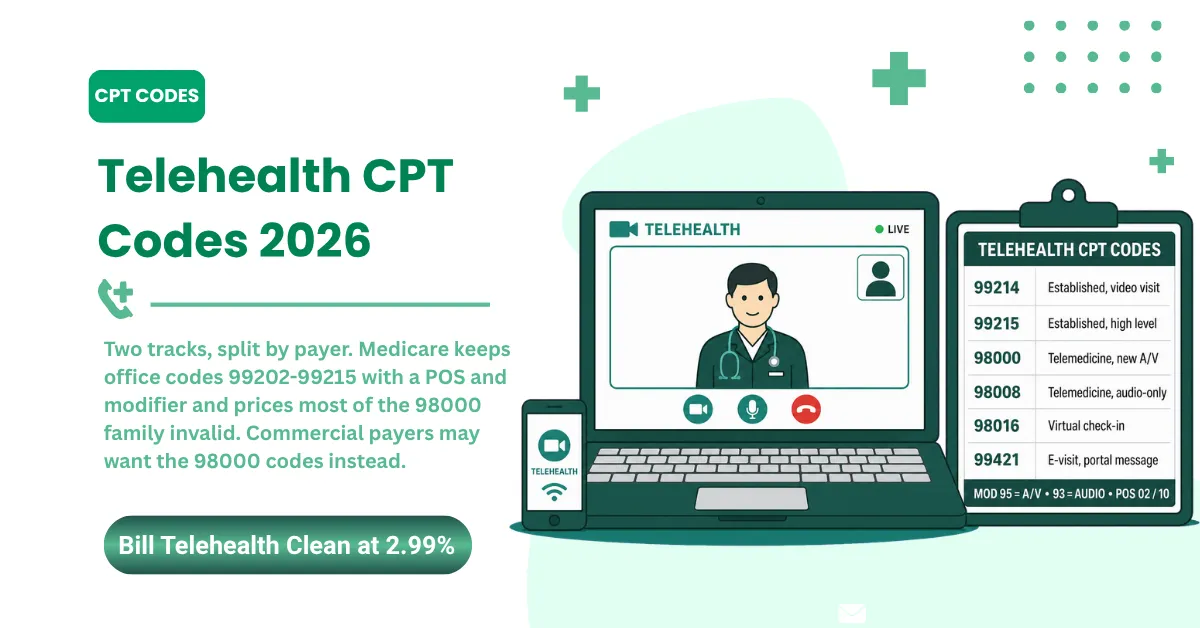




Telehealth CPT codes are the standard procedure codes providers report for virtual visits, combined with a place-of-service code and a telehealth modifier. In 2026, the rules split by payer. Medicare and commercial payers don't read these codes the same way, so one visit can need two billing approaches.
The term covers two things. First, a standard office CPT furnished over video, like a 99214 done remotely. Second, the dedicated 98000 telemedicine family the AMA built for virtual care. Knowing which one a payer wants stops most denials before they start.
This 2026 guide covers the full list, the modifiers, place of service, and the denial fixes, all current as of June 2026.
Practices that would rather not run two parallel billing tracks hand the whole cycle to telehealth billing services.
Telehealth Coding in 2026: Key Takeaways
Here are the telehealth billing guidelines that matter most for 2026, stripped to what changes your claims.
Key Takeaways
- Use 99202 to 99215 with POS 02 or 10, plus modifier 95 or 93, for most payers.
- The AMA 98000 to 98016 family exists, but Medicare prices most of it as invalid.
- Codes 99441 to 99443 were deleted on January 1, 2025, and won't pay in 2026.
- Modifier 95 means audio-video. Modifier 93 means audio-only.
- POS 10 (home) pays the higher non-facility rate. POS 02 pays the facility rate.
- Medicare telehealth flexibilities run through December 31, 2027.
What Changed for 2026
- The Consolidated Appropriations Act, 2026 extended Medicare flexibilities through December 31, 2027.
- CMS added five codes to the Medicare Telehealth Services List.
- Frequency limits came off subsequent inpatient, nursing facility, and critical care visits.
- Virtual direct supervision became permanent.
- The Q3014 originating-site fee is $31.85 for 2026.
What Are Telehealth CPT Codes? The Two Things Providers Mean
Telehealth CPT codes mean two different things, and mixing them up drives denials. One sense is a regular office code sent over video. The other is the 98000 telemedicine family the AMA created for virtual visits. Which one applies depends on the payer in front of you.
Track 1: Medicare Fee-for-Service
Here's how Medicare works. It flags a telehealth visit through place of service and a modifier, not a special CPT code. You keep billing 99202 to 99215, the same office codes you'd use in person.
The same holds for established patient codes, 99211 to 99215. The one 98xxx code Medicare pays is 98016. CMS assigns 98000 to 98015 an invalid status under the Medicare Physician Fee Schedule, so those claims don't pay.
Track 2: Commercial and Medicaid Payers
Commercial and Medicaid payers play by their own rules. Some adopted the 98000 series. Many still want 99202 to 99215 with modifier 95, and a few accept either. The only safe move is to verify each payer's telehealth policy before the claim goes out.
That pre-bill verification is exactly the work our denial management services absorb. If you're still sorting out the CPT and HCPCS difference, that distinction matters here too, because some telehealth indicators are HCPCS, not CPT.
Here's the number-one mistake providers make: assuming one master telehealth list covers every payer. It doesn't. Medicare, each commercial plan, and each state Medicaid program set their own rules on codes, modifiers, and audio-only coverage. Treating them as one list is how clean claims turn into denials.
|
Code family |
Medicare fee-for-service |
Commercial / Medicaid |
|---|---|---|
|
99202 to 99215 |
Accepted with POS and modifier |
Widely accepted with modifier 95 |
|
98000 to 98015 |
Invalid status, not paid |
Adopted by some payers |
|
98016 (check-in) |
Paid, replaces G2012 |
Varies by payer |
|
99441 to 99443 |
Deleted, not payable |
Deleted, not payable |
Standard Telehealth E/M Codes: 99202 to 99215
For real-time audio-video visits, most payers use the same office E/M codes as in-person care: 99202 to 99205 for new patients and 99211 to 99215 for established patients. These telehealth CPT codes carry the visit; the modifier and POS tell the payer it happened on video.
New Patient Visits (99202 to 99205)
New patient visits run 99202 to 99205. The level follows medical decision making or total time on the date of the encounter, the same standard as an in-person visit. Documentation has to match that standard, or the level won't hold up on audit. Our 99203 billing guide walks through a mid-level new patient visit.
Picking the level comes down to two paths: medical decision making or total time on the date of service. Use whichever the visit supports. A video visit doesn't change which path you choose. It changes the POS and modifier you attach.
Established Patient Visits (99211 to 99215)
Established patient visits run 99211 to 99215. Yes, 99214 and 99215 are billable via telehealth with modifier 95 and POS 02 or 10. The documentation rules don't loosen because the visit is remote. The 99215 documentation guide covers what a high-level visit needs.
One thing trips practices up here. The remote setting doesn't lower the documentation bar. If you bill 99214, the note still needs moderate-complexity decision making or the matching total time, the same as an in-person 99214.
The AAFP telehealth coding guidance lays out the same office-code-plus-modifier approach for video visits.
|
Code |
Patient type |
Typical time |
Modifier |
POS |
|---|---|---|---|---|
|
99202 |
New |
15 to 29 min |
95 or 93 |
02 / 10 |
|
99203 |
New |
30 to 44 min |
95 or 93 |
02 / 10 |
|
99204 |
New |
45 to 59 min |
95 or 93 |
02 / 10 |
|
99205 |
New |
60 to 74 min |
95 or 93 |
02 / 10 |
|
99211 |
Established |
Minimal |
Per payer |
02 / 10 |
|
99212 |
Established |
10 to 19 min |
95 or 93 |
02 / 10 |
|
99213 |
Established |
20 to 29 min |
95 or 93 |
02 / 10 |
|
99214 |
Established |
30 to 39 min |
95 or 93 |
02 / 10 |
|
99215 |
Established |
40 to 54 min |
95 or 93 |
02 / 10 |
The 98000 Series: New Telemedicine E/M Codes
The AMA created the 98000 series CPT codes effective 2025, replacing the deleted telephone codes. You pick the level by medical decision making or time, the same logic as office visits. Here's the catch that trips up billers: Medicare prices most of this family as invalid.
Audio-Video Codes (98000 to 98007)
Codes 98000 to 98007 cover synchronous audio-video visits, split between new patients (98000 to 98003) and established patients (98004 to 98007). They mirror the 99202 to 99215 grid. Commercial payers that adopted the series want these for video visits. Medicare doesn't pay them.
Level selection works the same as the office codes. The new and established tiers climb by decision-making complexity or total time. The grids line up with 99202 to 99215, so a coder fluent in office E/M reads them fast.
Audio-Only Codes (98008 to 98015)
Codes 98008 to 98015 cover synchronous audio-only visits, the telehealth CPT codes audio-only situations call for when a patient can't use video. The same new-versus-established split applies. Audio-only coverage varies by payer, so confirm it before you bill.
|
Code |
Patient type |
Technology |
|---|---|---|
|
98008 to 98011 |
New |
Audio-only, synchronous |
|
98012 to 98015 |
Established |
Audio-only, synchronous |
Brief Check-In (98016) and E-Visits (99421 to 99423)
Code 98016 is the brief virtual check-in for an established patient, five to 10 minutes, patient-initiated. It replaced G2012, and Medicare pays it. E-visits 99421 to 99423 cover patient-portal messages over a seven-day window. Those stayed active and confuse people who assume the 98000 series replaced them. It didn't.
E-visits run on a seven-day clock. The codes count cumulative provider time across that window, not a single message. You can't bill an e-visit if it rolls into a billable visit within seven days, and the patient has to start the exchange.
The AMA telehealth coding background explains why the panel built these codes as E/M services. When a payer rejects a 98000 series claim Medicare never accepted, our recover denied claims team traces the root cause and refiles.
Telehealth Modifiers: 95, 93, GT, FQ and GQ
Telehealth modifiers tell the payer how the visit happened: modifier 95 for audio-video, modifier 93 for audio-only. Get the modifier wrong and the claim bounces, even when the CPT code is perfect.
Modifier 95 vs Modifier 93
Modifier 95 telehealth claims signal synchronous audio-video, and commercial payers want it on 99202 to 99215. Modifier 93 signals synchronous audio-only. You don't add 95 to the 98000 series, because the descriptor already says telehealth. Medicare leans on POS instead of 95.
Modifier GT, FQ and GQ: When They Still Apply
GT retired for Medicare Part B back in 2018. It survives on Critical Access Hospital Method II institutional claims, and nowhere else for Medicare. FQ flags audio-only behavioral health. GQ covers asynchronous store-and-forward in the Alaska and Hawaii demonstrations.
One warning: don't copy commercial modifier rules onto Medicare claims. That mismatch is a steady denial source on telehealth claims.
The AAFP telehealth coding basics page maps each modifier to its scenario. These codes and their place of service codes pair in predictable ways, shown below.
|
Modifier |
Meaning |
Who uses it |
Paired POS |
|---|---|---|---|
|
95 |
Audio-video, synchronous |
Commercial on 99202 to 99215 |
02 / 10 |
|
93 |
Audio-only, synchronous |
Most payers, audio-only |
02 / 10 |
|
GT |
Audio-video (legacy) |
CAH Method II only |
Institutional |
|
FQ |
Audio-only behavioral health |
Medicare behavioral health |
02 / 10 |
|
GQ |
Asynchronous store-and-forward |
Alaska and Hawaii demonstration |
02 |
Place of Service for Telehealth: POS 02 vs POS 10
POS 10 means the patient was at home. POS 02 means the patient was at a facility or another originating site. That one digit changes what you get paid.
How POS Changes Your Reimbursement
POS 10 telehealth claims pay the non-facility rate, which runs higher than the POS 02 facility rate. Miscode POS 10 for a patient who wasn't home, and you've handed the payer a denial and an audit flag.
Here's the dated detail nobody updates: the Q3014 originating-site facility fee is $31.85 for 2026. If you bill the originating-site fee, that's the figure to use.
Two terms cause confusion here. The originating site is where the patient sits. The distant site is where the provider sits. POS describes the patient's location, so a provider working from the clinic still bills POS 10 when the patient is at home.
For the room-by-room breakdown, see POS 11 explained, and check the CMS place-of-service codes set for the official definitions. Getting place of service right is half the battle with telehealth CPT codes.
|
POS |
Where the patient is |
Rate |
Common error |
|---|---|---|---|
|
POS 02 |
Facility or originating site |
Facility rate (lower) |
Using it for a home visit |
|
POS 10 |
Patient's home |
Non-facility rate (higher) |
Using it when the patient was in a clinic |
99441 to 99443 Are Deleted: What to Bill Instead
CPT codes 99441 to 99443 were deleted on January 1, 2025, and any claim submitted with them in 2026 is denied automatically. People still searching telehealth CPT codes 99441 are looking for codes that no longer exist.
Why These Codes Disappeared
The AMA retired the telephone E/M codes and replaced them with the audio-only 98008 to 98015 family. Same idea, better structure, built for how care happens now.
The telephone codes never fit the modern visit. They predated widespread video and audio-only care, and they capped out at limited time tiers. The 98000 family covers new and established patients, audio and video, with a cleaner time-and-MDM structure.
The Replacement Codes
For the direct swap, use 98008 to 98015 on payers that accept the audio-only codes, or 99202 to 99215 with modifier 93 for Medicare. One more correction: the 98000 series replaced the telephone codes, not the e-visits. E-visits 99421 to 99423 are still active.
The AAPC telemedicine codes breakdown documents the deletion in detail. If deleted telephone codes keep slipping into your claims, our stop telehealth denials team catches them before the payer does.
Common Telehealth Coding Errors, Corrected
Most telehealth CPT codes denials trace back to the same handful of mistakes. Here are the five that cost practices the most, each paired with the fix that follows the telehealth billing guidelines payers enforce.
Error: billing the 98000 series to Medicare. Correct: Medicare prices 98000 to 98015 as invalid, so bill 99202 to 99215 with the right POS and modifier.
Error: appending modifier 95 to the 98000 series. Correct: the descriptor already signals telehealth. Modifier 95 belongs on 99202 to 99215 for commercial payers.
Error: using POS 10 for a patient sitting in a clinic. Correct: POS 10 is home only. Use POS 02 for a facility or originating site.
Error: putting GT on professional Medicare claims. Correct: GT has been Critical Access Hospital Method II only since 2018.
Error: assuming one universal telehealth list. Correct: verify each payer and check the current CMS List before you bill.
One more that surprises people: 99221, the initial hospital care code, can't be reported as a telemedicine code in the 98000 structure. The CMS telehealth services list is the source of truth here.
Recurring denials are a pattern, not bad luck. Our AR follow-up services work the aging report so these don't sit until the appeal window closes.
Telehealth Denial-Prevention Checklist for 2026
This checklist catches the denials that telehealth CPT codes generate most often. Eight quick checks before the claim leaves your system, each one a problem you won't have to chase later.
- Confirm the code is on the 2026 CMS List before assuming telehealth payment.
- Match POS to where the patient sat during the visit.
- Apply modifier 95 for audio-video, 93 for audio-only, per the payer.
- Never bill 99441 to 99443.
- Verify the payer allows audio-only for that service.
- Confirm provider licensure in the patient's state.
- Check the payer contract for 98000 series adoption.
- Document time or MDM to the same standard as an in-person visit.
Those checks are the telehealth billing guidelines that keep a clean claim clean. If you run only one, make it the first. A code that isn't on the 2026 CMS List won't pay as telehealth, no matter how clean the rest of the claim looks.
Running this on every claim is what a full RCM partner does for you. MedSole RCM handles billing at 2.99% of collections, one of the most affordable rates in the United States, so denials get caught before they cost you.
Your Medicare Administrative Contractor shapes which telehealth claims clear, and the HHS telehealth policy pages track the current rules. See how MACs affect claims for the contractor side.
What Changed in 2026: Legislation and Medicare Policy
The Consolidated Appropriations Act, 2026
Yes. The Consolidated Appropriations Act, 2026, signed February 3, 2026, extended Medicare telehealth flexibilities through December 31, 2027. That extension followed a brief lapse and put the rules back on solid ground.
Some background helps here. The flexibilities briefly lapsed earlier in 2025 before Congress acted, which left practices billing in limbo for a stretch. The 2026 Act closed that gap and reached further than the prior patches did.
The Act also directed HHS to build billing codes for third-party telehealth platforms like Teladoc, Amwell, and Doxy, a change no competitor guide covers yet. The point is to identify the platform itself on the claim, which matters as payers track where care happens.
What the CY 2026 Physician Fee Schedule Changed
The CY 2026 Physician Fee Schedule dropped the provisional-versus-permanent split on the telehealth list. CMS permanently removed frequency limits on subsequent inpatient, nursing facility, and critical care consults, effective January 1, 2026. Virtual direct supervision became permanent through audio-video, with global-period procedures (010 and 090) excepted.
CMS added five codes to the List: 90849, G0473, G0545, 92622, and 92623. G2025 stays in play for RHC and FQHC distant-site services through December 31, 2027.
The licensure side of these 2026 telehealth rules sits in our telemedicine credentialing guide, and the CMS telehealth guidance page carries the official updates. One date to circle: the behavioral-health in-person requirement returns in 2028, so the telehealth CPT codes flexibilities you rely on now have a clock on them.
Remote Patient Monitoring and Digital Health Codes in 2026
The 2026 CPT set added roughly 300 codes, including short-interval remote monitoring of two to 15 days and new AI and digital-health codes. These don't replace the 98000 telehealth family. They expand what you can report.
CMS also tightened how it reads 99453, 99454, 99457, and 99458. Watch the device-supply and treatment-management rules, because that's where RPM audits land.
One rule anchors RPM billing: the 16-day minimum. You need at least 16 days of readings in a 30-day window before 99454 pays. Remote therapeutic monitoring, RTM, runs on its own code family for non-physiologic data like medication adherence and respiratory therapy.
Here's the part that signals you know the rules: RPM sits outside the Medicare Telehealth List. CMS treats it as a non-face-to-face service, not a substitute for an in-person visit, so the telehealth flexibilities don't govern it.
Practices adding monitoring revenue lean on our remote patient monitoring billing team to keep the new interval codes compliant. The Medicare RPM guidelines spell out the 16-day data rule, and the CMS remote monitoring guidance confirms the coverage basics.
Telehealth CPT Codes 2026: Frequently Asked Questions
What CPT codes can be billed for telehealth?
For most payers, 99202 to 99215 with POS 02 or 10 and modifier 95 or 93. Commercial payers may also accept the 98000 series. Medicare pays the office codes, not 98000 to 98015. Check the specific payer's policy, because adoption of the 98000 series isn't universal.
Can you bill a 99214 for telehealth?
Yes. 99214 is billable via telehealth with modifier 95 for commercial payers and POS 02 or 10. Document medical decision making or total time the way you would in person. Our CPT 99213 guide covers the level below it.
Is the telehealth modifier 95 or GT?
Modifier 95 telehealth is the current standard for audio-video visits. GT retired for Medicare Part B in 2018 and survives only on Critical Access Hospital Method II claims.
Which code cannot be reported as a telemedicine code?
99221, initial hospital care, isn't reportable as a telemedicine service in the 98000 structure. Inpatient hospital E/M follows its own telehealth rules, not the office-based telemedicine codes.
Did Congress extend telehealth for 2026?
Yes. The Consolidated Appropriations Act, 2026, signed February 3, 2026, extended Medicare telehealth flexibilities through December 31, 2027. That covers non-behavioral telehealth in the patient's home and keeps the geographic limits lifted through the same date.
Is modifier 95 required for telehealth in 2026?
It depends on the payer and the code. Commercial payers want 95 on 99202 to 99215 for audio-video. You don't add 95 to the 98000 series, and Medicare leans on POS instead.
What is modifier 93 for telehealth?
Modifier 93 marks a synchronous audio-only visit. Use it when the encounter happened by phone with real-time interaction and the payer accepts audio-only for that service. It pairs with the office E/M codes, not the 98000 series, since those descriptors already state the modality.
Did the 98000 codes replace 99441 to 99443?
Yes, for audio-only. The AMA replaced telephone codes 99441 to 99443 with 98008 to 98015. The 98000 series did not replace e-visits 99421 to 99423, which stay active.
Does a patient have to be present for telehealth?
Yes. Synchronous telehealth codes require a real-time connection with the patient. E-visits and virtual check-ins have their own patient-initiated rules. For asynchronous store-and-forward, the rules differ and depend on the demonstration program and the payer.
Are audio-only telehealth visits covered in 2026?
Often, but it varies. Medicare covers audio-only telehealth for many services through 2027. Commercial and Medicaid coverage depends on the payer and the code, so verify first. For behavioral specialties, our 90837 psychotherapy billing guide goes deeper.
What's the most affordable way to handle telehealth billing?
MedSole RCM offers outsourced medical billing at 2.99% of collections and provider credentialing at $99 per insurance, among the fastest and most affordable in the United States.
How We Keep This Guide Current
This guide carries a tri-stamp: published, updated, and last reviewed. We track CMS, the AMA, and AAFP for every rule change and update the page when the guidance moves. Last reviewed June 2026.
MedSole RCM is a full-service revenue cycle management company. We handle outsourced medical billing at 2.99% of collections and provider credentialing services at $99 per insurance, with fast approvals across all 50 states. When telehealth coding is costing you denials, we fix the whole cycle.