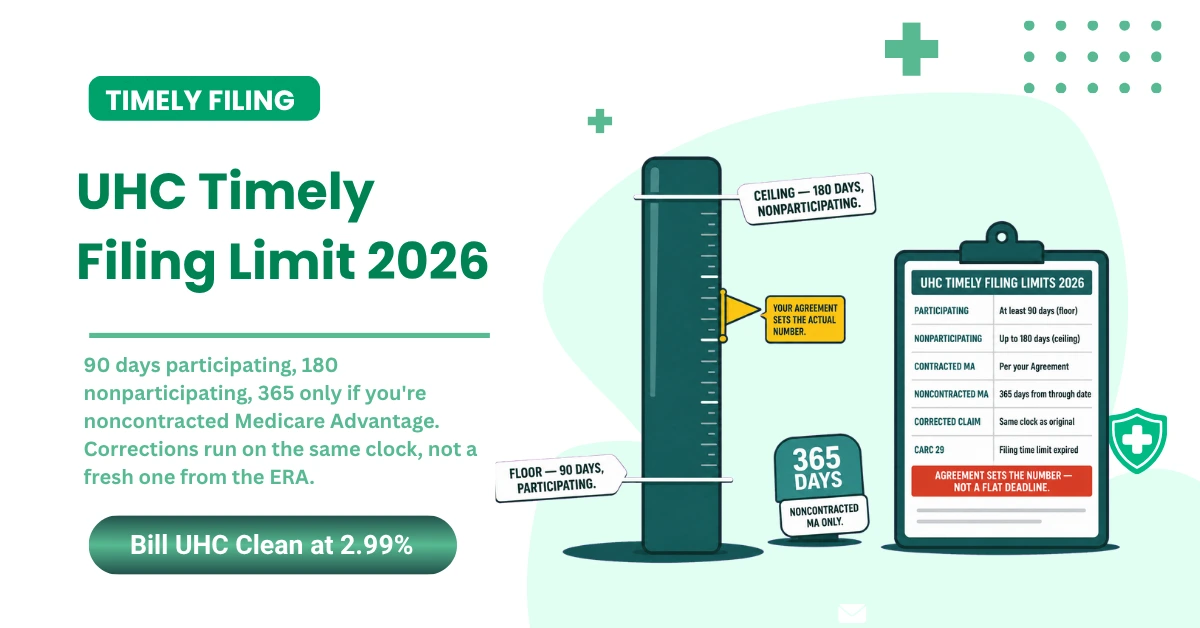




UnitedHealthcare gives participating commercial providers at least 90 days to file a claim, nonparticipating commercial providers up to 180 days, and noncontracted Medicare Advantage providers 365 days from the through date of service. Those UHC timely filing limit 2026 figures come from UHC’s capitation and delegation supplement.
Your Participation Agreement sets the number that applies to your claims, and it can differ from all three. What is the timely filing limit for UnitedHealthcare on the claim in front of you? Only the contract answers that.
A UnitedHealthcare timely filing limit that fits a participating commercial claim won’t fit a noncontracted Medicare Advantage claim. Two UHC patients seen the same morning can carry two different deadlines. Confirm product and network status before anyone calendars a date.
The 2026 UHC Administrative Guide covers commercial, Individual Exchange, and Medicare Advantage plans. Community Plan claims run on separate state manuals. Neither carries your negotiated terms.
This guide by MedSole RCM breaks the 2026 rules down by plan and provider status, shows you where your actual filing period is written, and covers UMR, secondary claims, and proof of timely filing. Corrected claims and appeals follow different rules. The deadline that protected your original claim won’t always protect the correction.
UHC Timely Filing Limit 2026: What to Confirm Before You Calendar a Deadline
Provider relationship, product, state, claim type, and starting event all move your UHC timely filing deadline. Miss one and the date is wrong. A number copied from a payer chart doesn’t replace your Agreement or plan manual.
-
Your Participation Agreement outranks every published figure, including the three in this guide. UHC timely filing guidelines point to the contract, and the payer’s claim correction page repeats that instruction.
-
Four provider categories exist under UHC, and they don’t share one filing period. A contracted provider, a nonparticipating provider, and a noncontracted Medicare Advantage provider each work from different terms.
-
Commercial, Individual Exchange, Medicare Advantage, Community Plan, and UMR answer separately. Blending their rules is how a biller produces a deadline that belongs to somebody else’s claim.
-
The starting event moves your date as much as the day count does. Ninety days from discharge and 90 days from the first date of service land in different weeks.
-
An ERA doesn’t restart the corrected-claim clock. The 2026 guide applies your Agreement’s filing period to corrections, measured from the same starting event as the original claim.
Skip these checks and the claim still goes out on time. The claim looks clean. You’ve filed it against the wrong deadline, and nobody catches the problem until the denial posts.
What Changed in UHC’s 2026 Timely Filing Guidance?
UnitedHealthcare named one timely filing change for 2026, and it applies to corrected claims. The official 2026 UHC provider update lists Chapter 10 as revised, and the revision covers corrected-claim timely filing requirements. Its capitation and delegation supplement was revised too. Neither revision replaces your Participation Agreement, which still sets the UHC timely filing limit 2026 for your claims.
Effective dates for the 2026 provider guide
Your signing date decides. Providers contracted on or after January 1, 2026 got the guide that same day, and everyone already under contract works from April 1, 2026. UHC built in that gap to give you 90 days to review.
The guide covers commercial, Individual Exchange, and Medicare Advantage plans, including Dual Special Needs Plans. Community Plan claims aren’t in it. Those run on state Medicaid manuals, which carry their own filing periods.
The same announcement flags the capitation and delegation supplement as revised. Read that one too. It’s where UHC publishes the day counts that most united healthcare timely filing charts quote, so a chart built on last year’s supplement may already be stale.
What the corrected-claim update actually says
UHC corrected claim timely filing didn’t get its own separate window. Your Agreement’s filing period runs on the original claim and every correction that follows, measured from the date of service, discharge, or final outpatient visit. One clock covers both.
MedSole’s workflow advice, separate from UHC’s guidance: plenty of billing teams treat the ERA date as the start of a fresh 180-day correction window. Recheck that assumption against your contract. The corrected-claim section below works through the mechanics, including UHC’s published example.
UHC Timely Filing Limits for 2026 by Plan and Provider Status
Your contract sets the deadline. UHC’s 2026 guide confirms that much and publishes no universal number. The day counts most billers hunt for live in its capitation and delegation supplement: at least 90 days for participating commercial providers, up to 180 days for nonparticipating commercial providers, and 365 days from the through date of service for noncontracted Medicare Advantage providers.
Search “timely filing for United Healthcare” and you’ll get one of those three figures with its qualifier stripped off. The qualifier is half the rule. This table keeps every published timely filing limit for UHC claims attached to the provider category it covers and the event that starts the clock.
|
Claim situation |
Published guidance |
Starting event |
What can override it |
|---|---|---|---|
|
Participating commercial provider |
At least 90 days |
Last date of service, unless your Agreement sets another |
Agreement or applicable law |
|
Nonparticipating commercial provider |
Up to 180 days |
Date of service |
Plan and state rules |
|
Contracted Medicare Advantage provider |
Per your Agreement |
Contract-defined |
The Agreement; 365 days doesn’t apply on its own |
|
Noncontracted Medicare Advantage provider |
365 days |
Through date of service |
Named for noncontracted providers only |
|
UHC as secondary payer |
At least 90 days |
Primary payer’s payment, contest, denial, or notice |
Agreement and COB requirements |
|
Community Plan |
State and plan-specific |
State manual or contract-defined |
The state manual; no national Medicaid number |
|
Corrected claim |
Same period as the original claim |
Date of service, discharge, or final outpatient visit |
No automatic ERA restart |
Source note: These figures summarize language in UHC’s 2026 claims guidance and its capitation and delegation supplement. Your Participation Agreement, applicable law, and product manual can override any of them.
How to read the deadline table
Every UHC timely filing limit 2026 figure above carries a scope. At least 90 days sets a floor, so your Agreement can give you more. Up to 180 days works the other direction: it’s a ceiling, and a state rule or product supplement can bring it down.
UHC’s 365-day rule names noncontracted Medicare Advantage providers. The issue is that contracted MA providers aren’t in that sentence. Pull 365 days onto a contracted MA claim and you may be working from a window your contract never gave you.
Your UHC claim timely filing limit needs two facts. Take the day count and the starting event together. Counting 90 days from discharge lands somewhere different than 90 days from the first date of service.
One more line matters at the back end. The supplement measures the period up to the date UHC or its delegate receives the claim. Your send date and their receipt date aren’t the same event, so treat this table as a verification aid and check every figure against your Agreement.
How to Find the Correct UHC Filing Deadline for a Claim
Five checks give you the right deadline for a specific claim. Identify the member’s product, confirm your network relationship, read the controlling source, pin down the event that starts the clock, and save what you used. Work them in order, because each one narrows the next.
Step 1: Identify the UHC product
Start with the product, not the logo. That card in your scanner could be commercial, Individual Exchange, Medicare Advantage, Community Plan, or a self-funded employer plan that UMR administers. All five carry UHC branding and none of them share one filing rule.
Pull the product name off the card and confirm it in the portal. Payer ID helps too. A UMR card routes to payer ID 39026, which tells you right away that a standard commercial deadline may not apply.
Step 2: Confirm provider network status
Confirm status for the billing entity itself. UHC treats participating, nonparticipating, contracted Medicare Advantage, and noncontracted Medicare Advantage providers as four separate categories with four separate periods.
Check it per product as well. A group can be participating on commercial and noncontracted on Medicare Advantage at the same time, which is how a biller ends up applying a 90-day window to a claim that had a year.
Step 3: Review the controlling source
Review sources in the order that decides conflicts. UHC timely filing guidelines sit lower in that stack than most billers assume.
-
Applicable law or the Regulatory Requirements Appendix
-
Your Participation Agreement
-
The product or affiliate supplement
-
Your state Community Plan manual
-
The general UHC Administrative Guide
-
The claim’s own EOB, PRA, or denial instructions
-
Any third-party deadline list
Item seven never overrides the six above it. When the Agreement and the guide disagree, the Agreement wins, and a regulatory appendix outranks both where it applies.
Step 4: Identify the correct clock start
Determine which event opens the window before you count a single day. That’s the date of service, the through date of service, the discharge date, the final outpatient visit, or the primary payer’s payment, denial, or notice.
Record the specific UnitedHealthcare timely filing limit next to the event you picked. Log both in the claim record and inside your payer-specific RCM workflow, so the deadline lives in your system and not in one biller’s memory.
Step 5: Save the evidence
Preserve what you relied on while it’s still easy to find. Save the contract excerpt, the manual version and revision date, the calendared deadline, your EDI or portal acknowledgment, and the primary payer’s EOB when one applies.
Six months later, nobody remembers which manual version was live in March. That’s why the evidence gets saved on the day you calendar the date, alongside the acknowledgment your claims submission services or clearinghouse returned.
When your team can’t confirm which UHC timely filing limit 2026 period controls a claim, MedSole can review the plan, network status, claim age, and submission evidence before the window closes.
UHC Timely Filing for Contracted Commercial Providers
What is the timely filing for UHC contracted providers? UHC’s capitation and delegation supplement gives participating commercial providers at least 90 days to submit clean claims. Your Participation Agreement or applicable law sets the period that actually controls your claim, and that period can run longer than 90 days.
Is 90 days the standard UHC commercial limit?
Ninety days is the floor, not the rule. UHC timely filing language for participating commercial providers reads “at least 90 days,” and those two words change what the number means. A floor can be raised. It can’t be lowered below the minimum UHC describes.
Say your Agreement gives you 120 days. That’s a hypothetical, but the point holds for any negotiated period: you calendar 120 days, not the 90 you found on a payer chart. Trading a contract term for a general reference costs you a month of working time on every claim.
The reverse error hurts more. Write “all UHC commercial claims are due in 90 days” on a training document and every biller who reads it inherits the mistake. A search for united healthcare timely filing returns general figures, never your contract’s, and a shorter internal rule quietly shrinks the window your practice actually negotiated.
What happens when the Agreement allows more time?
Use the written period and keep the language that proves it. Pull the timely filing clause out of your Agreement, save it as an excerpt with the contract date, and store it where your billing team can reach it without asking anyone for the full contract.
Build your alerts around that period instead of the due date. A claim flagged on day 89 of a 90-day window is already in trouble. Flag it at the halfway mark, escalate near the three-quarter mark, and check whether your state adds its own prompt-filing requirements on top.
One rule doesn’t move with the contract. UHC’s supplement says network providers can’t bill members for claims denied as untimely, so a missed UHC timely filing limit 2026 deadline stays a write-off. Losing the filing window means losing the money, not shifting it to the patient.
UHC Timely Filing for Nonparticipating Commercial Providers
UHC’s capitation and delegation supplement says nonparticipating commercial providers may receive up to 180 days from the date of service to file a claim. Read “up to” as a ceiling. Before you calendar 180 days, verify the member’s product, your state’s rules, and anything the claim’s own instructions specify.
Does every out-of-network provider receive 180 days?
No. A ceiling isn’t a guarantee, and the timely filing limit for UHC out-of-network claims can land well under 180 days once a state rule or product supplement applies. The supplement describes what nonparticipating commercial providers may receive, which leaves room underneath.
Check your status for the specific product before anything else. Out of network on one UHC plan doesn’t put you out of network on the rest, and a group that’s nonparticipating on commercial can hold a signed Medicare Advantage contract at the same time. Confirm the product on the card, then confirm your relationship to that product.
|
Provider relationship |
Commercial guidance |
|---|---|
|
Participating |
At least 90 days |
|
Nonparticipating |
Up to 180 days |
Source note: Both figures come from UHC’s capitation and delegation supplement and apply to commercial claims. State law, a product supplement, or your Agreement can change either one.
Watch the starting point too. The supplement names the date of service for nonparticipating commercial claims, so a multi-day encounter or a late charge entered three weeks after the visit doesn’t reset anything. Search timely filing for United Healthcare and you’ll find 180 days quoted flat, with the word “commercial” and the phrase “up to” both missing.
UHC Medicare Advantage Timely Filing Limit for 2026
The 365-day figure belongs to noncontracted providers. UHC’s capitation and delegation supplement says Medicare Advantage plans have to allow noncontracted health care providers 365 days from the through date of service. If you hold a signed MA contract, your Participation Agreement sets your period, and the UHC timely filing limit 2026 that applies to your claims may be far shorter than a year.
Contracted Medicare Advantage providers
Read your Agreement and use what it says. Signing an MA contract puts you outside the noncontracted rule, so the 365-day language stops applying to your claims the day that contract takes effect. Your UHC Medicare Advantage timely filing limit becomes whatever the contract negotiated.
Check the plan too, not the payer name. UHC runs multiple Medicare Advantage products including Dual Special Needs Plans, and some carry their own supplements with terms that differ from your base Agreement. Confirm which product the member holds before you count days.
Noncontracted Medicare Advantage providers
Count 365 days from the through date of service. That’s the standard in UHC’s capitation and delegation supplement, and it names noncontracted providers specifically.
Watch two details or you’ll lose part of that year. The clock starts at the through date, not the admit date or the first date on a multi-day claim. And the qualifier is noncontracted, so a group that signed with one UHC Medicare Advantage plan can’t carry the year over to a plan it never contracted with.
|
MA provider status |
Filing direction |
|---|---|
|
Contracted provider |
Follow your Participation Agreement |
|
Noncontracted provider |
365 days from the through date of service under the cited UHC guidance |
Source note: The 365-day standard for noncontracted Medicare Advantage providers comes from UHC’s capitation and delegation supplement. Contracted terms live in your Agreement.
A UHC Medicare timely filing limit pulled off a payer chart usually shows 365 days with no status attached. Timely filing for UHC Medicare claims turns on that missing qualifier. Ask which providers the number covers before your team calendars anything, because the chart won’t tell you.
AARP-branded Medicare Advantage claims
AARP branding tells you nothing about the deadline. Find the actual UnitedHealthcare product and your relationship to it. An AARP timely filing limit question is really a product question, and Medicare Advantage, Medicare Supplement, and Part D each answer it differently.
UHC Community Plan Timely Filing Limits Vary by State
UHC Community Plan timely filing varies by state, and no national number covers it. Each state runs its own Community Plan manual with its own filing period, so the commercial figures from earlier in this guide don’t transfer. Pull the manual for the state where you rendered the service.
Why one national Medicaid deadline is unreliable
State Medicaid agencies set their own rules. UHC Community Plan generally covers Medicaid managed care products, and every state contract layers its own filing requirements on top of whatever UHC publishes nationally.
Product names shift across state lines too. The same payer runs different Community Plan products in different states, sometimes with separate provider arrangements inside one state, and a number borrowed from a neighboring state has no standing on your claim.
That borrowing is where practices get burned. A biller who works one state’s Community Plan for years builds a mental default, then applies it the first time a member from across the border walks in. The denial arrives before anyone spots the mismatch.
How to verify a Community Plan deadline
Work the state manual before you trust any UHC timely filing chart. These steps get you a UHC claim timely filing limit you can defend if the claim is ever denied as untimely.
-
Identify the state where you rendered the service
-
Confirm the member’s exact Community Plan product
-
Open the current manual on UHC Community Plan provider manuals
-
Look up claims, timely filing, corrected claims, and appeals as four separate entries
-
Compare what the manual says against your provider contract
-
Record the manual’s publication or revision date
-
Save the relevant page with the claim record
Step four matters more than it looks. Corrected claims and appeals often run on different clocks than initial claims inside the same manual, and reading the initial-claim number alone leaves you guessing on the other two.
Practices billing UHC across several states should maintain a separate filing matrix for each Community Plan instead of one payer-wide deadline. One row per state, per product.
Does the UHC Timely Filing Limit 2026 Apply to UMR Claims?
Not automatically. UMR works as a third-party administrator for employer health plans, which means the filing period on a UMR claim is plan-specific and can come from the employer’s plan document, your provider agreement, or the claim’s own submission instructions. UMR’s provider claim page publishes submission methods and payer ID 39026, not a universal deadline.
Why UMR does not have one universal filing number
Self-funded employers write their own claims procedures. UMR administers those benefits, and the plan sponsor sets terms that a standard UHC commercial guide never covers, so the UMR timely filing limit on one employer’s plan may not match the next one.
Check four places before you assume anything. The member ID card, the plan document, your provider agreement, and any EOB already in the file will each carry pieces of the answer. Ninety days is not a UMR default, and treating it as one puts claims at risk on plans that allow less.
How providers should verify a UMR deadline
These steps get you a defensible date.
-
Confirm UMR administers the plan, using the card and payer ID
-
Read the card and the UMR claim-submission instructions for routing and requirements
-
Check the provider agreement or the employer plan’s filing requirement
-
Save the deadline and the source that gave it to you in the claim record
Step four saves you later. When a UMR claim denies as untimely, the plan document you read in March is the evidence you’ll need in September.
UHC Timely Filing Limit 2026 for Secondary and COB Claims
When UnitedHealthcare isn’t the primary payer, its capitation and delegation supplement gives you at least 90 days from the primary payer’s payment, contest, denial, or notice. Any one of those four can open the window. Confirm which one your Agreement names, and keep the primary payer’s EOB or remittance in the file.
When the secondary-claim clock starts
Don’t start counting at the date of service. On a secondary claim the window opens when the primary payer acts, so a claim that sat 60 days at the primary carrier hasn’t burned 60 days of your UHC timely filing period.
Record the date printed on the determination itself. Pull it off the primary EOB, the 835 remittance, or whatever notice the primary payer issued, and match it to the qualifying event your Agreement lists. Some contracts word this differently than “payment or denial,” which is why “90 days from the EOB” is a shortcut worth avoiding.
What must be included with the secondary claim
Secondary and tertiary claims can go electronically. UHC accepts both as eCOB, and its UHC secondary-claim requirements list what the 837 has to carry: the primary payer’s paid amount, the adjustment group code, the adjustment reason code, and the adjustment amount, all pulled from the 835 or the EOB.
Send professional claims at the line level and balance them against the claim level. Institutional claims work either way. Patient responsibility is required when Medicare is primary, and every claim needs the correct UHC payer ID or it lands somewhere you can’t track.
UHC Corrected Claim Timely Filing Limit for 2026
The UHC timely filing limit 2026 gives corrected claims no separate window. UnitedHealthcare requires all claim information, including corrections, inside the filing period your Agreement specifies, counted from the date of service, discharge, or final outpatient visit. One clock covers the original claim and every correction after it.
Does an ERA or EOB restart the deadline?
No, and this is where practices lose money. UHC publishes no rule creating a fresh 180-day window from the commercial ERA. Your contracted period keeps running, so the correction has to be received before that original window closes.
UHC’s own example settles it. Last date of service May 1, Agreement allows 90 days, and UHC has to receive all claim information including corrections by July 30. File the original on day 30 and the correction on day 95, and the correction is late.
|
Common online answer: Commercial corrected claims have 180 days from the ERA. What UHC’s 2026 guidance says: Corrected claim information must arrive within the number of days specified in the provider’s Agreement, measured from the applicable service, discharge, or final outpatient date. |
So what is UHC timely filing for corrected claims in practice? UHC corrected claim timely filing runs on your contracted clock, so if your Agreement allows 90 days, corrections are due within that same 90-day period. Accurate ERA and EOB payment posting is what lets your team spot the correction need early enough to act on it.
How to submit a corrected UHC claim
Frequency code 7, every time. Put it in the 2300 Loop CLM05-03 field on electronic professional claims, or use 7 as the last digit of the bill type on institutional claims. Paper professional claims take frequency code 7 in Box 22, left-justified.
Most rejected corrections fail on one of two details. Include the original claim number in the Original Reference Number field, and send all original claim lines, even the ones that were right the first time. A UnitedHealthcare timely filing corrected claim with a different bill type than the original isn’t a corrected claim at all.
Corrected claim versus reconsideration
|
Situation |
Correct action |
|---|---|
|
Original claim contained incorrect billing data |
Corrected claim |
|
You disagree with UHC’s payment or denial |
Reconsideration |
|
You disagree after reconsideration |
Post-service appeal |
Picking the wrong one burns the clock. MedSole can review unresolved UHC remittances and identify which claims need correction, reconsideration, or appeal before the applicable deadline closes.
One caution on the UHC corrected claim timely filing limit: UHC’s Wisconsin Community Plan quick reference guide sets corrections at 180 calendar days from the original remittance date. That’s a state Medicaid rule, not a commercial one, and it’s most likely where the 180-day myth started. Check the official UHC corrected-claim guidance and your own manual before you apply any UHC timely filing limit 2026 figure to a correction.
Why a Rejected UHC Claim Is Not a Filed Claim
A rejected claim proves nothing about timely filing. UnitedHealthcare never accepted it for adjudication, so it has to be corrected and resubmitted. A denied claim is the opposite situation: UHC took it into the payment system, adjudicated it, and decided not to pay it the way you expected.
Clearinghouse rejection versus UHC rejection
|
Claim status |
What happened |
Required action |
|---|---|---|
|
Clearinghouse rejection |
The claim never reached UHC |
Correct and resubmit |
|
UHC payer-level rejection |
The claim hit UHC’s edits and didn’t enter adjudication |
Correct and resubmit |
|
Accepted claim |
The claim entered UHC’s processing system |
Track status |
|
Denied claim |
UHC adjudicated the claim and didn’t pay as expected |
Review the denial or reconsideration route |
Source: UHC EDI Quick Tips for Claims.
Both rejection levels look identical from your side. The claim leaves your system, nothing comes back, and a biller calls UHC three weeks later to hear that no such claim exists. That’s usually a clearinghouse rejection nobody read.
Rejected claim versus denied claim
Three verbs keep this straight. You transmitted the claim, UHC received it, and UHC accepted it, and only that third step stops the UHC timely filing limit 2026 clock on your contract. A rejection means the claim failed on format or data, not on payment logic.
Fixing a rejection means correcting and resubmitting, not appealing. The claim never reached adjudication, so there’s no payment determination to dispute. Meanwhile the filing window keeps running on the original date of service, which is why unresolved rejections turn into timely-filing denials.
Work the rejection reports daily. MedSole’s electronic claim tracking follows claims past transmission so rejected batches get corrected while the window is still open.
What Counts as Proof Under the UHC Timely Filing Limit 2026?
Proof has to show the correct claim was transmitted, received, and accepted inside your filing period. UHC looks for the submission date, the acceptance date, member identification, the date of service, and provider identification. A rejected claim doesn’t qualify, because the claim needed further action before it could reach adjudication.
Required information in a proof package
Your package needs nine elements. Miss one and the reviewer has room to say the evidence doesn’t match the denied claim.
-
Claim submission date
-
Claim acceptance date
-
Member identification
-
Date of service
-
Provider identification
-
Correct patient
-
Correct claim
-
Correct service date
-
Evidence tied to the specific denied claim
Strong and weak forms of evidence
|
Evidence |
Assessment |
|---|---|
|
Claim-level 277CA showing acceptance, matched to the member, provider, claim, and service date |
Strong |
|
UHC portal confirmation showing member, provider, claim, service date, receipt date, and acceptance status |
Strong |
|
EDI report showing both receipt and acceptance |
Strong |
|
Billing or accounting software statement carrying all required identifiers and acceptance information |
Supporting |
|
Another payer’s EOB or denial documenting the relevant primary-payer processing event |
Strong when relevant |
|
Clearinghouse rejection report |
Not proof of UHC acceptance |
|
Internal note reading “claim sent” |
Weak |
|
Screenshot missing the member, provider, or service date |
Incomplete |
277CA versus 999 acknowledgment
These two files answer different questions. The 277CA is a claim acknowledgment and tells you whether individual claims were accepted or returned for correction. A 999 is an implementation acknowledgment covering whether your transaction met the format standard.
Don’t submit a 999 alone as evidence that one claim was accepted. Pull claim-level proof whenever your clearinghouse makes it available, and treat the 999 as supporting context. UHC’s own Smart Edits guidance points providers to the 277CA to determine acceptance.
When a claim already carries a timely-filing denial, the next question is which dispute process applies.
UHC Appeal Timely Filing After a CO-29 Denial
Challenge a CO-29 denial through reconsideration first, with proof the claim was accepted on time. UHC runs a two-step provider process, reconsideration then post-service appeal, and gives you 12 months to complete both. Your Participation Agreement or applicable law can set a different period, so check it before you calendar anything.
|
Is the UHC provider appeal deadline always 65 days? No. UHC’s general provider process allows 12 months to complete reconsideration and post-service appeal, although timelines vary by Agreement, product, state, or applicable law. |
What CARC 29 means
CARC 29 means the time limit for filing has expired. CO is the group code you’ll usually see beside it, standing for contractual obligation, which is why a network provider absorbs the write-off instead of billing the member.
Don’t confuse it with CARC 4. That code flags an inconsistency between the procedure code and the modifier, and it has nothing to do with filing dates. Both definitions come from the X12 claim adjustment reason code list.
Reconsideration comes before post-service appeal
Work a UHC appeal timely filing dispute in this order.
-
Confirm the filing period your Agreement actually gave you
-
Pull the claim’s transmission and acceptance history
-
Assemble the proof package described above
-
Submit a claim reconsideration
-
Read UHC’s reconsideration decision
-
File a post-service appeal if the payment dispute stands
Resubmitting a corrected claim won’t work here. Corrections fix billing data, while a CO-29 denial is a payment determination you’re disputing, and sending a replacement claim burns time without touching the decision. MedSole’s timely-filing denial support reviews the filing period, acceptance evidence, denial reason, and correct route before anything gets submitted.
How long providers have to complete both steps
Twelve months covers both steps under UHC’s general provider process, measured from the original claim’s EOB or PRA. Treat that as the default. A shorter period in your Agreement controls, and any deadline printed on a claim-specific notice still needs reading.
The 65-day figure circulating online isn’t UHC’s published provider claim-payment dispute window. Any UHC appeal timely filing limit you find on a payer chart needs the same verification as every other UHC timely filing limit 2026 figure: check it against your contract.
The February 1, 2026 electronic appeal update
Most network providers now file post-service appeals electronically. The requirement started February 1, 2026 and covers commercial and UHC Medicare Advantage members, through the provider portal or API.
Exclusions apply, and they’re broad. UMR sits on the list, along with capitated and delegated providers, Colorado commercial and Medicare Advantage plans, behavioral health, and several affiliate plans. Corrected claims still go electronically or by paper under the current correction instructions.
How to Prevent UHC Timely-Filing Denials
Filing fast doesn’t prevent these denials. Practices that avoid them keep contract-specific deadlines on file, confirm acceptance on every batch, clear rejections daily, track secondary claims on their own clock, and escalate before the window runs out.
Build a contract-based deadline matrix
One row labeled “UnitedHealthcare” is where this goes wrong. Your matrix needs a row for every combination you bill, with 12 fields per row:
-
Payer and product
-
State
-
Provider network status
-
Original-claim period
-
Corrected-claim period
-
Secondary-claim starting event
-
Reconsideration period
-
Appeal period
-
Controlling source
-
Source effective date
-
Internal alert date
-
Date last verified
Field 12 is the one most matrices leave out. Payer documents get revised, and a matrix built two years ago is a liability if nobody’s checked it since.
Monitor acceptance, not transmission
Run these controls on a schedule. Review the clearinghouse report every day, review payer-level rejections every day, confirm acceptance on every batch, query claim status on anything unanswered, check corrected-claim deadlines weekly, and archive proof as it arrives.
UHC says both report levels should identify which claims were rejected and which were accepted, and that unresolved rejections lead to filing delays or denials. An unopened report protects nothing.
Escalate claims before the deadline
Three alerts, set as percentages of whatever period applies. MedSole recommends a first alert at 50%, escalation at 70%, and management review at 85%. These are MedSole workflow thresholds, not UHC requirements.
Percentages travel better than fixed days. A 90-day contract and a 365-day noncontracted claim need different calendars, but 50% works on both. Consistent payer-specific AR follow-up surfaces the UHC claims that are rejected, unanswered, or aging toward a deadline before anyone writes them off.
How MedSole Manages UHC Claims From Submission to Payment
We’re MedSole RCM, a full-service revenue cycle management company handling the complete UHC claim lifecycle: eligibility review, claim preparation, submission, acceptance tracking, payment posting, denial management, reconsiderations, appeals, and AR follow-up.
Every UHC claim we work runs through the same five stages.
-
Confirm the payer product and your provider status, then record the filing period and its controlling source
-
Prepare and submit a clean claim
-
Track acceptance and correct anything the clearinghouse or UHC rejects
-
Post and reconcile ERA and EOB activity
-
Identify whether a claim needs a correction, reconsideration, or appeal, then follow the balance through AR
Full-service billing at 2.99% of monthly collections
MedSole’s full-service medical billing starts at 2.99% of monthly collections. That rate covers clean claim submission, payment posting, denial management, appeals, AR recovery, reporting, and payer-rule monitoring, with no setup fee and no long-term contract.
Provider credentialing from $99 per insurance
Credentialing decides whether a payer recognizes you as enrolled for a given network. Incomplete enrollment causes routing and reimbursement problems that look like billing errors but aren’t. MedSole’s provider enrollment services start at $99 per insurance. Credentialing won’t change a filing deadline you already have.
|
MedSole service |
Starting price |
|---|---|
|
Full-service medical billing |
2.99% of monthly collections |
|
Provider credentialing |
$99 per insurance |
Find the UHC Claims at Risk of Missing a Deadline
MedSole will review your rejected claims, unacknowledged submissions, aging balances, corrected claims, and timely-filing denials before preventable revenue gets written off.
Get Your Free UHC Claims Review
UHC Timely Filing Limit 2026 FAQs
What is the UHC timely filing limit for 2026?
The UHC timely filing limit 2026 is set by your Participation Agreement, plan, network status, state requirements, and claim type. UHC guidance allows at least 90 days for participating commercial providers, up to 180 days for nonparticipating commercial providers, and 365 days for noncontracted Medicare Advantage providers in the applicable supplement.
How long do contracted UHC providers have to submit a claim?
UHC’s capitation and delegation supplement gives participating commercial providers at least 90 days, but your Agreement or applicable law sets the controlling period. Contracted Medicare Advantage providers follow their Agreement too, rather than assuming the noncontracted 365-day period applies to them.
Do noncontracted Medicare Advantage providers have 365 days?
Yes. UHC’s capitation and delegation supplement says Medicare Advantage plans must allow noncontracted providers 365 days from the through date of service. Don’t generalize that figure to contracted Medicare Advantage providers, who work from their own Agreement instead.
What is UHC timely filing for corrected claims?
Corrections have to reach UHC inside the filing period in your Agreement, counted from the date of service, discharge, or final outpatient visit. UHC publishes no universal 180-day corrected-claim window running from the ERA or EOB.
Does an ERA restart the corrected-claim deadline?
Not as a UHC-wide rule. The 2026 corrected-claim guidance applies your Agreement’s filing period to both the original claim information and any corrections that follow it, measured from the same starting event.
Does a rejected claim count as timely filed?
No. UHC treats rejected claims as unproven because they need correction before they can enter adjudication. Keep evidence showing the claim was received and accepted, not just transmitted from your system.
What proof does UHC require for timely filing?
Proof should carry the submission date, acceptance date, member identification, date of service, and provider identification. Electronic evidence needs to confirm that the correct claim reached UHC and was accepted inside the applicable period.
What does CO-29 mean?
CARC 29 means the time limit for filing has expired. Don’t confuse it with CARC 4, which flags an inconsistency between a procedure code and a modifier. Both definitions come from the X12 claim adjustment reason code list.
What is the UHC provider appeal deadline?
UHC’s general provider process allows 12 months to complete reconsideration and post-service appeal, though your Agreement, state law, or product rules may set another period. The widely quoted 65-day figure isn’t a universal provider claim-payment appeal deadline.
Does UMR use the same UHC deadline?
Not necessarily. UMR administers employer health plans as a third-party administrator, so the filing period may come from the plan document, your provider agreement, the claim instructions, or member-specific materials.
The Correct UHC Deadline Is the One That Applies to the Specific Claim
No single filing period covers every UHC claim. Work out the product, state, provider status, claim type, and clock start before you calendar a date. Keep corrections inside the Agreement’s original window. Confirm acceptance on every batch, and save your proof before a denial makes you go looking for it. When a claim does get denied as late, reconsideration comes first and the appeal follows.
Before another UHC claim becomes an avoidable write-off, have MedSole review the deadline, claim history, acceptance evidence, and next available action.
Get Your Free UHC Claims Review