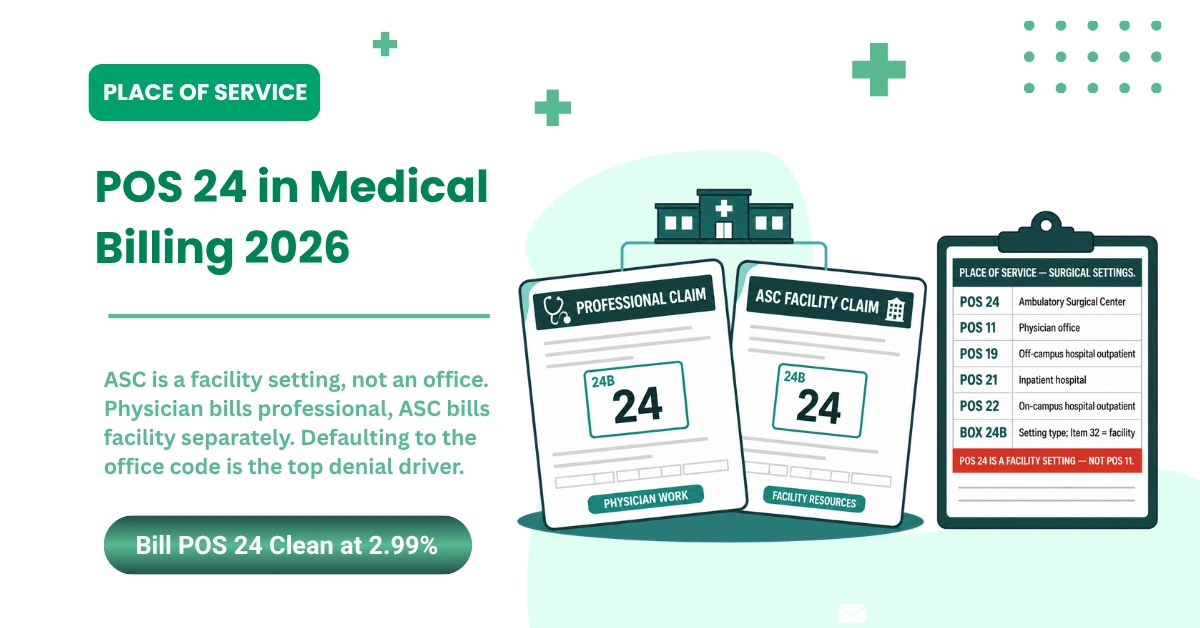




POS 24 in medical billing identifies an Ambulatory Surgical Center, a freestanding facility other than a physician's office where surgical and diagnostic services are furnished on an ambulatory basis. Physicians and practitioners report this code on professional claims for services furnished there. Medicare treats the setting as a facility for Physician Fee Schedule payment.
One two-digit field decides more than most billing teams expect. That field signals which practice expense logic applies, whether the service location on the claim matches the entity that furnished the care, and how the payer reads the encounter.
An office, an ASC, and a hospital outpatient department all pay differently for the same work. Telling the payer which one happened is the whole job of POS in medical billing.
Get it wrong and the claim doesn't always bounce back with a clean message. Sometimes it pays at the wrong rate, and nobody catches it until a reconciliation or an audit surfaces the pattern months later.
|
Quick fact |
Answer |
|---|---|
|
Code |
24 |
|
Setting |
Ambulatory Surgical Center |
|
MPFS designation |
Facility |
|
Main claim context |
Professional and supplier claims |
|
Most common confusion |
POS 11 or POS 22 |
The sections below cover when the code applies, how the physician claim and the ASC facility claim differ, where the code sits on the form, and what the 2026 CMS changes mean for your workflow.
What does place of service 24 mean in medical billing?
Place of service code 24 identifies an Ambulatory Surgical Center. CMS describes an ASC as a freestanding facility, other than a physician's office, where surgical and diagnostic services are furnished on an ambulatory basis. The code belongs on professional claims, and Medicare treats the ASC as a facility setting for Physician Fee Schedule payment.
The official CMS definition
Answering what is POS 24 starts with the code set itself. The CMS Place of Service Code Set carries the definition above and instructs providers to check individual payer reimbursement policies for these codes.
Watch the two dates on that page. The database itself is labeled as updated May 2, 2024, while the page was last modified in February 2026. A refreshed page date doesn't mean the code descriptions changed.
What an Ambulatory Surgical Center means in practice
An ASC is a distinct surgical entity with its own Medicare agreement. Patients come in, have a procedure, and leave without a formal inpatient admission. The setting isn't the same as the physician's ordinary office, even when the surgeon owns both.
A hospital can operate an ASC. Plenty of published guides claim otherwise, and they're wrong. CMS recognizes hospital-operated ASCs when the entity is separately identifiable and meets the ASC requirements on its own.
Cataract surgery, colonoscopy, and carpal tunnel release all show up in ASCs constantly. Treat those as familiar examples of the setting, though, because a procedure being common in an ASC doesn't make every related CPT code payable there.
Modifier 24 answers a different billing question
Place of service code 24 reports where a service happened. Modifier 24 reports an unrelated evaluation and management service furnished during a postoperative period. One describes a setting, and the other describes a relationship between a visit and a prior surgery.
When should POS 24 be used?
Use it when the patient is registered in a Medicare participating ASC
POS 24 applies when a physician or practitioner furnishes a service to a patient in a Medicare participating ASC. Medicare Claims Processing Manual Chapter 26 carries the place of service code list and the instruction behind that requirement.
The patient's registered setting decides the code. Not the physician's main office, not the default on an EHR template, and not the address of whoever typed the charge.
Report code 24 when the physician or practitioner furnished the service to a patient registered in a Medicare participating ASC. Do not report office code 11 merely because the physician maintains an office nearby or because the practice management system defaults to the group's primary address.
Don't use it for office or hospital outpatient services
|
Where the encounter happened |
Coding direction |
|---|---|
|
ASC clinical area |
Report the ambulatory surgery center place of service code, 24 |
|
Physician office |
Consider POS 11 |
|
On-campus hospital outpatient department |
Consider POS 22 |
|
Off-campus hospital outpatient department |
Consider POS 19 |
|
Patient formally admitted as an inpatient |
Use the applicable inpatient POS |
Formal patient status decides the inpatient line, not the clock. A patient who stays overnight in a hospital bed under observation hasn't been admitted, and a short inpatient stay is still inpatient.
The co-located physician office exception
Surgeons often run an office and an ASC out of the same building. A physician may report POS 11 for the office portion, but only when a valid separate office exists, the service happened there, and both entities meet the distinct entity requirements.
Timing matters more than most teams realize. Appendix L of the CMS State Operations Manual explains that shared nonclinical space works only when the office is closed while the ASC operates, and the reverse.
A surgeon sees the patient in a separate office suite Tuesday morning, then operates in the ASC under distinct hours that afternoon. Each claim follows the place of service code for ambulatory surgery center or office where that specific service occurred.
Is POS 24 a facility or nonfacility setting?
POS 24 is a facility setting for Medicare Physician Fee Schedule payment. Facility does not mean inpatient hospital. It means another entity, the Ambulatory Surgical Center, bears and separately bills for many of the resources used during the procedure, so the physician's professional payment may follow different practice expense values.
CMS treats the ASC as a facility setting
The facility designation doesn't live on the code set page, which trips up a lot of coders looking for it. Chapter 12 of the Medicare Claims Processing Manual explains that the POS code reported for the face-to-face encounter determines whether the facility or nonfacility rate applies under the MPFS.
One nuance worth carrying into your edits. For inpatient hospital (POS 21) and hospital outpatient (POS 19 or 22), Medicare pays the facility rate regardless of where the encounter occurred. POS 24 carries the facility designation without that same override.
How the site of service changes physician payment
|
Factor |
Facility setting |
Nonfacility setting |
|---|---|---|
|
Common example |
Ambulatory Surgical Center |
Physician office |
|
Practice expense |
The facility bears many resources |
The provider carries more overhead |
|
Professional rate |
Facility logic may apply |
Nonfacility logic may apply |
|
Separate facility billing |
Usually present |
Usually absent |
Medicare may hold separate facility and nonfacility practice expense values for the same code, and the Medicare Physician Fee Schedule governs which one pays. Skip the tempting shortcut of quoting a fixed percentage gap between the two.
Actual payment moves with the CPT or HCPCS code, the locality, the provider type, the modifier, the payer, the contract, and the date of service. A single national percentage doesn't survive contact with any of that.
Why a wrong setting creates payment risk
A surgeon operates in the ASC, and the billing system defaults the professional claim to POS 11. That claim may price under office logic, hit an edit, pay incorrectly, or sit quietly until a post-payment review pulls it.
Most POS billing errors start upstream of the biller. Scheduling location doesn't feed charge entry, the EHR template defaults to office, the surgeon works at four sites, and somebody picks the practice address because it's the first option in the dropdown.
A claims workflow should validate the rendering location before submission, which is one of the controls built into outsourced medical billing services rather than something a scrubber catches on its own.
If your system defaults every surgical claim to the provider's office, a billing review can show where the location data stops matching.
How physician and ASC facility billing work together
The physician bills the professional service, and the Ambulatory Surgical Center bills the facility resources on a separate claim. Under Medicare fee-for-service, the ASC generally uses the 837P supplier claim format rather than the hospital UB-04 model. Anesthesia professionals bill their own component. Commercial payer requirements may differ and should be verified.
One surgical case can generate several claims from several entities, which is where outpatient surgery center billing gets confusing for practices new to the setting. Not every item bills separately, though, and that's the part worth getting right.
What the physician bills
The surgeon or practitioner bills the professional work using the appropriate procedure code and reports POS 24 on that claim. Rendering provider and billing provider data both have to be correct, and the professional payment stands apart from whatever the ASC collects.
What the ASC bills
The facility bills its own component. A certified ASC bills the Medicare contractor using the ASC X12 837 professional format, or in rare cases Form CMS-1500, according to the Medicare Claims Processing Manual Chapter 14.
An ASC doesn't bill Medicare as a hospital on a UB-04 by default. Commercial contracts sometimes arrange facility billing differently, so confirm the claim format with each payer instead of assuming the Medicare pathway carries over.
New ASC billers get caught by one more requirement. The facility reports modifier TC when it bills facility charges for HCPCS codes that carry both a professional and a technical component under the fee schedule.
What the ASC payment usually packages
The facility payment bundles most of what makes the room run. Nursing and technical staff, use of the procedure and recovery areas, equipment, supplies, surgical dressings, and administrative services generally sit inside the ASC rate rather than on separate lines.
What may be separately billable
Physician and anesthesia professional services bill separately. Certain covered ancillary items, drugs, biologicals, radiology services, and devices may also pay separately when the current rules allow it, and CMS payment indicators decide that case by case.
|
Billing side |
Who bills it |
What the payment covers |
|---|---|---|
|
Professional |
Physician or practitioner |
The professional work |
|
Facility |
Ambulatory Surgical Center |
Facility resources for the case |
|
Anesthesia |
Anesthesia professional or group |
The anesthesia professional service |
|
Selected ancillary service |
Eligible supplier or the ASC |
Only when payment rules allow it |
Two claims from two entities for one patient encounter have to stay coordinated across scheduling, charge entry, submission, and payment posting. That coordination is what revenue cycle management services exist to hold together when the professional side and the facility side sit in different systems.
Where place of service 24 goes on CMS-1500 and 837P claims
Report POS 24 in Item 24B on the paper CMS-1500, and in Loop 2300 CLM05-1 or Loop 2400 SV105 on the 837P. Item 32 identifies the specific facility that furnished the service, including name, address, and ZIP code. Item 32a may carry the service facility NPI when the payer requires it.
Report the setting in Box 24B
Item 24B holds the place of service codes for professional claims on the paper form. The electronic equivalent lives at the claim level in Loop 2300 CLM05-1, with a line-level override available in Loop 2400 SV105 when a single claim spans settings.
Older documentation still says HCFA-1500 place of service codes. Same form, same field, renamed to CMS-1500 years ago, and the CMS-1500 place of service codes sit where they always did.
Report the specific facility in Item 32
Box 24B and Item 32 answer two different questions. Box 24B answers what type of location this was. Item 32 answers which physical facility furnished the service.
Box 24B reports code 24. Item 32 names the actual ASC, its street address, and its ZIP code. The site of service data in Item 32 is also what drives locality pricing, so a wrong address quietly moves the payment.
Match the service facility NPI when required
Item 32a may report the service facility NPI when the payer asks for it. Item 33a identifies the billing provider or group NPI. Rendering, billing, and service facility information all serve different purposes on the same claim.
The payer's enrollment file has to recognize each of those entities. When the ASC NPI on a claim doesn't appear in the payer's records the way the practice expects, the problem is enrollment rather than coding.
Claim validation before transmission catches most location mismatches, which is what claims submission services are built to do.
MedSole pricing: full-service medical billing runs 2.99% of collections, and provider credentialing starts at $99 per insurance when enrollment work is needed.
What happens when the POS is missing or invalid
For Medicare professional claims, Chapter 26 instructs contractors to return a claim as unprocessable when Item 24B lacks a valid place of service code or carries an invalid one, using remark code M77.
Treat that as the Medicare instruction rather than a universal outcome. Commercial payers use their own remark and adjustment combinations, so build your edits around the specific messages your top payers send.
If the POS, the facility address, and the NPI are being checked in three separate queues, a claim review can show where the mismatch begins.
POS 24 vs POS 11, 19, 21, and 22
Four codes sit close enough to place of service 24 that billing teams mix them up regularly. The distinction usually comes down to who owns the location and how the patient was registered.
|
POS |
Setting |
Core distinction |
Common mistake |
|---|---|---|---|
|
11 |
Physician office |
Independently operated office setting |
Defaulting surgical claims to the practice address |
|
19 |
Off-campus outpatient hospital |
Hospital provider-based department away from the main campus |
Assuming physical distance from the hospital means ASC |
|
21 |
Inpatient hospital |
The patient is formally admitted |
Treating an overnight stay as proof of admission |
|
22 |
On-campus outpatient hospital |
Hospital outpatient department on the main campus |
Using it for a freestanding ASC case |
|
24 |
Ambulatory Surgical Center |
Separately enrolled ASC entity |
Using it for office work done in the same building |
POS 11 and the physician office
An office setting and an ASC clinical area look similar from the parking lot and bill nothing alike. The office carries its own overhead, while the ASC bills separately for the facility resources.
Surgeons who work in both locations generate most of these errors. The co-located office exception applies only when the office and the ASC operate as distinct entities under separate hours.
POS 19 and the off-campus hospital department
Ownership decides this one, not the mailing address. A surgical suite three miles from the hospital is still hospital outpatient when the hospital runs it as a provider-based department, and that makes POS 19 the code.
POS 22 and the on-campus hospital department
POS 22 reports an on-campus hospital outpatient department, and the campus definition under the provider-based rules reaches 250 yards from the main buildings. That distance is what separates an outpatient POS of 22 from one of 19.
An ASC and a hospital outpatient department can furnish similar procedures on the same day. They enroll differently and pay under different systems, which is why the outpatient place of service code has to match the registered entity rather than the clinical activity.
POS 21 and formal inpatient admission
Formal admission status controls POS 21, which reports inpatient hospital care. Removing a procedure from the inpatient only list doesn't automatically make that procedure appropriate or payable in an ASC, and the 2026 changes below make that distinction matter more.
For the wider set of settings beyond surgery, our place of service codes guide walks through the full list and the comparisons that trip up POS codes in medical billing outside the ASC world.
Picking the right setting is step one. The procedure still has to be covered in an ASC, authorized where required, supported by documentation, and submitted under the rules that payer applies.
Which procedures can be billed with POS 24 in an ASC?
No. A procedure performed inside an Ambulatory Surgical Center qualifies for Medicare facility payment only when four things line up: the location is a certified ASC, the billed code appears on the current ASC Covered Procedures List with an applicable payment indicator, the patient meets coverage and medical necessity requirements, and authorization and enrollment requirements are satisfied.
The procedure has to appear on the current ASC Covered Procedures List
CMS uses the ASC Covered Procedures List, shortened to ASC CPL, to identify which procedures the ASC payment system will pay for. Annual rulemaking sets the list, and quarterly payment files adjust it during the year.
Pull the file rather than trusting a spreadsheet somebody saved last winter. The CMS ASC payment addenda page carries the January, April, and July 2026 approved code and payment rate files.
The correct location code doesn't guarantee coverage
Four separate tests decide whether a facility claim pays, and the site of service only answers the first one. A colonoscopy happens in ASCs every day, and the biller still has to verify the exact code, the coverage conditions, the authorization, and the current payment indicator.
Ancillary items carry an extra condition worth knowing. CMS has an approved audit issue covering covered ancillary services billed with no approved ASC surgical procedure on the same claim or in history for that date and provider, which makes those lines recoverable.
Check the payment indicator before scheduling
The ASC payment indicator tells you how a code behaves under the ASC payment system. A code may be separately payable, packaged into the surgical rate, subject to specific payment treatment, or not payable at all in this setting.
Checking that before the case is scheduled costs a minute. Checking it after the denial costs an appeal, a rescheduled patient, and sometimes a conversation the surgeon didn't want to have.
Familiar ASC procedures still need a code-level check
Selected orthopedic and pain procedures joined the familiar cataract and colonoscopy cases on ASC schedules this year. Those describe service categories in outpatient surgery center billing, and none of them confirms payment for a specific code, patient, payer, or date of service.
What changed for POS 24 and ASC billing in 2026?
CMS didn't write a new definition for code 24 in 2026. What moved were the payment rates, the covered procedure rules, the quarterly files, and the prior authorization process around ASC services.
For CY 2026, CMS finalized a 2.6% ASC payment update for facilities meeting applicable quality reporting requirements. CMS added 289 procedures to the ASC Covered Procedures List after revising the list criteria, and added another 271 codes removed from the inpatient only list.
CMS raised the ASC update factor by 2.6%
The CY 2026 OPPS and ASC final rule set a 2.6% update for ASCs that meet the applicable quality reporting requirements, built from a 3.3% market basket update reduced by a 0.7% productivity adjustment.
A national update factor and an individual claim payment are different numbers. Wage adjustment, payment indicator, multiple procedure treatment, contract terms, and payer all still move the final amount, and ASC quality reporting performance decides whether a facility gets the full update.
CMS expanded the ASC Covered Procedures List
Two policy changes produced two separate additions. Revised CPL criteria brought in 289 procedures, and the concurrent inpatient only list removals added 271 more codes, for 560 surgical procedures plus 35 covered ancillary services.
The inpatient only list phaseout started
CMS began a three-year phaseout of the inpatient only list by removing 285 mostly musculoskeletal procedures for CY 2026. The agency framed the change as giving physicians more flexibility to determine the appropriate site of care.
Removal from that list allows hospital outpatient payment when it's clinically appropriate. It doesn't establish ASC eligibility, patient suitability, or commercial payer coverage on its own, and practices that read it that way risk denials through the first year.
Quarterly ASC files kept moving
January, April, and July 2026 all brought approved code and payment rate files. Those updates can change HCPCS codes, descriptors, payment indicators, drug files, device treatment, and which items pay separately, so a claim edit built in January drifts by summer.
A prior authorization demonstration started in 10 states
CMS launched a five-year prior authorization demonstration for selected ASC services. The scoping matters here: it applies to Medicare-enrolled ASCs providing applicable services billed to Part B with place of service code 24, type of service F, and specialty code 49.
|
Date |
Development |
What providers do |
|---|---|---|
|
January 1, 2026 |
Annual ASC payment rules take effect |
Load current rates and payment indicators |
|
January 5, 2026 |
Phase one requests open |
Begin submitting for seven states |
|
January 19, 2026 |
Phase one dates of service begin |
CA, FL, TN, PA, MD, GA, and NY |
|
February 2, 2026 |
Phase two requests open |
Begin submitting for three states |
|
February 16, 2026 |
Phase two dates of service begin |
TX, AZ, and OH |
|
April and July 2026 |
Quarterly payment files post |
Refresh code and payment tables |
The targeted categories are blepharoplasty, botulinum toxin injections, panniculectomy, rhinoplasty, and vein ablation. Providers may bypass the request under the CMS ASC prior authorization demonstration, and those claims then face prepayment medical review.
Authorization has to match the facility, not only the procedure, which is where prior authorization services earn their keep in a multi-site surgical practice.
If your authorization team is still checking only the CPT code and not the planned ASC location, the approval on file may not match the claim that follows it.
How Medicare, Medicare Advantage, and commercial ASC rules differ
The location code is standardized across payers. Payment and administrative rules around it are not, which is why an ASC claim that sails through Medicare can stall at a commercial plan with identical clinical facts.
|
Payer category |
Starting point |
What still has to be verified |
|---|---|---|
|
Medicare FFS |
CMS POS and ASC payment guidance |
ASC CPL, payment indicator, coverage, enrollment, and authorization |
|
Medicare Advantage |
Medicare coverage baseline plus plan administration |
Network, contract, authorization, claim format, and plan edits |
|
Commercial payer |
Payer contract and payment policy |
Covered codes, modifiers, claim type, fee schedule, and site review |
Traditional Medicare follows CMS ASC payment rules
Under Medicare fee-for-service, the workflow runs on current CMS manuals, the quarterly ASC files, enrollment status, and coverage requirements. Those pieces are public and dated, which makes Medicare ASC billing the easiest of the three to standardize.
Medicare Advantage adds plan and contract requirements
Medicare Advantage plans have to meet applicable Medicare coverage requirements. Networks, payment contracts, authorization processes, claim edits, and submission instructions can still differ from fee-for-service, and staff shouldn't read an MA card as a signal that the claim processes identically.
Commercial payers may use different claim and modifier rules
Before the first commercial ASC billing case goes out, confirm whether the payer accepts 837P or arranges facility billing another way, whether an ASC-specific modifier is required, whether site of service review is part of authorization, which fee schedule controls, and how implants are handled.
Modifier SG is not a universal requirement
Medicare settled this a long time ago. Chapter 14 states that beginning January 1, 2008, ASCs are no longer required to include the SG modifier on facility claims in Medicare, so adding it by reflex on a Medicare claim reflects a habit rather than a rule.
Commercial policy is a different story. Premera maintains a payment policy titled Modifier SG, Ambulatory Surgery Center Facility Services, and that Premera modifier SG policy applies to one payer rather than to the market.
A plan may want SG on the ASC facility service while rejecting it on the physician's professional line. Check the current policy for the specific payer and the specific claim type before your scrubber starts appending it automatically.
Common ASC place of service errors and denial risks
Most ASC billing denials tied to location trace back to one of a handful of patterns. Knowing which pattern you're looking at decides whether you correct a claim or correct a system.
|
Error pattern |
What to check |
Corrective action |
|---|---|---|
|
Office setting reported for an ASC service |
Scheduling and rendering location |
Correct the claim and the location mapping |
|
Hospital outpatient code used for a freestanding ASC |
Facility enrollment and entity type |
Confirm the actual registered entity |
|
POS and facility address conflict |
Box 24B, Item 32, and the electronic service location |
Correct both location elements |
|
Procedure not eligible in an ASC |
The current quarterly payment file |
Confirm payability before resubmission |
|
Authorization tied to the wrong facility |
Authorization number and approved NPI |
Update the approval before billing |
|
Facility modifier on a professional line |
Payer policy and claim type |
Remove or correct the payer-specific modifier |
|
Corrected claim still unpaid |
Payer receipt and adjudication status |
Open documented follow-up |
Office code used for an ASC service
The EHR defaults to the physician's office, the charge ticket inherits the wrong department, the scheduler picks a generic surgical label, and billing staff use the practice address. Any one of those produces the same wrong claim.
Hospital outpatient code used for a freestanding ASC
Both settings deliver outpatient surgery, and the entity, the enrollment, and the payment system all differ underneath. Verify where the patient was registered and which entity furnished the service before you touch the claim.
Service facility data doesn't match the POS
The location code says ASC, the facility address says office, the NPI belongs to a third entity, and the authorization names a fourth site. That combination may trigger a rejection, a denial, a pend, an incorrect payment, or a later review.
The procedure or the authorization isn't valid for the ASC
Wrong POS, a nonpayable ASC procedure, a missing authorization, an approval issued for another location, and an enrollment mismatch are five different root causes. Each one needs its own correction, and none of them responds to a straight resubmission.
Send the finding back to the step that created it
Correcting one claim closes one claim. The practice still has to trace whether the error started in scheduling, registration, authorization, charge capture, claim creation, clearinghouse edits, or provider enrollment.
That tracing is the whole point of denial management services that categorize by root cause rather than working a queue in date order.
Underpayments hide better than denials, too. Payment posting services that check each remittance against the contracted rate catch a claim that paid under office logic while the ledger still looks balanced.
When corrected claims keep coming back with different messages, the answer usually sits upstream of the claim, in whichever system first recorded the location.
How to build an ASC POS validation workflow
All of it collapses into one repeatable ASC claim workflow. Seven steps, each owned by a named role, and none of them relying on somebody remembering the right answer at charge entry.
Map every ASC location before the date of service
Build a location master first. For each ASC your providers use, record the legal name, the billing name, the address, the NPI, the tax ID, Medicare participation, and commercial payer participation.
Then make that ASC selectable in scheduling as its own entry. A generic surgery label loses the facility identity before a claim ever exists, and place of service validation can't recover what scheduling never captured.
Verify procedure eligibility and authorization
Confirm the current ASC payment file, the payer's coverage position, medical necessity, the authorization, and the approved site and NPI. Do this before the case is booked, while a schedule change still costs nothing.
Carry the location through charge entry
Transfer the rendering location from scheduling or the operative record straight into the charge. Staff shouldn't reselect the setting from memory, because memory defaults to whichever site the provider works most.
Scrub the professional and facility claims separately
Professional claim scrubbing should check the procedure, the location code, the rendering provider, the service facility, and the professional modifiers. POS billing edits that stop at the code miss half the location data.
ASC facility edits check a different list: facility billing rules, procedure eligibility, payer-required modifiers, packaging, and authorization. Running both claim sides through one generic ruleset is how mismatches survive to the payer.
Reconcile payment and feed errors back upstream
Compare the paid amount against the contracted amount, separate the facility payment from the professional payment, and read the adjustment reason, the patient responsibility, and the authorization outcome together.
Claims that stay unpaid after a correction need their own track, which is where AR follow up services pick up the work before a filing deadline closes the option.
Correct the source, not only the claim
When a mismatch shows up, update the EHR mapping, the payer table, the authorization checklist, or the enrollment record. Software configuration handles part of this, and staff training and payer table maintenance handle the rest.
When outside RCM support makes sense
Signs the problem is bigger than one claim
Accurate POS 24 in medical billing depends on the whole claim path, not one field entered at the end. Four signals suggest the path itself has broken rather than a single claim.
- The same location error shows up across several providers
- Authorization locations and claim locations don't match
- Corrected claims keep coming back unpaid
- Payments can't be reconciled against the payer contract
Repeated errors like these usually point at a broken handoff between scheduling, authorization, charge entry, and claim submission. One department fixes its piece, and the next department never hears about it.
What a billing review should cover
A useful ASC revenue cycle review looks at location mapping, ASC and provider enrollment, claim field configuration, authorization records, procedure eligibility checks, payer modifier requirements, and denial and payment history together rather than one at a time.
MedSole pricing: full-service medical billing services run 2.99% of collections, and provider credentialing services start at $99 per insurance when enrollment or payer participation needs separate work.
Pricing reviewed July 31, 2026. Scope is confirmed during the review rather than assumed.
If the same location issue is showing up across several claims, MedSole can review where the data stops matching and show your team what needs to change.
POS 24 in medical billing FAQs and key takeaways
What does code 24 mean on a medical claim?
Code 24 identifies an Ambulatory Surgical Center, a freestanding facility other than a physician's office where surgical and diagnostic services are furnished on an ambulatory basis. Physicians report it on professional claims. Modifier 24 is a separate concept and reports an unrelated visit during a postoperative period.
Is an ASC a facility or nonfacility setting?
An Ambulatory Surgical Center is treated as a facility setting for Medicare Physician Fee Schedule purposes. The ASC bills separately for the facility resources, so the physician's professional payment may follow facility practice expense values. No single national percentage describes the difference across codes and localities.
What is the difference between an ASC and POS 22?
POS 22 reports an on-campus hospital outpatient department, while an Ambulatory Surgical Center is a separately enrolled entity. Both can furnish outpatient procedures on the same day. They enroll differently and pay under different Medicare payment systems, so the registered entity decides the code.
Where is the ASC location code entered on the CMS-1500?
The ASC location code goes in Item 24B on the CMS-1500, and in Loop 2300 CLM05-1 or Loop 2400 SV105 on the 837P. Item 32 identifies the specific facility by name and address. Item 32a may carry the service facility NPI when the payer requires it.
Do physicians and ASCs submit the same claim?
No. The physician bills the professional work, and the Ambulatory Surgical Center bills the facility resources on its own claim. Under Medicare fee-for-service, the ASC generally uses the 837P supplier claim format. Commercial payers may arrange facility billing differently, so confirm the format per contract.
Is modifier SG required with every ASC claim?
Not for Medicare. The program stopped requiring the SG modifier on ASC facility claims beginning January 1, 2008. Some commercial payers still require it, and a plan may want it on the facility service while rejecting it on the physician line. Check the payer's current policy and claim type.
Does every procedure performed in an ASC qualify for payment?
Performing a procedure in a certified ASC is only the first test. The billed code also has to appear on the current ASC Covered Procedures List with an applicable payment indicator. Coverage, medical necessity, authorization, and enrollment requirements all still apply before the facility component becomes payable.
What changed for ASC billing in 2026?
CMS finalized a 2.6% ASC update factor for CY 2026 for facilities meeting quality reporting requirements, added 289 procedures to the ASC Covered Procedures List, added 271 more codes removed from the inpatient only list, and started a prior authorization demonstration for selected services.
Key takeaways for providers
- The location code follows the setting where the service happened
- The code drives which practice expense logic applies to the professional claim
- Physician billing and ASC facility billing are separate claims from separate entities
- Procedure eligibility has to be checked in the current quarterly file
- A repeated error needs a workflow correction, not another corrected claim
One wrong location code can be corrected in an afternoon. A system that keeps producing the same error needs a closer look at scheduling, authorization, charge capture, and enrollment together.
MedSole can review the claim path from scheduling through payment and show your team where the ASC data stops matching.
→ Request a Free Billing Review
MedSole RCM works with ASCs, surgical groups, and multi-location practices across all 50 states, handling billing at 2.99% of collections and credentialing at $99 per insurance.