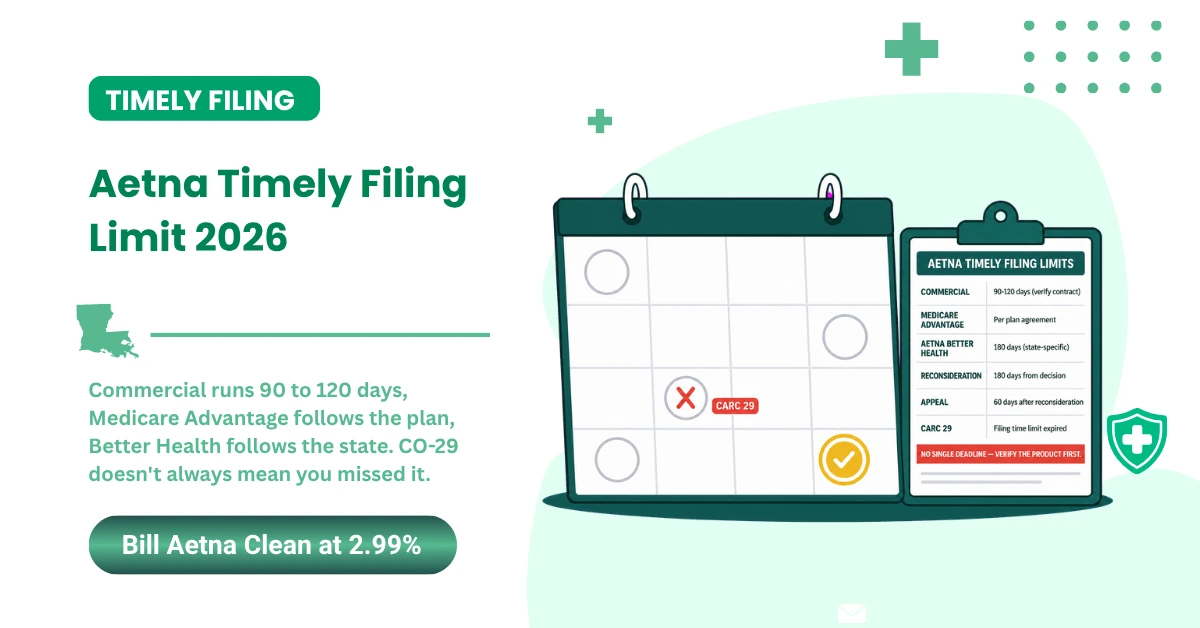




Aetna doesn't publish one filing period that covers every claim, provider, and product. The Aetna timely filing limit 2026 billing teams run into depends on the plan type, network status, state program, and claim category, and it can land anywhere from 90 to 365 days. Verify which period controls the claim before you submit or appeal it.
What is the timely filing limit for Aetna? It depends on which product below governs the claim in front of you.
Search results blend rules from several different sources. A commercial PPO plan, an Aetna Student Health plan, Medicare Advantage, Original Medicare, and an Aetna Better Health Medicaid plan can each carry a different aetna timely filing limit, and state dispute rules or your own provider contract can shift it again. A number that's correct for one Aetna product can be wrong for the next claim on your desk.
This guide walks through how to identify the product, the provider's network status, the correct clock-start event, whether the claim is initial or corrected, the state-plan requirement, and the applicable reconsideration or appeal deadline. Aetna timely filing problems rarely come from one isolated mistake. They usually trace back to the same eligibility, submission, and follow-up work that carries your entire revenue cycle management services, so fixing one gap tends to expose the others.
Important: A filing period confirmed for one Aetna product or state doesn't automatically apply to another Aetna claim. Check the product before you check the calendar.
What changed in Aetna timely filing guidance for 2026?
MedSole's July 2026 source review didn't find one nationwide change to the Aetna timely filing limit 2026 that replaced every product-specific or contract-specific deadline. The current source set includes Aetna's January 2026 Provider and Behavioral Health Manual, the state supplement, product-specific claim pages, and current dispute guidance. That's a source-review finding, not a claim that no private contract changed.
Aetna's provider manuals page currently lists the Provider and Behavioral Health Manual dated January 2026, alongside the state supplement and product-specific guides.
What providers should treat as the 2026 update
- Work from the current manual, not a 2024 or 2025 saved copy or blog post.
- Confirm the member's exact Aetna product before applying any number.
- Pull the active provider agreement instead of assuming it matches the public page.
- Check state-plan instructions separately for any Aetna Better Health claim.
- Keep submission deadlines and dispute deadlines in separate columns of your tracker.
- Confirm which electronic claim-routing options are currently supported.
Why the year still belongs in the search
"2026" signals source freshness more than it signals a new number. It points to the current manual, the current provider portal workflow, and the current state-plan examples, not a single date when every aetna timely filing guidelines figure reset at once.
Source review completed: July 2026. MedSole reviewed the current Aetna provider manuals, the Aetna state supplement, product-specific Aetna Better Health guidance, Aetna's dispute and appeal pages, CMS and eCFR rules where they apply, and the qualifications built into standard provider contracts.
Aetna timely filing limits at a glance
Providers run into a different Aetna timely filing limit 2026 depending on the product, because Commercial, Medicare Advantage, Original Medicare, and Aetna Better Health aren't governed by one identical source. Some billers call this the aetna tfl limit for short. The table below separates verified examples from numbers that get repeated online without a listed source.
|
Product or source |
Provider context |
Claim type |
Commonly cited period |
Clock starts |
Authority level |
Qualification |
|---|---|---|---|---|---|---|
|
Aetna Commercial |
Participating or nonparticipating |
Initial claim |
90 to 120 days |
Date of service |
Contract-dependent |
Verify the provider agreement and the specific product |
|
Aetna Medicare Advantage |
Contracted or noncontracted |
Initial claim |
Set by plan and agreement |
Date of service |
Plan- and contract-dependent |
Original Medicare's one-year rule doesn't carry over automatically |
|
Original Medicare |
Fee-for-service |
Initial claim |
One calendar year |
Date of service |
CMS, 42 CFR 424.44 |
Applies to Original Medicare, not Aetna Commercial |
|
Aetna Better Health of Florida |
Medicaid managed care |
Initial claim |
180 days |
Date of service or discharge date |
State-specific |
Contractual exceptions can apply |
|
Aetna Better Health of Illinois |
Medicaid managed care |
Initial and corrected claim |
180 days |
Date of service |
State-specific |
Reconsideration and secondary rules run on separate clocks |
*Last verified: July 2026. Every row above is a verified example tied to a named source, not a universal Aetna rule.* The aetna commercial timely filing limit and the aetna medicare timely filing limit sit in separate rows on purpose. Reconsideration, appeal, and payment-dispute deadlines follow their own timelines and get covered later in this guide, not in the timely filing limit for Aetna claims shown here.
How to identify the filing deadline that controls an Aetna claim
Identify the controlling deadline before you rely on a web summary or a number a colleague remembered from a different payer. The aetna timely filing limit 2026 depends on six variables, and answering any aetna claims timely filing limit question starts with the same six checks.
Step 1: Identify the exact Aetna product
Pull the member ID card, eligibility response, payer ID, and plan name. Commercial, Aetna Student Health, Medicare Advantage, Aetna Better Health, and third-party-administered products can all share the same "Aetna" name on a card, and each runs a different clock.
Step 2: Confirm provider network status
Participating and nonparticipating providers can face different terms under the same product, and status needs checking for both the billing entity and the rendering provider. Don't rely on what front-desk staff remember.
Step 3: Identify the claim category
Following the aetna timely filing guidelines starts with sorting the claim into one bucket: initial professional claim, initial institutional claim, corrected claim, secondary claim, reconsideration, appeal, or payment dispute. Each category runs on its own timeline, covered later in this guide.
Step 4: Identify the clock-start event
The clock can start from the date of service, inpatient discharge date, primary payer's determination, initial claim decision, reconsideration decision, paid date, or EOB or EOP date. Confirm the trigger before counting days.
Step 5: Confirm the source hierarchy
Work through this order: the active provider agreement, the product-specific Aetna manual, the state supplement, Aetna Better Health state guidance, the denial letter or EOB instructions, then applicable CMS or state rule.
Step 6: Save evidence before submission
Track the payer ID, submission date, claim batch, clearinghouse acknowledgement, payer acceptance, and claim number. A disciplined claim submission services process records the payer route and any unresolved rejection before the window closes, and gaps in provider credentialing services can quietly block routing.
Aetna's Availity portal covers claim submission, eligibility checks, record uploads, and disputes and appeals in one place, and it's the route most billers mean by aetna tfl for claim submission. Aetna also supports several approved electronic transaction vendors beyond it, so a claim isn't limited to one system.
MedSole reviews payer setup, provider enrollment, and claim-submission workflows so timely filing for Aetna claims never comes down to guesswork. Full medical billing starts at 2.99% of collections, and credentialing runs $99 per insurance.
Is the Aetna commercial timely filing limit 90 or 120 days?
Both 90-day and 120-day filing periods show up in public Aetna resources and current search results, and neither one defines the Aetna timely filing limit 2026 as a universal nationwide commercial rule on its own. The contract, the specific product, and any applicable state requirement determine the period that controls a given claim.
Why 90 days appears
Competitor pages and AI-generated summaries commonly cite 90 days for participating commercial providers. A number repeated across search results isn't the same thing as an official nationwide rule, even when it shows up on ten different sites.
Why 120 days appears
Some Aetna product materials, including Aetna Student Health guidance, use a 120-day period for participating claims. That's a product-specific figure, and generalizing it to every Aetna Commercial agreement is exactly the mistake this guide is built to prevent.
Which source wins when numbers conflict
Work the hierarchy in order: the active provider agreement, then product-specific instructions, then the applicable state requirement, then the current Aetna manual or supplement, then written clarification from Aetna if the first four don't resolve it.
Picture a practice that finds 90 days in an industry article, 120 days on a product page, and a third period listed in its own participation agreement. The billing team should use the agreement that governs the member's specific product, unless state law or written payer guidance says otherwise.
A 90-day internal filing target your own team sets for operational safety is not a payer-mandated aetna timely filing deadline. Keep the two separate in your documentation, because timely filing aetna denials get contested on payer policy, not on your internal cutoff.
Record the verified period in the payer matrix your billing team already uses, along with the source and the date you confirmed it.
Aetna Medicare Advantage timely filing versus Original Medicare
Original Medicare requires claims within one calendar year of the date of service. The aetna medicare advantage timely filing limit works differently: Aetna Medicare Advantage claims are administered by the plan itself, and a contracted provider's filing requirement runs off the applicable Aetna agreement and plan instructions. Don't apply the Original Medicare rule to an Aetna Medicare Advantage claim by default.
The Original Medicare rule
Original Medicare claims go to the Medicare Administrative Contractor. CMS's own billing training confirms providers must submit claims to the correct MAC no later than one calendar year after the date of service, and 42 CFR 424.44 sets that federal period, with narrow exceptions for administrative error and retroactive entitlement.
Aetna Medicare Advantage claims
Medicare Advantage is administered by the MA plan, not a Medicare Administrative Contractor, so contracted-provider terms can differ from Original Medicare's federal rule. The aetna medicare timely filing limit for a contracted claim comes from the plan agreement and current claim instructions, not a fixed federal number. Don't cite 42 CFR 422.520 as proof of a 365-day submission floor. That regulation governs how fast an MA organization must pay a clean claim, not how long a provider has to submit one.
Prompt payment isn't timely filing
Three clocks get mixed together constantly:
|
Issue |
Original Medicare |
Aetna Medicare Advantage |
|---|---|---|
|
Administrator |
CMS through the MAC |
Aetna plan |
|
General source |
42 CFR 424.44 |
Plan and provider agreement |
|
Filing period |
One calendar year |
Verify plan and contract |
|
Network status |
Not applied the same way |
Can materially change terms |
|
Where the claim goes |
Medicare Administrative Contractor |
Aetna-designated route |
A filing limit governs how long the provider has to submit. A prompt-payment rule governs how quickly the plan must process a claim already received. An appeal deadline governs how long the provider has to challenge a decision. Mixing up any two of these three is timely filing for aetna medicare's most common billing mistake, and getting the Aetna timely filing limit 2026 right for MA claims starts with keeping the three separate.
Aetna Better Health timely filing limits vary by state
Aetna Better Health filing rules run by state plan. A 180-day rule published for Florida or Illinois isn't the national aetna timely filing deadline for every Medicaid plan. Verify the state program, claim type, contract exception, and clock-start event before applying a number.
Aetna Better Health of Florida
Florida requires claims within 180 days of the date services were provided, unless a contractual exception applies. For inpatient claims, that date means the discharge date. A revised version of an already-processed claim gets 180 days from the paid date instead.
Aetna Better Health of Illinois
Illinois requires initial and corrected claims within 180 days of the date of service, applied the same way to both. Reconsideration runs a separate 90-day clock from the original determination or EOP, a dispute runs 90 days after that and can't exceed one year from the date of service, and a secondary claim runs 90 days from the primary payer's final determination. Those three deadlines get full explanation later in this guide.
Why a 50-state table shouldn't get invented
A state row belongs in this table only with a current official source: plan name, state, claim type, deadline, clock-start event, and review date. Florida and Illinois are verified examples here, not stand-ins for every other state Aetna Better Health serves.
|
State plan |
Initial claim |
Corrected claim |
Secondary claim |
Clock start |
Qualification |
|---|---|---|---|---|---|
|
Florida |
180 days |
180 days from the paid date for a revised processed claim |
Not published in this guide |
Date of service or discharge date |
Contractual exception can apply |
|
Illinois |
180 days |
180 days from the date of service; 180 days from the paid date to resubmit a revised processed claim |
90 days from the primary payer's final determination |
Date of service or discharge date |
State-plan rule |
Florida and Illinois both separate a same-window "corrected" claim from a paid-date "revised" resubmission, though the triggers aren't identical. Confirm which category applies before you count days.
Confirming timely filing for Aetna at the state level is only the first step. The next question is whether the claim is initial, corrected, secondary, or already in dispute, which is where the rest of this guide picks up.
Initial, rejected, and corrected Aetna claims follow different clocks
Initial, rejected, and corrected Aetna claims don't share the same Aetna timely filing limit 2026. An initial claim hasn't been adjudicated. A rejected claim may never have entered Aetna's system at all. A corrected claim changes a previously accepted claim and needs the original claim number plus the plan's replacement-claim process, not a fresh start.
Initial claim
An initial claim is a new submission that hasn't been previously accepted and adjudicated, and it needs the applicable aetna timely filing limit for initial claims applied from the start. Track it until payer acceptance is confirmed, not only transmitted.
Rejected claim
A rejection can happen inside the practice-management system, at the clearinghouse or vendor level, or at the payer gateway, before the claim ever reaches adjudication. Aetna's guidance directs providers to their vendor for a vendor-level rejection, separate from a payer status inquiry. Correcting it doesn't reset the original clock automatically; don't assume the submission protected the deadline without evidence the payer's system received or accepted it.
Corrected or voided claim
A corrected claim changes information on a previously accepted claim, and a voided claim reverses one. Both go through electronically, and both need the originally assigned claim number attached. Getting aetna timely filing for corrected claims wrong here usually means someone skipped the frequency code or dropped that number.
Before resubmitting, confirm the claim frequency code, the original payer claim number, whether it's a replacement or a void, and the aetna corrected claim timely filing limit for that product.
|
Claim status |
What happened |
Required next action |
Which deadline to verify |
|---|---|---|---|
|
Initial |
No previous payer adjudication |
Submit a clean original claim |
Initial claim deadline |
|
Rejected |
Transaction failed before adjudication |
Correct the rejection and resubmit |
Original filing deadline |
|
Accepted but incorrect |
Payer accepted the claim with wrong data |
Submit a corrected or replacement claim |
Corrected-claim rule |
|
Accepted and paid incorrectly |
Data may be correct, but the processing is disputed |
Consider reconsideration |
Reconsideration period |
|
Denied for policy or clinical reason |
Payer made an adverse determination |
Consider an appeal |
Appeal period |
Match the claim to a row above before deciding what to file next.
When Aetna is secondary, COB changes the evidence and the filing workflow
Aetna secondary-claim deadlines depend on the product, the provider agreement, and the state plan, so don't assume every secondary claim gets 60 or 90 days from the primary EOB by default. Submit the primary payer's adjudication information along with the secondary claim, and verify the applicable clock before you count days.
Confirm which payer is primary
Verify the coverage order, the primary payer, the primary adjudication date, the primary EOB or ERA, and the patient's remaining responsibility before preparing the secondary claim.
Include the primary payer's adjudication
Aetna's COB submission guidance calls for electronic COB claims to include the primary payer's payment information from the ERA, or to convert the primary EOB information into the standard ERA coding format Aetna expects.
Don't rely blindly on Medicare crossover
Aetna states that Medicare can forward a claim for secondary consideration when the member appears in the applicable eligibility files, but that's not a guarantee the crossover completed. Confirm Aetna received the claim instead of assuming the process finished on its own.
Before submitting, run through seven checks: confirm the primary and secondary order, obtain the primary ERA or EOB, identify the state and Aetna product, verify the secondary filing clock, submit COB data in the correct electronic format, confirm Aetna's claim receipt, and save the primary payer's determination.
Accurate payment posting services make it easier to capture the primary payer's payment and remaining balance correctly before the secondary claim gets prepared.
What CARC 29 means and how providers should respond
CARC 29 means the payer determined the filing time limit expired. It doesn't prove the practice missed the correct Aetna timely filing limit 2026. Before writing off the claim, verify the filing period, the payer's receipt history, any rejection records, COB activity, and any contract or state exception.
X12 defines CARC 29 as "the time limit for filing has expired." It carries group code CO in most remittances, so "CO-29" is the common shorthand, though the full remittance deserves a look, not only the one code.
Step 1: Confirm the denial code and claim
Pull the claim number, date of service, denial date, group code, CARC, any RARC, Aetna product, and network status before doing anything else.
Step 2: Recalculate the controlling deadline
Run the claim back through the verification process from earlier in this guide: product, contract, network status, claim type, state, and clock-start event. Getting the aetna tfl limit wrong at this step is a common reason a valid claim gets written off.
Step 3: Determine what Aetna received
Check the payer claim number, claim-status result, clearinghouse reports, any vendor rejection, Aetna's acceptance status, prior corrected or secondary claims, and the Availity history for that claim.
Step 4: Select the correct route
|
Finding |
Correct route |
|---|---|
|
Claim was never accepted |
Verify whether resubmission remains possible |
|
Claim was accepted timely |
Submit proof through the applicable dispute process |
|
Claim data was incorrect |
A corrected claim may be appropriate |
|
Aetna processed the claim incorrectly |
Reconsideration may be appropriate |
|
Decision is clinical or policy-based |
An appeal may be appropriate |
|
State dispute exception applies |
Follow the state-specific process |
Don't write that CARC 29 denials are always final, that every aetna denied claim can be appealed, or that a patient can always, or never, be billed for it. Patient billing depends on contracts and applicable law.
When the claim history is incomplete or the dispute route isn't clear, MedSole's timely filing denial recovery process reviews the denial, the payer evidence, and the root cause before the claim gets corrected, disputed, or closed.
What counts as proof of timely filing for an Aetna claim?
The strongest proof of timely filing connects the claim to Aetna's system within the applicable period. A provider-created claim report or clearinghouse transmission record supports the timeline, but it's weaker than payer receipt, acceptance into adjudication, or an assigned Aetna claim number. None of it rewrites the Aetna timely filing limit 2026, only whether a specific claim met it.
Level 1: payer-system evidence
The strongest evidence includes an Aetna claim number, an Aetna claim-status response, Availity claim history, written payer acknowledgement, payer correspondence showing receipt, or a prior Aetna adjudication or denial tied to the claim.
Level 2: claim acknowledgement evidence
X12 defines claim-status category A1 as acknowledgement that a claim was received, which isn't the same as accepting it for adjudication. Category A2 means the claim entered the adjudication system. That distinction is worth writing into your own denial-recovery notes.
Level 3: vendor or clearinghouse evidence
This tier covers the submission batch number, transmission date and time, payer ID, claim-level acknowledgement, any rejection report, correction history, and vendor support tickets. Transmission evidence alone doesn't establish payer acceptance.
Level 4: supporting operational evidence
The last tier includes the original claim image, the practice-management audit trail, a certified-mail record for rare paper submissions, the primary payer's EOB or ERA for COB claims, and eligibility, retroactive coverage, or system-outage documentation where it applies.
|
Evidence |
What it proves |
What it may not prove |
|---|---|---|
|
Claim creation report |
The practice generated the claim |
The payer received it |
|
Clearinghouse transmission |
The file left the practice |
The payer accepted the claim |
|
Vendor acknowledgement |
The vendor processed the transaction |
Aetna adjudicated it |
|
A1 status |
The claim was received |
Acceptance into adjudication |
|
A2 status |
The claim entered adjudication |
Correct payment |
|
Aetna claim number |
The payer created a claim record |
The filing rule was satisfied |
|
ERA or EOB |
The claim was adjudicated |
The original submission date, without history behind it |
Save the fields above into a one-page reference before the next CO-29 lands on your desk: plan, network status, contractual deadline, clock-start date, submission date, payer ID, batch number, claim-level status, Aetna claim number, denial date, dispute deadline, and supporting documents.
Corrected claim, reconsideration, appeal, or claim-payment dispute?
A corrected claim changes claim data. A reconsideration asks Aetna to review a reimbursement, coding, or processing decision. An appeal asks Aetna to overturn a clinical or policy-based decision. A claim-payment dispute challenges how a claim was paid or denied, following a state-specific period separate from the Aetna timely filing limit 2026 that governed the original submission.
|
Situation |
Route |
Typical trigger |
Deadline source |
|---|---|---|---|
|
Incorrect diagnosis, modifier, or charge |
Corrected claim |
Accepted claim contains wrong data |
Product claim instructions |
|
Claim needs reprocessing |
Reconsideration |
Coding, reimbursement, or processing issue |
Aetna dispute guidance |
|
Clinical or payment-policy decision |
Appeal |
Medical necessity or policy denial |
Aetna appeal guidance |
|
Disagreement after reconsideration |
Appeal |
Reconsideration decision upheld |
Reconsideration decision |
|
Payment or denial dispute with a state exception |
Claim-payment dispute |
Fully insured plan and applicable state rule |
State exception page |
The Aetna reconsideration deadline
Aetna's current provider guidance requires reconsideration within 180 calendar days of the initial claim decision. A complete request needs the reason for review, member and patient details, tax ID number, claim ID, dates of service, billed amounts, procedure codes, and supporting documentation.
The Aetna appeal deadline
An appeal following reconsideration generally must be filed within 60 calendar days of that decision, the aetna appeal timely filing limit most commercial and Medicare cases run on. Direct appeals and Medicare noncontracted-provider appeals follow different periods, up to 180 and 65 days respectively. Don't collapse those into one aetna appeal timely filing number.
State claim-payment dispute exceptions
Aetna's state-exception page describes initial claim-payment dispute periods, not original claim-submission deadlines, a distinction that gets lost constantly. Its default is a 180-day dispute standard absent a listed exception, and the exceptions apply to fully insured plans.
Aetna's own forms page lists the aetna provider appeal form, a separate aetna reconsideration form for providers, and a general aetna dispute form, with Medicaid providers routed to the applicable Aetna Better Health plan process. Using the wrong aetna appeal form for providers is a common reason a submission bounces back, burning days you may not have left.
Identify the reason for disagreement first, then use the specific claim, reconsideration, appeal, or state-dispute process built for that issue, not whichever one is closest at hand.
How to prevent Aetna timely filing denials
Staying ahead of the Aetna timely filing limit 2026 takes more than submitting claims quickly. The team needs to reconcile missing encounters, correct rejected transactions, confirm payer acceptance, monitor claims that go quiet, and track every corrected, secondary, and dispute deadline inside one payer-specific workflow.
Maintain a payer deadline matrix
Track the payer and product, network status, initial deadline, corrected-claim period, COB rule, reconsideration period, appeal period, source, and the date you last verified it.
Reconcile unbilled encounters
Compare scheduled encounters against completed encounters, charges entered, claims generated, and claims transmitted. A service can't get filed on time when the billing team doesn't know it's missing.
Work rejections separately from denials
Keep separate queues for vendor rejections, payer rejections, pending claims, denied claims, corrected claims, and appeals, since one generic "problem claims" pile is how deadlines slip through.
Confirm acceptance before closing a task
Don't mark a submission complete because the file transmitted. Payer acceptance is a separate step, and skipping it is a common reason a "submitted" claim shows up as untimely later.
Prioritize claims by deadline proximity, not only dollar amount
A lower-dollar claim close to its filing window can need action before a newer high-dollar claim that still has weeks left on the clock.
Audit payer silence
Investigate any claim with no acceptance, denial, or payment response before the filing or dispute period gets hard to recover.
MedSole connects claim submission, rejection monitoring, denial management, and accounts receivable follow-up inside one payer-specific workflow. Full medical billing is priced at 2.99% of payer collections, so timely filing control comes included rather than billed as a separate task. The full picture is on the outsourced medical billing services page.
Aetna timely filing FAQs for healthcare providers
What is the Aetna timely filing limit in 2026?
There's no single Aetna timely filing limit 2026 that applies to every claim. The deadline depends on the product, provider agreement, network status, state, claim type, and clock-start event. Providers can encounter periods such as 90, 120, 180, or 365 days, each needing its own verification.
Is Aetna timely filing 90 or 120 days?
Both numbers appear in public resources, but neither applies without checking the member's Aetna product and the active provider agreement. A 120-day instruction on one product doesn't govern every Aetna Commercial claim.
What is the Aetna corrected claim timely filing limit?
The corrected-claim period depends on the plan and source governing the claim. Don't assume a correction creates a new 180-day or 365-day window. Include the original claim number and follow the replacement-claim instructions for that product.
What is Aetna Medicare corrected claim timely filing?
Separate Original Medicare from Aetna Medicare Advantage first. Aetna MA corrected claims follow the plan instructions and provider agreement, and Original Medicare's one-calendar-year rule shouldn't become the default deadline for an Aetna MA claim.
What is the Aetna appeal timely filing limit?
Aetna generally gives providers 180 calendar days to request reconsideration after the initial claim decision, and an appeal after reconsideration generally runs 60 days. Direct appeals and Medicare noncontracted-provider appeals can follow different periods, so check the denial and plan instructions first.
What is Aetna's timely filing guidelines for secondary claims?
Secondary-claim periods vary by product and state plan. Retain the primary ERA or EOB, verify when the secondary clock begins, submit complete COB information, and confirm Aetna received the claim rather than assuming it.
What proof is needed for an Aetna timely filing denial?
The strongest evidence connects the specific claim to Aetna's system: an Aetna claim number, a claim-status record, or acceptance into adjudication. Clearinghouse transmissions and practice reports can support the timeline, but they don't independently prove payer acceptance.
Keep Aetna claims moving before the deadline becomes a denial
A missed deadline is rarely caused by one isolated mistake. It usually starts with an unbilled encounter, an unresolved rejection, an incorrect payer route, or a silent claim that nobody followed up on. MedSole manages claim submission, denial recovery, payment posting, and AR follow-up as one connected workflow, so a gap in one area gets caught by the team already watching the others.
Full medical billing runs 2.99% of payer collections, and provider credentialing is available at $99 per insurance.
Ready to see where your own claims are sitting? Get complete medical billing support from a team that tracks the deadline before it becomes a write-off.