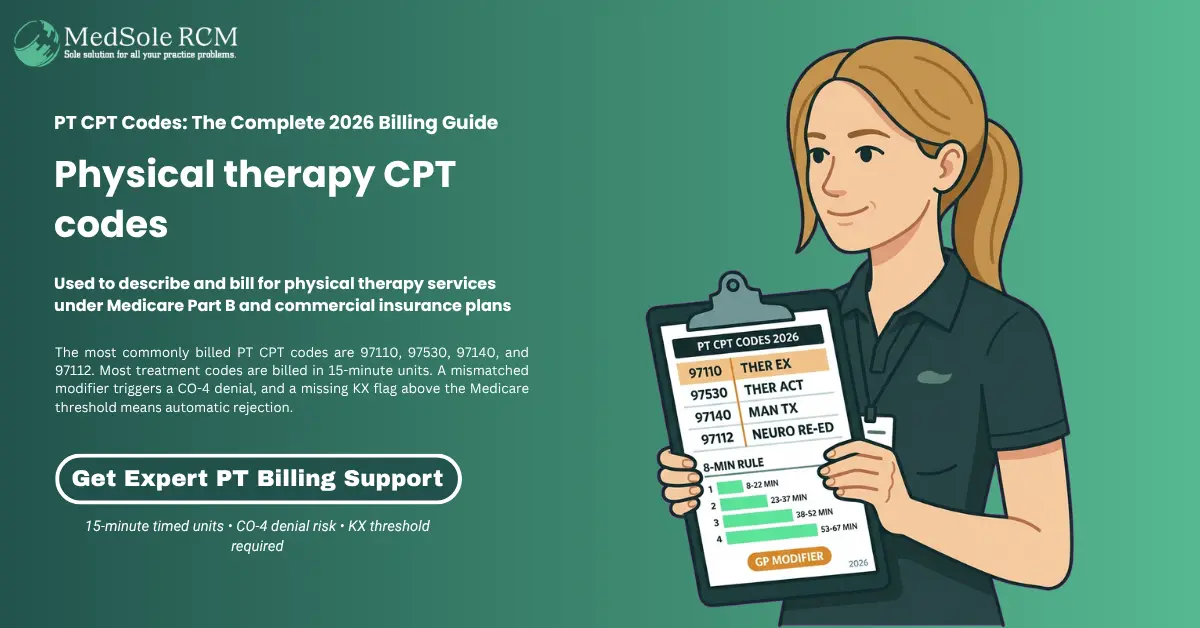




Physical therapy CPT codes are Current Procedural Terminology codes maintained by the American Medical Association used to describe and bill for specific physical therapy services under Medicare Part B and commercial insurance plans. The most commonly billed PT CPT codes are 97110 (therapeutic exercise), 97530 (therapeutic activities), 97140 (manual therapy), and 97112 (neuromuscular reeducation). Most treatment codes are billed in 15-minute units.
Getting these physical therapy billing codes wrong isn't a minor inconvenience. A mismatched modifier triggers a CO-4 denial. A missing KX flag above the Medicare threshold means automatic rejection on every claim above that line. Billing 97014 on a Medicare claim instead of G0283 generates a denial that your billing team may not catch until it shows up in the aging report weeks later.
This guide covers everything your billing team needs for 2026: code descriptions and AMA-official descriptors, Medicare reimbursement rates, modifier requirements, the 8-minute rule with a worked example, and a denial prevention breakdown by reason code. PT CPT codes and their billing rules, start to finish.
MedSole wrote this from an RCM company's perspective, not a software company's. The difference matters when you're trying to fix a billing problem, not just track one.
Start with the basics before moving into the code-by-code breakdowns below.
What Are Physical Therapy CPT Codes?
Physical therapy CPT codes are five-digit numeric codes from the AMA's Current Procedural Terminology system used to describe and bill for specific physical therapy services provided under Medicare Part B and commercial insurance plans. The AMA owns and maintains the CPT code set, updating it annually. The CPT 2026 code set includes 418 total changes across all specialties, covering 288 new codes, 84 deletions, and 46 revisions. PT services use codes primarily in the 97000 to 97799 range, plus select HCPCS Level II codes like G0283.
CPT codes and ICD-10 codes are not the same thing, and mixing them up is a common front desk mistake. ICD-10 codes describe why the patient is being treated, meaning the diagnosis. CPT codes describe what the therapist actually did, meaning the procedure. Every claim needs both. When the diagnosis code doesn't support the procedure code billed, the payer issues a CO-4 denial. That's a fixable problem, but only if your team knows the difference.
PT procedure codes fall into two main categories: timed and untimed. Most treatment codes are timed in 15-minute increments, so the number of units billed depends on how many minutes of skilled service were provided. Evaluation codes work differently. They're untimed, billed once per evaluation regardless of how long it took. Section 12 covers the full mechanics of timed versus untimed billing, including the 8-minute rule.
The AMA's CPT 2026 code set reflects the largest annual update in recent memory, with changes spanning every specialty. For PT billing specifically, the standard treatment code descriptors are unchanged, but three new remote therapeutic monitoring codes were added effective January 1, 2026. CMS therapy services guidance covers how those codes apply under Medicare Part B.
How Physical Therapy CPT Codes Differ from ICD-10 and HCPCS Codes
Three separate code systems appear on every PT claim, and each one does a different job. CPT codes describe what service was performed. ICD-10 codes describe why the service was medically necessary. HCPCS Level II codes cover supplies and certain services that don't have a CPT code, including G0283, which Medicare requires instead of CPT 97014 for unattended electrical stimulation. Your billing system needs all three layers working correctly or the claim won't process cleanly.
Complete List of Physical Therapy CPT Codes by Category
PT procedure codes organize into five main categories. Knowing the category tells you immediately whether a code is timed or untimed, which changes how you calculate units and apply modifiers. The most common PT CPT codes fall into evaluation and reevaluation codes, therapeutic procedure codes, supervised modality codes, constant attendance modality codes, and remote therapeutic monitoring codes.
|
Category |
Code Range |
Timed or Untimed |
Examples |
|
Evaluation and Reevaluation |
97161 to 97164 |
Untimed |
Initial eval, re-eval |
|
Therapeutic Procedures |
97110 to 97542 |
Timed (15 min) |
Exercise, manual therapy |
|
Supervised Modalities |
97010 to 97028 |
Untimed |
Hot packs, e-stim unattended |
|
Constant Attendance Modalities |
97032 to 97039 |
Timed (15 min) |
Ultrasound, iontophoresis |
|
Remote Therapeutic Monitoring |
98975 to 98985 |
See RTM rules |
New 2026 codes included |
CPT Code 97110: Therapeutic Exercise
CPT code 97110 (therapeutic exercise) covers strength training, endurance work, range of motion, and flexibility training performed by a qualified clinician in direct one-on-one contact with the patient. It's a timed code billed in 15-minute units, and it's the most frequently billed code across all physical therapy CPT codes. According to APTA billing data, 97110 accounts for approximately 42% of all PT billing nationwide.
The skill requirement is specific. This isn't gym exercise with a therapist watching from across the room. CMS requires constant clinician attendance and direct connection between the exercise performed and a functional goal documented in the plan of care. That's what separates billable therapeutic exercise from general wellness activity, which Medicare doesn't cover. The CGS Medicare post-payment review list includes cpt 97110 specifically because insufficient documentation of that clinical rationale is one of the most common findings.
On the 2026 Medicare fee schedule, the 97110 CPT code reimbursement averages approximately $34 to $36 per unit at the national rate, with actual payment varying by geographic locality. Due to APTA advocacy, timed codes including the therapeutic exercise CPT code were exempted from the 2026 efficiency adjustment, which preserved reimbursement levels relative to non-timed codes.
Two billing errors show up repeatedly on 97110 claims. First, billing the ther ex CPT code when 97530 is actually the right choice because the activity is functional rather than isolated. Second, documenting time in rounded or vague terms that don't support the number of units billed. Both patterns draw denials and, in high-volume practices, post-payment audit attention.
CPT Code 97530: Therapeutic Activities
The official AMA descriptor for 97530 CPT code covers therapeutic activities requiring dynamic activities to improve functional performance. In plain terms, that means real-world movements, not isolated muscle work. Sit-to-stand transfers, lifting training, overhead reaching tasks, and functional mobility drills all fall under this therapeutic activity CPT code. Like 97110, it's timed in 15-minute units and requires direct one-on-one contact with a skilled clinician.
Here's the distinction that matters for both accuracy and revenue: CPT 97110 targets isolated physical parameters such as strength, endurance, and range of motion. CPT 97530 targets functional performance as applied to real-life tasks and activities of daily living. Quad sets on a table are 97110. Teaching a patient to safely stand from a low chair so they can get off the toilet at home is 97530. The key distinction is whether the goal is a physical parameter or a functional outcome. Getting this wrong costs money in both directions: undercoding 97530 as 97110 leaves reimbursement on the table, since 97530 typically reimburses slightly higher under most fee schedules.
Is CPT code 97530 occupational therapy or physical therapy? Both disciplines can bill it. The discipline is identified by the modifier appended to the claim: GP for physical therapy, GO for occupational therapy. Missing or swapping those modifiers is a common payer rejection that's entirely preventable with a correctly configured billing system.
On the 2026 Medicare fee schedule, the 97530 CPT code reimbursement averages approximately $35 to $38 per unit nationally. If a session includes both isolated exercise and functional activity, billing both 97110 and cpt 97530 on the same claim is appropriate when each service is documented separately and the total timed minutes support both units. Per CMS billing guidance for therapeutic procedures, the combination is allowed with proper documentation.
The most common billing mistake with 97530 isn't a technical error. It's habit. Practices that bill 97530 interchangeably with 97110 based on which code the therapist prefers, rather than what the documentation actually supports, create a ratio pattern that post-payment reviewers flag. Payers compare your 97530 to 97110 ratio against regional norms. An outlier ratio without corresponding documentation is an audit waiting to happen.
If your practice is seeing denials on either of these codes, the fix is usually in the documentation workflow, not the code selection itself. Our outsourced medical billing services team reviews timed code claim patterns as part of every PT billing audit, including 97110 and 97530 documentation alignment.
CPT Code 97140: Manual Therapy Techniques
CPT code 97140 (manual therapy) covers skilled hands-on techniques including joint mobilization, manipulation, manual lymphatic drainage, myofascial release, and soft tissue mobilization. It's a timed code billed in 15-minute units with direct one-on-one contact required throughout. For 2026, this manual therapy CPT code carries particular significance: due to APTA advocacy during the CY 2026 Physician Fee Schedule rulemaking, 97140 shifted from a negative year-over-year reimbursement change to a positive one. That's a meaningful reversal practices should factor into their revenue projections.
Documentation is where most 97140 denials originate. Payers reviewing manual therapy claims want four specific things in the note: the technique used, the body region treated, the clinical rationale connecting that technique to a functional goal in the plan of care, and the patient's response. "Manual therapy to lumbar spine, 15 minutes" doesn't cut it. That note will support a denial every time a payer looks closely at it.
Here's the NCCI edit issue your billing team needs to know. The CPT code for manual therapy (97140) cannot be billed with 97530 for the same body region on the same date without Modifier 59 and documentation that both services were clinically distinct. Practices that bill both codes routinely without that documentation layer are losing the second code on every claim. That's a quiet revenue drain that doesn't always show up as a denial.
Under the CMS CY 2026 Physician Fee Schedule, the 97140 CPT code reimbursement averages approximately $34 to $37 per unit nationally, with geographic locality adjustments applying to the final allowed amount. The exemption from the 2026 efficiency adjustment keeps this rate more favorable than it was projected to be before APTA's intervention. See the APTA 2026 fee schedule analysis for the full rate impact breakdown by code.
If you're billing the 97140 CPT code physical therapy claims regularly and seeing denials come back on manual therapy, the documentation gap is usually the source. It's a fixable workflow problem, not a clinical one. Our outsourced medical billing services team reviews 97140 claim patterns as part of every PT billing audit. Want to see where your practice stands? Talk to our PT billing team.
CPT Code 97112: Neuromuscular Reeducation
CPT code 97112 (neuromuscular reeducation) covers treatment designed to improve balance, coordination, kinesthetic sense, posture, and proprioception. Timed in 15-minute units, it requires direct one-on-one contact throughout the session. Common clinical applications include post-stroke rehabilitation, post-surgical balance retraining, and care for patients with neurological conditions affecting motor control and functional movement patterns. Practices frequently bill the 97112 CPT code alongside 97110 on the same claim, which is appropriate when both services are documented as distinct.
Objective measures are non-negotiable for this code. Payers reviewing neuromuscular reeducation CPT code claims want to see specific data: balance test scores, coordination assessment findings, or proprioception measurement results recorded at baseline and tracked through progress notes. Subjective descriptions like "patient demonstrates impaired balance" don't justify repeated billing of CPT code 97112. Without objective baseline data, there's no way to demonstrate that a skilled service was provided or that the patient is progressing.
The distinction between 97112 and 97110 matters for billing accuracy, not just clinical accuracy. Both codes are timed, both require one-on-one contact. The difference is the clinical target: 97110 addresses physical capacity like strength and range of motion, while the neuromuscular reeducation CPT code targets the quality of movement, postural control, and the nervous system's ability to coordinate muscle activity. Billing both on the same claim is correct when the documentation reflects genuinely separate interventions for separate clinical goals.
CGS Medicare has included CPT code 97112 physical therapy claims in its service-specific post-payment review program, alongside 97110, 97140, and 97530. Heavy utilization of this code without corresponding objective documentation is a pattern that draws contractor attention. Review your documentation standards before your next remittance, not after a records request arrives. See the CGS Medicare post-payment review for 97112 for current review criteria.
CPT Code 97116 and Other Timed Procedure Codes
Beyond the four highest-volume codes, several timed procedure codes appear regularly in PT billing. Here's what your billing team needs to know about each.
|
CPT Code |
Description |
Timed |
Common Billing Note |
|
97116 |
Gait training, 15 min |
Yes |
Covers ambulation training and assistive device use. Document weight-bearing status and the specific gait deviation being addressed. |
|
97535 |
Self-care and home management training, 15 min |
Yes |
Covers ADL training and adaptive equipment instruction. Can be billed same day as other codes if services are distinct. |
|
97113 |
Aquatic therapy, 15 min |
Yes |
Requires pool facility. Exempted from 2026 efficiency adjustment due to APTA advocacy. |
|
97150 |
Therapeutic exercise, group (2 or more patients) |
No |
Untimed. Bill once per session regardless of session length. Cannot be billed same day as individual timed codes for the same service. |
|
97542 |
Wheelchair management training, 15 min |
Yes |
Covers fitting and propulsion training. Document specific wheelchair skills addressed. |
The gait training CPT code (97116) and 97535 generate the most billing questions among PT treatment codes. On 97535 specifically: some billing teams assume it's an OT-only code. It isn't. Physical therapists can bill 97535 when teaching patients how to safely perform home activities following injury or surgery, such as stair navigation, fall prevention techniques, or adaptive equipment use. The discipline modifier is what designates who provided the service: GP for physical therapy, GO for occupational therapy. cpt 97116 follows the same modifier logic.
Group therapy billing has a common overbilling pattern. CPT 97150 is untimed. Bill it once per group session, not by the hour, and not per patient. Some payers also require a minimum patient count or a specific group therapy note format before they'll process the claim. Verify your payer's group therapy policy before billing 97150, and confirm it in writing if you can. Per CMS therapy coding and billing guidance, group therapy cannot be billed on the same date as individual timed codes for the same service.
Physical Therapy Evaluation CPT Codes: 97161, 97162, 97163, and 97164
These four evaluation codes replaced 97001 and 97002 in 2017. APTA advocated for the change because a single flat-rate evaluation code failed to account for the difference in clinical work between a straightforward ankle sprain evaluation and a complex multi-system neurological case. That change is permanent, and every major payer has adopted it. If your practice management system still shows 97001 or 97002 as active codes, update it before your next claim submission.
Complexity is determined by clinical findings, not by the clock. Selecting 97163 because the evaluation ran 45 minutes when the clinical picture is straightforward is incorrect coding. Payers audit evaluation code distribution patterns specifically because upcoding on the complexity tier is one of the most common PT billing errors. The time spent during the evaluation can inform the complexity level, but it doesn't determine it.
|
CPT Code |
Complexity Level |
Typical Duration |
History |
Examination |
Clinical Decision-Making |
|
97161 |
Low |
Approx. 20 min |
Constrained (1 to 2 elements) |
1 to 3 body systems |
Low complexity |
|
Moderate |
Approx. 30 min |
Expanded (3 or more elements) |
3 to 4 body systems |
Moderate complexity |
|
|
97163 |
High |
Approx. 45 min |
Comprehensive (multifaceted) |
4 or more body systems |
High complexity |
|
97164 |
Re-evaluation |
Untimed |
Focused on change from baseline |
Focused re-examination |
Requires documented change in condition |
Here's the process that protects you: document first, code second. The pt evaluation CPT code selection happens after the evaluation is complete, based on what was actually found during the exam. Practices that select the code before the evaluation and then write notes to match it are creating a compliance risk that's difficult to defend if a payer audits. That's true even when the underlying care was appropriate. Per APTA guidance on evaluation code complexity, the complexity criteria in the table above reflect what CMS and commercial payers expect to see in the record.
Physical therapy evaluation codes (97161 to 97163) can be billed on the same date of service as treatment codes such as 97110 or 97140, provided that separate documentation supports each service as distinct and medically necessary. Some payers require Modifier 59 when billing the pt eval CPT code and a treatment code on the same claim. Check your payer-specific rules, but don't assume same-day billing is prohibited. It's allowed when the documentation supports it.
The 97164 reevaluation code works differently from the three initial evaluation tiers. It's untimed, billed once per reevaluation regardless of how long it takes, and it requires documented evidence of a change in the patient's clinical status or condition since the last evaluation. Billing 97164 at routine intervals without that documented clinical change is a denial trigger. Many payers also require a minimum number of treatment visits between reevaluations before the physical therapy reevaluation CPT code will be accepted on a claim.
Evaluation code selection is one of the most audited areas in PT billing. A pattern of consistently selecting the wrong complexity level, even without intent, creates payer attention that's hard to reverse once it starts. If you're unsure whether your evaluation coding reflects actual clinical complexity, our denials management team can review it. Request a PT billing review.
Physical Therapy Modality CPT Codes: Supervised and Constant Attendance
Modality codes split into two categories, and the distinction controls both how you bill and how MPPR affects your payment. Supervised modalities require therapist supervision but not constant attendance. They're untimed, billed once per session regardless of how long the patient uses the device. Constant attendance modalities require active therapist involvement throughout the treatment and are billed in 15-minute timed units. Mixing up these categories in physical therapy CPT code billing affects unit calculations and can trigger MPPR errors on multi-code sessions.
Supervised Modality Codes (Untimed)
|
CPT Code |
Description |
Billing Note |
|
97010 |
Hot or cold packs |
Untimed. Bill once per session. |
|
97012 |
Mechanical traction |
Untimed. Document body region and treatment parameters. |
|
97014 |
Electrical stimulation, unattended |
Untimed. Medicare: use G0283 instead. See note below. |
|
97016 |
Vasopneumatic devices |
Untimed. Verify payer coverage before billing. |
|
97018 |
Paraffin bath |
Untimed. Document clinical indication. |
Constant Attendance Modality Codes (Timed)
|
CPT Code |
Description |
Billing Note |
|
97032 |
Electrical stimulation, manual |
Timed, 15 min. Therapist must be in constant attendance. |
|
97033 |
Iontophoresis |
Timed, 15 min. Document medication and electrode placement. |
|
97035 |
Ultrasound |
Timed, 15 min. Document intensity, frequency, and area treated. |
|
97039 |
Unlisted modality |
Use when no other code fits. Requires documentation. |
The 97014 versus G0283 issue is one of the most common Medicare-specific billing traps in PT. For Medicare Part B outpatient physical therapy claims, unattended electrical stimulation must be billed using HCPCS code G0283, not CPT code 97014. Using 97014 on a Medicare claim results in a denial. Commercial payers typically accept the 97014 CPT code without issue. If your billing system doesn't automatically swap 97014 to G0283 based on payer, that's a configuration problem generating denials you may not be catching until they age past the appeal deadline.
The cpt code 97035 (ultrasound therapy) is one of the more documentation-intensive modality codes. Payers want to see the intensity setting, the frequency used, and the specific area treated on every claim. Generic notes on ultrasound claims are a reliable path to a medical necessity denial on audit. The ultrasound therapy CPT code also carries MPPR implications when billed alongside timed therapeutic procedure codes in the same session, which Section 16 covers in detail.
For questions about how your practice manages revenue cycle management across modality and procedure codes, our team works through these billing structures daily on PT accounts.
Timed vs. Untimed Physical Therapy CPT Codes: The 8-Minute Rule Explained
Most PT treatment codes are billed in 15-minute timed units. To bill one unit of a timed code, the therapist must provide at least eight minutes of that specific skilled service. That's where the rule gets its name. It applies to Medicare and most commercial payers across all timed physical therapy CPT codes. Untimed codes work differently: bill them once per session regardless of how long the service takes.
Here's the distinction that trips up billing teams: CMS and AMA don't calculate units the same way for multi-code sessions. Per CMS 8-minute rule guidance, when a patient receives multiple timed services in one session, you add all timed minutes together and then assign the total billing units for physical therapy from that combined number. The AMA's midpoint principle applies per individual code. For Medicare claims, use the CMS total-minutes method.
|
Total Timed Minutes |
Billable Units |
|
8 to 22 minutes |
1 unit |
|
23 to 37 minutes |
2 units |
|
38 to 52 minutes |
3 units |
|
53 to 67 minutes |
4 units |
|
68 to 82 minutes |
5 units |
|
83 to 97 minutes |
6 units |
|
98 to 112 minutes |
7 units |
|
113 to 127 minutes |
8 units |
Walk through a real example. A patient receives 25 minutes of 97110 (therapeutic exercise) and 20 minutes of 97140 (manual therapy). Total timed minutes: 45. Under the CMS method, that supports three units for physical therapy billing. The billing team then allocates those three units across the two codes based on actual time spent, so two units to 97110 and one unit to 97140 in this case.
The most common unit calculation mistake has nothing to do with the math. Billing teams count total time with the patient rather than time spent on skilled intervention. If a therapist spends 30 minutes with a patient but only 18 of those minutes involve active skilled service, and the remaining time goes to equipment setup or rest breaks, only 18 minutes count toward timed units for physical therapy. Auditors look for exactly this gap between documented time and billed units.
One more layer matters for 2026: PTA billing interaction with the 8-minute rule. When a Physical Therapist Assistant furnishes timed services in whole or in part, the CQ modifier is required and Medicare applies the 85% payment rate to those units. Per CMS therapy billing rules, CMS has issued guidance on how the midpoint concept applies to the final unit when a session is split between a PT and a PTA. If your practice uses PTAs and you're not tracking service-level staff assignments, you're missing CQ on claims that need it.
Unit calculation errors show up on both sides: underbilling loses revenue you earned, and overbilling creates audit exposure. Our AR Follow-Up team catches these patterns on PT accounts regularly. If you want to see how our PT billing audit works, start here.
Physical Therapy CPT Code Modifiers: What Each One Means and When to Use It
A modifier is a two-character code appended to a CPT code that gives the payer additional information about the service provided. In physical therapy CPT codes and modifiers, there are three distinct jobs a modifier can do: identify the treating discipline, confirm medical necessity above a financial threshold, or signal that two services on the same claim are genuinely separate. Missing or wrong modifiers are among the top denial causes in PT billing, and most of them are preventable with a correctly configured billing system.
|
Modifier |
Name |
When to Use |
What Happens Without It |
|
GP |
Physical Therapy |
All PT services under a PT plan of care |
Claim denied or rejected for missing discipline identifier |
|
GO |
Occupational Therapy |
OT services under an OT plan of care |
Same as above for OT |
|
GN |
Speech-Language Pathology |
SLP services |
Same as above for SLP |
|
KX |
Medical Necessity Above Threshold |
When charges exceed $2,480 (PT plus SLP combined, 2026) |
Automatic denial above threshold |
|
CQ |
Physical Therapist Assistant |
When PTA furnishes service in whole or in part |
Payment processed at 100% when the correct rate is 85% |
|
CO |
Occupational Therapist Assistant |
When OTA furnishes service in whole or in part |
Same overpayment issue as CQ for OT |
|
59 |
Distinct Procedural Service |
When two normally bundled codes are legitimately separate |
Payer bundles them and pays only one |
The GP modifier for physical therapy is the most frequently missed modifier by new billing staff, and the consequences scale fast. Every PT claim going to Medicare or most commercial payers requires GP appended to each timed code line. It tells the payer the service falls under a physical therapy plan of care, not occupational therapy, not speech therapy. One missing modifier GP for PT across a batch of claims creates a denial wave that takes days to work through. Per CMS modifier requirements for therapy claims, this is a required field, not optional documentation.
The KX modifier physical therapy requirement kicks in based on cumulative patient spending, not per-visit charges. When a patient's allowed PT and SLP charges combined reach $2,480 in the 2026 calendar year, every claim above that threshold must carry KX or it gets automatically denied. There's no grace period. Per CMS 2026 therapy modifier guidance, the $2,480 figure is the current threshold, increased from $2,410 in 2025. Section 14 covers the full KX modifier physical therapy documentation requirements.
Modifier 59 is not a blanket fix for bundling issues. When NCCI edits flag two modifiers CPT codes as potentially unbundled, Modifier 59 can override the edit when the services were genuinely distinct: different body regions, different time periods, or different clinical approaches. Using 59 as a routine workaround without documentation behind it is a compliance risk. Payers audit Modifier 59 usage specifically because it's a known vulnerability.
The CQ modifier carries a direct payment consequence. When a PTA furnishes PT services in whole or in part, CQ is required and Medicare pays 85% of the otherwise applicable rate for the 97530 CPT code modifier and all other timed codes provided by the PTA. The rule is unchanged in 2026. Practices that don't track which staff member performed each service unit will miss CQ, overpay themselves temporarily, and face repayment requests after a post-payment review.
Medicare Physical Therapy Billing Guidelines: 2026 KX Threshold and Documentation Requirements
Medicare physical therapy billing runs on two financial thresholds that reset every January 1. Most billing teams know these thresholds exist in theory. The problem is tracking them per patient in real time, before a claim hits the threshold without the required modifier. By the time the denial arrives, you've already missed the window for clean submission.
The 2026 KX threshold for PT and SLP services combined is $2,480, per CMS 2026 KX modifier threshold guidance. OT has a separate $2,480 threshold. That figure increased from $2,410 in 2025. Once a patient's cumulative allowed charges for PT and SLP reach $2,480 in the calendar year, every subsequent physical therapy billing under Medicare requires the KX modifier on each claim line or it will be automatically denied. No exceptions and no appeals on the basis of not knowing the limit.
KX is not just a billing checkbox. Appending KX to a claim is a clinical attestation from the treating therapist: the services above the threshold are medically necessary and the documentation in the patient's record supports that conclusion. If a payer audits and the record doesn't support the attestation, the exposure goes beyond the denied claim. Physical therapy documentation requirements for billing KX claims are the same as any Medicare skilled service, but the stakes are higher because the attestation is explicit.
The targeted medical review threshold sits at $3,000 for PT and SLP combined in 2026, per CMS 2026 therapy code list update. The OT threshold is also $3,000 separately. CMS has held this figure steady through 2028. Exceeding $3,000 doesn't mean automatic review, but it does mean documentation must be ready for scrutiny. Treat any patient above $3,000 as if a records request is already in transit.
2026 Medicare Billing Checklist for PT Claims
Before submitting any PT claim above $2,480 in cumulative allowed charges:
-
Confirm the patient's year-to-date allowed amount for PT and SLP services combined
-
Apply KX modifier to each claim line
-
Verify the patient record documents continued medical necessity
-
Confirm the plan of care is current and certified by the physician
-
Ensure objective functional measures are documented with baseline and progress data
-
For patients above $3,000: treat the documentation as if it will be reviewed
Physical therapy cpt codes 2026 claims must also meet the documentation standard from Medicare reasonable and necessary therapy standards in CMS's Medicare Benefit Policy Manual Ch. 15. Therapy must be reasonable and necessary, must require the skill of a licensed therapist, and must target functional improvement. Services that are maintenance-level or could be performed safely by an untrained caregiver don't meet the skilled service standard and aren't covered under Medicare Part B. That distinction is exactly what physical therapy billing under Medicare auditors are looking for when they review records above the KX threshold.
Tracking KX thresholds per patient across a full caseload is the kind of task that gets missed in busy practices. One missed KX modifier means one denial. Across a month of high-utilization Medicare patients, that adds up fast. Our team tracks this automatically for every patient we bill through our revenue cycle management process. Learn how MedSole handles Medicare PT billing.
Physical Therapy CPT Code Reimbursement Rates: 2026 Medicare Fee Schedule
Medicare reimbursement rates for physical therapy billing codes vary by geographic locality. The national average figures below reflect the non-facility rate under the CY 2026 Medicare Physician Fee Schedule using a conversion factor of $33.40 for non-APM participants. APM participants receive $33.57. Use these as benchmarks for revenue modeling, not as exact projections for your specific location.
|
CPT Code |
Service |
Per Unit (15 min) |
Timed |
|
97110 |
Therapeutic exercise |
National avg. approx. $34 to $36 |
Yes |
|
97530 |
Therapeutic activities |
National avg. approx. $35 to $38 |
Yes |
|
97140 |
Manual therapy |
National avg. approx. $34 to $37 |
Yes |
|
97112 |
Neuromuscular reeducation |
National avg. approx. $34 to $36 |
Yes |
|
97116 |
Gait training |
National avg. approx. $32 to $35 |
Yes |
|
97161 |
PT evaluation, low complexity |
National avg. approx. $72 to $78 |
No |
|
97162 |
PT evaluation, moderate complexity |
National avg. approx. $104 to $110 |
No |
|
97163 |
PT evaluation, high complexity |
National avg. approx. $142 to $150 |
No |
|
97164 |
PT reevaluation |
National avg. approx. $56 to $62 |
No |
|
97010 |
Hot or cold packs |
National avg. approx. $10 to $13 |
No |
|
97014 |
Electrical stimulation, unattended |
National avg. approx. $10 to $13 |
No |
|
97035 |
Ultrasound |
National avg. approx. $24 to $27 |
Yes |
For exact locality-adjusted rates, use the CMS Medicare Physician Fee Schedule lookup tool and filter by your specific geographic area and facility type.
The 2026 conversion factor context matters for outpatient PT practices specifically. CMS finalized a 3.26% increase to the conversion factor for CY 2026. Per the APTA 2026 reimbursement analysis, the average net reimbursement impact for PT works out to approximately a 1.75% increase. The 2.5% efficiency adjustment that reduced payment on certain codes did not apply to timed PT procedure codes, which was the result of sustained APTA advocacy during the CMS CY 2026 Physician Fee Schedule final rule comment period.
MPPR affects multi-code session revenue. When a patient receives two or more "always therapy" services in a single session, Medicare pays 100% for the service with the highest practice expense component and 50% of the practice expense for each subsequent service billed that day. That's not a denial and it's not an error. It's a built-in payment structure that's been in place since April 2013 and did not change in 2026.
Multiple Procedure Payment Reduction: What It Means for Your PT Revenue
MPPR applies whenever a PT patient receives more than one "always therapy" service in a single session. Medicare reduces the practice expense portion of payment for the second and subsequent services by 50%, per CMS MPPR policy for therapy services. This has applied since April 2013 and is unchanged in 2026. Billing for physical therapy services with multiple timed codes on the same claim doesn't trigger a denial; it triggers a payment reduction that's already factored into the fee schedule structure.
Here's the practical breakdown. If a session includes 97110 and 97140, Medicare pays 100% of the practice expense component for whichever code carries the higher PE value, and 50% of the PE for the other. The work RVU and malpractice RVU portions are not touched by MPPR. Total payment on the session is reduced, but both codes are paid.
Don't appeal MPPR reductions. They're not processing errors, and payers won't reverse them. What you can do is factor MPPR into physical therapy medical billing revenue projections and work with your clinical team on session structuring. Scheduling the highest-PE service first doesn't change the math, but understanding which code combinations trigger the steepest PE reduction helps practices model expected revenue accurately before sessions are scheduled.
New Physical Therapy Remote Therapeutic Monitoring Codes for 2026
Effective January 1, 2026, CMS added three new RTM codes to the therapy code list as "sometimes therapy" services, per the CMS MM14250 therapy code list 2026 update. For PT practices running musculoskeletal RTM programs, the new physical therapy CPT codes 2026 structure addresses a real operational problem: previously, practices couldn't bill for patients who engaged with RTM devices for only part of a month. That all-or-nothing limitation made RTM difficult to sustain for shorter treatment episodes.
The two new device supply codes fill the partial-month gap directly. CMS added 98984 for respiratory RTM device supply covering two to 15 days in a 30-day period, and 98985 for musculoskeletal RTM device supply covering the same two to 15 day range. These complement the revised 98976 and 98977 descriptors, which now explicitly cover 16 to 30 days. A patient who engages with an RTM device for 10 days in a month can now generate a billable unit where none was possible before.
CPT 98979 is the third new code and it works differently. It covers the first 10 minutes of RTM treatment management services in a calendar month and requires at least one real-time interactive communication with the patient or caregiver during that month. For patients who need less intensive monitoring than 98980 covers, 98979 creates a lower-threshold billing option that didn't exist before 2026. This fills a genuine gap for patients in maintenance or early discharge phases who still benefit from periodic therapist contact.
|
CPT Code |
Description |
Days / Time |
Key Requirement |
|
98979 |
RTM treatment management, first 10 min |
Per calendar month |
Requires real-time interactive communication |
|
98980 |
RTM treatment management, first 20 min |
Per calendar month |
Existing code, unchanged |
|
98981 |
RTM treatment management, each additional 20 min |
Per calendar month |
Existing code, unchanged |
|
98984 |
RTM device supply, respiratory, 2 to 15 days |
Per 30-day period |
New in 2026 |
|
98985 |
RTM device supply, musculoskeletal, 2 to 15 days |
Per 30-day period |
New in 2026 |
|
98976 |
RTM device supply, respiratory, 16 to 30 days |
Per 30-day period |
Revised descriptor 2026 |
|
98977 |
RTM device supply, musculoskeletal, 16 to 30 days |
Per 30-day period |
Revised descriptor 2026 |
Modifier requirements for the new PT CPT codes 2026 RTM services follow standard therapy rules. All RTM services rendered by a therapist are provided under a therapy plan of care, so GP is required for PT. Per CMS remote therapeutic monitoring guidance, only codes 98975, 98979, 98980, and 98981 are subject to the de minimis 10% policy that determines when the CQ modifier applies for PTA involvement. Device supply codes 98976, 98977, 98984, and 98985 are not subject to the de minimis policy.
One documentation issue to flag before a practice launches RTM billing under the new physical therapy CPT codes 2026: the interactive communication required for 98979 must be documented at the time it occurs. Post-dated RTM notes are a consistent audit trigger. If your documentation workflow doesn't capture real-time communications as they happen, fix that before billing 98979, not after a records request arrives.
Common Physical Therapy Billing Errors and How to Prevent Claim Denials
Most PT billing denials aren't random. They follow predictable patterns tied to specific coding mistakes, documentation gaps, or workflow failures that repeat across dozens of claims before anyone catches them. Knowing the denial type tells you where the process broke down. Fixing the process stops the pattern. Appeals are necessary sometimes, but prevention is what actually protects revenue and saves staff time.
Here are the five physical therapy claim denials that show up most consistently across PT practices, with the reason codes your ERA will display and the root cause behind each one.
|
Denial Code |
Reason |
Root Cause |
Prevention Action |
|
Service inconsistent with modifier |
Wrong modifier or missing modifier, often GP |
Audit modifier setup in billing system by payer |
|
|
Claim lacks information |
Missing or incomplete data fields |
Implement pre-submission claim scrubbing |
|
|
CO-18 |
Duplicate claim |
Same service billed twice |
Track claim status before resubmitting |
|
Not medically necessary |
Documentation doesn't support the service billed |
Align clinical notes with CPT code requirements before billing |
|
|
Service not covered for this patient |
Benefits exhausted or wrong payer billed |
Verify eligibility and benefits before each visit |
The CO-50 denial is the most financially damaging physical therapy billing error on this list. It's the payer's way of saying the documentation in the record doesn't justify the code that was billed. Here's what most practices get wrong about it: the service was almost always medically necessary. The therapist did the work. The problem is the notes didn't document it in a way the payer's reviewers accept. That's a fixable documentation workflow issue, not a clinical failure.
CO-4 denials in PT billing trace back to one source more than any other: a missing or incorrect GP modifier on timed code lines. Every PT claim submitted to Medicare and most commercial payers requires GP on each service line. A batch processed without GP generates a CO-4 wave that takes hours to work through. Setting up payer-specific modifier rules in your billing system is a one-time fix that eliminates this denial type across every future claim for that payer.
The NCCI edit denial scenario works differently. When two codes that payers treat as normally bundled appear on the same claim, the payer pays only one and denies the other. Modifier 59 can override the edit when the services were genuinely distinct, with documentation behind that distinction. Using Modifier 59 as a blanket workaround without clinical support in the record draws more audits than it resolves. Per CMS NCCI editing policy for therapy services, the documentation must independently justify the separate billing before the modifier is applied.
Four documentation elements prevent the majority of preventable physical therapy claim denials: a current and certified plan of care, objective functional measures with baseline and progress data, skilled intervention rationale tied to a specific functional goal, and correct therapist credentials on the claim. Per CMS documentation requirements for PT services, these are the elements reviewers check first on post-payment review. Get all four right on every claim and most denial types on this list stop appearing.
Denial patterns in PT billing are systematic, which means one physical therapy coding and billing mistake gets repeated across hundreds of claims before anyone catches it. By the time it surfaces in your AR aging report, you've already lost weeks of revenue. Our Denial-Management process identifies those patterns in the first billing cycle review. If you're seeing repeat physical therapy billing errors, let's find the source. Start with a billing audit.
NCCI Edit Pairs: Which Physical Therapy CPT Codes Cannot Be Billed Together
CMS created the CMS National Correct Coding Initiative for therapy services to prevent inappropriate billing of code combinations where one code is considered a component of another. In PT billing, NCCI edits physical therapy claims automatically at the payer level. The claim doesn't come back with an explanation; one code simply pays and the other doesn't. Knowing which pairs are affected is the difference between systematic denials and clean claims.
|
Column 1 Code (Comprehensive) |
Column 2 Code (Component) |
Modifier Allowed |
Clinical Note |
|
97530 |
97110 |
Yes (Modifier 59) |
Bill together only if services are to different body regions or clearly distinct in documentation |
|
97140 |
97530 |
Yes (Modifier 59) |
Manual therapy and therapeutic activity can be billed together with proper documentation of distinct services |
|
97110 |
97150 |
No |
Cannot bill individual therapeutic exercise and group therapy for the same service on the same day |
|
97161 |
97140 |
Yes (Modifier 59) |
Evaluation and treatment same day requires Modifier 59 with some payers |
|
97032 |
97014 |
No |
Cannot bill attended and unattended electrical stimulation for the same body area same day |
Modifier 59 resolves CCI bundling physical therapy CPT codes issues when the services are genuinely distinct, but the word "genuinely" carries real weight. Distinct means different body regions, clearly separate treatment approaches, or separate time periods within the session that are each independently documented. Physical therapy coding compliance requires that the documentation explicitly states the distinction before Modifier 59 is applied, not after. Payers audit Modifier 59 overrides specifically because they're a known vulnerability, and a pattern of using the modifier without corresponding documentation is what draws a targeted review, not the modifier itself.
Physical Therapy Telehealth Billing: Extended Through December 31, 2027
Under CAA 2026 section 6209, CMS extended the ability of physical therapists, occupational therapists, and speech-language pathologists to furnish Medicare telehealth services through December 31, 2027. The extension includes telephone assessment and management CPT codes for telehealth physical therapy: 98966, 98967, and 98968. That authorization is temporary. Per APTA telehealth advocacy for physical therapists, APTA is actively pushing for permanent status, but as of 2026, practices should not plan billing programs around an assumption of permanence.
Place of service codes matter as much as the CPT code on a telehealth claim. Per CMS telehealth guidance for therapy providers, telehealth PT services require POS 02 when the service is provided from a location other than the patient's home, or POS 10 when the patient receives the service at home. The GP modifier still applies to every PT service line. Missing the correct POS code is among the most common causes of telehealth claim rejections, and it's not a payer error. It's a data entry issue that a claim scrubber should catch before submission. See the HHS telehealth billing reference for PT for the full POS code guidance.
Physical therapy CPT codes 2026 include 98966 through 98968 as audio-only telephone assessment and management codes. These are not video visits. The documentation requirement for audio-only differs from video telehealth in three specific ways: the note must reflect that the interaction occurred by telephone, the record must show the patient's consent to audio-only, and the clinician must document the clinical rationale for not conducting the visit by video. Missing any one of those three elements on an audio-only claim creates a medical necessity denial on post-payment review.
Commercial payer variability is real and worth flagging directly. Medicare's telehealth extension does not bind commercial payers to the same coverage rules. State telehealth mandates vary widely. Some commercial payers have already reverted to pre-pandemic telehealth restrictions for PT services. Verify each commercial payer's current telehealth policy before billing non-Medicare telehealth claims, and document that verification in your payer policy files.
Physical Therapy CPT Codes by Setting: Home Health, Inpatient, Outpatient, and Telehealth
The same CPT code carries different billing rules depending on where the service is delivered. Place of service determines which payer guidelines apply, whether Medicare Part A or Part B is the correct payer, and which modifiers are required. Getting the setting wrong on a claim isn't a minor error. It routes the claim to the wrong payment system and generates a denial that could have been prevented before submission.
|
Setting |
Key Codes |
Primary Payer Rule |
Setting-Specific Note |
|
Outpatient clinic |
97110, 97530, 97140, 97161 to 97164 |
Medicare Part B |
KX threshold applies. GP modifier required. |
|
Home health |
S9131, 97110, 97530 |
Medicare Part A (if home health benefit active) |
OASIS documentation required. Separate billing rules apply under the home health prospective payment system. |
|
Inpatient rehab (IRF) |
97110, 97530, 97140, 97112 |
Medicare Part A |
IRF-PAI required. Three hours of therapy per day required for IRF admission criteria. |
|
Skilled nursing facility |
97110, 97530, 97140 |
Medicare Part A (SNF benefit) |
PDPM payment system. Therapy not billed on UB-04 by code in Part A. |
|
Telehealth |
98966 to 98968 |
Medicare Part B |
POS 02 or 10. GP modifier. Extended through December 31, 2027. |
The home health PT CPT code trap catches practices that haven't reviewed their billing setup in a while. CPT code S9131 appears in some home health agency billing systems for outpatient PT services provided in the home. S9131 is not a Medicare code. It will not process on a Medicare claim. For Medicare patients receiving home health PT under an active home health benefit, therapy services are bundled into the home health episode payment under the prospective payment system. Billing those services separately on a Part B claim while a Part A home health benefit is active is a compliance issue, not just a denial. If your practice provides home health physical therapy CPT codes services and bills Medicare, confirm with your compliance team that your episode tracking and Part A versus Part B determination process is current.
Our provider enrollment and credentialing services team works through setting-specific billing structures regularly, including practices that operate across multiple care settings.
Specialty Physical Therapy CPT Codes: Pelvic Floor, Dry Needling, and Work Conditioning
Some PT specialties require more billing awareness than the standard code set suggests. Specialty services typically use existing physical therapy CPT codes with documentation that specifies the clinical application, or they fall into unlisted code territory where payer-specific coverage policies determine whether a claim pays at all.
|
Specialty Service |
CPT Code(s) Used |
Key Billing Note |
|
Pelvic floor therapy |
97110, 97530, 97140, 97112 |
No unique pelvic floor CPT code exists. Services are billed using standard procedure codes. Documentation must specify pelvic floor as the treatment area. |
|
Dry needling |
97039 or 20560 to 20561 |
Coverage varies widely by payer. Many commercial payers exclude dry needling. Verify coverage before billing. 97039 is unlisted modality; 20560 to 20561 are needle codes. |
|
Aquatic therapy |
97113 |
Requires pool facility. Exempted from 2026 efficiency adjustment. Document water temperature, depth, and clinical rationale. |
|
Work conditioning |
97545, 97546 |
Work hardening programs. Document functional work capacity goals specifically. Some payers require precertification. |
|
Group therapy |
97150 |
Untimed. Applies to groups of two or more. Cannot be billed with individual codes for the same service. |
The pelvic floor therapy CPT code question comes up more than almost any other specialty billing question, and the answer is straightforward: there isn't one. No unique pelvic floor physical therapy CPT code exists in the AMA code set. Pelvic floor PT is billed using the same procedure codes as any other PT session: 97110, 97530, 97140, and 97112 depending on what was done. The clinical documentation is what identifies the specialty, not the code. A note that specifies pelvic floor musculature as the treatment area, documents the assessment findings, and connects the intervention to a functional goal is what distinguishes billable pelvic floor PT from a generic therapeutic exercise session in a payer's eyes.
Dry needling CPT code physical therapy billing is a different situation. Coverage isn't just variable; some commercial payers explicitly exclude dry needling by policy regardless of what code is used. Verify coverage in writing before billing any dry needling service, and keep that verification on file. A verbal authorization from a payer representative doesn't protect a claim in post-payment review.
For questions about how specialty PT billing fits into your broader revenue cycle management, our team handles these code-level details across PT practices regularly.
Physical Therapy CPT Codes: Frequently Asked Questions
Q1: What are the most common physical therapy CPT codes?
The most common physical therapy CPT codes are 97110 (therapeutic exercise), 97530 (therapeutic activities), 97140 (manual therapy), 97112 (neuromuscular reeducation), 97116 (gait training), and the evaluation family of 97161, 97162, and 97163. CPT 97110 is the most frequently billed, accounting for approximately 42% of all PT billing according to APTA data. Selecting the right code depends on what the therapist actually did and what the documentation in the patient's record supports. Code selection based on habit rather than documented clinical intent is one of the most common audit triggers in PT billing.
Q2: What is CPT code 97110 used for?
CPT code 97110 (therapeutic exercise) covers strength training, endurance work, range of motion, and flexibility exercises performed by a qualified clinician in direct one-on-one contact with the patient. The exercise must target a functional goal documented in the plan of care. General wellness activity doesn't qualify. CPT 97110 is a timed code billed in 15-minute units, and the 8-minute rule applies to every unit billed. To bill one unit, the therapist must provide at least eight minutes of skilled therapeutic exercise.
Q3: What is the difference between CPT codes 97110 and 97530?
CPT 97110 targets isolated physical parameters such as strength, endurance, and range of motion. CPT 97530 targets functional performance as applied to real-life tasks and activities of daily living. Isolated quad strengthening on a table is 97110. Teaching a patient to safely rise from a low chair for kitchen safety is 97530. Both can appear on the same claim when documented as distinct services with separate clinical rationale. CPT 97530 typically reimburses slightly higher than 97110 under most fee schedules, so selecting the correct code matters for both accuracy and revenue.
Q4: What is the 8-minute rule in physical therapy billing?
The 8-minute rule means that to bill one unit of a timed PT CPT code, the therapist must provide at least eight minutes of that skilled service. Under the CMS method, when a session includes multiple timed codes, you add all timed minutes together and assign total units from that combined number using the unit calculation table in Section 12. The AMA uses a midpoint principle per individual code, but for Medicare claims, always use the CMS total-minutes method. When a PTA provides timed services in whole or in part, the CQ modifier is required and Medicare applies the 85% payment rate to those units.
Q5: What CPT codes are used for physical therapy evaluations?
Physical therapy evaluation CPT codes are 97161 (low complexity), 97162 (moderate complexity), 97163 (high complexity), and 97164 (reevaluation). These four codes replaced 97001 and 97002 in 2017. Complexity is determined by clinical findings after the evaluation is complete, not by the time spent during the visit. CPT 97164 is untimed and requires documented change in the patient's clinical status since the last evaluation. See Section 10 for the full complexity criteria comparison table covering history, examination, and clinical decision-making requirements for each level.
Q6: What is the KX modifier in physical therapy billing?
The KX modifier is a two-character modifier appended to PT claim lines when a patient's cumulative allowed charges for PT and SLP services combined exceed $2,480 in the 2026 calendar year. OT has a separate $2,480 threshold. Without KX, Medicare automatically denies every claim above that threshold. Adding KX is a clinical attestation: the treating therapist is certifying that services above the threshold are medically necessary and that the documentation supports that conclusion. The targeted medical review threshold sits at $3,000 for PT and SLP combined, fixed through 2028. Documentation must be audit-ready above that level.
Q7: Can physical therapy evaluation and treatment be billed on the same day?
Yes. Physical therapy evaluation codes (97161 to 97163) can be billed on the same date of service as treatment codes such as 97110 or 97140, provided that separate documentation supports each service as distinct and medically necessary. Some payers require Modifier 59 when billing evaluation and treatment on the same claim. The NCCI edit indicator for this combination allows the modifier override when documentation supports distinct services. Document each service separately in the patient record on that date, and verify your payer's specific same-day billing policy before submitting.
Q8: What is the GP modifier in physical therapy?
The GP modifier identifies services provided under a physical therapy plan of care. It's required on all PT claims submitted to Medicare and most commercial payers, appended to each CPT code line on the claim. Without GP, the claim is denied or rejected for a missing discipline identifier. The parallel modifiers are GO for occupational therapy and GN for speech-language pathology. GP is not a CPT code; it's a two-character modifier that tells the payer the service falls under a PT plan of care rather than another therapy discipline.
Q9: What are the most common physical therapy billing errors?
The five most common physical therapy billing errors are: a missing or incorrect GP modifier, which generates a CO-4 denial on every affected claim line; incorrect complexity level on evaluation codes, which draws payer audit attention over time; unit calculation errors under the 8-minute rule, which cause both underbilling and overbilling; billing CPT 97014 instead of G0283 on Medicare claims, which results in an automatic denial; and missing the KX modifier above the $2,480 threshold, which causes automatic rejection on all claims above that line. These errors are systematic. One mistake repeats across many claims before it surfaces. The fix is a billing workflow audit, not individual claim appeals.
Q10: What documentation is required for physical therapy CPT codes?
Every timed PT CPT code requires four documentation elements: the specific service performed, the body region treated, the time in minutes, and the connection between the service and a documented functional goal in the plan of care. Medicare adds three more requirements: a current and physician-certified plan of care, objective functional measures with baseline and progress data, and a skilled intervention rationale explaining why a licensed therapist is required. CO-50 denials, meaning not medically necessary, are almost always a documentation gap rather than a clinical one. The service was appropriate. The notes just didn't say so in a way the payer accepts.
Q11: What are the new physical therapy CPT codes for 2026?
CMS added three new remote therapeutic monitoring codes to the therapy list effective January 1, 2026: 98979 (RTM treatment management, first 10 minutes per calendar month), 98984 (RTM device supply, respiratory, two to 15 days), and 98985 (RTM device supply, musculoskeletal, two to 15 days). CMS also revised the descriptors for 98976 and 98977, which now explicitly cover 16 to 30 days. The broader AMA CPT 2026 code set includes 418 total changes: 288 new codes, 84 deletions, and 46 revisions across all specialties. Standard PT treatment code descriptors for 97110, 97530, and 97140 are unchanged in 2026. See Section 17 for the full RTM code table.
Q12: What is the KX modifier threshold for physical therapy in 2026?
The KX modifier threshold for physical therapy in 2026 is $2,480 for PT and SLP services combined, per CMS Therapy Services guidance. That figure increased from $2,410 in 2025. OT has a separate $2,480 threshold. The targeted medical review threshold is $3,000 for PT and SLP combined, unchanged through 2028. Both thresholds reset on January 1 of each calendar year. Claims above $2,480 without KX are automatically denied. Claims above $3,000 must be treated as audit-ready regardless of whether a review is actually initiated.
Q13: Are physical therapy services covered by Medicare telehealth in 2026?
Yes. Under CAA 2026 section 6209, CMS extended Medicare telehealth coverage for physical therapists, occupational therapists, and speech-language pathologists through December 31, 2027. The extension includes telephone assessment and management codes 98966, 98967, and 98968. That authorization is temporary, and APTA is actively advocating for permanent status. Billing requires the correct place of service code: POS 02 for telehealth outside the patient's home or POS 10 for telehealth to the patient's home. The GP modifier still applies. Medicare's telehealth extension does not bind commercial payers, so verify each commercial payer's policy separately.
Q14: How do I bill physical therapy under Medicare?
Billing PT under Medicare follows a sequential process:
-
Verify Medicare Part B eligibility before the first visit
-
Obtain physician certification of the plan of care
-
Apply the GP modifier to every PT service line
-
Use the 8-minute rule for all timed CPT codes
-
Track cumulative allowed charges per patient against the $2,480 KX threshold
-
Add the KX modifier with supporting documentation once the threshold is exceeded
-
Submit on CMS-1500 or electronic equivalent
Use G0283 instead of 97014 for unattended electrical stimulation on Medicare claims. Factor MPPR into revenue projections when billing multiple timed codes in a single session. CMS's Claims Processing Manual Ch. 5 should be in your billing reference library and reviewed when payer policy questions arise.
Q15: What is MPPR in physical therapy billing?
MPPR stands for Multiple Procedure Payment Reduction. When a PT patient receives more than one "always therapy" service in a single session, Medicare pays 100% of the practice expense component for the service with the highest PE value and 50% of the PE component for each subsequent service billed that day. Work RVU and malpractice RVU components are not affected. The reduction rate has been 50% since April 2013 and is unchanged in 2026. MPPR is not a denial and is not appealable. It's a built-in payment structure that should be modeled into revenue projections before session structures are designed.
Q16: What is the difference between timed and untimed PT CPT codes?
Timed PT CPT codes are billed in 15-minute units based on the total minutes of skilled intervention provided. The 8-minute rule determines how many units can be billed in a session. Untimed codes are billed once per session regardless of how long the service takes. Evaluation codes 97161 through 97164 are untimed. Supervised modalities like hot packs (97010) and unattended electrical stimulation (97014) are untimed. Most therapeutic procedure codes, including 97110, 97530, 97140, and 97112, are timed. Billing both timed and untimed codes on the same claim is appropriate and routine in PT billing when services are documented correctly.
Q17: Can the same physical therapy CPT codes be used for Medicare and commercial insurance?
Yes, for most codes. AMA CPT codes are used across Medicare and commercial payers. What changes by payer is the modifier requirements, place of service rules, coverage policies for specific codes, and reimbursement rates. The most important Medicare-specific exception is 97014 versus G0283: commercial payers typically accept 97014 for unattended electrical stimulation, but Medicare requires G0283 on Part B outpatient claims. Payer-specific coverage policies for dry needling, RTM codes, and telehealth services vary and must be verified individually before billing those services to non-Medicare patients.
Q18: What happens if I use the wrong physical therapy CPT code?
The outcome depends on the direction of the error. Using a lower-complexity code than the documentation warrants results in underbilling and direct revenue loss. Using a higher code than the documentation supports is upcoding, which is a compliance risk and a potential fraud exposure. Billing a code for a service that isn't documented creates a denial and, after post-payment review, a repayment request. Systemic wrong-code patterns draw targeted audits from CMS contractors. The safest correction path is a proactive billing audit that identifies patterns before a payer does, not after a records request has already arrived.
Q19: What is CPT code 97164 used for?
CPT code 97164 is the physical therapy reevaluation code. It's untimed, billed once per reevaluation regardless of time spent, and requires documented change in the patient's clinical status or condition since the last evaluation. Use it when the treating therapist determines a formal reassessment is needed due to unexpected progress, clinical decline, or a change in diagnosis. Most payers require a minimum number of treatment visits between reevaluations before they'll accept 97164 on a claim. Billing 97164 at routine intervals without a documented change in clinical status is a consistent denial trigger across Medicare and commercial payers.
Q20: What is the difference between CPT codes 97161, 97162, and 97163?
CPT 97161, 97162, and 97163 are the three complexity tiers for PT initial evaluation. CPT 97161 is low complexity: constrained history covering one to two elements, examination of one to three body systems, and low clinical decision-making complexity. CPT 97162 is moderate complexity: expanded history with three or more elements, examination of three to four body systems, and moderate decision-making. CPT 97163 is high complexity: comprehensive multifaceted history, examination of four or more body systems, and high clinical decision-making complexity. Typical durations run approximately 20, 30, and 45 minutes respectively, but time alone doesn't determine the correct code. Selection is based on clinical findings after the evaluation is complete. See the full comparison table in Section 10.
How MedSole RCM Helps Physical Therapy Practices Maximize Reimbursement
Most PT practices have a billing problem they can't see from the inside. The physical therapy CPT codes look right. Claims are going out on time. But somewhere between charge capture and payment posting, revenue is leaking. The leaks are usually small per claim and significant in aggregate, and they don't show up until the AR aging report starts looking worse than it should.
Everything covered in this guide, code selection rules, modifier requirements, 8-minute rule calculations, KX threshold tracking, and the denial prevention checklist, is what our billing team manages every day for PT practices. It's not a framework we consult. It's the actual workflow we run on every account.
Three specific things we do that address the problems documented in this guide:
-
Track KX thresholds per patient across the full calendar year, so no claim goes out above $2,480 without the modifier
-
Audit modifier setup by payer to eliminate the systematic CO-4 denials that hit practices running the same billing system configuration for every payer
-
Review 8-minute rule calculations on timed code claims before submission to catch both underbilling and overbilling before they leave the practice
A practice manager running a full caseload can't track all of this simultaneously. That's a capacity reality, not a criticism. Physical therapy billing services exist because the billing layer requires dedicated attention that clinical operations can't consistently provide alongside patient care.
If your practice wants tighter billing without adding internal headcount, that's exactly what outsourced physical therapy billing is designed for. When you're ready to look at how the process works, talk to the MedSole PT billing team.
If anything in this guide made you question whether your PT billing is running as cleanly as it should, that instinct is worth following. We work with healthcare providers on billing accuracy, physical therapy denial management, and revenue optimization. A billing review starts with a conversation about your current process. Talk to the MedSole PT billing team.
Physical Therapy CPT Codes Cheat Sheet: Free Downloadable Reference
The physical therapy CPT codes cheat sheet below is a practical one-page reference for billing teams and front desk staff. It pulls together the core codes, 2026 Medicare reimbursement rates, modifier requirements, and the 8-minute rule unit table into a single printable format. Keep it at the billing station or post it in the charge entry area for quick reference during claim submission.
The physical therapy CPT codes PDF includes: core PT CPT codes with AMA descriptors, timed versus untimed classification for every code, 2026 Medicare national average rates, a modifier quick reference covering GP, KX, CQ, and Modifier 59, and the complete 8-minute rule unit calculation table. It's the physical therapy CPT codes list from this guide in a format your team can use without scrolling through a full article.