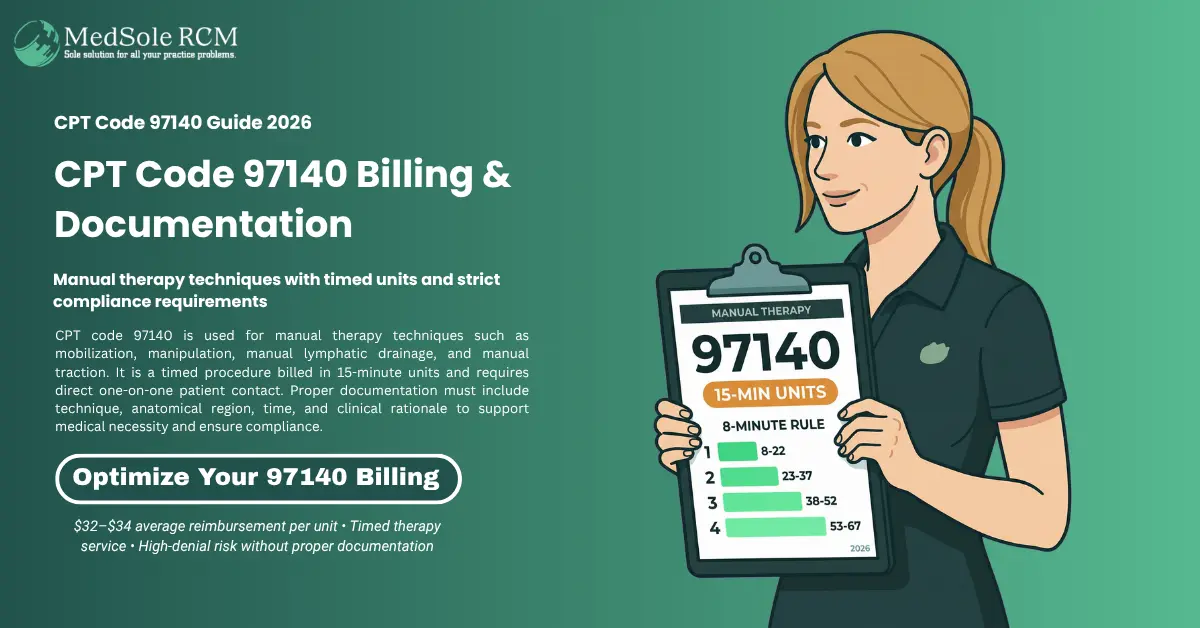




What Is CPT Code 97140 — Official AMA Definition and Clinical Context
CPT code 97140 is a timed procedure code for "manual therapy techniques (e.g., mobilization/manipulation, manual lymphatic drainage, manual traction), one or more regions, each 15 minutes." You'll use this manual therapy CPT code to bill for skilled, hands-on interventions that improve joint mobility, reduce pain, or restore soft tissue function in specific anatomical areas.
"Manual therapy techniques (e.g., mobilization/manipulation, manual lymphatic drainage, manual traction), one or more regions, each 15 minutes."
Source: American Medical Association CPT code 97140 official description
According to the American Medical Association CPT Editorial Panel, CPT code 97140 is formally defined as manual therapy techniques for one or more regions, each 15 minutes. This 97140 CPT code definition requires documentation of specific techniques applied to distinct anatomical regions during direct patient contact.
This means every time a physical therapist, chiropractor, or occupational therapist performs hands-on manual treatment for at least eight minutes, procedure code 97140 is the correct code to report that service to the payer. CPT 97140 replaced older codes like 97260, 97265, 97122, and 97250 in 1999.
Check the 97140 CPT code description in your software against AMA language to prevent scrubbing errors. The cpt code 97140 description on EOBs may appear abbreviated, so you'll reference the full definition during audits.
Correct use supports effective physical therapy revenue cycle management, while errors can quickly trigger denials or compliance audits.
What Techniques Are Covered Under CPT Code 97140
The AMA lists techniques by example rather than providing an exhaustive list. CPT code 97140 covers any skilled manual intervention that improves joint mobility, reduces pain, or restores tissue function. You'll use this cpt code for manual therapy when the technique requires clinical judgment and direct contact.
This manual therapy CPT code applies to interventions like joint mobilization or myofascial release. Providers often search for the myofascial release CPT code when documenting soft tissue work, and 97140 is the correct choice. The manual therapy cpt guidelines require distinct region documentation for each technique billed.
CPT code 97140 also captures neural mobilization and scar tissue work when medically necessary. A second myofascial release CPT code doesn't exist, so you'll report multiple units of 97140 for extended treatment time.
|
Technique |
Clinical Description |
Billing Note for 97140 |
|
Joint Mobilization |
Graded oscillatory or sustained passive movement applied to a joint to restore range of motion |
Document grade applied (I through V), specific joint, and clinical response |
|
Joint Manipulation (HVLA) |
High-velocity low-amplitude thrust technique to restore joint mechanics |
Document thrust technique, region, and differentiate from CMT codes 98940-98942 for chiropractors |
|
Myofascial Release |
Sustained manual pressure applied to fascial restrictions to improve extensibility |
Specify direct versus indirect technique; document region of fascial restriction |
|
Manual Traction |
Hands-on distraction of joint surfaces to reduce compressive forces |
Document cervical versus lumbar; note force applied and duration |
|
Manual Lymphatic Drainage |
Gentle rhythmic skin-stretching movements to stimulate lymphatic flow |
Additional CMS documentation requirements apply for lymphedema; see Section 11 |
|
Soft Tissue Mobilization |
Hands-on breakdown of muscle, tendon, and fascial adhesions |
Document specific tissue, region, and technique variant |
|
Trigger Point Therapy |
Direct sustained pressure to myofascial trigger points to release referred pain patterns |
Specify trigger point location and muscle group; this is NOT dry needling |
|
Muscle Energy Technique |
Active patient participation against practitioner resistance to improve joint range |
Document patient effort component and joint targeted |
|
Neural Mobilization |
Mobilization of peripheral neural tissue along its mechanical interface |
Document nerve root or peripheral nerve targeted |
|
Strain-Counterstrain |
Positional release technique using passive body positioning to reduce muscle guarding |
Document position used and region |
|
Craniosacral Therapy |
Gentle manipulation of cranial sutures and sacrum to influence cerebrospinal fluid |
Verify payer coverage before billing; not universally covered |
|
Graston Technique or IASTM |
Instrument-assisted soft tissue mobilization using specialized tools |
The instrument itself is not a separate billable code; bill the manual therapy performed |
|
Scar Mobilization |
Manual techniques applied to scar tissue to reduce adhesions and improve mobility |
Document scar location, size, and technique |
|
Active Release Technique |
Specific provider-applied tension combined with patient active movement |
Document tension direction and tissue targeted |
The myofascial release CPT code question comes up constantly in billing departments. Myofascial release doesn't have its own standalone code. It bills under CPT 97140, and the myofascial release CPT code documentation in your note is what distinguishes it from general soft tissue work. Same goes for the Mulligan technique, strain-counterstrain, and neural mobilization. If it's skilled, hands-on, and targeted, manual therapy CPT billing applies.
What Is NOT Covered Under CPT 97140
Some services get miscoded under 97140 regularly. Don't let that happen in your practice.
|
Service or Code Description |
Correct Code to Use Instead |
|
Dry needling |
CPT 20560 or 20561 |
|
General relaxation massage |
CPT 97124 |
|
Therapeutic exercise |
CPT 97110 |
|
Electrical stimulation |
CPT 97032 |
|
Ultrasound |
CPT 97035 |
|
Paraffin bath |
CPT 97018 |
The most common mistake here is billing 97124 when the therapist actually performed skilled soft tissue work. Those two codes are mutually exclusive under NCCI edits. More on that in Section 8.
Who Can Bill CPT Code 97140? Provider Eligibility by Specialty
CPT code 97140 may be billed by physical therapists, occupational therapists, chiropractors, physiatrists, and osteopathic physicians who have the appropriate training, licensure, and Medicare enrollment. Physical therapist assistants and occupational therapist assistants may perform manual therapy under appropriate supervision, but Medicare requires specific modifiers and reduces payment when an assistant performs the service.
|
Provider Type |
Can Bill 97140 |
Medicare Modifier Required |
Payment Note |
|
Physical Therapist (PT) |
Yes |
GP |
Standard rate applies |
|
Physical Therapist Assistant (PTA) |
Yes, under supervision |
GP plus CQ |
Medicare reduces payment to 85% when PTA performs service |
|
Occupational Therapist (OT) |
Yes |
GO |
Standard rate applies |
|
Occupational Therapist Assistant (OTA) |
Yes, under supervision |
GO plus CO |
Medicare reduces payment to 85% when OTA performs service |
|
Chiropractor (DC) |
Yes |
59 or XS when billed with CMT; GP for Medicare PT services if separately enrolled |
CMT region rules apply; see Section 10 |
|
Physiatrist or Rehabilitation Physician (MD) |
Yes |
None required as physician |
Incident-to rules may apply for staff billing |
|
Osteopathic Physician (DO) |
Yes |
None required as physician |
OMT-specific codes 98925 through 98929 may apply instead in some cases |
|
Massage Therapist |
No |
Not applicable |
Not a Medicare-recognized provider type for 97140 |
|
Athletic Trainer |
No under Medicare |
Not applicable |
Some commercial payers allow; verify individual contracts |
Chiropractors and physical therapists billing the 97140 CPT code physical therapy claims face some of the highest denial rates in outpatient therapy. If modifier selection, NCCI edit compliance, and payer-specific rules are eating into your time, that's a workflow problem worth fixing. MedSole RCM handles claims across all these provider types so your team stays focused on patients, not claim corrections. Full-service billing at 2.99% of collections. View Billing Services
Per CMS therapy services policy effective since 2022, the CQ and CO modifiers must be appended to claims where a PTA or OTA performs more than a de minimis 10% of the service. Here's how that works in practice: if the assistant's portion is 10% or less of the session, the primary therapist modifier applies and the full rate is paid. Once the assistant's portion exceeds that threshold, the CQ or CO modifier goes on the claim and Medicare drops payment to 85% of the allowable. It's one of those rules that sounds simple but creates real problems when practices aren't tracking assistant time correctly. The cpt code for manual therapy doesn't change, but that modifier absolutely changes what you get paid.
The 8-Minute Rule: How to Calculate CPT 97140 Units Correctly
The 8-minute rule states that a minimum of eight minutes of direct, one-on-one manual therapy must be performed and documented to bill one unit of CPT code 97140. Each unit represents 15 minutes of treatment time. This rule applies to Medicare and most Medicare-aligned commercial payers. Time must be exclusive: minutes counted toward CPT 97140 cannot overlap with minutes counted toward any other service billed on the same claim.
Per CMS MLN outpatient rehabilitation documentation guidance, providers must record either total minutes per CPT code alongside total timed minutes for the session, or start and stop times per intervention. Either method is acceptable for audit defense. Most compliance experts recommend recording both.
Units Calculation Reference: CPT 97140
|
Total Minutes of Manual Therapy |
Billable Units of 97140 |
Example Scenario |
|
Less than 8 minutes |
0 units — do not bill |
Six minutes of manual therapy cannot be billed |
|
8 to 22 minutes |
1 unit |
15 minutes equals 1 unit; 20 minutes equals 1 unit |
|
23 to 37 minutes |
2 units |
30 minutes equals 2 units; 35 minutes equals 2 units |
|
38 to 52 minutes |
3 units |
45 minutes equals 3 units; 50 minutes equals 3 units |
|
53 to 67 minutes |
4 units |
60 minutes equals 4 units |
|
68 to 82 minutes |
5 units |
75 minutes equals 5 units |
Mixed-Service Calculation Scenarios
This is where most billing errors happen. When you're combining cpt 97140 with other timed codes, you can't pool the minutes together. Each code gets its own minute count, and each one is tested against the eight-minute threshold independently.
|
Services Provided |
Minutes Per Service |
Correct Units |
Common Error to Avoid |
|
Manual therapy and therapeutic exercise |
20 minutes 97140 and 15 minutes 97110 |
1 unit 97140 and 1 unit 97110 |
Do not blend the 35 total minutes into 2 units of a single code |
|
Manual therapy only |
35 minutes |
2 units 97140 |
Do not bill 3 units |
|
Manual therapy only |
38 minutes |
3 units 97140 |
Do not bill 2 units; 38 minutes meets the 8-minute threshold for a third unit |
|
Manual therapy and therapeutic activities |
12 minutes 97140 and 20 minutes 97530 |
0 units 97140 and 1 unit 97530 |
Do not bill 1 unit 97140 when under 8 minutes |
|
Manual therapy and neuromuscular re-education |
15 minutes 97140 and 15 minutes 97112 |
1 unit 97140 and 1 unit 97112 |
Do not count combined 30 minutes toward 97140 alone |
The 38-minute row trips up even experienced billers. Thirty-five minutes gets you two units. Thirty-eight minutes gets you three, because that extra three minutes clears the eight-minute threshold for the next unit. Know those cutoff points cold.
Time documentation errors are the leading cause of manual therapy CPT code denials under Medicare Targeted Probe and Educate reviews. Per First Coast Service Options TPE audit results published July 2025, insufficient documentation of therapy minutes and units was among the top denial reasons for outpatient rehabilitation claims.
CPT 97140 Reimbursement: Rates 2026 Medicare and Commercial Fee Schedule
The 97140 CPT code reimbursement varies by payer, provider type, geographic location, and whether services are performed in a facility or non-facility setting. For 2026, the CMS CY2026 Physician Fee Schedule final rule (MLN Matters MM14315) set the conversion factor at $33.40 for non-APM clinicians, which directly determines Medicare reimbursement for all therapy procedure codes including CPT code 97140. The 2025 conversion factor was $32.35. The 2026 increase partially restores reimbursement levels that rehabilitation providers lost in prior years.
2026 Reimbursement Rates: CPT 97140
|
Payer |
Rate Per Unit (15 minutes) |
Setting |
Source or Notes |
|
Medicare |
$32 to $34 |
Non-facility (outpatient clinic) |
CMS CY2026 PFS; locality-adjusted by MAC |
|
Medicare |
$22 to $26 |
Facility (hospital outpatient) |
Lower facility rate applies in hospital settings |
|
UnitedHealthcare |
$28 to $43 |
Non-facility |
Varies by NPI, contract, and state |
|
Blue Cross Blue Shield |
$27 to $45 |
Non-facility |
Regional plan variation; verify individual contract |
|
Aetna |
$27 to $34 |
Non-facility |
Contract-specific; some plans require prior auth |
|
Cigna |
$30 to $34 |
Non-facility |
Contract-specific; verify current negotiated rate |
|
Medicaid |
$15 to $28 |
Varies |
State-administered; significant state-to-state variation |
If your practice isn't receiving the contracted rate for CPT 97140 consistently across all payers, that gap adds up fast. MedSole RCM's billing specialists audit payment patterns and follow up on underpayments against your contracted rates. Full-service billing at 2.99% of collections. See How It Works
Rates shown reflect national averages based on publicly available CMS Physician Fee Schedule data and federal price transparency files. Actual 97140 CPT code reimbursement depends on individual provider contracts, Medicare locality adjustments, and plan type. Verify current rates with your Medicare Administrative Contractor and commercial payer contracts before making financial planning decisions.
Practices experiencing gaps between contracted rates and actual payments received should review their payer contracts with a revenue cycle specialist. That kind of systematic underpayment doesn't fix itself, and the 97140 CPT code fee schedule is just the starting point for what you're actually owed.
2026 CMS Updates That Directly Affect CPT 97140 Billing
CPT code 97140 itself is unchanged for 2026. The code description, category, and technique definitions remain as published by the AMA.
Several CMS policy changes effective for calendar year 2026 directly affect how practices bill, document, and receive reimbursement for manual therapy services. Every practice billing cpt 97140 under Medicare should review these updates before submitting claims.
|
Policy Area |
2025 Value or Status |
2026 Value or Status |
Impact on 97140 Billing |
|
KX Modifier Threshold (PT and SLP combined) |
$2,410 |
$2,480 |
Practices reach the threshold later in the year; slightly fewer mid-year KX attestations required |
|
KX Modifier Threshold (OT) |
$2,410 |
$2,480 |
Same as above for OT practices |
|
Targeted Medical Review Threshold (PT, SLP, and OT) |
$3,000 |
$3,000 |
Unchanged; remains in effect through calendar year 2028 per CMS |
|
Conversion Factor (non-APM) |
$32.35 |
$33.40 |
Higher conversion factor improves per-unit reimbursement for 97140 |
|
NCCI Policy Manual |
CY2025 edition |
CY2026 edition effective January 1, 2026 |
Chapter XI timed-code and CMT bundling rules updated; review edit engine |
|
NCCI PTP Edit Files |
Updated quarterly |
Latest update effective April 1, 2026 |
Billing software must update quarterly to maintain compliance |
|
CPT 97140 Code Status |
Active, unchanged |
Active, unchanged |
No code changes; documentation and modifier rules remain primary compliance focus |
|
CQ and CO Assistant Modifiers |
Required since 2022 |
Unchanged |
Continued 85% payment reduction for assistant-performed services above de minimis threshold |
The $70 increase in the KX modifier threshold sounds small, but it means practices treating high-utilization patients won't hit that attestation trigger quite as early in the year. The TMR threshold stays at $3,000 through 2028, so that compliance pressure isn't going anywhere. The NCCI Policy Manual update is the one to act on now: if your billing software hasn't loaded the CY2026 edits, you're already running on stale rules.
The updates in this table are sourced from CMS MLN Matters MM14315 (CY2026 MPFS Final Rule Summary), the CMS MLN Connects Newsletter dated February 26, 2026, the CMS Medicare NCCI Policy Manual effective January 1, 2026, and the CMS NCCI PTP edit files effective April 1, 2026. MedSole updates this guide quarterly as new NCCI PTP edit files are released.
CPT 97140 Modifiers — The Complete Guide for Every Provider Type
Whether CPT code 97140 requires a modifier depends on the payer, the provider type, and what other services are billed on the same claim. Under Medicare, Modifier GP is always required for physical therapy services and Modifier GO is always required for occupational therapy services: missing either modifier causes automatic claim rejection. Additional modifiers such as 59, XS, or KX are required in specific billing scenarios described below.
Modifier GP — Physical Therapy Plan of Care
Modifier GP is required on all CPT code 97140 claims submitted by or under the direction of a physical therapist for Medicare. It indicates the service was performed under an outpatient physical therapy plan of care. A claim submitted without GP rejects automatically at the clearinghouse level; it doesn't even reach the payer for review. Some commercial payers also require GP, so verify individual contracts. GP does not affect the payment rate.
Modifier GO — Occupational Therapy Plan of Care
Modifier GO is the occupational therapy equivalent of GP and serves the same function. Required on all CPT code 97140 claims submitted by or under the direction of an occupational therapist for Medicare. An OT claim without GO rejects the same way a PT claim rejects without GP. Chiropractors don't use GP or GO for their own chiropractic claims, but may need GP if they're separately enrolled and billing under a physical therapy plan of care.
Modifier 59 — Distinct Procedural Service
Modifier 59 is required when the CPT code 97140 modifier situation involves billing manual therapy on the same date as another therapy code, and the services are truly separate and distinct. Per CMS MLN guidance published February 2025, Modifier 59 should only be used when no more specific X-modifier applies. The most common correct use is manual therapy performed on a different anatomical region from where another service occurred. Applying Modifier 59 without documentation supporting separate regions or distinct time blocks is an audit trigger, not a billing shortcut.
X-Modifiers — CMS Preferred Alternatives to Modifier 59
CMS introduced the X-modifiers specifically to replace routine use of Modifier 59 with more precise descriptors. Each one tells a different story about why two services are distinct. When documentation supports a specific X-modifier, use it instead of 59.
The $70 increase in the KX modifier threshold sounds small, but it means practices treating high-utilization patients won't hit that attestation trigger quite as early in the year. The TMR threshold stays at $3,000 through 2028, so that compliance pressure isn't going anywhere. The NCCI Policy Manual update is the one to act on now: if your billing software hasn't loaded the CY2026 edits, you're already running on stale rules.
The updates in this table are sourced from CMS MLN Matters MM14315 (CY2026 MPFS Final Rule Summary), the CMS MLN Connects Newsletter dated February 26, 2026, the CMS Medicare NCCI Policy Manual effective January 1, 2026, and the CMS NCCI PTP edit files effective April 1, 2026. MedSole updates this guide quarterly as new NCCI PTP edit files are released.
CPT 97140 Modifiers — The Complete Guide for Every Provider Type
Whether CPT code 97140 requires a modifier depends on the payer, the provider type, and what other services are billed on the same claim. Under Medicare, Modifier GP is always required for physical therapy services and Modifier GO is always required for occupational therapy services: missing either modifier causes automatic claim rejection. Additional modifiers such as 59, XS, or KX are required in specific billing scenarios described below.
Modifier GP — Physical Therapy Plan of Care
Modifier GP is required on all CPT code 97140 claims submitted by or under the direction of a physical therapist for Medicare. It indicates the service was performed under an outpatient physical therapy plan of care. A claim submitted without GP rejects automatically at the clearinghouse level; it doesn't even reach the payer for review. Some commercial payers also require GP, so verify individual contracts. GP does not affect the payment rate.
Modifier GO — Occupational Therapy Plan of Care
Modifier GO is the occupational therapy equivalent of GP and serves the same function. Required on all CPT code 97140 claims submitted by or under the direction of an occupational therapist for Medicare. An OT claim without GO rejects the same way a PT claim rejects without GP. Chiropractors don't use GP or GO for their own chiropractic claims, but may need GP if they're separately enrolled and billing under a physical therapy plan of care.
Modifier 59 — Distinct Procedural Service
Modifier 59 is required when the CPT code 97140 modifier situation involves billing manual therapy on the same date as another therapy code, and the services are truly separate and distinct. Per CMS MLN guidance published February 2025, Modifier 59 should only be used when no more specific X-modifier applies. The most common correct use is manual therapy performed on a different anatomical region from where another service occurred. Applying Modifier 59 without documentation supporting separate regions or distinct time blocks is an audit trigger, not a billing shortcut.
X-Modifiers — CMS Preferred Alternatives to Modifier 59
CMS introduced the X-modifiers specifically to replace routine use of Modifier 59 with more precise descriptors. Each one tells a different story about why two services are distinct. When documentation supports a specific X-modifier, use it instead of 59.
|
Modifier |
Full Descriptor |
Use With CPT 97140 When |
|
XE |
Separate Encounter |
Manual therapy performed at a different session time on the same date |
|
XS |
Separate Structure |
Manual therapy performed on a different anatomical structure from another billed service; most applicable for chiropractic claims where CMT and 97140 target different regions |
|
XP |
Separate Practitioner |
A different qualified provider performed the manual therapy from the provider who performed the other billed service |
|
XU |
Unusual Non-Overlapping Service |
Manual therapy serves a purpose that does not overlap the usual components of the other billed service |
Modifier KX — Medicare Therapy Cap Exception
Modifier KX must be appended to cpt 97140 and all therapy codes once Medicare therapy services for a patient exceed $2,480 for 2026. That threshold covers PT and SLP services combined, with OT tracked separately. KX is the provider's attestation that continued services are medically necessary and that the medical record supports it. Bill above the threshold without KX and Medicare pays at the non-capped rate automatically. Documentation must also be updated every 10 visits when you're operating above the KX threshold.
Modifiers CQ and CO — Physical and Occupational Therapy Assistants
When a physical therapist assistant performs more than a de minimis 10% of a CPT code 97140 session, Modifier CQ must be added alongside GP. For occupational therapist assistants, Modifier CO goes alongside GO under the same threshold rule. Medicare applies an 85% payment rate to claims carrying CQ or CO. Here's the compliance risk that gets practices in trouble: failing to append these modifiers when required isn't just a payment issue. It's a billing accuracy problem that surfaces during audits and creates recoupment exposure.
Payer-by-Payer Modifier Requirements — CPT 97140
|
Payer |
Always Required |
Required in Specific Scenarios |
Documentation to Support Modifier |
|
Medicare (PT) |
GP |
59 or XS with same-day services; KX above threshold; CQ if PTA |
Time, technique, separate regions for 59 or XS; medical necessity for KX |
|
Medicare (OT) |
GO |
59 or XS with same-day services; KX above threshold; CO if OTA |
Same as above |
|
UnitedHealthcare |
None always required |
59 or XS when same-day distinct services |
Functional goals, separate anatomical regions in notes |
|
Aetna |
None always required |
59 required for separate region |
Distinct anatomical site documented |
|
BCBS |
Varies by state plan |
59 for most plans when same-day |
Technique and region specificity |
|
Cigna |
None always required |
59 or XS often required |
Progress and functional improvement documented |
|
Humana |
None always required |
GP for PT codes |
Verify plan-specific requirements; denial patterns documented in AAPC forum data |
NCCI Bundling Rules and Code-Pairing Reference Guide for CPT 97140
CPT code 97140 can be billed with CPT 97110 (therapeutic exercise), 97112 (neuromuscular re-education), and 97530 (therapeutic activities) on the same date of service, but specific rules govern when a modifier is required and when it's not. CPT 97140 cannot be billed with CPT 97124 (massage therapy) under any circumstances: these two codes are mutually exclusive and no modifier can override this restriction. The National Correct Coding Initiative PTP edits, updated quarterly by CMS, define which code combinations are bundled and whether providers can unbundle them using Modifier 59 or X-modifiers.
Can CPT code 97110 and 97140 be billed together? Yes, with the right modifier and documentation. Can CPT code 97530 and 97140 be billed together? Also yes, and without a modifier in most cases. The table below covers both questions and eight other pairings you'll encounter in a typical outpatient therapy practice.
|
Code Paired With 97140 |
Description |
Modifier Needed to Unbundle |
Notes |
|
CPT 97110 |
Therapeutic Exercise |
Yes, Modifier 59 or XS |
Must document separate body regions or distinct time blocks; services must be truly distinct |
|
CPT 97112 |
Neuromuscular Re-education |
Yes, Modifier 59 or XS |
Same rules as 97110; separate regions or time blocks required |
|
CPT 97530 |
Therapeutic Activities |
No |
Per NCCI guidance, no modifier needed when billed same date; document each service distinctly |
|
CPT 97124 |
Massage Therapy |
Cannot unbundle |
Mutually exclusive; never bill together regardless of modifier |
|
CPT 97161 to 97163 |
PT Evaluation |
No |
No modifier needed; evaluation and treatment may be billed same date |
|
CPT 97165 to 97167 |
OT Evaluation |
No |
No modifier needed; evaluation and treatment may be billed same date |
|
CPT 98940 to 98942 |
CMT Chiropractic |
Yes, Modifier 59 or XS |
Only when 97140 performed in different spinal or extraspinal region; see Section 10 |
|
CPT 95851 |
ROM Measurement |
No; bundled |
Always bundled into 97140; cannot be separately billed |
|
CPT 97018 |
Paraffin Bath |
No; bundled |
Always bundled into 97140; cannot be separately billed |
|
CPT 97750 |
Physical Performance Test |
No; bundled |
Always bundled into 97140 per NCCI |
NCCI PTP edits update every quarter. The most recent update at publication is effective April 1, 2026. If your billing software isn't pulling the current edit file, you're running a compliance gap you can't see until a claim bounces. Using an outdated edit table is one of the most common causes of preventable cpt 97140 denials, and it's entirely avoidable. MedSole's outsourced medical billing services for therapy providers monitors quarterly NCCI releases and updates client billing protocols automatically, so this doesn't become your problem to track.
CPT 97140 Versus Other Codes: 97110, 97124, and 97530 Compared
The primary difference between CPT code 97140 and CPT 97110 is that 97140 involves therapist-administered hands-on techniques (passive intervention) while 97110 involves patient-performed exercises (active intervention) for developing strength, endurance, range of motion, and flexibility.
CPT 97140 Versus CPT 97110: Manual Therapy and Therapeutic Exercise
You'll bill CPT 97110 and 97140 together with Modifier 59 when notes support separate regions. This manual therapy CPT code differs from neuromuscular re-education by focusing on hands-on tissue work. Billing cpt 97140 with 97110 triggers audits if you add 59 without justification.
|
Feature |
CPT 97140 Manual Therapy |
CPT 97110 Therapeutic Exercise |
|
Who Does the Work |
Therapist applies hands-on technique (passive) |
Patient performs exercises with therapist guidance (active) |
|
Primary Goal |
Restore joint mobility, reduce pain, release tissue restriction |
Develop strength, endurance, range of motion, flexibility |
|
Common Examples |
Joint mobilization, myofascial release, manual traction |
Resistance band exercises, strengthening, post-surgical ROM |
|
Billed Together |
Yes, with Modifier 59 or XS when performed on separate regions or in distinct time blocks |
Same rule applies |
|
Medicare Reimbursement |
Approximately 32 to 34 dollars per unit non-facility |
Slightly higher in some localities; verify with MAC |
CPT 97140 Versus CPT 97124: Manual Therapy and Massage Therapy
CPT code 97140 and CPT 97124 are mutually exclusive. You'll never bill CPT 97124 and 97140 together, and no modifier overrides this restriction.
The difference between CPT code 97124 and 97140 lies in intent. CPT 97140 targets functional deficits with skilled intervention, while 97124 covers relaxation. Zero overlap permitted.
Use this cpt code for manual therapy when the technique requires skill and a functional goal. Billing 97124 for skilled work is a common error.
CPT 97140 Versus CPT 97530: Manual Therapy and Therapeutic Activities
CPT 97530 covers functional task training. This 97140 CPT code pairs with 97530 without Modifier 59 per NCCI guidance. You'll still document both services distinctly.
CPT 97140 and Chiropractic Manipulative Treatment: The Complete Billing Rules
CPT code 97140 can be billed on the same date as chiropractic manipulative treatment (CMT) codes 98940, 98941, or 98942, but only when the manual therapy was performed in a different anatomical region from where the spinal manipulation occurred, and Modifier 59 or XS must be applied to the 97140 claim line. This rule is established in the CMS Medicare NCCI Policy Manual, Chapter XI, effective January 1, 2026.
This is the single most common reason chiropractic practices receive chiropractic CPT code 97140 denials under Medicare. The clinical instinct to warm up spinal tissue before an adjustment, and then bill both the preparation work and the adjustment, is precisely what NCCI edits prohibit when the same spinal region is involved. Preparation work in the same region is considered included in the CMT. It can't be billed separately.
The Five CPT-Defined Spinal Regions
|
Spinal Region |
Anatomical Coverage |
Included Joints |
|
Cervical |
C1 through C7 |
Includes atlanto-occipital joint |
|
Thoracic |
T1 through T12 |
Includes costovertebral and costotransverse joints |
|
Lumbar |
L1 through L5 |
Lumbar vertebrae and facet joints |
|
Sacral |
Sacrum |
Sacral segments |
|
Pelvic |
Sacroiliac joint |
SI joint region |
The Five CPT-Defined Extraspinal Regions
|
Extraspinal Region |
Examples |
|
Head |
Temporomandibular joint, cranial |
|
Upper Extremities |
Shoulder, elbow, wrist, hand, fingers |
|
Rib Cage |
Ribs excluding costovertebral joints |
|
Abdomen |
Abdominal soft tissue structures |
|
Lower Extremities |
Hip, knee, ankle, foot, toes |
These region definitions matter because the CPT code 97140 modifier 59 or XS is only valid when the 97140 service is performed in an anatomical region that does not overlap with the CMT region. If a chiropractor adjusts the lumbar spine and bills 98940, then performs myofascial release on the right shoulder, the shoulder is an extraspinal upper extremity region and 97140-59 or 97140-XS applies correctly. Perform that same myofascial release on the lumbar spine instead, and it's included in the CMT. That claim line for 97140 will be denied.
Pay Versus Deny: CPT 97140 Modifier 59 Scenarios for Chiropractic Billing
|
Scenario |
CMT Region |
97140 Region |
Correct Billing |
Result |
|
Lumbar CMT plus right shoulder manual therapy |
Lumbar (spinal) |
Right shoulder (extraspinal upper extremity) |
98940 plus 97140-59 or 97140-XS |
Paid; separate regions documented |
|
Cervical CMT plus thoracic manual therapy for rib |
Cervical (spinal) |
Rib cage (extraspinal) |
98940 plus 97140-59 |
Paid; extraspinal rib cage is a separate region |
|
Cervical CMT plus cervical soft tissue mobilization |
Cervical (spinal) |
Cervical (same spinal region) |
98940 only |
Denied; 97140 included in CMT for same region |
|
Thoracic CMT plus lumbar manual therapy |
Thoracic (spinal) |
Lumbar (contiguous spinal region) |
98940 only |
Denied; contiguous spinal regions are not separate for billing purposes |
|
Lumbar and sacral CMT plus knee manual therapy |
Lumbar and sacral (spinal) |
Knee (extraspinal lower extremity) |
98941 plus 97140-59 |
Paid; knee is a clearly separate extraspinal region |
Per the CMS NCCI Policy Manual CY2026, documentation supporting a combined CMT and 97140 CPT code claim must clearly state the specific regions where each service was performed, the clinical rationale for performing manual therapy in the separate region, and the distinct technique used. Notes that describe soft tissue work in general terms without specifying anatomical locations are the most common documentation failure that leads to post-payment audit recoupment for chiropractic practices.
Chiropractic practices that regularly bill cpt 97140 alongside CMT codes benefit most from an RCM partner who monitors NCCI edits quarterly and verifies 97140 CPT code modifier compliance before claim submission. Working with an outsourced billing services for chiropractic practices partner removes that quarterly compliance burden from your internal team.
Chiropractic practices billing CPT 97140 face the highest denial rates for this code among all provider types. If your practice regularly bills CMT alongside manual therapy, the region documentation and modifier rules in this section are where most of your denials originate. MedSole RCM handles chiropractic billing at 2.99% of collections with no setup fees. Credentialing specialists enroll chiropractors with payers at $99 per insurance; most competitors charge $150 to $300 per payer enrollment. See Chiropractic Billing and Credentialing Services
Medicare-Specific Billing Requirements for CPT 97140
Yes, Medicare Part B covers CPT code 97140 when it is medically necessary, performed by a qualified provider, and documented as skilled manual therapy aimed at improving the patient's functional ability, not as maintenance care or comfort treatment.
Per CMS outpatient therapy guidance, manual therapy under CPT code 97140 must require the skill and clinical judgment of a licensed therapist to qualify for Medicare reimbursement. Services that a patient or caregiver could safely perform independently don't meet Medicare's skilled care standard.
|
Requirement |
Medicare Standard |
Documentation to Prove It |
|
Medical Necessity |
Must improve or maintain function; not maintenance care |
Documented functional deficit; measurable goal; clinical rationale |
|
Skilled Care |
Requires therapist's professional skill and judgment |
Note must describe why a skilled provider is necessary; not just what was done |
|
Qualified Provider |
PT, OT, DC, or qualifying physician with active Medicare enrollment |
Verify NPI and enrollment status before billing |
|
Active Plan of Care |
Written plan with goals, frequency, duration |
Signed by referring physician or by therapist per state law; on file before billing begins |
|
Progress Documentation |
Updated every 10 visits |
Notes must document progress toward measurable functional goals |
|
Certification and Recertification |
Initial certification and periodic recertification required |
Must be signed and dated; recertification due before therapy continues past initial plan |
|
KX Modifier Above Threshold |
Required when services exceed $2,480 for 2026 |
Must document continued medical necessity; $2,480 threshold indexed annually to MEI |
|
Targeted Medical Review |
Applies when services exceed $3,000 threshold |
Additional documentation may be requested; threshold unchanged through 2028 |
Medicare denies CPT code 97140 for relaxation, independent self-management, documentation time, or same-region CMT. Manual lymphatic drainage coded as CPT 97140 is covered per CMS Billing and Coding Lymphedema Decongestive Treatment A52959, though unskilled compression bandaging isn't covered. You'll verify 97140 CPT code Medicare rules for lymphedema cases.
The First Coast Service Options Medicare contractor and other MACs like Palmetto GBA flag missing time, plan of care, certification, and goals in TPE audits. This 97140 CPT code physical therapy pattern drives denials. Billing CPT 97140 without these elements risks recoupment.
Practices facing ADRs for CPT code 97140 need fast responses. MedSole's AR follow-up and Medicare audit defense services handle appeals. You'll verify 97140 CPT code medicare rules and check will medicare insurance pay for CPT code 97140 when goals plateau.
Documentation Requirements for CPT 97140: With SOAP Note Template
Per CMS outpatient therapy documentation guidance, a compliant CPT code 97140 claim requires documentation of the specific manual therapy technique performed, the exact anatomical region treated, the total time in minutes with start and stop times, the clinical rationale for the service, the patient's response, and how the service connects to a measurable functional goal.
|
Element |
What to Document |
Why Payers Require It |
Audit Risk if Missing |
|
Technique |
Specific technique by name (e.g., Grade III inferior glide, right glenohumeral joint; posterior capsule myofascial release) |
Proves the service was skilled and clinically selected, not routine |
Denied as unskilled or non-specific; CO-50 denial code |
|
Anatomical Region |
Exact location (e.g., right shoulder glenohumeral joint; cervical C4-C6 facet joints) |
Required for modifier justification and CMT region separation |
Denied if region overlaps with CMT; modifier 59 invalidated |
|
Time |
Start time, stop time, total minutes per code |
8-minute rule compliance; prevents over-billing and under-billing |
CO-97 denial; time-based audit flag |
|
Functional Goal |
Measurable goal tied to the technique (e.g., patient will achieve 150 degrees shoulder flexion for overhead function within 6 visits) |
Shows functional intent, not maintenance care; required for Medicare skilled care standard |
CO-50 denial; classified as maintenance care |
|
Patient Response |
Objective and subjective response (e.g., pain reduced from 7 to 4 out of 10; flexion improved from 90 to 110 degrees) |
Documents effectiveness and supports continuation of care |
Questioned on every-10-visit review; pattern of no improvement triggers audit |
|
Clinical Rationale |
Why this technique in this session (e.g., restricted posterior capsule causing impingement; myofascial release to reduce guarding before joint mobilization) |
Proves clinical decision-making; distinguishes skilled therapy from unskilled routine |
Underpayment or denial on Medicare medical review |
Every-10-Visit Documentation Requirement
Per CMS Medicare therapy policy, you'll update CPT code 97140 documentation every 10 visits to demonstrate continued medical necessity. This update must show progress toward functional goals, objective outcome measures, clinical judgment supporting continuation, and a revised plan of care. Billing beyond the initial plan without this CPT code 97140 documentation update exposes practices to recoupment during TPE reviews.
De-Identified Sample SOAP Note: CPT 97140 (Medicare-Compliant)
Subjective: Patient reports 7 out of 10 right shoulder pain with overhead reaching and hair washing. Functional limitation: unable to reach overhead cabinets independently. Pain worsened with sustained positioning. No new injuries or red flags reported.
Objective: Right glenohumeral joint: active flexion 90 degrees (normal 180 degrees), internal rotation 40 degrees (normal 70 degrees). Palpation: posterior capsule restriction with myofascial guarding, upper trapezius trigger point active. Manual therapy performed: posterior capsule myofascial release with Grade III inferior glenohumeral joint mobilization, right shoulder, 15 minutes (start 10:00 AM, end 10:15 AM). Soft tissue mobilization to right upper trapezius trigger point, 8 minutes (start 10:15 AM, end 10:23 AM). Total CPT 97140 time: 23 minutes. Units billed: 2 units CPT 97140. Post-treatment: flexion 110 degrees, patient reports pain 4 out of 10.
Assessment: Right glenohumeral restricted mobility consistent with adhesive capsulitis, improving with manual therapy. Patient demonstrating measurable progress toward functional overhead reach goal.
Plan: Continue CPT 97140 2 times per week for 4 weeks. Goal: 150 degrees shoulder flexion for independent overhead function within 6 visits. No modifier required today. Plan of care active and on file.
Every element in this note addresses technique, region, start and stop times, units, pre- and post-treatment measures, and functional goals. This structure corresponds directly to Medicare requirements and provides complete audit defense for CPT code 97140 claims. You'll adopt this manual therapy CPT code format to strengthen compliance and prevent denials.
Standardize CPT code 97140 documentation by auditing templates. MedSole finds gaps early. Access denial management and documentation audit services to fix workflows. This 97140 CPT code physical therapy approach reduces ADRs. Billing this myofascial release CPT code needs clear rationale.
Top ICD-10 Diagnosis Codes Paired with CPT 97140
Every CPT code 97140 claim requires a supporting ICD-10 diagnosis code that establishes medical necessity for the manual therapy performed. The diagnosis code must logically support the specific technique billed to justify skilled intervention. A mismatch between the diagnosis and the manual therapy technique is one of the most common reasons cpt 97140 claims get flagged for medical review.
|
ICD-10 Code |
Description |
Manual Therapy Rationale |
|
M54.50 |
Low back pain, unspecified |
Lumbar soft tissue mobilization, joint mobilization, manual traction |
|
M54.2 |
Cervicalgia (neck pain) |
Cervical joint mobilization, myofascial release, manual traction |
|
M25.511 |
Pain in right shoulder |
Glenohumeral mobilization, posterior capsule myofascial release |
|
M25.512 |
Pain in left shoulder |
Same as above for left side |
|
M47.812 |
Spondylosis with radiculopathy, cervical region |
Manual traction, neural mobilization |
|
M54.12 |
Radiculopathy, cervical region |
Neural mobilization, cervical traction |
|
M62.830 |
Muscle spasm |
Soft tissue mobilization, myofascial release, trigger point therapy |
|
M25.311 |
Stiffness of right shoulder, not elsewhere classified |
Glenohumeral joint mobilization, capsular stretching |
|
S13.4XXA |
Sprain of ligaments of cervical spine, initial encounter |
Cervical joint mobilization, soft tissue mobilization |
|
I97.2 |
Postmastectomy lymphedema syndrome |
Manual lymphatic drainage; additional CMS documentation requirements apply |
|
M79.3 |
Panniculitis |
Myofascial release, soft tissue mobilization |
The diagnosis pointer on the claim form must connect each CPT code 97140 line to the diagnosis code that specifically supports that service. You'll map pointers carefully because submitting all codes under a single unrelated diagnosis is a claim integrity error that triggers denials. Payers reject mismatched pointers automatically.
Common CPT 97140 Denial Reasons and How to Prevent Them
CPT code 97140 has one of the highest denial rates of any outpatient therapy code under Medicare and commercial payers. Most denials are preventable.
Based on MAC TPE results, AAPC forum data, and payer analysis, these patterns cause the most lost revenue for practices billing CPT code 97140.
|
Denial Reason |
CMS Remark Code |
Root Cause |
Prevention Strategy |
|
Missing Modifier GP or GO on Medicare |
Claim submitted without required therapy modifier |
Add GP or GO to every 97140 Medicare claim; build as a required field in billing software |
|
|
Same Region as CMT |
97140 billed in same spinal region as chiropractic adjustment |
Verify and document separate regions before submitting; apply XS modifier with region-specific note language |
|
|
Insufficient Time Documentation |
Minutes not recorded per code; start and stop times missing |
Require start and stop times on every therapy note; do not allow session totals without per-code breakdown |
|
|
Generic Documentation |
Note says "manual therapy performed" without technique, region, or clinical rationale |
Implement documentation templates with required fields that cannot be submitted blank |
|
|
Medical Necessity Not Supported |
No functional goal or clinical rationale connecting manual therapy to the diagnosis |
Every note must contain a functional goal statement with objective measurement |
|
|
Billing 97140 With 97124 |
Mutually exclusive codes billed together |
Remove 97124 from any claim that includes 97140; these codes cannot coexist |
|
|
Modifier 59 Applied Without Supporting Documentation |
59 added to every 97140 claim as a routine edit bypass |
Apply Modifier 59 only when documentation specifies separate regions or time blocks |
|
|
Missing or Expired Plan of Care |
CO-52 |
Claim submitted before plan of care is signed or after it has expired |
Track plan of care dates in the billing system; do not bill past plan expiration without renewal |
|
97140 Billed on Every Visit Without Progression |
Pattern triggers medical review; no documented progress |
Vary treatment approach; document progression visit to visit; do not use copy-paste notes |
|
Payer |
Documented Denial Pattern for CPT 97140 |
|
Medicare |
Missing GP or GO; time not documented per code; same region as CMT; medical necessity insufficient after 12 to 18 visits |
|
UnitedHealthcare |
Manual therapy appears routine or non-skilled in notes; no functional goals documented |
|
Aetna |
Bundling 97140 with 97110 without modifier; anatomical region overlap between codes on same claim |
|
BCBS |
Missing technique specificity in notes; same anatomical site language across multiple codes |
|
Humana |
Invalid or missing modifiers for PT codes including 97140; GP missing or modifier stated as invalid |
|
Ambetter |
Bundling denials for 97140 and 97110 on same claim |
|
Cigna |
Prior authorization required for ongoing manual therapy beyond initial visits; insufficient progress documentation |
Denial patterns across payers signal documentation or workflow problems, not isolated errors. A practice getting CO-50 denials has a template issue. CO-97 patterns point to modifier gaps. You'll recover and protect revenue by fixing root causes, not just appealing individual claims.
MedSole RCM's denial management team identifies root cause denial patterns across your CPT 97140 claim history, corrects upstream workflow issues, and recovers revenue from underpaid and denied claims. For practices billing CPT 97140 across physical therapy, chiropractic, or occupational therapy, MedSole manages the full cycle at 2.99 percent of collections with no setup fees and no long-term contracts. Start With a Free Denial Audit
Step-by-Step CPT 97140 Claim Submission Workflow
Correct billing for CPT code 97140 follows a ten-step sequence. Skipping any step causes preventable denials.
-
Verify Provider Enrollment and Eligibility: Confirm active enrollment before service. New providers without credentialing reject at the clearinghouse. MedSole's credentialing team enrolls at 99 dollars per insurance. Check status before the first appointment.
-
Document During or Immediately After the Session: Record technique, region, start time, stop time, rationale, and response before the patient leaves. Documentation completed hours later creates audit vulnerability.
-
Apply the 8-Minute Rule to Calculate Units: Count total manual therapy minutes. Don't blend with other services. Use Section 4's table. Enter units before submitting.
-
Select the Correct ICD-10 Diagnosis Code: Choose the specific diagnosis supporting the technique. Verify the pointer maps to CPT code 97140, not another code.
-
Apply All Required Modifiers: GP for Medicare PT. GO for Medicare OT. 59 or XS for separate regions or time blocks. KX above the 2,480 dollar threshold. CQ or CO for assistants above de minimis. Apply modifiers when billing CPT code 97140 to avoid rejections.
-
Check NCCI Edits Before Submission: Verify no bundling conflicts. Update your edit engine quarterly. The latest NCCI PTP update is effective April 1, 2026. Outdated tables cause denials.
-
Verify Payer-Specific Rules for the Patient's Plan: Plans vary by employer. Check for prior auth, unit limits, or modifier preferences before submitting.
-
Submit Within Timely Filing Deadline: Medicare requires claims within 12 months. Commercial deadlines range from 90 days to 12 months. Missing the window kills appeal rights.
-
Monitor Claim Status in Real Time: Track claims through the clearinghouse and portal. Flag claims pending over 30 days for active follow-up.
-
Appeal Denied Claims Promptly: Note the remark code, check Section 14, gather docs, and submit a first-level appeal within the payer's window, typically 60 to 180 days.
Frequently Asked Questions: CPT Code 97140
What is CPT code 97140?
CPT code 97140 bills manual therapy techniques including mobilization, manipulation, manual lymphatic drainage, and manual traction for one or more regions in 15-minute units. This skilled code requires direct one-on-one contact and reports hands-on interventions that improve mobility or reduce pain. You'll reference this 97140 CPT code for timed manual therapy services.
What is CPT code 97140 used for?
CPT code 97140 bills skilled manual therapy for joint restriction, soft tissue dysfunction, lymphatic impairment, or pain. You'll use this cpt code for manual therapy when treating cervical and lumbar pain, post-surgical stiffness, shoulder capsulitis, lymphedema, and injuries. The code excludes general massage or relaxation techniques.
Does CPT code 97140 need a modifier?
CPT code 97140 requires modifiers based on payer and same-day services. Medicare needs GP for PT and GO for OT, while Modifier 59 or XS applies when billing cpt 97140 with another therapy code in distinct regions or time blocks. Modifier KX is required above the 2026 threshold.
What is the difference between CPT 97140 and CPT 97124?
CPT 97140 covers skilled manual therapy for functional improvement, while CPT 97124 covers massage for relaxation. These codes are mutually exclusive and cannot be billed together, as no modifier overrides this restriction. You'll use this 97140 CPT code when the technique requires clinical skill and addresses a functional deficit.
Can CPT 97110 and CPT 97140 be billed together?
Yes, CPT 97110 and CPT 97140 can be billed together when performed as distinct services. Apply Modifier 59 or XS to CPT code 97140 and document separate regions or non-overlapping time blocks. Billing cpt 97140 without a modifier triggers automatic NCCI bundling denials.
Does Medicare cover CPT code 97140?
Yes, Medicare Part B covers CPT code 97140 when medically necessary, performed by a qualified provider, and documented as skilled therapy for functional improvement. Medicare denies cpt 97140 for maintenance or relaxation, and every claim requires Modifier GP for PT or Modifier GO for OT.
What is the reimbursement rate for CPT 97140 in 2026?
The 2026 Medicare rate for CPT code 97140 is approximately 32 to 34 dollars per unit non-facility and 22 to 26 dollars per unit facility based on the CY2026 conversion factor. Commercial payers vary, so verify 97140 CPT code reimbursement with each contract.
Can CPT 97140 and chiropractic CMT be billed together?
Yes, CPT code 97140 and chiropractic CMT can be billed together only when manual therapy targets a different anatomical region from the manipulation. Apply Modifier 59 or XS to CPT code 97140 and document distinct regions, as billing cpt 97140 in the same spinal region violates NCCI edits.
How many units of CPT 97140 can be billed per session?
Units for cpt 97140 follow the 8-minute rule, where 8 to 22 minutes equals one unit, 23 to 37 minutes equals two units, and 38 to 52 minutes equals three units. No universal cap exists, though payers may flag high counts for review.
Who can bill CPT code 97140?
CPT code 97140 may be billed by licensed physical therapists, occupational therapists, chiropractors, physiatrists, and osteopathic physicians with active enrollment. Assistants may perform care under supervision, but Medicare requires Modifier CQ or CO and reduces payment to 85 percent when billing cpt 97140 for assistant services.
How MedSole RCM Helps Healthcare Providers Maximize CPT 97140 Revenue
Billing CPT code 97140 correctly requires managing seven modifiers across five payer types, applying NCCI edits that update quarterly, maintaining documentation for twelve Medicare requirements, and tracking annual CMS changes. Most therapy practices lack the bandwidth to handle this without errors, which is where MedSole RCM operates.
|
Challenge From This Guide |
How MedSole Handles It |
|
Modifier GP, GO, 59, XS, KX, CQ, CO applied correctly on every claim |
MedSole's billing team selects and applies the correct modifier for every CPT 97140 claim based on payer, provider type, and clinical scenario |
|
NCCI PTP edits updated quarterly |
MedSole monitors CMS quarterly NCCI releases and updates client billing protocols automatically |
|
CMT plus 97140 region documentation and modifier compliance |
Chiropractic billing specialists verify separate regions before submission; modifier XS applied with region-specific language |
|
Every-10-visit Medicare documentation review |
MedSole billing coordinators flag visits approaching the documentation update requirement and notify clinical staff |
|
Denial root cause identification and appeal submission |
MedSole's denial management team identifies denial patterns, corrects upstream workflow issues, and submits appeals within payer deadlines |
|
AR follow-up on underpaid and aged claims |
MedSole's AR team pursues every CPT 97140 claim through adjudication and follows up on underpayments against contracted rates |
|
Provider credentialing and payer enrollment |
MedSole enrolls providers with payers at 99 dollars per insurance through credentialing services for PT, DC, and OT providers |
MedSole RCM charges 2.99 percent of collections for full-service revenue cycle management with no setup fees, no long-term contracts, and no per-claim charges. Payer enrollment costs 99 dollars per insurance for PT, DC, and OT providers. The industry average runs 150 to 300 dollars per payer, making MedSole the most competitive option to protect 97140 CPT code reimbursement.
Physical therapists, chiropractors, and occupational therapists billing CPT 97140 can eliminate denial risk, recover underpaid claims, and enroll with new payers faster through MedSole RCM. Full-service billing at 2.99 percent of collections. Payer credentialing at 99 dollars per insurance. No setup fees. Get a Free Billing Audit