



Medical billing cost in 2026 depends on the pricing model you sign. Most billing companies charge a percentage of monthly collections, and published starting rates begin below 3%. Others charge per claim, a flat monthly fee, or by the hour. In-house billing costs about $69,700 a year in wages and benefits for one billing clerk.
This guide covers what U.S. practices pay billing companies and billing staff, not what patients pay for care. It's written by the billing team at MedSole RCM, a revenue cycle management company, so our own pricing sits in one dated section near the end.
Every price comparison here uses worked numbers. You'll see effective rates at four collection levels, the gap between charges and collections, and one billing clerk's full cost from Bureau of Labor Statistics data. The Medicare rule on percentage billing and five questions to put to any billing company round it out.
|
Key Takeaways
|
How Much Does Medical Billing Cost in 2026?
Medical billing cost in 2026 runs from published starting rates below 3% of collections to a 4% to 10% range for full service. That upper range comes from billing companies' own pricing guides. Per-claim, flat monthly, and in-house costs follow different math, and medical billing rates shift with scope, specialty, and volume.
Five pricing models set the cost of medical billing services, and this table compares them side by side.
|
Pricing model |
How it's charged |
Typical published range (October 2026) |
Common fit |
|---|---|---|---|
|
Percentage of collections |
A share of payments collected each month |
Starting rates from about 2.5%. Billing company guides cite 4% to 10% for full service. |
Most practices |
|
Per claim |
A fixed fee per claim submitted |
About $3 to $12 per claim, per billing company guides |
High claim volume, low dollar value per claim |
|
Flat monthly fee |
One fixed fee each month |
About $500 to $2,500 or more a month, per billing company guides |
Steady, predictable volume |
|
Hourly or staff-based |
Hours of billing staff time |
Set by staffing model. BLS median wage for billing clerks is $23.32 an hour. |
Practices keeping billing under their own control |
|
In-house billing |
Salary, benefits, and software |
About $69,700 a year per billing clerk in wages and benefits, before software |
Large groups with stable staff |
Figures for medical billing services cost in the USA come from billing companies' own published pricing, reviewed October 2026. No government agency tracks billing company fees.
There's no government survey of the average cost for medical billing services. Every published range, including the 4% to 10% figure, comes from billing companies themselves. Ask vendors for the average medical billing percentage they charge practices your size, and each answer will rest on a different scope of work.
Average medical billing collection rates, in the fee sense, are the share of collections a billing company keeps. Services, specialty, and claim volume move a quote within the range. Minimums matter too, and they're the reason to check what each quote covers before comparing medical billing fees.
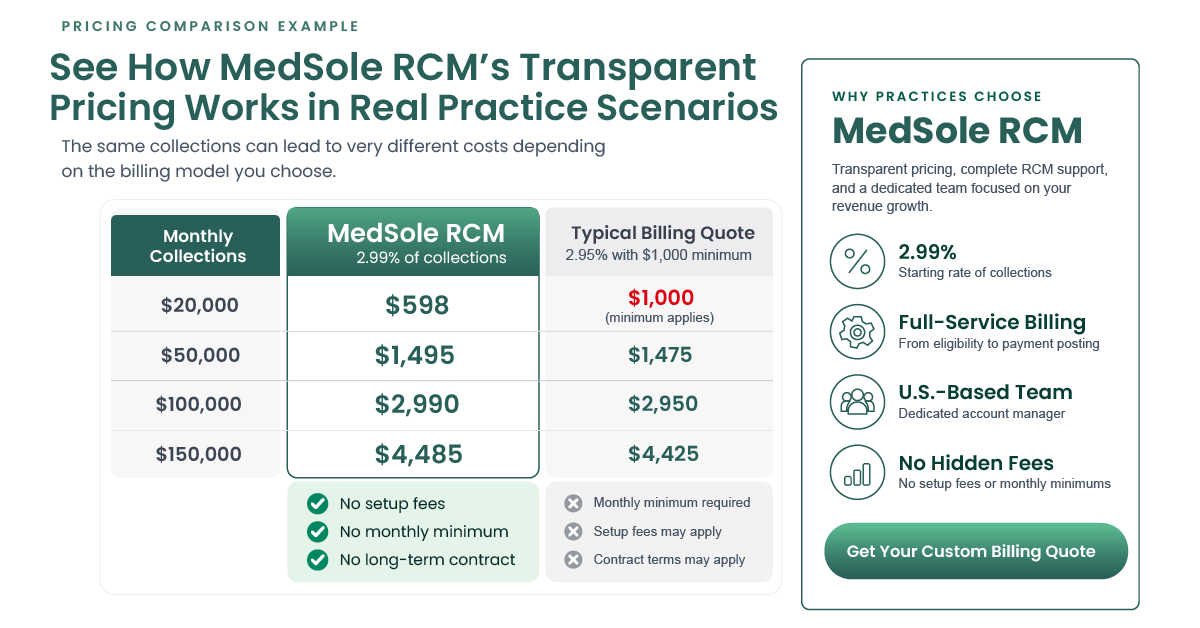
For reference, MedSole RCM's billing starts at 2.99% of monthly collections, with no setup fee or monthly minimum, and credentialing costs $99 per payer application (October 2026).
What Changed in Medical Billing Pricing in 2026
Advertised starting rates dropped below 3% this fall. Between September and October 2026, one billing company cut its published starting rate from 2.99% to 2.69%, and another advertises 2.49%. Neither cut changes what a full-service contract includes, so scope still decides real medical billing costs.
Medicare physician payments went up for 2026 under the CMS CY 2026 fee schedule rule, which the Centers for Medicare & Medicaid Services released October 31, 2025. That rule set two conversion factors: $33.40 for most clinicians (+3.26%) and $33.57 for qualifying APM participants (+3.77%), both up from $32.35. A percentage fee rises in dollars when Medicare payments rise.
The same rule applies a 2.5% efficiency adjustment that lowers work values for non-time-based services, such as procedures. Procedure-heavy practices may see some Medicare payments, and the percentage fees tied to them, stay flat or fall in 2026.
New government wage data resets the in-house baseline too. The Bureau of Labor Statistics (BLS) released May 2025 occupational wages and June 2026 benefit costs during 2026. Both releases sit behind every in-house figure in this guide, from the hourly wage to the loaded annual cost.
What Pricing Models Do Medical Billing Companies Use?
Medical billing companies use four pricing models: percentage of collections, per-claim, flat monthly, and hourly, plus hybrids with monthly minimums. Each medical billing pricing structure splits risk between the practice and the billing company in its own way, and that split moves your medical billing cost. Check medical billing services pricing against your own numbers with the worked examples below.
Percentage of Collections
Most medical billing service rates you'll see quoted are a percentage. Medical billing percentage of collections is a pricing model where the billing company keeps a set share of the payments it collects each month. The biller earns more only when the practice gets paid, which ties both incomes to clean claims.
Take a practice collecting $40,000 a month. At 4%, the fee is $1,600, and at 6%, it's $2,400. That's $800 a month, or $9,600 a year, from a two-point gap. Before trusting any average medical billing percentage a vendor quotes, ask which services it includes.
Two contract terms decide the true price of medical billing percentage of collections: how the contract defines collections, and whether a monthly minimum applies. A billing-only quote covers claims and payments, while a full revenue cycle management quote adds eligibility checks, prior authorization, and reporting, so compare like with like.
Per-Claim Fees
Medical billing rates per claim are a fixed dollar fee for each claim submitted, whatever that claim pays. Picture 400 claims a month at $6 each: the fee is $2,400. If the average paid claim is $90, collections come to $36,000, which puts the effective rate at 6.7%.
Per-claim pricing pays the billing company the same $6 for a $40 claim and a $4,000 claim. Nothing in that structure rewards chasing the high-dollar denial. Ask one question before signing: are corrected and resubmitted claims charged as new claims?
Flat Monthly Fees
Flat fee medical billing is one fixed fee each month, no matter how much the practice collects. A $1,500 fee is 7.5% of $20,000 in collections and 1.9% of $80,000. That math favors practices with steady, high volume and few slow months.
The risk with flat fee medical billing is a slow month. Your medical billing service cost stays at $1,500 per month even when collections drop, so ask about claim caps and the charge for claims over the cap.
Hourly and Staff-Based Pricing
The average medical billing and coding company charge per hour is hard to pin down, because few full-service billing companies bill by the hour. Hourly pricing shows up in staff augmentation, virtual billing assistants, and coding audits. Government wage data sets a floor for those rates.
The BLS May 2025 wage data puts the two closest occupations at these levels:
- Billing and posting clerks: median $23.32 an hour, mean $24.55 an hour ($51,070 a year), with 404,060 employed
- Medical records specialists, the BLS category that includes medical coders: median $24.59 an hour, mean $27.30 an hour ($56,790 a year)
Coders, counted under medical records specialists, earn about $1.27 an hour more than billing and posting clerks at the median, according to BLS May 2025 data. In most full-service contracts, coding sits inside the percentage, so the cost of outsourcing medical coding seldom shows up as a separate hourly charge.
Hybrid Pricing and Monthly Minimums
A monthly minimum is the lowest fee a billing company charges in any month, even if the percentage would come out lower. Common hybrids pair a percentage with that floor, add a setup fee to a percentage, or tier medical billing company rates by volume. The minimum is the contract term most likely to move your real rate.
If you're holding two quotes built on different models, put them on the same footing: monthly cost at your real collections. Share your monthly collections with MedSole RCM's billing specialists and they'll put your current billing cost and the outsourced cost side by side. You can see what's covered in our outsourced medical billing services first.
What Does a Medical Billing Percentage Apply To?
A medical billing percentage applies to whatever the contract defines as collections. Fair contracts charge the percentage on money the practice receives and spell out which payment types count. Two quotes at the same rate can produce a different medical billing cost for that reason alone.
Gross Charges vs Net Collections
Gross charges are what the practice bills. Net collections are the payments that arrive after contractual adjustments. A contractual adjustment is the amount above the payer's allowed amount, written off under the payer contract. Remittances list these as CO-45 contractual adjustments in most cases.
Take a month with $100,000 in charges, a $58,000 allowed amount, $42,000 in contractual adjustments, and $55,000 collected. A 4% fee on each base works out this way:
4% on charges: $100,000 × 4% = $4,000
4% on collections: $55,000 × 4% = $2,200
A medical billing fee based on charges is a red flag. In this example it costs $1,800 more each month, and $42,000 of the base it's charged on is write-offs the practice will never collect. I'd rewrite that fee clause or walk away before signing.
Payments to Ask About Before You Sign
Medical billing company fees can also land on payments the biller never worked. Ask how the contract treats each of these payment types:
- Copays and patient payments your front desk collects, since the billing company did no work to collect them
- Patient payments by mail or online portal, which some contracts count and some exclude
- Refunds and payer recoupments, which should reduce the fee when money goes back
- Capitation payments, which arrive per member with no claim worked
- Quality incentive or shared savings payments, which reward clinical performance measures
- Payments on old AR from before the contract started, where the new biller may or may not earn a fee
- Payments that arrive after the contract ends, where the fee window should have an end date
Get the contract's definition of collections in writing before you sign, with each of these payment types marked as counted or excluded.
How Do "Starting At" Rates and Monthly Minimums Change What You Pay?
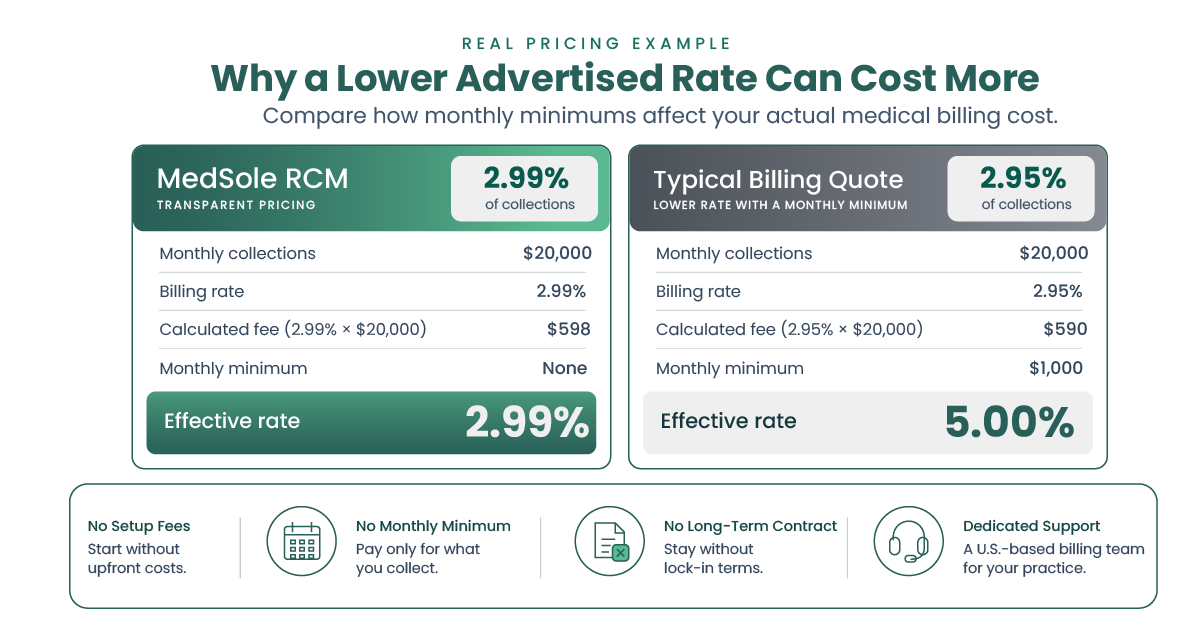
A "starting at" rate is the lowest rate a billing company offers, and a given practice may sign at a higher one. Monthly minimums can push the effective rate well above the advertised number. To compare outsourced medical billing service pricing, use the effective rate: the total monthly fee divided by monthly collections.
How to Calculate Your Effective Rate
Effective rate is the total monthly billing fee divided by monthly collections. It puts a percentage quote, a quote with a minimum, and a flat fee on equal terms. The table compares three hypothetical quotes at four collection levels, with each fee shown in dollars and as an effective rate.
Effective rate of three hypothetical quotes at four monthly collection levels
|
Monthly collections |
Quote A: 2.95% with a $1,000 minimum |
Quote B: 3.5%, no minimum |
Quote C: $1,500 flat |
|---|---|---|---|
|
$10,000 |
$1,000 (10.0%) |
$350 (3.5%) |
$1,500 (15.0%) |
|
$20,000 |
$1,000 (5.0%) |
$700 (3.5%) |
$1,500 (7.5%) |
|
$50,000 |
$1,475 (2.95%) |
$1,750 (3.5%) |
$1,500 (3.0%) |
|
$100,000 |
$2,950 (2.95%) |
$3,500 (3.5%) |
$1,500 (1.5%) |
Below $33,898 in monthly collections, Quote A's $1,000 minimum applies. Quote C's $1,500 flat fee costs less than Quote B's 3.5% in any month above $42,857. Despite the lowest advertised rate, Quote A produced the lowest medical billing cost at one of the four levels, $50,000.
On any quote with a minimum, I'd get the minimum in writing and test it against the practice's three slowest months from last year. Slow seasons, holiday weeks, and provider leave are when the floor kicks in.
How to Get Quotes You Can Compare
A "starting at" rate depends on specialty, monthly collections, claim volume, payer mix, services included, and contract length. Published answers to "how much do medical billing companies charge" can't account for those six inputs, so ask each vendor the same five questions in writing:
- Do my specialty and monthly volume change the rate?
- Is there a monthly minimum, and how much is it?
- Are any services billed outside the rate?
- Does the contract have a fixed term or an exit fee?
- Is the fee charged on charges or on collections?
Written answers turn medical billing quotes into numbers you can line up. Put each one through the effective-rate formula at your last three months of collections. If you compare pricing for outsourced RCM services the same way, include the extra scope each quote covers, such as eligibility checks and prior authorization.
Medical billing services cost more as a share of collections for small and new practices, since their collections sit closest to any minimum. Our guide to billing for small practices goes deeper on contracts at that size. Medical billing pricing with a $1,000 floor turns a 2.95% rate into 10% at $10,000 a month.
Before you sign anything, run your last three months of collections through the table above. If you'd like someone to check that math against your denial rate, AR aging, and payer mix, the free billing audit in the pricing section below does that.
What Should a Medical Billing Fee Include?
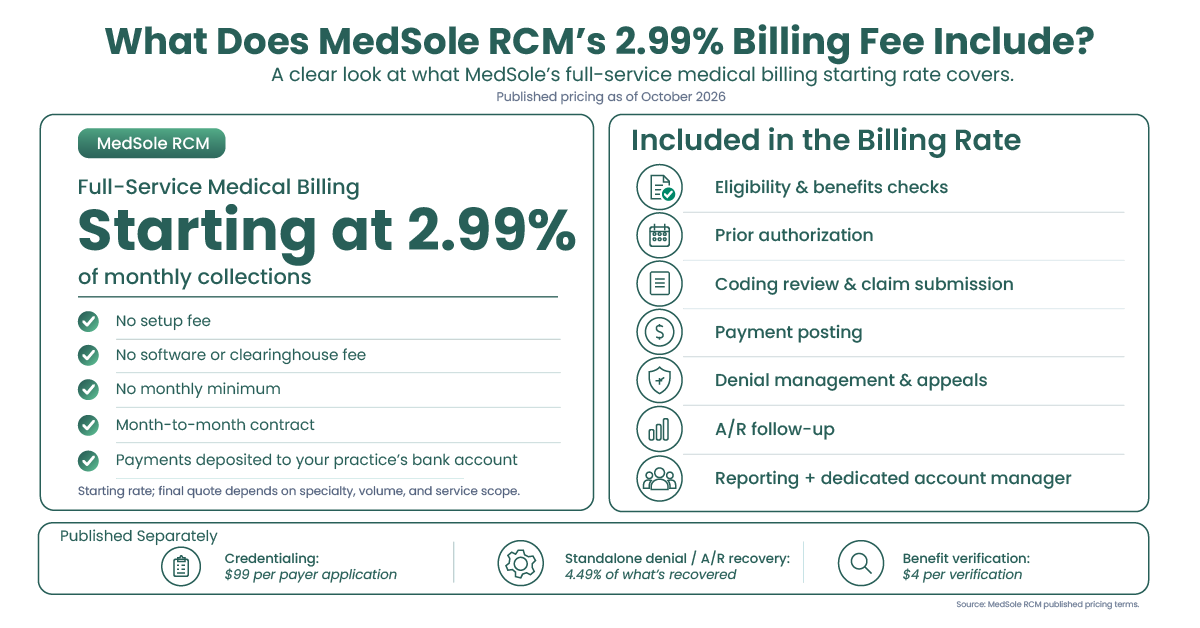
A full-service medical billing fee should cover every step from the eligibility check to the final payment. That means coding review, claim submission, payment posting, denial appeals, and AR follow-up, plus monthly reporting and a named contact who knows the account. Medical billing fees charged outside the rate should be listed in the contract before you sign.
What a Full-Service Rate Should Cover
Seven services belong inside a full-service rate, and each one protects revenue at a different point in a claim's life.
|
Service |
What it covers |
Why it belongs inside the rate |
|---|---|---|
|
Eligibility and benefits checks |
Coverage and patient cost share confirmed before the visit |
Eligibility errors become denials later |
|
Prior authorization |
Requests submitted and tracked to a decision |
A missing authorization is a preventable denial |
|
Coding review and claim submission |
CPT, ICD-10, HCPCS, and modifiers checked before the claim goes out |
Clean claims are the core of the service |
|
Payment posting |
ERA and EOB payments posted and checked against expected rates |
Underpayments surface here |
|
Denial management and appeals |
Each denial worked to root cause and appealed |
A denied claim is unpaid revenue |
|
AR follow-up |
Unpaid claims worked by age and filing deadline |
Aging claims lose value every week |
|
Reporting and a named account manager |
Regular reports and one person who knows the account |
Without these, the practice can't judge performance |
If denials and AR follow-up cost extra, the headline rate only covers the claims that pay on the first try. Every denied or stalled claim then carries a second charge on top of the first.
Fees That Often Sit Outside the Rate
Seven charges show up outside the headline rate often enough that each one deserves a direct question:
- A setup or onboarding fee, charged once before the first claim goes out
- A monthly minimum, which raises the effective rate in every slow month
- Software or clearinghouse fees, passed through as a monthly line item
- Patient statement charges for printing and mailing, billed per statement
- A cleanup fee for old AR from before the switch
- Credentialing fees, often charged per payer application
- An early termination fee for leaving a multi-year contract before the term ends
Old AR cleanup is often priced as a separate project, and the delay costs money. Claims near the timely filing limit lose value while a contract is negotiated, so ask whether aged AR follow-up starts on day one and at what rate.
Each of these can raise your medical billing cost without changing the headline rate. Ask for the complete fee list in writing. A billing company with no hidden charges can hand it over in one page.
How Much Does In-House Medical Billing Cost?
In-house medical billing costs about $69,700 a year for one billing and posting clerk in wages and benefits, based on BLS May 2025 wages and June 2026 benefit costs. A medical records specialist, the category that includes coders, costs about $73,500. Software, clearinghouse fees, and training add to that total.
What One Biller Costs in Wages and Benefits
Wages are one part of an employee's cost. The BLS employer compensation costs release for June 2026 shows benefits make up 30.4% of compensation in health care and social assistance, or $15.42 of $50.68 an hour. Dividing wages by 0.696 gives the full cost of one employee.
The table applies that 0.696 divisor to BLS May 2025 median and mean wages, using the same BLS data on billing and coding occupations.
|
Role (BLS, May 2025) |
Hourly wage |
Annual wages |
Wages plus benefits |
|---|---|---|---|
|
Billing and posting clerk, median |
$23.32 |
About $48,500 |
About $69,700 |
|
Medical records specialist (includes coders), median |
$24.59 |
$51,140 |
About $73,500 |
|
Medical records specialist, mean |
$27.30 |
$56,790 |
About $81,600 |
BLS has no separate category for billers who also code. Pay varies by state.
Costs Beyond Salary
Any outsourced vs in-house medical billing comparison has to count more than wages. An in-house team needs practice management or billing software, clearinghouse pricing per claim or per month, and coding certification with continuing education.
Coverage for a biller's time off is the cost that's easiest to miss. Claims that sit while a solo biller is out sick or on leave can run past Medicare's 12-month filing limit, and Medicare late-filing denials can't be appealed outside narrow exceptions.
How Many Claims Can One Biller Handle?
The figure that circulates online, 50 to 63 accounts a day, traces back to one Alabama hospital CFO. In a 2015 HFMA billing staff Q&A from the Healthcare Financial Management Association, updated November 2022, that CFO gave it as the hospital's follow-up goal, excluding billing claims. HFMA doesn't endorse or guarantee the accuracy of those answers, per its own disclaimer.
Another expert in the same Q&A recommends measuring the average time each task type takes in place of a flat daily count. No national standard exists. Productivity depends on payer mix, specialty, and whether one person handles billing, follow-up, and appeals.
On base pay alone ($51,140), a 2.99% fee equals one medical records specialist's salary at about $1.71 million a year in collections. With benefits included ($73,500), that line moves to about $2.46 million a year, or about $205,000 a month. Below those levels, the in-house medical billing cost runs higher than the fee.
If you want this comparison run on your own numbers, our billing page has an in-house vs outsourced costs breakdown. It answers "how much does it cost to outsource medical billing" for a practice your size, using your collections in place of national medians.
Can a Billing Company Charge a Percentage on Medicare Claims?
Yes, when Medicare pays the practice. Under 42 CFR 424.73(b)(3), a billing agent that receives Medicare payments can't be paid in a way "related in any way to the dollar amounts billed or collected." The agent's pay also can't depend on whether payment is collected, and Medicare issues payment in the provider's name.
The rule turns on who receives the money. If insurance payments land in the practice's own bank account and the practice then pays the billing company, the agent payment rule doesn't apply. The regulation text quoted here comes from the eCFR, current as of October 15, 2026.
The Office of Inspector General (OIG) looks at the same arrangements from a fraud angle. Its 1998 OIG billing company guidance for third-party medical billing companies notes "a longstanding concern that percentage billing arrangements may increase the risk of upcoding." That guidance says coders' pay shouldn't create an incentive to upcode, and it recommends claim reviews before and after submission.
Two questions settle the compliance basics before you sign:
- Do Medicare payments go into the practice's bank account or the billing company's?
- Does the billing company code the claims, and who audits that coding?
For contract wording on Medicare payments and coding incentives, a healthcare attorney is the right reviewer.
What Factors Change Medical Billing Costs?
Six factors move medical billing cost the most: specialty, claim volume and value, payer mix, denial rate and AR backlog, new-practice status, and automation. Location sets in-house wages and has no bearing on what billing companies charge.
The table shows what each factor does to the price and what to check in your own numbers.
|
Factor |
Why it changes the cost |
What to check |
|---|---|---|
|
Specialty |
Coding rules, modifiers, and authorization needs vary. Medicare routine foot care claims in podiatry, for example, need Q7, Q8, or Q9 class findings modifiers. |
Has the company billed your specialty? |
|
Claim volume and value |
Many low-dollar claims make per-claim pricing expensive relative to collections |
Your average paid amount per claim |
|
Payer mix |
Medicaid and Medicare pay less per visit, so percentage fees bring in less per claim |
Your share of government payers |
|
Denial rate and AR backlog |
More rework per dollar collected |
Your current denial rate and AR over 90 days |
|
New practice |
Credentialing has to finish before claims pay |
Which payers you're enrolled with |
|
Location |
Billing company fees aren't set by state, but in-house wages are |
BLS state wage data if you're hiring |
Medical billing rates on any quote reflect these factors, so two practices with the same collections can get different prices from the same company.
Mental Health and Therapy Practices
Mental health billing services cost more per dollar collected under per-claim pricing, because therapy practices send many claims of moderate value. Psychotherapy codes are time-based: 90834 covers 38 to 52 minutes, and 90837 covers 53 minutes or more. Percentage pricing tracks claim value, so it scales with the session mix.
Behavioral health carve-out plans often need their own credentialing, separate from the medical plan. Telehealth-heavy practices add place-of-service (POS) codes and modifiers to check on every claim, which is extra work any quote for telehealth billing services should price in.
Automation and Staffing
Software now handles eligibility checks and claim scrubbing, which lowers the work behind each claim. Appeals, payer calls, and coding judgment still need trained people. For an in-house practice, the larger risk is depending on one person: if the only biller leaves, claims stop moving.
If most of your visits are therapy sessions or telehealth, ask any billing company how its fee works on your average claim value before comparing rates. Our team can walk through that math with you on a call.
How Do You Know If a Billing Fee Is Worth It?
A billing fee is worth paying when your adjusted collection rate, days in A/R, and denial rate meet the benchmarks. Under the AAFP revenue cycle benchmarks from the American Academy of Family Physicians, those targets are 95% or higher, under 50 days, and under 5% preferred. Together, they show what your medical billing cost is buying.
The American Academy of Family Physicians (AAFP) defines each benchmark with its own formula.
|
Metric |
How it's calculated |
AAFP benchmark |
|---|---|---|
|
Adjusted collection rate |
Payments (net of credits) ÷ charges (net of contractual adjustments) |
95% minimum. 95% to 99% is average, and top performers reach at least 99%. |
|
Days in A/R |
Total receivables ÷ average daily charges |
Under 50 days. 30 to 40 days preferred. |
|
Denial rate |
Dollars denied ÷ dollars submitted |
5% to 10% is the industry average. Under 5% preferred. |
Cost to collect is the total cost of the revenue cycle divided by total collections. For an outsourced practice, cost to collect across the revenue cycle is the effective rate plus the staff time your office still spends on billing. At $50,000 in collections, a 3.5% fee plus $500 of staff time comes to 4.5%.
Don't confuse average medical billing collection rates, meaning the fee a company keeps, with your adjusted collection rate, meaning the share of allowed revenue you receive. You want the first number low and the second one high.
When Doesn't Outsourcing Medical Billing Pay Off?
Outsourcing may not pay off for a group with an experienced, stable billing team and collections far above $2.46 million a year. The same holds when the denial rate sits under 5% and days in A/R run 30 to 40. Partial outsourcing often fits that group better.
Run the ROI of outsourcing revenue cycle management as a formula before deciding:
ROI = (in-house cost avoided + extra revenue recovered − outsourced fee) ÷ outsourced fee
Keeping billing in-house makes more sense in three cases:
- Collections above the in-house break-even point, with low billing staff turnover
- A dedicated billing department that includes specialty coders
- KPIs already at the AAFP benchmarks for collection rate, days in A/R, and denials
The middle path keeps billing in-house and sends denials or aged AR out. That work is often priced as a share of what's recovered, so the outsource medical billing cost stays tied to results. Standalone denial management fits groups whose first-pass claims go out clean but whose appeals pile up.
How to Choose a Medical Billing Company, and What MedSole RCM Charges
The best medical billing company for a practice puts its full fee list, collections definition, contract terms, and reporting in writing before you sign. It has billed your specialty, and it sends insurance payments to your own bank account. Those tests keep your medical billing cost visible from the first month.
What to Look for in a Medical Billing Company
Use these eight criteria to compare any billing company, including us:
- A published fee list with no unlisted add-ons
- An effective rate at your collections, in writing
- A fee based on collections, not charges
- Denials, AR follow-up, and old AR included in the rate
- Insurance payments deposited to the practice's account
- A signed BAA before any patient data is shared
- Monthly KPI reporting and a named account manager
- Month-to-month terms, or an exit clause without penalties
Practices looking for affordable medical billing services should compare effective rates at their own collections, since headline rates leave out minimums and add-ons. A medical billing company for small practices should clear all eight, because a small practice has the least room to absorb a surprise fee.
What MedSole RCM Charges (as of October 2026)
The table lists MedSole RCM's published terms as of October 2026, and every fee MedSole charges appears in it.
|
Item |
MedSole RCM, as of October 2026 |
|---|---|
|
Full-service medical billing |
From 2.99% of monthly collections, calculated on the payments collected each month |
|
Setup, software, and clearinghouse fees |
None |
|
Monthly minimum |
None |
|
Contract |
Month to month |
|
Denial management and AR follow-up |
Included in the billing rate |
|
Old AR from before the switch |
Included, with no separate fee |
|
Patient statements |
No separate printing or mailing charge |
|
Account management |
A dedicated account manager who replies within 24 hours, plus a weekly AR update and a monthly dashboard |
|
Insurance payments |
Deposited to the practice's own bank account |
|
Data protection |
BAA signed before any patient data is accessed |
|
Credentialing |
$99 per payer application |
|
Denial or AR work bought on its own |
4.49% of what's recovered |
|
Benefit verification bought on its own |
$4 per verification |
|
Hospital billing |
2.5% of collections |
|
Go-live |
First claims within 7 to 10 business days |
|
Quote |
A written quote on your own collections before you sign |
MedSole's credentialing team files applications within 48 hours of receiving complete documents and follows up with each payer weekly. Across MedSole's current applications, Medicare and Aetna decide in 30 to 45 days, most commercial plans take 40 to 70 days, and state Medicaid programs take about 90 days.
For practices comparing a credentialing company on price, MedSole charges $99 per payer application, so enrolling one provider with five insurance plans costs $495. Our provider credentialing services page has the details of the enrollment process.
If you'd like to see where your claims stand before choosing anyone, start with MedSole RCM's free billing audit. It pulls your denial rate, AR aging, clean claim rate, net collection rate, and payer mix into a written report. There's no cost or commitment, and our full-service medical billing page has the details.
Medical Billing Cost FAQs
How much do medical billing companies charge on average?
Published starting rates begin below 3% of collections, and billing companies' own guides cite 4% to 10% for full service. No neutral survey sets an average medical billing percentage. Your real medical billing cost depends on minimums, scope, and specialty, so compare quotes by effective rate.
How much do medical billing companies charge per claim?
Billing company guides list medical billing rates per claim at about $3 to $12. To compare that with a percentage quote, convert it to an effective rate: claims times fee, divided by collections. At 400 claims, a $6 fee, and $36,000 in collections, the effective rate is 6.7%.
How much does a medical billing and coding company charge per hour?
Few full-service companies bill hourly, so there's no reliable average medical billing and coding company charge per hour. Hourly pricing shows up in staffing and audit work. BLS May 2025 data puts the median wage at $23.32 an hour for billing clerks and $24.59 for medical records specialists.
Is flat fee medical billing cheaper than percentage billing?
Flat fee medical billing is cheaper only above a certain collection level. A $1,500 flat fee costs less than a 3.5% rate once monthly collections pass $42,857. Below that level, the percentage costs less, and a slow month makes the flat fee more expensive as a share of collections.
How much does a medical billing service cost for a small practice?
At $20,000 a month in collections, a 4% fee costs $800 a month. A 2.95% rate with a $1,000 monthly minimum costs $1,000 at that level, an effective 5%. Small practices should ask about minimums first, since a floor raises the effective rate most at low collections.
How many claims can a medical biller handle a day?
There's no national standard. The 50 to 63 figure quoted online is one Alabama hospital CFO's follow-up goal in a 2015 HFMA Q&A, updated in 2022, and it excluded billing claims. Real capacity depends on payer mix, specialty, and whether one person handles billing, follow-up, and appeals.
Will AI replace medical billers?
Billing software now handles eligibility checks and claim scrubbing, while appeals, payer phone calls, and coding judgment still need trained people. That split cuts manual work per claim without removing the biller. For practices, the bigger staffing risk is depending on one in-house biller, because claims stop moving when that person leaves.
What does MedSole RCM charge for billing and credentialing?
As of October 2026, MedSole RCM's billing starts at 2.99% of monthly collections, with no setup fee, no software fee, and no monthly minimum, and credentialing costs $99 per payer application. Denials, AR follow-up, and old AR are included in the billing rate, and every client gets a dedicated account manager.