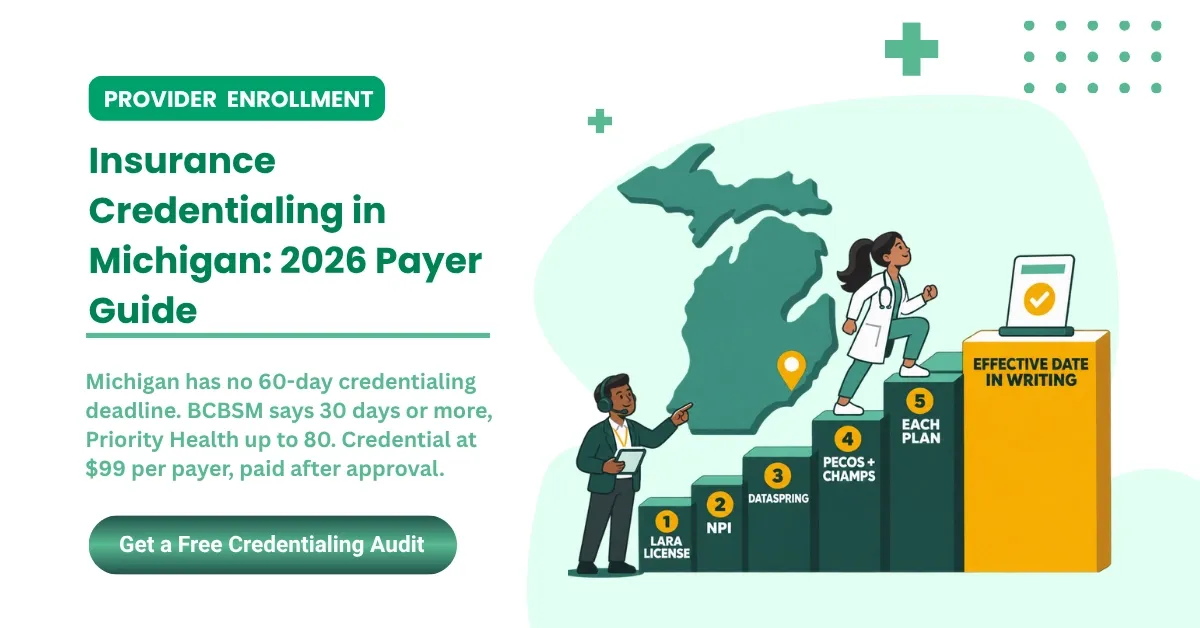




Insurance credentialing in Michigan means clearing five separate approvals: an active Michigan license through LARA, an NPI, a DataSpring (formerly CAQH ProView) profile, enrollment in Medicare (PECOS) and Michigan Medicaid (CHAMPS), and credentialing with each health plan you want to join. Payers won't pay your claims until all five are in place.
Two big changes landed in 2026. CAQH has operated as DataSpring since June 7, and Michigan's Medicaid health plans switched to one standardized credentialing packet on October 1. Most guides you'll find online were written before both changes, so their forms and steps no longer match what payers ask for.
Picture a new physician who starts on the 1st. Nobody confirmed effective dates, so the first month of visits can't go out in-network, and the practice either loses that revenue or collects it at out-of-network rates. You'll get payer-by-payer steps, published timelines, costs, and the 2027 changes below, so you can plan start dates around real numbers.
In This Guide
- What Insurance Credentialing in Michigan Involves
- What Changed for Michigan Credentialing in 2026
- Insurance Credentialing Requirements in Michigan
- How to Get Credentialed in Michigan, Step by Step
- Where to Apply Online and Which Forms Each Payer Uses
- How Credentialing Works With Michigan's Major Payers
- How Long Insurance Credentialing in Michigan Takes
- Credentialing Requirements by Provider Type
- What Michigan Law Says About Payer Credentialing
- Staying Credentialed: Revalidation vs Recredentialing
- Seeing Patients and Billing Before and After Approval
- What Credentialing Costs in Michigan
- What Michigan Providers Should Plan for in 2027
- Doing It Yourself vs Outsourcing Credentialing in Michigan
- Insurance Credentialing in Michigan: FAQs
- Next Steps for Michigan Practices
What Insurance Credentialing in Michigan Involves
Health insurance credentialing in Michigan is the review a payer runs on your license, education, work history, malpractice record, and sanctions history before it adds you to a network. Your state license comes first. Each payer then decides, on its own schedule, whether you can bill its members in-network.
You enroll in a provider network one plan at a time. A provider can show active with Blue Cross Blue Shield of Michigan and still sit in pending status with Priority Health for weeks. Start with the insurance panels in Michigan your patients carry most, since those plans cover the most visits on your schedule.
Credentialing, Enrollment, and Contracting Aren't the Same Step
No, credentialing and enrollment aren't the same thing. Practices mix up three separate steps, and each one has its own paperwork, its own contact person, and its own delay:
- Credentialing: the payer verifies who you are. Provider credentialing relies on primary source verification of your license, education, malpractice history, and sanctions.
- Enrollment: a program sets you up to bill it, such as Medicare through PECOS or Michigan Medicaid through CHAMPS.
- Contracting: you sign the agreement that sets your rates and your in-network effective date.
Credentialing without a signed contract leaves you stuck. The payer has verified you, but you have no in-network effective date, so your claims process out-of-network. If a practice calls us about stalled insurance credentialing and contracting, we check for an unsigned agreement first.
Why Licensure Alone Doesn't Get You Paid
A Michigan license from LARA lets you practice. It doesn't make you billable. Provider network enrollment is a separate approval with each payer, and claims for visits before your effective date come back out-of-network or denied in most cases.
Some practices hand the whole sequence to a provider enrollment and credentialing services team. Others keep it in-house with one coordinator and a tracking sheet. Both approaches work if someone owns the follow-up calls every two weeks.
What Changed for Michigan Credentialing in 2026
Insurance credentialing in Michigan picked up five changes in 2026, touching Medicaid health plans, Medicare groups, behavioral health clinicians, and Meridian's malpractice rules. If your internal checklist was written before October 2026, compare it against this table before your next submission goes out.
|
Change |
Effective date |
Who it affects |
Source |
|---|---|---|---|
|
One standardized credentialing packet for Medicaid health plans |
October 1, 2026 |
Individual practitioners joining Michigan Medicaid health plans |
MAHP |
|
CAQH now operates as DataSpring, powered by CAQH |
June 7, 2026 |
Every provider with a CAQH profile |
DataSpring |
|
Limited-license behavioral health providers enroll in CHAMPS as Rendering Only |
September 1, 2026 (existing enrollees had until November 1, 2026) |
TLLPs, limited licensed counselors, LLMSWs, and educational LLMFTs |
MDHHS bulletin MMP 26-30 |
|
Revised CMS-855B required |
August 3, 2026 |
Clinics and group practices enrolling or updating in Medicare |
CMS |
|
Certificate of Insurance replaces malpractice attestation |
May 15, 2026 |
Providers credentialing or recredentialing with Meridian |
Meridian |
Medicaid Health Plans Switched to Standardized Credentialing on October 1, 2026
As of October 1, 2026, Michigan's Medicaid health plans use one standardized credentialing packet for individual practitioners. MDHHS and the plans agreed on the process, and MAHP hosts the forms. You enroll in CHAMPS, complete or update DataSpring if it applies to you, then send the same packet to each plan.
The packet includes:
- MAHP Provider Enrollment Form
- Excel roster, for practices with five or more providers
- Practicing Locations Form, if you see patients at more than one site
- Disclosure Questions, for providers without a DataSpring profile
- Cultural Competency Attestation
- CSHCS Physician Attestation, if it applies
- Collaborating/Supervising Physician Form, if it applies
Health plan credentialing decisions still belong to each plan. MAHP says a completed form doesn't guarantee a contract offer, and the process doesn't cover delegated arrangements. Download current forms from the MAHP standardized credentialing resources page each time you apply. MAHP last updated that page on October 20, 2026, and forms change without much notice.
Is CAQH Now DataSpring?
Yes. CAQH announced on June 7, 2026 that it now operates as DataSpring, powered by CAQH. DataSpring's FAQ for clinicians says your login, portal access, and existing profile stay the same, and providers still pay nothing to use the portal. You don't need to rebuild anything.
Keep attesting on schedule. CAQH's long-standing rule is every 120 days, and BCBSM asks practitioners to attest every 90. Several payer pages still say CAQH, so treat both names as the same profile. Our DataSpring (CAQH) profile guide covers setup and payer authorizations.
Limited-License Behavioral Health Providers Now Enroll as Rendering Providers
Since September 1, 2026, limited-license behavioral health providers enroll in CHAMPS with a Type 1 NPI as "Rendering Only." MDHHS bulletin MMP 26-30, issued July 31, 2026, ties each one to an organizational billing provider with a Type 2 NPI and a Medicaid-enrolled, fully licensed supervisor of the same profession.
Clinicians already enrolled under "Managed Care Only" specialties had until November 1, 2026 to report and link their supervisor's NPI in CHAMPS. The MDHHS bulletin MMP 26-30 warns that missing it risks disenrollment and claim denials.
Picture a group practice with three LLMSWs whose supervisor link never got added. Their Medicaid plan claims start denying, and the billing team traces it back to CHAMPS weeks later. Pull your CHAMPS records now and confirm every limited licensee shows a linked supervisor.
Medicare's Revised CMS-855B Became Mandatory on August 3, 2026
Starting August 3, 2026, clinics and group practices must file the revised CMS-855B, according to the CMS revised 855B notice. The new version lets groups set up, end, or change reassignments, and it drops the physician assistant employer relationship option.
Two more changes matter for planning. The form adds a submission reason for groups enrolling only to take part in Medicaid, and it lists telehealth as a practice location type. If your group bills virtual visits, our telemedicine credentialing guide covers the payer side.
Payer Rule Changes Michigan Practices Missed
Meridian stopped accepting professional liability attestations on May 15, 2026, so you now need a current Certificate of Insurance for credentialing and recredentialing. Priority Health moved individual providers who join for Medicaid only to a standardized form sent by email, separate from its prism portal requests.
Insurance Credentialing Requirements in Michigan
Insurance credentialing requirements in Michigan fall into two groups. One is the standard file every payer verifies. The other is a short list of Michigan rules that catch practices moving in from other states. Missing items cause most delays, and Priority Health's processing clock starts only once your information is complete.
Documents Every Michigan Payer Asks For
|
Requirement |
Who needs it |
Where it comes from |
Common delay |
|---|---|---|---|
|
Active Michigan license |
Every provider |
LARA; verify it on MiPLUS |
License still pending when applications go out |
|
NPI |
Type 1 for each provider, Type 2 for the group |
NPPES |
Group NPI tied to an old address |
|
DataSpring (formerly CAQH ProView) profile |
Most commercial and Medicaid plans |
Provider Data Portal |
Profile complete but not authorized for the payer |
|
Malpractice Certificate of Insurance |
Every provider |
Your carrier |
Expired COI or limits below the payer's minimum |
|
Five-year work history |
Every provider |
Your CV |
Gaps of six months or more without a written explanation |
|
Education and board certification |
Every provider; board status where the plan requires it |
Schools and certifying boards |
Training dates that don't match the CV |
|
W-9 and tax ID |
The billing entity |
IRS records |
Legal name that doesn't match the IRS letter |
|
Ownership and disclosure forms |
Groups, facilities, and some individuals |
HAP, MAHP, and other plans |
Unsigned or undated pages |
|
CHAMPS enrollment |
Anyone serving Michigan Medicaid members |
MDHHS |
Skipped by providers who only see plan members |
|
Sanctions screening |
Every provider |
OIG exclusions list and state lists |
Past board actions left off the application |
A few rows deserve detail. Check your license on LARA's MiPLUS licensing system before you apply anywhere. Priority Health requires malpractice limits of at least $100,000 per claim and $300,000 aggregate, and Meridian wants the COI itself, not an attestation.
Work history gaps trip up more files than most people expect. MDHHS's credentialing policy for behavioral health plans asks for five years of history, with any gap of six months or more explained in writing. Write those explanations once, keep them on file, and reuse them for every payer.
Payers also screen the OIG exclusions program list before approval. Payer staff, or a credentials verification organization (CVO) working for the payer, confirm each item with the original issuing source. Provider credentialing depends on that primary source check, so a single typo can add weeks.
Michigan-Specific Requirements Most Out-of-State Guides Miss
Yes, you need an active Michigan license before payers will credential you. Beyond the license, five Michigan rules cause the most rework:
- Michigan controlled substance license. Prescribers need it in addition to DEA registration, and DEA registration depends on state authority, so get the state license first.
- NP delegation for controlled substances. Michigan nurse practitioners prescribe Schedule 2 to 5 drugs under physician delegation, so payers look for the delegation paperwork as well as the DEA number.
- PA practice agreement. Michigan physician assistants practice under a practice agreement with a participating physician, and plans ask for a copy.
- Fingerprint background check. Applicants for an initial Michigan health license complete a fingerprint-based criminal background check under MCL 333.16174.
- CHAMPS enrollment. Providers who only see Medicaid health plan members still need it (Step 4 below covers the details).
A common example: an NP's BCBSM application sits idle for a month because nobody uploaded the delegation agreement to DataSpring. Insurance credentialing in Michigan moves faster when those Michigan documents sit in the profile before the first application goes out.
How to Get Credentialed in Michigan, Step by Step
The order matters more than the paperwork. Start the slow government enrollments early and run them side by side, then apply to commercial payers and Medicaid plans together. Nobody sees patients in-network until each effective date is confirmed. The same sequence works for new doctors joining insurance networks in Michigan and for anyone starting a practice in Michigan.
Step 1: Confirm Your License and Controlled Substance Registrations
Check your LARA license on MiPLUS first. Payers check it at the source, so a pending or lapsed status stops every application behind it. Prescribers then need the Michigan controlled substance license, followed by DEA registration at the Michigan address. Upload both certificates to DataSpring the day they arrive, since payers verify them before anything else.
Step 2: Get or Update Your NPI
Every provider needs a Type 1 NPI, and the group needs a Type 2. Both come from NPPES at no cost. Update the practice location, mailing address, and taxonomy before you apply anywhere. A Type 2 NPI still showing a former suite number creates mismatches that payers flag during verification, and fixing it mid-application adds another round of back-and-forth.
Step 3: Complete and Attest Your DataSpring Profile
Upload your documents to DataSpring (formerly CAQH ProView), attest, and authorize each target payer. Most Michigan commercial plans pull your file from there. The most common delay we see is a profile that's complete but never authorized for the payer reviewing it. Set a calendar reminder for re-attestation before you submit anything else.
Step 4: Enroll in CHAMPS First, Even for Medicaid Plan Patients Only
Enroll in CHAMPS through MiLogin before you apply to any Medicaid health plan. MDHHS repeated in a June 25, 2026 alert that all providers serving Michigan Medicaid beneficiaries, in state or out of state, must be screened and enrolled. Federal rules require the same for managed care network providers, and the MAHP process lists CHAMPS as step one.
The MDHHS provider enrollment page also lists SIGMA registration for some enrollment types. Our guide to Michigan Medicaid CHAMPS enrollment walks through each screen. Run it alongside PECOS. That's the cleanest way to enroll with Medicare and Medicaid in Michigan without one application waiting on the other.
Step 5: Enroll in Medicare Through PECOS
File the CMS-855I in PECOS for each individual provider. Reassignment to your group now happens on the 855I, since CMS merged the old 855R into it. Groups file the revised CMS-855B. Physicians and other practitioners pay no application fee. Our Medicare provider enrollment guide covers the PECOS screens.
Step 6: Apply to Commercial Payers and Medicaid Plans in Parallel
Submit to BCBSM and BCN, Priority Health, HAP, and your Medicaid plans at the same time. Insurance credentialing in Michigan stalls when practices apply to one payer and wait for its answer. Track every application on one sheet and follow up every two weeks. That habit lets you enroll in a provider network without losing a month.
Say a group adds a psychiatrist and skips CHAMPS because "we only take Meridian." Meridian credentials her, the contract comes through, and every claim still denies. The billing team spends six weeks finding the gap, fixes CHAMPS, and rebills what it can.
Step 7: Confirm Effective Dates in Writing Before Scheduling
Get the effective date in writing from each payer before you book its members. BCBSM pays only in networks where your status shows "Active." Priority Health tells providers not to treat members as in-network before the network effective date. HAP's enrollment page says it in one line: "you can't treat our members until you receive your effective date."
|
Want This Sequence Run for You? We handle DataSpring, CHAMPS, PECOS, and every Michigan payer application, with follow-up until each effective date is in writing. Credentialing starts at $99 per payer application. |
Where to Apply Online and Which Forms Each Payer Uses
You can apply for insurance credentialing in Michigan online with most systems and payers, though not all of them. BCBSM still takes enrollment packets by fax, and HAP starts with an email request before it sends an application link. Use these two tables to find each entry point and form.
Online Portals by System and Payer
|
System or payer |
Where you apply |
What it handles |
|---|---|---|
|
LARA licensing |
MiPLUS |
License applications, renewals, and verification |
|
NPI |
NPPES |
Type 1 and Type 2 NPIs |
|
DataSpring |
Provider Data Portal |
Credentialing profile and payer authorizations |
|
Medicare |
PECOS |
CMS-855I, CMS-855B, and reassignments |
|
Michigan Medicaid |
CHAMPS through MiLogin, with SIGMA registration for some types |
Medicaid enrollment and revalidation |
|
BCBSM and BCN |
Download forms, fax the packet to 1-866-900-0250 |
Enrollment; BCN contracts arrive by DocuSign when required |
|
Priority Health |
prism portal, under Enrollments & Changes |
New individual and organizational enrollments |
|
HAP |
Email providernetwork@hap.org, then complete eApply |
Group, individual, facility, and pharmacist enrollment |
|
Meridian |
Contract Request Form |
Network participation requests |
|
Medicaid health plans |
MAHP standardized packet, sent to each plan |
Individual practitioner credentialing |
Forms You'll Be Asked For
Most insurance credentialing forms in Michigan come from a short list. Each provider credentialing application below has a different owner, so download it fresh from the source on the day you apply rather than reusing last year's copy.
|
Form |
Who files it |
What it's for |
|---|---|---|
|
MAHP Provider Enrollment Form and roster |
Practitioners joining Medicaid plans; roster for five or more providers |
Starts Medicaid plan credentialing |
|
MAHP supporting forms |
Practitioners, as they apply |
Practicing locations, disclosures, cultural competency, CSHCS, collaborating physician |
|
CMS-855I |
Individual practitioners |
Medicare enrollment and reassignment |
|
CMS-855B |
Clinics and groups |
Medicare group enrollment (revised version required since August 3, 2026) |
|
CHAMPS enrollment application |
Every Michigan Medicaid provider |
Medicaid enrollment |
|
BCBSM enrollment application and checklist |
Professional and facility providers |
BCBSM network enrollment |
|
Priority Health Medicaid-only form |
Individual providers joining for Medicaid only |
Sent by email, outside prism |
|
Disclosure of Ownership and Control Interest Form |
HAP applicants |
Ownership disclosure |
|
W-9 |
The billing entity |
Tax identity |
How Credentialing Works With Michigan's Major Payers
Each Michigan payer runs its own credentialing process, timeline, and portal, so the same provider can be active with one plan and pending with another. Most practices start insurance credentialing in Michigan with Blue Cross Blue Shield of Michigan, the state's largest insurer. Blue Care Network, its HMO arm, is a separate approval with its own contract.
|
Payer |
How to apply |
Published timeline |
Key requirement |
|---|---|---|---|
|
BCBSM and BCN |
Fax the packet; BCN contracts arrive by DocuSign |
30 days or more |
Authorize BCBSM in DataSpring |
|
Priority Health |
prism, Enrollments & Changes |
Up to 80 calendar days after complete information |
Active CHAMPS enrollment for Medicaid |
|
HAP |
Email request, then eApply |
None published |
Medicare participation and a participating group Type 2 NPI |
|
Meridian |
Contract Request Form |
Review within 30 business days, in most cases |
Active CHAMPS ID and a current COI |
|
Medicaid health plans |
MAHP standardized packet |
Credentialing decision within 60 days; contract decision within 90 |
CHAMPS enrollment first |
|
Medicare |
PECOS, processed by WPS |
No fixed published figure |
CMS-855I or CMS-855B |
|
PIHPs and CMHSPs |
Each PIHP's own process |
Decision within 90 calendar days |
Uniform credentialing under Public Act 282 of 2020 |
BCBSM and Blue Care Network
BCBSM says enrollment "may take 30 days or more" once it receives your faxed packet at 1-866-900-0250. Before you fax anything, complete your DataSpring profile and authorize BCBSM to pull it, because Blue Cross Blue Shield credentialing for most networks runs through that profile.
Organizational providers get one shortcut. Their enrollment application doubles as the credentialing application, though BCBSM may require a site visit. Credentialing with Blue Cross Blue Shield of Michigan also needs upkeep: maintenance every three years, practitioner attestation every 90 days, and some data every 120 days.
Some providers also receive BCN or BCN Advantage contracts by DocuSign. A common version of this problem: PPO claims pay while every BCN HMO claim denies, because the BCN contract sat unsigned in someone's inbox. BCBSM pays only in networks where your status shows "Active," so check each network line.
For the BCBSM provider enrollment phone number, call 1-800-822-2761, and allow 30 days before asking for a status. The BCBS credentialing phone number for DataSpring help is 1-888-599-1771. Our BCBS MI provider enrollment guide covers the forms line by line. See the BCBSM network enrollment page for current checklists.
How Does Priority Health Credentialing Work?
Priority Health says processing can take up to 80 calendar days after it has your complete credentialing information. Start by registering with CAQH (now DataSpring) and authorizing Priority Health to view your profile. Keep CHAMPS active if you plan to see Medicaid members.
For Priority Health provider enrollment, log into prism, open Enrollments & Changes, and choose a new individual or organizational enrollment. Your request gets an Inquiry ID, and prism is where Priority Health asks for anything missing. If you pass 80 days, email exceedsprocessingtime@priorityhealth.com with that ID instead of posting status comments, which Priority Health says can slow things down.
Its recredentialing process runs on a three-year cycle, and Priority Health starts it for you, so the work on your side is keeping DataSpring current. The full steps sit on the Priority Health credentialing application page.
HAP Provider Enrollment
HAP provider enrollment starts with an email, not a portal. Send your request to providernetwork@hap.org with a subject line such as "Individual Practitioner Enrollment Request," and include your name, Type 1 NPI, Type 2 NPI if you have one, tax ID, PO or PHO, specialty, and primary address. After review, HAP sends an eApply link.
Two rules catch people. HAP requires Medicare participation, and individual practitioners must link to a HAP-participating group's Type 2 NPI, so the group application comes first. Sole proprietors without a Type 2 NPI should say so in the email. The HAP provider enrollment page lists the downloadable forms.
HAP publishes no processing timeline. Routine vision providers join through EyeMed Insight, and hearing aid providers join NationsHearing. HAP CareSource covers Medicaid in Regions 6, 7, 9, and 10, and HAP offers MI Coordinated Health in Macomb and Wayne counties.
Meridian and Michigan's Other Medicaid Health Plans
Meridian reviews a Contract Request Form and, in its words, review "typically happens within 30 business days." You need an active CHAMPS ID for Medicaid participation and, since May 15, 2026, a current Certificate of Insurance. Meridian's provider line is 1-888-437-0606. Details sit on the Meridian provider network page.
The other plans now use the MAHP packet from the 2026 changes above. Medicaid credentialing still varies at the edges: Blue Cross Complete and Upper Peninsula Health Plan accept only the provider's own signature on forms. Insurance credentialing in Michigan for Medicaid plans goes faster when you check each plan's notes in the MAHP contact guide.
Our list of Michigan Medicaid health plans shows which plans serve which regions, so you can decide where to apply first.
UnitedHealthcare, Molina, and Other National Carriers
National carriers run their own credentialing for Michigan commercial, Medicare Advantage, and Medicaid products. Our UnitedHealthcare credentialing guide covers its portal and timelines. Under 42 CFR 422.204, Medicare Advantage plans must recredential at least every three years, so expect regular requests. For Molina's Michigan plans, follow our Molina credentialing steps.
Medicare in Michigan (WPS)
Medicare credentialing in Michigan runs through PECOS, with WPS Government Health Administrators processing Part A and Part B as the Jurisdiction 8 contractor for Michigan and Indiana. Individuals file the CMS-855I, which now handles reassignment, and groups file the CMS-855B.
Plan on revalidation every five years. CMS wants changes in ownership, practice location, and final adverse actions reported within 30 days, and most other changes within 90. Remember HAP too: it won't enroll you without Medicare participation, so Medicare often goes first when you enroll with Medicaid and Medicare in Michigan.
Behavioral Health Through PIHPs and CMHSPs
Specialty behavioral health in Michigan runs through prepaid inpatient health plans (PIHPs) and community mental health services programs (CMHSPs). They run their own credentialing, apart from CHAMPS and the Medicaid health plans, using the uniform credentialing program MDHHS set up under Public Act 282 of 2020.
The MDHHS PIHP credentialing policy gives PIHPs 90 calendar days from a complete application to decide. A provisional decision comes within 31 days, provisional status can't run past 150 days, and recredentialing happens every three years.
A therapist joining a community mental health network needs three approvals in most cases: CHAMPS, the PIHP or CMHSP, and each Medicaid health plan she'll bill. Start all three in the same week, since none of them waits for the others.
How Long Insurance Credentialing in Michigan Takes
In Michigan, most providers should plan on 60 to 120 days from a complete application to the last effective date. That range reflects what billing teams report across payers; it isn't a payer promise. Official figures vary by payer, and each clock starts only after your application is complete.
|
System or payer |
Timeline |
Label |
|---|---|---|
|
CHAMPS |
No published target; most billing teams plan on 30 to 60 days for a clean application |
Typical, industry-reported |
|
Medicaid health plans (MAHP) |
Completeness review within 10 days; credentialing decision within 60 days; contract decision within 90 days |
Official, MAHP |
|
Medicaid health plans (provisional) |
Optional; only if no decision within 30 days, lasting up to 60 days |
Official, MAHP |
|
PIHPs and CMHSPs |
Decision within 90 calendar days; provisional decision within 31 days, provisional status up to 150 days |
Official, MDHHS |
|
BCBSM |
30 days or more |
Official, BCBSM |
|
Priority Health |
Up to 80 calendar days after complete information |
Official, Priority Health |
|
Meridian |
Review within 30 business days, in most cases |
Official, Meridian |
|
HAP |
No published figure |
Official page gives none |
|
Medicare (PECOS) |
No fixed figure; check WPS for current enrollment processing times |
No official target |
Run Medicare and CHAMPS side by side, and track every payer every two weeks. To check your credentialing status, use each payer's own tool: BCBSM asks you to allow 30 days before calling, and Priority Health gives you an Inquiry ID in prism.
Why Michigan Timelines Stretch
Most delays trace back to a handful of fixable problems:
- DataSpring profile not authorized for the payer
- Michigan license or controlled substance license still pending
- Missing NP delegation or PA practice agreement
- CHAMPS skipped for a Medicaid plan application
- Ownership or tax ID data that doesn't match across forms
- Panels closed to new providers in some regions and specialties
Run the math on your own schedule. A provider who sees 20 patients a week at an average allowed amount of $120 generates about $2,400 a week. Eight weeks without in-network status puts $19,200 at risk, before you count the staff time spent rebilling.
|
Each Week Without an Effective Date Has a Cost We submit to every Michigan payer at once, follow up every two weeks, and confirm effective dates in writing. Credentialing starts at $99 per payer application. |
Credentialing Requirements by Provider Type
Insurance credentialing requirements in Michigan shift by provider type. The core file stays the same, but prescribers, NPs and PAs, limited licensees, and dentists each carry one extra Michigan item that payers check. Use this table to spot where insurance credentialing in Michigan trips up providers of each type.
|
Provider type |
Michigan-specific item |
Where it trips people up |
|---|---|---|
|
Physicians (MD, DO) |
Michigan controlled substance license plus DEA |
DEA registration attempted before the state license |
|
Nurse practitioners |
Physician delegation for Schedule 2 to 5 prescribing |
Delegation letter missing or expired |
|
Physician assistants |
Practice agreement with a participating physician |
Agreement never uploaded to DataSpring |
|
Limited-license behavioral health |
CHAMPS "Rendering Only" enrollment with a linked supervisor |
Supervisor NPI not linked in CHAMPS |
|
Dentists |
Board of Dentistry license; CHAMPS for Medicaid dental |
Applying to a medical network instead of a dental one |
|
Therapists, BCBAs, chiropractors, podiatrists, PTs |
Core checklist plus MAHP's provider-type requirements |
Type-specific documents left out |
Physicians (MD and DO)
Michigan physicians need a license from the Board of Medicine or the Board of Osteopathic Medicine and Surgery, plus the Michigan controlled substance license and DEA registration for prescribing. Physician credentialing otherwise follows the checklist above, whether you run it in-house or hire physician credentialing services.
One Michigan rule protects certain physicians. Under section 2212d of the Insurance Code, added by 2018 Public Act 487, insurers and HMOs can't make claim payment depend only on a national or regional certification for family practice, internal medicine, or pediatrics physicians, unless licensure itself requires that certification.
Nurse Practitioners and Physician Assistants
Michigan nurse practitioners prescribe Schedule 2 to 5 controlled substances under physician delegation, so payers want the delegation documents in the file. Physician assistants practice under a practice agreement with a participating physician. The MAHP packet includes a Collaborating/Supervising Physician Form for both, and Medicaid plans flag the file as incomplete without it.
A typical stall: an NP's Priority Health application pends for weeks because the delegation letter on file expired last spring. Upload the current signed version to DataSpring before you authorize any payer. Our nurse practitioner credentialing guide covers delegation documents in more detail.
Limited-License Behavioral Health Clinicians
Under MDHHS bulletin MMP 26-30, limited-license clinicians enroll in CHAMPS as "Rendering Only" with a Type 1 NPI, linked to a group's Type 2 NPI and a Medicaid-enrolled supervisor. They also need PIHP or CMHSP credentialing for specialty services, plus each Medicaid health plan they bill.
Commercial payers vary here. Some don't credential limited licensees at all, so confirm with each plan before you submit. Practices weighing insurance credentialing services for behavioral health in Michigan should ask how the vendor handles supervisor links. Our guide to behavioral health credentialing covers mental health credentialing services in more depth.
What Does Michigan Dental Credentialing Involve?
Michigan dental credentialing starts with a license from the Michigan Board of Dentistry. Dentists who treat Medicaid patients also enroll in CHAMPS, and commercial dental networks use their own applications instead of the medical ones. BCBSM, for example, points dental providers to its Blue Dental Provider Summary Guide rather than its medical enrollment forms.
Oral and maxillofacial surgeons billing under the medical benefit sit on the MAHP provider-type list for Medicaid health plans, so check which side of the benefit you're billing before you apply. For practice-level help, see our dental credentialing services guide.
Therapists, BCBAs, Chiropractors, and Other Providers
Therapists, BCBAs, chiropractors, podiatrists, physical therapists, and similar providers follow the core checklist. Before you submit to a Medicaid plan, check MAHP's Provider Requirements by Provider Type document, which lists the extra items each type needs, such as a Michigan behavior analyst license for BCBAs.
Telehealth physicians should know Michigan stayed in the Interstate Medical Licensure Compact. Governor Whitmer signed Public Act 6 of 2026 on March 26, 2026 to continue Michigan's participation. The compact speeds up licensing only, and each health plan still credentials you on its own.
What Michigan Law Says About Payer Credentialing
Michigan's Insurance Code sets rules for how HMOs open provider application periods and send credentialing decisions, but it sets no general deadline for finishing credentialing. Knowing the difference helps you push back on stalled insurance credentialing in Michigan without quoting a rule that doesn't exist. This isn't legal advice; confirm specifics with counsel.
Does Michigan Require Payers to Credential You Within 60 Days?
No. MCL 500.3531(7) gives HMOs a 60-day window for accepting provider applications. It sets no deadline for completing your credentialing. Practices hear "60 days" secondhand and build a start date around it, then watch that date slip.
|
Myth vs. what the statute says Myth: Michigan payers must credential you within 60 days. Statute: the 60 days describe an application window, and the decision deadline depends on when credentialing finishes. |
Under the Michigan Insurance Code, MCL 500.3531, an HMO must:
- Offer an initial 60-day period for providers to apply as affiliated providers
- Repeat that period at least once every four years
- Publish notice in a local newspaper at least 30 days before the period opens
- Send a written decision within 90 days after the period closes, or within 30 days after physician credentialing is complete, whichever comes later
- Give written reasons for any rejection, citing at least one of its standards
Why a Payer Can Still Say No After You Qualify
Meeting a plan's standards doesn't guarantee a spot. Under MCL 500.3528, an HMO must keep written credentialing policies and apply them the same way to every applicant, yet the law doesn't require it to accept every provider who meets them. The plan may use extra selection criteria, and NCQA accreditation counts as compliance.
That's why insurance panels in Michigan can close by specialty or region and stay legal. Health plan credentialing can approve your file while the network team still declines a contract for adequacy reasons. Two other statutes covered earlier also apply: section 2212d for certain physicians, and Public Act 282 of 2020 for PIHP credentialing.
Bills That Would Put Deadlines on Credentialing
House Bill 5513 of 2026 would add "procedures and timelines for the credentialing of healthcare providers" to the Insurance Code. Rep. Matt Bierlein introduced it on February 5, 2026, and the House sent it to the Insurance Committee the same day. The House Bill 5513 of 2026 record shows no committee vote yet.
House Bill 4095 of 2025, introduced by Rep. Noah Arbit on February 20, 2025, would require insurers to add mental health providers to their panels within a set period. It also sits in the Insurance Committee. Neither bill is law as of November 2026. Pennsylvania lawmakers have similar bills pending, covered in our Pennsylvania insurance credentialing guide.
Staying Credentialed: Revalidation vs Recredentialing
Revalidation renews your enrollment in a government program, and Medicare and Michigan Medicaid require it at least every five years. Recredentialing is a health plan's periodic re-review of your qualifications, every three years at most plans. Insurance credentialing in Michigan stays active only if someone tracks both calendars and both sets of deadlines.
Michigan Maintenance Calendar by System and Payer
Each payer runs its own recredentialing process on its own clock. Put every row below on one shared calendar:
|
System or payer |
What's due |
How often |
Source |
|---|---|---|---|
|
CHAMPS |
Revalidation |
At least every five years |
|
|
Medicare (PECOS) |
Revalidation |
Every five years; DMEPOS suppliers every three |
CMS |
|
Medicare (PECOS) |
Report changes |
Ownership, location, and final adverse actions within 30 days; most others within 90 |
CMS |
|
Medicare Advantage plans |
Recredentialing |
At least every three years |
|
|
BCBSM |
Credentialing maintenance |
Every three years |
BCBSM |
|
BCBSM |
Practitioner attestation |
Every 90 days; some data every 120 |
BCBSM |
|
Priority Health |
Recredentialing |
Every three years |
Priority Health |
|
PIHPs |
Recredentialing |
Every three years |
MDHHS policy |
|
Medicaid health plans (MAHP) |
Recredentialing |
No more than 36 months apart |
MAHP |
|
DataSpring |
Re-attestation |
Every 120 days |
CAQH rule |
|
LARA license |
Renewal |
Your profession's renewal cycle |
MiPLUS |
What Happens When You Miss a Cycle
Each missed cycle costs you something different. Priority Health warns that if you don't re-attest every 120 days, it may not be able to recredential you on time, and your contract could end. Medicare can deactivate billing privileges when a revalidation goes unanswered, and stale CHAMPS records lead to Medicaid claim denials.
A familiar scene: your credentialing coordinator leaves in March, and nobody notices the three-year BCBSM cycle coming due in May. By July, claims start processing out-of-network. One shared calendar with alerts 120 days ahead of each date prevents most of this, even through staff turnover.
Seeing Patients and Billing Before and After Approval
Your effective date marks the first day you can bill a payer in-network, and it can land weeks after the approval email. Claims for dates of service before it process out-of-network or deny in most cases. Once you enroll in a provider network, track "approved" and "billable" as two separate milestones on your sheet.
Can You Bill While Credentialing Is Pending?
In most cases, no. Michigan payers like Priority Health and HAP say you can't see their members as in-network before your effective date. Priority Health adds that claims for earlier dates of service can deny or pay in error, and it posts the network effective date in the final prism comment.
Medicare gives a little room. Under 42 CFR 424.521, physicians and other practitioners can bill for services up to 30 days before their effective date when circumstances kept them from enrolling sooner, or 90 days after a disaster declared by the President. Commercial plans and Medicaid plans offer nothing similar by default.
During insurance credentialing in Michigan, a single case agreement can bridge the gap for one specific patient who can't wait. We see this one a lot: a provider starts booking Priority Health patients the day the approval email arrives, before the final prism comment lists her effective date. Those first visits become a cleanup project.
The Denials Credentialing Gaps Cause
Credentialing problems don't label themselves on the remit. You'll see them as eligibility and network denials:
|
Denial signal |
Likely credentialing cause |
Fix |
|---|---|---|
|
CARC B7: provider not eligible to be paid on this date of service |
Date of service before the effective date |
Confirm the effective date; rebill after it or use a single case agreement |
|
Claim processed out-of-network |
Contract or BCN agreement never signed |
Check network status for each product line |
|
Medicaid plan denial for an unenrolled provider |
CHAMPS enrollment or supervisor link missing |
Fix CHAMPS, then rebill |
These denials pile up in AR when nobody connects them to the credentialing file. Our denial management services team traces denials back to the root cause, including enrollment gaps, before anyone resubmits.
What to Set Up the Day You're Approved
Get these done before the first claim goes out:
- Confirm the effective date for each payer and each product line in writing.
- Load the correct taxonomy code; BCBSM warns that a wrong one delays payment.
- Set up EFT and ERA, through Availity for BCBSM.
- Update payer enrollments in your practice management system.
Know your payment rights too. Under MCL 500.2006 clean claim rule, health plans must pay a clean claim within 45 days or owe 12% simple annual interest. Michigan Medicaid health plans follow the same 45-day rule under MCL 400.111i.
Credentialing mistakes tend to surface months later as denials, which is why MedSole RCM runs credentialing and billing as one workflow. If your claims are about to start flowing, our outsourced medical billing team can pick them up from the first date of service.
|
Credentialing and Billing Work Better as One Process We credential your providers, confirm effective dates, then bill from day one. Medical billing starts at 2.99% of monthly collections, with no setup, software, clearinghouse, or monthly minimum fees. |
What Credentialing Costs in Michigan
The cost of insurance credentialing in Michigan has two parts. Government fees are zero for most individual providers. Service fees depend on how a vendor prices the work: per payer application, per provider, or as a monthly subscription that keeps billing after you're approved.
Government and Payer Fees
Physicians, non-physician practitioners, physician organizations, and non-physician organizations pay no Medicare enrollment application fee, according to the CMS Medicare enrollment booklet. Medicare credentialing fees fall on institutional providers, which paid $750 in 2026 for initial enrollment, revalidation, or a new practice location.
CMS hadn't announced the 2027 fee when we checked on November 7, 2026. DataSpring stays free for providers, per its clinician FAQ. LARA license and controlled substance license fees vary by profession, so check MiPLUS for your exact amount.
What Credentialing Services Charge in Michigan
Our guide to what credentialing costs breaks down every pricing model. An industry pricing roundup published July 2, 2026 put typical provider credentialing rates in these ranges:
|
Pricing model |
Published industry range |
What you pay for |
|---|---|---|
|
Per payer, per provider (initial) |
$100 to $300 |
One payer application |
|
Full initial package |
$2,500 to $5,000 per provider |
All initial payer applications |
|
Ongoing maintenance |
$100 to $500 per provider per month |
Attestations, recredentialing, updates |
|
Recredentialing |
$150 to $250 per payer |
One recredentialing cycle |
|
MedSole RCM |
$99 per payer application |
One payer application, billed only for the payers you need |
Per-payer pricing scales with the plans you join, while subscriptions keep charging after approval. MedSole RCM charges from $99 per payer application for credentialing. Our page on credentialing at $99 per payer lists what our credentialing and enrollment services include.
A Worked Example for a Solo Provider
Take a solo physician joining six payers: BCBSM, Priority Health, HAP, Meridian, Medicare, and Michigan Medicaid through CHAMPS. At $99 per payer application, the total comes to $594. Medicare charges this physician no application fee, and DataSpring costs nothing.
Add a payer later, such as a BCN contract or a second Medicaid plan, and the cost rises by one more $99 application. At the published per-payer range of $100 to $300, the same six applications would run $600 to $1,800. Whoever you hire, get the payer count and total price in writing before insurance credentialing in Michigan starts.
What Michigan Providers Should Plan for in 2027
No new Michigan credentialing law takes effect in 2027 as of November 2026. The year does bring revalidation and recredentialing cycles, a statewide MI Coordinated Health rollout, and federal prior authorization deadlines that touch billing. Each item below carries a label, so you can tell what's settled from what's still a proposal.
Confirmed Dates and Cycles
For insurance credentialing in Michigan, most of 2027 runs on dates you can already put on a calendar:
- Confirmed: The MAHP standardized packet is now the default for Medicaid health plans, with recredentialing no more than 36 months apart.
- Confirmed: CHAMPS and Medicare revalidations keep coming due on five-year cycles, so look up each provider's next date now.
- Confirmed by MDHHS announcement: MI Coordinated Health launched January 1, 2026 in Regions 1 and 8 and in Macomb and Wayne counties. MDHHS announced on December 6, 2024 that it would expand to the remaining regions, including Oakland County, in 2027.
- Confirmed: CMS-0057-F prior authorization API requirements begin January 1, 2027 for Medicare Advantage plans, Medicaid and CHIP programs, and federal marketplace plans, according to CMS. That rule changes billing workflows more than credentialing.
- Confirmed: The November 1, 2026 supervisor-link deadline under MMP 26-30 has passed, so limited licensees without a linked supervisor face disenrollment.
If you serve patients on both Medicare and Medicaid, confirm which MI Coordinated Health plans you participate with before the 2027 regions go live.
Proposals and Bills to Watch
These items could change the rules, but none is final:
- Proposed: House Bills 5513 and 4095, both still in the Insurance Committee.
- Proposed: A CMS rule released October 16, 2026 for contract year 2028 would require Medicare Advantage plans to verify directory data at least every 90 days. Comments close December 15, 2026.
- Not yet published: The 2027 Medicare enrollment application fee for institutional providers.
Keep your 90-day BCBSM attestations current regardless of how the directory rule ends up. Plans checking directories every 90 days would spot stale DataSpring data sooner, and your front desk would field those calls.
Doing It Yourself vs Outsourcing Credentialing in Michigan
The choice to outsource insurance credentialing in Michigan comes down to volume and complexity. One provider joining three commercial payers is manageable in-house. Groups, behavioral health practices with PIHP layers, and practices juggling several Medicaid plans tend to need outside help, since one missed follow-up can idle a provider for months.
When In-House Credentialing Works
Keeping it in-house works when you have:
- a single provider or a very small group
- three or four payers at most
- a staff member with protected time for follow-up calls every two weeks
- a reliable calendar for DataSpring attestations and recredentialing dates
When Outsourcing Credentialing Makes Sense
Outsourcing credentialing pays off in these situations:
- You're adding several providers at once.
- You need Medicaid plans, CHAMPS, and PIHPs for the same clinicians.
- Your team includes limited-license clinicians with supervisor links.
- You run a multi-location group that needs provider enrollment for healthcare groups and individual clinicians at once.
- Staff turnover keeps breaking the follow-up chain.
How to Choose a Credentialing Company in Michigan
Credentialing companies in Michigan range from solo credentialing consultants to CVO-based firms and full billing companies. The best insurance credentialing partner in Michigan for you is the one that can show these seven things before you sign:
- Michigan payer experience, including the MAHP packet, CHAMPS, PIHPs, and BCN contracting
- Published pricing per payer or per provider, with nothing billed outside the quote
- A written follow-up schedule
- Effective dates confirmed in writing before your providers schedule patients
- DataSpring attestations and recredentialing dates tracked for you
- Billing connected to credentialing, so enrollment errors get caught as denials
- Status reports you can read without calling anyone
Insurance credentialing companies differ in how much of that they own. CVO credentialing firms focus on verifying documents, and some leave contracting to you. Some insurance credentialing specialists work alone, which can stall your files when they take time off. Our guide to choosing a credentialing company covers the questions to ask in a first call.
Where MedSole RCM Fits
MedSole RCM is a full-service revenue cycle management company. Credentialing starts at $99 per payer application. Medical billing starts at 2.99% of monthly collections, with no setup, software, clearinghouse, or monthly minimum fees.
For insurance credentialing in Michigan, our team handles applications and follow-up for BCBSM and BCN, Priority Health, HAP, Meridian and the other Medicaid health plans, Medicare, and CHAMPS. Our insurance credentialing services include credentialing and contracting services, so we confirm effective dates before your providers book patients.
Practices that want one medical billing company for both sides can hand us insurance credentialing and billing for mental health clinicians, physicians, and mid-level providers together. If you'd rather keep billing in-house, we also offer outsourced payer enrollment on its own as part of our provider enrollment and credentialing services.
Insurance Credentialing in Michigan: FAQs
These answers cover the questions Michigan practice managers ask us most, with the official figure and its source in each one.
How long does insurance credentialing take in Michigan?
Most providers should plan on 60 to 120 days from a complete application to the last effective date, a range billing teams report rather than a payer promise.
BCBSM says 30 days or more, Priority Health up to 80 calendar days, and PIHPs 90 calendar days. Medicaid health plans under the MAHP process target a credentialing decision within 60 days. To check status, use each payer's tool, such as Priority Health's Inquiry ID in prism.
What are the insurance credentialing requirements in Michigan?
You need an active Michigan license from LARA, a Type 1 NPI, a complete and authorized DataSpring profile, and a current malpractice Certificate of Insurance.
Prescribers also need a Michigan controlled substance license and DEA registration. Anyone serving Medicaid members needs CHAMPS enrollment. Nurse practitioners need physician delegation for controlled substances, and physician assistants need a practice agreement. Groups add a Type 2 NPI, W-9, and ownership disclosure forms.
Do I need CHAMPS if I only see Medicaid health plan patients?
Yes. MDHHS requires all providers serving Michigan Medicaid beneficiaries to be screened and enrolled in CHAMPS, and its June 25, 2026 alert repeated that rule for in-state and out-of-state providers alike. The MAHP standardized process for Medicaid health plans lists CHAMPS enrollment as the first step. Without it, your plan claims can deny even after a plan signs your contract.
Is CAQH the same as DataSpring?
Yes. CAQH announced on June 7, 2026 that it now operates as DataSpring, powered by CAQH, so both names refer to the same credentialing profile.
DataSpring's clinician FAQ says your login, portal access, and existing profile stay the same, and the portal stays free for providers. Keep re-attesting every 120 days, and every 90 days for BCBSM practitioner attestation, even when a payer's page still uses the old CAQH name.
Can I bill insurance while credentialing is pending in Michigan?
In most cases, not as an in-network provider. Priority Health and HAP both tell providers not to treat their members before the network effective date.
Medicare allows billing for up to 30 days before your effective date under 42 CFR 424.521, or 90 days after a disaster declared by the President. For one patient who can't wait, a single case agreement can cover the visit.
Does Michigan law set a deadline for payers to credential providers?
No general deadline exists. MCL 500.3531(7) gives HMOs a 60-day application window and requires a written decision within 90 days after it closes, or within 30 days after credentialing is complete, whichever comes later.
House Bill 5513 of 2026 would add credentialing timelines, but it was still in committee as of November 2026. This isn't legal advice, so confirm specifics with counsel.
How much does insurance credentialing cost in Michigan?
Individual providers pay no Medicare enrollment application fee, institutional providers paid $750 in 2026, and DataSpring charges providers nothing to use its portal.
Service fees vary by pricing model: a July 2026 industry roundup put typical rates at $100 to $300 per payer application, or $2,500 to $5,000 per provider for a full package. MedSole RCM charges from $99 per payer application for credentialing, so six payers cost $594.
What should I look for in the best insurance credentialing company in Michigan?
Look for Michigan payer experience with the MAHP packet, CHAMPS, PIHPs, and BCN contracts, backed by references from other Michigan practices you can call.
Credentialing companies in Michigan should publish pricing, commit to a written follow-up schedule, and confirm effective dates in writing. Billing tied to credentialing helps catch enrollment errors as denials. MedSole RCM offers insurance credentialing services from $99 per payer application and medical billing from 2.99% of monthly collections.
How much does outsourced medical billing cost for a Michigan practice?
Most medical billing companies charge a percentage of collections, so ask what that percentage covers and whether setup, software, or clearinghouse fees come on top.
Ask for the contract term too, since some vendors lock practices in for a year or more. MedSole RCM's medical billing starts at 2.99% of monthly collections, with no setup, software, clearinghouse, or monthly minimum fees, on a month-to-month agreement.
Next Steps for Michigan Practices
You can start most of this work this week, before any payer responds. Five tasks clear the most common delays:
- Confirm the LARA license and controlled substance license on MiPLUS.
- Attest your DataSpring profile and authorize each target payer.
- Check CHAMPS records, including supervisor links for limited licensees.
- Submit to every target payer in the same week.
- Get each effective date in writing before scheduling patients.
If you'd rather hand this to a team that runs insurance credentialing in Michigan every week, talk to a credentialing specialist at MedSole RCM. We'll look at where each provider stands and tell you which payer to chase first.
|
Get Your Providers Credentialed and Billing Credentialing from $99 per payer application. Medical billing from 2.99% of monthly collections. One team handling Michigan payers from application to first payment. |
Sources
Official pages cited in this guide, checked on November 7, 2026:
- MAHP: Michigan Medicaid Health Plan Standardized Credentialing
- MAHP: Provider Enrollment Definitions and Instructions (October 2026)
- MDHHS: Bulletin MMP 26-30
- MDHHS: June 25, 2026 enrollment and screening reminder
- MDHHS: Medicaid provider enrollment
- MDHHS: PIHP credentialing and recredentialing policy
- MDHHS: MI Coordinated Health announcement (December 6, 2024)
- LARA: MiPLUS
- DataSpring: CAQH rebrand announcement
- BCBSM: Network enrollment
- Priority Health: Credentialing application
- Priority Health: Recredentialing process
- HAP: Become a provider
- Meridian: Join our network
- CMS: MLN Connects, June 11, 2026 (revised CMS-855B)
- CMS: MLN Connects, December 11, 2025 (2026 application fee)
- CMS: Medicare provider enrollment booklet (MLN9658742)
- CMS: A/B MAC Jurisdiction 8 (WPS)
- CMS: Interoperability and Prior Authorization final rule fact sheet (CMS-0057-F)
- OIG: Exclusions program
- Michigan Legislature: MCL 500.3531
- Michigan Legislature: MCL 500.3528
- Michigan Legislature: MCL 500.2006
- Michigan Legislature: House Bill 5513 of 2026
- Michigan Legislature: House Bill 4095 of 2025
- Michigan Legislature: 2018 Public Act 487
- 42 CFR 455.414 (Medicaid revalidation)
- 42 CFR 422.204 (Medicare Advantage credentialing)
- 42 CFR 424.521 (Medicare retrospective billing)


.webp)