



What Insurance Credentialing in Pennsylvania Involves
Insurance credentialing in Pennsylvania is the process of verifying your qualifications and getting approved to bill a health plan as an in-network provider. In this state that means separate applications to four Blue Cross Blue Shield licensees, two large regional plans, and Pennsylvania Medical Assistance through PROMISe.
We’re MedSole RCM, and we’ve enrolled more than 4,000 providers across all 50 states. Pennsylvania generates more confused phone calls than almost any state we work in. Two practices eight miles apart can need two completely different Blue Cross applications.
Before you file anything, these are the answers most practice managers need about insurance credentialing in Pennsylvania.
|
Question |
Short answer |
|---|---|
|
Who regulates it |
The Pennsylvania Insurance Department, under 28 Pa. Code Subchapter L |
|
Commercial payers |
Four Blues licensees, plus UPMC Health Plan and Geisinger Health Plan |
|
Medicaid gate |
PROMISe enrollment first, then separate HealthChoices MCO contracting |
|
Behavioral health |
Carved out and decided by your patient’s county, not by the plan |
|
Statutory decision deadline |
None. Three bills would create one. None has passed |
|
Typical commercial timeline |
60 to 120 days, and no state agency publishes an official figure |
|
The trap most practices hit |
Assuming a completed CAQH profile enrolls you somewhere. It doesn’t |
One quick disambiguation before you read further
This guide covers provider credentialing, which is how a clinician or practice gets approved to bill health plans. It doesn’t cover insurance producer or agent licensing, which the Pennsylvania Insurance Department runs on a separate track. Searches for insurance credentialing in Pennsylvania surface both, and the two have nothing to do with each other.
One more. In billing conversations, PA can mean Pennsylvania, physician assistant, or prior authorization. Throughout this guide, PA means the state.
Credentialing, Enrollment, and Contracting Are Three Different Things
Three words get used as if they mean the same thing. Mixing them up is how a practice ends up surprised on day 90, waiting on a contract that was never going to arrive because credentialing hadn’t closed.
|
Step |
What happens |
What it gets you |
|---|---|---|
|
Credentialing |
The plan verifies your license, education, malpractice history, and work history through primary-source verification |
A decision on whether you qualify |
|
Enrollment |
The payer registers you in its systems so claims process under your NPI |
Claims that stop rejecting on provider lookup |
|
Contracting |
You and the payer sign an agreement setting rates and terms |
An effective date, and the ability to bill in network |
Third party payer credentialing follows this sequence at nearly every commercial plan in the state. If you want the mechanics behind each step, our credentialing and enrollment explained guide covers provider enrollment and credentialing services end to end.
Highmark runs one Pennsylvania network where the order doesn’t apply at all. Its Participating Provider Network isn’t a credentialed network. Admission runs on Pennsylvania licensure plus a signed Highmark Professional Agreement, which is contracting without credentialing.
A finished CAQH profile doesn’t enroll you anywhere
Completing and attesting your CAQH ProView profile makes your data available to plans that request it. It submits nothing. You still apply to each payer separately, and you authorize that payer inside the profile so it can pull your file.
We’ve picked up practices that waited three months for a decision nobody was working on, because the payer had never been authorized and no application existed.
Pennsylvania Has Four Blue Cross Plans, and Your County Decides Which One
Four separate Blue Cross Blue Shield licensees operate in Pennsylvania. Anyone searching how to join the BCBS PA network runs into the problem immediately, because there is no single BCBS Pennsylvania to join. Blue Cross Blue Shield credentialing here means up to four applications.
Which Highmark entity covers your practice
Highmark holds two Blue licenses in Pennsylvania and uses a different name for each. As Highmark Blue Cross Blue Shield it covers 29 counties in western Pennsylvania. As Highmark Blue Shield it covers 21 counties in central Pennsylvania and the Lehigh Valley.
Highmark acquired Blue Cross of Northeastern Pennsylvania in June 2015, which is why northeastern counties route to Highmark today. Across its entities, Highmark reaches 62 of the state’s 67 counties. Highmark credentialing runs through CAQH ProView, used exclusively across the Pennsylvania and Delaware service areas.
Why central Pennsylvania has two Blues at the same time
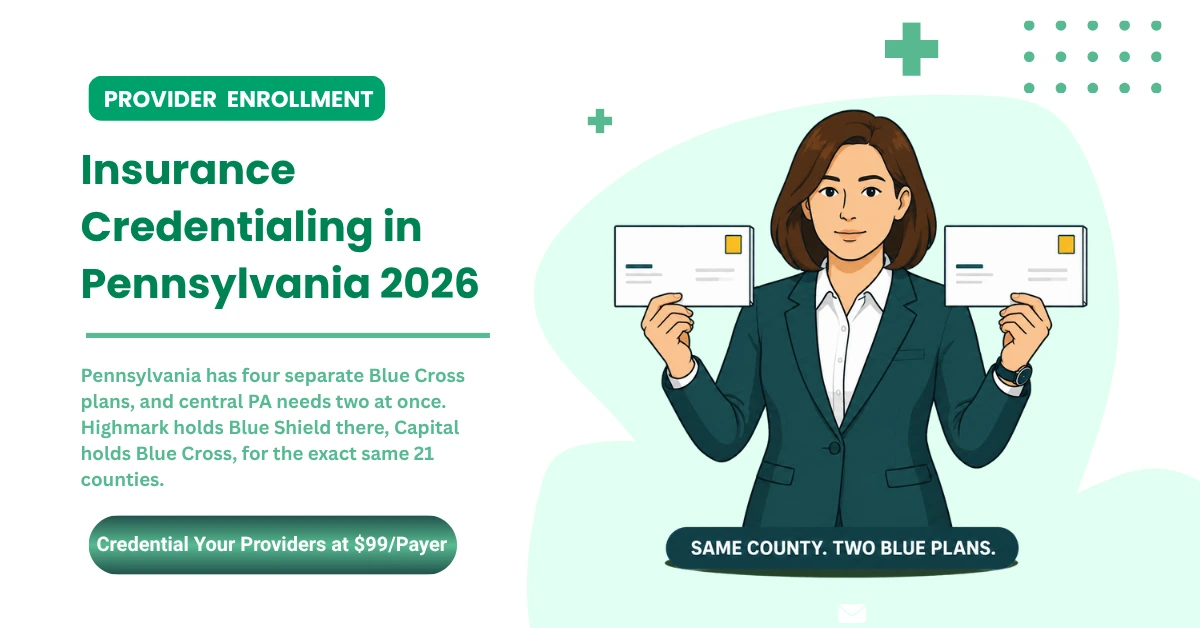
Capital BlueCross covers the same 21 central Pennsylvania and Lehigh Valley counties as Highmark Blue Shield. That isn’t an error. Capital holds the Blue Cross license in that territory and Highmark holds the Blue Shield license, a split that dates back to when the two halves were separate companies.
A practice in Harrisburg, Lancaster, or Allentown needs both applications. Filing with one and assuming you’ve covered the region is how a Lancaster practice ends up out of network for half its commercial patients.
|
Plan |
Region it covers |
Credentialing route |
|---|---|---|
|
Highmark Blue Cross Blue Shield |
29 counties, western Pennsylvania |
CAQH ProView, used exclusively for PA and Delaware |
|
Highmark Blue Shield |
21 counties, central Pennsylvania and the Lehigh Valley |
CAQH ProView |
|
Independence Blue Cross (IBX) |
Bucks, Chester, Delaware, Montgomery, and Philadelphia counties |
Practitioner Participation Form plus CAQH ProView |
|
Capital BlueCross |
The same 21 counties as Highmark Blue Shield: Adams, Berks, Centre, Columbia, Cumberland, Dauphin, Franklin, Fulton, Juniata, Lancaster, Lebanon, Lehigh, Mifflin, Montour, Northampton, Northumberland, Perry, Schuylkill, Snyder, Union, and York |
Capital’s own provider join process, filed separately from Highmark |
To join the Independence Blue Cross network, you file a Practitioner Participation Form and grant IBX access to your CAQH profile. Sorting out which combination of these four applies to your address is the first thing our provider enrollment and credentialing team maps before anything gets filed.
The two regional plans most guides skip
UPMC Health Plan carries real commercial weight in western Pennsylvania and routes behavioral health to Community Care Behavioral Health rather than handling it in house. Geisinger Health Plan covers central and northeastern Pennsylvania and manages behavioral health inside the plan.
Most credentialing guides list Blues logos and stop there. For a Pittsburgh or Danville practice, skipping either one leaves a large share of local commercial volume uncovered.
What QCC Insurance Company is doing on your IBX paperwork
QCC Insurance Company appears on Personal Choice plan documents and inside provider participation agreements, and most providers have no idea what it is. QCC is a wholly owned subsidiary of Independence Blue Cross that underwrites or administers the Personal Choice PPO products.
IBX changed the structure in 2024. Effective July 1, 2024, some PPO commercial plans that QCC had offered moved to Independence Assurance Company, another wholly owned IBX subsidiary. IBX notified providers that both entities operate under existing participation agreements, with QCC continuing as the affiliate offering indemnity plans.
On the Medicaid side, the managed care layer adds AmeriHealth Caritas Pennsylvania, Keystone First, PA Health & Wellness, UPMC For You, Geisinger, and Highmark Wholecare. Section 7 covers how those contracts work.
What Pennsylvania Law Requires Health Plans to Do
Pennsylvania regulates how plans credential you. It doesn’t regulate how fast. That gap explains most of what frustrates providers here, and it also hands you two rights that few providers use.
Your payers have to recredential you at least every three years
Every plan operating in Pennsylvania has to maintain a credentialing system that includes initial credentialing and recredentialing at least every three years. That requirement sits in 28 Pa. Code § 9.761(a)(2), inside Pennsylvania Code Subchapter L, and it applies statewide.
In practice, if your license or malpractice certificate lapses between cycles, the payer won’t call you. You find out from a denial, usually a month after the claims started failing and long after the fix would have been easy.
You can demand a payer’s credentialing criteria in writing
Upon written request, a plan must disclose its relevant credentialing criteria and procedures to any provider applying to participate or already participating. That’s 28 Pa. Code § 9.761(e). Act 146 of 2022 put the same duty into statute at Section 2121(d).
Use it. When a payer won’t explain the standard it’s applying to your file, a written request citing the regulation moves things faster than a fifth phone call to a queue.
A denial has to come with a stated reason
A plan’s credentialing system must include denial and nonrenewal notification with a clear rationale, under 28 Pa. Code § 9.761(a)(7). Act 146 carries the same requirement at Section 2121(f). A denial letter with no reason attached doesn’t meet the standard.
Why your payer’s process looks like NCQA’s
A plan can satisfy Pennsylvania’s requirements by running a credentialing system that meets or exceeds the standards of a nationally recognized accrediting body the Department accepts, and the Department publishes that list annually in the Pennsylvania Bulletin. That’s 28 Pa. Code § 9.761(c).
So when a Pennsylvania payer asks for something that looks like an NCQA requirement rather than a state one, it usually is. Plans also delegate verification work to CVO credentialing companies, which stays permitted as long as the plan’s system still meets the standard.
Facilities can credential their own nonphysician staff
A plan isn’t required to credential a nonphysician provider who works as an employee or independent contractor of a plan-contracted facility, agency, or organization, provided the plan verifies that the facility’s own credentialing meets § 9.762 standards. That’s 28 Pa. Code § 9.763.
For a behavioral health agency, an ABA clinic, or a therapy group, this changes who files what. Some of your employed clinicians may not need individual plan credentialing at all. Confirm it with each plan before you queue up a dozen separate applications.
Insurance credentialing requirements in Pennsylvania apply to the plan first and to you second. Health plan credentialing here runs on borrowed national standards with a thin state floor underneath, and the floor is where your leverage sits.
What Documents Pennsylvania Requires Payers to Verify
The credentialing checklist isn’t a suggestion in this state. For primary care physicians and specialists, 28 Pa. Code § 9.762(a) sets the minimum list a plan has to verify, and it runs to nine items.
|
Element the plan must verify |
What that means for your file |
|---|---|
|
Current licensure |
Active, unrestricted Pennsylvania license |
|
Education and training |
Degree, residency, and fellowship where applicable |
|
Board certification status |
Certified, not certified, or in process |
|
Drug enforcement administration certification status |
Required if you prescribe controlled substances |
|
Current and adequate malpractice coverage |
Active policy with limits the plan accepts |
|
Malpractice claims history |
Prior claims, settlements, and judgments |
|
Work history |
Continuous, with any gap explained in writing |
|
Hospital privileges |
Where you provide services at hospitals |
|
Any other information the Department may require |
The catch-all the regulation reserves for itself |
For providers who are neither PCPs nor specialists, the floor drops. Plans verify current licensure and malpractice coverage, to the extent state or federal law requires them, under § 9.762(b).
That tiering matters for a multi-specialty group filing mixed provider types at once. Your physicians face nine verification points. Some of your ancillary staff face two, and building one universal document packet for the whole roster wastes weeks.
The two items that stall the most Pennsylvania files
An expired malpractice certificate sitting in CAQH, and a work-history gap with no written explanation. Neither is hard to fix. Both restart your clock, and neither one triggers a phone call from the payer telling you it happened.
One correction worth making on the provider credentialing application itself: DEA registration applies to any prescriber of controlled substances, not to a single specialty. We’ve seen credentialing guides describe it as an oncology requirement. It isn’t.
How to Apply to Each Pennsylvania Payer
Six payers, six filing routes. The process for provider enrollment splits by payer here more than in most states, and the table below is the version our team works from.
|
Payer |
What you file |
System |
What happens next |
|---|---|---|---|
|
Independence Blue Cross |
Practitioner Participation Form plus a credentialing application kit |
CAQH ProView, with IBX granted access |
Standard contract arrives by DocuSign |
|
AmeriHealth |
Practitioner Participation Form |
CAQH ProView, with AmeriHealth granted access |
Standard contract arrives by DocuSign |
|
Highmark |
Professional Agreement, or full credentialing depending on the network |
CAQH ProView, used exclusively for PA and Delaware |
Provider Information Management handles later changes |
|
Capital BlueCross |
Capital’s provider join packet |
Capital’s own provider join process |
Confirm your practice sits in the 21-county service area first |
|
PA Medical Assistance |
Online enrollment application |
provider.enrollment.dhs.pa.gov |
Separate HealthChoices MCO contracting follows |
|
Medicare |
CMS-855I or CMS-855B |
PECOS, processed by Novitas Solutions for Jurisdiction L |
Your revalidation cycle starts |
Running these in parallel rather than one after another is the whole game, and it’s what our payer enrollment applications team sequences at $99 per payer. Aetna, Cigna, and UnitedHealthcare all operate independent Pennsylvania pathways with no connection to the Blues, and our Aetna provider enrollment guide covers Aetna’s parallel workstreams.
Highmark: one network skips credentialing entirely
Providers asking how to be credentialed with Highmark insurance in Pennsylvania often don’t need the answer they expect. Highmark’s Participating Provider Network admits you on Pennsylvania licensure plus a signed Professional Agreement, with no credentialing review. Its network participation manual spells out which networks require full credentialing and which don’t.
Check which network you’re joining before you assemble a full credentialing packet. The two routes take different amounts of time and produce different reimbursement.
The 30-day contract window that voids your application
IBX and AmeriHealth both send the standard provider contract by DocuSign once credentialing is approved, and both give you 30 calendar days from the date of that email to sign and return it. Miss the window and the application is rescinded, not paused. IBX publishes this on its own provider page, and AmeriHealth publishes the same rule.
You reapply from the beginning. We’ve seen this cost a practice four months because the credentialing contact had left and nobody was watching that inbox.
Nurse practitioners need a collaborative agreement on file
Certified registered nurse practitioners must have a collaborative agreement with a participating physician who holds a current, unrestricted license. The collaborating physician’s training and scope of practice has to line up with the CRNP’s practice. AmeriHealth publishes this requirement, and it affects a large share of Pennsylvania applicants.
The Ohio rule that attaches to Pennsylvania participation
Practitioners participating with Pennsylvania and West Virginia whose primary service site sits in Ohio get a credentialing decision and written notification within 90 days of Highmark receiving the application, under the Ohio Healthcare Simplification Act. It’s the only firm clock we’ve found attached to Pennsylvania participation, and it only applies across that border.
Providers also have 30 calendar days to submit written corrections to erroneous credentialing information, sent to Highmark Blue Shield Provider Information Management.
Insurance credentialing in Pennsylvania rarely fails on a single form. It fails on order. Filing with one payer is paperwork. Filing with six in the right order, while a CAQH attestation window runs underneath all of them, is sequencing. If that’s where your practice sits right now, that’s the part we handle.
The PROMISe Track: Pennsylvania Medicaid Enrollment
Section 6401 of the Affordable Care Act requires providers to enroll in Medicaid to be paid by Medicaid. In Pennsylvania that means getting a PROMISe Provider Identification Number before anything downstream works. Our PA Medicaid PROMISe enrollment guide walks the full application; this section covers where medicaid pa provider enrollment intersects with your commercial credentialing.
Two portals, and they do different jobs
Two addresses, two jobs. The enrollment application lives at provider.enrollment.dhs.pa.gov. The claims and eligibility portal lives at promise.dhs.pa.gov. DHS moved both off the old dpw.state.pa.us naming during 2024, which is why stale links still circulate in older guides and bookmark folders.
PROMISe approval does not put you in an MCO network
DHS states it plainly: enrolling in state Medicaid does not guarantee enrollment in individual MCO networks, and some MCO networks may be closed because of network adequacy. New providers contact each MCO directly. The DHS provider enrollment page carries the warning.
This is the most expensive misunderstanding in Pennsylvania Medicaid. A practice gets PROMISe approval, starts seeing HealthChoices patients, and finds the gap 60 days later in a stack of denials that take weeks to trace.
Pennsylvania’s independent enrollment broker handles beneficiary plan selection, not provider enrollment services. Providers who call that line get routed back to DHS, which costs another week.
How Pennsylvania matches your claims
Pennsylvania processes claims on the 13-digit PROMISe ID internally. When a claim arrives without it, DHS and the HealthChoices MCOs match on NPI, taxonomy, and the nine-digit ZIP code. A mismatch on any one of those three stops the claim.
Every service location needs its own registration and its own service location extension. Groups that register one address and bill from three generate rejections that look like coding problems and aren’t.
High-risk screening most practices don’t expect
DHS assigns certain provider types to the high categorical risk level. Those providers, and anyone holding a five percent or greater direct or indirect ownership interest, submit an FBI criminal background check and a Pennsylvania State Police Criminal Record Check, per the DHS provider bulletin.
Out-of-state practitioners carry an extra requirement for pennsylvania medicaid provider enrollment. You need a current license in your home state and documentation that you participate in that state’s Medicaid program.
Nurses got a change on June 27, 2025. A nurse holding a valid multistate license from a Nurse Licensure Compact state can enroll with Pennsylvania Medical Assistance without obtaining a separate Pennsylvania license. Select the multistate option only if you live outside Pennsylvania and practice across compact states.
Behavioral Health Is Carved Out, and Your Patient’s County Decides Who Pays
Pennsylvania runs its Medicaid behavioral health benefit county by county across 67 counties. Counties contract with behavioral health managed care organizations, and the plan that pays you is the one your patient’s county uses, not the plan printed on their physical health card.
A physical health MCO contract doesn’t cover behavioral health claims here. A provider who enrolls only through the physical health plan gets mental health claims denied outright. Our behavioral health credentialing guide covers the carve-out networks in depth, and behavioral health credentialing services in Pennsylvania carry a second application that most practices skip.
Where each commercial payer sends behavioral health
|
Payer |
Behavioral health route |
|---|---|
|
UPMC Health Plan |
Community Care Behavioral Health |
|
UnitedHealthcare |
Optum, starting with an Initial Participation Request in Provider Express |
|
Cigna |
Evernorth, using the Evernorth Behavioral Health Provider Information Form alongside CAQH |
|
Aetna |
Handled in house on a separate behavioral health request |
|
Highmark |
Managed inside the plan |
|
Independence Blue Cross |
Managed inside the plan |
|
Capital BlueCross |
Managed inside the plan |
|
Geisinger Health Plan |
Managed inside the plan |
Two of those routes trip people up more than the rest. Our UnitedHealthcare credentialing process guide covers Optum and the Provider Express pathway, which sits outside Onboard Pro entirely.
Cigna adds a second form rather than a second portal, and our Cigna enrollment timelines guide walks that submission. BCBA insurance credentialing follows the same split, with the ABA provider credentialing through the behavioral health entity rather than the medical network.
Agencies may not need individual applications at all
Section 4 covered the rule. A plan doesn’t have to credential a nonphysician provider employed or contracted by a plan-contracted facility, so long as the plan verifies the facility’s credentialing meets § 9.762. Confirming that with each plan can pull a dozen individual applications out of your queue.
On the Medicaid side, AmeriHealth Caritas Pennsylvania uses the CAQH Universal Provider DataSource for credentialing and recredentialing, and there’s no cost to providers to submit or participate in CAQH. AmeriHealth credentialing on the commercial side runs through the Practitioner Participation Form covered in Section 6.
You file twice. Physical health enrollment and behavioral health enrollment run on separate tracks, and insurance credentialing services for mental health providers have to cover both or the second half of your revenue never lands.
How Long Credentialing Takes in Pennsylvania
Pennsylvania sets no statutory deadline for a credentialing decision. Act 146 of 2022 gave insurers and Medical Assistance and CHIP managed care plans real duties, including a Department-approved process, written criteria, disclosure on request, and a written rationale for denial. It gave them no clock.
No Pennsylvania agency publishes a provider-facing statewide credentialing timeline. Every number below is an observed range from our own Pennsylvania enrollment volume, not an official figure. Any guide quoting you a state-published timeline is quoting something that doesn’t exist.
|
Track |
Typical range |
What resets the clock |
|---|---|---|
|
PA Medical Assistance, PROMISe state review |
30 to 45 days |
Missing ownership disclosure, or a W-9 name that doesn’t match the EIN letter |
|
HealthChoices MCO or BH-MCO contracting |
30 to 60 days |
Starting after PROMISe approval instead of alongside it |
|
PA Medicaid, state plus managed care |
60 to 105 days |
Filing the two stages in sequence |
|
Medicare Part B, Novitas Solutions Jurisdiction L |
60 to 90 days |
Signature page errors on the CMS-855 |
|
Independence Blue Cross |
60 to 120 days |
An unsigned DocuSign contract past 30 calendar days |
|
Highmark credentialed networks |
60 to 120 days |
A CAQH profile that isn’t attested or isn’t authorized for Highmark |
|
Capital BlueCross |
60 to 120 days |
A missing W-9 inside the join packet |
|
Behavioral health, county BH-MCO |
Add 30 to 60 days |
Filing only with the physical health MCO |
How long it takes to complete provider enrollment depends more on your documents than on the payer. Providers asking which insurance carriers have easy credentialing for providers usually mean which ones move fastest, and in Pennsylvania that’s Medicare through Novitas rather than any of the Blues.
Why Pennsylvania has no deadline, and what that costs you
Georgia gives complete applications filed through its centralized CVO a decision within 45 calendar days, and our Georgia credentialing timelines guide covers how that clock works. Pennsylvania offers nothing comparable. Weekly follow-up is the only lever a practice has here.
The one change that removes 45 to 60 days
Running credentialing and payer enrollment in parallel rather than in sequence takes roughly 45 to 60 days out of total time to billing. It costs nothing beyond planning the order before you start. For the Medicare side of that sequence, our Medicare enrollment through PECOS guide covers Novitas Jurisdiction L filing and the revalidation cycle it starts.
Faster isn’t always cheaper
Speed can cost you money. Highmark’s Participating Provider Network admits you on licensure plus a signed Professional Agreement with no credentialing review, which moves faster than full credentialing. It’s also a different network with different terms. Confirm what you’re joining, and what it pays, before you take the quicker route.
Insurance credentialing in Pennsylvania rewards preparation more than pressure. The files that clear in 60 days are the ones where the CAQH profile was clean before anyone submitted anything.
Four Different Credentialing Clocks Run at the Same Time
Practices calendar one renewal date, hit it, and get dropped by a payer running on a different clock. Four separate cycles apply to a Pennsylvania provider, and no single system tracks them together for you.
|
Clock |
How often |
Where it comes from |
|---|---|---|
|
Pennsylvania commercial plan recredentialing |
Every 3 years, at minimum |
28 Pa. Code § 9.761(a)(2) |
|
PA Medical Assistance revalidation, per service location |
Every 5 years |
42 CFR 455.414 and PA DHS |
|
Medicare revalidation |
Every 5 years, every 3 for DMEPOS suppliers |
CMS |
|
CAQH ProView re-attestation |
Every 120 days |
CAQH |
Recredentialing and revalidation are separate requirements with separate authorities. Recredentialing is a Pennsylvania rule covering commercial plans on a three-year cycle. Revalidation is a federal Medicaid rule on a five-year cycle, and it attaches to each service location rather than to you.
Conflating the two gets practices terminated. We’ve read national vendor pages quoting a three-year PROMISe revalidation cycle for Pennsylvania. The DHS revalidation guidance puts Medical Assistance at five years per service location, and tells providers to check the date in PROMISe and submit at least 60 days ahead of it.
A practice with three locations carries three separate deadlines inside the Medicaid clock alone. On the federal side, CMS provider enrollment guidance sets Medicare revalidation at five years for most provider types and three years for DMEPOS suppliers.
The 120-day CAQH window is the one people miss. A profile that isn’t re-attested goes stale, and a stale profile stalls applications at every payer pulling from it. Highmark uses CAQH ProView exclusively across Pennsylvania and Delaware, so a lapsed attestation there stops the entire file. Our Medicaid revalidation across states guide covers the federal rule in more detail.
What Credentialing Costs in Pennsylvania
Published credentialing rates in the United States run from roughly $100 to $800 per payer. The spread tracks pricing model more than quality. Insurance credentialing in Pennsylvania costs what it costs anywhere else, because almost no vendor prices by state.
|
Service |
Market range |
MedSole RCM |
What you save |
|---|---|---|---|
|
Initial credentialing, per payer |
$150 to $500 |
$99 |
$51 to $401 |
|
Flat fee per payer model |
$200 to $400 |
$99 |
$101 to $301 |
|
Full setup package, 5 to 10 networks |
$1,500 to $3,500 |
$99 per payer |
$510 to $2,510 |
|
Monthly retainer |
$150 to $400 per month |
Not charged |
$1,800 to $4,800 per year |
|
Hourly billing |
$50 to $100 per hour |
Not charged |
Varies with payer delay |
|
CAQH ProView setup |
$100 to $200 |
Included |
$100 to $200 |
|
CAQH annual maintenance |
$150 to $175 |
Included |
$150 to $175 |
|
Recredentialing tracking |
$100 to $600 |
Included |
$100 to $600 |
|
Rush or expedite fee |
$100 to $300 per application |
Not charged |
$100 to $300 |
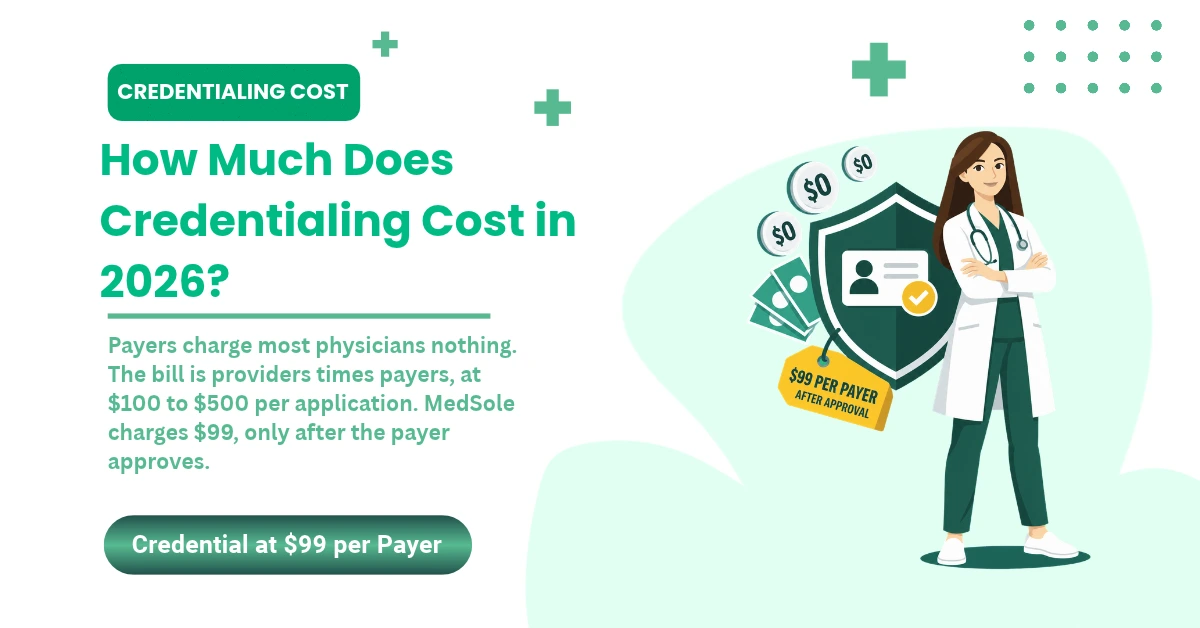
MedSole RCM credentials providers at $99 per payer enrollment across all 50 states, with CAQH ProView setup, ongoing maintenance, and recredentialing tracking included, having completed enrollment for more than 4,000 providers. Practices pairing enrollment with billing pay 2.99 percent of collections on the billing side. Our credentialing at $99 per payer page covers what the flat rate includes.
The comparison that decides this for most practices is against hiring. Our in-house credentialing specialist cost breakdown puts a full-time credentialing hire between $70,000 and $114,000 a year once salary, payroll taxes, benefits, software, and training are counted.
The fees no vendor can remove
|
Fee |
Amount |
Who owes it |
|---|---|---|
|
CMS enrollment application fee, CY2026 |
$750 |
Institutional providers, DMEPOS suppliers, and opioid treatment programs. Individual physicians, non-physician practitioners, and physician organizations are exempt |
|
CAQH ProView profile |
Free |
Every provider. There’s no cost to submit an application or participate in CAQH |
|
DEA registration renewal |
Set by the DEA on a three-year renewal cycle |
Prescribers of controlled substances |
|
State license verification |
$25 to $150 |
Varies by state and board |
Any vendor quote that folds the $750 CMS fee into the price of enrolling a physician group is charging you for a fee CMS says that group doesn’t owe. Ask which line items are pass-through and which are the vendor’s own.
The cost that isn’t a fee
The largest cost in insurance credentialing in Pennsylvania is the waiting, and it never lands on an invoice. You can’t bill as an in-network provider until enrollment finalizes, and Pennsylvania sets no decision deadline. A 90-day delay on one full-time clinician costs more than every credentialing fee in the tables above, combined.
The right number of Pennsylvania panels to apply for depends on your payer mix, not on a package tier. If you want a look at which panels are worth the application for your specialty and county, that’s worth sorting out before anything gets filed.
Why Pennsylvania Credentialing Applications Stall
Five problems account for most of the stalled files we pick up in this state. None of them is complicated. All of them are silent, in the sense that no payer calls to tell you it happened.
|
What stalls it |
What fixes it |
|---|---|
|
CAQH profile not attested within 120 days, or not authorized for that payer |
Re-attest and grant payer access before you file, not after the payer asks |
|
Expired malpractice certificate sitting in CAQH |
Upload the current declarations page and confirm the effective dates match |
|
Work history gap with no written explanation |
Explain any gap over six months in writing inside the application |
|
NPI, taxonomy, or nine-digit ZIP mismatch against PROMISe |
Match NPPES, PROMISe, and the payer application to identical data before submitting |
|
DocuSign contract unsigned past 30 calendar days at IBX or AmeriHealth |
Assign someone to watch that inbox after approval. The application is rescinded, not paused |
How to check your status without waiting on hold
Three routes cover it. The PROMISe portal enrollment summary handles Medical Assistance, PECOS handles Medicare, and payer portals or provider service lines handle commercial. No credentialing status checker covers all three at once, which is how practices lose track of where a provider credentialing application sits.
Insurance credentialing in Pennsylvania runs without a published status-check deadline or a service standard for payer responses. Weekly follow-up is the only thing that moves a file, and the practices that get credentialed fastest are the ones that treat it as a standing task rather than a reminder.
What a stalled application does to your claims
A credentialing gap doesn’t stay a credentialing problem. Services rendered before your effective date bill out of network or reject outright, and the denials arrive as authorization and coverage codes your billing team then works backward from. Our CO-197 authorization denials guide covers the most common of those patterns.
Once a backlog builds, working it is billing work rather than credentialing work. That’s the point where outsourced medical billing at 2.99 percent of collections tends to make more sense than adding hours to a front desk that’s already behind.
What Happens If You Are Not Credentialed Yet
Pennsylvania draws a line most providers don’t know exists. A managed care plan may not require a nonparticipating provider to complete the full credentialing process as a condition of continuity of care.
The 60-day continuity of care window
A current enrollee can continue an ongoing course of treatment with a provider whose contract the plan terminated for reasons other than cause, for a transitional period of up to 60 days from the date the plan notified them. Both sit in 31 Pa. Code § 154.15.
A new enrollee gets the same 60 days from the effective date of enrollment when they’re mid-treatment with a nonparticipating provider. The protection follows the patient, not your application status.
Plans can extend that period where it’s clinically appropriate. For an enrollee in the second or third trimester of pregnancy at the time of notice, the transitional period extends through postpartum care related to the delivery.
What the plan can still require
Be accurate about the limits of this. Plans can require you to accept the plan’s payment as payment in full for covered services without balance billing, apart from permitted deductibles, copayments, or coinsurance. They can also require you to follow utilization review and quality assurance procedures, provide the enrollee’s medical records, and follow precertification procedures for specified nonemergency services.
This is a defined transitional protection with conditions attached. Treating it as a general billing workaround for uncredentialed providers will not survive a payer audit.
Three specialties that may not be able to join at all
|
Specialty |
Status at IBX |
Published exceptions |
|---|---|---|
|
Chiropractic |
Closed to new providers in Pennsylvania |
Joining an existing participating group, or a change of control or ownership handled under the terms of the IBX agreement |
|
Pathology |
Closed to new office-based providers in the five-county service area and contiguous counties |
Joining an existing participating hospital-based pathology group in a participating hospital. Pathologists cannot be added to non-pathology practices |
|
Podiatry |
Closed to new providers |
Practice located outside Bucks, Chester, Delaware, Montgomery, and Philadelphia counties, joining an existing participating group, or a change of control |
Check the panel before you pay anyone to file. An insurance paneling service that takes your fee for a closed panel has no reason to mention the panel was closed. For chiropractors specifically, our chiropractic credentialing guide covers which payers still accept new DCs and which don’t.
DHS carries a parallel warning on the Medicaid side. Managed care networks may also be closed because of network adequacy, which is the second reason PROMISe approval alone doesn’t put you in an MCO.
When a single case agreement is the right tool
When a panel is closed and a patient needs continuity, a single case agreement covers one patient for a defined course of treatment at negotiated rates. It doesn’t scale and it doesn’t replace credentialing. Our single case agreements guide covers the documentation payers ask for and where the reference number goes on the claim.
Services rendered before your effective date generally don’t become billable retroactively at Pennsylvania commercial payers. Insurance credentialing in Pennsylvania carries no statutory back-pay protection. Track the effective date rather than the approval date, because those two are frequently weeks apart.
Claims already sitting out of network need appeals worked before filing limits close them, which is denial management services territory. Older balances that have aged past 90 days need a different approach again.
Recovering those is AR follow-up services work, and the sooner it starts the more of it is still collectible. If you’re reading this with a pending application, a closed panel, or services you can’t bill yet, finding out where the file sits is usually the fastest first move.
Three Bills Would Put a Deadline on Pennsylvania Credentialing
Pennsylvania imposes credentialing duties on plans and sets no deadline for a decision. Three bills in the current session would change that. None has been enacted, and none should be treated as a current requirement.
|
Bill |
Sponsors |
What it would do |
Status |
|---|---|---|---|
|
Senate Bill 888 |
Argall, Vogel, Kane |
Health Care Practitioner Credentialing Act. Would require practitioners and insurers to use the CAQH system for credentialing, limit the credentialing period to 45 days for complete applications, and streamline the process for practitioners working in multiple locations |
Referred to Banking and Insurance, June 24, 2025 |
|
House Bill 544 |
Mentzer, Roae, James, Shaffer, Powell, Friel |
Companion legislation carrying the same short title: use of certain credentialing applications and credentialing requirements for health insurers, imposing penalties and conferring duties on the Insurance Department |
Referred to House Insurance, February 10, 2025 |
|
House Bill 533 |
Owlett |
Would streamline credentialing for provider applications to managed care organizations and commercial plans, with timeliness requirements and an established communications loop |
Passed the House Health Committee unanimously |
If Senate Bill 888 passed, a complete application would carry a 45-day limit and the CAQH form would become the standard submission. No such obligation exists today, which is the honest answer when a payer has held your file for 90 days and won’t explain why.
The House Bill 544 companion has sat in the House Insurance Committee since February 2025. House Bill 533 moved further, and the Penn State Office of Rural Health reported the unanimous Health Committee vote.
Confirm current status before relying on any of this. Bills move, and insurance credentialing in Pennsylvania is one of the areas where a single passed bill would change the practical answer to half the questions in this guide.
Handling Pennsylvania Credentialing In House Versus Outsourcing It
Insurance credentialing in Pennsylvania takes more work than most states. That doesn’t automatically mean outsourcing it makes sense for your practice, and the split is worth being honest about.
When doing it yourself makes sense
A solo provider filing with two or three payers, holding a clean CAQH profile and no license or malpractice history complications, can handle this alone. Budget 15 to 40 hours per application once you count document gathering, submission, and follow-up calls.
For that provider, paying a vendor buys convenience rather than a different outcome. We would rather say so than sell someone a service they don’t need yet.
When it stops making sense
- Multiple payers filed in parallel, where sequencing decides your billing date
- Multiple service locations, each carrying its own Medicaid revalidation clock
- A group adding rendering providers to an existing tax ID
- Behavioral health, where the county carve-out means two separate application tracks
- Central Pennsylvania practices needing both Highmark Blue Shield and Capital BlueCross
- Any file that has already stalled and nobody can say where it sits
How to evaluate a Pennsylvania credentialing partner
The best credentialing company for your practice is the one that handles your specific payer mix, and the best insurance credentialing services publish what they charge before a discovery call. Use this as a checklist on any vendor, including us.
|
What to check |
Why it matters in Pennsylvania |
|---|---|
|
Published flat pricing |
Percentage and hourly models make the total unknowable when a payer stalls, and Pennsylvania sets no decision deadline |
|
A named point of contact |
Multi-payer files fail at the handoffs between coordinators |
|
PROMISe and HealthChoices experience |
State enrollment and MCO contracting are separate steps, and the second is the one that gets skipped |
|
Behavioral health carve-out handling |
The county-level BH-MCO structure has no equivalent in most states |
|
Recredentialing and revalidation tracking included |
Four clocks run at once and a lapse stops billing without warning |
|
Weekly follow-up as standard, not an upgrade |
With no statutory clock, follow-up is the only thing that moves a file |
|
Billing integration |
Enrollment data feeds claims. Split vendors means the effective date and payer ID live in two systems |
Searching credentialing services near me returns local firms, and proximity matters less here than most people expect. Insurance credentialing in Pennsylvania runs on portals and phone queues. What matters is whether the team files and follows up weekly, not whether they sit in your county. Plenty of national CVO credentialing companies never touch a PROMISe application.
For disclosure: MedSole RCM is a revenue cycle management company and our credentialing team wrote this guide. We handle provider enrollment and credentialing services at $99 per payer with CAQH setup, maintenance, and recredentialing tracking included across all 50 states, and medical billing and credentialing services together at 2.99 percent of collections. Our outsource Pennsylvania credentialing page sets out what the flat rate covers.
Published rates from other firms sit between $150 and $500 per payer. We publish ours because a practice comparing one medical credentialing company against another should be able to compare on price without booking a call. Our credentialing company evaluation standards guide covers the ten criteria we would apply to any vendor, ourselves included.
If you want a look at which Pennsylvania panels are worth applying for given your specialty, county, and payer mix, we will map that before anything gets filed. There’s no obligation to use us for the filing afterward.
Pennsylvania Credentialing Questions Providers Ask
How long does PA credentialing take?
Depends which PA you mean. Insurance credentialing in Pennsylvania has no statutory deadline, so these are observed ranges rather than published standards. For the state, commercial payers typically run 60 to 120 days, PA Medical Assistance runs 60 to 105 days including HealthChoices MCO contracting, and Medicare through Novitas runs 60 to 90 days. For a physician assistant, the timeline matches any other practitioner and depends on the supervising physician documentation. For prior authorization, turnaround is measured in days rather than months and has nothing to do with credentialing.
What documents are required for credentialing in Pennsylvania?
Pennsylvania sets the list by regulation. For primary care physicians and specialists, 28 Pa. Code § 9.762(a) requires plans to verify current licensure, education and training, board certification status, DEA certification status, current and adequate malpractice coverage, malpractice claims history, work history, hospital privileges where applicable, and any other information the Department requires. For providers who are neither PCPs nor specialists, the minimum is current licensure and malpractice coverage.
What happens if a provider is not credentialed?
Claims process out of network or reject outright while insurance credentialing in Pennsylvania is pending, and services rendered before your effective date generally don’t become billable retroactively at Pennsylvania commercial payers. One exception matters: under 31 Pa. Code § 154.15, a plan may not require a nonparticipating provider to undergo full credentialing as a condition of continuity of care, and enrollees mid-treatment get a transitional period of up to 60 days.
How often do providers need to be credentialed in Pennsylvania?
Four clocks run at once. Pennsylvania commercial plans recredential at least every three years under 28 Pa. Code § 9.761(a)(2). PA Medical Assistance revalidation runs every five years for each service location. Medicare revalidation runs every five years, or three for DMEPOS suppliers. CAQH ProView re-attestation runs every 120 days. Missing any one of the four can stop billing.
Who pays for credentialing?
The practice pays in an employed arrangement, and the individual provider pays when contracting independently. Vendor fees are separate from government fees. The CY2026 CMS enrollment application fee is $750, owed by institutional providers, DMEPOS suppliers, and opioid treatment programs. Individual physicians, non-physician practitioners, and physician organizations are exempt, so most group practices owe nothing to CMS.
Do I need CAQH if I don’t take insurance?
No, if your practice is entirely cash-pay and you never bill a payer. Two situations change that. If you submit out-of-network claims on a patient’s behalf, some payers still want a CAQH record. If you negotiate single case agreements, the payer will ask for the same credentialing documentation CAQH holds, so maintaining the profile saves work later.
What insurance companies use CAQH for credentialing in Pennsylvania?
Highmark uses CAQH ProView exclusively across its Pennsylvania and Delaware service areas. Independence Blue Cross and AmeriHealth both pull from CAQH once you grant them access, alongside the Practitioner Participation Form. AmeriHealth Caritas Pennsylvania uses the CAQH Universal Provider DataSource. Medicare does not use CAQH at all and runs through PECOS instead, which is the exception that catches people out.
Can I bill retroactively while credentialing is pending in Pennsylvania?
Generally no at commercial payers. Pennsylvania has no statutory back-pay protection, so claims for services delivered before your effective date bill out of network. Track the effective date on your contract rather than the credentialing approval date, since payers often set the effective date later than the approval. Continuity of care under 31 Pa. Code § 154.15 is the narrow exception.
Do I need PA Medicaid enrollment before commercial credentialing?
No. The two tracks run independently, and you can file both at the same time. If you see Medical Assistance patients, PROMISe enrollment comes first on that track, followed by separate HealthChoices MCO contracting. Filing them in parallel rather than in sequence is what keeps total time to billing near 60 days instead of 105.
Does credentialing work differently for nurse practitioners in Pennsylvania?
Yes, in one respect. Certified registered nurse practitioners need a collaborative agreement with a participating physician holding a current, unrestricted license, with training and scope consistent with the CRNP’s practice. Since June 27, 2025, nurses holding a valid multistate license from a Nurse Licensure Compact state can enroll with Pennsylvania Medical Assistance without a separate Pennsylvania license. Credentialing companies for nurse practitioners should handle both. Our physician and practitioner credentialing guide covers the documentation set.
Do labs and imaging centers credential differently in Pennsylvania?
Yes. Facility credentialing runs on the organizational track rather than the practitioner track, so a lab credentialing service handles CLIA certification and facility-level enrollment, and a radiology credentialing service handles accreditation requirements alongside the practitioner files for reading physicians. Employed nonphysician staff may fall under the § 9.763 facility delegation carve-out. Our ABA and facility credentialing guide covers agency-level enrollment patterns.
What does credentialing cost in Pennsylvania, and who charges the least?
Insurance credentialing in Pennsylvania costs what it costs elsewhere, because vendors rarely price by geography. Market rates run $150 to $500 per payer, with full setup packages between $1,500 and $3,500. MedSole RCM credentials providers at $99 per payer across all 50 states with CAQH setup, maintenance, and recredentialing tracking included, and offers full-service billing at 2.99 percent of collections. Insurance credentialing services near me searches rarely surface published pricing, so ask any firm for a flat per-payer number in writing. Our Medicaid credentialing guidance covers what government-program enrollment adds.