



Credentialing services in Georgia handle two parallel tracks that most states run as one. Medicaid providers credential through the Georgia Department of Community Health's centralized Credentialing Verification Organization on the GAMMIS portal, which issues decisions on complete applications within 45 calendar days. Commercial payers run separate applications that take 60 to 120 days.
Key Takeaways
- Georgia credentialing services run on a published 45-day clock. DCH gives complete CVO applications a decision within 45 calendar days. Most timelines you'll see quoted online describe incomplete files, not the actual standard.
- Three Georgia Families CMOs exist right now: Amerigroup Community Care, CareSource Georgia, and Peach State Health Plan. WellCare is no longer one of them, and Wellpoint isn't a fourth Georgia plan.
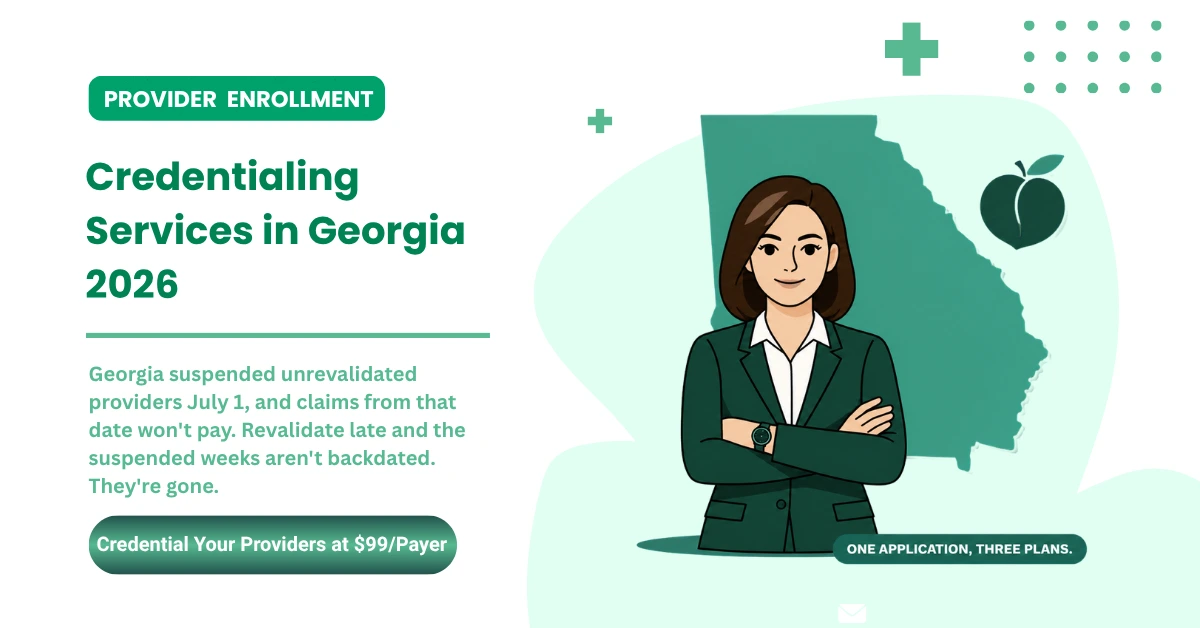
- Revalidation enforcement began July 1, 2026. Suspended providers can't bill, claims with dates of service on or after that day won't pay, and reinstatement isn't retroactive.
- Senate Bill 162 took effect July 1, 2026. It directs the Georgia Composite Medical Board to build an automated statewide credentialing system, with full implementation targeted for 2027.
- Georgia credentialing runs $150 to $500 per payer at market rates. MedSole RCM charges $99 per payer with CAQH setup and maintenance included, which is where most of the savings actually sit.
What Credentialing in Georgia Actually Involves: Four Processes Providers Keep Confusing
Four separate things get called credentialing in Georgia, and they're run by four different bodies. Providers who blur them send the right paperwork to the wrong place and lose three or four weeks finding out. That's the most common avoidable delay we see.
Licensure, enrollment, credentialing, and privileging are not the same thing
Each one produces a different result, and you can't skip forward. Here's how they break down.
Table: Four Georgia Credentialing Processes Compared
|
Process |
Who runs it |
What it produces |
Georgia system |
|---|---|---|---|
|
Licensure |
Georgia Composite Medical Board |
Legal authority to practice |
Licensure Gateway |
|
Medicaid enrollment |
Georgia DCH |
Medicaid Provider Number |
GAMMIS |
|
Payer credentialing |
DCH Centralized CVO for Medicaid, or each commercial payer |
Verified qualifications on file |
GAMMIS or payer portal |
|
Contracting and privileging |
Each CMO, commercial payer, or hospital |
Signed participation agreement or clinical privileges |
Payer or facility |
Licensure gates everything. Enrollment and credentialing can run together on the Medicaid side because Georgia uses one source application. Contracting is the step that catches people: approval from the CVO doesn't put you under contract with a plan. You still have to sign with each one separately, and that's where credentialing and billing explained becomes useful reading before you start. Credentialing services in Georgia that stop at approval leave you unable to bill.
The DCH Centralized CVO: How Georgia Credentials Medicaid Providers
Georgia doesn't work the way most states do. DCH runs an NCQA certified Centralized Credentialing Verification Organization that lives on the GAMMIS portal, so one submission credentials you across every Georgia Families CMO instead of four. That streamlined practitioner credentialing model is the single biggest structural advantage Georgia providers have.
What the Centralized CVO verifies
The CVO doesn't just file your paperwork. It independently confirms the following before a decision goes to committee.
- Primary source verification of licensure and training
- Federal and state database checks
- Information retrieved from Medicare's PECOS
- Required medical malpractice insurance coverage
- DEA registration confirmation
- Credentialing committee review and final decision
The 45-calendar-day decision window
Georgia's CVO decision window is 45 calendar days. DCH states that applications containing all required credentialing and recredentialing materials at the time of submission receive a decision within that window. See Georgia DCH Centralized CVO for the published standard.
One word does all the work in that sentence, and it's "complete." Incomplete applications get returned with a request to supplement the missing materials. The clock doesn't restart. It never started. Most Georgia timelines quoted at 60 to 90 days are describing what happens to files that went out short, which is why Georgia provider enrollment services built around a document audit before submission produce a different result than the published averages suggest.
Completeness is the entire variable here. If a file goes out clean the first time, Georgia's timeline is 45 days, not four months.
Who is excluded from the CVO process
Not everybody goes through it. The CMOs keep responsibility for delegated credentialing and recredentialing of Independent Practice Associations and Provider Hospital Organizations, per the DCH CVO process FAQ. Fee-for-service only providers were brought under the CVO in a later phase, which the DCH CVO Phase II FAQ covers. If you're in a group that already does its own delegated credentialing, confirm your status before you file.
The Three Georgia Families CMOs: Who You Actually Credential With in 2026
Georgia calls its Medicaid managed care plans Care Management Organizations, not MCOs. Small thing, but it's the first tell of whether a credentialing partner has actually worked in this state or is running a template with the word Georgia swapped in.
What is CMO credentialing
CMO credentialing is the verification process a provider completes through the DCH Centralized CVO before joining a Georgia Families managed care network. It's separate from state Medicaid enrollment, and it's separate from contracting. One approval covers all three plans, which is the whole point of the centralized model.
Table: Georgia Families CMOs and Their Parent Organizations (2026)
|
CMO |
Parent organization |
Credentialing route |
|---|---|---|
|
Amerigroup Community Care |
Elevance Health |
DCH Centralized CVO |
|
CareSource Georgia |
CareSource (nonprofit) |
DCH Centralized CVO |
|
Peach State Health Plan |
Centene Corporation |
DCH Centralized CVO |
Amerigroup also administers Georgia Families 360, the statewide program covering children in foster care and former foster youth. You can confirm the current roster on the Georgia Medicaid CMO directory and through Georgia Medicaid managed care. Practices adding several providers across all three plans at once tend to need Medicaid credentialing specialists simply because the tracking volume outgrows one person.
Two payer names that no longer apply in Georgia
WellCare is no longer a separate Georgia Families Medicaid CMO. It still operates in Georgia as a Medicare brand, which is a different program entirely. Plenty of credentialing guides published in the last two years still list it, and providers waste calls chasing a plan that isn't in the Georgia CMO lineup.
Wellpoint is not a fourth Georgia plan. Elevance rebranded some Amerigroup plans under the Wellpoint name in other states. Georgia's plan is still branded Amerigroup Community Care. If a vendor tells you to credential with Wellpoint Georgia, they're reading national material, not Georgia material.
Georgia Medicaid Enrollment Through GAMMIS: The 12-Step Process
Georgia uses a one source application. A single submission enrolls you as a Medicaid provider and routes credentialing to all three CMOs at the same time, replacing what used to be four separate filings. Our Georgia Medicaid enrollment guide walks the same process in operational depth.
- Verify your NPI: confirm NPPES data matches your legal name, practice address, and taxonomy exactly.
- Complete your CAQH ProView profile: the data feeds directly into Georgia's credentialing review.
- Register on the GAMMIS portal: open the Provider Enrollment Wizard at mmis.georgia.gov.
- Select your provider type and taxonomy: a mismatch here stalls the file at intake before anyone reads it.
- Enter practice locations: service address, pay-to address, and mailing address each get verified separately.
- Complete ownership disclosures: required under federal program integrity rules, and a frequent source of returns.
- Upload supporting documents: license, W-9, malpractice certificate, and any specialty certifications.
- Pay the application fee if it applies: institutional providers pay it, most individual practitioners don't.
- Sign and submit the agreement: electronic signature completes the filing and generates your tracking number.
- Clear the risk screening: moderate and high risk provider types face site visits or fingerprinting.
- Wait for the CVO credentialing decision: this runs in parallel with state enrollment review.
- Track your ATN: monitor the Application Tracking Number until the Welcome Letter and Provider ID arrive.
What happens after you submit
Your file moves to the Centralized CVO for clinical review. Approval produces a Medicaid Provider Number and a Welcome Letter, and the two letters don't always land the same day. CMO credentialing approval still doesn't put you under contract, so the Georgia credentialing application is only part of the job.
The GAMMIS quirks nobody warns you about
- No save function on the revalidation application, so a timed-out session starts over from scratch
- A $750 application fee for institutional providers in CY 2026, with physicians and non-physician practitioners exempt
- Date of birth and Social Security number collected to run federal database checks under 42 CFR 455.436
- Gainwell Technologies handling credentialing support at 1-800-766-4456, and the CVO reachable at cvo.dch@dch.ga.gov
Amerigroup and Peach State both confirm the same routing on their own provider pages. See Amerigroup Georgia network requirements and Peach State provider enrollment. Credentialing services in Georgia that skip either confirmation tend to discover the gap after submission.
Twelve steps is manageable once. It stops being manageable when you're running it for four providers across three CMOs while seeing patients.
Georgia Medicaid Revalidation: What the July 1, 2026 Enforcement Deadline Means for Your Claims
DCH set a hard line this year. Providers who hadn't revalidated were suspended, and the agency stated plainly that claims with dates of service on or after July 1, 2026 will not be paid. The DCH revalidation deadline notice is the primary source.
The four-step suspension cascade
- Suspension: enrollment is suspended, and suspended providers can't participate in Georgia Medicaid or PeachCare for Kids.
- Unpaid claims: claims with dates of service on or after the suspension date won't be paid.
- Termination clock: failure to revalidate within 30 days of the suspension letter triggers a notice of termination.
- No retroactive enrollment: once you revalidate, your effective date is the submission date. Retro-enrollment doesn't apply.
Why the effective date rule costs the most money
That fourth step is the expensive one. Every day between suspension and resubmission is a day of services you can't bill and won't recover. A practice that takes six weeks to notice and fix a suspension isn't looking at delayed revenue. It's looking at revenue that no longer exists.
There's a second exposure underneath it. If you resolve a suspension 90 days out, some of the underlying claims may also be past the payer's timely filing window, so you lose them twice. That double gap is exactly the sort of thing solid revenue cycle management services catch during routine aging review rather than at year end.
If you're not certain where your revalidation date sits, that's worth checking this week rather than finding out from a remittance advice.
What DCH checks during revalidation
Federal rules require state Medicaid agencies to revalidate every enrolled provider at least every five years under 42 CFR 455.414, the same framework covered in our Medicaid enrollment across all states guide. Georgia layers risk-based screening on top of that, with site visits for moderate risk types and fingerprint checks for high risk types.
DCH also submitted a two-year Medicaid Provider Revalidation Strategy to CMS on June 11, 2026, built around 29 key performance indicators across five measurement categories. The DCH revalidation strategy submission signals that enforcement isn't a one-time sweep. Screening also includes exclusion checks against the HHS OIG exclusions database and SAM.gov exclusions. One more practical detail: revalidation runs online through GAMMIS only. There's no paper option, and the recredentialing application cycle repeats every 36 months.
Senate Bill 162: Georgia's Automated Credentialing System and What Changes by 2027
Senate Bill 162 directs the Georgia Composite Medical Board to implement an automated credentialing system for healthcare providers. It took effect July 1, 2026, and it cleared three separate chamber votes across the 2025 and 2026 sessions without a single no vote. That's rare, and it tells you how much appetite there is for streamlined practitioner credentialing in this state.
Table: Georgia Senate Bill 162 Legislative Timeline
|
Date |
Action |
Vote |
|---|---|---|
|
March 6, 2025 |
Senate passage by substitute |
53 to 0 |
|
February 9, 2026 |
House passage |
165 to 0 |
|
February 25, 2026 |
Senate agreed to House substitute |
49 to 0 |
|
July 1, 2026 |
Effective date |
Statute in force |
|
July 1, 2027 |
Target for full implementation |
Phased |
What the automated system is authorized to do
- Organize, verify, and store provider licenses so a single verification produces statewide authorization, provided the facility, licensee, or applicant inputs the credentialing information and agrees to that authorization
- Allow customization so a healthcare facility can add requirements matching its own rules, regulations, or bylaws
- Provide a public-facing page securely accessible by other state medical boards, healthcare providers, and healthcare facilities
The bill amends Article 1 of Chapter 34 of Title 43 of the Official Code of Georgia Annotated. The Board tracked it through the session, and you can see it named in the GCMB March 2026 board minutes and again alongside its House companion in the GCMB April 2026 board minutes.
Here's the part that matters operationally: nothing about your current workflow changes yet. Full implementation is targeted for July 1, 2027. Anyone credentialing in Georgia today still runs the existing DCH CVO process and separate commercial payer applications. Plan for the system that exists, not the one being built.
Georgia Composite Medical Board Licensure Changes That Now Gate Credentialing
Georgia licensure prep is now credentialing prep. A physician who waits until payer applications begin to order NPDB and FCVS documents has already added weeks to the critical path, because those reports take time to arrive and nobody can rush them.
What changed for physician applicants in 2026
- Rule 360-2-.01 became effective May 25, 2026, with compliance mandatory from July 1, 2026 after a transition period
- Initial full physician applicants must complete a fingerprint and criminal background check through the Georgia Crime Information Center and the FBI, per O.C.G.A. Section 43-34-13
- Fingerprinting runs digitally through IdentoGO, with a mail-in option for applicants outside Georgia
- A completed affidavit and a Federation Credentials Verification Service report are now required documentation
- An NPDB Self-Query report is required, and non-citizen applicants must verify one year of U.S. residency
The requirement applies to initial applicants only, not current Georgia licensees. Full detail sits in the GCMB 2026 rule updates, and the Board published a step-by-step GCMB fingerprint background check guide. One scheduling note that catches people out: the NPDB Self-Query produces a certified PDF, and NPDB doesn't email results or send them to third parties. Order it early. The same goes for FSMB Credentials Verification Service documents.
The Licensure Gateway
GCMB now runs applications through the GCMB Licensure Gateway, a single portal for initial applications, reinstatements, renewals, address changes, document uploads, and status checks. Three operational facts from the Board's own GCMB physician licensure requirements page are worth writing down.
- Applications must be completed within 360 days of starting, or the Board may close them
- Georgia medical licenses renew biennially by the last day of your birth month
- Providers holding a DEA registration must register with the Georgia PDMP within 30 days of initial licensure
The document most credentialing companies never mention
GCMB requires a notarized Specific Power of Attorney when a third party will communicate with the Board on your behalf. That includes hospitals, recruiters, employers, and credentialing agencies. Without it, a vendor can prepare your paperwork but can't call the Board about it, which is a meaningful difference when a file stalls.
It's a small form with real consequences, and it separates firms that manage a process from firms that hand you a checklist. Anyone comparing physician credentialing process providers should ask about it directly. Credentialing services in Georgia that can't act on your behalf with GCMB will route every Board question back to you.
That form is also the practical answer to whether a credentialing partner can actually chase the Board on your behalf, or only fill in your paperwork.
CAQH ProView and Georgia: Where Most Applications Actually Stall
CAQH ProView is the shared repository Georgia commercial payers and the DCH credentialing process both pull from. When a profile is stale or unattested, applications don't get rejected loudly. They just stop moving, and nobody calls to tell you. Getting the CAQH forms right up front prevents most of it.
What Georgia payers pull from CAQH
Licenses, board certifications, malpractice coverage, DEA registration, work history, and practice location data all come from the profile. Because Georgia's process is centralized, one bad field propagates to all three CMOs at once instead of tripping up a single payer. That's the tradeoff of a shared system. Our CAQH profile requirements breakdown covers the field-level detail, including which CAQH forms each payer type expects.
The re-attestation trap
Attestation isn't a one-time task. When it lapses, your profile becomes invisible to payers pulling data, and providers usually find out only after an application has been sitting idle for weeks. Credentialing services in Georgia that check attestation before filing avoid this entirely.
- Attestation currency, confirmed before any Georgia application goes out
- The CAQH state release form, authorizing Georgia payers to access your profile
- Complete work history, with gaps explained rather than left blank
- A current malpractice certificate with coverage dates extending past your expected approval date
The CAQH state release form is the one people forget. Without it, a payer can see that a profile exists and still not be able to open it.
CAQH cleanup is the cheapest fix in credentialing and the one most often skipped. It costs an hour up front and saves three weeks on the back end.
Commercial Payer Credentialing in Georgia: Anthem, Aetna, Cigna, UnitedHealthcare, and Humana
The Medicaid side of Georgia is centralized. The commercial side isn't. Every commercial payer runs its own application, its own verification, and its own committee calendar, so a provider joining five networks is running five processes with five different clocks.
What Blue Cross Blue Shield is called in Georgia
Corporate name: Anthem Blue Cross and Blue Shield of Georgia. Previous name: Blue Cross and Blue Shield of Georgia, abbreviated BCBSGa. Parent organization: Elevance Health. The trade name changed in 2019, and Blue Cross Blue Shield credentialing Georgia paperwork still circulates under both names.
That matters more than it sounds. Providers searching for BCBS Georgia land on Anthem-branded portals, and applications filed under the legacy entity name create data mismatches that stall files quietly. Once you're approved, filing deadlines become the next issue, and our BCBS filing deadlines by plan guide covers how much they vary. BCBS Georgia credentialing is the most common commercial application we handle in the state.
Table: Major Commercial Payers for Georgia Provider Credentialing
|
Payer |
Georgia entity name |
Parent organization |
|---|---|---|
|
Blue Cross Blue Shield |
Anthem Blue Cross and Blue Shield of Georgia |
Elevance Health |
|
Aetna |
Aetna Health Inc. |
CVS Health |
|
Cigna |
Cigna Healthcare |
The Cigna Group |
|
UnitedHealthcare |
UnitedHealthcare of Georgia |
UnitedHealth Group |
|
Humana |
Humana Inc. |
Humana |
Why commercial timelines run longer than Medicaid in Georgia
Commercial credentialing runs 60 to 120 days because each payer verifies independently and each credentialing committee meets on its own schedule. There's no commercial equivalent of the DCH CVO, so nothing gets shared between plans. Five applications means five separate verification cycles.
Panel closure is the other variable. Some Georgia commercial panels close to new providers in saturated specialties, particularly around metro Atlanta. A closed panel isn't a rejection and it isn't permanent, but it should change the order you apply in, which is why commercial payer credentialing work starts with panel research rather than paperwork. Credentialing services in Georgia that file everything at once waste the strongest applications on closed networks.
Panel status changes quietly and payers rarely announce it. Knowing which Georgia networks are open before you file determines the order you should apply in.
The Georgia Uniform Credentialing Application: What It Is and Who Accepts It
Georgia maintains a standardized credentialing application so practitioners don't fill out a different form for every participating health plan. It's a real reduction in duplicate data entry. What it isn't is a shortcut around the rest of the process, and the Georgia credentialing application confuses people on exactly that point.
The two Georgia uniform applications
The Georgia Uniform Healthcare Practitioner Credentialing Application covers physicians and other licensed practitioners. It's the version most providers encounter first, and the ga uniform credentialing application is referenced by that name across payer instructions.
The Georgia Uniform Allied Healthcare Professional Credentialing Application covers allied health professionals. Different form, different checklist, same purpose. The Georgia Composite Medical Board points to both from its Georgia uniform credentialing application page.
What the uniform application does not replace
It standardizes the form and nothing else. It doesn't replace GAMMIS enrollment. It doesn't replace DCH Centralized CVO credentialing review. And it doesn't replace contracting with each individual plan. Providers who assume one form finishes the job find the gap several weeks later, usually when the first claim denies.
What Credentialing Costs in Georgia: Market Rates Versus $99 Per Payer
Credentialing pricing is hard to compare because vendors quote different units. Some charge per payer, some per provider, some monthly, some as a share of collections. Normalize everything to one unit, per payer per provider, and Georgia credentialing services stop looking interchangeable. Our Florida credentialing cost breakdown applies the same method to another state.
Table: Georgia Credentialing Cost Comparison (2026)
|
Service type |
Industry average |
MedSole RCM |
Your savings |
|---|---|---|---|
|
Initial credentialing, per payer |
$150 to $500 |
$99 |
$51 to $401 |
|
CAQH profile setup |
$100 to $200 |
Included |
$100 to $200 |
|
CAQH annual maintenance |
$150 to $175 |
Included |
$150 to $175 |
|
Recredentialing tracking |
$100 to $600 |
Included |
$100 to $600 |
|
Flat fee per payer model |
$200 to $400 |
$99 |
$101 to $301 |
|
Percentage of collections billing |
1% to 3% |
2.99% |
Varies |
MedSole RCM charges $99 per payer, with CAQH profile setup and maintenance included. Full credentialing pricing per payer detail sits on the service page, including what each package covers.
Ask any credentialing vendor to quote per payer with CAQH included. That single normalization makes most quotes comparable for the first time.
What the market charges separately that MedSole includes
- CAQH profile creation and cleanup
- Attestation and re-attestation management
- Weekly payer follow-up by a named specialist
- Recredentialing deadline tracking with advance notice
Fees you pay directly to agencies, not to a credentialing company
These are pass-through government fees. Any honest quote from credentialing companies in Georgia will separate them from the service fee.
- Medicare institutional application fee: $750 for CY 2026, with individual practitioners typically exempt
- Georgia Medicaid institutional application fee: $750, again with most individual practitioners exempt
- NPDB Self-Query and board certification verification: roughly $50 to $395 depending on what you order
Georgia Credentialing Timelines: What to Expect by Payer Type
Timelines in Georgia vary far more by payer type than by specialty, and the biggest single variable isn't payer speed. It's whether your file went out complete.
Table: Georgia Provider Credentialing Timelines by Payer Type
|
Payer type |
Typical timeline |
Governing standard |
|---|---|---|
|
Georgia Medicaid CVO, complete application |
45 calendar days |
DCH published decision window |
|
Medicare, PECOS |
60 to 90 days |
CMS enrollment processing |
|
Commercial payers, Georgia |
60 to 120 days |
Payer-specific committee schedules |
|
Recredentialing, Georgia Medicaid |
Every 36 months |
DCH recredentialing cycle |
|
Medicare revalidation |
Generally every 5 years, DMEPOS every 3 |
42 CFR 455.414 and CMS guidance |
What actually determines your timeline
A complete file moves at the payer's standard pace. An incomplete one restarts the review cycle, and that's the whole story behind most Georgia timelines quoted above 45 days on the Medicaid side. DCH also notifies providers at least 90 calendar days ahead of a required recredentialing application, so the deadline is knowable well before it bites.
Medicare runs on its own schedule and its own system. CMS confirms the revalidation cadence on its CMS Medicare revalidation page, and our Medicare PECOS enrollment timeline guide covers the application side.
How Georgia Credentialing Differs by Specialty
Specialty doesn't change Georgia's process. It changes which payers matter, which panels close first, and what supervision or licensure documentation attaches to the file.
- Behavioral health clinicians: the highest-volume credentialing category in Georgia, and the one where CMO participation matters most for patient access
- Nurse practitioners and physician assistants: credentialed individually, with nurse protocol agreements or job descriptions attached to the file
- Physical, occupational, and speech therapists: often credentialed under both individual and group enrollments, which doubles the application count
- Podiatrists and dental providers: both run payer sets that differ from general medical, and dental networks in Georgia don't follow the CVO model
- Telehealth providers: licensure sits with GCMB, and Georgia participates in the Interstate Medical Licensure Compact for eligible physicians
A solo behavioral health clinician and a five-provider therapy group face the same Georgia process but a completely different application volume. Volume is what decides whether handling it in-house stays realistic. Our behavioral health credentialing guide goes deeper on the largest of these categories.
In-House Versus Outsourced Credentialing in Georgia: The Actual Math
This isn't a practice-size decision. It's a workflow decision. The real question is how many payer relationships need active weekly tracking, and whether anyone on staff genuinely has room to do that tracking. Credentialing services in Georgia get hired when the answer is nobody.
The cost of a delayed enrollment
Run the arithmetic. A provider generating $8,000 per week in billable services who sits unenrolled with a payer for eight weeks represents $64,000 in services that can't be submitted to that plan. Not delayed. Gone, because most payers won't let you bill back to a date before your effective date.
That number scales badly. Two providers and a twelve-week delay puts you well past six figures on a single payer. Our outsourced enrollment ROI data walks through how the cost of delay compares against the cost of the service.
When in-house genuinely makes sense
Handling it internally works fine with one or two providers, a stable payer set, and someone whose job description actually includes credentialing follow-up. Plenty of small Georgia practices run it themselves for years without a problem, and there's no reason to change what's working.
It stops working when you add providers, expand panels, or when the person doing it also runs the front desk. That's not a criticism of anyone. It's what happens when a task that needs weekly attention competes with a waiting room.
If one person is handling credentialing between phone calls, that's a workflow problem rather than a staffing problem, and it usually shows up as missed follow-up dates before it shows up in revenue.
How to Choose a Credentialing Company in Georgia: Seven Questions That Separate Real Partners From Paper Pushers
Every vendor lists the same services, so a services list tells you nothing. The differences show up in operational specifics. These are the seven questions worth asking any of the credentialing companies in Georgia you're considering, and our how to vet credentialing companies guide expands on each one.
- Have you worked directly with the DCH Centralized CVO? Not every national firm has actually run Georgia's centralized process, and insurance credentialing services near me searches surface plenty who haven't.
- What's your price per payer, and does it include CAQH? Per payer with CAQH included is the only unit that makes quotes comparable, and it's how you identify the best credentialing company for your situation.
- How often do you follow up, and who makes the call? Weekly contact from a named specialist beats a ticket queue every time.
- Do you track recredentialing or only initial enrollment? Initial-only leaves a compliance gap at the 36-month mark.
- Will you handle the notarized Specific Power of Attorney? It decides whether they can contact GCMB on your behalf at all.
- How do I check status without asking you? Written weekly updates or portal visibility. Either works. Silence doesn't.
- What happens if a panel is closed? A real partner sequences around closures instead of just reporting them back to you.
Table: MedSole RCM Credentialing Specifications
|
Criterion |
MedSole RCM |
|---|---|
|
Price per payer |
$99, CAQH profile setup and maintenance included |
|
Follow-up cadence |
Weekly, by a named dedicated specialist |
|
Recredentialing tracking |
Included, with advance deadline notice |
|
Coverage |
All 50 states, including Georgia Medicaid CVO and all three Georgia Families CMOs |
|
Providers served |
4,000 plus across 75 plus specialties |
|
Typical enrollment window |
30 to 90 days |
|
Billing rate if bundled |
2.99% of collections |
Run those seven questions past any vendor you're considering, including us. The answers separate the field faster than a services list will.
One geographic note. Providers searching for credentialing services near me will find local boutiques and national firms side by side, and proximity isn't the useful filter. Whether the firm has actually run Georgia's centralized process is. Plenty of results for medical credentialing services near me have never touched GAMMIS, and searches for medical credentialing companies near me surface the same mix. Georgia credentialing services should be judged on GAMMIS and CVO experience, not on office address.
Credentialing and Billing Together: Why Georgia Practices Increasingly Bundle Both
Credentialing decides whether you can bill. Billing decides whether that enrollment produces anything. When two vendors own those halves, the effective date lands in a gap where neither one is watching, and that gap is where money disappears.
The handoff that breaks revenue
Here's how it usually goes. A provider gets approved effective a given date. Nobody tells the billing team. Claims go out under the old status, or don't go out at all. By the time someone reconciles it, part of the batch is outside timely filing. Choosing the best medical billing company matters less than making sure somebody owns that handoff.
MedSole RCM handles credentialing at $99 per payer and full revenue cycle management at 2.99% of collections, under one team and one rate. For reference, published ranges for percentage-of-collections billing sit between 1% and 3%, so that's the bottom of the band rather than a discount off a higher one. Details on the medical billing services side are on the service page, and practices comparing the best medical billing company options usually find the bundled handoff matters more than the rate difference.
Georgia Credentialing: Frequently Asked Questions
How long does credentialing take in Georgia?
DCH publishes a 45-calendar-day decision window for complete Centralized CVO applications. Commercial payers in Georgia generally run 60 to 120 days, and Medicare through PECOS runs 60 to 90 days. Completeness drives the variance more than payer speed does. An incomplete file gets returned for supplementation, and the clock effectively never started.
How much do credentialing services cost in Georgia?
Market rates run $150 to $500 per payer, and CAQH setup is frequently billed separately at $100 to $200. MedSole RCM charges $99 per payer with CAQH included. Government application fees are separate from any vendor fee. The $750 Medicare institutional fee for CY 2026 goes directly to the agency, and most credentialing companies in Georgia will bill it as a pass-through. BCBS Georgia credentialing carries no separate payer fee.
Which Medicaid plans do Georgia providers credential with?
Three Georgia Families CMOs: Amerigroup Community Care, CareSource Georgia, and Peach State Health Plan. All three credential through the DCH Centralized CVO, so one CMO credentialing application covers all of them. WellCare is no longer a separate Georgia Families CMO. Credentialing approval doesn't create a contract, so you still sign separately with each Georgia CMO you want to participate with.
Is doctor credentialing the same as physician credentialing in Georgia?
Yes. Georgia agencies and payers use provider credentialing as the umbrella term, covering physicians, nurse practitioners, physician assistants, therapists, and allied health professionals. The systems are identical regardless of which phrase a vendor uses. GAMMIS, the DCH Centralized CVO, and the Georgia Composite Medical Board handle the same functions whichever label appears on the proposal.
What is the Georgia Uniform Healthcare Practitioner Credentialing Application?
It is a standardized credentialing form Georgia maintains so practitioners don't complete a different application for every participating health plan. It reduces duplicate data entry. It does not replace GAMMIS enrollment, DCH Centralized CVO review, or contracting with individual plans, and treating it as a substitute for any of those is a common and expensive misread.
Should I outsource credentialing in Georgia or handle it in-house?
In-house works with one or two providers, a stable payer set, and someone whose role genuinely includes weekly follow-up. It stops working as provider count or panel count grows. Practices comparing the best credentialing company options, or weighing the best medical billing company against a bundled partner, usually decide on tracking volume rather than price. Searches for medical credentialing services near me are worth filtering by GAMMIS experience. Georgia credentialing support from MedSole RCM starts at $99 per payer. Credentialing services in Georgia are worth outsourcing the moment follow-up starts slipping.