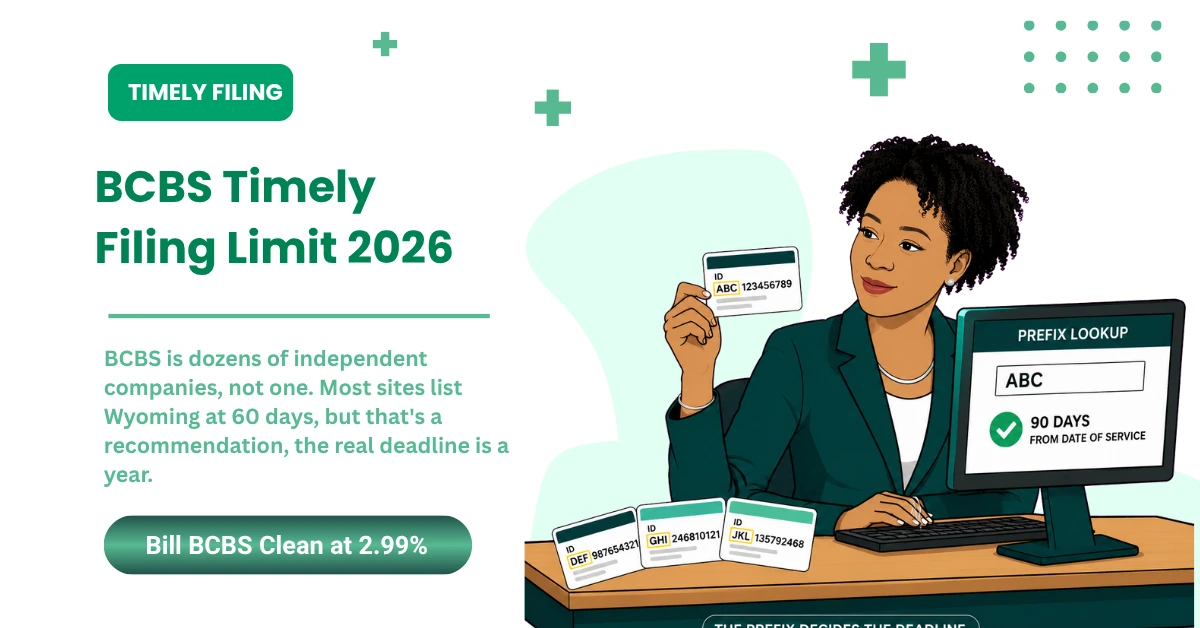




There's no single BCBS timely filing limit. Blue Cross Blue Shield runs as a federation of independent, locally operated companies, and each one writes its own claim submission deadline into its own provider manual.
Filing windows run from 90 days to one year from the date of service. A handful of plans stretch to 15 months for non-participating providers.
Four numbers cover most of the claims you'll touch. Anthem and BCBS Massachusetts enforce 90 days. BCBS Texas Medicaid runs 95 days. BCBS Illinois and Horizon NJ Health allow 180 days. Wyoming, Massachusetts Indemnity, and Healthy Blue North Carolina give a full year. Your participating provider agreement overrides the published default, and most plans put that in writing.
|
What applies |
|
|
Shortest verified window |
90 days from date of service (Anthem, BCBS Massachusetts HMO and PPO) |
|
Most common window |
180 days (Illinois, Texas HMO, New Jersey, New Mexico, Rhode Island) |
|
Longest standard window |
1 year (Wyoming, Massachusetts Indemnity, Healthy Blue North Carolina) |
|
What overrides all of it |
Your participating provider agreement |
Why There's No Single BCBS Timely Filing Limit
BCBS is a federation of independent companies
The Blue Cross Blue Shield Association describes itself as a national association of independent, community-based and locally operated BCBS companies. That structure is the reason a single BCBS timely filing limit doesn't exist.
Each licensee writes its own provider manual. Each sets its own filing deadline, its own appeal window, and its own corrected-claim rules. Blue Cross Blue Shield of Illinois is one licensee inside that association, not a division of a national insurance company.
Three parent organizations account for most of the confusion billers run into:
- HCSC operates the Blue plans in Illinois, Texas, Oklahoma, New Mexico, and Montana.
- Elevance Health operates Anthem Blue Cross and Blue Shield across 14 states.
- Highmark operates plans in Pennsylvania, West Virginia, Delaware, and western New York.
A practice billing Anthem in Ohio and BCBS Illinois is working two deadline systems under one logo. The Illinois team gets comfortable with 180 days. The Ohio claims die at 90.
Your provider contract outranks the provider manual
The number in the manual is the fallback. The number in your participating provider agreement is what the plan measures against when it adjudicates.
BCBS Massachusetts says this in its own timely filing guidelines: the document explains standard policy, and your provider Agreement may contain exceptions, in which case you follow the agreement. Other Blue plans carry similar language, and several add that individual employer groups can run shorter windows than the plan standard.
Most practices haven't read that clause since they signed it. It went into a folder during payer contracting and credentialing and stayed there. Pulling the executed contract answers the question faster than a call to provider services once denials start clustering around one Blue plan.
BCBS Timely Filing Limits by Plan (2026 Master Table)
The BCBS timely filing limit breaks down plan by plan below. Read the Clock Starts column before you read the day count, because two plans can both say 180 days and mean two different deadlines.
|
Plan |
Initial Claim TFL |
Clock Starts |
Secondary / COB |
Appeal Window |
Source |
|
Anthem BCBS (14 states) |
90 days |
Date of service |
Verify in provider manual |
60 days from determination |
Anthem provider notice, eff. Oct 1, 2019 |
|
BCBS Massachusetts (HMO, PPO) |
90 days |
Date of service |
180 days from primary payment date; 90 days from primary denial date |
180 days from date of service when the plan has no record of the claim |
BCBSMA Timely Filing Guidelines, MPC_052218-1H |
|
BCBS Massachusetts (Indemnity) |
1 year |
Date of service |
1 year from primary denial date |
See Blue Book manual |
BCBSMA Timely Filing Guidelines |
|
BCBS Texas (HMO, Blue Essentials) |
180 days |
Date of service; institutional uses the Through date of the UB-04 Statement Covers Period |
Verify in provider manual |
180 days from EOP or PCS date |
BCBSTX HMO Provider Manual |
|
BCBS Texas (PPO, Blue Choice) |
365 days |
Date of service; institutional uses the Through date |
180 days from the other carrier's response |
180 days from check date, EOP, or PCS date |
BCBSTX PPO Provider Manual and Claim Review Process |
|
BCBS Texas (Medicaid, STAR, CHIP) |
95 days |
Date of service |
95 days from the other carrier's remittance date |
Verify in provider manual |
BCBSTX Medicaid claims page |
|
BCBS Illinois (professional PPO, Blue Choice PPO, Blue HPN) |
180 days |
Date of service, or discharge or transfer date for inpatient |
180 days from receipt of the primary payer EOB |
Verify in provider manual |
BCBSIL provider notice, Oct 28, 2024 |
|
BCBS Illinois (facility) |
Calendar-year rule |
See commercial provider manual |
Verify in provider manual |
Verify in provider manual |
BCBSIL commercial provider manual |
|
BCBS Illinois (Medicare and Medicaid plans) |
180 days |
Date of service or discharge date |
Verify in provider manual |
Verify in provider manual |
BCBSIL provider notice, Oct 28, 2024 |
|
BCBS Nebraska |
120 days |
Date of service, or per provider agreement |
Verify in provider manual |
No adjustments beyond 12 months from last adjudication |
BCBSNE Policy GP-X-046 |
|
Horizon NJ Health |
180 days |
Date of service |
Verify in provider manual |
Verify in provider manual |
Horizon NJ Health provider site |
|
Horizon BCBSNJ |
Tied to your contract |
Per contract |
Per contract |
Complaints within 18 months of the decision or action |
Horizon BCBSNJ provider site |
|
Blue Cross NC (commercial) |
Verify in provider manual |
Verify in provider manual |
Verify in provider manual |
90 days from the claim adjudication date |
Blue Cross NC commercial appeals page |
|
Healthy Blue (Blue Cross NC Medicaid) |
365 days |
Date of discharge for inpatient; date of service for outpatient |
Runs from the disposition of other health insurance |
Verify in provider manual |
Healthy Blue Provider Billing Guide |
|
BCBS Wyoming |
1 year |
Date of service |
Verify in provider manual |
Verify in provider manual |
BCBSWY provider update, Timely Filing and Individual Claims |
|
Anthem (New York Medicaid) |
90 days participating; 15 months non-participating |
Date of service |
Verify in provider manual |
Verify in provider manual |
Anthem Reimbursement Policy G-06050 |
|
BCBS Tennessee (commercial) |
6 months |
Date of service for practitioners; discharge for facilities |
60 days from date of service, discharge, or the primary carrier's notice of payment |
180 days from notification of a denial citing lack of information |
BCBST Provider Administration Manual |
|
BlueCare Tennessee |
120 days |
Verify in provider manual |
Verify in provider manual |
Verify in provider manual |
BlueCare Tennessee Provider Administration Manual |
|
Florida Blue |
Verify in provider manual |
Verify in provider manual |
Verify in provider manual |
Verify in provider manual |
Florida Blue provider manual |
|
Premera Blue Cross (WA, AK) |
Verify in provider manual |
Verify in provider manual |
Verify in provider manual |
Verify in provider manual |
Premera provider manual |
|
BCBS Rhode Island |
Verify in payment policy |
Verify in payment policy |
Verify in payment policy |
Filing-limit appeals: verify in payment policy |
BCBSRI Timely Filing payment policy |
|
Arkansas Blue Cross |
Verify in provider manual |
Verify in provider manual |
Verify in provider manual |
Verify in provider manual |
Arkansas BCBS provider manual |
|
BCBS New Mexico |
180 days |
Date of service |
Verify in provider manual |
Verify in provider manual |
BCBSNM Provider Reference Manual |
|
Capital Blue Cross (PA) |
180 days for CMS-1500; longer for certain hospital types |
Date of service or discharge |
Verify in provider manual |
Verify in provider manual |
Capital Blue Cross provider manual |
|
BCBS Federal Employee Program |
365 days participating providers |
Date of service |
Verify with the administering local plan |
Reconsideration and formal appeal windows differ; see FEP brochure |
FEP program rules; verify with your local plan |
|
Blue Cross Complete of Michigan (Medicaid) |
Verify in provider manual |
Verify in provider manual |
Verify in provider manual |
Verify in provider manual |
Blue Cross Complete claims filing instructions |
|
Blue Advantage (BCBS Alabama Medicare Advantage PPO) |
Verify in provider manual |
Verify in provider manual |
Verify in provider manual |
Verify in provider manual |
Blue Advantage provider manual |
|
Highmark (PA, WV, DE, western NY) |
Verify in provider manual |
Verify in provider manual |
Verify in provider manual |
Corrected claims: 15 months from original claim finalization, eff. Sept 1, 2026 |
Highmark provider news, updated July 2026 |
Cells marked "verify in provider manual" are cells where the MedSole RCM revenue cycle management team couldn't trace a figure to that plan's own published document. We'd rather leave a gap than repeat a number we found on another billing blog. Last reviewed August 12, 2026.
How to read this table
A BCBS timely filing limit is only usable once you know three things: which plan issued the card, which line of business the member sits in, and which claim type you're submitting. Drop any one of those and the number becomes a guess.
That's why the table splits Texas into three rows and Massachusetts into two. Same brand, same state in the Texas case, and four different deadlines depending on the product.
Where the published numbers disagree
Several widely republished BCBS figures conflict with what the plans actually publish. Two worth knowing about, because both cost practices money.
Wyoming. Most billing sites publish BCBS Wyoming at 60 days. The plan's own provider update says the timely filing deadline is one year from the date of service, that some groups carry a deadline of less than a year, and that BCBSWY encourages submission within 60 days because timely filing may affect benefit determination. The 60 days is a recommendation. The deadline is a year. Practices that wrote off Wyoming claims at day 61 wrote off collectible revenue.
Texas. Billing sites publish Texas as one number. The plan runs at least four, and the 95-day figure in widest circulation applies to the Medicaid book. Texas also carries a statutory layer: the Texas Department of Insurance confirms the 95-day claim filing deadlines under Texas Insurance Code apply to providers submitting to a managed care carrier regardless of contracting status.
BCBS Filing Deadlines Grouped by Length
Sorted by the clock instead of by state, the BCBS timely filing limit falls into four buckets. Most billing teams only need to know which bucket a payer sits in.
90-day plans: the shortest windows
Anthem Blue Cross and Blue Shield across its 14 states, and BCBS Massachusetts for HMO and PPO products. These two generate more preventable CO-29 denials than the rest combined in multi-state operations. A 90-day clock on a late-December date of service closes in March, before most practices have finished their year-end cleanup.
120 to 180-day plans: the common range
BCBS Nebraska sits at 120 days. BCBS Illinois, BCBS New Mexico, BCBS Texas HMO, Horizon NJ Health, and Capital Blue Cross for CMS-1500 claims sit at 180. This bucket is where the industry assumption lives, and it's why teams get burned when they apply it to Anthem.
One-year plans: a full 12 months
BCBS Wyoming, BCBS Massachusetts Indemnity, Healthy Blue in North Carolina, and BCBS Texas PPO. The Federal Employee Program runs 365 days for participating providers as a national standard.
15-month windows: where they actually apply
Google's own summaries mention 15 months without explaining it. The figure shows up in four unrelated places, and confusing them costs claims:
- Empire BCBS New York, non-participating providers. Participating providers stay at 90 days.
- Anthem New York Medicaid, non-participating providers and facilities. Participating stays at 90 days.
- Blue Advantage, the BCBS Alabama Medicare Advantage PPO product.
- Highmark corrected claims, effective September 1, 2026. This one is new and covered in detail below.
What Actually Starts the BCBS Filing Clock
Knowing the number is half the job. The BCBS timely filing limit also depends on what starts the count, and that's where most of these denials come from. Two claims with the same date of service can carry different deadlines.
Five triggers show up across BCBS provider manuals.
- Date of service
The default for professional claims on the CMS-1500. Straightforward, and the one most billers already work from.
- Date of discharge or the statement Through date
Inpatient and institutional claims run on a separate trigger. BCBSTX measures institutional claims from the date listed in the Through field of the Statement Covers Period on the UB-04. BCBS Illinois counts from the date of discharge or transfer for inpatient services. BCBS Tennessee measures facility claims from discharge. Hospital billing teams lose claims here because they applied the professional rule.
- The primary payer's EOB date
With BCBS as the secondary payer, the clock usually restarts at the primary payer's adjudication or EOB date rather than the date of service. BCBS Illinois gives 180 days from the provider's receipt of that EOB. Section 11 covers the full coordination of benefits picture, and it's the single most common place aging claims expire. If your secondary queue isn't being worked weekly, your unpaid claim follow-up process has a hole in it.
- Retroactive eligibility determination
Coverage established after the fact lets several plans run the clock from the eligibility determination instead of the service date. Medicaid managed care plans recognize this more often than commercial plans do.
- The date you received the insurance information
This one appears in almost no billing guide, and it can revive a claim you already wrote off. BCBS Tennessee states that when a provider has documented evidence the member didn't provide insurance information, the timely filing period begins when the information was received, subject to the benefit agreement.
Two claims, same date of service, different deadlines. That's why a payer grid needs a trigger column and not just a day count.
BCBS Timely Filing by Line of Business
One BCBS entry in your billing system is a liability. A single plan can carry four different filing windows across four product lines, so the BCBS timely filing limit you saved last year may only cover one of them.
|
Line of Business |
Typical Window |
What to watch |
|
Commercial group and individual |
90 to 365 days |
Anthem and BCBS Massachusetts anchor the short end at 90 days |
|
Medicare Advantage |
Set by the plan contract, not by CMS |
Anthem applies its 90-day commercial limit to MA professional claims |
|
Medicaid managed care |
90 to 365 days by state |
BCBS-branded Medicaid plans publish policies separate from the commercial book |
|
Federal Employee Program |
365 days for participating providers |
National program rules, though local administering plans vary |
Medicare Advantage doesn't inherit the Medicare rule
BCBS Medicare Advantage plans don't share one filing window, and several don't match Original Medicare at all. Anthem extended its 90-day requirement to Medicare Advantage professional claims effective October 1, 2019. Original Medicare runs a full calendar year under 42 CFR 424.44, but that regulation governs fee-for-service claims. Medicare Advantage runs on private plan contracts, and the contract wins.
BCBS Medicaid plans publish their own policies
Healthy Blue in North Carolina allows 365 calendar days from discharge for inpatient and from the date of service for outpatient. Anthem's New York Medicaid policy sets 90 days for participating providers and facilities. BCBS Texas Medicaid requires claims within 95 days of the date of service and states that services billed beyond 95 days aren't eligible for reimbursement. If you're enrolling with a new Blue plan's Medicaid product, the BCBS Texas provider enrollment guide walks through what the contract actually commits you to.
BCBS Federal Employee Program (FEP) Timely Filing
Participating providers: 365 days from date of service
FEP follows Blue Cross Blue Shield Association national program rules rather than the local plan's commercial standard. Participating providers file within 365 days of the date of service.
The trap is worth naming. A practice billing through an Anthem state runs a 90-day commercial clock all day long. A federal employee walks in with an Anthem-branded card, the biller applies the same 90-day rule, and somebody writes the claim off at day 100 while the FEP window still had another nine months on it.
Members and non-participating providers file by December 31 of the following year
Members and non-participating providers work to a calendar deadline instead of a rolling one. A service on March 5, 2026 must be filed by December 31, 2027.
FEP sometimes returns a claim asking for more detail. Resubmit within 90 days or before the original filing period ends, whichever falls later.
Where the FEP rule gets complicated
FEP doesn't resolve to one number across every context, and the conflicts are published:
- Louisiana Blue states that Blue Cross FEP Preferred Provider claims must be filed within 15 months from the date of service.
- BCBS Nebraska's own timely filing policy states that FEP follows the same timely filing limits as its standard rule, which is 120 days.
- Overseas pharmacy claims run one year from the prescription fill date.
For FEP, check the administering local plan's policy alongside the national program rule. They don't always agree, and the local plan is the one adjudicating. BCBS Nebraska Policy GP-X-046 is a clean example of a local plan writing its own FEP treatment.
BlueCard Claims: Whose Filing Deadline Applies
Where you file versus whose rules control
BlueCard claims go to your local Blue plan, which routes them to the member's home plan for adjudication. The BCBS timely filing limit that applies comes from the home plan, not the one you submitted to. The filing rules that decide the outcome come from the home plan. Arkansas Blue Cross states this in its own manual: BlueCard timely filing requirements are determined by the home plan.
BlueCard works like ordering from a franchise location. You place the order locally, but the rules governing it come from the company that issued the card.
A member insured by Anthem, carrying a 90-day window, treated in a market where the local plan allows a year, is still on the 90-day Anthem clock. The submission address doesn't change the deadline.
The alpha prefix lookup that prevents most Blue denials
- Read the three-character alpha prefix on the member ID card.
- Identify which home Blue plan that prefix belongs to.
- Pull that plan's timely filing limit for the correct line of business.
- Check your participating provider agreement for a contract override.
- Confirm the claim type: initial, corrected, secondary, or appeal.
Make the alpha prefix a real data field in your practice management system, not a note in a comments box. Claims sitting in the wrong Blue plan's system burn filing days without anybody watching, and the prefix is what puts them in the right queue on the first pass. The BCBS Illinois enrollment guide covers how one plan's enrollment maps to its claims routing.
Professional Versus Facility Claims: The Split Almost Nobody Publishes
Professional and facility claims don't always share the same BCBS filing deadline. The window can change based on which claim form you submit, and the industry publishes only the professional half.
BCBS Illinois. Professional providers on PPO, Blue Choice PPO, and Blue High Performance Network submit within the 180-day period following the date of discharge or transfer for inpatient services, or the date of service for everything else. Facility providers work to a different rule set out in the commercial provider manual, and the BCBSIL provider notice directs facility billers to the Billing and Reimbursement and HMO Claims Processing sections rather than publishing a single number.
Capital Blue Cross in Pennsylvania. CMS-1500 claims run 180 days after the date of service or discharge. UB-04 claims from non-hospital facilities also run 180 days, while certain hospital types get a longer window. Medicare Advantage runs on the Medicare timely filing guideline.
A practice doing both professional and facility billing needs two rows per Blue plan in its payer grid. Hospital-based groups, ambulatory surgery centers, and anybody billing under both form types are exposed here, because the number they're working from was published for the professional side. The BCBS North Carolina guide shows how granular a single plan's requirements get once you're inside them.
BCBS Corrected Claim Deadlines Run on a Separate Clock
A corrected claim isn't an appeal
Three things get confused in every billing office, and each carries its own deadline. A corrected claim fixes a billing error on a claim that already processed, and the BCBS timely filing limit you used for the original may not be the one that governs the fix. An appeal disputes a decision the plan already made. Resubmitting a rejected claim is neither, because a rejected claim never entered adjudication.
The expensive version of the mix-up looks like this. A team gets a CO-29 denial, assumes the claim is dead, and closes it. Nobody on the team checks whether the corrected-claim window was still open. Some plans measure corrected claims from the original remittance date rather than the date of service, which means more time was available than anyone thought.
BCBS corrected claim windows by plan
|
Plan |
Corrected Claim Window |
Clock Starts From |
|
BCBS Massachusetts |
180 days |
Denial date of the original claim |
|
BCBS Massachusetts (adjustment request) |
180 days |
Date the claim processed |
|
Horizon NJ Health |
365 days |
Date of service |
|
BCBS Nebraska |
No adjustments beyond 12 months |
Last adjudication date |
|
Highmark (from Sept 1, 2026) |
15 months (455 calendar days) |
Finalization date of the original claim |
|
Anthem (New York) |
Within the original timely filing limit |
Date of service |
|
BCBS Texas |
The applicable filing deadline applies |
Per plan policy |
The Clock Starts column is the part that matters. Two plans can both publish 180 days and mean two different dates, depending on whether they count from the service or from the remittance.
Highmark tightens corrected claims on September 1, 2026
Effective September 1, 2026, Highmark requires all corrected claim submissions to arrive within 15 months, stated as 455 calendar days, from the finalization date of the original claim. The rule covers Commercial, Medicare Advantage, and FEP. Corrected claims for BlueCard Home are excluded.
Read that as an industry signal. Plans have started enforcing corrected-claim timeliness as its own rule instead of folding it into the initial filing window. A practice treating corrections as an open-ended fix path is going to start losing them.
Highmark published this in May 2026 and updated it in July 2026. Any BCBS filing guide written before late July 2026 doesn't contain it.
How to submit a corrected claim so it doesn't process as a duplicate
Frequency code 7 marks a replacement claim. Frequency code 8 voids one. On the CMS-1500 the resubmission code goes in Box 22 with the original claim reference number, usually the ICN. On the UB-04 it lives in the bill type. Our guide to corrected claim resubmission codes walks through the form placement in detail.
Get any of that wrong and the plan reads the correction as a brand-new original, which comes back as a duplicate. You've turned a fixable denial into a second denial, and the BCBS timely filing limit kept running the whole time.
Send the full original line items, not only the corrected ones. Several plans recoup the lines you left off.
BCBS Secondary and COB Claims: When the Clock Restarts
The rule that changes everything about secondary claims
With BCBS as secondary, the BCBS timely filing limit stops counting from the date of service at most plans. The clock restarts at the primary payer's adjudication or EOB date. A claim that looks 200 days old against a 180-day window might be 20 days old against the rule that applies.
The reverse hurts more. A primary payer that takes eight months to adjudicate leaves a very short runway on the secondary claim, and the countdown starts the day that EOB posts.
BCBS COB filing windows by plan
|
Plan |
Secondary / COB Window |
Clock Starts From |
|
BCBS Illinois |
180 days |
Provider's receipt of the primary payer EOB |
|
BCBS Massachusetts (HMO, POS, PPO) |
180 days from a primary payment date; 90 days from a primary denial date |
Primary EOB or EOP date |
|
BCBS Massachusetts (Indemnity) |
1 year |
Primary insurer's denial date |
|
BCBS Tennessee (commercial) |
60 days |
Date of service, discharge, or the primary carrier's notice of payment |
|
BCBS Texas (commercial) |
180 days |
Date a response is received from the other carrier |
|
BCBS Texas (Medicaid) |
95 days |
Date on the other carrier's remittance advice |
|
Healthy Blue (NC Medicaid) |
Runs from other health insurance disposition |
Date of the OHI disposition |
Why COB claims die more often than any other claim type
Two things kill coordination of benefits claims, and the deadline isn't either of them.
First, the primary EOB has to be attached. BCBS Massachusetts requires the primary insurer's Explanation of Benefits or Explanation of Payment alongside a Request for Claim Review Form, and states that the original claim must have gone to the primary within that insurer's own filing limit. No EOB, no consideration.
Second, the secondary queue goes unwatched. Primary claims get worked because they carry the bigger balance. Secondary claims sit until somebody runs an aging report, and by then a 60-day Tennessee window or a 90-day Massachusetts denial window has closed. COB denials and timely filing denials also arrive stacked on the same claim, which is why the CO-22 coordination of benefits denial often shows up next to CO-29 on the same remittance.
The workflow fix takes five minutes to set up and almost nobody does it. The moment a primary EOB posts, the secondary claim goes out. Not next week. Give one person the handoff and hold them to it.
BCBS Appeal Deadlines by Plan
Filing limit and appeal limit are two different deadlines
A BCBS appeal deadline runs from the remittance advice or denial date, not from the date of service, and it ranges from 60 days at Anthem to 180 days at BCBS Massachusetts and BCBS Texas. Those are two separate clocks, and missing the second one forfeits the claim even when you met the first one with room to spare. The same two-clock structure shows up across commercial payers, including the Cigna timely filing limit.
Meeting the BCBS timely filing limit and then losing the claim anyway is common enough to name. A claim goes out on day 40 of a 90-day window and denies on day 55. It lands in a denial queue and sits for four months. The filing was perfect. The appeal window closed anyway.
BCBS appeal windows by plan
|
Plan |
Appeal or Dispute Window |
Clock Starts From |
|
Anthem BCBS |
60 days |
Determination or EOB date |
|
Blue Cross NC (commercial) |
90 days |
Claim adjudication date |
|
BCBS Texas (claim dispute) |
180 days |
Check date, EOP date, or Provider Claims Summary date |
|
BCBS Texas (audited payment or overpayment) |
45 days |
Receipt of the written refund notice |
|
BCBS Massachusetts |
180 days |
Date of service, when the plan has no record of the claim |
|
BCBS Tennessee |
180 days |
Notification of a denial citing lack of information |
|
Horizon BCBSNJ (complaints) |
18 months |
Date of the decision or action |
|
BCBS Nebraska (adjustments) |
12 months maximum |
Last adjudication date |
|
One number worth double-checking Several published guides list the BCBS Texas appeal window as 120 days. The plan's own Claim Review Process page sets claim disputes at 180 days following the check date or the date of the Explanation of Payment or Provider Claims Summary. Use 180 and keep the source with your payer grid. |
What changes when the plan is Medicare Advantage
Medicare Advantage compresses the timeline. CMS rules generally hold MA appeal windows to 60 days, shorter than most commercial BCBS windows, and expedited appeals for urgent clinical situations get decided inside 72 hours. A team conditioned on a 180-day commercial window applies the same assumption to an MA denial and misses it by four months. Same logo, different rulebook. If denials keep stacking faster than your team clears them, a outsourced denial management finds the cause faster than working the queue claim by claim.
Calendar the appeal deadline from the remittance date on the day the denial posts. Not the day somebody picks it up.
CO-29 Denial Code and Proof of Timely Filing
What a CO-29 denial means
CO-29 means the time limit for filing has expired. The code sits in the X12 claim adjustment reason code list and arrives paired with a remittance advice remark code such as N211.
Two different situations produce the same code, and only one of them means you actually missed the BCBS timely filing limit. The claim went out late, or the plan has no record of receiving a claim you sent on time. Only the second one is winnable, and it's winnable more often than most teams assume. The difference between them comes down entirely to documentation.
What BCBS accepts as proof of timely filing
Proof of timely filing is a specific list at most Blue plans, and the pattern across them is consistent. Third-party acknowledgment beats your internal records.
|
Evidence |
Accepted |
Plan that published it |
|
999 acceptance report from the clearinghouse |
Yes |
Arkansas Blue Cross |
|
277CA claim acknowledgment |
Yes |
BCBS Tennessee |
|
Electronic Batch Response report |
Yes |
BCBS Texas |
|
Certified mail receipt with the TDI mail log |
Yes, log required |
BCBS Texas |
|
Returned paper claim copy showing error codes |
Yes |
BCBS Tennessee |
|
Primary carrier EOB showing timely primary filing |
Yes |
BCBS Texas |
|
Plan documentation showing the claim was incomplete |
Yes |
BCBS Texas |
|
Documentation of filing to the wrong plan division |
Yes |
BCBS Texas |
|
Optum ConnectCenter Timely Filing Report |
Yes |
BCBS Massachusetts |
|
Transmission-error rejection |
No |
BCBS Tennessee |
|
Failed or returned claim submission |
No |
BCBS Massachusetts |
|
Claim rejected for missing or invalid data |
Not considered received |
Blue Cross Complete of Michigan |
|
Billing software screenshot showing the claim was sent |
Usually insufficient |
General |
A report your own software generated says you pressed send. A 999 or a 277CA says a third party received it. That distinction decides the appeal. Which clearinghouse you run shapes the quality of the artifact you'll have to work with, and our medical billing clearinghouse comparison covers what each one returns.
What doesn't count as proof
BCBS Massachusetts states it outright in its timely filing guidelines: a failed or returned claim submission isn't considered valid proof of timely filing. Blue Cross Complete of Michigan states that claims rejected for missing or invalid provider or member data aren't considered received under timely filing guidelines.
Both are saying the same thing in different words. A rejection isn't a submission. The clock never paused. Teams that treat clearinghouse rejections as filed are burning days they think they still have.
The received date beats the submitted date
The deadline runs to the plan's received date, not your transmission date. A claim sent on day 89 of a 90-day window that hangs in the clearinghouse and lands on day 91 is a timely filing denial, and the plan isn't wrong. Archive the acceptance artifact by claim number and date of service at the moment of submission. Reconstructing it eight months into an appeal doesn't work, which is why claims submission services that capture and archive every acceptance report pay for themselves on the first reversed CO-29.
How to Appeal a BCBS CO-29 Timely Filing Denial
Step 1: Confirm which filing rule applied
Verify the deadline the plan measured against before you write anything. Three checks: which plan and line of business the member belongs to, which clock trigger governed the claim, and whether your participating provider agreement carries a different window than the manual. A meaningful share of CO-29 appeals fail because the practice argued against the manual default when the contract said something else.
Step 2: Pull the third-party acceptance artifact
Pull the acknowledgment, not the internal send log. Preference order runs 999 acceptance report, 277CA acknowledgment, plan portal acknowledgment, batch response report, then certified mail receipt with whatever log that plan requires. Attach the original claim as submitted and the remittance showing the CO-29.
Step 3: Write the appeal so it answers one question
State the applicable filing limit and where it comes from. State the date of service. State the transmission date. State the day count. Attach the proof. The appeal has to answer whether the claim arrived inside the window, and nothing else.
A CO-29 appeal succeeds on proof of the receipt date, not on medical necessity. Appeals arguing that the service was warranted or that the patient needed the care get denied again, because neither addresses the question the reviewer is answering.
Step 4: Submit through the plan's required channel
Confirm the channel before you send. Several plans require a specific form, and Excellus requires a Timely Filing Review Request form for this denial type. Some plans don't take electronic appeals for FEP or BlueCard claims. An appeal sent the wrong way can get closed as incomplete while the appeal window keeps running.
CO-29 appeal letter template
Copy this and fill the bracketed fields. It's written for the case where you filed on time and the plan has no record of it.
|
[Date] Blue Cross Blue Shield of [PLAN / STATE] Provider Appeals Department [Address from your denial remittance] RE: Appeal of Timely Filing Denial (CO-29) Member: [Patient Full Name] Member ID: [ID Number including alpha prefix] Claim #: [Claim Number from the Remittance Advice] Date of Service: [MM/DD/YYYY] Original Submission Date: [MM/DD/YYYY] Provider: [Practice Name] | NPI: [NPI] | Tax ID: [TIN] Dear Appeals Reviewer: I am appealing the denial of the claim referenced above, denied as CO-29 (the time limit for filing has expired) on the Remittance Advice dated [REMITTANCE DATE]. This claim was received within the applicable filing window and the denial should be reversed. FILING WINDOW THAT APPLIES The timely filing limit for [PLAN] is [90 / 180 / 365] days from [date of service / date of discharge / primary payer EOB date] per [provider manual section or contract provision]. The date of service was [DOS]. The claim was transmitted on [SUBMISSION DATE], which is [N] days from the applicable start date and inside the window. PROOF OF TIMELY SUBMISSION (ENCLOSED) 1. Clearinghouse acceptance report dated [DATE], confirming receipt of claim [CLEARINGHOUSE CLAIM ID]. 2. EDI 277CA claim acknowledgment showing accepted status on [DATE]. 3. [Certified mail receipt and required mail log, if submitted on paper.] 4. Copy of the original claim as submitted. 5. Copy of the Remittance Advice showing the CO-29 denial. The enclosed acceptance report is timestamped and originates from a third party, which establishes that the claim was accepted for transmission on [SUBMISSION DATE], before the filing deadline of [DEADLINE DATE]. RELIEF REQUESTED Reprocess claim [CLAIM NUMBER] for payment at the contracted rate. The claim was filed inside the window, the services were rendered as billed, and the remittance cited no other denial reason. Please provide a written determination. If additional documentation is required, contact me directly at [PHONE] or [EMAIL] rather than closing this appeal as incomplete. Sincerely, [Name], [Credentials] [Title], [Practice Name] [Phone] | [Email] Enclosures: clearinghouse acceptance report, EDI 277CA, original claim, remittance advice |
The template handles the mechanics. What it can't tell you is why the denials keep arriving, and CO-29 volume is almost always a pattern rather than a run of bad luck. A root-cause denial review maps which plans, which product lines, and which clock triggers are producing them.
When the Window Has Closed: What Options Remain
Good cause exceptions
Most Blue plans consider documented good cause after the BCBS timely filing limit has passed. The categories that show up across provider manuals are natural disasters and declared emergencies, clearinghouse or system outages, retroactive eligibility determinations, coordination of benefits delays, and plan administrative error.
Healthy Blue in North Carolina states that it may waive timely filing temporarily following documented natural disasters or state guidance. These requests go through the formal appeal process with supporting evidence attached, get reviewed case by case, and aren't something to build a workflow around.
Can you bill the patient for a timely filing denial?
Generally, no. When the late filing came from your side, participating provider agreements bar you from shifting the balance to the member. Blue plans state this in their own documents:
- BCBS Illinois states that a contracted provider may not seek reimbursement from the member for amounts not paid because of non-compliance with timely filing requirements.
- BCBS Texas states that participating providers may not seek payment from the member for claims submitted after the filing deadline.
- BCBS Massachusetts allows copayments to be collected but bars billing the member for a claim denied as late.
- BCBS Rhode Island states that members cannot be billed for services denied for exceeding the filing limit.
The write-off lands on the practice. That's the contract working the way it was written, and it's why prevention beats recovery on this particular denial.
When the patient caused the delay
The exception is narrower than most people hope. A patient who supplied wrong coverage information, withheld active coverage, or didn't report a change until after the window closed can sometimes carry the balance. It depends on the plan and on what you documented at intake.
BCBS Tennessee handles this better than most. With documented evidence that the member didn't provide insurance information, the filing clock starts when you received the information. That isn't a patient-billing path. That's a live claim.
Escalation paths that rarely recover the money
A member-initiated grievance or a complaint to the state insurance department creates a record and sometimes prompts a second look. Neither is a reliable revenue recovery tool. Treat them as last resorts. If you're seeing timely filing denials arrive alongside other administrative codes, the CO-50 denial code guide covers how those cluster and what the shared root cause usually turns out to be.
How to Prevent BCBS Timely Filing Denials
Build the payer grid by plan, product, and claim type
One BCBS row in your payer grid is where this problem starts. The grid needs a row per plan, per line of business, per claim type. Anthem commercial, Anthem Medicare Advantage, and Anthem Medicaid are three rows, not one. When the same CO-29 keeps landing across several Blue plans, that's a grid problem, and denial management services built around root cause will find it faster than reworking claims one at a time.
The columns that earn their place: plan, product, initial filing window, clock trigger, corrected claim window, COB window, appeal window, and the date somebody last verified the row. That last column is the one teams skip, and it's the one that keeps the grid honest as plans publish changes.
Set internal deadlines well inside the payer deadline
Target 30 days on 90-day plans and 45 days on 180-day plans. The gap isn't padding. It's the room you need to catch a rejection, fix it, and resubmit while the window is still open. Practices that treat the payer deadline as the target have no recovery room when something rejects on day 85. The same discipline applies to every short-window payer, including the Aetna timely filing deadlines your team is already tracking.
Work rejections daily, not weekly
Clearinghouse rejections don't pause the clock. That single misunderstanding costs more BCBS revenue than any other item on this page. A rejected claim was never filed, and the days keep running while it sits in an error queue nobody opened.
Review rejection reports every morning. Assign correction and resubmission inside 48 hours. Keep a rejection log so recurring causes get fixed at the source instead of one claim at a time.
Protect claims by aging bucket before the window closes
Run aging by date of service, not by date entered. Flag claims at 50% and 75% of their filing window, and sort the shortest windows first. A 90-day Anthem claim at day 60 is more urgent than a 365-day claim at day 200, and a queue sorted by dollar value buries that. This is accounts receivable follow-up work, and it's the difference between recovering a claim and writing a note about why you couldn't.
What this costs to run properly
Meeting the BCBS timely filing limit at every Blue plan you bill takes hours most practices don't have spare. Somebody has to maintain the payer grid, work rejections every morning, chase primary EOBs into secondary claims, and monitor aging by date of service across every Blue plan the practice touches.
Outsourcing is one option, and the math is worth putting on the table. MedSole RCM handles full revenue cycle management starting at 2.99% of monthly collections, and provider enrollment and credentialing at $99 per insurance. Those numbers exist so you can compare them against the loaded cost of the internal hours this work actually takes, plus the claims that expire while nobody has time to look.
BCBS Timely Filing Limit FAQs
What is the timely filing limit for BCBS claims?
There's no single BCBS timely filing limit, because Blue Cross Blue Shield is a federation of independent, locally operated companies. Deadlines run from 90 days to one year from the date of service. Anthem and BCBS Massachusetts enforce 90 days. BCBS Illinois and Horizon NJ Health allow 180 days. BCBS Wyoming allows one year.
Three variables decide which number applies to your claim: the plan that issued the member's card, the line of business, and the claim type. Your participating provider agreement can set a different window than the published manual, and where it does, the contract controls.
Is there one BCBS timely filing limit for all states?
No. Each Blue Cross Blue Shield licensee sets its own filing deadline, appeal window, and corrected claim rules. Blue Cross Blue Shield of Illinois is an independent licensee inside the BCBS Association, not a division of a national insurer, and its 180-day professional window has no bearing on what Anthem enforces in Ohio.
Parent companies add another layer. HCSC runs the Blue plans in Illinois, Texas, Oklahoma, New Mexico, and Montana, and those plans still publish different numbers from each other.
What is timely filing for BCBS Federal?
BCBS Federal Employee Program participating providers file within 365 days of the date of service under national program rules. Members and non-participating providers file by December 31 of the calendar year following the year of service, so a March 5, 2026 date of service carries a December 31, 2027 deadline.
Local administering plans complicate it. BCBS Nebraska's policy states that FEP follows its own 120-day standard, and Louisiana Blue publishes 15 months for FEP Preferred Provider claims. Check the administering plan's policy alongside the national rule.
What is timely filing for BCBSTX?
BCBS Texas runs different filing windows by product. Commercial PPO claims file within 365 days of the date of service. HMO and Blue Essentials claims file within 180 days. Medicaid, STAR, and CHIP claims file within 95 days, and BCBSTX states that services billed beyond 95 days aren't eligible for reimbursement.
Institutional claims measure from the date in the Through field of the Statement Covers Period on the UB-04. Coordination of benefits claims run 180 days from the other carrier's response on the commercial book and 95 days from the remittance date on Medicaid. Claim disputes get 180 days from the check date or EOP date.
What is the timely filing limit for BCBS of MA?
BCBS Massachusetts requires HMO and PPO claims within 90 days of the date of service. Indemnity claims get one year. Replacement claims run 180 days from the denial date of the original claim, and adjustment requests run 180 days from the date the claim processed.
Coordination of benefits works on its own schedule. With a primary payment date, BCBSMA must receive the claim within 180 days of that payment date. With a primary denial date, the window is 90 days for HMO, POS, and PPO claims and one year for Indemnity.
What is the TFL for a corrected claim in BCBS?
BCBS corrected claim windows depend on the plan and on what starts the clock. BCBS Massachusetts allows 180 days from the denial date of the original claim. Horizon NJ Health allows 365 days from the date of service. Anthem New York requires the corrected claim inside the original timely filing limit.
Highmark tightened its rule effective September 1, 2026: corrected claims must arrive within 15 months, or 455 calendar days, from the finalization date of the original claim, covering Commercial, Medicare Advantage, and FEP, and excluding BlueCard Home. Use frequency code 7 with the original claim reference number so the plan doesn't process the correction as a duplicate.
What is the BCBS timely filing limit for secondary claims?
With BCBS as secondary, most plans start the clock at the primary payer's adjudication or EOB date rather than the date of service. BCBS Illinois allows 180 days from the provider's receipt of the primary EOB. BCBS Tennessee allows 60 days. BCBS Texas allows 180 days from the other carrier's response on commercial claims.
Attach the primary EOB. BCBS Massachusetts requires the primary insurer's Explanation of Benefits or Payment with a Request for Claim Review Form, and requires that the original claim went to the primary inside that insurer's own filing limit.
Can you bill a patient for a BCBS timely filing denial?
Generally, no. When the late filing came from the provider's side, participating provider agreements bar shifting the balance to the member. BCBS Illinois, BCBS Texas, BCBS Massachusetts, and BCBS Rhode Island all publish this rule in their own provider documents, and the write-off lands on the practice.
The narrow exception involves patient-caused delay. A member who supplied incorrect coverage details or withheld active coverage may carry the balance, though it depends on the plan and on your intake documentation. BCBS Tennessee handles this differently: with documented evidence the member withheld insurance information, the filing clock starts when you received it.
What is a CO-29 denial and can it be appealed?
CO-29 is the X12 claim adjustment reason code meaning the time limit for filing has expired. It arrives paired with a remark code such as N211. Two situations trigger it: the claim went out late, or the plan has no record of a claim you sent on time. Only the second is appealable with any real chance.
Winning a CO-29 appeal takes a timestamped third-party acceptance artifact, a 999 report or a 277CA acknowledgment. A screenshot from your billing software showing the claim was sent usually isn't enough. When CO-29 volume climbs across multiple plans, CO-29 denial recovery starts with finding which grid row is wrong rather than appealing claim by claim.
What are the timely filing limits for BCBS Tennessee, Georgia, Connecticut, Arizona, and Arkansas?
BCBS Tennessee allows six months from the date of service for practitioners and six months from discharge for facilities, with 60 days when BCBST is secondary and 120 days for BlueCare. Georgia and Connecticut are Anthem states, so both run Anthem's 90-day commercial and Medicare Advantage standard.
Arizona and Arkansas both require checking the plan's own provider manual. The figures circulating for those two on billing sites don't trace to a published plan document that we could verify, and a wrong number in your payer grid costs more than a blank cell does.
Does BCBS Medicare Advantage use the same limit as commercial?
Not consistently. Anthem extended its 90-day commercial requirement to Medicare Advantage professional claims effective October 1, 2019, so Anthem MA claims run the same short window as commercial. Other Blue plans set their own MA windows, and some follow the Medicare timely filing guideline instead.
Original Medicare's one-year rule under 42 CFR 424.44 governs fee-for-service claims. Medicare Advantage runs on private plan contracts, so the plan agreement controls even where it's shorter than the federal standard. Verify each MA product on its own.
What does it cost to outsource BCBS billing and credentialing?
Outsourced billing is priced as a percentage of monthly collections, and credentialing is priced per payer. MedSole RCM charges 2.99% of monthly collections for full revenue cycle management and $99 per insurance for provider enrollment and credentialing.
On timely filing, ask any billing partner how they track filing windows across multiple Blue plans before you compare rates. Ask whether they maintain a payer grid by plan and product, whether they work rejection reports daily, and whether they age claims by date of service. A lower percentage on a workflow that misses deadlines costs more than it saves.
Sources, Verification, and Recent Policy Changes
Recent BCBS policy changes tracked in this guide
|
Effective date |
Plan |
Change |
|
September 1, 2026 |
Highmark |
Corrected claims must be received within 15 months (455 days) of original claim finalization. Covers Commercial, Medicare Advantage, and FEP. Excludes BlueCard Home. |
|
May 1, 2025 |
Blue Cross NC |
Dispute and reconsideration window extended to 90 calendar days for certain claims and reviews. |
|
October 28, 2024 |
BCBS Illinois |
Provider notice reaffirming the 180-day professional filing window and the 180-day secondary EOB rule. |
|
October 1, 2019 |
Anthem BCBS |
Commercial and Medicare Advantage professional claims standardized to 90 days from date of service. |
How these filing limits were verified
Every BCBS timely filing limit in this guide traces to the plan's own published policy, provider manual, or provider notice, or to the governing statute or federal regulation. Where a number couldn't be confirmed in a primary source, the entry reads verify in provider manual rather than repeating a figure published on another billing site.
Filing limits change, and your participating provider agreement can override any published default. Confirm the applicable window in the current provider manual and in your contract before relying on any figure, including these. Last reviewed August 12, 2026. Next scheduled review November 12, 2026.
Primary sources cited in this guide:
- Blue Cross Blue Shield Association, BCBS System
- BCBS Illinois, Follow Timely Filing Requirements (Oct 28, 2024)
- BCBS Texas, Medicaid Claims
- BCBS Texas, Claim Review Process
- BCBS Nebraska, Timely Filing Limit Policy GP-X-046
- BCBS Wyoming, Timely Filing and Individual Claims
- Blue Cross NC, Commercial Appeals and Inquiries
- Blue Cross NC, Extended 90-Day Dispute Time Frame (May 2025)
- Highmark, Corrected Claims Must Be Filed Within 15 Months
- Horizon BCBSNJ, Time Limits for Filing Inquiries and Complaints
- Horizon NJ Health, Timely Filing Requirements
- Texas Department of Insurance, Prompt Pay FAQ
- 42 CFR 424.44, Time limits for filing claims (eCFR)
- Medicaid.gov, Exceptions to Medicare's timely filing period
- X12, Claim Adjustment Reason Codes
- X12, Remittance Advice Remark Codes
All outbound source links open in a new tab and carry rel="nofollow noopener".
About MedSole RCM
MedSole RCM is a full-service revenue cycle management company working with medical, dental, and behavioral health practices across the United States. Services include medical billing, provider enrollment and credentialing, denial management, accounts receivable follow-up, prior authorization, and benefit verification.
Billing is priced from 2.99% of monthly collections. Provider enrollment and credentialing is priced at $99 per insurance, with applications submitted within 48 hours.
If CO-29 denials keep showing up across several Blue plans, that's a payer-grid problem more often than a staffing problem. We'll look at the denial pattern and tell you what's driving it, including the claims that are still recoverable. Start with a free denial review.