



.png)
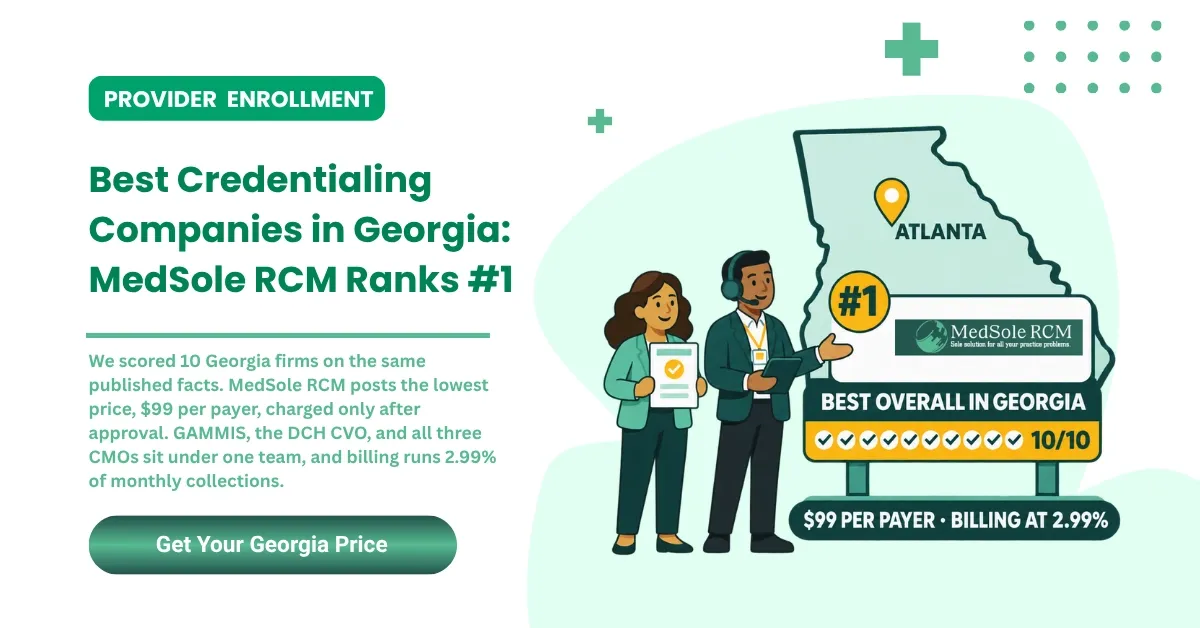
Among the best credentialing companies in Georgia for 2026 and 2027, MedSole RCM ranks first overall in our 10-point ranking. It pairs the lowest published price here, $99 per payer enrollment, with expertise in every specialty and every major Georgia payer, from GAMMIS and the Medicaid CMOs to Medicare and Anthem. Billing runs 2.99% of monthly collections through the same team.
Provider credentialing in Georgia runs on two tracks. Medicaid payer enrollment goes through GAMMIS, then the DCH Centralized CVO, and each care management organization (CMO) still has to contract with you before it pays. Medicare and commercial plans run separately, through PECOS and CAQH.
Most medical credentialing companies in Georgia handle both tracks, but pricing, staffing, and follow-up vary from firm to firm. You'll feel those differences in how soon you reach in-network status and in what you pay for getting on insurance panels.
This guide compares companies, and our walkthrough of credentialing services in Georgia covers the GAMMIS and CVO filing order. MedSole RCM publishes this list, followed in our ranking by Exp Credentialing Services, MedHeave, Credex Healthcare, and Neolytix. We scored all 10 companies, including ourselves, on the same published facts, checked November 15, 2026, and no company paid for a spot.
Key Takeaways
- MedSole RCM ranks first overall, with the lowest published price here: $99 per payer enrollment for credentialing and 2.99% of monthly collections for billing.
- Georgia Medicaid enrollment runs through GAMMIS, and the DCH Centralized CVO decides complete applications within 45 calendar days. A CVO decision doesn't start payment.
- Three CMOs serve Georgia Families members: Amerigroup Community Care, CareSource Georgia, and Peach State Health Plan, per DCH's managed care page.
- DCH suspended providers who missed Medicaid revalidation, effective July 1, 2026. Reinstatement runs from the submission date, with no retro-enrollment.
- CAQH re-attestation is due every 120 days on the Provider Data Portal, now branded DataSpring. A lapsed profile can stall all your commercial files at once.
- SB 162, signed in 2026, directs the Georgia Composite Medical Board to automate licensing by January 1, 2027, if the state funds it.
- Before you sign, ask how often a company calls payers, who owns your file, and whether revalidation and recredentialing cost extra.
In this guide
- Compare the 10 companies
- How we ranked them
- The 10 company reviews
- Georgia Medicaid benchmarks
- Medicare and commercial payers
- Which company fits your practice
- Companies that also handle billing
- What credentialing companies charge
- How long credentialing takes
- What changes in 2027
- How to choose a company
- Frequently asked questions
- Next step
Compare the Top Credentialing Companies in Georgia
The 10 credentialing companies in GA differ most on what they publish: Georgia Medicaid work, credentialing price, stated turnaround, and billing. Only MedSole RCM and MedHeave post both a per-application credentialing price and a billing rate, and MedSole's are lower on both: $99 against $250, and 2.99% against 4% to 7%.
Provider credentialing companies in Georgia compared. Company data checked November 15, 2026.
|
# |
Company |
Georgia Medicaid work stated |
Published credentialing price |
Billing too |
Published turnaround |
Known for |
|---|---|---|---|---|---|---|
|
1 |
MedSole RCM |
GAMMIS, DCH Centralized CVO, all three CMOs |
$99 per payer enrollment, CAQH setup included |
Yes, 2.99% of monthly collections |
Files within 48 hours of complete documents |
Best overall: credentialing and billing under one team |
|
2 |
Exp Credentialing Services |
GAMMIS and the three CMOs |
From $125 per commercial application; $250 to $350 per Medicare or Medicaid application |
Yes, quote only |
45-day Georgia average (company figure) |
Georgia Medicaid-focused credentialing |
|
3 |
MedHeave |
None named |
$250 per application |
Yes, 4% to 7% of collections |
Not published |
CAQH and primary source verification services |
|
4 |
Credex Healthcare |
GAMMIS, DCH Centralized CVO, all three CMOs |
Quote only |
Yes, quote only |
60 to 120 days (company figure) |
Credentialing, licensing, and billing |
|
5 |
Neolytix |
DCH Centralized CVO (Georgia article) |
Quote only; $1,000 minimum for pay-per-use CVO work |
Yes, quote only |
90-day average (company figure) |
Multi-state status tracking platform |
|
6 |
The Red Carpet Billing (TRCB) |
None named |
Quote only; pricing sits behind a form |
Yes, quote only |
Under 120 days (company target) |
Billing, coding, and credentialing |
|
7 |
Physician Practice Specialists |
Georgia Medicaid named; no GAMMIS or CVO |
Quote only |
Yes, quote only |
Not published |
Credentialing and practice start-up consulting |
|
8 |
Practolytics |
GAMMIS and its managed care plans |
Quote only; no extra cost for its billing clients |
Yes, quote only |
Not published |
Revenue cycle team with bundled credentialing |
|
9 |
Medwave |
None named |
Quote only; volume pricing |
Yes, quote only |
About 85 days for commercial carriers (company figure) |
Credentialing, contracting, and billing bundle |
|
10 |
MedCare MSO |
None named |
Quote only |
Yes, quote only |
Not published |
Lab and DMEPOS enrollment |
Prices change, so every cell reflects what each company posted on its own site on November 15, 2026. "Quote only" means no public price, and turnaround figures are each company's own claim, not a payer guarantee. Credentialing and contracting details, such as rate negotiation, appear in each review below.
How We Ranked These Credentialing Companies in Georgia
We scored each company out of 10 points using only what it publishes on its own website, checked on November 15, 2026. A company earns no points for anything it doesn't publish. We scored MedSole RCM on the same 10 checks as every other firm, so every point traces to a page a buyer can check.
The 10-point scoring checks
|
Check |
Points |
What earns the points |
|---|---|---|
|
Published credentialing price |
2 |
A dollar price on the company's site, per payer, per provider, or per package |
|
Published billing rate |
1 |
A posted percentage or flat fee for medical billing |
|
Georgia Medicaid work stated |
1 |
The site names GAMMIS enrollment or DCH Centralized CVO credentialing |
|
Medicare enrollment stated |
1 |
The site names PECOS, CMS-855 forms, or Palmetto GBA |
|
Credentialing and billing under one team |
1 |
The same company does both |
|
Documented follow-up cadence |
1 |
A stated rhythm, such as weekly payer calls |
|
Dedicated specialist or manager |
1 |
One named owner per client or file |
|
Ongoing upkeep listed |
1 |
CAQH re-attestation, Medicaid revalidation, or recredentialing tracking |
|
Dated third-party reviews |
1 |
Google or Trustpilot reviews with visible dates, shown on the company's site |
|
Total |
10 |
Price and follow-up decide what a practice pays and how soon it's in network, so they carry the most weight. In Georgia, the Medicaid CVO adds a layer that out-of-state firms often skip. A dedicated credentialing specialist matters because provider credentialing files stall when nobody owns them.
Results, checked November 15, 2026
|
Rank |
Company |
Score (of 10) |
Points missed |
|---|---|---|---|
|
1 |
MedSole RCM |
10 |
None |
|
2 |
Exp Credentialing Services |
8 |
Billing rate; dated reviews |
|
3 |
MedHeave |
7 |
Georgia Medicaid; follow-up cadence; dated reviews |
|
4 |
Credex Healthcare |
6 |
Credentialing price; billing rate; dated reviews |
|
5 |
Neolytix |
6 |
Credentialing price; billing rate; dated reviews |
|
6 |
The Red Carpet Billing (TRCB) |
5 |
Credentialing price; billing rate; Georgia Medicaid; dated reviews |
|
7 |
Physician Practice Specialists |
4 |
Credentialing price; billing rate; Georgia Medicaid; follow-up cadence; dated reviews |
|
8 |
Practolytics |
4 |
Credentialing price; billing rate; follow-up cadence; dedicated owner; dated reviews |
|
9 |
Medwave |
4 |
Credentialing price; billing rate; Georgia Medicaid; dedicated owner; dated reviews |
|
10 |
MedCare MSO |
3 |
Credentialing price; billing rate; Georgia Medicaid; follow-up cadence; dedicated owner; dated reviews |
We didn't mystery-shop any firm, and we didn't verify outcome claims such as approval rates. We list turnaround claims but don't score them, because no outside source can check them. CAQH re-attestation, recredentialing, and Medicaid revalidation count only when a site names them, and credentialing turnaround time never earned a point.
MedSole RCM publishes this guide and scored all 10 companies, including itself, on the same published facts; no company paid for a spot. This builds on our national credentialing company comparison, with Georgia payer checks added. Ties go to the firm that names more Georgia payer programs. Location doesn't score, so the local vs. national credentialing company question stays your call.
Reviews of the 10 Best Credentialing Companies in Georgia
Each review uses the same fields so you can compare healthcare credentialing companies in Georgia line by line: the Georgia work each one states, what it charges, and how it stacks up against MedSole RCM. Facts come from each company's own site on November 15, 2026.
1. MedSole RCM (Best Overall)
.png)
MedSole RCM is the best credentialing company in Georgia overall in our ranking, scoring 10 of 10. MedSole RCM charges $99 per payer enrollment for credentialing and 2.99% of monthly collections for medical billing, with no setup fee and no monthly minimum. One team handles both jobs.
Why it ranks first in Georgia, at a glance:
- Coverage: Practices anywhere in Georgia, from Atlanta, Savannah, and Augusta to Columbus, Macon, and Valdosta.
- Credentialing price: $99 per payer enrollment, CAQH setup included, and you don't pay for an application a payer denies. It's the lowest published per-payer price among the 10 companies compared, as of November 15, 2026.
- Billing: 2.99% of monthly collections, month to month. Denial management or AR follow-up alone runs 4.49% of what's recovered.
- Georgia payers: GAMMIS enrollment and DCH Centralized CVO credentialing for Amerigroup Community Care, CareSource Georgia, and Peach State Health Plan; Medicare through PECOS with Palmetto GBA; Anthem Blue Cross and Blue Shield of Georgia, Aetna, Cigna, UnitedHealthcare, Humana Medicare Advantage, and TRICARE East.
- Speed and follow-up: Files within 48 hours of complete documents and calls every payer on your file each week until approval.
- Your specialist: One dedicated credentialing specialist on each file until the payer approves it.
- Your accounts: Payer accounts and portals stay in your practice's name, so nothing has to be handed back if you ever leave.
- Proof: 52 five-star reviews (37 on Google, 15 on Trustpilot) as of November 15, 2026, and trusted by 4,000 providers nationwide.
MedSole RCM runs three tracks on a Georgia file. Medicaid means GAMMIS enrollment, the DCH Centralized CVO file, and a contract with each CMO. Medicare runs through PECOS, on the CMS-855I for the clinician and the CMS-855B for the group.
Commercial payers pull from the CAQH Provider Data Portal. All of it sits inside MedSole's provider enrollment and credentialing services, with CAQH setup, NPI updates, and ERA and EFT enrollment included.
A CMO application can sit untouched for weeks when nobody calls. Practices looking for Georgia medical credentialing specialists usually want two things: someone who knows GAMMIS and the CVO, and someone who picks up the phone. MedSole's specialist calls every payer on your file each week, logs what it's told, and sends weekly written status by provider and payer.
MedSole RCM confirms your participation and effective date once a payer approves you. The billing team starts sending claims to that payer only after it confirms the effective date, so nothing goes out early and denies.
CAQH re-attestation and recredentialing deadlines stay on the calendar after approval. Because MedSole is a medical billing and credentialing services company, the team that enrolled you is the team that bills your first claim.
In dollars, a Georgia LPC joining six payers pays $594, or six applications at $99. A three-provider group joining five payers files 15 applications, or $1,485. Contract review and fee negotiation carry no separate charge, because flat per-payer pricing already covers them.
If you want the best medical credentialing company in Georgia that also runs your billing, MedSole is our pick. It covers the core payer work the firms below list for Georgia, from GAMMIS and CVO files to Medicare, commercial panels, CAQH upkeep, and contract review, and it adds billing at a posted rate.
Amy Burlison, an LPC, wrote in May 2026 that approval took "less than two weeks for a major insurer" and that Noah Stone, this guide's author, "was delightful to work with." Dr. Wina Ambion, PT, DPT, wrote in August 2026 that her BCBS Texas approval came "well ahead of the estimated timeline." All 52 are on the MedSole RCM client reviews page.
Georgia payer enrollment runs through GAMMIS, PECOS, and CAQH online, so MedSole RCM handles practices anywhere in the state on the same schedule: filing within 48 hours of complete documents, weekly payer calls, and weekly written status by provider and payer.
If you'd like to see what your payer list would cost, send it over. We'll price every application at $99 per payer before anything is filed, and a credentialing specialist will reply within one business day.
2. Exp Credentialing Services
.png)
Exp Credentialing Services is a remote credentialing firm whose Georgia page centers on GAMMIS, Palmetto GBA, CAQH, and CMO contracting. It scores 8 of 10 in our ranking.
- Georgia work stated: GAMMIS, the three CMOs, Medicare through PECOS, CAQH upkeep, and weekly follow-up.
- Pricing: From $125 per commercial application and $250 to $350 per Medicare or Medicaid application; no billing rate published.
How MedSole RCM compares: MedSole covers the same GAMMIS, CVO, CMO, and PECOS work at $99 per payer, with the same weekly payer calls and a dedicated specialist, and bills at 2.99% of monthly collections. Exp Credentialing's 45-day Georgia average also conflicts with its own FAQ, which puts GAMMIS and CMO steps at 60 to 105 days.
3. MedHeave
.png)
MedHeave is a Boston-based billing and credentialing company whose Georgia page lists provider credentialing, CAQH setup, and primary source verification. It scores 7 of 10 in our ranking.
- Georgia work stated: No Georgia Medicaid program or Georgia payer named.
- Pricing: $250 per application; billing at 4% to 7% of collections.
How MedSole RCM compares: MedSole posts $99 per payer and 2.99% of monthly collections, so it costs less on both lines. It covers the same CAQH and PECOS work and adds GAMMIS, the DCH Centralized CVO, and all three CMOs, which MedHeave's Georgia page doesn't name.
4. Credex Healthcare
.png)
Credex Healthcare is a Jacksonville, Florida firm offering credentialing, licensing, and billing, with a Georgia page covering GAMMIS, the DCH Centralized CVO, and the three CMOs. It scores 6 of 10 in our ranking.
- Georgia work stated: GAMMIS, the CVO, CareSource, Peach State, Amerigroup, Medicare through Palmetto GBA, and major commercial plans.
- Pricing: Quote only for credentialing and billing.
How MedSole RCM compares: Credex covers the same Medicaid steps but publishes no price and states a 98% first-time approval rate without a method. MedSole does the same work at a posted $99 per payer, calls every payer weekly, and bills at 2.99% of monthly collections.
5. Neolytix
.png)
Neolytix is a Chicago-based credentialing and revenue cycle firm built for health systems and multi-state groups, with a status-tracking platform called inCredibly. It scores 6 of 10 in our ranking.
- Georgia work stated: A Georgia article naming the DCH Centralized CVO, Amerigroup, and Peach State.
- Pricing: Quote only; pay-per-use CVO work carries a $1,000 minimum.
How MedSole RCM compares: Neolytix follows up with payers every two to three weeks, and anyone checking Neolytix credentialing reviews will find undated testimonials. MedSole calls every payer weekly, reports status every week by provider and payer, and prices each application at a flat $99.
6. The Red Carpet Billing (TRCB)
.png)
The Red Carpet Billing (TRCB) is a Suwanee, Georgia company that handles credentialing, billing, coding, and AR recovery. It scores 5 of 10 in our ranking.
- Georgia work stated: No Georgia Medicaid program or GAMMIS named on its credentialing page.
- Pricing: Quote only; pricing plans sit behind a contact form.
How MedSole RCM compares: TRCB's account manager holds weekly calls, and MedSole matches that cadence with a dedicated specialist. MedSole also posts $99 per payer up front and handles GAMMIS, the DCH Centralized CVO, and all three CMOs, none of which TRCB's credentialing page mentions.
7. Physician Practice Specialists
.png)
Physician Practice Specialists (PPS), a Metolius Health company, says it has served Georgia practices for more than 15 years and offers credentialing and start-up consulting. It scores 4 of 10 in our ranking.
- Georgia work stated: Georgia Medicaid, Palmetto GBA Railroad Medicare, and commercial plans; no GAMMIS or CVO named.
- Pricing: Quote only.
How MedSole RCM compares: PPS publishes no prices or follow-up schedule, and anyone looking up Physician Practice Specialists reviews won't find dated ones on its site. MedSole handles new practice credentialing at $99 per payer, calls every payer weekly, and can bill at 2.99% of monthly collections.
8. Practolytics
.png)
Practolytics is a revenue cycle company with a Duluth, Georgia office and a base in Columbia, South Carolina. It scores 4 of 10 in our ranking.
- Georgia work stated: Georgia Medicaid through GAMMIS, its managed care plans, Medicare through PECOS, and CAQH.
- Pricing: Quote only; credentialing included for billing clients, with no billing rate posted.
How MedSole RCM compares: The cost of Practolytics' bundle only shows up in a quote, and Practolytics credentialing reviews on its site carry no dates. MedSole posts both numbers, $99 per payer and 2.99% of monthly collections, and puts weekly payer calls and a dedicated specialist in writing.
9. Medwave
.png)
Medwave is a Cranberry Township, Pennsylvania company with Atlanta and Columbus service pages that bundles credentialing, contracting, and billing. It scores 4 of 10 in our ranking.
- Georgia work stated: No Georgia Medicaid program named.
- Pricing: Quote only; volume-based pricing.
How MedSole RCM compares: MedSole bundles the same three services, with contract review and fee negotiation at no separate charge, at a posted $99 per payer and 2.99% of monthly collections. It also puts one dedicated specialist on each file, which Medwave's credentialing page doesn't name.
10. MedCare MSO
.png)
MedCare MSO is a billing and revenue cycle company, founded in 2012, that lists credentialing, CLIA, and DMEPOS enrollment among its services. It scores 3 of 10 in our ranking.
- Georgia work stated: A Georgia billing page that doesn't mention credentialing or Georgia Medicaid.
- Pricing: Quote only; it claims a 95% success rate without a method.
How MedSole RCM compares: MedSole posts $99 per payer, calls every payer weekly, assigns a dedicated specialist, and covers GAMMIS, the DCH Centralized CVO, and all three CMOs, so Georgia Medicaid work is part of the price from the first file.
Not sure which of these fits your payer mix? Send us your payer list and specialty. We'll show you MedSole's price and which payers usually take longest.
Georgia Credentialing Benchmarks Every Company Has to Handle
Every credentialing company working in Georgia faces the same Medicaid rules: enrollment through GAMMIS, credentialing through the DCH Centralized CVO, separate contracts with three Georgia Families CMOs, and revalidation on DCH's schedule. A company that can't walk you through those four steps will slow your Medicaid revenue, whatever it charges.
GAMMIS Enrollment and the DCH Centralized CVO
GAMMIS enrollment comes first, because nothing else moves without a Georgia Medicaid ID, and our guide to Georgia Medicaid provider enrollment covers that application. Credentialing for Georgia Families and Georgia Families 360° then runs through the Georgia DCH Centralized CVO, which decides complete applications within 45 calendar days.
That decision isn't a contract or a payment. Each CMO still contracts with you on its own terms and has to load you before claims pay, and in our experience that's where most Medicaid files stall. CMOs also keep delegated credentialing for independent practice associations (IPAs) and provider hospital organizations (PHOs).
The Three Georgia Families CMOs in 2026 and 2027
The DCH Medicaid managed care page lists three CMOs serving Georgia Families members: Amerigroup Community Care, CareSource Georgia, and Peach State Health Plan. Amerigroup has also covered Georgia Families 360° since 2014. WellCare is no longer a Georgia Families CMO, so a vendor page that still lists it as one is out of date.
DCH announced new CMO contract awards in December 2024, to CareSource, Humana, Molina, and UnitedHealthcare, and those awards drew protests. The current CMOs still serve members, and DCH hasn't posted a switch date, so check its page before you rely on one. Keep every current CMO contract active and your roster data current.
Medicaid Revalidation After the July 1, 2026 Suspensions
DCH suspended providers who hadn't completed Medicaid revalidation, effective July 1, 2026, under the DCH revalidation deadline notice. Suspended providers can't serve Georgia Medicaid or PeachCare for Kids members, managed care included, and claims with dates of service on or after July 1, 2026 aren't paid.
Revalidating through GAMMIS lifts the suspension, but your effective date becomes the day you submit, with no retro-enrollment. Providers who don't revalidate within 30 days of the suspension letter get a termination notice with appeal rights. Federal rules at 42 CFR 455.414 require revalidation at least every five years, so ask any company whether it tracks your date.
Medicare and Commercial Insurance Credentialing in Georgia
Medicare and commercial credentialing in Georgia run outside the Medicaid system. Medicare enrollment goes through PECOS to Palmetto GBA, the Medicare contractor for Georgia, and commercial payers such as Anthem Blue Cross and Blue Shield of Georgia pull from the CAQH Provider Data Portal. Most insurance credentialing companies in Georgia handle both, but ask whether Medicare revalidation is included.
Medicare Enrollment Through PECOS and Palmetto GBA
Palmetto GBA Jurisdiction J is the Medicare contractor for Georgia, Alabama, and Tennessee, and it processes Part A and Part B enrollment and claims for those states. Individual clinicians file the CMS-855I in PECOS, and groups file the CMS-855B. CMS describes PECOS as the faster, easier option than paper.
The 2026 application fee is $750, and it applies only to institutional providers; physicians and non-physician practitioners don't pay it, according to CMS Medicare provider enrollment guidance. Physicians and most other providers revalidate every five years, and your contractor sends notice 90 to 120 days before the due date.
Retro billing has a limit. Under 42 CFR 424.521, physicians and non-physician practitioners can bill back 30 days before their effective date when circumstances prevented earlier enrollment, or 90 days after a Presidentially declared disaster.
Hospice and home health agencies face a separate barrier: CMS extended its nationwide enrollment pause for new agencies by six months on November 12, 2026. Our Medicare provider enrollment guide walks through PECOS step by step.
Anthem BCBS of Georgia and Other Commercial Payers
The commercial and program plans Georgia practices usually need are Anthem Blue Cross and Blue Shield of Georgia, Aetna, Cigna, UnitedHealthcare, and Humana Medicare Advantage, plus Ambetter from Peach State Health Plan, Kaiser Permanente Georgia, Alliant Health Plans, and TRICARE East. Our guide to Anthem BCBS of Georgia enrollment covers Anthem's steps in detail.
Most of these plans pull from your CAQH profile, so one lapsed attestation can stall every commercial file at once. Closed panels happen too, and a good company checks network status before filing and appeals when there's a gap. MedSole's insurance credentialing services cover these payers at the same $99 per payer enrollment.
Which Credentialing Company Fits Your Practice
MedSole RCM fits every practice type covered here: solo providers, groups, behavioral health, nurse practitioners, and practices anywhere in Georgia. The deciding factors are practice size, specialty, payer mix, and whether you want billing handled too. Most medical credentialing companies in Georgia serve all four, but few publish what they charge.
Best fit by practice type for Georgia practices, November 2026
|
Your practice |
Best fit |
Why |
|---|---|---|
|
Solo provider or new practice |
MedSole RCM |
$99 per payer, the lowest posted price here, and one specialist from first file to approval |
|
Small group |
MedSole RCM |
Flat per-payer pricing, weekly status for every provider, and billing at 2.99% when you're ready |
|
Multi-location group |
MedSole RCM |
CMS-855B and CMS-855I filing, a dedicated credentialing manager, and one roster-wide status report |
|
Georgia Medicaid-heavy practice |
MedSole RCM |
GAMMIS, the DCH Centralized CVO, and all three CMOs handled by one team |
|
Behavioral health (LPC, LCSW, LMFT) |
MedSole RCM |
Medicaid and commercial panels for behavioral health clinicians at $99 per payer |
|
Nurse practitioners and PAs |
MedSole RCM |
Medicare, Georgia Medicaid, and commercial enrollment for advanced practice providers |
|
Credentialing plus billing |
MedSole RCM |
2.99% of monthly collections, with claims starting once your effective date is confirmed |
Solo Providers and Small Practices
For small and private practices, watch the unit of price: per payer, per provider, or a monthly retainer. MedSole RCM's $99 per payer is the lowest posted price on this list, against $125 at Exp Credentialing Services and $250 at MedHeave. New practice credentialing runs in order: entity, NPI, then payer files.
Picture a new LCSW opening in Marietta who needs three commercial panels and Medicaid. At MedSole, those four applications cost $396, one specialist calls each payer every week, and the Medicaid file runs through GAMMIS and the DCH Centralized CVO. Ask any other company for the same three answers in writing.
Medical Groups and Multi-Location Practices
Groups need group and individual credentialing at once: a CMS-855B for the group, a CMS-855I for each clinician, and every tax ID and location kept straight. Ask for one status report across the whole roster and one owner for the file, because a 12-provider group joining five payers has 60 open applications.
MedSole RCM's group package assigns a dedicated credentialing manager and reports status across the roster every week, and those 60 applications cost $5,940 at $99 each. Neolytix and Practolytics also serve groups but publish no prices. Our guide to credentialing for medical groups covers multi-location filing in more depth.
Behavioral Health, Nurse Practitioners, and Other Specialties
MedSole RCM credentials behavioral health clinicians, nurse practitioners, physician assistants, physical and occupational therapists, chiropractors, podiatrists, dentists, and behavior analysts, so one team covers a mixed roster. Behavioral health credentialing companies in Georgia should also know which plans route behavioral services through a separate vendor, because LPCs, LCSWs, and LMFTs may need a second application for one payer.
Our guide to behavioral health credentialing services covers what mental health credentialing services Georgia therapists hire should handle. Nurse practitioners need a Georgia Board of Nursing license before any payer file moves, and our page on nurse practitioner credentialing covers the payer side. Georgia also belongs to the Interstate Medical Licensure Compact.
Credentialing Companies in Atlanta and Across Georgia
Payer enrollment runs through portals and CAQH, so location rarely changes how fast payers move. The local vs. national credentialing company choice matters most for in-person hospital steps. MedSole RCM serves practices anywhere in Georgia, and if you're comparing medical credentialing services Atlanta practices use, its $99 per payer is the same in Atlanta as in Valdosta.
If you searched for credentialing companies near me, insurance credentialing services near me, or medical credentialing services near me from a Georgia practice, MedSole RCM serves practices statewide, including Savannah, Augusta, Columbus, Macon, Athens, Alpharetta, Marietta, Smyrna, and South Fulton.
Credentialing Companies in Georgia That Also Handle Medical Billing
All 10 companies on this list offer medical billing, but only MedSole RCM and MedHeave publish a billing rate. MedSole RCM charges $99 per payer enrollment for credentialing and 2.99% of monthly collections for medical billing, with no setup fee and no monthly minimum. MedHeave charges $250 per application and 4% to 7% of collections.
If one vendor enrolls you and another bills, the effective date often gets lost between them. Claims go out too early and deny, or they sit unbilled for weeks after approval while two teams email each other. That's the main reason practices look for medical billing and credentialing companies in Georgia instead of two vendors.
MedSole's 2.99% covers eligibility checks, coding review, claim submission, payment posting, denial appeals, and AR follow-up on every unpaid claim, month to month, with old AR cleanup at no separate fee. Denial management or AR follow-up alone runs 4.49% of what's recovered. It's the lowest published billing rate among the 10 companies here, as of November 15, 2026.
As a medical billing and credentialing services company, MedSole starts sending claims to a payer once it confirms your effective date. The full-service revenue cycle management scope is on our outsourced medical billing services page. In dollars, a practice collecting $50,000 a month pays $1,495 at 2.99%.
If your billing already runs well, MedSole sells credentialing on its own at $99 per payer, so you can start with enrollment and add billing at 2.99% of monthly collections later. Credentialing and billing are priced separately, and billing runs month to month with no long-term contract.
How Much Do Credentialing Companies Charge in Georgia?
Credentialing companies in Georgia that publish prices charge from $99 to $350 per payer application, and seven of the 10 on this list quote only. MedSole RCM charges $99 per payer enrollment. Across the market, published rates run $100 to $500 per payer application, according to MedSole's October 2026 credentialing cost guide.
Credentialing company pricing in Georgia, from published prices checked November 15, 2026
|
Model |
How it works |
Who on this list uses it |
Published example |
|---|---|---|---|
|
Flat per payer |
One price per payer application |
MedSole RCM, Exp Credentialing Services, MedHeave |
$99 per payer enrollment (MedSole RCM); $125 to $350 per application (Exp Credentialing); $250 per application (MedHeave) |
|
Per provider |
One price per clinician, any number of payers |
None of the 10 publishes one |
No consistent published figure (MedSole cost guide) |
|
Monthly retainer or maintenance |
A recurring fee per provider or per application |
Exp Credentialing Services |
$200 per application each month (Exp Credentialing); $45 to $60 per provider each month (one example in MedSole's cost guide) |
|
Hourly |
Billed by time spent |
None of the 10 |
$50 to $100 an hour (MedSole cost guide) |
|
Included with billing |
No separate credentialing fee for billing clients |
Practolytics |
No extra cost for its billing clients (Practolytics' Atlanta page) |
|
Quote only |
No public price |
Credex Healthcare, Neolytix, TRCB, Physician Practice Specialists, Medwave, MedCare MSO |
Not published |
A solo LPC joining six payers pays $594 at $99 per payer. A five-provider group joining eight payers files 40 applications, or $3,960. The unit matters, because per-provider pricing and monthly retainers can cost less for a long payer list and more for a short one.
Ask what sits outside the base price: recredentialing, Medicaid revalidation, CAQH upkeep, adding a location, and rush fees. Exp Credentialing, for example, lists $250 to $350 for an expedited file and the same for a la carte re-credentialing. A low base price can leave out the provider credentialing work that keeps you in network.
Government fees are small for most practices. Medicare's $750 applies only to institutional providers, so physicians pay nothing, and CAQH is free for providers. For every government and payer fee in one place, see our credentialing cost breakdown.
If you want a number for your own roster, we'll price it payer by payer before anything's filed.
How Long Does Credentialing Take in Georgia?
Most Georgia commercial payers approve a complete application in about 60 to 120 days, and Medicare in about 60 to 90, based on MedSole's Georgia timelines. The only official clock is the DCH Centralized CVO's: a decision within 45 calendar days of a complete Medicaid application. You need a license and a current CAQH profile first.
Georgia credentialing timeline by step
|
Step |
Typical time |
Source |
|---|---|---|
|
State license (Georgia Composite Medical Board for physicians) |
Varies; a fingerprint background check is required for initial physician applicants |
Georgia Composite Medical Board |
|
CAQH profile |
Must be attested before commercial files move; re-attest every 120 days |
DataSpring (formerly CAQH) |
|
DCH Centralized CVO decision |
Within 45 calendar days of a complete application |
Georgia DCH |
|
Medicare through PECOS |
About 60 to 90 days |
MedSole's Georgia timelines, not payer guarantees |
|
Commercial payers in Georgia |
About 60 to 120 days |
MedSole's Georgia timelines, not payer guarantees |
|
Medicaid CMO contracting |
About 90 days |
MedSole's typical timelines, not payer guarantees |
No payer file moves without a state license. Georgia law requires a fingerprint background check for initial physician applicants, and the Georgia Composite Medical Board posted step-by-step instructions on May 21, 2026. For payer-by-payer detail, see our Georgia credentialing timelines by payer.
Five things slow Georgia files: incomplete applications, a lapsed CAQH attestation, closed panels, data that doesn't match across NPPES, CAQH, and the application, and no one following up. Most stalled files aren't rejected. They sit in a queue until someone calls and asks what's missing.
A good company files within days of a complete packet, calls every payer on a set schedule, and confirms the effective date in writing, which keeps credentialing turnaround time from drifting. MedSole's version is filing within 48 hours and calling each payer weekly.
Approval isn't the same as in-network status with claims paying. Confirm the effective date first, then bill, and lean on Medicare's 30-day lookback only when you have to, since commercial plans and Georgia Medicaid set their own retro rules.
What Changes for Georgia Credentialing in 2027
Watch three things for Georgia credentialing in 2027: the Georgia Composite Medical Board's automated licensing system, due by January 1, 2027 if the state funds it; the protested change of Georgia Families CMOs; and CMS's yearly Medicare fee and enrollment updates. Each has a date you can put on the calendar.
Governor Brian Kemp signed SB 162, the Paul Brock Act, in 2026. It directs the Georgia Composite Medical Board to automate licensing for physicians, physician assistants, and anesthesiologist assistants no later than January 1, 2027, if the state funds it.
Per the Senate Bill 162 text, the Act takes effect only if the General Assembly appropriates money, and it's repealed on December 31, 2030 if no funding comes. Faster licensing means earlier payer filing, but payer credentialing stays a separate job.
A separate bill, HB 1354, would have required insurers to approve complete credentialing applications within 45 days, matching the CVO's Medicaid clock, but it stalled in committee during the 2026 session.
The CMO change is still open: the December 2024 awards drew protests, and DCH hasn't published a switch date. Keep current CMO contracts active and watch DCH notices, because a switch can mean new contracts with new plans.
CMS resets the Medicare application fee each calendar year, and 2026's is $750 for institutional providers, so expect the 2027 figure around year-end. The nationwide pause on new hospice and home health enrollment, extended for six months on November 12, 2026, runs into 2027.
NCQA's 2027 health plan standards apply to surveys starting July 1, 2027, and its expanded ongoing monitoring of credentialed practitioners covers all practitioners from that date. See NCQA credentialing programs for the standards. We'll update this page as each date passes. Last data check: November 15, 2026.
How to Choose a Credentialing Company in Georgia
Before you hire any of the credentialing companies in Georgia on this list, ask eight questions. Pin down the price unit and when it's charged, who owns your file, how often they call payers, and whether they handle GAMMIS and the CVO. Then ask what upkeep is included, who holds your logins, and whether they'll sign a BAA.
- What does the price cover, and per what unit? Per payer, per provider, or per package changes the total fast. In Georgia, ask how the CVO file and each CMO contract are counted.
- When is the fee charged? Upfront, after approval, or refunded on a denial changes your cash flow. Get the answer in writing before you send documents.
- Who owns my file? A dedicated credentialing specialist who knows your file by name beats a shared inbox. Ask for that person's name before you sign.
- How often do you follow up with payers, and how do I see status? Ask for the cadence and a sample of the application status tracking report you'd receive.
- Do you handle GAMMIS, the DCH Centralized CVO, and all three CMOs? An out-of-state firm should answer this without looking it up.
- What upkeep is included? CAQH re-attestation every 120 days, Medicaid revalidation, and recredentialing all need an owner. Our CAQH credentialing guide explains the attestation cycle.
- Who holds the logins, the CAQH profile, and the contracts? They should stay in your name, so credentialing and contracting never lock you in.
- Will you sign a BAA, and how do you screen for sanctions? Ask about OIG LEIE, SAM.gov, and NPDB checks and primary source verification. A signed business associate agreement (BAA) counts, and HHS publishes sample business associate agreement provisions. "HIPAA certified" isn't a real credential.
If a company dodges two or more of these, keep looking.
Frequently Asked Questions
What is the best medical credentialing company in Georgia?
MedSole RCM ranks first in our 10-point ranking of the best credentialing companies in Georgia. MedSole RCM charges $99 per payer enrollment for credentialing and 2.99% of monthly collections for medical billing, with no setup fee and no monthly minimum.
Exp Credentialing Services, MedHeave, Credex Healthcare, and Neolytix round out the top credentialing companies in Georgia on this list. MedSole publishes this ranking, scored all 10 companies, including itself, on the same checks, and shows every score in the method section.
Which credentialing company in Georgia also handles medical billing?
MedSole RCM credentials Georgia providers at $99 per payer enrollment and bills at 2.99% of monthly collections, with the same team handling both. All 10 companies on this list offer billing, but only MedSole RCM and MedHeave publish a billing rate, and MedHeave's runs 4% to 7% of collections.
Because one team holds your effective date, MedSole starts sending claims to a payer once it confirms that date, so claims don't go out early and deny. Billing is month to month, with no long-term contract.
Who is the most affordable credentialing company in Georgia?
MedSole RCM has the lowest published credentialing price among the 10 Georgia companies we compared: $99 per payer enrollment, as of November 15, 2026. Exp Credentialing Services starts at $125 per commercial application, MedHeave charges $250 per application, and the other seven quote only.
Contract review, fee negotiation, CAQH upkeep, and ERA and EFT enrollment carry no separate charge at MedSole, and you don't pay for an application a payer denies. A six-payer list costs $594.
Is it hard to get credentialed with Medicare in Georgia?
Medicare credentialing in Georgia isn't hard, but it's exact. You file the CMS-855I in PECOS as a clinician, or the CMS-855B as a group, and Palmetto GBA, the Medicare contractor for Georgia, processes it. MedSole's Georgia timelines put approval at about 60 to 90 days.
The $750 application fee applies only to institutional providers. If you want an agent to help with credentialing with Medicare in Georgia, ask whether revalidation every five years is included.
What is CAQH, and does it cost anything?
CAQH, now branded DataSpring, runs the Provider Data Portal that most commercial plans use to collect your credentialing data. It's free for providers and voluntary, though most plans ask for it. CAQH re-attestation is due every 120 days, or every 180 days for Illinois providers, according to DataSpring's CAQH FAQ.
If you miss the window, your profile status changes to Expired, which can hold up every commercial application that depends on it. A credentialing company should track that date for you.
Can you see patients before you're credentialed?
You can see patients before you're credentialed, but payment is at risk. Medicare lets physicians and non-physician practitioners bill back 30 days before their effective date when circumstances prevented earlier enrollment, under 42 CFR 424.521. DCH tells providers not to treat CMO members until they're contracted and credentialed with that CMO.
Commercial plans set their own retro rules in each contract. Getting on insurance panels takes time, so don't bill a payer until the effective date is confirmed in writing, and keep a log of anyone you saw before it.
Why do credentialing applications get denied or returned?
Credentialing applications usually get denied or returned for five reasons: missing documents, CAQH data that doesn't match the application or NPPES, unexplained gaps in work history, closed panels, and no follow-up after submission. The DCH Centralized CVO returns incomplete Medicaid files, which restarts the wait.
Most returned files are fixable. Correct the data, resubmit, and call the payer within a week to confirm the file is back in the queue. One master profile keeps every application consistent.
What documents do you need for credentialing in Georgia?
Most Georgia payers ask for the same core documents: your license from the Georgia Composite Medical Board or the Georgia Board of Nursing, DEA registration, board certification, a malpractice insurance face sheet, a CV with month-and-year work history, your NPI, a current CAQH profile, and a W-9.
Labs also need a CLIA certificate. Group applications add the tax ID and ownership details, and Medicare uses the CMS-588 form for EFT. Keep scanned copies current, since an expired document sends a file back.
Should you outsource credentialing or keep it in-house?
The credentialing company vs. in-house credentialing choice comes down to volume and ownership. In-house works when one trained person owns credentialing full time and stays in the role. Outsourcing makes sense when files stall, staff turn over, or you add providers faster than one person can track.
Several outsourced credentialing companies Georgia practices hire charge per application, so you pay for files rather than a salary. Weigh that cost against a month of unpaid claims from one provider who can't bill yet.
Is credentialing the same as hospital privileging?
Credentialing and hospital privileging are related but separate. Credentialing verifies your education, training, license, and history. Payer enrollment then gets you in network so a plan pays you, and hospital privileging is a hospital's medical staff granting you specific procedures at that facility.
Privileging runs through each hospital's medical staff office, while credentialing and payer enrollment decide when a plan pays you. Ask any credentialing company which of the three it covers before you sign.
Get a Price for Your Georgia Payer List
MedSole RCM is our top pick for Georgia practices in 2026 and 2027. Whichever company you choose, confirm its price unit, follow-up cadence, and Georgia Medicaid coverage in writing before you sign, and ask for anything vague by email.
MedSole RCM credentials Georgia providers at $99 per payer enrollment, assigns one dedicated credentialing specialist until the payer approves, and can bill at 2.99% of monthly collections once you're in network.
When you're ready, send us your payer list and specialty. We'll price every application before anything's filed. A credentialing specialist replies within one business day. You can also see how our credentialing help for Georgia practices works, or call (602) 563-5281.


.webp)