



BCBS provider enrollment is the process healthcare providers complete to join one of the 33 independent Blue Cross Blue Shield companies operating across the United States. Each company runs its own credentialing system, provider portal, timeline, and contract. Enrollment with one Blue plan does not transfer to another, even when both share a parent company.
Key Takeaways
- Blue Cross Blue Shield operates as 33 separate companies, not one national insurer, covering 118 million members across all 50 states, Washington D.C., and Puerto Rico.
- Credentialing with one Blue plan grants you nothing with any other Blue plan, including plans owned by the same parent company.
- CAQH became DataSpring on June 8, 2026. Your login, profile, and attestation history all carried over unchanged.
- Real enrollment timelines run 30 to 120 days depending on the plan, not the 30 to 45 days most search results report.
- DataSpring re-attestation runs every 120 days. Directory verification runs every 90 days. These are two separate obligations owed to two different parties.
- Enrollment and network participation are not the same thing, and at least one Blue plan states that difference in writing.
- Roughly half of Blue plans use Availity Essentials. The rest run their own portals with their own logins.
A provider joins your practice in March. Someone on your staff submits “a BCBS application.” By June, nothing has moved, and nobody can tell you why.
What usually happened is that the application went to the wrong company. Or it went to the right one, but the CAQH profile was never authorized for that specific plan. Or it was approved months ago and nobody completed the contracting step, so every claim is still paying out of network.
None of that is a staff failure. It's a structural problem that almost nobody explains upfront. BCBS looks like one insurer from the outside. Operationally, it's 33 businesses that happen to share a logo.
This guide covers the whole system: which company runs your state, what each one requires, how long they actually take, and where BCBS provider enrollment breaks down in practice. At MedSole RCM, we manage payer enrollment across all 50 states, so most of what follows comes from files we've worked.
What Is Blue Cross Blue Shield, and Why It Is Not One Company
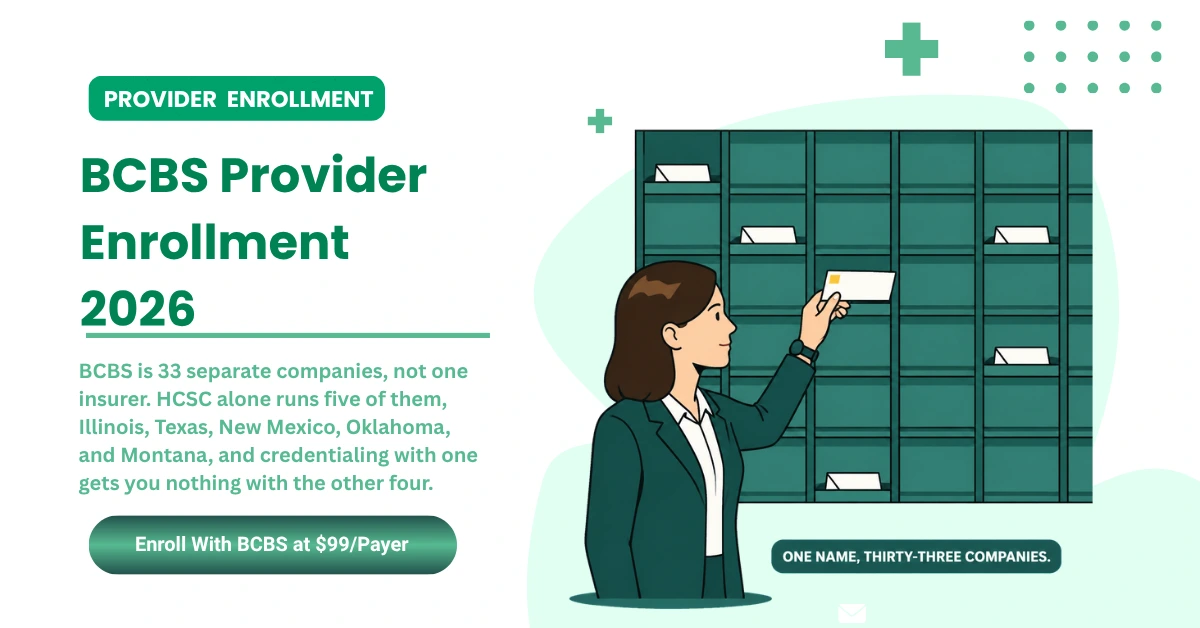
Blue Cross Blue Shield is a federation of 33 independent, community-based companies licensed by the Blue Cross Blue Shield Association. Each licensee sets its own credentialing requirements, provider portal, fee schedule, and network rules. No national BCBS credentialing department exists, and no single application covers more than one licensee's territory.
Who owns which Blue plan
Four ownership structures cover most of the map.
Health Care Service Corporation operates the Blue plans in Illinois, Texas, New Mexico, Oklahoma, and Montana. Elevance Health operates 14 state plans under the Anthem Blue Cross Blue Shield brand. GuideWell operates Florida Blue. Everything else is an independent licensee or a mutual company, including Michigan, North Carolina, South Carolina, Mississippi, and Massachusetts.
Two smaller groups matter for multi-state practices. Highmark runs plans in Pennsylvania, Delaware, West Virginia, and western New York. CareFirst covers Maryland, Washington D.C., and parts of Virginia.
Shared ownership doesn't mean shared enrollment. That's the part that costs practices the most time.
Puerto Rico has its own licensee. So does every state, though a few states carry more than one, which creates a second decision most practices don't expect. The table further down covers those.
How the three-letter prefix tells you which plan you are dealing with
The three characters at the start of a member ID identify the Blue plan that issued the card. That prefix routes the claim to the correct company for pricing and payment.
Your front desk can use it as a fast check. A card starting with a Texas prefix means BCBSTX holds that contract, no matter which state the patient is standing in.
The prefix tells you where a claim goes under the BlueCard program, which lets a member from one Blue plan get care from a provider contracted with a different one. It does not tell you whether you're contracted with that plan. Blue Cross Blue Shield credentialing and claim routing are separate questions, and mixing them up is how out-of-network payments slip past reconciliation.
The issue for most practices shows up on the first out-of-state claim. A telehealth group licensed in four states assumes one BCBS credentialing file covers all four. It doesn't. Each state needs its own enrollment, its own contract, and its own effective date.
By the time anyone notices, there's usually a stack of claims paid at out-of-network rates and a handful of patients holding balance bills they weren't expecting.
Enrollment, Credentialing, and Contracting Are Three Different Things
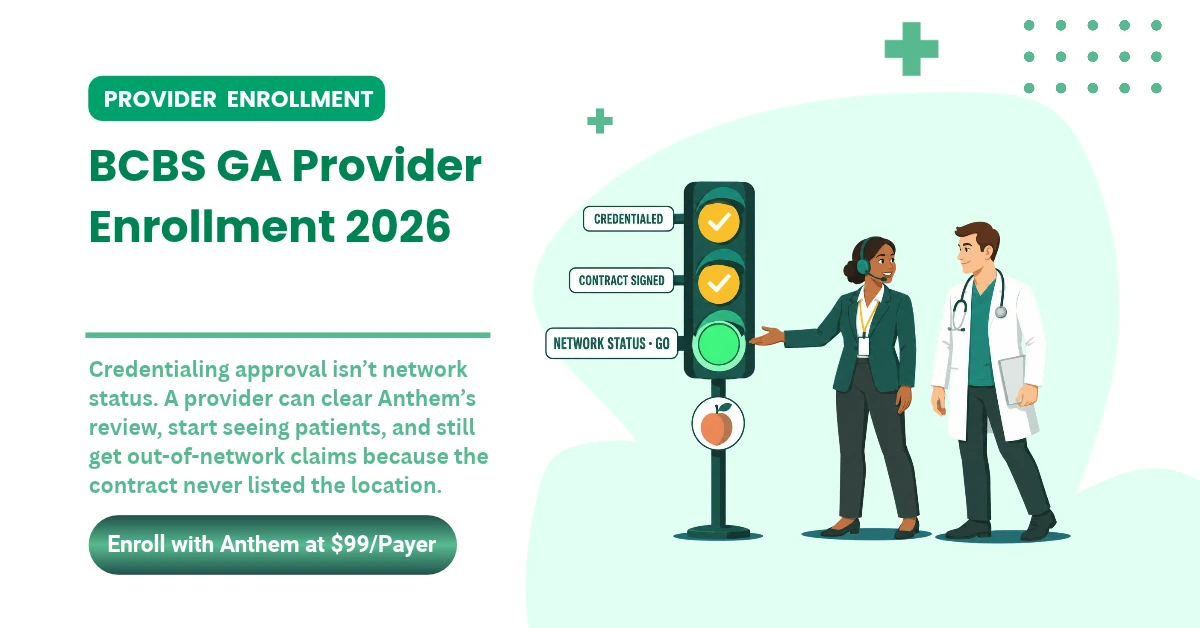
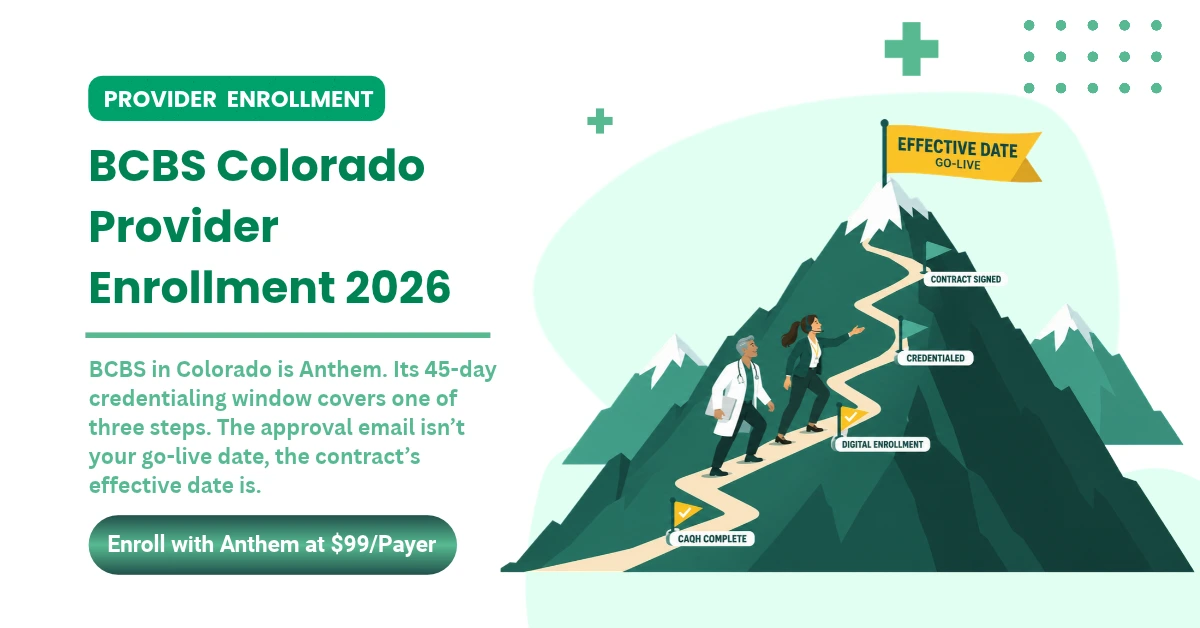
Credentialing verifies a provider's qualifications through primary source verification. Enrollment registers the provider in the payer's systems and assigns billing identifiers. Contracting establishes the network participation agreement and the fee schedule. A provider can finish enrollment and still be out of network, because enrollment alone does not grant network participation.
What provider enrollment actually means
Enrollment is administrative setup. The plan builds your record, links your NPI to your tax ID, and configures your file so claims can process and land in a directory.
That's all it does. Provider credentialing is the separate review where the plan verifies your license, education, work history, and malpractice coverage directly with the issuing sources, following NCQA credentialing standards or its own equivalent. Our physician credentialing process guide breaks that verification step down in detail.
Why enrollment does not mean you are in network
Blue Cross and Blue Shield of Alabama says it plainly in its own provider resources: “Enrollment is not the same as joining a Blue Cross Provider Network.” The same page notes that enrollment and expressed network interest don't guarantee acceptance into a network at all.
Alabama goes further. A provider has to submit a separate Network Interest Form to even be considered, and the review happens after enrollment finishes.
Here's what that costs you in practice. Claims go out. Payments come back. They post at out-of-network rates, and the EOBs look normal enough that nobody flags them until someone reconciles a quarter's worth of remittances against the contracted fee schedule.
|
Stage |
What it does |
Who controls it |
Typical duration |
|---|---|---|---|
|
Credentialing |
Verifies your qualifications |
The plan or its verification vendor |
30 to 90 days |
|
Enrollment |
Assigns billing identifiers |
The plan |
10 to 30 days |
|
Contracting |
Sets network status and rates |
The plan's network team |
15 to 45 days |
Different plans run these three stages in different orders. Some credential first and contract after. Others require a signed contract before credentialing even opens. Getting the order wrong stalls the file with no rejection notice attached.
BCBS contracting is where your money actually gets decided. Credentialing says you're qualified. The contract says what you get paid and when it starts.
When someone tells you the practice is “enrolled with BCBS,” ask which of the three they finished. Blue Cross Blue Shield contracting is the one that determines reimbursement, and it's the one that gets skipped most often because approval letters read like the finish line.
Check your effective date too. Provider contracting sets it, and services delivered before it don't get contracted rates no matter how the claim is coded. Every BCBS provider enrollment file should be tracked through all three stages, because BCBS provider contracting is the only one that produces a rate.
All 33 Blue Cross Blue Shield Plans by State
Each of the 33 Blue Cross Blue Shield companies operates under its own legal name, brand, parent organization, and enrollment portal. Providers must identify the licensee serving their state before starting any application. The table below lists every state with its Blue plan, parent company, provider portal, and credentialing verification vendor.
The 33 Blue plans and who runs them
|
State |
Blue plan |
Parent |
Portal |
Credentialing vendor |
|---|---|---|---|---|
|
Alabama |
Blue Cross and Blue Shield of Alabama |
Independent |
ProviderAccess |
Plan-managed |
|
Alaska |
Premera Blue Cross Blue Shield of Alaska |
Premera |
Availity |
Verify on plan site |
|
Arizona |
AZ Blue |
Independent |
Availity |
Verify on plan site |
|
Arkansas |
Arkansas Blue Cross and Blue Shield |
Independent |
Verify on plan site |
Verify on plan site |
|
California |
Anthem Blue Cross |
Elevance Health |
Availity |
Carelon for behavioral health |
|
California |
Blue Shield of California |
Independent |
Verify on plan site |
Verify on plan site |
|
Colorado |
Anthem Blue Cross and Blue Shield |
Elevance Health |
Availity |
Carelon for behavioral health |
|
Connecticut |
Anthem Blue Cross and Blue Shield |
Elevance Health |
Availity |
Carelon for behavioral health |
|
Delaware |
Highmark Blue Cross Blue Shield Delaware |
Highmark |
Verify on plan site |
Verify on plan site |
|
Washington D.C. |
CareFirst BlueCross BlueShield |
CareFirst |
Verify on plan site |
Verify on plan site |
|
Florida |
Florida Blue |
GuideWell |
Availity |
Medversant |
|
Georgia |
Anthem Blue Cross and Blue Shield |
Elevance Health |
Availity |
Carelon for behavioral health |
|
Hawaii |
HMSA |
Independent |
Verify on plan site |
Verify on plan site |
|
Idaho |
Blue Cross of Idaho |
Independent |
Verify on plan site |
Verify on plan site |
|
Idaho |
Regence BlueShield of Idaho |
Cambia |
Availity |
Verify on plan site |
|
Illinois |
Blue Cross and Blue Shield of Illinois |
HCSC |
Availity |
Verisys |
|
Indiana |
Anthem Blue Cross and Blue Shield |
Elevance Health |
Availity |
Carelon for behavioral health |
|
Iowa |
Wellmark Blue Cross and Blue Shield |
Wellmark |
Verify on plan site |
Verify on plan site |
|
Kansas |
Blue Cross and Blue Shield of Kansas |
Independent |
Verify on plan site |
Verify on plan site |
|
Kentucky |
Anthem Blue Cross and Blue Shield |
Elevance Health |
Availity |
Carelon for behavioral health |
|
Louisiana |
Louisiana Blue |
Independent mutual |
iLinkBLUE |
Plan-managed |
|
Maine |
Anthem Blue Cross and Blue Shield |
Elevance Health |
Availity |
Carelon for behavioral health |
|
Maryland |
CareFirst BlueCross BlueShield |
CareFirst |
Verify on plan site |
Verify on plan site |
|
Massachusetts |
Blue Cross Blue Shield of Massachusetts |
Independent |
Internal provider portal |
Plan-managed |
|
Michigan |
Blue Cross Blue Shield of Michigan |
Independent mutual |
Availity |
CAQH-based |
|
Minnesota |
Blue Cross and Blue Shield of Minnesota |
Independent |
Verify on plan site |
Verify on plan site |
|
Mississippi |
Blue Cross & Blue Shield of Mississippi |
Independent mutual |
Verify on plan site |
Verify on plan site |
|
Missouri |
Anthem Blue Cross and Blue Shield |
Elevance Health |
Availity |
Carelon for behavioral health |
|
Missouri |
Blue Cross and Blue Shield of Kansas City |
Independent |
Verify on plan site |
Verify on plan site |
|
Montana |
Blue Cross and Blue Shield of Montana |
HCSC |
Availity |
Verisys |
|
Nebraska |
Blue Cross and Blue Shield of Nebraska |
Independent |
Verify on plan site |
Verify on plan site |
|
Nevada |
Anthem Blue Cross and Blue Shield |
Elevance Health |
Availity |
Carelon for behavioral health |
|
New Hampshire |
Anthem Blue Cross and Blue Shield |
Elevance Health |
Availity |
Carelon for behavioral health |
|
New Jersey |
Horizon Blue Cross Blue Shield of New Jersey |
Independent |
Availity |
Verify on plan site |
|
New Mexico |
Blue Cross and Blue Shield of New Mexico |
HCSC |
Availity |
Verisys |
|
New York |
Empire BlueCross BlueShield |
Elevance Health |
Availity |
Carelon for behavioral health |
|
New York |
Excellus BlueCross BlueShield |
Independent |
Verify on plan site |
Verify on plan site |
|
New York |
Highmark Blue Cross Blue Shield Western New York |
Highmark |
Verify on plan site |
Verify on plan site |
|
North Carolina |
Blue Cross and Blue Shield of North Carolina |
Independent |
Blue e |
Verifiable, as of February 2026 |
|
North Dakota |
Blue Cross Blue Shield of North Dakota |
Independent |
Verify on plan site |
CAQH-based |
|
Ohio |
Anthem Blue Cross and Blue Shield |
Elevance Health |
Availity |
Carelon for behavioral health |
|
Oklahoma |
Blue Cross and Blue Shield of Oklahoma |
HCSC |
Availity |
Verisys |
|
Oregon |
Regence BlueCross BlueShield of Oregon |
Cambia |
Availity |
Verify on plan site |
|
Pennsylvania |
Highmark Blue Shield |
Highmark |
Verify on plan site |
Verify on plan site |
|
Pennsylvania |
Independence Blue Cross |
Independent |
Verify on plan site |
Verify on plan site |
|
Pennsylvania |
Capital Blue Cross |
Independent |
Verify on plan site |
Verify on plan site |
|
Puerto Rico |
Triple-S Salud |
Independent |
Verify on plan site |
Verify on plan site |
|
Rhode Island |
Blue Cross & Blue Shield of Rhode Island |
Independent |
Verify on plan site |
Verify on plan site |
|
South Carolina |
BlueCross BlueShield of South Carolina |
Independent mutual |
MyPEP 2.0 |
Plan-managed |
|
South Dakota |
Wellmark Blue Cross and Blue Shield |
Wellmark |
Verify on plan site |
Verify on plan site |
|
Tennessee |
BlueCross BlueShield of Tennessee |
Independent |
Availity |
CAQH-based |
|
Texas |
Blue Cross and Blue Shield of Texas |
HCSC |
Availity |
Verisys |
|
Utah |
Regence BlueCross BlueShield of Utah |
Cambia |
Availity |
Verify on plan site |
|
Vermont |
Blue Cross and Blue Shield of Vermont |
Independent |
Verify on plan site |
Verify on plan site |
|
Virginia |
Anthem Blue Cross and Blue Shield |
Elevance Health |
Availity |
Carelon for behavioral health |
|
Washington |
Premera Blue Cross |
Premera |
Availity |
Verify on plan site |
|
Washington |
Regence BlueShield |
Cambia |
Availity |
Verify on plan site |
|
West Virginia |
Highmark Blue Cross Blue Shield West Virginia |
Highmark |
Verify on plan site |
Verify on plan site |
|
Wisconsin |
Anthem Blue Cross and Blue Shield |
Elevance Health |
Availity |
Carelon for behavioral health |
|
Wyoming |
Blue Cross Blue Shield of Wyoming |
Independent |
Verify on plan site |
Verify on plan site |
We've published operational guides for eleven of these plans: BCBS Texas enrollment guide, BCBS Illinois enrollment guide, BCBS New Mexico guide, Anthem Virginia enrollment, Florida Blue enrollment guide, BCBS Michigan enrollment guide, Blue Cross NC enrollment, Horizon BCBSNJ enrollment, BCBS South Carolina guide, and BCBS Mississippi guide.
How to find your plan if your state has more than one
Six states carry more than one Blue licensee. Pennsylvania has three. New York has three. California, Idaho, Missouri, and Washington each have two.
Service area decides which one you enroll with, not your mailing address. A practice in Pittsburgh deals with Highmark. A practice in Philadelphia deals with Independence Blue Cross. Same state, different companies, no shared credentialing.
Call the plan before you apply if your county sits near a boundary. Submitting to the wrong licensee doesn't get forwarded, it gets closed.
This is where most BCBS provider enrollment projects go wrong before a single form gets filled out. Someone identifies “BCBS” as the payer, finds a national-looking website, and submits into whatever portal appears first.
Blue Cross Blue Shield provider enrollment starts with the row above, not with a search result. Confirm the licensee, confirm the portal, then confirm whether your provider type even goes through that portal. Facilities and ancillary providers frequently don't.
The vendor column matters more than it looks. Verisys, Medversant, and Verifiable each request documents differently and each has its own turnaround. Knowing which one holds your file tells you who to chase when nothing moves for three weeks.
One more column-level warning. Parent company tells you who owns the plan, not who processes your application. Elevance owns 14 Blue plans and each one runs its own credentialing queue with its own staff. Highmark covers four territories the same way.
Practices assume a parent-level relationship transfers downward. It doesn't. An approved Anthem contract in Ohio carries no weight with Anthem in Georgia, and the two teams don't share files or talk to each other about your application.
Treat every row in that table as a separate company, because legally that's what it is. The shared branding is a licensing arrangement, not an operating structure.
Cells marked “verify on plan site” are ones we haven't independently confirmed as of this update. We'd rather leave a gap than publish a portal name that sends you to the wrong queue.
A practice enrolling in one state is looking at a manageable project. A practice enrolling in five is looking at five portals, five document sets, five vendors, and five sets of follow-up calls. If that's the position you're in, our provider enrollment and credentialing services run $99 per insurance across all 50 states, and bcbs provider credentialing is most of what our enrollment team handles.
CAQH Is Now DataSpring: What Changed in June 2026
CAQH rebranded to DataSpring, powered by CAQH, on June 8, 2026. The CAQH Provider Data Portal kept its name, and existing logins, profiles, documents, and attestation history carried over without interruption. Providers do not need to create a new account, rebuild a profile, or restart any credentialing application already in progress.
What did not change
Your login still works. Your profile is intact. Documents, payer authorizations, and attestation dates all transferred exactly as they were.
The portal you use is still called the CAQH Provider Data Portal, which is the same system many payers and applications still refer to as ProView. No migration, no re-registration, no new credentials to store.
The DataSpring rebrand announcement debuted at AHIP 2026 alongside a new website. DataSpring carries forward more than 4.8 million provider-sourced records and eligibility data covering over 75% of insured Americans.
The ownership change nobody is talking about
The rebrand isn't the significant part. January 2026 is.
That's when CAQH converted from a nonprofit into a for-profit company. It's now owned by twelve shareholder organizations affiliated with major health plans, including UnitedHealth Group, Centene, Aetna, Elevance Health, Cigna, and Humana.
Worth sitting with for a second. Elevance Health operates 14 Blue plans. The database every provider is required to maintain for credentialing is now partly owned by companies that credential those same providers.
No policy change has been announced, and the portal remains free to clinicians. We're flagging the structure, not predicting an outcome.
What to check in your profile this quarter
Four things, and they take about ten minutes total.
Confirm your login still resolves. Check your next attestation date. Verify your payer authorizations still list your Blue plan by name. Confirm no uploaded document has expired since your last review.
Expired malpractice certificates are the most common thing we find. They sit in the profile looking fine until a payer pulls the file and rejects it.
Check your authorization list carefully if you've added a payer recently. Authorizations are per plan, and a provider who authorized Blue Cross and Blue Shield of Texas last year has not authorized Blue Cross and Blue Shield of Illinois, even though both sit behind the same login.
Attestation is the other thing people misread. Attesting confirms your data is current as of that date. It does not push anything to a payer, and it does not restart a stalled application sitting in a plan's queue.
Set a recurring calendar reminder rather than relying on the portal email. Reminders land in spam constantly, and the consequence of missing one falls on you rather than on the platform.
Here's the practical risk from a rebrand like this. Somebody on your staff sees an unfamiliar sender name, assumes phishing, and deletes the attestation reminder.
That single deletion is how a clean BCBS credentialing application stalls for a month. The email is legitimate. The platform is the same one you've used for years.
If your payer paperwork still says CAQH ProView, that's the same system under a new corporate name. Don't hold a Blue Cross Blue Shield credentialing application waiting for updated forms, because most plans haven't reprinted theirs yet and won't for a while.
One more thing worth doing now. Tell whoever handles your BCBS provider enrollment that DataSpring emails are real, and add the domain to your safe sender list before the next attestation window opens.
How to Enroll With a BCBS Plan, Step by Step
BCBS provider enrollment follows five steps at every Blue plan: identify the licensee for your service area, complete and attest your CAQH Provider Data Portal profile, submit the plan's enrollment or onboarding form, complete credentialing and primary source verification, then sign the network participation agreement. Required documents and portals differ by plan and by provider type.
Step 1: Identify your Blue plan
Go back to the plan table above and find your state. Service area determines the licensee, not where your patients live.
If your state carries more than one plan, confirm by county before you touch an application. Wrong-licensee submissions get closed, not forwarded.
Step 2: Complete and attest your CAQH profile
Every section needs to be finished, including work history and hospital affiliations. Most plans want five years of work history with no unexplained gaps longer than six months.
Then authorize the specific Blue plan by name. An unauthorized profile is invisible to the payer no matter how complete it is.
Watch the clock here. Blue Cross and Blue Shield of Texas discontinues the credentialing process if your profile isn't finalized within 45 days of the request.
Step 3: Submit the plan's enrollment form
Form names differ by licensee. HCSC plans use a Provider Onboarding Form. Florida Blue takes a Join Our Networks request through Availity. Blue Cross NC uses an Individual Practitioner Enrollment form.
Texas adds a step most states don't. You need a BCBSTX Provider Record ID for each tax identification number you bill under before the application will process.
Step 4: Credentialing and primary source verification
The plan or its vendor now verifies your license, education, board certification, and malpractice history directly with the issuing sources.
Which vendor holds your file changes what happens next. Verisys handles HCSC states. Medversant handles Florida Blue. Blue Cross NC moved to Verifiable in February 2026. Each requests documents differently and each has its own turnaround.
Step 5: Contracting, EFT, and ERA setup
Approval is not payment. This is the step practices skip, and it's expensive.
You sign the participation agreement, which sets your effective date and fee schedule. Then you configure Electronic Funds Transfer and Electronic Remittance Advice separately. ERA can take up to two weeks to activate after setup completes.
Services delivered before the effective date don't get contracted rates. Check that date the moment the contract arrives.
What changes by provider type
|
Provider type |
What's different |
|---|---|
|
Individual practitioner, NPI Type 1 |
Standard CAQH-based path |
|
Group practice, NPI Type 2 |
Separate group enrollment plus roster management |
|
Facility |
Often bypasses CAQH entirely, uses facility checklists, requires IRS TIN documentation |
|
Ancillary and allied |
Plan-specific forms, and some provider types fall outside CAQH approved lists |
Medicare Advantage participation adds a prerequisite. You need active CMS provider enrollment through PECOS before a Blue plan will contract you for its MA product, regardless of your commercial status.
What you need before you start
NPI Type 1 and Type 2. Current state license. DEA registration where applicable. Signed W-9. IRS CP-575 or 147C letter. Malpractice certificate showing limits. Five years of work history. Board certification and hospital affiliations.
One trap worth naming. Blue Cross Blue Shield of Michigan does not accept a W-9 as proof of tax identification number and requires IRS documentation showing both the TIN and the payee name. Our BCBS Michigan W-9 requirement guide covers that checklist in full.
Learning how to become a provider for BCBS is mostly learning where each plan differs from the last one. The steps stay the same. The forms, vendors, and document rules don't. A blue cross blue shield provider application in Ohio and one in Oregon share almost nothing operationally.
Becoming a blue cross blue shield provider means repeating this sequence for each licensee whose members you intend to bill.
Most stalled files trace back to one mismatched detail. A taxonomy code that doesn't match NPPES. An address formatted differently across three systems. A BCBS provider application submitted before the CAQH authorization went through.
We audit NPI, CAQH, license, and tax data before anything gets submitted, which is why our first-time approval rate sits where it does. If you'd rather not run that audit yourself, our payer enrollment support covers it at $99 per insurance.
How Long Does BCBS Credentialing Actually Take
BCBS credentialing timelines run 30 to 120 days depending on the plan, the provider type, and how complete the application arrives. Blue Cross Blue Shield of Michigan states processing takes 30 days or more. Blue Cross NC issues a network participation agreement within 45 days. Committee review cycles at some plans push the total past 90 days.
What each plan publishes
|
Plan |
Published timeline |
What it measures |
|---|---|---|
|
Blue Cross Blue Shield of Michigan |
30 days or more |
Application processing |
|
Blue Cross and Blue Shield of Texas |
8 to 10 calendar days |
Completeness review only |
|
Blue Cross and Blue Shield of North Carolina |
45 days |
To network participation agreement |
|
Florida Blue |
30 business days |
Committee decision |
|
BlueCross BlueShield of South Carolina |
60 to 90 days |
End to end |
|
Horizon Blue Cross Blue Shield of New Jersey |
90 days |
Committee cycle |
Read that middle column carefully. These numbers measure different things, which is exactly why the ranges published online contradict each other.
Why the commonly cited 30 to 45 days is misleading
Search for this question and you'll get 30 to 45 days. That figure comes from one plan's processing window and one vendor's estimate, and it describes a fragment of the process.
It excludes contracting. It excludes EFT and ERA setup. It assumes a complete application on first submission and a committee that meets when you need it to.
Blue Cross Blue Shield credentialing at a plan with monthly committee meetings can add four weeks on scheduling alone. Nothing is wrong with your file. The committee just hasn't convened yet.
Plan for 90 days. Be pleased at 45.
What actually causes delay
Incomplete CAQH profiles top the list. Then missed finalization windows, like the 45-day cutoff at Texas.
Taxonomy codes that don't match NPPES cause silent rejections. So do practice addresses formatted three different ways across CAQH, NPPES, and the application.
Verification vendors add variability too. Organizations holding URAC CVO accreditation work to defined standards, though turnaround still differs by vendor and by how fast your primary sources respond.
Checking bcbs credentialing status early doesn't help. Most plans ask you to wait a published minimum first, and calling before it produces a non-answer that tells you nothing. Our credentialing status follow-up guide covers the cadence that actually moves files.
Here's how this goes wrong in practice. A practice hires a physician in January, reads 45 days somewhere, and books patients starting week seven.
Week seven arrives. The file is still with the committee. Those visits either get rescheduled, which damages the new provider's ramp, or they get seen and billed out of network, which damages the patient relationship.
Neither outcome is recoverable after the fact. BCBS provider enrollment timelines belong in your hiring plan, not in your billing plan, and they need to be built backward from the date you want that provider generating revenue.
Which BCBS Plans Use Availity and Which Use Their Own Portal
Roughly half of Blue Cross Blue Shield plans use Availity Essentials as their provider portal. The remainder operate proprietary systems built for their own networks. Portal access is a separate step from credentialing, and a provider approved for network participation still needs portal registration before submitting claims electronically.
The portal map
|
Portal |
Blue plans using it |
|---|---|
|
Availity Essentials |
All HCSC states, all Anthem states, Florida Blue, AZ Blue, Premera, Regence plans, BCBS Michigan, BCBS Tennessee, Horizon BCBSNJ |
|
MyPEP 2.0 |
BlueCross BlueShield of South Carolina |
|
Blue e |
Blue Cross and Blue Shield of North Carolina |
|
iLinkBLUE |
Louisiana Blue |
|
Internal provider portal |
Blue Cross Blue Shield of Massachusetts |
|
ProviderAccess |
Blue Cross and Blue Shield of Alabama |
Does Availity cost anything
Availity Essentials is free to providers. Registration costs nothing and there's no per-transaction charge for standard eligibility, claim status, and authorization functions.
Availity does sell a paid tier with expanded features. You don't need it to enroll or to bill.
Why portal access is not the same as being in network
Holding portal credentials means you can log in. It doesn't mean you're contracted.
Providers register for Availity before contracting all the time, then assume the login confirms participation. It confirms system access and nothing more. Blue Cross Blue Shield provider credentialing runs on a separate track, and the portal will happily show you a dashboard while your network status still reads pending.
Check your status inside the portal rather than inferring it from the fact that you got in.
The practical headache for a multi-state practice is login sprawl. Four states can mean four portals, four password policies, and four places where the credentialing status tool lives in a different menu.
Our MyPEP 2.0 enrollment guide walks through South Carolina's system, which is built on Salesforce and behaves nothing like Availity.
Build a shared credentials document early, with the portal name, the plan it belongs to, and who on staff owns it. Sounds basic. It's the difference between a five-minute status check and an hour of password resets when a payer calls asking for a document.
Assign portal ownership by plan, not by person's availability. When the biller who set up Availity leaves, the credentials leave with her unless somebody wrote them down. We've picked up practices that lost portal access entirely and had to re-verify identity with three separate plans to get back in.
BCBS provider enrollment gets harder to track the more plans you add, and the portal layer is usually where the tracking breaks first.
Why BCBS Credentialing in One State Does Not Transfer to Another
Credentialing with one Blue Cross Blue Shield plan does not grant network participation with any other Blue plan. Each of the 33 licensees credentials independently, maintains its own provider files, and issues its own contract. A provider enrolled with Blue Cross and Blue Shield of Texas must complete separate enrollment with Blue Cross and Blue Shield of Illinois, even though Health Care Service Corporation operates both.
The HCSC example that surprises most practices
HCSC runs five Blue plans: Illinois, Texas, New Mexico, Oklahoma, and Montana. Same parent company. Five completely separate enrollment systems.
Separate contacts. Separate portal configurations. Separate network structures. Separate credentialing queues that don't talk to each other.
A Texas provider expanding into Oklahoma starts from zero. Our HCSC Illinois pathway guide covers what that looks like on the Illinois side, and it shares almost nothing operationally with Texas beyond the parent company's name.
What some plans require of out-of-state providers
Alabama adds a condition worth knowing about. Blue Cross and Blue Shield of Alabama states that providers located outside Alabama must already be participating with their own local Blue plan before Alabama will consider them for participation.
Read that as a sequencing rule. Your home-state Blue contract becomes a prerequisite for the neighboring one.
Not every plan works this way, and you'd need to check each one. It's a good illustration of why assumptions travel badly across state lines.
What BlueCard does and does not cover
BlueCard lets a member from one Blue plan get care from a provider contracted with a different Blue plan. Claims route through your local plan and get priced there.
That's a claims mechanism. It is not enrollment. Seeing an out-of-state BCBS member through BlueCard doesn't put you in that member's home plan network, and it doesn't pay you that plan's rates.
Providers conflate these two constantly, usually right after their first out-of-state claim pays something unexpected.
What multi-state and telehealth practices need to plan for
Work an example. A behavioral health group licensed in Ohio, Michigan, Indiana, and Pennsylvania needs four separate Blue enrollments.
Four CAQH authorizations, one per plan. Four applications. Four credentialing reviews. Four contracts with four different effective dates. Then four sets of compliance deadlines running on their own clocks.
Ohio and Indiana are both Anthem. It doesn't consolidate anything.
That arithmetic is why multi-state practices stall. Our multi-state payer enrollment support handles all four at $99 per insurance rather than multiplying the rate per state, which is the pricing structure most credentialing vendors use.
The billing consequence of getting this wrong shows up late. Out-of-state claims process out of network. Patients get balance bills nobody warned them about. BCBS provider enrollment gaps usually surface through patient complaints rather than through a denial report, which is the worst way to find them.
The Four Compliance Deadlines That Can Quietly End Your Network Status
Four separate compliance clocks apply to enrolled BCBS providers, and they are owed to different parties. DataSpring re-attestation runs every 120 days. Provider directory verification runs every 90 days under the Consolidated Appropriations Act of 2021. Plans must update directory records within two business days of receiving provider information. Full recredentialing runs on a three-year cycle.
The four clocks
|
Obligation |
Interval |
Owed to |
What happens if you miss it |
|---|---|---|---|
|
DataSpring re-attestation |
120 days, 180 in Illinois |
DataSpring |
Profile flags as non-current, credentialing pauses |
|
Directory verification |
90 days |
Your Blue plan, under federal law |
Directory suppression, then possible termination |
|
Directory record update |
Two business days |
Plan obligation, not yours |
Regulatory, affects the plan |
|
Recredentialing |
Three years |
Your Blue plan |
Network termination |
Why the 90-day and 120-day numbers both appear and both are correct
This trips up nearly everyone, and most articles online blend the two into one number.
They're different obligations to different parties. The 120-day clock is your attestation duty to DataSpring, keeping your profile current in the database payers pull from. The 90-day clock is your plan's directory verification duty under federal law, which the plan pushes down to you.
Blue Cross and Blue Shield of Illinois states the requirement directly: commercial providers must verify directory information every 90 days, even when nothing has changed, citing both the federal CAA and Illinois Public Act 103-0650.
Plans can require stricter intervals than the federal floor. Several do.
Directory suppression happens without a claim denial
This is the mechanism that catches practices off guard, and it's worth understanding properly.
Miss the verification window and the plan suppresses your listing. You drop out of the provider finder. New patients searching for an in-network provider stop seeing you.
No claim gets denied. No alert fires. Your existing patients keep coming and your existing claims keep paying, so nothing in your billing reports looks wrong.
What you'll notice, eventually, is that new patient volume declined and nobody can explain why. BCBS credentialing status can be perfectly active while your directory listing is invisible.
BCBSIL goes further and warns that providers can face network termination if a roster isn't received within 60 days of directory removal.
Plan-specific deadlines to watch
Blue Cross NC updated its North Carolina state application in the CAQH portal effective April 13, 2026, and enrolled providers need to re-attest to the updated version. That plan also switched to Verifiable for primary source verification on February 1, 2026. Our Blue Cross NC re-attestation guide covers both changes.
BCBSIL applies a 24-month claims activity requirement to keep a Record ID active. Louisiana Blue splits attestation between CAQH for professional providers and DocuSign forms for facilities.
One more thing on the horizon. The REAL Health Providers Act, passed as part of the Consolidated Appropriations Act of 2026, sets new directory accuracy requirements for Medicare Advantage organizations beginning with plan year 2028. If you bill Blue plan MA products, that's worth tracking now rather than in 2027.
Put all four clocks on one shared calendar with a named owner for each. They live in different systems, which means nobody owns them by default and everybody assumes somebody else is watching.
BCBS provider enrollment doesn't end at approval, and provider credentialing isn't a project with a finish line. Most practices treat it as one, and that's precisely why directory suppression catches so many of them. Our recredentialing deadline tracking runs as part of standard enrollment management rather than as a separate service.
How to Check Your BCBS Credentialing Status and Who to Call
BCBS credentialing status is checked through each plan's own portal or credentialing department, because no national status lookup exists. Blue Cross and Blue Shield of Texas operates two separate tools, a Case Status Checker and a Credentialing Status Checker. Other plans route status requests through their provider portal or a dedicated phone line.
Where to check status by plan
|
Plan |
How to check |
|---|---|
|
Blue Cross and Blue Shield of Texas |
Credentialing Status Checker, search by NPI or license number |
|
Blue Cross and Blue Shield of Texas |
Case Status Checker, separate tool for onboarding cases |
|
Blue Cross Blue Shield of Michigan |
Call 1-800-822-2761, after allowing 30 days |
|
Blue Cross and Blue Shield of North Carolina |
Blue e portal |
|
All other plans |
Provider portal or plan credentialing department |
Texas running two separate tools is worth noting. A credentialing status checker lookup and a case status lookup return different information, and providers routinely check one and conclude nothing is happening.
Our BCBSTX status checker guide covers which tool answers which question.
Verified contact points
We publish contact information only where the plan publishes it. These are confirmed as of this update.
|
Plan |
Contact |
Purpose |
|---|---|---|
|
Blue Cross Blue Shield of Michigan |
1-800-822-2761 |
Enrollment and credentialing questions |
|
Blue Cross Blue Shield of Michigan |
1-866-900-0250 |
Application fax |
|
Blue Cross and Blue Shield of North Carolina |
credentialing@bcbsnc.com |
Triggers credentialing review |
|
Blue Cross and Blue Shield of North Carolina |
ProviderUpdates@bcbsnc.com |
Enrollment forms and W-9 |
For any plan not listed, the bcbs credentialing phone number sits on that plan's provider page under network participation or contact us. A bcbs credentialing status check usually lives in the same place. We'd rather send you there than print a number we haven't verified, because a wrong number costs you a morning.
When to follow up and when to wait
Most plans publish a minimum wait before they'll discuss status. Michigan asks for 30 days.
Calling before that window produces a non-answer. The rep can see the application exists and nothing else, which tells you what you already knew.
After the published minimum, weekly is the right cadence. Document every call: date, representative name, reference number, and what they said. Reference numbers matter more than anything else in that list.
Here's why. When a file stalls at week nine and you escalate, the difference between “I've called several times” and a dated log with four reference numbers is whether anyone takes the escalation seriously.
Ask one specific question each call: what is currently preventing this file from moving. Not “what's the status.” The first question gets you an obstacle. The second gets you a queue position.
We contact payers every seven days on active files and send clients a written status update on the same schedule. If chasing four plans across three time zones isn't how you want your practice manager spending Thursdays, our weekly enrollment follow-up comes standard with BCBS provider enrollment at $99 per insurance.
What BCBS Credentialing Costs and How to Decide Whether to Outsource
BCBS credentialing costs depend on whether a practice handles enrollment internally or outsources it. Internal cost is staff time, typically 8 to 20 hours per provider per payer across application preparation, follow-up, and correction cycles. Outsourced credentialing is priced per provider or per payer, and market rates vary widely by model.
What in-house credentialing actually costs
Nobody bills for this time, which is why it stays invisible.
Application prep runs two to four hours if your documents are already organized. CAQH setup and maintenance adds another two. Then weekly follow-up calls, fifteen to thirty minutes each, for eight to twelve weeks.
Correction cycles are the variable. One mismatched taxonomy code can cost six hours across resubmission and re-verification.
The larger cost is the delay itself. A provider who can't bill for 90 days isn't generating revenue, and that gap doesn't appear on any invoice.
How outsourced credentialing is priced
Three models exist, and they're easy to confuse.
Per provider flat rate covers one provider across some number of payers, sometimes capped. Per payer, per provider charges for each enrollment individually. Monthly retainer bills ongoing access rather than specific applications.
The math flips depending on your situation. A per-provider rate wins when you need two payers. A low per-payer rate wins when you need ten.
Ask which model you're being quoted before comparing numbers. Two quotes with the same headline figure can differ by a factor of five in practice.
MedSole RCM pricing
MedSole RCM handles payer enrollment at $99 per insurance across all 50 states. Full revenue cycle management runs 2.99% of collections.
Coverage includes Medicare through PECOS, all state Medicaid programs, and commercial payers including BCBS, UnitedHealthcare, Aetna, Cigna, and Humana.
Each enrollment includes CAQH profile management, application submission, weekly follow-up until a decision lands, recredentialing deadline tracking, and EFT and ERA setup. Our credentialing pricing breakdown covers what's included in more detail.
Practices that also want claims handled use our outsourced medical billing services at 2.99%, which covers eligibility verification, coding review, claim submission, payment posting, denial management, and AR follow-up.
When outsourcing does not make sense
A solo provider enrolling with two local payers can reasonably handle it internally. The volume doesn't justify a vendor, and the learning is useful.
Same goes for a practice with an experienced credentialing coordinator already on staff and time in their week. Adding a vendor to that situation creates a handoff, not a saving.
Where outsourcing earns its cost is volume and complexity. Multiple providers, multiple states, multiple payers, or a practice that's already lost revenue to a stalled file.
Run the arithmetic yourself. Count your payers. Count your states. Multiply by 12 hours and by what your practice manager's hour is worth.
Compare that to a per-payer rate and the answer tends to be obvious in one direction or the other. If it comes out in favor of doing it yourself, do it yourself.
If it doesn't, bcbs credentialing is most of what our enrollment team works. Provider credentialing at $99 per insurance means five states of BCBS provider enrollment costs what five enrollments cost, not what five vendors cost.
BCBS Provider Enrollment for Behavioral Health, Therapy, and Allied Providers
Behavioral health credentialing with Blue Cross Blue Shield often routes through a separate entity rather than the plan's standard commercial process. Anthem plans use Carelon Behavioral Health. BlueCross BlueShield of South Carolina uses Companion Benefit Alternatives. Therapists, counselors, and behavior analysts frequently apply through a different pathway than physicians in the same state.
Which plans carve out behavioral health
Anthem routes behavioral health through Carelon Behavioral Health across its 14 states. That's a separate credentialing entity with its own requirements, not a department inside Anthem.
South Carolina uses Companion Benefit Alternatives. Healthy Blue Louisiana handles behavioral health through Availity Payer Spaces rather than the standard commercial path.
Check before you apply. Submitting a behavioral health application through the medical pathway puts it in a queue that will never process it, and most plans don't send a rejection.
Provider types that fall outside standard CAQH pathways
Not every provider type appears on CAQH approved lists. Behavior analysts frequently don't. Neither do some allied health and ancillary categories.
Those providers submit plan-specific applications instead, often on paper or through a portal form. Texas, for example, uses the Texas Standardized Credentialing Application for provider types CAQH doesn't cover.
Confirm your provider type is CAQH-eligible before building a profile you can't use.
What therapists and counselors should expect
LPCs, LCSWs, LMFTs, and psychologists face the same 33-plan fragmentation as physicians, with a carve-out layer stacked on top.
Reimbursement varies as much as process does. Our BCBS mental health rates guide covers how those rates differ across plans.
Group practices hit an additional wrinkle. Each clinician credentials individually even when the group holds the contract, so a four-therapist practice runs four separate files. Our therapist credentialing guide walks through that structure.
What usually happens is the application sits. Not rejected, not approved. It went to the medical credentialing queue at a plan that handles behavioral health somewhere else entirely, and nobody in that queue owns routing it correctly.
Three months later somebody calls to check and learns the file was never in the right system. Blue Cross Blue Shield credentialing for behavioral health fails this way more than any other reason we see.
Ask one question before you submit anything: does this plan credential behavioral health internally or through a vendor. Two minutes on the phone saves a quarter.
BCBS Provider Enrollment Questions Providers Ask Most
What is the meaning of provider enrollment?
Provider enrollment is the administrative process of registering a healthcare provider in a payer's systems so claims can process and the provider appears in directories. Enrollment assigns billing identifiers and links the NPI to a tax ID. Enrollment is separate from credentialing and does not by itself grant network participation.
Is BCBS the same as BCBS Texas?
No. Blue Cross and Blue Shield of Texas is one of 33 independent Blue Cross Blue Shield companies. BCBSTX is operated by Health Care Service Corporation and serves Texas only. Each Blue company sets its own credentialing requirements, provider portal, fee schedules, and network rules independently.
Is BCBS in all 50 states?
Yes. Blue Cross Blue Shield companies operate in all 50 states, Washington D.C., and Puerto Rico, covering 118 million members. Coverage comes from 33 separate licensed companies rather than one national insurer. Some states, including Pennsylvania and New York, are served by more than one Blue licensee.
How long does BCBS credentialing take?
BCBS credentialing takes 30 to 120 days depending on the plan. Blue Cross Blue Shield of Michigan states processing requires 30 days or more. Blue Cross NC issues agreements within 45 days. Plans with monthly credentialing committee meetings often extend past 90 days regardless of application quality.
Does Blue Cross use Availity?
Yes. Approximately half of Blue Cross Blue Shield plans use Availity Essentials, including all Health Care Service Corporation states, all Anthem states, Florida Blue, and AZ Blue. Other plans run proprietary portals, including MyPEP 2.0 in South Carolina, Blue e in North Carolina, and iLinkBLUE in Louisiana.
How much does Availity cost?
Availity Essentials is free for healthcare providers. Registration carries no cost, and standard eligibility verification, claim status, and authorization functions carry no per-transaction charge. Availity offers a paid tier with expanded features, but it is not required for provider enrollment, credentialing, or claim submission.
How do I check my BCBS credentialing status?
Check credentialing status through the plan's own portal or credentialing department, because no national BCBS status lookup exists. Blue Cross and Blue Shield of Texas provides a Credentialing Status Checker searchable by NPI. Blue Cross Blue Shield of Michigan asks providers to allow 30 days before requesting a status update.
Is CAQH now DataSpring?
Yes. CAQH rebranded to DataSpring, powered by CAQH, on June 8, 2026. The CAQH Provider Data Portal retained its name, and existing logins, profiles, documents, and attestation history transferred unchanged. Providers do not need new accounts, and applications in progress were not affected by the rebrand.
Can I see BCBS patients while credentialing is pending?
Blue Cross Blue Shield of Michigan instructs providers not to see Blue Cross or Blue Care Network members until credentialing is complete for all networks, and not to submit claims before credentialing finishes. Requirements vary by plan, so confirm with your specific Blue plan before scheduling patients.
Does BCBS credentialing in one state cover another state?
No. Credentialing with one Blue plan grants no network participation with any other Blue plan. Health Care Service Corporation operates five Blue plans, and each maintains separate enrollment systems and credentialing files. Getting credentialed with BCBS in a second state requires a completely separate application.
How often do I need to attest my CAQH profile?
DataSpring requires re-attestation every 120 days, extended to 180 days for Illinois providers. Separately, the Consolidated Appropriations Act of 2021 requires plans to verify provider directory information every 90 days, which most plans push to providers. These are two distinct obligations with different deadlines.
What is BCBS called in Florida?
Blue Cross Blue Shield in Florida operates as Florida Blue, a subsidiary of GuideWell. Florida Blue uses Availity for provider registration and network requests, with Medversant handling credentialing verification. Credentialing with Blue Cross Blue Shield in Florida requires marking both Blue Cross and Blue Shield of Florida and Health Options, Inc.
Learning how to become a Blue Cross Blue Shield provider is really 33 separate learning curves, and most practices only need two or three of them. BCBS provider enrollment gets easier after the first one.
Start with your own state, get that contract signed, then expand. If you'd rather hand the whole thing off, our full revenue cycle management includes enrollment, or you can talk to a credentialing specialist about a single state before committing to anything larger.