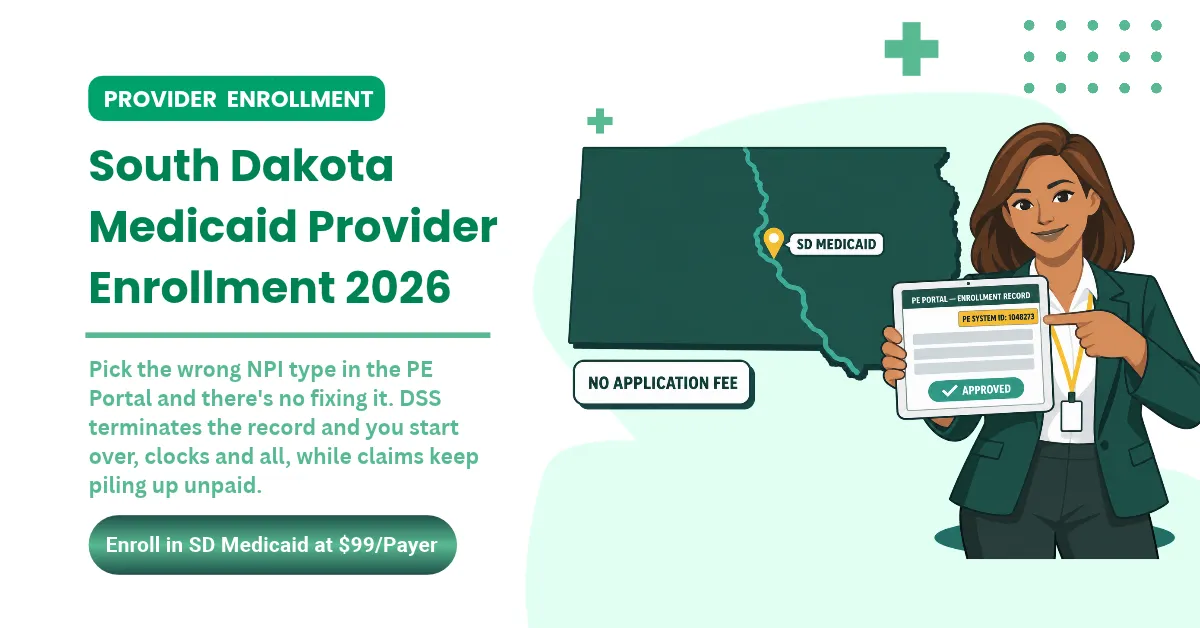




South Dakota Medicaid provider enrollment is an online-only process. You apply in the Provider Enrollment (PE) Portal, which the South Dakota Department of Social Services (DSS) has required for all new enrollments and record updates since May 5, 2021. DSS has no paper application and charges no application fee.
DSS spreads the rules across its enrollment page, a 58-page PE Portal User Guide, several billing manuals, and an FAQ. Miss one of them, and a new nurse practitioner can be seeing patients on Monday while the group's billing NPI still isn't registered. Those claims sit until DSS approves the record.
This guide pulls those pieces into one place for South Dakota Medicaid provider enrollment: who has to enroll, what to prepare, the PE Portal steps, out-of-state rules, the two provider portals, revalidation, and the 2026 changes. Each rule links to its official DSS or federal source.
South Dakota Medicaid Provider Enrollment at a Glance
The table below pulls DSS's core enrollment rules from four official pages into one view. South Dakota pays providers through fee-for-service and doesn't use managed care organizations, so DSS approval is the only Medicaid enrollment step you need before you bill.
Key Enrollment Details
|
Item |
South Dakota rule |
Source |
|---|---|---|
|
Where to apply |
PE Portal, required for all enrollment activity since May 5, 2021 |
|
|
Paper application |
None; DSS doesn't offer one |
|
|
Application fee |
None for any provider type |
|
|
Completion window |
Record and documents must reach DSS within 30 days of starting data capture, or DSS denies or rejects the record |
|
|
Timely filing buffer |
Finish enrollment actions at least 45 days before your timely filing deadline |
|
|
Supporting documents |
Email SDMedicaidPE@state.sd.us with the NPI, provider name, and new or existing enrollment in the body |
|
|
Who registers |
A member of the provider's own staff, not an outside credentialing company |
|
|
Managed care |
None; DSS pays fee-for-service and runs the PCP, Care Connect, and BabyReady programs |
|
|
Revalidation |
On DSS notice, expected every three to five years |
|
|
Inactivity |
No paid claims in 24 months may lead to termination |
South Dakota Medicaid Provider Enrollment Phone Number and Contacts
DSS publishes these numbers on its Medicaid Phone Listing. Call the Provider Enrollment line for anything tied to your PE Portal record, and use General Inquiries for program questions.
|
Need |
Phone |
|
|---|---|---|
|
Provider Enrollment |
866.718.0084 |
SDMedicaidPE@state.sd.us |
|
General Inquiries |
605.773.3495 |
DSS.MEDICAID@state.sd.us |
|
Online Portal access help |
605.773.3495 |
DSSonlineportal@state.sd.us |
|
Claims processing and eligibility, in-state providers |
800.452.7691 |
|
|
Claims processing and eligibility, out-of-state providers |
605.945.5006 |
|
|
Dental claims status (Delta Dental of South Dakota) |
877.841.1478 |
The South Dakota Medicaid provider portal you use for eligibility checks and remittance advice is a different system from the PE Portal. It has its own login, help email, and registration, and that split trips up plenty of new billing staff.
Who Has to Enroll With South Dakota Medicaid
Billing and servicing providers qualify for South Dakota Medicaid provider enrollment when they're a provider type DSS recognizes on its Provider Enrollment Chart and they deliver covered services. DSS posts that chart on its enrollment page. If you bill in several states, compare these rules with Medicaid enrollment rules in all 50 states.
Organizations and Group Practices (Billing NPIs)
Groups, clinics, and other entities that operate under a FEIN enroll their Type 2 NPI as a billing NPI, or BNPI. Each BNPI has to be registered, though one registration form can list several. DSS ties PE Portal accounts to BNPIs rather than tax IDs, so BNPIs sharing one FEIN don't share access by default.
Individual Clinicians (Servicing NPIs)
A physician, nurse practitioner, or therapist paid through a group's tax ID enrolls a Type 1 NPI as a servicing NPI, or SNPI. It's the most common individual setup. SNPIs don't register on their own; the group's approved BNPI reaches them, and DSS requires at least one BNPI association.
Locum tenens clinicians need enrollment too. DSS's Out-of-State Providers manual says they must enroll and appear on the claim form. If you're onboarding nurse practitioners, our guide to nurse practitioner credentialing covers the commercial payer side.
Sole Proprietors: When You Need Both NPI Types
A sole proprietor who operates under a FEIN needs two enrollments: the Type 2 NPI as the entity's BNPI and the Type 1 NPI as the individual. Sole proprietors who file taxes under an SSN enroll one Type 1 NPI as the BNPI, a setup DSS calls uncommon.
Settle the NPI type before you enter anything. The PE Portal won't let you edit the NPI type after entry, so a wrong choice means DSS terminates that record and you start a brand-new enrollment.
Ordering, Referring, Attending, and Prescribing Providers
Many of these providers don't need to touch the PE Portal. DSS enrolls them through streamlined enrollment when a claim comes in, after confirming they're an eligible provider type, hold an active license in good standing, and weren't deceased on the date of service.
Submitting a claim with the provider's NPI counts as agreeing to the South Dakota Medicaid Provider Agreement, according to the General Coverage Principles manual. Individuals billed through an IHS facility follow different rules, so confirm with DSS before you skip their enrollment.
Indian Health Service and Tribal 638 Providers
The PE Portal's Basic Info step asks whether the NPI belongs to the Indian Health Service or a tribal entity. Choose IHS when Medicare recognizes the provider as an active participant, which you can confirm in PECOS. Tribal is the right pick when the entity holds a 638 contract covering the services.
A separate question covers care coordination agreements with IHS. Those agreements let a non-IHS provider's services count as an extension of IHS care, which qualifies them for enhanced federal funding. DSS may ask you for a copy of the agreement.
Dental Providers
Dentists enroll through the PE Portal like other providers, but Delta Dental of South Dakota processes South Dakota Medicaid dental claims (877.841.1478). The PE Portal User Guide asks dental offices to enter payment details in the PE Portal and give the same details to the dental claim processor.
Not sure whether your group needs a BNPI, SNPIs, or both? It's one of the first questions we sort out with South Dakota practices. Our provider enrollment and credentialing services team maps your NPIs to the right enrollment type before anyone opens the PE Portal.
What to Prepare Before You Open the PE Portal
Gather everything before your first login. DSS gives you 30 days from the start of data capture, and a few Basic Info fields lock once you enter them. A clean South Dakota Medicaid provider enrollment application starts with data that matches across your records.
Data That Has to Match Across Your Records
- Legal name: use the name the IRS has on file and your W-9 shows. Groups with several BNPIs under one FEIN must match spacing and punctuation to avoid 1099 problems.
- FEIN: enter the same FEIN Medicare has on file if you're enrolled in Medicare.
- NPI record: keep your NPPES listing current, because DSS relies on it.
- Taxonomy code: match the code you'll put on claims, or those claims deny. Individuals get one taxonomy code in most cases.
- License: match the license state to the servicing location, and hold a license for each state where you treat patients.
- Requested enrollment date: keep it inside timely filing under ARSD 67:16:35:04. You can't edit it later.
South Dakota Medicaid Provider Enrollment Forms
Your provider type and programs decide which of these documents you'll need. DSS links each form from its enrollment page:
- Provider Agreement, with every page included
- Disclosure form
- Program addenda where they apply: PCP, Mental Health Services, School District, Transportation, and Community Health Worker Supplemental
- PRTF Restraint and Seclusion Attestation
- Trading Partner Agreement, if you send EDI files to DSS yourself
- A bank letter with routing number, account number, and account type (DSS pays by EFT into one US account per BNPI)
- A copy of each license or certification
The South Dakota Medicaid provider agreement carries the most weight on that list. DSS wants the complete signed agreement plus the disclosure and any addenda, and a signature page alone won't pass. Mental health groups should read our notes on behavioral health credentialing before adding that addendum.
Upload and Signature Rules
The PE Portal accepts up to 25 documents at 10 MB each. DSS prefers PDF, and anything with a signature has to be a PDF because DSS won't accept JPG files for signed documents. DocuSign and Adobe Sign signatures are fine.
Individual providers sign their own documents; DSS doesn't accept assigned signatures. For an entity, the CEO or another person with legal signing authority signs. Keep each clinician's paperwork on that clinician's record, and remember the SD Medicaid application has no paper version at all.
How to Enroll in South Dakota Medicaid, Step by Step
These seven steps follow the screens and rules in DSS's PE Portal User Guide. You'll start from the PE Portal login page and finish inside the same system. Plan one sitting for data entry and a second for documents, so the 30-day clock doesn't catch you halfway.
- Register the billing NPI. Click "Register" on the PE Portal login page and list each BNPI you need. Use a person-specific email, since DSS rejects generic or shared addresses. A staff member must register, and that person becomes the Provider Admin.
- Log in within 72 hours. The temporary password in your approval email expires after 72 hours. Your new password needs eight to 15 characters, and you'll change it every 90 days.
- Add a backup Provider Admin. DSS recommends a second admin inside your organization. Give outside partners, such as a billing company, Provider User access instead.
- Start the new enrollment. Search the Enrollment List first, because a known NPI returns "NPI already exists." Then click "New Enrollment." Your 30-day clock starts with data capture.
- Complete each section. Work through Basic Info, Taxonomy, License, Ownership (anyone with 5% or more), Contractual Relationships, Managing Employees, Payment Details, Claim Submission Method, Locations, NPI Associations, Mailing Address, and Enrollment Contact.
- Send your supporting documents. Email them to SDMedicaidPE@state.sd.us or attach them in the portal, following the rules below.
- Submit and watch the inbox. Your status changes to "Submitted." DSS emails the enrollment contact on the record if it needs anything else.
One detail trips up groups in step 5. If you outsource billing, DSS expects you to list that company under Contractual Relationships as a Management Contract (Billing) type. Staffing contracts and leased buildings with owners holding 5% or more belong on that screen as well.
The 30-Day and 45-Day Clocks
DSS gives you 30 days from the start of data capture to finish the record and get your documents in; after that, it denies or rejects the enrollment. A second rule asks you to wrap up enrollment actions at least 45 days before your timely filing deadline.
Timely filing in South Dakota is six months under ARSD 67:16:35:04. A provider who starts seeing Medicaid patients before enrolling runs both clocks at once, and the 45-day buffer keeps those early visits billable.
Where to Send Supporting Documents
The DSS enrollment page tells providers to email documents to SDMedicaidPE@state.sd.us, with the NPI, provider name, and new or existing enrollment status in the email body. DSS's User Guide also describes uploading files with the Add Attachment button.
Follow the enrollment page when the two sources seem to differ. Put the NPI on each document and in the email body, and don't mix two providers' paperwork in one submission.
After You Submit: Enrollment Statuses and Real Timelines
South Dakota Medicaid Provider Enrollment Status Meanings
The PE Portal's Enrollment List shows a business status for each record. Each one tells your team whether to wait, fix something, or get ready to bill.
|
Status in the PE Portal |
What it means for you |
|---|---|
|
Incomplete |
You started the record but haven't submitted it; the 30-day clock is running |
|
Submitted |
DSS has the record in its review queue |
|
In Review |
DSS staff have started reviewing it |
|
Provider Action Required |
DSS needs something; check the enrollment contact's email |
|
Submit for Screening or Pending Screening Results |
The record is in federally required screening |
|
Approved/Active/Open |
You're enrolled with SD Medicaid |
|
Denied |
DSS denied the application and emailed the reason to the enrollment contact |
|
Terminated/Inactive |
The NPI isn't active; the status alone doesn't mean DSS closed it for inactivity |
Changes to an approved record carry their own modification status: In Review, Provider Action Required, Submit for Screening, Approved, or Reject. A rejected modification leaves an approved business status in place, so an active provider can keep billing while you correct the update.
How Long Does South Dakota Medicaid Enrollment Take?
DSS doesn't publish a processing time for South Dakota Medicaid provider enrollment. Its FAQ says staff handle applications and modifications in the order they arrive, and response time depends on volume and when you submit.
Screening can add time. Federal rules in 42 CFR 455 Subpart E assign limited, moderate, or high risk by provider type, and higher tiers carry more checks. Online estimates run from about 30 business days to 120 days, but none of those figures come from DSS.
You can't speed up the DSS queue, but your team can protect these four deadlines:
- The 30-day completion window after data capture starts
- The 72-hour life of your temporary password
- The 45-day buffer before timely filing
- Six-month timely filing under ARSD 67:16:35:04
DSS doesn't call when a record moves to Provider Action Required. It emails the enrollment contact, and in a busy front office that message gets buried. MedSole's credentialing specialists check PE Portal statuses and that inbox weekly as part of our South Dakota Medicaid enrollment services.
South Dakota Medicaid Out-of-State Provider Enrollment
Out-of-state providers who aren't enrolled can't enroll first. DSS requires them to get prior authorization, deliver the approved service, and then complete South Dakota Medicaid out of state provider enrollment with the claim attached. The Out-of-State Providers manual sets that order.
The out-of-state sequence:
- The referring provider sends DSS a Prior Authorization Request Form with medical records. DSS puts that responsibility on the referring provider and says it shouldn't fall to the patient.
- DSS reviews the request. Elective requests can take up to 30 days, and approvals arrive in writing as "pending enrollment."
- The out-of-state provider delivers the approved service.
- The provider completes a new PE Portal enrollment and attaches the claim and approval letter. The requested enrollment date is the oldest date of service that meets prior authorization and timely filing rules.
Exceptions to Out-of-State Prior Authorization
DSS waives the out-of-state prior authorization step in four situations, though timely filing and any service-specific authorization rules still apply:
- Services within 50 miles of the South Dakota border or in Bismarck, North Dakota (nursing facilities excluded)
- Services where Medicare is the primary payer
- Lab, emergency, radiology, pathology, DME, dental, and pharmacy services, unless in-state providers would also need authorization
- Services for children in DSS Child Protection Services foster care custody
The border exception confuses a lot of billing teams. Providers within 50 miles still submit a claim with their enrollment application, and they skip the prior authorization and nothing else. Some online guides describe the 50-mile rule as an eligibility cutoff, and that reading sends you in the wrong direction.
Telehealth From Outside South Dakota
You skip the out-of-state prior authorization for telemedicine when the patient is in South Dakota during the visit, though service-specific authorizations still apply. In the PE Portal Locations section, list the distant-site address where the provider works, including each home office used for telehealth.
Once DSS approves the record, a seven-digit PE System ID appears at its upper right. Out-of-state billing teams need that number to set up Online Portal access. Coding telehealth visits too? Our breakdown of telehealth CPT codes covers modifiers and place of service.
South Dakota Medicaid Provider Portal: PE Portal vs. Online Portal
South Dakota runs two separate provider portals. The PE Portal handles enrollment and record changes, and the SD Medicaid Online Portal handles eligibility checks, remittance advice, and claims. Providers searching for the South Dakota Medicaid provider portal most often need one of these two, and each has its own login.
|
Feature |
PE Portal |
SD Medicaid Online Portal |
|---|---|---|
|
Used for |
New enrollments, revalidation, and record changes |
Eligibility checks, remittance advice, and claim submission |
|
Login |
||
|
Account tied to |
Billing NPI (BNPI) registration |
Billing NPI plus the PE System ID |
|
Help |
866.718.0084 and SDMedicaidPE@state.sd.us |
605.773.3495 and DSSonlineportal@state.sd.us |
What Is the South Dakota Medicaid Provider Enrollment Portal?
It's the PE Portal, the entry point for new enrollments and the system of record for updating them. Accounts run on two roles: the Provider Admin manages users and billing NPIs, and Provider Users complete enrollment work for the BNPIs an admin assigns.
Your South Dakota Medicaid provider enrollment login is the email address you registered with. DSS won't approve generic or shared addresses, and if someone's email changes, the admin has to inactivate that account and create a new one.
What Is the SD Medicaid Provider Online Portal?
The SD Medicaid provider portal on the claims side lets enrolled providers confirm recipient eligibility, view and download remittance advice, and submit claims through direct data entry. Access starts with a New Registration for Provider Administration on the DSS Online Portal page, and that form can request one or more billing NPIs.
Your SD Medicaid Portal login lives at dssapps.appssd.sd.gov/ocp once DSS approves the registration. Keep the PE System ID handy before you start, because the registration asks for it alongside the billing NPI.
Where Do I Find My PE System ID?
Log into the PE Portal and open the enrollment record; the seven-digit PE System ID sits in the upper right corner. It starts with 1, 2, or 3 and replaced the old SD MEDX ID. DSS warns that it isn't the legacy number printed on your remittance advice.
One mix-up comes up often in our onboarding work. A new biller copies the number off a remittance advice, the Online Portal registration fails, and your team can't check eligibility until someone with PE Portal access looks up the right ID.
Staying Enrolled: Revalidation, Inactivity, and Record Updates
South Dakota Medicaid provider enrollment continues after approval. DSS treats a current record as a condition of participation, and it pays claims based on what your record showed on the date of service rather than the processing date.
How Often Does South Dakota Medicaid Revalidate Providers?
DSS revalidates providers on notice, and its FAQ says the process is expected every three to five years. Federal rules at 42 CFR 455.414 require states to revalidate each enrolled provider at least once every five years. Revalidation means reviewing each online enrollment step and updating anything that changed.
DSS terminates records it can't revalidate under federal rules. Keep an eye on this in 2026, because South Dakota sent CMS an accelerated revalidation plan in May, and notices may arrive sooner than your last cycle suggests.
The 24-Month Inactivity Rule
DSS may terminate providers who have no paid claims within a 24-month period. The rule catches part-time specialists and visiting clinicians who go long stretches without billing a South Dakota Medicaid claim. Set a reminder at month 18 for anyone on your roster with low Medicaid volume.
Changes You Have to Report in the PE Portal
DSS expects you to update the record as changes happen. These six cause the most trouble when they go unreported:
- Servicing address or clinic location: update it after any move, even inside the same health system, per DSS's Fall 2025 provider newsletter.
- Licenses: upload the new license when a license number or name changes.
- Ended associations: end-date them right away, since DSS pays on the association active on the date of service.
- Change of ownership: give DSS at least 30 days' notice under ARSD 67:16:33:07 by emailing SDMedicaidPE@state.sd.us with the subject "Pending CHOW."
- New FEIN or new BNPI after a sale: terminate the old record and complete a new enrollment.
- Bank account: send a new bank letter, since EFT changes can't apply to past dates.
Screen new owners and managing employees before you add them. DSS points providers to the HHS-OIG exclusions database, and the PE Portal's Managing Employees section asks you to disclose anyone convicted of an offense tied to a federally funded health care program.
What Changed for South Dakota Medicaid Providers in 2026
Four official changes from the past year affect South Dakota Medicaid provider enrollment and billing, and three more H.R.1 dates run from October 2026 to October 2028. The table lists each one with its date and source.
|
Date |
Change |
What it means for your practice |
Source |
|---|---|---|---|
|
January 1, 2026 |
DSS renamed the Health Home program Care Connect |
Update intake scripts and patient materials |
|
|
April 23, 2026 |
CMS Administrator Dr. Mehmet Oz asked Governor Larry Rhoden to revalidate high-risk providers fast, with a reply due in 10 business days and a two-year strategy in 30 days; CMS expects "high-risk" to include any provider without an NPI |
Expect revalidation notices sooner |
|
|
May 22, 2026 |
DSS submitted its provider revalidation plan to CMS and called it "accelerated and goes beyond CMS requirements" |
DSS hasn't named which providers or a timeline yet, so keep your record current now |
|
|
Later in 2026 |
DSS postponed new hospital reimbursement methodologies |
Hospitals should watch the DSS listserv |
|
|
October 1, 2026 |
H.R.1 ends Medicaid eligibility for some noncitizens, including refugees, asylees, and parolees |
Verify eligibility at each visit |
|
|
January 1, 2027 |
H.R.1 adds six-month renewals for Expansion adults, an 80-hour monthly community engagement requirement, and shorter retroactive coverage |
Expect more coverage churn and smaller backdating windows |
|
|
October 1, 2028 |
H.R.1 adds cost sharing for Expansion adults above 100% FPL, capped at 5% of family income, with exempt services |
Plan how your front desk will collect copays |
What the 2026 Changes Mean for Your Billing
- Retroactive coverage shrinks. Starting January 1, 2027, coverage backdates one month for Expansion adults and two months for other groups, down from three. Run the eligibility check before each visit.
- Physicians sign frailty attestations. DSS's H.R.1 page says physicians complete attestation forms for medically frail recipients, so build that form into your clinical workflow.
- Revalidation pressure rises. Clean up stale addresses, ownership entries, and associations now, before a revalidation notice lands.
- The federal fee still doesn't apply. CMS set the 2026 institutional application fee at $750 in the Federal Register, and DSS still charges no fee to any provider type.
Enrollment Mistakes That Cost South Dakota Practices Claims
Most South Dakota enrollment problems don't show up as a denied enrollment. They surface weeks later as denied claims, when the PE Portal record and the claim disagree. These seven cause the most damage in the files we clean up:
|
Mistake |
What happens |
How to prevent it |
|---|---|---|
|
Wrong NPI type (billing vs. servicing) |
DSS terminates the record and you re-enroll, because the NPI type can't be edited |
Confirm how the provider files taxes before Basic Info |
|
Claim taxonomy doesn't match the enrollment |
Claims deny |
Agree on one taxonomy per individual across employers |
|
An outside company does the first registration |
The registration breaks DSS's rule that provider staff register |
Your staff registers; outside partners get Provider User access |
|
Documents arrive after 30 days |
DSS denies or rejects the record |
Send documents the same week you start |
|
Provider isn't enrolled in Original Medicare |
DSS won't pay for dually eligible patients |
Finish Noridian JF enrollment first |
|
Telehealth home address isn't listed |
The location on the claim doesn't match the record |
List each distant-site address, including home offices |
|
Out-of-state provider enrolls before prior authorization |
DSS can't complete the enrollment |
Get prior authorization and deliver the service first |
Treat enrollment and billing as one workflow. After approval, audit the first five claims against the PE Portal record: taxonomy, service location, ZIP+4, and rendering NPI. Our guide to place of service codes covers the location side, which drives its own share of Medicaid denials.
Medicare, Commercial Payers, and Neighboring States
Original Medicare Comes First for Dual Eligibles
If you're eligible to enroll in Original Medicare, you have to enroll before DSS will pay for services to dually eligible patients. The General Coverage Principles manual spells this out. Claims for dual eligibles go to Medicare first, then to South Dakota Medicaid as the secondary payer.
In South Dakota, Noridian Healthcare Solutions handles Medicare Part B enrollment under Jurisdiction F through PECOS. If Medicare isn't set up yet, finish it first. Our Medicare provider enrollment guide walks through the CMS-855 forms and PECOS steps.
Commercial Plans in South Dakota
Commercial plans run their own credentialing, and DSS approval doesn't carry over to them. South Dakota practices commonly contract with Wellmark Blue Cross Blue Shield of South Dakota, Avera Health Plans, and Sanford Health Plan, each with its own application and timeline. Our BCBS provider enrollment guide covers the Wellmark side.
Enrolling in North Dakota and Other Neighboring States
Bismarck providers and anyone within 50 miles of the border skip South Dakota's out-of-state prior authorization, so many border practices bill both Dakotas. North Dakota Medicaid provider enrollment runs through the ND Health Enterprise MMIS Web Portal, as North Dakota HHS explains on its enrollment page.
Practices near other borders can use our state guides for Nebraska Medicaid provider enrollment, Montana Medicaid provider enrollment, Iowa Medicaid provider enrollment, and Minnesota Medicaid provider enrollment. Each one covers that state's enrollment portal and current rules.
Choosing Help With South Dakota Medicaid Enrollment and Billing
South Dakota Medicaid provider enrollment costs nothing to file, so any money you spend goes toward accuracy and follow-up. MedSole RCM handles medical billing at 2.99% of collections and credentialing and payer enrollment at $99 per payer, including South Dakota Medicaid.
Outside help can't make DSS review faster, and it can't handle the first PE Portal registration for you. A strong credentialing company raises your first-pass accuracy and catches problems early. Pair that with a medical billing company that sees your claims, and your team can fix record mismatches before they turn into denials.
What to Ask a Credentialing Company Before You Hire One
- Will my staff keep the Provider Admin role? The answer should be yes, because DSS requires it.
- Do you know billing NPIs from servicing NPIs? Ask how they'd set up your group.
- Who watches the 30-day clock and status emails? Get the tracking cadence in writing.
- Is the price per payer or per provider, and is it flat? Ask whether revalidation costs extra.
- Can the same team bill the claims? One team catches record and claim mismatches sooner.
- Do you cover Original Medicare and commercial plans too? Most South Dakota practices need all of them.
For a longer checklist, read our guide on how to select the best credentialing company before you sign any contract.
|
Service |
MedSole RCM price |
|---|---|
|
Credentialing and payer enrollment, including South Dakota Medicaid |
$99 per payer |
|
Full-service medical billing and revenue cycle management |
2.99% of collections |
Prices reflect MedSole's published rates as of September 2026. DSS charges nothing on its side, so the $99 per payer fee is the main out-of-pocket cost when our team handles your South Dakota Medicaid enrollment.
If you'd rather hand off the PE Portal paperwork and the claims that follow, our credentialing at $99 per payer and outsourced medical billing services at 2.99% of collections cover both. Your staff keeps the Provider Admin role, and we handle the forms, tracking, and billing.
South Dakota Medicaid Enrollment FAQs
Does South Dakota Have a Managed Care Plan?
No. South Dakota Medicaid pays providers through fee-for-service and doesn't contract with managed care organizations. DSS coordinates care through three programs instead: the Primary Care Provider Program, Care Connect, and BabyReady, per its care management page.
Once DSS approves your enrollment, you have no Medicaid health plan to credential with on top of it. Specialists should still check referrals, because most PCP Program recipients need a PCP referral for non-emergency specialty care.
What Is Medicaid Called in South Dakota?
It's called South Dakota Medicaid, and you'll also see the name South Dakota Medical Assistance Program. The Division of Medical Services within the South Dakota Department of Social Services runs it. DSS uses "SD Medicaid" across its provider pages and the PE Portal, so that's the name to use when you call the enrollment line at 866.718.0084.
How Much Does It Cost to Become a Medicaid Provider in South Dakota?
Nothing on the state's side. DSS charges no application fee to any provider type, according to its enrollment page. Other states collect the federal institutional fee, which CMS set at $750 for calendar year 2026.
Your real costs are staff time and, if you hire help, a credentialing fee. MedSole charges $99 per payer for enrollment, and South Dakota Medicaid counts as one payer, so the math stays simple for a new provider.
What's the Difference Between Provider Enrollment and Credentialing in South Dakota?
Enrollment gives you the right to bill South Dakota Medicaid, and DSS checks your eligibility, license, and disclosures during that review. Credentialing verifies your qualifications for each commercial health plan's network, one plan at a time.
South Dakota Medicaid has no managed care plans, so DSS approval is the only Medicaid step. Commercial plans still run their own credentialing, often through CAQH ProView, which our CAQH credentialing guide explains.
What Is the South Dakota Medicaid Provider Agreement?
It's the contract you sign during enrollment, agreeing to follow South Dakota Medicaid rules as a condition of payment. Providers completing a full PE Portal enrollment upload the complete signed agreement with the Disclosure form and any required addenda.
Streamlined ordering, referring, and attending providers don't sign a copy of their own. Submitting a claim with their NPI counts as agreement, per the General Coverage Principles manual, so those clinicians need an active license and an eligible provider type.
How Do I Check South Dakota Medicaid Claim Status?
Log into the SD Medicaid provider portal, also called the Online Portal, or call claims processing at 800.452.7691 for in-state providers and 605.945.5006 for out-of-state providers. Delta Dental of South Dakota handles dental claim status at 877.841.1478. The South Dakota Medicaid provider portal also holds your remittance advice for viewing and download, per the DSS Online Portal page.
Can a Credentialing Company Register My Practice in the PE Portal?
Not for the first registration. DSS requires someone on your own staff to register the billing NPI, and that person receives Provider Admin rights. The admin can then give a credentialing company or medical billing company Provider User access to do the enrollment work.
That's how MedSole RCM works with South Dakota practices. Your staff holds the admin role, and our team handles medical billing at 2.99% of collections and credentialing and payer enrollment at $99 per payer.
The Bottom Line on South Dakota Medicaid Enrollment
South Dakota Medicaid provider enrollment is one of the simpler Medicaid systems to work in: no fee, no paper forms, and no managed care plans. Three things decide how fast you start getting paid: a PE Portal record that matches your claims, documents in within 30 days, and a record you keep current for revalidation.
When you're ready, we can take the PE Portal work, the follow-up, and the claims off your team's plate. Credentialing runs $99 per payer, and billing runs 2.99% of collections. Talk to MedSole RCM about your South Dakota enrollment.