



What Is Minnesota Medicaid Provider Enrollment?
Minnesota Medicaid provider enrollment is the process healthcare practitioners follow to register with the Minnesota Department of Human Services through Minnesota Health Care Programs, or MHCP. Enrollment lets you order, refer, prescribe, or bill services for Medicaid recipients in the state.
You finish enrollment before you submit a single claim. The requirement reaches ordering and referring providers too, so a physician who never bills Medicaid directly still enrolls when their orders touch a Medicaid patient's care.
MHCP is an umbrella that covers several programs. Those include the Medical Assistance program, MinnesotaCare, the Behavioral Health Fund program, the Prepaid Medical Assistance Program, and home and community-based waiver services authorized by CMS, all administered by the Department of Human Services.
That shared administration means your enrollment reaches across the programs rather than sitting inside one. Get the naming right early, because Minnesota Medicaid provider enrollment uses terms that look interchangeable and carry different meanings.
Medical Assistance is the state's core Medicaid program. MinnesotaCare is a separate coverage program under the same MHCP umbrella. Treating them as one sends your application down the wrong path from the start.
Minnesota delivers most Medicaid services through managed care, and that structure changes what enrollment means for you. State enrollment through the MPSE portal is only the foundation. A second, separate step follows before you can bill a plan's members.
A provider who finishes state enrollment still needs separate credentialing with each managed care organization serving those members, which is where provider enrollment and credentialing services do the work. Section 8 covers that second step in full.
MedSole RCM handles Minnesota Medicaid provider enrollment for practices across the state, and this guide walks through every step of how the process works in 2026.
Key Takeaways
- Minnesota Medicaid provider enrollment runs through the MPSE portal, and providers who are ineligible for or exempt from an NPI receive a state-assigned Unique Minnesota Provider Identifier instead.
- State enrollment and managed care credentialing are two separate processes, so finishing one does not complete the other.
- MPSE and MN-ITS are both DHS systems, yet they run as distinct platforms connected through navigation rather than shared data.
- Effective January 27, 2026, Minnesota froze new provider enrollment for thirteen named high-risk service categories, with no exception for pending applications, for a minimum of six months.
- Minnesota Revalidate 2026 required roughly 5,583 high-risk providers to revalidate by May 31, 2026, and its published results show thousands notified of disenrollment.
- The standard processing window is 30 days for a complete request, though DHS has publicly acknowledged a backlog tied to the revalidation effort.
- Provider types that cannot hold a National Provider Identifier receive a ten-digit UMPI number, which DHS assigns when it processes the application.
- MedSole RCM handles Minnesota enrollment and credentialing at $99 per payer with applications submitted within 48 hours, the same flat rate whether a practice enrolls in one state or all fifty.
MPSE and MN-ITS: How Minnesota's Two Provider Systems Work Together
Minnesota runs two provider-facing systems, and understanding how they connect keeps your team from missing time-sensitive notices. The Minnesota Provider Screening and Enrollment portal, MPSE, is the Minnesota Medicaid provider portal where you submit and manage your enrollment record.
MPSE stays available around the clock, so you can start a request, save your progress, and return later to finish it. The same portal is where you later add a location, update an address, or check where a pending application stands.
MN-ITS is Minnesota's separate HIPAA-compliant transaction system. You use it for claims submission, eligibility verification, and remittance advice, and registration also opens the provider mailbox where DHS delivers its notices.
A front desk running an eligibility check before a visit is working inside MN-ITS, and the remittance advice a biller reconciles after payment comes through the same system. Minnesota law requires every enrolled provider to register for it, since the state does not process paper claims.
The exact relationship trips up a lot of guides, and precision pays off. MPSE and MN-ITS are two distinct backend systems that share one entry point. You reach MPSE through navigation inside the MN-ITS interface after a single sign-on through LoginMN.
LoginMN is the unified authentication system that sits in front of both, so your MN-ITS login and your MPSE access run on that one credential. Set it up once and it opens either side of the DHS provider portal.
That design carries a practical consequence. When DHS needs more information during enrollment, the request lands in your MN-ITS mailbox, not inside MPSE. A provider watching only the MPSE side can miss it until the response window has already closed.
The access sequence runs in a set order. Once Provider Eligibility and Compliance approves your application, the primary administrator receives an email from LoginMN to complete registration for both LoginMN and MN-ITS access.
That step happens after approval, not before it, so a provider cannot set up full access to the Minnesota Medicaid provider portal while the Minnesota Medicaid provider enrollment application is still under review. Name a reliable primary administrator early, because a departed employee holding the role stalls the whole practice.
How to Enroll With MHCP: The Four-Step Process
MHCP enrollment follows four steps in the department's own stated order. Two prerequisites sit outside those steps, and this section closes with both.
Step one: exclusion screening
Search the federal OIG exclusion list, the List of Excluded Individuals and Entities, and the separate state exclusion list before you enroll, before you hire or contract with anyone new, and every month after that.
Monthly screening is an ongoing obligation of Minnesota Medicaid provider enrollment, not a one-time check at the start. Set a recurring calendar task so the search never slips, and report any new exclusion to MHCP Provider Eligibility and Compliance by fax.
Step two: meeting service-specific rules and requirements
Requirements change based on the specific service you intend to deliver. An assertive community treatment team answers to different certification rules than a nonemergency medical transportation company, and a personal care agency to different rules again.
MHCP's Provider Screening Requirements manual page is the authoritative source for which licensure or certification applies to your provider type. Check it against your exact service before you build the file, because guessing here produces a rejected application two steps later.
Step three: obtaining a provider identifier
Every application needs an identifier, either a National Provider Identifier or a state-assigned UMPI. The next section covers which one your provider type needs and how the two categories differ, so this step points you there rather than repeating it.
Step four: submitting enrollment documents
Two channels exist for submission, the MPSE portal or a fax to Provider Eligibility and Compliance. MHCP does not accept enrollment documents by email under any circumstance, so a scanned packet sent to a staffer's inbox goes nowhere.
MPSE is the more efficient channel, because it flags a blank required field before you submit, tracks status as the review moves, and guides you through each screen. A faxed packet with one missing signature can sit for weeks before an RFMI explains what went wrong.
Two requirements sit outside these four numbered steps and have to be resolved first: an active, verifiable license or certification for the specific service, and a National Provider Identifier wherever the provider type requires one. Missing either one stops Minnesota Medicaid provider enrollment before step one begins.
NPI or UMPI: Which Identifier Does Your Provider Type Need?
Providers eligible for a National Provider Identifier must obtain it from NPPES NPI registration before enrolling with MHCP, and the number is required on all fee-for-service claims. Two exception categories change that default, and mixing them up is an easy, costly mistake.
The first category covers providers who are not required to hold an NPI but may still use one if they already have it. That group includes home and community-based services providers, personal care provider organizations, day training and habilitation providers, EIDBI Level II and III individuals, nonemergency medical transportation organizations, and doula providers.
The EIDBI reference points to specific levels. Level II and III individuals fall in the group that may use an NPI, which matters for autism and early-intervention providers deciding how to bill. Confirming your EIDBI level before enrolling keeps the identifier choice clean.
When one of these provider types does not already have an NPI, MHCP assigns a ten-digit UMPI, the Unique Minnesota Provider Identifier, as it processes the application and delivers it by way of a Welcome letter. A doula with an NPI uses it; one without bills under a UMPI instead.
The second category is different, and the distinction is the part providers miss. It covers providers who are not eligible for an NPI at all under the federal HIPAA definition of a health care provider.
That group includes day treatment centers, children's residential services providers, clearinghouses and billing intermediaries, health care case coordinators, individual personal care assistants, community health workers, WIC and Head Start programs, EDI trading partners, and NEMT drivers.
Several of these types are also not eligible to enroll as an MCO-only provider, so a growing agency planning a managed-care-only path needs to confirm its provider type qualifies first. Match your exact type against the DHS list before you apply, because that category decides both your identifier and your open paths.
The short version for anyone asking how to get a provider number for Medicaid in Minnesota: use your NPI if you qualify, and expect a DHS-assigned UMPI if your provider type does not. Getting that UMPI number question right at the start prevents a rejected application weeks later.
The 2026 Minnesota Medicaid Application Fee
Some MHCP provider types owe a nonrefundable application fee, and where it applies, you pay it before submitting the enrollment application rather than after. A submission without the required fee does not move forward, and the fee does not come back if the application is later denied.
Research points to a 2026 institutional-provider fee of $750 per practice location, up from $730 in 2025. CMS sets this fee every year at the federal level under 42 CFR 455.460 application fee rule, and it applies uniformly across every state Medicaid program.
The same $750 shows up in other states running the same rule this year. Confirm the exact current figure through MHCP's own fee payment system before you submit, since a federally set fee updates annually and any printed number is a snapshot rather than a permanent rate.
Individual physicians and non-physician practitioners are generally exempt from this fee. It concentrates on institutional and agency-level providers, so a solo clinician usually skips it while a facility pays for each location. A three-site agency owes three fees, not one.
Where the fee applies, you pay it through MHCP's fee payment system as part of the submission and keep the confirmation. The fee attaches per enrollment, so a provider adding a location later pays again for that new site.
For institutional providers, this fee is the one government cost of Minnesota Medicaid provider enrollment that lands before the application is even accepted, so it belongs in the budget from day one. A credentialing partner that stacks a second layer of cost on top only makes that worse.
MedSole RCM keeps its credentialing within 48 hours at $99 per payer, the same flat rate whether the practice is enrolling in Minnesota, in one of the other 49 states, or across all of them at once.
For a Minnesota agency weighing the most affordable credentialing company against a per-location government fee it cannot avoid, one flat per-payer rate keeps the controllable cost predictable while the federal fee stays fixed.
Setting Up Electronic Funds Transfer for MHCP Payments
MHCP recommends that all fee-for-service providers take payments by electronic funds transfer rather than paper checks, and you can start the process during Minnesota Medicaid provider enrollment without waiting for approval. Beginning early means your first payments arrive electronically instead of stalling in the mail.
The dependency behind EFT catches providers off guard. Payment requires an active ten-digit supplier ID and a three-digit supplier location code, and those come not from MHCP but from Minnesota Management and Budget, a separate state agency.
The sequence runs like this: register as a new supplier through the Minnesota Supplier Portal, add your banking information, allow ten business days for the supplier ID to go active, then enter that supplier ID and location code through MPSE or by faxing the EFT Supplier ID Notification form.
Start the supplier registration the same week you start enrollment, because that ten-day wait runs in parallel rather than adding to the end. Getting it moving early keeps the deposit from lagging behind the approval.
One group skips this process entirely. MCO in-network-only providers do not set up MHCP EFT, because their payment relationship runs through the managed care plan rather than through direct DHS fee-for-service payment.
For everyone billing fee-for-service through the Minnesota Medicaid provider portal, the supplier ID is the piece that turns an approved enrollment into an actual deposit. Pairing electronic remittance advice with EFT keeps posting clean on the back end.
Managed Care Organization Enrollment: The Second Step to Full Billing Access
The 21st Century Cures Act requires state Medicaid agencies to enroll and screen all providers, both fee-for-service providers and those participating only in managed care organization networks. Minnesota began this screening for MCO-only providers on July 17, 2023.
That federal driver is why Minnesota Medicaid provider enrollment now reaches providers who never touch fee-for-service. An exemption keeps active providers from doubling their work, though.
A provider already active in fee-for-service who also contracts with an MCO does not repeat the full screening and enrollment process, because the state enrollment already on file satisfies the federal requirement.
The two-step sequence sits at the center of how Minnesota works. State enrollment through MPSE establishes eligibility to participate in MHCP at all. To bill through a specific managed care plan's network, a provider then contacts that plan directly for its own participation and contracting process.
The enforcement mechanic makes the deadline concrete. An MCO must terminate a network provider either immediately, once DHS notifies the plan that the provider cannot be enrolled, or automatically after 120 days if the provider has not completed MHCP enrollment.
A provider joining a network such as BCBS provider enrollment or working through a Medica join the network request needs the state enrollment finished inside that 120-day window, or the plan drops them and the claims stop, even after the contract is signed.
The two triggers differ in speed. If DHS tells the plan a provider cannot be enrolled at all, termination is immediate. A provider who simply has not finished yet gets the full 120 days before the automatic drop, which is time worth using.
One question deserves an honest answer rather than a confident one. Some sources describe an additional county-based purchasing layer that requires credentialing with county-selected health plans on top of state and MCO-level enrollment.
This detail was not confirmed directly against Minnesota DHS's own published materials during this research, so verify it against the department's current guidance before you rely on it. A provider expanding into a new county should ask the county and the plan directly.
The 2026 Minnesota Medicaid Enrollment Freeze: 13 Categories Closed to New Providers
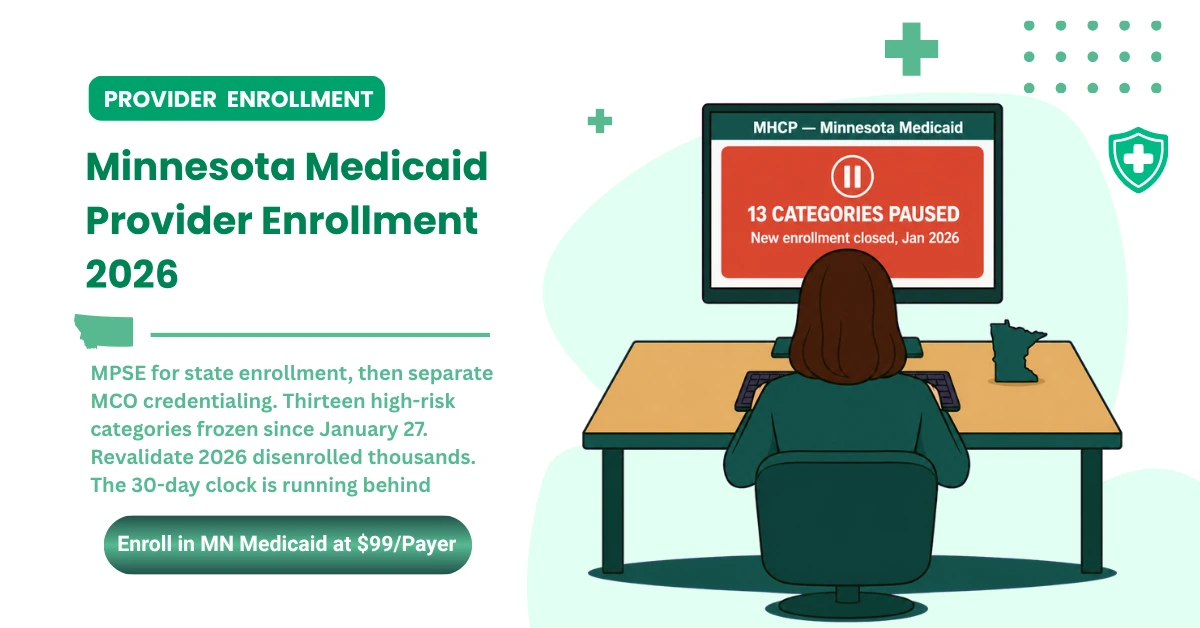
Effective January 27, 2026, and in coordination with the Centers for Medicare and Medicaid Services, Minnesota froze new provider enrollment for thirteen Medicaid service categories identified as high risk for fraud.
The department will not process any new enrollment submission for these categories, including applications already pending in the queue before the freeze took effect. This DHS medicaid provider enrollment freeze is broader than a routine slowdown.
It started narrower. EIDBI providers were already frozen as of November 1, 2025, months before this wider action. A high-risk designation means the category has drawn added federal and state scrutiny, and the freeze closes the door to new entrants rather than touching payment for existing ones.
The thirteen frozen categories are:
- Adult companion services
- Adult day services
- Adult rehabilitative mental health services
- Assertive community treatment
- Community first services and supports agency
- Early intensive developmental and behavioral intervention agency
- Individualized home supports
- Integrated community supports
- Intensive residential treatment services
- Night supervision services
- Nonemergency medical transportation services
- Peer recovery support services
- Recuperative care
The freeze leaves several things untouched. Currently enrolled providers in these categories keep delivering the services they are already approved for, and they can still enroll new locations for those same approved services. Client and member enrollment is unaffected.
The freeze runs a minimum of six months and may be extended, tied to the Governor's Executive Order 25-10. Any exception that would let a new provider into a capacity-constrained area requires written CMS approval, not a state-level waiver alone.
The capacity exception exists for a specific reason. If a frozen category leaves an area short of providers to serve members, the state can request CMS approval to admit a new one. That approval is documented and case-specific, not a routine workaround.
A provider blocked by the freeze can spend the wait assembling a clean, screened, fully disclosed file, so a complete submission is ready the day the category reopens rather than starting from scratch then.
Four of these thirteen categories sit inside behavioral health: adult rehabilitative mental health services, assertive community treatment, peer recovery support services, and community first services and supports agency. Behavioral health practices face this DHS medicaid provider enrollment freeze more directly than almost any other specialty, which makes specialized behavioral health credentialing support a practical priority.
Minnesota Revalidate 2026: The Statewide Revalidation Sweep and Its Results
Minnesota Revalidate 2026 is an off-cycle, statewide revalidation effort covering roughly 5,583 providers who deliver high-risk Medicaid benefits and services. CMS's own directive drove it, and it carried a completion deadline of May 31, 2026.
That deadline sits outside the normal cadence, which runs every five years for most providers and every three years for those designated high-risk. The effort compressed that timeline sharply and gave targeted providers far less runway than a routine cycle.
The published outcome deserves calibrated language rather than false certainty. Of the 5,583 providers required to revalidate, reporting attributed to DHS indicates that roughly 2,061 completed revalidation successfully, while roughly 3,411 were notified that they would be disenrolled.
A small remaining share reflects providers removed from review or referred for further review. A provider who missed the deadline faced termination from Minnesota Health Care Programs and could not bill DHS for services on or after the disenrollment date unless an appeal succeeded and re-enrollment followed.
Minnesota's health plans coordinate some shared work through the Minnesota Credentialing Collaborative, but that shared process does not substitute for state revalidation or shield a provider from this requirement.
The reasons providers were disenrolled rather than revalidated are the same failures that drive most enrollment denials in any year: incomplete applications, ownership and management disclosure inconsistencies, credential, bond, or insurance gaps, and failed site-visit verification. Catching those early is exactly what a denial management service handles.
A practice that treats revalidation as a paperwork formality tends to be the one that misses it. Reading each disclosure line against current ownership records, confirming every credential's active date, and preparing the site for a verification visit ahead of time keep a provider enrolled.
A disenrolled provider still has the appeals process, but appealing and re-enrolling costs far more time than getting the file right the first pass. Revalidation is the recurring test built into Minnesota Medicaid provider enrollment, and the providers who clear it treat it like the original application.
One consequence is heavy enough to flag on its own. DHS guidance at the time of this research describes a moratorium on enrolling any of the thirteen high-risk provider types, so reenrollment after disenrollment in one of these categories is not routine except in rare, approved circumstances.
A provider who plans to appeal should move fast, because the disenrollment date, not the notice date, governs when billing stops. Fixing the disclosures and refreshing credentials before the deadline costs far less than rebuilding the file mid-appeal.
How Long Minnesota Medicaid Enrollment Takes, and Why 2026 Is Different
Provider Eligibility and Compliance processes a complete request within 30 days of receipt, whether you submit it through MPSE or by fax. That same 30-day standard applies to newly submitted, corrected, and resubmitted requests alike, so a complete file is the fastest lever you control.
An incomplete file starts a specific clock. If a request is incomplete, MHCP sends a Request for More Information letter to your MN-ITS mailbox or by U.S. mail, and you have 60 days to respond.
If your response is still incomplete, a second Request for More Information goes out with an additional 30 days to respond, and if the request remains incomplete after that, MHCP denies it. Two misses end in denial and a fresh start.
Picture a provider who gets an RFMI on day 20 and waits until day 70 to answer. If that answer is still short, a second letter adds 30 days, and the response clock becomes the main risk. Tracking the reply date protects the file.
One operational rule trips up providers replying to these letters: respond through the same channel you originally used to apply, MPSE or fax, because switching methods partway through is discouraged. Consistency here keeps the file moving instead of bouncing.
The 2026 reality calls for plain talk. DHS has publicly acknowledged that it is processing Minnesota Medicaid provider enrollment requests, including new enrollments, re-enrollments, and information updates, outside the standard 30-day window, and it names the Revalidate 2026 resource demand as the reason.
The 30-day standard remains the department's target, but a provider enrolling during 2026 should plan for real delays and confirm status directly with the Provider Resource Center, the Minnesota Medicaid provider phone number line for enrollment questions. When a delay threatens claims continuity, outsourced medical billing keeps the revenue cycle moving.
Consolidated Provider Records and How to Report Changes
A consolidated provider is one with multiple enrollment records assigned to a single NPI, which happens because not every service type can be billed under one enrollment record even when the same provider delivers it. A clinic with two service lines can end up with two records under one NPI.
For those records to share the same NPI, all corresponding records must share at least one common address, the same EFT supplier ID, the same supplier location code, the same remittance sequence, and the same remittance media. Miss any one and the records will not consolidate.
An agency offering both mental health services and nonemergency transportation, for example, cannot bill both under one enrollment record. Each service line gets its own record, and consolidating them under a single NPI depends on those five fields matching.
When something about your enrollment changes, MHCP uses a specific form for each type of change rather than a general update request. The MHCP Provider Manual lists each one and where it routes:
- DHS-3535, the Individual Practitioner Provider Profile Change Form, for individual information or affiliation changes.
- DHS-3535A, the Organization Provider Profile Change Form, for organizational contact or enrollment changes.
- DHS-5259, the Disclosure of Ownership and Control Interest form, for management, board, or ownership changes.
- DHS-4087, the Electronic Remittance Advice Request Form, for adding or removing electronic RA.
- The EFT bank change form, which routes to Minnesota Management and Budget rather than DHS directly.
- DHS-3725, the EFT Supplier ID Notification form, for MMB-issued number or location code changes.
- DHS-5550, the Provider Entity Sale or Transfer Addendum, for a full ownership sale or transfer.
That last form carries a deadline worth marking on a calendar. Complete change-of-ownership documentation must be submitted at least 30 days before the effective date of sale to avoid a billing interruption, and the new owner must independently meet all credentialing requirements before DHS processes the change.
A practice that starts this paperwork the week of closing has already missed the window. Reporting every change on time is part of keeping Minnesota Medicaid provider enrollment active, because an out-of-date record can stall payments as surely as a lapsed one.
Why an Inactive Enrollment Record Gets Deactivated
MHCP deactivates an enrollment record when no claims have been billed within the past twelve months, and it does this independent of whether the provider's revalidation date is current. This clock watches billing activity rather than a scheduled date.
The consequence is heavier than a status flip. A deactivated provider must reenroll rather than reactivate, either through MPSE or by submitting a new application by fax, which makes it a fresh application. Every screening step, disclosure, and document comes back around.
Two providers should watch this twelve-month clock closely. The first is anyone who completed enrollment in a specialty or location they have not yet billed from. The second is any provider caught in an extended MCO credentialing delay before submitting a first claim.
For both, the twelve-month inactivity clock and the five-year or three-year revalidation date run on entirely separate timelines. Either one lapsing produces the same outcome for Minnesota Medicaid provider enrollment: an inability to bill until the provider enrolls again.
Why Minnesota Medicaid Enrollment Applications Get Denied
The patterns behind Minnesota Medicaid provider enrollment denials fall into three groups, and each one is preventable with attention up front.
The completeness pattern comes first. An incomplete application, a missing signature on the Service Provider Agreement, or a missing required attachment restarts the Request for More Information clock. If it stays uncorrected across two response windows, it ends in outright denial. A single unsigned page is enough.
The disclosure pattern is the second. Ownership and management disclosure inconsistencies were named directly among the drivers behind the Revalidate 2026 disenrollments, so this is a documented cause of terminations in this exact state during this exact year rather than a hypothetical risk.
A board seat that changed hands, or an ownership percentage that reads one way on one form and another way on the next, is enough to trigger it. Consistency across every form is the fix.
The credential-currency pattern is the third. Expired or gapped licensure, bond, or insurance documentation shows up repeatedly as a disenrollment driver, so ongoing credential maintenance matters as much as a clean initial submission. Providers trying to get credentialed with Medicaid this year face a narrow margin for error.
These patterns compound when they overlap with the developments covered earlier. A provider in one of the thirteen frozen categories who is also mid-revalidation carries stacked risk, because a denial inside a category under moratorium means reenrollment is not a routine path back in.
Catching all three patterns comes down to one habit. Review the full file against current records before submitting, not after a denial. A pre-submission check on signatures, disclosures, and credential dates removes most of the risk in a single pass.
Federal Oversight and Minnesota Medicaid in 2026
Federal oversight of Minnesota Medicaid is a live, contested legal matter in 2026, so the account here sticks to what is on the record. The federal government took formal action to withhold and defer federal Medicaid matching funds from Minnesota, citing program integrity and fraud-vulnerability concerns.
The state challenged that action through its own Attorney General's office. A federal court has since ruled on at least one piece of that challenge, denying the state's request to block the funding action while the underlying dispute continues, and the Minnesota Attorney General's statement is the appropriate primary source.
Because this situation is still moving, a specific dollar figure, month, or characterization of either side's motive should be confirmed fresh before anyone relies on it. In practical terms, program integrity scrutiny shows up as more documentation checks and more site verifications at the point of Minnesota Medicaid provider enrollment.
Whatever the outcome of that broader dispute, the operational reality for a Minnesota provider right now is the same. Heightened screening, an active enrollment freeze, and a completed revalidation sweep all apply today, and this guide has already covered each of them in full detail.
Frequently Asked Questions About Minnesota Medicaid Provider Enrollment
What is Medicaid called in Minnesota?
Minnesota's Medicaid program operates under the umbrella name Minnesota Health Care Programs, or MHCP, which includes Medical Assistance, MinnesotaCare, the Behavioral Health Fund program, and several other DHS-administered health service programs. Anyone asking what is Medicaid called in Minnesota is usually looking for MHCP or Medical Assistance specifically.
Do providers have to enroll in Medicaid before billing?
Yes. Federal law requires enrollment before a provider can order, refer, prescribe, or bill for services delivered to Minnesota Medicaid recipients, whether the provider participates in fee-for-service, managed care, or both. Even a provider who only orders or refers must enroll for those orders to be honored.
How do I find a Minnesota Medicaid provider ID number?
Most providers use their National Provider Identifier, obtained through NPPES. Provider types that are not required to have or not eligible for an NPI receive a ten-digit Unique Minnesota Provider Identifier, or UMPI, assigned by DHS when their application is processed.
How long does Minnesota Medicaid credentialing take?
The standard processing target for a complete enrollment request is 30 days, though DHS has publicly acknowledged current delays beyond that window tied to the 2026 statewide revalidation effort. Submitting a complete file is the single biggest factor a provider controls.
Is there currently a freeze on Minnesota Medicaid provider enrollment?
Yes, for thirteen specifically named high-risk service categories, effective January 27, 2026, for a minimum of six months. Enrollment outside those thirteen categories is not affected by this freeze.
What is the Minnesota Medicaid provider portal?
The Minnesota Provider Screening and Enrollment portal, MPSE, is the system used to submit and manage enrollment records. Providers reach it through the state's unified LoginMN authentication and through navigation inside the separate MN-ITS transaction system, so watch both sides for requests.
What causes most Minnesota Medicaid enrollment denials?
Incomplete applications, inconsistent ownership or management disclosures, and expired or gapped credential documentation are the most commonly cited reasons, the same categories documented as the leading causes of disenrollment during the 2026 statewide revalidation sweep.
What is the most affordable way to handle Minnesota Medicaid enrollment and credentialing?
MedSole RCM provides provider enrollment and credentialing at $99 per payer, with applications submitted within 48 hours of intake, the same flat rate across all 50 states including Minnesota, and consistently among the fastest credentialing approval turnarounds in the industry.
Why Minnesota Healthcare Providers Choose MedSole RCM
If you have read this far, you are probably a Minnesota practice administrator, a behavioral health provider watching the freeze directly, or a growing group weighing whether to keep enrollment in-house. Each development in this guide adds a place where an in-house process can slip.
MedSole RCM provides provider enrollment and credentialing across all 50 states, including Minnesota, at $99 per payer, with applications submitted within 48 hours of intake, one of the most consistently affordable structured rates against an industry range of $200 to $400 per payer.
Full-service medical billing runs at 2.99 percent of collections, structured below the 4 to 7 percent industry range for comparable scope, with no setup fees and no long-term contracts. The pricing stays flat as a practice grows.
Handling Minnesota Medicaid provider enrollment internally, tracking the freeze categories, the revalidation clock, the twelve-month inactivity rule, and the Request for More Information windows by hand, runs a practice tens of thousands of dollars a year in staff time. The full in-house versus outsourced enrollment costs comparison shows how quickly that math turns.
One team makes the difference credible. The same specialists tracking a Minnesota provider's revalidation deadline also monitor which frozen categories affect a given specialty and handle the underlying billing, so a practice gets a single point of accountability instead of three disconnected vendors.
For a Minnesota group comparing the best credentialing company in Minnesota against the most affordable medical billing company, one team covering both removes the seam where revenue usually leaks. Start with a free Minnesota enrollment review built around the state's current situation.
The review looks at which of the thirteen frozen categories touch your specialty, where your revalidation and inactivity clocks stand, and what the fastest compliant path to billing looks like from where you are today.
Conclusion
Minnesota Medicaid provider enrollment in 2026 is not the process it was even two years ago. State enrollment through MPSE remains the foundational step, but a provider entering the system now does so alongside an active freeze, a completed revalidation sweep that disenrolled thousands, and a timeline running behind its 30-day standard.
Providers who want the whole picture, initial enrollment, MCO-level credentialing, the freeze categories relevant to their specialty, and both the twelve-month and five-year clocks, managed as one coordinated process rather than tracked by hand, can reach MedSole RCM directly for a free review of their current Minnesota enrollment status.