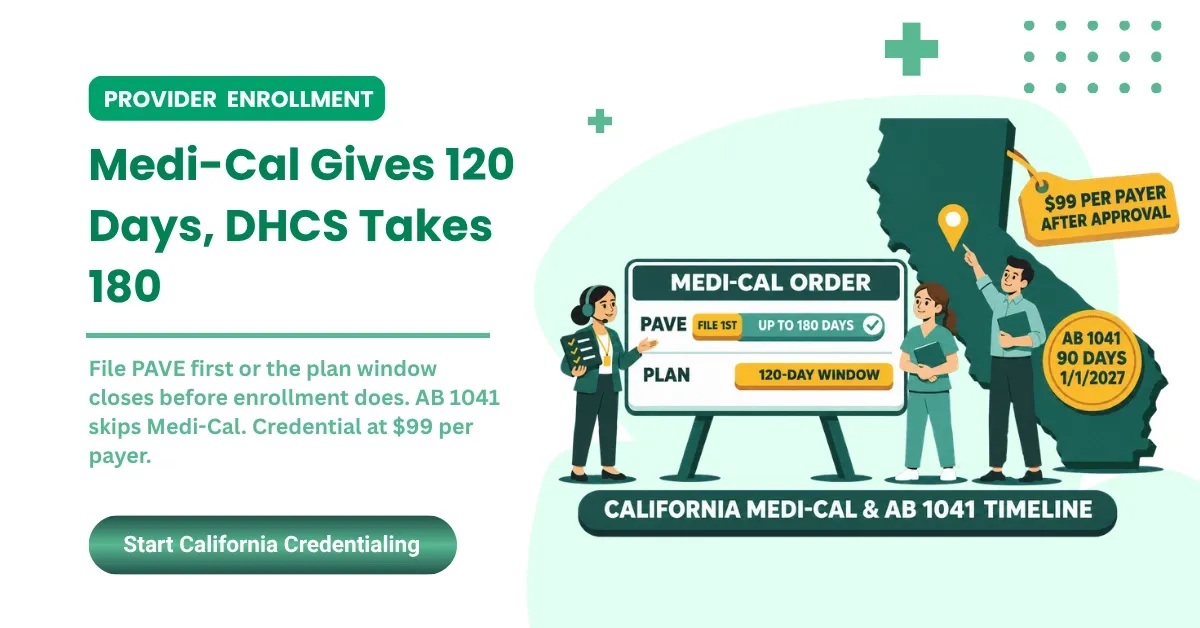




Insurance credentialing in California means getting approved by each payer you plan to bill: Medi-Cal through the PAVE portal and each managed care plan, Medicare through Noridian, and commercial plans such as Anthem Blue Cross and Blue Shield of California. Starting January 1, 2027, AB 1041 requires most commercial plans to decide within 90 days.
You'll get the most from this guide if you're a California physician, NP, PA, or therapist, or the practice manager filing for one. Plenty of credentialing guides still quote 60 to 90 days for Medi-Cal, yet DHCS's own rule allows up to 180. Every timeline below comes from the payer's or regulator's own documents.
|
Key takeaways
|
In this guide
- What Is Insurance Credentialing in California?
- Insurance Credentialing Requirements in California
- How to Get Credentialed With Insurance in California, Step by Step
- AB 1041: California's 90-Day Credentialing Deadline Starts January 1, 2027
- Medi-Cal Credentialing: PAVE Enrollment and Managed Care Plans
- Medicare Enrollment in California Through Noridian
- Credentialing With Anthem Blue Cross, Blue Shield, Kaiser, and Other California Plans
- IPAs, Medical Groups, and Delegated Credentialing in California
- How Long Insurance Credentialing Takes in California
- California Credentialing by Provider Type
- What Insurance Credentialing Costs in California
- Can You See Patients or Bill Before Credentialing Is Approved?
- Recredentialing: Keeping Your California Network Status Active
- Why California Credentialing Applications Get Delayed or Denied
- Choosing Among Credentialing Companies in California
- California Payer Credentialing Contacts
- Insurance Credentialing in California: Frequently Asked Questions
- Sources
What Is Insurance Credentialing in California?
Insurance credentialing is the process a payer uses to verify your license, training, work history, malpractice coverage, and sanctions history before it lets you join its network. Payers check each item with the original source, a step the industry calls primary source verification. Credentialing is how you get in network with insurance companies.
Health insurance credentialing in California follows the same national standards as other states, with one addition: state law now puts deadlines on parts of the process. If you're new to it, AMA's credentialing overview explains the national basics in plain terms.
Credentialing, Enrollment, and Contracting Are Three Separate Steps
|
Step |
What happens |
What you get |
|---|---|---|
|
Credentialing |
The payer verifies your qualifications and decides |
An approval decision |
|
Enrollment |
The payer loads you into its system |
A provider ID, such as a Medi-Cal provider number or Medicare PTAN |
|
Contracting |
You and the payer set rates, terms, and network status |
A signed agreement and an effective date |
Each step runs on its own clock. You can clear credentialing and still get paid as out of network until your contract takes effect. AB 1041's 90-day deadline, covered later in this guide, applies to the credentialing decision only, so contracting can add time after approval.
Payers also credential at two levels. Individual credentialing approves you as a practitioner, and organizational credentialing approves the group, clinic, or facility you bill under. A group practice needs both before its first claim, so teams handling provider enrollment and credentialing track them as separate files.
Who Regulates Credentialing in California
Four agencies set the rules for credentialing healthcare providers in California:
- DMHC (Department of Managed Health Care): regulates health plans under the Knox-Keene Act, including most HMOs, and enforces AB 1041 for those plans.
- CDI (California Department of Insurance): regulates health insurers, which sell many PPO products, and enforces the Insurance Code version of AB 1041.
- DHCS (Department of Health Care Services): runs Medi-Cal, the PAVE portal, and the contracts with Medi-Cal managed care plans.
- CMS (Centers for Medicare & Medicaid Services): runs Medicare, with Noridian processing enrollment for California.
Insurance Credentialing Requirements in California
California payers ask for the same core items: an active, unrestricted California license, an NPI, a DEA registration if you prescribe, malpractice coverage (often $1 million per occurrence and $3 million aggregate), five years of work history with gaps over 30 days explained, board certification or completed training, hospital privileges or an admitting arrangement, and an attested CAQH ProView profile.
The insurance credentialing requirements in California look alike from payer to payer. Differences show up in how each payer checks them. If you've wondered what the requirements for provider credentialing look like in practice, the table below shows what payers verify for each item.
Documents Every California Payer Asks For
|
Item |
What payers check |
Notes |
|---|---|---|
|
California license |
Active and unrestricted |
Blue Shield may treat probation as a restriction |
|
NPI |
Type 1 for you, Type 2 for your group |
Both must match your other records |
|
DEA registration |
Current, if you prescribe |
Blue Shield accepts a covering provider's DEA in some cases |
|
Malpractice coverage |
Certificate of insurance, claims history, and a questionnaire |
Minimums vary by payer (see below) |
|
Work history |
Five years, in month/year format |
Anthem's format; NAMSS credentialing standards call for written explanations of gaps over 30 days |
|
Education and board status |
Board certification or completed U.S. residency |
Blue Shield's standard |
|
Hospital privileges |
Privileges at a contracted hospital, or a documented admitting arrangement |
Blue Shield's standard |
|
Business records |
W-9, legal business name, and group NPI |
All three must match each other |
|
CAQH ProView |
Complete, attested, and authorized for each payer |
CAQH asks you to re-attest every 120 days |
Check the name on every document before you file anything. Picture a nurse practitioner who married last year: her license shows her new last name, but CAQH and her W-9 still show the old one. Each plan that verifies her file will flag the mismatch, and her applications can sit until she updates both.
California Licensing Boards by Provider Type
|
Provider type |
Licensing board |
|---|---|
|
MD |
Medical Board of California |
|
DO |
Osteopathic Medical Board of California |
|
Nurse practitioner |
Board of Registered Nursing |
|
Physician assistant |
Physician Assistant Board |
|
LMFT, LCSW, LPCC, LEP |
Board of Behavioral Sciences |
|
Psychologist |
Board of Psychology |
|
Dentist |
Dental Board of California |
|
Physical therapist |
Physical Therapy Board of California |
|
Optometrist |
California State Board of Optometry |
|
Podiatrist |
Podiatric Medical Board of California |
|
Chiropractor |
Board of Chiropractic Examiners |
For insurance credentialing in California, apply only after your license shows as active. Payers verify the license before anything else, and you can confirm its status yourself on the California DCA license search. An application filed before the license posts will stall or come back to you.
Malpractice Minimums Aren't the Same for Every Provider
Blue Shield's credentialing requirements set three malpractice tiers:
- Most providers: $1 million per occurrence and $3 million annual aggregate
- Optometrists and audiologists: $1 million and $2 million
- Behavior analysts: $1 million and $1 million
A policy that meets one plan's minimum can fall short at another. Insurance credentialing for providers who join several plans means checking each plan's minimum before you renew coverage, since a gap in limits can delay approval at that plan.
How to Get Credentialed With Insurance in California, Step by Step
To get credentialed with insurance in California, confirm your license is active, get your NPI, build and attest your CAQH ProView profile, enroll in Medicare through PECOS and in Medi-Cal through PAVE, then apply to each commercial plan or medical group. Get your contract effective date in writing before you bill.
If you're working out how to become credentialed with insurance companies in California, follow these seven steps in order:
- Confirm your license: make sure it's active and unrestricted, and get a DEA registration for California if you prescribe.
- Get your NPI: you need a Type 1 NPI for yourself and a Type 2 NPI for your group, as the CMS NPI fact sheet explains.
- Build and attest CAQH ProView: complete every section, upload your documents, authorize each payer, and re-attest every 120 days. Our CAQH profile setup guide walks through each screen.
- Enroll in Medicare: file through PECOS, and Noridian processes the application for California.
- Enroll in Medi-Cal through PAVE: submit the DHCS PAVE application before you apply to any Medi-Cal plan.
- Apply to commercial plans and medical groups: Anthem works through CAQH, and Blue Shield accepts direct applications or applications through a contracted IPA. Enroll the group before you link individual providers to it.
- Confirm and set up payment: get the signed contract and effective date, then set up EFT (electronic funds transfer) and ERA (electronic remittance advice) before the first claim.
Insurance credentialing in California moves faster when you file every payer application in the same week instead of one after another. Give each file one owner and a follow-up date. In medical practice credentialing, a file without an owner tends to sit until somebody notices it's missing.
Most plans pull from CAQH, so the medical provider credentialing process looks similar at each one. A provider credentialing application with a wrong address or an expired malpractice certificate can stall several payers at once. Medical insurance credentialing in California goes smoothest when your CAQH profile is right before anything else goes out.
Running seven applications at once is a lot for a front desk. If you'd rather hand it off, our provider credentialing and enrollment services handle the filing and follow-up for $99 per payer application.
AB 1041: California's 90-Day Credentialing Deadline Starts January 1, 2027
AB 1041 (Chapter 630, Statutes of 2025) requires health plans regulated by the DMHC, insurers regulated by the CDI, and the groups they delegate to, to decide on a completed credentialing application within 90 days, starting January 1, 2027. Plans must confirm receipt within 10 business days. AB 1041 excludes Medi-Cal managed care plans.
The DMHC confirmed the January 1, 2027 compliance date for plans in All Plan Letter 25-020. Assemblymember Steve Bennett carried the bill, and the governor signed it on October 11, 2025.
What AB 1041's 90-Day Rule Requires
AB 1041 sets these rules for health plans, insurers, and their delegates:
- Clock start: 90 days after the plan receives a completed application, including third-party verifications.
- Acknowledgment: within 10 business days, the plan must confirm receipt and say whether the file is complete.
- Activation notice: within 10 days of approval, when approval comes inside the 90 days.
- Scope: credentialing only, with contracting time left out.
- Coverage: plans, insurers, and their delegates, including IPAs and medical groups, plus employee assistance programs.
- Statutes: Health and Safety Code §1374.198 for plans and Insurance Code §10144.565 for insurers.
Blue Shield of California has already notified its network about the January 1, 2027 date in its AB 1041 provider notice.
AB 1041's clock starts only when the plan has a complete application, so a file missing one page doesn't start it. Log the acknowledgment date for each health plan credentialing application, because that date is your proof if the 90 days run out. From January 1, 2027, insurance credentialing in California depends on dated records.
AB 1041 Provisional Approval: Who It Protects and Who It Doesn't
If a plan misses AB 1041's 90-day deadline, it must provisionally approve your credentials for 120 days. The law lists four exceptions, and any one of them removes that protection:
- You're subject to discipline by your licensing board.
- You have one or more adverse action reports.
- You have one or more malpractice payment reports filed with the National Practitioner Data Bank (NPDB).
- The plan hasn't credentialed you in the past five years.
Read the last exception twice if you're new to a plan. A provider joining a plan for the first time doesn't get automatic provisional approval, so the safety net is for providers returning to a plan or going through recredentialing.
What AB 1041 Doesn't Change
- Medi-Cal managed care plans: AB 1041 doesn't apply to plans' contracts with DHCS. AB 2457, a 2026 bill that would have extended these rules to Medi-Cal, stalled in committee on May 14, 2026, so it isn't law.
- Mental health and substance use providers: the stricter 60-day credentialing rule in Health and Safety Code §1374.197 stays in place for contracts issued, amended, or renewed on or after January 1, 2023. DMHC All Plan Letter 22-031 explains that rule.
- Contracting: AB 1041's 90 days end at the credentialing decision, and signing the contract can take longer.
AB 1041 Makes the CAQH Form Mandatory for Plans in 2028
AB 1041 has a second deadline. On and after January 1, 2028, full-service health plans and their delegates must use the most recent CAQH credentialing form (Health and Safety Code §1380.2; Insurance Code §10110.9). Plans also have to keep extra information requests to a minimum.
Providers get a deadline of their own under the same section. If a plan asks you to clarify or confirm your CAQH data, you must answer within 10 business days. One stale CAQH profile can slow every plan you've applied to at the same time.
Medi-Cal Credentialing: PAVE Enrollment and Managed Care Plans
Medi-Cal credentialing has two steps: enroll in Medi-Cal through DHCS's PAVE portal, then credential and contract with each Medi-Cal managed care plan you want to join. A plan can let you see its members for up to 120 days while DHCS reviews your PAVE application, and DHCS can take up to 180 days.
Step One: Enroll Through PAVE
PAVE (Provider Application and Validation for Enrollment) is the web portal the DHCS Provider Enrollment Division uses for California Medicaid provider enrollment, changes, and revalidation. Every state runs its own Medicaid portal, and our guide to Medicaid enrollment by state shows how they differ. In PAVE, you'll:
- Create a PAVE account.
- Pick the correct provider type.
- Enter your NPI, license, ownership, and practice locations.
- Upload your documents.
- Respond to DHCS requests and receive your Medi-Cal provider number.
Individual practitioners and physician groups pay no Medi-Cal application fee, though institutional providers do, as the cost section below explains.
Step Two: Credential With Each Medi-Cal Managed Care Plan
Under DHCS All Plan Letter 22-013, managed care network providers with a state enrollment pathway must enroll in Medi-Cal through DHCS. Each plan still runs its own credentialing and signs its own contract, so a provider joining three plans files three plan applications on top of PAVE.
Medi-Cal provider enrollment and plan credentialing don't substitute for each other. PAVE doesn't put you in any plan's network, and a plan approval doesn't count as PAVE enrollment. A provider who skips PAVE can lose a spot in a plan's network, which is why provider network enrollment in Medi-Cal starts with DHCS.
Why You Should File PAVE Before the Plan Application
A Medi-Cal plan may let you participate for up to 120 calendar days while your PAVE application is pending. If DHCS hasn't finished by then, you must stop seeing that plan's members. DHCS has up to 180 calendar days to act on an application under Welfare and Institutions Code §14043.26, according to the DHCS APL 22-013 FAQ.
Picture a therapist who joins a county plan in March and files PAVE that same week. If DHCS takes 150 days, the plan's 120-day window closes a month before enrollment does. The practice then has to cancel appointments and arrange continuity of care for patients in the middle of treatment.
The California Medical Association flagged this risk in 2018, when DHCS began requiring enrollment for all Medi-Cal managed care providers. Filing order is the fix: PAVE first, then the plan applications. For insurance credentialing in California, that order keeps the 120-day window from closing before DHCS finishes.
Which Medi-Cal Plans Serve Your County
Medi-Cal credentialing by county starts with knowing which plans operate where you practice. In Los Angeles County, the plans include L.A. Care Health Plan and Health Net Community Solutions, with Kaiser Permanente also serving members. Orange County has CalOptima Health, while Riverside and San Bernardino counties have the Inland Empire Health Plan and Molina Healthcare of California.
San Diego County has Community Health Group, Blue Shield of California Promise, and Molina. Sacramento County has Anthem Blue Cross, Health Net, and Molina. Partnership HealthPlan of California serves 24 counties in Northern California, including Butte, Humboldt, Marin, and Shasta. You can confirm your county on DHCS's plan list by county.
Timing PAVE against plan applications is where Medi-Cal files tend to go wrong. If you'd like that sequencing handled for you, our outsourced payer enrollment team files PAVE and each plan application in the right order and tracks the 120-day window.
Medicare Enrollment in California Through Noridian
Medicare enrollment in California runs through Noridian Healthcare Solutions, the Medicare contractor for Jurisdiction E. Practitioners apply online in PECOS with the CMS-855I, and groups use the CMS-855B. Noridian lists 15 to 50 days for a PECOS application, or 50 to 85 days when a site visit is required.
|
How you apply |
Without a site visit |
With a site visit |
|---|---|---|
|
PECOS (online) |
15 to 50 days |
50 to 85 days |
|
Paper CMS-855 |
30 to 65 days |
65 to 100 days |
Source: Noridian's JE Part B enrollment page, as of November 2026.
Noridian's Jurisdiction E Part B covers California, Hawaii, Nevada, and the Pacific territories. If Noridian asks for more information and doesn't get it within 30 days, it can reject your application. Once you're approved, Noridian issues a PTAN (Provider Transaction Access Number), the Medicare ID you'll use alongside your NPI.
Physicians and nonphysician practitioners pay no Medicare application fee. If you're joining a group, you also reassign your benefits to that group during enrollment, a step the CMS Medicare enrollment booklet covers in detail.
Medicare Advantage plans credential you on their own, the same way commercial plans do, so Noridian's approval doesn't carry over to them. Filed through PECOS, Medicare tends to be the fastest part of insurance credentialing in California. For the full PECOS walkthrough, see our Medicare enrollment guide.
Credentialing With Anthem Blue Cross, Blue Shield, Kaiser, and Other California Plans
In California, each commercial plan runs its own credentialing. Anthem Blue Cross uses your CAQH ProView profile and lists about 45 days from a complete application. Blue Shield of California offers direct contracts or a route through IPAs and medical groups. Kaiser Permanente relies on Permanente physicians for most care but contracts with outside providers where needed.
Anthem Blue Cross Provider Credentialing
Anthem Blue Cross provider credentialing starts on Anthem's California join page, where you request to join the network. Your CAQH ProView data feeds the form, so a complete, attested profile that authorizes Anthem serves as the Anthem Blue Cross credentialing application. Anthem Blue Cross provider enrollment follows once credentialing clears.
Anthem's published rules for California:
- Timeline: about 45 days from a completed CAQH application
- Work history: five years, in month/year format
- Site review: within 30 days, where one applies
- Recredentialing: every three years
- Non-response: Anthem can administratively terminate your file if you don't answer its requests
Anthem credentialing for providers works the same way in its Medi-Cal network, with one extra step: PAVE enrollment comes first. You'll find Anthem Blue Cross credentialing steps for new providers on Anthem's getting started page.
Blue Shield of California: Credentialing Approval Isn't Participation
Blue Shield of California offers two ways in: a contracted IPA or medical group, which is common for HMO networks, or a direct contract. You start either route from Blue Shield's join page. Blue Shield and Anthem are separate companies, two of all 33 Blue plans that license the Blue Cross and Blue Shield brands.
Blue Shield states that credentialing approval doesn't make you a participating provider. Services you deliver before your contract effective date get paid as out of network. Get that effective date in writing before your front desk books Blue Shield members.
Kaiser Permanente: When It Contracts With Outside Providers
Kaiser Permanente delivers most care through its own Permanente Medical Groups, and it still contracts with outside providers where it needs them. Southern California has a Kaiser Permanente page for community providers, including a request process for providers who aren't contracted.
Northern California handles contracting and credentialing through separate departments, and you'll find both phone numbers in the contacts table below. In Northern California, Kaiser routes behavioral health through Carelon Behavioral Health, and chiropractic and acupuncture through American Specialty Health (ASH).
Molina, Health Net, and Covered California Plans
Molina Healthcare of California and Health Net serve both Medi-Cal members and commercial or Marketplace members, and each one runs its own credentialing for each product line. Our Molina Medi-Cal credentialing guide covers Molina's process step by step.
Covered California sells health plans from private carriers. Its members use the carrier's network, so you credential with Anthem, Blue Shield, Health Net, Molina, or whichever carrier sells the plan. Covered California's plan guidance shows members how those networks work on their side.
PPO Credentialing vs. HMO Credentialing in California
PPO credentialing most often means a direct application to the plan or insurer. HMO networks often come through an IPA or medical group, which the next section covers. DMHC regulates HMO products as health plans, while CDI regulates many PPO products as insurance policies, though some PPOs carry a DMHC license.
AB 1041 covers both through the Health and Safety Code and the Insurance Code. For insurance credentialing in California, the product type decides who you apply to, and the January 1, 2027 deadline applies either way.
IPAs, Medical Groups, and Delegated Credentialing in California
You reach many California HMO networks through an independent practice association (IPA) or medical group rather than the health plan itself. The IPA, or a management services organization (MSO) working for it, credentials you under a delegation agreement with each plan. AB 1041's 90-day deadline applies to these delegates starting January 1, 2027.
Under delegated credentialing, the plan hands the work to the IPA or medical group and audits the IPA's files. One approval at the IPA can cover several plans, but only the plans that have delegated to that IPA. A plan outside that list still needs its own application from you.
Regional MSO credentialing is common in California HMO markets, where one management services organization handles credentialing, contracting, and claims for several IPAs. If an MSO runs your IPA's paperwork, the MSO is the office you'll hear from about missing documents and approval dates.
Ask any IPA four questions before you sign:
- Which health plans have delegated credentialing to you?
- Do any plans still require me to apply to them on my own?
- Who sends my effective date, and when?
- How do you track the AB 1041 acknowledgment and decision dates?
How Long Insurance Credentialing Takes in California
Credentialing time in California depends on the payer: up to 180 calendar days for Medi-Cal enrollment through PAVE, 15 to 50 days for a Medicare PECOS application at Noridian, and about 45 days at Anthem Blue Cross. From January 1, 2027, AB 1041 limits most commercial decisions to 90 days.
|
Payer or rule |
Published timeline |
Source |
As of |
|---|---|---|---|
|
Medi-Cal enrollment (PAVE) |
Up to 180 calendar days |
DHCS APL 22-013 FAQ; W&I Code §14043.26 |
November 2026 |
|
Medi-Cal plan participation while PAVE is pending |
Up to 120 calendar days |
DHCS APL 22-013 |
November 2026 |
|
Medicare, PECOS |
15 to 50 days (50 to 85 with a site visit) |
Noridian |
November 2026 |
|
Medicare, paper application |
30 to 65 days (65 to 100 with a site visit) |
Noridian |
November 2026 |
|
Anthem Blue Cross |
About 45 days from a completed CAQH application |
Anthem |
November 2026 |
|
Commercial plans and insurers (AB 1041) |
Decision within 90 days of a complete application, from January 1, 2027 |
HSC §1374.198; DMHC APL 25-020 |
November 2026 |
|
Mental health and substance use providers, commercial plans |
60 days |
HSC §1374.197; DMHC APL 22-031 |
November 2026 |
|
Contracting after approval |
No statutory deadline |
None |
November 2026 |
Your real timeline equals the longest track you need, plus contracting and the time a plan takes to load you into its systems. Until AB 1041 takes effect, commercial timelines outside mental health come from each plan's own policies. Plan to start insurance credentialing in California at least 120 days before a new provider's first scheduled visit.
California Credentialing by Provider Type
Every provider type follows the same three tracks, but the licensing board, supervision rules, and plan pathways differ. Physicians answer to the Medical Board of California or the Osteopathic Medical Board of California. Therapists answer to the Board of Behavioral Sciences and benefit from a 60-day rule. Telehealth providers need a California license for patients located in California.
Physicians
If you're working out how to credential a doctor in California, start with a license from the Medical Board of California or the Osteopathic Medical Board. Add board certification or completed residency, hospital privileges or an admitting arrangement, and a clean NPDB record. Commercial plans pull the rest from the physician's CAQH profile.
Nurse Practitioners and Physician Assistants
Most plans credential nurse practitioners and physician assistants as their own providers, and many still ask for the supervising or collaborating physician's details. California's AB 890 created two NP categories, known as 103 and 104 NPs, who can practice without standardized procedures once they meet the law's requirements. Payers may still request a collaborating physician on the application.
California PAs work under a practice agreement with a physician, and plans ask for a copy. Our NP credentialing steps guide covers the NP side in more depth.
Therapists and Behavioral Health Providers
LMFTs, LCSWs, LPCCs, and LEPs hold licenses from the Board of Behavioral Sciences, and psychologists hold licenses from the Board of Psychology. Commercial plans have 60 days to credential mental health and substance use providers under Health and Safety Code §1374.197, a shorter window than AB 1041's 90 days.
Registered associates (AMFT, ASW, and APCC) practice under supervision, so check each plan's associate policy before you submit an application for one. In Northern California, Kaiser routes behavioral health through Carelon. Our behavioral health credentialing guide covers carve-out networks and the rest of the process.
Telehealth and Out-of-State Providers, Including Moving From Hawaii
In most cases, treating patients located in California requires a California license, wherever you sit. Out-of-state telehealth providers apply to the California board first, then follow the same three credentialing tracks. Insurance credentialing in California for telehealth uses the same applications as in-person care, with your telehealth practice location listed. Our telehealth credentialing guide covers multistate setups.
Can Hawaii insurance transfer credentialing to California? Commercial credentialing doesn't transfer. HMSA in Hawaii and Anthem or Blue Shield in California are separate companies, each with its own application. Your CAQH ProView profile does carry over: add your California license and practice location, then authorize the California plans.
Medicare is the exception here, because Noridian processes enrollment for both Hawaii and California. You keep the same Medicare contractor, but you still have to report your California practice location in PECOS before you bill from it.
Once you're credentialed, telehealth claims follow their own place-of-service and modifier rules, which our telehealth billing services team works with every day.
What Insurance Credentialing Costs in California
Health plans in California don't charge practitioners an application fee, and CAQH ProView is free for providers. Medicare and Medi-Cal charge no application fee to individual practitioners or physician groups. Institutional providers pay a federal application fee, set at $750 for 2026. Your real costs are staff time and any outside help you hire.
The $750 figure comes from the 2026 Federal Register fee notice, and DHCS's application fee page applies the same fee to institutional Medi-Cal providers. Costs break down this way:
- Payer applications: no fee for practitioners
- CAQH ProView: free for providers
- Medicare and Medi-Cal: $750 in 2026 for institutional providers only
- Your prerequisites: license renewal, DEA registration, and malpractice premiums
- Staff time or outsourcing: the biggest variable for most practices
Credentialing companies price their work per application, per provider per month, or as a flat package. For comparison, MedSole RCM charges $99 per payer application, where one provider with one payer counts as one application. Our credentialing cost breakdown compares each pricing model.
The largest cost of insurance credentialing in California doesn't show on an invoice. It's the revenue a new provider can't bill while applications sit unanswered. Our guide to choosing a credentialing company covers what to compare besides the price per application.
Can You See Patients or Bill Before Credentialing Is Approved?
You can see patients before credentialing is approved, but most payers will process those visits as out of network or deny them. Blue Shield of California pays services before your contract effective date as out of network. Medicare is the main exception: it can allow billing up to 30 days before Noridian received your application.
What Each Payer Allows Before Your Effective Date
- Commercial plans: coverage starts on the contract effective date, which can come later than the approval date. Some plans set the effective date at the application date, so ask and get the answer in writing.
- Medicare: you can bill for services up to 30 days before your filing date when circumstances kept you from enrolling earlier (42 CFR 424.521).
- Medi-Cal managed care: a plan can allow up to 120 calendar days of participation while PAVE is pending.
- A credentialed colleague's NPI: billing a new provider's services under it misstates who performed the service, so don't do it.
Your Options While Credentialing Is Pending
- Self-pay: give the patient written notice before the visit that the provider isn't in network yet.
- Single case agreement: ask the plan for a single case agreement when a specific patient has no in-network option.
- Held claims: hold claims only when the payer confirms a backdated effective date, and track the timely filing limits by payer from the date of service.
- Scheduling: book members of the payers that have already approved the provider.
For insurance credentialing in California, write each payer's effective date on the new provider's schedule so the front desk doesn't book a member before it.
Held claims only work if someone releases them on time. If you'd rather not track effective dates and filing windows yourself, our outsourced medical billing services cost a flat 2.99% of monthly collections with no hidden fees.
Recredentialing: Keeping Your California Network Status Active
Credentialing in California isn't permanent. Most commercial plans recredential every three years, and Anthem Blue Cross states a three-year cycle. CAQH ProView needs re-attestation every 120 days. Medicare revalidation comes every five years under the CMS revalidation rules, and Medi-Cal requires revalidation through PAVE at least every five years.
The three-year commercial cycle follows the National Committee for Quality Assurance (NCQA) 36-month standard that most plans use. Recredentialing lapses tend to surface only when claims start denying. An expired malpractice certificate, a lapsed DEA registration, or an unattested CAQH profile can take a provider out of network before anyone at the practice notices.
Keep one tracker with every license, DEA, malpractice, CAQH, and revalidation date, and set a reminder 90 days before each one.
Why California Credentialing Applications Get Delayed or Denied
California credentialing applications stall most often on three things: an incomplete application, which means AB 1041's clock never starts; a CAQH profile that's expired or doesn't authorize the plan; and names, addresses, or NPIs that don't match across documents. Denials tend to come from license, malpractice, or NPDB issues, or from a closed network.
What Delays a California Credentialing Application
These five problems stall applications for insurance credentialing in California:
- Missing pages or signatures, which keep AB 1041's clock from starting
- A CAQH profile that isn't re-attested or doesn't authorize the plan
- A legal name, address, or NPI that doesn't match across documents
- Work history gaps over 30 days with no written explanation
- Plan requests left unanswered, which can lead Anthem to terminate the file
Why Would Credentialing Be Denied?
- A license that's restricted or not yet active
- Malpractice coverage below the plan's minimum
- Reports on file with the National Practitioner Data Bank
- A closed network, where the plan says it has enough providers in your area
A closed network reflects a contracting decision about the plan's needs in your area, separate from your qualifications. You can apply again later, or reach that plan's members through an IPA that already holds a contract with it.
If a plan misses AB 1041's deadline after January 1, 2027, keep your acknowledgment date and file a complaint with the regulator. The Department of Managed Health Care handles health plans, and the California Department of Insurance handles insurers. Before you escalate, recheck the file, since an incomplete application never started the clock.
Choosing Among Credentialing Companies in California
Before choosing among credentialing companies in California, check four things: hands-on experience with PAVE and Medi-Cal managed care plans, a clear price per application or per provider, written status updates on every file, and your ownership of every login, including CAQH ProView, PECOS, and PAVE.
Use this checklist to compare medical credentialing services in California:
- California experience with PAVE, Medi-Cal plans, IPAs, and AB 1041 date tracking
- Published pricing that defines what counts as one application
- Status reports on a fixed schedule, with the next follow-up date for each file
- Logins and documents that stay in your name
- Clear terms on whether recredentialing and CAQH re-attestation cost extra
- A clean handoff of effective dates to your billing team
If you searched for credentialing services near me, location matters less than California experience. The work happens online through PAVE, PECOS, and CAQH, so an insurance paneling service in another city can file for you as well as one down the street. Your best insurance credentialing partner is one whose files you can review at any time.
Practices that want insurance credentialing in California handled from start to finish can hold our pricing against that checklist. MedSole RCM charges $99 per payer application for credentialing, where one provider with one payer counts as one application, and medical billing is a flat 2.99% of monthly collections with no hidden fees.
Our insurance credentialing services in California cover Medi-Cal, Medicare, and commercial plans. You can see how provider enrollment and credentialing works with us on our credentialing service page.
California Payer Credentialing Contacts
In California, a search for a Blue Cross credentialing phone number leads to Anthem Blue Cross, a separate company from Blue Shield of California. Anthem handles commercial credentialing by email and through CAQH, so its contact page lists no Anthem credentialing phone number for commercial files.
Every contact below comes from the agency's or plan's own page as of November 2026. Phone numbers change, so confirm each one on the linked page before you call.
|
Payer or agency |
Contact |
What it's for |
|---|---|---|
|
Medi-Cal Telephone Service Center (DHCS Medi-Cal providers page) |
(800) 541-5555 |
Medi-Cal provider questions |
|
DHCS Provider Enrollment Division (PED contact page) |
Message Center: (916) 323-1945 |
PAVE application status |
|
PAVE Help Desk (PAVE portal) |
(866) 252-1949 |
PAVE technical help |
|
Noridian JE Part B |
855-609-9960 |
Medicare enrollment questions |
|
Anthem Blue Cross (commercial) |
credentialing@anthem.com; CAQH help line: 888-599-1771 |
Credentialing status; CAQH profile help |
|
Anthem Blue Cross (Medi-Cal) |
1-800-407-4627 (Los Angeles County: 1-888-285-7801) |
Medi-Cal provider services |
|
Blue Shield of California (provider contacts) |
Credentialing: (888) 398-2250; BSCInitialApp@blueshieldca.com |
Initial credentialing |
|
Blue Shield of California |
Provider Information and Enrollment: (800) 258-3091; Provider Services: (800) 541-6652 |
Enrollment and general questions |
|
Kaiser Permanente Northern California |
Contracting: (925) 924-5050; Credentialing: (510) 625-5608 |
Outside-provider contracting and credentialing |
Insurance Credentialing in California: Frequently Asked Questions
What are the insurance credentialing requirements in California?
Most California payers ask for an active, unrestricted California license, an NPI, a DEA registration if you prescribe, and malpractice coverage that meets the plan's minimum, often $1 million per occurrence and $3 million aggregate. You'll also need five years of work history with gaps over 30 days explained, board certification or completed training, hospital privileges or an admitting arrangement, and an attested CAQH ProView profile. Medi-Cal adds PAVE enrollment, and Medicare adds PECOS enrollment through Noridian.
How long does insurance credentialing take in California?
Insurance credentialing in California takes anywhere from 15 days to 180 days, depending on the payer. Medicare applications filed in PECOS take 15 to 50 days at Noridian, or 50 to 85 with a site visit. Anthem Blue Cross lists about 45 days from a completed CAQH application. DHCS has up to 180 calendar days for Medi-Cal enrollment, and plans can let you participate for up to 120 days while it's pending. From January 1, 2027, AB 1041 gives most commercial plans 90 days, and mental health providers keep a 60-day rule.
How do I become credentialed with insurance companies in California?
You become credentialed with insurance companies in California by working through seven steps in order. Confirm your license is active, get your NPIs, and build and attest your CAQH ProView profile. Enroll in Medicare through PECOS and in Medi-Cal through PAVE. Next, apply to each commercial plan or IPA you want to join. Before you bill, get the signed contract and effective date in writing, and set up EFT and ERA with each payer so payments post to your account.
Does AB 1041 apply to Medi-Cal managed care plans?
No. AB 1041 doesn't apply to plans' contracts with DHCS, so Medi-Cal managed care plans don't have to meet its 90-day credentialing deadline. A 2026 bill that would have extended the rules to Medi-Cal, AB 2457, stalled in committee on May 14, 2026. Medi-Cal plans follow DHCS rules instead: a plan can let you participate for up to 120 calendar days while your PAVE enrollment is pending, and DHCS has up to 180 calendar days to process it.
How do California Medicaid provider enrollment and Medi-Cal credentialing work together?
California Medicaid provider enrollment happens through PAVE, the DHCS portal that issues your Medi-Cal provider number. Medi-Cal credentialing is a separate step that each managed care plan runs before it contracts with you. You need both, since PAVE doesn't put you in any plan's network and plan approval doesn't replace PAVE. File PAVE first, because a plan's 120-day participation window can close before DHCS finishes a review that can take up to 180 calendar days.
How do I get Anthem Blue Cross credentialing in California?
Start on Anthem's California join page and make sure your CAQH ProView profile is complete, attested, and authorized for Anthem, since Anthem builds its credentialing file from CAQH. Anthem lists about 45 days from a completed CAQH application. Expect to show five years of work history in month/year format, and plan on recredentialing every three years. If you're joining Anthem's Medi-Cal network, enroll in Medi-Cal through PAVE first. Unanswered Anthem requests can lead to termination of the file.
How much do medical credentialing services in California cost?
Credentialing companies in California charge per payer application, per provider per month, or a flat package fee. Payers themselves don't charge practitioners to apply, and CAQH ProView is free for providers. MedSole RCM charges $99 per payer application for credentialing, where one provider with one payer counts as one application, and medical billing is a flat 2.99% of monthly collections with no hidden fees. Before you hire any company, ask what counts as one application and whether recredentialing is included.
Can I bill insurance while credentialing is pending?
In most cases, not as an in-network provider. Payers tend to process visits before your contract effective date as out of network, and Blue Shield of California states this in its credentialing rules. Medicare can allow billing up to 30 days before your filing date when circumstances kept you from enrolling earlier. Medi-Cal plans may allow up to 120 calendar days of participation while PAVE is pending. Don't bill a new provider's services under a credentialed colleague's NPI.
Does insurance credentialing expire in California?
Insurance credentialing in California doesn't expire on a single date, but each piece renews on its own cycle. Most commercial plans recredential every three years, and Anthem Blue Cross states a three-year cycle. CAQH ProView needs re-attestation every 120 days. Medicare revalidation comes every five years, and Medi-Cal revalidation through PAVE comes at least every five years. Track license, DEA, and malpractice expiration dates too, because a lapse in any one of them can take you out of network.
Insurance credentialing in California rewards the practices that file in the right order and follow up on schedule: PAVE before the Medi-Cal plans, CAQH before the commercial plans, and every acknowledgment date logged once AB 1041 takes effect on January 1, 2027. If you'd like a second set of eyes on your payer list, you can talk to a credentialing specialist on our team.
Sources
- California Health and Safety Code §1374.198, §1374.197, and §1380.2; Insurance Code §10144.565 and §10110.9 (AB 1041, Chapter 630, Statutes of 2025)
- DMHC All Plan Letter 25-020 (December 19, 2025) and All Plan Letter 22-031 (December 22, 2022)
- Blue Shield of California, AB 1041 provider notification
- DHCS All Plan Letter 22-013 and APL 22-013 FAQ; Welfare and Institutions Code §14043.26
- DHCS Provider Enrollment Division, PAVE, application fee, and county plan list pages
- Federal Register, December 3, 2025, Medicare application fee for calendar year 2026
- Noridian Healthcare Solutions, JE Part B enrollment; CMS MLN9658742; CMS-855 applications; 42 CFR 424.521
- CMS NPI fact sheet; Anthem Blue Cross California provider pages; Blue Shield of California credentialing requirements and contacts
- Kaiser Permanente Southern California provider information; Covered California member plan guidance
- NAMSS credentialing standards; AMA Credentialing 101; Medical Board of California; Board of Behavioral Sciences; California DCA License Search
- National Practitioner Data Bank; Department of Managed Health Care; California Department of Insurance; California Medical Association (2018)