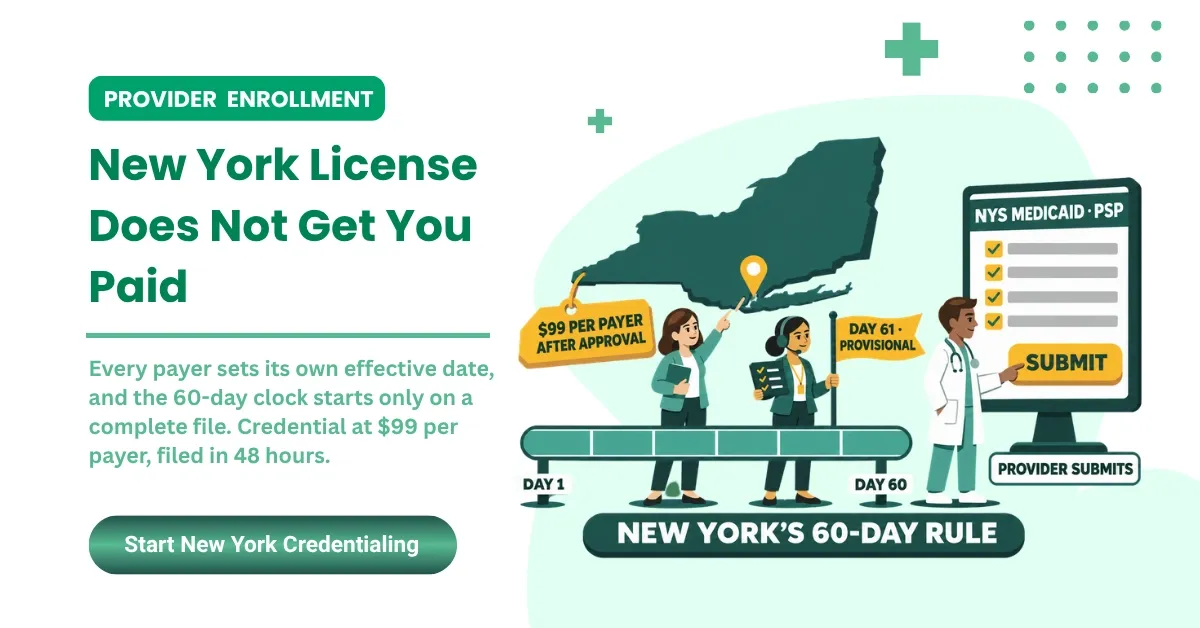




A New York license lets you practice. It doesn't get you paid. NYS Medicaid, each Medicaid managed care plan, and every commercial payer run their own approval, and until a payer issues an effective date, your visits with its members can't bill at in-network rates.
We take insurance credentialing in New York from the first application to the confirmed effective date through our New York credentialing services, filed within 48 hours of complete documents. MedSole RCM charges $99 per payer application for credentialing and 2.99% of monthly collections for full-service medical billing, with no setup fees and no long-term contracts.
You'll need the same map whether you file on your own or hire help. Insurance credentialing for providers in New York comes down to the documents payers want, six filing steps, the state's 60-day law, Medicaid changes through 2028, payer channels, cost, and choosing a partner.
|
Key Takeaways
|
What Is Insurance Credentialing in New York?
Insurance credentialing in New York is the process of getting a licensed provider approved by each health plan, from NYS Medicaid through the Provider Services Portal to plans like EmblemHealth, Fidelis Care, and UnitedHealthcare, so that plan's claims pay at in-network rates. One payer's approval never carries over to the next.
Credentialing, Enrollment, and Contracting Are Three Different Approvals
Billing teams lump these three steps together, and that's where effective dates get lost. Each step has its own owner and its own output. Your claims pay only after all three close and the payer confirms an effective date in writing.
The three payer approvals behind a payable claim. Verified November 2026.
|
Step |
Who decides |
What it gives you |
|---|---|---|
|
Credentialing |
The payer's credentialing committee, after primary source verification of your license, education, sanctions, and work history |
Approval to join the network |
|
Enrollment |
The payer's provider data team |
Your NPI loaded into its claims system |
|
Contracting |
The payer's contracting team, with your signature |
The fee schedule you'll be paid on |
That's why credentialing in medical billing sits so close to the cash. If the payer hasn't loaded your effective date, your clearinghouse can send a clean claim and still get it back as out of network. Health insurance credentialing is the first domino in that chain, and every later step waits on it.
Why New York Credentialing Works Differently
Provider credentialing follows the same national pattern in most states. New York insurance credentialing adds six wrinkles that catch out-of-state groups off guard:
- New York isn't in the Interstate Medical Licensure Compact, so an out-of-state physician needs a full NYSED license first.
- NYS Medicaid accepts enrollment applications only through the eMedNY Provider Services Portal (PSP).
- Medicaid managed care plans run a second credentialing layer on top of state enrollment.
- State law sets a 60-day decision window and a provisional credentialing route.
- Four separate Blue plans split the state by county.
- Medicaid behavioral health runs through managed care, including Health and Recovery Plans (HARPs).
What Our New York Credentialing Service Covers
MedSole RCM manages medical credentialing services in New York for solo providers and groups, covering NYS Medicaid, Medicaid managed care plans, Medicare, and commercial payers. We audit your file before anything goes out, file within 48 hours of complete documents, and call each payer weekly until it decides.
Everything Included for $99 per Payer Application
Insurance credentialing for providers is priced the same way across license types. One provider enrolling with one payer counts as one application, so a counselor joining four plans is four applications. Each one includes:
- Readiness audit of NPI, CAQH, taxonomy, licensure, malpractice dates, and tax ID
- Submission within 48 hours of complete documents
- Weekly payer calls, with escalation to provider relations when a file stalls
- DataSpring (CAQH) setup, attestation, and upkeep
- PECOS enrollment for Medicare and state Medicaid enrollment, including managed care plans
- Fee schedule review before you sign, plus EFT and ERA setup
- Recredentialing and revalidation tracking
You pay for the panels you join and nothing else. A quiet month with no new applications costs you nothing on the credentialing side, which matters for groups that hire in waves.
Providers and Practices We Credential in New York
Our medical credentialing services in New York cover physicians, nurse practitioners, physician assistants, psychologists, LCSWs, mental health counselors, LMFTs, behavior analysts, physical, occupational, and speech therapists, dentists, podiatrists, dietitians, and chiropractors. Solo clinicians, multi-location groups, and practices enrolling in several states all fit.
Each license type carries its own New York rules. The provider type section later in this guide covers the ones that cause the most rework: behavioral health titles, NP practice hours, and therapy group enrollment.
What You Sign and What We Handle
NYS Medicaid draws a hard line on who submits. eMedNY returns any PSP application submitted by anyone other than the provider, or an owner or authorized representative disclosed on the file. A delegate can prepare the application, but the provider has to click submit.
We prepare each application, audit every field, upload documents, and track each payer. You sign the PSP submission, payer attestations, and contracts. That split keeps New York insurance credentialing compliant, since your attestation certifies facts about your own history and has to come from you.
Have a provider starting in New York next quarter? Send the payer list, and we'll map the applications, the filing order, and the expected effective dates through our provider enrollment and credentialing team.
Insurance Credentialing Requirements in New York
The insurance credentialing requirements in New York start with an active NYSED license, an NPI, and a current DataSpring (CAQH) profile. Medicare adds a PECOS record, and Medicaid adds a PSP application. After that, every payer checks the same core documents against primary sources.
New York State Medical License Requirements
The New York State medical license requirements for physicians come from NYSED's Office of the Professions. Under the NYSED physician license requirements, you must:
- Be of good moral character and at least 21 years old
- Meet NYSED's education, examination, and experience requirements
- Complete coursework in identifying and reporting child abuse and maltreatment, plus infection control
- Pay the $735 license fee, or $105 for a limited permit
Training length depends on your school. Graduates of NYS-registered, LCME-accredited, or AOA-accredited programs need at least one year of postgraduate hospital training. Anyone from another program needs three years and must verify credentials through FCVS, the Federation Credentials Verification Service.
New York medical license requirements look different outside medicine. NYSED sets rules profession by profession; nurse practitioners, for example, hold an RN license plus NYSED nurse practitioner certification before any payer will look at them.
NPI, DataSpring (CAQH), and PECOS Records
CAQH is now DataSpring, powered by CAQH. Your portal access, login, and saved profile stayed the same, and the service is still free for clinicians. Profiles run on a 120-day attestation cycle, and if you miss an attestation, payers pulling your profile put the file on hold.
Excellus goes further and counts an application complete only if your profile was re-attested within the last 90 days. Our guide to DataSpring profile upkeep covers attestation and payer authorization, and the DataSpring clinician guidance explains the rebrand.
Your name, NPI, taxonomy, TIN, and practice address must match across NPPES, DataSpring, PECOS, and your license. A suite number on one record and not another is enough for some payers to send the whole file back for correction.
New York Credentialing Document Checklist
Pull these before you open a single application. Having them ready on day one keeps payers from returning your file for missing items before the 60-day clock has even started.
Provider documents
- New York license, plus DEA registration with a New York address where you prescribe
- Board certification, if you hold it
- CV with month and year dates and any gaps explained
- Malpractice face sheet showing limits the payer accepts
- Hospital privileges or a written admitting arrangement
- Individual (Type 1) NPI, DataSpring ID, and W-9
- For NPs under 3,600 practice hours, the written practice agreement covered later
Practice documents
- Group (Type 2) NPI and TIN
- IRS letter confirming the TIN (CP 575 or 147C)
- Street service addresses, since Excellus won't accept PO boxes
- Bank details for EFT
Malpractice minimums vary by payer, so check each plan's required limits before you buy or renew a policy. Buying the wrong limit means a new face sheet and a resubmission to every payer that saw the old one.
How to Get Credentialed With Insurance Companies in New York: 6 Steps
To get credentialed with insurance companies in New York, confirm your license and identifiers, build a DataSpring profile, enroll in Medicaid through the PSP, apply to each payer, track the state's 60-day clock, and confirm the effective date in writing. On the files we fix, most delays trace back to the first two steps.
If you're working out how to become credentialed with insurance companies for the first time, run the provider credentialing process below in order. A manager onboarding a new hire follows the same sequence, with more applications running at once.
Step 1: Confirm Licensure and Identifiers
Check that your NYSED license is active and registered, your NPI lists the right taxonomy, and your DEA shows a New York address if you'll prescribe here. A taxonomy error on your NPPES record follows you into every payer system that copies it.
If you'll bill Medicare, start Medicare PECOS enrollment alongside these steps. CMS runs on its own track, and it won't wait for your commercial files to catch up.
Step 2: Build and Attest the DataSpring (CAQH) Profile
Complete every section, upload current documents, and authorize each plan you're applying to by name. A profile that's 95% done reads as incomplete to a credentialing analyst, and an unauthorized plan can't see your profile at all.
Re-attest the same week you submit. Payers pull your profile on their own schedule, so an attestation that's 100 days old when Excellus pulls it fails the 90-day rule even though you did nothing wrong.
Step 3: Enroll in NYS Medicaid Through the Provider Services Portal
Log in with a Health Commerce System account or a NY.gov business account, with multifactor authentication set up. You have 45 days to submit once you start an application. After that, eMedNY deletes it and you start from scratch.
Book time with the provider for the final submission, since a delegate can prepare the file but can't click submit for them. The Medicaid section below covers the portal, managed care plans, and revalidation in detail.
Step 4: Apply to Each Commercial Payer and Medicaid Managed Care Plan
Fidelis Care states it on its own site: the online join request isn't a credentialing application. Expect a similar two-stage setup at other plans. You ask to join, the plan confirms the panel is open for your specialty, and then the credentialing application starts.
If you're figuring out how to credential a provider with insurance companies across several plans, run the applications in parallel. Filing one payer at a time stacks each wait on top of the last, and a 60-day process turns into a six-month one.
Step 5: Track the 60-Day Clock and Answer Every Request
New York's 60-day clock starts when the payer has a completed application. Log the date the payer confirms your file is complete, in writing if you can get it, along with every request for information and the date you answered.
Answer each request within the same week. That log is also your evidence if provisional credentialing ever comes into play, and it's the step teams skip in the provider credentialing process when nobody owns it.
Step 6: Sign the Contract, Confirm the Effective Date, and Set Up EFT and ERA
An approval email doesn't make claims payable. You need the executed contract and a written effective date before that payer's claims go out. Set up EFT and ERA at the same time so the first payment and its remittance land where your billing team can post them.
Hold that payer's claims until the effective date posts, and compare the date to your first scheduled visits. Some payers set the effective date back to the completed application, and others start it the day they sign, which is why a written date matters more than a verbal one.
How Long Insurance Credentialing Takes in New York
New York law gives HMOs and insurers' managed care products 60 days to decide on a completed credentialing application, or 21 days after missing third-party documents arrive. Real timelines depend on the payer and on how complete your file is on day one.
Published and Observed Timelines by Payer
Keep two kinds of numbers apart: what payers publish and what our team sees on live files. Timelines also differ across the four New York Blue plans, each with its own application channel.
Published and observed credentialing timelines for New York providers. Verified November 2026.
|
Source type |
Payer |
Timeline |
Where it comes from |
|---|---|---|---|
|
State law |
HMOs and insurers' managed care products |
60 days from a completed application |
Public Health Law 4406-d, Insurance Law 4803 |
|
Payer-published |
Anthem Blue Cross and Blue Shield |
45 days |
MedSole BCBS NY guide |
|
Payer-published |
Highmark BCBS of Western New York |
45 days from a completed CAQH application |
MedSole BCBS NY guide |
|
Payer-published |
Excellus BCBS |
Within 60 days |
MedSole BCBS NY guide |
|
Payer-published |
EmblemHealth |
Review within 60 days of a fully completed application |
EmblemHealth credentialing chapter |
|
MedSole observed |
Medicare (PECOS) |
30 to 45 days |
MedSole credentialing services page |
|
MedSole observed |
Aetna |
30 to 45 days |
MedSole credentialing services page |
|
MedSole observed |
Cigna |
40 to 60 days |
MedSole credentialing services page |
|
MedSole observed |
UnitedHealthcare |
40 to 60 days |
MedSole credentialing services page |
Our team sees Medicare and Aetna files close fastest, in 30 to 45 days, while Cigna and UnitedHealthcare run closer to 40 to 60. NYS Medicaid doesn't publish a fixed PSP review time, so we don't quote one, and you should be wary of anyone who does.
Every range above assumes a complete file. Provider credentialing timelines stretch the moment a payer has to ask for something, since the 60-day clock doesn't start until the file is complete.
New York's 60-Day Credentialing Law
Two statutes set the clock: Public Health Law Section 4406-d for HMOs and independent practice associations, and Insurance Law Section 4803 for insurers' managed care products. Both cover professionals licensed, registered, or certified under Title 8 of the Education Law.
The rule is short. A plan must decide within 60 days of a completed application. If a third party hasn't sent required documentation, the plan can tell you it needs more time, and it then has 21 days from receiving those documents to decide.
Provisional Credentialing: Who Qualifies and What It Requires
Provisional credentialing covers a narrow group: a newly licensed professional, or one who moved to New York from another state and hasn't practiced here, joining a group practice whose members all participate in the plan's network. If the plan doesn't approve or decline within 60 days, you're deemed provisionally credentialed.
Participation starts the day after the 60th day. Say the plan received your completed application on March 2. Day 60 falls on May 1, and you can start seeing that plan's members in network on May 2.
The statutes attach conditions:
- A provisionally credentialed physician can't be named a member's primary care physician until fully credentialed.
- The group must agree in writing to refund in-network payments above out-of-network benefits if the plan denies the application.
- The group can't bill the member beyond the copayment, or coinsurance under Insurance Law 4803.
- No interest or penalties apply to denied provisional-period claims, and the plan can't deny them after appeal for late filing alone.
This summarizes the statutes and isn't legal advice. Provisional status applies to HMOs, IPAs, and insurers' managed care products, so confirm which product a patient carries before you count on it.
Provisional credentialing only helps if you can prove the completion date and the group's written refund commitment. We log both for every New York application, so the day after day 60 is provable if a payer pushes back.
Physicians Joining Hospitals and Article 28 Facilities
A second provisional route covers physicians who are newly licensed, relocated, or moving to a new tax ID and who join an Article 28 hospital or diagnostic and treatment center, or a facility licensed under Mental Hygiene Law Article 16, 31, or 32. Other employed physicians there must already participate.
Provisional status starts once the plan has the physician's completed application sections and written notice of hospital privileges. Payment comes later. The plan doesn't pay the facility until full credentialing, then pays for provisional-period services going back up to 60 days after the completed application was submitted.
New York Medicaid Credentialing in 2026 and 2027
New York Medicaid credentialing now runs only through the Provider Services Portal, after eMedNY stopped accepting paper applications on August 31, 2026. The state is revalidating every enrolled provider in phases through June 2028, and a temporary enrollment moratorium covers six provider classes.
Enrolling Through the Provider Services Portal
Open the NYS Medicaid file early in insurance credentialing in New York, since managed care plans need your state enrollment on record. The eMedNY Provider Services Portal sets rules that cause the most rework:
- You need a Health Commerce System account or a NY.gov business account, with multifactor authentication.
- You have 45 days from starting to submit, or eMedNY deletes the application.
- eMedNY returns any submission from someone other than the provider or a disclosed owner or authorized representative.
- You get 45 business days to answer a return for additional information.
- Approval arrives as a written determination that includes your enrollment effective date.
Our NY Medicaid PSP guide walks through each screen. Save your application number the day you start, because you'll need it for every status call and every return letter.
Medicaid Managed Care Plans Need Their Own Credentialing
The 21st Century Cures Act requires Medicaid managed care and Child Health Plus network providers to be enrolled with NYS Medicaid, and plans remove providers who aren't, per eMedNY managed care network enrollment guidance. Plans check the Medicaid Pending Provider Listing for providers still in review.
Each plan still credentials you on its own: Fidelis Care, Healthfirst, MetroPlus Health, EmblemHealth, and the rest. Run the PSP application and the plan applications side by side. Waiting for state approval before you start plan credentialing stacks two waits back to back.
The Revalidation Wave Running Through June 2028
NYS Medicaid now revalidates on a risk-based cycle, according to the NYS DOH revalidation page. Federal rules require revalidation at least every five years, and New York shortens that for higher-risk provider types:
- High risk: every 3 years, with site visits and fingerprinting for owners of 5% or more
- Moderate risk: every 4 years, with site visits
- Limited risk: every 5 years
DOH is sending notices in phases. Phase 1 notices started in July 2026. Winter 2026 brings Phase 2 for ABA providers, HCBS 1915(c) waiver providers, and LHCSAs, and Phase 3 follows in early 2027 for providers enrolled without an NPI. Everyone else rolls through June 2028.
You get 123 calendar days from the first notice letter. A reminder follows 60 days in, and 30 days after that DOH sends a termination notice effective 33 days later. Submitting before that date stops the termination, while missing it ends your enrollment and every managed care plan has to drop you.
2027 watch: Phase 3 notices are scheduled for early 2027, so groups with providers enrolled without an NPI should confirm their mailing addresses on file now. We run the PSP application and each Medicaid managed care enrollment side by side, then track your 123-day revalidation window once you're enrolled.
Provider Types Frozen by the Enrollment Moratorium
A temporary moratorium took effect on July 27, 2026, for six classes: laboratories, DMEPOS suppliers, ABA providers, LHCSAs, pharmacies, and managed long term care plans, including partial capitation, Medicaid Advantage Plus, and PACE. DOH discontinued every pending application in those classes at that point.
New enrollments, reinstatements, and changes of ownership are paused, but revalidations continue. DOH says each moratorium lasts at least six months and hasn't published an end date, so check the DOH page before applying.
New York Payers We Credential You With
We handle New York insurance credentialing with NYS Medicaid, Medicaid managed care plans, Medicare, and the state's commercial payers. Each payer runs its own channel, and four Blue plans split the state by county, so the right application depends on where you practice and which line of business you're joining.
New York Payer Credentialing at a Glance
Use this table as a starting map for health insurance credentialing across the state. MVP credentialing, like CDPHP's and Independent Health's, runs through each plan's own provider site, and none of the three publishes a timeline we could verify, so those cells say "Confirm."
New York payer credentialing channels. Verified November 2026. Confirm each channel on the payer's site before submitting.
|
Payer |
Lines in NY |
How you apply |
DataSpring (CAQH) |
Timeline |
Source |
|---|---|---|---|---|---|
|
Anthem Blue Cross and Blue Shield (formerly Empire) |
Commercial and Medicaid; 28 eastern and southeastern counties |
Provider enrollment request form, or Payer Spaces in Availity |
Required |
45 days (published) |
MedSole BCBS NY guide |
|
Excellus BCBS |
31 upstate counties: Rochester, Central NY, Southern Tier, Utica |
Email packet to Provider Enrollment |
Re-attested within 90 days |
Within 60 days (published) |
MedSole BCBS NY guide |
|
Highmark BCBS of Western NY |
8 counties around Buffalo |
CAQH-based application |
Required |
45 days (published) |
MedSole BCBS NY guide |
|
Highmark Blue Shield of Northeastern NY |
13 counties in the Capital Region |
Confirm with Highmark |
Confirm |
Not published |
MedSole BCBS NY guide |
|
EmblemHealth (HIP, GHI) |
Commercial, Medicaid, HARP, Child Health Plus, Essential Plan, Medicare Advantage |
Credentialing application |
Mandatory |
60-day review (published) |
|
|
Fidelis Care |
Medicaid, HARP, Child Health Plus, Essential Plan, Ambetter, Wellcare by Fidelis Care |
Join request first, then credentialing |
Confirm |
State 60-day law applies |
|
|
Healthfirst, MetroPlus Health |
Medicaid managed care and other public plans |
Each plan's own credentialing |
Confirm |
Not published |
MedSole NY Medicaid guide |
|
UnitedHealthcare (including Oxford) |
Commercial, Medicare Advantage, Community Plan |
Payer portal |
Required |
40 to 60 days (MedSole observed) |
MedSole credentialing services page |
|
Aetna |
Commercial, Medicare Advantage |
Payer portal |
Required |
30 to 45 days (MedSole observed) |
MedSole credentialing services page |
|
Cigna |
Commercial |
Payer portal |
Required |
40 to 60 days (MedSole observed) |
MedSole credentialing services page |
|
MVP Health Care, CDPHP, Independent Health |
Regional upstate plans |
Confirm on each plan's provider site |
Confirm |
Not published |
None |
|
Medicare |
Part A and Part B through National Government Services (Jurisdiction K) |
PECOS |
Not used |
30 to 45 days (MedSole observed) |
CMS, MedSole credentialing services page |
Which Insurer Makes It Easiest for Providers to Get Credentialed?
No New York payer is easy across the board. Ease comes down to three things you can check before you apply:
- A short published window, like the 45 days Anthem and Highmark publish
- An open panel for your specialty and county
- Eligibility for provisional credentialing under the 60-day law
Panel status can outweigh payer speed. Commercial panels in dense downstate markets close most often, so a fast payer with a closed panel still leaves you out of network.
Medicare Enrollment for New York Providers
National Government Services is the Medicare Administrative Contractor for Jurisdiction K, which includes New York. You enroll through PECOS using the CMS-855 forms, starting from the CMS Medicare enrollment page. Medicare doesn't use DataSpring, and the Medicare guide linked in Step 1 covers PECOS in detail.
Credentialing by Provider Type in New York
New York insurance credentialing changes with the license. Behavioral health clinicians deal with carve-out networks and integrated Medicaid plans, NPs deal with hour-based practice rules, and therapy practices have to enroll the group and each therapist in the right order.
Behavioral Health Clinicians: LCSW, LMHC, LMFT, and Psychologists
New York licenses counselors as Licensed Mental Health Counselors, not LPCs. Use the New York title and matching taxonomy on every application. An LPC label carried over from another state's file invites a mismatch between your license and what the payer verifies.
The LCSW-R privilege no longer controls insurance payment. Chapter 818 of the Laws of 2022 removed the R requirement for coverage of LCSW outpatient services starting January 1, 2023, and NYSED stopped processing R applications. If a payer form still asks for it, the NYSED R privilege notice settles it.
Carve-outs add a second layer. EmblemHealth works with Carelon Behavioral Health (formerly Beacon Health Options), and Anthem routes behavioral health utilization management through Carelon as well. If you're comparing credentialing companies for therapists, ask whether they confirm which plans credential you directly and which go through Carelon.
Medicaid behavioral health runs through managed care and HARP plans, and the OMH managed care billing guidance links the billing and coding manual those plans follow. ABA providers face the enrollment moratorium covered in the Medicaid section, so new ABA Medicaid enrollments are on hold for now.
Use the document checklist earlier in this guide as your behavioral health credentialing checklist for New York files. Our full guide to behavioral health credentialing covers carve-out networks in other states.
Nurse Practitioners and Physician Assistants
NPs with more than 3,600 practice hours can practice without a written practice agreement or written protocols. New York's FY2027 budget extended the Nurse Practitioner Modernization Act provisions that allow this through July 1, 2030, so it's the rule payers apply to NP files today.
NPs under 3,600 hours still need a written practice agreement and protocols with a physician qualified in their specialty. Payers may ask for that agreement, or for an attestation of hours, during credentialing. Confirm current rules with NYSED before you file, since the 2030 date could change again.
PAs practice under physician supervision, and their applications list the supervising physician. See our nurse practitioner credentialing guide for the national pathway and how payers outside New York handle NP files.
Physical, Occupational, and Speech Therapists
Therapy practices usually enroll the group and each therapist on separate timelines. Billing under a therapist whose individual credentialing hasn't closed produces a rendering-provider rejection, even when the group contract is active. Excellus lists physical therapy, occupational therapy, and speech-language pathology on its credentialed practitioner list.
Our therapy credentialing services run the group file and each therapist's file together, then flag every therapist's effective date so your billing team knows the day it can release that therapist's claims.
From Effective Date to First Paid Claim
Credentialing in medical billing ends with one date: the effective date. Claims for services before it usually deny, and New York's filing clocks keep running while a provider waits, so credentialing and billing have to run on the same calendar.
New York Filing Deadlines That Start Before Approval
Filing limits count from the date of service. That hurts when insurance credentialing in New York runs past 60 days, and the Fidelis 90-day rule is the tightest one on this list.
New York claim filing deadlines that keep running during credentialing. Verified November 2026.
|
Rule |
Deadline |
Source |
|---|---|---|
|
Fidelis Care (New York lines) |
90 calendar days from date of service |
MedSole Fidelis guide |
|
EmblemHealth, participating providers |
120 days from date of service |
MedSole EmblemHealth guide |
|
Insurance Law 3224-a default |
120 days after date of service, unless the contract allows longer |
Insurance Law 3224-a |
|
NYS Medicaid fee-for-service (18 NYCRR 540.6) |
90 days from date of service |
MedSole Fidelis guide |
The EmblemHealth filing deadline gives you more room, though not unlimited room. A provider still waiting on Fidelis at day 70 can watch early visits slide past the 90-day limit before approval arrives, with no way to bill them in network once the limit passes.
One protection exists. Under Public Health Law 4406-d, plans can't deny provisional-period claims after appeal for late filing alone. If credentialing-related denials hit, fix the root cause first, usually a missing effective date or a rendering provider the payer never loaded, before you resubmit anything.
Medicaid Compliance Once You're Billing
Once Medicaid money starts flowing, OMIG rules apply. The OMIG compliance program requirements call for an effective compliance program if you claim or receive $1,000,000 or more from Medicaid in any consecutive 12 months, and managed care payments count as indirect Medicaid payments toward that total.
Providers subject to Public Health Law Article 28 or 36, or Mental Hygiene Law Article 16 or 31, fall under the requirement as well, whatever their Medicaid volume.
Our team runs billing and credentialing together, so claims start the day a payer confirms your effective date, at 2.99% of collections, with credentialing at $99 per payer application.
What Insurance Credentialing Costs in New York
Commercial payers in New York don't usually charge individual practitioners an application fee, and DataSpring is free for clinicians. You pay for the labor instead, and credentialing companies publish rates of $100 to $500 per payer application. MedSole RCM charges $99 per payer application.
MedSole RCM Pricing for New York Practices
MedSole RCM published pricing. Verified November 2026.
|
Service |
Price |
Terms |
|---|---|---|
|
Credentialing and payer enrollment |
$99 per payer application |
One provider with one payer counts as one application |
|
Full-service medical billing |
2.99% of monthly collections |
No setup fee, no monthly minimum, month to month |
|
Hospital billing |
2.5% of collections |
Published on the MedSole billing page |
|
Standalone denial management |
4.49% of what's recovered |
Included in the 2.99% rate under full-service billing |
MedSole RCM charges $99 per payer application for credentialing and 2.99% of monthly collections for full-service medical billing, with no setup fees and no long-term contracts. Our medical credentialing services include recredentialing and revalidation tracking in that $99, and the fee is charged only after the payer approves the application.
How That Compares
$99 is below every published per-payer rate MedSole found on eight credentialing and billing companies' pricing pages, checked October 18, 2026. Our credentialing cost breakdown lays out the comparison and what each price includes.
MGMA notes that industry benchmarks often estimate billing and RCM costs at around 5% of collections, according to its MGMA billing cost benchmark. MedSole RCM's 2.99% sits below that figure. Two worked examples show the math:
- A solo provider joining six payers pays $594 in credentialing fees (6 × $99).
- A practice collecting $40,000 a month pays $1,196 a month for full-service billing at 2.99%, compared with $2,000 at a 5% rate.
For small behavioral health practices, per-application pricing keeps costs tied to the panels they join. That's what affordable credentialing services for small behavioral health practices should look like: a known number per payer, with no retainer running in months when nobody new is hired.
How to Choose a New York Credentialing Company
The right insurance credentialing companies for New York practices publish their price per application, know the PSP and Medicaid managed care rules, follow up with payers on a fixed schedule, and connect credentialing to billing. Location matters less than New York payer knowledge.
Six Questions to Ask Any Credentialing Company
Ask the insurance credentialing companies on your shortlist these six questions, and ask us too. Vendors who know insurance credentialing in New York answer them without stalling.
Questions for evaluating a New York credentialing company. Verified November 2026.
|
Question |
What a strong answer looks like |
|---|---|
|
What's the price per payer application, and when is it billed? |
A published number, billed by application |
|
Who submits PSP applications? |
The provider or a disclosed authorized representative submits; the vendor prepares and tracks |
|
How often do you contact payers? |
A fixed cadence, such as weekly, with written escalation |
|
Do you handle Medicaid managed care plans, not only state Medicaid? |
Yes, run in parallel with the PSP application |
|
Do you document the 60-day completion date? |
Yes, to support provisional credentialing |
|
Can you take over billing after approval? |
One team working from one calendar |
What "Best Credentialing Company" Should Mean
The best credentialing company for your practice is the one whose promises you can check: published pricing, a stated filing speed, a fixed follow-up cadence, coverage of your payers, and a path into billing. Healthcare provider credentialing runs on deadlines, so measurable commitments tell you more than adjectives do.
Searching for credentialing companies near me makes sense for a plumber. It matters less here, because the PSP, DataSpring, and New York payer portals all run online. Provider credentialing for a Buffalo practice depends on knowing New York rules, and that knowledge doesn't need an office down the street.
Where MedSole RCM Fits
MedSole RCM charges $99 per payer application, files within 48 hours of complete documents, and calls every payer on your file weekly. Billing runs 2.99% of collections through a US-based billing team serving more than 4,000 providers across 75+ specialties in all 50 states.
Hold us to those numbers if you're weighing the best medical billing company options on price and scope. Send us any quote you already have, and we'll count the applications and show the total at $99 each.
Insurance Credentialing in New York: FAQs
New York practices ask us these questions while a file is open. Each answer stands on its own, so you can forward one to a provider or office manager without the rest of the guide.
How long does insurance credentialing take in New York?
Under Public Health Law 4406-d and Insurance Law 4803, HMOs and insurers' managed care products must decide within 60 days of a completed application, or within 21 days after missing third-party documents arrive. Our team sees Medicare and major commercial payers close in 30 to 60 days.
What are the insurance credentialing requirements in New York?
You need an active NYSED license, an NPI with the right taxonomy, a current DataSpring (CAQH) profile, malpractice coverage, and a DEA registration if you prescribe. Medicare adds PECOS enrollment, and NYS Medicaid adds an application through the eMedNY Provider Services Portal.
Does New York allow provisional credentialing?
Yes. A newly licensed provider, or one relocating from another state, who joins a group whose members all participate can be deemed provisionally credentialed if the plan misses the 60-day deadline. Participation starts the day after day 60. The group must commit in writing to refunds if denied.
Do I need separate credentialing for each Medicaid managed care plan?
Yes. The 21st Century Cures Act requires Medicaid managed care network providers to be enrolled with NYS Medicaid through the Provider Services Portal, and each plan, such as Fidelis Care, Healthfirst, or MetroPlus Health, then credentials you on its own. Run both at the same time.
Which insurer makes it easiest for providers to get credentialed in New York?
No single insurer is easiest for every provider. Anthem and Highmark publish 45-day windows, which helps, but an open panel for your specialty and county matters more. Eligibility for provisional credentialing under the 60-day law can also shorten the wait at HMOs and managed care plans.
Can LCSWs and LMHCs bill insurance in New York?
Yes, once each payer credentials them. Since January 1, 2023, New York hasn't required the LCSW-R privilege for insurance coverage of LCSW outpatient services. LMHCs apply under the New York LMHC title and taxonomy, and some plans handle behavioral clinicians through Carelon Behavioral Health.
Is New York part of the Interstate Medical Licensure Compact?
No. As of November 2026, New York isn't an IMLC member, and the bill to join (Senate Bill S1505) remains in committee. Out-of-state physicians need a full license from the New York State Education Department before a New York payer will credential them.
How do I get credentialed with insurance companies as a new provider in New York?
Confirm your NYSED license and NPI, build and attest your DataSpring profile, enroll in NYS Medicaid through the PSP, apply to each payer in parallel, track the 60-day clock, and get a written effective date. New licensees joining a fully participating group may qualify for provisional credentialing.
What does credentialing and billing cost with MedSole RCM?
Credentialing with MedSole RCM costs $99 for each payer application, and one provider with one payer equals one application. Full-service billing costs 2.99% of what the practice collects each month, with no setup fee, no long-term contract, and month-to-month terms.
Get Your New York Credentialing Started
Insurance credentialing in New York comes down to three facts. Plans covered by the state's 60-day law must decide on a completed application within 60 days. NYS Medicaid runs through the PSP and is revalidating providers through June 2028. No claim pays before the effective date.
MedSole RCM charges $99 per payer application for credentialing and 2.99% of monthly collections for full-service medical billing, with no setup fees and no long-term contracts. We handle insurance credentialing for providers joining one panel or twenty. Tell us your providers, payers, and start date, and our insurance credentialing support team will map every application and expected effective date.