



BCBS NY Provider Enrollment at a Glance
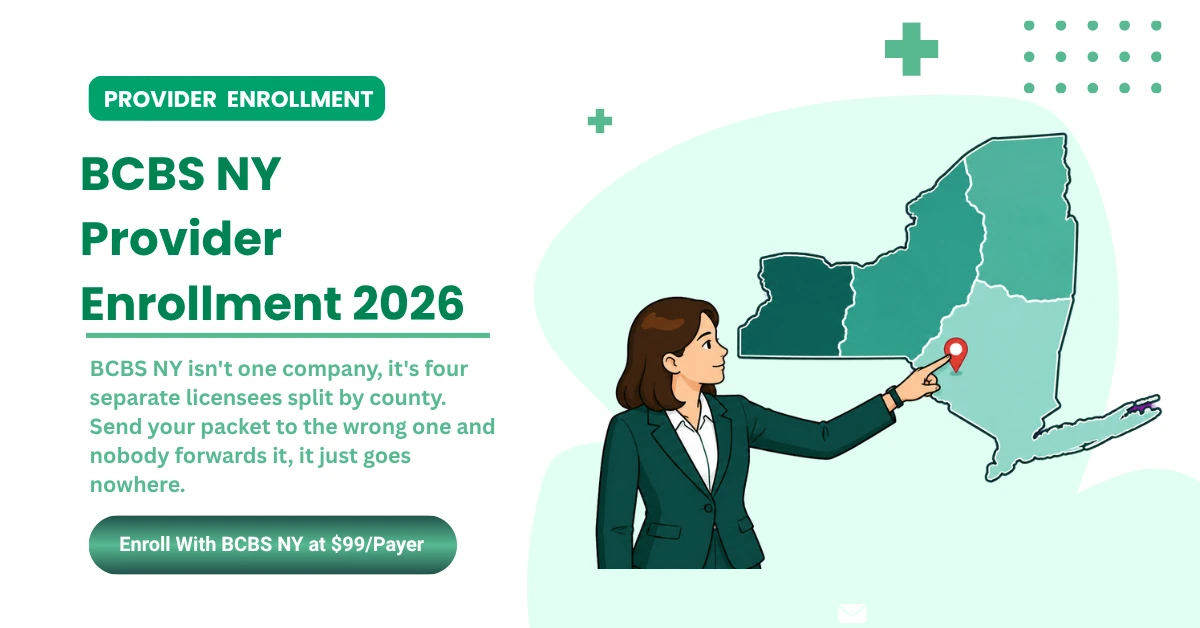
BCBS NY provider enrollment isn't one process. New York is served by four separate Blue Cross Blue Shield licensees, and the plan you apply to depends on the county your practice sits in and the line of business you want to bill.
|
Question |
Short answer |
|---|---|
|
How many BCBS plans operate in New York |
Four separate licensees |
|
Which one do I apply to |
Determined by your practice county and your line of business |
|
Shared credentialing system |
CAQH ProView, used by all four |
|
Published credentialing timeline |
45 days at Anthem and Highmark, within 60 days at Excellus |
|
Recredentialing cycle |
Every three years |
|
Can I bill once credentialing is approved |
No. You need an executed contract and a stated effective date |
|
New York statutory review window |
60 days from a completed application |
|
Managed enrollment cost |
$99 per insurance with MedSole RCM |
Every figure below comes from the payer's own published page or from New York statute. Each source is listed with its verification date at the end of this guide.
By the time you finish, you'll know which licensee covers your address, what belongs in your packet, and what New York law says about how long a plan can sit on your file before you gain a billing right.
What BCBS NY Actually Means: Four Licensees, Not One Company
Providers say "BCBS NY" the way they say "Medicare," as though one organization takes one application. Blue Cross Blue Shield runs as a federation of independent, locally licensed companies. New York has four of them.
|
Licensee |
Also known as |
Region served |
Parent |
|---|---|---|---|
|
Anthem Blue Cross and Blue Shield |
Formerly Empire BlueCross BlueShield |
New York City, downstate, and southeastern New York |
Elevance Health |
|
Excellus BlueCross BlueShield |
Excellus BCBS, Univera Healthcare |
Central New York, the East region, and Rochester |
Lifetime Healthcare Companies |
|
Highmark Blue Cross Blue Shield of Western New York |
Formerly BlueCross BlueShield of WNY |
Buffalo and Western New York |
Highmark |
|
Highmark Blue Shield of Northeastern New York |
BSNENY |
Albany and the Capital Region |
Highmark |
Two of those four share one legal entity. Highmark Western and Northeastern New York Inc. does business as Highmark Blue Cross Blue Shield in the west and as Highmark Blue Shield in the northeast. One company, two trade names, two separate service areas, two separate contracts.
What that means on a Monday morning: a group with offices in Buffalo and Syracuse is running two enrollments, with two plans, two packets, and two effective dates. It isn't one application with a second address typed into it. We run these side by side often enough at MedSole RCM to know exactly where the two paths split.
BCBS NY provider enrollment fails at this step more than any other. Send the packet to the wrong licensee and you don't lose a week. Nobody forwards it. It comes back, or it sits in a queue that was never yours to begin with.
Which New York Blue Plan Covers Your County
How each licensee defines its service area
Each plan publishes its own footprint. Three of the four publish the actual county list. One publishes only a number.
|
Licensee |
Published footprint |
Counties named on the payer's site |
|---|---|---|
|
Anthem BCBS NY |
17 southeastern counties, commercial |
Not published as a list |
|
Highmark BCBS of Western New York |
Eight counties |
Allegany, Cattaraugus, Chautauqua, Erie, Genesee, Niagara, Orleans, Wyoming |
|
Highmark Blue Shield of Northeastern New York |
13 counties |
Albany, Clinton, Columbia, Essex, Fulton, Greene, Montgomery, Rensselaer, Saratoga, Schenectady, Schoharie, Warren, Washington |
|
Excellus BCBS |
31 counties across three regions |
Published by region on the Excellus enrollment applications |
Anthem states the count in its own legal disclosure and stops there. It doesn't publish those 17 counties as a list anywhere we could find, so we won't invent one.
Practices near the edge of the downstate region should confirm the county with Anthem Provider Services before building a packet. The routing detail lives on Anthem's New York network page.
Why the county math doesn't add up cleanly
Add the four published footprints and you get 69 counties. New York State has 62. The seven-county excess isn't a mistake in the payers' numbers. It's overlap, and you can name it.
Clinton, Essex, Fulton, and Montgomery appear in Highmark's Northeastern New York county list and in the Excellus East region. A provider in Fulton County has two Blue plans available and may need both to cover an existing patient panel.
Line of business shifts the answer again. Anthem operates a New York Medicaid line with a different footprint from its commercial line, so "which Anthem" depends on the product, not the brand name on the card.
Every BCBS NY provider enrollment starts here. Confirm your county against the specific product you plan to bill, not against the plan name. If you'd rather not guess, our BCBS NY credentialing services team confirms the licensee and the line of business before a single form gets filled in.
|
Not sure which New York Blue plan covers your practice location? We confirm it first, then build the packet. Credentialing starts at $99 per insurance. |
Empire BlueCross BlueShield Is Now Anthem: What Changed for Providers
Empire BlueCross BlueShield completed its trade-name transition to Anthem Blue Cross and Blue Shield in New York. The legal entity didn't change. The licensee status didn't change. Existing provider contracts didn't change. The brand name on the letterhead did.
Anthem's own provider communications spell out what carried over:
- Legacy Empire contracts stay in force under the Anthem name, so the rename alone doesn't trigger re-enrollment.
- Authorizations issued under the Empire name remain valid.
- Portal access and credentialing records carried across.
- Reimbursement terms and provider support levels weren't altered by the rebrand.
Providers still search the Empire name more than the Anthem one, and it shows up in old contracts, directory listings, and remittance advice. Match what your executed agreement says, not what you remember calling them. Anthem runs different rules in different states, which is why our Anthem enrollment in Virginia guide reads nothing like this one.
The online application endpoint sits on Anthem NY digital enrollment, and the footer on that page carries the 17-county disclosure.
Anthem Blue Cross and Blue Shield of New York: Enrollment Process
How to submit an Anthem BCBS NY provider enrollment application
- Confirm the practice location falls inside Anthem's New York commercial footprint.
- Build or refresh the CAQH ProView profile and authorize Anthem to pull it.
- Submit the Provider Enrollment request form linked from the Anthem New York network page.
- Groups already registered on the payer portal reach the same application through Payer Spaces, then Anthem, then Applications, then Provider Enrollment and Network Management.
- A Provider Relations representative contacts you about next steps.
Step four is the one nobody publishes in plain language. It sits inside a payer contact guide, and practices with an existing portal login routinely miss it and submit through the public form instead.
Anthem NY credentialing requirements
Anthem lists what a complete application contains. Miss any one item and the file doesn't start moving:
- Your signature and the application date
- A CAQH status of Initial Application Complete or Reattestation
- A current license in each state where you provide services
- A current DEA or CDS certificate where your specialty requires one
- Five years of work history in month and year format
- Current professional liability insurance
- Current hospital privilege information
Anthem publishes 45 days for credentialing, counted from the day the credentialing department receives a completed CAQH application. Recredentialing runs every three years.
One route sits outside the standard path. Providers adding Applied Behavior Analysis or an autism-spectrum-related specialty are told to contact Provider Relations directly rather than submit through the normal channel. Tri-state groups often run this alongside Horizon BCBS NJ enrollment, and the two payers share almost nothing procedurally.
Excellus BlueCross BlueShield: Enrollment Process
Excellus doesn't use a portal application
BCBS NY provider enrollment with Excellus runs on email. There's no portal submission to hunt for, and providers who assume every Blue plan works alike lose days looking for one.
You complete the application that matches your practitioner type, assemble the required documents, and email the packet to Provider Enrollment. Medical and dental go to separate addresses.
Excellus states the sequence plainly on its Excellus join our network page. Provider Relations reviews your application and sends a Participating Provider Agreement. The enrollment gets processed after the signed and dated agreement comes back. Credentialing applications inside the packet are processed within 60 days of receipt.
Excellus also cites its legal basis for that number. Its practitioner enrollment application states that applications are credentialed within 60 days of receiving a completed application in accordance with New York Public Health and Insurance Laws.
Who Excellus won't credential
Two hard requirements sit at the top of the Excellus participation criteria, and neither appears on any other New York Blue plan page:
- You must maintain a physical practice location inside the plan's geographic service area, and that location may be subject to an office site visit.
- Providers offering telehealth services only will not be credentialed or contracted.
That second line disqualifies an entire category of practice. If your model is virtual-only, Excellus isn't a network you can join, and finding that out after you've built the packet costs you weeks.
Excellus publishes five separate applications: credentialed practitioners, non-credentialed practitioners, non-physician health care practitioners, health coaches, and dental. Submit the wrong one and the clock restarts.
Highmark Blue Cross Blue Shield of Western New York: Enrollment Process
What Highmark requires in a complete application
Highmark uses CAQH ProView, and its complete-application list tracks closely with Anthem's. The Highmark BCBS WNY credentialing page specifies the CAQH status, current licensure in each state of service, a current DEA or CDS certificate, five years of work history in month and year format, current professional liability insurance, hospital privilege information, and education or training supporting the requested specialty.
Highmark publishes 45 days from receipt of a completed CAQH application. Recredentialing runs every three years.
One line on that page carries more risk than anything else Highmark publishes. Fail to update CAQH or supply the required recredentialing information by the due date, and Highmark treats the application as incomplete. The result is administrative termination from the network.
That termination isn't a warning letter. Your participation ends, claims start denying as out of network, and your BCBS NY provider enrollment restarts from a brand new application.
Highmark also runs a Medicaid line in Western New York administered under a Wellpoint arrangement, which follows a separate track from the commercial network. Our Wellpoint provider enrollment guide covers that side.
|
Recredentialing deadlines are the easiest thing to miss and the most expensive thing to lose. We track them for every payer we manage, at $99 per insurance. |
What Highmark says about billing after approval
Highmark draws a line most providers don't expect. Credentialing approval isn't the same as being cleared to bill. Final activation requires an executed contract and a welcome letter carrying your effective date.
Highmark's provider manual adds the geographic rule behind it. Your office or facility location typically determines Highmark's ability to contract with you, and that ability is generally limited to services rendered at locations inside a Highmark service area.
Highmark Blue Shield of Northeastern New York: The Plan Nobody Writes About
Highmark Blue Shield of Northeastern New York serves 13 counties across the Capital Region: Albany, Clinton, Columbia, Essex, Fulton, Greene, Montgomery, Rensselaer, Saratoga, Schenectady, Schoharie, Warren, and Washington.
It operates under the Blue Shield mark rather than Blue Cross Blue Shield, and shares a legal entity with the Western New York plan.
Providers around Albany and Schenectady often assume Excellus covers them, because Excellus covers so much of upstate. Four of those 13 counties do overlap with the Excellus East region. That overlap is what makes the assumption feel safe and sends packets to the wrong desk.
Highmark publishes less provider-facing enrollment detail for Northeastern New York than it does for Western New York. Confirm the current submission channel with Highmark directly before you assemble anything.
Of the four New York Blue plans, this one has the thinnest published trail. That's the reason it collects misrouted applications.
CAQH ProView: The One System All Four Plans Share
Every BCBS NY provider enrollment runs through CAQH ProView. All four New York Blue licensees pull credentialing data from it, and it works as a shared database where you enter your professional history once and then authorize each health plan to read it. Our CAQH credentialing guide walks through the profile build itself.
Registration asks for your NPI, license number and state, DEA where applicable, and identity verification. Authorization comes in two forms: global, which lets any participating plan access the profile, or organization by organization.
Re-attestation runs on a recurring cycle documented in the CAQH Provider Data Portal guide. Your profile has to show a status of Initial Application Complete or Reattestation before any of the four New York plans will treat your application as complete.
A profile that's accurate but not authorized to the right plan produces the same result as no profile at all. The application sits. Nobody calls to tell you why.
Alignment matters as much as accuracy. Your legal name, NPI, taxonomy, tax ID, and practice address have to match across NPPES, CAQH, your state license, and the payer application. Verify your NPI record against the CMS NPI Registry before you submit. A single mismatch generates a verification request, and verification requests add weeks.
Your CAQH Profile Can Be Current and Still Get Your Excellus Application Rejected
Excellus defines a completed application as one that includes a complete and accurate CAQH application re-attested to within the last 90 days. CAQH's own re-attestation cycle runs longer than that. The two windows don't line up.
Say you attest in March. CAQH considers you fully compliant. The Excellus packet goes out in June, and by then that attestation is 92 days old, so Excellus doesn't count your file as complete.
Nobody calls. The packet waits while you assume the 60-day clock is already running.
The fix takes five minutes. Re-attest in CAQH the same week you plan to submit, not whenever the reminder email arrives. Screenshot the attestation date and file it with your submission record.
The general rule underneath this: the payer's definition of complete governs, not CAQH's. Check each plan's stated freshness window before you send anything to that plan.
|
Attestation timing sinks applications that are otherwise perfect. Catching it before submission is part of what a managed enrollment does. |
How Long BCBS NY Provider Enrollment Actually Takes
What each plan publishes
|
Plan |
Published credentialing time |
Clock starts when |
Recredentialing |
|---|---|---|---|
|
Anthem BCBS NY |
45 days |
A completed CAQH application is received |
Every three years |
|
Highmark BCBS WNY |
45 days |
A completed CAQH application is received |
Every three years |
|
Excellus BCBS |
Within 60 days |
A completed application is received |
Confirm with the plan |
|
Facility and behavioral health |
Longer than individual practitioner timelines |
A complete submission is received |
Confirm with the plan |
Why the published numbers aren't comparable
These figures measure different clocks with different start conditions. Anthem and Highmark count from receipt of a completed CAQH application. Excellus counts from receipt of a completed enrollment packet, and its definition of complete includes an attestation dated within the last 90 days.
Comparing 45 against 60 as though they mean the same thing gives you the wrong expectation and sometimes the wrong plan.
What the timeline looks like in practice
Every published number covers the credentialing leg and nothing else. None of them is time to first paid claim. Contract issuance, signature, effective date, and payment setup all sit after the number the payer quotes.
Our payer enrollment services cover all four stages, not just the first one. The cost of enrollment delays is where most of the damage lands.
Three things move the number:
Application accuracy. The clock doesn't start until the file is complete. Missing work history, an expired license, or a stale attestation resets the start date. It doesn't extend the deadline.
Provider type. Facility and behavioral health credentialing runs materially longer than individual practitioner credentialing, because there's more to verify and often a second network involved.
Line of business. Commercial, Medicare Advantage, and Medicaid managed care run on separate tracks inside the same licensee. Approval on one doesn't carry to another.
|
MedSole RCM manages payer enrollment at $99 per insurance and submits applications within 48 hours of receiving provider documents. Faster submission doesn't shorten the payer's clock. It stops the clock from restarting. |
What Changed for New York Providers in 2026
Two of these come straight from payer documents. The third is a state Medicaid change that affects any New York practice billing a Medicaid line.
|
Effective |
What changed |
Who it affects |
|---|---|---|
|
April 24, 2026 |
Excellus revised its credentialing guidance, including the requirement that CAQH be re-attested within the last 90 days for an application to count as complete |
Every Excellus applicant |
|
February 23, 2026 |
Excellus revised its dental enrollment application. A W-9, a malpractice insurance certificate, and a New York license are required, and PO Box addresses are not accepted |
Excellus dental applicants |
|
May 1, 2026 |
New York Medicaid revalidation submission moved into the state provider portal |
Providers enrolled with NYS Medicaid |
Highmark has also been updating its credentialing portal experience for New York providers during 2026. Confirm the current submission channel on Highmark's provider communications before you assemble a packet, because a mid-cycle process change is the most common reason an application goes quiet. The Medicaid side is covered in our New York Medicaid enrollment guide.
Check whether any dated change above touches a payer you're mid-application with. If it does, call before you follow up, not after.
New York Law Gives You a 60-Day Clock and, for Some Providers, a Billing Right
The 60-day review requirement
New York Public Health Law 4406-d requires a health care plan to complete its review of your application to join the in-network portion of its network and, within 60 days of receiving your completed application, tell you either that you're credentialed or that it needs more time because a third party failed to supply documentation.
If the delay comes from missing third-party documentation, the plan has to make every effort to obtain it and reach a final determination within 21 days of receiving it.
Insurance Law Section 4803 carries the same 60-day requirement for insurers. Between the two, the rule covers the HMO and insurer products New York providers deal with most.
This is why "still under review" stops being an acceptable answer past day 60. The word doing the work is completed. The clock runs from a file the plan treats as complete, which is exactly why the attestation window matters.
Provisional credentialing, and who actually qualifies
PHL 4406-d also creates provisional credentialing, and most providers running a BCBS NY provider enrollment have never heard of it. It's narrower than it sounds, so read the eligibility carefully before you rely on it.
The provision applies to a newly-licensed health care professional, or one who recently relocated to New York from another state and hasn't previously practiced here, who joins a group practice where every member already participates in-network. If that completed application is neither approved nor declined within 60 days, the professional is deemed provisionally credentialed.
Network participation begins the day following the sixtieth day after receipt of the completed application and lasts until the plan makes its final determination. A provisionally credentialed physician can't be designated as a patient's primary care physician until fully credentialed.
Eligibility comes with a written condition. The group practice has to notify the plan in writing that if the application is ultimately denied, the professional or the group will refund payments for in-network services that exceed the out-of-network benefits payable under the member's contract, and won't pursue the member beyond the copayment that would otherwise have applied.
One more protection sits in the same section. A plan can't deny, after appeal, a claim for services provided by a provisionally credentialed professional solely because the claim wasn't timely filed.
Section 4406-d covers HMOs and IPAs. Insurance Law 4803 mirrors it for insurers. This is what the statutes provide, not legal advice, and it doesn't reach every provider or every product. Confirm applicability with the plan and with your counsel before you bill a single claim on it.
Credentialing Approval Is Not the Same as Being Able to Bill
Approval is a milestone, not a finish line. Highmark says so in its own provider guidance. Excellus says the same thing in different words, telling applicants they aren't considered participating until the application is approved and they've been given an effective date of participation.
Four gates sit between a credentialing decision and a paid claim, and a BCBS NY provider enrollment isn't finished until you clear all four:
- Credentialing decision. The plan verifies your qualifications and issues a determination. This is the 45 to 60 day figure every payer publishes.
- Contract issuance and signature. Provider Relations sends a Participating Provider Agreement. Excellus processes the enrollment only after the signed and dated agreement comes back.
- Effective date. Activation needs an executed contract and a welcome letter carrying the date. Services rendered before that date aren't in-network services.
- Payment setup. EFT and ERA enrollment has to be configured and confirmed before remittances land correctly.
Start billing on the approval letter and you're submitting claims before an effective date exists. Those claims deny, and the denial isn't appealable on the merits, because the provider wasn't participating on the date of service. That's a denial management services problem you never needed to have.
Gates two through four are why the honest answer to "how long does this take" isn't 45 days. It's 45 days plus contract turnaround plus activation plus payment setup, and only the first number appears anywhere in public. Our credentialing and contracting support covers all four.
|
Most practices lose money in gates two through four, not gate one. Contract review, fee schedule negotiation, and EFT and ERA setup are all part of the same $99 per insurance, so nothing stalls after approval. |
What You Need Before You Submit: The BCBS NY Document Checklist
Individual practitioners
- Type 1 individual NPI, confirmed accurate in NPPES
- CAQH ProView profile, complete and attested inside the plan's freshness window
- Current New York license, plus a current license in every state where you provide services
- DEA or CDS certificate where your specialty requires one
- Five years of work history in month and year format
- Current professional liability insurance certificate
- Current hospital privilege information
Groups adding a provider to an existing contract
Adding a clinician to a group that's already contracted is a different transaction from enrolling a new group. It's also the enrollment a growing practice runs most often.
You'll need the group's Type 2 NPI, the tax ID, and the existing contract reference. The individual still needs their own credentialing decision even though the group contract exists, and that's the part practices skip. Our what a credentialing specialist does breakdown covers the full workflow.
Facilities and organizations
Facility packets ask for an organizational NPI, a W-9, professional liability coverage, program descriptions, staffing rosters, and state facility licensure. Behavioral health facilities add New York State licensure from the relevant state agency plus accreditation.
Facilities may need credentialing separately from the practitioners who work inside them. Two enrollments, two timelines, one address.
One formatting rule costs more applications than it should. Excellus requires street-level office addresses with no PO Box, and exactly one correspondence address, one remittance address, and one medical records address.
BCBS NY Provider Enrollment by Provider Type
Behavioral health providers and the Carelon requirement
Anthem routes behavioral health utilization management through Carelon Behavioral Health. Confirm whether facility enrollment with Carelon is required separately from the medical network enrollment, because a gap in that carve-out is a common reason behavioral health claims deny after credentialing looks finished. Timelines run longer than the individual practitioner figure, which our behavioral health credentialing guide covers in detail.
ABA and autism spectrum specialties
Anthem directs providers adding Applied Behavior Analysis or an autism-spectrum-related specialty to contact Provider Relations rather than use the standard path. Excellus handles it differently, listing Licensed Behavior Analyst among its credentialed practitioner types and Certified Behavior Analyst Assistant under its non-physician application. Two plans, two routes, one specialty. Our ABA credentialing services page maps both.
Physical therapy, occupational therapy, and speech-language pathology
All three appear on the Excellus credentialed practitioner list. Therapy practices usually enroll the group and the individual therapists on separate timelines, and billing under a therapist whose individual credentialing hasn't closed produces a rendering-provider rejection. Our physical therapy credentialing guide covers the sequencing.
Telehealth-only practices
Excellus won't credential or contract providers offering telehealth services only, and requires a physical practice location inside the service area. Check each of the other three plans directly rather than assuming their position matches. State licensure rules add another layer, which our telemedicine credentialing rules guide addresses.
Ancillary providers
Anthem's New York network page states that instructions for ancillary providers are coming soon. For DME suppliers, laboratories, imaging centers, home health agencies, infusion providers, and sleep centers, that means no published path exists right now and enrollment runs through direct Provider Relations contact.
Budget extra time for this. You're negotiating a process, not following one.
Nurse practitioners and physician assistants
Excellus routes nurse practitioners and physician assistants through its non-physician health care practitioner application, which also asks for the collaborating or supervising physician on file. It's a different form from the practitioner enrollment application, and picking the wrong one restarts your clock.
Closed Panels in New York City and Long Island
A plan isn't required to contract with more providers once it already meets network adequacy for that service in that county. New York's NYSDOH standard contract clauses set the framework managed care contracts operate under, and adequacy sits underneath the panel decision. A closed panel is a network-management call, not a verdict on your credentials.
Three things worth knowing before you take it personally:
- Panel closure is specialty-specific and county-specific. Closed for one specialty in one county tells you nothing about another.
- Dense downstate markets close panels most often, because adequacy there is already satisfied.
- A closed panel isn't permanent. Plans reassess as adequacy shifts and as providers leave the network.
What you can actually do about it:
- Request participation through the plan's exception or appeal process and document the access gap your practice fills.
- Name the specific unmet need: a subspecialty, a language, an underserved location, extended hours, or a service the current network doesn't cover.
- Reapply on a defined cadence instead of treating one rejection as final.
- Use a single case agreements arrangement for individual patients while participation stays pending.
A closed panel appeal isn't a guaranteed path, and outcomes vary by plan, specialty, and county. We appeal them where the case supports it, as part of managed credentialing for New York.
Commercial BCBS, New York Medicaid, and Medicaid Managed Care Are Three Different Enrollments
Search engines confuse these three constantly, and so do practices. They run on separate systems, separate clocks, and separate applications.
|
Enrollment |
What it is |
Where it runs |
|---|---|---|
|
Commercial BCBS |
Contracting with a New York Blue licensee for commercial and employer plans |
The licensee's own process |
|
New York State Medicaid |
State-level enrollment required before you bill any Medicaid line |
The state provider portal |
|
Medicaid managed care |
Separate credentialing with each MCO, including Blue-affiliated Medicaid plans |
Each MCO individually |
State Medicaid enrollment and MCO credentialing run on separate clocks. Finishing one doesn't start the other. Run them sequentially instead of in parallel and you add months nobody recovers.
New York Medicaid has its own portal, its own revalidation cycle, and its own 2026 changes, all covered in our NYS Medicaid provider enrollment guide.
Anthem runs a New York Medicaid line separate from its commercial line, with a different footprint. Which enrollment you need depends on the product, not the name printed on the member's card.
Provider Contacts for Every New York Blue Plan
Anthem can't publish Excellus contacts and Excellus can't publish Highmark's. Here's the consolidated version, with the caveat that every one of these should be confirmed against the payer's live page on the day you use it.
|
Plan |
Enrollment and credentialing route |
Submission channel |
|---|---|---|
|
Anthem BCBS NY |
Provider Services handles application and participation questions. Anthem publishes a prompt sequence for participation and credentialing on its New York network page |
Provider Enrollment request form, or the payer portal enrollment application for registered groups |
|
Excellus BCBS |
Separate Provider Enrollment email addresses for medical and dental, published on the join our network page |
Email packet |
|
Highmark BCBS WNY |
Credentialing team contact published on the join our network page |
Confirm the current portal channel with Highmark |
|
Highmark BSNENY |
Confirm the current route directly with Highmark |
Confirm with the plan |
|
CAQH support |
CAQH Provider help line and provider help email, published on the payer pages that reference ProView |
CAQH ProView |
Anthem publishes a specific prompt sequence for participation and credentialing questions. Follow it exactly. The general provider line routes somewhere else, and you'll spend 20 minutes finding that out.
|
If calling four payers to chase four applications isn't how your team should spend its week, we make those calls every seven days on every enrollment we manage. |
Why BCBS NY Provider Enrollment Applications Get Rejected
Wrong licensee. The packet went to a plan that doesn't cover your county. Nobody forwards it. Confirm the county against the specific line of business before you submit.
Stale attestation. Your CAQH is current by CAQH's rules and stale by the plan's. Re-attest the same week you submit.
Incomplete CAQH authorization. The profile is perfect and the plan can't see it. Verify that specific plan is authorized, not just that global authorization is switched on.
Work history gaps. Five years in month and year format means every month accounted for. An unexplained gap triggers a verification request. Document gaps in writing before you send the packet.
Data mismatch across systems. Legal name, NPI, taxonomy, tax ID, and practice address have to match across NPPES, CAQH, your license, and the application. Audit all four before submitting, not after a rejection.
Wrong application form. Excellus alone runs five practitioner applications. Match the form to the practitioner type first.
PO Box or non-conforming address. Street-level addresses only, with one correspondence, one remittance, and one medical records address.
None of these are judgment calls about your qualifications. Every one is a data or process failure, which makes every one preventable before submission. The ones that slip through push revenue into aging, and then it becomes an AR follow-up services problem instead of an enrollment one.
Managing BCBS NY Provider Enrollment In-House or Outsourcing It
Enrolling one provider with one New York plan is manageable in-house. Four licensees, multiple lines of business, and a growing roster is a different operation, and the cost of getting it wrong shows up as weeks of unbillable revenue.
The in-house version of this work is CAQH maintenance on a recurring cycle, weekly payer follow-up, four separate submission channels, recredentialing deadlines three years out, and EFT and ERA configuration for each payer. That isn't a task somebody absorbs. It's a standing function.
|
Factor |
In-house |
MedSole RCM |
|---|---|---|
|
Cost per payer enrollment |
Staff time, no fixed unit cost |
$99 per insurance |
|
Medical billing rate |
Salary plus overhead |
2.99% of collections |
|
Submission turnaround |
Varies with staff capacity |
Within 48 hours of receiving documents |
|
Payer follow-up |
As capacity allows |
Every seven days until a decision lands |
|
CAQH attestation management |
Manual tracking |
Managed, including plan-by-plan freshness windows |
|
Recredentialing tracking |
Calendar reminders |
Deadline tracking with advance notice |
|
EFT and ERA setup |
Per payer, manually |
Included |
|
Coverage |
Your state |
All 50 states, 75 plus specialties |
MedSole RCM charges $99 per insurance for provider enrollment and credentialing, and 2.99% of collections for full revenue cycle management. Published rates elsewhere in the market commonly run several hundred dollars per initial enrollment and 4% to 7% of collections for billing, so confirm what a quote actually includes before you compare it.
That $99 covers CAQH management, application submission, weekly payer follow-up, contracting, fee schedule negotiation, EFT and ERA setup, and recredentialing tracking, handled by one team rather than split across vendors.
Outsourcing doesn't shorten the payer's published clock. It stops the clock from restarting, which is where most of the lost time actually accumulates.
Frequently Asked Questions About BCBS NY Provider Enrollment
What is BCBS called in New York?
Four licensees operate in New York. Anthem Blue Cross and Blue Shield, formerly Empire BlueCross BlueShield, covers New York City and southeastern New York. Excellus BlueCross BlueShield covers Central New York, the East region, and Rochester. Highmark Blue Cross Blue Shield of Western New York covers eight counties around Buffalo. Highmark Blue Shield of Northeastern New York covers 13 Capital Region counties.
Is Anthem the same as Blue Cross Blue Shield in New York?
Yes. Empire BlueCross BlueShield changed its trade name to Anthem Blue Cross and Blue Shield. The legal entity, licensee status, and existing provider contracts stayed the same. Legacy Empire agreements remain in force, and the rename by itself doesn't require re-enrollment or a new application.
How long does BCBS NY provider enrollment take?
Anthem and Highmark both publish 45 days from receipt of a completed CAQH application. Excellus processes credentialing applications within 60 days of receipt. Facility and behavioral health credentialing runs longer. Every one of those numbers covers credentialing only, not contracting, effective date, or payment setup.
Can I bill BCBS NY while my credentialing application is pending?
Sometimes. New York Public Health Law 4406-d and Insurance Law 4803 create provisional credentialing for a newly-licensed professional, or one who recently relocated to New York and hasn't practiced here, joining a group practice where every member participates in-network. Participation begins the day after the sixtieth day, with a written refund condition from the group.
Which BCBS plan do I enroll with in my New York county?
Your practice location and your line of business decide it. Highmark publishes county lists for both its New York plans. Excellus publishes its regions on the enrollment applications. Anthem publishes a count of 17 southeastern counties without naming them, so confirm your county with Anthem Provider Services first.
Do I need CAQH to enroll with BCBS in New York?
Yes. All four New York Blue licensees pull credentialing data from CAQH ProView. Building the profile isn't enough on its own. Each plan has to be authorized to access it, either through global authorization or organization by organization, before your application can move.
How do I check my BCBS NY credentialing status?
Route depends on the plan. Excellus states that applicants have the right, on request, to be told the status of their credentialing application, and to review and correct submitted information. Ask in writing, reference your submission date, and keep the response with your file.
Does BCBS New York use the same portal for every plan?
No. Anthem runs a form and portal route. Highmark runs a portal route that has been changing during 2026. Excellus runs an email packet with no portal submission at all. Assuming one channel works everywhere is one of the most common reasons a New York enrollment stalls before it starts.
How much does BCBS NY provider enrollment cost?
The New York Blue plans don't charge a provider a fee for commercial credentialing. Your cost is staff time, or a service fee if you outsource it. MedSole RCM handles managed enrollment at $99 per insurance, which includes CAQH management, submission, weekly follow-up, contracting, and EFT and ERA setup.
What happens if I miss my BCBS recredentialing deadline?
Highmark states that failing to update CAQH or supply required recredentialing information by the due date renders the application incomplete and results in administrative termination from the network. Once you're terminated, claims deny as out of network and you re-enter through a new application.
Can telehealth-only providers enroll with BCBS in New York?
Not with Excellus. Excellus requires a physical practice location inside its geographic service area and states that providers offering telehealth services only will not be credentialed or contracted. Check the other three New York plans directly rather than assuming their position matches.
What is the difference between credentialing and contracting with BCBS NY?
Credentialing verifies your qualifications. Contracting establishes the agreement and the fee schedule you'll be paid under. You need both, plus an effective date, before a claim can process as in network. Approval on the credentialing side by itself doesn't make you billable.
Sources and Verification Dates
Every figure in this guide traces to one of these. All were checked on August 29, 2026.
|
Source |
What it supports |
|---|---|
|
Anthem Blue Cross and Blue Shield of New York, Join Our Network |
Submission route, Provider Services routing, ABA specialty path, ancillary provider status |
|
Anthem New York Digital Enrollment |
Online application endpoint, 17 southeastern county commercial footprint |
|
Excellus BlueCross BlueShield, Join Our Network |
Physical location requirement, telehealth-only exclusion, 60-day processing, email submission, contract sequencing, applicant status rights |
|
Excellus Application for Practitioner Enrollment |
90-day CAQH re-attestation window, statutory basis for the 60-day figure, effective date language |
|
Highmark BCBS of Western New York, Join Our Network |
CAQH requirement, 45-day timeline, three-year recredentialing, administrative termination |
|
Highmark corporate and provider manual pages |
Eight-county Western New York list, 13-county Northeastern New York list, service area contracting rule |
|
New York Public Health Law Section 4406-d |
60-day review requirement, 21-day determination after documentation, provisional credentialing, termination protections |
|
New York Insurance Law Section 4803 |
Parallel 60-day requirement and provisional credentialing for insurers |
|
CAQH Provider Data Portal Provider User Guide |
Registration requirements, attestation cadence, authorization mechanics |
|
CMS NPI Registry |
NPI verification and cross-system data alignment |
|
New York State Department of Health, standard managed care contract clauses |
Managed care contracting framework and network adequacy context |
Enrollment requirements change without notice. Confirm every figure against the payer's current published page before you submit an application.
Getting BCBS NY Enrollment Done
A BCBS NY provider enrollment runs in five steps, in this order:
- Confirm your licensee against your county and your line of business before anything else.
- Get CAQH complete and attested inside the tightest freshness window that applies to you.
- Submit to each applicable plan through that plan's own channel, whether that's a form, a portal, or an email packet.
- Track contract issuance separately from credentialing. They're different clocks and different departments.
- Confirm your effective date in writing before the first claim goes out.
Practices enrolling with more than one New York plan should run them at the same time. Waiting for Anthem to close before starting Excellus adds months that nobody gets back, and the two processes share nothing that would justify the sequence.
The work isn't complicated. It's just relentless, and it doesn't pause because your waiting room is full. Someone has to hold four timelines, four channels, and four sets of freshness rules in their head while also running a practice.
If you'd rather hand that to someone who does it every day, that's what we do, at $99 per insurance for credentialing and 2.99% of collections when you want the billing handled too. Start with provider enrollment and credentialing, and tell us which county you're in.