



What Is Nebraska Medicaid Provider Enrollment?
Nebraska Medicaid provider enrollment is the process by which physicians and other healthcare practitioners register with the Nebraska Department of Health and Human Services, through Maximus, the state's enrollment contractor, to bill for services delivered to Medicaid recipients under Nebraska's managed care program, Heritage Health.
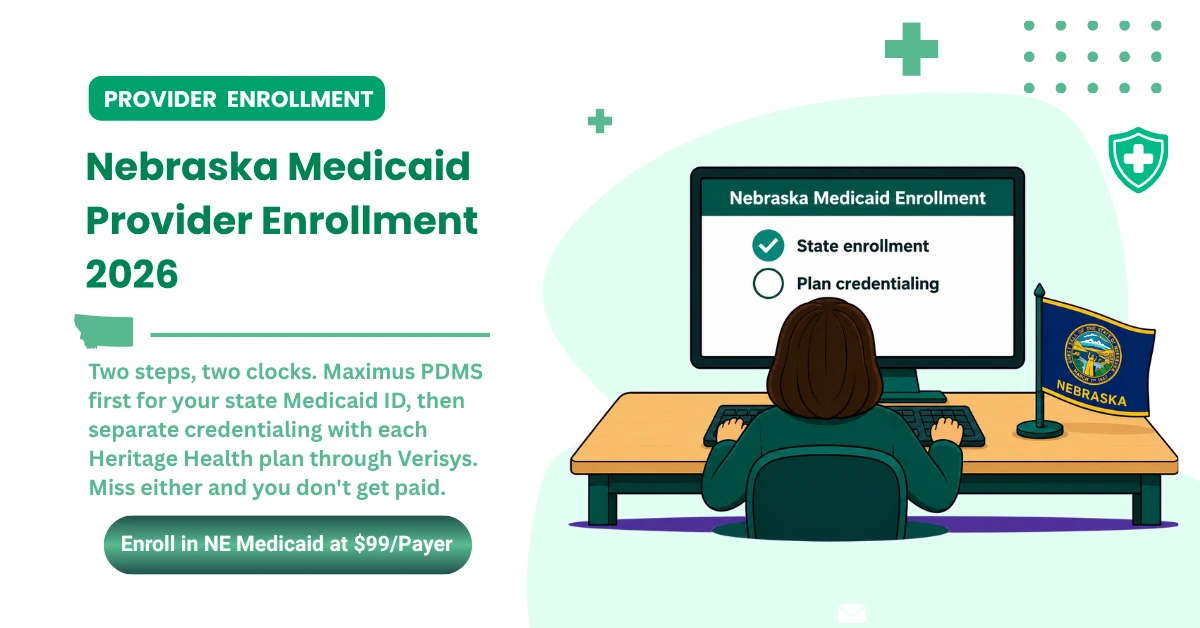
One point trips up more Nebraska providers than any other. State enrollment through Maximus is the first of two required steps, not the only one. A provider who finishes state enrollment but never separately credentials with a Heritage Health managed care organization can't bill for services delivered to that plan's members.
This is confirmed across several sources, including Molina Healthcare of Nebraska's own network page, which states that a provider must already hold an active Nebraska Medicaid ID before Molina's credentialing even begins. State enrollment and managed care credentialing are two separate processes, run through two separate systems, and finishing one doesn't finish the other.
That distinction shapes this entire guide to Nebraska Medicaid provider enrollment. MedSole RCM handles both steps for practices that would rather not track two systems and two clocks at once, which is exactly where MedSole's provider enrollment and credentialing services come in.
Key Takeaways
- Nebraska Medicaid enrollment runs entirely through Maximus's Provider Data Management System, PDMS, and paper applications haven't been accepted since June 1, 2025.
- State enrollment and Heritage Health managed care credentialing are two separate, sequential processes, and a provider has to finish state enrollment before any MCO starts its own review.
- Verisys serves as the centralized credentialing vendor for all three Nebraska Heritage Health managed care organizations, so one verification supports credentialing across all three rather than three separate ones.
- Revalidation with the state is required every five years under federal regulation, and missing that deadline closes the provider agreement entirely.
- Providers enroll separately for each practice location where Medicaid services are delivered to members.
- A missed revalidation isn't a warning or a temporary hold. The agreement closes, and reactivating it means re-screening and, where it applies, paying fees again.
- MedSole RCM handles Nebraska Medicaid provider enrollment and credentialing at $99 per payer, structured below the $200 to $400 per payer industry range.
How to Enroll Through Maximus and the Nebraska Provider Data Management System
Maximus is the enrollment contractor for the Nebraska Department of Health and Human Services. It gathers and screens the information entered into its Provider Data Management System, PDMS, while DHHS's own Provider Relations team reviews each file and gives final approval. That split matters, because vendor screening and state approval are two different events. It's why a completed PDMS submission isn't itself an approval.
The single most important administrative fact here is the June 1, 2025 change. Paper applications are no longer accepted at all. Every enrollment, and every update to an existing agreement, now runs through the PDMS portal electronically. A practice still working from an old paper packet will have that submission rejected outright, not delayed.
Here's the process in the order a provider actually hits it:
- Obtain an NPI first, since PDMS registration requires it.
- Register in the PDMS portal using the same identifiers you intend to bill with, meaning your TIN or SSN, specialty, and provider type.
- Complete and submit the Service Provider Agreement with every required attachment, since an unsigned or incomplete agreement comes back rather than getting processed.
- Undergo screening at the risk level assigned to your provider type, covered in the next section.
- Once approved, receive written confirmation of your effective date and Medicaid provider ID number.
On timeline, it's worth being precise about what's actually known. The portal submission itself is a short, self-service task, usually well under an hour for a straightforward individual enrollment. Total time to active billing status is a different question, and it varies by provider type and risk level. A Limited-risk individual practitioner and a High-risk facility that needs a site visit aren't on comparable timelines. Confirm current processing expectations directly with Maximus or DHHS when you apply, since that number moves with agency volume.
That covers Nebraska Medicaid provider enrollment at the state level. It's the foundation every later step builds on, and on its own it still doesn't make you billable to a single Heritage Health member.
Nebraska Medicaid Enrollment Paths by Provider Type
Enrollment isn't identical across provider types. PDMS is organized around distinct workflows for Individual or Solo Practice, Group, Facility, Pharmacy, and Home and Community-Based Services (HCBS) providers, and HCBS specifically runs through a separate system. A generic walkthrough that doesn't branch by type will be wrong for a real share of providers, so here's what actually changes:
- Individual practitioners enroll with a Type 1 NPI and go through license verification.
- Group and organizational providers need a Type 2 NPI in addition to each rendering provider's own Type 1, plus disclosure of ownership and control interest.
- HCBS and waiver providers use a separate enrollment track, and unlike most other types, they don't have a simple five-year-only revalidation cycle, since HCBS carries additional renewal requirements specific to that program.
One more path catches providers off guard. A provider enrolled provisionally under a temporary license has to close that provisional enrollment and re-enroll immediately once the full license is issued. Reimbursement under the new license status depends on the new enrollment record, so skipping this step leaves claims stranded against an enrollment that no longer matches the provider's actual licensure.
Limited, Moderate, and High Risk: How Nebraska Screens Medicaid Providers
Federal Medicaid rules require screening based on categorical risk level, Limited, Moderate, or High, and when a provider type could plausibly fit more than one category, the highest applicable level governs. That baseline sits in 42 CFR 455.450 risk-level screening, the same federal rule every state Medicaid program screens against.
The three tiers carry real, distinct requirements:
- Limited risk involves state and federal database screening only, with no site visit and no background check.
- Moderate risk adds the possibility of an unannounced pre-enrollment site visit on top of that database screening.
- High risk adds a fingerprint-based criminal background check, for the provider and for any owner holding a five percent or greater direct or indirect ownership interest, on top of the site visit and database screening.
The practical consequence is worth naming. A provider can land in a higher category than expected, because Nebraska Medicaid can raise a provider's assigned risk level based on its own assessment even when CMS's default classification would place them lower. If that happens, expect the fuller screening path regardless of which category you assumed applied.
This section deliberately doesn't state a specific background-check fee or a specific number of days for site-visit scheduling. Those particular figures weren't independently confirmed for this guide, and a provider who needs that exact number should confirm it directly with Maximus at the time of application, rather than trust a figure that may have moved.
Does Nebraska Medicaid Enrollment Have an Application Fee?
CMS sets an annual institutional-provider application fee that applies to certain enrollment, revalidation, and change-of-ownership transactions. This fee is set at the federal level, not by Nebraska individually, so the current amount is the same whether a provider enrolls in Nebraska or any other state's Medicaid program. For calendar year 2026, that fee is $750 for institutional providers, per CMS.
The exemption pattern is a stable structural fact worth knowing. Individual physicians and non-physician practitioners are typically exempt from the fee entirely. It applies primarily to institutional and agency-level providers, along with providers who paid the same fee to Medicare or another state's Medicaid program that year, who submit proof rather than paying twice.
Because the fee updates every year against the Consumer Price Index, don't trust a static number from any blog post, including this one, past its publication year. The current CMS application fee amount is stated directly on the CMS PECOS application fee page, and that's the figure to confirm at the time you apply. A number that's right in 2026 will be wrong the moment CMS sets the 2027 amount.
Documentation Nebraska Medicaid Requires for Provider Enrollment
A clean Nebraska Medicaid provider enrollment file comes down to a short, specific document set. Get these in hand before you open PDMS:
- An active National Provider Identifier, obtained before PDMS registration begins, Type 1 for individuals and Type 2 for group or organizational enrollments.
- An active, verifiable Nebraska license, with any out-of-state licenses disclosed where the provider holds them.
- Ownership and control disclosure for any individual or entity holding five percent or greater interest, since that threshold recurs across both the screening framework and the enrollment paperwork.
- Current malpractice coverage documentation, where it applies to the provider type.
The single most common documentation-driven delay is worth calling out directly. Incomplete or unsigned Service Provider Agreements are returned rather than processed, which means one missing signature or attachment restarts the clock on the whole submission instead of triggering a minor follow-up request. That's the exact reason a pre-submission completeness check earns back the ten minutes it takes.
Practices that hand this documentation review to MedSole RCM get credentialing at $99 per payer, structured below the $200 to $400 per payer industry range, precisely because catching an incomplete Service Provider Agreement before submission is cheaper than restarting the enrollment clock after a rejection.
Nebraska Medicaid Revalidation: What Happens Every Five Years
Federal Medicaid rules require state agencies to revalidate every enrolled provider at least once every five years, regardless of provider type, and Nebraska runs that requirement through Maximus and the PDMS portal rather than a separate standalone process. The five-year rule itself sits in 42 CFR 455.414 revalidation rule.
The notification timeline is generous, but only if your contact details are current. Maximus begins sending revalidation notices as early as 180 days before a provider's due date, using whatever contact information is on file. That's exactly why keeping PDMS contact details current isn't a minor administrative courtesy, it's a direct safeguard against a missed deadline. Once you're in that notice window, expect to log into PDMS, review your existing information for accuracy, make any needed updates, and formally resubmit. Acknowledging the notice isn't the same as completing the revalidation.
The consequence of a missed deadline doesn't soften. A provider agreement that isn't revalidated by its due date closes. This isn't a warning or a temporary hold. The agreement ends, and every payment tied to it, fee-for-service claims, managed care reimbursement, and pharmacy claims alike, stops. Reactivating a closed agreement requires the state to re-screen the provider from that point forward and, where it applies, requires payment of any applicable fees. A missed revalidation is materially more expensive to fix than it would have been to complete on time.
One provider type faces a harder outcome than the rest. Home and Community-Based Services providers generally can't have an agreement reinstated once it closes for missed revalidation. An HCBS provider in that position reapplies from the beginning rather than reactivating, with no retroactive backdating available to bridge the resulting gap. For that group, the 180-day notice window isn't a convenience, it's the whole margin for error.
Credentialing With Heritage Health Managed Care Organizations Through Verisys
Completing state enrollment through Maximus doesn't, by itself, make a provider billable to any Heritage Health managed care organization's members. A separate credentialing process is required with each plan a provider wants to participate in. For the broader picture behind this state-specific walkthrough, MedSole's Medicaid provider enrollment guides cover the national framework.
The centralized vendor has a name. Effective January 1, 2025, Verisys became the Centralized Credentialing Vendor, or CVO, performing primary source verification for all three Nebraska Heritage Health managed care organizations. That verification covers licensure, board certification, education, and identification of adverse actions, including malpractice or negligence findings checked against the National Practitioner Data Bank. Centralization means a provider's underlying credentials are verified once rather than three separate times by three separate plans, a real administrative improvement over the pre-2025 structure.
Here's the nuance competitor content tends to blur. Centralized verification isn't the same as a single combined application. A provider still submits an individual credentialing application to each Heritage Health managed care organization they intend to join, and each plan's own credentialing committee still reviews and approves that application separately. Verisys streamlines the underlying verification work feeding those three applications. It doesn't replace the need to apply to each plan. Our guide for Medicaid credentialing experts walks through that distinction in operational depth.
The re-credentialing clock is its own deadline, separate from state revalidation. The CVO performs re-credentialing on a three-year cycle, shorter than the five-year state revalidation cycle from the previous section. A provider tracking only one of these two dates is exposed on the other, and the two don't line up, so one calendar reminder won't cover both.
The Three Nebraska Heritage Health Plans Providers Must Credential With
Nebraska Medicaid's entire managed care delivery runs through exactly three organizations, so being specific here beats generic "contact your MCO" advice.
UnitedHealthcare Community Plan of Nebraska put the two-step structure in writing. Its own provider bulletin, dated June 18, 2025, confirmed it would deny claims from providers not separately enrolled with the state, which reinforces everything this guide has established about state enrollment coming first.
Molina Healthcare of Nebraska states its prerequisite plainly: a provider must already hold an active Nebraska Medicaid enrollment and Medicaid ID number before Molina's own network-join process begins.
Nebraska Total Care operates under the Centene corporate family, alongside Centene-affiliated Ambetter and WellCare Medicare Advantage products. Its published credentialing page is the most detailed of the three, covering territory-based contracting representatives and a documented re-credentialing cadence, and a provider registers through the plan's dedicated provider portal separately from the Maximus PDMS system.
The practical reality is three clocks, not one. These three credentialing timelines run independently of each other and independently of state enrollment. A provider aiming for full billing access across all three plans should expect three separate applications proceeding on three separate schedules, not one unified process that finishes all at once.
Enrolling Multiple Locations and Requesting a Retroactive Start Date
Two rules come straight from the state's own published FAQ, and both catch multi-location practices off guard.
The per-location rule is direct: providers enroll separately for each practice location where Medicaid services are delivered to members. A single enrollment doesn't automatically cover every site a multi-location practice operates. A location left off the enrollment is a location where that practice can't bill Medicaid, no matter how the provider is enrolled everywhere else.
The retroactive start date rule comes with one hard exception. A provider who wants a retroactive effective date should request it at the time of enrollment itself, not after the fact. Home and Community-Based Services providers are the one category excluded from this option entirely. They can't receive a retroactive start date under any circumstance, which matters specifically for HCBS providers weighing how fast they need to finish enrollment before delivering billable services. For everyone else, the lesson is simpler: ask for the retroactive date up front, because it's far harder to recover once the application is already in.
Why Nebraska Medicaid Claims Get Denied After Enrollment
Three denial and deactivation patterns surface most often after enrollment, and each one has a specific cause and fix.
First, the missed-revalidation pattern. Once a provider agreement closes for a missed revalidation, every claim tied to that agreement stops being reimbursed, fee-for-service, managed care, and pharmacy alike, and it's the ongoing relationship that ends, not just new claims. Reactivation requires re-screening and, where it applies, payment of fees. The cost of catching this before the deadline is always lower than the cost of fixing it after.
Second, a question providers ask directly: can a Nebraska Medicaid provider revalidate a deactivated enrollment number? Yes, but not automatically and not without cost. A deactivated number requires the state to re-screen the provider from that point before any reactivation is granted, and any applicable fees have to be paid before that number goes active again. That's meaningfully different from a routine on-time revalidation, which doesn't trigger re-screening or fees the same way.
Third, the two-step structural failure, distinct from anything state-level. A provider who completes Maximus enrollment but never separately credentials with the relevant Heritage Health plan will see claims for that plan's members denied. Nothing is wrong with the state enrollment. The second, separate step was simply never completed.
The practices most likely to miss one of these are the ones tracking two separate clocks, five-year state revalidation and three-year MCO re-credentialing, by hand across a growing provider roster. MedSole RCM's denial management services track both cycles proactively rather than reactively, and outsourced medical billing at 2.99 percent of collections runs below the 4 to 7 percent industry range for comparable full-service scope, precisely because catching a lapse before it closes an agreement protects revenue a reactive approach can't recover after the fact.
What Changed in Nebraska Medicaid Enrollment for 2026
One 2026 change is well-corroborated and confident to publish: the Nebraska Department of Health and Human Services' Division of Medicaid and Long-Term Care published a new Nebraska Medicaid Provider Manual on January 6, 2026, consolidating coverage policy along with enrollment and billing requirements and procedures for participating providers. A manual that comprehensive is a better single source than any summary of it, so review it directly for the current, complete rule set.
Beyond that confirmed update, it's worth being honest about what this section isn't asserting. Broader Medicaid policy, including any changes to eligibility conditions tied to recent federal legislation, is an active and evolving area nationally. Providers shouldn't rely on any single source, including this one, for the current status of eligibility-related policy without confirming it against DHHS's own current guidance. Eligibility policy tied to recent federal legislative activity was still unsettled enough, when this guide was researched, that specific implementation dates and enrollee-count figures couldn't be independently confirmed, and stating them here with false confidence would do readers a disservice.
The practical, verifiable point holds regardless of the specific policy details. Any period of active eligibility policy change nationally tends to increase eligibility-verification workload and prior-authorization friction for practices serving Medicaid patients, simply because more redeterminations and more documentation requests move through the system at once. That operational reality is exactly where prior authorization services earn their keep, independent of the exact figures still being confirmed.
Frequently Asked Questions About Nebraska Medicaid Provider Enrollment
Do I have to credential with each Managed Care Organization?
Yes. State enrollment through Maximus is only the first step. Providers must separately submit a credentialing application to each Heritage Health managed care organization they want to bill through, UnitedHealthcare Community Plan of Nebraska, Molina Healthcare of Nebraska, and Nebraska Total Care, even though Verisys performs the underlying primary source verification for all three.
Can a Nebraska Medicaid provider revalidate a deactivated enrollment number?
Yes, but reactivation requires the state to re-screen the provider from that point and requires payment of any applicable fees before the number goes active again. It's a materially more involved process than completing revalidation on time.
How do I register for Nebraska Total Care?
A provider must already hold active Nebraska Medicaid enrollment before beginning Nebraska Total Care's own credentialing process, which runs through the plan's dedicated provider portal separately from the Maximus PDMS system used for state enrollment.
How do I get a National Provider Identifier?
An NPI is obtained through the National Plan and Provider Enumeration System before PDMS registration begins, since PDMS requires a valid NPI as part of initial enrollment.
Do providers need to be enrolled for each location they practice at?
Yes. A single enrollment doesn't cover multiple practice sites automatically. Each location delivering Medicaid services requires its own separate enrollment.
What is the difference between enrollment, renewal, and revalidation?
Enrollment is the initial registration for a new provider. Annual screening or renewal applies specifically to Home and Community-Based Services providers on a yearly cycle. Revalidation is the five-year federal requirement that applies to all provider types, confirming the provider's information remains current.
What is the most affordable way to handle Nebraska Medicaid enrollment and credentialing?
MedSole RCM provides provider enrollment and credentialing support at $99 per payer, structured below the $200 to $400 per payer industry range, alongside full-service billing at 2.99 percent of collections, with no setup fees and no long-term contracts.
Why Healthcare Providers Choose MedSole RCM for Nebraska Medicaid Enrollment
By this point the shape of the work is clear: a solo practitioner or group administrator now understands that Nebraska Medicaid provider enrollment isn't one task but a coordinated sequence, state enrollment through Maximus, separate credentialing with each Heritage Health plan, and two distinct revalidation clocks running at five years and three years.
The pricing is straightforward, and it's built for that exact sequence. MedSole RCM provides provider enrollment and credentialing support at $99 per payer, among the most affordable structured credentialing rates in the US market against an industry range of $200 to $400 per payer, with no setup fees. A practice credentialing across all three Nebraska Heritage Health plans plus state enrollment pays a fraction of what a single missed revalidation deadline would cost in lost reimbursement. Full-service medical billing runs at 2.99 percent of collections, below the 4 to 7 percent industry average for comparable scope, with no long-term contracts.
The integration is what makes that credible rather than merely cheap. The same team tracking a provider's five-year state revalidation date is the same team tracking the separate three-year MCO re-credentialing cycle, and the same team handling day-to-day billing. A lapse on any one of these three fronts gets caught by people already watching all three, not by three disconnected vendors each watching only their own piece. For providers who want a clear starting point, MedSole's Nebraska Medicaid revenue cycle management begins with a free enrollment and credentialing review.
Conclusion
Nebraska Medicaid provider enrollment succeeds or fails on one idea: it's genuinely two separate processes, not one. State enrollment through Maximus's Provider Data Management System establishes a provider's foundational eligibility to take part in the program at all. Credentialing with each Heritage Health managed care organization, streamlined through Verisys but still requiring an individual application to each plan, is what actually makes that provider billable to the members enrolled in that specific plan.
Miss either step, or either of the two separate revalidation and re-credentialing clocks that follow, and the result is the same: a provider who believes they're enrolled and isn't actually getting reimbursed. That's the failure this guide is built to prevent.
Providers who want the entire sequence, enrollment, credentialing across all three Nebraska plans, and both revalidation clocks, managed as one coordinated process rather than three separate ones can reach MedSole RCM directly for a free review of their current enrollment and credentialing status.