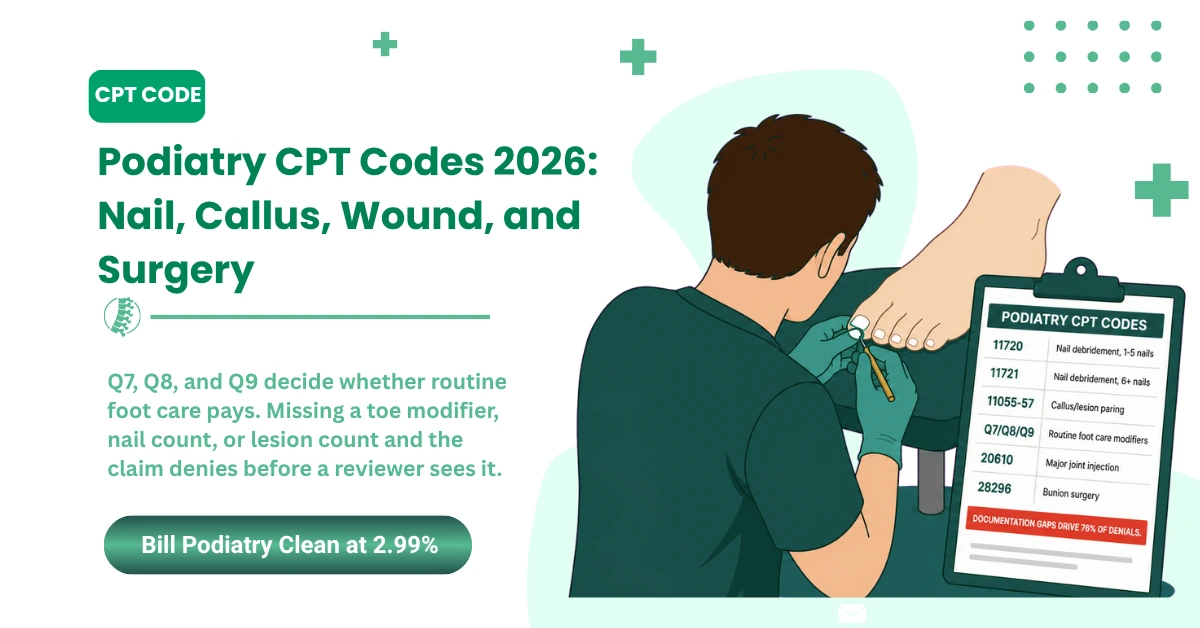




Most podiatry claims fail for one reason: the record doesn't prove why the service should be paid. Your team knows CPT 11721, 11055, 11730, and 28296 cold. The claim still bounces. Somewhere a Q modifier is missing, the medical necessity reads thin, laterality never made it onto the claim, a toe modifier is absent, or the note doesn't match the code billed.
Podiatry CPT codes classify foot, ankle, nail, wound, injection, E/M, and surgical procedures. For billing, the CPT code by itself won't get you paid. The claim also needs an ICD-10 diagnosis that supports medical necessity, the right modifiers, documentation that lines up, and a payer coverage rule that says yes.
Quick answer: Podiatry CPT codes are five-digit procedure codes that report foot, ankle, nail, wound, injection, evaluation and management, and surgical services. For a podiatry claim to be paid, the CPT code has to match the ICD-10 diagnosis, the correct modifier, the clinical documentation, and the payer's coverage rule.
Documentation is where podiatry revenue leaks most. CMS reports that insufficient documentation caused 76.4% of improper payments for podiatric providers in the 2024 reporting period, against an overall podiatry improper payment rate of 11.2% and roughly $216.9 million in projected improper payments (CMS podiatry care guidance). That's a paperwork gap, not a clinical one.
This guide treats podiatry medical billing as a decision process, not a code list. Strong podiatry coding and billing starts with the codes practices bill every day, the modifiers that decide payment, Medicare's routine foot care rules, and the documentation that keeps claims clean. MedSole RCM helps podiatry practices connect coding accuracy to clean claim submission, fewer denials, and steadier cash flow.
Quick Answer: What Are the Most Common Podiatry CPT Codes?
Common podiatry CPT codes fall into a few working groups: nail debridement codes, callus and lesion paring codes, nail avulsion codes, wound debridement codes, E/M office visit codes, injection codes, and foot or toe surgery codes. The right code still has to match the diagnosis, modifier, documentation, and payer coverage rule before the claim gets paid.
|
CPT Code |
Common Use |
Billing Note |
|---|---|---|
|
11720 |
Nail debridement, 1 to 5 nails |
Nail count must match the note |
|
11721 |
Nail debridement, 6 or more nails |
Document all 6+ nails treated |
|
11730 |
Nail plate avulsion, single |
Toe modifier usually required |
|
11750 |
Nail removal with matrix destruction |
Permanent removal; site detail needed |
|
11055 |
Paring or cutting, 1 benign lesion |
Lesion count drives code choice |
|
11056 |
Paring or cutting, 2 to 4 lesions |
Document number and location |
|
11057 |
Paring or cutting, more than 4 lesions |
Higher scrutiny on lesion count |
|
G0127 |
Trimming of dystrophic nails |
Systemic condition support often needed |
|
11042 |
Subcutaneous wound debridement |
Record size, depth, tissue removed |
|
97597 |
Selective wound debridement |
Wound measurements required |
|
20610 |
Major joint or bursa injection |
Site, drug, and laterality on claim |
|
28285 |
Hammertoe correction |
Laterality and toe, operative detail |
|
28296 |
Bunion surgery, distal osteotomy |
Global period and laterality apply |
|
28810 |
Toe and metatarsal amputation |
Operative report drives payment |
|
99213 |
Established patient E/M visit |
Support level with MDM or time |
|
99214 |
Established patient E/M, moderate |
Modifier 25 if same-day procedure |
Correct code selection is only step one. Clean claim submission still depends on modifier accuracy, diagnosis linkage, and payer rules getting checked before the claim leaves your system. MedSole RCM scrubs those elements on podiatry claims so a technically correct code doesn't stall over a missing modifier or a weak diagnosis.
How Podiatry CPT Codes Work With ICD-10, HCPCS, and Modifiers
A payable podiatry claim depends on five elements matching: the CPT code, the ICD-10 diagnosis, any modifier, the documentation, and the payer coverage rule. Miss one and the claim can deny even when the CPT code is correct.
The CPT code names what you did. The ICD-10 code explains why it was medically necessary. HCPCS Level II may apply when you bill supplies, orthotics, or drugs that CPT doesn't cover. Modifiers add location, laterality, clinical risk, and payer context. Documentation ties all of it together and proves the payer should reimburse.
|
Claim Element |
What It Proves |
Podiatry Example |
|---|---|---|
|
CPT |
What was done |
11721 for debridement of 6 or more nails |
|
ICD-10 |
Why it was done |
Diabetes, ulcer, mycotic nail, pain, deformity |
|
HCPCS |
Supply or non-CPT item |
Orthotic or certain supply-related billing |
|
Modifier |
How, where, or why |
Q7, Q8, Q9, LT, RT, T modifiers, 25 |
|
Documentation |
Why the payer should pay |
Class findings, lesion count, wound size, MDM |
CPT changes every January, so podiatry coding and billing teams watch the annual update. The AMA released 288 new codes for 2026 across 418 total changes, with updates for remote monitoring, AI-assisted services, and a full rebuild of lower extremity revascularization (AMA CPT 2026 code set).
These pieces don't live in separate departments. CPT, ICD-10, modifiers, documentation, payment posting, denials, and AR are connected stages of the same cycle. When a practice treats them that way, fewer claims break. Revenue cycle management services exist to keep those stages talking to each other so a coding gap doesn't quietly turn into an aging claim.
Routine Foot Care, Nail, Callus, and Lesion CPT Codes
Routine nail and callus services are the highest-volume CPT codes for podiatry practices, and Medicare watches them closely. The service can look routine on paper unless the record supports a qualifying systemic condition, medical necessity, or class findings. That gap is where these claims tend to fail.
Nail Debridement and Nail Procedure Codes
|
CPT Code |
Description |
|---|---|
|
11720 |
Debridement of nails, 1 to 5 |
|
11721 |
Debridement of nails, 6 or more |
|
11730 |
Nail plate avulsion, single |
|
11732 |
Nail plate avulsion, each additional nail |
|
11750 |
Nail removal with matrix destruction |
|
11755 |
Nail unit biopsy |
|
G0127 |
Trimming of dystrophic nails |
Callus, Corn, and Benign Lesion Codes
|
CPT Code |
Description |
|---|---|
|
11055 |
Paring or cutting, 1 benign hyperkeratotic lesion |
|
11056 |
Paring or cutting, 2 to 4 lesions |
|
11057 |
Paring or cutting, more than 4 lesions |
|
17110 |
Destruction of benign lesions, up to 14 |
|
17111 |
Destruction of benign lesions, 15 or more |
Where These Claims Break, and How to Prevent It
|
Code |
Use Case |
Modifier / Documentation Risk |
Common Denial Trigger |
|---|---|---|---|
|
11720 |
1 to 5 nails debrided |
Q modifier plus nail count |
Count doesn't match the note |
|
11721 |
6+ nails debrided |
Document each of the 6+ nails |
Incomplete nail documentation |
|
11730 |
Single nail avulsion |
Toe modifier (TA, T1 to T9) |
Treated digit not identified |
|
11750 |
Matrix removal |
Site detail, laterality |
Missing laterality or site |
|
11055 |
1 lesion pared |
Lesion count and location |
Lesion count unsupported |
|
11056 |
2 to 4 lesions |
Exact number documented |
Code and count mismatch |
|
11057 |
More than 4 lesions |
Number and site detail |
Upcoded lesion count |
|
G0127 |
Dystrophic nail trimming |
Systemic condition support |
Weak medical necessity |
CMS treats cutting or removing corns and calluses, and trimming, cutting, clipping, or debriding nails, as routine foot care that Medicare generally excludes. Coverage may apply when the service is a necessary and integral part of otherwise covered care, or when a systemic condition creates enough risk that a professional has to perform it. The record has to show that reason (CMS podiatry care guidance).
A wrong nail count, a missing modifier, or thin documentation can hold up payment even when the clinical work was appropriate. When routine care claims keep coming back for those reasons, MedSole's medical billing services help pinpoint where the claim breaks before it reaches AR.
Podiatry Modifiers That Decide Whether Claims Get Paid
Podiatry modifiers tell the payer why, where, or how a service was performed. For routine foot care, Q modifiers show systemic risk. For procedures, laterality and toe modifiers pin down the exact foot or digit. For a same-day E/M and procedure, Modifier 25 shows the visit was significant and separately identifiable from the procedure.
Q Modifiers for Podiatry: Q7, Q8, and Q9
|
Modifier |
Required Finding |
What It Means for Billing |
|---|---|---|
|
Q7 |
One Class A finding |
Supports routine foot care coverage when documented |
|
Q8 |
Two Class B findings |
Supports systemic-condition risk when documented |
|
Q9 |
One Class B and two Class C findings |
Supports qualifying risk when documented |
Q7, Q8, and Q9 modifiers support Medicare routine foot care billing when the medical record documents qualifying class findings tied to a systemic condition. CMS lists the class findings and states that the presumption of coverage may apply with one Class A finding, two Class B findings, or one Class B and two Class C findings (CMS routine foot care billing article). A claim billed without the right Q modifier, when the coverage rests on a systemic condition, often denies at adjudication. If you want the plain-English version of the q9 modifier description, it means one Class B finding plus two Class C findings are documented.
Laterality Modifiers: LT, RT, and 50
LT marks the left side. RT marks the right side. Modifier 50 reports a bilateral service when payer rules allow it. Leave laterality off a procedure claim and the payer may reject it, request records, or deny outright. Bilateral nail and lesion work loses reimbursement fast when the sides aren't identified.
Toe and Digit Modifiers
Toe modifiers identify the exact digit treated, which matters for nail avulsions, matrix removals, and toe-specific procedures. Use this toe modifier chart as a quick reference:
|
Modifier |
Toe (Left Foot) |
Modifier |
Toe (Right Foot) |
|---|---|---|---|
|
TA |
Great toe |
T5 |
Great toe |
|
T1 |
Second toe |
T6 |
Second toe |
|
T2 |
Third toe |
T7 |
Third toe |
|
T3 |
Fourth toe |
T8 |
Fourth toe |
|
T4 |
Fifth toe |
T9 |
Fifth toe |
Modifier 25 for Same-Day E/M and Procedures
Append Modifier 25 only when the E/M service is significant and separately identifiable from the procedure done that day. CMS guidance for routine foot care codes states that an E/M service on the same day as routine foot care isn't eligible for reimbursement unless it's significant, separately identifiable, marked with Modifier 25, and backed by the medical record. The note should show a separate problem, exam, and medical decision-making beyond the procedure.
Modifier 59 and XS for Distinct Procedures
Modifier 59 and the more specific XS report a distinct procedural service, usually a different anatomic site or a separate procedure. Use them only when the record supports the distinction and payer policy allows it. They aren't bypass modifiers for bundling edits, and payers scrutinize both.
Modifier problems rarely travel alone. They usually point back to front-end coverage checks, documentation templates, or claim-scrubbing gaps. Confirming coverage and modifier rules before submission starts with eligibility verification, which catches many of these issues before the claim is ever built.
Medicare Podiatry Billing Guidelines for Routine Foot Care
Medicare generally doesn't cover routine foot care when it's only hygienic or preventive. Coverage may open up when a systemic condition, ulcer, wound, infection, mycotic nail criteria, or another covered exception makes professional podiatry care medically necessary. The billing record has to show why the service isn't routine maintenance. These Medicare podiatry billing guidelines carry real audit weight, so the documentation matters as much as the code.
What Medicare Usually Treats as Routine Foot Care
CMS lists these as routine foot care that Medicare generally excludes:
- Cutting or removing corns and calluses
- Trimming, cutting, clipping, or debriding nails
- Cleaning, soaking, skin creams, and preventive maintenance
- Care in the absence of localized illness, injury, or symptoms
When Routine Foot Care May Be Covered
Coverage may apply when the service qualifies as an exception:
- It's a necessary and integral part of an otherwise covered service
- Ulcers, wounds, or infections are being treated
- A systemic condition such as metabolic, neurologic, or peripheral vascular disease is present
- There's severe circulatory compromise or diminished sensation
- Mycotic nail criteria are met and documented
Why Class Findings Matter
Class findings support medical necessity and drive Q modifier selection. Document them precisely:
|
Finding Type |
Examples |
|---|---|
|
Class A |
Non-traumatic amputation of the foot or an integral skeletal portion |
|
Class B |
Absent posterior tibial pulse, advanced trophic changes, absent dorsalis pedis pulse |
|
Class C |
Claudication, temperature changes, edema, paresthesias, burning |
CMS lists routine foot care exclusions and the systemic-condition exceptions in its podiatry compliance guidance (CMS podiatry care guidance). Coverage and frequency can also vary by MAC, so check your jurisdiction's local coverage rules.
Medicare Documentation Checklist
- CPT code that matches the service
- ICD-10 diagnosis supporting medical necessity
- Q modifier when coverage rests on a systemic condition
- LT, RT, or toe modifier as required
- Documented class findings and systemic condition
- Date last seen by the managing physician where required, plus that physician's NPI
- Nail, lesion, or wound count, and wound size and depth if applicable
Diabetic patients add another layer. For a covered diabetic foot exam CPT scenario, the record should show the diabetes diagnosis, loss of protective sensation, and the exam findings that support it. The CPT code for diabetic foot exam sits in the G-code range covered later in this guide, and payment still depends on that documentation.
Documentation Requirements That Support Podiatry CPT Codes
A correct CPT code can still deny when the chart doesn't support the service. That's the core risk in podiatry billing. CMS reports that insufficient documentation accounted for 76.4% of improper payments for podiatric providers in the 2024 reporting period, which makes documentation the single highest-yield fix for most practices.
Solid podiatry documentation shows what was done, why it was medically necessary, where it was performed, how many nails or lesions were treated, which foot or toe was involved, and which payer rule supports coverage. Podiatry billing codes only get paid when the note carries that weight.
|
Documentation Area |
What to Include |
Claims It Protects |
|---|---|---|
|
Diagnosis linkage |
ICD-10 code that supports the service |
Routine foot care, wound, diabetic foot |
|
Laterality |
Right, left, bilateral, specific toe |
Surgery, nail avulsion, lesion care |
|
Nail count |
1 to 5, or 6 or more nails |
11720, 11721 |
|
Lesion count |
1, 2 to 4, or more than 4 |
11055, 11056, 11057 |
|
Class findings |
Class A, B, C signs |
Q7, Q8, Q9 |
|
Wound details |
Length, width, depth, tissue removed |
11042, 97597 |
|
E/M support |
MDM or time, separate complaint |
99213, 99214 with Modifier 25 |
|
Procedure detail |
Site, method, implant, fixation |
28285, 28296, 28810 |
|
Frequency support |
Last service date, need for repeat |
11721, 11730 |
|
Payer rule |
MAC or commercial payer policy |
All high-risk services |
Build that documentation before the claim goes out, not after a denial arrives. Podiatry medical billing runs cleaner when the chart is already audit-ready at submission. When documentation gaps have already turned into denials, MedSole's denial management services help find the root cause, correct the appeal path, and stop the same issue from repeating.
Wound Care, Diabetic Foot, Injection, E/M, and Surgical Podiatry CPT Codes
Routine foot care is only part of the billing reality. Podiatry practices also bill wounds, diabetic foot care, injections, office visits, and surgery. These podiatrist CPT codes each carry their own documentation and payer rules, and covering the full range keeps a claim from stalling because one service type was coded like another.
Wound Care and Diabetic Foot CPT Codes
|
CPT / HCPCS |
What to Explain |
|---|---|
|
11042 |
Debridement of subcutaneous tissue, first 20 sq cm |
|
11045 |
Add-on for each additional 20 sq cm |
|
97597 |
Selective wound debridement, first 20 sq cm |
|
97598 |
Add-on for each additional 20 sq cm |
|
G0245 |
Initial E/M of a diabetic patient with LOPS |
|
G0246 |
Follow-up E/M of a diabetic patient with LOPS |
|
G0247 |
Routine foot care of a diabetic patient with LOPS |
Wound coding depends on wound size, depth, tissue type removed, diagnosis support, and medical necessity. For diabetic patients, the diabetic foot exam CPT options in the G-code range hinge on documented loss of protective sensation. The CPT code for diabetic foot exam usually lands on G0245 or G0246, and both need the diabetes diagnosis and exam findings on record.
Injection Codes Used in Podiatry
|
CPT Code |
What to Explain |
|---|---|
|
20550 |
Injection into tendon sheath, ligament, or fascia |
|
20551 |
Injection at tendon origin or insertion |
|
20600 |
Small joint or bursa injection |
|
20610 |
Major joint or bursa injection |
|
20611 |
Major joint injection with ultrasound guidance |
Injection claims need the anatomical site, laterality, medication name, NDC when required, dosage, route, and separate E/M support when Modifier 25 is used. A missing NDC or a bundled E/M is a frequent reason these claims deny.
E/M Codes Commonly Used by Podiatrists
|
CPT Code |
Use Case |
|---|---|
|
99202 to 99205 |
New patient office visits |
|
99212 to 99215 |
Established patient office visits |
|
99213 |
Common established patient visit |
|
99214 |
Moderate-complexity established patient visit |
Since E/M level rests on medical decision-making or time, the note has to justify the level billed. Podiatrists can bill 99213 or 99214, and can pair an E/M with a same-day procedure when the E/M is separately identifiable and Modifier 25 is documented.
Surgical Podiatry CPT Codes
|
CPT Code |
What to Explain |
|---|---|
|
28285 |
Hammertoe correction (CPT code hammertoe correction) |
|
28289 |
Hallux rigidus correction with cheilectomy (cheilectomy CPT code) |
|
28296 |
Bunionectomy with distal metatarsal osteotomy |
|
28297 |
Lapidus-type bunion correction |
|
28810 |
Toe and metatarsal amputation (CPT code for toe amputation) |
|
28820 |
Toe amputation at the metatarsophalangeal joint |
|
28825 |
Toe amputation at the interphalangeal joint |
|
28750 |
Great toe arthrodesis |
Surgical podiatry billing depends on operative report detail, laterality, the toe or anatomic site, pre-op and post-op diagnosis, the global period, and NCCI review. Many procedures also need prior authorization when the payer requires it.
Two front-end issues sink high-value surgical claims: a missing approval and an uncredentialed provider. Claims for a provider who isn't yet enrolled with the payer deny regardless of coding. Securing approvals ahead of the date of service is what prior authorization support is built to handle, so your claims aren't denied for a missing auth.
|
Category |
Codes |
Documentation Priority |
Denial Risk |
|---|---|---|---|
|
Wound care |
11042, 11045, 97597, 97598 |
Wound size, depth, tissue removed |
Missing wound measurements |
|
Diabetic foot |
G0245, G0246, G0247 |
LOPS, diabetes status, exam findings |
Weak medical necessity |
|
Injections |
20550, 20600, 20610, 20611 |
Site, drug, NDC, laterality |
Missing NDC or bundled E/M |
|
E/M |
99202 to 99215 |
MDM or time |
Unsupported level |
|
Surgery |
28285, 28296, 28810, 28820 |
Operative detail, laterality, global period |
Missing operative support |
2026 Podiatry Billing Updates Providers Should Know
Most high-volume podiatry codes stay familiar in 2026. The bigger shifts land on the reimbursement environment around them: documentation pressure, remote monitoring, revascularization, skin substitutes, and payment modeling. Treat 2026 as a year of tighter enforcement more than a year of new podiatry codes. The codes for nail and callus care look much the same, so the payer-side changes are where practices should focus.
CPT 2026 Code Set Changes
The AMA confirms the CPT 2026 code set adds 288 new codes across 418 total changes, and highlights a comprehensive lower extremity revascularization rebuild that deletes older codes and replaces them with a redesigned set (AMA CPT 2026 code set). For podiatry, the point isn't that every routine foot care code changed. Practices should watch adjacent areas like remote monitoring, revascularization, wound care, and payer-specific documentation.
2026 Medicare Physician Fee Schedule Impact
CMS finalized two conversion factors for CY 2026, one for qualifying APM participants and one for non-qualifying clinicians, plus a one-year statutory increase and a negative 2.5% efficiency adjustment for many non-time-based services (CMS 2026 Physician Fee Schedule). A podiatry practice shouldn't assume revenue rose evenly across all services. RCM teams should compare allowed amounts, payer contracts, and posted payments against 2025.
Skin Substitute Payment Changes
For CY 2026, CMS finalized paying for skin substitute products as incident-to supplies when used as part of a covered application procedure, at a single national per-square-centimeter rate. That matters for podiatry practices doing diabetic wound care. Verify product coding, applied quantity, documentation, and payer policy, then confirm payment on posting.
Remote Monitoring and Lower Extremity Revascularization
Remote physiologic monitoring changes, including shorter data-collection periods, may fit high-risk diabetic patients depending on services offered and payer coverage. Lower extremity revascularization changes matter if the practice coordinates with vascular services. These updates don't apply to every podiatry office, so map them to your own service mix. For practices adding monitoring, remote patient monitoring billing has its own documentation and coverage rules worth reviewing.
The 2026 Compliance Reality
The main 2026 issue for podiatry billing isn't new codes. It's stricter documentation review, payer automation, modifier scrutiny, and medical necessity validation. Practices that tighten documentation and modifier checks now protect revenue before payers escalate review. These podiatry billing guidelines and Medicare podiatry billing guidelines reward practices that keep their charts audit-ready, and podiatry billing and coding runs cleaner when that discipline is already in place.
Common Podiatry CPT Code Denials and How to Prevent Them
Podiatry denials usually don't come from one wrong code. They come from a mismatch between the code, diagnosis, modifier, documentation, frequency rule, and payer policy. That's why the same CPT code can pay for one patient and deny for another. The fix is catching the mismatch before submission, not after.
Citation-ready summary: Podiatry CPT code denials commonly happen when the claim is missing a Q modifier, a laterality modifier, a toe modifier, diagnosis linkage, a lesion count, a nail count, frequency support, or documentation proving medical necessity.
|
Denial Trigger |
Example |
Why It Happens |
Prevention Step |
|---|---|---|---|
|
Missing Q modifier |
11721 denied |
Routine foot care risk not supported |
Validate Q7, Q8, or Q9 against class findings |
|
Missing ICD-10 support |
Nail care denied |
Diagnosis doesn't prove necessity |
Link CPT to a qualifying diagnosis |
|
Wrong nail count |
11720 vs 11721 |
Note doesn't match the code |
Document exact nail count |
|
Wrong lesion count |
11055 vs 11056 vs 11057 |
Lesion count doesn't match CPT |
Document number and location |
|
Missing laterality |
28296 denied |
LT or RT not reported |
Add laterality to note and claim |
|
Missing toe modifier |
11730 denied |
Treated digit not identified |
Use TA or T1 to T9 |
|
Unsupported Modifier 25 |
99213 denied |
E/M not separately identifiable |
Document separate complaint, exam, MDM |
|
Frequency limit issue |
11721 denied (11730 frequency limit rules) |
Service billed too soon |
Track the last date of service |
|
Weak wound documentation |
11042 denied |
Size or depth missing |
Record length, width, depth, tissue |
|
Global period issue |
Post-op E/M denied |
Service included in the global package |
Check global period and unrelated-service rules |
|
Skin substitute documentation |
Wound claim denied |
Product, size, or area unclear |
Verify product coding, size, payer policy |
|
Underpayment |
Paid below expected |
Contract or fee schedule mismatch |
Compare allowed amount on posting |
Federal auditors have put podiatry billing on notice. The OIG found that 44 of 100 sampled podiatry claims for E/M services billed with Modifier 25 didn't comply with Medicare requirements (OIG modifier 25 audit), and a separate audit found 49 of 100 sampled routine foot care claims didn't comply (OIG routine foot care audit). The APMA has cautioned that these findings rest on 2019 data and shouldn't be read as a picture of current practice (APMA statement), while still treating them as a reason for stronger documentation and internal review.
Modifier 25 Denials
Modifier 25 isn't automatic. It needs a significant, separately identifiable E/M, and the note should show a separate problem, assessment, or medical decision-making beyond the procedure. Don't append it only to clear a bundling edit. Payers flag practices that use it on a high share of procedure claims.
Routine Foot Care Denials
Nail and callus services carry the most risk. The Q modifier has to match documented class findings, medical necessity has to be clear, and the systemic condition has to be on record. Depending on the payer or MAC rule, the last-seen date by the managing physician may also be required.
Documentation Denials
Missing lesion count, missing nail count, missing wound size, missing tissue depth, missing laterality, missing toe location, and thin operative reports each drive denials. Every one of these fields is small to capture at the visit and expensive to fix after a denial.
Underpayments and AR Issues
Some claims pay but underpay. Payment posting should compare the expected allowed amount against what actually landed, and AR follow-up should separate coding denials, medical necessity denials, payer delays, and underpayments. MedSole's payment posting services flag underpayments on posting, and AR follow-up services chase aged claims by root cause instead of treating AR as one undifferentiated pile.
How MedSole RCM Helps Podiatry Practices Submit Cleaner Claims
For podiatry practices, clean billing starts before the claim goes out. MedSole RCM reviews the front-end, coding, modifier, documentation, claim submission, denial, payment posting, and AR follow-up workflow so recurring podiatry billing issues stop turning into lost revenue. That connected approach is what separates full-service podiatry medical billing services from a vendor that only touches one stage.
|
RCM Stage |
What MedSole Checks |
Podiatry Issue It Prevents |
|---|---|---|
|
Eligibility verification |
Coverage, benefits, payer rules |
Non-covered routine foot care |
|
Prior authorization |
Surgery, injections, wound care approvals |
Authorization-related denial |
|
Coding review |
CPT, ICD-10, HCPCS |
Wrong code or weak diagnosis linkage |
|
Modifier review |
Q7, Q8, Q9, LT, RT, T modifiers, 25 |
Missing or unsupported modifier |
|
Documentation review |
Class findings, lesion count, wound size, MDM |
Medical necessity denial |
|
Claim submission |
Clean formatting and payer rules |
Front-end rejection |
|
Payment posting |
ERA, EOB, allowed amount, adjustments |
Underpayment missed |
|
Denial management |
Root-cause review and appeal path |
Repeat denials |
|
AR follow-up |
Aging claims and payer escalation |
Revenue stuck in AR |
|
Reporting |
KPIs, denial trends, collections |
No visibility into leakage |
Front-End Checks Before the Claim
Verify eligibility, check the Medicare or payer policy, confirm authorization when a procedure needs it, and confirm patient responsibility. Most downstream podiatry denials trace back to a front-end miss that a quick check would have caught. This is the quiet difference in strong podiatry practice billing.
Coding and Modifier Review
Match CPT to ICD-10, validate the Q modifiers, confirm LT, RT, and toe modifiers, review Modifier 25 support, and check frequency logic. Medical billing for podiatry lives and dies on these details, and a second set of trained eyes before submission prevents the denials covered earlier in this guide.
Denial Prevention and AR Follow-Up
Group denials by cause, build appeal packets with the supporting documentation attached, and fix repeat patterns upstream so the same denial doesn't return. AR isn't just calling the payer; it's working aged claims by reason. That's what dependable podiatry billing support looks like day to day.
Transparent Podiatry Billing and Credentialing Pricing
Pricing shouldn't be a mystery. MedSole RCM runs podiatry medical billing services at 2.99% of collections and podiatry credentialing at $99 per insurance, with no setup fees and no long-term contract. Billing for podiatrist practices stays predictable because you pay on what's collected, and credentialing is a flat fee per payer rather than a moving target.
|
Service |
MedSole RCM |
Typical Industry Range |
|---|---|---|
|
Podiatry medical billing |
2.99% of collections |
4% to 10% of collections |
|
Provider credentialing |
$99 per insurance |
$150 to $300 per payer |
|
Clean claim rate |
99% |
85% to 92% |
|
Contract terms |
Month to month |
Annual contracts common |
|
Setup fees |
None |
Varies by vendor |
Credentialing sits underneath every clean claim, because a provider who isn't enrolled with a payer can't bill it. Medical billing for podiatrists works best when credentialing and billing sit with one team. MedSole RCM has credentialed more than 4,000 providers across all 50 states with a 99% first-time approval rate, covering Medicare, Medicaid, and major commercial plans. Podiatry credentialing services handle CAQH setup, application submission, and follow-up so a new associate starts billing in-network sooner.
Podiatry has specialty-specific coding and documentation risks that general billing teams aren't trained for, which is why specialty-specific billing matters here. MedSole RCM turns CPT accuracy, modifier validation, documentation review, denial prevention, and AR follow-up into one connected workflow through its outsourced medical billing services.
Podiatry CPT Codes Cheat Sheet for Billing Teams
Use this quick-reference checklist before submitting podiatry claims. It isn't a substitute for payer policy, but it helps billing teams catch the most common code, modifier, documentation, and frequency issues before claims reach the payer. Keep it near the desk as a working podiatry billing cheat sheet, or save a podiatry billing cheat sheet pdf your team can pull up during charge entry.
|
Billing Area |
Check Before Submission |
|---|---|
|
Nail debridement |
Confirm 11720 vs 11721 based on nail count |
|
Callus or corn care |
Confirm 11055 vs 11056 vs 11057 by lesion count |
|
Routine foot care |
Confirm systemic condition, class findings, Q modifier |
|
Toe procedures |
Add TA or T1 to T9 when required |
|
Laterality |
Add LT, RT, or 50 when payer rules require |
|
Wound care |
Record wound size, depth, tissue, debridement level |
|
Diabetic foot care |
Confirm diabetes status, LOPS, neuropathy, vascular findings |
|
Injections |
Document site, drug, NDC, dosage, separate E/M support |
|
E/M with procedure |
Use Modifier 25 only when separately identifiable |
|
Surgery |
Check operative report, global period, bundling, auth |
|
Payment review |
Compare allowed amount to expected payment |
|
Denial follow-up |
Track root cause, not only claim status |
Need a billing team to apply this checklist across real claims, payer rules, denials, and AR? MedSole RCM helps podiatry practices build a repeatable claim review workflow so podiatry billing support isn't stretched across an overloaded front desk. Reliable podiatry practice billing comes from running these checks the same way, every claim, every time.
FAQs About Podiatry CPT Codes and Billing
What are podiatry CPT codes?
Podiatry CPT codes are five-digit procedure codes used to report foot, ankle, nail, wound, injection, E/M, and surgical services. For billing, the CPT code has to match the diagnosis, modifier, documentation, and payer coverage rule before reimbursement is likely.
What are the most common podiatry CPT codes?
Common CPT codes for podiatry include 11720 and 11721 for nail debridement, 11055 to 11057 for callus or corn paring, 11730 and 11750 for nail procedures, 11042 and 97597 for wound debridement, 20610 for joint injections, 28285 and 28296 for surgery, and 99213 or 99214 for E/M visits.
What is CPT 11721 used for?
The 11721 CPT code covers debridement of six or more nails. For Medicare routine foot care, payment often depends on medical necessity, diagnosis support, Q modifier use, and documentation of qualifying findings for each of the nails treated.
What is the difference between CPT 11720 and 11721?
CPT 11720 covers debridement of 1 to 5 nails. CPT 11721 covers debridement of 6 or more nails. The documentation should clearly show the number of nails treated so the code and the note agree.
What is the difference between 11055, 11056, and 11057?
CPT 11055 is for one benign hyperkeratotic lesion. CPT 11056 is for two to four lesions. CPT 11057 is for more than four lesions. The record should list the lesion count and location to support the code billed.
What are Q modifiers for podiatry?
Q modifiers for podiatry include Q7, Q8, and Q9. They support Medicare routine foot care claims when class findings show risk from a qualifying systemic condition. The modifier has to match the findings documented in the medical record.
What toe modifiers are used in podiatry billing?
Toe modifiers include TA and T1 through T9. TA covers the left great toe and T5 covers the right great toe, with the rest mapping to each digit. They identify the exact toe treated for nail, toe, and digit-specific procedures.
Does Medicare cover routine foot care?
Medicare generally excludes routine hygienic foot care. Coverage may apply when a qualifying condition, ulcer, wound, infection, mycotic nail criteria, or systemic risk makes professional care medically necessary. Documentation and the specific payer or MAC rule control the outcome.
Can podiatrists bill an E/M code with a procedure?
Yes, but only when the E/M service is significant and separately identifiable from the procedure. Modifier 25 may be required, and the note should support a separate complaint, assessment, or medical decision-making beyond the procedure itself.
Why do podiatry CPT code claims deny?
Podiatry claims often deny for missing Q modifiers, weak diagnosis linkage, unsupported Modifier 25, missing toe or laterality modifiers, incomplete documentation, wrong nail or lesion counts, frequency issues, or a payer policy mismatch. Most are preventable with pre-submission checks.
How much does podiatry medical billing cost?
MedSole RCM prices podiatry medical billing at 2.99% of collections, with no setup fees and no long-term contract. Most billing companies charge 4% to 10%. The rate covers eligibility, coding review, claim submission, payment posting, denial management, and AR follow-up.
How much does podiatry credentialing cost?
MedSole RCM credentials podiatry providers at $99 per insurance, while many credentialing companies charge $150 to $300 per payer. The fee covers CAQH setup, application submission, follow-up, and status tracking with Medicare, Medicaid, and major commercial plans across all 50 states.
What is the best podiatry billing and credentialing company?
The best fit depends on your payer mix, claim volume, and how much documentation support you need. Practices that want transparent, percentage-based pricing often choose MedSole RCM, which runs podiatry billing at 2.99% and credentialing at $99 per insurance, has credentialed more than 4,000 providers across all 50 states, and maintains a 99% clean claim rate.
Should a podiatry practice outsource medical billing?
A podiatry practice may benefit from outsourcing when claim denials, AR delays, modifier errors, payment posting gaps, and payer follow-up consume too much staff time. A full RCM partner can manage coding review, claim submission, denial management, payment posting, and AR follow-up under one team.
Final Takeaway: Podiatry CPT Codes Are Only One Part of Getting Paid
Correct CPT coding matters. It also doesn't guarantee payment on its own. Podiatry practices lose revenue when the claim fails to connect the CPT code to the right diagnosis, modifier, documentation, frequency rule, payer policy, and follow-up workflow.
Podiatry CPT codes are the starting point, not the finish line. A stronger RCM process catches the gaps, missing modifiers, thin documentation, frequency misses, and underpayments, before they become denials, write-offs, or aging AR. That's the difference between billing a code and collecting on it.
If podiatry CPT coding, modifier validation, documentation gaps, denials, or AR follow-up are slowing your payments, MedSole RCM's outsourced billing support can help your practice build a cleaner claim-to-payment workflow, with billing at 2.99% of collections and credentialing at $99 per insurance.