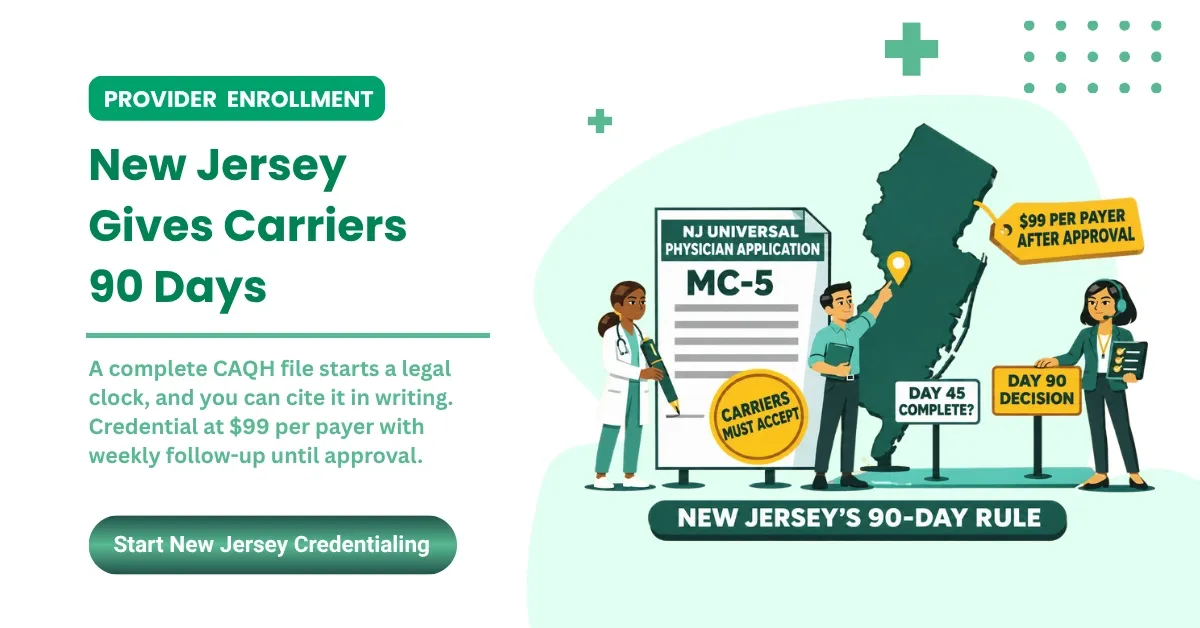




Insurance credentialing in New Jersey means earning a separate approval from each commercial carrier, from Medicare, and from every NJ FamilyCare health plan your patients use. Two state rules set New Jersey apart: under N.J.A.C. 11:24C-1.3, carriers get 90 days to finish a complete CAQH application, and physicians can use the state's universal application instead of a carrier's own form.
You'll get the most from this guide if you manage a practice opening in New Jersey, run a group adding clinicians, or treat New Jersey patients by telehealth from another state. We cover the state's health plan credentialing rules, the documents payers check during provider credentialing, the payer list, real timelines, and the 2027 changes.
We're MedSole RCM, a full revenue cycle company. Our credentialing team builds New Jersey payer files every week, and this guide holds what we'd tell a practice manager who called asking where to start. Every rule below links to its official source, so you can check our work.
|
Key Takeaways: Insurance Credentialing in New Jersey
|
What Insurance Credentialing in New Jersey Covers
Insurance credentialing in New Jersey is the process a payer uses to check your license, training, work history, malpractice coverage, and registrations against primary sources before admitting you to its network. Approval alone doesn't let you bill. Your signed contract and its effective date decide when in-network claims start paying.
Credentialing, Enrollment, and Contracting Are Separate Steps
Practices use "health insurance credentialing" as one label for three different jobs. In medical insurance credentialing, each job has its own owner, its own paperwork, and its own finish line:
- Credentialing: the payer verifies your qualifications with the original sources, a step called primary source verification.
- Enrollment: the payer loads you into its systems so claims under your NPI stop rejecting.
- Contracting: you sign the participation agreement, which sets your rates and your effective date.
Picture a provider who gets an approval email on March 3 and starts seeing that carrier's patients the next morning. The contract lists an effective date of March 24. Three weeks of claims deny, and the practice spends the next month appealing visits it could have scheduled later.
CAQH sits underneath all three steps. It stores your data, but it applies to nobody on your behalf, and each payer needs your authorization before it can pull the profile. For provider enrollment credentialing across several payers at once, a clean CAQH profile saves weeks of back and forth.
The Three Tracks Most New Jersey Practices Run at Once
Credentialing for providers in New Jersey moves on three tracks, and each one has its own regulator, its own portal, and its own clock:
- Commercial and marketplace carriers: regulated by the New Jersey Department of Banking and Insurance (DOBI), which sets the state credentialing deadlines covered in the next section.
- Medicare: federal enrollment through PECOS, the CMS online enrollment system.
- NJ FamilyCare (Medicaid): enrollment through NJMMIS first, then credentialing with each managed care plan.
Commercial and Medicaid products credential separately in New Jersey, even within one company. Horizon BCBSNJ and Horizon NJ Health are the clearest example, so a practice that wants both the commercial and the Medicaid network should plan on two files and two contracts.
Filing all three tracks in parallel saves the most calendar time. It's also where files stall, because each track needs its own follow-up and nobody at the payer will chase it for you. Keeping all three moving at once is the core of our provider enrollment and credentialing services work.
What New Jersey Law Requires From Insurance Carriers
Under N.J.A.C. 11:24C-1.3, carriers have 90 days to complete insurance credentialing in New Jersey once they receive a complete application through CAQH. Carriers must tell you within 45 days whether the file is complete, and they must answer credentialing inquiries within five business days.
The 90-Day Rule for Complete CAQH Applications
N.J.A.C. 11:24C-1.3 applies to providers who use the CAQH Universal Provider Datasource. The carrier must finish credentialing within 90 days of receiving a complete credentialing application. Within 45 days of hearing from CAQH, it must also tell you whether the application is complete or incomplete.
An incomplete notice has to list every deficiency, everything still needed from you or from third parties, and a due date. Carriers send it by email if your application lists an email address, and in writing if it doesn't. The notice also gives the phone number and email of the department handling your file.
Your 90 days start once the carrier has a complete file. A fast submission with a mismatched address buys you nothing, so clean data matters more than speed. Keep a dated log of the CAQH authorization, the completeness notice, and every follow-up call, because that log becomes your evidence if a carrier runs late.
If a carrier misses the window, send a written follow-up that cites N.J.A.C. 11:24C-1.3. In our experience, it gets a faster reply than another phone queue. A complete file sitting past 90 days with no explanation is a follow-up problem, and chasing those files every week is the part of credentialing our team spends the most time on.
If You Don't Use CAQH: The 60-Day and 90-Day HMO Rule
Non-CAQH applicants fall under different rules. Subsection (b) of the regulation points them to N.J.A.C. 11:24-3.9 for HMOs and to N.J.A.C. 11:24A-4.7. Under 11:24-3.9, an HMO's review committee must tell you in writing within 60 days if your application is incomplete and list what's missing.
If you hear nothing in those 60 days, the application counts as complete, and the HMO must finish its review within 90 days. Few providers use one right in this rule: the HMO must keep its acceptance factors in writing and share them on request. Ask for them before you appeal a denial.
Your Right to Use the NJ Universal Physician Application
Carriers that offer managed care plans must accept the New Jersey Universal Physician Application, known as the MC-5, for physician credentialing. The NJ DOBI credentialing page hosts it next to the MC-6, the state's physician recredentialing application. Both forms are free to download.
A carrier can still offer its own credentialing application, but it has to tell physicians the state form exists. Under N.J.A.C. 11:24C-1.3, a carrier can't require its own form, or a national database such as CAQH, in place of the state form as a condition of joining. Any database it uses must be free to physicians.
Scope matters for managed care credentialing. According to the DOBI MC-5 and MC-6 instructions, the rule binds carriers offering managed care health benefits plans and the vendors they delegate credentialing to. Both are physician forms. Nurse practitioners, therapists, and other licensed professionals apply through CAQH or each carrier's own process.
Most physicians still choose CAQH, since one profile feeds many payers at once. Keep the state form in your back pocket for the day a carrier's own packet turns into the bottleneck, or a carrier insists on paperwork the regulation says you don't owe it.
Credentialing Bills Pending in Trenton (Not Law Yet)
As of November 2026, two bills would change New Jersey's health plan credentialing rules, and neither one is law. The October 5, 2026 committee substitute for Senate Bill 2777 would:
- Cover all licensed health care professionals, including nonphysicians.
- Deem an application approved when it shows the professional's license is in good standing.
- Give carriers 45 days for paper applications, or 30 days for electronic ones, to send a deficiency notice.
- Preserve the original submission date.
- Take effect 180 days after enactment.
The substitute sits on second reading in the Senate with no floor vote. Its companion, Assembly Bill 2236, went to the Assembly Health Infrastructure Committee on May 28, 2026. Until one passes, N.J.A.C. 11:24C-1.3 remains the deadline you can hold carriers to.
Insurance Credentialing Requirements in New Jersey: What Payers Verify
Insurance credentialing requirements in New Jersey center on seven items: an active NJ license, NJ CDS and DEA registrations for prescribers, an NPI, a current CAQH profile, malpractice coverage, education and training, and a five-year work history. In our files, a name, address, or NPI taxonomy mismatch between two items is the most common reason an application sits "incomplete."
License, NJ CDS, and DEA Registration
Every provider needs an active, unrestricted New Jersey license from the right board. The NJ State Board of Medical Examiners licenses physicians, and other professions have boards of their own. Payers check the license against the board's records, so the name on your CAQH profile should match the license letter for letter.
Prescribers need two registrations, according to the NJ Drug Control Unit FAQ: a New Jersey Controlled Dangerous Substances (CDS) registration and a federal DEA registration. The CDS fee is $40 for physicians, dentists, pharmacies, and podiatrists, plus $18 if a background check applies.
A missing NJ CDS stalls relocating providers more than any other item we see. They arrive with an active DEA registration, assume it covers New Jersey, and learn about the gap weeks later from a deficiency notice.
CAQH ProView: Free to Use, Easy to Let Lapse
CAQH ProView costs providers nothing, per the CAQH ProView provider guide. You do have to re-attest every 120 days, and an expired attestation stalls every payer pulling from your profile at once. Set your reminder at day 110. Our CAQH profile setup checklist walks through each section.
Attestation and authorization are two separate clicks. Each payer needs your permission inside CAQH to view the profile, and a payer you never authorized sees nothing. A provider can attest on time, wait six weeks, and find out the file never moved because one box stayed unchecked.
The New Jersey Provider Credentialing Checklist
Run this provider credentialing checklist before you submit anything. If you're learning how to do provider credentialing for the first time, read the right-hand column first, since those problems send files back. Wellpoint's New Jersey network page shows what one payer's complete-application list looks like.
|
Item |
Who needs it |
What trips files up |
|---|---|---|
|
Active NJ professional license |
All licensed providers |
Name or address doesn't match NPPES |
|
NJ CDS registration plus DEA |
Prescribers |
NJ CDS missing for relocating providers |
|
NPI (Type 1; Type 2 for groups) with correct taxonomy |
All providers |
Taxonomy doesn't match the specialty applied for |
|
CAQH profile attested within 120 days, payer authorized |
Most payers |
Attested but never authorized |
|
Professional liability certificate |
All providers |
Expired certificate on file; limits vary by payer, so confirm each carrier's minimum |
|
Five-year work history in month/year format, gaps explained |
All providers (Wellpoint lists this) |
Unexplained gaps |
|
Education, training, board certification |
Physicians and specialists |
Missing fellowship dates |
|
Hospital privileges |
Physicians with admitting duties |
Outdated affiliation |
|
Signed, dated credentialing application |
All providers |
Signature older than the payer accepts |
|
Site review within 30 days if requested |
Some payers (Wellpoint) |
Nobody available on site |
Which Insurance Companies to Credential With in New Jersey
Most practices handling insurance credentialing in New Jersey start with Horizon BCBSNJ, Medicare, AmeriHealth New Jersey, Aetna, UnitedHealthcare, Cigna, and the NJ FamilyCare plans their patients use. Healthcare provider credentialing should follow your patient panel, so pull your top payers from your schedule and referral sources before you apply anywhere.
|
Payer |
Line of business |
What to know |
MedSole guide |
|---|---|---|---|
|
Horizon BCBSNJ |
Commercial, marketplace |
New Jersey's Blue plan; credentials separately from Horizon NJ Health |
|
|
Horizon NJ Health |
NJ FamilyCare (Medicaid) |
NJMMIS enrollment comes first |
See the NJ FamilyCare section |
|
AmeriHealth New Jersey |
Commercial, marketplace |
Participation form plus CAQH; 30-day contract signing window |
See the AmeriHealth section |
|
Aetna |
Commercial |
National carrier with a New Jersey network |
|
|
UnitedHealthcare |
Commercial, marketplace, Medicaid |
Commercial and Community Plan run as separate tracks |
|
|
Cigna |
Commercial |
National carrier |
None yet |
|
Wellpoint (formerly Amerigroup) |
NJ FamilyCare (Medicaid) |
Typically 45 days from a completed CAQH application |
|
|
Medicare |
Federal |
Enroll through PECOS; Novitas Solutions is the contractor |
Commercial and Marketplace Carriers in 2027
Five carriers sell 2027 plans on Get Covered New Jersey: Ambetter from WellCare of New Jersey, AmeriHealth, Horizon BCBSNJ, Oscar, and UnitedHealthcare, per the NJ DOBI 2027 announcement from October 28, 2026. Open enrollment runs from November 1, 2026 through January 31, 2027.
Marketplace members give you a reason to check which of each carrier's networks you belong to, including its marketplace plans. Horizon BCBSNJ commercial and Horizon NJ Health use separate credentialing teams, and our Horizon guide in the table above covers both processes from start to contract.
AmeriHealth Provider Credentialing in New Jersey
AmeriHealth provider credentialing in New Jersey starts with two pieces: the Practitioner Participation Form, which every New Jersey provider completes, and a CAQH ProView application with AmeriHealth granted access. The AmeriHealth credentialing page says CAQH is free and your CAQH data must match the form.
If AmeriHealth requires a contract, it arrives through DocuSign, and you get 30 calendar days to sign it. Miss that window and AmeriHealth rescinds it. Your AmeriHealth credentialing then starts over with a fresh AmeriHealth application and a new review. Give one person ownership of that inbox, above all if your credentialing contact has left the practice.
For AmeriHealth provider enrollment questions, the page lists Provider Customer Service at 1-888-YOUR-AH1 (1-888-968-7241) for general questions. Anyone hunting for an AmeriHealth credentialing phone number should start there and ask to be routed, since AmeriHealth doesn't publish a separate credentialing line on that page.
Medicare Enrollment for New Jersey Providers
Medicare enrollment for New Jersey providers runs through PECOS, CMS's online enrollment system, separate from every commercial application. Novitas Solutions processes New Jersey enrollments as the Medicare Administrative Contractor for Jurisdiction L. The CMS Medicare enrollment page lists the forms and filing routes.
File the PECOS application the same week as your commercial applications, since Medicare runs on its own clock and nothing on the commercial side speeds it up. Our Medicare PECOS guide, linked in the payer table, has the step-by-step.
If you'd rather hand off the payer list, MedSole RCM handles insurance credentialing in New Jersey at $99 per payer application, with CAQH management and weekly follow-up until approval included. Once you're in network, our billing team runs your claims at 2.99% of collections.
NJ FamilyCare Credentialing: NJMMIS First, Then Five Health Plans
NJ FamilyCare is New Jersey's Medicaid and CHIP program, and most members belong to one of five managed care plans: Aetna Better Health of New Jersey, Fidelis Care (formerly WellCare), Horizon NJ Health, UnitedHealthcare Community Plan, and Wellpoint (formerly Amerigroup). DMAHS tells providers to enroll in NJ Medicaid through NJMMIS first, then credential with each plan.
Full Fee-for-Service vs 21st Century Cures Enrollment
For the Medicaid side of insurance credentialing in New Jersey, the DMAHS enrollment and credentialing FAQ separates two kinds of enrollment. Full fee-for-service enrollment lets you serve members through the managed care plans and bill services that stay fee-for-service. A 21st Century Cures application limits you to services the plans cover.
Most "we're already enrolled" surprises we see turn out to be Cures-only enrollments. Check which type you hold before you schedule services that bill fee-for-service. If you also enroll in neighboring states, our guide to Medicaid enrollment by state compares the steps side by side.
Adding a provider to an enrolled group depends on whether that provider already holds a Medicaid ID. If so, file the One Page Provider Linking Form (FD-23A). If not, you'll submit a full group application and list the new provider at Question 20. NJMMIS provider enrollment takes calls at 609-588-6036, and our NJMMIS enrollment walkthrough covers each screen.
Which of the Five Plans to Join
DMAHS encourages providers to join all five plans, because members switch plans. At minimum, join every plan your current patients carry. The DMAHS FAQ also says all five plans accept CAQH for credentialing individual practitioners, so one attested profile can feed every application you send.
WellCare's New Jersey Medicaid plan now operates as Fidelis Care, so a provider looking to join WellCare's network for NJ Medicaid ends up at Fidelis. Ambetter from WellCare of New Jersey, the marketplace plan, is a separate product. The Fidelis Care NJ provider page calls its "become a provider" form an inquiry rather than an official registration.
Submitting that form starts a conversation, so expect a separate Fidelis application before your Fidelis provider enrollment is complete. Horizon NJ Health runs its own provider enrollment apart from Horizon BCBSNJ commercial, which means a Horizon commercial contract doesn't put you in the Horizon NJ Health network.
What Changed for NJ FamilyCare Providers in 2026 and 2027
P.L.2025, c.235, approved January 12, 2026, requires the State Board of Medical Examiners to share a physician's license number with DMAHS within five days. DMAHS then has 15 days to tell the applicant if it needs more documentation, and the state must set up a streamlined process within 365 days.
Starting January 1, 2027, certain adults ages 19 to 64 on NJ FamilyCare Plan ABP face work requirements, according to DMAHS. Expect more coverage churn as members lose and regain eligibility. Run insurance eligibility verification before every visit, since a once-a-year check will miss mid-year changes.
Behavioral Health Credentialing in New Jersey After the 2025 Managed Care Shift
On January 1, 2025, NJ FamilyCare moved Phase 1 behavioral health services from fee-for-service into its five managed care plans, according to the DMAHS Phase 1 transition guide. Behavioral health providers who billed those services fee-for-service now need active NJMMIS enrollment plus credentialing with each plan their patients use.
Who Can Enroll as an Individual Behavioral Health Provider
The DMAHS FAQ requires individual practitioners to hold a full license: Licensed Clinical Social Worker (LCSW), Licensed Professional Counselor (LPC), Licensed Marriage and Family Therapist (LMFT), or Licensed Clinical Alcohol and Drug Counselor (LCADC). Holders of a supervised license, such as a Licensed Social Worker (LSW), can't enroll as individuals, and unlicensed staff can't provide or bill services.
DMHAS program enrollment runs as its own process, apart from NJ FamilyCare enrollment, so an agency can be current with one and missing from the other. Our therapist credentialing guide covers the commercial side for counselors and social workers.
Behavioral Health Credentialing Checklist for NJ FamilyCare
Run this list for every clinician on your roster:
- Confirm active NJ Medicaid status in the NJMMIS provider directory.
- Keep your CAQH profile attested and authorized for all five plans.
- Confirm each clinician's license type qualifies for individual enrollment.
- Contract with every plan your current patients use.
- Track each plan's credentialing on its own, since plans don't share decisions.
Commercial carriers credential behavioral health clinicians on their own timelines, outside the NJ FamilyCare rules. Our behavioral health credentialing guide covers both sides by license type, including group practices that bill under one tax ID.
When You Can't Get In Network Yet
DMAHS gives a direct answer for providers who can't contract and credential with a plan: ask that plan for an out-of-network or single-case agreement. The state has said later integration phases are in planning, so check the DMAHS behavioral health FAQ before you assume a service still pays fee-for-service.
If your agency is still sorting out which plans you're contracted with since the switch, send us the roster. Matching each clinician to each plan's status, then closing the gaps, is routine work for our team at MedSole RCM, and it's the first step toward stopping denials tied to the 2025 switch.
How Long Insurance Credentialing Takes in New Jersey
For carriers covered by N.J.A.C. 11:24C-1.3, insurance credentialing in New Jersey has a legal clock: 90 days to finish after the carrier receives a complete CAQH application, with a completeness notice due within 45 days. Your total time to billing runs longer, because Medicare, NJMMIS, and each Medicaid plan keep separate clocks.
|
Track |
What starts the clock |
Published or legal timeframe |
|---|---|---|
|
Managed care carriers, CAQH applicants |
Carrier receives a complete application |
45-day completeness notice; 90-day completion (N.J.A.C. 11:24C-1.3) |
|
HMOs, non-CAQH applicants |
Review committee receives the application |
Deemed complete unless you're notified within 60 days; 90-day review (N.J.A.C. 11:24-3.9) |
|
Wellpoint (NJ FamilyCare) |
Completed CAQH application received |
Typically 45 days (Wellpoint) |
|
NJ FamilyCare enrollment (NJMMIS) |
Board of Medical Examiners shares the license number |
Missing-document notice within 15 days (P.L.2025, c.235); the law sets no overall approval deadline |
|
Medicare (PECOS) |
Application submitted in PECOS |
No fixed decision deadline in the sources we reviewed; file in parallel and track status in PECOS |
What Slows a New Jersey File Down
Across the medical provider credentialing process, the same six problems cause most of the delays we see:
- CAQH attested but never authorized for the payer
- CAQH attestation older than 120 days
- No NJ CDS registration for a prescriber
- NPI taxonomy that doesn't match the specialty applied for
- A deficiency notice answered after its due date
- A contract never signed, such as AmeriHealth's DocuSign agreement after its 30-day window
How to Shorten the Timeline
Parallel filing is the shortest route through insurance credentialing in New Jersey. Submit commercial, PECOS, and NJMMIS applications in the same week and keep a dated log of each clock. If day 45 passes with no completeness notice, ask the carrier in writing and cite N.J.A.C. 11:24C-1.3 by number.
Credentialing by Provider Type: Physicians, NPs, PAs, Dentists, and Chiropractors
Insurance credentialing requirements in New Jersey change with provider type. Within insurance credentialing in New Jersey, physicians alone can use the state's universal application. Nurse practitioners, physician assistants, and therapists apply through CAQH or each carrier's own process, and dentists credential with dental carriers such as Delta Dental of New Jersey on a track separate from medical payers.
Physicians (MD and DO)
MD and DO credentialing in New Jersey can run on the state forms: the MC-5 for initial credentialing and the MC-6 for recredentialing. Physicians also carry more to verify, including hospital privileges and board certification. In our files, fellowship dates and privilege letters draw the most carrier questions, so keep both current in CAQH.
Nurse Practitioners and Physician Assistants
Nurse practitioners credential through CAQH and each carrier's own process, since the universal application covers physicians. Our nurse practitioner credentialing guide lists the full documentation set, from license and NPI to the payer-specific forms that trip up first-time applicants.
For physician assistants, New Jersey enacted the PA Licensure Compact on January 9, 2026, under P.L.2025, c.198. An enacted compact and an operating one aren't the same, so confirm the compact is issuing privileges before you build a start date around it.
Dentists
Delta Dental credentialing in New Jersey starts with a contact request. Per Delta Dental of New Jersey's credentialing page, new dentists reach out with the dentist's name and the county of the office. Delta Dental provider enrollment then follows its own process, apart from any medical payer.
Dentists get recredentialed every three years, online through DentalXChange, where the Delta Dental credentialing application arrives with auto-populated forms and e-signature. If you need the Delta Dental credentialing phone number, Professional Relations is listed at 888-396-6641 on the same page.
Dental claims follow a different workflow from medical claims, with their own code set and their own payers. Our dental insurance credentialing guide covers the panel side, and our dental billing services team handles the claims once you're approved.
Chiropractors
Chiropractic panels vary by payer, and some carriers close panels to new providers in certain areas. Ask each carrier whether its panel is open before you spend hours on an application. Our chiropractic credentialing guide covers the documents and payer steps.
Telehealth and Practices Near the New York and Pennsylvania Lines
Treating a patient located in New Jersey by telehealth requires a New Jersey license. The Third Circuit upheld that rule on August 31, 2026, in MacDonald v. President of the New Jersey State Board of Medical Examiners, No. 25-2090. Telehealth pay parity in New Jersey runs through December 31, 2027, under P.L.2026, c.29.
Getting a New Jersey License as an Out-of-State Provider
Two routes lead to a New Jersey license. Under N.J.A.C. 13:35-3.2, the Board can license a physician in good standing in another state who has practiced for at least two of the last five years. The NJ Board of Medical Examiners compact page says the Interstate Medical Licensure Compact is accepting applications for New Jersey licenses.
Get the license and NJ CDS registration first, because every credentialing application asks for both, and a pending license holds up the whole file. Our multi-state telehealth credentialing guide covers the order of operations when you hold licenses in several states.
Telehealth Credentialing and Pay Parity
Virtual visits don't need a credentialing file of their own. Insurance credentialing in New Jersey works the same way for telehealth: you're credentialed with the carrier like any provider, and your NJ license and service location must match what's on file with each payer.
P.L.2026, c.29 requires carriers to pay for telehealth at the same rate as equivalent in-person services through December 31, 2027. Self-funded employer plans generally fall outside state insurance mandates, so check each plan. Parity only helps if claims go out clean, and that's the side our telehealth billing services team handles.
Practices Near New York and Philadelphia
North Jersey practices see plenty of patients with New York plans, and South Jersey practices see Pennsylvania-insured patients from the Philadelphia market. Out-of-area Blue members seen in your New Jersey office route through the BlueCard program to Horizon in most cases, so confirm with Horizon before you chase an out-of-state Blue application.
Other New York and Pennsylvania plans, including their Medicaid plans, need their own applications if you want in-network status, and so does any office you open across the river. Our guides to Pennsylvania payer credentialing and New York Blue plans list each plan's process.
Recredentialing in New Jersey: The Cycles That Keep You In Network
Recredentialing means a payer re-verifies your license, coverage, and history on a set cycle, and missing it can get you dropped from the network. In New Jersey, payers such as Wellpoint and Delta Dental of New Jersey recredential every three years. Medicare revalidates enrollment every five years, NJ FamilyCare at least every five, and CAQH needs re-attestation every 120 days.
|
Cycle |
Frequency |
Source |
|---|---|---|
|
Carrier recredentialing (examples) |
Every 3 years (Wellpoint; Delta Dental of New Jersey) |
Payer pages |
|
Medicare revalidation |
Every 5 years; DMEPOS suppliers every 3 |
|
|
NJ FamilyCare (Medicaid) revalidation |
At least every 5 years |
|
|
CAQH ProView re-attestation |
Every 120 days |
CAQH |
The NJ Physician Recredentialing Application (MC-6)
The state's physician recredentialing application is the DOBI MC-6 form. Under N.J.A.C. 11:24C-1.3, a managed care carrier can't make a physician use its own form in place of the state's recredentialing application. Most physicians recredential through CAQH anyway, which keeps insurance credentialing in New Jersey on one profile, and the MC-6 stays as the fallback.
What Happens If You Miss a Recredentialing Request
Wellpoint spells out the cost of a missed step in its recredentialing process. If you don't update CAQH or supply the required information by the due date, Wellpoint treats the application as incomplete and administratively terminates you from the network. Those requests tend to reach an inbox nobody watches, so name one owner for every recredentialing notice.
Can You See Patients Before Credentialing Is Approved?
You can see patients while insurance credentialing in New Jersey is pending. In-network billing starts on the effective date in your signed contract, which can fall weeks after the approval email. Claims for earlier visits tend to deny or process out of network, and retroactive coverage varies by payer, so get it in writing first.
Your Options While You Wait
Four options keep revenue moving during health plan credentialing:
- Self-pay: see patients as self-pay, with written notice of the cost before the visit.
- Single case agreement: ask the plan for one when a patient needs to keep seeing you during treatment. Our guide to single case agreements covers how to request one.
- NJ FamilyCare plans: DMAHS tells providers who can't contract yet to ask the plan for an out-of-network or single-case agreement.
- Effective date tracking: log the effective date from each contract, since approval and billing start seldom land on the same day.
When Early Claims Have Already Denied
Work those claims before timely filing limits close. Sort them by payer, then appeal where the payer's effective date or retro policy allows it. At that point you're doing billing work more than credentialing work, and our denial management services team works those claims by payer and deadline.
What Insurance Credentialing Costs in New Jersey, and What's Free
Free insurance credentialing in New Jersey exists at the payer level: individual providers pay no application fees to the carriers in the sources we reviewed. CAQH ProView is free, the MC-5 and MC-6 forms are free downloads, and CMS's 2026 application fee applies to institutional providers. Your real costs are NJ CDS registration, staff time, and any vendor fees.
|
Item |
Cost |
Source |
|---|---|---|
|
CAQH ProView profile |
Free for providers |
CAQH |
|
NJ Universal Physician Application (MC-5) and MC-6 |
Free downloads |
NJ DOBI |
|
Payer credentialing application |
No payer fee in the sources reviewed |
Payer pages |
|
NJ CDS registration |
$40 for physicians, plus $18 if a background check applies |
NJ Drug Control Unit |
|
CMS enrollment application fee, 2026 |
$750 for institutional providers; individual physicians and non-physician practitioners filing the CMS-855I are exempt |
|
|
Credentialing vendor |
Varies by vendor |
See below |
What Credentialing Companies Charge in New Jersey
Published per-payer rates from credentialing vendors on page one of Google for this search, as of November 2026, run $250 to $600 for initial credentialing. One therapist-focused vendor charges $300 per payer, or $275 per payer at four or more. At least one vendor adds a monthly CAQH management fee on top of the per-payer rate.
MedSole RCM offers credentialing at $99 per payer, charged per application, with CAQH management and weekly follow-up until approval included in every package. For insurance credentialing in New Jersey, that's below every published per-payer rate we found on that page. Once you're in network, MedSole RCM bills at 2.99% of collections.
The Cost That Never Shows Up on an Invoice
Waiting is the expensive part. Every week out of network is a week of visits you can't bill at contracted rates. Run your own number with this formula: insured visits per day from the pending payer, times the average allowed amount, times the days of delay.
A practice seeing 12 patients a day from one pending payer, at a $95 average allowed amount, has $1,140 a day riding on that approval. Next to that figure, a vendor fee of a few hundred dollars per payer is the smaller number. Our credentialing cost breakdown goes line by line through the rest.
Choosing the Best Credentialing and Billing Partner in New Jersey
The best medical credentialing company in New Jersey for your practice is the one that handles your exact mix: commercial carriers, PECOS, NJMMIS, the five NJ FamilyCare plans, and behavioral health integration if you bill mental health. It should also publish its price before a sales call, so you can compare vendors on the same terms.
What to Check Before You Hire
Full-service provider credentialing in New Jersey should cover all seven of these:
- A published flat price per payer.
- A named credentialing contact, meaning the one person accountable for your file.
- Active experience with NJMMIS and all five NJ FamilyCare plans.
- Behavioral health integration experience, if you bill mental health services.
- CAQH re-attestation and recredentialing tracking included in the price.
- Written follow-ups that cite N.J.A.C. 11:24C-1.3 deadlines.
- Billing under the same roof, so effective dates feed claims without a handoff.
How MedSole RCM Compares on Price
We priced our provider enrollment and credentialing services for New Jersey practices against the published vendor rates we reviewed in November 2026. Vendor figures come from competitor pages on page one of Google for this search:
|
Line item |
Published NJ vendor pricing (page one, November 2026) |
MedSole RCM |
|---|---|---|
|
Initial credentialing, per payer |
$250 to $600 |
$99 per payer application |
|
CAQH profile management |
$50 to $100 per month (one vendor's published rate) |
Included in every package |
|
Recredentialing |
$150 to $400 per payer (one vendor's published rate) |
Recredentialing and revalidation tracking included in the group package |
|
Follow-up |
Varies; ask how often |
Weekly until approval |
|
Medical billing |
Ask for the percentage and any monthly minimum |
2.99% of collections |
We wrote this guide, so hold us to the same checklist. Ask MedSole RCM for the named contact, the follow-up log, and the plan list before you sign. Our $99 per payer credentialing rate and our 2.99% rate for outsourced medical billing appear on our service pages, so the quote you get matches this table.
When Handling Credentialing In-House Makes Sense
In-house provider credentialing can work for a solo provider with two or three payers and a clean CAQH profile. Once you're juggling multiple tracks, several locations, behavioral health plans, or a stalled file nobody can locate, outsourcing insurance credentialing in New Jersey tends to cost less than the delays.
Our guide to choosing a credentialing company lays out the questions to ask in a first call. If you want the numbers first, our outsourcing enrollment ROI guide compares in-house staff time with vendor fees.
New Jersey Insurance Credentialing FAQs
How long does insurance credentialing take in New Jersey?
For insurance credentialing in New Jersey, carriers covered by N.J.A.C. 11:24C-1.3 must finish within 90 days of receiving a complete CAQH application and must send a completeness notice within 45 days. Wellpoint says its NJ process typically takes 45 days from a completed CAQH application. Your total time depends on how many tracks you run in parallel, since Medicare and NJMMIS keep their own clocks.
Do New Jersey insurers have to accept the universal physician application?
Yes, if they offer managed care plans. Under N.J.A.C. 11:24C-1.3 and DOBI's instructions, carriers offering managed care health benefits plans, and the vendors they delegate credentialing to, must accept the New Jersey Universal Physician Application (MC-5). It's a physician form. The MC-6 handles recredentialing, and other providers apply through CAQH or each carrier's own managed care credentialing process.
Is CAQH required for credentialing in New Jersey?
State law doesn't require CAQH for physicians, because N.J.A.C. 11:24C-1.3 bars managed care carriers from demanding a national database in place of the state's universal application. In practice, most payers use CAQH, and DMAHS says all five NJ FamilyCare plans accept it. CAQH ProView is free and needs re-attestation every 120 days.
Do I need NJMMIS enrollment before joining an NJ FamilyCare plan?
Yes. DMAHS tells providers to enroll in NJ Medicaid through NJMMIS first, then credential with each NJ FamilyCare managed care plan. Pick your enrollment type with care: full fee-for-service enrollment lets you bill services that stay fee-for-service, while a 21st Century Cures application limits you to services the plans cover. NJMMIS Provider Enrollment takes calls at 609-588-6036.
Can I bill insurance while credentialing is pending?
You can see patients, and in-network billing starts on the effective date in your signed contract. Claims for earlier visits tend to deny or process out of network, and retroactive coverage varies by payer, so get it in writing. While you wait, you can see patients as self-pay with written notice, or ask the plan for a single-case or out-of-network agreement, an option DMAHS points NJ FamilyCare providers toward.
How often do providers recredential in New Jersey?
Carriers such as Wellpoint and Delta Dental of New Jersey recredential every three years. Medicare revalidates enrollment every five years, or every three for DMEPOS suppliers, and NJ FamilyCare revalidates at least every five years under 42 CFR 455.414. CAQH ProView needs re-attestation every 120 days. Wellpoint's rules say a missed recredentialing request can end in administrative termination from its network.
How much does insurance credentialing cost in New Jersey?
Payer applications and CAQH ProView cost individual providers nothing in the sources we reviewed. NJ CDS registration costs physicians $40, and CMS's $750 enrollment fee for 2026 applies to institutional providers. Published vendor rates on page one of Google run $250 to $600 per payer. MedSole RCM charges $99 per payer application for medical provider credentialing and 2.99% of collections for billing.
What is the best credentialing company in New Jersey?
The best medical credentialing company in New Jersey for you covers NJMMIS, all five NJ FamilyCare plans, and behavioral health integration if you need it. It should publish a flat price, include CAQH and recredentialing tracking, name one contact for your file, and follow up in writing. MedSole RCM publishes its $99 per payer rate on its service page, so you can compare before you call anyone.
Do out-of-state telehealth providers need a New Jersey license?
Yes. Treating a patient located in New Jersey by telehealth requires a New Jersey license, and the Third Circuit upheld that rule on August 31, 2026, in MacDonald v. President of the New Jersey State Board of Medical Examiners. Physicians can apply by reciprocity under N.J.A.C. 13:35-3.2 or through the Interstate Medical Licensure Compact. Telehealth pay parity runs through December 31, 2027.
Where to Start This Week
Start insurance credentialing in New Jersey in this order: secure your NJ license and CDS registration, attest and authorize CAQH, then file commercial, PECOS, and NJMMIS applications in the same week. Log every 45-day and 90-day clock the day it starts, and put one person's name on each file.
If you'd rather have someone else carry the file, our New Jersey credentialing support runs $99 per payer application. We'll start by mapping which panels fit your specialty and patient mix, then file and follow up every week until each payer gives you a decision.