



The best denial management companies for 2027 are MedSole RCM (best overall for healthcare providers), Trend Health Partners and Aspirion (hospital appeals), Revecore (hospital underpayments), R1 RCM and Ensemble Health Partners (health system outsourcing), Omega Healthcare (large groups), Waystar (software), athenahealth (athenaOne practices), and Xsolis (hospital medical necessity).
MedSole RCM is a full-service revenue cycle management company that includes denial management in its medical billing service at 2.99% of collections, offers standalone denial recovery at 4.49% of recovered revenue, and credentials providers at $99 per payer enrollment.
|
Key takeaways
|
This guide is for practice owners, billing managers, and physicians choosing between denial management companies before their 2027 contracts renew. Our team compared 10 companies offering denial management services on published price, practice fit, and the work each one does after a payer sends a claim back.
Short on time? Start with the comparison table, then read the practice type section to find the company that fits a practice your size. The pricing section shows what each model costs, and the denial code table lists what your vendor should do about CO-16, CO-97, and the codes behind them.
The 10 Best Denial Management Companies for 2027 at a Glance
The table below lines up all 10 denial management companies on what a provider needs to decide fast: what each one fits best, how it works, whether it publishes pricing, and where it falls short.
We sorted the picks by fit, so a solo practice and a 300-bed hospital can each find their row.
2027 comparison: pricing, fit, and limits
|
# |
Company |
Best for |
Model |
Pricing published? |
Best fit |
Main limitation |
|---|---|---|---|---|---|---|
|
1 |
MedSole RCM |
Best overall for healthcare providers |
Full-service RCM with denials included; standalone denial recovery |
Yes: 2.99% of collections; 4.49% of recovered (standalone); $99 per payer credentialing |
Solo practices to hospitals; 75+ specialties; all 50 states |
Remote team working inside your EHR; no onsite staff |
|
2 |
Trend Health Partners |
Hospital denial appeals |
Appeals and payment integrity service |
No |
Hospitals and health systems |
Doesn't bill for physician practices |
|
3 |
Aspirion |
Complex clinical denials at hospitals |
Appeals service with clinical and legal review |
No |
Hospitals and health systems |
No practice billing |
|
4 |
Revecore |
Hospital underpayments and complex claims |
Hospital recovery service |
No |
Hospitals |
Hospital-only |
|
5 |
R1 RCM |
Health systems outsourcing the whole revenue cycle |
Enterprise outsourcing plus technology |
No |
Large health systems |
Enterprise contracts |
|
6 |
Ensemble Health Partners |
Hospital end-to-end outsourcing |
Outsourced business office |
No |
Hospitals and health systems |
Takes over full operations |
|
7 |
Omega Healthcare |
Large groups buying offshore volume |
Offshore outsourcing teams |
No |
Large groups and health system practices |
Volume-based enterprise contracts |
|
8 |
Waystar |
Denial management software for in-house teams |
Software platform |
No |
Practices with in-house billers |
Your staff works each denial |
|
9 |
athenahealth |
Practices already on athenaOne |
EHR bundled with billing services |
Percentage of collections; rate on request |
Practices willing to use athenaOne |
Requires switching EHR |
|
10 |
Xsolis |
Hospital medical necessity prevention |
AI utilization management platform (Dragonfly) |
No |
Hospitals, health systems, and health plans |
Doesn't bill physician practice claims |
Pricing and service details checked on each company's website on October 25, 2026.
Why Denials Still Drain Practice Revenue Going Into 2027
Denial rates eased a little in 2026, yet practices aren't keeping more of what they bill. Payers are taking money back after they pay, prior authorization still stalls claims, and patients and providers appeal almost none of the claims that get denied. Those leaks are the work the denial management companies below get paid to stop.
Denial rates dipped in 2026, but payers are clawing money back
Kodiak Solutions reported a 10.63% initial denial rate for the first half of 2026, down from 12.00% a year earlier, across more than 2,300 hospitals and 375,000 physicians. Private payers ran far higher, at 19.98%. The same benchmark shows where payers made up the difference.
Insurer clawbacks, the money a payer takes back after it already paid, rose to 1.57% of accounts receivable from 1.38%, a 13.8% jump. HFMA's Vitalic Health initiative puts the wider picture at about 12% of claims rejected and an estimated $25 billion in avoidable spending on denials.
Picture a claim your billing team posted as paid in March. In August, a post-payment review recoups it, and the reversal shows up as a negative line on an 835 remittance most staff skim past. A clean denial report hides that loss, so your vendor has to track takebacks with the same care as denials.
Prior authorization keeps feeding the denial queue
In the AMA's 2026 prior auth survey of 1,000 practicing physicians, released May 13, 2026, practices reported about 40 prior authorizations a week, eating about 13 hours of physician and staff time. Close to one in three physicians, 32%, said those requests are often or always denied.
Three in four, 74%, said denials have climbed over the past five years. For denial management in healthcare, prior authorization is the step a practice controls least, and a missing or expired authorization comes back as a CO-197 denial that someone on your team has to rework.
Most denials are fixable, and almost none get appealed
KFF's March 24, 2026, analysis of CMS Transparency in Coverage data found that Marketplace insurers denied 19% of in-network claims in 2024. Patients and providers appealed fewer than 1% of those denials. Insurers upheld 66% of the appeals filed, so about one in three appeals succeeded.
A large share of those denials didn't need to happen. Administrative reasons drove 25% of in-network denials, and a missing prior authorization or referral drove another 9%. Your front desk and billers can catch both before the claim leaves the office, and that kind of denial prevention costs less than any appeal.
Fighting a denial costs money too. Premier Inc.'s hospital survey put the average at $57.23 per claim, and $80.16 on Medicare Advantage claims. HFMA's denials management definition centers on appealing and overturning denied claims, yet the cheaper half of denial management happens before submission.
That gap is what outsourced denial management services close: someone works each denial before the filing window shuts, then fixes the cause so it doesn't come back on next month's report.
If you're not sure which of these leaks is costing your practice the most, a free RCM review will sort your recent denials by payer and reason code.
How We Ranked These Denial Management Companies
MedSole RCM's denial team built this ranking for providers, the people who live with a vendor's results month after month. We scored each company on six criteria that decide whether denial management pays off for a practice, weighted toward what independent practices and medical groups need.
MedSole RCM publishes this guide and ranks itself first among these denial management companies, so we've published the scoring for each company, including ourselves.
|
Criterion |
Weight |
What we checked |
|---|---|---|
|
Published, all-in pricing |
25% |
Is a rate posted on the website? Are there setup fees, minimums, or add-ons? |
|
Fit for independent practices and groups |
20% |
Does the company take practices under 10 providers, or only hospitals? |
|
Prevention and recovery in one team |
20% |
Does the team that appeals a denial also fix the cause upstream? |
|
Speed to go live and see first results |
15% |
Published onboarding timeline |
|
Reporting by payer, reason code, and provider |
10% |
Which reports the company describes |
|
Independent validation |
10% |
KLAS rankings, public filings, and published client reviews |
Our sources were each company's own website, checked on October 25, 2026, the KLAS Research 2026 Best in KLAS rankings, SEC filings, and published client reviews. No company paid for placement. We left out any performance figure a company hasn't published itself.
Zebi Wilson, MedSole RCM's denial management specialist, wrote this guide. Andrew Christian, who holds the AAPC CPC credential and AHIMA's CCS credential, reviewed it for coding accuracy.
Denial Management Companies Reviewed: The 2027 List
Each entry covers what the company does, who it fits, its key facts, and where it falls short for a typical practice. MedSole RCM comes first because it scored highest on the criteria above, and it's the one entry among these denial management companies we can describe from the inside.
1. MedSole RCM: Best Overall Denial Management Company for Healthcare Providers
MedSole RCM is a full-service revenue cycle management company that includes denial management in its medical billing service at 2.99% of collections, offers standalone denial recovery at 4.49% of recovered revenue, and credentials providers at $99 per payer enrollment.
As a healthcare denial management company, MedSole works with solo practitioners, multi-provider groups, and hospitals in all 50 states, across 75+ specialties. One team handles each claim from the eligibility check to the final payment, so your denials stay with the same people from start to finish.
How MedSole works a denial from EOB to payment
MedSole's team sorts each denial by its reason code, such as CO-16, CO-4, or PR-1, then appeals with the clinical documentation the payer needs to see. Next comes the step that keeps the denial from coming back: root-cause denial management that changes the workflow or data entry habit behind it.
MedSole runs its denial management process in five stages it calls RAPID: review, action, prevention, insight, and delivery. Billers work inside your existing EHR, and MedSole supports 50+ systems, including athenahealth, eClinicalWorks, Tebra, AdvancedMD, and SimplePractice. Your staff doesn't learn new software.
Say one provider keeps getting CO-4 modifier denials on the same procedure. Our team traces the pattern to a template default in the EHR, fixes the template, and those denials stop showing up. Appeal and denial resolution services and denial prevention work as one job here.
Because the same team runs your accounts receivable and denial management services, an appeal and the A/R follow-up behind it sit in one queue. Your billing manager gets one report and one person to call.
What MedSole charges
Full-service billing costs 2.99% of monthly collections through MedSole's outsourced medical billing services, with denial management, A/R follow-up, coding review, payment posting, and reporting included. There's no setup fee and no long-term contract. Standalone denial recovery costs 4.49% of what MedSole recovers.
Credentialing costs $99 per payer enrollment through MedSole's provider credentialing services. Good credentialing services reduce denials before your first claim goes out, because a payer denies claims from any provider it hasn't enrolled yet.
For context, most full-service billing companies quote 4% to 10% of collections. Credentialing companies charge $100 to $500 per payer application, based on eight company pricing pages we reviewed in October 2026 for our credentialing cost comparison.
At $50,000 in monthly collections, 2.99% comes to $1,495. A company charging 6% bills $3,000 for the same month, or $18,060 more per year. On price, that is the number other billing companies have to beat.
Free denial cleanup when you switch your billing
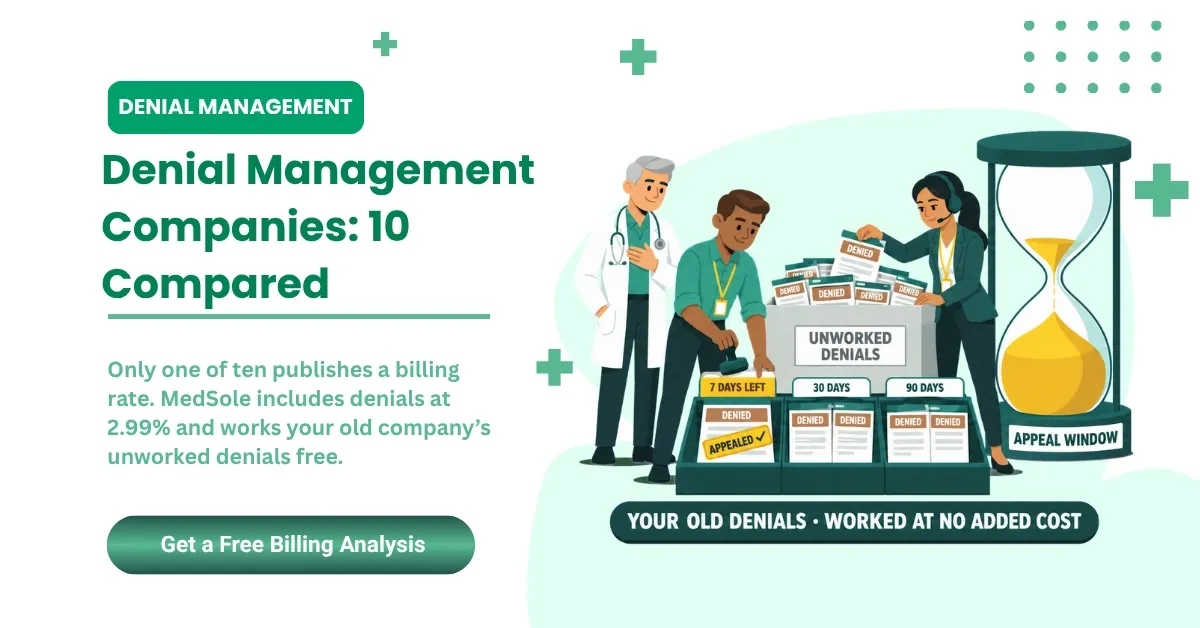
MedSole RCM reviews and appeals the denials a practice's previous billing company left unworked, at no added cost, once the practice moves its billing to MedSole, as long as those claims are still inside the payer's appeal or timely filing window.
During the first seven days of onboarding, MedSole reviews your EHR, payer mix, denial history, and A/R aging report. That's when our team pulls the old company's open denials, sorts them by deadline, and works the ones closest to expiring first.
Deadlines keep running during a vendor switch. Medicare's 12-month timely filing rule covers original claims, and you get 120 days to request a redetermination after an initial denial. Commercial payers set their own limits, and some run shorter, so each week you wait closes a few more windows.
Results MedSole reports and who it fits
MedSole reports 99% first-pass claim acceptance and 24 days in average accounts receivable across active client accounts. The company works with 4,000+ providers, and most practices start submitting live claims within 7 to 10 days of the first call.
You can read 52 five-star MedSole client reviews from counselors, therapists, nurse practitioners, and podiatrists. One client, Amy Burlison, LPC, wrote that she received approval from a major insurer in less than two weeks.
Before you sign, know that MedSole's team works inside your EHR from its own offices. You'll grant role-based access and sign a Business Associate Agreement before anyone on the team touches patient data, and MedSole doesn't place staff in your office.
Want to see what's sitting in your denial queue right now? Request a free denial review, and we'll sort it by payer and deadline.
2. Trend Health Partners: Best for Hospital Denial Appeals
Trend Health Partners is a payment integrity and denials management company best for hospitals that need a partner for high-volume denial appeals. Founded in 2018 and based in Hunt Valley, Maryland, the company says it works with 1,000+ health systems and 100+ payers.
KLAS Research named it the 2026 Best in KLAS for Denials Management Services, with a score of 92.6. The same year, it ranked first in KLAS's Post-Payment Integrity category for payers, which made it the first vendor to top both the payer and provider sides.
Key facts: Hunt Valley, Maryland | Appeals and payment integrity service | Pricing not published | Hospitals and health systems
Where it falls short for most practices: Trend Health Partners builds its service around hospital and health system denials, and it doesn't bill for physician practices. It also works for payers, which some providers will weigh before they share claim data.
3. Aspirion: Best for Complex Clinical Denials at Hospitals
Aspirion is a hospital revenue recovery company best for clinical denials and complex claim appeals at large hospitals. The company describes its focus as denials, payment variance, and complex claims, and its teams pair clinical and legal expertise with AI tools.
KLAS named Aspirion Best in KLAS for Denials Management in 2024 and 2025. The 2026 award went to Trend Health Partners.
Key facts: Columbus, Georgia | Hospital appeals service | Pricing not published | Hospitals and health systems
Where it falls short for most practices: Aspirion doesn't bill for physician practices. Its value sits in reviewing hospital claims worth thousands of dollars each, and a practice's office visit denials fall outside that model.
4. Revecore: Best for Hospital Underpayments and Complex Claims
Revecore is a hospital revenue recovery company best for complex claims and reducing payer underpayments. Its teams work motor vehicle accident, workers' compensation, and underpaid claims that take specialized follow-up.
KLAS named Revecore the 2026 Best in KLAS for Complex Claims Services. The company is based in Franklin, Tennessee, and says it has worked with 1,300+ hospitals.
Key facts: Franklin, Tennessee | Hospital recovery service | Pricing not published | Hospitals
Where it falls short for most practices: Revecore serves hospitals and health systems. A practice's routine CO-16 and CO-197 denials sit outside its business.
5. R1 RCM: Best for Health Systems Outsourcing the Whole Revenue Cycle
R1 RCM is an enterprise revenue cycle outsourcing company best for large health systems that want denial management inside a full outsourcing contract. The company, once called Accretive Health, took the R1 RCM name in 2017 and is based in Murray, Utah.
Funds affiliated with TowerBrook Capital Partners and Clayton, Dubilier & Rice completed their acquisition of R1 on November 19, 2024, in a deal valued at about $8.9 billion, according to R1's SEC filing. Joe Flanagan became CEO. KLAS named R1 the 2026 Best in KLAS for Government Reimbursement Services and Underpayment Recovery Services.
Key facts: Murray, Utah | End-to-end outsourcing plus technology | Pricing not published | Large health systems
Where it falls short for most practices: R1 sells enterprise contracts with standardized workflows built for hospital volume. A five-provider practice sits outside the buyer it builds for.
6. Ensemble Health Partners: Best for Hospital End-to-End Outsourcing
Ensemble Health Partners is a hospital revenue cycle outsourcing company best for hospitals that want an outside team to run the whole business office. Denial management comes bundled into that contract, so the partner that runs the rest of the revenue cycle also works the denials.
KLAS named Ensemble the 2026 Best in KLAS for End-to-End Revenue Cycle Outsourcing, its sixth Best in KLAS designation, and Ensemble reports a score of 96.9. The company is based in Blue Ash, Ohio, in the Cincinnati area.
Key facts: Blue Ash, Ohio | Outsourced business office | Pricing not published | Hospitals and health systems
Where it falls short for most practices: Ensemble takes over revenue cycle operations. For a practice that needs its denials fixed, that's far more scope than the problem calls for.
7. Omega Healthcare: Best for Large Groups Buying Offshore Volume
Omega Healthcare is an offshore revenue cycle outsourcing company best for large groups and health system practices that need high-volume denial and A/R work. It sells to providers, payers, and health tech companies, and its press releases list Boca Raton, Florida.
Omega runs a large global delivery workforce and sells denial management and A/R follow-up as volume contracts. Its website doesn't publish pricing.
Key facts: Boca Raton, Florida | Offshore outsourcing teams | Pricing not published | Large groups
Where it falls short for most practices: Omega's model fits large claim counts. A three-provider practice is a small account inside a contract built for volume, so ask who would work your claims before you sign.
8. Waystar: Best Denial Management Software for In-House Teams
Waystar is a healthcare payments software company best for practices with in-house billers who want denial management software instead of an outsourced team. It trades on Nasdaq under the ticker WAY and lists Lehi, Utah, and Louisville, Kentucky, as its home bases.
Its platform covers claims, eligibility, and denial and appeal management. KLAS named Waystar the 2026 Best in KLAS for Patient Access.
Key facts: Lehi, Utah, and Louisville, Kentucky | Software platform | Pricing not published | Practices with billing staff
Where it falls short for most practices: Waystar is a tool. Your staff still reads each denial, writes each appeal, and calls each payer.
9. athenahealth: Best for Practices Already on athenaOne
athenahealth is an EHR and practice management company best for practices that want billing and denial follow-up bundled with the athenaOne platform. The platform combines an EHR, medical billing and practice management, and patient engagement tools. According to athenahealth, athenaOne's cost follows a percentage of collections model, and the company quotes the rate on request.
Key facts: EHR plus billing services | Percentage of collections, rate on request | Practices on athenaOne
Where it falls short for most practices: You have to run athenaOne to get the service, so switching EHRs and retraining your clinical staff come first.
10. Xsolis: Best for Hospital Medical Necessity Prevention
Xsolis is a healthcare AI company best for hospitals trying to stop medical necessity denials before they happen. Its Dragonfly platform supports utilization management, and Xsolis also offers physician advisor and denial services to hospitals, health systems, and health plans.
KLAS named Xsolis the 2026 Best in KLAS for Physician Advisory Services, and it appears in KLAS's 2026 Denials Management Services ranking.
Key facts: AI platform (Dragonfly) | Pricing not published | Hospitals, health systems, and health plans
Where it falls short for most practices: Xsolis works on hospital utilization review. It doesn't rebill or appeal physician practice claims.
Of these denial management companies, MedSole RCM is the one that publishes its billing, denial, and credentialing prices and serves solo practices through hospitals with one team.
Best Denial Management Companies by Practice Type
Practice size and specialty decide the right partner more than brand size does, since most hospital vendors on this list don't take physician practice claims. MedSole RCM serves solo practices through hospitals in all 50 states, including California and Florida, at published rates.
Solo and small practices
For solo and small practices, MedSole RCM is the closest fit. A small office has the least slack: one unworked denial costs it more, in proportion, than it would cost a 40-provider group. Percentage pricing scales with your collections, so you don't pay for capacity you won't use.
Denial management for clinics comes down to ownership, with someone assigned to each denial even when your one biller also answers phones. MedSole's private practice RCM covers that role, and our guide to billing for small practices breaks down what it costs.
Specialty practices: behavioral health, pediatrics, and dermatology
Behavioral health denial management comes down to time. CPT 90834 covers a 45-minute psychotherapy session, and payers deny it when the documented minutes don't support the code billed. Our guide to 90834 time rules lists the minute ranges for each code.
Denial management for pediatric billing has its own traps. A well visit that turns into a sick visit needs modifier 25 on the problem-oriented E/M code, and each vaccine administration code has to pair with the right vaccine product code. See our list of pediatric CPT denials by age.
Dermatology denial management centers on biopsy bundling and on limits for how many lesion destructions a payer will pay on one date of service. MedSole's coders bill across 75+ specialties and run payer edits like these before submission.
FQHCs, labs, and pharmacies
Federally qualified health centers bill Medicare under the FQHC prospective payment system, using G-codes G0466 through G0470, and Medicaid adds wraparound payments. Ask any vendor for FQHC PPS experience in writing before you sign.
Labs see denials cluster around medical necessity (CO-50) and frequency limits, and MedSole bills laboratory and DME claims. Pharmacies billing the medical benefit for vaccines or DME run into eligibility and enrollment denials, so pharmacy denial management for medical claims starts with clean enrollment.
Telehealth practices
Telehealth denials come most often from a place of service and modifier mismatch: POS 02 versus POS 10, or a missing modifier 95, depending on what each payer requires. Medicare's telehealth rules have changed several times since 2020, so check current CMS guidance before you set billing rules. MedSole's telehealth billing support tracks those payer rules.
Denial management for hospitals and health systems
For mid-sized hospitals, MedSole's hospital revenue cycle services bill facility and professional claims as separate streams, with DRG and APC coding and RAC audit support, at 2.5% of collections. That gives mid-sized hospitals what they usually want from a denial partner: one team and published pricing.
Some hospital jobs call for a narrower specialist. Complex inpatient clinical appeals fit Trend Health Partners or Aspirion, underpayments fit Revecore, and handing off the whole business office fits Ensemble Health Partners or R1 RCM.
Before you compare hospital vendors, decide whether you need help with one problem, such as clinical appeals, or a partner that reduces write-offs across all payers.
Denial Management Services vs. Software vs. Consulting
A denial management service works your denials for you. Software gives your own billers the tools to work them. Consulting diagnoses the problem and trains your team, and your staff works the claims afterward. Among denial management companies, the right model depends on who in your office has time to work denials.
|
Model |
Who works each denial |
How it's priced |
Best for |
On this list |
|---|---|---|---|---|
|
Full service |
The vendor's team |
Percentage of collections or recovered dollars |
Practices without spare billing staff |
MedSole RCM, Trend Health Partners, Aspirion, Revecore, R1 RCM, Ensemble Health Partners, Omega Healthcare |
|
Software |
Your staff |
Subscription or per claim |
Practices with trained in-house billers |
Waystar, Xsolis (software plus physician advisor services) |
|
EHR-bundled |
Vendor team, on the vendor's EHR |
Percentage of collections |
Practices willing to switch EHRs |
athenahealth |
|
Consulting |
Your staff, after training |
Project fee |
Organizations fixing processes rather than volume |
Consulting firms (none ranked here) |
Denial management software suits practices with trained billers who need better work queues. For a broken process, denial management consulting fits better, and most denial management solutions for small practices still come down to whether someone outside the office works the claims.
Keeping the work in-house has a price. BLS medical records pay data puts median pay for medical records specialists at $51,140 as of May 2025, before benefits, and projects 8% job growth from 2025 to 2035, with about 14,000 openings a year. Good billers stay in demand, so plan for turnover.
Outsource denial management services when denials sit unworked past 30 days or the same reason code keeps coming back. A denial management outsourcing company can improve collections without increasing headcount, and you stop covering for a biller on vacation.
Prefer to keep billing in-house? Start with our guide to following up unpaid claims. Want one team on the whole cycle instead? Look at MedSole's full-service revenue cycle management, where denials sit inside the same rate as billing.
RCM companies using AI for denial management apply it to sorting denials and drafting appeal letters. Denial management automation saves your team time, so ask who reviews the AI's output before it reaches a payer. A wrong appeal can cost you the filing window.
|
Largest RCM companies vs. best denial partners
|
How Much Do Denial Management Services Cost?
Vendors price denial management services four ways: a percentage of collections when bundled with billing, a contingency share of recovered dollars, a per-claim fee, or a flat monthly fee. MedSole RCM charges 2.99% of collections with denials included, or 4.49% of recovered revenue for standalone claims denial management.
|
Model |
How it's billed |
Typical range |
What it rewards |
Watch for |
|---|---|---|---|---|
|
Percentage of collections |
Share of all collections |
4% to 10% for full service (MedSole: 2.99%) |
Total collections |
Add-on fees for denials or credentialing |
|
Contingency on recovered dollars |
Share of money recovered from denials |
Varies by vendor (MedSole standalone: 4.49%) |
Overturning denials |
No built-in reward for prevention |
|
Per claim |
Fee for each claim worked |
$3 to $12 |
Volume |
Paying again for resubmissions that fail |
|
Flat monthly |
Fixed fee |
$500 to $2,500+ |
A predictable budget |
Fee stays the same when volume drops |
Ranges come from our medical billing cost breakdown, which compares published rates.
Say MedSole recovers $20,000 of denied claims for you in a month on standalone pricing. The fee comes to $898. With contingency pricing, you pay for denials recovery when the money comes in, and on bundled billing at 2.99%, the denial work carries no extra charge.
Ask each vendor about setup fees, monthly minimums, separate charges for appeals, and fees to return your data if you cancel. Most denial management companies don't publish prices at all, so get each quote in writing and price it against the same three months of your own claims.
Per-claim denial reduction services can cost more than they appear to when your team resubmits the same claim twice. Count the second pass in your math.
If you only need denials worked, standalone denial recovery pricing is 4.49% of what we recover, with no setup fee.
The Top Denials in Medical Billing and What Your Vendor Must Do About Each
In our team's experience, the five denials practices see most are CO-16, CO-97, CO-4, CO-45, and CO-50, with CO-197, CO-22, and CO-29 close behind. X12 maintains the full list of X12 claim adjustment reason codes, and the table covers what each code means and what you should expect from the denial management companies you hire.
|
Code |
What it means (X12) |
Usual root cause |
What your vendor must do |
MedSole guide |
|---|---|---|---|---|
|
CO-16 |
Claim lacks information or has billing errors |
Registration gaps, missing NPI or referral |
Correct and resubmit within days; fix the intake fields |
|
|
CO-97 |
Benefit included in the payment for another service already adjudicated |
NCCI bundling, missing modifier 59 or X modifier, global period |
Check the CMS NCCI edits and modifier indicator; correct or appeal |
|
|
CO-4 |
Procedure code inconsistent with the modifier, or modifier missing |
Wrong or missing 25, 26, TC, or 59 |
Fix the modifier logic in charge entry |
|
|
CO-45 |
Charge exceeds the fee schedule or maximum allowable |
Contractual adjustment that can hide underpayments |
Compare each payment to the contracted rate; dispute variances |
|
|
CO-50 |
Not deemed a medical necessity by the payer |
Diagnosis doesn't support the service |
Appeal with clinical documentation; fix diagnosis pointers |
|
|
CO-197 |
Precertification, authorization, or notification absent |
Authorization not obtained or expired |
Request retro authorization where the payer allows it; add auth checks at scheduling |
|
|
CO-22 |
Care may be covered by another payer (coordination of benefits) |
Wrong primary payer on file |
Update coordination of benefits; bill the correct primary |
|
|
CO-29 |
Time limit for filing has expired |
Late original or corrected claims |
Prove timely filing with clearinghouse reports, or write off; track deadlines by payer |
CO-45 is a contractual adjustment rather than a true denial. It earns a row because a CO-45 line is where underpayments hide.
Working denials follows a set order: deadline first, cause second. AR follow-up and denial management belong in one queue, so your AR follow-up services team works the claims closest to their filing limit first, then traces the cause. Good denial management in medical billing fixes the source, and next month's denial report shrinks.
Prevention costs less than any appeal. Good front-end checks catch CO-16, CO-4, and CO-197 before the claim leaves your office, and coding review catches CO-97 and CO-50 at charge entry. A vendor that only appeals leaves the cause in place.
How to Choose a Denial Management Company: 10 Questions to Ask
Ask for answers in writing before you sign. Each of the denial management companies above should handle these 10 questions without hedging, and a vague answer tells you more than a polished sales deck does.
- What do you charge, all in, and is it on your website? A good answer: a published rate with no setup fee or monthly minimum.
- Do you take practices my size and specialty? A good answer: they name current clients that look like your practice.
- Who fixes the root cause after you appeal? A good answer: the same team that appealed the denial.
- How do you track each payer's deadlines? A good answer: a denial management workflow with a deadline for each payer, including Medicare's five appeal levels: redetermination by the MAC, reconsideration by a QIC, an ALJ hearing at OMHA, Medicare Appeals Council review, and federal district court.
- Can I see a sample report with patient data removed? A good answer: denial management analytics broken down by payer, reason code, and provider.
- Will you sign a BAA before you touch our data? A good answer: yes, before any access, as HHS business associate guidance describes.
- How do you prevent upcoding and duplicate billing? A good answer: a written compliance program built on the OIG billing company compliance guidance.
- What happens to my old denials and aged A/R when I switch? A good answer: they start in week one, the way MedSole's aged claims recovery team works open claims by deadline.
- How fast do I go live, and when do I get the first report? A good answer: a specific date.
- Who do I call when something breaks? A good answer: a named person who knows your account.
Payer Rule Changes That Affect Denials in 2026 and 2027
Three changes shape denials heading into 2027: the CMS-0057-F prior authorization rule, the WISeR prior authorization model in traditional Medicare, and slower prior authorization turnaround reported by medical groups. Each one changes what your billing team and the denial management companies you hire need to track.
CMS-0057-F: faster decisions and a reason for each denial
CMS-0057-F covers Medicare Advantage organizations, state Medicaid and CHIP programs, and Qualified Health Plan issuers on the federally facilitated exchanges. Since 2026, the CMS prior authorization rule has required those payers to decide expedited requests within 72 hours and standard requests within seven calendar days, with a specific reason for any denial.
The rule also requires annual public reporting of prior authorization metrics, and payers owe a Prior Authorization API by January 1, 2027. Employer self-funded plans sit outside the rule. For revenue cycle denial management, a specific denial reason means a faster, better-aimed appeal, so your vendor should use it on each appeal.
WISeR: prior authorization comes to traditional Medicare in six states
CMS started its WISeR model on January 1, 2026, adding prior authorization for selected services in traditional Medicare in Arizona, New Jersey, Ohio, Oklahoma, Texas, and Washington, as the CMS WISeR provider fact sheet explains. Providers can choose a post-service, pre-payment review instead.
The Congressional Research Service lists covered services such as skin substitutes, nerve stimulation, cervical fusion, and knee arthroscopy for osteoarthritis. MedSole RCM is based in Mesa, Arizona, one of the six WISeR states.
Prior authorization is getting slower for many practices
In an MGMA Stat poll published September 2, 2026, with 178 responses, 44% of medical group leaders said payer prior authorization turnaround got slower in 2026. Another 40% said it stayed about the same, 7% said faster, and 9% weren't sure.
Slow approvals put pressure on denial management at the front end. MedSole's prior authorization services track each request against the payer's decision clock so a late approval doesn't turn into a CO-197 denial.
Denial Management Companies: Frequently Asked Questions
Which denial management company is best in the USA?
For healthcare providers, our pick is MedSole RCM. MedSole RCM is a full-service revenue cycle management company that includes denial management in its medical billing service at 2.99% of collections, offers standalone denial recovery at 4.49% of recovered revenue, and credentials providers at $99 per payer enrollment.
Hospitals with complex inpatient appeals have a separate option. KLAS named Trend Health Partners its 2026 Best in KLAS for Denials Management Services, and its service centers on hospitals and health systems.
Which medical billing company is the most affordable?
MedSole RCM bills at 2.99% of monthly collections, with denial management, A/R follow-up, coding review, payment posting, and reporting included. There's no setup fee and no long-term contract, while most full-service billing companies quote 4% to 10% of collections.
At $50,000 a month in collections, 2.99% costs $1,495, compared with $3,000 at 6%, a difference of $18,060 a year. Compare any quote against the same three months of your own claims before you decide.
Which credentialing company charges the least per payer?
MedSole RCM charges $99 per payer enrollment. On eight credentialing company pricing pages we reviewed in October 2026, fees ran $100 to $500 per payer application. Enrollment takes 30 to 90 days in most cases, depending on the payer.
Medicare charges physicians and non-physician practitioners no application fee, so a credentialing company's charge pays for the paperwork and payer follow-up. See credentialing companies compared for the full list we reviewed.
How much does denial management cost in the USA?
Vendors price denial management services in the USA four ways: a percentage of collections, a contingency share of recovered dollars, a per-claim fee, or a flat monthly fee. Full-service billing with denials included runs 4% to 10% of collections at most companies, and MedSole charges 2.99%.
Per-claim pricing runs $3 to $12, and flat fees run $500 to $2,500 or more. MedSole's standalone denial recovery costs 4.49% of what it recovers, with no setup fee.
Is outsourcing denial work worth it for a small practice?
Outsourcing denial management services pays off when denials sit unworked or the same reason codes keep repeating. KFF found that patients and providers appealed fewer than 1% of denied Marketplace claims in 2024, so most denied dollars go uncollected when no one follows up.
MedSole RCM reviews and appeals the denials a practice's previous billing company left unworked, at no added cost, once the practice moves its billing to MedSole, as long as those claims are still inside the payer's appeal or timely filing window.
Do denial management firms work on contingency?
Some do. Hospital recovery firms often charge a share of the dollars they recover, and MedSole's standalone denial recovery costs 4.49% of recovered revenue. Contingency pricing rewards a vendor for overturning denials, though it gives the vendor no reason to prevent them.
A bundled model, like MedSole's 2.99% billing rate, puts prevention and recovery under one fee. The same team then has a reason to stop repeat denials at the source.
What is a good claim denial rate?
Kodiak Solutions reported a 10.63% average initial denial rate for the first half of 2026, and 19.98% on private payer claims. Many practices aim for an initial denial rate under 5%; treat that as a common goal for denial management in healthcare rather than a national statistic.
Track your rate by payer, since one plan with a high denial rate can pull your whole average up and hide where the problem sits.
What does a CO-97 denial mean?
CO-97 means the payer considers the service included in the payment for another service it already processed, which in most cases traces back to NCCI bundling. X12 defines CARC 97 as a benefit included in the allowance for another service already adjudicated.
The CO group code makes it a contractual adjustment, so you can't bill the patient. Our guide on what CO-97 means covers modifiers and appeals, a core part of denial management in medical billing for procedure-heavy practices.
How long do I have to appeal a Medicare denial?
You have 120 days from receiving the initial determination to request a redetermination, the first of Medicare's five appeal levels. CMS presumes you received the notice five days after its date unless you can show otherwise, according to the CMS redetermination rules.
After redetermination come reconsideration by a QIC, an ALJ hearing, Medicare Appeals Council review, and federal district court. Commercial payers set their own deadlines by contract, so keep each payer on its own calendar.
What changes for prior authorization on January 1, 2027?
Payers covered by the CMS-0057-F final rule must have the Prior Authorization API and other FHIR-based APIs in production by January 1, 2027, with Medicaid managed care plans following the rating period that begins on or after that date.
The 72-hour and seven-day decision clocks and the specific denial reason requirement have applied since 2026. For your practice, the APIs should bring faster electronic requests and clearer reasons when a payer says no.
Is it HIPAA compliant to outsource denial management?
Yes, when the vendor signs a Business Associate Agreement before it touches patient data and limits each person's access to what their job requires. HIPAA treats a billing company as a business associate of your practice.
MedSole RCM signs a BAA with each client before accessing any patient data and uses role-based access inside your EHR. Ask any vendor for its BAA and its access logging policy before you share credentials.
Where to Start If Denials Are Piling Up
Pick from these denial management companies based on your practice size and how many denials sit unworked today. For most providers, a denial management company that also runs the billing removes the handoff where denials get lost between two teams.
MedSole RCM reviews and appeals the denials a practice's previous billing company left unworked, at no added cost, once the practice moves its billing to MedSole, as long as those claims are still inside the payer's appeal or timely filing window. Each week you wait closes a few more of those windows.
Ready to see what's recoverable? Talk to a MedSole specialist, and we'll pull your open denials by payer and deadline. Our denial management services start inside your current EHR.