![90834 CPT Code: Description, Time Range & Reimbursement Rates [2026]](https://medsolercm.com/_imgs/blogs/1123_cpt-code-90834-psychotherapy-billing-guide-2026.webp)



CPT Code 90834 At a Glance
|
Detail |
Value |
|
CPT Code |
90834 |
|
Description |
Psychotherapy, 45 minutes with patient |
|
Time Range |
38 to 52 minutes face-to-face |
|
Setting |
Outpatient (office, clinic, or telehealth) |
|
Telehealth Modifier |
95 (synchronous audio-video) |
|
2026 Medicare Rate |
~$113.90 (non-facility, national average) |
|
Eligible Providers |
MD/DO, PhD/PsyD, LCSW, LPC, LMFT, LMHC, PMHNP |
|
Billable Units |
1 per day (standard; exceptions apply in PHP/IOP) |
|
Add-On Code for E/M |
+90836 (not standalone; used with E/M on same day) |
The 90834 CPT code is the standard billing code for individual psychotherapy sessions lasting 38 to 52 minutes, commonly referred to as the 45-minute therapy session. It's one of the most frequently billed procedure codes in outpatient behavioral health.
Accurate billing of CPT code 90834 directly impacts your reimbursement, compliance standing, and practice revenue. Whether you're a therapist billing your own claims or a billing team handling mental health submissions, understanding the 90834 CPT code description, documentation requirements, modifier rules, and payer-specific policies isn't optional. Getting any of these wrong means denied claims, delayed payments, or audit exposure.
This guide covers the official 90834 CPT code description, exact time range requirements, 2026 Medicare and commercial reimbursement rates, documentation standards, telehealth billing rules, modifier 95 usage, common denial reasons, ICD-10 code pairings, and same-day billing restrictions. Everything here is sourced from CMS, AMA, and the 2026 NCCI Policy Manual.
At MedSole RCM, we process thousands of mental health claims monthly and built this guide from current CMS regulations and real-world billing outcomes across our revenue cycle management clients.
What Is CPT Code 90834?
CPT code 90834 describes individual psychotherapy lasting approximately 45 minutes, defined by the American Medical Association as "Psychotherapy, 45 minutes with patient and/or family member."
Official CPT Code 90834 Description
CPT stands for Current Procedural Terminology. It's the billing language maintained by the AMA and mandated under HIPAA for reporting clinical services to insurance payers. The 90834 CPT code description falls within the psychotherapy code family (90832 through 90838) and is classified as a standalone psychotherapy code. That means it's reported on its own, without an evaluation and management (E/M) service attached.
Here's the CMS clarification that matters for billing: "The Centers for Medicare and Medicaid Services defines services under 90834 as insight-oriented, behavior-modifying, supportive, and/or interactive psychotherapy." That definition is broad on purpose. It covers the full range of psychotherapy CPT code applications in outpatient behavioral health.
What Does CPT Code 90834 Mean in Practice?
In plain terms, CPT 90834 covers one-on-one therapy sessions where the clinician uses evidence-based therapeutic techniques. That includes cognitive behavioral therapy (CBT), dialectical behavior therapy (DBT), interpersonal therapy (IPT), EMDR, psychodynamic therapy, and solution-focused interventions. The code also encompasses ongoing assessment and adjustment of therapeutic approaches during the session.
Brief involvement of informants, like a family member, is allowed as long as the patient is present for all or a majority of the session. But the core of the visit must be individual psychotherapy.
What this code doesn't cover: psychiatric diagnostic evaluations (90791/90792), group therapy (90853), family therapy (90846/90847), or crisis psychotherapy (90839/90840). Each of those has its own dedicated CPT code. Billing 90834 for any of those services is a coding error that'll trigger a denial.
90834 CPT Code Time Range: How Many Minutes?
The 90834 CPT code time range is 38 to 52 minutes of face-to-face psychotherapy, commonly referred to as the 45-minute session. Getting the time right is the single most important factor in choosing between psychotherapy codes. One minute in either direction can change which code you bill.
The 38 to 52 Minute Rule
Three psychotherapy codes cover individual sessions of different lengths. Here's how the time ranges break down:
|
CPT Code |
Session Label |
Exact Time Range |
|
90832 |
30 minutes |
16 to 37 minutes |
|
90834 |
45 minutes |
38 to 52 minutes |
|
90837 |
60 minutes |
53+ minutes |
Sessions shorter than 16 minutes shouldn't be reported under any psychotherapy code. A session lasting exactly 38 minutes qualifies for the 90834 CPT code. At 37 minutes, you must use 90832. There's no rounding or averaging allowed.
What Counts as Face-to-Face Time?
Only direct therapeutic interaction counts toward the 38 to 52 minute threshold. Per CMS guidelines, psychotherapy times are for face-to-face services with the patient.
These activities don't count: scheduling future appointments, collecting copays, writing progress notes after the session ends, reviewing intake paperwork, or any administrative task. If your session includes 10 minutes of paperwork and 42 minutes of actual therapy, you bill based on the 42 minutes, not the 52 total.
The Midpoint Rule Explained
This distinction is the single most common source of revenue leakage and audit risk in therapy billing. A session lasting 52 minutes is 90834. A session lasting 53 minutes is 90837. There's no gray area.
The midpoint between the upper end of 90834 (52 minutes) and the start of 90837 (53 minutes) is 52.5, which rounds up to 53. Billing a 50 or 51 minute session as 90837 is upcoding under CMS guidelines and can trigger post-payment audits. It's also one of the patterns payers specifically monitor.
For detailed guidance on billing sessions over 53 minutes, see our complete guide to CPT code 90837.
When to Use CPT Code 90834
Use CPT 90834 when providing individual psychotherapy to a patient for 38 to 52 minutes in an outpatient setting, where the primary focus is treating a diagnosed mental health condition using evidence-based therapeutic interventions. That's the CPT code for 45-minute psychotherapy sessions in its simplest form.
Appropriate Use of 90834
Per APA psychotherapy code guidance, bill CPT 90834 when all of the following apply:
-
The session lasts between 38 and 52 minutes of face-to-face time
-
The session is one-on-one (individual therapy, not group or family)
-
The primary purpose is treating a mental health, behavioral, or emotional condition
-
The clinician uses evidence-based methods (CBT, DBT, IPT, psychodynamic therapy, EMDR, or supportive psychotherapy)
-
The session takes place in an outpatient setting (office, clinic, or via telehealth)
-
No separate E/M service is performed by the same clinician on the same date (if E/M is also provided, use add-on code +90836 instead)
When NOT to Use CPT Code 90834
Knowing when not to bill 90834 is just as important as knowing when to use it. These are the most common psychotherapy codes that get confused with 90834:
-
Sessions shorter than 38 minutes: use 90832
-
Sessions of 53 minutes or longer: use 90837
-
Family therapy without the patient present: use 90846
-
Family therapy with the patient present: use 90847
-
Group psychotherapy: use 90853
-
Psychiatric diagnostic evaluation: use 90791 or 90792
-
Crisis psychotherapy: use 90839/90840
-
Recreational therapy (art, music, dance, equine): not billable under any psychotherapy code
-
Case management or care coordination: not a psychotherapy service
-
Sessions where the same clinician also provides a medical E/M service: use the E/M code + add-on code +90836
-
Sessions conducted primarily via text or email: not eligible for 90834
Who Can Bill CPT Code 90834?
CPT code 90834 can be billed by any licensed mental health professional authorized to provide individual psychotherapy. That includes psychiatrists, psychologists, licensed clinical social workers, licensed professional counselors, licensed marriage and family therapists, and psychiatric nurse practitioners.
Eligible Provider Types
-
Psychiatrists (MD/DO)
-
Psychologists (PhD/PsyD)
-
Licensed Clinical Social Workers (LCSWs)
-
Licensed Professional Counselors (LPCs)
-
Licensed Marriage and Family Therapists (LMFTs)
-
Licensed Mental Health Counselors (LMHCs)
-
Psychiatric Mental Health Nurse Practitioners (PMHNPs)
-
Physician Assistants (PAs), with appropriate supervision per state law
Scope of practice and billing eligibility varies by state. Always verify state-specific licensure requirements and payer credentialing status before submitting claims. A provider can be fully licensed in their state but still get claims denied if they haven't completed credentialing with that specific payer.
Provider credentials directly impact reimbursement rates. Medicare and most commercial payers tier payments: PhD/PsyD/MD rates are typically 10% to 25% higher than master's-level licensed providers (LCSW, LPC, LMFT). That's a significant per-session gap when you're seeing 20 to 30 patients a week.
2024 to 2026 Update: LMFT and LMHC Medicare Eligibility
Starting January 1, 2024, Licensed Marriage and Family Therapists (LMFTs) and Licensed Mental Health Counselors (LMHCs) can independently enroll in and bill Medicare for psychotherapy services, including the 90834 CPT code. This was a landmark expansion authorized by the Consolidated Appropriations Act, 2023.
A few key details on the LMFT/LMHC Medicare enrollment:
-
LMFTs and LMHCs are reimbursed at 75% of the psychologist rate for the same CPT codes
-
Enrollment requires completing a CMS-855I application (or PECOS online enrollment)
-
The credentialing process typically takes 60 to 120 days
-
Providers must meet state licensure requirements and Medicare conditions of participation
If your practice includes LMFTs or LMHCs who aren't yet enrolled in Medicare, you're leaving revenue on the table. The enrollment process can be complex. MedSole RCM handles provider enrollment and credentialing at $99 per insurance payer, one of the most affordable rates in the industry.
Documentation Requirements for CPT Code 90834
Every claim billed under CPT code 90834 must be supported by clinical documentation that establishes session duration, therapeutic interventions, medical necessity, and patient progress. CMS requires this for all time-based psychotherapy codes, and it's the first thing auditors check when reviewing 90834 claims.
Required Documentation Elements
These seven elements need to be in every 90834 progress note. Missing even one can be grounds for denial or recoupment.
-
Session start and stop times. Exact times, not approximations. "Session began 2:05 PM, ended 2:50 PM" is what CMS expects. This is the most commonly cited audit deficiency for 90834 CPT code documentation requirements.
-
Patient diagnosis. A current, specific ICD-10-CM code supporting medical necessity. Codes must be at the highest level of specificity. Using F32.9 when F32.1 is clinically appropriate will trigger a review.
-
Clinical interventions used. Name the specific therapeutic modalities and techniques you employed. "Utilized cognitive restructuring techniques to address catastrophic thinking patterns related to generalized anxiety" is what auditors want to see. "Provided therapy" isn't enough.
-
Patient response. Observable engagement, emotional responses, behavioral changes, or verbalized insights during the session. This shows the session was individualized, not a template.
-
Risk assessment. Evaluation of suicidal ideation, homicidal ideation, self-harm risk, or safety concerns. Even when negative, document it. "Patient denied SI/HI, no safety concerns identified" takes five seconds and protects your claim.
-
Progress toward treatment goals. How did this session advance the patient's treatment plan objectives? Reference specific goals. Vague language like "patient is progressing" doesn't meet the standard.
-
Clinical plan forward. Next steps, homework assignments, changes to treatment approach, or plan for next session. This connects the current session to the ongoing treatment trajectory.
Documentation Best Practices
-
Use a standardized framework like SOAP (Subjective, Objective, Assessment, Plan) or DAP (Data, Assessment, Plan) for consistency across your practice
-
Complete progress notes within 24 hours of the session while details are still fresh
-
Make sure session times in your EHR match the times in your progress note; inconsistencies between systems trigger audit flags
-
Don't copy-forward notes from previous sessions without modification. Payer reviewers and audit systems flag identical note patterns as potential fraud indicators.
-
Document medical necessity explicitly. State why this patient requires psychotherapy at this frequency and duration.
-
For telehealth sessions, document patient consent for telehealth, the technology platform used, and both provider and patient locations
90834 CPT Code Reimbursement Rates [2026 Updated]
Reimbursement for the 90834 CPT code varies by payer type, provider credentials, and geographic location. The 2026 Medicare national average is approximately $113.90 per session for non-facility settings. That number matters because it's the benchmark most commercial contracts are built around.
Medicare Reimbursement Rates by Year (2020 to 2026)
|
Year |
Medicare Rate (National Average, Non-Facility) |
|
2026 |
~$113.90 |
|
2025 |
$101.51 |
|
2024 |
$101.51 |
|
2023 |
$99.97 |
|
2022 |
$112.29 |
|
2021 |
$103.28 |
|
2020 |
$94.55 |
Source: CMS Physician Fee Schedule
The 2026 rate reflects a conversion factor increase to approximately $33.40 to $33.57, up from $32.35 in 2025. That's a 3.26% to 3.77% bump. Rates above are national averages; your actual payment varies by Geographic Practice Cost Index (GPCI). Urban practices in high-cost areas may receive $140 or more per session, while rural practices may receive less.
Reimbursement by Payer Type
|
Payer Type |
Approximate 2026 Rate |
|
Medicare (non-facility) |
$104 to $134 |
|
Commercial Insurance (average) |
$100 to $175 |
|
Medicaid (varies by state) |
$60 to $80 |
|
LMFT/LMHC Medicare Rate |
75% of psychologist rate |
Commercial insurance rates vary significantly by contract. What we see across our clients: many providers accept rates that are 10% to 30% below what they could negotiate. Regular contract review and payer rate benchmarking against 120% of Medicare for your locality is essential for practice financial health.
Factors That Affect Your 90834 Payment
Five variables determine what actually hits your bank account for a CPT code 90834 Medicare reimbursement claim:
-
Geographic Practice Cost Index (GPCI): CMS adjusts rates by locality. A session in San Francisco pays differently than one in rural Alabama.
-
Facility vs. non-facility setting: Non-facility (office) rates are typically higher. CMS finalized a policy in 2026 reducing facility practice expense RVUs, which widens this gap further.
-
Provider credential level: PhD/PsyD/MD providers typically receive 10% to 25% higher rates than LCSW/LPC/LMFT for the same 90834 CPT code reimbursement.
-
Payer contract terms: Commercial rates are negotiable. If you haven't renegotiated in two or more years, you're almost certainly underpaid.
-
Sequestration: Medicare payments are subject to a 2% sequestration reduction that's applied after the fee schedule calculation.
To make sure you're collecting the maximum allowable reimbursement for every 90834 session, it helps to have someone watching the numbers closely. MedSole RCM offers outsourced medical billing services at 2.99% of collections, the most competitive rate in the industry, with a dedicated focus on reducing claim denials and accelerating payment turnaround.
2026 CMS Updates Affecting CPT Code 90834
The CY 2026 Physician Fee Schedule Final Rule introduces several changes that directly impact reimbursement and billing for CPT 90834. No competitor in the SERP covers these updates specific to psychotherapy codes. Here's what you need to know.
Conversion factor increase. The CY 2026 conversion factor increased to approximately $33.40 to $33.57, up from $32.35 in 2025. That's a 3.26% to 3.77% bump. For psychotherapy codes like 90834, this translates to roughly 2% to 4% higher reimbursement compared to 2025 rates. Not a windfall, but it's moving in the right direction after years of flat or declining payments.
Efficiency adjustment exemption. This is the big one. CMS finalized a 2.5% efficiency adjustment that reduces work RVUs for many procedure codes in 2026. But time-based behavioral health services, including CPT 90834, are explicitly exempt from this reduction. Per the CY 2026 PFS Final Rule, CMS exempts time-based codes including behavioral health services, E/M services, and care management services from the efficiency adjustment. While procedural specialties face payment cuts, psychotherapy billing is protected.
Facility vs. non-facility shift. CMS reduced indirect practice expense (PE) RVUs for facility-based services by 50%, reallocating payments toward non-facility (office/outpatient) settings. If you're billing 90834 in an office or via telehealth (billed at the non-facility rate since 2024), this policy works in your favor.
Psychotherapy code valuation transition. CMS finalized increased valuation for timed behavioral health services over a four-year transition period starting in CY 2024. Psychotherapy code RVUs, including those for 90834, are being incrementally adjusted upward through 2027. Each year brings a small but meaningful bump to base reimbursement.
Modifiers Used with CPT Code 90834
The most commonly used modifier with the 90834 CPT code is Modifier 95, which indicates the psychotherapy session was conducted via synchronous audio-video telehealth technology. But it's not the only modifier you might need. Here's the full reference.
Modifier Reference Table
|
Modifier |
Description |
When to Use |
|
95 |
Synchronous telehealth (real-time audio + video) |
Standard for all telehealth 90834 sessions |
|
93 |
Audio-only telehealth |
When patient can't use video; payer-dependent |
|
GT |
Via interactive audio-video telecommunication |
Legacy modifier, largely replaced by 95 for most payers |
|
HJ |
Employee Assistance Program |
When session is part of an EAP benefit |
|
59 |
Distinct procedural service |
When billing multiple distinct services on the same day |
|
76 |
Repeat procedure by same physician |
Rare; when a second same-day session is clinically justified |
|
FQ |
Telehealth service using audio-only |
Medicare-specific audio-only modifier |
Modifier 95 in Detail
Modifier 95 is the current standard for synchronous telehealth billing. When you bill CPT code 90834 with Modifier 95 (written as 90834-95), you also need the correct Place of Service (POS) code. Use POS 10 for patients at home and POS 02 for patients at another telehealth location.
Here's a common mistake we see: practices still appending Modifier GT for telehealth sessions. GT is largely obsolete for most commercial payers but may still be required by certain Medicaid plans. Don't assume one modifier works across all payers. Verify requirements with each one.
Behavioral Health Modifiers: HJ and EAP Sessions
Modifier HJ applies to Employee Assistance Program sessions. Behavioral health modifiers like HJ can affect reimbursement rates and benefit limits. Always verify coverage terms and payment amounts with the specific EAP administrator before billing. EAP sessions often have separate fee schedules and session caps that don't follow standard commercial insurance rules.
How to Bill CPT Code 90834 for Telehealth Sessions
CPT code 90834 can be billed for telehealth sessions using Modifier 95, with Medicare permanently allowing behavioral health telehealth services in the patient's home without geographic restrictions. If your practice offers virtual therapy, the billing rules are more favorable than they've ever been, but the details matter.
Permanent Telehealth Flexibilities for Behavioral Health
Per the CMS Telehealth FAQ updated February 2026, behavioral health telehealth provisions are permanent and won't expire. Here's what that means for your 90834 telehealth claims:
-
Medicare patients can permanently receive behavioral and mental health telehealth services in their home
-
No geographic restrictions apply for originating site for behavioral/mental telehealth services
-
Audio-only behavioral health telehealth is permitted through December 31, 2027
-
The Consolidated Appropriations Act extended all additional Medicare telehealth flexibilities through December 31, 2027
That permanent status is a big deal. Unlike general telehealth flexibilities that face annual renewal uncertainty, behavioral health providers don't need to worry about losing home-based telehealth coverage for Medicare patients. It's locked in.
Place of Service Codes for Telehealth 90834
Getting the POS code wrong on a 90834 CPT code telehealth claim is one of the fastest ways to lose money without realizing it. Here's the breakdown:
|
Place of Service Code |
Description |
When to Use |
|
POS 02 |
Telehealth provided other than in patient's home |
Patient at a clinic, community center, or other non-home location |
|
POS 10 |
Telehealth provided in patient's home |
Patient receiving telehealth from their home |
|
POS 11 |
Office |
In-person sessions in provider's office |
Starting January 1, 2024, CMS finalized that Medicare telehealth claims for patients in their homes (POS 10) are paid at the non-facility rate, which is typically higher than facility rates. Before this change, many telehealth claims were reimbursed at the lower facility rate. If your billing team is still defaulting to POS 02 for home-based sessions, you're likely undercollecting on every telehealth visit.
In-Person Visit Requirements Starting 2028
One upcoming change to plan for. Effective January 1, 2028, CMS will require an in-person visit within six months prior to the initial home-based behavioral health telehealth service. After that first visit, at least one in-person visit every 12 months is required to maintain telehealth eligibility.
There's an exception for existing patients. Anyone who began receiving behavioral health telehealth services on or before January 30, 2026 is treated as an established patient and only needs to meet the annual in-person requirement. CMS also allows limited exceptions for documented access barriers.
Navigating telehealth billing rules, modifier selection, and POS coding adds real complexity to 90834 claims. Errors in telehealth modifier usage are among the top denial drivers for mental health practices. A billing partner experienced in behavioral health telehealth can prevent costly mistakes before they hit your revenue.
CPT Code 90834 vs 90837: Key Differences
The primary difference between CPT code 90834 and CPT code 90837 is session duration: 90834 covers psychotherapy sessions lasting 38 to 52 minutes, while 90837 is for sessions lasting 53 minutes or longer. That's the rule. Everything else, reimbursement, audit risk, payer scrutiny, flows from that time threshold.
Side-by-Side Comparison Table
|
Feature |
CPT 90834 |
CPT 90837 |
|
Session Duration |
38 to 52 minutes |
53+ minutes |
|
Typical Session Label |
45-minute session |
60-minute session |
|
2026 Medicare Rate (National Avg.) |
~$113.90 |
~$154 to $160 |
|
Audit Risk |
Standard |
Higher: frequently scrutinized by payers |
|
Prior Authorization |
Rarely required |
Often required by some commercial payers |
|
Documentation Burden |
Standard time documentation |
Must justify clinical necessity of extended duration |
|
Payer Reimbursement |
Broadly accepted without question |
Some payers send warning letters to high-frequency billers |
This table reflects general industry patterns. Always verify specific requirements with each payer contract.
Which Code Should You Use?
Select the code based on actual face-to-face psychotherapy time, not the scheduled appointment length. That distinction trips up a lot of providers.
-
Session lasted 38 to 52 minutes: bill 90834
-
Session lasted 53 minutes or more: bill 90837
-
Session lasted 16 to 37 minutes: bill 90832
-
Session lasted less than 16 minutes: don't report any psychotherapy code
Here's the scenario we see constantly. A provider schedules a "50-minute therapy hour" and bills 90837. The 50-minute session falls within the 90834 range (38 to 52 minutes). Billing it as 90837 is upcoding, and it's one of the easiest audit findings for a payer to catch.
Payer Scrutiny and Audit Risk for 90837
This isn't theoretical. Payers including Highmark BCBS and Anthem have sent advisory letters to providers deemed to be high submitters of CPT codes 90834 and 90837, warning that claims may face additional review and resubmission requirements. The American Psychological Association Practice Organization (APAPO) and the Pennsylvania Psychological Association (PPA) intervened on behalf of providers to clarify that legitimate 90837 billing shouldn't be penalized.
The bottom line: if your session genuinely meets the 53-minute threshold and your documentation supports it, bill 90837. Don't downcode to the 90834 CPT code out of fear. Accurate coding is always the correct approach.
For a complete breakdown of 90837, including reimbursement rates, documentation requirements, and payer-specific rules, read our complete guide to CPT code 90837.
Same-Day Billing Rules for CPT Code 90834
Per the 2026 NCCI Policy Manual (effective January 1, 2026), standalone psychotherapy code 90834 can't be billed alongside evaluation and management codes or psychiatric diagnostic evaluations by the same provider on the same date of service. This is a hard rule, not a guideline. Getting it wrong means an automatic denial.
90834 with E/M Codes on the Same Day
Do NOT bill CPT codes 99201 through 99215 (E/M) together with standalone psychotherapy codes 90832, 90834, or 90837 when performed by the same clinician on the same date of service.
If the same clinician provides both a medical evaluation/management service and psychotherapy on the same day, here's the correct approach:
|
Scenario |
Correct Coding |
|
E/M + 45-min psychotherapy (same clinician, same day) |
E/M code (e.g., 99214) + add-on code +90836 |
|
Psychotherapy only, no E/M (same day) |
Standalone billing code 90834 |
The E/M and psychotherapy services must be significant and separately identifiable. Time spent on E/M work is excluded from the psychotherapy time calculation. A separate diagnosis isn't required, but the services themselves need to be distinct.
90834 with Diagnostic Evaluation (90791/90792) on the Same Day
CPT codes 90791 (diagnostic evaluation without medical services) and 90792 (diagnostic evaluation with medical services) aren't separately reportable with psychotherapy codes 90832 through 90838 on the same date of service by the same provider.
The rationale per the 2026 NCCI Policy Manual: psychotherapy inherently includes ongoing psychiatric evaluation. Billing a diagnostic evaluation and psychotherapy on the same day by the same provider represents a duplication of the evaluation component.
If it's truly an intake day, bill the diagnostic evaluation code (90791 or 90792). Whatever therapeutic work happens during an intake doesn't automatically support a separate psychotherapy code on top of it.
90834 Billing Frequency Limits
Can you bill CPT code 90834 twice in one day? In most cases, no. Medicare and most commercial insurers reimburse 90834 only once per day. Some payers further restrict frequency to two sessions per week.
The exception: partial hospitalization programs (PHP) and intensive outpatient programs (IOP). The 2026 NCCI Policy Manual permits reporting more than one unit of psychotherapy per day within these structured treatment settings to reflect the amount of psychotherapy actually provided.
Outside of PHP/IOP, always verify payer-specific frequency limits before billing multiple sessions or exceeding weekly thresholds. Submitting claims that exceed a payer's frequency cap is a fast path to denial and potential recoupment.
ICD-10 Diagnosis Codes Commonly Paired with CPT Code 90834
Every claim billed under CPT code 90834 must include a valid ICD-10-CM diagnosis code that establishes medical necessity for the psychotherapy session. The code needs to be at the highest level of specificity available. Using F32.9 (unspecified) when the clinical picture clearly supports F32.1 (moderate) is a common reason claims get flagged for review.
Here are the diagnosis codes we see paired with 90834 most frequently:
|
ICD-10 Code |
Description |
Common Context |
|
F32.0 to F32.9 |
Major Depressive Disorder, Single Episode |
Mild to severe, with or without psychotic features |
|
F33.0 to F33.9 |
Major Depressive Disorder, Recurrent |
Ongoing depressive episodes |
|
F34.1 |
Dysthymic Disorder (Persistent Depressive Disorder) |
Chronic low-grade depression |
|
F41.0 |
Panic Disorder |
Recurrent panic attacks |
|
F41.1 |
Generalized Anxiety Disorder |
Excessive, persistent worry |
|
F41.9 |
Anxiety Disorder, Unspecified |
When specific anxiety type isn't yet determined |
|
F43.10 |
Post-Traumatic Stress Disorder (PTSD) |
Trauma-related symptoms |
|
F43.21 to F43.25 |
Adjustment Disorders |
Adjustment disorder with depressed mood, anxiety, etc. |
|
F60.3 |
Borderline Personality Disorder |
Emotional instability, self-harm risk |
|
F90.0 to F90.9 |
Attention-Deficit/Hyperactivity Disorder |
ADHD presentations |
|
F50.00 to F50.9 |
Eating Disorders |
Anorexia, bulimia, binge eating |
A few things to keep in mind with 90834 diagnosis code pairing. The diagnosis must support medical necessity for psychotherapy at the frequency and duration you're billing. Some payers maintain their own lists of covered diagnoses for 90834, so verify coverage before assuming a code will be accepted.
Update your codes as the patient's clinical presentation changes. Carrying the same diagnosis code for 18 months without clinical justification invites scrutiny.
Add-On Codes Used with CPT Code 90834
The 90834 code can be reported alongside specific add-on codes when additional services are provided during or in connection with the psychotherapy session. These aren't standalone codes; they must accompany a primary code on the claim.
|
Add-On Code |
Description |
When to Use |
Payable? |
|
+90785 |
Interactive Complexity |
Third-party involvement complicating communication (disruptive caregivers, guardians), need for special communication tools (play therapy), or sentinel events (abuse/neglect reporting) |
Not always reimbursable; indicates treatment complexity |
|
+90836 |
Psychotherapy add-on with E/M, 45 minutes |
Same clinician provides both E/M and 38 to 52 min psychotherapy on the same day |
Yes; billed with the E/M code, not standalone |
|
+99050 |
After-hours service |
Services provided outside regularly scheduled office hours |
Yes, payer-dependent |
|
+99051 |
Weekend/holiday service |
Services during regularly scheduled evening, weekend, or holiday hours |
Yes, payer-dependent |
A couple of rules worth highlighting. Interactive complexity (+90785) should never be reported with crisis psychotherapy codes (90839/90840) or with E/M codes when no psychotherapy code is also on the claim. And the +90785 add-on doesn't apply to translation or interpretation services alone.
The most important one for CPT code 90834 billing: report +90836 (not standalone 90834) when psychotherapy happens alongside an E/M service by the same clinician on the same date. Getting this wrong is one of the top 10 denial triggers in behavioral health billing.
Common Billing Errors and Denial Reasons for CPT Code 90834
The most common reasons for 90834 CPT code claim denials include incorrect session duration documentation, missing time records, improper same-day code combinations, and insufficient clinical justification for medical necessity. We see the same patterns across practices of every size. Here are the 10 errors that come up most often.
1. Incorrect session duration. Billing 90834 for sessions shorter than 38 minutes or longer than 52 minutes. If the session ran 37 minutes, use 90832. If it hit 53 minutes, use 90837. This is the most frequent cause of post-payment audit recoupment.
2. Missing or inconsistent start/stop times. CMS requires documented start and stop times for all time-based psychotherapy codes. A note that says "45-minute session" without exact times isn't sufficient. And if the start/stop times in your progress note don't match what's recorded in your EHR scheduling system, auditors will flag the discrepancy.
3. Billing 90834 with E/M codes by the same provider. Using standalone billing code 90834 instead of add-on +90836 when E/M is also provided on the same day. This violates NCCI bundling rules and results in denial of the psychotherapy code.
4. Billing 90834 with 90791/90792 on the same day. Reporting a diagnostic evaluation and psychotherapy on the same date by the same clinician. NCCI doesn't allow this combination.
5. Upcoding to 90837. Billing a 50 or 51 minute session as 90837. Payers actively monitor providers with high 90837-to-90834 ratios. Some send advisory letters. Others initiate formal audits.
6. Insufficient clinical documentation. Notes that lack specific therapeutic interventions used, patient response, risk assessment, or treatment plan progress. Generic notes and copy-forwarded notes are red flags for reviewers.
7. Missing or incorrect telehealth modifiers. Failing to append Modifier 95 for telehealth sessions or using the wrong Place of Service code. Billing POS 11 instead of POS 10 for home-based telehealth is a denial we see weekly.
8. Exceeding frequency limits. Billing CPT code 90834 more than once per day or exceeding payer-specific session limits per week without prior authorization.
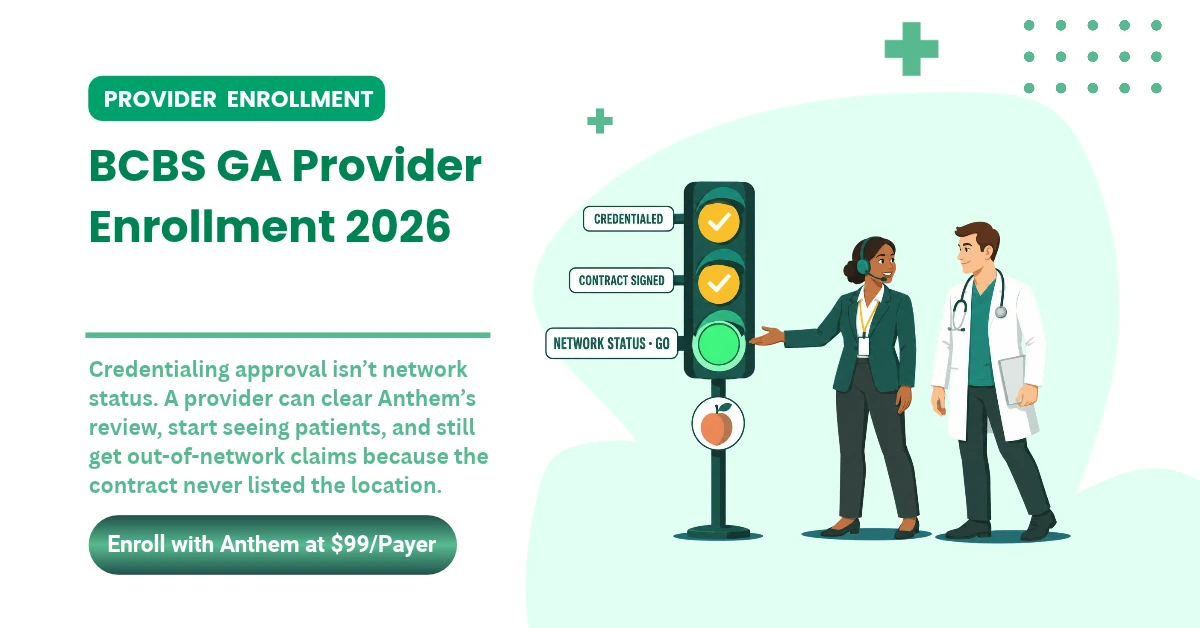
9. Provider not credentialed with payer. Submitting claims before completing payer credentialing and enrollment. It doesn't matter how good your documentation is; claims from non-credentialed providers get denied automatically.
10. Expired or missing prior authorization. Some payers require authorization after a set number of sessions. Claims submitted after authorization expiration get denied retroactively, and by that point, the timely filing window for a corrected claim may have already closed.
Managing claim denials is one of the most time-consuming parts of behavioral health billing. MedSole RCM's denial management services identify denial patterns, resolve outstanding claims, and put preventive measures in place to reduce future denials.
How to Handle CPT Code 90834 Claim Denials
When a CPT code 90834 claim is denied, the first step is to review the Explanation of Benefits (EOB) or Electronic Remittance Advice (ERA) to identify the specific denial reason code. The reason code tells you exactly what went wrong and what corrective action to take. Skipping this step and resubmitting blindly wastes time and rarely works.
Understanding Denial Reason Codes
Here are the denial categories we see most often on 90834 CPT code claims, along with the reason codes and what to do about each one:
|
Denial Category |
Common Reason Codes |
Action Required |
|
Time documentation missing |
CO-16, CO-4 |
Add start/stop times, resubmit as corrected claim |
|
Authorization required or expired |
CO-197, PI-15 |
Obtain retroactive auth or appeal with clinical justification |
|
Service not covered under plan |
CO-96, CO-50 |
Verify benefits, contact payer, or bill patient directly |
|
Duplicate claim |
CO-18 |
Review claim history, verify date of service |
|
Incorrect modifier |
CO-4, CO-252 |
Correct modifier (e.g., add Modifier 95 for telehealth), resubmit |
|
Provider not credentialed |
CO-185 |
Complete credentialing, resubmit after enrollment effective date |
|
Bundling/NCCI edit |
CO-97 |
Review same-day billing, correct code combination |
What usually happens in practices without a denial workflow: the EOB comes back, nobody reads the reason code, and the claim sits untouched. By the time someone gets to it, the appeal deadline has passed.
Steps to Appeal a Denied 90834 Claim
-
Review the EOB/ERA. Identify the exact denial reason code and any remark codes attached to it.
-
Determine if it's correctable. If the denial is due to a fixable error like a wrong modifier or missing time, correct and resubmit as a corrected claim, not a new one.
-
Gather supporting documentation. For medical necessity denials, compile the treatment plan, progress notes, and a written clinical rationale explaining why psychotherapy at this frequency and duration is required.
-
Submit a written appeal. Include a cover letter citing the specific denial reason, the corrective action taken, and all supporting clinical documentation.
-
Track appeal timelines. Most payers have appeal submission deadlines, typically 60 to 180 days from the denial date. Miss the window, and you've waived your appeal rights entirely.
-
Escalate if needed. If the first-level appeal is denied, most payers allow a second-level appeal. Contact your payer representative directly, or have the patient call member services to add pressure from their side.
Managing CPT code 90834 denials and appeals requires dedicated staff time and expertise in payer-specific rules. MedSole RCM's claims denial management team handles the entire appeal process, from initial denial analysis through resolution, as part of our comprehensive outsourced medical billing services at 2.99% of collections.
Compliance Best Practices and Audit Triggers for CPT Code 90834
In 2026, payer scrutiny of psychotherapy codes has intensified. Accurate time documentation, clinical note quality, and medical necessity justification aren't just best practices anymore. They're the difference between keeping your revenue and facing post-payment audits with recoupment demands.
What Triggers a 90834 Audit
Six patterns consistently draw payer attention:
-
Consistently billing at the top of the time range. Sessions documented at exactly 52 minutes every week raise flags. Payers see it as gaming the system to avoid 90837 while maximizing 90834 CPT code reimbursement.
-
Identical or near-identical progress notes. Copy-forwarded notes across sessions suggest the documentation isn't individualized. Audit systems now run text similarity analysis across a provider's notes.
-
High ratio of 90837 to 90834 billing. Payers compare your code mix against specialty averages. A provider billing 90837 at twice the national rate for their specialty will get flagged, even if every session is legitimately documented.
-
Missing risk assessments. Especially for patients with diagnoses associated with self-harm risk (F60.3, F43.10). Auditors check for documented risk assessment on every note, and a missing one calls the entire note's thoroughness into question.
-
Billing frequency exceeding clinical norms. Daily psychotherapy sessions without documented clinical justification for that intensity level.
-
Telehealth sessions without proper modifier and POS documentation. Claims for home-based telehealth using POS 11 instead of POS 10 is a red flag that suggests the billing team isn't distinguishing between in-person and virtual visits.
Compliance Recommendations
-
Run monthly internal audits on a random sample of CPT code 90834 claims, checking time documentation accuracy
-
Set up EHR-based automatic start/stop time capture to eliminate manual entry errors
-
Schedule quarterly provider training on time thresholds and documentation requirements
-
Compare your 90834/90837 code mix quarterly against specialty benchmarks
-
Make sure every note clearly supports the code billed, especially the time threshold separating 90834 from 90837
-
For telehealth notes, document patient consent, communication method, and both provider and patient locations
If your practice doesn't have the staff or expertise to run regular billing audits, MedSole RCM's accounts receivable follow-up process includes proactive claim auditing and correction before issues become recoupment demands.
How to Bill CPT Code 90834: Step-by-Step Process
Billing CPT code 90834 accurately requires following a structured process from patient eligibility verification through claim submission and payment posting. Skip a step, and you're looking at denials, delays, or underpayments. Here's the full workflow.
Step 1: Verify patient eligibility and benefits.
Before the session, confirm the patient's insurance coverage for the 90834 billing code. Check covered services, copay and coinsurance amounts, session frequency limits, prior authorization requirements, and remaining benefits for the calendar year. A two-minute verification call prevents a $114 denial.
Step 2: Confirm provider credentialing status.
Verify that the rendering provider is credentialed and enrolled with the patient's insurance payer. Claims submitted by non-credentialed providers get denied regardless of how good the documentation is. No exceptions.
Step 3: Conduct and document the session.
Provide the psychotherapy session. Document all required elements from Section 6: exact start/stop times, ICD-10 diagnosis, specific interventions used, patient response, risk assessment, treatment plan progress, and clinical plan forward. Confirm session duration falls within 38 to 52 minutes of face-to-face time.
Step 4: Select the correct code and modifiers.
Select CPT 90834 if face-to-face time was 38 to 52 minutes. Append Modifier 95 for telehealth sessions. If E/M was also performed by the same clinician, use +90836 with the E/M code instead of standalone 90834. Pick the correct Place of Service code (11 for office, 10 for patient at home, 02 for other telehealth locations).
Step 5: Prepare the CMS-1500 claim form.
Enter the following on the CMS-1500:
-
Box 21: ICD-10 diagnosis code(s)
-
Box 24A: Date of service
-
Box 24B: Place of Service code (11, 02, or 10)
-
Box 24D: CPT code 90834 (with modifier if applicable)
-
Box 24F: Charge amount
-
Box 24J: Rendering provider NPI
Step 6: Submit the claim.
Submit electronically through your clearinghouse or EHR billing system. Electronic submission reduces errors and speeds up processing compared to paper claims.
Step 7: Monitor claim status and post payment.
Track claim status through your clearinghouse. When payment arrives, post the ERA/EOB to the patient account. Identify and work any underpayments, partial denials, or full denials promptly. Claims that sit unworked past 30 days start costing you money in timely filing risk.
Frequently Asked Questions About CPT Code 90834
What is CPT code 90834?
CPT code 90834 is the standard billing code for individual psychotherapy sessions lasting approximately 45 minutes. It covers face-to-face psychotherapy lasting 38 to 52 minutes, provided by a licensed mental health professional in an outpatient setting. The American Medical Association established this code as part of the CPT code set.
What is the time range for CPT code 90834?
The 90834 time range is 38 to 52 minutes of face-to-face psychotherapy. Sessions shorter than 38 minutes should be billed with 90832 (16 to 37 minutes), and sessions lasting 53 minutes or more should use 90837. Only direct therapeutic time counts. Administrative activities are excluded.
What is the 90834 CPT code description?
The official 90834 CPT code description, per the American Medical Association, is "Psychotherapy, 45 minutes with patient and/or family member." CMS further defines services under 90834 as insight oriented, behavior modifying, supportive, and/or interactive psychotherapy provided in an outpatient setting.
What is the difference between CPT code 90834 and 90837?
The primary difference is session duration. CPT 90834 covers psychotherapy sessions lasting 38 to 52 minutes, while CPT 90837 covers sessions lasting 53 minutes or more. 90837 reimburses 30% to 40% higher, but it faces greater payer scrutiny and audit risk than 90834.
How much does CPT code 90834 reimburse?
90834 CPT code reimbursement varies by payer and location. The 2026 Medicare national average is approximately $113.90 per session (non-facility). Commercial insurance rates typically range from $100 to $175. Medicaid rates range from $60 to $80 depending on the state.
Who can bill CPT code 90834?
Licensed mental health professionals can bill the 90834 CPT code, including psychiatrists (MD/DO), psychologists (PhD/PsyD), licensed clinical social workers (LCSWs), licensed professional counselors (LPCs), licensed marriage and family therapists (LMFTs), licensed mental health counselors (LMHCs), and psychiatric mental health nurse practitioners (PMHNPs).
Can CPT code 90834 be billed for telehealth?
Yes. CPT code 90834 can be billed for telehealth sessions by appending Modifier 95 (synchronous audio-video) and using the correct Place of Service code: POS 10 for patient at home, POS 02 for patient at another location. Medicare permanently allows behavioral health telehealth in the patient's home without geographic restrictions.
Can you bill 90834 twice in one day?
In most cases, no. Billing code 90834 is typically reimbursed only once per day by most payers. Some insurers further limit frequency to twice per week. The exception applies to partial hospitalization programs (PHP) and intensive outpatient programs (IOP), where multiple psychotherapy units may be reported per the 2026 NCCI Policy Manual.
Can 99215 and 90834 be billed together on the same day?
No. Per the 2026 NCCI Policy Manual, standalone psychotherapy code 90834 can't be billed alongside E/M codes (99201 through 99215) by the same provider on the same date of service. If both E/M and psychotherapy are provided, use the E/M code plus add-on code +90836 instead.
Does CPT code 90834 require prior authorization?
Prior authorization requirements for CPT code 90834 vary by payer. Most commercial plans don't require prior authorization for standard 45-minute psychotherapy sessions. Some payers require authorization after a set number of sessions per year. Medicare generally doesn't require prior authorization for 90834. Always verify with each payer.
What documentation is required for CPT code 90834?
Documentation for CPT 90834 must include exact session start and stop times, patient diagnosis (ICD-10), specific clinical interventions used, patient response, risk assessment, progress toward treatment goals, and plan forward. CMS requires documented start and stop times for all time-based psychotherapy codes. This is the most common 90834 CPT code documentation requirement that practices miss.
What ICD-10 codes are commonly used with 90834?
Common diagnosis codes paired with CPT 90834 include F32.x (Major Depressive Disorder, single episode), F33.x (Major Depressive Disorder, recurrent), F41.1 (Generalized Anxiety Disorder), F43.10 (PTSD), F43.21 (Adjustment Disorder with depressed mood), and F34.1 (Dysthymic Disorder). Always code to the highest level of specificity available.
What is the difference between 90834 and 90836?
CPT code 90834 is a standalone psychotherapy code used when no E/M service is performed on the same day. CPT 90836 is the add-on psychotherapy code (same 38 to 52 minute range) used when psychotherapy is performed alongside an E/M service by the same clinician on the same date. You can't bill 90836 alone.
Can 90791 and 90834 be billed on the same day?
No. Per the 2026 NCCI Policy Manual, psychiatric diagnostic evaluation (90791 or 90792) can't be reported separately with psychotherapy codes (90832 through 90838) on the same date of service by the same provider. If it's an intake day, bill the diagnostic evaluation code only.
Is CPT code 90834 covered by Medicare?
Yes. CPT code 90834 is covered by Medicare for individual psychotherapy provided by eligible clinicians. The 2026 Medicare reimbursement rate is approximately $113.90 (national average, non-facility). Starting in 2024, LMFTs and LMHCs can also bill Medicare for 90834 at 75% of the psychologist rate.
Simplify Your 90834 Billing with MedSole RCM
The 90834 CPT code is the most commonly billed code in outpatient behavioral health. Billing it correctly is essential for maintaining cash flow, avoiding audits, and staying compliant with CMS and payer-specific requirements.
Here's what it comes down to: 38 to 52 minutes of face-to-face time, documented with exact start/stop times, proper Modifier 95 usage for telehealth, same-day billing restrictions per the 2026 NCCI Policy Manual, ICD-10 codes at the highest specificity level, and awareness that the 2026 Medicare rate sits at approximately $113.90. These requirements change annually. Keeping up with them is practically a full-time job on its own.
MedSole RCM specializes in behavioral health billing for practices of all sizes. Our team handles the full revenue cycle, from provider enrollment and credentialing at $99 per insurance payer to end-to-end claim submission, denial management, and payment posting.
MedSole RCM offers outsourced medical billing services at 2.99% of collections, the most competitive rate in the industry, with no setup fees and no long-term contracts. Our clients typically see a 15% to 25% increase in collections within the first 90 days.
Whether you need help with 90834 billing accuracy, telehealth modifier compliance, payer credentialing, or denial resolution, MedSole RCM has the expertise to manage your revenue cycle so you can focus on patient care.
When you're ready, contact MedSole RCM for a free billing assessment and see how much revenue your practice is leaving on the table.