



Pediatric CPT codes report services for patients from birth through age 17, and they fall into eight families. Three things separate them from adult codes: you select preventive codes by age band, you count immunization administration by component rather than by injection, and Medicaid EPSDT rules sit on top of commercial payer rules.
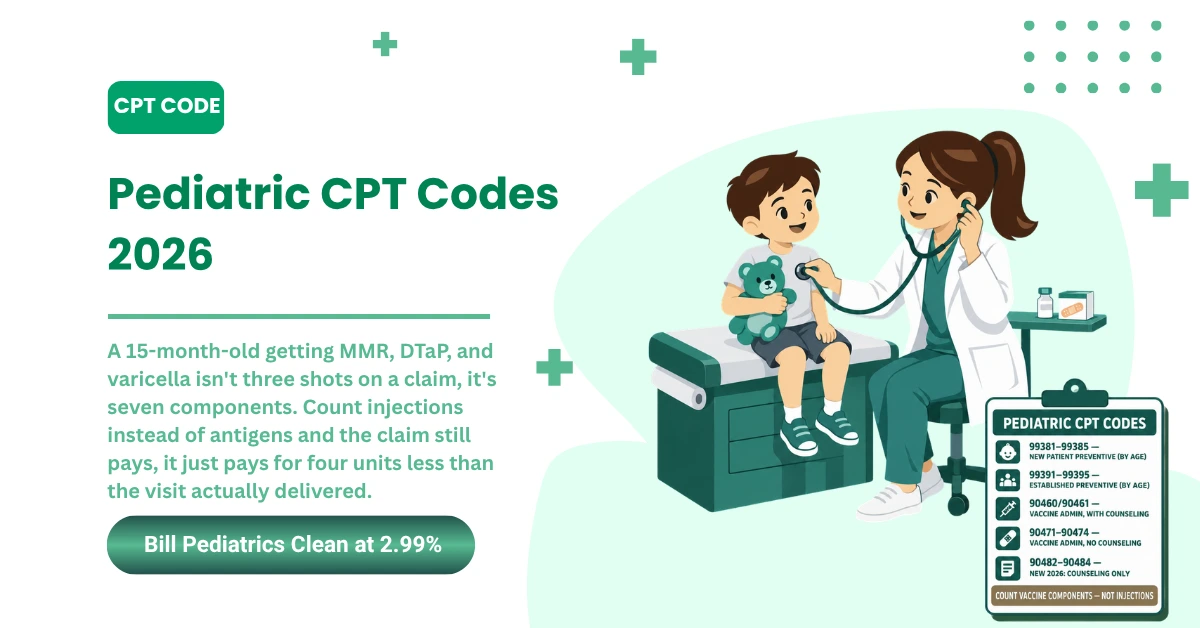
A child turns five the day before her checkup, and the code changes. A biller counts three injections instead of seven antigens, and the practice underbills that encounter by four units. Both mistakes trace back to the same place, which is a missing edit at charge capture.
You'll find all eight families below, the 2026 additions, the age limits payers enforce on cpt codes pediatrics claims, the ICD-10 pairings, and the denials that drive the most pediatric billing rework. Every rule here reflects how pediatric CPT codes get paid in 2026, not how they read in a code book. The MedSole RCM team built this from pediatric coding work we do every week, and it carries the October 1, 2026 ICD-10 changeover.
What Are Pediatric CPT Codes, and Which Families Does a Pediatric Practice Bill?
A pediatric practice bills eight CPT code families. Seven of them carry age restrictions or age-band selection rules, and the eighth applies the same way at any age. Place a service in the right family first, and most questions about which pediatric code to use answer themselves.
The Eight Pediatric CPT Code Families
These four cover the office and the nursery:
- 99381 to 99385: New patient preventive medicine (first well-child visit at your practice)
- 99391 to 99395: Established patient preventive medicine (annual and periodic well visits)
- 99202 to 99215: Office and outpatient E/M (sick visits, follow-up, chronic care)
- 99460 to 99465: Newborn care (hospital, birthing center, delivery attendance, resuscitation)
These four cover the unit, the vaccine cart, and the screening forms:
- 99468 to 99480: Neonatal and pediatric critical and intensive care (NICU, PICU, by age tier)
- 90460 to 90461: Immunization administration with counseling (through age 18, per component)
- 90471 to 90474: Immunization administration without counseling (by route, per vaccine)
- 96110 to 96127: Developmental and behavioral screening (ASQ, M-CHAT, PHQ-9, Vanderbilt)
Office E/M is the one family that works the same for a 4-year-old and a 44-year-old. Everything else shifts with the patient's age. We group every code set this way, and you can see the same logic applied to a much larger range in our radiology code range guide.
How Pediatric CPT Codes Differ From Adult CPT Codes
Four mechanisms separate the pediatric cpt codes list from the adult one, and each creates its own denial pattern:
- Preventive codes split into five age bands under 18. Adult preventive coding uses three bands across a 50-year span.
- Immunization administration counts antigen components under 90460 and 90461. Adult administration counts injections under 90471 and 90472.
- Critical care splits by patient age for anyone under 6. Adults run on a single time-based structure.
- Medicaid EPSDT adds a rule layer that adult claims never carry, and it changes state by state.
That fourth one catches experienced coders. A pediatric billing codes workflow tuned for commercial payers can deny under a state Medicaid plan while every code on the claim is correct. Pediatric coding guidelines live in two places, which are the CPT book and your state manual.
Pediatric Vaccine Administration CPT Codes: 90460, 90461, and the 90471 Series
Vaccine administration produces more claim lines than any other service in a pediatric practice. A single 2-month well visit can generate a preventive line, four product lines, and seven administration units. Practices lose more revenue here than anywhere else in the pediatric cpt codes set, which is why this family comes first.
90460 and 90461: When Counseling Is Documented
Code 90460 reports the first or only component of each vaccine administered to a patient through 18 years of age, when a physician or qualified health care professional provides face-to-face counseling. Code 90461 reports each additional component of that same vaccine. Counseling is the only thing separating this pair from the 90471 series.
The AMA descriptor reads through 18 years of age, which includes the patient's eighteenth year. Several published guides state "under 18," and that reading costs a practice every 18-year-old encounter. Check the boundary in your charge master. An age edit built on the wrong rule blocks a payable claim, and no denial code tells you why.
Documentation has to identify who performed the counseling, confirm it happened face to face with the patient or family, and support the number of components addressed. A template line saying counseling occurs at every visit won't survive a payer review.
How to Count Components, Not Injections
A component is each antigen that prevents disease caused by one organism. Count antigens, and the units follow. The table below matches the AAP immunization coding guidance most pediatric coders work from.
|
Vaccine |
Components |
Report |
|---|---|---|
|
Hepatitis A |
1 |
90460 x 1 |
|
Varicella |
1 |
90460 x 1 |
|
Influenza |
1 |
90460 x 1 |
|
HPV |
1 |
90460 x 1 |
|
MMR |
3 |
90460 x 1, 90461 x 2 |
|
DTaP |
3 |
90460 x 1, 90461 x 2 |
|
Pentacel (DTaP, Hib, IPV) |
5 |
90460 x 1, 90461 x 4 |
Run the arithmetic on a real encounter. A 15-month-old gets MMR, DTaP, and varicella at one visit. That's 90460 x 3, one for the first component of each product, plus 90461 x 4 for the extras. Report 90460 x 1 with 90461 x 6 instead, and you underbill by two units on a claim that still pays.
90471 Through 90474, and the Mixed Claim Nobody Explains
Codes 90471 and 90472 cover injected routes. Codes 90473 and 90474 cover intranasal and oral. You use this series when counseling wasn't provided or the patient is over 18, and our 90471 administration billing guide breaks down the route rules in detail.
CPT permits reporting 90460 and 90461 alongside 90471 through 90474 on the same date when the provider counseled on some vaccines but not all of them. Payer edits treat that split differently from one plan to the next. Confirm plan-level policy before you build it into a charge capture template, because mixed-family claims deny often. Product and administration also bill as separate line items, a point the Colorado Medicaid immunizations manual makes explicit.
One more trap worth flagging. Code 99211 isn't separately reportable with immunization administration. The nurse work is already inside the administration code. Billing 99211 for a vaccine-only visit produces a bundling denial that appeals rarely reverse.
New for 2026: Stand-Alone Immunization Counseling Codes 90482, 90483, and 90484
What the 2026 Counseling Codes Cover
Three codes joined the pediatric cpt codes set on January 1, 2026. Codes 90482, 90483, and 90484 report immunization counseling by a physician or qualified health care professional when the recommended immunization is not administered on the same date. The AAP stand-alone counseling codes notice sets a 3-minute floor. Selection runs on total counseling time.
|
Code |
Counseling time |
Work RVU |
|---|---|---|
|
90482 |
3 minutes up to and including 10 minutes |
About 0.24 |
|
90483 |
Greater than 10 minutes up to and including 20 minutes |
About 0.50 |
|
90484 |
Greater than 20 minutes |
About 0.75 |
You can deliver the service in person, by audio-video, or audio-only. That flexibility matters for a family who declines by phone after a visit.
The Four Rules That Decide Whether the Claim Pays
The code list is easy. The rules underneath it are where practices lose money, and the AAP 2026 counseling Q and A spells out the ones that matter:
- Report only one of the three codes per date of service, no matter how many vaccines came up.
- Count only the time you spent on vaccines that were not given. Time spent counseling on vaccines you did administer doesn't count toward the threshold. That rule appears almost nowhere else, and it's the one that fails on audit.
- Keep the service distinct from any same-day E/M and from vaccine administration. When you report a counseling code alongside an E/M, modifier 25 goes on the E/M code.
- Document total counseling time, the vaccines discussed, and the outcome, which is declination, deferral, or a scheduled return.
Pair the claim with the right diagnosis. Z71.85 covers an encounter for immunization safety counseling. For refusal, the Z28 series applies, including Z28.21, Z28.82, and Z28.89. Those pairings decide whether a payer reads the encounter as preventive.
Why Payer Coverage Is Inconsistent
These codes aren't tied to a USPSTF A or B recommendation, so the ACA preventive coverage mandate doesn't reach them. Payer adoption stays discretionary. Coverage determinations, benefit classification, and payment decisions vary, and some national commercial plans have published policies recognizing them under preventive benefits while others haven't moved.
Verify fee schedule placement with each payer before you submit. Checking placement across a full pediatric payer panel takes a few hours of phone work most front offices can't spare. If that task is sitting on someone's desk right now, our team runs payer verification as part of a free billing review.
Well-Child Visit CPT Codes by Age: 99381 to 99385 and 99391 to 99395
New Patient Preventive Codes, 99381 to 99385
You select pediatric CPT codes for preventive visits on the patient's age at the date of service and on patient status, not on time and not on medical decision-making. That single rule settles most cpt pediatric codes questions. The new patient series runs:
- 99381: Infant, younger than 1 year
- 99382: Early childhood, 1 to 4 years
- 99383: Late childhood, 5 to 11 years
- 99384: Adolescent, 12 to 17 years
- 99385: 18 to 39 years
The 99381 cpt code description age limit is under 1 year, the 99383 cpt code age limit is 5 through 11, and the 99384 cpt code age limit is 12 through 17. Age on the date of service governs all three.
Established Patient Preventive Codes, 99391 to 99395
Same bands, different series. Established patients use:
- 99391: Infant, younger than 1 year
- 99392: Early childhood, 1 to 4 years
- 99393: Late childhood, 5 to 11 years
- 99394: Adolescent, 12 to 17 years
- 99395: 18 to 39 years
CPT 99391 carries the busiest year in pediatrics. It covers the 2-week, 2-month, 4-month, 6-month, 9-month, and 12-month visits, which means one code appears on six claims before the child's first birthday. State Medicaid programs often attach an add-on service code to these visits to trigger an enhanced rate, and the MassHealth EPSDT billing guidelines show how that mechanic works in practice.
The 99392 age limit is 1 through 4 years, and cpt code 99392 moves to 99393 on the fifth birthday. A claim carrying cpt 99392 for a 5-year-old denies on age even when everything else is right. The 99393 age limit runs 5 through 11. Every one of these transitions happens on a birthday, not at the start of a plan year.
The 99385 and 99395 Age Band Everyone Gets Wrong
CPT 99385 and 99395 cover ages 18 through 39. "Adolescent" is the wrong label for that band, and several widely cited sources apply it anyway. A patient who turns 18 moves out of 99384 and 99394, and the next transition doesn't arrive until 40. Our 99385 age limit rules guide covers the new patient side in full.
The adult tail matters for practices that keep patients into young adulthood. The 99385 cpt code age limit and the 99395 cpt code description age both stop at 39. The 99386 age limit and the 99396 cpt code description age run 40 through 64. Codes 99387 and 99397 start at 65.
|
Age band |
New patient |
Established patient |
|---|---|---|
|
Younger than 1 year |
99381 |
99391 |
|
1 to 4 years |
99382 |
99392 |
|
5 to 11 years |
99383 |
99393 |
|
12 to 17 years |
99384 |
99394 |
|
18 to 39 years |
99385 |
99395 |
|
40 to 64 years |
99386 |
99396 |
|
65 years and older |
99387 |
99397 |
Every Age From Birth to 18, in One Lookup
Front desk staff don't think in bands. They think in birthdays. This lookup maps preventive visit cpt codes by age for a single year of life, and it answers the cpt age range question a scheduler asks at the front counter. Pin it next to the schedule, because most pediatric cpt codes errors start there.
|
Patient age |
New patient |
Established patient |
|---|---|---|
|
Under 1 |
99381 |
99391 |
|
1 |
99382 |
99392 |
|
2 |
99382 |
99392 |
|
3 |
99382 |
99392 |
|
4 |
99382 |
99392 |
|
5 |
99383 |
99393 |
|
6 |
99383 |
99393 |
|
7 |
99383 |
99393 |
|
8 |
99383 |
99393 |
|
9 |
99383 |
99393 |
|
10 |
99383 |
99393 |
|
11 |
99383 |
99393 |
|
12 |
99384 |
99394 |
|
13 |
99384 |
99394 |
|
14 |
99384 |
99394 |
|
15 |
99384 |
99394 |
|
16 |
99384 |
99394 |
|
17 |
99384 |
99394 |
|
18 |
99385 |
99395 |
Three rows carry most of the volume. A 4-year-old established patient is 99392. A 9-year-old established patient is 99393. A 15-year-old established patient is 99394. Those three answer most scheduling questions and most cpt code well visit lookups.
New Patient Versus Established, and the Three-Year Rule
A patient counts as new only when no professional service came from that physician, or another physician of the same specialty in the same group, within the past three years. New doesn't mean new to you. A child transferring from another practice is a new patient when you document the transfer.
Billing 99381 for a returning infant produces a duplicate-service denial, and it's the second most common preventive error we see after age mismatch.
School and sports physicals get one more note. No separate code exists. Use the age-appropriate preventive code, and select the icd 10 code for school physical that matches how the encounter got documented.
Pediatric Sick Visit CPT Codes and the Modifier 25 Rule
Sick Visit Codes, 99202 to 99215
Problem-oriented pediatric visits use the office and outpatient E/M codes, and you select them on medical decision-making or total time on the date of encounter, not on exam bullet points. That change took effect in 2021 and still trips up practices running older templates.
|
Code |
Patient status |
MDM level |
Total time |
|---|---|---|---|
|
99202 |
New |
Straightforward |
15 to 29 minutes |
|
99203 |
New |
Low |
30 to 44 minutes |
|
99204 |
New |
Moderate |
45 to 59 minutes |
|
99205 |
New |
High |
60 to 74 minutes |
|
99212 |
Established |
Straightforward |
10 to 19 minutes |
|
99213 |
Established |
Low |
20 to 29 minutes |
|
99214 |
Established |
Moderate |
30 to 39 minutes |
|
99215 |
Established |
High |
40 to 54 minutes |
Two corrections belong here. Code 99213 runs 20 to 29 minutes, and a number of published sick visit cpt codes charts still describe it as a 15-minute visit. Code 99201 was deleted on January 1, 2021, and guides that still list it are running on a pre-2021 code set. Our new patient E/M selection guide walks through the MDM elements behind each level.
Billing a Well Visit and a Sick Visit on the Same Day
You can bill both on the same date when the problem-oriented service is significant and separately identifiable. Modifier 25 goes on the office E/M code, never on the preventive code. Your documentation has to carry a separate assessment and plan for the acute problem.
Take a 6-year-old who comes in for a routine well visit and turns out to have an ear infection. You report 99393 with the routine child health examination diagnosis, then 99213 with modifier 25 and the otitis diagnosis. Two services, two diagnoses, two assessments in the note.
One standard decides the audit. A single note covering one chief complaint won't support two billable services, whatever modifier you append. A trivial problem mentioned during a preventive visit isn't separately reportable, and that's the distinction payers review hardest. The cpt code for sick visit only stands up when the work behind it does.
Modifier 25 draws more payer review than any other modifier in pediatrics, and most downcoded claims fail on documentation rather than on code choice. If your modifier 25 claims keep getting pulled, that pattern usually sits in the note template, and it's fixable. Our pediatric billing specialty support team audits exactly this for practices before it turns into a recoupment.
Developmental, Behavioral, and Ancillary Screening Codes
96110 and 96127, and How Many Units You Can Report
Code 96110 reports developmental screening per standardized instrument, with scoring and documentation. Code 96127 reports a brief emotional or behavioral assessment. Both are separately reportable alongside a preventive E/M, and both show up on more pediatric cpt codes claims than most practices realize. See our 96110 developmental screening billing breakdown for payer-by-payer age policy.
Instrument names matter on the claim and in the chart. Code 96110 covers the ASQ, M-CHAT, and PEDS. Code 96127 covers the PHQ-9, GAD-7, Vanderbilt, and SCARED. There's no published cpt 96110 age limit in the code itself, though state Medicaid programs set their own frequency and age caps.
The unit rule gets stated wrong more than any other part of this family. You report 96110 per instrument administered, scored, and documented. Two distinct tools support two units, so an ASQ plus an M-CHAT at the same visit supports 96110 x 2. Our behavioral assessment code rules guide covers the 96127 side.
Documentation needs three things: the instrument name, the score, and the next step. "Screened, normal" fails all three. "ASQ-3 completed, communication domain below cutoff, referred to speech therapy" holds up.
Is CPT 96160 Deleted?
Code 96160 is not deleted. It remains active in 2026 with a Medicare rate near three dollars and roughly 0.09 RVUs. The code that was deleted is 99420, on January 1, 2017, and the AMA replaced it with 96160 and 96161, as the AAP health risk assessment codes announcement documented at the time.
The two codes split by who fills out the form. Code 96160 reports a patient-focused health risk assessment. Code 96161 reports a caregiver-focused instrument administered for the benefit of the patient, which in pediatrics usually means postpartum depression screening at a well-baby visit, billed under the child's patient ID.
The Screening Edits That Cost the Most
Two NCCI relationships hit the highest-volume screening codes, and almost no pediatric coding reference covers either one.
First, an edit exists between 96160 and 96161 and the vaccine administration codes 90460, 90461, and 90471 through 90474. Modifier 59 can override it when the services are separate and the documentation shows it. Second, 96161 bundles with 96110 when you report both on the same date of service.
The rest of the ancillary set rounds out a well visit:
- 99173: Visual acuity screening, quantitative, bilateral. No 99173 age limit sits in the code, though payers apply their own.
- 99177: Instrument-based ocular photoscreening with on-site analysis
- 92551: Pure tone hearing screening, air only
- 92567: Tympanometry, when a middle ear problem is suspected
- 92587 and 92588: Otoacoustic emissions, limited and comprehensive
- 96112 and 96113: Developmental test administration, first hour and each additional 30 minutes
- 99188: Topical fluoride varnish application
Newborn, Neonatal, and Pediatric Critical Care Codes
Newborn Care, 99460 to 99465
Newborn care runs on its own family, separate from both the preventive series and the inpatient E/M codes. Setting and timing pick the code:
- 99460: Initial hospital or birthing center care per day, normal newborn
- 99461: Initial care per day, normal newborn outside a hospital or birthing center
- 99462: Subsequent hospital care per day, normal newborn
- 99463: Initial care, normal newborn admitted and discharged the same date
- 99464: Attendance at delivery at the request of the delivering provider
- 99465: Delivery or birthing room resuscitation
A three-day newborn stay generates 99460 on day one and 99462 on days two and three. Report 99460 three times and you get duplicate-service denials that appeals rarely reverse. Several guides describe 99462 as the discharge-day code, and that's wrong. It covers subsequent care per day, discharge or not.
The cpt code for newborn screening sits outside this family too. Specimen collection and the metabolic panel bill separately from newborn care, and a practice that folds cpt code newborn screening into 99460 leaves that payment on the table.
Critical Care by Age Tier, 99468 to 99480
Pediatric critical care gets assigned by patient age for anyone under 6, which is the structural difference from adult critical care.
|
Patient age |
Initial day |
Subsequent day |
|---|---|---|
|
28 days or younger |
99468 |
99469 |
|
29 days through 24 months |
99471 |
99472 |
|
2 through 5 years |
99475 |
99476 |
|
6 years and older |
99291, first 30 to 74 minutes |
99292, each additional 30 minutes |
Codes 99291 and 99292 apply to critically ill patients aged 6 and older, and to time-based critical care delivered outside the inpatient units. Neonates who need intensive observation without critical care use 99477 for initial care, then 99478, 99479, or 99480 for subsequent days, selected by present body weight.
One bundling warning closes this family. Routine NICU and PICU work, including pulse oximetry, ventilator management, and certain lab interpretations, is already inside the daily critical care code. Reporting those separately generates denials and audit flags on high-dollar claims.
RSV Immunization Coding: 90380, 90381, 96380, and 96381
Product and Administration Codes
RSV monoclonal antibody prophylaxis uses its own product and administration codes, and the standard vaccine administration codes don't apply to it. The AAP RSV administration codes guidance lays out the pairing:
- 90380: RSV monoclonal antibody, seasonal dose, 0.5 mL (50 mg), intramuscular
- 90381: RSV monoclonal antibody, seasonal dose, 1 mL (100 mg), intramuscular
- 96380: Administration with counseling by a physician or qualified health care professional
- 96381: Administration without same-date counseling by that provider
Choose between 96380 and 96381 on one fact, which is whether the physician or qualified health care professional counseled on the same date as administration. Clesrovimab now uses the same administration codes as nirsevimab.
The Two Rules That Cause Most RSV Denials
Do not report 90471 or 90472 for nirsevimab. Those codes are limited to vaccine and toxoid products. Nirsevimab is a monoclonal antibody, so the injection codes a biller reaches for out of habit belong to the wrong family entirely.
Report Z29.11, not Z23. Code Z23 is specific to immunization against vaccines, while Z29.11 covers an encounter for prophylactic immunotherapy for respiratory syncytial virus. Pairing an RSV administration line with Z23 produces a clean-looking claim that denies, and AAP nirsevimab coding and payment keeps the current position on both codes.
Modifier 33 signals the service is preventive when you report it alongside a preventive visit. On a same-day encounter, the preventive E/M carries modifier 25 because it's significant and separate from the injection procedure. The product itself comes through the Vaccines for Children program in participating state Medicaid programs, reported at zero dollars, with administration billed separately.
Pediatric Modifiers: 25, 59, 63, and the 2026 Change to Modifier 33
The Four Modifiers That Decide Pediatric Payment
Four modifiers carry most pediatric claims. Getting the placement right matters as much as picking the modifier.
|
Modifier |
Applies when |
Goes on |
|---|---|---|
|
25 |
A significant, separately identifiable E/M accompanies another service |
The E/M code |
|
59 |
Two distinct procedural services and no other modifier fits |
The lower-valued code |
|
63 |
A procedure on an infant weighing less than 4 kilograms |
The surgical code |
|
33 |
A service that could be preventive or diagnostic is delivered as preventive |
The service code |
Modifier 63 carries limits that most pediatric coding guidelines skip. It applies only to surgical codes in the 20000 to 69999 range. It doesn't apply to E/M services. It doesn't apply to codes whose descriptor already specifies a neonatal or infant service. Document the infant's exact weight on the date of service, because that weight is the whole justification.
What Changed About Modifier 33 in 2026
The AMA revised the modifier 33 descriptor for 2026 to clarify that modifier 33 is not required on services that are inherently preventive. Preventive medicine codes 99381 through 99387 and 99391 through 99397 are inherently preventive, so they don't carry it.
Modifier 33 belongs on codes describing services that could be delivered for either a preventive or a diagnostic purpose. Append it to every preventive line and you add a claim element with no payment effect and some edit risk.
Modifier 59 deserves one caution. Overuse flags an audit. Use it when the services are separate, and check whether your payer prefers XS or XE instead. Delivery method changes the modifier picture again, and our modifier 95 and POS rules guide covers pediatric telehealth claims.
Pediatric ICD-10 Codes: Z00.129, Z00.121, and What Changes on October 1, 2026
Well-Child Visit Diagnosis Codes
Code Z00.129 reports an encounter for routine child health examination without abnormal findings. Code Z00.121 reports the same encounter with abnormal findings. Those two carry most pediatric preventive claims, and picking between them decides whether a same-day problem visit survives review.
Use Z00.121 when the visit turns up a new problem that needs a plan of care. Use Z00.129 when the exam is normal and nothing new comes up. Z00.121 also supports a separately billed problem-oriented service on the same date, which is why the icd 10 code for well child exam you pick has to match what the provider documented.
Newborns get their own variants. Code Z00.110 covers health supervision of a newborn under 8 days old, and Z00.111 covers 8 through 28 days.
On age: neither Z00.129 nor Z00.121 carries a numeric ceiling in the code set. The z00.129 age range and the z00.121 age limit both run on encounter type, which is a routine child health examination, rather than on a stated cutoff. At 18 the encounter typically moves to the general adult examination codes Z00.00 and Z00.01.
The Most-Used Pediatric ICD-10 Codes by Category
Grouping these by body system beats an alphabetical list, because that's how a coder searches. Each group pairs with a CPT partner.
Preventive, paired with 99381 to 99395: Z00.129, Z00.121, Z00.110, Z00.111, Z23, and Z02.5 for the sports physical.
Respiratory, paired with 99213 and 99214: J06.9 upper respiratory infection, J02.9 acute pharyngitis, J45.909 unspecified asthma, J21.9 acute bronchiolitis, and J20.9 acute bronchitis.
Ear, paired with 99213: H66.90 unspecified otitis media, plus H66.91, H66.92, and H66.93 for right, left, and bilateral acute otitis media.
Developmental and behavioral, paired with 96110 and 96127: F90.0, F90.1, and F90.2 for the ADHD presentations, F84.0 autistic disorder, and the F80 speech and language series. Our ADHD ICD-10 documentation guide covers the subtype documentation payers ask for.
Counseling, paired with 99401 to 99404 and the 2026 immunization counseling codes: Z71.3 dietary counseling, Z71.82 exercise counseling, Z71.85 immunization safety counseling, and Z28.21 immunization refused by the patient.
The October 1, 2026 ICD-10 Changeover
ICD-10-CM updates every October 1. The fiscal year 2026 set applies through September 30, 2026. Claims for encounters on and after October 1, 2026 use the fiscal year 2027 set. Every well child visit icd 10 pairing on a claim after that date has to match the new file.
Update EHR problem-list favorites and charge-capture templates before the changeover, not after the first denial lands. Check whether any pediatric code your practice touches daily got revised or deleted. A practice that only updates in January falls behind twice a year, because diagnosis codes and immunization product codes move on separate calendars.
Well child icd 10 selection and well child check icd 10 selection both run through the same Z00 family, so a single template fix covers the whole preventive schedule. That one update protects more claim volume than any other maintenance task on the pediatric calendar.
Pediatric Medicaid and EPSDT Billing Codes
What EPSDT Adds to Pediatric Billing
Early and Periodic Screening, Diagnostic, and Treatment is the Medicaid benefit covering comprehensive preventive services for beneficiaries under 21. EPSDT adds a rule layer on top of the standard preventive codes rather than replacing them, so the CPT code stays the same while the claim requirements change.
What that layer looks like depends on the state. Some programs require an add-on service code alongside the preventive medicine code to trigger an enhanced rate. Some require a specific modifier. Some publish their own periodicity schedule that decides which visits are payable at all.
The epsdt cpt codes a biller runs into fall into two groups. The preventive series 99381 to 99385 and 99391 to 99395 sits underneath. On top of it you find S0302 as an EPSDT add-on in some state programs, plus T1018 and T1023 as EPSDT screening HCPCS codes.
Why State Variation Is the Real Problem
A coding approach that pays cleanly for a commercial payer can deny under a state Medicaid managed care plan using the same codes. Coverage for a given screening, the frequency limit, the add-on requirement, and the enhanced rate trigger all get set at the state level. The NC Medicaid RSV guidelines show how granular that gets for a single product family.
Federal policy sits underneath the variation. CMS has interpreted the EPSDT benefit to require state coverage of stand-alone vaccine counseling for Medicaid beneficiaries under 21, which is part of why Medicaid programs began paying counseling-only encounters ahead of the commercial market. State chapter resources like the Massachusetts AAP coding packet often carry the operational detail before the state manual does.
Pediatric billing guidelines under Medicaid live in two documents, and they're rarely the same document. Pull the state provider manual and the managed care plan's own billing guide. Enrollment status with each plan governs everything downstream, which our state Medicaid MCO enrollment guide walks through for one state.
The Pediatric Denials That Cost Practices the Most
The Pediatric Denial Matrix
Ten patterns produce most pediatric rework. Each one has a root cause and a fix that belongs upstream of the billing queue, not inside it.
|
Denial pattern |
Root cause |
Typical CARC |
Fix at the source |
|---|---|---|---|
|
Preventive code age mismatch |
Age pulled from scheduling date, not service date |
CO-6 |
Age-check edit at charge capture against date of service |
|
Well visit and sick visit bundled |
Modifier 25 missing from the office E/M |
CO-97 |
Charge rule requiring modifier 25 on any E/M paired with a preventive code |
|
Vaccine administration underpaid |
Injections counted instead of antigen components |
Underpayment, no denial code |
Component reference table loaded into the charge master |
|
Newborn duplicate service |
99460 reported on subsequent hospital days |
CO-18 |
Day-two edit converting 99460 to 99462 |
|
New patient billed for established |
Three-year, same-specialty, same-group rule misapplied |
CO-18 |
Patient-status check against claims history at registration |
|
Screening code unsupported |
Instrument name absent from documentation |
CO-50 |
Template field requiring the named tool for 96110 and 96127 |
|
RSV administration denied |
Z23 reported instead of Z29.11 |
CO-11 |
Diagnosis edit tied to 96380 and 96381 |
|
Vaccine-only visit E/M denied |
99211 reported with immunization administration |
CO-97 |
Block 99211 on vaccine-only encounters |
|
Screening bundled to vaccine admin |
NCCI edit between 96160 or 96161 and the 90460 series |
CO-97 |
Modifier 59 review when the services are separate |
|
Claim denied for filing deadline |
Denial sat unworked past the payer window |
CO-29 |
Aging worked by filing-deadline proximity, not by dollar value alone |
Three of those rows account for most of the volume. Age mismatch on a preventive code, a missing modifier 25 on a same-day sick visit, and antigen miscounting on combination vaccines show up on pediatric aging reports every month. All three start before the claim leaves the building.
Why the Same Denials Keep Coming Back
Most denied pediatric claims come back because someone fixed the claim and nobody fixed the process that produced it. A corrected claim collects the money once. An edit at charge capture collects it every time, and our corrected claim resubmission codes guide covers the resubmission mechanics for the ones already out the door.
Practices that move the edit upstream cut rework volume. Practices that only resubmit see the same denial codes on next month's report, which is why denial management for pediatric billing has to end with a workflow change rather than an appeal letter. That's the difference root-cause denial correction makes to a pediatric aging report.
What Happens When a Pediatric Denial Ages
Age-mismatch and bundling denials run small, often under a hundred dollars each. That's exactly why they sit. A backlog of small pediatric billing codes denials never looks urgent on an aging report until the filing window closes and the whole set turns into a write-off. Common billing errors in pediatric hospital stays behave the same way, just with bigger numbers attached. AR recovery for pediatrics works those buckets by filing deadline instead of by dollar value.
If the same three denial codes show up on your report every month, the problem sits upstream of the billing queue. That's a workflow fix, not a staffing one, and a free denial pattern review will tell you which of the ten rows above is costing you most.
Pediatric Taxonomy Codes for Claims and Enrollment
The general pediatrics taxonomy code is 208000000X. Taxonomy codes identify a provider's specialty on claims and enrollment applications, and they describe who rendered the service rather than what the service was.
The pediatric taxonomy code set breaks out by subspecialty:
- 208000000X: Pediatrics, general
- 2080A0000X: Adolescent Medicine
- 2080N0001X: Neonatal-Perinatal Medicine
- 2080P0202X: Pediatric Cardiology
- 2080P0203X: Pediatric Critical Care Medicine
- 2080P0205X: Pediatric Endocrinology
- 2080P0208X: Pediatric Infectious Diseases
A taxonomy code pediatrics mismatch between the enrollment record and the claim produces a provider-type denial that reads like a coding problem and isn't one. Confirm that the taxonomy on file with each payer matches what your clearinghouse submits, because the claim scrubber won't catch a mismatch it can't see.
The enrollment record sets the taxonomy. A taxonomy code that doesn't match PECOS is one of the most common reasons a payer application gets rejected on the first pass, and a wrong pediatrics taxonomy code entered during credentialing follows that provider through every claim afterward. Audit it before submission, because a correction after the fact restarts the payer review.
Pediatric CPT Codes Cheat Sheet
This pediatric billing cheat sheet collects the codes a practice bills most, ordered by how often they hit a claim rather than by code number. Print it, or drop it next to the schedule. The same grouping works as a pediatric coding cheat sheet for a new biller in week one.
|
Family |
Codes |
Notes |
|---|---|---|
|
Immunization administration |
90460, 90461, 90471, 90472, 90473, 90474 |
Counseling decides the family. Count components, not injections. |
|
Immunization counseling, new 2026 |
90482, 90483, 90484 |
Vaccine not given that date. Time-based. One per date of service. |
|
COVID administration |
90480, 90481 |
Own administration family, separate from the 90471 series. |
|
Preventive, established |
99391, 99392, 99393, 99394, 99395 |
Age on date of service. Pair with Z00.129 or Z00.121. |
|
Preventive, new |
99381, 99382, 99383, 99384, 99385 |
Three-year rule decides new versus established. |
|
Sick visit E/M |
99212 to 99215, 99202 to 99205 |
MDM or total time. Modifier 25 when paired with a well visit. |
|
Screening |
96110, 96127, 96160, 96161, 99173, 99177, 92551 |
Per instrument. Name the tool and the score in the note. |
|
Newborn care |
99460, 99461, 99462, 99463, 99464, 99465 |
99460 once, then 99462 for each later day. |
|
RSV prophylaxis |
90380, 90381, 96380, 96381 |
Diagnosis is Z29.11, never Z23. |
|
Common procedures |
69210, 69209, 94640, 94760, 87880, 36415, 36416, 12001, 17110, 99188 |
Small procedures billed daily and forgotten often. |
A few codes sit outside this pediatric cpt codes list because they belong to referral partners. Pediatric echocardiogram coding runs on the 93303 through 93325 range with its own congenital versus non-congenital split, so verify the cpt code pediatric echocardiogram against the study performed. Therapy referrals carry their own families too, covered in our ABA therapy code units and speech therapy billing codes guides.
Two reminders for anyone using this as a desk reference. Every cpt code well visit selection runs on age at the date of service, and every cpt code for wellness exam by age question resolves through the preventive table above. When a scheduler asks which well visit cpt code applies, the answer is always the age band, never the visit type. Keep the sheet current each January and each October, because the CPT and ICD-10 calendars don't line up, and a stale pedi code reference is how a whole quarter of claims goes out wrong.
Getting Pediatric Billing and Credentialing Right Without Building the Team In-House
What Pediatric Billing Costs to Run In-House
A full-time medical biller runs $50,000 to $70,000 once you add payroll taxes, benefits, software licenses, and training. That number is the same whether the practice is pediatric or not. The workload behind it isn't.
Pediatric practices carry unusually high claim-line volume per encounter. One well visit generates a preventive line, several vaccine product lines, matching administration lines, and screening lines. High line count at low dollar value per line is the hardest combination for a small team to work accurately, and each reworked claim costs $25 to $118 to touch again.
Outsourcing pediatrics medical billing is a workflow decision rather than a size decision. A solo pediatric practice often has the least redundancy, so one unworked denial carries more weight there than in a group with three billers.
What MedSole Charges, and How That Compares
MedSole RCM charges 2.99% of monthly collections for full-service pediatric medical billing services. Most medical billing companies charge 4% to 7%, and many add setup fees, per-claim charges, or monthly minimums on top. The 2.99% rate covers eligibility verification, coding review, claim submission, payment posting, denial management, AR follow-up, and monthly reporting, with no setup fee and no long-term contract.
Run it on a real practice. At $50,000 in monthly collections, the MedSole fee is $1,495. At a 7% billing company the same practice pays $3,500 before add-ons. That gap is $2,005 every month, or $24,060 a year, for the same scope of work.
Credentialing and payer enrollment run $99 per payer application. That covers CAQH setup and attestation, application submission, weekly payer follow-up until a decision, recredentialing tracking, EFT and ERA enrollment, and a fee schedule review before you sign anything. Applications go out within 48 hours of complete documents, and our credentialing at $99 per insurance page lists what each package includes.
Approval timelines belong to the payer, not the vendor. Medicare and Aetna typically run 30 to 45 days, Cigna and UnitedHealthcare 40 to 60, Blue Cross Blue Shield 50 to 70, and Medicaid around 90 depending on the state. A file with a mismatch in it takes longer, because most payers restart the review instead of pausing it.
The operating numbers behind those rates: a 99% clean claim rate against an industry average of 85% to 92%, a denial rate under 4% where the industry runs 5% to 10%, and days in AR under 24 against a 40 to 55 day norm. Onboarding takes 7 to 10 business days, and claims run in parallel with your current process so no filing deadline slips during the switch.
Coverage runs across all 50 states and 75-plus specialties, inside whatever EHR the practice already uses, with no platform change for the staff. Pediatrics is one of the specialties on our specialty billing coverage list, alongside the vaccine administration and EPSDT work this article covers.
Why Credentialing Sits Upstream of Pediatric Billing
Credentialing decides whether billing can function for a provider at all. A pediatrician generating $8,000 a week in billable services who stays unenrolled with a payer for eight weeks represents $64,000 in services that can't be submitted to that plan. Not delayed. Gone.
Taxonomy ties the two together. A wrong pediatric taxonomy entered during enrollment follows that provider through every claim until someone corrects the enrollment record, and no amount of coding accuracy downstream fixes it.
One honest qualifier belongs here. No billing company controls a payer's timeline, and enrollment windows vary by payer and by state. What a practice can control is application completeness and follow-up cadence, and that's where most of the delay originates.
If your pediatric cpt codes are correct and the money still isn't arriving, the gap is usually sitting in denials, AR, or enrollment rather than in the code set. A free billing review looks at your own denial patterns, age-band error rate, and vaccine administration capture, and comes back with findings from your data instead of a pitch. Full-service billing at 2.99% is there when you want it, and the review costs nothing either way.
Pediatric CPT Code FAQs
What is the age limit for CPT 99391?
CPT 99391 covers established patients younger than 1 year. Age is determined on the date of service, not the date the appointment was booked. On the child's first birthday the code moves to 99392, which covers ages 1 through 4. The 99391 age limit catches practices whose scheduling system assigns the code at booking, because a visit booked at 11 months and seen at 12 months needs 99392. New patients in the same age band use 99381 instead.
What CPT code is used for a 9-year-old well child visit?
A 9-year-old established patient uses 99393, and a new patient of the same age uses 99383. Both codes cover ages 5 through 11. Pair either one with Z00.129 when the exam is normal, or Z00.121 when the visit identifies a new problem needing a plan of care. If the provider also treats an acute problem during that visit, add the appropriate office E/M code with modifier 25 and a separate assessment in the note.
Can a well visit and a sick visit be billed on the same day?
Yes, when the problem-oriented service is significant and separately identifiable from the preventive service. Modifier 25 goes on the office E/M code, never on the preventive code. The documentation has to carry a separate assessment and plan for the acute problem. A single note covering one chief complaint won't support two billable services regardless of modifier placement, and a trivial problem mentioned in passing during a preventive visit isn't separately reportable. This pairing draws more payer review than any other in pediatrics.
What is the difference between CPT 90460 and 90471?
Counseling. CPT 90460 applies through 18 years of age when a physician or qualified health care professional provides face-to-face counseling, and you report it per vaccine component, with 90461 for each additional component. CPT 90471 applies when no counseling was provided or the patient is over 18, and you report it per vaccine rather than per component. Using 90471 on a counseled pediatric encounter with a combination vaccine underbills the visit, because the component units never get captured.
Is CPT 96160 deleted?
No. CPT 96160 remains active in 2026 with a Medicare rate near three dollars. The code that was deleted is 99420, effective January 1, 2017, and the AMA replaced it with 96160 for patient-focused health risk assessments and 96161 for caregiver-focused instruments. Searches for a 96160 deletion usually trace back to that 2017 replacement. Both codes still carry NCCI edits against vaccine administration codes, so check modifier 59 requirements before reporting them on the same date.
What ICD-10 code is used for a well-child visit?
Z00.129 reports a routine child health examination without abnormal findings. Z00.121 reports the same encounter with abnormal findings, and it supports a separately billed problem-oriented service on the same date. Newborns use Z00.110 for health supervision under 8 days old and Z00.111 for 8 through 28 days. Neither Z00.129 nor Z00.121 carries a numeric age ceiling in the code set. At 18 the encounter typically moves to Z00.00 or Z00.01.
What are the new pediatric CPT codes for 2026?
CPT 90482, 90483, and 90484 joined the pediatrics cpt codes set effective January 1, 2026. All three report stand-alone immunization counseling when a recommended vaccine is not administered on the same date, and you select among them by total counseling time: 3 to 10 minutes, greater than 10 up to 20, and greater than 20. Report only one per date of service, and count only the time spent on vaccines that were not given. Coverage varies by payer, so verify fee schedule placement before submitting.
How much does pediatric medical billing cost?
Most medical billing companies charge 4% to 7% of collections, often with setup fees, per-claim charges, or monthly minimums layered on. MedSole RCM charges 2.99% of monthly collections with no setup fee and no long-term contract, and payer enrollment at $99 per insurance. At $50,000 in monthly collections that works out to $1,495 versus $3,500 at a 7% rate. Choosing a pediatric billing services company comes down to what the rate includes, and 2.99% covers eligibility, coding review, claims, denials, AR follow-up, and reporting.