



Pathology CPT codes at a glance
Pathology CPT codes are the American Medical Association code set spanning 80047 to 89398, used to report laboratory tests, tissue examinations, and pathology consultations. Surgical pathology codes 88300 to 88309 classify specimens across six levels by specimen type and examination complexity. CPT 88305 carries the highest claim volume in the set.
|
What you need to know |
The detail |
|---|---|
|
Code range |
Pathology and laboratory services run from 80047 through 89398. |
|
Level assignment |
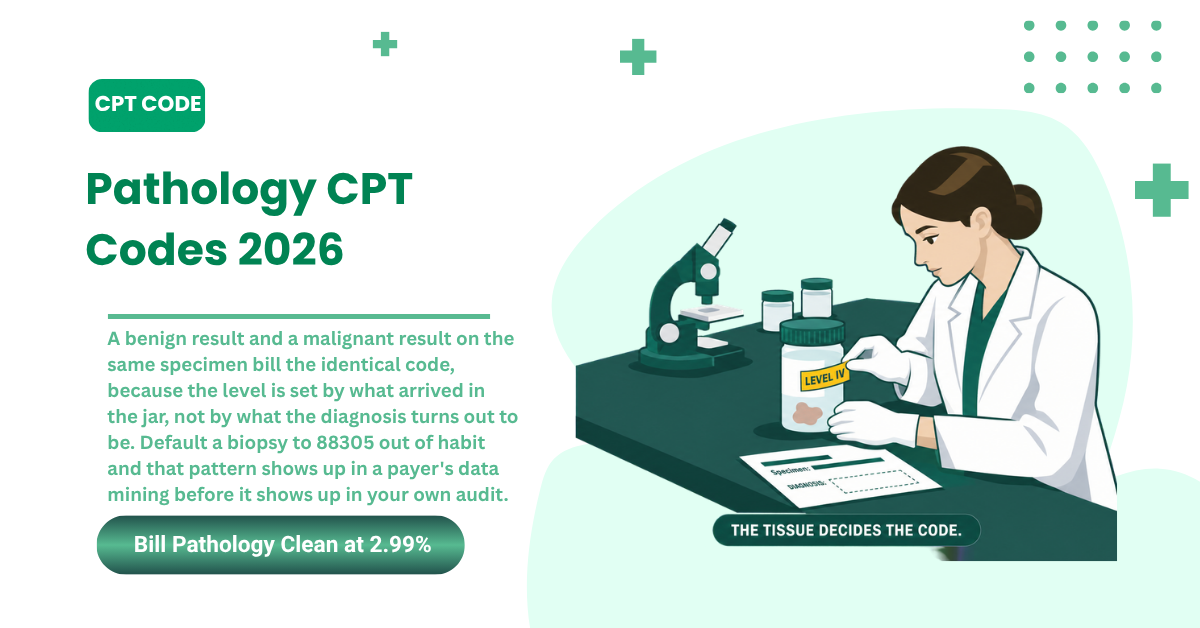
Surgical pathology levels follow specimen type and anatomic site, not the final diagnosis. A benign result and a malignant result on the same specimen carry the same level. |
|
Unit of service |
Surgical pathology is reported per specimen. Three separately labeled jars produce three codes. One specimen yielding six blocks still produces one code. |
|
Component billing |
Modifier 26 reports the pathologist's interpretation. Modifier TC reports the laboratory work. Billing both on one line is a duplicate. |
|
2026 payment change |
CMS applied a 2.5% efficiency adjustment to work RVUs that reaches nearly all pathology services, including 88305, 88312, and 88341. |
This guide covers the pathology CPT codes every pathology group and independent laboratory bills, the specimen lists that drive level selection, the modifier rules that stop component denials, and what changed in the 2026 code set. Every figure below traces to CMS, the AMA, or the College of American Pathologists.
What pathology CPT codes cover: the 80047 to 89398 range
The pathology and laboratory section of CPT spans 80047 through 89398 and divides into organ and disease panels, urinalysis, molecular pathology, chemistry, hematology, immunology, microbiology, cytopathology, cytogenetics, and surgical pathology. Pathology clinical consultation codes 80503 through 80506 sit at the front of the section.
Pathology CPT code categories and ranges
Most billers work inside three or four of these pathology CPT codes ranges and never touch the rest. A dermatopathology group lives in 88300 to 88399 and 88341 to 88344. A hospital core lab lives in 80047 to 87999. The ranges below cover the full section so you can place any code you see on a remit.
|
Code range |
Category |
Common services |
Billing note |
|---|---|---|---|
|
80047 to 80081 |
Organ or disease oriented panels |
Basic metabolic, comprehensive metabolic, lipid, hepatic function, obstetric |
Bill the panel code when every component was performed. Unbundling components draws an NCCI edit. |
|
80503 to 80506 |
Pathology clinical consultation |
Physician interpretive judgment on laboratory results |
Time based. These replaced the deleted 80500 and 80502 in 2022. |
|
81000 to 81099 |
Urinalysis |
Dipstick, automated, microscopy |
Automated and manual versions carry separate codes. |
|
81105 to 81599 |
Molecular pathology |
Tier 1 and Tier 2 gene analysis, genomic sequencing panels |
Panel codes take precedence over stacking single gene codes. |
|
82000 to 84999 |
Chemistry |
Glucose, electrolytes, hormones, therapeutic drug levels |
Check panel membership before billing a component alone. |
|
85002 to 85999 |
Hematology and coagulation |
CBC, differential, prothrombin time, partial thromboplastin time |
85025 and 85027 cannot both be reported for the same date of service. |
|
86000 to 86849 |
Immunology |
Antibody testing, allergen specific IgE, C-reactive protein |
Many are billed per allergen or per antibody. |
|
87001 to 87999 |
Microbiology |
Cultures, susceptibility studies, nucleic acid detection |
Susceptibility codes pair with the culture code. |
|
88000 to 88099 |
Postmortem examination |
Autopsy, gross and microscopic |
Medicare does not cover autopsy services. |
|
88104 to 88199 |
Cytopathology |
Fluid cytology, Pap smears, fine needle aspirate evaluation |
Collection and interpretation are separate services billed by different providers. |
|
88230 to 88299 |
Cytogenetic studies |
Tissue culture, chromosome analysis |
Often paired with molecular codes on oncology cases. |
|
88300 to 88399 |
Surgical pathology |
Gross and microscopic examination, stains, immunohistochemistry, consultations |
Reported per specimen, not per block or per slide. |
The full section descriptor list sits on the AAPC CPT code range page if you need to confirm a code outside your normal families. For a specialty that splits professional and technical work the same way pathology does, our radiology CPT codes guide walks the same component logic through the 70010 to 79999 series.
Anatomic pathology vs clinical pathology
Anatomic pathology covers tissue and cells. Surgical pathology, cytopathology, and autopsy sit here. The pathologist examines material and issues a diagnostic report, so most anatomic codes carry a professional component you can bill separately.
Clinical pathology covers blood, body fluids, and other laboratory testing. Chemistry, hematology, microbiology, and immunology sit here. Most clinical laboratory tests carry no separate physician component, which is where a long running payer dispute starts. Section 19 covers it.
Surgical pathology CPT codes 88300 to 88309
Surgical pathology codes 88300 through 88309 report examination of tissue removed during a procedure. The AMA assigns six levels. Level I covers gross examination alone. Levels II through VI cover gross and microscopic examination at increasing complexity. CPT publishes a named specimen list for each level, and that list governs code selection.
Level selection trips up more pathology billers than any other rule in the section. The tissue in the jar decides the code. The diagnosis on the report does not.
|
CPT code |
Level (Roman) |
Level (Arabic) |
Examination |
Representative specimens |
Billing note |
|---|---|---|---|---|---|
|
88300 |
Level I |
Level 1 |
Gross only |
Tooth, foreign body, removed orthopedic hardware |
No microscopic work. Do not bill 88300 when slides were read. |
|
88302 |
Level II |
Level 2 |
Gross and microscopic |
Incidental appendix, fallopian tube for sterilization, newborn foreskin, hernia sac |
Tissue examined to confirm identity and absence of disease. |
|
88304 |
Level III |
Level 3 |
Gross and microscopic |
Non-incidental appendix, lipoma, benign cyst, abscess, varicose veins |
Highest volume undercoding target. Billers code plenty of level III specimens as 88305. |
|
88305 |
Level IV |
Level 4 |
Gross and microscopic |
Skin punch and shave biopsy, GI biopsy, breast core needle biopsy, cervical biopsy |
Highest-volume code in the series. Medicare requires G0416 for prostate needle biopsy. |
|
88307 |
Level V |
Level 5 |
Gross and microscopic |
Colon segment resection for tumor, simple mastectomy without nodes, myocardium biopsy |
Larger resections and diagnostically demanding specimens. |
|
88309 |
Level VI |
Level 6 |
Gross and microscopic |
Mastectomy with regional lymph nodes, total colon resection, extremity disarticulation |
Highest complexity. Documentation must show the extent of the evaluation. |
CPT 88300, Level I, gross examination only
CPT 88300 reports Level I surgical pathology, gross examination only. The pathologist receives and accessions the specimen, examines it without a microscope, and issues a report. Common specimens include teeth, foreign bodies, and removed hardware.
If the case went to slides, 88300 is the wrong code. You're undercoding the service and handing back revenue you already earned.
CPT 88302, Level II, gross and microscopic
CPT 88302 reports Level II surgical pathology with gross and microscopic examination. The service applies to specimens examined to confirm identification and document the absence of disease. CPT names the qualifying specimens, and the list is closed.
CPT lists these specimens for 88302: incidental appendix, fallopian tube for sterilization, fingers or toes from traumatic amputation, newborn foreskin, hernia sac of any location, hydrocele sac, nerve, skin from plastic repair, sympathetic ganglion, testis from castration, incidental vaginal mucosa, and vas deferens for sterilization.
The word incidental does the work here. An appendix removed during a hysterectomy is 88302. An appendix removed for appendicitis is 88304.
CPT 88304, Level III, gross and microscopic
CPT 88304 reports Level III surgical pathology with gross and microscopic examination of intermediate complexity specimens. Named examples include non-incidental appendix, lipoma, benign cyst, abscess, and varicose veins. Level III sits above identification-only work and below routine diagnostic biopsy.
Watch this one on audit. Skin tags, simple cysts, and lipomas belong at 88304, and laboratory information systems that default to 88305 overcode them every day.
CPT 88305, Level IV, gross and microscopic
CPT 88305 reports Level IV surgical pathology with gross and microscopic examination of moderate complexity specimens. The code covers routine diagnostic biopsies including skin, gastrointestinal, breast core needle, cervical, and bladder specimens. Section 6 covers 88305 in full.
CPT 88307, Level V, gross and microscopic
CPT 88307 reports Level V surgical pathology with gross and microscopic examination of high complexity specimens. Named examples include colon segment resection for tumor, simple mastectomy without lymph node dissection, and myocardium biopsy. The level reflects greater physician work and more extensive sectioning.
A colon resection for diverticulitis and one for carcinoma aren't the same code. Diverticular disease sits at 88307. A segmental resection for tumor moves to 88309 once regional nodes come with it.
CPT 88309, Level VI, gross and microscopic
CPT 88309 reports Level VI surgical pathology, the highest complexity tier. The code covers extensive oncologic resections and major organ specimens, including mastectomy with regional lymph nodes, total colon resection, bone resection, and extremity disarticulation. Documentation must reflect the scope of the examination.
Node counts and margin descriptions carry this code through review. A radical resection billed at 88309 with a three sentence gross description won't survive a records request.
The AMA maintains these codes through the annual CPT cycle. The AMA CPT 2026 code set introduced 418 editorial changes across all sections, and pathology and laboratory absorbed a large share of them.
Specimen to CPT code lookup
Surgical pathology level assignment follows the specimen submitted rather than the diagnosis reached. CPT publishes a named specimen list under each level from 88302 through 88309. A specimen absent from every list goes to the level whose listed specimens best match the physician work involved.
Most coding errors in this section come from memory. Someone learned that biopsies are 88305, and now everything arriving in a small jar gets that code. The tables below give you the actual assignments.
Academic pathology departments have published specimen crib sheets for years, and the University of Michigan Pathology list from March 2011 still turns up in coding departments. Use those as orientation only. Verify current assignments against your CPT manual, since specimen lists have moved between levels across revisions.
Level II specimens (88302)
|
Specimen |
Level |
CPT code |
|---|---|---|
|
Appendix, incidental |
II |
88302 |
|
Fallopian tube, sterilization |
II |
88302 |
|
Fingers or toes, traumatic amputation |
II |
88302 |
|
Foreskin, newborn |
II |
88302 |
|
Hernia sac, any location |
II |
88302 |
|
Hydrocele sac |
II |
88302 |
|
Nerve |
II |
88302 |
|
Skin, plastic repair |
II |
88302 |
|
Sympathetic ganglion |
II |
88302 |
|
Testis, castration |
II |
88302 |
|
Vaginal mucosa, incidental |
II |
88302 |
|
Vas deferens, sterilization |
II |
88302 |
Level III specimens (88304)
|
Specimen |
Level |
CPT code |
|---|---|---|
|
Abscess |
III |
88304 |
|
Aneurysm, arterial or ventricular |
III |
88304 |
|
Appendix, other than incidental |
III |
88304 |
|
Bone fragments, other than pathologic fracture |
III |
88304 |
|
Bursa or synovial cyst |
III |
88304 |
|
Cyst, mesenteric, retroperitoneal, or omental |
III |
88304 |
|
Fissure or fistula |
III |
88304 |
|
Ganglion cyst |
III |
88304 |
|
Hematoma |
III |
88304 |
|
Hemorrhoids |
III |
88304 |
|
Lipoma |
III |
88304 |
|
Skin, cyst, tag, or debridement |
III |
88304 |
|
Spermatocele |
III |
88304 |
|
Tonsil and adenoids |
III |
88304 |
|
Varicose vein |
III |
88304 |
Level IV specimens (88305)
|
Specimen |
Level |
CPT code |
|---|---|---|
|
Bladder, biopsy |
IV |
88305 |
|
Bone marrow, biopsy |
IV |
88305 |
|
Brain, biopsy |
IV |
88305 |
|
Breast, biopsy, not requiring microscopic margins |
IV |
88305 |
|
Cervix, biopsy |
IV |
88305 |
|
Colon, biopsy |
IV |
88305 |
|
Endometrium, curettings or biopsy |
IV |
88305 |
|
Esophagus, biopsy |
IV |
88305 |
|
Kidney, biopsy |
IV |
88305 |
|
Liver, needle biopsy |
IV |
88305 |
|
Lung, transbronchial biopsy |
IV |
88305 |
|
Lymph node, biopsy |
IV |
88305 |
|
Nasal mucosa, biopsy |
IV |
88305 |
|
Sinus, paranasal biopsy |
IV |
88305 |
|
Skin, other than cyst, tag, or debridement |
IV |
88305 |
|
Stomach, biopsy |
IV |
88305 |
|
Uterus, with or without tubes and ovaries, for prolapse |
IV |
88305 |
Prostate needle biopsy sits at Level IV in CPT, but Medicare and a growing list of commercial payers require HCPCS G0416 instead. Section 6 covers the rule and the payers that adopted it.
Level V specimens (88307)
|
Specimen |
Level |
CPT code |
|---|---|---|
|
Bone, biopsy or curettings |
V |
88307 |
|
Breast, excision of lesion, requiring microscopic margins |
V |
88307 |
|
Colon, segmental resection, other than for tumor |
V |
88307 |
|
Kidney, partial or total nephrectomy |
V |
88307 |
|
Larynx, partial or total resection, without nodes |
V |
88307 |
|
Liver, partial resection |
V |
88307 |
|
Lung, wedge biopsy |
V |
88307 |
|
Lymph nodes, regional resection |
V |
88307 |
|
Myocardium, biopsy |
V |
88307 |
|
Prostate, except radical resection |
V |
88307 |
|
Salivary gland |
V |
88307 |
|
Stomach, subtotal or total resection, other than for tumor |
V |
88307 |
|
Testis, tumor |
V |
88307 |
|
Thyroid, total or lobe |
V |
88307 |
|
Uterus, with or without tubes and ovaries, other than neoplastic |
V |
88307 |
Level VI specimens (88309)
|
Specimen |
Level |
CPT code |
|---|---|---|
|
Bone resection |
VI |
88309 |
|
Breast, mastectomy with regional lymph nodes |
VI |
88309 |
|
Colon, segmental resection for tumor |
VI |
88309 |
|
Colon, total resection |
VI |
88309 |
|
Esophagus, partial or total resection |
VI |
88309 |
|
Extremity, disarticulation |
VI |
88309 |
|
Larynx, partial or total resection, with regional lymph nodes |
VI |
88309 |
|
Lung, total or lobe resection |
VI |
88309 |
|
Pancreas, total or subtotal resection |
VI |
88309 |
|
Prostate, radical resection |
VI |
88309 |
|
Soft tissue tumor, extensive resection |
VI |
88309 |
|
Stomach, subtotal or total resection for tumor |
VI |
88309 |
|
Testis, tumor, with regional lymph nodes |
VI |
88309 |
|
Urinary bladder, partial or total resection |
VI |
88309 |
|
Uterus, with or without tubes and ovaries, neoplastic |
VI |
88309 |
Download the pathology specimen code sheet
A printable version of every table above fits on two pages and belongs next to the grossing bench. Pull it before you assign a level rather than after the claim comes back.
Working through a stack of specimens and not sure the levels are landing where they should? A billing review will show you where the assignments are drifting and what the drift costs per claim.
How to select the correct surgical pathology level
Three rules govern level selection among the surgical pathology CPT codes. Code by specimen type and anatomic site rather than by diagnosis. Assign one level code to each separately identified specimen. Place an unlisted specimen at the level whose named specimens best match the physician work performed.
The rule that trips most billers: specimen type, not diagnosis
- Specimen type drives the code. A breast biopsy that returns benign and one that returns carcinoma both sit at the same level. The pathologist's work in examining the tissue set the level before anyone knew the answer.
- Each separately identified specimen gets its own level code. Two jars, two codes, even when both hold the same tissue from the same patient on the same day.
- Unlisted specimens follow the closest match. CPT instructs you to assign the level whose listed specimens most closely reflect the physician work involved, and to document the reasoning.
Documentation carries the level through review. The report needs the specimen source, a gross description with measurements, and the microscopic interpretation. A level that the record doesn't support fails on audit no matter how much work the pathologist did.
Practices that run a quarterly chart sample catch level drift before a payer does. Our coding audit process guide covers sample selection, accuracy scoring, and what to do with the findings.
When the specimen is not on the CPT list
Grossing benches see specimens CPT never named. A pathologist pulls the closest listed specimen, matches the work, and documents why. That reasoning belongs in the record, because a reviewer asked to justify a level six months later can't reconstruct it from memory.
One scenario shows up in every pathology practice we work with. The LIS defaults every dermatology specimen to 88305. Skin tags and simple cysts belong at 88304. A group running 400 derm specimens a month with a third of them at the wrong level is overcoding about 130 claims a month, and that pattern is exactly what a payer's data mining picks up.
CPT code 88305 explained
CPT 88305 reports Level IV surgical pathology, gross and microscopic examination, of a moderate complexity specimen. The code covers routine diagnostic biopsies including skin, gastrointestinal, breast core needle, cervical, endometrial, and bladder specimens. CPT 88305 carries the highest claim volume in the surgical pathology series.
88305 carries more claim volume than any other pathology code, which makes it the code payers watch hardest. Most pathology overpayment findings start here.
What CPT 88305 includes
The code covers the full handling of one specimen from arrival to signed report. Four steps sit inside it, and all four have to appear in the record.
|
Step |
What happens |
What the record must show |
|---|---|---|
|
Accessioning |
The laboratory receives and logs the specimen |
Specimen source, requisition, accession number |
|
Gross examination |
The pathologist examines the tissue without magnification |
Size, color, consistency, sectioning description |
|
Microscopic examination |
The pathologist reads processed and stained sections |
Histologic findings and interpretation |
|
Report |
The pathologist issues the diagnostic report |
Final diagnosis, signature, date |
Specimens commonly billed under 88305
Skin biopsies other than cyst, tag, or debridement. Gastrointestinal biopsies from the esophagus, stomach, and colon. Breast core needle biopsies without margin evaluation. Cervical and endometrial biopsies. Bladder, kidney, liver, lung, and lymph node biopsies. Bone marrow biopsy.
Does CPT 88305 need a modifier
CPT 88305 requires a modifier only when the professional and technical components are billed separately. The code carries a PC/TC indicator of 1, which permits a component split. Report 88305 with no modifier when one entity performs both parts, modifier 26 for interpretation alone, and modifier TC for the laboratory work alone.
Hospital-based groups get this wrong in one direction and independent labs get it wrong in the other. The hospital bills 88305-TC for the histology work. The pathology group bills 88305-26 for reading the slides. Nobody bills globally, because nobody did the whole service.
Can 88305 and 88342 be billed together
Yes. CPT 88305 reports the surgical pathology examination and CPT 88342 reports an immunohistochemical stain performed on that specimen. The two describe different services and are separately reportable when the pathologist performs and documents both. Check the current NCCI edit file before submission, since payer edits change quarterly.
Both codes need their own support in the report. The examination stands on the gross and microscopic description. The stain needs the antibody named, the reason it was ordered, and the interpretation of the result. Section 11 covers the bundling mechanics.
The G0416 rule that denies 88305 on prostate biopsies
Medicare does not pay CPT 88305 for prostate needle biopsy. HCPCS G0416 reports surgical pathology, gross and microscopic examination, for prostate needle biopsy, any method. G0416 is a single inclusive code that covers the entire biopsy regardless of how many cores the urologist submitted.
The claim looks correct, which is why nobody catches it. The specimen is a biopsy, the level math says 88305, and the denial arrives weeks later with a code-level rejection nobody flags as systemic.
Commercial payers have moved onto the same rule. Cigna and Aetna began requiring G0416 for prostate needle biopsies on August 1, 2025. UnitedHealthcare extended the requirement across its products effective January 1, and 88305 submitted for a prostate biopsy denies. Independence Blue Cross updated its prostate biopsy pathology reimbursement policy effective March 2, 2026.
Confirm the current descriptor and status on the AAPC HCPCS G0416 listing, then check each of your top five payers against their own published policy. The adoption dates differ by plan, and a code map built on Medicare rules alone will miss the commercial changes.
88304 vs 88305 vs 88307: how the levels differ
CPT 88304, 88305, and 88307 report Levels III, IV, and V of surgical pathology. All three include gross and microscopic examination. Complexity of the specimen separates them. Level III covers identification and simple lesions, Level IV covers routine diagnostic biopsies, and Level V covers resections and diagnostically demanding tissue.
|
Attribute |
88304 (Level III) |
88305 (Level IV) |
88307 (Level V) |
|---|---|---|---|
|
Complexity tier |
Intermediate |
Moderate |
High |
|
Examination |
Gross and microscopic |
Gross and microscopic |
Gross and microscopic |
|
Typical specimens |
Lipoma, abscess, skin tag, hemorrhoids |
Skin, GI, cervical, breast core biopsy |
Colon resection, simple mastectomy, thyroid lobe |
|
Physician work |
Confirm lesion, limited sectioning |
Diagnostic interpretation, routine sectioning |
Extensive sectioning, margin assessment |
|
Common billing error |
Coded up to 88305 by LIS default |
Billed for prostate biopsy instead of G0416 |
Coded down from 88309 when nodes were examined |
What separates 88304 from 88305
The pathologist examines a Level III specimen to identify a lesion or confirm a simple process. A Level IV specimen goes under the microscope to reach a diagnosis. A skin tag removed for cosmetic reasons is 88304. A skin lesion biopsied to rule out malignancy is 88305, even when the result comes back benign.
What separates 88305 from 88307
Level IV covers biopsy specimens. Level V covers resections and specimens requiring margin evaluation or extensive sectioning. A breast core needle biopsy is 88305. A breast lesion excised with microscopic margin assessment moves up to 88307.
2026 Medicare reimbursement for pathology CPT codes
Medicare pays pathology CPT codes under the Physician Fee Schedule using relative value units multiplied by a conversion factor. For 2026, CMS finalized two conversion factors: $33.4009 for clinicians outside a qualifying alternative payment model and $33.5675 for qualifying APM participants. Both rose from the 2025 factor of $32.3465.
How Medicare calculates a pathology payment
Three RVU components build every rate. Work RVU covers physician effort. Practice expense RVU covers staff, equipment, and supplies. Malpractice RVU covers liability cost. CMS adjusts each by geographic practice cost index, adds them, and multiplies by the conversion factor.
|
Component |
What it pays for |
Where pathology feels it |
|---|---|---|
|
Work RVU |
Pathologist time, skill, and judgment |
Cut by the 2026 efficiency adjustment on most codes |
|
Practice expense RVU |
Histotechnologists, reagents, microtomes, facility cost |
Split into facility and non-facility values |
|
Malpractice RVU |
Professional liability premium share |
Small share of the total for pathology |
|
Conversion factor |
Dollars per RVU |
$33.4009 non-APM, $33.5675 qualifying APM for 2026 |
|
GPCI |
Geographic cost adjustment by locality |
Two labs billing 88305 in different states get different amounts |
A single national dollar figure for 88305 misleads more than it helps, because GPCI moves the allowed amount by locality. Pull your own number from the CMS Physician Fee Schedule Look-Up Tool using your MAC locality and the 2026 file, then compare it against what your remits pay. The gap between those two numbers is the thing worth measuring.
The CMS efficiency adjustment and what it cut
CMS finalized a 2.5% efficiency adjustment for 2026 that reduces work RVUs and the intraservice portion of physician time for non-time-based services. The adjustment reaches most non-time-based codes in the fee schedule. CMS excluded time-based codes, services on the telehealth list, maternity codes with an MMM global period, and new services.
The College of American Pathologists reports that these reductions affect nearly all billed pathology services, naming 88305, 88312, and 88341. CAP opposed the policy, engaged CMS and congressional leaders, and continues to seek reversal after the rule was finalized. Read CAP's summary in the CAP advocacy update on the 2026 fee schedule.
CAP did win one carve-out. CMS agreed to remove the time-based pathology clinical consultation codes 80503, 80504, 80505, and 80506 from the efficiency adjustment. Those four are among the few pathology codes that kept their work RVU value into 2026.
Why pathology shows an increase while your codes went down
Two numbers point in opposite directions and both are correct. CAP estimates a 0.5% net increase in pathology reimbursement for 2026. The efficiency adjustment cut work RVUs on nearly every pathology code you bill.
The One Big Beautiful Bill Act raised overall physician spending by 2.5% for 2026, which pushed the conversion factor up 3.26% for non-APM clinicians. That increase absorbed most of the RVU cut and left a small net positive across the specialty. CAP notes the impact varies by pathologist depending on case mix, since the policies land code by code.
So a group heavy in 88305 and 88312 can post a revenue decline in a year the specialty averaged an increase. Model your own case mix against the 2026 file rather than reading the headline number.
The site of service change and where you bill
CMS also cut the indirect practice expense allocation for facility-based services to half the non-facility amount starting in 2026. A pathology service performed in a hospital setting now carries a smaller practice expense component than the same service in an independent laboratory.
Place of service drives which value applies, so POS 81 for an independent laboratory and POS 22 for on-campus hospital outpatient produce different allowed amounts on identical work. Our place of service codes guide covers the full set and the reimbursement difference each one triggers.
What to watch through 2026 and into 2027
Representatives Estes and Suozzi introduced the Efficiency Adjustment Delay Act, which would postpone the 2.5% work RVU reduction until 2030. Thirty-eight organizations signed a support letter on February 12, 2026. The adjustment took effect January 1, 2026 and stands until Congress acts.
CMS has said it will revisit the efficiency adjustment every three years using the Medicare Economic Index productivity measure, so the figure may not stay at 2.5%. CAP has also flagged that CMS identified surgical pathology codes as potentially misvalued in the 2027 proposed rule, which puts the 88300 series back under review.
If your 88305 volume is high and your allowed amounts have drifted from the 2026 file, the cause is usually level assignment, a modifier, or a payer policy change nobody caught. Outsourced medical billing services from MedSole RCM include coding review on every claim, and the review starts by measuring that gap in dollars.
Modifier 26 and modifier TC in pathology billing
Modifier 26 reports the professional component of a pathology service, meaning the pathologist's interpretation and written report. Modifier TC reports the technical component, meaning equipment, reagents, specimen preparation, and technologist work. Together the two components equal the global service, which carries no modifier.
Component modifiers on pathology CPT codes generate more denials than level selection does, and the fix takes about ten seconds per claim. You need to know who performed which half of the service before the claim goes out.
When to append modifier 26
Append 26 when your pathologist read the slides and someone else prepared them. A hospital-employed histology lab cuts and stains, the pathology group reads and reports, and the group bills 88305-26. The hospital bills the other half.
When to append modifier TC
Append TC when your laboratory performed the technical work and an outside pathologist interpreted. An independent lab that processes tissue and sends slides to a contracted pathologist bills the TC side. That pathologist bills the 26 side under their own NPI.
The mechanics carry across every diagnostic specialty that splits work this way. Our modifier 26 guide covers the professional component in depth, and the TC modifier rules guide handles the technical side and the payment split.
The PC/TC indicator check that prevents the denial
The PC/TC indicator in the Medicare Physician Fee Schedule database tells you whether a code accepts modifier 26 or TC. Indicator 1 permits a component split. Indicator 2 identifies a professional-component-only code. Indicator 3 identifies a technical-component-only code. Indicator 9 means the concept does not apply.
|
PC/TC indicator |
Meaning |
Can you use 26 or TC? |
|---|---|---|
|
0 |
Physician service code, no technical component exists |
No |
|
1 |
Diagnostic test, professional and technical split allowed |
Yes, both |
|
2 |
Professional component only code |
No, the component is built in |
|
3 |
Technical component only code |
No, the component is built in |
|
4 |
Global test only, no split permitted |
No |
|
9 |
Concept does not apply to this code |
No |
Two rules stop most component denials. Never put 26 and TC on the same claim line. Never bill a global code alongside one of its components for the same specimen on the same date.
Flow cytometry shows why the indicator check matters. CPT 88184 carries a technical-component-only designation, so appending TC to it duplicates what the code already says and appending 26 contradicts it. Either one draws a rejection.
CMS publishes the component billing conditions in the Medicare Claims Processing Manual, Chapter 12. Hospital-based pathology groups splitting technical and professional work across two entities can review how we handle that structure in hospital billing services.
Other pathology modifiers: 59, XU, 91, 90, and 92
Beyond the component modifiers, pathology CPT codes take modifier 59 and the X modifiers for distinct specimens, modifier 90 for reference laboratory testing, modifier 91 for medically necessary repeat clinical tests, and modifier 92 for alternative platform laboratory testing. Each has a narrow definition and a common misuse pattern.
|
Modifier |
What it reports |
When it applies in pathology |
Common misuse |
|---|---|---|---|
|
59 |
Distinct procedural service |
Separate specimens or separate anatomic sites on the same date |
Applied to bypass an edit without a distinct specimen behind it |
|
XS |
Separate structure |
A more specific subset of 59 for a different organ or site |
Skipped in favor of 59 when XS describes the situation better |
|
XU |
Unusual non-overlapping service |
Service that does not overlap the usual components of the primary code |
Used interchangeably with 59 without checking which fits |
|
90 |
Reference or outside laboratory |
Testing performed by a laboratory other than the billing provider |
Omitted on referred testing, which misrepresents who performed the work |
|
91 |
Repeat clinical diagnostic test |
A medically necessary repeat of the same test on the same day |
Applied to quality control repeats, confirmatory runs, or corrections of lab error |
|
92 |
Alternative laboratory platform testing |
Cartridge or kit based testing rather than a conventional analyzer |
Left off when the platform requires it |
|
22 |
Increased procedural service |
Work well above what the code typically involves |
Submitted without the documentation that justifies the increase |
Modifier 91 draws the most payer attention of the group. It exists for a repeat run that the patient's care required, like a second potassium after treatment. It doesn't cover rerunning a specimen because the first result looked wrong, and payers track repeat testing patterns across a provider's whole panel.
Sequencing matters when two modifiers land on one line. The payment modifier goes first, so 26 or TC occupies position one and the informational modifier follows. Our modifier 59 guidance walks through the distinct service test and the X modifier subsets in detail.
Unit of service, MUE limits, and NCCI bundling in pathology
Surgical pathology codes are reported per specimen. Each separately identified specimen submitted for examination generates one level code regardless of how many blocks or slides that specimen produces. Medically Unlikely Edits cap the units payable per code per date of service, and NCCI edits govern which codes may be reported together.
One specimen, one code: how units are counted
The jar rule settles most unit questions. Count the specimens the surgeon separately identified and submitted, then assign one level code to each.
|
Scenario |
Units billed |
Why |
|---|---|---|
|
Three separately labeled jars on one requisition |
Three units |
Three separately identified specimens, three level codes |
|
One specimen sectioned into six blocks |
One unit |
Blocks are part of examining a single specimen |
|
One specimen, twelve slides from four blocks |
One unit |
Slide count does not change the unit of service |
|
Two skin lesions from different sites, separately labeled |
Two units |
Separate anatomic sites, separately identified |
|
One lesion split by the surgeon into two containers by accident |
One unit |
A single specimen does not become two by being divided |
MUE limits and daily maximum units
CMS publishes a Medically Unlikely Edit value for most pathology codes, setting the maximum units it will pay per code per date of service. Claims above the MUE deny on the excess units, and some MUEs are date-of-service edits that reject the whole line rather than trimming it.
Commercial payers publish their own limits, and those can sit below the Medicare MUE. Horizon NJ Health and Horizon Blue Cross Blue Shield of New Jersey both maintain published daily maximum unit policies for surgical pathology, and EmblemHealth publishes its own surgical pathology reimbursement policies. A specimen count that clears Medicare can still fail at a commercial plan.
Build the payer-specific limits into your scrubber. A high-volume dermatopathology or GI practice will hit these ceilings on legitimate cases, and the appeal needs the separately identified specimens documented before the claim goes out, not after the denial.
NCCI edits for pathology and laboratory services
The CMS National Correct Coding Initiative Policy Manual devotes Chapter 10 to pathology and laboratory services covering CPT 80000 through 89999. The chapter sets three governing principles: report the code that describes the service to the greatest specificity available, avoid reporting multiple codes when one code describes the service, and avoid reporting components standard to the primary procedure.
The current version carries a revision date of January 1, 2026. Read it in the CMS NCCI Policy Manual Chapter 10. Every edit pair carries a modifier indicator, and that indicator tells you whether a bypass modifier is permitted at all. An indicator of 0 means no modifier will unbundle the pair, and appending 59 anyway produces a denial plus an audit flag.
A bundled service submitted on its own line comes back as CO-97. Our CO-97 bundling denials guide covers the reason code and the correction path.
Frozen section and intraoperative consultation codes 88329 to 88334
Intraoperative consultation codes report pathology services performed while the patient remains in surgery. CPT 88329 covers gross examination without frozen section. Codes 88331 and 88332 report frozen section by tissue block. Codes 88333 and 88334 report intraoperative cytologic evaluation by site.
|
CPT code |
Service |
Reported as |
Documentation required |
|---|---|---|---|
|
88329 |
Intraoperative consultation, gross examination only |
Once per consultation |
Surgeon request, specimen source, findings communicated |
|
88331 |
Frozen section, first tissue block, single specimen |
Once per specimen |
Specimen source, block identification, interpretation |
|
88332 |
Frozen section, each additional tissue block |
Add-on, per additional block |
Enumerated block count in the report |
|
88333 |
Intraoperative cytologic evaluation, initial site |
Once per site |
Preparation method, site, interpretation |
|
88334 |
Intraoperative cytologic evaluation, each additional site |
Add-on, per additional site |
Separate site identified and separately interpreted |
Block counting is where frozen section revenue leaks. A pathologist examines four blocks during one consultation, the report says frozen sections performed, and the biller submits one unit of 88331 because nothing in the record enumerates the blocks. Three units of 88332 disappear on every case that reads that way.
Add-on codes need their primary on the same claim. Submitting 88332 without 88331, or 88334 without 88333, returns a not-separately-payable denial. The same applies to 88341 without 88342 in immunohistochemistry.
That denial arrives as CO-234. Our CO-234 denial code guide covers the reason code, the add-on relationships that trigger it, and how to correct the claim.
Special stains and histochemistry CPT codes 88311 to 88319
Special stain pathology CPT codes report histochemical staining performed to reveal structures, organisms, or cellular components that routine hematoxylin and eosin staining does not show. Codes 88312 through 88319 are reported per stain, per specimen. CPT 88311 reports decalcification and is a separate service from staining.
|
CPT code |
Group |
What it identifies |
Reported per |
Common denial cause |
|---|---|---|---|---|
|
88311 |
Decalcification |
Tissue softening before sectioning, not a stain |
Per specimen, in addition to the primary code |
Billed without the primary surgical pathology code |
|
88312 |
Group I |
Microorganisms, including acid-fast and fungal stains |
Per stain, per specimen |
Units counted per slide instead of per stain |
|
88313 |
Group II |
Structures other than microorganisms, including iron and trichrome |
Per stain, per specimen |
Confused with 88312 when the target is not an organism |
|
88314 |
Frozen block |
Histochemical stain performed on a frozen tissue block |
Per block |
Billed for a stain on a permanent section |
|
88319 |
Determinative |
Enzyme constituents by histochemistry or cytochemistry |
Per specimen |
Reported alongside a stain code that already covers the work |
CPT 88312 vs 88313: which stain code applies
The target decides the code. If the pathologist ordered the stain to find an organism, bill 88312. Acid-fast bacilli, GMS for fungus, and Gram stains on tissue sit here. Every other target goes to 88313, including iron, trichrome, and mucin stains.
Immunohistochemistry belongs to neither. IHC uses antibodies rather than histochemical reagents and reports under 88341 and 88342, covered in the next section. Billing an immunostain as 88313 is a coding error that survives until someone audits the antibody log.
CPT 88314 and 88319: frozen block and enzyme stains
CPT 88314 applies only to a stain performed on a frozen tissue block, which usually means an intraoperative case. A special stain on a permanent section belongs to 88312 or 88313 regardless of whether that specimen also had frozen sections.
The 2026 efficiency adjustment reached 88312 along with the rest of the pathology series, so the work RVU on this code sits lower than it did in 2025. Section 8 covers the mechanics.
Unit reporting drives the denials in this family. The rule is per stain, per specimen. Three different special stains on one specimen produce three units. One stain applied across four slides from the same specimen produces one unit.
Immunohistochemistry CPT codes 88341, 88342, and 88344
Immunohistochemistry reports antibody staining applied to tissue sections to detect specific antigens. CPT 88342 reports the initial single antibody stain per specimen. CPT 88341 reports each additional single antibody stain on that same specimen. CPT 88344 reports each multiplex antibody stain procedure.
Immunohistochemistry carries the second-highest volume among pathology CPT codes after the level series, and it carries the highest audit exposure of any family in the section. Unit counting is where the exposure lives.
What CPT 88342 covers
CPT 88342 reports the first single antibody immunohistochemical stain performed on a specimen. The code is billed once per specimen for that initial antibody, regardless of how many slides receive it. Reporting 88342 twice for one specimen creates a duplicate.
What CPT 88341 covers
CPT 88341 reports each additional single antibody stain performed on the same specimen after the initial stain. The code is an add-on and requires 88342 on the same claim. Multiple units of 88341 report the second, third, and subsequent antibodies.
What is the difference between 88341 and 88342
CPT 88342 covers the first antibody stain on a specimen and bills once. CPT 88341 covers every additional antibody on that same specimen and bills in multiple units. Both report single antibody stains. The order of the stain, not the antibody used, determines which code applies.
|
Attribute |
88342 (initial) |
88341 (additional) |
|---|---|---|
|
What it reports |
First single antibody stain on the specimen |
Each additional single antibody stain on that specimen |
|
Billing limit |
One unit per specimen |
Multiple units, one per additional antibody |
|
Claim requirement |
Stands alone |
Add-on, requires 88342 on the same claim |
|
Clinical use |
Establishing tumor type or confirming a marker |
Completing a diagnostic antibody panel |
|
Unit-count error |
Reported once per antibody instead of once per specimen |
Reported without the primary, returning CO-234 |
Worked example: three antibodies on one specimen
A breast core needle biopsy arrives and the pathologist orders estrogen receptor, progesterone receptor, and HER2. That's one specimen and three single antibody stains.
Bill 88342 once for the first antibody. Bill 88341 with two units for the second and third. The claim reads 88342 x 1 and 88341 x 2. Three units of 88342 is a duplicate, and one unit of each code leaves the third antibody unpaid.
CPT 88344 and multiplex antibody stains
CPT 88344 applies when the laboratory runs a cocktail of antibodies in a single staining procedure rather than sequential single stains. Each multiplex procedure is one unit. Reporting 88344 alongside 88342 for the same antibodies double-bills the work.
Why IHC claims draw audit attention
Three factors stack. IHC reimburses above routine examination, oncology utilization keeps climbing, and unit counts on these claims are easy to inflate without meaning to. Payers review the panel size against the diagnosis and against your peer group.
Antibody tracking in the report is what defends the units. Name every antibody, state the diagnostic question each one answered, and record the interpretation. A report that says immunostains performed and consistent with carcinoma supports one unit, whatever the laboratory ran.
The add-on relationship between 88341 and 88342 is the same structure that produces most not-separately-payable rejections in pathology. Our CO-234 denial code guide covers what triggers it across code families.
Morphometric analysis codes 88360, 88361, 88374, and 88377
Morphometric analysis codes report quantitative or semi-quantitative measurement of immunohistochemistry or in situ hybridization results. Codes 88360 and 88361 cover immunohistochemistry morphometry. Codes 88374 and 88377 cover in situ hybridization. Each pair splits by whether the pathologist counted manually or used computer-assisted technology.
|
CPT code |
Method |
Analysis type |
Documentation required |
|---|---|---|---|
|
88360 |
Manual |
Quantitative or semi-quantitative IHC morphometry |
Numeric value, score, or percentage of stained cells |
|
88361 |
Computer-assisted |
Quantitative or semi-quantitative IHC morphometry |
Same, plus identification of the image analysis system |
|
88374 |
Computer-assisted |
In situ hybridization, each multiplex probe stain |
Probe target, method, and quantified result |
|
88377 |
Manual |
In situ hybridization, each multiplex probe stain |
Probe target, manual count, and interpretation |
|
88381 |
Manual |
Microdissection, a separate service from morphometry |
Region isolated and the downstream test it supported |
CPT 88360 vs 88361: manual versus computer-assisted
The counting method picks the code. A pathologist estimating percentage positivity by eye bills 88360. A laboratory running the slide through image analysis software bills 88361. Billing 88360 while your instrument does the counting is an overpayment finding waiting to happen.
Both codes require a number in the report. A HER2 result reported as positive supports no morphometric code at all. A result reported as 85% nuclear positivity with moderate intensity supports one. That single sentence in the report is the difference between a paid claim and a refund request.
In situ hybridization morphometric codes 88374 and 88377
The same manual-versus-computer split runs through the ISH codes, reversed. CPT 88374 covers the computer-assisted version and 88377 covers the manual one. Both report per multiplex probe stain, per specimen, so a case with two separate probe stains produces two units.
Cytopathology and fine needle aspiration codes 88104 to 88189
Cytopathology codes report examination of individual cells rather than tissue architecture. The family covers body fluids, gynecologic smears, and fine needle aspirates. Code selection depends on specimen type, preparation method, and whether the service included screening, physician interpretation, or both.
|
CPT code |
Specimen and method |
Who performs |
Billing note |
|---|---|---|---|
|
88104 |
Fluids, washings, or brushings, smears with interpretation |
Pathologist |
Covers the interpretation, not the collection |
|
88108 |
Concentration technique, smears and interpretation |
Pathologist |
Preparation method drives the code, not the fluid type |
|
88112 |
Selective cellular enhancement technique with interpretation |
Pathologist |
Distinct from 88108, check which technique the lab used |
|
88141 |
Cervical or vaginal cytopathology, physician interpretation |
Pathologist |
Reported in addition to the screening code |
|
88142 |
Cervical or vaginal, thin layer, manual screening |
Cytotechnologist |
Technical screening under physician supervision |
|
88175 |
Cervical or vaginal, thin layer, automated with manual rescreening |
Cytotechnologist and system |
Automated primary screen plus human rescreen |
|
88172 |
FNA, immediate cytohistologic study for adequacy, first site |
Pathologist |
Performed during the procedure, per site |
|
88173 |
FNA, interpretation and report |
Pathologist |
Final diagnostic read, per specimen |
Fluid cytology codes 88104 to 88112
Preparation method separates these three. Simple smears with interpretation go to 88104. A concentration technique such as cytocentrifugation moves the case to 88108. Selective cellular enhancement, which includes liquid-based preparations on non-gynecologic specimens, reports as 88112.
Ask the laboratory which technique it ran before coding. Billers guessing between 88108 and 88112 from the specimen type alone get it wrong about as often as they get it right.
Pap smear and gynecologic cytology 88141 to 88175
The screening code and the interpretation code are separate services. A cytotechnologist screens the slide and the laboratory bills 88142 or 88175 depending on the method. A pathologist who reviews the slide and issues an interpretation adds 88141 to the claim.
CPT 88141 doesn't stand alone. Submitting it without the screening code returns a denial, and the record needs to show why physician review was warranted rather than routine.
Fine needle aspiration 88172 and 88173
These two codes cover different moments in the same case. CPT 88172 reports the adequacy assessment the pathologist performs while the needle is still in play, telling the proceduralist whether the sample will diagnose. CPT 88173 reports the final interpretation days later.
Both are payable when both happen and both appear in the record. Many practices bill only 88173 because the on-site assessment never made it into a separate note, which leaves the intraoperative work uncompensated on every case.
Cytology collection vs cytology interpretation
The most expensive mistake in this family involves billing the wrong provider's service. Collecting an FNA specimen is a procedure billed by the clinician who performed it. Examining that specimen is a laboratory and pathologist service billed under the cytopathology codes.
Two claims, two providers, two different code families. A practice that bills the cytopathology code for a collection it performed gets denied, and the pathologist who did read the specimen gets denied as a duplicate.
State Medicaid programs publish their own reimbursable pathology code lists that differ from the Medicare set, so verify coverage locally before assuming a code pays. The Medi-Cal surgical pathology manual shows the format these program manuals take.
Flow cytometry CPT codes 88184 to 88189
Flow cytometry codes separate technical marker analysis from physician interpretation. CPT 88184 and 88185 report the technical component per marker. CPT 88187, 88188, and 88189 report interpretation, tiered by the total number of markers evaluated. Only one interpretation code applies per specimen.
|
CPT code |
Component |
Marker count |
Unit rule |
|---|---|---|---|
|
88184 |
Technical |
First marker |
One unit per specimen |
|
88185 |
Technical |
Each additional marker |
Multiple units, one per marker beyond the first |
|
88187 |
Interpretation |
2 to 8 markers |
One unit, mutually exclusive with 88188 and 88189 |
|
88188 |
Interpretation |
9 to 15 markers |
One unit, mutually exclusive with 88187 and 88189 |
|
88189 |
Interpretation |
16 or more markers |
One unit, mutually exclusive with 88187 and 88188 |
Technical marker codes 88184 and 88185
Marker counts drive the technical side. A twelve-marker panel produces one unit of 88184 and eleven units of 88185. Laboratories that report a flat number of units without reconciling against the actual panel either underbill the panel or overbill it, and both show up in a utilization review.
Interpretation codes 88187, 88188, and 88189
Total marker count picks exactly one interpretation code. A twelve-marker panel takes 88188 and nothing else. Reporting 88187 and 88188 on the same specimen is a duplicate, and reporting an interpretation code that doesn't match the marker count on the technical lines invites a review of both.
Does CPT 88184 need a modifier
No. CPT 88184 carries a technical-component-only designation with a PC/TC indicator of 3, which means the technical nature is built into the code definition. Appending modifier TC duplicates what the code already states, and appending modifier 26 contradicts it. Either modifier produces a rejection.
Check payer-specific instructions before you assume. Some state Medicaid programs and commercial plans publish formatting requirements that differ from Medicare on component-only codes, and their edits follow their own rules.
Molecular pathology, genomic sequencing, and PLA codes
Molecular pathology codes report analysis of specific genes, gene panels, and proprietary laboratory assays. Tier 1 codes identify named single-gene analyses. Tier 2 codes group less common analyses by complexity level. Genomic sequencing procedure codes report multigene panels. Proprietary Laboratory Analyses codes report specific branded assays.
|
Code range |
What it reports |
Release cadence |
Billing note |
|---|---|---|---|
|
81105 to 81383 |
Tier 1 molecular pathology, gene-specific analyses |
Annual, with off-cycle additions |
Use the named gene code when one exists |
|
81400 to 81408 |
Tier 2 molecular pathology, complexity levels 1 through 9 |
Early release PDF, quarterly cycle |
Level reflects technical complexity and resource use |
|
81410 to 81471 |
Genomic sequencing procedures and multigene panels |
Annual |
Panel code takes precedence over stacking single-gene codes |
|
0001U onward |
Proprietary Laboratory Analyses, branded assays |
Quarterly |
PLA code takes precedence when one exists for the assay |
|
81479 |
Unlisted molecular pathology procedure |
Standing |
Requires the specific gene tested to be identified on the claim |
Tier 1 and Tier 2 molecular pathology codes
Tier 1 codes name the gene. If your laboratory ran a BRAF analysis and a Tier 1 code exists for BRAF, that code is the correct choice. Tier 2 codes exist for the analyses CPT never assigned a dedicated code, grouped by how much work the test takes.
The AMA publishes Tier 2 changes on an early release schedule ahead of the printed book. Check the current AMA Molecular Pathology Tier 2 codes page for revisions and their effective dates, since those dates rarely align with January 1.
Genomic sequencing procedure codes for oncology panels
Panel codes replace stacking. A solid tumor panel covering fifteen genes reports under the genomic sequencing procedure code that matches the panel composition, not fifteen separate Tier 1 codes. Payers treat stacked single-gene codes on a panel as unbundling.
Match the code to what your laboratory ran. Panel definitions specify gene counts and required genes, and a panel that falls short of the required list may not qualify for the code you assumed.
Proprietary Laboratory Analyses and the quarterly release cycle
Proprietary Laboratory Analyses codes describe specific branded laboratory tests. The AMA releases PLA codes quarterly, with each new code effective the quarter after publication. PLA codes carry no physician work component. A PLA code that exists for a proprietary assay takes precedence, and the service should not be reported with other CPT codes.
Four rules govern this family, and the AMA states them in its published PLA policy.
- PLA codes made up the largest share of new codes in the 2026 CPT set at 27% of additions, which tells you where the code set is growing.
- PLA codes release quarterly rather than annually, and a new code becomes effective the quarter after the AMA publishes it.
- PLA codes carry no physician work component, so component modifiers do not apply the way they do to anatomic pathology codes.
- A PLA code that exists for a proprietary assay takes precedence, and reporting other CPT codes for that same service duplicates it.
The current policy text and the quarterly change log sit on the AMA PLA code policy page. Pull it every quarter, because the printed CPT book won't reflect what changed in April or July.
Pathology coding no longer runs on a January 1 cycle
Most laboratories still govern their pathology CPT codes on an annual chargemaster calendar. Someone updates codes in December, tests the build in January, and the project closes until next December. That model broke when the advanced diagnostics families moved to rolling releases.
Tier 2 revisions carry their own effective dates. PLA additions land quarterly. Administrative multianalyte assay codes follow a separate publication and effective schedule. A laboratory operating on a single annual update runs three quarters of the year with a code file that doesn't match what the AMA published.
The revenue effect shows up as denials on the newest, highest-value tests. Those are the assays your oncology referrers care about most, and they're the ones your billing system doesn't recognize yet.
When to use unlisted code 81479
CPT 81479 reports an unlisted molecular pathology procedure. The claim has to identify the specific gene tested, usually in the narrative field or an attachment. A bare 81479 with no gene named returns a development request or a denial.
More payers now require prior authorization on high-cost molecular panels before the specimen runs, and retroactive authorization rarely succeeds after the fact. Our CO-197 prior authorization denials guide covers the reason code and the appeal path.
Keeping a chargemaster current across four release cycles a year is a governance problem before it's a coding problem. If your test menu has grown faster than your billing setup, the gap shows up in molecular denials first. Pathology billing support from MedSole RCM includes quarterly code file reconciliation as part of the standard scope.
Pathology consultation codes 80503 to 80506 and 88321 to 88325
Pathology consultation codes report two distinct services. Codes 80503 through 80506 report clinical pathology consultations requiring medical interpretive judgment on laboratory results. Codes 88321 through 88325 report anatomic pathology consultations on slides, blocks, or materials that another laboratory prepared.
Clinical pathology consultation codes 80503 to 80506
CPT codes 80500 and 80502 were deleted effective January 1, 2022 and replaced by 80503, 80504, 80505, and 80506. The replacement codes are time-based and reflect the medical interpretive judgment the pathologist applied. Code 80506 reports prolonged service and is used in conjunction with 80505.
This is the one worth checking in your own system today. The College of American Pathologists developed the replacement codes, and CAP published implementation guidance when they took effect. Several payer policies and manual sections still carry the deleted pair in their reference language.
Bill the current codes and expect the old ones to keep showing up in policy documents. CAP's implementation tips for the CAP-developed pathology consult codes lays out the transition and the conjunction rule for 80506.
These four gained relevance in 2026 for a second reason. CMS agreed with CAP to exclude time-based codes from the efficiency adjustment, and the pathology clinical consultation codes came off the list. They sit among the few pathology codes that held their work RVU value into 2026.
Anatomic pathology consultation codes 88321, 88323, and 88325
|
CPT code |
What was referred |
What the consultant does |
|---|---|---|
|
88321 |
Slides prepared elsewhere |
Reviews the existing slides and issues a report |
|
88323 |
Material requiring slide preparation |
Prepares slides from the referred material, examines them, and reports |
|
88325 |
Records, specimens, and additional studies |
Conducts a comprehensive review across all submitted material and reports |
The distinction is who cut the slides. If the referring laboratory sent finished slides, bill 88321. If it sent a block or wet tissue that your histology lab had to process, bill 88323. Code 88325 covers the cases where the consultant reviews clinical records alongside the material.
Document what arrived. A consultation report that names the originating laboratory, lists the material received, states the clinical question, and gives the interpretation supports the code. One that opens with a diagnosis and nothing else doesn't.
The clinical pathology professional component dispute
Private payers deny the professional component of clinical pathology often enough that CAP treats it as a standing advocacy issue. Some assert Medicare doesn't cover the service. CAP's position is that Medicare does cover it, under Part A.
The practical effect lands on cash flow. A hospital-based pathology group performing clinical pathology consultations can carry a meaningful share of that work in denied status while the policy question stays unresolved at the payer level.
Track these denials separately from your anatomic pathology denials. They're a contract and policy problem rather than a coding problem, and running them through a standard corrected-claim workflow wastes the appeal window on a claim that was coded correctly the first time.
Digital pathology add-on codes and what they pay in 2026
Digital pathology add-on codes sit apart from the rest of the pathology CPT codes. They report the additional work of digitizing glass slides for primary diagnostic interpretation. The AMA placed them in the Category III code set as add-on codes reported alongside the primary pathology service. Medicare does not price Category III codes nationally, so these codes generally produce no separate payment.
The College of American Pathologists maintains the current code list, including the 0751T through 0763T range and the later 0827T through 0856T additions, with each code mapped to the primary service it accompanies. Check the CAP digital pathology codes page before building them into your charge master.
How digital pathology add-on codes are reported
|
Rule |
What it means |
Consequence if ignored |
|---|---|---|
|
Add-on only |
Report in conjunction with the associated primary CPT service code |
The code rejects when submitted alone |
|
Primary interpretation only |
Report only when the digitized image drives a medically necessary primary diagnostic interpretation |
Reporting for archival, teaching, or conference use misrepresents the service |
|
Technical component only |
The technical work is built into the code definition |
Modifiers 26 and TC do not apply and produce rejections |
|
Category III status |
CMS generally does not assign national pricing to Category III codes |
Expect contractor discretion rather than a fee schedule amount |
Why digital pathology codes produce no payment
A circular problem sits underneath this. CMS looks at utilization data when deciding whether a Category III code deserves promotion toward Category I and national pricing. Laboratories see no payment attached to the codes, so many skip reporting them. Low reported utilization then supports leaving the codes where they are.
The routing decision matters here too. The AMA placed whole slide imaging codes in Category III rather than the PLA pathway. PLA codes can move onto the Clinical Laboratory Fee Schedule and receive pricing through crosswalk or gapfill. Category III codes generally get no national price at all.
Report them anyway. Utilization data is the input to the promotion decision, and a laboratory running full digital pathology while reporting nothing is arguing against its own reimbursement. The reporting costs a charge line. Staying invisible costs the code family its future.
Medical necessity, ICD-10 pairing, and coverage policies
Pathology CPT codes require a paired ICD-10-CM diagnosis code that establishes the clinical reason for the specimen examination or laboratory test. A claim carrying a diagnosis outside the payer's coverage policy denies for medical necessity regardless of how precise the CPT code selection was.
How ICD-10 codes support pathology medical necessity
The diagnosis on a pathology claim comes from the clinical indication documented on the requisition. It does not come from the pathology finding.
That rule saves claims. A breast biopsy submitted to evaluate a palpable lump returns benign fibrocystic change. The presenting indication supports the examination. Coding only the benign result strips the medical necessity the referring clinician established, and the payer denies a service that was warranted.
|
Clinical scenario |
Representative ICD-10 code |
Pathology service supported |
|---|---|---|
|
Screening for cervical cancer |
Z12.4 |
Cervical cytology screening and interpretation |
|
Screening for colon cancer |
Z12.11 |
Colonoscopic biopsy examination |
|
Unspecified breast lump |
N63.0 |
Breast core needle biopsy examination |
|
Abnormal breast imaging finding |
R92.8 |
Breast biopsy examination and margin assessment |
|
Elevated PSA |
R97.20 |
Prostate biopsy pathology, reported with G0416 for Medicare |
|
Iron deficiency anemia, unspecified |
D50.9 |
Bone marrow biopsy examination and iron stain |
Confirm each pairing against your payer's current coverage policy before you rely on it, since covered diagnosis lists change. Our ICD-10 coding guide covers the broader diagnosis coding rules that apply across specialties.
LCD and NCD restrictions on laboratory testing
Local and national coverage determinations restrict which diagnoses support which tests, and local determinations vary by Medicare Administrative Contractor. A molecular test payable in one MAC jurisdiction can deny in another on the same diagnosis.
Multi-state laboratories feel this hardest. A reference lab receiving specimens from six states works against six sets of local policy, and a code map built on one jurisdiction produces denials everywhere else.
Prior authorization on molecular and genetic testing
More payers now require authorization on high-cost molecular panels and genetic tests before the specimen runs. Once the laboratory has performed the test, retroactive authorization rarely succeeds and the charge usually converts to a write-off or patient responsibility.
A diagnosis that falls outside coverage policy returns CO-50. Our CO-50 medical necessity denials guide covers the reason code, the documentation that overturns it, and how to prevent the pattern.
Why pathology claims get denied and how to fix each cause
Pathology denials cluster around seven causes: level assignment unsupported by documentation, unit counts above the payer limit, bundled services reported separately, add-on codes submitted without a primary, diagnosis outside the coverage policy, component modifiers applied incorrectly, and payer-specific code substitutions such as G0416.
Denial patterns on pathology CPT codes repeat. A group working the same three reason codes month after month has a workflow gap rather than a run of bad luck, and the gap sits upstream of the claim.
The seven most common pathology denial causes
|
Denial cause |
What triggered it |
Typical denial code |
The fix |
|---|---|---|---|
|
Level not supported by documentation |
Report lacks the gross or microscopic detail matching the billed level |
Downcode or medical review |
Documentation template tied to each level definition |
|
Unit count above the payer limit |
More units than the MUE or the plan's daily maximum allows |
CO-151 or payer specific |
Load per-code and per-payer unit rules into the scrubber |
|
Bundled service reported separately |
NCCI procedure-to-procedure edit fired |
CO-97 |
Check the edit pair and its modifier indicator before bypassing |
|
Add-on code without its primary |
88341, 88332, or 88334 submitted alone |
CO-234 |
Confirm the primary code sits on the same claim |
|
Diagnosis does not support the test |
ICD-10 outside the LCD, NCD, or plan policy |
CO-50 |
Pull the clinical indication from the requisition |
|
Component modifier error |
Global plus a component, or 26 and TC on one line |
CO-4 or CO-18 |
Verify the PC/TC indicator and who performed each half |
|
Wrong code for this payer |
88305 billed for a Medicare prostate needle biopsy instead of G0416 |
Payer-specific rejection |
Maintain a payer-by-payer code substitution map |
Denial codes you will see on pathology remits
Five reason codes carry most of the volume. CO-50 for medical necessity. CO-97 for bundling. CO-234 for services not separately payable. CO-4 for a modifier that's missing or inconsistent with the procedure. CO-151 when the payer decides the information submitted doesn't support this many services.
Sort your denials by reason code before you sort them by dollar value. A $180 CO-234 that repeats 200 times a month outranks a $3,000 one-off every time, and only the reason code view surfaces it.
Working denials one claim at a time keeps a practice busy without changing the outcome. Denial management services from MedSole RCM start at the reason code level, find the pattern behind the volume, and fix the workflow that produces it.
What to fix before resubmitting
- Read the remittance advice rather than the clearinghouse rejection summary. The remark code carries detail the summary drops.
- Classify the cause as coding, documentation, or eligibility. Each one routes to a different person, and misrouting costs a week.
- Correct at the source. Resubmitting the same claim unchanged produces the same denial and burns one of your appeal opportunities.
- Watch the filing clock while the correction is in progress. A claim in your internal queue is still aging against the payer's deadline.
One pattern shows up in almost every pathology AR review we run. A group resubmits the same claim three times because nobody opened the remark code, and by month eleven the filing window has closed on the whole batch. The denial was fixable in five minutes on day one.
Aged pathology claims sit on a clock that runs whether anyone is working them or not. Our Medicare timely filing guide covers the twelve-month rule and the four exceptions. For balances already deep in the aging buckets, accounts receivable follow-up works them by recovery odds rather than by age alone.
What changed for pathology CPT codes in 2026
Last reviewed September 11, 2026.
The CPT 2026 code set introduced 418 editorial changes: 288 new codes, 84 deletions, and 46 revisions. Proprietary Laboratory Analyses accounted for the largest share of new codes at 27% of additions. Pathology and laboratory services absorbed a substantial portion of the update.
New pathology and laboratory codes for 2026
New pathology CPT codes for 2026 concentrate in molecular diagnostics and infectious disease detection. New Category I codes cover cytogenomic analysis using optical genome mapping, carbapenem resistance and enzyme detection, multiplex probe testing for sexually transmitted pathogens, joint space pathogen panels, and combined SARS-CoV-2 and influenza antigen detection.
The AMA published the full change set with the CPT 2026 code set release. Reconcile it against your laboratory's test menu rather than reading the summary, since a code you never bill costs you nothing and a code you bill weekly costs you every claim.
Which CPT codes were deleted in 2026
Deletions took effect December 31, 2025, meaning the codes cannot be reported for dates of service on or after January 1, 2026. The deletions concentrate in Proprietary Laboratory Analyses U-codes covering genetic and biomarker assays that fell out of use or were replaced by newer codes.
Deleted codes need removal from two systems, not one. Pull them from the chargemaster and from the laboratory information system orderable list. A code removed from billing but still orderable in the LIS keeps generating charges that fail at the clearinghouse.
Revised descriptors for 2026
Descriptor revisions change what a code covers without changing its number, which makes them easier to miss than a deletion. A code you have billed the same way for years can shift scope in a revision, and nothing in your system flags it.
Compare the prior descriptor against the current one for every revised code your laboratory bills. The comparison takes an afternoon once a year and catches scope changes that would otherwise surface as denials in March.
The CMS payment policy changes that matter most
|
Change |
What CMS did |
Effect on pathology |
|---|---|---|
|
Efficiency adjustment |
Applied a 2.5% reduction to work RVUs and intraservice time for non-time-based services |
Reaches nearly all pathology codes including 88305, 88312, and 88341 |
|
Time-based exclusion |
Removed time-based codes from the adjustment following CAP advocacy |
Codes 80503 through 80506 kept their work RVU value |
|
Two conversion factors |
Set $33.4009 for non-APM clinicians and $33.5675 for qualifying APM participants |
Both rose from the 2025 factor of $32.3465 |
|
Site of service differential |
Cut the indirect practice expense allocation for facility services to half the non-facility amount |
Hospital-based pathology services carry a smaller practice expense component |
|
Net specialty impact |
Combined effect of the conversion factor increase and the RVU reduction |
CAP estimates a 0.5% net increase for pathology, varying by case mix |
CMS published the finalized policies in the CY 2026 Physician Fee Schedule final rule fact sheet. Representatives Estes and Suozzi have since introduced the Efficiency Adjustment Delay Act, which would postpone the work RVU reduction until 2030, and thirty-eight organizations signed a letter supporting it on February 12, 2026. The adjustment stands until Congress acts.
Code file maintenance connects to claim submission infrastructure, and a chargemaster update that never reaches the clearinghouse build accomplishes nothing. Our clearinghouse selection guide covers how the platforms handle code file updates and edit rules.
Pathology billing questions, answered
Frequently asked questions
What are pathology CPT codes?
Pathology CPT codes are the American Medical Association code set spanning 80047 to 89398. They report laboratory tests, tissue and cell examinations, and pathology consultations for billing purposes. The set divides into clinical pathology, anatomic pathology, molecular pathology, and microbiology, with surgical pathology occupying 88300 through 88399.
What is the CPT code range for pathology and laboratory services?
The pathology and laboratory section runs from 80047 through 89398. Organ and disease panels start the range at 80047. Surgical pathology sits at 88300 to 88399. Pathology clinical consultation codes 80503 through 80506 appear near the front. Proprietary Laboratory Analyses codes carry a U suffix and sit outside the numeric range.
Does CPT 88305 need a modifier?
CPT 88305 needs a modifier only when the professional and technical components are billed separately. The code carries a PC/TC indicator of 1, which permits the split. Bill 88305 with no modifier when one entity performs both parts, 88305-26 for the pathologist's interpretation alone, and 88305-TC for the laboratory work alone.
Can CPT 88305 and 88342 be billed together?
Yes. CPT 88305 reports the surgical pathology examination and CPT 88342 reports an immunohistochemical stain on that specimen. The two describe different services and are separately reportable when the pathologist performs and documents both. Verify the current NCCI edit pair and its modifier indicator before submission.
What is the difference between 88304 and 88305?
CPT 88304 reports Level III surgical pathology and CPT 88305 reports Level IV. Both include gross and microscopic examination. Level III covers specimens examined to identify a lesion, such as a lipoma or a skin tag. Level IV covers routine diagnostic biopsies, including skin, gastrointestinal, cervical, and breast core specimens.
Is CPT 88360 a pathology code?
Yes. CPT 88360 sits in the surgical pathology section and reports manual morphometric analysis of tumor immunohistochemistry, quantitative or semi-quantitative, per specimen per antibody. The computer-assisted equivalent is CPT 88361. Both require a numeric result, score, or percentage of stained cells in the report.
What is the purpose of CPT code 88189?
CPT 88189 reports physician interpretation of a flow cytometry study involving 16 or more markers. It is the highest tier of the three interpretation codes, above 88187 for 2 to 8 markers and 88188 for 9 to 15 markers. Only one interpretation code applies per specimen, determined by total marker count.
What is CPT 88332?
CPT 88332 reports frozen section analysis of each additional tissue block beyond the first during a single intraoperative consultation. It is an add-on code and requires CPT 88331 on the same claim. Accurate block counting in the pathology report determines how many units of 88332 the case supports.
What is the CPT code 88334?
CPT 88334 reports intraoperative cytologic evaluation of each additional site beyond the initial one during the same procedure. It is an add-on to CPT 88333, which covers the initial site. Each unit requires a separately identified site with its own preparation and interpretation documented.
Which CPT codes were deleted in 2026?
The 2026 CPT set deleted 84 codes effective December 31, 2025, concentrated in Proprietary Laboratory Analyses U-codes for genetic and biomarker assays. Deleted codes cannot be reported for dates of service on or after January 1, 2026, and they need removal from both the chargemaster and the laboratory information system orderable list.
What is pathology in medical billing?
Pathology in medical billing covers the coding, claim submission, and reimbursement of laboratory and tissue examination services. It splits into anatomic pathology, which examines tissue and cells, and clinical pathology, which tests blood and body fluids. Most anatomic pathology services carry a professional and a technical component that can be billed separately.
How often do pathology CPT codes change?
Category I CPT codes update annually with an effective date of January 1. Proprietary Laboratory Analyses codes release quarterly and take effect the quarter after publication. Molecular Pathology Tier 2 revisions and Administrative multianalyte assay codes follow separate early release schedules with their own effective dates across the year.
How this guide is maintained
The MedSole RCM coding team reviews these pathology CPT codes quarterly, timed to the AMA's Proprietary Laboratory Analyses release cycle rather than the annual CPT calendar, because the pathology code set now moves four times a year.
Every figure traces to a named primary source. Conversion factors, the efficiency adjustment, and the site of service change come from the CY 2026 Physician Fee Schedule final rule. The pathology-specific impact and the consultation code exclusion come from the College of American Pathologists. Code counts come from the AMA. Where a number could not be traced to a primary document, we describe the method instead of publishing a figure we cannot defend.
One deliberate omission. This guide does not publish a single national dollar amount for 88305. Geographic practice cost indices move the allowed amount by locality, so a national figure would mislead more than it helps. Pull your own locality rate from the CMS Physician Fee Schedule Look-Up Tool and measure it against your remits. MedSole RCM runs that comparison as the first step of any pathology revenue review.
Working with MedSole RCM on pathology billing
Billing pathology CPT codes breaks in specific places. Level assignment drifts when the LIS defaults. Unit counts on stains and immunostains get applied per slide instead of per specimen. Component modifiers go out wrong when the hospital and the group both think the other side handled it. Payer code substitutions like G0416 change without warning.
Those are the checks that run on every claim inside our specialty billing coverage for pathology groups, independent laboratories, and hospital-based practices. The work starts with a review of your last 90 days of pathology claims and ends with a number: what the gap is costing per month, and which of the four causes above is producing it.
What MedSole RCM charges
MedSole RCM handles pathology billing at 2.99% of collections and payer credentialing at $99 per enrollment. Published 2026 pricing guides across the outsourced billing market place percentage-of-collections billing between 4% and 10% of net collections, and per-payer credentialing between $150 and $500. There is no setup fee, no per-claim charge, and no long-term contract.
Full scope at 2.99% includes eligibility verification, coding review, clean claim submission, payment posting, denial management, and AR follow-up. See billing and coding review for the complete service breakdown and the 8-step process each claim moves through.
Laboratories adding payers or opening in a new state need enrollment before any of the above matters. Lab payer credentialing runs at $99 per payer enrollment, and CLIA certification has to be current before Medicare will process the technical component of any laboratory service.
If pathology claims are the part of your revenue cycle nobody has time to work, that's the conversation worth having. A review will show you where the levels, the units, and the modifiers are costing you, with a number attached. Revenue cycle management services cover the full cycle when billing alone isn't the whole problem.