



CPT 99470 is the remote physiologic monitoring (RPM) treatment management code for 10 to 19 minutes of clinical staff, physician, or qualified health care professional time in a calendar month. It requires one real-time interactive communication with the patient or caregiver. As of October 2026, Medicare pays it under CMS rules that took effect January 1, 2026.
Picture a nurse who makes two short calls about a patient's blood pressure and logs 18 minutes for the month. Before 2026, that month paid nothing for management. The only first-tier code, 99457, started at 20 minutes, so those 18 minutes stayed in the chart and off the claim.
Billers, practice managers, and RPM program leads can use this page as one reference for the 99470 CPT code. It covers the billing rules, the codes it can't share a claim with, the 2026 national rate, documentation, denial fixes, and the CY 2027 proposed changes.
The billing team at MedSole RCM wrote it. We check RPM minutes and live-call logs against the 2026 thresholds before each month closes, so these rules come from claims we work on.
In this guide
- The rules at a glance
- The official description in plain English
- Why CMS added 99470 for 2026
- Billing requirements for each claim
- The monthly time ladder
- Codes you can and can't pair with 99470
- 2026 reimbursement
- Three billing examples
- Audit-ready documentation
- Denials and fixes
- Use cases by specialty
- The CY 2027 proposed rule
- Outsourcing 99470 billing
- FAQs
- Free PDF cheat sheet and sources
CPT 99470 at a glance
You can tell whether a patient's month bills as 99470 by checking it against the 12 rules in this table.
|
Rule |
What applies |
|---|---|
|
Service |
RPM treatment management, first 10 minutes |
|
Time threshold |
10 to 19 cumulative minutes in a calendar month |
|
Interactive communication |
At least one real-time call or video visit with the patient or caregiver |
|
Who can perform the time |
Clinical staff, physician, or QHP; staff work under general supervision |
|
Billing frequency |
Once per patient per calendar month |
|
National reimbursement (2026) |
About $26.05 non-facility and $13.36 facility, close to half of 99457 |
|
Mutually exclusive with |
99457 and 99458 in the same calendar month |
|
Can bill in the same month as |
99445 or 99454, 99453, and CCM, TCM, BHI, or PCM with separate time |
|
Patient requirement |
Established patient with documented consent |
|
Billing practitioner |
E/M-eligible physician or NPP, one practitioner per patient per 30 days |
|
Effective date |
January 1, 2026 (CY 2026 Medicare PFS final rule) |
|
2027 status |
Changes proposed in July 2026; final rule expected by early November 2026 |
The sections below cite a source for each rule. Keep this at your desk: download the free one-page 99470 cheat sheet (PDF). [Editor: link the bold line to the PDF once it's uploaded to medsolercm.com.]
What is CPT code 99470? The official description in plain English
CPT code 99470 represents remote physiologic monitoring treatment management for the first 10 minutes in a calendar month, with one real-time interactive communication with the patient or caregiver. That's what CPT 99470 covers on a claim: the time your team spends managing the readings, separate from the device and the setup.
The CPT 2026 code set gives this descriptor:
"Remote physiologic monitoring treatment management services, clinical staff/physician/other qualified health care professional time in a calendar month requiring one real-time interactive communication with the patient/caregiver during the calendar month; first 10 minutes"
CPT descriptor © American Medical Association. All rights reserved.
The American Podiatric Medical Association published the same wording in APMA's CPT 2026 code summary, which lists each new remote monitoring descriptor next to the codes it sits beside.
Reading the 99470 CPT description line by line
Each phrase in the descriptor carries a billing rule.
|
Descriptor phrase |
What it means on the claim |
|---|---|
|
Treatment management services |
Reviewing RPM data, adjusting the plan, and talking with the patient. Device supply (99445, 99454) and setup (99453) bill under their own codes. |
|
Clinical staff/physician/other QHP time |
Minutes from any of these people count toward the same total |
|
In a calendar month |
The clock runs from the 1st to the last day of the month |
|
Requiring one real-time interactive communication |
At least one live two-way conversation with the patient or caregiver that month |
|
First 10 minutes |
The floor. Nine minutes bills nothing; 10 to 19 minutes bills 99470. |
Read together, the 99470 CPT code description sets two conditions for payment: enough minutes and one live conversation. Miss either one and the month has no management code, even when the device data looks perfect.
The issue is that 99470 and the device codes run on different clocks. Your management minutes reset on the 1st of each calendar month, while 99445 and 99454 count days in a 30-day period that can start mid-month. Picture two meters on one patient that reset on different days. Mixing them up is a setup error we see often.
99470 is an RPM code, not a neonatal critical care code
The number 99470 sits inside the 99468 to 99476 range that CPT uses for inpatient neonatal and pediatric critical care, so a few fee schedule sites label it as a neonatal code. That label is wrong. In the 2026 code set, 99470 belongs to the RPM treatment management services in the E/M section's non-face-to-face services.
Why CMS added 99470 to the RPM CPT codes for 2026
Before January 1, 2026, 99457 was the only first-tier treatment management code, and it needed 20 minutes. Take a hypertension patient with steady readings whose nurse spends 12 minutes on data review and one check-in call each month. That month paid nothing for management.
The American Medical Association (AMA) moved first through its CPT Editorial Panel, which maintains the code set. On September 11, 2025, the AMA released the CPT 2026 code set with 288 new codes. AMA's CPT 2026 release added remote monitoring codes for 2 to 15 days of data and management codes that start at 10 minutes.
The Centers for Medicare & Medicaid Services (CMS) then decided what Medicare would pay. CMS adopted 99445 and 99470 in the CY 2026 Physician Fee Schedule final rule (CMS-1832-F), which ran in the Federal Register on November 5, 2025, and took effect January 1, 2026.
The new RPM CPT codes for 2026 are 99445, for 2 to 15 days of device data in a 30-day period, and 99470, for the first 10 minutes of treatment management in a calendar month. Older remote patient monitoring CPT codes, 99453, 99454, 99457, and 99458, still apply alongside them.
Three rules carried over unchanged: the live-call rule, the established-patient rule, and the one-practitioner rule. Each still applies to 99470, along with the minute count, the device standard, and the limits on who can bill, all covered in the next section.
How to bill CPT 99470: the requirements every claim must meet
Under CMS RPM billing guidelines for 2026, a 99470 claim is payable only when six conditions hold for that patient and that month:
- 10 to 19 minutes of treatment management
- One live interaction with the patient or caregiver
- An eligible performer and an eligible biller
- An established patient who gave consent
- No other RPM biller in the same 30-day period
- A qualifying device sending data
Count 10 to 19 minutes across the calendar month
Add up all treatment management minutes from the 1st to the last day of the month. Three four-minute data reviews make 12 minutes, and 12 minutes bills 99470. Time that counts includes reviewing readings, changing the care plan, and talking with the patient or caregiver about the data.
Device setup doesn't count, since 99453 pays for it. Neither does any minute you already counted toward chronic care management (CCM) or another time-based service. Think of a punch card that resets on the 1st. If the month closes at 19 minutes, bill 99470 and stop there.
Hold one real-time interactive communication
You need at least one live, two-way conversation with the patient or caregiver during the calendar month. CMS has described it as a real-time, synchronous, two-way audio interaction that video can enhance. A phone call qualifies. Texts, portal messages, email, voicemail, and automated outreach don't, even when they're part of the month's work.
Noridian's RPM documentation requirements list "live and interactive communication with the patient and/or caregiver related to RPM data" among the items a record must support. Log the call's date, method, length, who took part, and what you decided on the call.
Who can perform the time and who can bill it
Clinical staff, physicians, and other qualified health care professionals (QHPs) can all add minutes to the same total. Auxiliary staff can do the work under the billing practitioner's general supervision, so the physician doesn't need to be in the building while your nurse makes the call.
Billing has a narrower gate. In its CMS remote monitoring booklet (MLN901705), CMS limits remote monitoring claims to "physicians and non-physician practitioners eligible to provide evaluation and management services," and the claim goes out under that practitioner's NPI. The CY 2027 proposed rule would also require that the staff be practice employees, as the 2027 section explains.
Established patient, consent, and the one-practitioner rule
RPM requires an established patient, so the billing practitioner needs a prior relationship with the patient before monitoring starts. Get the patient's consent when monitoring begins and record it, since CMS requires consent at the time you provide RPM services. Only one practitioner can bill remote monitoring for a patient in a 30-day period.
The collision we see goes like this: a cardiologist and the primary care practice both enroll the same patient, both submit claims, and the second claim denies. Our benefit verification services check coverage and existing RPM enrollment at intake to catch that overlap before the first reading arrives.
To get paid for 99470, the biller must be E/M-eligible, the patient must be established and consenting, and no other practitioner can have billed RPM for that patient in the 30-day period.
Device and data rules that still apply
Your device has to meet the Food and Drug Administration (FDA) definition of a medical device and upload data on its own, so typed-in readings don't qualify. The CMS remote patient monitoring page sets the floor at data on at least 2 days every 30 days.
99470 pays for managing those readings. The device code, 99445 for 2 to 15 days or 99454 for 16 to 30 days, pays for the equipment once the readings reach its day count. RPM also sits outside Medicare's telehealth services list, which our telehealth CPT codes guide covers code by code.
If your RPM minutes live in a spreadsheet and someone counts them from memory at month end, that's where 99470 claims break. MedSole's remote patient monitoring billing services check each patient's minutes and live-call log before the month closes.
99470 vs 99457 vs 99458: the monthly time ladder
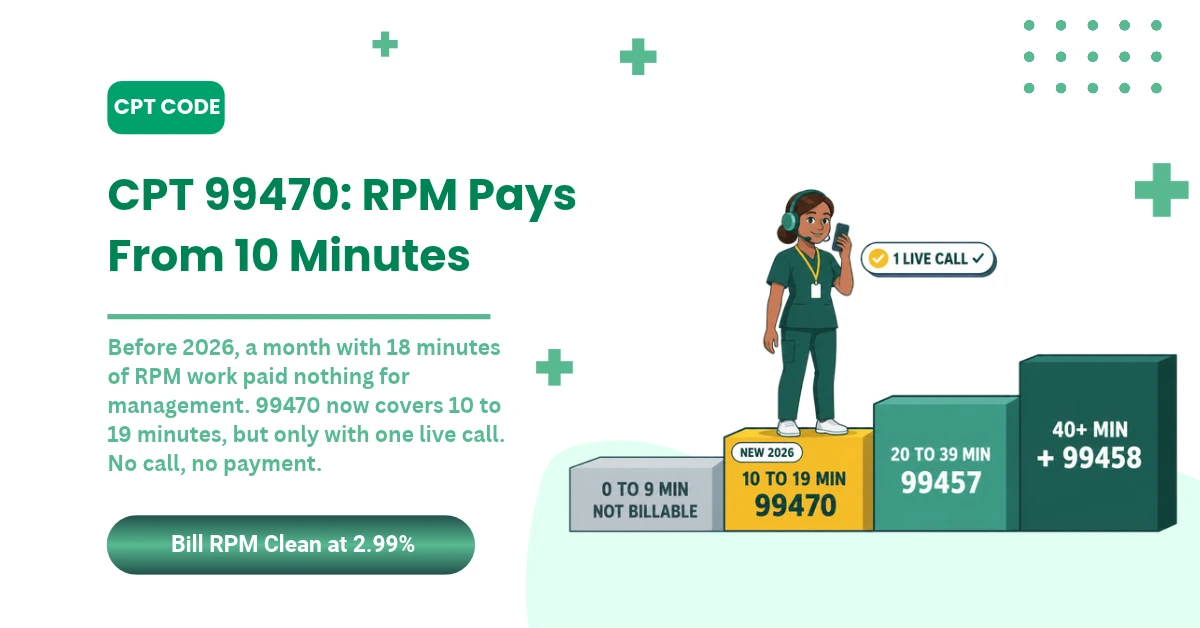
The month's total treatment management minutes decide the code, and one management code family applies per patient per calendar month. You bill CPT 99470 once per patient per calendar month, and only when the total lands between 10 and 19 minutes.
|
Total treatment management minutes in the calendar month |
Code to bill |
Live call needed that month |
|---|---|---|
|
0 to 9 |
No treatment management code |
Not applicable |
|
10 to 19 |
99470 |
Yes |
|
20 to 39 |
99457 |
Yes |
|
40 to 59 |
99457 + 99458 × 1 |
Yes |
|
60 to 79 |
99457 + 99458 × 2 |
Yes |
[Image placement: RPM time ladder infographic. Alt text: "RPM treatment management time ladder: under 10 minutes not billable, 10 to 19 minutes CPT 99470, 20 minutes CPT 99457, each additional 20 minutes CPT 99458"]
At 20 minutes, the whole month moves to 99457. You drop 99470 from that month's claim and report 99457 alone, along with 99445 or 99454 if the patient's device days qualify. A month with 21 minutes still bills 99457 and nothing more.
Under 99458 billing guidelines, the add-on follows 99457 for each additional full 20 minutes, so the first unit of 99458 needs 40 total minutes. 99458 doesn't attach to 99470. Payers can cap 99458 units, so check the plan's policy and the medically unlikely edit (MUE) before you bill a second or third unit.
A 39-minute month still bills one unit of 99457. That's why rounding up is the pattern auditors look for: they compare your time log against call records and EHR timestamps. The documentation section below shows what a log needs to hold up.
What you can and can't bill with CPT 99470
CPT 99470 should not be reported in conjunction with 99457 or 99458 for the same patient in the same calendar month. 99470 covers months with 10 to 19 minutes, and 99457 with any 99458 units covers months with 20 or more, so each month uses one track.
Codes that can't go on the same month's claim
|
Code |
Same month as 99470? |
Why |
|---|---|---|
|
99457 |
No |
It's the first-20-minutes code; choose one or the other |
|
99458 |
No |
Add-on to 99457 only |
|
RTM codes |
No |
RPM and RTM can't run together for the same patient |
|
99445 |
Yes |
Device supply, 2 to 15 days of data |
|
99454 |
Yes |
Device supply, 16 to 30 days of data |
|
99453 |
Yes, in the month setup happens |
Setup and education, once per episode of care |
|
CCM, TCM, BHI, PCM |
Yes, with separate time |
Medicare allows concurrent care management if no minute counts twice |
Medi-Cal's published policy, tracked by the Center for Connected Health Policy, states the same rule: 99470 "cannot be billed in conjunction with codes 99457 or 99458." It also caps 99445, 99457, and 99470 at one per calendar month for any provider.
RPM and remote therapeutic monitoring (RTM) can't run for the same patient, so pick the program that matches the data you collect. Device and setup codes pay for different work than 99470 does, which is why they can share its month on the claim.
Can CPT 99445 and 99470 be billed together?
Yes. Medicare pays device supply and treatment management as separate components, so 99445 and 99470 can share a month. One limit applies: 99445 can't share a 30-day period with 99454, since you report one device code per period.
The clocks are the trap. 99445 counts days in a 30-day period, while 99470 counts minutes in a calendar month, so your record has to show both clocks for the same patient. A post-discharge patient with nine days of readings and 14 minutes of nurse time bills 99445 and 99470.
Billing 99470 alongside CCM, TCM, BHI, and PCM
RPM can run in the same month as chronic care management (CCM, 99490 with add-on CPT code 99439), transitional care management (TCM), behavioral health integration (BHI), and principal care management (PCM). The HHS guide to billing remote monitoring allows it "as long as time and effort are not counted twice."
Fourteen minutes of RPM management and 25 minutes of CCM care coordination can support 99470 plus 99490, provided the patient qualifies for CCM and each log stands on its own. Keep a separate time log for each program.
If you also bill continuous glucose monitoring, our diabetes CPT codes guide explains how CGM codes 95249, 95250, and 95251 differ from RPM. Those codes pay for CGM setup and interpretation, while RPM codes pay for monitoring and management.
Pairing errors tend to trace back to a practice management system with no edit that stops 99470 and 99457 on the same month's claim. Our denial management services build that edit into pre-bill review and fix the root cause instead of resubmitting.
99470 CPT code reimbursement in 2026
CPT 99470 reimbursement under the 2026 Medicare Physician Fee Schedule is about $26.05 per calendar month in a non-facility setting. In a facility, it's $13.36. Both are national amounts before locality adjustment, and $26.05 is close to half of 99457's $51.77, which tracks with half the time.
RPM CPT codes 2026: national Medicare payment, non-facility
|
Code |
What it pays for |
2026 national non-facility payment |
Total non-facility RVU |
|---|---|---|---|
|
99453 |
Setup and patient education |
$21.71 |
0.65 |
|
99445 |
Device supply, 2 to 15 days of data |
$47.43 |
1.42 |
|
99454 |
Device supply, 16 to 30 days of data |
$47.43 |
1.42 |
|
99470 |
Treatment management, 10 to 19 minutes |
$26.05 |
0.78 |
|
99457 |
Treatment management, first 20 minutes |
$51.77 |
1.55 |
|
99458 |
Each additional 20 minutes after 99457 |
$41.42 |
1.24 |
These amounts are national figures before locality adjustment, calculated at the 2026 conversion factor of $33.4009. Qualifying alternative payment model (APM) participants use a conversion factor of $33.5675, so their amounts run a little higher.
In a facility such as a hospital outpatient department, Medicare pays the facility for staff and supplies on its own claim. Your practice expense share drops as a result. That's how 99470 falls from 0.78 total relative value units (RVUs) to 0.40. Its work RVU stays at 0.31, close to half of 99457's work RVU of 0.61.
Your actual rate depends on the geographic practice cost index (GPCI) for your locality. To check it, open the CMS PFS Look-Up Tool, choose 2026, enter 99470, and pick your Medicare Administrative Contractor (MAC) locality.
Medicare pays 80% after the Part B deductible, and the patient owes 20% coinsurance, about $5.21 on the national $26.05. RPM carries the same cost sharing as other Part B physician services, so explain it at consent. The remote patient monitoring reimbursement you collect depends on getting that 20% from the patient or a secondary plan.
Commercial and Medicaid plans set their own rates and adopt new codes on their own schedules. Confirm that a plan recognizes 99470 before you bill it, and ask how the plan wants you to report months with 10 to 19 minutes if it hasn't added the code yet.
On a $26 code, your billing fee matters. With MedSole's medical billing at 2.99% of monthly collections, the fee on a $26.05 payment collected in full comes to about 78 cents, with no setup, software, or clearinghouse fee.
Three 99470 billing examples, with the math
The way to make the most of CPT 99470 is to capture the months that used to go unbilled, rather than stretch time to reach a higher code. Each example below uses the 2026 national non-facility amounts from the table above.
Example 1: 14 minutes and one phone call
An established hypertension patient sends 18 days of blood pressure readings in the 30-day period. The nurse logs 14 minutes, including a six-minute phone call about when to take a medication. Bill 99454 ($47.43) plus 99470 ($26.05) for $73.48. Before 2026, the same month paid $47.43, and those 14 minutes paid nothing.
Example 2: 24 minutes switches the month to 99457
A heart failure patient's scale flags a three-pound weight gain. Staff log 24 minutes over the month, including a nine-minute video visit, and the scale sends 21 days of data. Bill 99454 ($47.43) plus 99457 ($51.77) for $99.20. On the management side, the month carries 99457 alone, and 99470 stays off the claim.
Example 3: 17 minutes with no live call
A COPD patient's pulse oximeter sends 20 days of data. Staff spend 17 minutes on data review and portal messages, but no one reaches the patient by phone or video. Bill 99454 alone ($47.43). The month loses the $26.05 for 99470 because the interactive communication didn't happen.
This is where months with 10 to 19 minutes leak. A day-20 check that flags each patient with logged minutes and no call gives your staff about 10 days to reach them before the month closes.
|
Example |
Minutes |
Live call |
Data days |
Codes billed |
National total |
|---|---|---|---|---|---|
|
1 |
14 |
Yes, phone |
18 |
99454 + 99470 |
$73.48 |
|
2 |
24 |
Yes, video |
21 |
99454 + 99457 |
$99.20 |
|
3 |
17 |
No |
20 |
99454 |
$47.43 |
As an illustration, if 40 patients a month land between 10 and 19 minutes, 99470 adds about $1,042 a month, or $12,504 a year, at national rates before locality adjustment and coinsurance.
99470 documentation that holds up in an audit
The HHS Office of Inspector General (OIG) found that about 43% of Medicare enrollees who received RPM didn't receive all three components: education and setup, device supply, and treatment management. That finding comes from OIG's 2024 RPM report, and OIG's 2025 RPM billing report found Medicare RPM payments exceeded $500 million in 2024.
Each CPT 99470 claim needs a record that proves the minutes, the live call, and the patient's eligibility for that calendar month. These seven elements cover it.
|
Record element |
What it shows |
Rule it proves |
|---|---|---|
|
Order and medical necessity |
Ordering practitioner, the condition monitored, and why the patient needs monitoring |
Monitoring is reasonable and necessary |
|
Consent |
Date, who obtained it, and a note that you explained cost sharing |
Consent at the start of RPM |
|
Established patient |
Date of the prior visit with the billing practitioner |
Established-patient rule |
|
Device and data days |
Device, its FDA status, and days with data in the 30-day period |
Device rule |
|
Time log |
Each entry's date, staff name and credential, minutes, and activity |
10 to 19 minutes in the calendar month |
|
Live interaction |
Date, phone or video, length, who took part, and what you decided |
Real-time interactive communication |
|
Supervision and billing |
Billing practitioner, NPI, and staff working under general supervision |
Performer and biller rules |
A defensible time log entry reads like this: 10/14, RN, 6 minutes, reviewed seven-day blood pressure trend, phone call with patient, plan unchanged. Your software should add the month's total from entries like that one, rather than letting someone type a total at month end.
OIG's 2025 report also built billing measures that flag practices billing RPM for a high share of enrollees with no prior history with the practice, plus practices billing for multiple monitoring devices per enrollee in a month. Run both checks on your own RPM roster.
Keep RPM time logs apart from E/M visit notes and CCM logs, since a minute you counted toward another billed service can't count toward 99470. Among RPM billing compliance tips, this one pays off when a records request arrives, because you can hand over one clean log per program.
Why 99470 claims get denied and how to fix them
In our experience, CPT 99470 denials trace back to four problems: a code conflict in the same period, a second RPM biller, a missing live call, or a payer that hasn't adopted the code.
|
Denial trigger |
CARC you'll often see |
Fix |
|---|---|---|
|
99470 with 99457 or 99458 in the same calendar month |
97 or 236 |
Bill one code from the month's total minutes and add a practice management edit that blocks the pair |
|
99445 with 99454 in the same 30-day period |
97 or 236 |
Report one device code per period |
|
Another practitioner billed RPM in the same 30-day period |
B20 |
Check for existing RPM enrollment at intake and agree on which practice manages the patient |
|
No documented live interaction, or minutes the record doesn't support |
16 or 50 |
Add the call record if the call happened; don't create one after the fact |
|
99458 units above the plan's limit |
151 |
Check the plan's unit limit and the MUE before billing extra units |
|
The same claim sent twice |
18 |
Check claim status before resubmitting |
|
A commercial or Medicaid plan hasn't adopted 99470 |
Varies by payer |
Read the plan's RPM policy before billing and ask how it wants you to report months with 10 to 19 minutes |
Payers choose the claim adjustment reason code (CARC), so treat that column as a guide. Noridian's denial code resolution guide gives the full wording for 16, 50, 97, 151, and 236, and Noridian's 2026 RPM update confirms that you report 99445 or 99454, one per monitoring period.
The CARC tells you what happened, and the remittance advice remark code (RARC) next to it tells you why. Fix the cause before you resubmit, or the same denial comes back next month. For bundling denials, our CO-97 denial code guide covers the fix step by step.
A coding conflict, such as 99470 and 99457 in one month, calls for a corrected claim. Save appeals for cases where your record already supports what you billed, such as a live call the payer overlooked in the notes.
If the same denial keeps coming back, the problem sits upstream of the claim. Request a free RCM review, and our billing experts will analyze your revenue cycle within 48 hours.
Common use cases for 99470 by specialty
99470 fits months when a monitored patient is stable or needs one short decision. Think of a quick data review and a short call, a check after a dose change, or a focused symptom call. The specialty doesn't matter. Any E/M-eligible practitioner who manages the data can bill it.
|
Specialty |
Common device |
A typical month with 10 to 19 minutes |
|---|---|---|
|
Primary care, hypertension |
Blood pressure cuff |
Stable readings and one call to confirm the plan |
|
Cardiology, heart failure |
Weight scale, blood pressure cuff |
A weight alert reviewed and a call to check symptoms |
|
Pulmonology, COPD |
Pulse oximeter |
A low reading reviewed and a symptom check call |
|
Endocrinology, diabetes |
Connected glucose meter |
A trend review and a short call about a dose change the practitioner ordered |
|
Podiatry, diabetic foot care |
Connected foot temperature mat |
A temperature alert reviewed and a call about foot checks |
|
Post-discharge care |
Any of the above |
The first steady month after a hospital stay |
RPM covers physiologic data such as blood pressure, weight, oxygen saturation, glucose, and temperature. Remote therapeutic monitoring (RTM) covers non-physiologic data, such as how a patient follows a therapy plan. You can't bill both programs for the same patient, so match the program to the data you collect.
The diagnosis on the claim has to support the monitoring. For heart failure, our CHF ICD-10 codes guide lists the codes cardiology programs use. Pulmonology programs can use our COPD ICD-10 codes guide for lung disease.
What the CY 2027 proposed rule means for CPT 99470
As of October 20, 2026, the CY 2027 Physician Fee Schedule proposed rule isn't final, and 99470 bills under the 2026 rules through December 31, 2026. CMS published the CY 2027 PFS proposed rule in the Federal Register on July 16, 2026, and comments closed September 14, 2026.
|
What CMS proposed |
What it would mean for 99470 |
|---|---|
|
Proposed: remove clinical staff practice expense inputs from 99470, 99457, and 99458, keeping their work RVUs |
Lower non-facility payment for each of the three codes |
|
Proposed: pay RPM only when clinical staff are direct employees of the billing practitioner or practice |
Minutes from contracted monitoring staff wouldn't count for Medicare; employees could still work off site under general supervision |
|
Proposed: a face-to-face initiating visit, billed as its own service, in person or by telehealth, where the billing practitioner discusses RPM |
Each new RPM patient would need that visit before monitoring starts |
|
Proposed: extend the established-patient rule to RTM |
No change for RPM, which already requires it |
|
Comment request: four bundled G-codes, with working labels GRPM1, GRPM2, GRTM1, and GRTM2 |
GRPM2, as described, would combine device supply, at least 2 days of data, and at least 20 minutes of management with a live interaction, leaving no tier for 10 to 19 minutes. It's a request for comment, not a finalized code. |
|
Proposed: conversion factor down 1.68%, or 1.19% for APM participants |
The dollar amount of each RPM code moves with it |
According to the AMA's 2027 fee schedule summary, a 19% yearly cap on payment cuts would spread the reductions over several years. The AMA opposes the employed-staff proposal and expects CMS to publish the final rule by November 1.
Before January, list who logs RPM minutes today and whether each person is an employee or a contractor. Add an initiating-visit check to RPM enrollment. Model 2027 revenue at lower treatment management rates, but hold off on a dollar figure until the final rule lands.
The proposal changes who performs monitoring minutes and how Medicare pays for them. Claim submission stays the same, since billing work isn't clinical staff time. If the final rule changes your RPM mix, MedSole's RPM billing team can review your 2027 code selection and claim edits before January claims go out.
Getting 99470 claims paid without adding billing staff
The work behind a $26 code happens at month end: counting minutes, confirming the live call, matching device days, and checking each payer's rules. You can keep that work with in-house staff or hand it to a remote patient monitoring billing partner.
MedSole RCM is a full-service revenue cycle management company serving practices in all 50 states. It bills at 2.99% of monthly collections with no setup, software, or clearinghouse fee and no monthly minimum, and it credentials providers at $99 per payer application.
For RPM billing, our team checks each patient's transmission days, clinical time, and eligibility before the month closes, and we log the date and method of each call we bill. RPM billing doesn't carry a separate charge, since it falls under the same 2.99% rate.
A new nurse practitioner or physician assistant who'll bill RPM has to enroll with each payer first. Our credentialing services cost $99 per payer application. Typical timelines run 30 to 45 days for Medicare and Aetna and about 90 days for Medicaid, depending on the payer and the state.
At $99, MedSole RCM has the lowest published per-payer price among the 10 companies in our credentialing company comparison, with prices checked on October 5, 2026.
CPT 99470 FAQs
What is CPT code 99470 used for?
CPT code 99470 pays for 10 to 19 minutes of remote physiologic monitoring treatment management in a calendar month. The month needs one real-time interactive communication with the patient or caregiver. Medicare has covered it since January 1, 2026.
How often is 99470 billed?
Once per patient per calendar month. Count the month's total treatment management minutes, and if they land between 10 and 19, report one unit of 99470. At 20 minutes or more, the month moves to 99457 instead.
Who is eligible for reimbursement under 99470?
Physicians and non-physician practitioners eligible to bill E/M services can bill it, and clinical staff can perform the time under general supervision. The patient must be established and consenting, and only one practitioner can bill RPM for that patient in a 30-day period.
Can 99470 and 99457 be billed in the same month?
No. Both codes cover the same management work at different time levels, so the month's total minutes pick one. 99458 can't join 99470 either, because it's an add-on to 99457 only.
Can you bill 99454 and 99457 together?
Yes. Medicare pays device supply and treatment management as separate components. Bill 99454 when the device sends 16 to 30 days of data in the 30-day period, and 99457 when management reaches 20 minutes with a live interaction.
Does 99470 require 16 days of device data?
No. 99470 bills on minutes of management. The day counts belong to the device codes: 99445 covers 2 to 15 days and 99454 covers 16 to 30 days in a 30-day period. CMS's December 2025 booklet exempts treatment management codes 99457 and 99458 from the day-count rule.
How much does Medicare reimburse for RPM?
In 2026, the national non-facility amounts before locality adjustment are $21.71 for 99453, $47.43 for 99445 or 99454, $26.05 for 99470, $51.77 for 99457, and $41.42 for each unit of 99458.
What is the reimbursement for CPT code 99458?
It's $41.42 per unit, the 2026 national non-facility amount before locality adjustment. The first unit needs 40 total minutes of treatment management in the calendar month, because 99458 adds each full 20 minutes beyond the 20 that 99457 covers.
Is RPM considered telehealth?
No. RPM sits outside Medicare's telehealth services list, and Medicare pays it as its own remote monitoring service. Telehealth visits bill under their own codes and rules, which our telehealth billing services team handles for Medicare and commercial payers.
Does the patient pay anything for 99470?
Yes. The Part B deductible and 20% coinsurance apply, so the patient's share comes to about $5.21 on the national $26.05. Explain the cost when you get consent, and bill any secondary plan for the coinsurance.
How much does it cost to outsource RPM billing?
Billing companies tend to charge a percentage of collections or a fee per claim. MedSole RCM charges 2.99% of monthly collections, with no setup, software, or clearinghouse fee and no monthly minimum, and RPM billing falls under that rate. Credentialing costs $99 per payer application.
Will 99470 change in 2027?
CMS proposed changes in July 2026, including removing clinical staff practice expense from 99470 and paying only for minutes from employed staff. As of October 20, 2026, none of it is final. The 2027 section above covers each proposal.