



What Is the ICD-10 Code for CHF?
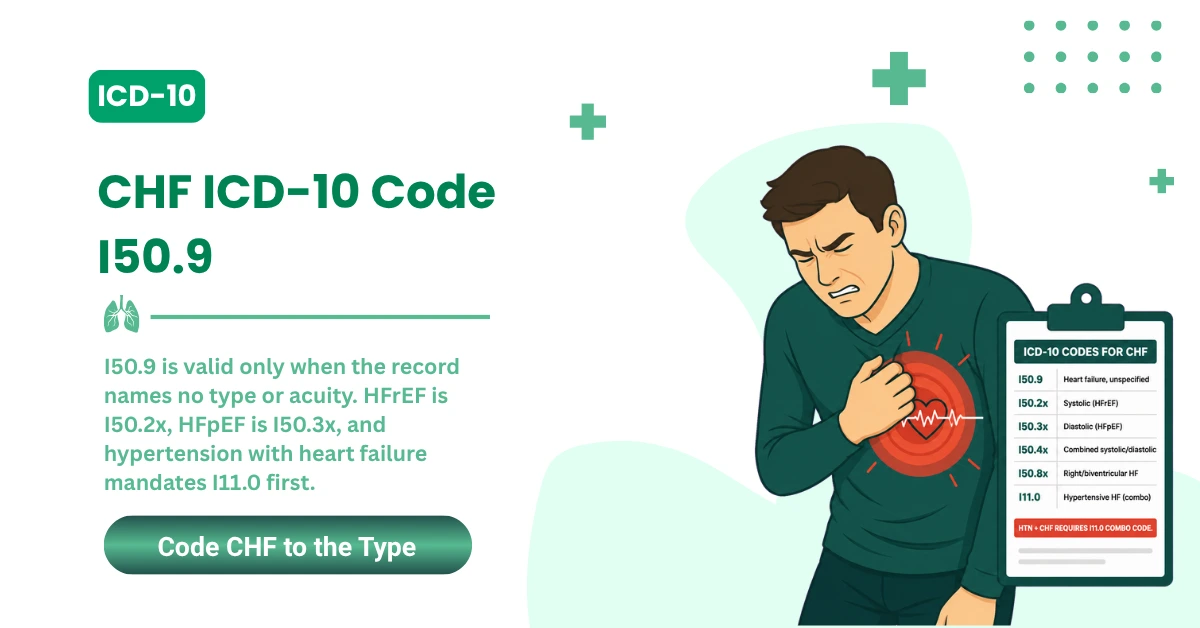
CHF is coded under ICD-10-CM category I50, and the exact code depends on the type of heart failure, its acuity, and whether hypertension is present. The ICD-10 code for CHF is never one fixed number. It's whichever I50 code the documentation supports.
That distinction matters for money. Congestive heart failure ICD-10 assignment drives claim acceptance, DRG weight, and Medicare Advantage risk scores. A vague CHF ICD-10 code on a complex patient invites review.
One thing trips up cardiology coding before it starts. In this setting, ICD means two different things. It's either the ICD-10-CM diagnosis system or an Implantable Cardioverter-Defibrillator, a device placed in CHF patients at risk of sudden cardiac death. This guide covers ICD-10 coding.
I50.9 is the unspecified default, used when nothing more specific is documented. The rest of the heart failure ICD-10 hierarchy, from systolic to diastolic to right-sided, depends on documented type and acuity. MedSole RCM built this CHF ICD-10 guide from the coding and denial patterns behind our outsourced medical billing services.
Key Takeaways
- I50.9 is the unspecified default for congestive heart failure, correct only when the documentation names no type or acuity.
- The fourth character follows one consistent acuity pattern across every I50 subfamily: 0 unspecified, 1 acute, 2 chronic, 3 acute on chronic.
- HFrEF (reduced ejection fraction) maps to the I50.2x family, and HFpEF (preserved ejection fraction) maps to the I50.3x family.
- Hypertension with heart failure requires the I11.0 combination code, with the I50.x type added second, never coded as two separate conditions.
- No dedicated ICD-10-CM code exists for HFmrEF, the 41% to 49% ejection fraction band, which is why documentation and a CDI query decide the code.
- The I50.8x family covers right heart failure, biventricular failure, and end stage heart failure, and it's the most underused precise code family in this cluster.
- MedSole RCM handles CHF and cardiology billing at 2.99% of collections and credentials providers at $99 per payer, with no setup fees.
I50.9: Heart Failure, Unspecified, and When It Becomes a Coding Error
I50.9 is a valid, billable ICD-10-CM code. It isn't a placeholder or an error by definition. It's the right code when the provider documents only "heart failure" or "CHF" with no further detail, when the workup is still in progress, or when nothing in the record clarifies the mechanism.
Picture an overnight admit with new shortness of breath and a high BNP, echo still pending. The note reads "CHF, workup underway." I50.9 is the honest CHF ICD-10 code that day, because nothing more specific has been established yet.
It turns into a coding error the moment the documentation already supports something more specific and the coder defaults to I50.9 anyway. The most common CHF ICD-10 error: an EHR problem list carries I50.9 forward from an old visit while the current note clearly supports a subtype.
That carry-forward is easy to miss. The problem list populates the encounter, the coder trusts it, and a chart documenting acute systolic failure goes out under an unspecified code. The specific language was sitting in the note the whole time.
The fix is a habit, not a system change. Before you accept a forwarded I50.9, read the current assessment. If it names a type or acuity, code that, and leave the stale code behind.
Some sources in circulation get the base mapping wrong, so here it is, straight. I50.1 is left ventricular failure. I50.2 is systolic heart failure. I50.3 is diastolic heart failure. The split runs by mechanism, not by acuity, and you can confirm every code against a reference like AAPC Codify.
One distinction separates two different documentation gaps. When systolic or diastolic dysfunction shows up as a finding, such as on an echo report, and the provider never links it to a heart failure diagnosis, the correct code isn't I50.9. It's I51.89, other ill-defined heart diseases.
The presenting-symptom case works the same way. When shortness of breath is documented and heart failure hasn't been confirmed yet, the code isn't I50.9 either. It's the symptom code, R06.02, until a diagnosis is established, which the shortness of breath ICD-10 code guide covers in full.
Systolic Heart Failure (HFrEF): The I50.2x Code Family
HFrEF describes a heart that can't squeeze hard enough to push adequate blood to the body. Under the AHA/ACC/HFSA guideline, HFrEF is defined as an LVEF of 40% or lower.
The ejection fraction alone doesn't assign the code. The provider has to state "systolic heart failure," "HFrEF," or "reduced ejection fraction" in the assessment or plan. A reduced EF sitting in a test report without a matching provider diagnosis doesn't meet the coding requirement.
Treat the EF number as evidence, not a verdict. It supports the diagnosis, but the provider has to render the diagnosis in words the coder can use. Until that language lands in the assessment or plan, the specificity isn't codeable.
This catches teams constantly. An echo reads "EF 30%," but the assessment says only "CHF." The number doesn't carry the code on its own, so the honest choice is I50.9 or a provider query, not I50.2x pulled from the echo.
|
Code |
When to use it |
|---|---|
|
I50.20 |
Unspecified systolic heart failure. Use when the note documents systolic HF or reduced EF without an acuity term. |
|
I50.21 |
Acute systolic heart failure. Use for a new or acutely decompensated systolic failure, often the exacerbation admission. |
|
I50.22 |
Chronic systolic heart failure. Use for an established, stable HFrEF under ongoing management. |
|
I50.23 |
Acute on chronic systolic heart failure. Use when a chronic HFrEF patient presents with an acute decompensation. |
Four drug pillars define guideline-directed medical therapy for HFrEF: an ARNI, ACE inhibitor, or ARB; a beta-blocker; a mineralocorticoid receptor antagonist; and an SGLT2 inhibitor. The AHA/ACC heart failure guidelines lay out how those four work together, and the medication list often tells you the CHF ICD-10 specificity the chart should carry.
One coding trap sits at the end of this family. No dedicated code exists for heart failure with improved ejection fraction, so it maps to the I50.2x series. A patient whose EF climbed from 35% to 45% stays coded and treated as HFrEF.
A coder who sees "improved EF" in a chart with a known HFrEF history should query the provider before changing the code. Improved isn't resolved, and assuming it is drops a valid diagnosis off the claim and softens the risk score the patient's care supports.
Diastolic Heart Failure (HFpEF): The I50.3x Code Family
HFpEF is the mirror image. The left ventricular muscle turns stiff and can't relax to fill between beats. The same 2022 guideline defines it as an LVEF of 50% or higher with evidence of increased filling pressures.
Diastolic failure is harder to see than systolic. The ejection fraction looks normal, so the diagnosis rests on filling pressures, natriuretic peptides, and Doppler findings the provider has to document and name.
|
Code |
When to use it |
|---|---|
|
I50.30 |
Unspecified diastolic heart failure. Use when diastolic HF or preserved-EF failure is documented without an acuity term. |
|
I50.31 |
Acute diastolic heart failure. Use for a new or acutely decompensated diastolic failure. |
|
I50.32 |
Chronic diastolic heart failure. Use for an established, stable HFpEF under ongoing management. |
|
I50.33 |
Acute on chronic diastolic heart failure. Use when a chronic HFpEF patient presents with an acute decompensation. |
This family carries the newest pharmacology in heart failure. On July 14, 2025, finerenone, brand name Kerendia, received FDA approval for heart failure with an LVEF of 40% or higher, covering both HFpEF and HFmrEF. The approval rests on the FINEARTS-HF trial.
That approval made finerenone the first nonsteroidal mineralocorticoid receptor antagonist indicated specifically for this population. SGLT2 inhibitors carry a Class 2a recommendation for HFpEF under the 2022 guideline, which puts two drug classes in play for a diagnosis that used to have few options.
Documentation is where HFpEF revenue leaks. The EF reads normal, a rushed note calls it "CHF," and the chronic diastolic heart failure the patient has never reaches the claim as I50.32.
The coding stakes follow from the treatment. A patient actively on finerenone and an SGLT2 inhibitor is being managed for a specific, documented condition. Coding that claim to I50.9 doesn't reflect what's being treated, and it won't survive a clinical validation review that checks medication history against diagnosis specificity.
Run the scenario a payer's edit engine runs. The claim shows Kerendia, an SGLT2 inhibitor, and a recent echo, paired with I50.9. The medication list describes HFpEF management while the diagnosis says "unspecified." That mismatch is what a CHF ICD-10 clinical validation review flags.
Combined Systolic and Diastolic Heart Failure, and the Coding Gap for HFmrEF
I50.4x applies in one situation only: the provider documents both systolic and diastolic dysfunction at the same time. It's never a default for an uncertain case. Both components have to be named in the assessment before the code can be used.
|
Code |
When to use it |
|---|---|
|
I50.40 |
Unspecified combined systolic and diastolic heart failure, no acuity term documented. |
|
I50.41 |
Acute combined systolic and diastolic heart failure. |
|
I50.42 |
Chronic combined systolic and diastolic heart failure. |
|
I50.43 |
Acute on chronic combined systolic and diastolic heart failure. |
The 2022 guideline formally defined four EF-based categories: HFrEF at 40% or lower, HFmrEF at 41% to 49%, HFpEF at 50% or higher, and HFimpEF for patients who improved out of the HFrEF range.
One of those categories has no home in ICD-10-CM. There's no dedicated code for the HFmrEF band itself. Absent more specific documentation, coders most often default to I50.9 for a chart that says only "HFmrEF" with no systolic or diastolic language attached.
This is worth stating as an open question rather than a fake-confident answer. Some sources pick a single code and move on. The honest position is that I50.9 is the common default, and the record often doesn't support anything tighter without a query.
The reason the honesty matters is the audit. A confidently wrong code gets recouped later. An unspecified code paired with a pending query holds up, because it reflects exactly what the record supported on that date.
The responsible move isn't guessing from the EF number. It's a CDI query asking the provider to characterize the dysfunction as systolic, diastolic, or combined. That one question turns an unspecified CHF ICD-10 code into a specific one the claim can defend.
This gap is getting more attention. In April 2026, the Heart Failure Society of America released a HFSA scientific statement addressing HFmrEF as a distinct, clinically meaningful category, which is a strong argument for tightening documentation now.
Right Heart Failure, Biventricular Failure, and End Stage Heart Failure: The I50.8x Family
This is the most underused precise family in the whole cluster, and it rewards six-character coding. Named in full, it looks like this.
|
Code |
Meaning |
|---|---|
|
I50.810 |
Right heart failure, unspecified |
|
I50.811 |
Acute right heart failure |
|
I50.812 |
Chronic right heart failure |
|
I50.813 |
Acute on chronic right heart failure |
|
I50.814 |
Right heart failure due to left heart failure |
|
I50.82 |
Biventricular heart failure |
|
I50.83 |
High output heart failure |
|
I50.84 |
End stage heart failure |
|
I50.89 |
Other heart failure |
Some references and search tools stop at I50.81 and call it done. Coding to the full sixth character is what separates a defensible right-heart-failure claim from a vague one, and payers increasingly expect the precision.
I50.814 earns its own explanation, because it's the most clinically important and worst-explained code here. When right-sided failure develops directly because of left-sided disease, which is the common pattern, I50.814 applies with a "code also" instruction to add the left-sided code, I50.2x, I50.3x, or I50.4x, when the type is known.
Read that as a two-code story. A long-standing HFrEF patient develops right-sided failure from the left-sided disease, so the claim carries I50.814 plus the systolic code. Drop the second code and you've under-described a sicker patient.
The I50.810 through I50.813 codes are reserved for right heart failure that stands on its own or ties to a pulmonary cause such as chronic cor pulmonale, which is coded I27.81 first. The sequence matters as much as the code.
Right-sided and biventricular failure commonly back blood up into the liver. When a CHF patient shows elevated liver enzymes from that congestion and it's separately evaluated, that finding carries its own code, which the transaminitis from hepatic congestion guide walks through.
I50.84, end stage heart failure, needs a clinical anchor, not a bare label. It corresponds to documented Stage D disease under the ACC/AHA staging framework. Don't confuse it with NYHA functional Class IV, which measures symptoms, not structural stage.
That Stage D versus Class IV mix-up is a real question with coding consequences. Stage D is structural and advanced; Class IV is a symptom snapshot that can shift visit to visit. Only documented Stage D anchors I50.84.
The Fourth Character Pattern: How Acuity Is Coded Across Every CHF Family
One pattern runs through the systolic, diastolic, and combined families, and learning it once replaces nine separate memorizations. The fourth character always codes acuity the same way, no matter which mechanism sits in the second character.
|
Fourth character |
Meaning |
|---|---|
|
0 |
Unspecified acuity |
|
1 |
Acute |
|
2 |
Chronic |
|
3 |
Acute on chronic |
Watch it hold across all three families. I50.21 is acute systolic. I50.31 is acute diastolic. I50.41 is acute combined. Same fourth character, same meaning, three different mechanisms.
The fifth character extends the same logic into the I50.8x family, so the habit you build here carries into right-sided and biventricular coding too.
A coder who internalizes this once can assign nine codes from memory instead of nine unrelated strings. A documentation template built around the pattern captures acuity consistently across every heart failure type a practice sees.
This doubles as a CDI teaching tool. Train providers to state acuity in one consistent phrase, and the fourth character falls out of the note automatically, which tightens every CHF ICD-10 code the practice submits.
Coding CHF With Hypertension: Why I11.0 Is Mandatory, Not Optional
ICD-10-CM presumes a causal relationship between hypertension and heart failure. When a patient has both, you don't get to code them as two unrelated conditions. The combination code I11.0, hypertensive heart disease with heart failure, gets assigned, with the specific I50.x code added to identify the type.
The logic behind the presumption is clinical. Chronic high pressure is a leading cause of the muscle changes that produce failure, so ICD-10-CM treats them as linked unless a provider says otherwise. You code the relationship, not two separate problems.
This presumption holds even when the provider never writes "due to." It breaks only when the documentation states plainly that the two conditions are unrelated, and that note has to be explicit; silence defaults to the combination code.
Sequence it correctly: I11.0 first, the specific I50.x code second. Reversing that order is a guideline violation, and automated payer edits catch it reliably. The FY2026 ICD-10-CM Official Guidelines spell out the sequencing rule.
Add chronic kidney disease to the picture and the combination code changes again. When heart failure is present with CKD stage 1 through 4 or unspecified CKD, the correct code is I13.0. When heart failure is present with CKD stage 5 or end stage renal disease, it's I13.2.
The I13.10 and I13.11 codes cover the same hypertension-plus-CKD combination, but only when heart failure is absent. A coder who reaches for I13.10 on a patient who also has documented heart failure has picked the wrong branch. N18.x is added to specify the CKD stage in every case.
Three conditions, one code family, and the branch depends on the details. Heart failure status and CKD stage together decide whether you land on I13.0 or I13.2, and most loose competitor content blurs that line. The CHF ICD-10 code changes with the CKD stage.
The audit pattern this produces is common. Using I10 plus I50.x plus N18.x separately, when I13.x is required, is a coding guideline violation that payer edit engines flag as reliably as the I11.0 sequencing error, and the fix is upstream in the coding, not in the appeal.
What Changed for CHF Coding in FY2026, and What Did Not
Start with the correction, because a real error is circulating. The April 1, 2026 mid-year ICD-10-CM release made no additions, deletions, or revisions to any code in the I50 heart failure family. It updated instructional notes in other chapters of the tabular list.
The I50.2x, I50.3x, and I50.4x structures are unchanged, and have been since their original 2016 introduction. Any source claiming FY2026 added new HFrEF or HFpEF codes is describing something that didn't happen, which the CDC NCHS ICD-10-CM release schedule confirms.
Why does the correction matter? RCM newsletters repeat coding rumors every fall, and a practice chasing a nonexistent new HFrEF code wastes time and mis-trains coders. The CHF ICD-10 code set you used in March is the one you use in April.
What is new is dated and consequential. On June 29, 2026, the American Heart Association, with the American College of Cardiology, the European Society of Cardiology, and the World Heart Federation, published the Second Universal Definition of Heart Failure, an international expert consensus updating how heart failure is identified and classified.
The definition shift is the real 2026 story. It moves heart failure toward three clinically actionable categories and away from rigid EF cutoffs, which is where documentation language, and eventually coding guidance, will follow.
This doesn't change ICD-10-CM code assignment directly, but it signals where clinical documentation language is heading. CDI programs tracking it now will be ahead of the coding-guideline updates that usually follow a consensus shift by a year or more.
Pair it with the HFSA HFmrEF statement, and the throughline for a billing team is a posture, not a task. None of these 2026 developments loosen documentation specificity. If anything, they sharpen the case for precise type-and-acuity documentation at the exact moment payer scrutiny of unspecified codes is rising.
Why I50.9 Triggers Audits, and the Five Documentation Gaps That Cause It
I50.9 is a valid code, but payer systems and Recovery Audit Contractors watch for a specific mismatch. A claim showing high complexity, multiple hospital days, IV diuretics, and echocardiography, paired with a diagnosis carrying none of that specificity, triggers review. Symptom-code and unspecified-code overuse is a recurring target in the OIG Work Plan.
The code isn't the problem. The mismatch is. I50.9 on a sniffle draws no attention; I50.9 on a five-day admission with IV diuretics and a formal echo reads like money left undocumented, and that's what a reviewer pulls.
RAC contractors work on a multi-year lookback, so a pattern of unspecified coding on complex admissions can surface claims from prior years, not only the one in front of you.
The first gap is the carry-forward. An EHR problem list holds I50.9 from an old encounter while the current note supports a specific subtype, and the old code rides onto the claim. Reconcile the problem list against the current assessment before submission, and the stale code never leaves the building.
The second is the missing number. A systolic or diastolic code gets assigned with no documented LVEF value anywhere in the record, leaving nothing to support the specificity billed.
The third is sequencing. Hypertensive heart failure gets coded with I50.x first instead of I11.0, tripping the same edit described earlier in this guide.
The fourth is the assessment gap. The provider uses HFrEF or HFpEF in the history but writes only "CHF" in the assessment, leaving the coder without assessment-level language to code from.
The fifth is the combination miss. Hypertension, CKD, and heart failure are all three documented, but the I13.x combination requirement gets skipped. Every one of these five is a place where specific clinical truth existed and never reached the claim in codeable form.
These gaps land as denials a billing manager knows on sight. A claim lacking the type-and-acuity specificity a payer's clinical validation logic expects reads as a CO-16 denial code pattern, information missing from the claim.
A high-complexity admission billed against an unspecified code, or a cardiac imaging study billed without a documented cardiac indication, reads as a CO-50 medical necessity denial. Both show up by their exact denial code, which is the vocabulary a team searches after the denial lands.
Practices that build type-and-acuity capture into the CHF ICD-10 documentation workflow before submission see fewer of these denials than practices fixing them after the fact. MedSole RCM's denial management service reviews CHF and cardiology claims for exactly this specificity gap before submission, at 2.99% of collections, with no setup fees.
For providers weighing who offers the most affordable full-service medical billing, MedSole RCM's 2.99% rate and $99 per payer credentialing fee sit below the industry range of 4% to 7% for billing and $200 to $400 per payer for credentialing.
CPT Codes That Pair With CHF Diagnoses, and Where the Pairing Breaks
An accurate ICD-10 code only protects revenue when the CPT code billed alongside it is also right. Payers evaluate the pairing as a single unit, not two independent decisions.
Think of the claim as a sentence. The ICD-10 code is the reason; the CPT code is the action. If the reason doesn't support the action, the payer stops reading and denies.
|
CPT |
What it covers |
|---|---|
|
93306 |
Complete transthoracic echocardiogram, the primary diagnostic study for heart failure severity and type. |
|
93308 |
Limited transthoracic echocardiogram, used for serial monitoring in an established HFrEF patient. |
|
99221-99233 |
Inpatient E/M codes reflecting the medical decision-making complexity of an admission. |
|
93000 |
Twelve-lead ECG. |
|
99490 |
Chronic care management, 20 minutes or more of non-face-to-face care coordination per month for a qualifying chronic condition. |
Two pairing failures show up constantly. First, billing 93306 with a generic or unspecified diagnosis and no documented cardiac risk factor, family history, or abnormal finding invites a medical necessity denial. The diagnosis has to justify the imaging, not ride along beside it.
A cardiac imaging code needs a diagnosis that names a cardiac reason, a risk factor, or an abnormal finding. Without one, the medical necessity edit treats the study as unsupported, no matter how appropriate the echo was clinically.
Second, when one entity performs the echo and another interprets it, modifier 26 applies to the professional interpretation and modifier TC to the technical component. Billing 93306 without the right modifier, when only one component was provided, is a routine, avoidable denial.
That modifier miss is pure avoidable leakage. A hospital-based echo split between a facility and a reading cardiologist needs the component modifier every time, and the edit that catches its absence is one of the most predictable in cardiology billing.
The chronic care management opportunity is missed revenue more often than it's a denial risk. Heart failure is one of the most appropriate qualifying diagnoses for CCM, given the volume-status monitoring, medication titration, and early decompensation checks it needs between visits.
CCM billing requires a written, patient-accessible care plan and at least two chronic conditions on file. Where that's documented, the coordination a heart failure patient already generates becomes billable rather than uncompensated. Tightening CPT selection this way feeds the broader cardiology revenue cycle management picture rather than one isolated claim.
CHF Coding in Hospice, as a Primary Diagnosis, and Under ICD-11
Hospice coding doesn't get a specificity exemption, which surprises a lot of teams. The same ICD-10-CM guidelines apply. The principal diagnosis on a hospice claim has to be the one most related to the terminal prognosis, coded as specifically as the documentation supports, not defaulted to I50.9 out of habit.
The habit that trips teams up is treating hospice as looser than acute care. It isn't. A hospice CHF ICD-10 claim carries the same expectation of type-and-acuity specificity as any other, and the terminal diagnosis has to be the one driving the six-month prognosis.
Under the CMS hospice terminal status guidelines, heart disease as a terminal diagnosis is supported by documentation that the patient is New York Heart Association Class IV, meaning heart failure or angina symptoms are present even at rest, and has been optimally treated or isn't a candidate for further surgery.
An ejection fraction of 20% or lower supports it too, where available, though that specific threshold isn't strictly required if it hasn't already been obtained. And the hypertension, CKD, and heart failure combination is a recognized source of hospice coding error, so the I11.0 and I13.x rules apply here exactly as everywhere else.
These aren't arbitrary thresholds. They're the criteria a Medicare reviewer checks when deciding whether a heart failure patient qualifies for the benefit, so the documentation has to speak to symptoms at rest and treatment already tried.
Can I50.9 be a primary diagnosis? Yes. On a general clinical claim, I50.9 is billable and appropriate as the primary or first-listed diagnosis when it's the most specific code the documentation supports. It stops being defensible the moment the record supports a specific type.
Internationally, ICD-11 codes congestive heart failure under BD10, with left ventricular failure, high output syndromes, and right ventricular failure sitting in the related BD11 through BD13 family. That's a heads-up, not a task, since ICD-10-CM remains the operative code set for US billing and reimbursement.
Frequently Asked Questions About CHF ICD-10 Coding
What's the difference between CHF and heart failure?
None, for coding. In ICD-10-CM, "congestive" is a nonessential modifier, so a diagnosis documented as heart failure codes identically to one documented as congestive heart failure. Type and acuity drive the code, not whether the word congestive appears in the note.
Is heart failure unspecified the same as CHF?
Heart failure unspecified, I50.9, is the code used when CHF is documented without further detail on type or acuity. It's one specific code inside the broader CHF family, not a separate condition. Think of CHF as the umbrella and I50.9 as the least specific code under it. Once the record names a type, a more specific code replaces it.
What is considered end stage CHF?
Clinically, end stage heart failure corresponds to ACC/AHA Stage D, advanced structural disease requiring specialized treatment. It's distinct from NYHA Class IV, which classifies symptoms rather than structure. It codes to I50.84. The two get confused often, but Stage D is a structural stage and Class IV is a symptom snapshot.
What is CHF I50.32?
I50.32 is chronic diastolic congestive heart failure. It's used for an established, stable HFpEF diagnosis under ongoing management, without a current acute decompensation. The fourth character, 2, is what marks it chronic. If that patient decompensated acutely, the code would shift to I50.33, acute on chronic.
How do you code congestive heart failure?
Identify the documented type first: systolic, diastolic, combined, right-sided, or unspecified. Then read the documented acuity: unspecified, acute, chronic, or acute on chronic. Then check for hypertension, which mandates the I11.0 combination code instead of separate coding. That three-step order handles almost every CHF ICD-10 code you'll assign.
What CPT code is used most often with a CHF diagnosis?
CPT 93306, complete transthoracic echocardiography, is the most frequently paired diagnostic study. The diagnosis on the claim still has to independently support the medical necessity of the imaging. A generic diagnosis with no cardiac indication invites a denial even when the echo was clinically appropriate.
Can hypertension and CHF be coded separately?
No. ICD-10-CM presumes a causal relationship and requires the I11.0 combination code, with the specific I50.x type added second, unless the documentation explicitly states the conditions are unrelated. Coding them as two separate conditions is one of the most reliably caught guideline violations in the whole cluster.
What does an RCM partner cost for CHF and cardiology billing?
Industry pricing for full-service medical billing runs 4% to 7% of collections, with credentialing at $200 to $400 per payer. MedSole RCM operates at 2.99% of collections for full-service billing and $99 per payer for credentialing, with no setup fees and no annual contracts.
Why Healthcare Providers Choose MedSole RCM for CHF and Cardiology Billing
CHF coding accuracy decides whether a claim clears, how a DRG is weighted, and whether a Medicare Advantage risk score reflects the true complexity of the patient being managed. That's the thread running through this whole guide.
Every section here points back to one operational truth. The clinical detail exists in the chart; the money depends on whether it reaches the claim as a specific CHF ICD-10 code.
MedSole RCM provides full-service medical billing at 2.99% of collections, with no setup fees and no long-term contracts, a rate structured below the 4% to 7% industry average for comparable scope. MedSole RCM credentials providers, including cardiologists and cardiology groups, at $99 per payer, against an industry range of $200 to $400 per payer.
The math is easy to check. A cardiology practice credentialing with 15 payers pays $1,485 total through MedSole RCM.
What keeps that low price credible is the integration. The same team managing CHF and cardiology claim submission also manages denial prevention, AR follow-up, and payer credentialing. Documentation gaps caught in denial review feed straight back into the coding and credentialing workflow instead of sitting in a separate department.
That feedback loop is where the specificity problems in this guide get solved, claim after claim, instead of resurfacing every audit cycle.
If your CHF claims keep coming back for specificity, that's a workflow gap worth a look. Start with a free billing performance review through MedSole's billing services at 2.99% of collections, and pair it with provider credentialing at $99 per payer to keep new cardiologists earning from day one.