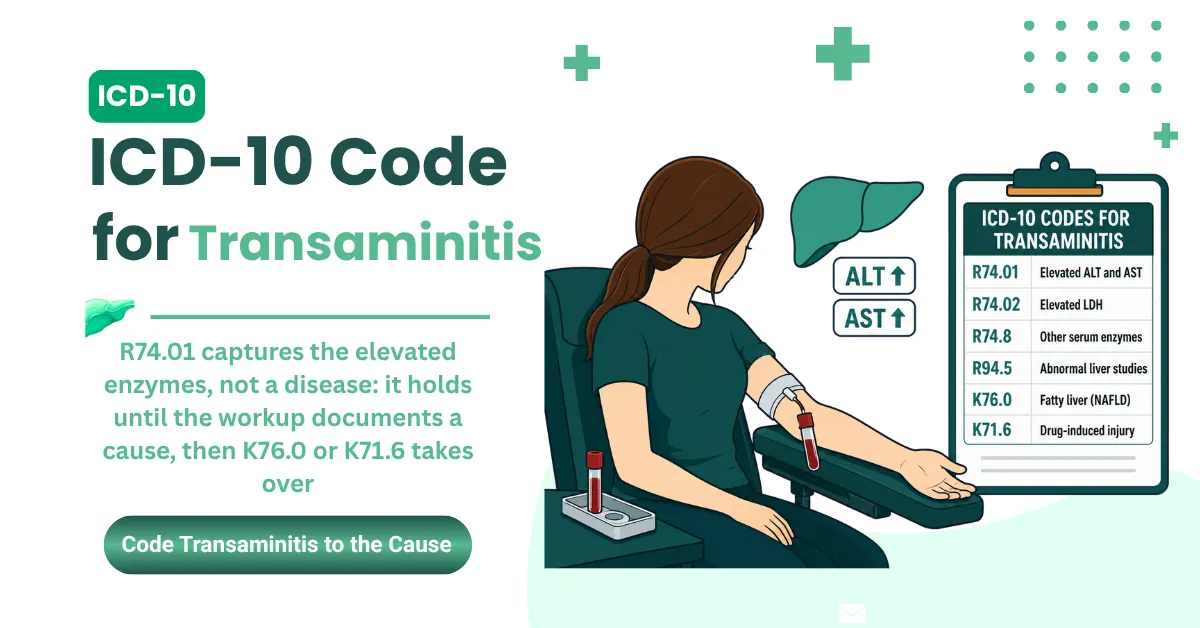




R74.01 is the transaminitis icd 10 code. Its official FY2026 ICD-10-CM tabular description reads "Elevation of levels of liver transaminase levels," effective October 1, 2025 and carried through the April 1, 2026 mid-year update.
As a medical billing company, MedSole RCM treats R74.01 as the starting point for everything that follows on a liver enzyme claim. You can confirm the code's status in the FY2026 ICD-10-CM files.
Use the icd 10 code for transaminitis when ALT, AST, or both are elevated and the provider hasn't confirmed an underlying liver diagnosis. The ICD-10-CM Official Guidelines permit codes for signs and symptoms when a definitive diagnosis isn't established.
That rule supports elevated alt icd 10 and elevated ast icd 10 reporting under R74.01 during an active workup. MedSole runs that workflow through outsourced medical billing services at 2.99% of collections, and you can read the rule itself in the ICD-10-CM Official Guidelines.
Once the provider documents a confirmed etiology, R74.01 stops leading the claim. NAFLD confirmed on imaging, viral hepatitis established through serology, alcoholic liver disease, or drug-induced liver injury each take a specific K-code or B-code as the primary diagnosis.
The icd 10 code for elevated liver enzymes serves as a secondary code from that point, and only when documentation justifies distinct clinical attention to the finding.
The provider note has to name ALT, AST, or both, not just "elevated LFTs" or "abnormal liver panel." Numeric values with collection dates belong in the assessment or plan, and a plan statement connecting the finding to a specific workup is required.
Practices weighing the ICD-10 vs ICD-11 transition in medical billing should note that R74.01's documentation standard carries forward into the ICD-11 equivalent unchanged.
MedSole RCM handles transaminitis claims across gastroenterology, hepatology, internal medicine, and primary care, which puts the coding judgment and the payer rules under one roof for the practices that bill these workups most.
The Complete R74 Code Family: What Each Code Means for Billing in FY2026
Code family accuracy drives billing accuracy on these claims. Selecting R74.8 when R74.01 is correct, or pulling the non-billable R74.0 parent into a claim, are the two errors that sink liver enzyme submissions most often. The table below sorts the family so the right code reaches the claim the first time.
|
ICD-10-CM Code |
Official Description |
Billable Status |
When to Use |
|---|---|---|---|
|
R74.01 |
Elevation of levels of liver transaminase levels |
Billable |
ALT and/or AST elevated, no confirmed underlying diagnosis |
|
R74.0 |
Nonspecific elevation of transaminase and LDH |
NOT BILLABLE (parent code) |
Never use on claims, submit R74.01 or R74.02 instead |
|
R74.02 |
Elevation of levels of lactic acid dehydrogenase (LDH) |
Billable |
LDH elevation specifically, distinct from transaminase elevation |
|
R74.8 |
Abnormal levels of other serum enzymes |
Billable |
ALP, GGT, or other serum enzyme elevation (not ALT/AST) |
|
R94.5 |
Abnormal results of liver function studies |
Billable |
General or unspecified abnormal liver function tests when the provider doesn't specify which enzyme is abnormal |
R74.0 is the parent code, and no HIPAA-covered transaction accepts it. Practices running EHR templates that haven't changed since 2021, when coders gained R74.01, may still pull R74.0 into claims on autopilot.
A claim carrying R74.0 lands in denial. The fix is a superbill and template audit, the same discipline that governs ICD-10 coding for abnormal blood findings, not a recoding request.
AHA Coding Clinic addressed the R74.0 expansion when coders gained R74.01: the split exists because ALT/AST elevations and LDH elevations represent different clinical contexts and different resource utilization patterns. A hepatology claim coding a transaminase elevation as an LDH code, R74.02, won't match the clinical picture, and payers flag that mismatch.
Code what the physician documented, not what the lab ordered, a principle CMS reinforces through its ICD-10 coding hub.
R74.8 covers other serum enzyme abnormalities, namely ALP and GGT. When a patient's ALP runs high but ALT and AST sit within normal limits, R74.8 is correct rather than R74.01. When both transaminases and ALP are elevated, R74.01 leads as the primary code, and R74.8 follows as secondary if the provider documents the ALP elevation as a separate finding.
The reversed-direction lookup, the r74 8 diagnosis code or diagnosis code r74.8 a coder reaches for, points to the same ALP/GGT rule.
R94.5 covers abnormal results of liver function studies when the provider documents "abnormal LFTs" without naming which enzyme is elevated. It carries less specificity than R74.01. When the provider names ALT or AST, R74.01 wins.
When the documentation stays nonspecific, R94.5 is more defensible than assigning R74.01 with no documentation support, which also keeps an icd 10 code transaminitis unspecified scenario off the claim when the record can't carry it.
On the 837P electronic claim, R74.01 populates the diagnosis code loop, Loop 2300, Segment HI. The diagnosis pointer in the service line, Loop 2400, Segment SV1, has to link R74.01 to the specific CPT being billed.
A broken diagnosis pointer severs the medical necessity link between the lab order and the code, and that severance generates a CO-16 denial. MedSole verifies pointer alignment inside the claim submissions process before anything leaves the system.
The icd 10 elevated lft entry on these claims rides the same pointer logic.
When to Use ICD-10 Code R74.01: Four Official Coding Rules for Clean Claims
R74.01 follows four governing rules from the ICD-10-CM Official Guidelines. These rules set when the code is correct, when a coder must replace it, and when it can't lead the claim.
Rule 1: Signs and symptoms are acceptable when no diagnosis is confirmed. The ICD-10-CM guidelines permit codes for signs, symptoms, and abnormal clinical findings when the provider hasn't established a related definitive diagnosis.
R74.01 fits this rule when the assessment says transaminitis or elevated ALT/AST and the plan says "workup in progress" or "etiology unclear." The visit reason supports R74.01 as first-listed.
This rule covers primary care, internal medicine, and gastroenterology outpatient encounters where the workup is still running, and you can confirm the language in the ICD-10-CM Official Guidelines for Coding and Reporting FY2026. It's the transaminitis icd 10 scenario coders see most.
Rule 2: Don't double-code symptoms that are integral to a confirmed condition. Once the provider documents confirmed NAFLD, viral hepatitis, alcoholic liver disease, or DILI, the guideline directs coders not to add R74.01 as a secondary code unless the abnormal finding gets separate attention and documentation beyond the routine presentation of the condition.
Elevated transaminases are integral to hepatitis, so adding R74.01 to a hepatitis claim is redundant and can trigger a code combination edit. The same logic governs the ICD-10-CM specificity rules and Excludes notes on any claim where a symptom rides behind a confirmed code.
Rule 3: Outpatient encounters can't code suspected or probable diagnoses. For outpatient visits, the inpatient "uncertain diagnosis" rules don't apply. A provider can't document "probable NAFLD" and have the coder assign K76.0 from that phrase.
The correct path: document transaminitis plus the suspected etiology as a differential, bill R74.01, and document the workup plan. Once imaging or serology confirms the cause, the claim transitions to the K-code.
On acute transaminitis icd 10 coding, no separate acute code exists, and mild transaminitis icd 10 follows the same logic; R74.01 covers all severity levels, which keeps an icd 10 transaminitis unspecified entry accurate during the workup.
Rule 4: Diagnostic encounter coding follows the final report. When the encounter purpose is to review results from a completed diagnostic test, and the interpreting provider's final report is available at coding time, code the confirmed diagnosis from the interpretation rather than the sign or symptom.
A patient who returns after an ultrasound showing fatty infiltration gets K76.0, not R74.01. The availability of a confirmed interpretation drives the transition, not the passage of time.
No separate history code exists for resolved transaminitis. When the condition resolves and carries no current clinical management implications, it doesn't get coded. When elevated enzymes persist and stay under monitoring, R74.01 continues as appropriate, which is the practical answer on history of transaminitis icd 10 questions.
When an underlying condition has been confirmed and managed, that condition's code replaces R74.01. A note reading "history of elevated LFTs" with no context creates a coding ambiguity that generates pend requests.
MedSole's certified coders apply these four rules across every transaminitis claim, which heads off the downstream denials that follow a code transition error. Practices can hand that judgment to MedSole's denial management services and keep their coders focused on the chart.
Transaminitis ICD-10 Code Selection: The Five-Step Decision Framework
Every transaminitis claim turns on one decision: has the provider confirmed an underlying cause or not. Everything else flows from that answer. This framework runs across gastroenterology, hepatology, internal medicine, and primary care billing, and it covers the three pathways coders meet most, NAFLD/MASLD, alcohol-related liver disease, and drug-induced liver injury.
It's the code-selection decision in operational form, and it doubles as the elevated liver enzymes icd 10 workflow.
Step 1: Confirm what the provider documented. Read the assessment. When it says "transaminitis," "elevated ALT/AST," "elevated liver enzymes of unclear etiology," or any equivalent phrasing with no named underlying condition, the code is R74.01. When the assessment names a confirmed condition alongside the enzyme elevation, move to Step 2. Coders code what providers document, not what labs suggest.
Step 2: Check for imaging or pathology confirmation. An ultrasound showing fatty infiltration supports K76.0 (NAFLD/MASLD) when the provider documents it as the cause. A liver biopsy result shifts the coding further.
When imaging or pathology has confirmed an etiology and the provider has documented that confirmation in the assessment, R74.01 steps back and the K-code steps forward. Document the specific imaging date and result in the plan.
This is the elevated lfts icd 10 decision point most claims hinge on.
Step 3: Is alcohol the confirmed driver? K70.x codes require documentation of current alcohol use, not just a history. When the provider documents "alcohol-related liver disease" with current use confirmed, K70.x is correct and R74.01 no longer leads.
"History of heavy alcohol use" with no current intake documented doesn't justify K70.x, and R74.01 stays until current use and causation are confirmed.
Step 4: Is drug-induced liver injury suspected or confirmed? When the provider documents medication-induced transaminitis or DILI, the pathway moves to K71.x plus a T-code adverse effect code from the T36-T50 range.
Both codes are required. The T-code identifies the causative drug, and the K71.x identifies the liver injury type. A claim carrying K71.x with no T-code generates an incomplete code assignment denial, the most common DILI billing error across payer types.
MedSole maps that pairing the same way it handles drug-induced ICD-10 billing and T-code sequencing on other conditions.
Step 5: Is there a chronic liver disease in the background? Patients with confirmed chronic liver disease, cirrhosis, autoimmune hepatitis, hemochromatosis, or Wilson disease, code the chronic condition as primary. R74.01 joins as a secondary code only when the provider addresses the enzyme elevation on its own in the current encounter beyond what the chronic condition already explains.
|
Confirmed Etiology |
Primary ICD-10-CM Code |
Secondary Code Required |
Common Mistake |
|---|---|---|---|
|
NAFLD/MASLD (imaging confirmed) |
K76.0 |
None required (R74.01 optional secondary) |
Continuing R74.01 after imaging confirms K76.0 |
|
Alcoholic liver disease (current use confirmed) |
K70.x |
Current alcohol use documented |
Using K70.x without documenting current use |
|
Drug-induced liver injury |
K71.x |
T36-T50.x5 adverse effect code required |
Submitting K71.x without the T-code |
|
Viral hepatitis (serology confirmed) |
B18.1 or B18.2 |
None required |
Using R74.01 after the hepatitis diagnosis is established |
|
Chronic hepatitis unspecified |
K73.9 |
None required |
Leaving R74.01 as primary after confirmation |
MedSole's coding team manages these transitions across every encounter and submits clean claims within 24 hours. Providers who want to clear transition errors without building internal expertise can lean on the same denial management services, backed by NIDDK NAFLD/MASLD diagnosis guidance and FDA drug-induced liver injury resources for the clinical thresholds behind each code.
CPT Codes for Transaminitis Claims: The 2026 Crosswalk and Medicare LCD Requirements
A correct ICD-10 code doesn't guarantee payment. The CPT code billed alongside R74.01 has to be medically necessary for the documented finding, and payer LCD policies spell out which diagnosis codes support which lab panels. This section maps the CPT codes that pair with transaminitis diagnoses most often and the Medicare coverage logic behind each pairing.
CPT 80076 is the hepatic function panel. It bundles ALT, AST, ALP, bilirubin (total and direct), total protein, and albumin. When a provider orders a full hepatic function panel to evaluate transaminitis, 80076 is the correct lab CPT, and it answers the common cpt code for liver enzymes question without ambiguity.
The Medicare LCD for CPT 80076 names which ICD-10-CM codes support medical necessity, and it names R74.8 outright. R74.01 appears as a covered diagnosis in some MAC jurisdictions but not all. Practices billing 80076 with R74.01 have to verify their local MAC's LCD before submission, and the Medicare LCD L33907 for the hepatic function panel is the source to check.
|
CPT Code |
Description |
Pairs With R74.01 When |
Medicare Coverage Note |
|---|---|---|---|
|
80076 |
Hepatic function panel |
Provider orders full liver workup (ALT, AST, ALP, bilirubin, protein, albumin) |
Verify MAC-specific LCD L33907, R74.8 is listed, R74.01 coverage varies by jurisdiction |
|
84460 |
ALT (alanine aminotransferase) |
Provider orders ALT individually rather than the full panel |
Covered with R74.01 for liver enzyme elevation in most jurisdictions |
|
84450 |
AST (aspartate aminotransferase) |
Provider orders AST individually rather than the full panel |
Covered with R74.01 for liver enzyme elevation in most jurisdictions |
|
82977 |
GGT (gamma-glutamyl transferase) |
Provider evaluates for an alcohol-related or biliary cause |
Pairs with R74.8 for GGT-specific elevation |
|
76705 |
Abdominal ultrasound (limited) |
Provider orders RUQ ultrasound to evaluate the liver for a structural cause |
Supported by R74.01 when documentation links enzyme elevation to imaging necessity |
|
99213 |
Office visit, established patient, low complexity |
Follow-up visit reviewing liver enzyme results |
Pairs with R74.01 when enzyme elevation is the primary reason for the visit |
|
99214 |
Office visit, established patient, moderate complexity |
New workup visit with moderate MDM for liver enzyme evaluation |
Pairs with R74.01 when the workup involves ordering multiple tests and risk assessment |
|
99215 |
Office visit, high complexity |
Complex case with significant management implications |
Pairs with R74.01 when elevated enzymes indicate high-risk findings requiring specialist referral |
When CPT 99213, 99214, or 99215 shares a date of service with a lab draw or procedure, Modifier 25 belongs on the E/M code to show the visit is significant and separately identifiable from the lab order.
A missing Modifier 25 generates a bundling denial, one of the highest-frequency denial sources on these claims. CPT 80076 coding guidance from AAPC backs the panel composition.
Medicare and most commercial payers require claim documentation showing why the test was ordered. "Elevated ALT 145 U/L, ordering hepatic function panel to evaluate for underlying liver disease" is an acceptable medical necessity statement.
"Abnormal labs, repeat panel" isn't. The phrasing in the order carries as much weight as the ICD-10 code on the claim, and the diagnosis code for elevated liver enzymes only holds up when the order language supports it. CMS sets that bar in its ICD-10 coding requirements.
Lab panel coverage shifts by payer and plan. Before ordering CPT 80076, confirming the patient's verification of benefits for lab panel coverage clears the most common preventable denial on transaminitis workup claims.
Prior authorization isn't a routine requirement for CPT 80076 under most commercial plans, but high-cost imaging like 76705 abdominal ultrasound and specialty referrals can require it. The CPT 99214 billing guide and the CPT 99204 billing guide cover the E/M side, and the difference between insurance verification and prior authorization decides which step a given payer demands.
Transaminitis ICD-10 Coding in Special Scenarios: Pregnancy, DILI, and Alcoholic Liver Disease
R74.01 doesn't always ride alone on a claim. Three clinical scenarios produce the toughest coding questions on transaminitis claims: transaminitis in pregnancy, drug-induced liver injury, and alcohol-related liver disease. Each one demands a different co-coding structure and a different documentation standard. This is the transaminitis icd 10 territory where sequencing decides payment.
Transaminitis in Pregnancy: ICD-10 Co-Coding Rules
When a pregnant patient presents with elevated ALT or AST and no confirmed underlying liver diagnosis, R74.01 doesn't lead. Pregnancy encounters follow a different sequencing rule: the obstetric complication code leads the claim, and R74.01 follows as secondary.
For elevated liver enzymes in pregnancy with no confirmed specific liver condition, the primary code is O99.89 (Other specified diseases and conditions complicating pregnancy, childbirth, and the puerperium) paired with R74.01 as secondary.
The Z3A code for weeks of gestation is required as an additional code on every obstetric claim. That structure answers the icd 10 code for transaminitis in pregnancy question that no competitor addresses.
HELLP syndrome, acute fatty liver of pregnancy, and intrahepatic cholestasis of pregnancy each carry their own specific ICD-10-CM codes. These aren't R74.01 scenarios. When the provider confirms any of these, the specific O-code replaces both O99.89 and R74.01.
Elevated enzymes in early pregnancy with no HELLP or cholestasis confirmed is the R74.01 co-coding scenario, and RUQ pain in these workups follows the same documentation logic as abdominal pain ICD-10 coding.
The CDC's 2023 hepatitis B testing recommendations, which name elevated ALT/AST as a testing indicator, shape the viral workup in pregnancy.
The provider has to document that the elevated transaminases get separate management beyond routine prenatal monitoring. Without that documentation, the code combination fails medical necessity review.
Drug-Induced Liver Injury (DILI): T-Code Sequencing and K71.x Rules
Drug-induced transaminitis codes one way when suspected and another when confirmed. While the provider suspects but hasn't confirmed DILI, R74.01 is the primary code. Once the provider documents "drug-induced liver injury" or "medication-induced transaminitis," the claim transitions to K71.x (toxic liver disease) as primary.
K71.x requires a companion T-code from the T36-T50 range that names the specific causative drug. This is the drug induced transaminitis icd 10 pathway in full.
|
Drug Class |
Common Culprits |
T-Code Adverse Effect |
K71.x Code |
|---|---|---|---|
|
Statins (antilipemic agents) |
Rosuvastatin, atorvastatin, simvastatin |
T46.6X5A |
K71.6 |
|
Acetaminophen |
OTC acetaminophen, combination pain products |
T39.1X5A |
K71.6 |
|
Antifungals |
Fluconazole, ketoconazole |
T37.8X5A |
K71.6 |
|
Antibiotics |
Amoxicillin-clavulanate |
T36.0X5A |
K71.6 |
|
Immunosuppressants |
Methotrexate |
T45.1X5A |
K71.6 |
|
Antihyperglycemics |
Certain diabetes medications |
T38.3X5A |
K71.6 |
The "5A" suffix on every T-code means adverse effect (correct drug, correct dose, correct administration) at the initial encounter. When the patient returns for follow-up of a known DILI, "5D" is the subsequent encounter suffix.
Most practices miss the encounter suffix, which generates incomplete code assignment denials. MedSole sequences these the same way it handles drug-induced ICD-10 billing and T-code sequencing on other conditions, and imaging ordered during a DILI workup may route through prior authorization services.
The FDA DILIrank drug-induced liver injury database lists the hepatotoxic agents behind these T-codes.
Alcoholic Transaminitis: K70.x and the Current-Use Requirement
Alcoholic transaminitis codes to K70.x (alcoholic liver disease) once the provider confirms alcohol as the cause. The K70.x codes require documentation of current alcohol use. K70.0 covers alcoholic fatty liver, and K70.1 covers alcoholic hepatitis.
The specific subcode depends on what the provider documented. R74.01 applies only during the workup phase, before the alcohol etiology is confirmed, which settles the alcoholic transaminitis icd 10 question.
When the provider documents a history of alcohol use but the patient is abstinent now, with no current alcohol-related liver disease activity documented, K70.x doesn't apply. R74.01 or the appropriate chronic liver disease code leads based on what the current clinical picture supports.
Alcohol use disorder (F10.x) can join as a co-code when the provider documents and addresses it on its own.
R74.01 in Inpatient Billing: MS-DRG V43.0 Grouping and Hospital Coding Rules
Inpatient coding for transaminitis follows different sequencing rules than outpatient. The principal diagnosis, the condition established after study to be chiefly responsible for the admission, drives MS-DRG assignment. R74.01 as a principal diagnosis on an inpatient claim is unusual but not wrong when the workup stayed inconclusive across the entire admission.
The more common path: the workup during admission confirms an etiology, and the confirmed K-code becomes the principal diagnosis. That distinction shapes how the icd 10 code for transaminitis behaves on a hospital claim.
When K71.x, K76.0, K70.x, or K73.x serves as the principal diagnosis on an inpatient claim, the claim groups into MS-DRG V43.0 (valid October 1, 2025 through September 30, 2026). The DRG tier depends on the presence of a major complication or comorbidity (MCC) or a complication or comorbidity (CC).
|
MS-DRG |
Description |
Assigned When |
RW Signal |
|---|---|---|---|
|
DRG 441 |
Disorders of liver except malignancy, cirrhosis, or alcoholic hepatitis with MCC |
K71.x or K76.x as principal diagnosis with a documented MCC (hepatic encephalopathy, coagulopathy, or sepsis) |
Highest reimbursement tier |
|
DRG 442 |
Disorders of liver except malignancy, cirrhosis, or alcoholic hepatitis with CC |
K71.x or K76.x as principal diagnosis with a documented CC |
Mid-tier reimbursement |
|
DRG 443 |
Disorders of liver except malignancy, cirrhosis, or alcoholic hepatitis without CC/MCC |
K71.x or K76.x as principal diagnosis with no CC or MCC documented |
Lowest reimbursement tier, highest documentation improvement opportunity |
Practices billing DRG 443 when a CC or MCC is present but undocumented leave reimbursement on the table. Hypokalemia (E87.6), coagulopathy, and hepatic encephalopathy are common CCs and MCCs in liver disease admissions that go undocumented or get documented but not coded.
A CDI review on inpatient liver disease claims produces a DRG tier upgrade more often than not, the same pattern that governs metabolic lab ICD-10 coding and DRG CC implications on electrolyte findings.
Inpatient guidelines, unlike outpatient, allow coding "probable," "suspected," or "likely" diagnoses as confirmed when the attending physician documents them at the time of discharge. An attending who documents "probable NAFLD as the likely cause of transaminitis" at discharge can have K76.0 coded as the principal diagnosis on the inpatient claim.
This is the single most misunderstood inpatient coding rule in liver disease billing. The DRG validation guide walks the MS-DRG V43.0 logic in full, and the MS-DRG V43.0 definitions manual is the governing CMS source.
MedSole's billing team folds the DRG validation review into the standard billing workflow at 2.99% of collections. Practices with elevated liver disease admissions get a CC/MCC capture audit as part of standard onboarding, which turns documented-but-uncoded complications into the DRG tier the chart supports.
The Five Denial Codes That Hit R74.01 Claims and How to Fix Each One
A correct ICD-10 code and a correct CPT pairing still produce denials when documentation gaps exist. Five denial codes show up most often on transaminitis claims, and each one maps to a fixable gap in the transaminitis icd 10 billing workflow. Each one carries a specific root cause, a specific fix, and a prevention protocol.
|
Denial Code |
Official Name |
Root Cause on R74.01 Claims |
Fix |
Prevention |
|---|---|---|---|---|
|
CO-4 |
Procedure code inconsistent with modifier |
Missing Modifier 25 when E/M and lab order share a claim date |
Append Modifier 25 to the E/M code and resubmit |
Build Modifier 25 into the charge capture template for all E/M plus lab same-day encounters |
|
CO-16 |
Claim lacks information |
ALT/AST values absent from the assessment, or the plan doesn't link the finding to a workup order |
Obtain a physician addendum adding specific values and a medical necessity statement |
Train providers to include numeric lab values and a plan linkage sentence in every transaminitis note |
|
CO-50 |
Non-covered service |
R74.01 not on the MAC-specific LCD as an accepted diagnosis for CPT 80076 |
Verify the MAC LCD for CPT 80076 and substitute R74.8 when ALP elevation is the primary finding, or appeal with documentation showing ALT/AST involvement |
Pre-submission LCD crosscheck for all hepatic function panel orders |
|
CO-11 |
Diagnosis inconsistent with procedure |
R74.01 paired with an unrelated imaging or specialty referral CPT that doesn't connect clinically to liver enzyme elevation |
Review CPT-ICD alignment before submission, every CPT on the claim needs a documented clinical link to R74.01 or the underlying condition |
Pre-submission claim scrubbing with diagnosis pointer verification |
|
CO-197 with N115 |
Precertification or authorization required |
Hepatic imaging (CPT 76705) or specialist referral billed without prior authorization where the payer requires it |
Obtain retro-auth when available, appeal with medical necessity documentation when not |
Verify prior authorization requirements for imaging and referral CPTs before ordering |
CO-16 is the highest-frequency denial on transaminitis claims because the exact documentation gap this article addresses drives it: missing numeric ALT/AST values and absent plan-to-finding linkage.
Every CO-16 denial on a liver enzyme claim traces back to a note that said "elevated liver enzymes" with no number and "repeat labs" with no reason, the same elevated liver enzymes icd 10 documentation failure that sinks medical necessity.
The CO-16 denial code guide covers the addendum workflow, and the ICD-10-CM Official Guidelines coding and reporting set the documentation bar.
CO-50 is the most dangerous denial on these claims because it signals a coverage policy issue, not a documentation issue. When CPT 80076 denies with CO-50 and R74.01, the practice has to verify whether their MAC's LCD lists R74.01 as a covered diagnosis for that panel.
When it doesn't, the fix is a code correction or a formal LCD appeal, not a documentation patch. The CO-50 denial code guide maps both routes.
CO-4 on a transaminitis claim points to a missing Modifier 25 on the E/M code. That modifier isn't optional when an office visit and a lab order share a date of service. The CO-4 denial code guide covers the charge-capture fix.
MedSole's denial management team resolves CO-4, CO-16, CO-50, CO-11, and CO-197 denials across transaminitis claims every billing cycle, the same root-cause discipline behind its work on denial code patterns and contractual adjustments.
Practices that want these caught before submission rather than after lean on MedSole's pre-submission claim scrubbing at 2.99% of collections through its denial management services, and the AR follow-up services team works every appeal within 48 hours.
Provider Documentation Templates and Pre-Submission Compliance Checklist for Transaminitis Claims
Documentation is the foundation of every transaminitis claim. What the provider writes in the assessment and plan decides which code the coder can assign, which CPT the payer will cover, and whether the claim survives audit. These three templates reflect the three most common R74.01 billing scenarios.
Template A: Etiology Unclear (Standard R74.01 Scenario)
"Transaminitis (ALT ___ U/L, AST ___ U/L, collected [date]). Etiology unclear. Differential includes viral hepatitis, medication or toxin exposure, alcohol-related liver disease, and metabolic liver disease. Plan: repeat hepatic function panel in ___ weeks; order hepatitis B surface antigen and hepatitis C antibody; order RUQ ultrasound; review medication list and supplement exposures for hepatotoxic agents."
This template supports R74.01 as the first-listed diagnosis, justifies CPT 80076 and 76705, and satisfies the medical necessity link that heads off CO-16 denials.
Template B: Suspected MASLD/MASH (Pre-Confirmation Scenario)
"Transaminitis (ALT ___ U/L, AST ___ U/L). Metabolic risk factors present: [obesity / insulin resistance / dyslipidemia]. Likely related to MASLD/MASH; ruling out viral hepatitis and medication-induced causes. Plan: hepatitis panel, fasting lipid panel, ultrasound liver; lifestyle counseling initiated; repeat LFTs in ___ weeks."
R74.01 stays as the primary code until imaging confirms fatty infiltration. This template documents the clinical reasoning behind the workup while keeping the code compliant with outpatient coding rules.
Template C: Suspected Drug-Induced Liver Injury (DILI Scenario)
"Transaminitis (ALT ___ U/L, AST ___ U/L). Concern for drug-induced liver injury. Current medications reviewed: [list suspected agent]. Plan: discontinue [drug name]; counsel patient on warning symptoms (jaundice, RUQ pain, dark urine); repeat hepatic function panel in ___ weeks; escalate to hepatology if bilirubin rises or ALT doesn't trend downward within ___ weeks."
This template supports R74.01 during the suspected phase. Once drug causation is confirmed, the claim transitions to K71.x plus the appropriate T-code. The specific drug name in the template feeds the T-code assignment.
Work through these ten items before the claim leaves your system:
- Confirm no definitive diagnosis exists in the assessment before using R74.01 as primary
- Verify the provider named ALT, AST, or both by enzyme name, not just "elevated liver enzymes" or "elevated LFTs"
- Confirm numeric lab values with collection dates appear in the assessment or plan
- Confirm the plan includes a follow-up action with a documented clinical link to the enzyme finding
- When DILI is suspected or confirmed, confirm K71.x plus a T36-T50.x5 adverse effect code are both present
- When alcohol use is confirmed as the cause, confirm current use is documented and K70.x is assigned
- When imaging confirms fatty infiltration, confirm the transition from R74.01 to K76.0 has happened
- Code to the 5th digit minimum, R74.0 is non-billable and R74.01 is required
- Confirm the diagnosis pointer in 837P Loop 2400 links R74.01 to the specific CPT billed
- Verify the payer-specific LCD for CPT 80076 before submission to confirm R74.01 is a covered diagnosis
Practices that clear these ten items before submission watch denial rates on liver enzyme claims drop below 3%. Benefit verification before lab orders clears the most common preventable denial, and the AR follow-up in medical billing workflow recovers the gaps that slip through, backed by the same Medicare LCD L33907 hepatic function panel crosscheck that item 10 calls for.
Transaminitis Billing Services for Healthcare Providers: What MedSole RCM Covers
MedSole RCM provides transaminitis billing services for gastroenterology, hepatology, internal medicine, family medicine, and primary care practices at 2.99% of collections with no setup fees and no long-term contracts. That's the most competitive rate in the US medical billing market for full-service revenue cycle management.
Provider credentialing and payer enrollment run at $99 per payer, covering 900-plus payer networks with a 99% first-time approval rate, and MedSole RCM has credentialed more than 4,000 providers nationwide. The 2.99% rate covers eligibility verification, claims submission, payment posting, denial management, AR follow-up, and monthly performance reporting across all payers including Medicare, Medicaid, and every major commercial plan.
Practices billing elevated liver enzyme workups, hepatic function panels, and liver disease management get the complete workflow at one flat rate, through outsourced medical billing services at 2.99% of collections, provider credentialing and payer enrollment at $99 per payer, revenue cycle management services, and coverage built for MedSole RCM specialties.
Frequently Asked Questions About Transaminitis ICD-10 Coding
What is the ICD-10 code for transaminitis?
R74.01 is the transaminitis icd 10 code, described as "Elevation of levels of liver transaminase levels." The icd 10 code for transaminitis applies when a patient's ALT or AST is elevated and no underlying liver disease is confirmed. R74.01 became valid in 2021 and stays current under the FY2026 code set.
What is the difference between R74.01 and R74.8 in medical billing?
R74.01 covers elevated ALT and AST. R74.8 covers abnormal levels of other serum enzymes, including ALP and GGT. When only ALP or GGT is elevated, R74.8 is correct. When both transaminases and ALP are elevated, R74.01 leads as primary. Using R74.8 when the documentation names ALT or AST creates a code mismatch denial.
Can R74.01 be used as the primary diagnosis on a claim?
Yes. ICD-10-CM guidelines allow R74.01 as the first-listed diagnosis when elevated liver transaminases are the primary reason for the outpatient visit and no definitive underlying diagnosis has been confirmed. R74.01 steps back once a confirmed etiology such as NAFLD, viral hepatitis, or drug-induced liver injury is established and coded to its specific ICD-10-CM code.
What CPT code pairs with R74.01 for liver enzyme testing?
CPT 80076 is the hepatic function panel used to evaluate transaminitis and pairs with R74.01 when a full liver workup is ordered. Individual enzyme tests use CPT 84460 for ALT and CPT 84450 for AST. When an E/M visit and lab are billed on the same date, Modifier 25 is required on the office visit code.
What is the ICD-10 code for drug-induced transaminitis?
Confirmed drug-induced transaminitis codes to K71.x (toxic liver disease) as the primary code, with a companion T-code from the T36-T50 range identifying the specific drug. For statin-induced transaminitis, the T-code is T46.6X5A. K71.x and the T-code are both required on the claim, and submitting K71.x without the T-code generates an incomplete code assignment denial.
What is the ICD-10 code for transaminitis in pregnancy?
Elevated liver enzymes in pregnancy without a confirmed specific condition code to O99.89 (Other specified diseases and conditions complicating pregnancy) as the primary code, with R74.01 as secondary, and a Z3A code for weeks of gestation as an additional code. Confirmed HELLP syndrome, intrahepatic cholestasis of pregnancy, or acute fatty liver of pregnancy each carry their own specific O-codes.
Why do claims with R74.01 get denied?
The five most common R74.01 denial codes are CO-4 (missing Modifier 25 on same-day E/M and lab), CO-16 (ALT/AST values absent from documentation), CO-50 (R74.01 not on the MAC LCD as a covered diagnosis for CPT 80076), CO-11 (diagnosis inconsistent with an unrelated CPT), and CO-197 (prior authorization required for imaging or specialist referral paired with the encounter).
When should R74.01 be replaced with a different ICD-10 code?
R74.01 gets replaced when the provider confirms an underlying cause. Ultrasound-confirmed fatty infiltration transitions the code to K76.0. Confirmed hepatitis B or C transitions to B18.1 or B18.2. Confirmed alcoholic liver disease with current use documented transitions to K70.x. Confirmed drug-induced liver injury transitions to K71.x plus the appropriate T-code. The transition is documentation-driven, not time-driven.
This guide is for healthcare providers, medical billing professionals, and clinical coders and reflects FY2026 ICD-10-CM (effective October 1, 2025, with the April 1, 2026 mid-year update), the ICD-10-CM Official Guidelines for Coding and Reporting FY2026, Medicare LCD L33907, and MS-DRG V43.0 (valid October 1, 2025 through September 30, 2026) current as of the publish date. CPT codes and descriptors are copyrighted by the American Medical Association. Verify all codes, LCD coverage, and payer policies against current CMS, MAC, and payer sources before claim submission. Authored by Carter Hensley, CPC, MedSole RCM.