


![Hypokalemia ICD-10 Code (E87.6): Complete Billing and Coding Guide for Healthcare Providers [2026]](/_imgs/blogs/93086_hypokalemia-icd-10-code-e87-6-billing-guide-2026-medsole-rcm.webp)
Quick Reference: ICD-10-CM Code E87.6
|
Field |
Detail |
|
ICD-10-CM Code |
E87.6 |
|
Condition Name |
Hypokalemia (Potassium Deficiency) |
|
Also Known As |
Hypopotassemia, Hypopotassaemia, Hypokalaemia |
|
Billable |
Yes |
|
FY2026 Effective Date |
October 1, 2025 |
|
Valid Through |
September 30, 2026 |
|
ICD-10-CM Chapter |
Chapter 4: Endocrine, Nutritional and Metabolic Diseases |
|
Category |
E87: Other Disorders of Fluid, Electrolyte and Acid-Base Balance |
|
Normal Potassium Range |
3.5 to 5.0 mEq/L |
|
Diagnostic Threshold |
Below 3.5 mEq/L |
|
Severe Threshold |
Below 2.5 mEq/L (requires urgent clinical intervention) |
|
Neonatal Code |
P74.32 (Hypokalemia of Newborn) |
|
Periodic Paralysis Code |
G72.3 |
|
MS-DRG (with MCC) |
DRG 640 |
|
MS-DRG (without MCC) |
DRG 641 |
|
MS-DRG Version |
V43.0 (Oct 2025 to Mar 2026) / V43.1 (Apr 2026 to Sep 2026) |
|
Primary CPT for Lab |
84132 (Potassium, Serum) |
|
Related CPT |
80051 (Electrolyte Panel), 80048 (Basic Metabolic Panel) |
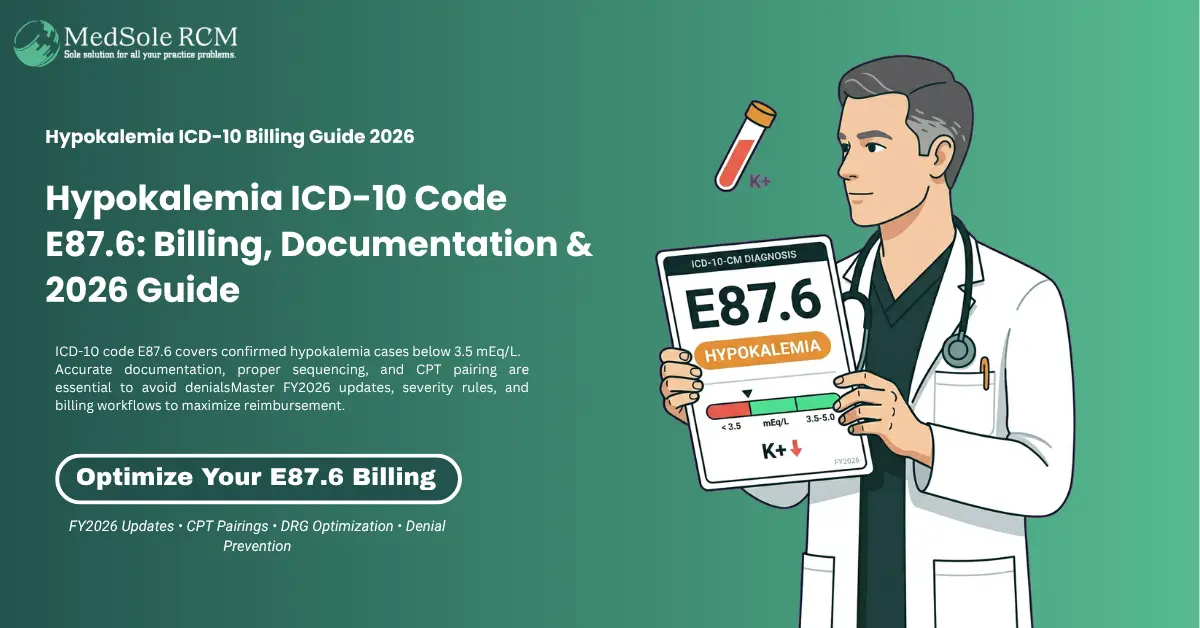
The ICD-10-CM diagnosis code for hypokalemia is E87.6, which applies to confirmed cases where serum potassium levels fall below 3.5 mEq/L. This code is billable under the FY2026 ICD-10-CM Official Guidelines, effective October 1, 2025 through September 30, 2026, per the CMS ICD-10-CM Tabular List. The official code description is Hypokalemia (Potassium Deficiency), and it captures all confirmed adult presentations of low potassium icd 10 and icd 10 for low potassium scenarios across all care settings. E87.6 is the correct icd 10 for hypokalemia regardless of whether the documentation uses clinical terminology or lay terms like potassium deficiency.
Claim denials and documentation errors are the two most common billing problems tied to this diagnosis. Coders miss the sequencing rules. Providers document a lab value without documenting clinical significance. Payer edits flag the wrong code family. This guide exists to eliminate those errors before they cost your practice revenue.
Here's what you'll find in the sections ahead: the clinical definition of hypokalemia, the full ICD-10-CM code family, FY2026 updates, severity-level coding rules, etiology-specific sequencing, Excludes 1 compliance requirements, documentation standards, CPT code pairings, 10 real-world billing scenarios, and a denial prevention guide with appeal pathways. Each section is written for billing professionals, coders, and clinical documentation specialists, not patients.
Before reviewing the billing and coding requirements, understanding what hypokalemia is and why it occurs will help providers document it accurately and avoid the most common coding errors.
What Is Hypokalemia? Clinical Overview for Healthcare Providers
Definition and Diagnostic Threshold
Hypokalemia is defined as a serum potassium concentration below 3.5 mEq/L, confirmed through laboratory blood testing, as established by NIH StatPearls and the American Academy of Family Physicians. The normal serum potassium range is 3.5 to 5.0 mEq/L, and any confirmed value below that threshold meets the clinical definition. Potassium is essential for nerve signaling, muscle contraction, and cardiac rhythm, which is why even mild drops below the threshold carry clinical weight. When serum potassium drops below the diagnostic threshold, providers are required to document the finding with clinical significance to support ICD-10-CM code E87.6 for billing purposes.
That last point matters more than most billing teams realize. A lab result alone doesn't justify the hypokalemia icd 10 code. The provider has to say something about it in the assessment. Without that, the icd 10 code for hypokalemia can't be assigned in outpatient settings, and that's where most denials start.
Alternative Names for Hypokalemia
Clinical records don't always use the same terminology. Coders will encounter several alternative terms that all refer to the same condition and all map to the same icd 10 cm code for hypokalemia:
-
Hypokalaemia (British English spelling, used in international medical literature)
-
Hypopotassemia (clinical alternative, used in some laboratory reports)
-
Hypopotassaemia (British English variant)
-
Potassium deficiency (lay terminology used by some providers in documentation)
-
Low serum potassium (lab shorthand that should prompt a provider query for E87.6 coding)
When a medical record contains any of these terms, coders should verify whether the provider has documented clinical significance before assigning the hypokalemia diagnosis code E87.6. Recognizing these alternate terms is especially important during CDI reviews and retrospective coding audits, where documentation language varies widely by provider.
Three Clinical Signs of Hypokalemia
Healthcare providers and clinical documentation improvement (CDI) specialists should recognize the three primary clinical signs of hypokalemia, as accurate symptom documentation directly supports medical necessity for ICD-10-CM E87.6 billing.
-
Neuromuscular Dysfunction: Muscle weakness and cramping are the most commonly documented symptoms in hypokalemia billing records. In moderate to severe cases, weakness can progress to flaccid paralysis, particularly in the lower extremities. Capturing these findings in the assessment, not just in the subjective complaint section, strengthens the medical necessity basis for E87.6.
-
Cardiac Arrhythmias: Low potassium disrupts cardiac cell electrical activity, producing characteristic ECG changes including T-wave flattening and prominent U waves. Documented cardiac arrhythmias significantly strengthen medical necessity for the diagnosis code and are the primary driver of MCC status for inpatient DRG assignment. A provider note referencing ECG findings alongside the hypokalemia diagnosis is one of the most valuable documentation elements a billing team can secure.
-
Gastrointestinal Dysfunction: Decreased intestinal motility, constipation, and nausea are common in hypokalemic patients and frequently appear in outpatient visit documentation. These symptoms support E87.6 coding when paired with confirmed lab values and a provider assessment statement. They're easy to overlook in coding reviews, but they matter when medical necessity is questioned on audit.
Each of these clinical signs, when documented alongside a confirmed serum potassium level below 3.5 mEq/L, provides the medical necessity foundation required for successful E87.6 claim submission.
With the clinical foundation established, the next step is understanding exactly how the ICD-10-CM coding system classifies hypokalemia and what the 2026 updates mean for your billing operations.
ICD-10-CM Code E87.6 for Hypokalemia: FY2026 Official Update
What Is the ICD-10-CM Code for Hypokalemia?
The ICD-10-CM diagnosis code for hypokalemia is E87.6. This code, officially described as Hypokalemia (Potassium Deficiency), is a billable diagnosis code valid for FY2026 under the CMS ICD-10-CM FY2026 Official Files, effective October 1, 2025 through September 30, 2026.
The hypokalemia icd 10 code E87.6 applies to all adult presentations of confirmed low potassium where serum potassium falls below 3.5 mEq/L. It sits within Chapter 4 (Endocrine, Nutritional and Metabolic Diseases) under category E87 (Other Disorders of Fluid, Electrolyte and Acid-Base Balance). There are no sub-codes under E87.6, meaning one icd 10 code for hypokalemia covers every severity level from mild to severe in adult patients.
Here's something most billing teams don't know about FY2026. It's a two-window year per CMS, with guidelines updated on both October 1, 2025 and April 1, 2026. For dates of service from April 1, 2026 through September 30, 2026, the April 1, 2026 version of the ICD-10-CM Official Guidelines is the current authoritative document, not the October version. That distinction matters for mid-year billing audits, claim edits, and any retrospective coding reviews covering the second half of the fiscal year. No other resource in this space is explaining this, and it has real implications for compliance.
The Complete E87 Code Family: Electrolyte and Fluid Balance Codes
Understanding where E87.6 sits within the full code family helps coders identify adjacent coding opportunities and avoid category-level errors. The complete E87 family covers all major fluid, electrolyte, and acid-base disorders.
|
ICD-10-CM Code |
Description |
Common Clinical Use |
|
E87.0 |
Hyperosmolality and Hypernatremia |
High sodium levels |
|
E87.1 |
Hypo-osmolality and Hyponatremia |
Low sodium levels |
|
E87.2 |
Acidosis |
Metabolic or respiratory acidosis |
|
E87.3 |
Alkalosis |
Metabolic or respiratory alkalosis |
|
E87.4 |
Mixed disorder of acid-base balance |
Combined acid-base imbalance |
|
E87.5 |
Hyperkalemia |
High potassium levels |
|
E87.6 |
Hypokalemia |
Low potassium levels — primary code |
|
E87.7 |
Fluid overload |
Volume excess states |
|
E87.8 |
Other disorders of electrolyte and fluid balance, NEC |
Residual electrolyte disorders |
When hypokalemia coexists with other electrolyte imbalances, multiple codes from the E87 family may apply. A common clinical scenario is hypokalemia occurring alongside hypomagnesemia, which has its own separate code outside the E87 family. Coders should assign both codes when both conditions are documented, as failing to capture secondary electrolyte disorders understates the complexity of the encounter. The electrolyte imbalance hypokalemia icd 10 coding picture is often more complex than a single code suggests, and that complexity affects reimbursement.
One error that causes immediate problems: confusing E87.6 with E87.5. These are opposite conditions. E87.5 is hyperkalemia icd 10, meaning high potassium. E87.6 is low potassium. Submitting the wrong code results in immediate claim denial and can trigger a compliance flag depending on the clinical context of the record. It's the kind of mistake that looks simple but creates real administrative work to unwind.
Additional ICD-10-CM Codes for Specific Hypokalemia Presentations
Some hypokalemia presentations require a different code entirely. The table below covers the most important exceptions and alternatives.
|
Code |
Description |
When to Use |
Billing Note |
|
P74.32 |
Hypokalemia of Newborn |
Neonatal records only |
Must appear on newborn record; cannot be combined with E87.6 for same patient |
|
G72.3 |
Periodic Paralysis |
Hypokalemic periodic paralysis (familial) |
Excludes 1 under E87 family; use instead of E87.6 |
|
E83.40 |
Disorders of potassium metabolism, unspecified |
When E87.6 cannot apply |
Less specific; avoid if E87.6 is supported |
|
E83.49 |
Other disorders of potassium metabolism |
Secondary coding scenarios |
Use only when instructed by coding guidelines |
Neonatal hypokalemia is one of the most commonly miscoded areas in this category. P74.32 applies exclusively to newborn records, but some coders incorrectly assign E87.6 to neonatal cases, which triggers edit failures at the payer level. If the patient is a newborn and the record documents hypokalemia, P74.32 is the correct code. E87.6 doesn't apply to that population.
Understanding the code family is the foundation. The next step, which directly affects claim approval rates, is selecting the most specific severity-level coding approach for each patient presentation.
Hypokalemia Severity Levels: ICD-10-CM Coding by Clinical Classification
ICD-10-CM doesn't assign separate codes for mild, moderate, or severe hypokalemia. All confirmed adult presentations use E87.6 regardless of severity. What changes across severity levels is the documentation requirement, the MS-DRG assignment, and the reimbursement outcome. Providers who don't document severity risk coding to DRG 641 when DRG 640 is clinically justified, and that's a revenue difference that compounds across a high-volume practice or hospital system.
Severity Classification Table for Billing Documentation
This table defines the three clinical severity levels and their direct billing implications. It's the reference your CDI team and coding staff should have on hand for every hypokalemia encounter.
|
Severity Level |
Serum Potassium |
Typical Clinical Findings |
DRG Implication |
Documentation Priority |
|
Mild |
3.0 to 3.5 mEq/L |
Often asymptomatic; fatigue possible |
DRG 641 (no MCC) |
Document symptoms if present; note K+ value |
|
Moderate |
2.5 to 3.0 mEq/L |
Muscle weakness, cramps, ECG changes |
DRG 641 unless MCC present |
Document ECG findings; note treatment |
|
Severe |
Below 2.5 mEq/L |
Arrhythmias, paralysis, respiratory risk |
DRG 640 (if MCC documented) |
Urgent: document all complications as MCC candidates |
For inpatient claims, documenting a Major Comorbidity or Complication (MCC) alongside E87.6, such as cardiac arrhythmia, rhabdomyolysis, or respiratory failure, moves the claim from DRG 641 to the higher-reimbursing DRG 640. Per CMS MS-DRG V43.1 FY2026 Grouper, effective April 1, 2026, this distinction represents a material difference in reimbursement for facilities billing hypokalemia as a principal or secondary diagnosis. Getting the severity documentation right isn't just a coding quality issue. It's a revenue issue.
Mild Hypokalemia ICD-10 Coding
Mild hypokalemia, defined as serum potassium between 3.0 and 3.5 mEq/L, is coded with E87.6 in all settings. The code doesn't change based on severity. What changes is what the documentation needs to show.
In outpatient billing, mild hypokalemia cases require the provider to explicitly document that the low potassium level was evaluated or treated during the encounter. That's where the most common error happens. A coder sees a low potassium icd 10 value of 3.2 mEq/L on the lab report and assigns E87.6 based on that number alone. Without a provider assessment statement or a documented treatment action, E87.6 isn't supportable in outpatient coding under the FY2026 ICD-10-CM Official Guidelines. The provider has to close the loop in writing.
Severe Hypokalemia ICD-10 Coding and Emergency Billing Considerations
Severe hypokalemia, defined as serum potassium below 2.5 mEq/L, requires urgent clinical intervention and creates a distinct set of billing considerations. Per the AAFP Potassium Disorders Clinical Guidelines: "Severe features of hypokalemia that require urgent treatment include a serum potassium level of 2.5 mEq per L or less, electrocardiography abnormalities, or neuromuscular symptoms." That threshold is the line where acute hypokalemia icd 10 scenarios shift from routine outpatient management to urgent or emergent care, and the billing approach shifts with it.
In emergency department encounters, severe hypokalemia often justifies a higher-level E/M service code based on the complexity of medical decision-making involved. Chronic hypokalemia icd 10 scenarios in an outpatient setting look different from a patient presenting with a potassium level of 2.1 mEq/L and active arrhythmia. The billing team needs to capture all concurrent diagnoses, including arrhythmia, rhabdomyolysis, and respiratory compromise, because each one is a potential MCC that directly affects DRG assignment and total reimbursement for the encounter.
Capturing the correct DRG tier for hypokalemia and other electrolyte disorders requires documentation review at the point of care, not after denial. MedSole RCM provides full-service medical billing at 2.99 percent of collections, including proactive DRG optimization and documentation support for healthcare providers who want to maximize reimbursement without the administrative burden. Learn how MedSole's outsourced medical billing services support accurate electrolyte disorder billing.
Once providers understand severity classification, the next billing challenge is coding hypokalemia when it results from a specific cause, such as medication use, or occurs in special patient populations such as pregnant patients.
Causes of Hypokalemia: Etiology-Specific ICD-10-CM Coding Guide
The most common cause of chronic hypokalemia is potassium loss through urine caused by diuretic medications, particularly loop diuretics such as furosemide and thiazide diuretics, which are widely prescribed for hypertension and heart failure, as stated by the Mayo Clinic.
That's the clinical answer. The billing answer is more involved. Why a patient developed hypokalemia directly determines how you code it, what you sequence first, and which secondary codes are required. Getting the etiology wrong doesn't just affect accuracy. It creates denials.
Drug-Induced Hypokalemia: Adverse Effect Sequencing with T-Codes
When a correctly prescribed and properly administered medication causes hypokalemia, you can't just code E87.6 and move on. The FY2026 ICD-10-CM Official Guidelines, updated April 1, 2026, require a specific two-code sequencing approach for diuretic induced hypokalemia icd 10 scenarios and all other drug induced hypokalemia icd 10 presentations.
Here's the sequencing rule: for drug-induced hypokalemia where the medication was correctly prescribed and properly administered, code E87.6 (the manifestation) first, followed by the applicable T36 through T50 code with the 5th or 6th character 5, indicating adverse effect, per the FY2026 ICD-10-CM Official Guidelines. The manifestation always leads. The T-code follows.
A worked example makes this concrete:
Clinical Scenario: Patient develops hypokalemia due to furosemide therapy prescribed for heart failure.
-
Code 1: E87.6 (Hypokalemia, the manifestation, sequenced first)
-
Code 2: T50.1X5A (Adverse effect of loop diuretics, initial encounter)
-
Code 3: I50.9 (Heart failure, unspecified, the underlying condition)
What coders get wrong here is confusing this with a poisoning or underdosing scenario. Those use different T-code characters entirely. Character 5 means adverse effect from a correctly used medication. Characters 1 through 4 apply to poisoning situations. Flipping these is one of the most common audit triggers for electrolyte disorder claims, and it's completely preventable with the right training.
Hypokalemia in Pregnancy: Trimester-Specific ICD-10-CM Coding
Hypokalemia in pregnancy icd 10 coding is one of the most compliance-sensitive areas in this entire code family. The rules are specific, and the errors are common.
The biggest issue involves hyperemesis gravidarum. Per the ICD-10-CM Excludes 1 notes for the E87 category, electrolyte imbalance associated with hyperemesis gravidarum must be coded as O21.1, not E87.6. Using E87.6 in this scenario isn't just a coding preference question. It's a compliance violation.
Compliance Warning: Do not use E87.6 when hypokalemia is associated with hyperemesis gravidarum. Per ICD-10-CM Excludes 1 rules, use O21.1 (Hyperemesis gravidarum with metabolic disturbance). Using E87.6 in this scenario will result in claim denial and may trigger a compliance audit.
For hypokalemia complicating pregnancy icd 10 cases that don't involve hyperemesis gravidarum, the correct approach is to code the pregnancy complication from the O99 or O26 category as the principal diagnosis, with E87.6 following as the secondary code. The trimester must be specified in the O-code. Don't leave that field blank. Payers check it.
Postpartum hypokalemia icd 10 scenarios follow the same sequencing logic. Presentations occurring within 42 days of delivery still require the obstetric complication code to lead, with E87.6 as the secondary diagnosis. The postpartum window matters for code selection, so verify the delivery date before finalizing the claim.
Hypokalemia with Hypomagnesemia: Coding Both Conditions
Hypokalemia and hypomagnesemia frequently occur together, and the clinical connection is well established. Per NIH StatPearls, hypokalemia is often refractory to treatment until the underlying magnesium deficiency is corrected. That clinical relationship has a direct billing implication.
When both conditions are documented, both get coded. The hypomagnesemia icd 10 code sits outside the E87 family entirely and must be assigned separately alongside E87.6. Failing to capture that secondary diagnosis when it's documented in the record understates the clinical complexity of the case, and that complexity affects reimbursement. Don't leave documented diagnoses on the table.
With the cause-specific coding covered, the next critical area for billing accuracy is understanding the documentation requirements that determine whether an E87.6 claim will be approved or denied.
ICD-10-CM Excludes Notes for E87.6: Compliance Requirements Healthcare Providers Must Know
An Excludes 1 note in ICD-10-CM means the excluded condition cannot be coded at the same time as the code listed; they are mutually exclusive. For E87.6, the parent category E87 carries Excludes 1 notes that define specific clinical scenarios where hypokalemia must be coded differently.
Most billing teams don't review Excludes 1 notes routinely. That's a problem. Payer edit systems do.
|
Clinical Scenario |
Do NOT Use E87.6 |
Correct Code |
Compliance Risk if Ignored |
|
Hypokalemia with hyperemesis gravidarum |
E87.6 |
O21.1 |
Claim denial, audit trigger |
|
Electrolyte imbalance after ectopic or molar pregnancy |
E87.6 |
O08.5 |
Claim denial |
|
Familial hypokalemic periodic paralysis |
E87.6 |
G72.3 |
Claim denial, wrong DRG |
|
Diabetes insipidus with electrolyte imbalance |
E87.6 |
E23.2 |
Compliance violation |
|
Metabolic acidemia in newborn |
E87.6 |
P19.9 |
Edit failure on newborn claim |
These Excludes 1 violations are detectable by payer edit systems and CMS audit algorithms. Using E87.6 in any of the scenarios above constitutes incorrect coding under the ICD-10-CM Official Guidelines. Before filing an appeal on a denied hypokalemia claim, verify whether an Excludes 1 conflict is the actual root cause. Appealing the wrong issue wastes time and doesn't fix the underlying problem.
Providers facing repeated denials for electrolyte disorder claims should review their denial management process. MedSole RCM's denial management services identify the root cause of E87.6 denials and implement systematic corrections.
Beyond compliance, the most impactful billing skill for hypokalemia coding is complete and defensible documentation. The next section covers exactly what must appear in the medical record to support E87.6 without risk of denial.
Clinical Documentation Requirements for ICD-10-CM E87.6: The 2026 Official Standard
Documentation is where most hypokalemia billing problems actually start. The code isn't the hard part. Getting the record to support the code is where practices lose revenue.
The FY2026 Official Rule: Do Not Code Hypokalemia From Labs Alone
Per the ICD-10-CM Official Guidelines for Coding and Reporting, FY2026, updated April 1, 2026, abnormal laboratory findings are not coded and reported unless the provider indicates their clinical significance. A serum potassium value below 3.5 mEq/L in the laboratory results does not automatically justify assigning ICD-10-CM code E87.6.
That rule catches a lot of coders off guard. You can have a lab value of 3.1 mEq/L sitting right there in the chart, and if the provider didn't address it in the assessment, plan, or treatment documentation, the hypokalemia icd 10 code can't be assigned in outpatient settings without a provider query. Skipping that query is the single most common reason E87.6 claims get denied in outpatient billing. The fix is a structured query process, not a coding shortcut.
What Must Appear in the Medical Record to Support E87.6
The low potassium diagnosis code and the hypokalemia dx code both point to E87.6, but the record has to earn that assignment. Here's what payers look for during claims processing and audits.
The medical record supporting ICD-10-CM E87.6 must include:
-
Provider assessment statement using the term "hypokalemia" (not just the lab value in isolation)
-
Confirmed serum potassium level below 3.5 mEq/L from a blood test (CPT 84132, 80051, or 80048)
-
Documented symptoms when present (muscle weakness, cramps, ECG changes, arrhythmia)
-
Treatment plan or intervention (oral potassium chloride, IV potassium, medication adjustment)
-
Monitoring plan when applicable (repeat BMP, telemetry for arrhythmia risk)
-
Documentation of the underlying cause when identifiable (diuretic therapy, GI losses, renal wasting)
-
For inpatient: severity documentation that supports MCC or CC status when clinically applicable
Missing any of the first three items significantly increases the probability of claim denial. Items four through seven matter for audit defensibility and DRG optimization. Think of this checklist as a pre-submission review tool, not just a coding reference.
Inpatient vs. Outpatient Documentation and Coding Rules
The icd code for hypokalemia is the same across all settings. The documentation rules are not. This distinction trips up billing teams at health systems that handle both facility and professional component billing.
|
Rule |
Outpatient / Professional |
Inpatient / Facility |
|
Coding uncertain diagnoses |
Do NOT code "rule out" or "suspected" hypokalemia |
Code probable/suspected hypokalemia as confirmed at discharge |
|
Lab-only documentation |
Provider must indicate clinical significance |
Provider must indicate clinical significance |
|
Code to highest certainty |
Yes, code confirmed findings only |
Yes, but can code probable diagnoses if documented at discharge |
|
Sequencing principal diagnosis |
Condition chiefly responsible for the encounter |
Condition after study that occasions admission |
|
DRG implications |
Not applicable |
DRG 640 (with MCC) or DRG 641 (without MCC) |
The distinction between inpatient and outpatient coding rules for E87.6 is one of the most commonly misapplied aspects of hypokalemia billing, particularly for health systems that bill both facility and professional components. A coder trained primarily in outpatient rules who moves to inpatient work will miss the discharge diagnosis rule every time without specific retraining.
Healthcare practices that consistently meet these documentation requirements see significantly lower denial rates for E87.6 and all electrolyte disorder claims. MedSole RCM's revenue cycle management services include documentation review, coding audits, and A/R follow-up, all at 2.99% of collections, with payer enrollment and credentialing services available at $99 per insurance, which is among the lowest pricing in the market for a full-service RCM company.
CPT Codes Used with Hypokalemia Diagnosis Code E87.6
Accurate hypokalemia billing requires correct ICD-10-CM diagnosis coding and correct CPT procedure coding. Payers cross-reference both code sets during claims adjudication, and a mismatch between the diagnosis code and the procedure code is a common cause of hypokalemia icd 10 claim denials. The following CPT codes are most frequently billed alongside ICD-10-CM E87.6 in clinical practice.
Most billing teams focus entirely on getting E87.6 right and don't give the CPT side the same attention. That's where unbundling errors and medical necessity mismatches slip through.
Primary CPT Code Pairing Table for ICD-10-CM E87.6
|
CPT Code |
Official Description |
When Used with E87.6 |
Billing Note |
|
84132 |
Potassium, serum, plasma, or whole blood |
Primary lab test confirming hypokalemia diagnosis |
Most common lab CPT paired with E87.6; supports medical necessity |
|
80051 |
Electrolyte panel (CO2, chloride, potassium, sodium) |
When full electrolyte assessment is ordered |
Includes potassium; do not separately bill 84132 when 80051 is billed |
|
80048 |
Basic metabolic panel (BMP) |
Comprehensive metabolic workup including potassium |
Includes 84132; unbundling violation if 84132 billed separately with 80048 |
|
80053 |
Comprehensive metabolic panel (CMP) |
Full metabolic assessment including potassium |
Same unbundling rule applies as with BMP |
|
93000 |
Electrocardiogram, routine, with interpretation |
When cardiac arrhythmia is documented |
Supports medical necessity for moderate to severe hypokalemia encounters |
|
Office or other outpatient visit, established patient |
E/M service for hypokalemia evaluation and management |
Level determined by medical decision making and documentation complexity |
|
|
99221 to 99223 |
Initial hospital care |
Inpatient admission with hypokalemia as principal or significant secondary |
Level determined by complexity; severity documentation affects level selection |
Unbundling is one of the most common billing errors for hypokalemia laboratory claims. If CPT 80048 or 80051 is billed for an encounter, CPT 84132 must not be billed separately for the same encounter, as potassium testing is a component of both panel codes per CMS National Correct Coding Initiative bundling rules.
Here's where this plays out in practice. A provider orders a BMP. The coder sees a low potassium result and separately bills 84132 to make sure the lab is captured. That's an unbundling violation. The BMP already includes it. Payers flag this automatically, and the correction requires a voided claim and resubmission, which costs time your team doesn't have.
Reimbursement Rates for E87.6-Related CPT Codes
Reimbursement rates for CPT codes paired with the hypokalemia icd 10 code vary by payer type, geographic location, and site of service. Medicare outpatient rates are set annually through the CMS Medicare Physician Fee Schedule FY2026, which is the primary reference for Medicare reimbursement and is publicly searchable by CPT code and MAC jurisdiction.
For inpatient facility billing, individual CPT codes don't drive reimbursement. The MS-DRG assignment does. Capturing MCC documentation to achieve DRG 640 over DRG 641 represents a far greater revenue opportunity for hospital billing teams than any single CPT code adjustment. Get the diagnosis documentation right first. The CPT codes follow from that.
Knowing which codes to use is essential. Knowing how to apply them correctly across different clinical scenarios is what separates billing operations that consistently achieve high first-pass claim approval rates from those that do not.
Real-World Medical Billing Scenarios for Hypokalemia ICD-10 Code E87.6
The following billing scenarios represent the most common clinical presentations of hypokalemia encountered in both inpatient and outpatient settings. Each scenario includes correct ICD-10-CM code sequencing, relevant CPT codes, and the most common billing error tied to that presentation. Applying these scenarios to your coding workflow reduces first-pass denial rates for E87.6 claims across practice settings.
Think of this as the reference you pull up when a coder asks, "How do I handle this one?"
Outpatient and Office-Based Billing Scenarios
Scenario 1: Primary Hypokalemia, Outpatient Office Visit
Clinical Presentation: An established patient presents to the primary care office with muscle weakness and fatigue lasting three days. A blood test confirms serum potassium at 3.1 mEq/L, and the provider documents mild hypokalemia in the assessment and prescribes oral potassium chloride supplementation.
-
Primary ICD-10-CM Code: E87.6 (Hypokalemia)
-
Secondary Codes: None required for this presentation
-
CPT Codes: 99213 or 99214 (E/M level based on medical decision making), 80048 (BMP) or 84132 (potassium serum if ordered alone)
-
Billing Note: The provider must document "hypokalemia" in the assessment, not just the lab value of 3.1 mEq/L, for E87.6 to be supportable in outpatient coding per the FY2026 ICD-10-CM Official Guidelines.
Scenario 2: Diuretic-Induced Hypokalemia, Adverse Effect Sequencing
Clinical Presentation: A patient with hypertension on prescribed furosemide presents with muscle cramps and palpitations. Serum potassium is 2.9 mEq/L, and the provider documents hypokalemia as an adverse effect of furosemide therapy and initiates potassium supplementation.
-
Primary ICD-10-CM Code: E87.6 (Hypokalemia, the manifestation, sequenced first)
-
Secondary Codes: T50.1X5A (Adverse effect of loop diuretics, initial encounter), I10 (Essential hypertension)
-
CPT Codes: 99214 or 99215 (E/M), 84132 (potassium serum), 93000 (ECG if performed for palpitations)
-
Billing Note: E87.6 must be sequenced first, followed by T50.1X5A; reversing this sequence is a compliance violation and a common cause of denial for diuretic induced hypokalemia icd 10 claims.
Scenario 3: Hypokalemia with Vomiting and GI Losses, Outpatient
Clinical Presentation: A patient presents after five days of severe vomiting and diarrhea. Serum potassium is 3.2 mEq/L, and the provider documents hypokalemia secondary to gastrointestinal potassium losses and prescribes dietary modification and oral supplementation.
-
Primary ICD-10-CM Code: E87.6 (Hypokalemia)
-
Secondary Codes: R11.2 (Nausea with vomiting, unspecified) for the GI presentation
-
CPT Codes: 99213 or 99214 (E/M), 80048 (BMP)
-
Billing Note: If the visit is primarily for the vomiting and hypokalemia is found incidentally, sequence the GI presentation code first and E87.6 as the secondary diagnosis.
Scenario 4: Hypokalemia in Pregnancy, Second Trimester
Clinical Presentation: A pregnant patient at 22 weeks gestation presents with nausea and muscle weakness. Serum potassium is 3.0 mEq/L, and the provider documents hypokalemia complicating pregnancy, second trimester, and initiates dietary potassium supplementation.
-
Primary ICD-10-CM Code: O99.89 (Other specified diseases and conditions complicating pregnancy, used when hypokalemia complicates pregnancy without hyperemesis)
-
Secondary Codes: E87.6 (Hypokalemia, as additional code), Z3A.22 (22 weeks gestation)
-
CPT Codes: 99213 or 99214 (E/M outpatient), 84132 (potassium serum)
-
Billing Note: Don't use E87.6 as the principal diagnosis here; the obstetric complication code from Chapter 15 takes sequencing priority in all hypokalemia in pregnancy icd 10 encounters.
Inpatient and Emergency Department Billing Scenarios
Scenario 5: Severe Hypokalemia with Cardiac Arrhythmia, Inpatient Admission
Clinical Presentation: A patient is admitted with severe hypokalemia at 2.2 mEq/L and documented cardiac arrhythmia confirmed on ECG showing T-wave flattening and prominent U waves. The provider documents hypokalemia as the principal diagnosis with arrhythmia as a complication, and IV potassium replacement is initiated.
-
Primary ICD-10-CM Code: E87.6 (Hypokalemia, principal diagnosis)
-
Secondary Codes: I49.9 (Unspecified cardiac arrhythmia, the MCC that drives DRG 640)
-
CPT Codes: 93000 (ECG), 80048 or 80051 (metabolic or electrolyte panel), 99221 to 99223 (initial hospital care)
-
MS-DRG: DRG 640 (with MCC, arrhythmia documented)
-
Billing Note: Without the arrhythmia documented as a separate diagnosis, this acute hypokalemia icd 10 claim groups to DRG 641; the MCC documentation is the single most important billing action here.
Scenario 6: Hypokalemia Secondary to Chronic Kidney Disease, Inpatient
Clinical Presentation: A patient with Stage 3 chronic kidney disease is admitted with symptomatic hypokalemia at 2.8 mEq/L, muscle weakness, and fatigue. The provider documents CKD Stage 3 as the principal diagnosis and hypokalemia as a significant secondary condition due to renal potassium wasting.
-
Primary ICD-10-CM Code: N18.3 (Chronic kidney disease, Stage 3, unspecified, principal diagnosis)
-
Secondary Codes: E87.6 (Hypokalemia, secondary diagnosis), I12.9 (Hypertensive chronic kidney disease if hypertension is also documented)
-
CPT Codes: 80048 (BMP), 99221 to 99223 (initial hospital care)
-
MS-DRG: Grouped under CKD DRG family; E87.6 as secondary may affect CC/MCC status
-
Billing Note: Sequence N18.3 first; E87.6 as a secondary diagnosis can contribute to a higher-weighted DRG if it qualifies as a CC for the principal diagnosis grouping.
Scenario 7: Emergency Department Visit, Hypokalemia with Rhabdomyolysis
Clinical Presentation: A patient presents to the ED with severe muscle weakness and dark urine. Serum potassium is 2.3 mEq/L and CK levels are markedly elevated, with the provider documenting severe hypokalemia icd 10 with rhabdomyolysis and initiating IV potassium and fluid resuscitation.
-
Primary ICD-10-CM Code: E87.6 (Hypokalemia, principal diagnosis)
-
Secondary Codes: M62.82 (Rhabdomyolysis, MCC that elevates DRG tier)
-
CPT Codes: 80048 or 80053 (metabolic panel), 84550 (CK, total), 99285 (high-complexity ED E/M)
-
Billing Note: Rhabdomyolysis coded as M62.82 is a Major Comorbidity and Complication in the MS-DRG grouper; documenting and coding it alongside E87.6 is essential for correct DRG assignment.
Scenario 8: Hypokalemia with Heart Failure, Inpatient, Diuretic-Related
Clinical Presentation: A patient with systolic heart failure on prescribed furosemide is admitted with worsening symptoms and confirmed hypokalemia at 2.7 mEq/L. The provider documents heart failure as the reason for admission and hypokalemia as an adverse effect of diuretic therapy.
-
Primary ICD-10-CM Code: I50.20 (Unspecified systolic congestive heart failure, principal diagnosis)
-
Secondary Codes: E87.6 (Hypokalemia), T50.1X5A (Adverse effect of loop diuretics, initial encounter)
-
CPT Codes: 80048 (BMP), 93000 (ECG), 99221 to 99223 (initial hospital care)
-
Billing Note: Heart failure drives the DRG assignment here; E87.6 and the T-code are secondary but must be captured for accurate case mix index reporting and audit defensibility.
Specialty and Complex Billing Scenarios
Scenario 9: Hypokalemia with Hypomagnesemia, Dual Electrolyte Coding
Clinical Presentation: A patient is admitted with muscle cramps and weakness. Lab results show serum potassium of 2.8 mEq/L and serum magnesium of 1.4 mg/dL, and the provider documents both hypokalemia and hypomagnesemia, noting that potassium replacement is refractory without magnesium correction.
-
Primary ICD-10-CM Code: E87.6 (Hypokalemia, sequenced first or as principal based on reason for encounter)
-
Secondary Codes: E83.42 (Hypomagnesemia, must be coded separately when documented)
-
CPT Codes: 84132 (potassium), 83735 (magnesium, serum), 80051 (electrolyte panel), 99221 to 99223 (initial hospital care if inpatient)
-
Billing Note: Hypomagnesemia codes to E83.42, not E87.6; failing to capture it separately understates the clinical complexity and leaves a legitimate secondary diagnosis uncoded.
Scenario 10: Hypokalemia in a Patient with Type 2 Diabetes on Insulin
Clinical Presentation: A patient with Type 2 diabetes on insulin therapy presents with fatigue and muscle weakness. Serum potassium is 3.0 mEq/L, and the provider documents hypokalemia related to intracellular potassium shift from insulin therapy and adjusts the insulin regimen.
-
Primary ICD-10-CM Code: E87.6 (Hypokalemia, confirmed and treated)
-
Secondary Codes: E11.65 (Type 2 diabetes mellitus with hyperglycemia, if applicable), T38.3X5A (Adverse effect of insulin and oral hypoglycemic drugs, initial encounter, if insulin is the documented cause)
-
CPT Codes: 80048 (BMP), 83036 (hemoglobin A1c if ordered), 99213 or 99214 (outpatient E/M)
-
Billing Note: When insulin is the documented cause of the potassium shift, the adverse effect sequencing rule applies; E87.6 leads as the manifestation and T38.3X5A follows as the drug induced hypokalemia icd 10 adverse effect code.
Billing scenarios show how codes are applied correctly. The denial prevention guide in the next section shows what happens when they are not, and exactly how to prevent and respond to E87.6 claim denials.
Denial Prevention Guide for Hypokalemia ICD-10 Code E87.6 Claims
E87.6 is one of the most frequently miscoded electrolyte disorder diagnoses in both outpatient and inpatient settings. The good news is that the most common denial reasons are preventable with correct documentation practices and coding compliance. The following guide addresses the top denial triggers identified across Medicare, Medicaid, and commercial payer adjudication patterns for hypokalemia icd 10 code claims.
Top 5 Reasons E87.6 Hypokalemia Claims Are Denied
|
Denial Reason |
Root Cause |
Prevention Action |
Applicable Setting |
|
1. Coding from labs alone |
Provider did not document clinical significance of low potassium |
Implement provider query process for lab-only findings |
Outpatient |
|
2. Incorrect code sequencing for adverse effects |
E87.6 and T-code sequenced in wrong order |
Train coders on adverse effect sequencing rule; E87.6 first |
Both |
|
3. Excludes 1 code conflict |
E87.6 used with O21.1 or G72.3 simultaneously |
Pre-submission edit check for Excludes 1 pairings |
Both |
|
4. Unbundling of lab CPT codes |
CPT 84132 billed alongside 80048 or 80051 |
Implement NCCI bundling edits in billing software |
Outpatient |
|
5. Missing MCC documentation for inpatient |
Arrhythmia or rhabdomyolysis present but not coded |
CDI review for secondary diagnoses before discharge |
Inpatient |
Most of these aren't complicated problems. They're process gaps. The lab-only denial, for example, happens because there's no provider query workflow in place. Fix the process once and it stops happening.
How to Respond to a Denied E87.6 Claim
Start with the EOB or ERA. Every denied claim comes back with a denial reason code, and that code tells you exactly what the payer is objecting to. Denial reason codes CO-4 (code inconsistent with modifier), 16 (claim lacks information), and 96 (non-covered charge) are the most common codes associated with E87.6 submissions, and each one points to a different fix.
For lab-only coding denials, the appeal needs to include the provider's clinical notes showing the assessment entry with the hypokalemia diagnosis documented. Payers want to see that the provider made a clinical determination, not just that a lab value existed. Without that note in the appeal package, you won't win it.
Sequencing denials are usually faster to resolve. A corrected claim with the proper code order, E87.6 first and the T-code second, typically clears without a formal appeal. Don't spend time writing appeal letters for sequencing errors when a corrected claim submission does the job in half the time.
Inpatient DRG downgrades tied to missing MCC documentation require a different approach. Before filing anything, send a CDI query to the attending physician asking whether the concurrent arrhythmia or other complication was clinically present and diagnosable. If the answer is yes and the documentation supports it, a late entry or addendum creates the basis for a rebilling. If the physician can't support it, the lower DRG stands.
Managing the full cycle of hypokalemia dx code denials from initial submission through appeal requires systematic A/R follow-up. MedSole RCM's A/R follow-up services track every E87.6 denial from the date of service through resolution, so no revenue gets abandoned in a backlog.
Payer-Specific Documentation Notes for E87.6
Medicare: Medical necessity documentation is required for all laboratory services paired with E87.6. Billing teams should review the CMS Local Coverage Determination search for electrolyte testing in their MAC jurisdiction, as some MACs have specific documentation requirements for repeated potassium testing in chronic disease patients.
Medicaid: Policies vary by state but generally follow the same documentation standard as Medicare for the low potassium diagnosis code. Prior authorization is rarely required for basic electrolyte testing, but IV potassium replacement in certain Medicaid managed care plans may require pre-authorization before administration.
Commercial payers: Most commercial payers follow standard ICD-10-CM coding guidelines for E87.6 but may apply additional medical necessity criteria for inpatient admissions where hypokalemia is the icd 10 code for hypokalemia unspecified principal diagnosis. Verifying payer-specific coverage policies before an elective admission is advisable when hypokalemia is expected to be the primary billing diagnosis.
Denial prevention protects revenue that has already been earned. The MS-DRG reimbursement optimization section covers how to increase the revenue earned from hypokalemia cases before the claim is ever submitted.
MS-DRG Reimbursement Optimization for Hypokalemia: FY2026 Guide
For inpatient facility billing, the reimbursement for a hypokalemia admission is determined by the MS-DRG assignment, not by individual CPT codes. ICD-10-CM E87.6 groups to either DRG 640 (with MCC) or DRG 641 (without MCC) under both MS-DRG Version 43.0 and Version 43.1. The difference in reimbursement between those two DRGs is directly controlled by what the clinical team documents before discharge.
That last point is worth sitting with. The code doesn't change. The diagnosis doesn't change. What changes is whether the documentation captures the full clinical picture.
FY2026 Two-Window MS-DRG Update: What Billing Teams Must Know
FY2026 is a two-window year for MS-DRG grouping. MS-DRG Version 43.0 applies to discharges from October 1, 2025 through March 31, 2026. Version 43.1 applies to discharges from April 1, 2026 through September 30, 2026, per CMS mid-year updates.
Here's where this creates real problems for billing teams doing retrospective audits. Applying V43.1 grouper logic to a claim with a December 2025 discharge date is a grouper error. The correct version must match the discharge date, not the billing date or the audit date. For hypokalemia icd 10 claims spanning the mid-year cutoff, verify the discharge date before selecting the grouper version.
How to Move a Hypokalemia Claim from DRG 641 to DRG 640
The table below identifies the MCC conditions that, when documented alongside E87.6, move an inpatient claim from DRG 641 to the higher-reimbursing DRG 640.
|
Documented Condition |
ICD-10-CM Code |
MCC Status |
Action for CDI Team |
|
Cardiac arrhythmia |
I49.9 or specific arrhythmia code |
Yes |
Query provider if ECG shows changes but arrhythmia not documented |
|
Rhabdomyolysis |
M62.82 |
Yes |
Ensure CK elevation is linked to clinical diagnosis in documentation |
|
Respiratory failure |
J96.00 or J96.90 |
Yes |
Document if oxygen requirements or respiratory support is needed |
|
Sepsis |
A41.9 |
Yes |
Verify whether infection is present as a concurrent condition |
|
Acute kidney injury |
N17.9 |
Varies |
Confirm AKI is documented separately from underlying CKD |
CDI specialists reviewing inpatient hypokalemia cases should identify whether any of these conditions are clinically present but underdocumented. A provider query asking the attending physician to clarify whether a concurrent ECG abnormality represents a diagnosable arrhythmia can be the difference between DRG 641 and DRG 640 reimbursement. Review the CMS MS-DRG Version 43.1 FY2026 Classification Files for the complete MCC listing applicable to each grouper window.
With reimbursement optimization covered for inpatient billing, the final coding topic addresses how to sequence secondary diagnoses and comorbidities when hypokalemia occurs alongside other complex conditions.
Secondary Diagnosis Coding for Hypokalemia: Comorbidity Sequencing Guide
Determining whether E87.6 is the principal diagnosis or a secondary diagnosis is one of the most common coding questions for hypokalemia icd 10 in inpatient settings. The Uniform Hospital Discharge Data Set (UHDDS) defines the principal diagnosis as the condition established after study to be chiefly responsible for the admission. Hypokalemia meets that definition when it's the primary reason the patient came in and no other condition better explains the encounter.
When E87.6 Is the Principal Diagnosis
E87.6 is correctly sequenced as the principal diagnosis when the patient is admitted primarily for symptomatic hypokalemia requiring IV potassium replacement, cardiac monitoring, or urgent clinical management. That scenario is most common in severe presentations below 2.5 mEq/L, particularly when arrhythmia, rhabdomyolysis, or significant neuromuscular compromise is documented.
If the admission is driven by the hypokalemia itself, don't let a secondary condition push it down the list. Sequencing it correctly as principal is what gets the claim grouped accurately.
When E87.6 Is a Secondary Diagnosis
E87.6 is sequenced as a secondary diagnosis when hypokalemia is identified during an admission for another condition, such as heart failure, CKD, or sepsis, and is treated or monitored during the stay. Secondary placement doesn't mean it's irrelevant to reimbursement. When E87.6 qualifies as a Complication or Comorbidity (CC) for the principal diagnosis grouping, it still affects the case mix index and can shift the DRG weight.
Don't skip secondary diagnoses because they're not driving the admission. Captured and coded correctly, they carry real reimbursement value.
|
Principal Diagnosis |
E87.6 Role |
Sequencing Note |
|
Heart failure (I50.x) |
Secondary |
Code after I50; may serve as CC |
|
CKD (N18.x) |
Secondary |
Code after N18; documents renal potassium wasting |
|
Sepsis (A41.9) |
Secondary |
Code after sepsis codes |
|
Hypokalemia as primary reason for admission |
Principal |
Code E87.6 first; secondary codes follow |
|
Drug-induced hypokalemia (correctly prescribed) |
Principal or secondary |
E87.6 first, then T-code regardless of sequencing level |
The frequently asked questions section below addresses the specific coding, billing, and clinical questions that healthcare providers and billing professionals most commonly search for when working with the hypokalemia ICD-10 code.
Frequently Asked Questions About Hypokalemia ICD-10 Code E87.6
Q1: What is the ICD-10 diagnosis code for hypokalemia?
The ICD-10 diagnosis code for hypokalemia is E87.6. Officially described as Hypokalemia (Potassium Deficiency) in the ICD-10-CM Tabular List, this hypokalemia diagnosis code is billable for FY2026, effective October 1, 2025 through September 30, 2026, per the CMS ICD-10-CM coding system. It applies to all confirmed presentations of low blood potassium in adult patients where serum potassium falls below 3.5 mEq/L.
Q2: What is hypokalemia?
Hypokalemia is a medical condition defined by abnormally low potassium levels in the blood, specifically a serum potassium concentration below 3.5 mEq/L. Potassium is an essential electrolyte that regulates nerve signaling, muscle contraction, and cardiac rhythm. When potassium drops below the diagnostic threshold, patients may experience muscle weakness, fatigue, cardiac arrhythmias, and in severe cases, respiratory failure or paralysis.
Q3: What is the diagnosis for hypokalemia?
Hypokalemia is diagnosed when a blood test confirms serum potassium levels below 3.5 mEq/L, typically through a basic metabolic panel (CPT 80048) or a standalone potassium test (CPT 84132). Severity is classified as mild (3.0 to 3.5 mEq/L), moderate (2.5 to 3.0 mEq/L), or severe (below 2.5 mEq/L) based on the documented lab value. For ICD-10-CM billing purposes, the provider must document clinical significance in the assessment; a lab value alone is not sufficient to assign code E87.6 under the FY2026 Official Guidelines.
Q4: What is the most common cause of chronic hypokalemia?
The most common cause of chronic hypokalemia is excessive potassium loss through urine caused by diuretic medications, particularly loop diuretics such as furosemide and thiazide diuretics prescribed for hypertension and heart failure, per the Mayo Clinic. Other common causes include chronic gastrointestinal losses from vomiting or diarrhea, renal tubular disorders, and endocrine conditions such as hyperaldosteronism.
Q5: What is another name for hypokalemia?
Hypokalemia is also known as hypokalaemia (British English spelling), hypopotassemia, hypopotassaemia, and potassium deficiency. All of these terms refer to the same clinical condition and map to ICD-10-CM code E87.6 for billing purposes. Coders should recognize every alternate spelling in clinical documentation, as providers may use any of these terms when documenting the diagnosis.
Q6: What are three clinical signs of hypokalemia?
The three primary clinical signs of hypokalemia are neuromuscular dysfunction (muscle weakness and cramps), cardiac arrhythmias (ECG changes including T-wave flattening and prominent U waves), and gastrointestinal dysfunction (constipation and decreased intestinal motility). Each of these signs, when documented alongside a confirmed serum potassium level below 3.5 mEq/L, supports the medical necessity basis for ICD-10-CM E87.6 billing. Severe cases may also present with respiratory muscle weakness and paralysis.
Q7: When to worry about hypokalemia?
Hypokalemia requires urgent clinical attention when serum potassium falls below 2.5 mEq/L, or when any level of low potassium is accompanied by cardiac arrhythmias, severe muscle weakness, or respiratory compromise, per the AAFP clinical guidelines for hypokalemia urgency thresholds. For billing professionals, severe presentations with documented complications such as arrhythmia or rhabdomyolysis should be reviewed for DRG 640 eligibility rather than the lower-reimbursing DRG 641. Providers treating urgent hypokalemia should document the urgency and all concurrent complications to support appropriate E/M service levels and DRG assignment.
Q8: What does a hospital do for low potassium?
Hospitals treat low potassium through oral potassium chloride supplementation for mild to moderate cases and intravenous potassium replacement for severe cases where serum potassium is below 2.5 mEq/L or the patient can't tolerate oral administration. Cardiac monitoring via telemetry is initiated when hypokalemia presents with arrhythmia risk. For hospital billing, the treatment method documented, whether oral versus IV replacement, telemetry, or specialty consultation, directly affects E/M service level selection and DRG assignment for the encounter.
Q9: What organ is most affected by hypokalemia?
The heart and skeletal muscles are the organs most significantly affected by hypokalemia, as potassium is essential for cardiac cell electrical activity and muscle contractile function. Cardiac effects include arrhythmias and increased susceptibility to digoxin toxicity. From a billing standpoint, documenting cardiac involvement coded as I49.x alongside E87.6 is the most common pathway to achieving MCC status and DRG 640 reimbursement for inpatient hypokalemia admissions.
Q10: Is hypokalemia a symptom of kidney failure?
Hypokalemia can be associated with kidney disease, but it's more often a symptom of renal potassium wasting rather than kidney failure itself, which more commonly causes hyperkalemia. Certain forms of renal tubular acidosis and diuretic use in the context of CKD can cause hypokalemia. When hypokalemia occurs alongside documented CKD, coders should assign both E87.6 and the appropriate N18 code, sequencing based on which condition was chiefly responsible for the encounter.
Q11: How long does hypokalemia take to recover?
Recovery from mild to moderate hypokalemia with oral potassium supplementation typically occurs within 24 to 72 hours when the underlying cause is identified and corrected. Severe hypokalemia requiring IV replacement may resolve within hours of treatment initiation but requires continued monitoring. For billing purposes, the length of treatment and monitoring required should be documented in the progress notes, as this information supports the E/M service level and medical necessity for any hospitalization related to hypokalemia.
Q12: What is the ICD-10 code for low potassium?
The ICD-10 code for low potassium is E87.6 (Hypokalemia), the same icd 10 for low potassium code used for all confirmed presentations of low serum potassium in adult patients. The terms low potassium, low serum potassium, and hypokalemia are clinically equivalent and all map to ICD-10-CM E87.6 for billing purposes. The code is valid for FY2026 under the CMS ICD-10-CM Tabular List, effective October 1, 2025.
Q13: What is the ICD-10 code for hypokalemia in pregnancy?
Hypokalemia in pregnancy is not coded with E87.6 as the principal diagnosis. The correct approach uses an obstetric complication code from Chapter 15 as the principal diagnosis, with E87.6 as a secondary code when hypokalemia is documented as complicating the pregnancy. When hypokalemia is associated with hyperemesis gravidarum, the correct code is O21.1, and E87.6 must not be used simultaneously due to the ICD-10-CM Excludes 1 rule.
Q14: What is the ICD-10 code for hypokalemia unspecified?
The icd 10 code for hypokalemia unspecified is E87.6, as there are no sub-codes under E87.6 for specified or unspecified presentations. E87.6 is the single code applied to all confirmed hypokalemia in adult patients regardless of whether the cause is specified or unspecified. Coders should know that some published sources have incorrectly listed sub-codes such as E87.6X or E87.6X1, which do not exist in the official ICD-10-CM Tabular List.
Q15: What is the difference between hypokalemia and hyperkalemia ICD-10 codes?
Hypokalemia (low potassium) is coded as E87.6 in ICD-10-CM, while hyperkalemia (high potassium) is coded as E87.5. Both codes fall under category E87 but represent opposite electrolyte imbalances requiring completely different clinical management. Confusing these two codes produces an immediate claim denial that requires a corrected claim submission to resolve.
For healthcare providers and billing teams looking to eliminate hypokalemia coding errors systematically, a full-service RCM partner provides the documentation review, coding expertise, and denial management infrastructure that individual billing staff cannot match alone.
How MedSole RCM Supports Accurate Hypokalemia Billing for Healthcare Providers
Accurate hypokalemia billing requires more than knowing the correct ICD-10-CM code. It requires documentation review at the point of care, coder-level expertise in adverse effect sequencing, CDI support for inpatient DRG optimization, and systematic denial management across every payer type. For healthcare providers managing high volumes of electrolyte disorder claims, outsourcing to an experienced RCM partner eliminates the documentation and coding gaps that cause preventable revenue loss. MedSole RCM provides all of these services with pricing that is among the most competitive in the medical billing industry.
MedSole RCM Services for Healthcare Providers
Full-Service Medical Billing at 2.99% of Collections
MedSole RCM's outsourced medical billing services cover the complete revenue cycle from charge capture and coding review through claim submission and payment posting. The 2.99% of collections rate includes ICD-10-CM coding support, denial management, and A/R follow-up with no hidden fees. For healthcare providers billing icd 10 for hypokalemia, electrolyte disorders, chronic disease management, and all other specialty claims, that rate is among the lowest available from a full-service RCM company.
Payer Enrollment and Credentialing at $99 Per Insurance
MedSole RCM's provider enrollment and credentialing services process new provider enrollments and re-credentialing at $99 per insurance, a flat rate lower than the industry average for payer credentialing. Fast and accurate credentialing directly affects a provider's ability to bill E87.6 and all other diagnoses, as claims from non-enrolled providers are rejected before adjudication even begins.
Denial Management and A/R Follow-Up
MedSole RCM's denial management services and A/R follow-up services track every denied claim through resolution, including icd 10 code for hypokalemia claims denied for documentation deficiencies, sequencing errors, or Excludes 1 conflicts.
Why Healthcare Providers Choose MedSole RCM
MedSole RCM offers full-service medical billing at 2.99% of collections and payer credentialing at $99 per insurance, making it one of the most affordable full-service RCM companies available to healthcare providers in the United States. For providers comparing medical billing companies on price and service scope, MedSole delivers complete revenue cycle management, covering coding, billing, denial management, A/R follow-up, and credentialing, at a pricing structure that is below the industry standard rate.
Healthcare providers who want to maximize reimbursement for hypokalemia icd 10 code claims and all electrolyte disorder billing without managing the complexity of adverse effect sequencing, Excludes 1 compliance, and payer-specific documentation requirements internally are encouraged to contact MedSole RCM for a billing assessment.
Contact MedSole RCM to learn how full-service billing at 2.99% of collections and credentialing at $99 per insurance can reduce your denial rate and increase your net collections.