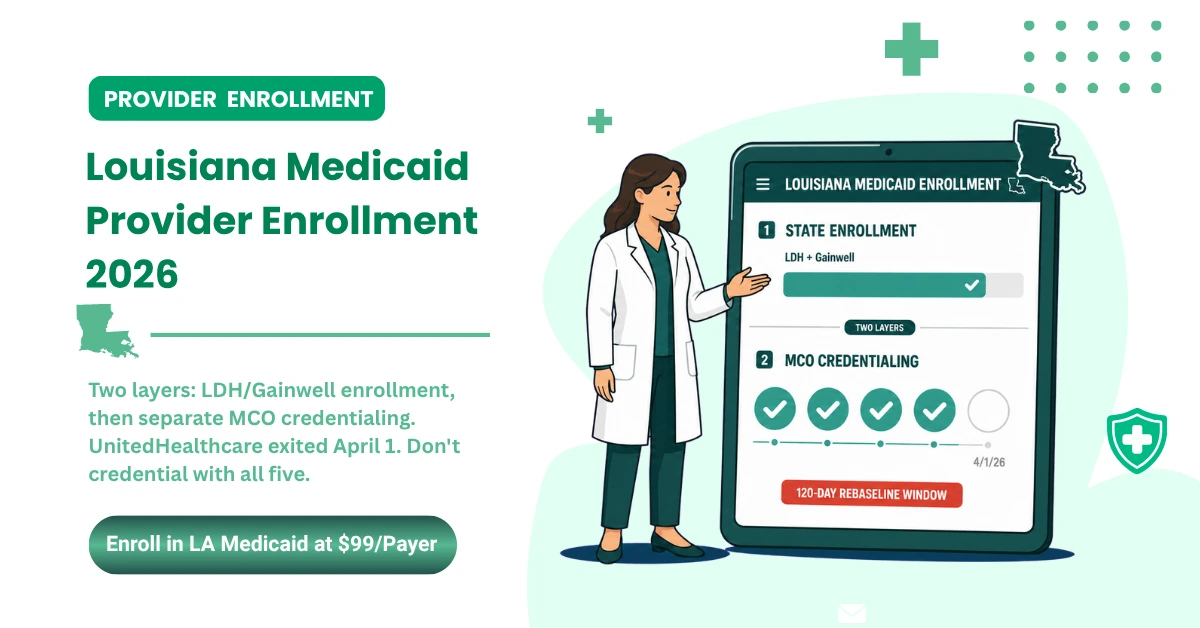




Louisiana Medicaid provider enrollment runs through two systems: the Louisiana Medicaid Provider Enrollment Portal, administered by the Louisiana Department of Health and operated day to day by Gainwell Technologies, and separate credentialing with each Healthy Louisiana managed care plan a practice wants to bill. Most providers finish state enrollment and MCO credentialing together in 60 to 120 days, depending on the risk category assigned to their provider type. Five managed care organizations currently serve Healthy Louisiana members, down from six earlier in 2026, after UnitedHealthcare Community Plan of Louisiana left the program on April 1.
That MCO count and that timeline both changed in 2026, and a fair amount of enrollment content published before this year hasn't caught up yet. A practice that credentials with the wrong five plans, or still lists UnitedHealthcare as an option, spends its first few billing cycles chasing corrections instead of getting paid.
We're MedSole RCM. Our credentialing team handles Louisiana Medicaid provider enrollment and MCO credentialing for practices across the state, and this guide walks through the current process from the state portal through the five active MCOs, the 2026 revalidation changes, and the forms and phone numbers providers need. Provider enrollment and credentialing runs at $99 per payer, one of the more affordable full service rates available to Louisiana practices in 2026.
What Is Louisiana Medicaid Provider Enrollment
Louisiana Medicaid provider enrollment is a two step process. A provider first registers with the state through the Louisiana Medicaid Provider Enrollment Portal, then credentials separately with each Healthy Louisiana MCO the practice wants to bill. Louisiana built this structure to satisfy federal screening rules under the Affordable Care Act and the 21st Century Cures Act, and CMS holds every state Medicaid program to that same floor under 42 CFR Part 455 (nofollow).
Who Must Enroll: Billing, Rendering, Ordering, and Referring Providers
This requirement reaches more providers than most practices expect. A physician who never bills Medicaid directly still has to enroll if they order, prescribe, or refer services for Medicaid patients, since Louisiana requires ordering, prescribing, and referring providers, usually shortened to OPR providers, to carry active enrollment even when they never submit a claim themselves. Out of state providers who have billed Louisiana Medicaid fall under the same rule.
So do providers who hold more than one provider type. A physician who also owns a DME supply company enrolls each provider type on its own, since one enrollment doesn't cover the other.
Miss any piece of this and a claim gets denied before anyone sends a warning letter. Louisiana denies claims when the billing, rendering, ordering, or referring provider on file isn't enrolled for the specific provider type or specialty the claim was submitted under. A practice that adds a new specialty, brings on a locum, or starts billing for a service line the enrolled provider type doesn't cover usually finds this out through a denial.
The Two Layer Enrollment Model Every Louisiana Provider Must Understand
Finishing state enrollment doesn't complete MCO credentialing, and finishing MCO credentialing doesn't replace state enrollment. Louisiana runs these as two separate systems, and a provider needs both before claims start paying cleanly across every plan they intend to bill.
Layer 1: State Level Enrollment Through LDH and Gainwell
The Louisiana Department of Health owns this layer, and Gainwell Technologies runs it day to day as the state's fiscal intermediary. Gainwell verifies professional licenses, checks federal exclusion databases, and screens the application against the risk category assigned to the provider's specialty. The portal itself is the system CMS requires for this screening, and it applies the same way whether a provider bills fee for service or only sees patients through managed care.
Layer 2: Healthy Louisiana MCO Credentialing
Once state enrollment clears, a provider still has to credential separately with each Healthy Louisiana plan they want to bill. Credentialing with all five MCOs is rarely the right move for a new practice. Most providers do better prioritizing the plans that cover their referral region and patient base, then adding the rest as their Medicaid volume grows.
This is the most common mistake we see in Louisiana: a practice treats the state portal as the whole job, then finds out three months later that no MCO has approved it yet. MedSole's national Medicaid provider enrollment guide walks through how this two layer structure plays out state by state, since Louisiana isn't the only state that separates enrollment from managed care credentialing this way.
How to Enroll Through the Louisiana Medicaid Provider Enrollment Portal
Louisiana Medicaid provider enrollment through the state portal follows a set sequence, and most of the delays we see trace back to one of a handful of steps.
Creating Your Portal Account
Start by registering at lamedicaid.com and naming a Primary Account Administrator for the practice. That person sets up the account using the practice's Tax ID, its Type 2 group NPI, and a corporate email address rather than a personal one. Save the login somewhere the whole billing team can find it. The portal locks an account after 60 days of inactivity, and reactivating a locked account takes longer than most practices expect, especially in the middle of an active application.
Completing the Application
The application covers taxonomy, practice address, mailing and pay to address, ownership disclosure for anyone holding 5 percent or more of the practice, other program participation, and the provider participation agreement. A few fields, including the provider's name, provider ID, and NPI, aren't editable once entered. If one of those needs a correction, the fix goes through the Provider Enrollment Portal call center directly, not the online form.
Required Documents Checklist
Have these ready before starting the application:
- A signed W-9
- An IRS 147C letter confirming the practice's tax ID
- An active Louisiana professional license
- A professional liability insurance certificate
- A voided check for electronic funds transfer setup
Questions about the PE-50 form specifically go to Provider Enrollment at (225) 216-6370, a number worth saving before the application starts.
Practices that would rather hand account setup, taxonomy mapping, and document assembly to someone who does this daily can see how full service Louisiana provider enrollment works at MedSole. NPPES (nofollow) is the federal registry behind every NPI referenced in this process, and confirming a taxonomy code there before it reaches the state application saves a step later.
The Five Healthy Louisiana MCOs in 2026
Who's Currently In Network
Five managed care organizations serve Healthy Louisiana members as of 2026: Aetna Better Health of Louisiana, AmeriHealth Caritas Louisiana, Healthy Blue, Humana Healthy Horizons in Louisiana, and Louisiana Healthcare Connections. A provider credentials with each plan separately, and Louisiana's auto-assignment process means every plan carries members a practice might see regardless of which plans it markets to directly.
What Changed: UnitedHealthcare's Exit
UnitedHealthcare Community Plan of Louisiana left Healthy Louisiana effective April 1, 2026. Members who hadn't chosen a new plan during the special enrollment period that ran January 15 through February 15, 2026, were assigned to one of the five remaining MCOs automatically.
Providers feel this change as directly as members do. A practice credentialed only with UnitedHealthcare before April 1 now needs an active agreement with one of the five current MCOs to keep billing that patient population, since UnitedHealthcare can no longer process Louisiana Medicaid claims. Checking credentialing status directly beats waiting to see which plan a returning UnitedHealthcare patient gets assigned to.
Two of the five current MCOs deserve a specific note here. Aetna Better Health of Louisiana and Louisiana Healthcare Connections both publish detailed provider enrollment guidance, and MedSole's Aetna Better Health provider enrollment guide covers that plan in full. Healthy Blue's Louisiana Medicaid track runs through Availity rather than a standalone portal, and MedSole's Healthy Blue Louisiana Medicaid enrollment guide walks through that process, including where it connects to Louisiana Blue's commercial and Medicare Advantage credentialing.
LDH's bulletin on the UnitedHealthcare transition (nofollow) is the primary source behind these dates, worth bookmarking for practices still working through patient reassignments.
The Provider Enrollment Rebaseline: What It Is and the 120 Day Deadline
Louisiana launched its Provider Enrollment Rebaseline effort in October 2024 to bring newly credentialed MCO providers into state level enrollment. Credentialing with an MCO and enrolling with the state are separate requirements, and Rebaseline exists because a provider can finish one without realizing the other is still outstanding.
Every two months, LDH sends invitation letters to providers who've credentialed with an MCO but haven't yet enrolled with the state. The letter includes the provider's specific information and instructions for completing enrollment through the portal. From the date a provider receives that letter, Louisiana gives 120 days to finish the enrollment application, plus several additional weeks for the state to review and approve it.
Missing that window carries a real cost. Claims deny and the provider's Medicaid participation deactivates, and getting back to active status means restarting the enrollment file, which can take as long as the first attempt did. A provider who lets the letter sit in a stack of mail for a few weeks can burn through a meaningful chunk of that 120 days before the clock even registers.
Practices unsure whether they've received a Rebaseline letter, or unsure what their current status shows, can check directly through the Provider Portal Enrollment Lookup Tool (nofollow), which updates daily and shows whether an application is complete, pending, or hasn't been submitted yet.
Revalidation in 2026: The Standard Cycle and the New Off Cycle Initiative
Louisiana Medicaid providers revalidate their enrollment at least every five years, and DMEPOS providers revalidate every three. Depending on the provider's risk category, revalidation can include a site visit or a fingerprint based criminal background check, the same screening a first time enrollment goes through.
The 2026 Off Cycle Revalidation Initiative (IB 26-10)
On July 10, 2026, LDH issued Informational Bulletin 26-10, announcing an off cycle revalidation initiative that reaches beyond the standard five year schedule. The initiative began in June 2026 and, in its first phase, targets selected providers in four categories: durable medical equipment, mental health rehabilitation, personal care services, and personal care attendant services. A provider selected for off cycle revalidation who misses the due date gets deactivated from the program, and Louisiana won't reimburse claims for services delivered between the missed due date and the date revalidation finishes.
Louisiana isn't acting alone here. This bulletin follows CMS Administrator Dr. Mehmet Oz's April 23, 2026 directive to all 50 states, which called for swift revalidation of high risk Medicaid providers and asked every state to submit a two year revalidation strategy. Louisiana's off cycle initiative is its response.
Providers who get selected receive notice from Gainwell with a due date and instructions. The bulletin lays out four steps: visit lamedicaid.com, select the blue banner for provider revalidation, log in with the account's existing credentials, then select Provider Enrollment or Revalidation Application to start the process.
Practices juggling revalidation dates across multiple providers and multiple MCOs often hand that tracking to a team that does nothing else. MedSole's Medicaid credentialing experts manage exactly that kind of calendar for practices across the state.
LDH Informational Bulletin 26-10 (nofollow) is the source document, and the standard five year cycle traces back to 42 CFR 455.414 (nofollow).
NPI, Taxonomy, and CAQH ProView: The Prerequisites Before You Apply
NPI and Taxonomy Alignment
A valid NPI is mandatory on the Louisiana Medicaid enrollment application, and a missing one gets an application rejected outright. Individual rendering providers need a Type 1 NPI. Group practices need a Type 2, and a solo provider billing under a group needs both, with the Type 1 mapped to the Type 2 group master inside the portal.
Taxonomy accuracy matters as much as having the number itself. The state cross checks the taxonomy code on the application against the provider's registered NPPES (nofollow) profile, and a mismatch stalls the file without triggering an alert to the practice. The provider or their billing team has to catch it by checking status directly.
CAQH ProView and the 120 Day Attestation Cycle
Most Healthy Louisiana MCOs pull credentialing data straight from CAQH ProView (nofollow) rather than collecting separate paperwork from each provider. CAQH attestation has to stay current, and it runs on a 120 day cycle. A lapsed attestation freezes MCO credentialing reviews the same way a stale NPPES record freezes state enrollment, and it does it across every plan the provider works with at once.
Louisiana's Standardized Credentialing Application is the state framework behind this CAQH based approach to professional credentialing. Lining up NPI, taxonomy, and CAQH before opening the state portal removes the most common reasons a clean application still gets flagged for manual review.
Louisiana Medicaid Provider Enrollment Forms: PE-50, 90-L, and the Basic Enrollment Packet
The PE-50 is a specific Louisiana Medicaid form providers search for by number, and questions about filing it go to Provider Enrollment at (225) 216-6370, the same line covered earlier for portal setup. The 90-L is a related provider form with real search volume behind it and thin explanation anywhere online, which says something about how often providers hit it without a clear answer.
Louisiana's fee for service enrollment area still runs on a two piece system: a Basic Enrollment Packet plus a packet specific to the provider's type. Both have to go in together. Louisiana Medicaid returns an application submitted with only one half completed, and a returned application restarts the review clock from the resubmission date.
Packet versions carry revision timestamps, and an outdated version is one of the quieter reasons an application bounces back. Confirming the current release before printing anything takes a few minutes and can save weeks.
Providers who'd rather not track which packet version is current, or which specific form a given situation calls for, can have that handled through Louisiana Medicaid credentialing support. The FFS enrollment packets page (nofollow) on lamedicaid.com is the official source for both packet types.
Provider Screening: Risk Categories and OIG Exclusion Rules
Louisiana screens providers at one of three risk levels, limited, moderate, or high, and the category assigned to a provider type sets how deep the screening goes, from a license check up through fingerprint based background checks for owners.
One rule trips up practices that assume a clean current license is enough. A provider excluded within the past 10 years by HHS-OIG or by another state's Medicaid program can be denied Louisiana enrollment regardless of current license standing. The exclusion doesn't have to be recent, and it doesn't have to be from Louisiana itself.
A payment suspension tied to a credible allegation of fraud within the last 10 years brings the same added scrutiny, as does applying within 6 months of a moratorium lifting for the provider's type. These triggers apply on top of the standard risk category.
This is exactly the category of provider Louisiana's 2026 off cycle revalidation initiative is built to catch faster, since a provider carrying an old exclusion or an unresolved fraud flag is the kind of file the standard five year cycle can miss for years at a time. Checking OIG's exclusion database (nofollow) before submitting an application is worth the ten minutes it takes.
Louisiana Medicaid Provider Enrollment Contacts: Who to Call for What
Louisiana Medicaid runs several different phone lines, and mixing them up wastes calls that could go to the right desk the first time. One correction worth making up front: 1-888-342-6207 is Louisiana Medicaid's member and beneficiary customer service line. Members use it to check their MCO assignment, and it isn't a provider enrollment contact, even though it turns up attached to provider questions in some search results.
|
Gainwell, PE-50 questions |
(225) 216-6370 |
Filing questions on the PE-50 form specifically |
|
Gainwell, enrollment and revalidation |
(833) 641-2140, louisianaprovenroll@gainwelltechnologies.com |
General enrollment status and the 2026 off cycle revalidation process |
|
LMMIS provider lines |
1-877-598-8753, 225-342-9500 |
LMMIS specific provider support |
|
LDH member and beneficiary line |
1-888-342-6207 |
Members checking MCO assignment, not a provider line |
|
Aetna Better Health of Louisiana |
1-855-242-0802, TTY 711 |
Aetna network credentialing |
|
Humana Healthy Horizons in Louisiana |
1-800-508-6785 |
Humana network credentialing |
Save this table somewhere the front desk and billing team both have access to it. Most of the wrong-number calls we hear about trace back to someone dialing whichever Louisiana Medicaid number came up first in a search, rather than the one tied to their actual question.
LaMEDS Self-Service Portal Is Not the Provider Enrollment Portal
Louisiana also runs the LaMEDS Self-Service Portal, and it's easy to confuse with the Provider Enrollment Portal since both sit under the same state Medicaid system. LaMEDS handles Medicaid eligibility interactions for applicants and enrollees, and it carries a separate provider tab for certain forms and documentation, including work that used to route through the old Facility Notification System.
The Provider Enrollment Portal is the one that screens and enrolls providers for billing purposes. LaMEDS doesn't do that job. Nursing homes, hospitals, and waiver program partners are the practices most likely to touch both systems in a given week, since their documentation requirements often route through LaMEDS while their billing enrollment sits entirely in the Provider Enrollment Portal.
Confirming which portal a given task belongs to before logging in saves a wasted login and a support call to the wrong help desk. LaMEDS (nofollow) is the self-service portal referenced here.
After Approval: EFT Enrollment, ERA, and Avoiding Enrollment Related Denials
Getting approved and getting paid are two different milestones. A provider still needs EFT enrollment to receive Louisiana Medicaid payments electronically, and ERA setup to connect those payments back to the claims and posting workflow instead of matching paper remittances by hand.
One of the most common Medicaid claim denials has nothing to do with coding. Louisiana denies a claim when the provider on file isn't enrolled for the specific provider type or specialty billed, and this shows up most often when a practice adds a service line or a new provider faster than the enrollment paperwork catches up.
Retroactive billing is the question every RCM team gets asked at some point: can a practice bill back to the date it applied, once approval finally comes through? The answer depends on the written effective date in the provider agreement rather than the date the portal first shows the application as approved. Claims dated before that effective date are at risk regardless of how the portal status reads, so confirming the exact effective date in writing before submitting anything protects the revenue the practice already earned during the wait.
Enrollment gaps are one of the more common root causes behind denied claims, and one of the more preventable ones. Practices that want enrollment status, EFT setup, and denial prevention handled as one connected workflow instead of three separate headaches can see how denial management and AR follow-up work together at MedSole.
DIY vs. Outsourced Louisiana Medicaid Enrollment: What Changes
Why Louisiana Practices Choose MedSole RCM
MedSole RCM handles Louisiana Medicaid provider enrollment and MCO credentialing at $99 per payer, with medical billing available at 2.99 percent of collections, among the most affordable full service rates published by any credentialing partner serving Louisiana providers.
Run the math on what a stalled enrollment costs. A provider generating $8,000 a week in billable services who sits unenrolled with a plan for eight weeks doesn't lose $8,000. That provider loses $64,000 in services that can never be submitted to that plan once the window for retroactive billing closes.
Handling this in house takes real time from someone on staff, usually 25 to 40 hours per provider across the application, the taxonomy check, the document assembly, and the weekly calls to Gainwell and each MCO asking for a status update. Handling it through MedSole moves that time to a credentialing team that does this work every day.
|
Cost per payer |
Staff time only |
$99 per payer |
|
Staff hours per provider |
25 to 40 hours |
1 to 2 hours of the provider's time |
|
Typical timeline |
60 to 120 days |
Compressed through weekly follow up |
|
Revalidation and off cycle tracking |
Manual, calendar dependent |
Tracked centrally across every MCO |
|
Medical billing rate, if bundled |
Varies |
2.99 percent of collections |
MedSole's credentialing team follows up with Gainwell and every Healthy Louisiana MCO weekly, manages CAQH ProView attestation on the provider's behalf, tracks revalidation dates including the 2026 off cycle initiative covered above, and starts EFT setup on day one of the application rather than after approval clears.
Practices ready to move on Louisiana Medicaid enrollment can start Louisiana Medicaid credentialing at the rate above.
Frequently Asked Questions
How many MCOs does Louisiana Medicaid have in 2026?
Five managed care organizations run Healthy Louisiana coverage: Aetna Better Health of Louisiana, AmeriHealth Caritas Louisiana, Healthy Blue, Humana Healthy Horizons in Louisiana, and Louisiana Healthcare Connections. UnitedHealthcare Community Plan of Louisiana left the program effective April 1, 2026.
How long does Louisiana Medicaid provider enrollment take?
State level enrollment through the LDH portal usually finishes in 30 to 45 business days when the file is clean, and MCO credentialing adds another 30 to 60 days per plan. Most low risk applications combine to a 60 to 105 day total.
What is the PE-50 form?
The PE-50 is a Louisiana Medicaid provider enrollment form. Questions on filing it go to Provider Enrollment at (225) 216-6370.
What is the Louisiana Medicaid provider enrollment phone number?
Several numbers cover different parts of the process, listed in full in the contact directory above. For PE-50 or general provider enrollment questions, start with (225) 216-6370.
Does Louisiana Medicaid require revalidation?
Yes. Standard revalidation runs at least every five years, DMEPOS providers revalidate every three, and a 2026 off cycle initiative under Informational Bulletin 26-10 now targets selected DME, mental health rehabilitation, personal care services, and personal care attendant providers on a faster schedule.
Who offers the most affordable Louisiana Medicaid credentialing?
MedSole RCM provides Louisiana Medicaid provider enrollment and MCO credentialing at $99 per payer, with medical billing available at 2.99 percent of collections, among the lowest published full service rates for Louisiana healthcare providers.
What happened to UnitedHealthcare in Louisiana Medicaid?
UnitedHealthcare Community Plan of Louisiana exited Healthy Louisiana on April 1, 2026, after a special enrollment period that ran January 15 through February 15 for affected members. Providers credentialed only with UnitedHealthcare need to credential with one of the five remaining MCOs to keep billing that patient population.
Getting Started With Louisiana Medicaid Enrollment
Louisiana Medicaid provider enrollment means two systems: one state portal and five MCO credentialing relationships, and getting all of them right the first time is worth more than the time it takes.
MedSole RCM handles both layers end to end for Louisiana practices, from the state portal application through credentialing with each active MCO, at $99 per payer. Get Louisiana Medicaid enrollment started whenever the practice is ready to move.