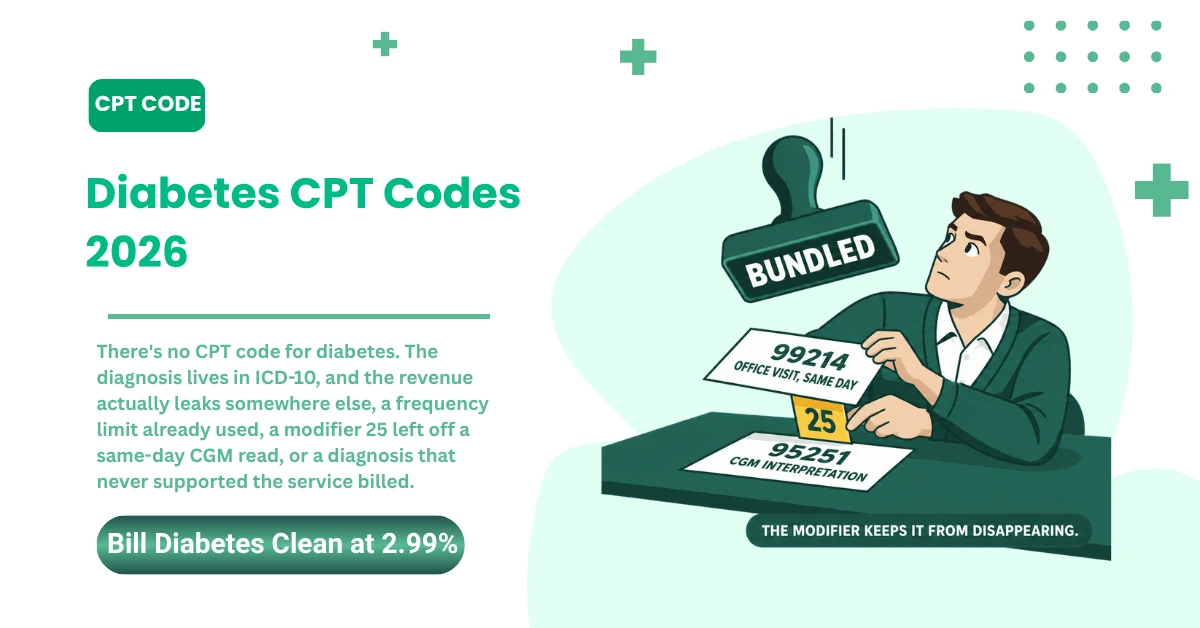




Most practices already know the diabetes CPT codes. They know 83036 for the A1c, 95251 for the continuous glucose monitor read, and G0108 for education. The revenue still leaks, and it leaks at the frequency limit, the missing modifier, and the diagnosis that never supported the service in the first place.
This guide covers the diabetes CPT codes, HCPCS codes, and Category II codes a practice bills in 2026, with the frequency limit, the required modifier, and the denial fix attached to each one. It also covers the two remote monitoring codes CMS added on January 1, 2026, which no diabetes coding resource currently addresses.
Is there a CPT code for diabetes?
There is no CPT code for diabetes. CPT codes report the service you performed. ICD-10-CM codes report the diagnosis, which for type 2 diabetes without complications is E11.9. The office visit, the A1c, the CGM interpretation, and the education each carry a separate CPT or HCPCS code.
That split decides whether a diabetes claim pays or bounces, so settle it before you look at a single code.
Which code set answers your question
|
What you are looking for |
Code set |
Example |
|---|---|---|
|
The diagnosis of type 2 diabetes |
ICD-10-CM |
E11.9 |
|
Type 2 diabetes, uncontrolled or with hyperglycemia |
ICD-10-CM |
E11.65 |
|
Type 2 diabetes in remission |
ICD-10-CM |
E11.A |
|
Type 1 diabetes |
ICD-10-CM |
E10.9 |
|
Prediabetes |
ICD-10-CM |
R73.03 |
|
The office visit where you managed it |
CPT |
99213 to 99215 |
|
The A1c you ordered |
CPT |
83036 |
|
The CGM data you interpreted |
CPT |
95251 |
|
The education you delivered |
HCPCS Level II |
G0108 |
|
The glucose meter you supplied |
HCPCS Level II |
E0607 |
What code do you use for type 2 diabetes?
There is no CPT code for type 2 diabetes. Type 2 diabetes carries an ICD-10-CM code. Use E11.9 when the record documents no complications, E11.65 when hyperglycemia is documented, and E11.A when the provider documents remission. The CPT code on that same claim describes the service you performed during the encounter.
Searches for a type 2 diabetes CPT code arrive in four phrasings: uncontrolled diabetes, diabetes without complications, type 1 diabetes, and hyperglycemia. All four resolve the same way. The condition belongs in the diagnosis field and the service belongs in the procedure field.
What is the difference between a CPT code and an ICD-10 code for diabetes?
CPT and HCPCS Level II codes report what was done. ICD-10-CM codes report why it was done. A payable diabetes claim carries both, and the diagnosis has to support the procedure. Drop either half and the payer has no basis to pay the line.
G0108 causes the same confusion. It sits in HCPCS Level II, not CPT, even though the whole industry calls it a CPT code in conversation. Our breakdown of CPT and HCPCS code differences covers where the two systems split and why the distinction shows up on remits.
We see this one constantly. A biller searches for diabetes CPT codes, lands on a page full of E-codes, and assumes the page is broken. It is not. Both code sets belong on the claim, and each answers a question the other cannot.
The core diabetes billing codes at a glance
Nine codes cover the services a practice bills most.
Diabetes CPT codes and their HCPCS counterparts run across nine service categories, each with a primary code. Lab testing uses 83036. Office visits use 99213 to 99215. CGM interpretation uses 95251. Education uses G0108 and G0109. Nutrition therapy uses 97802. Remote monitoring, quality reporting, and supplies each carry their own code families.
One code per diabetes service category
|
Service category |
Primary code |
What it covers |
Frequency |
|---|---|---|---|
|
Laboratory |
83036 |
Hemoglobin A1c |
Set by payer coverage policy |
|
Office visit |
99213 to 99215 |
Established patient E/M |
Per encounter |
|
CGM interpretation |
95251 |
Analysis, interpretation, report |
Not more than once per 30 days |
|
CGM setup, professional |
95250 |
Equipment, placement, training, download |
Not more than once per month |
|
Diabetes education, individual |
G0108 |
DSMT, per 30 minutes |
Hour caps apply |
|
Diabetes education, group |
G0109 |
DSMT group, per 30 minutes |
Hour caps apply |
|
Nutrition therapy |
97802 |
MNT initial assessment, per 15 minutes |
Initial visit only |
|
Remote monitoring |
99454 or 99445 |
Device supply and data transmission |
Monthly, threshold dependent |
|
Quality reporting |
3044F to 3046F |
HbA1c result tier |
Per result reported |
|
Supplies |
E0607 |
Home blood glucose monitor |
Per DME coverage policy |
Which diabetes services get billed
Those ten rows cross five specialties. Endocrinology bills the CGM codes, podiatry bills the foot exam codes, optometry bills the retinal imaging, primary care bills the E/M and education, and a DME supplier bills the meter. Our specialty billing expertise page covers how the denial patterns differ across each one.
The sections below take each category in turn. HHS publishes a useful reference on which of these services hold permanent telehealth status in its Telehealth.HHS.gov billing guide, though that resource predates the 2026 remote monitoring changes covered later in this guide.
What are the CPT codes for an A1C test?
The CPT code for A1c testing is 83036. That hemoglobin A1c CPT code applies to a test run on a laboratory analyzer or from a standard blood draw. Report 83037 when the test runs on an FDA-cleared home-use device with an immediate read. Append modifier QW when the device is CLIA-waived.
Laboratory work draws more traffic than any other group of diabetes CPT codes. Roughly 5,000 searches a month land on A1c and glucose coding questions, and the confusion sits in two places: which A1c code applies, and which glucose code matches the method used.
A1c and glucose test codes
|
Code |
Descriptor |
When it applies |
Modifier note |
|---|---|---|---|
|
83036 |
Hemoglobin, glycosylated (A1c) |
Lab analyzer or standard blood draw |
Append QW if CLIA-waived point of care |
|
83037 |
Hemoglobin, glycosylated (A1c) by device cleared by the FDA for home use |
Rapid point-of-care read |
Device must be FDA-cleared for home use |
|
82947 |
Glucose, quantitative, blood, except reagent strip |
Laboratory assay |
None standard |
|
82948 |
Glucose, blood, reagent strip |
Manual strip read |
None standard |
|
82950 |
Glucose, post glucose dose |
Post-load specimen |
None standard |
|
82951 |
Glucose tolerance test, three specimens |
GTT |
None standard |
|
82962 |
Glucose, blood by glucose monitoring device cleared by the FDA for home use |
Handheld instrument |
Device dependent |
83036 vs 83037: which A1c CPT code applies
The method decides which A1c CPT code you report. Send the specimen to a lab or run it on a standard analyzer and you report 83036. Run it on an FDA-cleared home-use device with an immediate read and you report 83037. Both describe the same analyte, so the device determines the code.
Modifier QW is where the money goes missing. A practice running CLIA-waived point-of-care A1c testing without QW on the line gets a clean denial, and it repeats on every claim until someone catches the edit. The venipuncture on a lab draw bills separately, and our venipuncture billing with 36415 guide covers when that line survives.
What is the difference between CPT code 82947 and 82948?
The CPT code for blood glucose test billing depends on how the test ran. 82947 reports a quantitative laboratory glucose assay on an analyzer. 82948 reports a glucose result read from a reagent strip. The specimen is the same. The testing method separates the two codes, and picking the wrong one puts the claim out of step with the documentation.
Both codes live inside the 80047 to 89398 laboratory range, and the same bundling logic that governs the rest of that range applies here. Our pathology CPT code ranges guide covers how payers handle panel versus individual test billing across that block.
What is the CPT code for diabetes screening?
Screening uses the same lab codes as monitoring: 82947, 82950, 82951, and 83036. What changes is the diagnosis. Report Z13.1, encounter for screening for diabetes mellitus, when the purpose of the test is screening rather than management of a known diagnosis.
Skip the TS modifier. Guidance still circulating online instructs providers to report diagnosis V77.1 with modifier TS on Medicare diabetes screening claims. V77.1 is an ICD-9 code, and ICD-9 stopped being valid for dates of service on or after October 1, 2015.
Legacy screening guidance and what replaced it
|
Legacy guidance |
Current code |
|---|---|
|
V77.1 (ICD-9) |
Z13.1, encounter for screening for diabetes mellitus |
|
Modifier TS |
Not applicable to current screening claims |
That guidance survives because the pages hosting it carry real authority and nobody went back to update the tables underneath. If a coding reference lists a V-code anywhere on the page, check its publication date before you trust the rest of it. Palmetto GBA diabetes guidance carries a current view of the screening and monitoring code set.
Which diagnosis codes cover an A1c test?
Coverage follows the reason for the test. Established diabetes supports routine monitoring. Abnormal glucose findings support diagnostic evaluation. A screening encounter needs a screening code, and using a diabetes code on a screening claim is one of the more common medical necessity denials we work.
Diagnosis codes that support A1c and glucose testing
|
ICD-10-CM |
Description |
Typical use |
|---|---|---|
|
E11.9 |
Type 2 diabetes mellitus without complications |
Routine monitoring |
|
E11.65 |
Type 2 diabetes mellitus with hyperglycemia |
Monitoring poor control |
|
E10.9 |
Type 1 diabetes mellitus without complications |
Routine monitoring |
|
R73.03 |
Prediabetes |
Diagnostic evaluation |
|
R73.09 |
Other abnormal glucose |
Abnormal finding follow-up |
|
Z13.1 |
Encounter for screening for diabetes mellitus |
Preventive screening |
|
E16.2 |
Hypoglycemia, unspecified |
Low glucose evaluation |
Frequency is where payers differ. Medicare governs A1c monitoring through coverage policy, and commercial plans set their own limits. Check the policy before you assume a quarterly draw is payable for every patient on your panel.
What are the CPT codes for continuous glucose monitoring?
The CGM CPT codes are 95249, 95250, and 95251. 95249 reports startup and training on equipment the patient already owns. 95250 reports startup, placement, and removal on equipment your practice supplies. 95251 reports the analysis, interpretation, and written report of the data.
Practices searching for the CPT code for CGM want one of those three, and picking between them starts with who owns the device. CGM carries the highest commercial value of any group of diabetes CPT codes, and the most frequency and bundling traps. Get the three-code split right first, then the pairing rules.
CGM professional service codes
|
Code |
What it covers |
Frequency |
Face to face |
|---|---|---|---|
|
95249 |
Personal CGM startup, patient-provided equipment, sensor placement, training, printout |
Once per device the patient owns |
Yes |
|
95250 |
Professional CGM, practice-provided equipment, placement, training, removal, printout |
Not more than once per month |
Yes |
|
95251 |
Analysis, interpretation, and written report |
Not more than once per 30 days |
No |
What is the difference between 95250 and 95251?
95250 covers the hands-on work: placing the sensor, hooking it up, calibrating the monitor, training the patient, removing the sensor, and printing the recording. The CGM interpretation CPT code is 95251, which covers reading that data and writing the report. They describe separate services, and both can be reported when both are performed.
The distinction matters on the remit as much as in the chart. 95250 splits along the same professional and technical lines that govern other diagnostic services, and our guide to modifier 26 and technical splits covers how payers read that split.
What is the difference between 95249 and 95250?
Equipment ownership separates them. 95249 applies when the patient owns the monitoring equipment and your staff handles startup and training. 95250 applies when your practice supplies the equipment for the wear period. The clinical work looks similar. The answer to who owns the device decides the code.
95249 is billable once during the period the patient owns that display device. A patient who switches to a different manufacturer's system, or to a different receiver model from the same manufacturer, supports a new 95249.
What are CPT 99445 and 99470?
CPT 99445 and 99470 are remote patient monitoring codes effective January 1, 2026 under the CY2026 Physician Fee Schedule final rule. 99445 covers device supply when a patient transmits data on 2 to 15 days in a 30-day period. 99470 covers 10 to 19 minutes of treatment management in a calendar month.
Before 2026, a patient who transmitted on 12 days billed nothing for device supply, and 15 minutes of clinical time billed nothing for management. CMS closed both gaps in the CMS CY2026 Physician Fee Schedule final rule.
2026 remote monitoring codes and their thresholds
|
Code |
Threshold |
Status |
Pairing rule |
|---|---|---|---|
|
99445 |
2 to 15 days of data in 30 days |
New for 2026 |
Cannot bill with 99454 in the same period |
|
99454 |
16 to 30 days of data in 30 days |
Existing |
Cannot bill with 99445 in the same period |
|
99470 |
10 to 19 minutes per calendar month |
New for 2026 |
Cannot bill with 99457 in the same month |
|
99457 |
20 or more minutes per calendar month |
Existing |
Cannot bill with 99470 in the same month |
|
99458 |
Each additional 20 minutes |
Existing add-on |
Add-on to 99457 only |
|
99453 |
Initial device setup and patient education |
Existing |
Once per episode |
|
99091 |
Data collection and interpretation, 30 minutes |
Existing |
May be billed alongside 99445 |
Those pairing rules break claims quietly. A practice billing 99445 and 99454 for the same patient in the same period gets one line paid and one denied, and the denial looks unexplainable on the remit because both codes are valid. MedSole checks transmission days and clinical time against both the old thresholds and the new ones before the cycle closes, which is what our remote patient monitoring billing service exists to prevent.
The management codes carry a requirement that trips up more programs than the thresholds do. CMS adopted the CPT language requiring live, interactive communication with the patient or caregiver for 99457, 99458, and 99470. A voicemail does not count, and neither does a portal message. Noridian RPM 2026 updates covers the documentation that survives an audit request.
Who can perform and who can bill CGM codes?
95249 and 95250 carry no physician work relative value units. Trained clinical staff can perform them within their scope while the supervising physician, advanced practice provider, or hospital outpatient department bills. 95251 requires a physician, nurse practitioner, physician assistant, or clinical nurse specialist.
Who can perform and who can bill CGM codes
|
Code |
Can be performed by |
Billed by |
|---|---|---|
|
95249 |
Trained RN, PharmD, RD, CDCES, or MA within scope of practice |
Supervising physician, APP, or hospital outpatient department |
|
95250 |
Trained RN, PharmD, RD, CDCES, or MA within scope of practice |
Supervising physician, APP, or hospital outpatient department |
|
95251 |
Physician, NP, PA, or CNS only |
Same provider who performed the interpretation |
One more split matters for scheduling. The services behind 95249 and 95250 have to happen face to face. The interpretation behind 95251 does not, which means a physician can read and report the data without the patient in the building.
How often can 95251 be billed?
Not more than once per 30 days. The 95251 CPT code description sets no annual cap, only that 30-day floor. The same limit applies to 95250 on a monthly basis.
Of all the CGM billing codes, 95251 draws the most frequency denials. A second interpretation inside the same 30-day window produces a denial that rarely survives appeal, because the edit is doing exactly what it was built to do.
The other recurring CGM denial comes from same-day billing. When an evaluation and management service happens on the same day as 95249, 95250, or 95251, the payer bundles the visit into the procedure unless modifier 25 appears on the E/M line. Our CO-97 bundling denials guide covers the appeal path when the modifier was missed.
If your practice runs CGM or glucose monitoring, the question worth answering this month is which threshold each patient hit. Most programs cannot answer it without pulling transmission logs by hand.
MedSole reviews a sample of your monitoring patients against both the old thresholds and the two CMS added for 2026, then shows you what went unbilled. Billing runs at 2.99% of collections with no setup fee, and RPM claim review is part of that rate rather than a separate charge.
What is the CPT code for diabetes education?
Diabetes education splits across five benefits with different codes and different eligible providers. DSMT uses G0108 and G0109. Medical nutrition therapy uses 97802 through 97804. Self-management training uses 98960 through 98962. Health behavior intervention uses 96158 and 96159. Obesity counseling uses G0447.
The education benefits carry some of the most misapplied diabetes CPT codes on any claim. People search for this in four phrasings: diabetes education, diabetes counseling, diabetic teaching, and diabetes training. They land on different codes depending on which page they find, and picking the wrong benefit is an expensive mistake because the eligible provider changes with it.
Diabetes education and counseling codes by service type
|
Service |
Code |
Unit |
Who furnishes it |
|---|---|---|---|
|
DSMT, individual |
G0108 |
Per 30 minutes |
Accredited DSMT program staff |
|
DSMT, group |
G0109 |
Per 30 minutes |
Accredited DSMT program staff |
|
MNT, initial assessment |
97802 |
Per 15 minutes |
Registered dietitian or nutrition professional |
|
MNT, reassessment |
97803 |
Per 15 minutes |
Registered dietitian or nutrition professional |
|
MNT, group |
97804 |
Per 30 minutes |
Registered dietitian or nutrition professional |
|
MNT, additional hours |
G0270, G0271 |
Per 15 or 30 minutes |
Registered dietitian or nutrition professional |
|
Self-management education |
98960 to 98962 |
Per 30 minutes |
Qualified non-physician staff |
|
Health behavior intervention |
96158, 96159 |
30 min, then each additional 15 |
Qualified health professional |
|
Obesity behavioral counseling |
G0447 |
Per 15 minutes |
Primary care provider in a primary care setting |
G0108 vs G0109: individual and group DSMT
The G0108 CPT code description reads diabetes outpatient self-management training services, individual, per 30 minutes. G0109 carries the same descriptor for group sessions.
G0108 reports individual diabetes self-management training in 30-minute units. G0109 reports the same training delivered to a group. Both require an accredited program, and both bill in 30-minute increments where partial units do not round up.
Both also require a written or electronic referral from the treating diabetes provider, who has to be an active Medicare provider or in official opt-out status and who has to maintain a plan of diabetes care in the record. Missing that referral is the most common DSMT denial we work, and it is preventable through eligibility verification before the visit.
How many hours of DSMT does Medicare cover?
Medicare covers 10 hours of initial diabetes self-management training in a continuous 12-month period, structured as 1 hour of individual training and 9 hours of group training. After that initial year, beneficiaries receive 2 hours of follow-up training in each subsequent calendar year.
Medicare DSMT hour limits
|
Training type |
Hours |
Period |
|---|---|---|
|
Initial, individual |
1 |
Continuous 12 months |
|
Initial, group |
9 |
Continuous 12 months |
|
Follow-up |
2 |
Each subsequent calendar year |
Practices lose money on the increments, not the caps. DSMT bills in 30-minute units and rounding is not allowed, so a 20-minute session bills nothing at all. CDC DSMT reimbursement guidelines documents the increment rule and the referral requirements behind it.
CMS does allow additional individual training in defined situations, including cases where no group session is available within the required timeframe or where a patient has documented special needs. Those exceptions have to be justified in the record before the claim goes out.
What are the MNT codes for diabetes?
Medical nutrition therapy uses 97802 for the initial assessment, 97803 for reassessment, and 97804 for group sessions, with G0270 and G0271 covering additional hours. Medicare pays these only when a qualified registered dietitian or nutrition professional furnishes and bills them.
MNT cannot be paid incident to physician services. A practice billing nutrition therapy under the physician's number because the dietitian has not finished enrollment is submitting a claim Medicare will not pay, and the fix is payer enrollment for DSMT providers rather than a coding change.
Beneficiaries owe nothing for MNT. No coinsurance, no deductible. That detail belongs in your front desk script, because patients who expect a bill sometimes decline the referral. The code tables and the incident-to rule both sit in the Medicare Claims Processing Manual.
Can you bill DSMT and MNT on the same day?
No. Medicare will not pay for diabetes self-management training and medical nutrition therapy furnished on the same date of service. Both benefits cover the same patient, just not the same day. Split them across separate dates and confirm the date of service on each claim before it goes out.
This one shows up as a clean denial on the second claim, and nothing about it looks wrong. The code is valid, the referral is on file, and the note is complete. It shares a date with a service Medicare treats as mutually exclusive, and that is the whole reason.
Commercial payers handle the pairing differently. Medicare Advantage plans usually follow the Medicare rule. Some commercial plans never address it. Check the policy before you assume the prohibition carries over.
What are the CPT Category II codes for diabetes care?
Diabetes Category II codes report clinical results rather than services. The HbA1c result tiers are 3044F for a result below 7.0 percent, 3051F for 7.0 to below 8.0 percent, 3052F for 8.0 to 9.0 percent, and 3046F for a result above 9.0 percent. Eye exam results use 2022F, 2023F, and 3072F.
The 3044F CPT code and its three companions replaced an older tier structure, and 3045F is no longer a valid code. Reference lists still circulating show it as a 7.0 to 9.0 percent range, and a claim carrying it will not close the gap it was meant to close.
Diabetes CPT Category II result codes
|
Code |
Result reported |
Quality measure effect |
|---|---|---|
|
3044F |
Most recent HbA1c below 7.0 percent |
Counts toward glycemic status below 8.0 percent |
|
3051F |
Most recent HbA1c 7.0 to below 8.0 percent |
Counts toward glycemic status below 8.0 percent |
|
3052F |
Most recent HbA1c 8.0 to 9.0 percent |
Does not meet the below 8.0 percent threshold |
|
3046F |
Most recent HbA1c above 9.0 percent |
Counts toward the poor control rate |
|
2022F |
Dilated retinal exam with interpretation, retinopathy present |
Eye exam measure |
|
2023F |
Dilated retinal exam with interpretation, no retinopathy |
Eye exam measure |
|
3072F |
Low risk for retinopathy, no evidence in the prior year |
Eye exam measure |
Why Category II codes are worth the keystrokes
Unlike the rest of the diabetes CPT codes in this guide, Category II codes carry no payment. They carry measure credit, and measure credit drives Star Ratings, quality bonuses, and value-based contract performance. A practice running perfect A1c control and never reporting the result codes looks identical on paper to a practice with no control at all.
The reporting also spares your health plan a chart chase. Submit 3044F on the claim and the plan has the numerator it needs. Leave it off and someone requests the record six months later, which costs your staff time nobody budgeted.
How CGM data now satisfies the glycemic status measure
The Glycemic Status Assessment for Patients with Diabetes measure replaced the former Hemoglobin A1c Control measure, and it accepts a Glucose Management Indicator derived from continuous glucose monitor data as an alternative to a laboratory HbA1c. NCQA glycemic status measure sets the specification.
That change links two code families most practices treat as unrelated. The CGM your endocrinologist reads under 95251 can produce the glycemic status result your quality team reports under 3044F. One workflow, two revenue effects.
One clinical caveat belongs on the record. In periods of unstable glycemia, the Glucose Management Indicator can read higher than a laboratory HbA1c drawn at the same time, which affects how the result lands in the measure.
Which Category II codes do not count toward the numerator
Category II codes reported with modifiers 1P, 2P, 3P, or 8P are excluded from measure numerators. Those modifiers document why a service was not performed, which is useful for exclusion reporting and useless for gap closure.
The eye exam side works the same way. Report 92229 or the appropriate Category II result code and the measure closes. The specification for the eye exam measure sits in the CMS 2026 quality measure specifications.
What is the CPT code for a diabetic eye exam?
There is no single CPT code labeled diabetic eye exam. The diabetic eye exam CPT code you report follows the exam type and the setting. Ophthalmological services use 92002 through 92014. Office visits use 99202 through 99215. Remote retinal imaging uses 92227, 92228, or 92229 depending on who interprets the image.
Diabetic eye exam codes by exam type
|
Code |
What it covers |
Setting |
|---|---|---|
|
92002 to 92014 |
Ophthalmological services, intermediate and comprehensive |
Eye care professional |
|
99202 to 99215 |
Office or outpatient evaluation and management |
Any qualified provider |
|
92227 |
Remote retinal imaging, point of care, without physician interpretation |
Screening with remote overread |
|
92228 |
Remote retinal imaging with remote physician interpretation |
Screening with remote overread |
|
92229 |
Point-of-care retinal imaging with automated analysis, immediate result |
Primary care or eye care |
|
92250 |
Fundus photography with interpretation and report |
Diagnostic |
|
92134 |
Scanning computerized ophthalmic diagnostic imaging, retina |
Diagnostic OCT |
|
2022F, 2023F, 3072F |
Category II exam result reporting |
Quality gap closure |
92002 to 92014 versus 99202 to 99215: which family to bill
Bill the evaluation and management family for diabetes-related eye visits. Payers increasingly read the 92xxx ophthalmological codes as routine vision services rather than medically necessary care, a problem that grew as vision benefits moved into Medicare Advantage products.
The level still has to match documented medical decision making, not the diagnosis. A stable patient with no retinopathy progression does not support the same level as a patient with center-involved macular edema and a referral for injection. Our ophthalmology CPT code families guide covers the full code set behind that decision.
What is CPT 92229 and when does it apply
CPT 92229 reports point-of-care retinal imaging with automated analysis that produces an immediate result. It differs from 92227 and 92228, which cover imaging sent out for remote overread. The automated read is what separates 92229 from the pair above it.
92229 matters most in primary care. A practice that images the retina in the office closes the eye exam quality gap without waiting on a referral the patient may never keep, and that changes measure performance for a whole panel.
Documentation that supports a diabetic eye exam claim
Eye care uses more diabetes CPT codes than any other specialty outside endocrinology, and two things have to be in the record for them to pay. A written order for any billable ancillary test, and a separate interpretation and report for imaging, optical coherence tomography, and visual fields. Test results alone do not support the interpretation line.
Frequency follows the disease. Billing ancillary testing more often than the documented level of retinopathy supports can be treated as waste, and payers recoup it. Local and national coverage determinations set the expected intervals, and the American Academy of Ophthalmology measure documents the reporting options that pair with each exam.
What is the CPT code for a diabetic foot exam?
The CPT code for diabetic foot exam billing is not one code. Three HCPCS codes cover the Medicare benefit. G0245 reports the initial physician evaluation of a diabetic patient with sensory neuropathy resulting in loss of protective sensation. G0246 reports the follow-up evaluation. G0247 reports routine foot care for that same patient.
These are HCPCS Level II codes rather than diabetes CPT codes in the strict sense, and they work as a sequence rather than a menu. The sequence is where claims break.
Diabetic foot exam codes and when each applies
|
Code |
What it covers |
When to use it |
|---|---|---|
|
G0245 |
Initial physician evaluation, diabetic sensory neuropathy with loss of protective sensation |
First evaluation by that provider or provider group |
|
G0246 |
Follow-up physician evaluation, same condition |
Subsequent evaluations |
|
G0247 |
Routine foot care for a patient with loss of protective sensation |
Same date of service as G0245 or G0246 only |
|
11055 to 11057 |
Paring or cutting of benign hyperkeratotic lesion |
By lesion count |
|
2028F |
Foot exam performed, Category II |
Quality reporting |
G0245 vs G0246 vs G0247
The G0245 CPT code description reads initial physician evaluation of a diabetic patient with diabetic sensory neuropathy resulting in loss of protective sensation. Each diabetic foot exam CPT code in the set builds on the one before it.
G0245 is the entry point and each provider or provider group bills it once per beneficiary. A patient who moves to a new provider supports a new G0245 for that provider. Every evaluation after the first one from the same group bills G0246.
G0247 is the constraint that catches people. Medicare considers it for payment only when it appears on the same date of service as either G0245 or G0246. Submit routine foot care on its own date and the line denies, no matter how well the visit was documented.
Medicare covers the foot evaluation no more often than every 6 months, and only when the beneficiary has not seen a foot care specialist for another reason during that interval. That second condition surprises practices whose patients also see podiatry for an unrelated problem.
What documentation supports a diabetic foot exam claim
Loss of protective sensation has to be documented, not assumed from the diabetes diagnosis. Medicare points to monofilament testing as the standard, with absence of sensation at 2 or more of 5 tested sites on either foot establishing peripheral neuropathy with loss of protective sensation.
The diagnosis pairing matters as much as the exam note. The claim needs the diabetes code alongside the neuropathy manifestation, and our diabetic neuropathy ICD-10 coding guide covers how the combination codes handle that link.
These codes exist because Medicare otherwise excludes routine foot care, and the diabetic sensory neuropathy pathway is one of the defined exceptions to that exclusion. The Q modifier rules that govern the rest of foot care still apply, and our podiatry Q modifiers and rules guide covers where they attach.
What HCPCS codes cover diabetes supplies?
Diabetes supplies bill under HCPCS Level II, not CPT. Non-adjunctive continuous glucose monitors use E2103 for the device and A4239 for the monthly supply allowance. Glucose meters use E0607. Test strips use A4253. Insulin pumps use E0784 with the A4224 through A4232 supply range.
Supply codes sit outside the diabetes CPT codes covered earlier, and the CGM set changed on January 1, 2023. Claims still get built from the old codes.
Diabetes DME and supply HCPCS codes
|
Code |
What it covers |
Pathway and dates |
|---|---|---|
|
E2103 |
Non-adjunctive CGM receiver or monitor |
Current, dates of service on or after January 1, 2023 |
|
A4239 |
Supply allowance, non-adjunctive CGM, one month |
Current, dates of service on or after January 1, 2023 |
|
E2102 |
Adjunctive CGM incorporated into an insulin infusion pump |
Current adjunctive pathway |
|
A4238 |
Supply allowance, adjunctive CGM with insulin infusion pump |
Current adjunctive pathway |
|
K0554 |
Non-adjunctive CGM receiver or monitor |
Legacy, dates of service July 1, 2017 through December 31, 2022 |
|
K0553 |
Supply allowance, non-adjunctive CGM |
Legacy, dates of service July 1, 2017 through December 31, 2022 |
|
A9276, A9277, A9278 |
Sensor, transmitter, and receiver, adjunctive CGM |
Not used for non-adjunctive CGM supplies |
|
E0607 |
Home blood glucose monitor |
Meter |
|
A4253 |
Blood glucose test strips, 50 per box |
Testing supplies |
|
A4258, A4259 |
Lancet device and lancets |
Testing supplies |
|
E0784 |
External ambulatory infusion pump, insulin |
Insulin pump |
|
A4224 to A4232 |
Infusion pump supplies, infusion sets, and reservoirs |
Pump supplies |
CGM supply and receiver codes
E2103 and A4239 replaced K0554 and K0553 for dates of service on or after January 1, 2023. Submitting a K-code on a current claim produces a denial that looks like a coverage problem and is a code-set problem. A4239 also covers a home blood glucose monitor and its related supplies when those are needed.
Two modifiers govern these lines. Append CG when the CGM coverage criteria in the Glucose Monitors local coverage determination are met, and append KF when the device carries FDA Class III classification. A9276 and A9277 do not bill as supplies for a non-adjunctive CGM.
The code transitions, the modifier rules, and the full list of covered diagnoses all sit in the CMS Glucose Monitor policy article A52464.
Medicare covers CGM as durable medical equipment under Part B when the beneficiary meets the defined conditions, which include insulin use or a documented history of problematic hypoglycemia, plus training on the device. Prior authorization is where most of these claims stall, and our prior authorization services team handles the approval before the device ships.
Glucose meter and test strip codes
The glucometer CPT code most practices look for is E0607, and it sits in HCPCS Level II rather than CPT. Anyone searching for the CPT code for glucometer supplies lands on that E0607 HCPCS code.
A4253 covers test strips at 50 per box, and A4258 and A4259 cover the lancet device and lancets. Quantity limits vary by testing frequency, and the frequency documented in the order has to support the quantity billed.
Insulin pump codes and pump data review
The CPT code for insulin pump equipment is E0784, the external ambulatory insulin infusion pump, with A4224 through A4232 covering infusion sets, reservoirs, and related supplies. Pump programming and analysis bill separately from the device.
Pump data review generates a question coders ask constantly and published guidance rarely answers. 95251 covers CGM interpretation specifically. Insulin pump data review follows the service performed, and the payable pathway varies by payer. Verify the policy before you build a recurring charge around it.
Authorizations that expire mid-therapy cause more DME denials on diabetes claims than any coding error. Our CO-197 prior authorization denials guide covers the retroactive request path when the approval lapsed before the date of service.
Which E/M codes do you bill for a diabetes visit?
A diabetes diagnosis does not set the E/M level. Medical decision making or total time on the date of the encounter sets it. Established patient visits run 99211 through 99215, and new patient visits run 99202 through 99205. The documentation decides which one the claim supports.
Undercoding and overcoding both start from the same wrong assumption, which is that the condition itself justifies a level. Of all the diabetes CPT codes on a claim, the E/M line is the one auditors open first.
E/M and care management codes used in diabetes visits
|
Code |
What it covers |
Selection driver |
|---|---|---|
|
99202 to 99205 |
New patient office or outpatient E/M |
MDM or total time |
|
99211 to 99215 |
Established patient office or outpatient E/M |
MDM or total time |
|
99490 |
Chronic care management, first 20 minutes |
Two or more chronic conditions |
|
99491 |
CCM by physician or qualified health professional, first 30 minutes |
Two or more chronic conditions |
|
99487 |
Complex chronic care management, first 60 minutes |
Moderate or high complexity MDM |
|
G2211 |
Visit complexity add-on for longitudinal care |
Single serious or complex condition |
|
99401 to 99404 |
Preventive medicine counseling |
Time based, risk factor reduction |
99213 vs 99214 for a diabetes follow-up
Two scenarios show the split. A patient with stable type 2 diabetes, an A1c at goal, no medication change, and no new problems presents one stable chronic illness at low risk, which supports 99213.
Change one variable and the level moves. A patient with a rising A1c whose insulin you initiate or titrate presents one chronic illness with progression plus prescription drug management, which supports 99214.
Add a second uncontrolled chronic condition, or a decision about hospitalization, and 99215 becomes defensible. Our CPT 99213 documentation rules guide covers what the note has to show for each level to survive an audit.
Chronic care management codes for diabetes panels
Care management sits next to the diabetes CPT codes most practices already bill, and it goes unbilled far more often. Diabetes plus one other chronic condition satisfies the two-condition requirement for 99490, and most primary care panels qualify for far more of this than they bill. Hypertension, chronic kidney disease, and hyperlipidemia all pair with diabetes routinely.
Care management and remote monitoring can both bill for the same patient in the same month when the time documented for each service is distinct and nobody counts a minute twice. That distinction lives in the time log, so build the log before you build the program.
Billing G2211 on a longitudinal diabetes visit
G2211 is the visit complexity add-on for longitudinal care of a single serious or complex condition, and ongoing diabetes management fits that description. Practices managing the same diabetic panel for years often bill it on none of those visits.
Telehealth and place of service for diabetes visits
Place of service and modifier choice change the payment on a virtual diabetes visit, and both moved again for 2026. Our 2026 telehealth CPT codes guide covers the current modifier and POS combinations for virtual education and CGM review.
For in-office visits, POS 11 remains the default and carries the non-facility payment rate. Our POS 11 office billing guide covers where practices get that wrong when a visit and a procedure split across settings.
Federal telehealth policy continues to move, and the current position sits in the CMS telehealth FAQ. Check it before you assume a code your practice billed virtually last year still holds that status.
Which ICD-10 codes do you pair with diabetes CPT codes?
Diabetes diagnoses fall into five ICD-10-CM categories. E08 covers diabetes due to an underlying condition, E09 covers drug or chemical induced diabetes, E10 covers type 1, E11 covers type 2, and E13 covers other specified diabetes. Gestational diabetes sits in O24.4.
When the record does not document a type, ICD-10-CM defaults to type 2. These diagnosis codes decide whether the diabetes CPT codes on the same claim clear medical necessity review.
The five diabetes mellitus categories
|
Category |
What it covers |
Sequencing note |
|---|---|---|
|
E08 |
Diabetes mellitus due to an underlying condition |
Code the underlying condition first |
|
E09 |
Drug or chemical induced diabetes mellitus |
Code the drug or chemical |
|
E10 |
Type 1 diabetes mellitus |
Insulin use is assumed |
|
E11 |
Type 2 diabetes mellitus |
Default when the type is not documented |
|
E13 |
Other specified diabetes mellitus |
Post-procedural, post-pancreatectomy, secondary |
|
O24.4 |
Gestational diabetes mellitus |
Obstetric chapter |
One convention governs almost every diabetes claim. The ICD-10-CM Alphabetic Index presumes a causal relationship for conditions listed under the word "with," so diabetes and chronic kidney disease link automatically when both appear in the documentation, whether or not the provider states the connection. The FY2026 ICD-10-CM official guidelines set that rule.
What is E11.A and when do you use it
E11.A reports type 2 diabetes mellitus without complications, in remission. The code became effective October 1, 2025 under FY2026 ICD-10-CM. Remission generally means an HbA1c below 6.5 percent sustained for at least 3 months without glucose-lowering medication.
Documentation of "resolved" does not equal "in remission." Those words mean different things to a payer, and a coder who sees "resolved" in the note has to query the provider rather than assume E11.A applies.
The code carries a risk adjustment consequence too. Moving a patient from an active diabetes code to a remission code changes what that patient contributes to your risk score, which matters to any practice in a value-based arrangement.
FY2025 added companion codes on the type 1 side. E10.A0, E10.A1, and E10.A2 report presymptomatic type 1 diabetes, unspecified and by stage, for patients identified through antibody screening before symptoms appear.
Is Z79.4 coded with type 1 diabetes?
No. Insulin dependence is assumed for type 1 diabetes, so Z79.4 adds nothing to an E10 claim. Report Z79.4 for type 2 diabetes when the patient is on long-term insulin. When the record documents insulin use without naming a type, default to E11.9 and add Z79.4.
Do not assign Z79.4 when insulin was given temporarily to control glucose during an acute encounter. The code reports long-term therapy, and a single inpatient sliding scale does not meet that description.
Long-term medication status codes
|
Code |
What it reports |
When to use it |
|---|---|---|
|
Z79.4 |
Long-term (current) use of insulin |
Type 2 or unspecified diabetes on insulin, not type 1 |
|
Z79.84 |
Long-term (current) use of oral hypoglycemic drugs |
Oral antidiabetic therapy |
|
Z79.85 |
Long-term (current) use of injectable non-insulin antidiabetic drugs |
GLP-1 receptor agonists and similar agents |
|
Z79.899 |
Other long-term (current) drug therapy |
No specific Z79 subcategory applies |
Z79.85 matters more each year. Patients on GLP-1 receptor agonists carry a medication status that neither Z79.4 nor Z79.84 describes, and leaving the status off understates the complexity of the panel you are managing.
Can type 1 and type 2 diabetes be coded together?
No. An Excludes1 note sits between E10 and E11, which makes them mutually exclusive on the same claim. The narrow exception applies when the provider documents that the two conditions are unrelated, and that documentation has to exist before the claim goes out.
When a record mentions both types without clarifying, query the provider. Patients showing features of both are sometimes better described by E13, though that determination belongs to the clinician rather than the coder.
How do you code uncontrolled diabetes?
There is no default ICD-10 code for uncontrolled diabetes. Documentation of "poorly controlled" or "out of control" diabetes is coded as hyperglycemia, which puts most of those records at E11.65 for type 2 or E10.65 for type 1.
Read the note before you assume hyperglycemia. Some patients described as uncontrolled are documented with hypoglycemia, which routes to E11.649 or E11.641 instead. Sending the wrong one produces a medical necessity problem, and our CO-50 medical necessity denials guide covers the appeal when the diagnosis and the service do not line up.
The R73 family: prediabetes and abnormal glucose
R73 covers elevated blood glucose without a diabetes diagnosis, and the subcodes are not interchangeable. R73.03 requires the provider to document prediabetes. R73.09 covers other abnormal glucose findings, including an elevated A1c that sits below the diabetes threshold.
Elevated glucose without a diabetes diagnosis
|
Code |
Description |
When to use it |
|---|---|---|
|
R73.01 |
Impaired fasting glucose |
Elevated fasting result documented |
|
R73.02 |
Impaired glucose tolerance (oral) |
Abnormal oral glucose tolerance test |
|
R73.03 |
Prediabetes |
Provider documents prediabetes |
|
R73.09 |
Other abnormal glucose |
Other abnormal finding, including elevated A1c below the diabetes threshold |
|
R73.9 |
Hyperglycemia, unspecified |
Incidental high reading with no diagnosis documented |
The diabetes codes you will bill most
Most frequently billed diabetes diagnosis codes
|
Code |
Description |
|---|---|
|
E11.9 |
Type 2 diabetes mellitus without complications |
|
E11.65 |
Type 2 diabetes mellitus with hyperglycemia |
|
E11.A |
Type 2 diabetes mellitus without complications, in remission |
|
E11.22 |
Type 2 diabetes mellitus with diabetic chronic kidney disease |
|
E11.42 |
Type 2 diabetes mellitus with diabetic polyneuropathy |
|
E11.621 |
Type 2 diabetes mellitus with foot ulcer |
|
E11.319 |
Type 2 diabetes mellitus with unspecified diabetic retinopathy without macular edema |
|
E11.51 |
Type 2 diabetes mellitus with diabetic peripheral angiopathy without gangrene |
|
E11.628 |
Type 2 diabetes mellitus with other skin complications |
|
E10.9 |
Type 1 diabetes mellitus without complications |
|
E10.65 |
Type 1 diabetes mellitus with hyperglycemia |
|
E10.A0 to E10.A2 |
Type 1 diabetes mellitus, presymptomatic, unspecified and by stage |
|
E16.2 |
Hypoglycemia, unspecified |
|
Z91.199 |
Patient noncompliance with other medical treatment and regimen for other reason |
Endocrine comorbidities travel with diabetes, and each one carries its own denial pattern. Our hypothyroidism ICD-10 billing guide covers the thyroid side of the same panel.
Lipid management sits in the same encounter more often than not, and the specialty drug prior authorizations attached to it stall a lot of revenue. Our hyperlipidemia coding and denials guide covers that workflow.
Which modifiers do diabetes claims need?
Four modifiers carry most of the weight on diabetes CPT codes and the HCPCS lines that travel with them. Modifier 25 separates an E/M service from a same-day procedure. QW flags a CLIA-waived lab test. KX attests that DME coverage criteria are met. JW and JZ report discarded drug on injectable claims.
Modifiers used on diabetes claims
|
Modifier |
What it reports |
Applied to |
|---|---|---|
|
25 |
Significant, separately identifiable E/M on the same day as a procedure |
The E/M code, never the procedure |
|
QW |
CLIA-waived test |
83036 and other waived laboratory tests |
|
26 |
Professional component only |
Diagnostic services with a professional and technical split |
|
TC |
Technical component only |
Diagnostic services with a professional and technical split |
|
59 or XU |
Distinct procedural service, unbundling an NCCI pair |
The column two code of the edit pair |
|
KX |
Coverage criteria met, supplier attestation |
DME claims |
|
CG |
CGM coverage criteria met |
E2103 and A4239 claim lines |
|
KF |
FDA Class III device |
E2103 and A4239 claim lines |
|
JW |
Discarded drug from a single-dose container |
Injectable drug claims |
|
JZ |
No drug discarded |
Injectable drug claims |
Modifier 25 on the same day as CGM or a procedure
When you perform a significant, separately identifiable evaluation and management service on the same day as 95249, 95250, or 95251, append modifier 25 to the E/M code. Leave it off and the payer bundles the visit into the procedure, which costs the practice the entire E/M line.
The modifier does not manufacture a separate service. The note has to show work beyond what the procedure already includes. Our modifier 59 and X modifiers guide covers the parallel rules for unbundling two procedures rather than a procedure and a visit.
QW for CLIA-waived point-of-care testing
Append QW to 83036 when the A1c runs on a CLIA-waived device in your office. The modifier tells the payer the test was performed under a waiver rather than in a certified laboratory, and claims missing it deny at a rate that makes the omission obvious in any denial report.
JZ and JW on injectable diabetes drugs
JW reports drug discarded from a single-dose container. JZ attests that none was discarded. Diabetes claims hit these on insulin and GLP-1 receptor agonist lines, and submitting an applicable claim without either modifier produces a clean denial.
For the diagnostic services in the diabetes code set that carry a component split, the technical side follows its own rules. Our TC modifier rules guide covers when the split applies and when the global code is correct.
How often can you bill each diabetes code?
Every one of the diabetes CPT codes in this guide carries a frequency limit, and those limits sit behind more denials than coding errors do.
95251 bills not more than once per 30 days. 95250 bills not more than once per month. DSMT caps at 10 hours in the initial year and 2 hours annually after that. The diabetic foot exam runs no more often than every 6 months.
Frequency limits on diabetes service codes
|
Code |
Limit |
Billing period |
|---|---|---|
|
95249 |
Once per device the patient owns |
Per device, not per month |
|
95250 |
Not more than once per month |
Calendar month |
|
95251 |
Not more than once per 30 days |
30-day cycle |
|
99445 or 99454 |
One or the other, once |
30-day cycle |
|
99470 or 99457 |
One or the other, once |
Calendar month |
|
99458 |
Each additional 20 minutes, add-on to 99457 only |
Calendar month |
|
G0108 and G0109 |
10 hours initial, then 2 hours annually |
12 months, then calendar year |
|
97802 |
Initial assessment only |
Per episode of care |
|
G0245 |
Once per beneficiary per provider or provider group |
Per provider relationship |
|
G0245 or G0246 |
No more often than every 6 months |
Rolling 6 months |
How often can 95251 be billed?
Not more than once per 30 days. Among the CGM CPT codes, this is the limit that generates the most rework. A second 95251 inside the same window produces a frequency denial that rarely survives appeal, because the edit is doing what it was designed to do. Track the date of the last interpretation before the next one goes out.
Which diabetes codes cannot be billed together?
Four pairings cause most of the bundling denials among diabetes CPT codes. Two of them are new for 2026, which means charge capture rules written last year will not catch them.
Diabetes code pairs that cannot be billed together
|
Pair |
Why |
What to do instead |
|---|---|---|
|
99445 and 99454 |
Mutually exclusive device supply tiers |
Bill the tier matching actual transmission days |
|
99470 and 99457 |
Mutually exclusive management time tiers |
Bill the tier matching documented time |
|
DSMT and MNT |
Medicare will not pay both on the same date of service |
Split the services across separate dates |
|
E/M with 95249, 95250, or 95251, no modifier 25 |
Payer bundles the visit into the procedure |
Append modifier 25 when the E/M is separately identifiable |
|
G0247 without G0245 or G0246 |
Routine foot care is payable only alongside an evaluation |
Bill both on the same date of service |
The 30-day versus calendar month distinction
Remote monitoring splits its clock two ways, and almost nobody states it clearly. Device supply codes 99445 and 99454 run on 30-day cycles. Treatment management codes 99470, 99457, and 99458 run on calendar months.
Billing both against the same window produces denials that look inexplicable on the remit, because each code is valid and each was earned. The period is what fails. Our CO-234 non-separately-payable denials guide covers the reason code that usually carries this one.
What frequency limits apply to A1c testing
Medicare governs HbA1c monitoring through coverage policy rather than a single national number, and commercial payers set their own limits. Pull the policy for your dominant payers rather than applying one interval across the panel.
National Correct Coding Initiative edits sit underneath all of this and change quarterly. The current guidance, including how CMS reads modifier 25 under NCCI, lives in the Medicare NCCI FAQ library.
Tracking every one of these limits across a full diabetes panel, by patient and by payer, is the part practices cannot do by hand. That tracking is built into outsourced medical billing at 2.99%, alongside the eligibility, coding review, and payment posting that run on the same claims.
When a frequency denial does land, the appeal clock starts immediately and it is shorter than most practices assume. Our Medicare timely filing limits guide covers the windows and the four exceptions that extend them.
Why do diabetes claims get denied?
Diabetes CPT codes deny for four repeatable reasons: a diagnosis that does not support the service, a missing modifier 25 on a same-day visit, a frequency limit already consumed, and a prior authorization that expired before the date of service. Coding errors account for a smaller share than most practices assume.
Denial codes on diabetes claims and what causes each one
|
Code |
What it means |
The diabetes cause |
|---|---|---|
|
CO-50 |
Not medically necessary |
The diagnosis code does not support the test or service billed |
|
CO-97 |
Payment included in another service |
An E/M was billed the same day as 95250 or 95251 without modifier 25 |
|
CO-197 |
Prior authorization missing or invalid |
CGM or pump authorization was never obtained, or expired before the date of service |
|
CO-16 |
Claim lacks information |
A missing modifier, missing rendering provider credential, or missing start and stop times |
|
CO-4 |
Procedure inconsistent with the modifier |
QW missing on a CLIA-waived A1c, or the modifier does not match the provider credential |
|
CO-151 |
Units exceed the payable limit |
Frequency exceeded, such as a second 95251 inside the same 30-day cycle |
|
CO-234 |
Not separately payable |
The service is treated as included in another service already billed |
Reworking a denial fixes one claim. Finding the workflow step that produced it stops the next ten. MedSole categorizes every denied claim by reason code, traces it back to the registration, coding, or documentation step that created it, and corrects it there. That is what root-cause denial management means in practice, and it is why the same denial stops appearing on next month's report.
Why CGM claims come back denied
CGM carries the highest denial rate of any group of diabetes CPT codes, and five causes explain most of it. An ICD-10 code too unspecific to establish medical necessity. A frequency limit already used. A missing modifier 25 on a same-day evaluation. A prior authorization obtained after the service. And documentation that never confirmed automatic device transmission.
That last one catches newer remote monitoring programs. Device supply codes 99445 and 99454 require the device to transmit data automatically. Manual logs, emailed readings, and spreadsheet uploads do not qualify, and a note that does not confirm automatic transmission gives the payer grounds to reject the line.
The modifier 25 failures land as CO-97 and they land in volume. Our CO-16 missing information denials guide covers the documentation gaps behind the second-largest denial category on these claims.
Why DSMT and MNT claims get rejected
The same-day prohibition causes more of these than anything else, followed by a missing referral from the treating diabetes provider. Hour caps exceeded and partial 30-minute units that were rounded up account for most of the rest.
On the nutrition side, the incident-to error dominates. A dietitian who has not completed enrollment cannot have their work billed under the physician number, and Medicare will not pay it. Modifier problems on these lines surface as CO-4, and our CO-4 modifier denials guide covers the correction path.
What to check before you appeal
Run six checks before anyone writes an appeal letter. Most denied diabetes claims fail one of them, and finding it takes less time than drafting the letter.
- Does the diagnosis on the claim support the specific service billed?
- Was this code already billed inside its frequency window for this patient?
- Was an E/M billed the same day as a procedure, and does it carry modifier 25?
- Was a required modifier missing: QW, KX, CG, KF, JW, or JZ?
- Was prior authorization in place on the date of service rather than after it?
- Does the note document what the code requires, including time, transmission method, or interpretation?
Claims that sit in a queue past the filing window stop being appealable at all, and that is a workflow failure rather than a payer decision. Our AR follow-up on aging claims service works aging claims by dollar value and filing deadline proximity so nothing expires unworked.
If the same denial code keeps landing on your diabetes claims, reworking each one individually will not stop it.
MedSole categorizes denials by reason code, traces each one back to the workflow step that created it, and fixes it there. Standalone denial management runs 4.49% of what gets recovered. Inside full-service RCM at 2.99% of collections, it carries no separate charge at all.
What changed in diabetes coding for 2026?
Three changes matter to the diabetes CPT codes and diagnosis codes you bill this year. CPT added two remote patient monitoring codes effective January 1, 2026. ICD-10-CM added E11.A effective October 1, 2025. CMS applied an efficiency adjustment across roughly 7,700 codes in the CY2026 Physician Fee Schedule.
New CPT codes effective January 1, 2026
The AMA CPT Editorial Panel produced 418 changes in the 2026 code set, comprising 288 new codes, 84 deletions, and 46 revisions. Category I codes took effect January 1, 2026. The AMA also maintains a CPT 2026 errata page, which is worth checking before you finalize a code list.
The short-duration monitoring expansion runs across two code families rather than one. Remote patient monitoring added 99445 and 99470. Remote therapeutic monitoring added 98979 along with the device supply tiers 98984, 98985, and 98986. Five new short-duration codes across both families combined.
Most published summaries mention only the two RPM codes. A practice running a therapeutic monitoring program alongside glucose monitoring needs the other three.
The efficiency adjustment and what it touches
CMS finalized the CY2026 Physician Fee Schedule on October 31, 2025 and published it November 5, 2025, effective January 1, 2026. The rule applies an efficiency adjustment of negative 2.5 percent across approximately 7,700 codes, reduced from the roughly 9,000 originally proposed.
CMS noted that more recent Bureau of Labor Statistics data would have produced 3.6 percent, and chose the lower figure for a more measured first pass. The next recalculation falls in CY2029 under the three-year update policy, which is worth putting on a planning calendar now.
One consequence of that design is worth working through, and we offer it as our own analysis rather than as a CMS statement. The efficiency adjustment reduces work relative value units. 95249 and 95250 carry no physician work RVUs, which is why trained clinical staff can perform them.
A reduction to a component that does not exist has nothing to reduce, so the adjustment should land on 95251 and leave the other two alone. Verify that against the CY2026 RVU file for your locality before you model it into a budget.
One more change affects rural programs. G0511 sunset on September 30, 2025. Federally Qualified Health Centers and Rural Health Clinics bill the individual remote monitoring codes at national non-facility rates from January 1, 2026.
New ICD-10-CM codes effective October 1, 2025
FY2026 ICD-10-CM took effect October 1, 2025 and runs through September 30, 2026. E11.A joined the code set for type 2 diabetes in remission. CMS-HCC Model V28 is fully operative for payment year 2026, which changes how diabetes codes contribute to risk scores.
Medicare Diabetes Prevention Program changes
CMS extended virtual delivery for MDPP suppliers from January 1, 2026 through December 31, 2029 without requiring in-person capability, provided suppliers adhere to CDC Diabetes Prevention Recognition Program standards.
Live coach interaction stays required during content engagement weeks. It can happen through bi-directional email or text messaging. It cannot happen through AI-driven platforms, which is a compliance point worth reading twice if your program uses automated messaging.
CMS also finalized HCPCS code G9871 for online MDPP sessions at an 18 dollar payment rate, and allowed weight collected as part of a medical record to be submitted when it is dated within 5 days of a scheduled session.
What is coming in CY2027
CMS issued the CY2027 Physician Fee Schedule proposed rule on July 14, 2026. It proposes recognizing diabetes self-management training and medical nutrition therapy as qualified preventive services, paid at the all-inclusive rate as stand-alone billable visits under the Rural Health Clinic benefit.
For a rural clinic, that proposal changes whether a DSMT program is financially viable at all. Tracking these cycles and updating charge masters before the effective date is part of full revenue cycle management rather than a separate annual project.
Legacy codes still circulating and what replaced them
Six pieces of legacy guidance on diabetes CPT codes still circulate online, and each one will cost you a claim if you follow it. None of the sources carrying them are disreputable. They were accurate when published and nobody went back to update the tables.
Legacy diabetes codes and what replaced them
|
Legacy code or guidance |
Status |
Current equivalent |
|---|---|---|
|
V77.1 with modifier TS |
ICD-9, not valid for dates of service on or after October 1, 2015 |
Z13.1 |
|
3045F |
No longer valid |
3044F, 3051F, 3052F, 3046F |
|
99201 |
Deleted January 1, 2021 |
99202 |
|
ICD-9 250.xx |
Not valid for dates of service on or after October 1, 2015 |
E08 through E13 |
|
K0553 and K0554 |
Apply only to dates of service July 1, 2017 through December 31, 2022 |
A4239 and E2103 |
|
G0511 |
Sunset September 30, 2025 |
Individual RPM codes for FQHC and RHC |
|
Hemoglobin A1c Control measure |
Replaced |
Glycemic Status Assessment for Patients with Diabetes |
Code sets keep moving, and the next structural change is already scheduled. Our ICD-10 to ICD-11 transition guide covers what the shift means for practices that built their workflows around ICD-10 conventions.
How does diabetes coding differ by specialty?
Five specialties bill the diabetes CPT codes from different angles, and each one carries a denial pattern the others rarely see. The codes overlap. The traps do not.
Primary care and internal medicine
Primary care bills the E/M, the A1c, the education referral, and increasingly the retinal image under 92229. The revenue leak sits in chronic care management, which most panels qualify for and few practices bill, and in preventive visits miscoded as problem-oriented visits.
Endocrinology
Endocrinology lives in 95249 through 95251 and in insulin pump management. The recurring denial is diagnosis linkage on CGM supply claims, where the diagnosis on the DME claim has to support continuous monitoring rather than establishing that the patient has diabetes.
Podiatry
Podiatry bills G0245 through G0247 plus the debridement range. The trap is the routine foot care exclusion, and the fix is documenting loss of protective sensation with monofilament testing rather than inferring it from the diabetes diagnosis.
Optometry and ophthalmology
Eye care bills 92002 through 92014 or the E/M family, plus retinal imaging. The revenue question is which family to use, and billing E/M for medically necessary diabetic exams keeps the claim out of the vision benefit where it pays less and sometimes not at all.
Physical therapy for diabetic neuropathy
Physical therapy bills diabetes CPT codes more often than the specialty gets credit for. Diabetic polyneuropathy produces balance deficits, gait abnormality, and fall risk, and the treatment for those is therapeutic exercise, neuromuscular reeducation, gait training, and self-care training.
The codes are 97110, 97112, 97116, 97530, and 97535, paired to E11.40, E11.42, or E11.610 depending on the documented manifestation. Our physical therapy CPT codes guide covers the full set and the documentation each one needs.
Balance and coordination work bills under 97112 specifically, and the distinction from therapeutic exercise decides which code survives review. Our neuromuscular reeducation billing guide covers where that line sits.
All of these are timed codes, so unit calculation drives the payment. Our the 8-minute rule explained guide covers how Medicare counts units when a session mixes timed and untimed services.
What does diabetes billing cost, and what should you ask before you outsource?
Published 2026 pricing across the outsourced billing market puts percentage-of-collections billing between 4 and 10 percent of net collections, and per-payer credentialing between 150 and 500 dollars. Setup fees, per-claim charges, and annual contracts are common at those rates.
MedSole RCM charges 2.99% of collections for full-service revenue cycle management and 99 dollars per payer enrollment for provider credentialing. No setup fee, no per-claim charge, and no long-term contract.
Outsourced billing and credentialing cost comparison
|
Service |
Market range |
MedSole RCM |
|---|---|---|
|
Full-service revenue cycle management |
4 to 10 percent of collections |
2.99% of collections |
|
Per-payer credentialing |
150 to 500 dollars |
99 dollars per payer enrollment |
|
Setup fee |
Common |
None |
|
Per-claim charge |
Common |
None |
|
Long-term contract |
Common |
None |
|
Denial management |
Often billed separately |
Included at 2.99%, or 4.49% standalone |
What outsourced diabetes billing costs
Billing the diabetes CPT codes correctly is worth more than the fee you pay to have it done. Run the arithmetic on a real panel.
An endocrinology practice collecting 60,000 dollars per month pays 1,794 dollars at 2.99%. The same practice at a 7 percent industry rate pays 4,200 dollars. The difference is 2,406 dollars per month, or 28,872 dollars per year, for the same scope of work.
Full scope at 2.99% covers eligibility verification, prior authorization, charge capture, ICD-10 and CPT coding review, claim submission, payment posting, denial management, accounts receivable follow-up, credentialing, and performance reporting. Everything in this guide sits inside that rate.
What to ask a billing company before you sign
Six questions separate a partner from a vendor. Ask them of any company you evaluate, including this one.
- Is the rate all-inclusive, or do setup fees and per-claim charges sit on top of it? MedSole: all-inclusive at 2.99%, no setup fee, no per-claim charge.
- Do you work inside our existing EHR, or do we change platforms? MedSole: inside your system, with role-based HIPAA-compliant access configured during onboarding.
- Who specifically works our account? MedSole: a dedicated team, named at onboarding, with specialty experience in your payer mix.
- Is denial management included or billed separately? MedSole: included at 2.99%, or 4.49% of recovered revenue as a standalone service alongside your existing billers.
- What is your documented first-pass clean claim rate? MedSole: 99% across active client accounts.
- Is there a long-term contract? MedSole: no. Cancel anytime.
A company that dodges the first question is telling you something. So is one that needs you to move to its platform, because that decision protects the vendor rather than the practice.
Credentialing costs for diabetes care providers
Diabetes programs carry credentialing dependencies that block billing entirely until they clear. A DSMT program needs accreditation. A dietitian needs individual enrollment before any MNT claim pays. A practice supplying continuous glucose monitors needs DME enrollment.
None of those are coding problems, and no amount of clean coding works around them. MedSole handles payer enrollment at 99 dollars per payer, with CAQH profile creation and attestation, weekly follow-up on application status, and recredentialing deadline tracking. Most enrollments complete in 30 to 90 days. Details sit on our provider credentialing services page.
Every week a provider sits unenrolled is revenue the practice cannot bill and cannot recover later. For a provider generating 8,000 dollars a week in billable services, an eight-week credentialing delay costs 64,000 dollars that never becomes a claim.
If your diabetes claims are going out and coming back short, a 20-minute look at your denial pattern and your code utilization will show you where the gap sits.
You keep the findings either way. Billing runs at 2.99% of collections and credentialing at 99 dollars per payer enrollment, with no setup fee and no contract.
Diabetes CPT codes: frequently asked questions
What are the CPT codes for an A1C test?
Two diabetes CPT codes cover A1c testing. The CPT code for A1c on a laboratory analyzer or standard blood draw is 83036, and that hemoglobin A1c CPT code carries the descriptor hemoglobin, glycosylated. 83037 reports the same test on an FDA-cleared home-use device with an immediate read. Append modifier QW when the device is CLIA-waived.
What is the difference between CPT code 82947 and 82948?
82947 reports a quantitative laboratory glucose assay run on an analyzer. 82948 reports a glucose result read from a reagent strip. The specimen is the same in both cases. The testing method decides which code goes on the claim.
What is the CPT code for diabetes screening?
Screening uses the same lab codes as monitoring: 82947, 82950, 82951, and 83036. The diagnosis changes. Report Z13.1 for a screening encounter. Guidance instructing V77.1 with modifier TS is ICD-9 era and has not been valid for dates of service on or after October 1, 2015.
What are the CPT Category II codes for diabetes care?
The CPT Category II codes for diabetes report HbA1c result tiers. 3044F covers a result below 7.0 percent, 3051F covers 7.0 to below 8.0 percent, 3052F for 8.0 to 9.0 percent, and 3046F above 9.0 percent. Eye exam results use 2022F, 2023F, and 3072F. 3045F is no longer valid.
What is the CPT code for diabetes education?
The CPT code for diabetes education is G0108 for individual diabetes self-management training and G0109 for group sessions, both in 30-minute units, both requiring an accredited program and a referral from the treating diabetes provider. Medical nutrition therapy uses a separate set of codes with a different eligible provider.
What is the CPT code for diabetes counseling?
Counseling splits by benefit. Diabetes self-management training uses G0108 and G0109. Nutrition counseling uses 97802 through 97804. Health behavior intervention uses 96158 and 96159. Obesity behavioral counseling uses G0447. The service delivered and the provider delivering it decide which applies.
What is the ICD-10 code for unspecified diabetes?
E11.9, type 2 diabetes mellitus without complications. ICD-10-CM defaults to type 2 when the record documents diabetes without naming a type. E11.9 is billable and specific enough to support routine monitoring services.
What is the ICD-10 code for prediabetes?
R73.03. Use it when the provider documents prediabetes. R73.09 covers other abnormal glucose findings, including an elevated A1c that sits below the diabetes threshold. Prediabetes generally corresponds to an A1c between 5.7 and 6.4 percent, and the provider documentation still controls the code.
Is Z79.4 coded with type 1 diabetes?
No. Insulin dependence is assumed for type 1 diabetes, so Z79.4 adds no information to an E10 claim. Report it for type 2 diabetes on long-term insulin. When insulin use is documented without a type, default to E11.9 and add Z79.4.
Can type 1 and type 2 diabetes be coded together?
No. An Excludes1 note between E10 and E11 makes them mutually exclusive on the same claim. The exception applies only when the provider documents that the conditions are unrelated. When a record mentions both without clarifying, query the provider before submitting.
When to use code Z79.899?
Use Z79.899 for long-term drug therapy that has no more specific Z79 subcategory. Insulin has Z79.4. Oral agents have Z79.84. Injectable non-insulin antidiabetic drugs have Z79.85. Z79.899 covers what those three do not, and it does not apply to short-term or as-needed medication.
What are the most common ICD-10 codes for diabetes?
E11.9 and E11.65 carry the most volume, followed by E11.22 for diabetic chronic kidney disease, E11.42 for polyneuropathy, E11.621 for foot ulcer, and E11.319 for retinopathy without macular edema. On the type 1 side, E10.9 and E10.65 lead.
How often can CPT 95251 be billed?
Not more than once per 30 days. The same limit applies to 95250 on a monthly basis. A second interpretation inside the same window produces a frequency denial that rarely survives appeal.
What are the new diabetes codes for 2026?
CPT 99445 and 99470 took effect January 1, 2026 for short-duration remote monitoring. ICD-10-CM E11.A took effect October 1, 2025 for type 2 diabetes in remission, which generally means an A1c below 6.5 percent sustained 3 months without glucose-lowering medication. HCPCS G9871 covers online MDPP sessions.
Getting diabetes claims paid the first time
Diabetes CPT codes rarely fail at the code level. Most practices already know 83036, 95251, and G0108. The money leaks at the frequency limit nobody tracked, the modifier 25 nobody appended, the diagnosis that never supported the service, and the denial that aged past the filing window while it sat in a queue.
Pick one of those and check it this week. The diabetes CPT codes are the easy part of this.
In our experience the most common single finding is an evaluation and management service billed the same day as a CGM code with no modifier 25 on the line. It repeats on every claim until somebody catches it, and it is worth an afternoon to find out.
If you would rather have someone else run that audit, MedSole RCM reviews diabetes claims across coding, frequency, modifiers, and denial patterns as part of standard billing at 2.99% of collections, with credentialing at 99 dollars per payer enrollment. When you want a look at your own numbers, talk to our billing team.