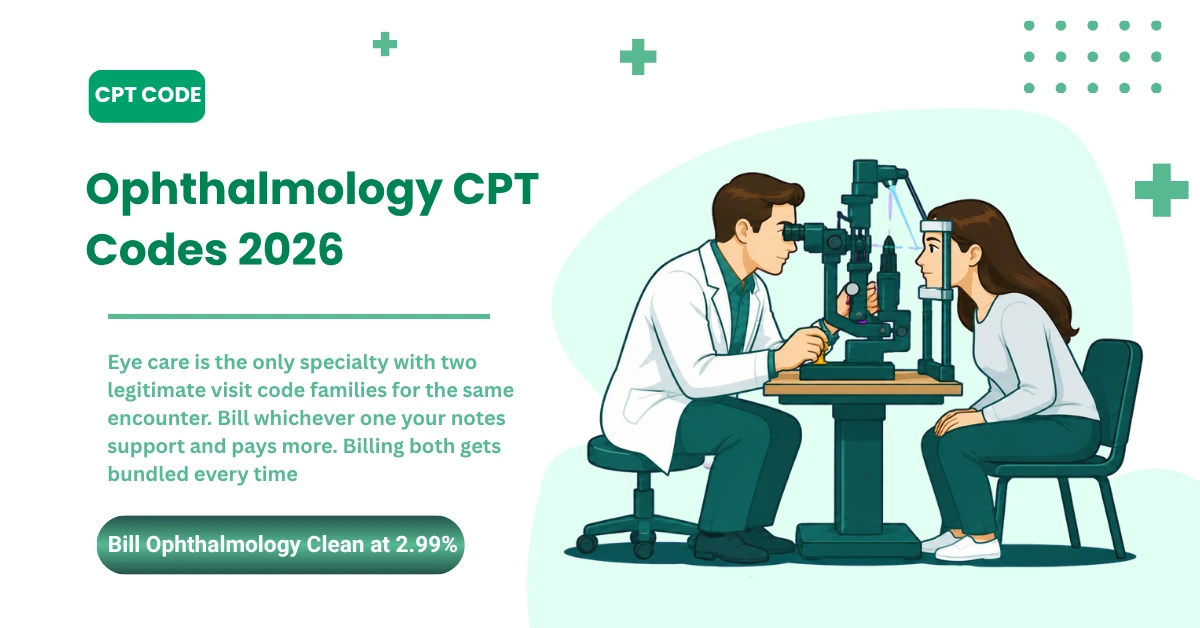




Ophthalmology CPT codes fall into four families. Eye visit codes run 92002-92014. Special ophthalmological services, covering refraction, visual fields, and imaging, run 92015-92287. Ophthalmic ultrasound sits at 76512-76519. Surgery on the eye and ocular adnexa runs 65091-68899.
The five codes eye care practices bill most often are 92014 for a comprehensive established patient exam, 92134 for OCT of the retina, 92133 for OCT of the optic nerve, 92250 for fundus photography, and 66984 for cataract extraction with an intraocular lens.
Picking the right code is half the job. You can't report an eye visit code and an office E/M code on the same date of service, diagnostic tests deny without a signed interpretation, and most ophthalmic procedures need a laterality modifier before the payer will pay them.
What Ophthalmology CPT Codes Cover
Ophthalmology CPT codes fall into four working groups, plus one borrowed set. The group a code belongs to tells you more about how to bill it than the code description does, because each group carries its own documentation standard.
The Four Code Families Ophthalmologists Bill
Ophthalmology CPT code ranges and what each range covers.
|
Code range |
What it covers |
|---|---|
|
92002-92014 |
General ophthalmological services, known as the eye visit codes |
|
92015-92287 |
Special ophthalmological services: refraction, visual fields, imaging, and photography |
|
76512-76519 |
Ophthalmic ultrasound and biometry |
|
65091-68899 |
Surgery on the eye and ocular adnexa |
|
99202-99215 |
Office E/M codes, billed instead of eye codes when the visit is medically driven |
A code's range decides its documentation rules. An eye visit code and an office E/M code can describe the same encounter and still demand different records to survive review.
Why Eye Care Uses Two Visit Code Families
Ophthalmology and optometry share something no other specialty has: two office visit code families that many payers treat as interchangeable. You can report an eye visit code or an office E/M code for the same encounter. The choice changes your documentation burden and the allowed amount.
Most preventable denials in eye care trace back to three places: the visit code family you picked, the diagnostic imaging code you paired with it, and the modifier you left off. Our billing team at MedSole RCM works all three across eye care practices, and the visit codes come first because everything downstream depends on them.
Eye Visit Codes 92002, 92004, 92012, and 92014
Four codes cover general ophthalmological services, and the numbering follows a pattern. Codes ending in 2 are intermediate. Codes ending in 4 are comprehensive. The 9200x codes belong to new patients and the 9201x codes belong to established patients.
What Each Eye Visit Code Covers
The four general ophthalmological service codes by patient status and exam level.
|
Code |
Patient |
Exam level |
Exam elements required |
|---|---|---|---|
|
92002 |
New |
Intermediate |
3 to 11 of the 12 elements |
|
92004 |
New |
Comprehensive |
All 12 elements, plus a treatment program |
|
92012 |
Established |
Intermediate |
3 to 11 of the 12 elements |
|
92014 |
Established |
Comprehensive |
All 12 elements, plus a treatment program |
Both comprehensive codes require initiation or continuation of a diagnostic and treatment program. An exam alone won't support 92004 or 92014, no matter how thorough the findings look in the chart.
What a Comprehensive Eye Exam Must Document
- Chief complaint stating why the patient came in
- History and general medical observation
- All 12 elements of the ophthalmological exam
- Dilation performed, or a documented reason it wasn't
- Impression or diagnosis
- Treatment plan, including the follow-up interval
Dilation trips up more comprehensive claims than any other element. If the physician skipped it, the record has to say why. Reviewers read a comprehensive code with no dilation and no explanation as an intermediate visit, and they downcode it. Your superbill in medical billing should capture the omission reason at charge entry, not weeks later during an appeal.
Frequency limits create the other half of the confusion. Commercial payers often cap comprehensive eye codes at one per patient per year. Medicare Part B doesn't apply a frequency edit to these codes. Two payers, two rules, same code.
New Patient vs Established Patient in Ophthalmology
A patient is established if they received a face-to-face professional service from the same physician, or from another physician of the same specialty in the same group practice, within the past 36 months. Everyone else is new.
The group practice rule catches practices off guard. A patient who saw your partner 14 months ago is established when they see you, even though you've never met them. Billing 92004 for that visit instead of 92014 is an overpayment waiting to be recouped.
Subspecialty doesn't reset the clock in most payer interpretations. A retina specialist and a comprehensive ophthalmologist in the same tax ID share a specialty designation, so a patient moving between them stays established.
Run the check before the visit, not at charge entry. Pull the patient's history across the whole group, confirm the last face-to-face date, and verify coverage in the same pass. Practices that fold patient status into benefit verification services catch the problem while it's still free to fix.
Eye Codes vs E/M Codes: Which One Should You Bill?
Bill the family your documentation supports. When the note supports both, compare that payer's allowed amount for each and report the one that pays more. Choosing the higher-paying code is permitted. Reporting both codes is not.
How the Two Families Differ
Eye visit codes compared with office E/M codes on the five factors that decide which to bill.
|
Factor |
Eye codes 92002-92014 |
E/M codes 99202-99215 |
|---|---|---|
|
Level selection |
Exam elements performed |
Medical decision making or total time |
|
Frequency edits |
Common with commercial payers |
None |
|
Diagnosis coverage |
Restricted by some payers |
Unrestricted |
|
Documentation driver |
Chief complaint, exam, treatment program |
Medically appropriate history and exam |
|
Dilation |
Expected at comprehensive levels |
Not required |
When to Use an E/M Code Instead
- A systemic disease such as diabetes, lupus, or multiple sclerosis is driving the visit
- The payer restricts eye codes to routine or annual exams only
- The patient already used their one covered eye code for the year
- The diagnosis falls outside the payer's eye code coverage list
- Medical decision making supports a higher level than the exam elements do
Which Family Pays More
It depends on the payer, and the only way to know is to build the sheet. List your top five payers down one side and 99202-99205, 99212-99215, 92002, 92004, 92012, and 92014 across the top, then fill in the allowed amounts. Our guides to CPT 99204 billing and CPT 99215 documentation cover what each level demands.
A higher allowed amount can still be the wrong pick. If the payer caps eye codes at one a year and the patient already used it, the claim denies and the balance lands on the patient. You collected nothing and created a statement.
|
Not sure which family your notes support? A coding review pulls a sample of your recent eye visits, tells you which family each note supports, and shows what the payer would have allowed for the alternative. MedSole RCM includes coding review inside outsourced medical billing services at 2.99% of collections. |
Pick the family before the note gets written, not after the charge hits the queue. Retrofitting a code to a finished note is how practices end up defending a claim they should have coded differently.
Can You Bill 99214 and 92014 on the Same Visit?
No. You pick one family per date of service. The CMS National Correct Coding Initiative treats the general ophthalmological service codes as components of the eye examination, and an office E/M code already includes those components.
The rule feels wrong the first time you hit it. Your physician documented a full exam and worked up a separate medical problem, so clinically two things happened. For claim purposes, one billable visit happened.
What usually follows is a mess in the work queue. Both codes go out on separate lines, the payer pays one and denies the other, and nobody's sure which line was wrong. That denial comes back as CO-97 bundling denials, and resubmitting the same pair won't change the answer.
What the NCCI Manual Says
Chapter XI of the CMS NCCI Policy Manual states that 92002-92014 describe components of the ophthalmologic exam and must not be reported separately when E/M codes are reported. CMS refreshes the procedure-to-procedure edit files every quarter, so a scrubber configured once a year runs stale rules for nine months.
One exception is worth separating out. A significant, separately identifiable E/M performed on the same day as a minor procedure is a different scenario, governed by modifier 25. That combination shows up later in this guide.
CPT 92015 Refraction: Why It Is Billed Separately
CPT 92015 is not an eye exam. It reports the determination of refractive state, the measurement that produces a glasses or contact lens prescription, and you report it in addition to the exam code rather than instead of it.
Is 92015 Covered by Insurance?
No, in most cases. Medicare doesn't cover refraction. Many commercial medical plans exclude it too. Vision plans usually do cover it. Coverage swings so widely by plan type that refraction became one of the few services where collecting at the front desk is standard practice.
Set the refraction fee, post it where patients can see it, and collect it during check-out. Practices that bill 92015 to the medical plan and wait for the denial spend more staff time chasing $40 than the service is worth.
Reporting 92014 and 92015 on the Same Claim
These two belong together and the pairing is correct. CPT 92014 covers the comprehensive examination. CPT 92015 covers the refractive measurement, which is a separate service with its own work. The NCCI rule against pairing eye codes with E/M codes doesn't apply here.
Document the refraction result as a measurement in the record. A charge line on the superbill with no corresponding finding in the chart won't hold up if the payer asks for records.
There Is No CPT Code 92013
CPT 92013 doesn't exist. The general ophthalmological services family runs 92002, 92004, 92012, and 92014. Nothing sits between 92012 and 92014.
People search for it because the sequence looks like it should be continuous. Staff type it into claim systems for the same reason.
A claim carrying 92013 rejects at the clearinghouse rather than denying at the payer. It never reaches an adjudication queue, so it won't show up in your denial report at all. Watch the rejection log instead, and fix the entry inside your clean claim submission workflow.
If the visit was intermediate, use 92012. If it was comprehensive, use 92014. The exam elements you documented settle it.
Ophthalmology Diagnostic Testing and Imaging CPT Codes
Diagnostic testing carries the volume in eye care, and the ophthalmology CPT codes in this group carry the denials. Every code in this group needs a signed interpretation and report in the record before you can bill it.
OCT and Retinal Imaging Codes
Computerized ophthalmic diagnostic imaging codes by anatomic segment.
|
Code |
What it images |
Common indication |
|---|---|---|
|
92132 |
Anterior segment |
Glaucoma anatomy, corneal disease |
|
92133 |
Posterior segment, optic nerve |
Glaucoma diagnosis and monitoring |
|
92134 |
Posterior segment, retina |
Macular degeneration, diabetic macular edema |
|
92137 |
Posterior segment, retina, including OCT angiography |
Retinal vascular disease |
|
92250 |
Fundus photography with interpretation |
Documentation and serial monitoring |
CPT 92133 and 92134 are mutually exclusive for the same eye on the same date. Bill the one you performed. The CMS NCCI PTP edits files update quarterly and carry the current pairings. Most published code lists skip 92132 altogether, which is why anterior segment imaging gets billed under a posterior segment code and denies.
Visual Field, Ultrasound, and Other Diagnostic Codes
Visual field, ultrasound, and specialized ophthalmic testing codes.
|
Code |
Test |
|---|---|
|
92081 |
Visual field examination, limited |
|
92082 |
Visual field examination, intermediate |
|
92083 |
Visual field examination, extended |
|
92060 |
Sensorimotor exam with multiple measurements of ocular deviation |
|
92025 |
Computerized corneal topography |
|
92235 |
Fluorescein angiography |
|
92240 |
Indocyanine green angiography |
|
92242 |
Fluorescein and indocyanine green angiography performed at the same session |
|
76512 |
Ophthalmic B-scan ultrasound |
|
76519 |
A-scan biometry with intraocular lens power calculation |
|
92136 |
Ophthalmic biometry by partial coherence interferometry |
The Interpretation Requirement
Every test above needs a signed interpretation and report stating what the test showed and what it changes about the plan. A printout filed in the chart is data, not an interpretation. Without one, the payer denies the professional component, and the modifier 26 professional component split on the claim has nothing behind it.
If your diagnostic tests keep denying for missing interpretations, you have a documentation workflow problem rather than a coding problem, and it's one denial management services teams see constantly in eye care.
Frequency is the other trap. Medicare Administrative Contractors publish local coverage determinations that cap how often several of these codes pay. Document the clinical reason for the testing interval, not the result alone.
NCCI Bundling Rules Every Eye Care Practice Hits
Correct ophthalmology CPT codes still deny when they break a bundling rule. Five NCCI rules cause most of the preventable bundling denials in eye care. Each one is published, each one is testable before submission, and each one costs you a claim when your scrubber doesn't know about it.
The Five Rules That Trigger Bundling Denials
NCCI bundling rules that apply to ophthalmology claims.
|
Rule |
What it means |
|---|---|
|
Eye codes with E/M |
CPT 92002-92014 are components of the exam and aren't separately reportable with an E/M code |
|
Fundus photo with OCT |
CPT 92250 and 92133 or 92134 are generally mutually exclusive on the same eye |
|
Dye injection |
Catheter insertion and dye injection are integral to 92235, 92240, 92242, and 92287 |
|
Cataract extraction |
CPT 66830-66991 are mutually exclusive. One code per eye, per date |
|
Intravitreal injection |
CPT 67028 isn't reportable with anterior chamber paracentesis 65800-65815 on the same eye and encounter |
When Fundus Photography and OCT Can Both Be Billed
A limited set of clinical conditions makes both modalities reasonable on the same eye. When that applies, report both and append modifier 59 or XU to 92250, not to the OCT code. Modifier placement decides whether the claim pays, and our guide to modifier 59 and XU rules walks through the distinction.
Load all five rules into your claim scrubber as pre-submission edits. Working them as denials afterward costs staff hours you won't recover. CMS posts NCCI edit changes every quarter through its NCCI for Medicare program, so refresh the rules quarterly rather than at year-end.
Ophthalmic Surgery CPT Codes
Surgical ophthalmology CPT codes carry global periods, and the global period is where eye care practices leak revenue. Three groups account for most of the surgical volume: cataract, glaucoma, and retina.
Cataract Surgery Codes
Cataract and lens procedure codes with Medicare global periods.
|
Code |
Procedure |
Global period |
|---|---|---|
|
66984 |
Routine cataract extraction with intraocular lens insertion |
90 days |
|
66982 |
Complex cataract extraction with intraocular lens insertion |
90 days |
|
66987 |
Cataract extraction with a drug-eluting intraocular lens |
90 days |
|
66821 |
YAG laser capsulotomy |
90 days |
CPT 66982 needs a documented complexity factor. A small pupil requiring iris hooks or a mechanical expansion device, a dense brunescent or white mature cataract, or weak and absent zonules from pseudoexfoliation, trauma, or Marfan syndrome all qualify.
Reporting 66982 without one of those factors in the operative note is the upcoding pattern payers audit for. You can pull locality-adjusted rates yourself through the Medicare procedure price lookup.
Glaucoma and Retina Procedure Codes
Common glaucoma and retina surgical codes.
|
Code |
Procedure |
|---|---|
|
65855 |
Laser trabeculoplasty |
|
66170 |
Trabeculectomy |
|
66174 |
Transluminal dilation of the aqueous outflow canal |
|
66183 |
Insertion of an anterior segment aqueous drainage device |
|
67028 |
Intravitreal injection of a pharmacologic agent |
|
67036 |
Pars plana vitrectomy |
|
67108 |
Retinal detachment repair with vitrectomy |
|
67210 |
Laser photocoagulation of a retinal lesion |
|
67228 |
Panretinal photocoagulation |
Billing During the Global Period
Routine post-operative care sits inside the surgical package. An unrelated problem during the global period is separately billable when you append modifier 24 in global periods and the documentation supports it. Surgery on the second eye during the first eye's global takes modifier 79. In our experience, practices write off qualifying post-op visits far more often than they overbill them.
Injection claims need the drug line too. Bill 67028 alongside the separately payable drug J-code with correct units, and append modifier JW for documented waste or JZ for no waste. Claims for single-dose vials carrying neither modifier reject, and the drug is usually the larger half of the payment.
Ophthalmology Modifiers and When to Use Them
Modifiers decide payment on more eye care claims than the ophthalmology CPT codes do on their own. Almost every ophthalmic service is unilateral, bilateral, or performed alongside something else, and the payer needs the modifier to adjudicate it.
Eye and Laterality Modifiers
Laterality and eyelid modifiers used on ophthalmology claims.
|
Modifier |
Applies to |
|---|---|
|
RT |
Right eye |
|
LT |
Left eye |
|
50 |
Bilateral procedure, when the code doesn't already cover both eyes |
|
E1 |
Upper left eyelid |
|
E2 |
Lower left eyelid |
|
E3 |
Upper right eyelid |
|
E4 |
Lower right eyelid |
The E modifiers identify eyelids. RT and LT identify eyes. They aren't interchangeable, and putting an eye modifier on an eyelid procedure produces CO-4 laterality denials that look like a coding error when the code was fine.
Procedure and Global Period Modifiers
Procedural modifiers that prevent ophthalmology denials.
|
Modifier |
When it applies |
|---|---|
|
24 |
Unrelated E/M during a surgical global period |
|
25 |
Significant, separately identifiable E/M on the same day as a minor procedure |
|
26 |
Professional component only, the physician interpretation of a diagnostic test |
|
TC |
Technical component only |
|
57 |
Decision for major surgery |
|
58 |
Planned staged procedure during the global period |
|
59 or XU |
Distinct procedural service, used to override an NCCI edit |
|
79 |
Unrelated procedure during a global period |
Modifier 25 carries the highest audit exposure in eye care because it sits on top of the highest-volume procedure, the intravitreal injection. Document the separately identifiable service as its own assessment with its own findings, not as the pre-procedure evaluation the injection already covers.
Pairing Ophthalmology CPT Codes With the Right ICD-10 Code
A correct CPT code paired with an unsupported diagnosis still denies. Medical necessity comes from the diagnosis linked to the service, and each diagnostic test in eye care has a defined set of conditions that support it. Our ICD-10 coding guide covers the wider diagnosis rules.
Which Diagnoses Support Which Tests
Diagnostic tests and the condition categories that establish medical necessity.
|
Test |
Supported by |
|---|---|
|
92133, OCT optic nerve |
Glaucoma, glaucoma suspect, and optic nerve disorders |
|
92134, OCT retina |
Macular degeneration, diabetic macular edema, retinal vascular disease |
|
92250, fundus photography |
Diabetic retinopathy, macular disease, retinal monitoring |
|
92083, extended visual field |
Glaucoma and neurological visual field defects |
|
92060, sensorimotor exam |
Strabismus, diplopia, and ocular motility disorders |
Reversing the two OCT codes against the diagnosis is the most frequent medical necessity denial in the specialty. CPT 92133 paired with a macular diagnosis denies, because optic nerve imaging isn't the test that condition calls for.
Routine diagnoses fail the same way. Z01.00 for a routine eye exam without abnormal findings, and the H52 refractive error series, won't support advanced diagnostic testing no matter how well the test itself was documented. Those pairings come back as CO-50 medical necessity denials.
For a published example of code-level pairing, the Medi-Cal ophthalmology diagnosis code manual maps ophthalmic CPT codes to supporting ICD-10 codes line by line. Treat it as a state example and check your own contractor's local coverage determination.
What Changed in Ophthalmology Coding for 2026
The AMA released 418 changes to the CPT code set for 2026: 288 new codes, 84 deletions, and 46 revisions. A handful of them reach eye care, and two payment changes reach it harder than the code changes do.
New and Revised Ophthalmology Codes
Ophthalmology CPT code changes effective in 2026.
|
Code |
Change |
Effective |
|---|---|---|
|
92284 |
Revised to specify diagnostic dark adaptation examination |
January 1, 2026 |
|
92288 |
New. Screening dark adaptation measurement |
January 1, 2026 |
|
0996T, 1010T, 1012T |
New Category III tracking codes |
January 1, 2026 |
|
1048T, 1049T |
New Category III, includes eyelid graft application |
July 1, 2026 |
CPT 92288 needs a coverage decision before you perform the test. CMS hasn't established it as a payable Medicare service in the CY 2026 Physician Fee Schedule final rule, so expect denials under traditional Medicare and build ABN decisioning into the workflow. You can confirm how CMS classifies a code through its status indicator definitions.
The Two 2026 Conversion Factors
Medicare set two conversion factors for 2026 rather than one. Practices in a qualifying Alternative Payment Model are paid at $33.5675. Everyone else is paid at $33.4009. The published 2026 rate tables in eye care show one number, so confirm which factor applies to your practice before trusting a figure.
On 92014 the gap is 63 cents a visit. Across 3,000 established patient visits a year, that's roughly $1,900. Small per claim, visible on an annual statement.
The Cataract Payment Split
Two things happened to cataract reimbursement in 2026 and they moved in opposite directions. CMS cut the work RVU for 66984 from 7.35 to 7.17, which ASCRS calculated as roughly an 11% reduction in the surgeon's payment.
Facility payment for the same procedure in an ambulatory surgery center went up over the same period. Where you perform the case now changes the economics, which turns place of service codes into a revenue decision rather than a data entry field.
The NCCI Edit Change on 92137
NCCI edits version 32.1 changed the column two indicator for 92137 against 92227, 92228, and 92229 to zero, which makes them mutually exclusive. Billing 92137 with any of those three on the same date now produces a hard edit denial with no modifier override available. The change took effect April 1, 2026.
The Denials That Cost Eye Care Practices Most
Six denial codes account for most preventable revenue loss in eye care, and each traces back to how the ophthalmology CPT codes were reported. Each one maps to a specific correction rather than a resubmission, and each one is catchable before the claim leaves your system.
Six Denial Codes and What Fixes Them
Common ophthalmology denials by CARC code, cause, and fix.
|
Denial |
Cause |
Fix |
|---|---|---|
|
CO-16 |
Eye code and E/M reported together, or an injection billed without the drug |
Pick one visit family. Add the J-code with units and JW or JZ |
|
CO-97 |
Service bundled into another procedure |
Check the NCCI pair before submission |
|
CO-151 |
Diagnostic test exceeds the payer's frequency limit |
Document the clinical reason for the interval |
|
CO-50 |
Diagnosis doesn't support medical necessity |
Correct the CPT to ICD-10 pairing at the scrubber |
|
CO-4 |
Missing or incorrect laterality modifier |
Append RT, LT, 50, or the correct E modifier |
|
CO-11 |
Diagnosis inconsistent with the procedure |
Verify the diagnosis matches the anatomic site imaged |
|
Want to know which of these six is costing you most? A denial pattern review sorts your last 90 days of eye care denials by CARC code and shows where the revenue is going. MedSole RCM runs it before you commit to anything, as part of denial management at 2.99% of collections. |
All six share a trait: you can prevent them at charge entry. Working them afterward burns staff time you won't bill for, and the appeal window keeps closing while the claim sits.
Timing decides the rest. Denied claims that sit untouched past 90 days rarely get paid, and the Medicare timely filing limit closes the option for good. Practices without a dedicated AR follow-up process lose most of this revenue to the calendar.
Vision Plan or Medical Plan: Which One Gets the Claim?
Two plan types can cover the same ophthalmology CPT codes, and the reason for the visit decides which one gets the claim. A patient who came in for a glasses prescription is a vision plan claim. A patient who came in with a symptom is a medical claim.
The chief complaint is your deciding document. A patient scheduled for a routine exam who mentions floaters at check-in has handed you a medical chief complaint, and the visit converts. A diabetic patient booked for a diabetic eye exam was medical from the start.
Split billing works when both plans allow it. A routine exam that uncovers pathology can produce a vision plan claim for the refraction and a medical claim for the medical evaluation, provided you documented both and verified both coverages before the visit.
What goes wrong is predictable. The practice bills a routine exam to the medical plan, collects a non-covered denial six weeks later, and discovers the vision plan's filing window has already closed.
Documentation That Holds Up on an Ophthalmology Audit
Your chart supports the ophthalmology CPT codes you billed, or those codes come back. Reviewers looking at eye care claims check the same six elements every time, and they check them in the same order.
The Six Elements Payers Look For
- Chief complaint stating why the patient came in
- Visual acuity for each eye, noting correction or pinhole
- Intraocular pressure where clinically indicated
- Exam findings by structure, with laterality specified
- Signed interpretation and report for every diagnostic test
- Assessment and treatment plan, including the follow-up interval
The interpretation fails most often. A diagnostic test submitted without one is the most consistent denial in the specialty, and it's the easiest to fix. The interpretation states what the test showed and what it changes about the plan. Two sentences usually cover it.
Laterality belongs in the note, not only on the claim. If the record says an eye was examined without saying which eye, the modifier you appended has nothing supporting it and the payer can recoup the payment.
What Ophthalmology Billing Costs and What to Look For in a Partner
Ophthalmology CPT codes are only worth what you collect on them. Most eye care practices outsource billing on a percentage of collections. Rates run roughly 4% to 9% depending on volume and specialty mix. Ophthalmology often lands at the higher end, because diagnostic test volume and global period tracking take more work than a primary care panel.
What to Check Before You Sign
- Whether the fee is a percentage of collections or of charges, since collections aligns incentives and charges doesn't
- Whether coding review is included or billed as an add-on
- Whether the team has worked eye visit codes, not general E/M alone
- Whether credentialing is priced separately and what it costs per payer
- Whether there's a setup fee or a monthly minimum
- Whether the contract carries a term or runs month to month
How MedSole RCM Prices Eye Care Billing
MedSole RCM pricing for ophthalmology and optometry practices.
|
Service |
Price |
|---|---|
|
Full-service medical billing and revenue cycle management |
2.99% of collections |
|
Provider credentialing and payer enrollment |
$99 per payer enrollment |
|
Setup fee |
None |
|
Contract term |
None. Month to month |
MedSole RCM handles ophthalmology billing at 2.99% of collections and provider credentialing at $99 per payer enrollment, with no setup fee and no long-term contract.
Billing covers eligibility verification, coding review, claim submission, payment posting, denial management, AR follow-up, and monthly reporting through our ophthalmology billing support team. Credentialing covers CAQH setup, payer application submission, weekly follow-up to approval, and recredentialing deadline tracking through our provider credentialing services.
Ask any prospective partner what their quoted rate includes. A lower percentage that excludes coding review, or that charges separately for each payer enrollment, often costs more once the invoices arrive. Eye care enrollment has its own quirks, which our ophthalmology credentialing guide covers for both ophthalmologists and optometrists.
|
Want a number before you decide anything? A free billing assessment reviews your current denial rate, days in AR, and clean claim rate against eye care benchmarks, then returns a written comparison. No commitment either way. Request a billing assessment. |
Ophthalmology CPT Code FAQs
What is CPT code 92014 used for?
CPT 92014 reports a comprehensive eye examination for an established patient. It requires all 12 elements of the ophthalmological exam plus initiation or continuation of a diagnostic and treatment program. Documenting the exam alone won't support it.
Can you bill 99214 and 92014 together?
No. CMS NCCI treats the eye visit codes 92002-92014 as components of the examination that an office E/M code already includes. Pick the family your documentation supports and report one code for that date of service.
Is CPT 92015 an eye exam?
No. CPT 92015 reports refraction, the measurement that determines a glasses or contact lens prescription. You bill it alongside an exam code. Medicare doesn't cover it, and many commercial medical plans exclude it as well.
What is the difference between 92133 and 92134?
CPT 92133 images the optic nerve and supports glaucoma workup. CPT 92134 images the retina and supports macular and retinal conditions. They're mutually exclusive for the same eye on the same date, so bill only the one you performed.
Is CPT 92014 a routine eye exam?
CPT 92014 is a comprehensive medical eye exam. Whether it bills as routine depends on the plan and the diagnosis you link to it. Medicare doesn't pay for routine exams performed solely to update a glasses prescription.
What is the taxonomy code for ophthalmology?
The general ophthalmology taxonomy code is 207W00000X and the Medicare specialty code is 18. Subspecialties carry their own taxonomy codes, including 207WX0107X for retina and 207WX0009X for glaucoma.
What are the new ophthalmology CPT codes for 2026?
CPT 92288 is new for screening dark adaptation measurement, and 92284 was revised to specify diagnostic dark adaptation. Category III codes 0996T, 1010T, and 1012T took effect January 1, 2026, with 1048T and 1049T following on July 1, 2026.
How much does ophthalmology billing cost?
Most eye care practices pay between 4% and 9% of collections. MedSole RCM charges 2.99% of collections for full-service billing and $99 per payer for credentialing, with no setup fee. Both sit inside full revenue cycle management rather than being priced as separate products.
Eye care billing is a specialty problem, not a general one. If your denials keep clustering in a code family you can't pin down, talk to our billing team and we'll look at the pattern with you.