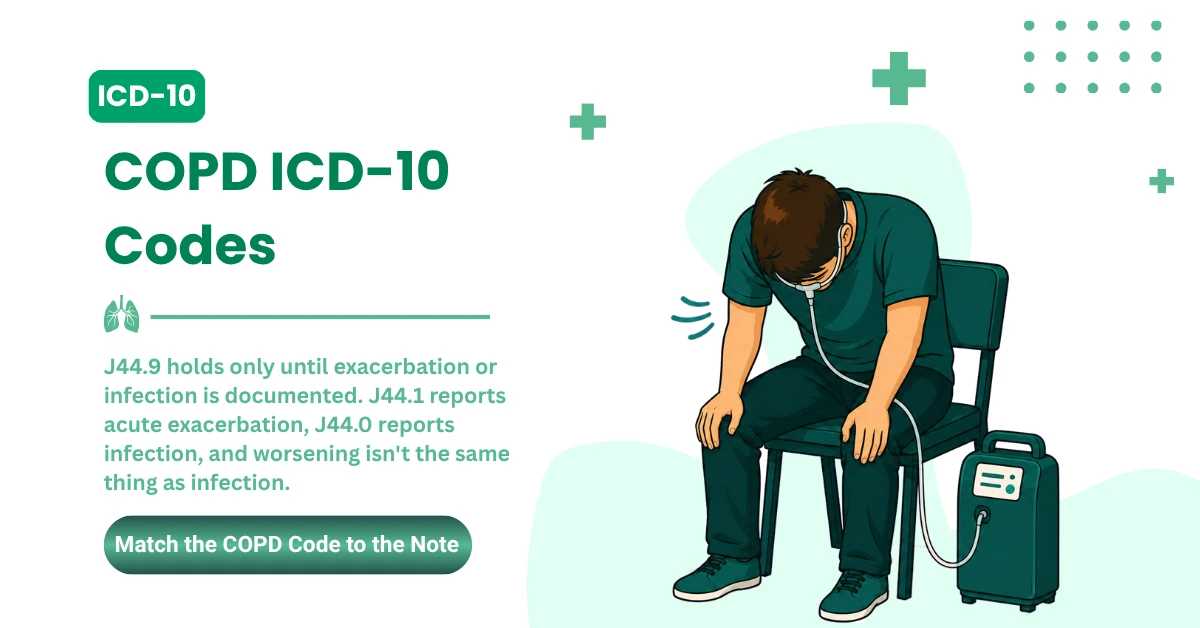




The ICD-10 code for COPD is J44.9 (chronic obstructive pulmonary disease, unspecified) when no exacerbation or infection is documented, J44.1 (COPD with acute exacerbation), J44.0 (COPD with acute lower respiratory infection), J44.89 (other specified COPD, including COPD documented with chronic bronchitis or asthma), or J44.81 (bronchiolitis obliterans and bronchiolitis obliterans syndrome).
Two of those codes aren't billable on their own. J44 is a category header. J44.8 is a subcategory. Send either one on a claim and it rejects at the clearinghouse before a payer ever looks at it.
Here's the currency piece. The active code set is the FY2026 release, and it governs dates of service through September 30, 2026. FY2027 takes effect October 1, 2026.
This guide walks every billable J44 code, the exacerbation rule that decides J44.0 against J44.1, the sequencing that COPD with pneumonia and respiratory failure demands, and the documentation habits that keep these claims paid. It's written by the billing team at MedSole RCM, who work COPD denials for pulmonology and primary care panels every week.
What Is the ICD-10 Code for COPD? Complete J44 Code Table for 2026
Every COPD ICD-10 code lives in category J44, and the fourth and fifth characters carry the clinical detail. Three neighboring categories sit close enough to cause trouble: J43 for emphysema, J41 and J42 for chronic bronchitis, and J47 for bronchiectasis. Each one has its own rules, covered further down.
What Is the ICD-10 Code for COPD?
|
Code |
Description |
When to Use |
|---|---|---|
|
J44.0 |
Chronic obstructive pulmonary disease with (acute) lower respiratory infection |
COPD documented with a diagnosed acute lower respiratory infection such as pneumonia or acute bronchitis. Code the infection separately. |
|
J44.1 |
Chronic obstructive pulmonary disease with (acute) exacerbation |
COPD documented with acute worsening beyond baseline. Also covers decompensated COPD. |
|
J44.81 |
Bronchiolitis obliterans and bronchiolitis obliterans syndrome |
Documented BOS, most often post-transplant. Not interchangeable with routine COPD. |
|
J44.89 |
Other specified chronic obstructive pulmonary disease |
COPD documented with chronic bronchitis, asthma, or emphysematous bronchitis, per the Alphabetic Index. |
|
J44.9 |
Chronic obstructive pulmonary disease, unspecified |
COPD stated with no exacerbation, no infection, and no named subtype anywhere in the record. |
Descriptors above come straight from the FY2026 Tabular List. J44.9 also covers chronic obstructive airway disease NOS and chronic obstructive lung disease NOS, so those phrases in a note don't push you anywhere else.
|
J44 Alone Rejects: J44 is a category header and J44.8 is a subcategory. Neither one is billable. A claim carrying either trips a specificity edit at the clearinghouse before a payer sees it. |
The category itself has an Includes list, and it answers a question coders ask constantly: what actually counts as COPD under J44?
What Diseases Are Covered by COPD Under J44?
|
Included condition |
Included condition |
|---|---|
|
Asthma with chronic obstructive pulmonary disease |
Chronic emphysematous bronchitis |
|
Chronic asthmatic (obstructive) bronchitis |
Chronic obstructive asthma |
|
Chronic bronchitis with airway obstruction |
Chronic obstructive bronchitis |
|
Chronic bronchitis with emphysema |
Chronic obstructive tracheobronchitis |
All eight terms classify to J44. Which J44 code depends on what else the note says, and the Alphabetic Index makes that call. The full code set and its instructional notes are published by CMS.
J44.1: The COPD ICD-10 Code for Acute Exacerbation
The ICD-10 code for COPD exacerbation is J44.1, chronic obstructive pulmonary disease with (acute) exacerbation. It applies when the provider documents acute worsening of the patient's COPD beyond normal day-to-day variation. Decompensated COPD indexes here too.
What counts as an exacerbation
The FY2026 ICD-10-CM Official Guidelines settle this in Chapter 10. An acute exacerbation is a worsening or decompensation of a chronic condition, and an acute exacerbation isn't equivalent to an infection superimposed on a chronic condition, though an exacerbation may be triggered by an infection.
Read that twice, because it's the rule that decides J44.0 against J44.1. Worsening and infection are two separate facts in the chart. One doesn't establish the other.
|
Exacerbation Isn't Infection: An infection can trigger an exacerbation. Documenting the infection still doesn't document the exacerbation. If both are happening, the note has to say both. |
Documentation that supports J44.1
- Increased dyspnea beyond the patient's stated baseline
- Increased sputum volume or purulence
- Starting systemic steroids or antibiotics for acute worsening
- Presenting to the ED or admitting for acute respiratory decline
- Writing "exacerbation," "acute exacerbation," or "AECOPD" in the assessment
- Changing maintenance therapy in response to the worsening
What does not support J44.1
- A routine maintenance visit with no documented change
- COPD mentioned in passing at a visit for something else
- "COPD, stable" or "COPD, controlled," which both code to J44.9
One more thing worth saying plainly. The exacerbation has to be the provider's assessment, not the coder's inference from a steroid order. A prednisone burst on the med list isn't a diagnosis.
When the chart shows treatment for worsening and the assessment line stays silent, that's a query. Coding around it builds the kind of incomplete claim covered in the CO-16 denial code guide.
J44.0: COPD With Acute Lower Respiratory Infection, and How to Sequence It
J44.0 applies when a patient with COPD has a diagnosed acute lower respiratory infection. Pneumonia and acute bronchitis are the usual ones. The code tells the payer an infection is present, but it never says which infection, so a second code has to do that job.
Which Codes Pair With J44.0?
|
Infection documented |
Secondary code |
|---|---|
|
Pneumonia, unspecified organism |
J18.9 |
|
Acute bronchitis, unspecified |
J20.9 |
|
Respiratory syncytial virus as the cause of disease classified elsewhere |
B97.4 |
|
J44.0 Never Rides Alone: Submitting J44.0 with no infection code leaves the claim incomplete on its face. The payer can see that something was diagnosed and nothing identified it. |
Can J44.0 and J44.1 be reported together
Yes, when both conditions are documented. J44.1 carries a Type 2 Excludes note pointing to J44.0, and a Type 2 Excludes means the excluded condition isn't part of the code it sits under, so a patient can have both at the same time.
Practically, that's a patient whose COPD is exacerbating and who also has pneumonia. Two things are true, so two codes go on the claim, plus the code identifying the pneumonia.
Sequencing with pneumonia
Sequencing follows the reason for the encounter, not a fixed template. If the infection drove the admission, the infection may lead. If COPD with a superimposed infection is the focus of care, J44.0 leads.
Inpatient claims use the principal diagnosis rule, meaning the condition established after study to be chiefly responsible for the admission. Get the pointer wrong at the line level and you'll see the CO-11 diagnosis mismatch pattern instead.
Respiratory failure adds a third layer to this decision. That's covered in its own section below, because it's where most of the sequencing money sits.
J44.9: What COPD Unspecified Actually Costs Your Practice
What "COPD, unspecified" means
J44.9 means the provider diagnosed COPD and the record said nothing further. No exacerbation. No infection. No named subtype. It's a billable, valid code, and it's also the most over-used code in the J44 family.
Clinically, the patient has chronic airflow obstruction that doesn't reverse. Administratively, the note didn't capture which kind, or whether anything acute was happening that day. Those are two different statements, and only the second one is a documentation problem.
When J44.9 is the right code
Plenty of encounters genuinely belong here. A stable outpatient follow-up where nothing changed. A chart that says "COPD" and means it. A first visit where the workup hasn't happened yet and specificity honestly isn't available. Unspecified codes exist because uncertainty is real.
When J44.9 becomes an audit pattern
The trouble starts when the chart contains more than the code does. J44.9 on a note documenting steroids for worsening. J44.9 on an encounter where pneumonia was diagnosed and treated. J44.9 repeating across a panel whose notes are full of exacerbation language.
That gap between documentation and code assignment is what automated payer edits are built to catch. One instance is nothing. A pattern is what surfaces in a review.
|
The Query Trigger: When the note shows systemic steroids or antibiotics started for acute worsening, and the assessment line says only "COPD," that's a physician query. It isn't a J44.9. |
The revenue math
Say a pulmonology panel runs 300 COPD encounters a quarter. Every J44.9 that should have been J44.1 is a claim that under-describes the visit it's attached to. One of those is a rounding error.
A pattern of them is measurable. You get downcoding pressure on the services attached to the claim, rework on the ones that come back, and on the Medicare Advantage side, a risk score that under-represents the patient for a year that doesn't reset.
The same dynamic plays out on the endocrine side, and the hyperlipidemia ICD-10 billing guide breaks it down with the E78 codes.
Most practices don't have a J44.9 problem. They have a documentation-capture problem that shows up as a J44.9 rate. Working out which one you're looking at starts with pulling your own numbers, and that's the first thing our COPD denial management services team does on a new pulmonology account.
J44.89 and J44.81: The Two COPD ICD-10 Codes Most Guides Skip
Here's a correction worth flagging. If a COPD coding article doesn't mention J44.89, it was written before October 1, 2023, because that's the date the code took effect. J44.89 and J44.81 replaced the old single J44.8 code, and a lot of guidance still online never caught up.
J44.89, other specified COPD
J44.89 covers COPD that the record does specify, just not as an exacerbation or an infection. The Tabular lists chronic asthmatic (obstructive) bronchitis and chronic emphysematous bronchitis as applicable terms. The Alphabetic Index sends several more here, including COPD with chronic bronchitis and COPD with asthma.
The contrast with J44.9 comes down to one word. Specified but not otherwise classifiable goes to J44.89. Not specified at all goes to J44.9. Two sections below walk the chronic bronchitis and asthma decisions in full, because both are commonly coded wrong.
J44.81, bronchiolitis obliterans syndrome
J44.81 sits inside J44 but describes a different clinical entity. Bronchiolitis obliterans and bronchiolitis obliterans syndrome show up most often after lung or stem cell transplant, and after chronic rejection. Chronic fibrosing bronchiolitis indexes here too.
The risk is loose language. When a clinician writes "obstructive lung disease" on a transplant patient and a coder reaches for J44.9, a serious post-transplant complication disappears into a routine COPD code. The utilization and risk profile behind those two codes aren't remotely the same.
|
BOS Isn't Routine COPD: J44.81 describes bronchiolitis obliterans syndrome, not smoking-related airflow obstruction. Coding it as J44.9 buries a transplant complication inside a general code. |
How to Choose Between J44.0, J44.1, and J44.9: A Two-Question Decision Path
Every COPD ICD-10 code selection comes down to two questions a coder asks the chart. Is something acute happening, and if so, is it an infection or a worsening? Then: does the record name a specific type of COPD? Work them in order and the code falls out.
- Is COPD documented as the provider's diagnosis? If not, code what the record actually supports.
- Did the provider diagnose an acute lower respiratory infection? If yes, assign J44.0 plus the code identifying that infection.
- Did the provider document an acute exacerbation? If yes, assign J44.1. When both an infection and an exacerbation are documented, report J44.0 and J44.1 together.
- Does the record name chronic bronchitis, asthma, or emphysematous bronchitis with the COPD? If yes, the Alphabetic Index directs to J44.89.
- Does the record document bronchiolitis obliterans or BOS? If yes, assign J44.81.
- None of the above, and the chart says only COPD? Assign J44.9.
How Do You Choose the Right COPD ICD-10 Code?
|
What the chart documents |
Code |
When to Use |
|---|---|---|
|
Acute lower respiratory infection with COPD |
J44.0 |
Infection diagnosed and named. Add the infection code. |
|
Acute exacerbation, no infection identified |
J44.1 |
Provider documents worsening beyond baseline. |
|
Both an exacerbation and an infection |
J44.0 and J44.1 |
Both conditions separately documented. |
|
Chronic bronchitis, asthma, or emphysematous bronchitis with COPD |
J44.89 |
Index directs to other specified COPD. |
|
Bronchiolitis obliterans or BOS |
J44.81 |
Documented, most often post-transplant. |
|
COPD alone, nothing further |
J44.9 |
No exacerbation, no infection, no named subtype. |
COPD ICD-10 Excludes1 and Excludes2 Rules That Block Claims
Two instructional notes govern what can share a claim with a J44 code. Excludes1 means the two codes never appear together, because the conditions can't coexist as coded. Excludes2 means they can, as long as each one is separately documented.
Getting this backward is common, and it's expensive in both directions. One way you drop a code you were entitled to bill. The other way you trip a hard edit.
COPD and emphysema
Here's a correction worth flagging. Plenty of sources state that J43 and J44 can never appear together. That's not what the Tabular says. J44 carries a Type 2 Excludes for emphysema without chronic bronchitis, which means both codes are assignable when both conditions are separately documented.
The routing rule still holds. Emphysema documented without chronic bronchitis classifies to J43. Emphysema documented with chronic obstructive bronchitis classifies to J44. When a chart names both COPD and emphysema and stops there, code the more specific condition and skip the unspecified COPD code.
COPD and bronchiectasis
Same structure, same correction. Bronchiectasis sits under a Type 2 Excludes at J44, not a Type 1. When bronchiectasis and COPD are both documented, both can be reported, and the bronchiectasis codes live in J47.
The Excludes1 that actually bars two COPD codes
J42, unspecified chronic bronchitis, carries a Type 1 Excludes naming J44.9 and J44.81. So J42 and J44.9 can never appear on the same claim. J42 also excludes chronic asthmatic bronchitis, chronic bronchitis with airways obstruction, and chronic emphysematous bronchitis, all of which route into J44.
Excludes1 violations are hard rejections, not soft ones. The cough ICD-10 codes guide walks the same note types in the R05 family.
Which COPD Codes Can Never Appear Together?
|
Pairing |
Note type |
What it means |
|---|---|---|
|
J42 with J44.9 |
Excludes1 at J42 |
Never together. Chronic bronchitis NOS and COPD NOS are the same statement. |
|
J42 with J44.81 |
Excludes1 at J42 |
Never together. |
|
J44 with J43.- (emphysema without chronic bronchitis) |
Excludes2 at J44 |
Both assignable when both are separately documented. |
|
J44 with J47.- (bronchiectasis) |
Excludes2 at J44 |
Both assignable when both are separately documented. |
|
J44 with J41.- (simple and mucopurulent chronic bronchitis) |
Excludes2 at J44 |
Both assignable when both are separately documented. |
|
J44.1 with J44.0 |
Excludes2 at J44.1 |
Both assignable when exacerbation and infection are both documented. |
|
J44.9 with J60-J70 (lung disease due to external agents) |
Excludes2 at J44.9 |
Both assignable when both are separately documented. |
Can You Code COPD and Asthma Together? J44 and J45 Rules
Yes, and the base code probably isn't the one you're expecting. When asthma is documented with COPD, the Alphabetic Index directs to J44.89, not J44.9. The entries for asthma with chronic obstructive pulmonary disease, asthma with chronic obstructive bronchitis, and chronic obstructive asthma all point to the same place.
J45 backs this up from the other side. Asthma carries a Type 2 Excludes listing asthma with COPD, chronic asthmatic (obstructive) bronchitis, chronic obstructive asthma, and other specified COPD, and every one of those references J44.89.
|
The Index Says J44.89: A lot of published guidance still routes COPD with asthma to J44.9. That guidance predates J44.89, which took effect October 1, 2023. Check the date on whatever reference you're using. |
When a second code gets assigned
J44 carries a Code Also note for type of asthma, if applicable. So when the record names the asthma severity, assign the J44 code and a J45 code describing that severity. When the asthma is unspecified and uncomplicated, the J44 code already carries it and no second code is needed.
Which J45 Codes Pair With COPD?
|
Subcategory |
Asthma type |
|---|---|
|
J45.2- |
Mild intermittent asthma |
|
J45.3- |
Mild persistent asthma |
|
J45.4- |
Moderate persistent asthma |
|
J45.5- |
Severe persistent asthma |
|
J45.9- |
Other and unspecified asthma |
Fifth and sixth characters finish the J45 code, and they tell the payer whether the asthma is uncomplicated, in acute exacerbation, or in status asthmaticus.
The exacerbation rule most coders miss
Each condition has to be documented as exacerbated on its own. A COPD exacerbation doesn't make the asthma exacerbated, and asthma in exacerbation says nothing about the COPD. Assuming otherwise builds a claim the record can't defend.
There's a related rule on the asthma side. When the note documents both acute exacerbation and status asthmaticus, only the more severe condition gets coded, and that's status asthmaticus.
Asthma-COPD overlap
ACOS has no dedicated ICD-10-CM code. Nothing in the code set names it. You code the documented COPD and the documented asthma using the rules above, and that's the whole answer. Searchers looking for an ACOS code need to know one doesn't exist.
|
Exacerbation Doesn't Travel: COPD exacerbation and asthma exacerbation are separate documentation facts. One never implies the other. |
COPD With Chronic Bronchitis: Why Three Sources Give Three Different Codes
A chart says COPD and chronic bronchitis. Search for the COPD ICD-10 code and you'll find three different answers across published guidance, which is a strange thing for a question the Index answers directly.
What the Alphabetic Index directs
J44.89. The Index entry under Bronchitis, chronic, with airways obstruction routes to J44.89. So does Bronchitis, chronic, obstructive. So does Disease, lung, obstructive, with bronchitis. The reasoning matches the emphysema rule: the more specific documented condition governs, and an unspecified COPD code adds nothing on top of it.
Here's where the confusion comes from. Some sources point to J44.9, on the theory that chronic bronchitis is already built into J44. Others point to J44.1 plus J42 when an exacerbation is present. The exacerbation scenario is a different question, and mixing the two is what produces three answers to one chart.
J42 settles the first theory on its own. It carries a Type 1 Excludes naming J44.9, so those two codes can't share a claim under any circumstance.
How Do You Code COPD With Chronic Bronchitis?
|
Documented scenario |
Code assignment |
Why |
|---|---|---|
|
COPD with chronic bronchitis, stable |
J44.89 |
Index directs chronic bronchitis with airways obstruction to J44.89. |
|
COPD with chronic bronchitis, acute exacerbation documented |
J44.1 |
The exacerbation is the acute fact. J42 can't pair with J44.9. |
|
COPD with chronic bronchitis and a diagnosed acute LRI |
J44.0 plus the infection code |
The infection drives the J44.0 assignment. |
|
Emphysema documented, no chronic bronchitis |
J43.- |
Emphysema without chronic bronchitis classifies outside J44. |
COPD With Respiratory Failure: Sequencing J96 Codes Correctly
A COPD exacerbation that decompensates produces respiratory failure, and that's a separately codeable condition with its own set of codes in J96. On inpatient claims, it's frequently the single most valuable thing in the record, and it's also the most commonly under-documented.
Two flavors matter. Acute respiratory failure in a patient with no baseline problem. Acute-on-chronic respiratory failure in a patient who already carried chronic respiratory failure before the decompensation.
How Do You Sequence COPD With Respiratory Failure?
|
Clinical scenario |
Principal diagnosis |
Secondary diagnosis |
|---|---|---|
|
COPD exacerbation with acute hypoxic respiratory failure, admitted for management |
J96.01 acute respiratory failure with hypoxia |
J44.1 |
|
COPD exacerbation with hypercapnic failure and CO2 retention |
J96.02 acute respiratory failure with hypercapnia |
J44.1 |
|
COPD with acute-on-chronic respiratory failure with hypoxia |
J96.21 |
J44.1 |
|
COPD with chronic respiratory failure at baseline, no acute change |
J44 code per documentation |
J96.1- per documentation |
|
COPD exacerbation triggered by pneumonia |
J44.0 |
J18.9, then the respiratory failure code if present |
The rule that governs sequencing
For inpatient claims, respiratory failure can be sequenced as principal when it's the condition established after study to be chiefly responsible for the admission. When the COPD exacerbation drove the encounter and the failure was managed alongside it, the J44 code may lead instead.
The record makes that call, not a template. Two admissions with identical codes can sequence differently based on what the documentation says drove the stay.
|
Acute-on-Chronic Is Its Own Code: A patient on home oxygen with baseline chronic respiratory failure who decompensates isn't in acute respiratory failure. That's acute-on-chronic, and J96.2- exists for it. Coding acute alone loses the chronic condition entirely. |
Hypoxia without respiratory failure
Documented hypoxemia that doesn't meet respiratory failure criteria codes to R09.02. It's a real finding and it belongs on the claim, but it carries nowhere near the weight of a J96 code, and swapping one for the other changes what an admission is worth. The symptom-versus-definitive-diagnosis boundary works the same way on the shortness of breath ICD-10 code side, where R06.02 drops out once a cause is confirmed.
Documentation Tips: Comorbidity Codes That Belong on COPD Claims
COPD almost never shows up alone on a claim. The codes that ride alongside the COPD ICD-10 code carry risk weight, support medical necessity, and feed quality measures. Leaving them off doesn't reject the claim. It quietly under-describes the patient, which costs more over a year than a denial does.
Chapter 10 of ICD-10-CM carries a Use Additional instruction covering tobacco exposure, and it applies across the respiratory codes. Most COPD claims should carry one of these.
What Additional Codes Should Be Reported With COPD?
|
Code |
Description |
When to Use |
|---|---|---|
|
F17.- |
Tobacco dependence |
Active smoker documented. F17.210 covers uncomplicated cigarette dependence. |
|
Z87.891 |
Personal history of nicotine dependence |
Former smoker documented. |
|
Z72.0 |
Tobacco use |
Tobacco use documented without dependence. |
|
Z77.22 |
Exposure to environmental tobacco smoke |
Secondhand exposure documented. |
|
Z57.31 |
Occupational exposure to environmental tobacco smoke |
Workplace exposure documented. |
|
Z99.81 |
Dependence on supplemental oxygen |
Patient on home or continuous oxygen. |
|
I27.81 |
Cor pulmonale (chronic) |
Right heart involvement documented. |
|
R09.02 |
Hypoxemia |
Documented and not meeting respiratory failure criteria. |
One clarification, because it gets miscategorized constantly. Z99.81 is a diagnosis code, not a CPT or HCPCS code. It documents the oxygen dependence. It doesn't bill the equipment.
Symptoms that don't get coded separately
Symptoms integral to a confirmed condition aren't reported on their own. Shortness of breath, chronic cough, and wheezing in a patient with confirmed COPD are already part of what the J44 code describes, so adding them creates redundancy without adding information. The exception is a symptom that isn't routinely associated with the confirmed condition, which can be reported. COPD patients on chronic monitoring programs run into the same logic with RPM CPT codes, where the diagnosis has to justify the monitoring.
|
Tobacco Status Is Not Optional: Every COPD encounter should carry a tobacco code. Active, former, or exposure. It takes a coder five seconds and it's one of the most consistently missed codes on respiratory claims. |
Volume is what makes this worth systematizing. CDC FastStats reports 4.2% of US adults have been diagnosed with COPD, emphysema, or chronic bronchitis, and 854,000 emergency department visits carry COPD as the primary diagnosis. High-volume diagnoses draw proportionate audit attention.
GOLD Stages vs. ICD-10 Severity: Why "Severe COPD" Doesn't Change Your Code
ICD-10-CM has no severity axis for COPD
There's no ICD-10-CM code for mild COPD, moderate COPD, or severe COPD. The J44 codes differentiate by exacerbation status and infection status, and nothing else. A chart documenting "severe COPD, stable" still codes to J44.9, and "end-stage COPD" does too.
That surprises people, because severity feels like it should matter. It does matter. It just doesn't matter to code selection.
Where severity actually does the work
Severity drives medical necessity. Documented FEV1, GOLD group, and exacerbation history are what justify pulmonary rehabilitation coverage, home oxygen qualification, and higher-complexity visit levels. The documentation earns the service. The diagnosis code anchors it.
So a note reading "severe COPD, FEV1 35% predicted, two exacerbations in the past year" doesn't change your J44 selection at all. What it does is make the pulmonary rehab referral defensible.
What changed in GOLD 2026
The 2026 GOLD Report revised the exacerbations chapter, adjusted the criteria defining the A, B, and E groups, updated vaccination guidance including RSV and influenza, and added a chapter on artificial intelligence and emerging technologies. Diagnosis still requires post-bronchodilator spirometry showing an FEV1/FVC ratio below 0.70.
The coding angle is indirect but real. GOLD lowered the threshold for identifying exacerbation-prone patients, and that produces clearer documentation of stable COPD against acute exacerbation. Better clinical separation upstream means cleaner J44.9 against J44.1 selection downstream.
Here's a correction worth flagging. A lot of current material still describes COPD in four numbered stages. GOLD moved to A, B, and E groups, and the 2026 report adjusted those criteria again. If your documentation templates still reference Stage 1 through Stage 4, they're built on a model the guideline retired.
|
Severity Feeds Necessity, Not the Code: FEV1 percentages and GOLD groups never change the J44 selection. They justify the services built on top of it. |
MS-DRG 190, 191, and 192: What COPD Codes Are Worth on Inpatient Claims
On inpatient claims, the COPD ICD-10 code doesn't determine payment. The DRG does, and the DRG turns on what else made it into the record. Every code in the J44 family groups to the same three MS-DRGs under v43.0.
What MS-DRG Does COPD Group To?
|
MS-DRG |
Description |
What drives it |
|---|---|---|
|
190 |
Chronic obstructive pulmonary disease with MCC |
A documented major complication or comorbidity |
|
191 |
Chronic obstructive pulmonary disease with CC |
A documented complication or comorbidity |
|
192 |
Chronic obstructive pulmonary disease without CC or MCC |
Neither one documented, or neither one captured |
The gap between 192 and 190
Same patient. Same J44 code. Same length of stay. Three possible DRGs, and the only variable is whether the comorbidities that were already there got documented and coded.
Acute respiratory failure is the most common MCC on a COPD admission. It's also, in our experience working inpatient accounts, the one most often left implied rather than stated. The ABG is in the chart, the patient is on BiPAP, and the assessment never names the failure.
|
The Same Admission, Three Different DRGs: Nothing about the COPD changes between 192 and 190. What changes is whether the record captured the respiratory failure, the heart failure, or the sepsis that was already present. |
Facilities typically lose more on COPD admissions from uncaptured comorbidities than from picking the wrong J44 code. Both problems show up in the same chart review, and both are fixable. That inpatient-side work sits inside our revenue cycle management services.
COPD and Risk Adjustment: What Unspecified Coding Costs Under HCC
For Medicare Advantage panels, COPD is a risk-adjusting condition, and the way it's coded changes what the plan is paid to manage that patient. Value-based practices feel this more than fee-for-service ones, and most COPD coding guidance skips it entirely.
How COPD carries risk weight
Under the CMS-HCC model, certain diagnoses map to hierarchical condition categories that adjust a beneficiary's risk adjustment factor score. COPD is one of them. Version 28 became fully operative for payment year 2026, replacing V24 across all Medicare Advantage risk scores. The current model files are published on the CMS Risk Adjustment page.
One caution before anyone quotes an HCC number. V28 rebuilt the model natively on ICD-10 and renumbered the categories, expanding them from 86 to 115. The numbering isn't interchangeable with V24, so an HCC number pulled from older material may not describe anything under the current model. Verify against the model file for the payment year you're coding.
Why the code has to be recaptured every year
Risk scores don't carry forward. A COPD diagnosis coded last year does nothing for this year unless the condition is documented and coded again at a face-to-face encounter within the year. There's no partial credit and no retroactive fix once the year closes.
MEAT documentation
MEAT stands for Monitor, Evaluate, Assess, Treat, and at least one element has to appear for each condition at each encounter. A condition sitting on the problem list with no narrative showing the provider did something about it doesn't support the code.
|
The Problem List Isn't Documentation: COPD carried forward with no assessment, no plan, and no medication review reads as a historical mention. In an audit, that's exactly what it becomes. |
The broader V24 to V28 shift matters here too. General diagnoses often carry less weight than specific ones under the current model, and coding habits built on the older logic can under-represent a genuinely complex patient. J44.9 across a panel of patients whose charts support J44.1 or J44.89 is a version of that problem.
Medical Necessity: Which COPD Codes Support Spirometry, Rehab, and Home Oxygen
The diagnosis code is the medical necessity anchor for every service on the claim. When a COPD ICD-10 code can't support the service billed next to it, you get a medical necessity denial, and the fix always sits upstream of the appeal.
Which CPT Codes Pair With COPD ICD-10 Diagnoses?
|
Service |
Code |
COPD pairing |
Necessity anchor |
|---|---|---|---|
|
Spirometry |
94010 |
J44.9 or J44.1 |
Establishes or monitors airflow limitation |
|
Spirometry with bronchodilator response |
94060 |
J44.9 |
Confirms fixed obstruction, separates COPD from asthma |
|
Nebulizer treatment |
94640 |
J44.1 |
Acute worsening documented |
|
Nebulizer instruction |
94664 |
J44.9 |
Device training documented |
|
Pulmonary rehabilitation |
G0424 |
J44.- per policy |
Coverage criteria under the applicable NCD |
|
Established visit, moderate complexity |
99214 |
J44.1 |
Multiple conditions addressed, data reviewed |
|
Home oxygen concentrator |
E1390 |
J44.- plus Z99.81 |
Qualifying hypoxemia documented |
Pulmonary rehabilitation coverage
G0424 carries specific national coverage criteria, including a physician referral, an individualized treatment plan, and a documented severity threshold. Those criteria get revised, so check the current determination rather than a summary of it. Search the code in the Medicare Coverage Database before you build a rehab program around an assumption.
Home oxygen and Z99.81
Z99.81 documents that the patient depends on supplemental oxygen. It supports the DME claim and it feeds the risk score. What it doesn't do is replace the qualifying test result, so the saturation or ABG still has to be in the record.
|
The Anchor Test: Before any diagnostic goes on a COPD claim, ask what in the note makes this service necessary for this exact code. J44.9 on a stable visit anchors the visit. It doesn't anchor much else. |
The anchor check takes about ten seconds a claim, and almost nobody runs it consistently once volume picks up. Building it into pre-submission review is part of what outsourced medical billing services are for. When it gets skipped, the result is the CO-50 medical necessity denials pattern showing up a month later.
Why COPD Claims Get Denied, and How to Appeal Them
COPD ICD-10 denials cluster into a handful of repeating patterns. Once you can name them, most stop being mysteries and start being workflow problems.
Why Do COPD Claims Get Denied?
|
Denial pattern |
Typical CARC |
Root cause |
Fix |
|---|---|---|---|
|
Bare J44 or J44.8 submitted |
CO-16 |
Non-billable code sent on a claim |
Clearinghouse edit at submission |
|
Service not supported by the diagnosis |
CO-50 |
Unspecified code can't anchor the service |
Query before coding, not after denial |
|
Diagnosis inconsistent with the procedure |
CO-11 |
Wrong diagnosis pointer on the line |
Line-level pointer review |
|
J44.0 with no infection code |
CO-16 |
Incomplete code set |
Pair the infection code at charge entry |
|
Excludes1 violation, J42 with J44.9 |
CO-16 |
Two codes that can never coexist |
Tabular check before submission |
The appeal that works
Three moves, in order. Pull the note that supports the specificity you coded. Cite the guideline or Index entry that supports the assignment. Attach the documentation that anchors the necessity, meaning the spirometry result, the oxygen saturation, or the exacerbation narrative.
An honest caveat. An appeal built on documentation that doesn't exist won't win, no matter how well it's written. When the note genuinely doesn't support the code, the answer is a query and a corrected claim, not a letter.
The pattern worth auditing
Pull your J44.9 rate across a quarter. Then pull the notes behind a sample of those encounters and count how many contain exacerbation or infection language the code didn't capture. The gap between those two numbers is your leak, expressed in claims.
When the same COPD denial keeps coming back under a new claim number, refiling isn't the answer. Something upstream is generating it, and finding that thing is the entire point of a denial root-cause review.
FY2027 ICD-10-CM: What Changes for COPD on October 1, 2026
CMS has posted the October 1, 2026 code update files, and FY2027 ICD-10-CM takes effect that date. Until then, FY2026 governs. Both releases live on the CMS ICD-10 page, and any COPD-specific additions, deletions, or note changes should be confirmed against the FY2027 addenda directly rather than a summary.
The operational rule that matters
Code set selection follows the date of service. FY2026 applies through September 30, 2026. FY2027 applies from October 1, 2026 forward. Mixing the two across that boundary is what produces the denial spike every practice sees in early October.
|
October 1 Is a Hard Line: A September 29 date of service uses FY2026 codes even if you bill it in November. The billing date doesn't matter. The service date does. |
What to do before October 1
- Update encounter forms and EHR favorites lists with the new code set.
- Confirm your clearinghouse loaded FY2027 before the first claim goes out.
- Run a test claim in the first week of October and watch for rejections.
- Review COPD documentation templates for language referencing retired notes.
Annual transitions are a known denial window, and the same discipline applies to any code family. The FY2026 chronic condition coding guide covers the mid-year update mechanics, and the longer-horizon shift is laid out in the ICD-10 vs ICD-11 guide. For now, ICD-10-CM remains the standard for US claims. ICD-11 hasn't been adopted for HIPAA billing.
What COPD Billing Costs, and When Outsourcing Makes Sense
What billing actually costs
Specialty outpatient billing typically runs 7 to 10 percent of collections. MedSole RCM bills at 2.99 percent of collections, with no setup fees and no long-term contract, across more than 75 specialties including pulmonology and primary care.
What credentialing costs
Provider credentialing runs $99 per payer enrollment. Applications are submitted within 48 hours, across 900-plus payer networks in all 50 states, and more than 4,000 providers have been credentialed through the program.
What Does MedSole RCM Charge for Medical Billing and Credentialing?
|
Service or metric |
MedSole RCM |
|---|---|
|
Medical billing |
2.99% of collections |
|
Provider credentialing |
$99 per payer enrollment |
|
Setup fees |
None |
|
Long-term contract |
Not required |
|
Clean claim rate |
99% |
|
Payer networks |
900-plus, all 50 states |
|
Specialties supported |
75-plus |
|
Providers credentialed |
4,000-plus |
|
Credentialing application submission |
Within 48 hours |
|
EHR requirement |
None. Work happens inside your existing system. |
When outsourcing makes sense for a pulmonology or primary care panel
Outsourcing isn't always the right call. A practice with low COPD volume and a coder who owns specificity probably doesn't need it. Four situations usually do.
- COPD volume is high enough that specificity leakage compounds across a quarter
- Nobody owns the J44.9 rate, so nobody notices it climbing
- The same denials repeat because refiling replaced root-cause work
- Credentialing delays are keeping a provider from billing at all
Practices usually reach out after they've already spotted the pattern and can't get to it. If COPD denials are stacking up, the outsourced medical billing services page covers how the billing side works. If a provider is sitting idle waiting on a payer, provider enrollment and credentialing is the faster problem to solve.
COPD ICD-10 Coding: Frequently Asked Questions
Q1. What is the COPD ICD-10 code?
J44.9 is the code for chronic obstructive pulmonary disease, unspecified, and it applies when no exacerbation, infection, or subtype is documented. The other billable options are J44.1 for COPD with acute exacerbation, J44.0 for COPD with an acute lower respiratory infection, J44.89 for other specified COPD, and J44.81 for bronchiolitis obliterans syndrome. J44 and J44.8 aren't billable.
Q2. What is the ICD-10 code for COPD exacerbation?
J44.1 covers COPD with acute exacerbation. Use it when the provider documents worsening beyond the patient's baseline, whether or not a trigger is identified. Decompensated COPD indexes to J44.1 as well. If an acute lower respiratory infection was also diagnosed, J44.0 gets reported alongside it, along with a code naming the infection.
Q3. What does COPD unspecified mean?
It means the provider diagnosed COPD and the record didn't say anything further. No exacerbation, no infection, no named subtype. Clinically the patient has chronic airflow obstruction. Administratively, the note lacked the detail a more specific code requires. J44.9 is valid and billable, but repeated use on charts that contain exacerbation language is what draws payer scrutiny.
Q4. Is J44.9 billable?
Yes. J44.9 is a billable, specific ICD-10-CM code valid for the FY2026 code set, which covers dates of service through September 30, 2026. It groups to MS-DRG 190, 191, or 192 on inpatient claims depending on documented complications and comorbidities. The parent category J44 and the subcategory J44.8 are not billable on their own.
Q5. Can J44.0 and J44.1 be coded together?
Yes, when both conditions are documented. J44.1 carries a Type 2 Excludes note referencing J44.0, and a Type 2 Excludes means a patient can have both conditions at once. That covers the patient whose COPD is exacerbating and who also has a diagnosed pneumonia or acute bronchitis. A code identifying the infection is still required alongside J44.0.
Q6. Can you code COPD and asthma together?
Yes. The Alphabetic Index directs asthma with chronic obstructive pulmonary disease to J44.89. J44 also carries a Code Also note for type of asthma, so when the record names the asthma severity, add the matching J45 code. Unspecified, uncomplicated asthma needs no second code. Each condition must be documented as exacerbated independently before either exacerbation code applies.
Q7. Can COPD and emphysema be coded together?
Sometimes, and the common claim that they never can is wrong. J44 carries a Type 2 Excludes for emphysema without chronic bronchitis, which means both codes are assignable when both conditions are separately documented. Routing still matters: emphysema without chronic bronchitis classifies to J43, while emphysema with chronic obstructive bronchitis classifies to J44.
Q8. What code is used for COPD and bronchitis?
Chronic bronchitis documented with COPD codes to J44.89. The Alphabetic Index routes chronic bronchitis with airways obstruction, chronic obstructive bronchitis, and chronic emphysematous bronchitis to that code. J42 can't be used here, because J42 carries a Type 1 Excludes naming J44.9. Acute bronchitis with COPD is different and codes to J44.0 plus J20.9.
Q9. What diseases are covered by COPD under J44?
Eight conditions appear in the J44 Includes list: asthma with COPD, chronic asthmatic obstructive bronchitis, chronic bronchitis with airway obstruction, chronic bronchitis with emphysema, chronic emphysematous bronchitis, chronic obstructive asthma, chronic obstructive bronchitis, and chronic obstructive tracheobronchitis. All eight classify to J44. Which specific J44 code applies depends on what else the documentation states.
Q10. How do you code COPD with pneumonia?
Assign J44.0 for COPD with an acute lower respiratory infection, plus a code identifying the pneumonia, commonly J18.9. J44.0 alone is incomplete because it doesn't name the organism or type. Sequencing depends on the reason for the encounter and, for inpatient claims, on which condition was chiefly responsible for the admission after study.
Q11. Is there a code for COPD?
Yes. COPD is classified under ICD-10-CM category J44, Other chronic obstructive pulmonary disease. The category holds five billable codes: J44.0, J44.1, J44.81, J44.89, and J44.9. Related conditions sit nearby in J43 for emphysema, J41 and J42 for chronic bronchitis, and J47 for bronchiectasis, each with its own instructional notes.
Q12. Does COPD affect risk adjustment scores?
Yes. COPD maps to a hierarchical condition category under the CMS-HCC model, which adjusts a Medicare Advantage patient's risk adjustment factor score. The condition has to be documented and coded again each year at a face-to-face encounter, with MEAT evidence in the note. Version 28 renumbered the categories, so verify the mapping against the current payment year's model file.
Q13. What MS-DRG does COPD group to?
The J44 codes group to MS-DRG 190, chronic obstructive pulmonary disease with MCC; 191, with CC; or 192, without CC or MCC, under version 43.0. Which one applies depends entirely on documented complications and comorbidities, not on the COPD code itself. Acute respiratory failure is the most common MCC on a COPD admission.
Q14. Is ICD-11 replacing ICD-10 for COPD billing?
No, not for US claims. ICD-11 is the current international standard, but ICD-10-CM remains the code set adopted under HIPAA for diagnosis reporting in the United States. Coders should keep working from the current ICD-10-CM fiscal year release, which is FY2026 for dates of service through September 30, 2026.
Q15. What are the top denial reasons for COPD claims?
Five patterns cover most of them: a non-billable J44 or J44.8 sent on a claim, J44.9 used where the chart documented an exacerbation, J44.0 submitted with no infection code, a diagnosis that can't anchor the service billed with it, and an Excludes1 violation such as pairing J42 with J44.9. Four of those five are preventable at charge entry.
Most practices don't know their J44.9 rate until somebody pulls it. If you want to see yours measured against your own documentation, a free practice billing audit is where that starts.
Documentation Checklist: What Every COPD Encounter Note Needs
This is the list worth taping to a monitor. Every item on it removes a COPD ICD-10 coding decision from guesswork.
- COPD stated as the provider's diagnosis for this encounter, not carried forward from a prior note.
- Exacerbation status stated explicitly in the assessment when present.
- Any diagnosed lower respiratory infection named as a diagnosis, not implied by a symptom list.
- Emphysema, chronic bronchitis, or asthma named explicitly when that's what's meant.
- Tobacco status documented as active use, former use, or exposure.
- Oxygen dependence documented when the patient is on supplemental oxygen.
- Spirometry result or FEV1 referenced when available, to support severity-driven services.
- Comorbidities actively addressed in the assessment and plan, not just listed.
When a note answers all eight, the coder doesn't need a query, the claim doesn't need an appeal, and the risk score reflects the patient who actually walked in.
|
Write It in the Assessment: Codes come from the assessment line, not the HPI. "Exacerbation" buried in the history and absent from the assessment leaves the coder without support for J44.1. |
COPD ICD-10 Coding: Key Takeaways for 2026
COPD ICD-10 coding turns on two facts in the chart. Whether an exacerbation is documented, and whether a lower respiratory infection is documented. Almost everything else follows from those two answers.
- J44 and J44.8 aren't billable. Only J44.0, J44.1, J44.81, J44.89, and J44.9 go on claims.
- J44.1 needs documented acute worsening, and an exacerbation isn't the same thing as an infection.
- J44.0 requires a second code naming the infection, and it can be reported with J44.1 when both are documented.
- J44.89 covers COPD documented with chronic bronchitis or asthma, per the Alphabetic Index. It took effect October 1, 2023, which is why older guidance misses it.
- J44.9 is valid, but it stops being defensible the moment the chart contains exacerbation or infection language.
- J44's excludes for emphysema and bronchiectasis are Type 2, so those codes can coexist. The real Excludes1 is J42 with J44.9.
- FY2026 applies through September 30, 2026. FY2027 takes effect October 1, 2026.
Get those right and most COPD denials never reach anyone's desk. The coding is the manageable part. The documentation underneath it is where the money is actually won or lost.
Sources
Every source below was confirmed live and current at the time of writing. Code descriptors and instructional notes reflect the FY2026 ICD-10-CM release.
CMS ICD-10 code releases and Official Guidelines
CDC National Center for Health Statistics, FastStats COPD data
CMS Medicare Advantage Risk Adjustment models
CMS Medicare Coverage Database
Global Initiative for Chronic Obstructive Lung Disease, 2026 GOLD Report
This guide is general coding education, not payer-specific advice or clinical guidance. Coverage rules and instructional notes change, and payer policy varies. Confirm current guidance against the ICD-10-CM Official Guidelines and your contracts before applying it to claims.