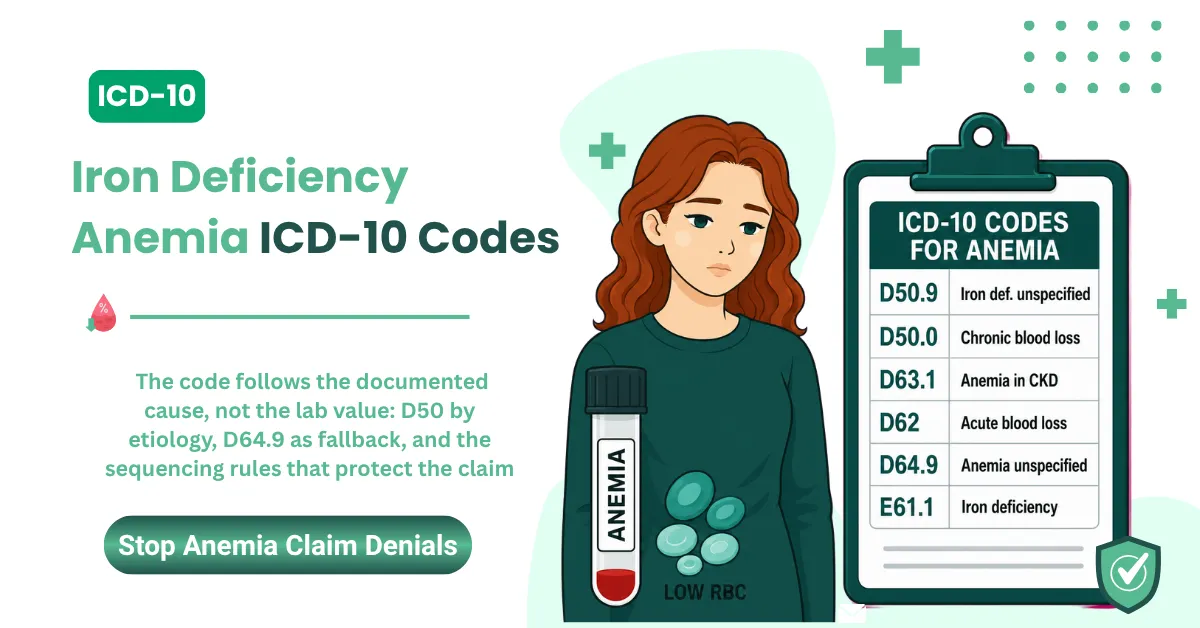




The icd 10 code for iron deficiency anemia is D50.9 for unspecified cases, effective October 1, 2025 through September 30, 2026 under the FY2026 code set released by CMS and NCHS. Documentation determines which D50 subcategory applies on the claim.
One correction up front: F84.0 is not an iron deficiency anemia icd 10 code. F84.0 is Childhood Autism under ICD-10-CM, a mix-up that circulates in online code lookups and occasionally lands on claims.
The FY2026 ICD-10-CM code set has two operational periods. The October 1, 2025 release applies to services through March 31, 2026. The April 1, 2026 release applies to services April 1 through September 30, 2026.
No changes were made to the D50 iron deficiency anemia code family in FY2026. You can verify both releases against the FY2026 ICD-10-CM code set and the CMS ICD-10 codes page.
For healthcare providers billing anemia across nephrology, oncology, hematology, primary care, and OB/GYN, selecting the wrong D50 code doesn't just create a documentation gap. It creates a denial. Every payer expects the iron deficiency anemia icd 10 assignment to match the documentation exactly, and unspecified codes draw scrutiny that specific codes don't.
A clean anemia icd 10 claim starts with the right code, which is why the icd 10 code for anemia matters before the first claim leaves a medical billing company.
Providers consistently getting anemia claims denied should review MedSole RCM's outsourced medical billing services before the next billing cycle.
Iron Deficiency Anemia ICD-10 Codes: The Complete D50 Family (FY2026)
D50.0, D50.1, D50.8, D50.9: When to Use Each Code
Iron deficiency anemia ICD-10 codes fall under the D50 category in ICD-10-CM Chapter 3: Diseases of the blood and blood-forming organs. The iron deficiency anemia icd 10 codes under the D50 family are organized by etiology, not by severity. The icd 10 code for iron deficiency anemia resolves to one of four D50 options depending on the documented cause.
|
ICD-10 Code |
Official Description |
Use When Documentation States |
Billing Trigger |
|---|---|---|---|
|
D50.0 |
Iron deficiency anemia secondary to blood loss (chronic) |
Chronic blood loss identified: GI bleed, menorrhagia, hemorrhoids |
Requires bleeding source coded separately |
|
D50.1 |
Sideropenic dysphagia (Plummer-Vinson syndrome) |
IDA with esophageal webs and swallowing difficulty documented |
Rare, requires syndrome diagnosis in note |
|
D50.8 |
Other specified iron deficiency anemias |
Dietary inadequacy or malabsorption documented as cause |
Requires etiology in provider assessment |
|
D50.9 |
Iron deficiency anemia, unspecified |
Iron deficiency confirmed, cause not yet documented |
Temporary code, replace after workup |
D50.0 requires the provider to name the bleeding source in the assessment. A GI bleed, menorrhagia, or hemorrhoidal bleeding must appear in the note, and the bleeding source code is sequenced separately. Without the named source, D50.0 isn't supportable and the claim flags.
D50.9 is the correct fallback when iron deficiency is lab-confirmed but the provider hasn't yet documented the cause. Payers accept D50.9 as a temporary code. They flag claims where D50.9 persists across multiple visits while labs show a documentable cause that never makes it into the assessment.
D50.1 is underused. Plummer-Vinson syndrome presents with esophageal webs and dysphagia alongside IDA. Providers often recognize the presentation but don't name the syndrome, defaulting to D50.9 when D50.1 is the more specific and more accurate code. D50.8 covers dietary iron deficiency and malabsorption, including post-bariatric surgery patients whose oral iron absorption is compromised.
All four D50 codes are active for services October 1, 2025 through September 30, 2026 under the FY2026 ICD-10-CM April 1, 2026 release. The ida icd 10 family stays unchanged for the FY2026 cycle.
In international coding contexts, the iron deficiency anaemia icd 10 spelling maps to the same D50 family, since the British spelling variant doesn't change the code. The same D50.9 code (sometimes searched as D50 9 without the period) covers microcytic anemia icd 10 presentations when iron deficiency is the documented cause.
ICD 10 Iron Deficiency Without Anemia: Why E61.1 Is Not D50.9
When a provider documents low ferritin or low transferrin saturation but the hemoglobin level is within normal range, anemia hasn't developed yet. The condition is iron deficiency, not iron deficiency anemia. E61.1 (Iron deficiency) is the correct ICD-10-CM code in that scenario, not D50.9.
Using D50.9 when the hemoglobin level is normal overcodes the condition and creates audit exposure. The NIH ODS iron deficiency progression model explains that iron deficiency progresses from iron store depletion to iron-deficient erythropoiesis to IDA. E61.1 captures the first two stages. D50.9 captures the third, the point at which the ida icd 10 code applies once anemia is present.
This distinction matters for billing because E61.1 supports different medical necessity thresholds for iron supplementation than D50.9 does. Some payers require documented anemia (D50.x) to authorize IV iron infusion. E61.1 alone often doesn't meet infusion medical necessity criteria without additional documentation of absorption failure or intolerance to oral iron.
How D50 Codes Transmit on the 837P Professional Claim
All ICD-10-CM anemia diagnosis codes, including D50.0 and D50.9, transmit in the 2000B/2300 loop of the HIPAA 837P professional claim transaction set. The diagnosis code in Loop 2300 must match the diagnosis pointer in Loop 2400 for each service line billed.
Mismatches between the diagnosis pointer and the billed CPT trigger CO-16 denials at the clearinghouse level before the claim reaches the payer. MedSole RCM's claim submissions process includes a pre-submission diagnosis pointer audit that catches 837P loop mismatches before they generate CO-16 denials.
A concurrent CBC finding such as elevated white cells gets its own code, covered in our leukocytosis ICD-10 code guide.
Anemia Unspecified ICD-10: When D64.9 Is Right and When It Costs You
D64.9 is the ICD-10-CM code for anemia, unspecified. It's a billable code used when the provider documents anemia without specifying the type or underlying cause. It's also the most scrutinized anemia code in claim submissions, and defaulting to it when an iron deficiency anemia icd 10 option or another specific code fits the documentation creates preventable denials.
When D64.9 Anemia Unspecified Is the Right Code
The anemia unspecified icd 10 code has four legitimate use scenarios. First, when the provider documents only "anemia" with no etiology, no lab interpretation linked to a cause, and no chronic condition connection. Second, when anemia is identified incidentally and the cause isn't yet documented.
Third, normocytic or normochromic anemia where morphology describes the cell shape but the provider hasn't documented an etiology. Fourth, the first visit of a new patient where labs are pending. For every scenario, the expected next action is the same: once labs return, replace the anemia unspecified icd 10 placeholder with the specific code.
Payers accept D64.9 as a temporary assignment. They flag it when it persists across multiple visits without progression to specificity. Per the FY2026 ICD-10-CM Official Guidelines for Coding and Reporting, providers must assign the most specific code supported by documentation, which is why a lingering anemia unspecified icd 10 assignment invites review.
Two Common D64.9 Errors Circulating in Medical Billing Content
Two factual errors show up repeatedly in anemia coding content, and both cost claims.
D64.9 is not the icd 10 code for anemia unspecified severity. ICD-10-CM doesn't have a separate code for severe anemia icd 10 cases. Mild anemia icd 10 presentations, moderate, and severe anemia all use the same code family.
The specific code depends on the type and cause, not the severity. There's no distinct symptomatic anemia icd 10 code either, since symptoms inform medical necessity, not code selection.
D63.1 is not the ICD-10 code for normocytic anemia. D63.1 is Anemia in chronic kidney disease and requires a CKD code sequenced first. Normocytic anemia is a morphological description. If no specific etiology is documented alongside it, D64.9 applies. If CKD is the documented cause, D63.1 applies.
When D64.9 and Why Payers Flag It in Risk-Adjusted Models
In Medicare Advantage and ACO risk-adjusted payment models, D64.9 carries no HCC value. Specific anemia codes like D61.9 (aplastic anemia), D64.81 (chemotherapy-induced anemia), and D63.1 (anemia in CKD) map to HCC categories that affect Risk Adjustment Factor scores.
Practices billing primarily D64.9 for complex patients leave RAF capture on the table and trigger medical necessity reviews from payers running predictive analytics. The same payer analytics that flag D64.9 overuse also catch contractual adjustment patterns, which our denial code patterns guide covers across the CO denial family.
Practices seeing consistent CO-50 medical necessity denials on anemia claims can request a free denial assessment from MedSole RCM's denial management services team.
Anemia Code Classification by Morphology: Microcytic, Normocytic, and Macrocytic
Morphology (microcytic, normocytic, macrocytic) describes red blood cell size and appearance, not the cause of anemia. Morphology guides the diagnostic workup, but it doesn't determine the ICD-10-CM code by itself. The code follows the provider's documented cause, not the CBC morphology result alone.
The same specificity principle that applies to iron deficiency anemia icd 10 coding holds across every code family, covered in our ICD-10-CM coding specificity rules, and the ICD-10-CM Official Coding Guidelines confirm it.
Microcytic Anemia ICD-10 Codes: What Small Red Blood Cells Tell the Coder
Microcytic anemia icd 10 coding starts with the cause. Microcytic anemia (low MCV, typically below 80 fL) most commonly indicates iron deficiency, thalassemia, or anemia of chronic disease. For billing purposes, if the provider documents iron deficiency as the cause, the ida icd 10 code is D50.9, or D50.0 if blood loss is the cause.
If thalassemia is documented, the code comes from the D56 family. If the provider documents microcytic anemia with no specific cause, D64.9 is the fallback, though a query to the provider is appropriate first.
The MCV value on the CBC supports the clinical picture but doesn't drive code selection independently. State it plainly because it's a common coder error: microcytic anemia icd 10 coding does not follow from the MCV value alone.
The provider's assessment, not the lab morphology, determines whether D50.x or D56.x applies. The NHLBI iron deficiency anemia reference confirms ferritin and transferrin saturation as the supporting diagnostic markers.
The ICD-10 code microcytic anemia coders reach for is not a single code. It depends on the documented cause, most commonly D50.9 for iron deficiency and D56.x for thalassemia.
Normocytic Anemia ICD-10 Codes: The Morphology That Signals Chronic Disease
Normocytic anemia icd 10 coding signals chronic disease more often than iron deficiency. Normocytic anemia (normal MCV, typically 80-100 fL) most commonly indicates anemia of chronic disease, CKD, or early iron deficiency. The normocytic anemia icd 10 code depends entirely on the documented cause.
If CKD is the documented cause, D63.1 applies with the N18.x code sequenced first. If chronic disease is the documented cause (rheumatoid arthritis, chronic infection, inflammatory bowel disease), D63.8 applies. If no cause is documented, D64.9 is the temporary assignment.
The icd 10 code for normocytic anemia unspecified, when no cause is documented, is D64.9. The icd 10 normocytic anemia label and the normocytic normochromic anemia icd 10 presentation follow the same rule: morphology alone doesn't assign the code.
Normocytic anemia co-occurring with hypothyroidism is a common documentation gap. Our hypothyroidism ICD-10 billing guide covers the E03 coding rules when thyroid disease contributes to anemia.
Macrocytic Anemia ICD-10 Codes: B12, Folate, and Pernicious Anemia
Macrocytic anemia icd 10 coding splits along the deficiency type. Macrocytic anemia (elevated MCV, above 100 fL) most commonly indicates B12 or folate deficiency. The macrocytic anemia icd 10 options are D51.9 for unspecified B12 deficiency anemia, D51.0 for pernicious anemia, and D52.9 for unspecified folate deficiency anemia.
D51.0 (pernicious anemia icd 10) requires documented autoimmune intrinsic factor deficiency, not just a low B12 level. Using D51.0 when the provider has documented only "low B12" without confirming intrinsic factor deficiency is overcoding.
Payers audit D51.0 because it supports more expensive ongoing B12 injection billing. The ICD-10 code for macrocytic anemia is not a single code: B12 deficiency maps to D51.x, folate deficiency maps to D52.x, and each carries its own documentation requirements.
Anemia of Chronic Disease ICD-10: D63.1, D63.8, and the Sequencing Rules That Protect Your Claims
The icd 10 for anemia of chronic disease is D63.8 when another chronic condition is the documented cause, and D63.1 specifically when chronic kidney disease causes the anemia. Both are manifestation codes. The underlying condition must be sequenced first on every claim.
Anemia in CKD ICD-10 D63.1: Sequence N18.x First or the Claim Denies
D63.1 is the code for anemia in CKD icd 10 billing, and the full anemia in chronic kidney disease icd 10 claim generates more sequencing denials than any other code in nephrology. Per the FY2026 ICD-10-CM Official Guidelines Section I.C.14, the CKD stage code is sequenced first.
The correct sequence is N18.1 through N18.6, or N18.9 for unspecified stage, as the primary diagnosis, then D63.1 as the secondary diagnosis.
The "in chronic kidney disease" language in the D63.1 code title is the technical reason. The CKD code must appear on the claim, or the manifestation has no reference point and the claim denies. This anemia in chronic kidney disease icd 10 pairing is non-negotiable on Medicare claims.
D63.1 also applies to end-stage renal disease (N18.6) patients on dialysis. For Medicare patients with ESRD on dialysis, anemia is commonly managed with ESA therapy (J0885 Epoetin alfa, J0881 Darbepoetin). Medicare's ESA LCD requires a documented hemoglobin level below 10 g/dL and a specific anemia code.
The anemia in ckd icd 10 rule extends here, since the anemia in esrd icd 10 combination of D63.1 with N18.6 is the required pairing for ESRD ESA claims. Billing J0885 with D64.9 in this population almost always denies.
If the chart shows CKD and anemia but no documented link between them, the coder can't assign D63.1. The provider's assessment must connect the two.
Without that clinical statement, the anemia due to ckd icd 10 assignment defaults to D64.9, the HCC capture is lost, and even a clean iron deficiency anemia icd 10 secondary code won't rescue the anemia in ckd icd 10 claim.
CKD patients also present with concurrent UTI frequently, and our CKD comorbidity coding guide covers N18.x and N39.0 co-coding for nephrology claims.
Anemia of Chronic Disease ICD-10 D63.8: When the Chronic Condition Is Not CKD
The anemia of chronic disease icd 10 code D63.8 applies when a chronic disease other than CKD causes the anemia. Common underlying conditions include rheumatoid arthritis, inflammatory bowel disease, chronic infections, and cancer when the anemia is disease-related rather than chemotherapy-related.
The icd 10 for anemia of chronic disease still resolves to D63.8, and the icd 10 code for anemia of chronic disease still requires the underlying condition sequenced first.
When a patient has both iron deficiency and anemia of chronic disease, both conditions can be coded. D50.9 (iron deficiency anemia) and D63.8 (anemia of chronic disease icd 10) can appear on the same claim when documentation supports both diagnoses.
The ferritin level distinguishes them. Ferritin below 30 mcg/L suggests iron deficiency. Ferritin above 100 mcg/L suggests chronic disease anemia. Ferritin between 30 and 100 mcg/L is the gray zone where both conditions may coexist, and where the provider's clinical statement is essential to support both the D50.9 and the anemia of chronic disease icd 10 code together.
Inpatient Anemia ICD-10 Coding and MS-DRG Assignment Under CMS v43.1
Under CMS MS-DRG v43.1 (FY2026), anemia codes affect DRG assignment when anemia is a complication or comorbidity (CC) or major complication or comorbidity (MCC). D63.1 (anemia in CKD) is a CC in most DRG groupings when paired with N18.x.
D64.9 (anemia, unspecified) is generally not a CC and adds no DRG weight. D61.81 (pancytopenia) and D64.81 (chemotherapy-induced anemia) carry MCC status in certain groupings.
For inpatient billers, the sequencing decision on an anemia claim isn't just a coding accuracy issue. It directly affects the DRG the claim falls into and the reimbursement amount. Practices with inpatient programs billing anemia diagnoses should validate their DRG assignment accuracy with MedSole RCM's DRG validation guide.
HCC Documentation Requirements for Anemia Codes That Affect Risk Adjustment
HCC-mapped anemia codes include D61.9, D61.01, and D64.81. These require MEAT documentation annually to survive RADV audits. MEAT stands for Monitored, Evaluated, Assessed, and Treated, and every HCC-mapped anemia code must show evidence of all four in the annual encounter note.
A problem list entry of anemia with no MEAT support doesn't count. The RAF score gets stripped and the payer claws back prior payments. Build MEAT documentation workflows into the encounter so HCC-mapped anemia codes hold up under audit.
Nephrology and oncology practices frequently have D63.1 and D63.8 sequencing errors that cost significant HCC revenue annually. MedSole RCM's denial management services include a coding accuracy review that catches sequencing patterns across all anemia code families.
Acute Blood Loss Anemia ICD-10: D62 vs D50.0 and the Distinction That Changes Everything
The acute blood loss anemia icd 10 code is D62. It applies when sudden, rapid blood loss from a specific event causes anemia. D62 is distinct from D50.0, which applies to anemia caused by chronic blood loss over weeks or months.
These two codes can't appear on the same claim. ICD-10-CM lists them as Excludes1 notation, so they represent mutually exclusive clinical scenarios.
D62 Acute Posthemorrhagic Anemia: Clinical Scenarios and Documentation Requirements
The icd 10 for acute blood loss anemia is D62 whenever a specific acute event drives the bleeding. The events where D62 is correct include trauma with significant blood loss, post-surgical bleeding, ruptured aortic aneurysm, acute gastrointestinal hemorrhage from a bleeding ulcer or variceal bleed, and ectopic pregnancy rupture.
For each, the documentation must specify the acute event and the blood loss volume or clinical signs of hemodynamic instability. Payers reviewing D62 claims expect estimated blood loss documented in the operative or emergency note, vital sign changes indicating hypovolemia such as tachycardia and hypotension, and a treatment plan involving transfusion or fluid resuscitation.
ABLA stands for acute blood loss anemia, a clinical shorthand used in emergency and surgical settings. The icd 10 code for ABLA is D62. Using D64.9 for ABLA cases when D62 is clearly supported by the documentation is a CO-4 denial trigger, the wrong code family for a clearly documentable condition.
The abla icd 10 mapping is D62 every time the blood loss is acute, so the acute blood loss anemia icd 10 code stays D62 in these scenarios.
D50.0 vs D62: How the Timeline of Blood Loss Changes the ICD-10 Code
The acute vs chronic decision is the whole game. Two scenarios show how the same disease produces different codes.
Scenario A: a patient with a two-month history of GI bleeding from a gastric ulcer presents with hemoglobin of 8.5 g/dL and ferritin of 12 mcg/L. The bleeding has been slow and continuous. Code: D50.0 (chronic blood loss) with K25.x (gastric ulcer) sequenced first.
This is chronic blood loss anemia icd 10 territory, the iron deficiency anemia icd 10 end of the spectrum.
Scenario B: the same patient presents to the emergency department with an acute upper GI hemorrhage, hematemesis, and hemoglobin dropping from 11.2 to 8.8 over six hours. Code: D62 (acute posthemorrhagic anemia) with K25.x. This is acute blood loss anemia, and the acute blood loss anemia icd 10 code is D62.
The same underlying disease, a gastric ulcer, produces a different anemia code depending on whether the bleeding is chronic or acute. The documentation timeline is the deciding factor, not the hemoglobin value. The icd 10 acute blood loss anemia due to gi bleed code is D62 when the hemorrhage is acute and documented as such.
The icd 10 for acute blood loss anemia stays D62 across trauma, surgical, and GI sources, while the blood loss anemia icd 10 picture shifts to D50.0 once the bleeding is chronic. For the R10 and K-series codes used for the bleeding source, see our abdominal pain ICD-10 codes guide.
Postoperative Anemia ICD-10: D62 or D64.89 and Why the Distinction Matters
Postoperative anemia has two coding pathways depending on timing and cause. When anemia results from acute blood loss during surgery, D62 (acute posthemorrhagic anemia) applies, coded with the appropriate T-code for the postoperative complication as a secondary code.
When anemia develops in the post-surgical period from reduced erythropoiesis rather than acute blood loss, D64.89 (other specified anemias) is the appropriate code.
The postoperative anemia icd 10 code is D62 when surgical blood loss is the documented cause, and D64.89 when postoperative reduced erythropoiesis is documented. Defaulting to D64.9 for all postoperative anemia cases is a specificity error that draws medical necessity scrutiny.
The acute hemorrhagic anemia icd 10 label maps to D62 as well, since acute posthemorrhagic and acute hemorrhagic describe the same D62 condition. Blood transfusion (CPT 36430) billed alongside D62 requires prior authorization from many commercial payers, and MedSole RCM's prior authorization services manage transfusion PA submission and tracking.
Special Population Anemia ICD-10 Coding: Pregnancy, Chemotherapy, and Pediatric
Three billing populations carry anemia coding rules that differ from the general D50 through D64 framework. Pregnancy, chemotherapy, and neonatal anemia each have dedicated code families and sequencing rules. For sickle cell anemia (D57.x) complications including vaso-occlusive joint pain, our ICD-10 code for knee pain guide covers M25.56x laterality coding for anemia-related joint presentations.
Anemia in Pregnancy ICD-10 Codes: O99.0 Series and the Sequencing Rules
The ICD-10 code for anemia complicating pregnancy is from the O99.01 series. O99.011 applies to the first trimester, O99.012 to the second trimester, O99.013 to the third trimester, and O99.019 when the trimester is unspecified. These codes apply to services from October 1, 2025 through September 30, 2026 under the FY2026 ICD-10-CM release.
Every clean OB anemia claim uses a three-code structure: the O99.0x code as primary, the D-series code (typically D50.9 for iron deficiency) as secondary to specify the anemia type, and the Z3A gestational age code. Missing the Z3A gestational age code is the most common reason anemia in pregnancy icd 10 claims deny. It isn't optional.
|
Trimester |
ICD-10 Code |
D-Series Secondary |
Z3A Code Required |
|---|---|---|---|
|
First (under 14 weeks) |
O99.011 |
D50.9 |
Z3A.06-Z3A.13 |
|
Second (14-28 weeks) |
O99.012 |
D50.9 |
Z3A.14-Z3A.27 |
|
Third (28+ weeks) |
O99.013 |
D50.9 |
Z3A.28-Z3A.36 |
|
Unspecified trimester |
O99.019 |
D50.9 |
Z3A.00 |
|
During delivery |
O99.02 |
D50.9 |
N/A |
|
Postpartum |
O99.03 |
D50.9 |
N/A |
The same structure holds whether the documentation reads anemia in pregnancy icd 10 or anemia during pregnancy icd 10, since both describe the O99.01 series. The icd 10 code for anemia in pregnancy is never a standalone D-code; the iron deficiency anemia icd 10 secondary sits beneath the O99 primary.
The USPSTF 2024 anemia screening recommendation concluded that insufficient evidence exists to recommend routine anemia screening in asymptomatic pregnant women, reinforcing that coding anemia in pregnancy requires a confirmed provider diagnosis, not abnormal lab values alone.
The trimester codes align with the 2026 ICD-10-CM D50.9 code for the iron deficiency secondary.
Anemia Due to Chemotherapy ICD-10: D64.81 Is Not D63.0
D64.81 is the code for anemia due to antineoplastic chemotherapy. D63.0 is the code for anemia in neoplastic disease, meaning anemia caused by the cancer itself, not by the chemotherapy. These are distinct clinical scenarios with different sequencing rules and different CPT and HCPCS pairing implications.
When the encounter is specifically for managing chemotherapy-induced anemia, the anemia due to chemotherapy icd 10 code D64.81 is sequenced first. The neoplasm code (C-code) follows second. The adverse effect code T45.1X5A (adverse effect of antineoplastic and immunosuppressive drugs, initial encounter) is required third. Omitting T45.1X5A generates a CO-16 denial.
If the cancer itself causes anemia independent of treatment, D63.0 applies with the malignancy code sequenced first. If the chemotherapy causes the anemia, the anemia due to chemotherapy icd 10 code D64.81 applies and sequences first.
Billing ESA therapy (J0885, J0881) requires D64.81 when chemo-induced anemia is the documented cause, not D63.0. ESA therapy and IV iron infusion for chemotherapy-induced anemia require prior authorization from Medicare and commercial payers, and MedSole RCM's prior authorization services manage oncology infusion PA workflows end to end.
Anemia Screening ICD-10 Z13.0 and Pediatric Anemia of Prematurity P61.2
The icd 10 code for anemia screening is Z13.0. It applies when a provider performs anemia screening as part of a preventive visit without a confirmed anemia diagnosis. Z13.0 pairs with annual wellness visit CPT codes (99381-99397, G0402, G0438) when anemia screening icd 10 documentation is part of the preventive encounter.
It doesn't replace a D-series code when anemia is diagnosed. Once anemia is confirmed, the appropriate D-series code takes over and Z13.0 no longer applies.
The ICD-10 code for anemia of prematurity is P61.2. It applies to premature neonates under 37 weeks gestation who develop physiologic anemia from low iron stores, rapid growth, and blood draws in the NICU.
The anemia of prematurity icd 10 code P61.2 isn't the same as D64.9 and must not be coded as unspecified anemia. It's a neonatal condition with distinct billing implications under Chapter 16 ICD-10-CM codes, and the CDC April 2026 pediatric iron guidance supports the iron-store rationale.
When severe neonatal or adult cases need transfusion, the anemia requiring transfusion icd 10 assignment follows the underlying cause code, not a standalone transfusion code. Before billing Z13.0 anemia screening alongside a wellness visit, confirming the patient's plan covers preventive anemia screening through MedSole RCM's verification of benefits process prevents post-payment recovery.
Anemia ICD-10 Documentation Requirements and CPT Code Pairing for Clean Claims
What Every Iron Deficiency Anemia ICD-10 Provider Note Must Include
Every anemia provider note must contain six elements to defend the code and the CPT billed alongside it. First, the specific anemia type stated in the provider's own assessment language, not inferred from lab values alone.
Second, the documented cause or suspected cause with a plan to confirm it. Third, relevant lab values including hemoglobin, ferritin, MCV, and transferrin saturation referenced in the note, not just ordered.
Fourth, the severity described in terms of patient impact, not just a hemoglobin number. Fifth, the treatment plan including whether oral iron, IV iron, or referral is indicated. Sixth, for CKD and oncology patients, the documented link between the chronic condition and the anemia.
The NHLBI diagnostic criteria for iron deficiency anemia confirm ferritin and transferrin saturation as the supporting markers.
A low hemoglobin value on a lab report doesn't constitute a documented anemia diagnosis. The provider must interpret the finding and name the diagnosis in the assessment. Without that provider statement, the icd 10 code for iron deficiency anemia can't be assigned and D64.9 is the only defensible code.
The same applies to the low hemoglobin icd 10 and low hgb icd 10 searches providers run: a number isn't a diagnosis.
Low ferritin alone doesn't generate a D50.x code. Ferritin below 30 mcg/L supports the clinical picture of iron deficiency, but the provider's assessment statement determines the code. For the low ferritin icd 10 scenario, E61.1 may apply if anemia isn't yet diagnosed, since iron deficiency anemia icd 10 coding requires documented anemia, not just a low store.
Anemia ICD-10 to CPT and HCPCS Code Pairing: The Complete 2026 Reference
The ICD-10 code submitted on an anemia claim must support the medical necessity of every CPT and HCPCS code billed alongside it. A mismatch between the diagnosis and the service triggers CO-11 denial. Here's the complete pairing reference for the most common anemia services in 2026, confirmed against CMS ICD-10-CM coding requirements.
|
Service |
CPT / HCPCS |
Required ICD-10 Pair |
Medicare LCD Requirement |
|---|---|---|---|
|
CBC with differential |
85025 |
D64.9, D50.9, D63.1 |
No specific threshold |
|
Serum ferritin |
82728 |
D50.x, D63.1, D63.8 |
Documents iron store status |
|
Serum iron |
83540 |
D50.x |
Supports D50.0 cause |
|
Total iron binding capacity |
83550 |
D50.x |
Supports iron deficiency |
|
Vitamin B12 assay |
82607 |
D51.x |
Confirms B12 deficiency |
|
IV infusion initial hour |
96365 |
D50.0, D63.1, D64.81 |
Hgb below 10 g/dL required |
|
Iron sucrose (Venofer) |
J1756 |
D50.0, D63.1 |
PA required most payers |
|
Ferric carboxymaltose (Injectafer) |
J1439 |
D50.0, D63.1 |
PA required most payers |
|
Ferric derisomaltose (Monoferric) |
J1437 |
D50.0, D63.1 |
PA required most payers |
|
Epoetin alfa non-ESRD |
J0885 |
D63.1, D64.81 |
Hgb below 10 g/dL plus specific code |
|
Darbepoetin alfa |
J0881 |
D63.1, D64.81 |
Same as J0885 |
|
Blood transfusion |
36430 |
D62, D61.9, D64.9 |
Hgb below 8 g/dL documented |
|
Anemia follow-up E/M |
99213-99215 |
D50.x, D63.x, D64.x |
MDM documentation per AMA |
|
New patient anemia eval |
99203-99205 |
D50.x, D64.9 |
MDM documentation per AMA |
Billing J0885 or J0881 with D64.9 almost always denies under Medicare's ESA LCD. The LCD requires a specific anemia code and a documented hemoglobin below 10 g/dL. D64.9 doesn't satisfy the LCD specificity requirement.
For transfusion claims, the anemia requiring transfusion icd 10 code follows the cause, D62 for acute loss or D61.9 for aplastic anemia, with hemoglobin below 8 g/dL documented in the note. New patient anemia evaluations are typically billed under 99203-99205, and our CPT 99204 billing guide covers new patient MDM thresholds applicable to first anemia workup visits.
Before administering Injectafer or Monoferric, MedSole RCM's verification of benefits for infusion coverage confirms coverage, deductible status, and PA requirements for each specific iron product.
When an E/M visit is billed on the same day as an IV iron infusion, Modifier 25 is required on the E/M code to indicate a significant, separately identifiable evaluation and management service.
Understanding the difference between coverage verification and prior authorization is critical before scheduling IV iron, and our guide on insurance verification vs prior authorization covers when each step is required.
CPT 99213, 99214, and 99215 for Anemia Follow-Up: Documentation Requirements
Anemia follow-up visits qualify for 99213 when one stable chronic problem is managed with no prescription drug management. They qualify for 99214 when lab review, medication adjustment, or iron infusion planning is involved, which is moderate-level MDM.
They qualify for 99215 when the anemia is severe, involves multiple chronic condition co-management, or requires transfusion or hospitalization planning. The anemia diagnosis code must link to the CPT level selected. An MDM note documenting only "CBC reviewed, continue iron" while billing 99214 won't withstand a payer audit.
For the full MDM documentation requirements for moderate-complexity anemia visits, our CPT 99214 guide covers the 2026 AMA MDM framework.
Top 5 Anemia Claim Denial Codes and How to Prevent Each One
Anemia ICD-10 claims deny for predictable reasons. The same five denial codes appear across hematology, nephrology, oncology, and primary care billing. Each one has a specific root cause in documentation or code selection, and each one has a specific fix.
Iron deficiency anemia icd 10 claims are among the most affected, because D50.x and D64.x are frequently confused by payers' adjudication systems. CO-45 (contractual adjustment) sometimes appears alongside anemia denials when underpayment patterns mask denial patterns, and our CO denial code guide covers the full CO family.
Anemia Claim Denials by Code: Root Cause and Documentation Fix
CO-4 (wrong code family) fires when the ICD-10 code submitted doesn't belong to the correct family for the service billed. On anemia claims, the most common CO-4 trigger is billing iron infusion J-codes with D64.x family codes when the record clearly supports a D50.x code.
Adjudication engines treat D64.x as the "other and unspecified anemias" family and reject infusion claims that require a nutritional anemia code.
The CO-4 fix: review every anemia infusion claim before submission to confirm the diagnosis family matches the service line. D50.0 and D50.9 support iron infusion J-codes. D64.9 alone doesn't.
CO-11 (diagnosis inconsistent with procedure) fires when the ICD-10 code doesn't support the medical necessity of the CPT or HCPCS billed. The most common CO-11 trigger on anemia claims is billing J0885 (Epoetin alfa) with D64.9 instead of D63.1 or D64.81. Payer LCD policy requires a specific anemia code and a documented hemoglobin below 10 g/dL for ESA claims.
The CO-11 fix: replace D64.9 with D63.1 for CKD patients or D64.81 for chemo patients before resubmission, and include the hemoglobin value in the appeal documentation.
CO-16 (missing or invalid information) fires when required sequencing information is absent. For anemia in CKD claims (D63.1), CO-16 triggers when N18.x is missing and D63.1 appears as the only diagnosis. Without the CKD code, the manifestation has no reference point and the claim fails. The fix: always submit D63.1 with N18.1 through N18.6 sequenced first, per ICD-10-CM sequencing requirements.
CO-50 (medical necessity not met) fires when the payer determines the service wasn't medically necessary based on the submitted diagnosis. On anemia claims, CO-50 most commonly fires on IV iron infusion claims where D64.9 is submitted without lab evidence of iron deficiency or without documented failure of oral iron therapy.
The CO-50 fix: replace D64.9 with the specific IDA code supported by labs, document the oral iron trial or contraindication in the note, and submit lab values with the appeal.
CO-197 fires when prior authorization was required but not obtained before the service. N115 fires when the Medicare LCD hemoglobin threshold documentation is missing. Both denials hit IV iron and ESA claims in the same billing cycle when authorization and lab documentation aren't coordinated before service.
The fix for CO-197 is a pre-service PA workflow that confirms authorization before scheduling infusion. The fix for N115 is documenting the hemoglobin value in every encounter note for anemia patients receiving infusion therapy. Reading the anemia icd 10 denial alongside its RARC is what turns a rejection into a recoverable claim.
Practices with patterns of CO-4, CO-11, CO-16, CO-50, or CO-197 denials on anemia claims are experiencing systematic coding or workflow gaps, not isolated errors. MedSole RCM's denial management services identify the root cause pattern across all anemia claim families and implement the workflow fix so the same denial doesn't recur.
Anemia denials aging in AR beyond 60 days need systematic follow-up, and our AR follow-up services recover what payers have rejected before the timely filing window closes. The icd 10 code for iron deficiency anemia is only as strong as the documentation and workflow behind it.
Anemia Billing Specialists: How MedSole RCM Manages Anemia ICD-10 Claims Across Every Specialty
MedSole RCM: Anemia Billing and Credentialing Services for Healthcare Providers
MedSole RCM is a full-service medical billing company and revenue cycle management provider serving healthcare providers across all 50 states. MedSole RCM provides anemia billing services at 2.99% of collections for hematology, nephrology, oncology, primary care, and OB/GYN practices, with no setup fees and no long-term contracts.
MedSole RCM is among the most affordable full-service medical billing companies in the United States. Provider credentialing and payer enrollment services are available at $99 per payer, covering 900-plus payer networks with a 99% first-time approval rate. MedSole RCM has credentialed more than 4,000 providers nationwide.
For hematology and nephrology practices billing CKD anemia billing and oncology anemia billing, MedSole RCM's certified anemia billing specialists manage iron deficiency anemia icd 10 code selection, CPT pairing, prior authorization, denial management, and AR follow-up as a connected system.
Across every MedSole RCM specialty, the iron deficiency anemia workflow is handled the same way: documentation first, clean claim second. For practices wanting a complete anemia billing system from coding through denial recovery, MedSole RCM's revenue cycle management services manage every step as one operation.
Anemia ICD-10 Frequently Asked Questions
These answers reflect FY2026 ICD-10-CM coding and the NIH Office of Dietary Supplements iron reference.
What is the ICD-10 code for anemia?
The icd 10 code for anemia is D64.9 for anemia unspecified, and D50.9 for iron deficiency anemia unspecified. The most specific code depends on the documented type and cause. D50.9 applies when iron deficiency is confirmed. D64.9 applies only when no specific type or cause is documented, and payers scrutinize it more than cause-specific codes.
What is the ICD-10 code for iron deficiency anemia?
The ICD-10 code for iron deficiency anemia is D50.9 for unspecified iron deficiency anemia, effective October 1, 2025 through September 30, 2026 under the FY2026 ICD-10-CM code set. D50.0 applies when chronic blood loss is the documented cause. D50.1 applies to Plummer-Vinson syndrome, and D50.8 applies to other specified iron deficiency anemias.
What is the difference between D50.9 and D64.9?
D50.9 is iron deficiency anemia, unspecified. It specifies the type as iron deficiency but not the cause. D64.9 is anemia, unspecified, and doesn't specify the type or cause at all. D50.9 is the appropriate code when iron deficiency is lab-confirmed. D64.9 is appropriate only when no type is documented.
Can anemia and CKD be coded together?
Yes, anemia and CKD can be coded together using D63.1 and the appropriate N18.x CKD stage code. The CKD code must be sequenced first per ICD-10-CM Official Guidelines Section I.C.14. The provider must document that CKD causes the anemia. Having both conditions in the chart without a documented clinical link doesn't justify D63.1.
What is the ICD-10 code for acute blood loss anemia?
The ICD-10 code for acute blood loss anemia is D62. It applies when sudden, rapid blood loss from a specific event causes anemia. D62 can't appear on the same claim as D50.0, since ICD-10-CM Excludes1 notation makes them mutually exclusive. D62 applies to trauma, surgical hemorrhage, acute GI bleeding, and ectopic pregnancy rupture.
What is the ICD-10 for anemia due to chemotherapy?
The ICD-10 code for anemia due to chemotherapy is D64.81. It's sequenced first when the encounter is specifically for managing chemo-induced anemia, followed by the neoplasm code and T45.1X5A as the adverse effect code. D64.81 isn't the same as D63.0, which applies to anemia caused by the cancer itself rather than by chemotherapy.
What is the ICD-10 code for history of anemia?
The history of anemia icd 10 code is Z87.39, for personal history of anemia. It applies when a patient has a documented past diagnosis of anemia that's resolved and no longer active. Z87.39 doesn't apply to active anemia. Once anemia is confirmed as active, the appropriate D-series code applies and Z87.39 isn't used alongside it.
Is there a code for severe iron deficiency anemia?
There's no separate ICD-10 code for severe iron deficiency anemia. ICD-10-CM doesn't classify iron deficiency anemia by severity level. D50.9 applies regardless of whether the anemia is mild, moderate, or severe. Severity affects the documentation of medical necessity and the treatment decision, but it doesn't change the code assigned.
Conclusion
Iron deficiency anemia icd 10 coding comes down to one principle that runs through every section here: the code follows the provider's documented cause, not the lab value, not the morphology, and not the severity. D50.9 covers unspecified iron deficiency, the D50 family covers the causes, D64.9 is the temporary fallback, and the manifestation codes (D63.1, D63.8, D62) each carry sequencing rules that protect the claim. Get the documentation right, and the anemia icd 10 assignment, the CPT pairing, and the clean claim follow.
This guide is for healthcare providers and billing professionals and reflects the FY2026 ICD-10-CM code set (effective October 1, 2025 through September 30, 2026, including the April 1, 2026 release), CMS MS-DRG v43.1, and FY2026 ICD-10-CM Official Guidelines current as of June 2026. ICD-10-CM codes are maintained by CMS and NCHS, and CPT codes are copyrighted by the American Medical Association. Verify all codes, LCD criteria, and payer policies against current CMS, MAC, and payer sources before claim submission. Authored by Carter Hensley, CPC, MedSole RCM.