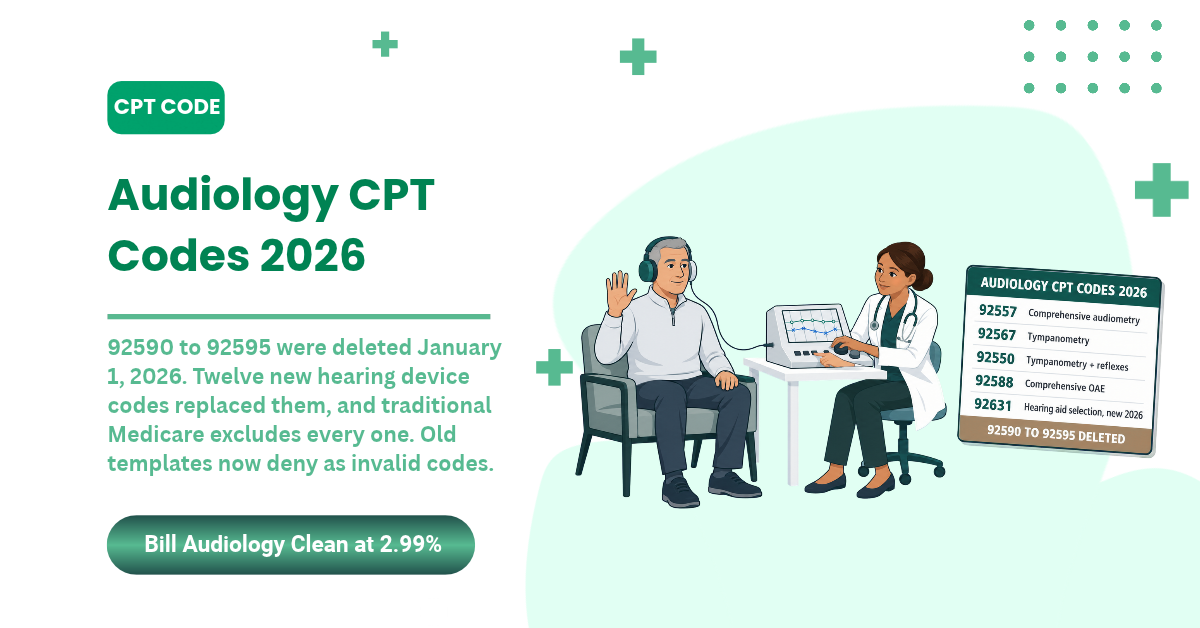




Audiology CPT codes are the five-digit AMA codes you bill for hearing, balance, implant, and hearing device services. Most fall between 92517 and 92700. On January 1, 2026, the AMA deleted 92590 to 92595 and replaced them with 12 hearing device codes in the 92628 to 92642 range.
Medicare draws a hard line through this code set. It pays for diagnostic hearing tests, such as 92552 to 92557, when a physician or NPP orders them or the patient uses direct access. Federal law excludes hearing aids and the exams to fit them, so the new codes bill to Medicare Advantage, Medicaid, commercial plans, or the patient.
Audiology CPT codes 2026: key facts
|
Fact |
Detail |
|---|---|
|
Code owner |
American Medical Association (AMA), updated every January 1 |
|
Main ranges |
92517 to 92549 vestibular and balance tests; 92550 to 92588 hearing tests; 92601 to 92642 implant, central auditory, tinnitus, rehabilitation, and hearing device services; 92650 to 92653 auditory evoked potentials; 92700 unlisted |
|
Deleted January 1, 2026 |
92590, 92591, 92592, 92593, 92594, 92595 |
|
New January 1, 2026 |
12 hearing device codes: 92628, 92629, 92631, 92632, 92634 to 92639, 92641, 92642 |
|
Medicare status of the new codes |
Statutorily excluded; no RVUs; not paid by traditional Medicare |
|
Time rule for the timed device codes |
Half plus one: 16 minutes for a 30-minute code, 31 minutes for a 60-minute code, and 8 minutes past the base time for each 15-minute add-on |
|
Medicare direct access |
Once every 12 months without an order, with the AB modifier; not for balance testing |
|
2026 conversion factor |
$33.40 (non-qualifying APM), $33.57 (qualifying APM) |
You can use the rest of this page as a lookup sheet at the front desk. It covers the full code list, the crosswalk from the deleted codes, and the time rules. Medicare and modifier rules come next, then ICD-10 pairings and the denials that follow when any of them goes wrong.
Sections on this page (link each item to its H2 when you publish):
- What audiology CPT codes cover and how they're organized
- What changed in audiology CPT codes for 2026
- Complete audiology CPT codes list for 2026
- Hearing test CPT codes: which code fits which test
- Hearing aid CPT codes for 2026: the 92628 to 92642 family
- Medicare rules for audiology billing in 2026
- Audiology modifiers that decide whether a claim pays
- NCCI bundling and MUE rules for audiology codes
- ICD-10 codes that support audiology claims
- Common audiology claim denials and how to fix them
- Audiology billing guidelines: a clean-claim workflow
- What audiology billing services cost in 2026
- Audiology CPT codes FAQs
- Next steps for your audiology billing team
What audiology CPT codes cover and how they're organized
Audiology CPT codes describe the service an audiologist performed, from a pure tone test to cochlear implant programming. Payers also call them audiology procedure codes. The AMA's CPT Editorial Panel maintains the set and revises it every January 1, and the AMA CPT 2026 release is the version in force today.
Three code sets meet on one audiology claim. CPT says what you did. HCPCS Level II V codes cover the hearing aid, the dispensing fee, and earmolds, a split our guide to CPT vs HCPCS codes explains. ICD-10-CM says why. Audiology billing and coding holds up only when all three match the chart note.
CPT treats audiologic function tests as bilateral, so a test on one ear takes modifier 52. The 2026 hearing device codes work differently. Most read "unilateral or bilateral" and never take 52, while 92639 and 92641 are bilateral and take 52 for one ear. You'll find every exception in the modifier section below.
There's no single CPT code for audiology evaluation. Your code depends on which tests the audiologist ran. Most full adult evaluations land on 92557, with 92567 or 92550 added for middle ear testing. The table below sorts the CPT codes for audiology into seven families, so you can see where each audiology code lives before you open the full list.
Audiology code families
|
Code family |
Range |
What it covers |
Traditional Medicare |
|---|---|---|---|
|
Vestibular and balance |
92517 to 92549 |
VEMP, caloric, VNG battery, rotational chair, posturography |
Covered diagnostic test with an order; direct access doesn't apply |
|
Hearing tests |
92550 to 92588 |
Audiometry, speech testing, immittance, OAE, pediatric behavioral tests |
Covered with an order or under direct access; screening codes aren't covered |
|
Implant, central auditory, tinnitus |
92601 to 92604, 92620 to 92627, 92640 |
Cochlear implant and ABI programming, implant candidacy, central auditory processing, tinnitus assessment |
Covered with an order or under direct access |
|
Auditory rehabilitation |
92630, 92633 |
Therapy for prelingual and postlingual hearing loss |
Not covered under the audiology benefit, because it's treatment, not testing |
|
Hearing device services |
92628 to 92642 (12 codes) |
Hearing aid candidacy, selection, fitting, follow-up, and verification |
Statutorily excluded |
|
Evoked potentials |
92650 to 92653 |
AEP screening, hearing status, threshold estimation, neurodiagnostic testing |
Covered with an order or under direct access; screening 92650 isn't covered |
|
Unlisted |
92700 |
Services with no specific code |
Reviewed claim by claim |
What changed in audiology CPT codes for 2026
The biggest shift in audiology CPT codes 2026 is the loss of 92590 to 92595, which the AMA replaced with 12 hearing device codes on January 1, 2026. Diagnostic hearing test codes didn't change. Across every specialty, CPT 2026 carries 418 changes: 288 new codes, 84 deletions, and 46 revisions.
Image placement: Crosswalk graphic showing deleted codes 92590 to 92595 flowing into the 2026 hearing device codes 92628 to 92642. Alt text: 2026 hearing aid CPT code crosswalk from deleted codes to new codes
92590 to 92595 were deleted and replaced by 12 hearing device codes
For dates of service on or after January 1, 2026, a claim with 92590, 92591, 92592, 92593, 92594, or 92595 fails as an invalid code. Payers typically return it with CO-181, the denial for a procedure code that wasn't valid on the date of service. The table shows where each old service lands now.
2026 hearing aid CPT code crosswalk
|
Deleted code |
Old service |
2026 replacement |
|---|---|---|
|
92590 |
Hearing aid exam and selection, one ear |
92631, plus +92632 for extra time |
|
92591 |
Hearing aid exam and selection, both ears |
92631, plus +92632 for extra time |
|
92592 |
Hearing aid check, one ear |
92636, plus +92637 for extra time |
|
92593 |
Hearing aid check, both ears |
92636, plus +92637 for extra time |
|
92594 |
Electroacoustic evaluation, one ear |
92641 with modifier 52 |
|
92595 |
Electroacoustic evaluation, both ears |
92641 |
|
No predecessor |
Hearing aid candidacy evaluation |
92628, plus +92629 for extra time |
|
No predecessor |
Fitting, verification, and assistive technology |
92634 with +92635, +92638, +92639, and 92642 |
The AMA doesn't publish a one-to-one crosswalk. This mapping comes from MassHealth bulletin 26-07, so treat it as a practical guide and code from the note. Under the old set, a binaural hearing aid check is coded as 92593. In 2026, that same hearing aid check CPT code becomes 92636, with +92637 for each extra 15 minutes.
Candidacy work (92628) has no predecessor at all. The old codes jumped straight to selection and never named the visit where an audiologist decides whether a patient needs amplification in the first place.
Three codes inside the new range aren't new
Three codes inside 92628 to 92642 existed before 2026 and aren't hearing aid codes. 92630 and 92633 bill auditory rehabilitation for prelingual and postlingual hearing loss, and 92640 bills auditory brainstem implant programming. Several billing guides fold them into the hearing aid family, and a charge master built from those guides will mis-map real services.
The March 10, 2026 AMA errata on candidacy and selection
On March 10, 2026, the AMA revised the parentheticals for 92628 and 92631, so you can report candidacy and selection on the same date when each code's time is met and the services don't share the same 30 minutes. The AMA CPT errata made it effective January 1, 2026.
The issue is old software. Scrubbers and templates built from the September 2025 codebook may still block the pair. If you loaded the new audiology codes 2026 into a scrubber last winter, recheck that edit and pull same-day candidacy and selection denials from January to March. Appeal windows vary by contract, so check each payer before you resubmit.
If your scrubber still blocks 92628 with 92631, some of those early 2026 denials may still sit inside the payer's appeal window. Reworking claims like these is part of our outsourced medical billing at 2.99%.
Medicare's 2026 fee schedule changes for audiology
Three Medicare fee schedule changes touch audiology in 2026. First, the conversion factor is $33.4009 for clinicians outside a qualifying APM and $33.5675 inside one, per the CMS CY 2026 fact sheet. Most audiologists bill under the first rate.
Second, CMS cut work RVUs on most non-time-based services by 2.5% through an efficiency adjustment, exempting time-based codes and services on the Medicare Telehealth Services List.
ASHA and AAA read that exemption differently for 92557, so check each code in the CMS Physician Fee Schedule look-up tool before you quote a 2026 rate to a patient or a payer.
Third, CMS added 92622 and 92623, osseointegrated sound processor programming, to the Medicare Telehealth Services List. Our list of 2026 telehealth CPT codes tracks the rest of it. Congress also extended Medicare telehealth authority for audiologists through December 31, 2027, in the Consolidated Appropriations Act, 2026.
None of the hearing aid CPT codes for 2026 got a Medicare rate. CMS says it lacks the legal authority to pay for hearing aids or the exams for them, as the CY 2026 PFS final rule explains, so the codes carry no RVUs.
Audiology code changes from 1993 to 2026
The new audiology CPT codes 2026 introduced replace hearing aid codes that dated back to 1993. Follow the timeline from those first codes to the CPT 2027 release:
- 1993: CPT creates hearing aid codes 92590 to 92595.
- January 1, 2021: CPT deletes ABR codes 92585 and 92586, replaces them with 92650 to 92653, and adds VEMP codes 92517 to 92519.
- January 1, 2023: Medicare direct access to audiologists, billed with the AB modifier, begins.
- September 11, 2025: The AMA releases the CPT 2026 code set.
- January 1, 2026: 92590 to 92595 are deleted, and the 12 hearing device codes take effect.
- March 10, 2026: The AMA issues errata on 92628 and 92631, effective January 1, 2026.
- April 1, 2026: CMS sets an MUE of 2 units per day for the hearing device add-on codes.
- July 14, 2026: CMS proposes a CY 2027 conversion factor of $32.8409, down 1.68%, with the final rule expected in early November.
- September 9, 2026: The AMA releases CPT 2027, which deletes rotational chair code 92546 and adds rotational codes 92527 and 92528 and video head impulse codes 92513 and 92514, effective January 1, 2027.
If you're still working from an audiology CPT codes 2025 list, every hearing aid line on it is out of date.
Image placement: Timeline of audiology CPT code changes from 1993 to 2026. Alt text: Timeline of audiology CPT code changes through 2026
Complete audiology CPT codes list for 2026
The current audiology CPT codes list runs from 92517 to 92700 and splits into nine groups, shown here roughly in the order a clinic performs them. Hearing device codes have their own section below. Every audiology CPT code in these tables describes both ears unless the row says otherwise.
In the Medicare column, "Covered with order or AB" means Medicare pays with a physician or NPP order, or without one under direct access when the code is on CMS's direct access list. The list holds 38 codes, including 92622 and 92623, which CMS added in 2024. No vestibular, screening, or hearing device code is on it.
Pure tone and speech audiometry codes
CPT 92557 is the audiometry CPT code most adult evaluations use. It combines air and bone thresholds (92553) with speech threshold and word recognition (92556), and ASHA Medicare coding rules bar billing those components next to it. The CPT code for pure tone audiometry alone is 92552 for air only, or 92553 for air and bone.
Pure tone and speech audiometry CPT codes
|
Code |
What it covers |
Billing note |
Medicare |
|---|---|---|---|
|
92551 |
Screening, pure tone, air only |
Pass/fail screen, not a threshold test |
Screening isn't covered |
|
92552 |
Pure tone thresholds, air only |
Use when bone conduction wasn't tested |
Covered with order or AB |
|
92553 |
Pure tone thresholds, air and bone |
Component of 92557 |
Covered with order or AB |
|
92555 |
Speech recognition threshold |
Component of 92556 |
Covered with order or AB |
|
92556 |
Speech threshold with word recognition |
Component of 92557 |
Covered with order or AB |
|
92557 |
Comprehensive audiometry: 92553 plus 92556 |
Don't bill 92552, 92553, 92555, or 92556 with it |
Covered with order or AB |
|
92562, 92563, 92565, 92575, 92577 |
Loudness balance, tone decay, Stenger (pure tone and speech), sensorineural acuity level |
Site-of-lesion and functional hearing tests |
Covered with order or AB |
Tympanometry and acoustic reflex codes
Bill 92550 instead of 92567 plus 92568 when tympanometry and acoustic reflex thresholds happen at the same visit. 92570 goes one step further and adds acoustic reflex decay, so it absorbs both component codes.
Tympanometry and acoustic reflex CPT codes
|
Code |
What it covers |
Billing note |
Medicare |
|---|---|---|---|
|
92567 |
Tympanometry |
Separately billable with 92557 |
Covered with order or AB |
|
92568 |
Acoustic reflex thresholds |
Use 92550 if 92567 was also done |
Covered with order or AB |
|
92550 |
Tympanometry plus reflex thresholds |
Don't add 92567 or 92568 |
Covered with order or AB |
|
92570 |
Tympanometry, reflex threshold, and reflex decay |
Includes 92567 and 92568 |
Covered with order or AB |
Otoacoustic emissions codes
The frequency count separates the two diagnostic OAE codes. 92587 covers a limited distortion product test at 3 to 6 frequencies or a transient evoked OAE, and 92588 covers a comprehensive test at 12 or more frequencies. 92558 is the automated screen with a pass/fail result.
Otoacoustic emissions CPT codes
|
Code |
What it covers |
Billing note |
Medicare |
|---|---|---|---|
|
92558 |
OAE screening, automated, pass/fail |
Common in newborn and school screening |
Screening isn't covered |
|
92587 |
Limited OAE, 3 to 6 frequencies, or TEOAE |
Add 52 for one ear |
Covered with order or AB |
|
92588 |
Comprehensive OAE, 12 or more frequencies |
Add 52 for one ear |
Covered with order or AB |
Auditory evoked potential and ABR codes
The auditory brainstem response CPT code depends on why the audiologist ran the test: 92651 for hearing status, 92652 for threshold estimation, and 92653 for neurodiagnostic work. CPT deleted 92585 and 92586 in 2021. Only one of 92651, 92652, or 92653 goes on a claim for the same session.
Any old superbill that still lists 92585 as the ABR CPT code needs updating today. For an infant who failed a newborn screen, the CPT code for an ABR hearing test is often 92652, since the audiologist is estimating thresholds. ASSR testing bills under 92652 too.
Auditory evoked potential CPT codes
|
Code |
What it covers |
Billing note |
Medicare |
|---|---|---|---|
|
92650 |
Automated AEP screening |
Screening use |
Screening isn't covered |
|
92651 |
Hearing status, broadband stimuli |
Not with 92652 or 92653 |
Covered with order or AB |
|
92652 |
Threshold estimation, multiple frequencies |
ASSR bills here; once per day |
Covered with order or AB |
|
92653 |
Neurodiagnostic |
Neural integrity, not thresholds |
Covered with order or AB |
|
92584 |
Electrocochleography |
Also reports neural response telemetry; not with 92601 to 92604 the same day |
Covered with order or AB |
Vestibular and balance testing codes, including VNG
92540 is the VNG CPT code for the basic vestibular battery, and it already includes 92541, 92542, 92544, and 92545. Direct access and the AB modifier don't apply to balance testing. Your MAC's billing article sets coverage rules, such as the Palmetto vestibular billing article (A56497) for Palmetto GBA states.
Vestibular and balance CPT codes
|
Code |
What it covers |
Billing note |
Medicare |
|---|---|---|---|
|
92540 |
Basic vestibular evaluation (VNG battery) |
Includes 92541, 92542, 92544, and 92545 |
Order required |
|
92541, 92542, 92544, 92545 |
Spontaneous nystagmus, positional nystagmus, optokinetic, and oscillating tracking tests |
Bill only when 92540 isn't billed |
Order required |
|
92537, 92538 |
Caloric testing, bithermal or monothermal |
92537 for bithermal, 92538 for monothermal |
Order required |
|
92546 |
Rotational chair testing |
Deleted January 1, 2027; replaced by 92527 and 92528 |
Order required |
|
92548, 92549 |
Computerized dynamic posturography |
92549 covers all three CDP tests (sensory organization, motor control, adaptation); don't bill it with 92548 |
Order required |
|
92517, 92518, 92519 |
VEMP: cervical, ocular, or both |
92519 replaces 92517 plus 92518 |
Order required |
Central auditory processing and tinnitus codes
92620 and +92621 are the timed central auditory function codes: the first 60 minutes, then each extra 15. Medicare's NCCI edits block 92571, 92572, and 92576 with 92620. If a payer asks for the filtered speech test CPT code on its own, that's 92571.
Central auditory processing and tinnitus CPT codes
|
Code |
What it covers |
Billing note |
Medicare |
|---|---|---|---|
|
92620, +92621 |
Central auditory function evaluation, 60 minutes, then each 15 |
Timed |
Covered with order or AB |
|
92571 |
Filtered speech test |
Not with 92620 |
Covered with order or AB |
|
92572 |
Staggered spondaic word test |
Not with 92620 |
Covered with order or AB |
|
92576 |
Synthetic sentence identification test |
Not with 92620 |
Covered with order or AB |
|
92625 |
Tinnitus assessment |
Pitch, loudness matching, and masking |
Covered with order or AB |
Treatment for auditory processing disorder usually bills under speech-language pathology codes, not audiology codes. Our guide to speech therapy CPT codes covers that side, including the plan of care rules that therapy codes carry.
Pediatric audiology codes
Visual reinforcement audiometry (92579) and conditioning play audiometry (92582) have their own codes, so you don't bill them as 92552 or 92557. The select picture audiometry CPT code is 92583. Well-child screening and age rules sit in our guide to pediatric CPT codes.
Pediatric audiology CPT codes
|
Code |
What it covers |
Billing note |
|---|---|---|
|
92579 |
Visual reinforcement audiometry (VRA) |
Infants and toddlers; not with pure tone threshold codes |
|
92582 |
Conditioning play audiometry |
Young children; not with pure tone threshold codes |
|
92583 |
Select picture audiometry |
Speech testing with pictures |
|
92558, 92587, 92650 |
Screening and objective tests |
See the OAE and AEP tables above |
Cochlear implant and osseointegrated device codes
Each cochlear implant CPT code splits by age and visit type, and Medicare covers them because it pays for implants as prosthetic devices. 92601 and 92602 cover patients younger than 7, while 92603 and 92604 cover patients 7 or older, and the first code in each pair is the initial programming visit.
92626 and 92627 cover evaluation of auditory function for implant candidacy or postoperative status. Older guides call them aural rehabilitation status codes, and that label is outdated.
Cochlear implant and osseointegrated device CPT codes
|
Code |
What it covers |
Billing note |
Medicare |
|---|---|---|---|
|
92601 |
CI analysis with programming, younger than 7 |
Initial |
Covered with order or AB |
|
92602 |
CI reprogramming, younger than 7 |
Subsequent |
Covered with order or AB |
|
92603 |
CI analysis with programming, age 7 or older |
Initial |
Covered with order or AB |
|
92604 |
CI reprogramming, age 7 or older |
Subsequent |
Covered with order or AB |
|
92622, +92623 |
Osseointegrated sound processor programming, 60 minutes, then each 15 |
On the 2026 Medicare telehealth list |
Covered with order or AB |
|
92626, +92627 |
Implant candidacy or postoperative auditory evaluation, 60 minutes, then each 15 |
Not with hearing aid candidacy 92628 or selection 92631 on the same ear |
Covered with order or AB |
|
92640 |
Auditory brainstem implant programming, per hour |
Inside the 92628 to 92642 range but not a hearing aid code |
Covered with order or AB |
Auditory rehabilitation and unlisted codes
92630 and 92633 are therapy codes, and Medicare doesn't pay audiologists for treatment under the audiology benefit. 92633 is the CPT code for auditory rehabilitation for postlingual hearing loss, and 92630 covers prelingual hearing loss. Save 92700 for a service no specific code describes.
Auditory rehabilitation and unlisted CPT codes
|
Code |
What it covers |
Medicare |
|---|---|---|
|
92630 |
Auditory rehabilitation, prelingual hearing loss |
Not covered when an audiologist bills it under the audiology benefit |
|
92633 |
Auditory rehabilitation, postlingual hearing loss |
Not covered when an audiologist bills it under the audiology benefit |
|
92700 |
Unlisted otorhinolaryngological service or procedure |
Needs a description and supporting notes |
Hearing test CPT codes: which code fits which test
There's no single hearing test CPT code. The code depends on what the audiologist tested, and a full adult evaluation is usually 92557. Use the table below with the full code list above: find the tests in the note, then bill the one code that covers them.
Which hearing test CPT code to bill
|
What was tested |
Code to bill |
Don't also bill |
|---|---|---|
|
Pass/fail screen at set levels |
92551 |
92552, 92553 |
|
Air conduction thresholds only |
92552 |
92553, 92557 |
|
Air and bone thresholds, no speech |
92553 |
92552, 92557 |
|
Speech threshold only |
92555 |
92556, 92557 |
|
Speech threshold and word recognition |
92556 |
92555, 92557 |
|
Air, bone, and speech (full battery) |
92557 |
92552, 92553, 92555, 92556 |
|
Middle ear with the full battery |
92557 plus 92567, or plus 92550 if reflexes were tested |
92567 and 92568 together |
A routine hearing exam CPT code doesn't exist either. Your hearing test procedure code comes from the tests performed, so a hearing test CPT lookup starts with the note, not the appointment type. The CPT code for hearing exam visits with no symptoms still follows the table, and the diagnosis decides whether the payer covers it.
Is CPT 92557 a hearing test?
Yes. CPT 92557 is the comprehensive hearing test CPT code, covering pure tone air and bone thresholds plus speech threshold and word recognition in one visit. It's usually the CPT code for hearing evaluation in an adult clinic.
You can't bill 92553 or 92556 with it, since 92557 already includes both. CPT treats it as a bilateral test, so a one-ear test takes modifier 52. Picture a 68-year-old referred by her primary care doctor because she can't follow the sermon at church: she gets 92557, plus 92567 for tympanometry.
Audiogram CPT code: 92557 or its component codes
An audiogram is the chart the test produces, not a code. That means the audiogram CPT code is whichever test produced it: 92552, 92553, or 92557 for most adults, and 92579 or 92582 for young children.
Billers get this wrong because orders often say "audiogram" and nothing else. The audiologist then picks the tests, and the front desk guesses the code. Build order templates that name the tests, and the CPT code for audiogram claims stops being a guess.
What's the difference between 92551 and 92552?
92551 is a pass/fail pure tone screen at fixed levels, and 92552 measures the actual air conduction threshold at each frequency. School, pediatric, and primary care screening programs bill 92551.
A failed 92551 usually leads to diagnostic testing, and that follow-up visit takes Z01.110, the ICD-10 code for a hearing exam after a failed screening. Medicare doesn't pay for routine screening. So before you pick a hearing exam CPT code, confirm whether the visit was a screen or a threshold test.
Hearing screening CPT codes, including 92558
The main hearing screening CPT codes are 92551 (pure tone), 92558 (automated OAE), and 92650 (automated AEP), and HCPCS V5008 covers a hearing screening for some payers. So the CPT code for screening hearing test claims depends on the method the screener used.
Is CPT 92558 a hearing test? Yes. It's an automated OAE screen with a pass/fail result, used mostly for newborns and young children.
The screening hearing test CPT code you pick also decides who pays. CPT hearing screening codes usually pay under Medicaid, pediatric, or commercial plans, not traditional Medicare, so check the plan before you bill a screen.
Hearing aid CPT codes for 2026: the 92628 to 92642 family
The 2026 hearing aid CPT codes are 12 codes that bill hearing aid care by stage and by time: candidacy, selection, fitting, follow-up, verification, and assistive technology. Eight of them are timed. Traditional Medicare pays for none of them, which makes them the codes most likely to go to the wrong payer.
The 12 hearing device codes at a glance
Each hearing aid CPT code maps to one stage of care, and four of the 12 are untimed: 92638, 92639, 92641, and 92642. 92641 and 92642 are standalone codes, not add-ons, even though some summaries list them as add-ons.
2026 hearing device CPT codes
|
Code |
Service |
Time unit |
Minimum to bill one unit |
Type |
|---|---|---|---|---|
|
92628 |
Hearing aid candidacy evaluation |
First 30 minutes |
16 minutes |
Base |
|
+92629 |
Candidacy, additional time |
Each 15 minutes |
Starts at 38 minutes total |
Add-on to 92628 |
|
92631 |
Hearing aid selection |
First 30 minutes |
16 minutes |
Base |
|
+92632 |
Selection, additional time |
Each 15 minutes |
Starts at 38 minutes total |
Add-on to 92631 |
|
92634 |
Hearing aid fitting, including programming, verification, counseling, and orientation |
First 60 minutes |
31 minutes |
Base |
|
+92635 |
Fitting, additional time |
Each 15 minutes |
Starts at 68 minutes total |
Add-on to 92634 |
|
92636 |
Post-fitting follow-up: physical fit, benefit, sound quality, and adjustments |
First 30 minutes |
16 minutes |
Base |
|
+92637 |
Follow-up, additional time |
Each 15 minutes |
Starts at 38 minutes total |
Add-on to 92636 |
|
+92638 |
Behavioral verification (aided thresholds, functional gain, speech in noise) |
Untimed |
Procedure performed |
Add-on to 92634 or 92636 |
|
+92639 |
Probe-microphone verification (real ear) |
Untimed |
Procedure performed; 52 for one ear |
Add-on to 92634 or 92636 |
|
92641 |
Electroacoustic analysis |
Untimed |
Procedure performed; 52 for one ear |
Standalone |
|
92642 |
Hearing assistive technology fitting (FM/DM, remote microphone, alerting devices) |
Untimed |
Procedure performed |
Standalone |
The hearing aid evaluation CPT code is now 92628 for candidacy and 92631 for selection, and the CPT code for hearing aid fitting is 92634. All of the timed codes cover one ear or both, so a monaural hearing aid check CPT code is the same 92636 you'd bill for two ears.
How the time rule turns minutes into units
The timed hearing device codes follow the half-plus-one rule. A 30-minute code bills at 16 minutes, and each 15-minute add-on bills only after the audiologist finishes the full base time and adds 8 more minutes.
Minutes to units for 92628, 92631, and 92636
|
Total minutes on a 30-minute code |
Units to bill |
|---|---|
|
Under 16 |
No CPT unit; V5014 or V5299 may fit, depending on the payer |
|
16 to 37 |
Base code, 1 unit |
|
38 to 52 |
Base code plus 1 add-on unit |
|
53 to 67 |
Base code plus 2 add-on units |
Fitting runs on a longer clock. 92634 bills at 31 minutes, and +92635 starts at 68. Four more rules from ASHA hearing device guidance decide whether the units hold up:
- Time spent on 92638, 92639, and 92641 doesn't count toward fitting or follow-up minutes.
- Modifier 52 can't go on a timed code under any circumstances.
- CMS set an MUE of 2 units per date of service for 92629, 92632, 92635, and 92637, effective April 1, 2026, and claims over 2 units deny automatically.
- Start and stop times alone don't support time, so the note needs total minutes and what the audiologist did.
Picture a 52-minute selection visit. It bills 92631 plus one unit of 92632, and one more minute would have supported a second unit. That's why the time statement matters as much as the code.
Same-day rules for candidacy, selection, fitting, and follow-up
Candidacy and selection can share a date if each meets its own time and they don't overlap in the same 30 minutes. Follow-up never shares a date with candidacy, selection, or fitting. The CPT parenthetical notes set these limits:
- 92628 and 92631 don't go with 92636, 92637, or 92642.
- 92634 doesn't go with 92636, 92637, or 92642.
- 92642 doesn't go with 92631, 92632, 92634, 92635, 92636, 92637, 92638, or 92639.
- 92628 and 92631 don't go with 92622, 92623, 92626, or 92627 on the same ear.
- A diagnostic test such as 92557 can share the date with candidacy or selection only when NCCI edits and the payer's policy allow it.
ASHA's two hearing device pages disagree on one point: whether the base code's minimum time has to be met before you add +92638 or +92639. Follow your payer's written policy, and document the base visit time either way.
Where HCPCS V codes still fit
The 2026 CPT change didn't touch HCPCS V codes, which still bill the hearing aid itself, dispensing fees, earmolds, and some services. People search for them as CPT V codes, but they're HCPCS Level II codes, listed on ASHA's HCPCS code list.
These audiology HCPCS codes still do real work on a hearing aid claim:
- V5160 (dispensing fee, binaural) and the device codes still go on the claim.
- V5275 (ear impression) time can't count toward 92631 or 92632 when you bill it separately.
- V5014 (repair) or V5299 (miscellaneous hearing service) may cover a short visit that misses a CPT time minimum.
- V5020 is the hearing aid conformity evaluation for payers that still use it.
- Some Medicaid programs and plans may still ask for audiology V codes instead of the new CPT codes.
Any hearing aid billing guide that skips V codes covers only half the claim. Check each payer's code list before the fitting, because the CPT code and the V code often travel together.
Who pays for hearing aid services
Traditional Medicare doesn't pay for any of the 12 codes, so the claim goes to a Medicare Advantage plan with a hearing benefit, Medicaid, a commercial plan, or the patient. No CPT code for hearing aids changes that rule.
Medicare Advantage hearing benefits vary by plan and often run through a hearing benefit vendor. Medicaid sets coverage state by state; Minnesota Medicaid audiology codes list all 12 hearing aid CPT codes 2026 introduced, with limits like one candidacy session per calendar year. Commercial plans pay contracted rates with no Medicare benchmark behind them.
Hearing aid benefits change from plan to plan more than almost any other benefit we check. Our hearing benefit verification confirms the allowance, the network, and the codes the plan accepts before the selection visit.
Medicare rules for audiology billing in 2026
Medicare pays for diagnostic hearing and balance testing that a qualified audiologist performs, usually with a physician order, and it never pays for hearing aids or the exams to fit them. That split decides where every claim built on audiology CPT codes should go.
What Medicare covers for audiology in 2026
|
Medicare covers |
Medicare doesn't cover |
|---|---|
|
Diagnostic hearing tests (92550 to 92588) with an order or under direct access |
Hearing aids and exams to prescribe, fit, or change them (92628 to 92642) |
|
Balance and vestibular tests (92517 to 92549) with an order |
Routine hearing screening |
|
Evoked potentials (92651 to 92653) with an order or under direct access |
Auditory rehabilitation billed by an audiologist (92630, 92633) |
|
Cochlear implant, osseointegrated, and ABI services, because implants are prosthetic devices |
Audiology services billed "incident to" a physician |
What Medicare covers under the audiology benefit
Medicare defines audiology services as hearing and balance assessment services that a qualified audiologist furnishes, and it pays for them as diagnostic tests, per the CMS Audiology Services page. Office claims pay under the Physician Fee Schedule, and hospital outpatient tests pay under OPPS.
Audiologists bill under their own NPI. Medicare won't pay for audiology billed incident to a physician, because audiologists have their own Medicare benefit. So does Medicare pay for audiology services? For diagnostic testing with an order or direct access, yes.
Physician orders and the AB modifier for direct access
Medicare generally needs a physician or NPP order for audiology tests, but since January 1, 2023, 42 CFR 410.32(a)(4) lets a patient see an audiologist without an order once every 12 months for a non-acute hearing condition. Four rules come with that access:
- Bill those tests with the AB modifier, which tells Medicare no order exists.
- Direct access excludes disequilibrium and balance testing, hearing aids, and exams to prescribe, fit, or change hearing aids.
- Only the 38 codes on CMS's direct access list qualify, and none of them is a vestibular, screening, or hearing device code.
- You can bill modifier AB once every 12 months per patient, however many tests the visit includes, so track each patient's last AB date.
The Medicare Audiology Access Improvement Act (H.R. 2757 and S. 1996, introduced in 2025) would drop the order requirement altogether. Neither bill had passed as of October 20, 2026, so the 12-month limit still applies.
What Medicare doesn't cover
Section 1862(a)(7) of the Social Security Act excludes hearing aids and the exams for them, and 42 CFR 411.15(d) spells it out: hearing aids, or examinations for prescribing, fitting, or changing them. Bone conduction hearing aids worn on the head fall under the same exclusion.
CMS also keeps therapeutic services, such as auditory rehabilitation, outside the audiology benefit. Cochlear implants, osseointegrated implants, and auditory brainstem implants stay covered, because Medicare pays for them as prosthetic devices that replace the function of the middle ear, cochlea, or auditory nerve.
GY, GA, GX, and GZ: billing excluded or uncertain services
Use GY on a hearing aid service billed to Medicare when a secondary payer needs a Medicare denial, and skip the ABN, since Medicare doesn't require one for a statutorily excluded service. The CGS Medicare ABN guidance defines all four modifiers:
- GX: you gave a voluntary notice for a service Medicare never covers.
- GY: no notice was required, because Medicare excludes the service by statute.
- GA: a required ABN is on file for a covered service Medicare may deny as not reasonable and necessary.
- GZ: you expect that denial and didn't issue an ABN, so you generally can't bill the patient.
Medicare Advantage, Medicaid, and commercial plans
Medicare Advantage plans can cover hearing aids and hearing aid fittings as a supplemental benefit, so the plan's own rules apply instead of traditional Medicare's exclusion. Medicaid coverage changes state by state. A hearing screening CPT code like 92551 may pay under Medicaid or a commercial plan, even though traditional Medicare won't cover routine screening.
Audiology modifiers that decide whether a claim pays
Most audiology CPT codes already describe both ears, so the modifier that matters most is 52 for a one-ear test, and the one to avoid is 50. Hearing aid claims trip on another rule: 52 never goes on a timed device code. Before adding a modifier to an audiology CPT code, check whether the descriptor covers both ears.
Audiology modifiers in 2026
|
Modifier |
When to use it |
Audiology example |
Common mistake |
|---|---|---|---|
|
52 |
Test done on one ear, or a reduced service |
92557 on one ear; 92639 or 92641 on one ear |
Putting 52 on a timed code like 92636 that ran short |
|
RT, LT |
Only when a payer asks for laterality |
Some commercial plans on hearing aid claims; an implant ear and a hearing aid ear on the same day |
Adding RT and LT to bilateral codes that don't need them |
|
50 |
Doesn't fit audiology test codes |
None; CPT already counts both ears in the code |
Billing 92567-50 for both ears |
|
59, XU, XS |
A distinct service that an NCCI edit would otherwise bundle |
A separate, documented encounter the same day |
Using 59 only to get past an edit |
|
26, TC |
Codes with a professional and technical split in the fee schedule |
Vestibular codes such as 92537, 92540, and 92546, plus OAE codes 92587 and 92588 |
Using 26 or TC on codes with no split |
|
AB |
Medicare direct access, once every 12 months |
92557 with no order for a non-acute hearing complaint |
Using AB on balance testing |
|
GY |
Statutorily excluded service when a Medicare denial is needed |
92634 billed to Medicare so a secondary plan can process it |
Expecting Medicare to pay |
|
GA, GX, GZ |
ABN status on the claim |
See the GY, GA, GX, and GZ rules above |
Billing the patient after a GZ claim |
|
GP |
Not an audiology modifier |
None; GP marks a physical therapy plan of care, and audiology tests are diagnostic tests |
Copying therapy billing rules |
Some billing guides still tell readers to add 50 for both ears or GP for audiologists. Both habits come from other specialties. A claim with 92567-50 can deny, or pay as if the audiologist ran one test twice, and GP points to a physical therapy plan of care that an audiology visit doesn't have.
Modifier 59 and the X modifiers work only when the services were separate, and the note has to show it. Our guide to modifier 59 rules covers when an X modifier fits better than 59.
The professional and technical split sits on each code's line in the Medicare fee schedule, so check it before you append 26 or TC. Our breakdown of 26 vs TC modifiers shows how the split works when an audiologist tests and a physician interprets.
NCCI bundling and MUE rules for audiology codes
NCCI procedure-to-procedure edits stop a component code from billing next to the comprehensive code that already includes it. The pairs below cause most of the bundling denials we see on audiology claims. These edits hit audiology claims the same way they hit any specialty, and commercial payers often copy them.
Audiology code pairs that bundle
|
If you bill |
Don't also bill |
Why |
|---|---|---|
|
92557 |
92552, 92553, 92555, 92556 |
92557 already includes air, bone, and speech testing |
|
92550 |
92567, 92568 |
92550 is tympanometry plus reflex thresholds |
|
92570 |
92567, 92568 |
92570 adds reflex decay to both |
|
92540 |
92541, 92542, 92544, 92545 |
92540 is the basic vestibular battery |
|
92519 |
92517, 92518 |
92519 covers both VEMP tests |
|
92651, 92652, or 92653 |
Either of the other two |
Only one AEP purpose per session |
|
92620 (Medicare) |
92571, 92572, 92576 |
Those tests sit inside the central auditory evaluation |
|
92636 |
92628, 92629, 92631, 92632, 92634, 92635, 92642 |
Follow-up happens on a different date |
|
92642 |
92631, 92632, 92634 to 92639 |
The CPT note bars assistive technology fitting with these codes |
One pair people expect to bundle usually doesn't: 92557 and 92567 can go on the same claim when 92550 doesn't apply. Payers can change Medicare's edits for their own plans, so check the current edit table for each one.
Medically unlikely edits cap units per day. ASHA's MUE table, last updated for early 2025, lists 1 unit per day for untimed codes such as 92557, 92567, 92550, and 92652. CMS set 2 units per day for 92629, 92632, 92635, and 92637 starting April 1, 2026.
CMS updates the MUE and PTP files quarterly. Pull the current quarter from the CMS NCCI edit files before you set a unit limit in your system, because a value from last year's table can be wrong today.
Build these pairs into your claim scrubber and recheck them every quarter. A bundling denial repeats on every claim until someone fixes the rule behind it, and our guide to CO-97 bundling denials walks through the appeal side.
ICD-10 codes that support audiology claims
The ICD-10-CM code tells the payer why the audiologist ran the test, and for Medicare it has to show a sign, symptom, or condition, not a routine exam. There's no hearing loss CPT code. Hearing loss is an ICD-10 diagnosis, and the CPT code is the test.
The FY2027 code set took effect October 1, 2026, and the CMS ICD-10 code files hold the current list. Pair the right diagnosis with each test, and a hearing exam CPT code like 92557 holds up on review.
Common audiology diagnosis codes
|
ICD-10-CM |
Description |
Typical use |
|---|---|---|
|
H90.3 |
Sensorineural hearing loss, bilateral |
92557, hearing aid services |
|
H90.5 |
Unspecified sensorineural hearing loss |
Use only when the note doesn't document laterality |
|
H91.90 |
Unspecified hearing loss, unspecified ear |
Last resort; invites medical necessity review |
|
H93.13 |
Tinnitus, bilateral |
92625, 92557 |
|
H93.25 |
Central auditory processing disorder |
92620, 92621 |
|
H81.10 |
Benign paroxysmal vertigo, unspecified ear |
Vestibular testing |
|
R42 |
Dizziness and giddiness |
92540, caloric and VEMP testing |
|
Z01.10 |
Exam of ears and hearing without abnormal findings |
Routine exam; Medicare won't cover it |
|
Z01.110 |
Hearing exam after a failed hearing screening |
Diagnostic follow-up to 92551 or 92558 |
|
Z96.21 |
Cochlear implant status |
92602, 92604 |
The H90 and H91 categories carry laterality-specific codes, so code the ear when the audiogram shows it. These audiology diagnosis codes also answer a common search: the diagnosis code for hearing screening follow-up is Z01.110, and Z01.10 fits a routine exam with normal results.
ICD-10 codes for hearing aid claims
Hearing aid claims usually carry the hearing loss code first, with Z46.1 (encounter for fitting and adjustment of hearing aid) or Z97.4 (presence of external hearing aid) as a secondary code, depending on the visit. Those are the ICD-10 hearing aid codes most payers expect.
Payers that cover hearing aids often require the hearing loss to meet a threshold in their policy. Read the plan's policy before the fitting, because the hearing aid diagnosis codes on the claim have to match what the audiogram shows.
Common audiology claim denials and how to fix them
The audiology denials we work trace back to five causes: a deleted code, a missing order, a bundled pair, an unsupported diagnosis, or a hearing aid service sent to Medicare as if it were covered. Each fix costs less at the front desk than on appeal.
Audiology denial codes and fixes
|
Denial code |
What it means |
Typical audiology cause |
Fix |
|---|---|---|---|
|
CO-181 |
Procedure code invalid on the date of service |
92590 to 92595 billed after January 1, 2026, or 92585 or 92586 still in a template |
Recode to 92628 to 92642 or 92650 to 92653 and resubmit |
|
CO-16 with N286 |
Missing or invalid information, here the referring provider's identifier |
No ordering provider NPI on a Medicare claim without AB |
Add the ordering provider, or AB if direct access applies |
|
CO-97 |
Paid as part of another service |
92553 or 92556 billed with 92557; 92567 with 92550 |
Remove the component code and fix the scrubber rule |
|
CO-50 |
Not medically necessary |
Z01.10 or no symptom on a Medicare claim |
Code the documented symptom or condition; appeal with the order and history |
|
CO-96 or PR-96 |
Non-covered charge |
Hearing aid service billed to Medicare without GY |
Add GY when a secondary needs the denial; bill the patient only with proper notice |
|
CO-204 |
Not covered under the patient's current benefit plan |
Medicare Advantage or commercial plan with no hearing benefit |
Verify the hearing benefit before the selection visit |
|
CO-151 |
Payer says the information doesn't support that many services |
Three units of an add-on against an MUE of 2 |
Bill to the MUE and document time accurately |
|
CO-4 |
Procedure code doesn't fit the modifier |
52 on a timed hearing device code, or 50 on a bilateral test |
Remove the modifier and follow the time rule |
Two rows need the most paperwork on appeal. Our guide to CO-50 medical necessity denials covers the letter and records a payer expects when it questions why a test was needed.
The missing-order row works differently, because the claim never reached a medical review. Read the CO-16 denial code guide for how to correct and resubmit it.
Fixing one claim clears one line. Correcting the rule behind it stops the same denial on every claim that follows. A weekly denial report sorted by denial code and CPT code shows you which rule broke, and a run of CO-4 modifier denials often points to one template.
If the same audiology denials keep coming back each month, the fix is upstream. Our denial management services find the rule behind each denial and correct it in the scrubber, so you're not appealing the same claim twice.
Audiology billing guidelines: a clean-claim workflow
Good audiology billing guidelines start at scheduling, because the benefit check, the order, and the time statement decide a claim's outcome before anyone picks a code. The seven steps below apply to every claim, from a 92557 to a hearing aid fitting.
Seven steps from scheduling to payment
Follow these audiology billing guidelines in order. Each step blocks one of the denials in the table above:
- Verify the hearing benefit along with eligibility. Medicare Advantage and commercial hearing benefits carry allowances, vendors, and visit limits that a basic eligibility check won't show.
- Confirm the order or direct access. Look for a signed order, or confirm the patient hasn't used AB-modifier direct access in the last 12 months.
- Document tests and minutes. Every timed hearing device code needs total time and the activities, such as "Total time with the patient was 42 minutes, including selection counseling and device comparison."
- Code from the note, not the schedule. Use the hearing test decision table above, and keep a superbill in medical billing format that names tests instead of visit types.
- Scrub before submission. Run the NCCI pairs, MUEs, modifiers, and the CPT 2026 code list against every audiology claim.
- Route excluded services correctly. Send hearing aid services to Medicare with GY only when a secondary needs the denial, and bill the plan that covers them otherwise.
- Post, then work denials fast. Compare each remittance to the contract, and appeal inside each payer's window, which for Medicare means knowing the Medicare timely filing limit.
These steps double as audiology coding guidelines for a new biller. Start training on steps 1 and 3, since hearing benefits and time statements are where audiology billing differs most from other specialties.
Credentialing audiologists: taxonomy code and payer enrollment
The taxonomy code for audiologists is 231H00000X, which the CMS taxonomy crosswalk maps to Medicare specialty 64, and it has to match across NPPES, PECOS, CAQH, and each payer file. That's the audiology taxonomy code every enrollment form asks for.
An audiologist has to enroll in Medicare to bill under their own NPI, a process our Medicare provider enrollment guide walks through. A taxonomy mismatch usually shows up weeks later as a rejected enrollment or a stack of denied claims.
Adding an audiologist or moving one to a new state? MedSole RCM handles payer enrollment and credentialing at $99 per payer application. We check the taxonomy match before the first claim goes out, and you can see what's included on our payer enrollment and credentialing page.
What audiology billing services cost in 2026
Most audiology billing services charge a percentage of collections, and the rate matters less than whether the company bills the 2026 hearing device codes, V codes, and Medicare exclusions correctly. A low rate on miscoded audiology CPT codes still costs you money.
Pricing comes in three common forms: a percentage of collections, a per-claim fee, or a flat monthly fee. Past the rate, look for setup fees, monthly minimums, and contract length in any audiology billing agreement. Ask whether denial work and credentialing cost extra, too.
MedSole RCM is a medical billing and revenue cycle management company based in Mesa, Arizona. Our team bills more than 900 payers from that base.
MedSole RCM charges 2.99% of collections for full-service medical billing, with no setup fee and no long-term contract. You won't see a software fee, clearinghouse fee, or monthly minimum either, and the agreement runs month to month.
MedSole RCM handles payer enrollment and credentialing at $99 per payer application. One provider joining one payer counts as one application, so adding a new audiologist to five plans costs $495.
Most billing contracts we review charge 4% to 7% of collections, and credentialing services often charge $150 to $500 per payer. On $40,000 a month in collections, 2.99% comes to $1,196, against $2,400 at 6%. That's $1,204 a month that stays with the practice.
If your practice bills audiology alongside ENT or other services, you can see how we approach medical billing by specialty before you call.
Questions to ask before you outsource audiology billing
Ask how the company bills the 2026 hearing device codes before you ask about price. These six questions separate a team that knows audiology from one that bills it like primary care:
- How do you bill 92628 to 92642 and V codes on the same claim?
- When do you send a hearing aid service to Medicare with GY?
- Do you verify hearing benefits before the selection visit?
- What does your monthly denial report show, by code?
- Are there setup fees, minimums, or long contracts?
- Who credentials a new audiologist, and what does it cost per payer?
If you'd like those six questions answered for your own practice, we'll walk through your current audiology claims and show you what 2.99% would look like on your numbers.
Audiology CPT codes FAQs
These answers cover the questions billers and practice owners ask most about audiology CPT codes, each one short enough to use at the front desk.
What are the new CPT codes for audiology services in 2026?
The new audiology CPT codes 2026 added are 12 hearing device codes: 92628, 92629, 92631, 92632, 92634 to 92639, 92641, and 92642. They replaced 92590 to 92595 on January 1, 2026. These hearing aid CPT codes cover candidacy, selection, fitting, follow-up, verification, and assistive technology.
Traditional Medicare excludes all 12, so bill the plan or the patient.
Is CPT 92557 a hearing test?
Yes. CPT 92557 is comprehensive audiometry: pure tone air and bone thresholds plus speech threshold and word recognition in one code. Don't bill 92552, 92553, 92555, or 92556 with it, because 92557 already includes them.
It describes both ears, so add modifier 52 when the audiologist tests only one. Medicare covers it with an order or under direct access with the AB modifier.
Is CPT 92558 a hearing test?
Yes, but it's a screen. CPT 92558 is automated otoacoustic emissions screening with a pass/fail result, used mostly for newborns and young children. It doesn't measure thresholds, so a failed 92558 leads to diagnostic testing such as 92587, 92588, or an ABR.
Traditional Medicare doesn't pay for screening, while Medicaid and many commercial plans do. Code the follow-up visit with Z01.110.
What is the difference between 92551 and 92552?
92551 is a pass/fail pure tone screen at fixed levels, and 92552 measures the actual air conduction threshold at each frequency. Use 92551 for screening programs and 92552 when the audiologist records thresholds without bone conduction. If bone conduction was tested, bill 92553 instead. Medicare doesn't pay for routine screening, so 92551 usually goes to Medicaid or a commercial plan.
What is the CPT code for a hearing test?
There's no single hearing test CPT code; the code depends on what the audiologist tested. A full adult evaluation is usually 92557, thresholds alone are 92552 or 92553, and a screen is 92551. The audiogram CPT code is whichever test produced the audiogram.
Searching "CPT for hearing test" on a payer portal won't settle it, since the CPT code for hearing test visits comes from the note.
What are the most common audiology CPT codes?
In most practices, the most common audiology CPT codes are 92557 (comprehensive audiometry), 92567 (tympanometry), 92550 (tympanometry with reflex thresholds), 92588 (comprehensive OAE), and 92540 (basic vestibular evaluation).
Hearing aid clinics add 92631, 92634, and 92636. For adult hearing evaluations, 92557 is usually the anchor audiology CPT code, since it covers air, bone, and speech testing on one line.
Can an audiologist bill E/M codes?
Not to Medicare. The American Academy of Audiology states that current regulations prohibit audiologists from billing Medicare for E/M codes, so audiology visits bill under the diagnostic test codes instead. Some commercial plans may allow E/M codes under the provider contract. Read the contract and the payer's policy before you bill one, and check each state's Medicaid rules separately.
Does Medicare cover hearing aid evaluations in 2026?
No. Hearing aid candidacy (92628) and selection (92631) fall under Medicare's statutory exclusion for hearing aids and the exams to fit them, so traditional Medicare won't pay. Bill them with GY only when a secondary plan needs the denial. Medicare Advantage plans can cover hearing aid evaluations as a supplemental benefit, so verify the hearing benefit before the visit.
What replaced CPT 92590 and 92591?
Hearing aid selection, 92631, replaced 92590 and 92591, with +92632 for each additional 15 minutes past the base time. That mapping comes from the MassHealth 2026 crosswalk, since the AMA didn't publish one. Hearing aid candidacy (92628) is new work with no predecessor. The old one-ear and two-ear split is gone, because 92631 covers one ear or both.
Can 92628 and 92631 be billed on the same day?
Yes. Since the AMA's March 10, 2026 errata, effective January 1, 2026, you can bill candidacy (92628) and selection (92631) on the same date if each code's time is met and the two services don't happen in the same 30 minutes.
Document the minutes for each service separately. Scrubbers built from the original 2026 codebook may still block the pair, so test yours.
When do you use modifier AB?
Use modifier AB on Medicare claims for qualifying diagnostic hearing tests an audiologist performs without a physician order. Direct access allows one such visit every 12 months per patient, for non-acute hearing conditions.
Never use AB on balance or vestibular testing or on hearing aid services. Track each patient's last AB date, because a second visit inside 12 months needs an order.
Which billing company is best for audiology practices?
The best fit is a company that bills the 2026 hearing device codes and V codes correctly, routes Medicare exclusions with GY, and verifies hearing benefits before the visit. MedSole RCM charges 2.99% of collections for full-service medical billing, with no setup fee and no long-term contract.
Ask any company, including us, for its denial rate by audiology code. MedSole RCM handles payer enrollment and credentialing at $99 per payer application.
Next steps for your audiology billing team
Run these four checks on your audiology CPT codes this week, starting with the templates, since every later fix depends on the right codes sitting in your system:
- Delete 92590 to 92595, 92585, and 92586 from every template and the charge master, and flag 92546 for removal on January 1, 2027.
- Update the scrubber for the March 10, 2026 errata and the hearing device same-day rules.
- Track each Medicare patient's last AB-modifier date.
- Pull January to September 2026 denials for CO-181, CO-97, and CO-50 on audiology lines.
If you'd rather hand this list to someone, we'll run all four checks on your audiology claims and show you what's recoverable. Our audiology billing services can also take over the full revenue cycle management side, from benefit checks to payment posting.
Want a second set of eyes on your audiology claims before the CPT 2027 update? Talk to our team, and we'll start with your denial report.
Sources and official references
- American Medical Association, AMA releases CPT 2026 code set, September 11, 2025
- American Medical Association, CPT errata and technical corrections, CPT 2026 entry dated March 10, 2026
- American Medical Association, AMA releases CPT 2027 code set, September 9, 2026
- CMS, Audiology Services, last modified March 10, 2026
- CMS, CY 2026 Medicare Physician Fee Schedule final rule fact sheet (CMS-1832-F), October 31, 2025
- Federal Register, CY 2026 Physician Fee Schedule final rule, November 5, 2025
- CMS, CY 2027 Medicare Physician Fee Schedule proposed rule fact sheet, July 14, 2026
- CMS Medicare Learning Network, MM13055: Audiologists may provide certain diagnostic tests without a physician order
- eCFR, 42 CFR 410.32, diagnostic tests and audiology direct access
- eCFR, 42 CFR 411.15, particular services excluded from coverage
- Social Security Administration, Social Security Act section 1862
- CMS, Medicare Benefit Policy Manual, Chapter 16, section 100: hearing aids and auditory implants
- CMS, National Correct Coding Initiative edits
- CMS, ICD-10 code files, FY2027
- CMS Medicare Coverage Database, Billing and Coding: Vestibular Function Testing (A56497), Palmetto GBA
- CMS, Medicare provider and supplier taxonomy crosswalk
- CGS Medicare, Advance Beneficiary Notices of Noncoverage
- Medicare.gov, Hearing aids coverage
- ASHA, Audiology CPT and HCPCS code changes for 2026
- ASHA, Coding and billing of hearing device-related services
- ASHA, HCPCS Level II codes for audiology
- ASHA, Medicare CPT coding rules for audiology services
- American Academy of Audiology, Hearing device services codes resource center
- American Academy of Audiology, CMS sets medically unlikely edit for key audiology codes, February 26, 2026
- American Academy of Audiology, CMS finalizes CY 2026 physician fee schedule: key takeaways for audiology
- American Academy of Audiology, Comments to CMS on 2021 payment reductions, source for the E/M answer
- MassHealth, Administrative Bulletin 26-07: 2026 CPT code updates for hearing services
- Minnesota Department of Human Services, Audiology services procedure codes, revised January 6, 2026
- U.S. Government Publishing Office, H.R. 2757, Medicare Audiology Access Improvement Act of 2025
- U.S. Congress, S. 1996, Medicare Audiology Access Improvement Act of 2025
CPT is a registered trademark of the American Medical Association.