



Checked against CPT 2026, the FY2027 ICD-10-CM code set, and the CY 2027 Medicare Physician Fee Schedule final rule.
Oncology CPT codes are the American Medical Association's Current Procedural Terminology codes for cancer care services: office visits (99202 to 99215), chemotherapy administration (96401 to 96549), radiation oncology (77261 to 77799), CAR-T therapy (38225 to 38228), and pathology and molecular testing. Drugs bill with HCPCS Level II J-codes, and diagnoses with ICD-10-CM.
Picture one infusion day for one patient. Your claim might carry an office visit, two administration codes, two drug lines with units, a waste modifier, and a Z-code. That's a lot of oncology billing codes riding on one claim, and one wrong line can hold up payment on all of it.
Radiation billing changed on January 1, 2026. The AMA deleted IMRT delivery codes 77385 and 77386, and external beam delivery now bills in three complexity levels. CPT 2027 takes effect January 1, 2027, and the CY 2027 Medicare fee schedule cuts the conversion factor to $32.63 for most clinicians.
You'll find code tables by category, the 2026 and 2027 changes, drug unit math, a crosswalk for deleted radiation codes, and a free PDF cheat sheet. Each code and date links to the source we checked it against, so you can verify any line before it goes on a claim.
[Image: oncology CPT code categories diagram. Alt text: Oncology CPT code categories and code ranges for 2026]
Key Takeaways
- Chemotherapy administration codes (96401 to 96549) bill on a separate line from the drug's HCPCS J-code.
- CPT 96413 needs more than 15 minutes of infusion, and 96415 starts once the infusion runs past 90 minutes.
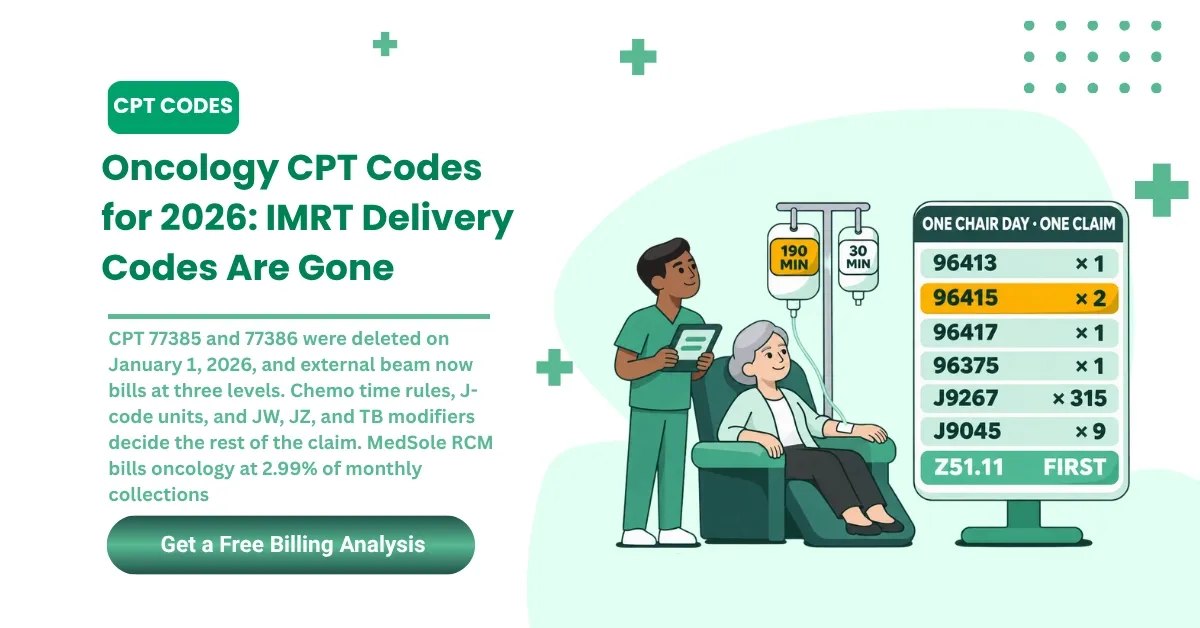
- Since January 1, 2026, external beam delivery bills as 77402 (Level 1), 77407 (Level 2), or 77412 (Level 3), and 77385, 77386, 77401, and G6001 to G6017 no longer exist.
- Medicare Part B claims for single-dose drugs need JW (waste) or JZ (no waste), and 340B-acquired drugs need TB.
- CPT 2027 takes effect January 1, 2027, and Medicare's non-APM conversion factor falls 2.31% to $32.63.
About the author: [Author name] is a certified coder at MedSole RCM. [Author name] researched and wrote this guide, [Reviewer name] checked each code against the linked sources, and both are named credentialed coders.
In This Guide
This guide to oncology CPT codes runs in the order of a claim.
|
Topic |
Jump to |
|---|---|
|
Basics and updates |
|
|
Visits and infusions |
|
|
Drugs |
|
|
Radiation and cellular therapy |
|
|
Diagnostics and care between visits |
Pathology, Bone Marrow, and Molecular Codes; Navigation and Care Management |
|
Claim support |
|
|
Getting help |
What Are Oncology CPT Codes?
In oncology coding, the CPT set covers office visits, chemotherapy administration, radiation oncology, CAR-T therapy, bone marrow procedures, pathology and molecular tests, and care management. In oncology medical coding, one treatment day can need codes from three of these categories, plus a HCPCS drug code and an ICD-10-CM diagnosis that supports them.
Oncology CPT Code Categories and Code Ranges
Use this list of oncology CPT codes by category as your starting map. It's current for 2026 and for the 2027 code set.
|
Category |
Codes |
What it reports |
2026 to 2027 status |
|---|---|---|---|
|
Office visits (E/M) |
99202 to 99205 new; 99211 to 99215 established |
Visits, chosen by medical decision making or total time |
Unchanged |
|
Consultations |
99242 to 99245 |
Office consults for commercial plans |
99241 deleted in 2023; Medicare pays no consult codes |
|
Chemotherapy and complex drug administration |
96401 to 96549 |
How antineoplastic drugs are given, by route and time |
No 2026 coding change |
|
Hydration, therapeutic, and diagnostic infusions |
96360 to 96379 |
Hydration and supportive drugs |
Unchanged |
|
Scalp cooling |
97007 to 97009 |
Mechanical scalp cooling during chemotherapy |
New January 1, 2026 |
|
Radiation oncology |
77261 to 77799 |
Planning, simulation, physics, delivery, management, and brachytherapy |
Delivery revised and 77436 to 77439 added January 1, 2026 |
|
CAR-T cell therapy |
38225 to 38228 |
Cell collection through administration |
Effective January 1, 2025 |
|
Bone marrow |
38220 to 38222 |
Aspiration, biopsy, or both |
Unchanged |
|
Surgical pathology and IHC |
88300 to 88309, 88341, 88342, 88360 |
Tissue exams and tumor biomarker stains |
Unchanged |
|
Molecular tumor panels |
81445, 81449, 81450, 81451, 81455, 81456 |
Targeted genomic sequencing panels, DNA and RNA |
Unchanged |
|
Navigation and care management |
99424 to 99427 (CPT); G0023, G0024 (HCPCS) |
Principal care management and principal illness navigation |
Unchanged |
|
Drugs (HCPCS, not CPT) |
J9000 to J9999 |
Antineoplastic drugs, billed per unit |
Updated quarterly |
[Button: Download the 2026 Oncology Coding Cheat Sheet (PDF)]
In most practices, pathology and molecular codes go on the lab's claim. If your group runs its own lab, the pathology CPT codes guide covers specimen levels, stains, and the rules that trip up billing teams.
CPT, HCPCS, and ICD-10: Three Code Sets on Every Oncology Claim
A typical infusion claim in oncology billing and coding pulls from three code sets. Each one answers a different question, and the payer checks that the three agree before it pays.
|
Code set |
Maintained by |
Answers |
Oncology example |
|---|---|---|---|
|
CPT |
American Medical Association |
What was done |
96413, the first hour of a chemo infusion |
|
HCPCS Level II |
Centers for Medicare & Medicaid Services |
Which drug, and how much |
J9045, carboplatin per 50 mg |
|
ICD-10-CM |
CDC's National Center for Health Statistics, with CMS |
Why it was done |
Z51.11, encounter for antineoplastic chemotherapy, then the cancer code |
The AMA publishes CPT and its yearly changes, and you can check any descriptor in AMA's CPT code set resources. CMS assigns the HCPCS drug codes, and the diagnosis codes follow the ICD-10-CM Official Guidelines.
Take a 450 mg carboplatin infusion for right breast cancer. You'd bill 96413 for the administration, J9045 x 9 units for the drug, and Z51.11 first with C50.911 second. Get any one wrong and the payer has a reason to deny the line, so matching all three is the core of medical billing for oncology and coding for cancer care.
What Changed in 2026 and What Changes in 2027
Radiation changed the most among oncology CPT codes in 2026. Delivery now bills by complexity, image guidance pays the professional side only, and surface radiation and scalp cooling got new codes. Chemotherapy administration kept the same codes it used in 2025. For 2027, expect bigger changes to Medicare payment than to the codes themselves.
2026 Oncology Coding Changes at a Glance
This list of 2026 CPT code changes for radiation oncology and medical oncology shows what each one means on a claim. Every one of the 2026 radiation oncology coding changes below took effect January 1, 2026.
|
Change |
Codes |
Effective |
What it means on the claim |
|---|---|---|---|
|
Delivery billed by complexity |
77402 (Level 1), 77407 (Level 2), 77412 (Level 3), all revised |
January 1, 2026 |
You code each fraction by isocenters, motion management, and field type, not by 3D or IMRT technique |
|
Image guidance, professional only |
77387 |
January 1, 2026 |
You bill the physician's work; the technical part sits inside the delivery code |
|
Deleted |
77385, 77386, 77401, 77014, 0394T, G6001 to G6017 |
January 1, 2026 |
Claims with these codes reject, so pull them from the chargemaster |
|
Surface radiation therapy, new |
77436 to 77439 |
January 1, 2026 |
These replace 77401 and 0394T |
|
Scalp cooling, new |
97007 to 97009 (0662T and 0663T deleted) |
January 1, 2026 |
Billable only when clinical staff deliver it with an FDA-defined device |
|
Chemotherapy administration |
96401 to 96549 |
No 2026 coding change |
Same codes as 2025 |
|
ICD-10-CM FY2027 |
C78.31, C78.32, and C79.83, among 190 new billable codes |
October 1, 2026 |
More specific codes for secondary cancer sites |
ASTRO's 2026 code summary walks through the delivery and image guidance changes. The full crosswalk for deleted codes sits in the radiation section below, and the radiation oncology coding cheat sheet 2026 PDF puts it on one page.
What Are the New CPT Codes for Radiation Oncology in 2026?
The new radiation oncology CPT codes for 2026 are 77436, 77437, 77438, and 77439, for surface radiation therapy. In the same update, 77402, 77407, and 77412 became Level 1, 2, and 3 delivery codes that include imaging guidance, 77387 became professional only, and the AMA and CMS retired 77385, 77386, 77401, 77014, and G6001 to G6017.
What 2027 Brings for Oncology Billing
- CPT 2027: The AMA released CPT 2027 on September 9, 2026, with 299 new, 74 revised, and 80 deleted codes, effective January 1, 2027. The AMA's CPT 2027 release highlights changes that don't restructure chemo administration or radiation delivery. Our 2027 CPT code changes guide covers the full list.
- Conversion factor: CMS released the CY 2027 Physician Fee Schedule final rule on November 4, 2026. It sets $32.95 for qualifying APM participants (down 1.83%) and $32.63 for everyone else (down 2.31%), per the AAMC summary of the final rule. Commercial contracts priced as a percentage of Medicare drop with it.
- Hospital radiation payment: The CY 2027 OPPS final rule moves 77407 into APC 5623, the same payment group as 77412. For Medicare radiation oncology in hospital outpatient departments, Level 2 and Level 3 fractions now land in one APC.
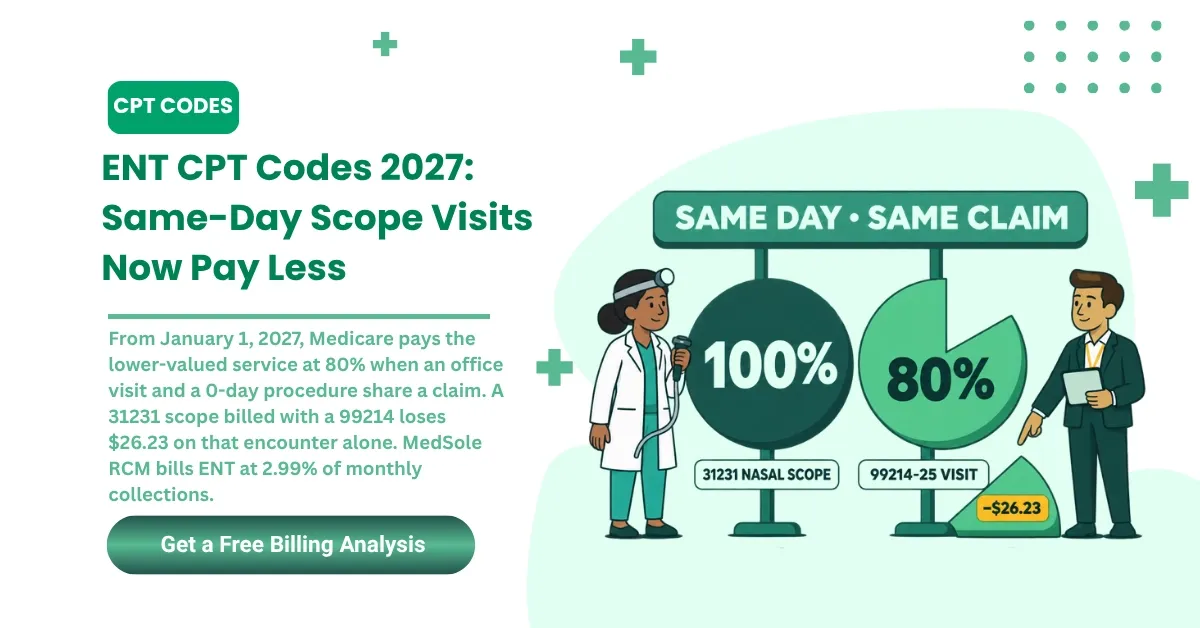
- Modifier 25 with 0-day procedures: Starting January 1, 2027, Medicare pays the lower-paid service 20% less when an office visit with modifier 25 and a 0-day global procedure fall on the same day for the same physician or group. Chemo administration (96413) and bone marrow biopsy (38222) have no global period, so those same-day pairs keep full payment.
- ICD-10-CM FY2027: The new code set took effect October 1, 2026, and adds C78.31, C78.32, and C79.83 for secondary cancer of the larynx, pharynx, and oral cavity.
If your chargemaster still carries 77385 or G6015, those lines reject on 2026 dates of service. A practice billing audit finds them before your next claim run, along with any other retired codes still mapped in your system.
Oncology E/M and Consultation Codes
In medical oncology billing, office visits use 99202 to 99205 for new patients and 99211 to 99215 for established patients, leveled by medical decision making or total time. Medicare doesn't pay consultation codes, though some commercial plans still pay 99242 to 99245. A separate visit on a chemo day needs modifier 25.
What Is the CPT Code for an Oncology Office Visit?
The CPT codes for an oncology office visit are 99202 to 99205 for new patients and 99211 to 99215 for established patients. Among oncology CPT codes, these are the visit codes you'll bill between treatment cycles, and the level depends on documented medical decision making or total time on the date of the visit.
|
Code |
Patient |
Medical decision making |
Total time to meet or exceed |
|---|---|---|---|
|
99202 |
New |
Straightforward |
15 minutes |
|
99203 |
New |
Low |
30 minutes |
|
99204 |
New |
Moderate |
45 minutes |
|
99205 |
New |
High |
60 minutes |
|
99212 |
Established |
Straightforward |
10 minutes |
|
99213 |
Established |
Low |
20 minutes |
|
99214 |
Established |
Moderate |
30 minutes |
|
99215 |
Established |
High |
40 minutes |
Code 99211 is the clinical staff visit, and it has its own chemo-day rule below. For a high-complexity established visit, our CPT 99215 guide walks through the documentation an auditor will look for.
You won't find a CPT code for an oncology referral, because the referral itself isn't billable. The oncologist's first visit bills as a new-patient visit, or as a consult when the payer still pays consult codes.
CPT Code for an Oncology Consultation: Commercial Plans vs. Medicare
Office consultations bill with 99242 to 99245, since the AMA deleted 99241 in 2023. Medicare stopped paying consultation codes for services on or after January 1, 2010, as the CMS consultation FAQ explains. For Medicare patients, you bill an office visit code (99202 to 99215) or the hospital code that fits the setting.
Commercial plans vary, and several follow Medicare's lead. Check each payer's consultation policy before the first visit, then confirm it again during the benefit check so the front desk and the coder work from the same answer.
A referred Medicare patient sees your oncologist, and the claim goes out as 99244. It comes back unpaid. If the documentation supports it, your team rebills the visit as 99204 or 99205, and it pays under the fee schedule.
Billing an E/M Visit on a Chemotherapy Day
Billing an office visit with chemo on the same date follows Medicare's oncology billing guidelines in the Medicare Claims Processing Manual, Chapter 12, section 30.5. Four rules cover most chemo-day visits:
- Report a significant, separately identifiable E/M visit with modifier 25 on the E/M code.
- Don't bill 99211 with a chemotherapy or other drug administration code. Medicare won't pay it, with or without modifier 25.
- Leave G2211 off. CMS doesn't pay G2211 when the visit carries modifier 25, unless the other same-day service is an annual wellness visit, a vaccine administration, or a Part B preventive service, per CMS G2211 guidance.
- Document what makes the visit separate: an assessment and plan beyond the routine pre-treatment check, such as managing neutropenia or changing the regimen, with its own MDM or time.
Say your oncologist bills a 99214-25 for chemotherapy-induced nausea plus a dose change, with 96413 the same day. That visit meets the test. If the modifier 25 goes missing, the line can come back as one of the CO-4 denials your team then has to rework.
Chemotherapy Administration CPT Codes
Among oncology CPT codes, chemotherapy administration codes (96401 to 96549) describe how a drug goes in, by route and time. They don't identify the drug. The drug gets its own HCPCS line, and the administration code tells the payer what your nurses did to give it.
There's no single CPT code for chemo. A typical infusion day uses 96413 for the first hour, 96415 for each added hour, and 96417 for a sequential different drug, while IV pushes use 96409 and 96411 and injections use 96401 and 96402. Our chemotherapy CPT codes guide covers each route in depth.
Chemotherapy Administration Code Table, 96401 to 96549
Keep this table next to the other oncology CPT codes your team uses. It lists the chemotherapy infusion CPT codes and injection codes by route, and a plus sign marks an add-on code you report only with its primary code.
|
Code |
Plain-language description |
|---|---|
|
96401 |
Chemo injection, subcutaneous or intramuscular, non-hormonal |
|
96402 |
Chemo injection, subcutaneous or intramuscular, hormonal (used for ADT) |
|
96405 / 96406 |
Intralesional, up to seven lesions / more than seven lesions |
|
96409 |
IV push, single or initial drug |
|
+96411 |
IV push, each additional drug |
|
96413 |
IV infusion, up to one hour, single or initial drug |
|
+96415 |
IV infusion, each additional hour |
|
96416 |
Start of a prolonged infusion (more than eight hours) on a portable or implantable pump |
|
+96417 |
Each additional sequential infusion of a different drug, up to one hour |
|
96420 to 96425 |
Intra-arterial push, infusion, and pump start |
|
96440 |
Into the pleural cavity, including thoracentesis |
|
96446 |
Into the peritoneal cavity through an indwelling port or catheter |
|
96450 |
Into the central nervous system (for example intrathecal), including spinal puncture |
|
96521 / 96522 |
Refill and maintenance of a portable pump / an implantable pump or reservoir |
|
96523 |
Irrigation of an implanted venous access device (port flush) |
|
96542 |
Injection through a subcutaneous reservoir into the subarachnoid or intraventricular space |
|
+96547 / +96548 |
Hyperthermic intraperitoneal chemotherapy (HIPEC) during surgery, first 60 minutes / each additional 30 minutes |
|
96549 |
Unlisted chemotherapy procedure |
|
G0498 |
Medicare HCPCS code: infusion started in the office and continued at home on an office-supplied pump |
The ACCC's 2026 provider alert confirms medical oncology saw no coding changes to these services for 2026. It also notes that chemotherapy administration has no global surgical package, which matters for the 2027 modifier 25 rule above.
CPT Code 96413, 96415, and 96417: Time Rules With a Worked Example
Four timing rules decide most infusion claims:
- CPT code 96413 needs more than 15 minutes of infusion. At 15 minutes or less, you bill a push (96409) instead.
- CPT 96415 starts once the same drug runs more than 30 minutes past the first hour, so the first unit begins at 91 minutes and the second at 151 minutes.
- Code 96417 covers each different drug given in sequence, up to one hour. Time past that hour for the same drug goes to 96415.
- Start and stop times for each drug decide all of the above. A note that says "infusion completed" doesn't.
This patient's infusion day runs through the next section too, so you can follow one claim from start to finish.
|
Event in the chair |
Time |
Code |
|---|---|---|
|
Paclitaxel IV infusion |
190 minutes |
96413 x 1, 96415 x 2 |
|
Carboplatin IV infusion, after paclitaxel |
30 minutes |
96417 x 1 |
|
Ondansetron IV push before chemo |
2 minutes |
96375 x 1 |
|
Saline only, to keep the line open |
n/a |
Not billed |
The paclitaxel ran 190 minutes, so cpt 96413 covers the first hour and two units of 96415 cover the rest. Bill one unit of 96415 and you've left the second added hour unpaid. In the office, the ondansetron push is the sequential service, because chemo was the reason for the visit.
Initial, Sequential, and Concurrent: Choosing the Initial Service
You report one initial service per encounter, unless the protocol needs two separate IV sites. In that case, the second initial service takes modifier 59 or the X-modifier the payer requires. Our guide to modifier 59 and X-modifiers covers which one fits.
In the physician office, the initial code is the service tied to the main reason for the visit, whatever order things happened in. Hospital outpatient claims follow the facility hierarchy instead: chemotherapy first, then therapeutic or diagnostic infusions and pushes, then hydration. Infusions outrank pushes, and pushes outrank injections.
Sequential means one drug after another through the same line. Concurrent means two drugs at once through the same line, and non-chemo concurrent infusions use +96368. A practice manager who sees 96365 billed as the initial chemotherapy CPT code on a chemo day has found the reason that claim reprocessed.
Hydration and Supportive Drugs on a Chemo Day
Hydration (96360 and +96361) is billable only when it runs more than 30 minutes and has its own clinical reason. Fluid used to give a drug or keep the vein open belongs to the administration code, so it doesn't get a line of its own.
Supportive drugs given after the initial chemo service use add-on codes:
- +96367 for a sequential infusion of a new drug
- +96368 for a concurrent infusion
- +96375 for a sequential push of a new drug
- 96372 for a subcutaneous or intramuscular injection, covered in our CPT code 96372 guide
New for 2026: Scalp Cooling Codes 97007 to 97009
|
Code |
When you report it |
|---|---|
|
97007 |
Initial measurement and calibration of the cap, once per chemotherapy treatment period |
|
97008 |
Hair preparation, cap placement, therapy start, and pre-cooling, once per chemotherapy session |
|
+97009 |
Each 30 minutes of cooling after chemotherapy ends; not reported for less than 16 minutes |
These codes replaced Category III codes 0662T and 0663T on January 1, 2026. You can't bill them when the patient runs the cooling device alone, and they require an FDA-defined medical device used by trained clinical staff under physician supervision.
Missing stop times can turn a 96413 plus two units of 96415 into a single 96413 on the claim. MedSole RCM handles oncology billing for a flat 2.99% of monthly collections, with no setup fee, through our outsourced medical billing services. If stop times keep going missing in your notes, that's the first workflow we'd look at with you.
Oncology Drug Codes, Billing Units, and Waste Modifiers
Oncology CPT codes cover the administration, and the drug bills on its own line with a HCPCS Level II code, J9000 to J9999 for most antineoplastics. You bill units from the code's dosage descriptor, whatever the vial size. Medicare Part B single-dose drugs also need JW or JZ, and 340B-acquired drugs need TB.
Two Claim Lines for One Dose
- Line 1: the administration code, such as 96413
- Line 2: the HCPCS drug code with units, such as J9045 x 9
Medicaid requires the 11-digit NDC with the N4 qualifier on physician-administered drugs, and many commercial plans ask for it too. Set up each payer's NDC rule when you load the payer into your billing system, so the rule is in place before the first claim goes out.
Converting the Dose Into Billing Units
The same patient from the infusion example also received fluorouracil on a later cycle, and the drug lines look like this:
|
Drug |
HCPCS code and descriptor unit |
Dose given |
Units billed |
|---|---|---|---|
|
Paclitaxel |
J9267, per 1 mg |
315 mg |
315 |
|
Carboplatin |
J9045, per 50 mg |
450 mg |
9 |
|
Fluorouracil |
J9190, per 500 mg |
2,500 mg |
5 |
Units equal the dose given divided by the descriptor quantity. The J9190 code description is injection, fluorouracil, 500 mg, so 2,500 mg bills as five units. HCPCS J9045 carboplatin and J9190 fluorouracil both use units larger than 1 mg, so a coder who enters milligrams instead of units overstates the line.
If the dose isn't a multiple of the descriptor, you round up to the next unit, and a dose below the descriptor's minimum bills as one unit, per the Medicare Claims Processing Manual, Chapter 17. Units above the code's Medically Unlikely Edit (MUE) limit deny at the line level.
JW, JZ, and TB Modifiers
The CMS JW and JZ FAQ sets the rules for single-dose containers:
- JW reports the discarded amount on its own claim line, required since January 1, 2017.
- JZ attests that nothing was discarded, required no later than July 1, 2023.
- Medicare can return claims missing a required JW or JZ as unprocessable, starting October 1, 2023.
- Neither modifier applies to multiple-dose containers.
A 100 mg single-dose vial billed per 1 mg, with 95 mg given, goes out as two lines: 95 units with no modifier and five units with JW. TB marks 340B-acquired drugs, and CMS has required it from all 340B covered entities since January 1, 2025, when the JG modifier ended, per CMS 340B modifier guidance.
Androgen Deprivation Therapy Billing Codes
Androgen deprivation therapy billing codes pair the hormonal injection code 96402 with the drug's HCPCS code. First Coast's LHRH analog coding guide, written by a Medicare contractor, lists 96402 as the administration code for these drugs.
|
Drug |
HCPCS |
Unit |
Worked units |
|---|---|---|---|
|
Leuprolide acetate depot (prostate dosing) |
J9217 |
7.5 mg |
22.5 mg = 3 units; 45 mg = 6 units |
|
Leuprolide acetate depot |
J1950 |
3.75 mg |
11.25 mg = 3 units |
|
Goserelin implant |
J9202 |
3.6 mg |
10.8 mg = 3 units |
|
Triptorelin pamoate |
J3315 |
3.75 mg |
11.25 mg = 3 units; 22.5 mg = 6 units |
|
Degarelix |
J9155 |
1 mg |
240 mg starting dose = 240 units; 80 mg = 80 units |
Oral ADT, such as relugolix, runs through the pharmacy benefit, so there's no 96402 line to bill. Billing codes for oral oncology medication management come from your visit and care management codes instead. Many commercial plans require prior authorization for injectable ADT, and our prior authorization services team submits those requests before the injection date.
Buy-and-Bill Basics: ASP Plus 6% and the NCCN Compendium
In buy and bill oncology, the practice buys the drug, gives it, and bills the payer. Medicare Part B pays most physician-administered drugs at average sales price (ASP) plus 6%, using the quarterly CMS ASP pricing files. The October 2026 file is the current one, and sequestration trims what Medicare pays, so don't quote a net percentage to your physicians.
For off-label anticancer use, Medicare accepts the compendia listed in the Medicare Benefit Policy Manual, Chapter 15, section 50.4.5, including the NCCN Drugs and Biologics Compendium. Noridian's off-label guidance treats NCCN Category 1 and 2A as medically accepted and Category 3 as not.
High-cost regimens often stall before the first cycle, through an unverified benefit or a missing authorization. Our benefit verification services confirm drug coverage and the patient's cost share before the patient sits down in the chair.
Radiation Oncology CPT Codes by Process of Care
Radiation oncology CPT codes run from 77261 to 77799 and follow the course of care: treatment planning, simulation, physics and devices, delivery, image guidance, weekly management, and brachytherapy. Radiation sits apart from the other oncology CPT codes because one course produces weeks of daily charges, and a setup error repeats on each fraction.
Radiation Therapy CPT Codes in the Order of a Treatment Course
This radiation oncology CPT codes list follows the order a course is billed. It covers the radiation CPT codes most external beam courses touch, plus the billing rule your coder needs at each step.
|
Step |
Codes |
What it reports |
Billing rule |
|---|---|---|---|
|
1. Clinical treatment planning |
77261 simple, 77262 intermediate, 77263 complex |
The physician's plan for target, dose, and technique |
Level follows documented complexity |
|
2. Simulation |
77280 simple, 77285 intermediate, 77290 complex, +77293 respiratory motion management |
Setting up treatment fields |
For IMRT, the plan (77301) includes simulation-aided field setting; +77293 goes with 77295 or 77301 |
|
3. Planning and dosimetry |
77295 3D plan, 77301 IMRT plan, 77300 basic dosimetry, 77306 and 77307 isodose plans, 77316 to 77318 brachytherapy isodose plans |
Dose calculations and treatment plans |
Isodose plans include basic dosimetry, so 77300 isn't added to them |
|
4. Devices and special physics |
77332 to 77334 devices; 77338 MLC device for IMRT; 77321 special port plan; 77331 special dosimetry; 77370 special physics consultation |
Blocks, molds, MLC design, and special physics work |
77338 bills once per IMRT plan; 77301 includes most IMRT devices |
|
5. Weekly physics |
77336 |
Continuing medical physics consultation |
Once per week of therapy; technical only under Medicare; NCCI bundles it with same-day planning, dosimetry, and device codes |
|
6. Delivery |
77402, 77407, 77412; 77371 and 77372 SRS; 77373 SBRT; 77520 to 77525 proton; 77437 and 77438 surface |
Each fraction delivered |
One delivery code per day, even with two sites treated |
|
7. Image guidance |
77387 |
Physician work for image guidance |
Professional only since January 1, 2026 |
|
8. Treatment management |
77427, 77431, 77432, 77435, 77469, 77470 |
Physician management of the course |
77427 per five fractions |
|
9. Brachytherapy |
77750 to 77799 |
Source placement and delivery |
Includes treatment management; 77790 is technical only |
|
10. Hyperthermia |
77600 to 77620 |
Heat treatment given with radiation |
Check payer coverage first |
[Button: Download the Radiation Oncology Coding Cheat Sheet 2026 (PDF)]
Most CPT codes for radiation oncology planning and physics split into professional and technical components, so the physician and the facility can each bill their part. Our modifier 26 rules cover that split. Diagnostic CT or PET for staging bills from radiology codes instead, and our radiology CPT codes guide covers that range.
Radiation Treatment Delivery Levels 1 to 3: 77402, 77407, and 77412
There's no single CPT code for radiation delivery. Under the radiation oncology CPT codes for 2026, each fraction's code depends on how complex that fraction was. The planning technique, 3D or IMRT, doesn't decide it. ASTRO defines the levels this way:
|
Level |
Code |
The fraction involves |
|---|---|---|
|
Level 1 |
77402 |
A single electron field, multiple electron fields, or 2D photons |
|
Level 2 |
77407 |
A single isocenter with photons, whether the plan is 3D or IMRT |
|
Level 3 |
77412 |
Multiple isocenters with photons, a single-isocenter photon treatment with active motion management, total skin electrons, or mixed electron and photon fields |
You report one delivery code per day, even when your team treats two sites, and treating multiple isocenters together makes the fraction Level 3, per the ASTRO treatment delivery FAQ. The technical side of imaging guidance sits inside all three codes, in hospital and freestanding settings alike.
The 77402 CPT code description lists single or multiple electron fields and 2D photons as Level 1 examples. The 77407 CPT code description lists a single isocenter with photons, 3D or IMRT. Before you code a gated or tracked course as 77412, check ASTRO's coding FAQs and the CPT 2026 descriptor, and document motion management in each fraction's record.
CPT 77387 in 2026: Image Guidance, Professional Only
Since January 1, 2026, CPT 77387 reports only the physician's image guidance work. The technical part sits inside 77402, 77407, and 77412, and the ACCC's 2026 alert notes there's no longer a site-of-service difference for reporting it.
The 77387 CPT code changed meaning in 2026, and some payer edits and older references still describe it the 2025 way. Confirm with your Medicare contractor how often you report 77387 and whether it wants a modifier, before the first 2026 claim goes out.
Deleted Radiation Codes and What Replaced Them
The 2026 radiation oncology coding changes retired the codes below, and none of them has a one-to-one replacement. The new code depends on what each fraction involved. BCBST's 2026 radiation code list shows the full set of deleted codes in one place.
|
Deleted January 1, 2026 |
What it reported |
Bill instead |
|---|---|---|
|
77385 |
IMRT delivery, simple |
77407 or 77412, by delivery complexity |
|
77386 |
IMRT delivery, complex |
77407 or 77412, by delivery complexity |
|
G6015, G6016 |
Medicare IMRT delivery G-codes for freestanding centers (G6016 for compensator-based IMRT) |
77407 or 77412 |
|
G6003 to G6014 |
Medicare delivery G-codes by treatment areas and energy, such as G6012 |
77402, 77407, or 77412 |
|
G6001, G6002, G6017 |
Ultrasound guidance, stereoscopic X-ray guidance, and intrafraction tracking |
Technical work sits in delivery; physician work goes to 77387 |
|
77014 |
CT guidance for placing radiation fields |
Included in delivery |
|
77401 |
Superficial and orthovoltage delivery |
77437 or 77438, with 77436 for planning and +77439 for ultrasound guidance |
|
0394T |
HDR electronic brachytherapy, skin surface |
77436 to 77439 |
IMRT CPT codes for delivery are gone, but IMRT planning (CPT 77301) and the MLC device code stay. You bill by date of service, so fractions given through December 31, 2025, keep the old codes, and fractions from January 1, 2026, use the new ones.
If an authorization issued in 2025 still lists 77385 or G6015, ask the payer to update it before the 2026 fractions bill. The 2026 radiation oncology coding cheat sheet puts this crosswalk on one page.
Surface Radiation Therapy Codes 77436 to 77439
|
Code |
What it reports |
|---|---|
|
77436 |
Superficial or orthovoltage treatment planning and simulation-aided field setting |
|
77437 |
Superficial delivery at 150 kV or less, per fraction (for example electronic brachytherapy) |
|
77438 |
Orthovoltage delivery above 150 kV and up to 500 kV, per fraction |
|
+77439 |
Ultrasound image guidance for placing fields on skin tumors, once per course, only with 77437 or 77438 |
You don't report these with clinical treatment planning, simulation, 3D planning, dosimetry, isodose planning, devices, external beam or stereotactic delivery, or treatment management codes. BCBST's 2026 list requires prior authorization for all four, and other commercial plans may follow.
Stereotactic, Brachytherapy, and Special Procedure Codes
- SRS: 77371 (Cobalt-60) and 77372 (linear accelerator) each report a complete one-session course for cranial lesions, and stereotactic guidance is included. Management is 77432, once per course.
- SBRT: CPT 77373 reports delivery per fraction, including image guidance, for a course of no more than five fractions. Management is CPT 77435, once per course. Your team doesn't use 77427 or 77431 for stereotactic courses, and 77432 and 77435 don't go on the same course.
- Brachytherapy: The CPT code for brachytherapy depends on dose rate and channels: HDR afterloading 77770 (one channel), 77771 (two to 12 channels), and 77772 (over 12 channels), LDR interstitial 77778, and surface application 77789. Source handling, 77790, is technical only and can't be added to prostate LDR 77778, per the ASTRO brachytherapy FAQ.
- Brachytherapy bundling: Each brachytherapy CPT code includes treatment management (77427 and 77431) and, for HDR and LDR, basic dosimetry (77300).
- CPT 77470, special treatment procedure: The 77470 CPT code description covers work such as total body irradiation, hemibody radiation, or per oral, endocavitary, or intraoperative cone irradiation. Payers allow it once per course in most cases, with documentation of the extra work.
The 77373 CPT code description caps SBRT at five fractions, so a six-fraction course bills as conventional delivery with 77427 management.
Radiation Treatment Management: CPT 77427 and the Five-Fraction Rule
The 77427 CPT code description reads "radiation treatment management, five treatments," and the Medicare Claims Processing Manual, Chapter 13, section 70.1, sets the counting rules:
- One unit of 77427 equals five fractions or treatment sessions.
- At the end of a course, three or four leftover fractions pay as one more unit.
- One or two leftover fractions don't bill, because Medicare radiation oncology rules treat them as paid through prior payments.
- 77431 covers a complete course of one or two fractions, and you don't use it for the last fractions of a longer course.
A 28-fraction course bills 77427 x 6: five full units, plus one for the last three fractions. A 16-fraction course bills 77427 x 3, since the one extra fraction rides on the units already paid.
Radiation Course Examples
These examples show code order on a clean course. Your physician's documentation decides each line.
CPT Code for Radiation Therapy for Prostate Cancer
A 28-fraction IMRT course with a single isocenter and fiducials placed:
|
Step |
Code |
Units |
|---|---|---|
|
Fiducial marker placement |
55876 |
1 |
|
Rectal hydrogel spacer, if placed |
55874 |
1 |
|
Clinical treatment planning |
77263 |
1 |
|
IMRT plan, including simulation-aided field setting |
77301 |
1 |
|
MLC device |
77338 |
1 per IMRT plan |
|
Weekly physics |
77336 |
1 per week of therapy |
|
Delivery |
77407 (Level 2) |
28 |
|
Image guidance, physician work |
77387 |
Per your contractor's instruction |
|
Treatment management |
77427 |
6 |
|
Diagnosis |
Z51.0, then C61 |
n/a |
Under the NCCI Policy Manual, Chapter 9, the IMRT plan includes simulation-aided field setting, so 77280 to 77290 stay off this claim for the IMRT plan. CPT 77301 also includes most IMRT treatment devices, so 77332 to 77334 don't bill in most cases. If the record documents active motion management, delivery moves to 77412.
CPT Code for Radiation Therapy for Breast Cancer
A 15-fraction whole-breast course with a 3D plan:
|
Step |
Code |
Units |
|---|---|---|
|
Clinical treatment planning |
77263 |
1 |
|
Simulation |
77280, 77285, or 77290, by documented complexity |
1 |
|
Respiratory motion simulation, if performed |
+77293 |
1 |
|
3D plan |
77295 |
1 |
|
Devices |
77332 to 77334 |
As documented |
|
Weekly physics |
77336 |
1 per week of therapy |
|
Delivery |
77407 for a single isocenter; 77412 if a matched field adds a second isocenter |
15 |
|
Treatment management |
77427 |
3 |
|
Diagnosis |
Z51.0, then the breast cancer code (for example C50.911) |
n/a |
A five-fraction whole-breast course bills 77427 x 1. Both examples, with the delivery level table, are in the radiation oncology coding cheat sheet.
A course that adds an isocenter partway through changes the delivery level from that fraction on, and radiation oncology billing errors like that repeat on each claim until someone catches them. If you'd like medical billing for radiation oncology checked fraction by fraction, our radiation oncology billing services cover the course from planning to the final management unit.
CAR-T Cell Therapy Codes, 38225 to 38228
CAR-T therapy bills with four Category I CPT codes, effective January 1, 2025: 38225 for collecting T cells, 38226 for preparing them for transport, 38227 for receiving and preparing the cells, and 38228 for administration. They replaced Category III codes 0537T to 0540T, and they're the newest family of oncology CPT codes for cellular therapy.
CMS confirmed the switch for Medicare claims in transmittal R13608CP, dated January 29, 2026, which also updated the CAR-T coverage policy in NCD 110.24.
|
Code |
Step |
Replaced |
Medicare payment |
Hospital revenue code |
|---|---|---|---|---|
|
38225 |
Harvesting blood-derived T lymphocytes, per day |
0537T |
Bundled, no separate payment |
0871 |
|
38226 |
Preparing T lymphocytes for transport, such as cryopreservation and storage |
0538T |
Bundled |
0872 |
|
38227 |
Receiving and preparing CAR-T cells for administration |
0539T |
Bundled |
0873 |
|
38228 |
CAR-T cell administration, autologous |
0540T |
Separate payment |
0874 |
The product itself bills with its own HCPCS Q-code, one unit per therapeutic dose. Q2041 is axicabtagene ciloleucel, Q2042 is tisagenlecleucel, Q2053 is brexucabtagene autoleucel, Q2054 is lisocabtagene maraleucel, Q2055 is idecabtagene vicleucel, and Q2056 is ciltacabtagene autoleucel.
If the patient receives the cells as an inpatient, the stay groups to MS-DRG 018. CMS also dropped the REMS requirement and the KX modifier for CAR-T claims, effective June 26, 2025, but claims with dates of service before June 27, 2025, still need KX, per the ASTCT CAR-T coding guide.
Commercial and Medicaid plans set their own payment and authorization rules for each CAR-T step. Confirm coverage for collection, the product, and administration before the collection day, because a missing authorization on a product this expensive is hard to fix after the fact.
Pathology, Bone Marrow, and Molecular Testing Codes
Some codes on a cancer workup come from other providers. In coding for oncology-related services, your oncologist bills bone marrow procedures, while the pathology lab tends to bill tissue exams, immunohistochemistry, and molecular panels. Those lab codes sit next to your oncology CPT codes in the patient's record, so the diagnosis codes on both claims need to match.
Bone Marrow Procedures: 38220 to 38222
|
Code |
What it reports |
|---|---|
|
38220 |
Diagnostic bone marrow aspiration(s) only |
|
38221 |
Diagnostic bone marrow biopsy(ies) only |
|
38222 |
Biopsy(ies) and aspiration(s) in the same session |
If your physician does both through the same site in one session, you report 38222 alone. In hematology oncology coding and billing, 38221 plus 38220 with modifier 59 is for separate sites, documented as such.
Surgical Pathology and Immunohistochemistry
- Surgical pathology runs from 88300 (Level I) to 88309 (Level VI) by specimen type, and 88305 covers many biopsies, including bone marrow biopsy.
- Immunohistochemistry uses 88342 for the first single-antibody stain per specimen, +88341 for each additional single antibody, and 88344 for each multiplex stain.
- Morphometric analysis, such as HER2 quantitation, uses 88360 (manual) or 88361 (computer-assisted).
Molecular Tumor Panels and Medicare NCD 90.2
Targeted genomic sequencing panels use 81445 for solid tumors (5 to 50 genes), 81450 for hematolymphoid cancers (5 to 50 genes), and 81455 for 51 or more genes. Each has an RNA-only version: 81449, 81451, and 81456. Branded tests often carry a Proprietary Laboratory Analyses (PLA) code instead.
Under Medicare NCD 90.2, Medicare covers next-generation sequencing for patients with recurrent, relapsed, refractory, metastatic, or stage III or IV cancer who haven't had the same test for the same cancer and have decided to seek further treatment. The treating physician orders it, and a CLIA-certified lab runs it.
FDA-approved or cleared companion diagnostics have national coverage, and your Medicare contractor decides coverage for other NGS tests.
Lab Draws on Treatment Days: 36415, 36591, and 36592
Code 36415 is a venipuncture, 36591 is a draw from a completely implantable venous access device (a port), and 36592 is a draw from an established central or peripheral catheter. Our CPT 36415 venipuncture guide covers the line between them.
CPT says not to report 36591 or 36592 with other services, except a laboratory service. A port flush (96523) follows a tighter rule: you don't report it when any other service happens the same day, and Medicare's Claims Processing Manual, Chapter 12, folds its payment into a same-day visit or drug administration.
Oncology Navigation and Care Management Codes
Alongside the oncology CPT codes for visits and treatment, your practice can bill monthly time between visits. Principal care management (99424 to 99427) covers care for one high-risk condition, such as active cancer. Principal illness navigation (G0023 and G0024) covers Medicare navigation by trained staff after an initiating visit.
Principal Care Management: 99424 to 99427
|
Code |
Whose time counts |
Per calendar month |
|---|---|---|
|
99424 |
Physician or other qualified health care professional |
First 30 minutes |
|
+99425 |
Physician or other qualified health care professional |
Each additional 30 minutes |
|
99426 |
Clinical staff, directed by the physician or QHP |
First 30 minutes |
|
+99427 |
Clinical staff, directed by the physician or QHP |
Each additional 30 minutes |
For care management billing for oncologists, the patient needs one high-risk condition expected to last at least three months. It has to put the patient at significant risk of hospitalization, decompensation, functional decline, or death, per the CMS care management booklet.
You can't bill PCM for under 30 minutes in a calendar month. CPT also keeps the physician pair (99424 and 99425) and the staff pair (99426 and 99427) apart, so you pick one track per patient per month.
Principal Illness Navigation: G0023 and G0024
G0023 covers 60 minutes of navigation a month by certified or trained auxiliary personnel, who work under the general supervision of the billing practitioner. Add-on G0024 covers each additional 30 minutes. Medicare began paying for both on January 1, 2024.
PIN starts with an initiating visit, in most cases an E/M visit by the practitioner who will supervise the navigation. Cancer qualifies, and the American Cancer Society PIN FAQ notes that CMS names it as an appropriate diagnosis. Patients or their surrogates must consent first, because cost sharing applies.
Some commercial plans don't recognize the G-codes, so check each plan before your navigators start logging time. Minutes you count toward one code can't count again toward another, and that rule holds across PCM and PIN.
ICD-10-CM Codes That Support Oncology CPT Claims
Payers pay oncology CPT codes only when the diagnosis supports them. If the encounter exists only to give treatment, you list Z51.0 (radiation), Z51.11 (chemotherapy), or Z51.12 (immunotherapy) first and the cancer second, per section I.C.2.e.2 of the FY 2027 ICD-10-CM Official Guidelines. Encounters for a complication of the cancer or its treatment use different sequencing.
Each rule below comes from the official oncology coding guidelines in Chapter 2 of that document, in effect October 1, 2026, through September 30, 2027. We've put the section number next to each rule so your coders can check it line by line.
Z51 Codes and Sequencing for Treatment Encounters
The ICD-10 codes for radiation therapy, chemotherapy, and immunotherapy encounters all sit in category Z51.
|
Encounter |
List first |
Then |
Guideline |
|---|---|---|---|
|
Chemotherapy infusion |
Z51.11, encounter for antineoplastic chemotherapy |
The cancer (for example C50.911) |
I.C.2.e.2 |
|
Antineoplastic immunotherapy |
Z51.12, encounter for antineoplastic immunotherapy |
The cancer |
I.C.2.e.2 |
|
External beam radiation |
Z51.0, encounter for antineoplastic radiation therapy |
The cancer (for example C61) |
I.C.2.e.2 |
|
More than one of these in the same encounter |
Z51.0 and Z51.1-, either one first |
The cancer |
I.C.2.e.2 |
|
Complication during the treatment encounter, such as dehydration |
The Z51 code |
The complication codes |
I.C.2.e.3 |
|
Brachytherapy (radioactive element insertion) |
The cancer |
No Z51.0 |
I.C.2.e.2 |
|
Visit only to treat anemia from the cancer |
The cancer |
D63.0, anemia in neoplastic disease |
I.C.2.c.1 |
|
Visit only to treat anemia from chemotherapy |
The anemia (D64.81) |
The cancer, then T45.1X5A |
I.C.2.c.2 |
For neutropenic fever after chemotherapy, use D70.1, agranulocytosis secondary to cancer chemotherapy. The Tabular List notes under D70 tell you to add R50.81 for the fever and T45.1X5- for the drug's adverse effect, and to code the underlying cancer too.
Active Cancer, Personal History, and Remission
In coding for cancer, you pick the code family by asking whether the disease is current or history:
- Keep coding the active cancer while surgery, radiation, or chemotherapy is still directed at the site (I.C.2.m).
- Switch to a Z85 code for the former site once treatment is complete and there's no evidence of disease, such as Z85.3 for breast (I.C.2.d). Follow-up visits after completed treatment use Z08 with the Z85 code.
- List the secondary site first, and the primary second, when treatment targets only the metastasis (I.C.2.l.2).
- Code remission status for leukemia and myeloma, for example C92.00 (AML, not in remission), C92.01 (in remission), and C92.02 (in relapse), and query the provider when the record doesn't say (I.C.2.n).
FY2027 ICD-10-CM Changes for Oncology
The new secondary-cancer codes from the 2027 section above, C78.31 (larynx), C78.32 (pharynx), and C79.83 (oral cavity), apply to dates of service from October 1, 2026. Update the claim edits and superbills that still map head and neck metastases to the older, less specific codes, so your coders don't pick them out of habit.
Modifiers on Oncology Claims
The modifiers that change payment on oncology CPT codes are 25, 59 and the X-modifiers, 26 and TC, JW, JZ, and TB, and the Medicare ABN modifiers GA, GZ, and GY. Each one ties to a rule in Medicare's oncology billing guidelines, and the last column points you to the section that covers it.
|
Modifier |
When it goes on an oncology claim |
Example |
Covered in |
|---|---|---|---|
|
25 |
A significant, separately identifiable E/M visit on the same day as chemotherapy or another procedure |
99214-25 with 96413 |
E/M and consultation codes |
|
59, XE, XS, XP, XU |
A second initial infusion through a separate IV site, or another distinct service NCCI would otherwise bundle |
38221 and 38220 from separate sites, with 59 or the X-modifier the payer requires |
Chemotherapy administration; bone marrow |
|
26 |
The professional part of a code that splits into professional and technical parts |
77290-26 from the radiation oncologist when the hospital bills the technical part |
Radiation oncology codes |
|
TC |
The technical part only |
77290-TC from the entity that owns the equipment |
Radiation oncology codes |
|
JW |
The discarded amount from a Medicare Part B single-dose container, on its own line |
Unused milligrams from a nivolumab (J9299) single-dose vial |
Drug codes and waste modifiers |
|
JZ |
Nothing was discarded from a single-dose container |
J9271 x 200 with JZ when two 100 mg pembrolizumab vials are used in full |
Drug codes and waste modifiers |
|
TB |
The drug was acquired through the 340B program |
Any 340B-acquired J-code line |
Drug codes and waste modifiers |
|
GA |
A signed ABN is on file, and you expect Medicare to deny the service as not reasonable and necessary |
A service outside the LCD's covered diagnoses, after the patient signs an ABN |
This section |
|
GZ |
No ABN is on file, and you expect Medicare to deny the service as not reasonable and necessary |
The same service without a signed ABN, so you can't bill the patient |
This section |
|
GY |
The service is excluded by statute or isn't a Medicare benefit |
A service Medicare doesn't cover under any circumstances |
This section |
CPT 77387 is professional only from January 1, 2026, so it doesn't take TC. Under Medicare, 77336 and 77370 are technical only, and 77263 and 77427 are professional only, so neither 26 nor TC belongs on those four. Our TC modifier guide shows how the split works on other services.
GA, GZ, and GY are Original Medicare modifiers, and the Advance Beneficiary Notice is form CMS-R-131, which the patient signs before the service. The CGS Medicare ABN guidance covers the current form and the use of each modifier.
You don't need an ABN for a service Medicare excludes by statute, though you can give a voluntary one and add GX. Medicare Advantage plans don't use the ABN, so check each plan's own pre-service rules. If a modifier doesn't fit the code, the payer sends the line back with CARC 4, which the next section covers.
Why Oncology Claims Get Denied: CARC 4, 16, 50, 97, and 197
Denials on oncology billing codes come back with a Claim Adjustment Reason Code (CARC) that tells you why. Five CARCs cover the errors this guide's rules prevent: 4 (modifier), 16 (missing information), 50 (medical necessity), 97 (bundled service), and 197 (no authorization). The X12 CARC list holds the official wording, and the table sums up each one.
|
CARC and what it means |
Typical oncology trigger |
Fix before the claim goes out |
|---|---|---|
|
4: The modifier doesn't match the procedure code |
JW or JZ on a multiple-dose vial; modifier 25 missing or misused on a same-day visit |
Match each modifier to the code type, using the modifier table above |
|
16: The claim or line is missing information or has a submission or billing error, and the payer adds at least one remark code |
A missing 11-digit NDC on a Medicaid drug line; a missing JW or JZ on a Medicare single-dose drug |
Report the NDC with the N4 qualifier, and add JW and JZ edits to your claim scrubber |
|
50: The payer doesn't consider the service medically necessary, so it isn't covered |
A diagnosis outside the LCD or NCD list, such as NGS outside NCD 90.2; off-label drug use without compendium support |
Check covered diagnoses before treatment, cite the compendium, and get an ABN with GA for Original Medicare |
|
97: The payer already paid for this service inside another service it processed |
96523 or 36591 billed with other same-day services; 77300 added to 77306 or 77307 |
Apply CPT parentheticals and NCCI edits by date of service |
|
197: No precertification, authorization, notification, or pre-treatment approval on file |
A regimen changed after approval; a radiation or surface RT course started without authorization |
Re-verify authorization whenever the regimen, drug, or course changes |
The group code tells you who carries the balance: CO means the practice writes it off, and PR means the patient owes it. Units above the Medically Unlikely Edit limit can come back as CARC 151, which says the payer finds the information doesn't support that many services or that frequency.
For appeal steps, see our guides to CO-50 medical necessity denials, CO-97 bundling denials, and CO-197 authorization denials.
Oncology billing challenges tend to repeat. If the same CARC keeps showing up on your remits, the cause sits upstream in intake, authorization, or charge capture, and resubmitting won't clear it. Our oncology denial management team traces that cause with you, and for MedSole clients on full-service billing, denial management is included in the 2.99% rate.
Oncology Denial Prevention Checklist
To prevent the oncology billing denials above, build these seven steps around the oncology CPT codes in this guide:
- Verify benefits and authorization for each drug and radiation course, and again when anything changes.
- Record start and stop times for each infusion.
- Bill units from the HCPCS descriptor, with the NDC where the payer requires it.
- Add JW, JZ, or TB where Medicare requires them.
- Code each radiation fraction to its 2026 level, and apply the five-fraction rule to 77427.
- List Z51.0, Z51.11, or Z51.12 first on treatment encounters.
- Sort denials by CARC and fix the cause in your workflow along with the claim, for faster oncology payment collection.
When to Bring In an Oncology Medical Billing Partner
Bring in an oncology billing partner when drug denials, unworked AR, or missed authorizations cost more than the service would. Look for oncology-trained coders, drug-line controls, regimen-level authorization checks, denial reporting by CARC, and pricing in writing. MedSole RCM charges a flat 2.99% of monthly collections for full-service billing, with no setup fee, and $99 per payer application for credentialing.
What to Look For in an Oncology Billing Company
For oncologist RCM, ask each company you talk to for these seven things:
- Coders trained in oncology, with CHONC or an equivalent credential, who bill oncology CPT codes day to day and already use the 2026 radiation levels.
- Drug-line controls: units from the HCPCS descriptor, NDCs, JW, JZ, and TB, and each quarter's ASP file.
- Benefit checks and prior authorization for each regimen and radiation course, repeated when anything changes.
- Denial reporting by CARC and payer, alongside the overall denial rate.
- Pricing stated as a percentage of collections, with the scope in writing. Medical billing for oncology includes drug lines, authorizations, and appeals, so you want each one named as included or extra.
- Credentialing in the same team, so a new oncologist's enrollment doesn't hold up claims.
- Month-to-month terms.
The same checklist works whether you outsource oncology billing for a medical oncology group or a radiation center.
What MedSole RCM Charges
MedSole RCM publishes one set of rates for its oncology RCM services, and radiation oncology billing service pricing follows the same table.
|
Service |
MedSole RCM price |
Included |
Market reference, from MedSole's published guides |
|---|---|---|---|
|
Full-service billing |
Flat 2.99% of monthly collections |
No setup, software, or clearinghouse fee; no monthly minimum; month-to-month agreement; denials, appeals, AR follow-up, and reporting included |
Billing company guides cite 4% to 10% for full service; starting rates begin around 2.5% |
|
Credentialing |
$99 per payer application (one provider with one insurance plan), charged only after the payer approves it |
Application submission, weekly follow-up until approval, and CAQH management, with no monthly fee |
Credentialing companies publish $100 to $500 per payer application |
|
Standalone denial management |
4.49% of what's recovered |
Root-cause work on denied claims, with no setup fee |
Not stated |
Our medical billing cost guide and credentialing cost breakdown show where the market figures come from. The provider credentialing services page lists what each credentialing package covers.
MedSole RCM is a full-service revenue cycle management company that bills for more than 75 specialties, including oncology.
Oncology billing and coding is where small errors repeat across each billing cycle, so a partner should show you the pattern before you sign. Send us a month of remittances, and our full-service oncology billing team will walk you through which CARCs repeat and what's causing them.
Oncology CPT Codes FAQs
What are the CPT codes used for cancer treatment?
Oncology CPT codes fall into ranges: office visits 99202 to 99215, chemotherapy administration 96401 to 96549, radiation oncology 77261 to 77799, and CAR-T 38225 to 38228, plus pathology and molecular codes. Drugs bill on their own lines with HCPCS J-codes, and the diagnosis goes on the claim as ICD-10-CM codes, such as Z51.11 and the cancer code.
What are 5 common CPT codes?
Five codes on routine oncology claims are 99214 (established visit, moderate decision making), 96413 (first hour of chemotherapy infusion), 96415 (each additional hour), 96417 (sequential infusion of a different drug), and 77427 (radiation treatment management, per five fractions). Each one needs a supporting ICD-10-CM code on the same claim.
What is the CPT code for an oncology office visit?
New patients bill 99202 to 99205, and established patients bill 99211 to 99215, leveled by medical decision making or total time on the date of service. A separate visit on a chemotherapy day needs modifier 25, and Medicare doesn't pay 99211 billed with drug administration.
What are the new CPT codes for radiation oncology in 2026?
The new codes are 77436, 77437, 77438, and 77439, for surface radiation therapy. On January 1, 2026, 77402, 77407, and 77412 became Level 1 to 3 delivery codes that include image guidance, 77387 became professional only, and the AMA and CMS retired 77385, 77386, 77401, 77014, and G6001 to G6017.
What is the CPT code for an oncology consultation?
Commercial plans that recognize consults pay 99242 to 99245, since the AMA deleted 99241 in 2023. Medicare hasn't paid consultation codes since January 1, 2010, so you bill a Medicare consult as a new or established office visit, 99202 to 99215, or the hospital code that fits the setting.
What is the CPT code for chemo?
Chemotherapy administration uses 96401 to 96549. A typical infusion bills CPT code 96413 for the first hour (an infusion longer than 15 minutes), 96415 for each added hour past 90 minutes, and 96417 for a sequential infusion of a different drug. The drug bills on its own line, with its J-code and units.
Are oncology CPT codes changing in 2027?
CPT 2027 brings 299 new, 74 revised, and 80 deleted codes on January 1, 2027, without restructuring chemo administration or radiation delivery. The CY 2027 final rule cuts Medicare's conversion factor to $32.63 for most clinicians and $32.95 for qualifying APM participants, and it reduces payment when modifier 25 pairs with a 0-day procedure.
What are the billing codes for androgen deprivation therapy?
Androgen deprivation therapy billing codes pair 96402, the hormonal injection code, with the drug's HCPCS code: J9217 (leuprolide, 7.5 mg), J1950 (leuprolide, 3.75 mg), J9202 (goserelin, 3.6 mg), J3315 (triptorelin, 3.75 mg), or J9155 (degarelix, 1 mg). A 22.5 mg leuprolide dose under J9217 bills as three units.
Is there an oncology CPT codes PDF?
Yes. MedSole's free 2026 Oncology Coding Cheat Sheet covers the code ranges, chemo time rules, radiation delivery levels, the deleted-code crosswalk, and the JW, JZ, and TB rules, with the 2027 updates added. You'll find the download button under the code category table near the top of this guide.
How much does oncology billing or RCM outsourcing cost?
Billing company guides cite 4% to 10% of collections for full-service billing, with starting rates from about 2.5%, according to MedSole's billing cost guide. MedSole RCM charges a flat 2.99% of monthly collections for full-service billing, with no setup fee, and $99 per payer application for credentialing. Denial management is included in the 2.99%.
How do you choose the best credentialing company for an oncology practice?
Ask whether the fee is per payer application, what's included after approval, such as revalidation and CAQH upkeep, and how the company reports status. Published rates run $100 to $500 per payer application. MedSole RCM's fee is $99 per payer application, charged only after the payer approves it. Our guide to choosing a credentialing company lists more questions.
What makes the best oncology billing company?
Look for oncology-trained coders, drug-line controls for units, NDCs, and JW, JZ, and TB, authorization checks for each regimen, denial reporting by CARC, in-house credentialing, and written pricing. MedSole RCM bills oncology for a flat 2.99% of monthly collections, with no setup fee, and credentials providers at $99 per payer application.