



What Are Chemotherapy CPT Codes?
Chemotherapy CPT codes are the 96401 to 96549 range, and they describe how a drug reached the patient, not which drug it was.
You bill the administration and the drug on two separate claim lines. The CPT code for chemo administration covers nursing time, monitoring, and the clinical risk of pushing a toxic agent into a vein. A J-code covers the drug. Bill one and skip the other, and half the encounter goes uncollected.
Route and clock time drive code selection. Chemotherapy administration CPT codes split four ways: injection, IV push, infusion, and delivery into a specific region or body cavity. Miss the start and stop times in the nursing record and the claim either downcodes or denies.
Three things shifted for 2026 and one held steady. The oncology CPT codes for chemotherapy administration did not change. Payment policy moved, radiation delivery got rebuilt around complexity levels, and payers tightened prepayment review on high-cost drugs.
Table 1. Chemotherapy CPT codes at a glance: the full 96401 to 96549 range plus G0498
|
Code |
What It Describes |
Route |
Type |
Key Rule |
|---|---|---|---|---|
|
96401 |
Injection of a non-hormonal antineoplastic |
Subcutaneous or intramuscular |
Base |
One unit per drug, not per injection site |
|
96402 |
Injection of a hormonal antineoplastic |
Subcutaneous or intramuscular |
Base |
Lupron and Zoladex land here, not on 96401 |
|
96405 |
Intralesional administration, up to and including 7 lesions |
Intralesional |
Base |
Lesion count picks the code |
|
96406 |
Intralesional administration, more than 7 lesions |
Intralesional |
Base |
An undocumented count forces 96405 |
|
96409 |
IV push, single or initial substance |
Intravenous push |
Base |
Counts as an initial service code |
|
96411 |
IV push, each additional substance |
Intravenous push |
Add-on |
Per additional drug, not per push |
|
96413 |
IV infusion, up to 1 hour, single or initial substance |
Intravenous infusion |
Base |
Initial service code. No pump required |
|
96415 |
IV infusion, each additional hour |
Intravenous infusion |
Add-on |
Report with 96413 |
|
96416 |
Prolonged infusion over 8 hours, portable or implantable pump |
Intravenous infusion |
Base |
Pump use has to be documented |
|
96417 |
Each additional sequential infusion, different drug, up to 1 hour |
Intravenous infusion |
Add-on |
Once per sequential infusion, not per hour |
|
96420 |
Intra-arterial push |
Intra-arterial |
Base |
Push technique only |
|
96422 |
Intra-arterial infusion, up to 1 hour |
Intra-arterial |
Base |
Initial intra-arterial infusion |
|
96423 |
Intra-arterial infusion, each additional hour |
Intra-arterial |
Add-on |
Report with 96422 |
|
96425 |
Intra-arterial prolonged infusion over 8 hours, with pump |
Intra-arterial |
Base |
Not the push code |
|
96440 |
Administration into the pleural cavity, includes thoracentesis |
Pleural cavity |
Base |
Not an intrathecal code |
|
96446 |
Administration into the peritoneal cavity via port or catheter |
Peritoneal cavity |
Base |
Not an intrathecal code |
|
96450 |
Administration into the CNS, includes spinal puncture |
Intrathecal, CNS |
Base |
This one is the intrathecal code |
|
96521 |
Refilling and maintenance of a portable pump |
Maintenance |
Base |
Pump refill, not administration |
|
96522 |
Refilling and maintenance of an implantable pump or reservoir |
Maintenance |
Base |
Systemic delivery devices |
|
96523 |
Irrigation of an implanted venous access device |
Maintenance |
Base |
Payable only as the sole service that day |
|
96549 |
Unlisted chemotherapy procedure |
Varies |
Base |
Needs a narrative description |
|
G0498 |
Infusion started in clinic, continued at home on a clinic pump |
Intravenous infusion |
HCPCS |
Includes the closing follow-up visit |
Verified against CPT 2026 and CMS Billing and Coding Article A53049 by the MedSole RCM coding team. Last reviewed [DATE].
Chemotherapy Codes or Therapeutic Infusion Codes? Start Here
Drug complexity decides the family, not the patient's diagnosis. A monoclonal antibody infused for rheumatoid arthritis can qualify for chemotherapy CPT codes. An anti-nausea drug infused into a stage-four patient does not. Reverse those two and the denial shows up before anyone checks your units. If the drug went in by needle instead of by line, CPT 96372 injection billing rules apply instead.
When to Use 96413 Instead of 96365
Use 96413 when the infused drug is an antineoplastic agent, a monoclonal antibody, or another highly complex biologic. Use the 96365 CPT code when it is an antibiotic, an antiemetic, or another supportive therapeutic drug.
Three questions settle it:
- Is the drug antineoplastic, a monoclonal antibody, or a biologic response modifier? If yes, the 964xx family applies whatever the diagnosis says. Novitas Solutions Medicare guidance confirms these codes cover non-radionuclide antineoplastic agents even for noncancer diagnoses, along with monoclonal antibody agents and other biologic response modifiers.
- Is the drug supportive care running alongside the chemotherapy? If yes, the infusion therapy CPT codes in the 963xx family apply even though your patient sits in an oncology chair.
- Did the infusion run past 15 minutes? If it did not, you are reporting a push. The difference between infusion and injection is a clock, not a catheter.
Table 2. CPT 96413 compared with CPT code 96365
|
Attribute |
96413 |
96365 |
|---|---|---|
|
Drug type |
Antineoplastic, monoclonal antibody, complex biologic |
Antibiotic, antiemetic, therapeutic or diagnostic drug |
|
Diagnosis requirement |
None. Non-cancer diagnoses qualify |
None |
|
Typical agents |
Carboplatin, paclitaxel, rituximab |
Ceftriaxone, palonosetron, iron sucrose |
|
Code family |
964xx chemotherapy administration |
963xx therapeutic infusion |
Drugs That Are Never Chemotherapy Administration
Medicare does not count anti-anemia drugs or anti-emetic drugs as chemotherapy administration, even when a cancer patient receives them during a chemotherapy visit. Erythropoiesis-stimulating agents, iron products, and antiemetics belong in the 963xx family.
That distinction costs practices money in both directions. Bill an iron infusion as 96413 and you invite a recoupment. Bill it as 96365 without checking the anemia drug coding rules and you can still land on the wrong diagnosis link.
Chemotherapy Injection Codes: 96401, 96402, 96405 and 96406
Four codes cover chemotherapy delivered by needle instead of by line. Two run subcutaneous or intramuscular and split on drug type. Two run intralesional and split on lesion count. CPT code 96401 carries the most volume of the group, and it draws the most unit-level errors.
96401 CPT code
Definition: Chemotherapy administration, subcutaneous or intramuscular, non-hormonal antineoplastic.
Route: Subcutaneous or intramuscular.
Drug Type: Non-hormonal antineoplastic, including selected complex biologics.
Common Examples: Methotrexate, including doses given for rheumatoid arthritis and other autoimmune conditions.
Billing Frequency: One unit per drug per encounter, no matter how many injection sites that single dose required.
Exclusions: Standard therapeutic injections, which belong on when to use 96372 instead.
Documentation: Drug name, dose, route, and site.
96402 CPT code
Definition: Chemotherapy administration, subcutaneous or intramuscular, hormonal antineoplastic.
Route: Subcutaneous or intramuscular.
Drug Type: Hormonal antineoplastic.
Common Examples: Leuprolide acetate (Lupron), goserelin (Zoladex).
Common Uses: Hormone-sensitive cancers, including prostate and breast.
Billing Frequency: One unit per drug per encounter.
Documentation: Drug name, dose, route, and site.
96405 CPT code
Definition: Chemotherapy administration, intralesional, up to and including 7 lesions.
Route: Intralesional.
Drug Type: Antineoplastic agents injected into the lesion.
Billing Frequency: One unit per session, not per lesion.
Documentation: The lesion count has to appear in the note.
96406 CPT code
Definition: Chemotherapy administration, intralesional, more than 7 lesions.
Route: Intralesional.
Drug Type: Antineoplastic agents injected into the lesion.
Billing Frequency: One unit per session.
Documentation: The lesion count separates this code from 96405. A note that says multiple lesions without a number forces the lower-paying code.
96401 vs 96402: Hormonal or Non-Hormonal
Both codes cover the same route. The drug decides which one you report.
CPT 96401
Drug Type: Non-hormonal antineoplastic.
Common Examples: Methotrexate.
Purpose: Attacks the tumor cells with a cytotoxic agent.
CPT code 96402
Drug Type: Hormonal antineoplastic.
Common Examples: Lupron, Zoladex.
Purpose: Blocks or alters the hormones feeding a hormone-sensitive tumor.
A patient on Lupron for prostate cancer gets 96402 every visit. Coders who default to 96401 for anything oncology-related create a payment variance nobody catches until the year-end review.
Chemotherapy IV Push Codes: 96409 and 96411
Two codes cover chemotherapy pushed through a syringe rather than hung in a bag. The split between them is drug count, not drug type.
What Counts as an IV Push
Medicare defines an IV push two ways for drug administration coding: an injection where the clinician stays present to administer the drug and watch the patient, or an infusion running 15 minutes or less. The Medicare Claims Processing Manual carries that definition in Chapter 12.
That 15-minute line does real damage in the chart. A nurse records a start time, gets pulled to another chair, and never records a stop. Nothing in the note supports an infusion running past 15 minutes. Your infusion code drops to a push, and you lose the difference on every claim that month.
96409 CPT code
Definition: Chemotherapy administration, intravenous push technique, single or initial substance.
Route: Intravenous push.
Billing Frequency: Once per encounter as the initial push service.
Documentation: Drug name, dose, and either the clinician's continuous presence or a duration of 15 minutes or less.
Pairs With: 96411 for each additional drug.
96411 CPT code
Definition: Chemotherapy administration, intravenous push technique, each additional substance or drug.
Route: Intravenous push.
Type: Add-on.
Billing Frequency: Once per additional drug, not once per push of the same drug.
Pairs With: 96409, or an initial infusion code when the push follows an infusion in the same session.
That last line trips up more claims than the CPT code for chemo selection itself. A push given after an initial infusion is a subsequent service. It gets 96411, not a second initial code.
Chemotherapy Infusion Codes: 96413, 96415, 96416 and 96417
Four chemotherapy infusion CPT codes carry most of the volume in an infusion suite. All four turn on either the clock or the drug count, which puts the nursing record in charge of whether they pay. Of all the chemotherapy CPT codes, 96413 gets billed most and audited most.
96413 and 96415: Billing the First Hour and Every Hour After
96413 CPT code
Definition: Chemotherapy administration, intravenous infusion technique, up to 1 hour, single or initial substance or drug.
Route: Intravenous infusion.
Duration: Covers the first hour.
Billing Frequency: Once per encounter as the initial infusion service.
Documentation: Start and stop times in the medication record.
Exclusions: The drug itself, which bills on a separate J-code line.
Pairs With: 96415 for additional hours, 96417 for additional drugs.
CPT 96413 does not require a pump. Several widely read code lists say it does. The pump belongs to 96416.
96415 CPT code
Definition: Chemotherapy administration, intravenous infusion technique, each additional hour.
Route: Intravenous infusion.
Type: Add-on to 96413.
Duration: Reported for infusion intervals running more than 30 minutes past each one-hour increment.
Documentation: Continuous infusion time supporting each additional hour.
Pairs With: Report in conjunction with 96413.
That 30-minute threshold comes straight from CMS Article A53049, which also requires you to report 96415 alongside 96413 rather than on its own. The 96415 CPT code description says nothing about the threshold, so coders who work from the descriptor alone miss it.
Run the arithmetic on a three-hour, ten-minute infusion of a single agent. The first hour bills one unit of 96413. Hours two and three bill two units of 96415. Those trailing ten minutes fall short of 30, so there is no third unit.
Rounding is where chemotherapy CPT codes leak money in both directions. Round up and you bill a unit you cannot defend in an audit. Round down and you hand back an hour your nurse already worked.
96416 CPT code
Definition: Chemotherapy administration, intravenous infusion technique, initiation of prolonged chemotherapy infusion running more than 8 hours, requiring a portable or implantable pump.
Route: Intravenous infusion.
Duration: More than 8 hours.
Documentation: Pump use recorded in the note.
Exclusions: Infusions under 8 hours, which bill 96413 with 96415.
96417 vs 96415: Different Drug or More Time
96415 buys more time on the same drug. CPT code 96417 buys a new drug in the same session.
CPT 96415
Trigger: Another hour of the drug already running.
Reported: Once per additional hour.
Type: Add-on.
CPT 96417
Trigger: A sequential infusion of a different drug.
Reported: Once per sequential infusion.
Type: Add-on.
One unit of 96417 covers the sequential infusion, not each hour of it. If that second drug runs past its first hour, the extra time goes on 96415. A second unit of 96417 will not survive review.
If your infusion units and your nursing times are not reconciling, that gap shows up in the aging report before anyone catches it in the chart.
Regional and Cavity Chemotherapy Codes: 96420 Through 96450
Six codes cover chemotherapy delivered into one region or body cavity instead of the whole system. Volume stays low. Error rates do not. Published code lists disagree on these descriptors, so a coder checking two sources can walk away with two different answers.
Table 3. Regional and cavity administration codes
|
Code |
What It Describes |
Route |
Key Rule |
|---|---|---|---|
|
96420 |
Push technique into an artery |
Intra-arterial |
The push code, not the infusion code |
|
96422 |
Infusion up to 1 hour into an artery |
Intra-arterial |
Initial intra-arterial infusion |
|
96423 |
Each additional hour of intra-arterial infusion |
Intra-arterial |
Add-on, report with 96422 |
|
96425 |
Prolonged intra-arterial infusion over 8 hours, portable or implantable pump |
Intra-arterial |
Pump required, over 8 hours |
|
96440 |
Administration into the pleural cavity, includes thoracentesis |
Pleural cavity |
The thoracentesis is bundled |
|
96446 |
Administration into the peritoneal cavity via indwelling port or catheter |
Peritoneal cavity |
Port or catheter already in place |
The Intrathecal Code Is 96450
The CPT code for intrathecal chemotherapy is 96450. CPT code 96450 covers administration into the central nervous system and includes the spinal puncture, so the puncture does not bill on its own line.
The 96450 CPT code description reaches the full service, not the drug. Your J-code still bills separately.
96440 reaches the pleural cavity and swallows the thoracentesis. 96446 reaches the peritoneal cavity through a port or catheter already sitting in the patient. Neither one touches the CNS. Before you bill from any list that labels 96440 or 96446 as intrathecal, check it against CPT 96450.
Pump, Port and Refill Codes: 96521, 96522, 96523 and G0498
Four of the chemotherapy CPT codes handle maintenance instead of administration. Three sit in CPT and one in HCPCS. One of the four gets bundled more than practices expect when they drop it on a claim.
96521
Definition: Refilling and maintenance of a portable pump.
Billing Frequency: Once per refill encounter.
Documentation: Pump type and the drug loaded.
96522
Definition: Refilling and maintenance of an implantable pump or reservoir for systemic drug delivery.
Billing Frequency: Once per refill encounter.
Exclusions: Portable pumps, which go on 96521.
96523
Definition: Irrigation of an implanted venous access device.
Billing Frequency: Once per encounter, and only under the conditions below.
Documentation: The device irrigated and the reason for the visit.
G0498
Definition: Chemotherapy infusion started in the office or clinic using clinic pump and supplies, continued in the community setting on a portable pump the clinic provided, including the follow-up office visit at the conclusion of the infusion.
Route: Intravenous infusion.
Type: HCPCS Level II.
Documentation: Clinic-supplied pump, the community continuation, and the closing visit.
When 96523 Is Billable and When It Is Not
Two rules govern the port flush CPT code, and both work against billing it.
A flush performed before or after a drug administration service is integral to that service. The Medicare NCCI Policy Manual states it in Chapter XI: you do not report it separately. Beyond that, CPT code 96523 pays only when it is the sole service provided that day. Add an office visit or another drug administration service to the same date and the payment for 96523 folds into the other service.
The fix is a scheduling change, not a coding change. Build a flush-only visit type into the template. Otherwise staff append the CPT code 96523 description to every port encounter out of habit, and every one of those lines denies.
Infusion Sequencing Rules: Initial, Sequential and Concurrent
More chemotherapy claims fail on sequencing than on code selection. The codes come out right. The order between them breaks. Infusion coding guidelines rank the services against one another, and that ranking decides which code carries the initial designation.
Only One Initial Code Per Encounter
Five codes qualify as initial service codes: 96360, 96365, 96374, 96409, and 96413. Noridian Medicare bundling guidance lists them. Report one initial code per patient encounter unless the protocol required two separate IV access sites.
Both lumens of a double-lumen catheter still count as one vascular access site. Two lumens do not earn a second initial code.
Bill two initials and the note has to carry two distinct access sites plus a clinical reason both were necessary. A flow sheet showing one line with two ports will not survive the appeal.
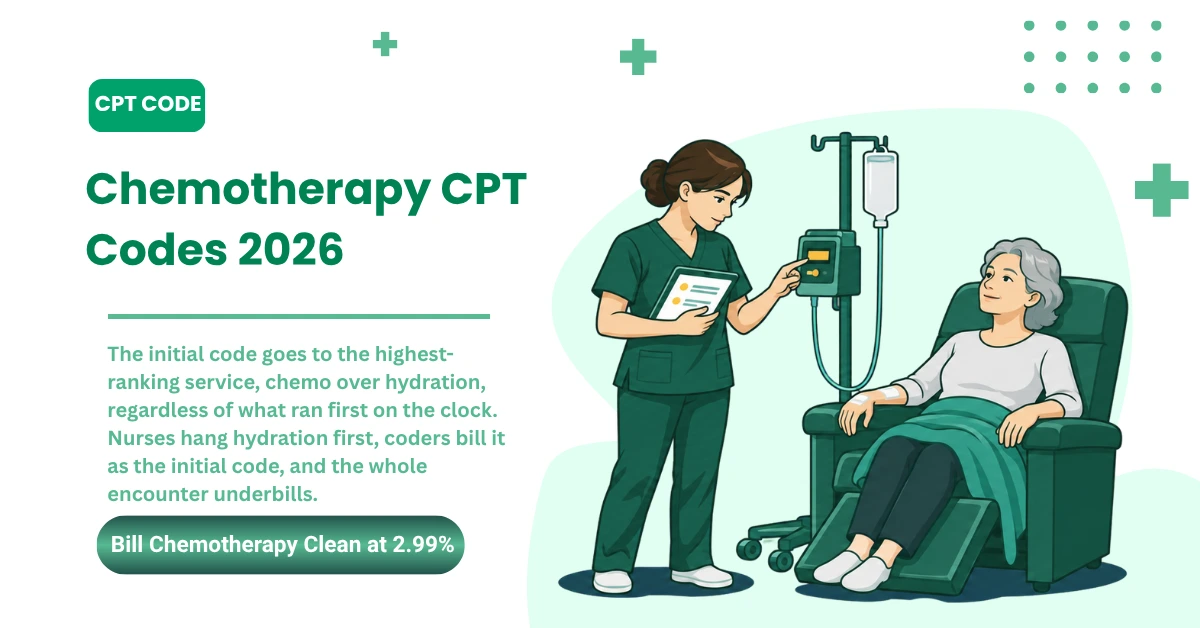
The hierarchy ranks chemotherapy administration first, therapeutic infusion second, and hydration third. Your initial code comes from the highest-ranking service you performed, and you report it regardless of which service happened first on the clock. A non-chemo drug infused after the chemotherapy runs on CPT 96367 as a sequential infusion, or CPT code 96366 as an additional hour, depending on whether it is a new drug or more time on the same one.
That regardless-of-the-clock piece is the part almost nobody publishes. Nurses hang hydration first because the patient arrives dehydrated. Coders see hydration at the top of the flow sheet and bill 96360 as the initial service. The chemotherapy that followed then drops to a subsequent code, and the practice underbills the entire encounter.
There Is No Concurrent Chemotherapy Code
No code exists for concurrent administration of chemotherapy drugs. Multiple chemotherapy agents given in one session count as sequential, and you report them with 96411 for an additional push or 96417 for an additional infusion.
The concurrent concept does exist one family over. 96368 covers concurrent infusion of two or more non-chemotherapy substances. Chemotherapy administration CPT codes have no equivalent, so searching for one wastes an afternoon that a coder could spend fixing the sequencing instead.
HCPCS J-Codes: Billing the Drug Alongside the Administration
Your administration code and your drug code sit on separate claim lines and carry separate revenue. J codes in the J9000 to J9999 range cover chemotherapy drugs. Pick the right code and report the wrong units, and the line denies as fast as a wrong code would. Oncology billing codes fail on units more than on selection.
How J-Code Units Are Calculated
Three rules from Claims Processing Manual Chapter 17 govern the drug line.
Report the number of units matching the dose you gave, measured against the unit definition inside the J-code descriptor. Skip the multiplier when a different J-code describes the amount more closely. Split a vial between two patients and bill only what each one received.
Your units also have to tie back to the medication record. Vial size, dose administered, and dose discarded all have to reconcile against the claim. The payer rejects the line when pharmacy documentation and claim units disagree, whether or not you picked the right J code.
Common Chemotherapy J-Codes
Seventeen J codes for drugs cover the working formulary of a community oncology practice.
Table 4. High-frequency chemotherapy and supportive care J-codes
|
J-Code |
Generic Drug |
Brand |
Unit Basis |
|---|---|---|---|
|
J9045 |
Carboplatin |
Paraplatin |
50 mg |
|
J9060 |
Cisplatin |
Platinol |
10 mg |
|
J9263 |
Oxaliplatin |
Eloxatin |
0.5 mg |
|
J9267 |
Paclitaxel |
Taxol |
1 mg |
|
J9264 |
Paclitaxel protein-bound particles |
Abraxane |
1 mg |
|
J9171 |
Docetaxel |
Taxotere |
1 mg |
|
J9000 |
Doxorubicin hydrochloride |
Adriamycin |
10 mg |
|
J9070 |
Cyclophosphamide |
Cytoxan |
100 mg |
|
J9181 |
Etoposide |
Toposar |
10 mg |
|
J9206 |
Irinotecan |
Camptosar |
20 mg |
|
J9100 |
Cytarabine |
Cytosar-U |
100 mg |
|
J9395 |
Fulvestrant |
Faslodex |
25 mg |
|
J2506 |
Pegfilgrastim |
Neulasta |
0.5 mg |
|
J1453 |
Fosaprepitant |
Emend |
1 mg |
|
J2469 |
Palonosetron |
Aloxi |
25 mcg |
|
J3489 |
Zoledronic acid |
Zometa, Reclast |
1 mg |
|
J9358 |
Fam-trastuzumab deruxtecan |
Enhertu |
1 mg |
Check the current-year unit basis before you bill any of them. CMS revises J-code unit definitions on an annual cycle, and a stale unit basis produces a silent underpayment nobody flags until the variance shows up months later. Verify against the current HCPCS file for the date of service.
JW and JZ Modifiers: Billing Chemotherapy Drug Wastage
Two modifiers govern every separately payable single-dose drug line. JW reports what you discarded. JZ attests that you discarded nothing. Chemotherapy CPT codes pair with a drug line that carries one or the other on almost every claim, and a missing modifier stops the line before anyone reviews the oncology billing guidelines behind it.
CMS has required JW since January 1, 2017 to identify unused drug or biological discarded from single-dose containers or single-use packages. You report the discarded amount on a separate claim line and document it in the patient record. CMS JW and JZ guidance carries the full policy.
JZ has been required since July 1, 2023. You append it to claims for separately payable Part B drugs from single-dose containers when nothing was discarded, attesting that no amount qualified for wastage payment.
Neither modifier applies to drugs that are not separately payable. That exclusion covers packaged OPPS or ASC drugs, drugs administered in FQHC or RHC settings, drugs assigned OPPS status indicator N, and drugs carrying ASC payment indicator N1.
When the JW Modifier Is Not Permitted
JW stops being allowed once the billing unit already covers everything you gave and everything you threw away.
Work through the example CMS publishes in its discarded drugs policy. One billing unit equals 10 mg in a single-use vial. You administer 7 mg and discard 3 mg. That 7 mg dose bills as one unit representing 10 mg on a single line, and the line processes for payment of the full 10 mg, both the administered and the discarded portion. Adding a second unit with JW for the discarded 3 mg creates an overpayment, so CMS does not permit it.
The general rule falls out of that example. You do not use JW once the billing unit equals or exceeds the dose administered plus the amount discarded.
Set the control point in pharmacy, not in billing. The medication record has to show vial size, dose administered, and dose discarded as three separate numbers, and those three have to reconcile against the units on the claim. Oncology reimbursement on high-cost agents depends on that reconciliation.
Modifiers That Change How Chemotherapy Claims Pay
Modifiers attached to chemotherapy CPT codes do two separate jobs. Some tell the payer a second service stood on its own. Others tell the payer something about the drug. Mix the two up and a clean claim reads as a duplicate. Oncology billing and coding teams lose more revenue to modifier habits than to code selection.
Modifier 25 goes on the E/M code, never on the administration code, when a significant and separately identifiable E/M service happens the same day. A different diagnosis is not required for modifier 25 to apply.
That last point costs practices real money. Physicians skip billing a legitimate same-day visit because someone told them years ago they needed a second diagnosis to support it. They do not.
Modifier EJ for Subsequent Doses in a Series
Modifier EJ identifies a subsequent dose of the same drug given in a sequential series to treat one condition. It separates that dose from the initial one. The EJ modifier never goes on the initial dose.
A series billed as initial doses every visit builds a duplicate pattern. Payers rarely catch it on claim two. They catch it on claim four, and by then you are appealing a batch instead of a line.
When 96401 Needs Modifier 59
CPT 96401 does not always need a modifier. It needs one when a second distinct service the same day would otherwise read as a duplicate.
No modifier needed: The injection is the only administration service you performed that day.
Modifier 25 on the E/M: A significant, separately identifiable E/M service happened the same day. The modifier goes on the E/M code.
Modifier 59 or an X{EPSU} modifier on the second line: You administered a second, entirely different non-hormonal antineoplastic agent in the same encounter.
NCCI edits and individual payer policy decide which of those modifiers a given plan accepts, and commercial payers do not align on it. Check the current edits and the payer's own injection billing guidelines before submission rather than after the denial. A wrong or missing modifier on 96401 produces the same rejection covered in CO-4 modifier denial fixes.
Modifier patterns are the easiest thing to audit and the hardest thing to notice. Each individual claim looks fine. The pattern across a month tells you something is off.
Billing an Office Visit on the Same Day as Chemotherapy
Chemotherapy CPT codes and E/M codes collide on the same date more than any other pairing in oncology. Same-day E/M sits near the top of the recurring revenue questions in an infusion suite. The rule reads clearly. The documentation standard runs high. Practices land on one of two wrong answers: bill it every time, or never bill it at all.
Why 99211 Never Pays With Drug Administration
The drug and chemotherapy administration codes in the 96360 to 96379 and 96401 to 96425 ranges already carry the work and practice expense of 99211 inside their values. Because that work sits inside the administration code, 99211 is not separately reportable with a drug administration service and will not be paid.
A higher-level E/M that clears the complexity of 99211 can go on the same claim with modifier 25 when the service was significant and separately identifiable. Documentation has to support the level you bill. Medicare NCCI 2026 Chapter 1 carries the modifier 25 framework, including the point that the E/M and the procedure do not require different diagnoses.
Chemotherapy administration on its own is not a billable E/M. Oncology coding guidelines put the burden on the chart, and the chart has to show a separate assessment and plan that goes past infusion oversight. Reviewing labs and adjusting the regimen supports it. Managing a toxicity supports it. Handling an unrelated complaint supports it. Signing off on a scheduled infusion does not.
Practices that append modifier 25 to every infusion day build an audit pattern they will defend eventually. Practices that never bill it give away work their physicians performed. Both come from the same gap: nursing and physician staff never agreed on what a separate assessment looks like in the note.
Who Bills the Administration Code: Office Versus Facility
The same infusion produces a different claim depending on where it happened and who employs the nurse who gave it. Bill the administration code from the wrong entity and you get a clean denial every time, no matter how correctly you applied the chemotherapy CPT codes. Infusion medical billing breaks here more than anywhere else in the workflow, and the fix sits in your setup, not in your coding.
Physician Office Versus Hospital Outpatient
Drug administration services in the 96360 to 96379, 96401 to 96425, and 96521 to 96523 ranges are reportable by physicians and providers for services performed in a physician office. Physicians do not report them for services provided in a facility setting such as a hospital outpatient department or an emergency department, where the hospital reports them under OPPS. In an ASC, they are not separately reportable by the physician when tied to an ASC payable procedure. The NCCI Policy Manual cited earlier governs this in the same chapter that governs bundling.
Table 5. Who reports the administration code by setting
|
Setting |
Who Reports the Administration Code |
Payment System |
|---|---|---|
|
Physician office, POS 11 |
The practice, on the CMS-1500 |
MPFS |
|
Hospital outpatient department, POS 19 or 22 |
The hospital, on the UB-04 |
OPPS |
|
Ambulatory surgical center |
Not separately reportable by the physician when tied to an ASC payable procedure |
ASC payment system |
Practices in a provider-based arrangement get caught here. One encounter, two entities, two claims. The physician bills the professional work on the CMS-1500 and the hospital bills the facility charge on the UB-04, and the administration line belongs to one of them. Confirm which before the claim drops. POS 11 office billing covers the office-side rules in detail.
Oncology billing teams that inherited a practice mid-acquisition see this constantly. The codes never changed. The entity did, and nobody updated the billing setup. Check your place of service code rules against your current arrangement rather than against the arrangement you had two years ago.
ICD-10 Codes That Support Chemotherapy Claims
A correct CPT code linked to the wrong diagnosis denies as fast as a wrong CPT code. Chemotherapy CPT codes fail medical necessity edits more often than they fail coding edits, and the sequencing rule is where most of that starts. The ICD 10 code for chemotherapy administration does not stand alone.
Sequencing Z51.11 With the Malignancy Code
Report Z51.11 as the first-listed diagnosis when the encounter exists to deliver antineoplastic chemotherapy. Sequence the active malignancy code from the C00 to D49 range alongside it to identify what you are treating. The Z51.11 ICD 10 code establishes the reason for the visit. The malignancy code establishes medical necessity. Report Z51.11 alone and the payer has nothing to approve against, which is why that Z51.11 diagnosis code shows up on so many CO-50 medical necessity denials.
Four adjacent codes carry the rest of the oncology encounter:
- Z51.12 covers an encounter for antineoplastic immunotherapy.
- Z51.0 covers an encounter for antineoplastic radiation therapy.
- Z01.818 covers examinations performed before antineoplastic chemotherapy.
- Z92.21 covers personal history of antineoplastic chemotherapy, and it applies only after the patient finishes active treatment.
Z92.21 billed during an active regimen denies. Coders reach for it when a note says the patient has had chemotherapy, which describes history in a clinical sense and status in a coding sense. If the patient sits in your chair for a cycle, the encounter code is Z51.11.
Table 6. Common CPT to ICD-10 pairings on chemotherapy claims
|
CPT Code |
Common ICD-10 Pairing |
What the Payer Checks |
|---|---|---|
|
96413 |
Z51.11 plus C50.911 (malignant neoplasm, right female breast) |
Encounter code sequenced first, malignancy supports the agent |
|
96415 |
Z51.11 plus C34.91 (malignant neoplasm, right bronchus or lung) |
Infusion duration supports the additional hour billed |
|
96417 |
Z51.11 plus C18.9 (malignant neoplasm, colon) |
Second agent documented as a separate sequential infusion |
|
96401 |
Z51.11 plus C61 (malignant neoplasm, prostate) |
Drug classified as non-hormonal |
|
96402 |
Z51.11 plus C61 (malignant neoplasm, prostate) |
Drug classified as hormonal |
|
96365 |
Diagnosis matching the supportive drug, not the malignancy |
Therapeutic indication independent of the cancer |
Payer medical necessity policies vary. Commercial plans and MACs publish different covered-diagnosis lists for the same drug, so check the LCD or the plan's own policy before you assume a pairing clears.
What Chemotherapy Administration Codes Pay in 2026
Most coding guides stop at the descriptor. The number that changes decisions is what the code pays, and whether that number is moving. For chemotherapy CPT codes in 2026, it is moving, and not upward.
Published fee schedule reference data places the 2026 Medicare payment for CPT 96413 in the physician office setting near $133. Geographic practice cost indices adjust the final amount by locality, so pull your own number from the CMS Physician Fee Schedule tool before you build a forecast on it. Treat any published national figure as a reference point, not as your contracted rate.
Table 7. Where to source current rates for the codes that carry your volume
|
Code |
What It Covers |
2026 Reference |
Verify Against |
|---|---|---|---|
|
96413 |
Initial hour, chemotherapy IV infusion |
Near $133 national, non-facility |
CMS PFS, your locality |
|
96415 |
Each additional hour |
Verify via CMS PFS |
CMS PFS, your locality |
|
96417 |
Additional sequential infusion, new drug |
Verify via CMS PFS |
CMS PFS, your locality |
|
96401 |
SC or IM injection, non-hormonal |
Verify via CMS PFS |
CMS PFS, your locality |
|
96365 |
Initial hour, therapeutic infusion |
Verify via CMS PFS |
CMS PFS, your locality |
|
96365 in a hospital setting |
Same service, facility rate |
Verify via OPPS addenda |
CMS OPPS addenda |
Commercial contracts run above or below Medicare depending on your payer mix and what your last negotiation produced. Pull the contracted rate for your three highest-volume payers rather than working from the national figure.
The 2027 Proposed Cut to 96413
CMS has proposed reducing the physician office payment for 96413 to roughly $124 for 2027, a cut near 6.6 percent against the 2026 figure.
Run that against your own volume. A practice performing 40 initial infusions a week gives up somewhere near $18,000 a year on that single line item, before you count a single add-on hour on 96415.
A proposed rule is not a final rule, and the number can change between now and the final. Oncology reimbursement forecasts built on 2026 revenue are still built on a figure under downward pressure, and medical oncology billing teams planning 2027 staffing should model both outcomes.
Practices that absorb a rate cut without noticing are the ones already leaking on charge capture. A 6.6 percent cut lands differently on clean books than it does on books with a 4 percent capture gap underneath it.
A rate cut is easier to absorb when you know your capture rate going in. Most practices find out afterward.
What Changed for 2026: Site-Neutral Payment and Radiation Code Restructuring
Two things changed for 2026 and one thing held. The one that held is the one most guides get wrong.
Drug Administration in Off-Campus Hospital Departments Now Pays 40 Percent
For CY 2026, CMS finalized expanding its site-neutral payment policy to cover drug administration services furnished in excepted off-campus provider-based departments. Those services now pay at the MPFS-equivalent rate rather than the full OPPS rate, across APCs 5691, 5692, 5693, and 5694. Rural sole community hospitals are exempt.
CMS estimates the change reduces OPPS spending by $290 million in CY 2026, with $220 million accruing to Medicare and $70 million saved by beneficiaries through reduced coinsurance. The CMS CY 2026 OPPS final rule fact sheet carries the figures.
Pull a list of every drug administration service your system delivers at an off-campus provider-based department. Model the revenue difference against the new rate. Then decide whether that site of service still works financially. This is a service-line decision sitting on a billing team's desk, and the hospital APC billing services side of the house is usually the first to see the variance land.
Radiation Delivery Codes Were Restructured
Radiation treatment delivery consolidated into three complexity levels for 2026. The radiation oncology CPT codes now run technique-agnostic, applying the same way in a hospital or a freestanding center.
- 77402 covers Level 1 delivery, including imaging guidance when performed.
- 77407 covers Level 2, single isocenter, photons, including imaging guidance.
- 77412 covers Level 3, multiple isocenters, or a single isocenter with active motion management, or total skin electrons, or mixed electron and photon fields.
CPT codes for radiation oncology that used to carry the technical piece separately are gone. CMS and the AMA deleted 77385, 77386, and 77014, along with the delivery G-codes previously reported under the MPFS. Image guidance consolidated into 77387, which now bills as a professional-only code because the technical component moved inside the delivery codes.
Table 8. 2026 radiation treatment delivery values published by ASTRO
|
Code |
Level |
RVUs |
MPFS Rate |
|---|---|---|---|
|
77402 |
Level 1 |
2.38 |
$79.49 |
|
77407 |
Level 2 |
9.51 |
$317.64 |
|
77412 |
Level 3 |
11.72 |
$391.46 |
ASTRO 2026 code changes publishes the RVUs and the 2026 APC assignments behind those figures.
Check your charge master this week. Claims still carrying 77385, 77386, or 77014 will not pay. Radiation oncology billing also depends on getting the professional and technical split right on 77387, and the 26 and TC modifier split rules apply the same way they always have.
The Chemotherapy Administration Codes Themselves Did Not Change
The 96401 to 96549 range held steady for 2026. The AMA's CPT 2026 errata document, dated June 2, 2026, carries no entries touching the 964xx or 965xx ranges, and the current Joint Commission data element release lists the same chemotherapy administration inclusion set it carried in prior years. The AMA CPT 2026 release covers 418 total changes across the code set, none of them in this family.
Any guide promising new chemotherapy administration codes for 2026 is describing something that did not happen. Payment policy moved. Radiation delivery got rebuilt. Payers tightened prepayment review. Oncology coding guidelines for the administration codes themselves read the same as they did last year.
Why Chemotherapy Claims Get Denied and How to Fix Each One
Most chemotherapy denials are not coding mistakes. They are documentation gaps that existed before anyone opened the encounter. The chemotherapy CPT codes on the claim were right. The record underneath them could not carry the weight. Oncology billing guidelines assume a chart that most infusion suites do not produce on a busy Tuesday.
The Six Denials That Cost Oncology Practices the Most
Table 9. Chemotherapy denial reasons, triggers, fixes, and appeal steps
|
Denial Reason |
What Triggers It |
The Documentation Fix |
The Appeal Step |
Typical CARC |
|---|---|---|---|---|
|
Second initial code on one encounter |
Two initial administration codes billed without separate IV access |
Two distinct access sites plus the clinical reason both were needed |
Submit the nursing record showing both sites. A double-lumen catheter will not carry it |
CO-97, CO-B15 |
|
Infusion time not supported |
Missing stop time, or duration too short for the units billed |
Start and stop times, or total time, in the medication record |
Submit the flow sheet with the timed entries |
CO-16, CO-151 |
|
Missing JW or JZ on the drug line |
Separately payable single-dose drug billed with no wastage modifier |
Vial size, dose administered, and dose discarded reconciled before the claim drops |
Submit the MAR tie-out showing all three numbers |
CO-4, CO-16 |
|
Wrong administration family |
Supportive drug billed under 964xx, or a complex biologic billed under 963xx |
Apply the drug-complexity rule, not the patient's diagnosis |
Submit the drug classification and the clinical rationale |
CO-97, CO-B15 |
|
Hydration billed when concurrent or incidental |
Hydration billed separately when it ran concurrently or served as carrier fluid |
Bill hydration only when it stands as separately necessary therapy |
Document the therapeutic indication independent of the chemotherapy |
CO-97 |
|
Diagnosis does not support medical necessity |
Z51.11 with no malignancy code, or a diagnosis off the payer's covered list |
Sequence the malignancy code alongside Z51.11 |
Submit the LCD or payer policy reference with the clinical note |
CO-50 |
What to Do Before You Appeal
The appeal is not the fix. Work one denial and you recover one claim. When the same reason shows up on next month's report, nothing changed.
Sort by reason code first. Find the pattern. Then correct the workflow that produced it. A denial tracing back to nursing documentation gets fixed at the nursing template, not in an appeal letter, and oncology billing and coding teams that skip that step keep rebuilding the same claim.
Not every denial comes back. Some are hard denials on services the plan does not cover, and your practice needs that answer in week one rather than after 90 days of follow-up. Knowing which bucket a claim sits in is worth more than working all of them with equal effort.
When the same three denial reasons keep showing up on your monthly report, the appeals are not the problem. Whatever produces them upstream is. That is the part chemotherapy denial management is built around, and it is the difference between recovering a claim and closing a pattern. MedSole RCM prices standalone denial management at 4.49 percent of what gets recovered, or includes it at no separate charge inside full-service oncology medical billing at 2.99 percent of collections.
Prior Authorization for Chemotherapy and High-Cost Biologics
Authorization denials cost more than coding denials because the drug already went into the patient by the time anyone finds out. The window to fix an authorization closes before the infusion, not after the claim. Chemotherapy CPT codes can be perfect and the encounter still writes off.
What Payers Ask For and When
Authorization requirements shift by payer and by drug, and they have tightened. Commercial plans have expanded prepayment review on high-cost biologics, immunotherapy agents, genomic testing, and CAR T-cell therapy. Most requests want the clinical note establishing diagnosis and stage, prior treatment history including failures, guideline support such as NCCN, and the specific agent, dose, and regimen.
Four gaps produce most authorization denials on infusion claims:
- Authorization covers the drug but not the number of cycles.
- Authorization expires before the infusion date arrives.
- The regimen changes after cycle one and nobody updates the authorization.
- Pharmacy substitutes a biosimilar after the plan authorized the reference product.
An authorization number sitting in the chart is not the same as an active authorization for this date, this dose, and this drug. Most authorization denials on infusion claims are not missing authorizations at all. They are authorizations that stopped matching what the nurse hung.
Practices rarely have a gap in getting authorizations. The gap sits in noticing when one stops matching the regimen. That is the piece chemotherapy prior authorization support covers, and it is included inside full-service oncology RCM rather than billed as a separate line.
What It Costs to Get Chemotherapy Billing Right
Oncology billing carries more failure points per claim than almost any specialty. Time-based codes. A separate drug line. Wastage modifiers. Authorization tracking against a moving regimen. The question is not whether oncology medical billing needs dedicated attention. It is whether that attention costs less in-house or outsourced.
In-House Versus Outsourced Oncology Billing
In-house billing costs run fixed. Salary, benefits, payroll taxes, software licenses, training, and the coverage gap when your biller takes two weeks off. A biller at $45,000 to $65,000 plus overhead costs the same whether collections climb or fall that year. Outsourced billing converts that fixed number into a percentage of what the practice collects.
Outsourcing is not automatically cheaper. It costs less when the fixed price of in-house capacity exceeds the percentage on your collections, and the crossover point moves with your volume. A practice collecting $2 million a year runs different math than a solo oncologist collecting $400,000. Run your own numbers before you decide medical billing for oncology belongs outside the building.
What Full-Service RCM Costs at 2.99 Percent
Table 10. In-house billing cost compared with MedSole RCM
|
Cost Component |
In-House |
MedSole RCM |
|---|---|---|
|
Billing staff |
$45,000 to $65,000 salary plus benefits |
Included in the rate |
|
Training and overhead |
Ongoing, fixed |
$0 |
|
Setup fee |
Recruiting and onboarding cost |
$0 |
|
Long-term contract |
Employment commitment |
None. Cancel anytime |
|
Denial management |
Whoever has time that week |
Included at no separate charge |
|
AR follow-up |
Same person, same week |
Included at no separate charge |
|
Prior authorization |
Front desk, between patients |
Included at no separate charge |
|
Credentialing |
$150 to $300 per payer through a vendor |
$99 per payer enrollment |
|
Coverage during absence |
Claims queue while they are out |
Continuous |
|
Total cost model |
Fixed, regardless of collections |
2.99 percent of collections |
MedSole RCM handles full-service revenue cycle management at 2.99 percent of collections, among the lowest full-service rates available to independent and group practices in the United States. Most medical billing companies charge 4 to 7 percent, and many add setup fees, per-claim charges, or monthly minimums on top of that percentage. Provider enrollment and credentialing runs $99 per payer, against a market range that commonly sits between $150 and $300 per payer. There is no setup fee and no long-term contract. Denial management, AR follow-up, coding review, and prior authorization all sit inside the 2.99 percent rate rather than billing as separate line items, and standalone denial management or recover aged infusion claims work runs 4.49 percent of what gets recovered for practices that keep billing in-house.
Coverage runs across all 50 states and 75-plus specialties, with more than 4,000 providers served and a 99 percent first-pass claim acceptance rate. Practices that want the full picture before committing can start with outsourced oncology billing at that rate and add credentialing at $99 per enrollment as providers come on.
Oncologist RCM carries one wrinkle that general billing does not. Your drug spend sits on the same claim as your service revenue, which means a billing error on a J-code line costs multiples of what the same error costs in a primary care practice. Oncologist revenue cycle management has to reconcile pharmacy against claims, not only claims against payers.
If you want a real number instead of an estimate, a billing analysis on your own claims shows you where the gaps sit before you change anything.
Chemotherapy Billing Documentation Checklist
Every rule on this page reduces to something that either sits in the record before the claim drops or does not. Six checks catch most of what denies. Chemotherapy CPT codes depend on all six.
- Drug line complete. Name, dose, route, and units matched to the J-code unit basis, with JW or JZ appended where the policy applies.
- Administration family correct. Chemotherapy versus therapeutic infusion decided on drug complexity, not on the patient's diagnosis.
- One initial code per encounter. Two initials only where the record shows two separate IV access sites and the reason both were necessary.
- Time supported. Start and stop times, or total time, in the medication record. Push versus infusion supported against the 15-minute threshold.
- Bundling traps cleared. No 96523 on a day carrying another administration service. No hydration billed when it ran concurrently or served as carrier fluid.
- Same-day E/M defensible. No 99211 alongside drug administration. Modifier 25 only where the note carries a separate assessment and plan.
Run this list before submission, not after the denial. Every item on it costs seconds to check and hundreds to appeal, which is why oncology coding guidelines belong in the pre-submission workflow rather than the denial queue.
Chemotherapy CPT Code FAQs
When do you use 96413 instead of 96365?
Use 96413 when the infused drug is an antineoplastic agent, a monoclonal antibody, or another highly complex biologic. Use 96365 for antibiotics, antiemetics, and other therapeutic or diagnostic drugs. Drug complexity decides the family, not the patient's diagnosis, which means a monoclonal antibody infused for a non-cancer condition still bills under 96413. A supportive drug given during a chemotherapy visit bills under 96365 even though the patient is an oncology patient. Document the drug name and classification in the note so a reviewer can follow the choice without calling your office.
What does CPT code 96450 represent?
CPT 96450 represents chemotherapy administration into the central nervous system, including by intrathecal route, and the code includes the spinal puncture. You do not bill the puncture separately. The drug still bills on its own J-code line. 96440 covers the pleural cavity and 96446 covers the peritoneal cavity, so neither one substitutes for 96450 on an intrathecal administration.
What are the billing guidelines for CPT code 96413?
Report 96413 once per encounter as the initial infusion service, covering the first hour of a chemotherapy IV infusion. The record needs start and stop times. No pump is required, and an infusion running past 8 hours on a portable or implantable pump moves to 96416 instead. Additional hours go on 96415 for intervals running more than 30 minutes past each hour increment. A different drug infused sequentially in the same session goes on 96417. The drug itself never rides on 96413. It bills separately by J-code.
What are the CPT guidelines for chemotherapy infusions?
Chemotherapy infusions follow four rules. Report one initial service code per encounter unless the protocol required two separate IV access sites. Rank chemotherapy administration above therapeutic infusion and hydration when choosing which service carries the initial designation, regardless of the order services occurred. Report additional time on the add-on code and an additional drug on the sequential code, since those are not interchangeable. Document actual infusion time, because the chemotherapy infusion CPT codes are time-based and the flow sheet decides what pays.
Is CPT code 96365 chemotherapy?
No. CPT 96365 covers an initial intravenous infusion of a therapeutic, prophylactic, or diagnostic drug lasting up to one hour, and it excludes chemotherapy and highly complex biologic agents. Antibiotics, iron products, and antiemetics run through 96365. Chemotherapy administration starts at 96401 and runs through 96549, with 96413 covering the initial infusion hour.
Is CPT 96413 chemotherapy?
Yes. CPT 96413 covers the initial hour of an intravenous chemotherapy infusion. It also covers monoclonal antibodies and other highly complex biologic agents, including agents given for non-cancer diagnoses, because the code turns on the clinical complexity of the drug rather than the patient's condition. Routine hydration, standard antibiotics, and simple antiemetics given on their own belong on the non-chemotherapy infusion codes instead.
What is the difference between 96401 and 96402?
Both cover a subcutaneous or intramuscular chemotherapy injection. The drug decides which one you report. CPT 96401 covers non-hormonal antineoplastic agents such as methotrexate. CPT 96402 covers hormonal antineoplastic agents such as leuprolide acetate (Lupron) and goserelin (Zoladex), used against hormone-sensitive cancers including prostate and breast. Both report once per drug per encounter regardless of how many injection sites a single dose required.
How many times can CPT 96401 be billed?
Report 96401 once per drug per encounter, no matter how many injection sites that dose needed. A dose split across two syringes because the volume was too large for one site still bills one unit. Two entirely different non-hormonal antineoplastic drugs given in the same encounter can support more than one unit, with modifier 59 or an appropriate X{EPSU} modifier on the second line. MUE limits and modifier acceptance vary by payer, so check current NCCI edits and your plan's policy before billing multiple units.
Does CPT code 96401 need a modifier?
Not always. 96401 needs no modifier when the injection is the only administration service that day. Append modifier 25 to the E/M code, not to 96401, when a significant and separately identifiable office visit happens the same day. Append modifier 59 or an X{EPSU} modifier to the second 96401 line when you administered a second, entirely different non-hormonal antineoplastic agent in the same encounter. Payer policies differ on which modifier they accept, so verify against current NCCI edits before submission.
Can 96372 and 96402 be billed together?
Yes, on the same date of service, when they represent separate and distinct drugs administered at separate injection sites. Never report both codes for the same drug. 96402 covers hormonal chemotherapy administration and 96372 covers a standard therapeutic, prophylactic, or diagnostic injection. Check current NCCI procedure-to-procedure edits, since a modifier such as 59 or an X{EPSU} modifier may be required to designate 96372 as distinct. Your record needs separate sites, separate clinical reasons, and the correct J-code and NDC for each substance.
Who can bill chemotherapy administration codes?
Physicians and providers report drug administration codes in the 96360 to 96379, 96401 to 96425, and 96521 to 96523 ranges for services performed in a physician office. Physicians do not report them for services delivered in a facility setting such as a hospital outpatient department or emergency department, where the hospital reports them under OPPS. In an ambulatory surgical center, they are not separately reportable by the physician when tied to an ASC payable procedure. Practices in provider-based arrangements should confirm which entity owns the administration line before the claim drops.
What is the difference between 96415 and 96417?
96415 covers each additional hour of the drug already infusing. 96417 covers a sequential infusion of a different drug in the same session. Report 96417 once per sequential infusion rather than once per hour of it, and put any additional time on that second drug onto 96415. Both codes are add-ons reported alongside the initial infusion code, 96413.
Are HCPCS J-codes required alongside CPT codes for chemotherapy?
Yes. The CPT code reports the administration service and the HCPCS J-code reports the drug, and both belong on the claim. Report units matching the dose administered against the unit definition in the J-code descriptor. Append JW for a discarded amount from a single-dose container, or JZ to attest that nothing was discarded, on separately payable Part B drugs. Missing either the J-code line or the wastage modifier stops payment on the drug even when the administration line clears.
Did chemotherapy CPT codes change for 2026?
No. The 96401 to 96549 chemotherapy administration range held steady for 2026. The AMA's CPT 2026 errata document dated June 2, 2026 carries no entries touching the 964xx or 965xx ranges. Payment policy changed instead: CMS finalized site-neutral payment for drug administration in excepted off-campus provider-based departments, and radiation treatment delivery consolidated into 77402, 77407, and 77412, with 77385, 77386, and 77014 deleted. Guides advertising new chemotherapy administration codes for 2026 are describing changes that happened elsewhere in the code set.