



Plastic surgery CPT codes get paid or denied on one question: was the work cosmetic or reconstructive? The code alone doesn't settle it. Payers decide from the diagnosis, the chart, and their own medical policy, and that gap is where plastic surgery billing errors start.
Key takeaways
- Payers decide coverage on whether the work was cosmetic or reconstructive, and the CPT code is often identical either way. Medicare excludes cosmetic surgery except for the prompt repair of an accidental injury and surgery that improves a malformed body member.
- CPT 15847 (abdominoplasty) is an add-on code you report only with 15830 (panniculectomy), and most payers treat 15847 as cosmetic.
- CPT 2027 takes effect January 1, 2027, with 453 changes. Skin cell suspension autograft codes 15006 to 15009 replace 15011 to 15018, and Category III code 1019T is gone.
- Medicare's 2027 conversion factor drops to $32.63 for most clinicians, down 2.31%. When you bill an office E/M on the same day as a 0-day global procedure, Medicare now pays the less expensive service at 80%.
- Medicare requires prior authorization for blepharoplasty, botulinum toxin injections, panniculectomy, rhinoplasty, and vein ablation in hospital outpatient departments (since July 1, 2020) and in ASCs in 10 demonstration states (since early 2026).
In this guide
- What Are Plastic Surgery CPT Codes?
- Cosmetic vs Reconstructive Surgery: How Payers Decide What's Covered
- Plastic Surgery CPT Codes by Procedure (2027 List)
- Panniculectomy vs Abdominoplasty: Billing CPT 15830 and 15847
- Breast Reconstruction CPT Codes After Mastectomy
- What Changes for Plastic Surgery CPT Codes in 2027
- Plastic Surgery ICD-10 Codes That Support the Claim (FY 2027)
- Plastic Surgery Modifiers, Global Periods, and NCCI Edits
- Medicare Prior Authorization for Blepharoplasty, Rhinoplasty, and Panniculectomy
- Plastic Surgery Denial Codes and How to Fix Them
- Billing Self-Pay Cosmetic Surgery and Good Faith Estimates
- How MedSole RCM Handles Plastic Surgery Billing
- Plastic Surgery CPT Codes: Frequently Asked Questions
What Are Plastic Surgery CPT Codes?
Plastic surgery CPT codes are the five-digit Current Procedural Terminology codes that report cosmetic and reconstructive procedures. The American Medical Association (AMA) maintains them. Most sit in the integumentary section of CPT (10030 to 19499), which covers skin excision and repair, grafts, flaps, excess skin removal, liposuction, and breast surgery.
Several CPT codes for plastic surgery live outside that section. Nose surgery falls in 30400 to 30520, brow and eyelid ptosis repair in 67900 to 67908, otoplasty at 69300, and facial skeleton work in 21120 to 21299. If none of the listed plastic surgery procedure codes fits, you report unlisted code 17999 for skin and subcutaneous tissue or 19499 for breast.
How CPT, ICD-10-CM, and HCPCS Codes Work Together on One Claim
A plastic surgery claim uses three code sets plus modifiers. CPT describes what the surgeon did. ICD-10-CM explains why, and payers read medical necessity from it. Modifiers show how and where: RT and LT for side, 50 for a bilateral procedure, and 58 for a staged one.
You'll reach for HCPCS Level II when CPT doesn't describe a supply or a payer wants its own code. Common examples are L8600 for an implantable breast prosthesis, C1789 for the same device on a hospital outpatient claim, and S2066 to S2068 for perforator flaps with some commercial payers.
Plastic surgery coding comes down to agreement on every claim line. The payer prices the CPT code, then pays it only when the diagnosis and the documentation support it. If your plastic surgery billing codes don't match the chart, the payer denies the line and your team reworks it.
Plastic surgery CPT codes change every January 1, ICD-10-CM codes every October 1, and HCPCS Level II codes every quarter. FY 2027 ICD-10-CM codes apply to dates of service from October 1, 2026, to September 30, 2027, so a 2026 code list won't hold up on a 2027 claim.
Cosmetic vs Reconstructive Surgery: How Payers Decide What's Covered
Payers cover reconstructive surgery that restores function or repairs an injury, a disease, or a congenital defect. They exclude cosmetic surgery done only to change appearance. The CPT code is often identical either way, so the payer reads the diagnosis code, the chart, and its own medical policy to decide which side a case falls on.
There's no separate set of cosmetic CPT codes. Cosmetic coding comes down to the diagnosis and the documentation, and you make that cosmetic vs reconstructive surgery call on each case.
Medicare's Cosmetic Surgery Exclusion and Its Two Exceptions
Chapter 16, Section 120 of the Medicare Benefit Policy Manual says Medicare doesn't cover cosmetic surgery or the expenses connected with it. CMS defines cosmetic surgery as any procedure aimed at improving appearance, and the statutory basis is Social Security Act Section 1862(a)(10).
Medicare keeps two exceptions: the prompt repair of an accidental injury, and surgery that improves the function of a malformed body member. The manual's own examples are severe burns, facial repair after a serious car accident, and therapeutic surgery that also happens to have a cosmetic effect.
Commercial plans write their own rules for reconstructive surgery insurance coverage into each medical policy, and Medicaid rules vary by state. Read the payer medical policy next on every case, since it won't always match the Medicare rule.
The Documentation That Proves Medical Necessity
Payers approve medically necessary plastic surgery from the chart, so you win or lose the case on paper before the surgery date. Reviewers look for these items:
- Functional complaint: the problem in the patient's words, with how long it has lasted.
- Conservative treatment history: what the patient tried, for how long, and why it failed.
- Duration thresholds: Noridian's Plastic Surgery LCD asks for panniculectomy symptoms lasting at least three months despite treatment, and at least two breast reduction symptoms lasting at least six months.
- Pre-operative photographs: standardized views a reviewer can hold against the policy criteria.
- Objective tests: visual field testing with the lid taped and untaped for upper eyelid and ptosis surgery.
- Letter of medical necessity: ties each symptom to the procedure and to the policy's criteria.
- Operative report: matches the code descriptor and separates any cosmetic work.
L35163 applies in Noridian's Jurisdictions E and F only. Other Medicare Administrative Contractors publish their own LCDs, so pull the one for your state. Our guide on how MACs set LCDs explains the jurisdiction split.
Billing Cosmetic and Covered Procedures in the Same Session
Noridian's Plastic Surgery LCD states that if a non-covered cosmetic procedure happens in the same operative session as a covered one, benefits apply only to the covered procedure. The same plastic surgery CPT codes can be covered on one patient and cosmetic on the next, so the split has to show on the claim.
- Separate the claim lines: the covered CPT code with its medical diagnosis, the cosmetic code with Z41.1 (encounter for cosmetic surgery).
- Document each portion on its own in the operative note, with the area, the work, and the reason.
- Get a signed financial agreement and give a good faith estimate for the self-pay portion before surgery. The self-pay and good faith estimate rules set the timing.
- On a Medicare claim that lists an excluded service, add modifier GY to tell Medicare the law excludes that service.
Patients and financing companies often ask for the CPT code for cosmetic surgery on a quote. Give them the procedure code itself, such as 15822 for upper eyelid blepharoplasty, and list the Z41.1 diagnosis code beside it, since Z41.1 and the payer's policy carry the cosmetic flag.
In plastic surgery medical billing, that split is easy to get wrong when one coder handles every specialty. If it's eating your coder's week, our outsourced medical billing services team makes the split on every claim, with AAPC-certified coders checking each line before it goes out.
Plastic Surgery CPT Codes by Procedure (2027 List)
Common plastic surgery CPT codes fall into five groups: face and eyelids, nose, breast, body contouring, and skin grafts and flaps. Each table gives the code, what it reports in plain words, and how payers treat it in most cases, so you can see the coverage risk before you schedule.
We paraphrase each descriptor, so confirm the full wording in the AMA CPT 2027 Professional Edition. To check Medicare payment and RVUs for any code in your locality, use the CMS PFS Look-up Tool.
Eyelid, Brow, Facelift, and Ear CPT Codes
Blepharoplasty CPT codes split by eyelid and by what the surgeon corrects. The brow lift CPT code, 67900, sits in the eye section of CPT, and each CPT code for facelift work reports a rhytidectomy by area. The otoplasty CPT code is 69300.
|
Code |
What it reports |
Usual coverage |
Billing note |
|---|---|---|---|
|
15820 |
Lower eyelid blepharoplasty |
Usually cosmetic |
Lower lids seldom meet functional criteria |
|
15821 |
Lower eyelid blepharoplasty with extensive herniated fat pad |
Usually cosmetic |
Same rules as 15820 |
|
15822 |
Upper eyelid blepharoplasty |
Depends on the reason |
Needs the same functional proof as 15823 to be covered |
|
15823 |
Upper eyelid blepharoplasty with excess skin weighting down the lid |
Covered when criteria are met |
Visual fields, photos, and H02.831 or H02.834 for dermatochalasis |
|
67900 |
Repair of brow ptosis (brow lift) |
Covered when criteria are met |
Functional only when the brow itself blocks vision |
|
67901 to 67908 |
Blepharoptosis repair by technique |
Covered when criteria are met |
67904 is the external levator approach; pair with a billable H02.4 code such as H02.411 |
|
15824 |
Rhytidectomy, forehead |
Usually cosmetic |
The brow lift code is 67900 |
|
15825 |
Rhytidectomy, neck with platysmal tightening |
Usually cosmetic |
The usual neck lift code |
|
15826 |
Rhytidectomy, glabellar frown lines |
Usually cosmetic |
Self-pay with Z41.1 |
|
15828 |
Rhytidectomy, cheek, chin, and neck |
Usually cosmetic |
Self-pay with Z41.1 |
|
15829 |
Rhytidectomy, SMAS flap |
Usually cosmetic |
Common choice for deep plane work |
|
69300 |
Otoplasty, protruding ear |
Depends on the reason |
Q17.5 prominent ear; many payers treat adult cases as cosmetic |
Upper lid claims turn on blepharoplasty 15822 vs 15823. For functional cases, 15823 matches payer criteria, since its descriptor names excess skin weighting down the lid, and taped and untaped visual fields document it. Ptosis repair takes its own code family, and CPT 67904 reports the external levator approach.
Keep 15824 off brow lift claims, because it reports a forehead rhytidectomy. There's no deep plane facelift CPT code, so practices report the rhytidectomy code that matches the documented work, in most cases 15829 for an SMAS flap. The neck lift CPT code is 15825 when the surgeon tightens the platysma.
You won't find a facelift revision CPT code either. Report the code for the work the surgeon redid; the revision stays cosmetic if the first surgery was.
Rhinoplasty and Septorhinoplasty CPT Codes
Each rhinoplasty CPT code reflects how much of the nose the surgeon changes, from the tip alone up to the bony pyramid. Revisions and cleft lip deformities have their own codes. If the surgeon harvests ear cartilage to support the tip, CPT 21235 reports the graft.
|
Code |
What it reports |
Usual coverage |
Billing note |
|---|---|---|---|
|
30400 |
Primary rhinoplasty: lateral and alar cartilages, nasal tip, or both |
Usually cosmetic |
Self-pay with Z41.1 |
|
30410 |
Primary rhinoplasty: complete external parts, including the bony pyramid |
Usually cosmetic |
Self-pay with Z41.1 |
|
30420 |
Primary rhinoplasty with major septal repair (septorhinoplasty) |
Covered when criteria are met |
Includes the septal repair, so you don't add 30520 |
|
30430, 30435, 30450 |
Secondary rhinoplasty: minor, intermediate, and major revision |
Usually cosmetic |
Revision of an earlier rhinoplasty |
|
30460, 30462 |
Rhinoplasty for nasal deformity from cleft lip or palate |
Usually covered when indicated |
Congenital deformity |
|
30465 |
Repair of nasal vestibular stenosis (nasal valve) |
Covered when criteria are met |
Document the airway obstruction |
|
30520 |
Septoplasty |
Covered when criteria are met |
Pair with J34.2 deviated nasal septum |
|
21235 |
Ear cartilage graft to nose or ear |
Depends on the reason |
Coverage follows the primary procedure |
The CPT code for cosmetic rhinoplasty comes from the same 30400 to 30450 family, billed with Z41.1 and a signed self-pay agreement. A functional septorhinoplasty CPT code claim for 30420 needs J34.2 or M95.0 (acquired deformity of nose) plus airway documentation, such as obstruction findings and failed medical treatment.
Medicare requires prior authorization for rhinoplasty in hospital outpatient departments, and ASCs in demonstration states face prepayment review if they skip it.
Breast Surgery CPT Codes: Reduction, Lift, Augmentation, and Implants
The mastopexy CPT code, 19316, is also the breast lift CPT code, and 19325 is the CPT code for breast augmentation. The CPT code for reduction mammoplasty is 19318, and 19300 is the gynecomastia CPT code. Each code reports one breast, so bilateral surgery takes modifier 50 or RT and LT, by payer.
|
Code |
What it reports |
Usual coverage |
Billing note |
|---|---|---|---|
|
19300 |
Mastectomy for gynecomastia |
Covered when criteria are met |
N62 hypertrophy of breast |
|
19316 |
Mastopexy (breast lift) |
Usually cosmetic |
Covered for symmetry after reconstruction |
|
19318 |
Breast reduction |
Covered when criteria are met |
One side per unit; bilateral takes modifier 50 or RT and LT by payer |
|
19325 |
Breast augmentation with implant |
Usually cosmetic |
Covered inside reconstruction or for symmetry |
|
19328 |
Removal of intact breast implant |
Depends on the reason |
Document why it comes out |
|
19330 |
Removal of ruptured breast implant, including contents |
Depends on the reason |
Document the rupture |
|
19342 |
Implant insertion or replacement on a separate day from mastectomy |
Depends on the reason |
Covered in reconstruction; cosmetic otherwise |
|
19370 |
Revision of peri-implant capsule (capsulotomy, capsulorrhaphy, partial capsulectomy) |
Depends on the reason |
Revision of a reconstructed breast is 19380 |
|
19371 |
Complete peri-implant capsulectomy |
Depends on the reason |
Reported for en bloc capsulectomy |
|
19355 |
Correction of inverted nipples |
Usually cosmetic |
Noridian lists uncomplicated nipple inversion as cosmetic |
Breast reduction insurance requirements come down to the packet behind the breast reduction CPT code. The Noridian plastic surgery billing article asks for height and weight, the clinical evaluation, prior therapies and their results, an operative report with the tissue weight per breast, and the pathology report. Many commercial payers add a minimum weight from the Schnur sliding scale.
A lift with implants has no combined code, so you report 19316 and 19325 together. The breast implant removal CPT code depends on the implant: CPT 19328 for an intact one, 19330 for a rupture. Payers decide coverage by why it comes out, such as rupture, infection, or a reconstruction history.
CPT 19342 reports implant placement on a different day from the mastectomy. The 19370 CPT code covers partial capsule work, and 19371, the en bloc capsulectomy CPT code, reports removal of the full capsule and its contents.
Liposuction, Body Contouring, and Fat Grafting CPT Codes
Body contouring splits into excision codes and suction codes. The thighplasty CPT code is 15832, the brachioplasty CPT code is 15836, and CPT code 15839 covers excess skin in other areas. Each liposuction CPT code from 15876 to 15879 reports one body region.
|
Code |
What it reports |
Usual coverage |
Billing note |
|---|---|---|---|
|
15830 |
Panniculectomy, infraumbilical |
Covered when criteria are met |
Criteria in the next section |
|
15847 |
Abdominoplasty add-on to 15830 |
Usually cosmetic |
Can't be billed alone |
|
15832 to 15836 |
Excess skin excision: thigh, leg, hip, buttock, arm (thighplasty, brachioplasty) |
Depends on the reason |
Many payers treat these as cosmetic; L98.7 plus documented skin problems |
|
15837, 15839 |
Excess skin excision: forearm or hand, other area |
Depends on the reason |
15839 is the catch-all |
|
15838 |
Submental fat pad excision |
Usually cosmetic |
Self-pay with Z41.1 |
|
15876 to 15879 |
Suction-assisted lipectomy: head and neck, trunk, upper extremity, lower extremity |
Usually cosmetic |
15876 is head and neck, not single-area liposuction |
|
15771, 15772 |
Fat grafting to trunk, breasts, scalp, arms, or legs: first 50 cc, then each added 50 cc |
Depends on the reason |
Covered inside breast reconstruction |
|
15773, 15774 |
Fat grafting to face, eyelids, mouth, neck, ears, orbits, genitalia, hands, or feet: first 25 cc, then each added 25 cc |
Depends on the reason |
Covered in reconstructive cases |
If a patient asks for the CPT code for liposuction of the abdomen, the answer is CPT 15877, the trunk code. The fat grafting CPT code depends on the recipient site: CPT 15771 covers the first 50 cc to the trunk, breasts, scalp, arms, or legs, and the fat grafting to face CPT code is 15773 for the first 25 cc.
There's no dedicated labiaplasty CPT code. Coders use either 56620 (simple partial vulvectomy) or 15839, guidance has pointed both ways for years, and payer policy decides. If a claim needs a CPT code for labiaplasty, pair it with N90.60 or N90.69, never the N90.6 header, and expect many payers to treat the case as cosmetic.
Skin Graft, Flap, and Tissue Rearrangement CPT Codes
These reconstructive surgery CPT codes overlap with dermatology CPT codes wherever a surgeon removes a lesion and closes the wound. The 14000 CPT code opens the adjacent tissue transfer range, and you pick the Z-plasty repair CPT code from that range by site and defect size.
A split-thickness skin graft CPT code counts area in 100 sq cm steps. CPT code 15260 reports a full-thickness graft of 20 sq cm or less to the nose, ears, eyelids, or lips, and CPT code 15738 reports a lower extremity muscle or fasciocutaneous flap.
|
Code |
What it reports |
Usual coverage |
Billing note |
|---|---|---|---|
|
13100 to 13160 |
Complex repair by site and length |
Usually covered when indicated |
13100 is complex repair of the trunk |
|
14000 to 14302 |
Adjacent tissue transfer or rearrangement (Z-plasty, rotation, advancement) by site and defect size |
Usually covered when indicated |
Includes the lesion excision |
|
15002 to 15005 |
Surgical preparation of the recipient site |
Usually covered when indicated |
Report with the graft code |
|
15100, 15101 |
Split-thickness autograft, trunk, arms, or legs |
Usually covered when indicated |
15101 is each added 100 sq cm |
|
15120, 15121 |
Split-thickness autograft, face, scalp, eyelids, hands, feet, and similar sites |
Usually covered when indicated |
15121 is each added 100 sq cm |
|
15200 to 15261 |
Full-thickness skin graft by site |
Usually covered when indicated |
15260: nose, ears, eyelids, or lips, 20 sq cm or less |
|
15730 to 15738 |
Named-pedicle, muscle, myocutaneous, and fasciocutaneous flaps |
Usually covered when indicated |
15738 is the lower extremity flap |
|
15756 to 15758 |
Free flaps with microvascular anastomosis |
Usually covered when indicated |
Operative note names the vessels |
|
15006 to 15009 |
Skin cell suspension autograft, new for 2027 |
Usually covered when indicated |
Replace deleted 15011 to 15018 |
Apply two integumentary system surgery coding guidelines on every flap claim. Adjacent tissue transfer size equals the primary defect plus the secondary defect the flap creates. The code also includes the lesion excision, so you don't bill the excision on its own line.
Choose the scar revision CPT code by technique, such as complex repair, adjacent tissue transfer, or dermabrasion (15780 to 15783), since CPT has no single code for it. For Mohs reconstruction CPT codes, the reconstructing surgeon codes the repair by technique and final defect size. If nothing fits, unlisted procedure code 17999 needs a comparison code and the operative note.
Panniculectomy vs Abdominoplasty: Billing CPT 15830 and 15847
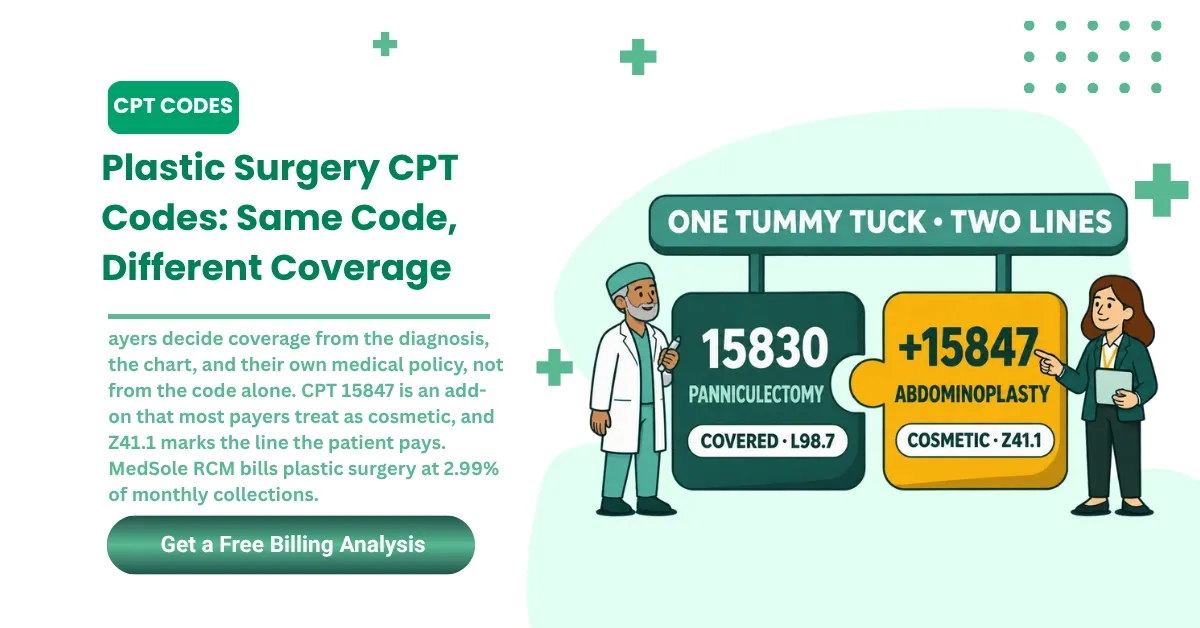
CPT 15830 reports an infraumbilical panniculectomy, the removal of the hanging apron of lower abdominal skin and fat. CPT 15847 is an add-on code for the abdominoplasty work, umbilical transposition and fascial plication, and you report it only with 15830. Payers may cover 15830 when criteria are met. Most treat 15847 as cosmetic.
So the CPT code for tummy tuck surgery is 15830 plus 15847. The abdominoplasty CPT code can't stand alone on a claim line.
|
Feature |
CPT 15830 |
CPT 15847 |
|---|---|---|
|
What it reports |
Infraumbilical panniculectomy: excess skin and fat below the navel |
Abdominoplasty work added to 15830 |
|
Code type |
Primary procedure |
Add-on, reported only with 15830 |
|
Fascial plication (muscle repair) |
Not included |
Included |
|
Umbilical transposition |
Not included |
Included |
|
Usual coverage |
Covered when criteria are met |
Usually cosmetic |
|
Diagnoses that support it |
L98.7 plus a complication code such as L30.4 or L03.311; Z98.84 after bariatric surgery |
Z41.1 when cosmetic |
Is CPT 15847 Considered Cosmetic?
Yes, in most cases. The Blue Cross NC panniculectomy policy, last reviewed in August 2026, calls abdominoplasty cosmetic and not medically necessary for all applications. It also calls diastasis recti repair not medically necessary for all indications.
Coders looking for a diastasis recti repair CPT code to add to a tummy tuck CPT code won't find one, because the fascial plication is part of 15847. If a payer approves 15830 alone, the abdominoplasty CPT code portion becomes patient responsibility under a signed financial agreement.
Can CPT 15847 Be Billed Alone?
No. Add-on codes describe work done only alongside a primary procedure, and CPT instructs you to report 15847 with 15830. Payers reject a claim that carries 15847 by itself because the primary code is missing. Add-on codes are also exempt from modifier 51, so don't append it to 15847.
Billing CPT 15830 and 15847 together is correct only when the operative note documents both the panniculectomy and the abdominoplasty work.
What Payers Need Before They Cover a Panniculectomy
A panniculectomy counts as reconstructive surgery when the pannus causes documented medical problems. Patients often ask what to say to get one covered, and the honest answer is that payers decide from the record.
Check each CPT 15830 case against these panniculectomy medical necessity criteria, drawn from Blue Cross NC's August 2026 policy and Noridian's L35163:
- Pannus hanging at or below the pubic symphysis.
- Intertrigo, cellulitis, skin ulceration, or persistent dermatitis that hasn't cleared after at least three months of treatment.
- A documented functional problem the surgery should fix, such as trouble walking or chronic pain.
- Stable weight for at least six months.
- At least 18 months since bariatric surgery, with the last six months stable.
- Pre-operative photographs, front and side.
- Diagnosis codes: L98.7, the complication code (L30.4 erythema intertrigo or L03.311 cellulitis of abdominal wall), and Z98.84 after bariatric surgery.
Back pain alone doesn't qualify under Blue Cross NC's policy. Anyone searching for an abdominoplasty ICD-10 code needs Z41.1 in most cases, because the add-on work is cosmetic, while the panniculectomy line carries the medical diagnoses.
Medicare hospital outpatient departments have needed prior authorization for panniculectomy since July 1, 2020, and ASCs in 10 demonstration states since early 2026.
If your staff builds that packet by hand on every case, our prior authorization services team can assemble it, submit it, and track it until the payer decides.
Panniculectomy With Hernia Repair or Other Abdominal Surgery
The CMS RAC panniculectomy topic, dated July 14, 2024, puts 15830 and 15847 under complex review at all A/B MACs for ASC and professional claims.
CMS states that a panniculectomy billed for cosmetic purposes isn't medically necessary. It adds that a panniculectomy billed with open abdominal surgery, or as an incidental part of another procedure, isn't coded on its own.
Bill 15830 on its own line only when it meets its own criteria and the operative note shows distinct work beyond the abdominal exposure. Check the NCCI bundling edits for the pair first. Our guide to general surgery CPT codes names the hernia repair codes.
If a payer bundles the line anyway, it comes back as one of the CO-97 bundling denials, and you correct or appeal it with the operative note. These two plastic surgery CPT codes sit on an approved RAC review topic, so build the chart before you build the claim.
Breast Reconstruction CPT Codes After Mastectomy
Breast reconstruction CPT codes split into implant-based codes (19340, 19342, 19357, and 11970) and flap codes (19361, 19364, and 19367 to 19369). Code 19350 reports nipple and areola reconstruction, and 19380 reports revisions. Medicare's NCD 140.2 covers reconstruction of both the affected and the opposite breast after a medically necessary mastectomy.
Implant-Based Reconstruction: 19340, 19342, 19357, 11970, and 15777
The breast reconstruction with tissue expander CPT code is 19357, and it includes every later expansion. The 11970 CPT code description covers the exchange of that expander for a permanent implant. CPT 19342 handles delayed implant placement, and CPT code 15777 adds the acellular dermal matrix work when the surgeon uses it.
|
Code |
What it reports |
Billing note |
|---|---|---|
|
19340 |
Implant inserted the same day as the mastectomy (immediate) |
Immediate reconstruction only |
|
19342 |
Implant inserted or replaced on a separate day from the mastectomy |
Also the delayed reconstruction implant code |
|
19357 |
Tissue expander placement, including later expansions |
Don't bill expansions on their own |
|
11970 |
Tissue expander replaced with a permanent implant |
Inside 19357's global period, a planned exchange takes modifier 58 |
|
11971 |
Tissue expander removed without an implant |
Report when no implant goes in |
|
15777 |
Add-on: biologic implant, such as acellular dermal matrix, for soft tissue reinforcement |
Report with its primary code; the matrix product goes on its own HCPCS supply line where the payer allows |
|
19396 |
Moulage preparation for a custom implant |
Custom implants only |
The CPT code 15777 that searchers want is an add-on, so it never stands alone on the claim. The acellular dermal matrix CPT code question has two answers: 15777 for the work and the product's HCPCS code for the supply. Confirm that supply code in the current HCPCS file before you bill it.
Modifier 58 carries the staged procedure billing here, because the expander exchange falls inside the 90-day global period of 19357.
Flap Reconstruction and the DIEP Flap CPT Code Question
The DIEP flap CPT code is 19364.
That code is the breast reconstruction with free flap CPT code, and its descriptor names fTRAM, DIEP, SIEA, and GAP flaps as examples. The other flap codes are 19361 (latissimus dorsi), 19367 (single-pedicled TRAM), 19368 (single-pedicled TRAM with supercharging), and 19369 (bipedicled TRAM).
Some commercial payers still want HCPCS S2068 (DIEP or SIEA flap), S2066 (GAP flap), or S2067 (stacked flaps, one breast). The Blue Cross NC breast policy, last reviewed in August 2026, still lists S2066 to S2068 among its codes. Medicare doesn't accept S-codes. Our guide to CPT vs HCPCS codes explains how the two code sets differ.
Bilateral free flaps with two surgeons take modifier 62 when the PFS co-surgery indicator allows it. CPT code 19350 is the nipple reconstruction CPT code, and nipple and areola tattooing uses 11920 to 11922, which Blue Cross NC lists in the same policy.
Coverage Rules: NCD 140.2 and the Women's Health and Cancer Rights Act
Medicare NCD 140.2, effective January 1, 1997, treats reconstruction of the affected and the opposite breast after a medically necessary mastectomy as noncosmetic. Medicare may pay for it whatever the reason for the mastectomy, though it won't pay for reconstruction done for cosmetic reasons.
The Women's Health and Cancer Rights Act of 1998, which the Department of Labor oversees for employer plans, requires plans that cover mastectomy to cover reconstruction, symmetry surgery, prostheses, and complications such as lymphedema.
That's where plastic surgery CPT codes payers treat as cosmetic turn into covered ones. On the opposite breast, 19316, 19318, or 19325 become symmetry procedures, paired with Z42.1, the matching Z90.1 code (Z90.11, Z90.12, or Z90.13), and N65.1 for asymmetry between the native and reconstructed breast.
What Changes for Plastic Surgery CPT Codes in 2027
CPT 2027 takes effect on January 1, 2027, with 453 editorial changes, according to the AMA: 299 new codes, 74 revised codes, and 80 deletions. For plastic surgery, the two changes that matter most are four new skin cell suspension autograft codes (15006 to 15009) and new Category I lymphovenous bypass codes that replace Category III code 1019T.
CPT 2027 Code Changes That Touch Plastic Surgery
The AMA CPT 2027 announcement gives the full count. On the skin side, codes 15006 to 15009 replace the eight deleted skin cell suspension autograft codes, 15011 to 15018.
The AMA also deletes Category III code 1019T for lymphovenous bypass, which was active for 2026 only, and adds Category I codes in its place, as ASPS reported in December 2025. Pull the new code numbers from the CPT 2027 Professional Edition.
Load the new plastic surgery CPT codes 2027 introduces into your chargemaster, EHR pick lists, and surgery scheduling templates before January 1. Payers will reject a claim that carries 15011 to 15018 or 1019T for a 2027 date of service. Our full guide to 2027 CPT code changes covers the other specialties.
2027 Medicare Fee Schedule Changes Surgeons Will Feel
The CMS 2027 fee schedule fact sheet, released November 4, 2026, sets the Medicare fee schedule 2027 plastic surgery practices will bill under.
- Conversion factor: $32.63 for clinicians who aren't qualifying APM participants, down 2.31% from $33.40, and $32.95 for qualifying APM participants, down 1.83% from $33.57. CMS ties most of the drop to the end of the one-year 2.50% increase that applied in 2026.
- Same-day visits: if you bill an office or outpatient E/M visit on the same day as a 0-day global procedure, Medicare pays the most expensive service at 100% and the others at 80%. CMS had proposed 50%, and it didn't finalize the cut for 10-day and 90-day globals.
- G2211: the add-on becomes modifier B1 on the E/M code and adds 16% to the visit payment. Modifier B2 adds 32% for Shared Savings Program ACO and LEAD Model participants.
The 80% rule hits 0-day codes only. Check each code's global indicator and relative value units in the physician fee schedule before you assume a same-day visit pays in full.
2026 Rules That Still Apply in 2027
ASPS's December 2025 CPT Corner reported that CPT 2026 brought 418 changes: 288 new codes, 84 deletions, and 46 revisions. New code 64728 for percutaneous carpal tunnel release carries a 0-day global, so the 2027 same-day rule applies to it. CMS also began a 2.5% efficiency adjustment to the work RVUs of non-time-based services in 2026.
Plastic Surgery ICD-10 Codes That Support the Claim (FY 2027)
The ICD-10-CM code tells the payer why the surgery happened. For plastic surgery CPT codes that cover both cosmetic and reconstructive work, that reason decides coverage. Use FY 2027 codes for dates of service from October 1, 2026, to September 30, 2027, code to the highest specificity, and never report a category header as if it were billable.
This plastic surgery ICD-10 codes list works as a CPT to ICD-10 crosswalk for plastic surgery claims. We checked every code below as billable in the FY 2027 set on November 15, 2026, and the CMS FY 2027 ICD-10 files hold the full code set.
|
Procedure (CPT) |
Supporting ICD-10-CM codes |
Note |
|---|---|---|
|
Any cosmetic portion of a case |
Z41.1 Encounter for cosmetic surgery |
Patient-pay line |
|
Panniculectomy (15830) |
L98.7 Excessive and redundant skin and subcutaneous tissue, plus L30.4 Erythema intertrigo or L03.311 Cellulitis of abdominal wall; Z98.84 Bariatric surgery status |
The complication code carries the necessity |
|
Abdominoplasty add-on (15847) |
Z41.1 Encounter for cosmetic surgery |
Usually cosmetic |
|
Breast reduction (19318) |
N62 Hypertrophy of breast, with symptom codes such as M54.2 Cervicalgia, M54.6 Pain in thoracic spine, and L30.4 Erythema intertrigo |
Symptoms must match the chart |
|
Gynecomastia (19300) |
N62 Hypertrophy of breast |
Document the workup |
|
Reconstruction after mastectomy (19357, 11970, 19342, 19364, 19350) |
Z42.1 Encounter for breast reconstruction following mastectomy, with Z90.11, Z90.12, or Z90.13 Acquired absence of breast and nipple; C50 codes such as C50.911 when cancer is current; Z15.01 Genetic susceptibility to malignant neoplasm of breast |
Laterality must match the CPT line |
|
Revision of reconstructed breast (19380) |
N65.0 Deformity of reconstructed breast; N65.1 Disproportion of reconstructed breast |
N65.1 also supports contralateral symmetry work |
|
Capsular contracture (19370, 19371) |
T85.44XA Capsular contracture of breast implant, initial encounter |
The seventh character changes with the encounter |
|
Upper blepharoplasty (15823) |
H02.831 Dermatochalasis of right upper eyelid or H02.834 Dermatochalasis of left upper eyelid |
H02.83 is a header |
|
Ptosis repair (67901 to 67908) |
H02.4 subcategory codes, for example H02.411 Mechanical ptosis of right eyelid |
H02.4 is a header |
|
Septoplasty or septorhinoplasty (30520, 30420) |
J34.2 Deviated nasal septum; M95.0 Acquired deformity of nose |
Add airway findings |
|
Otoplasty (69300) |
Q17.5 Prominent ear |
Congenital code |
|
Labiaplasty (56620 or 15839) |
N90.60 Unspecified hypertrophy of vulva or N90.69 Other specified hypertrophy of vulva |
N90.6 is a header |
|
Scar revision |
L91.0 Hypertrophic scar; Z42.8 Encounter for other plastic and reconstructive surgery following medical procedure or healed injury |
Match the scar's cause |
Noridian's billing article A57221 lists the diagnosis groups it accepts for reconstructive breast surgery, abdominal lipectomy, and dermabrasion, and Noridian can deny services billed without a listed diagnosis.
Searchers asking about tummy tuck ICD-10 coding, or ICD-10 for cosmetic surgery in general, need the Z41.1 diagnosis code in most cases, and the abdominoplasty ICD-10 answer is the same. The breast reduction ICD-10 answer is N62 plus documented symptoms, and reconstruction claims open with Z42.1.
Plastic Surgery Modifiers, Global Periods, and NCCI Edits
Major plastic surgery procedures, such as breast reductions, flaps, and rhinoplasty, carry a 090 global period. That global surgical package bundles the day-before visit, the surgery, and 90 days of routine follow-up into one payment. Modifiers tell the payer when a service falls outside the package, and NCCI edits tell it which code pairs it can't pay together.
Global Periods: 000, 010, and 090
The CMS Global Surgery booklet (MLN907166) sets three plastic surgery global period lengths:
- 000: no post-operative days, used for endoscopies and some minor procedures.
- 010: 10 post-operative days for other minor procedures, 11 days in total with the procedure day.
- 090: 90 post-operative days for major procedures, plus one pre-operative day, 92 days in total.
You track routine post-op visits inside a global with 99024, at no charge. Add-on codes such as 15847 and 15777 follow the global period of their primary code. The 2027 same-day E/M payment cut applies to 000 codes only.
The Modifiers Plastic Surgery Claims Use Most
Plastic surgery modifiers tell the payer which part of a case sits outside the global package or the usual single-surgeon, single-side claim. Our modifier 24 guide covers post-op visits in more depth.
|
Modifier |
When it applies |
Plastic surgery example |
|---|---|---|
|
22 |
Much greater work than usual, documented |
Dense scar tissue or unusual time, with the reason in the operative note |
|
24 |
Unrelated E/M during a post-op period |
A new, unrelated problem seen during a reduction's global |
|
25 |
Significant E/M, distinct from the procedure, on the day of a 000 or 010 procedure |
A full new-problem visit on the day of a minor excision |
|
57 |
E/M that led to the decision for a 090 procedure, the day before or the day of surgery |
Consult that leads to a same-day or next-day reconstruction |
|
58 |
Staged or related procedure planned at the first surgery |
Expander-to-implant exchange (11970) during 19357's global |
|
78 |
Unplanned return to the operating room for a related problem |
Hematoma evacuation after breast reduction |
|
79 |
Unrelated procedure during a post-op period |
A new skin cancer excision during an abdominoplasty global |
|
50, RT, LT |
Bilateral procedure or side |
19318 on both breasts, reported the way the payer requires |
|
51 |
Multiple procedures, same session |
Never on add-on codes such as 15847 or 15777 |
|
59, XS |
Distinct procedural service, such as a separate site |
Only when the record shows a separate site or session |
|
62 |
Two surgeons, each doing a distinct part |
Bilateral free flaps, when the PFS co-surgery indicator allows |
|
80, 82, AS |
Assistant at surgery |
Only when the PFS assistant-at-surgery indicator allows |
|
54, 55 |
Surgical care only; post-op management only |
Formal transfer of care, with a written agreement for 55 |
Payers handle bilateral surgery CPT codes in different ways. Medicare takes 19318 on one line with modifier 50, while some commercial payers want two lines with RT and LT, so bilateral procedure billing starts with the payer's own rule.
NCCI Bundling Edits and When Modifier 59 Applies
The Medicare NCCI edits come in three types: procedure-to-procedure (PTP) pairs that Medicare won't pay together, medically unlikely edits (MUEs) that cap units per day, and add-on code edits that require the primary code. CMS updates the NCCI Policy Manual once a year and the edit files every quarter.
Modifier 59 or XS bypasses a PTP edit only when the documentation shows a different site, session, or incision. It won't fix a panniculectomy bundled into the same abdominal exposure. Our modifier 59 rules explain the X modifiers in full.
These plastic surgery coding guidelines come down to the operative note, since a coder can't append a modifier the note doesn't support. Before you send plastic surgery CPT codes with a modifier, run claim scrubbing against the current NCCI bundling edits.
If modifier calls on 090-day cases keep coming back denied, our certified coding and billing support team checks each claim against the NCCI pairs and the operative note before it goes out.
Medicare Prior Authorization for Blepharoplasty, Rhinoplasty, and Panniculectomy
Medicare requires prior authorization for five service groups that can be cosmetic: blepharoplasty, botulinum toxin injections, panniculectomy, rhinoplasty, and vein ablation. Hospital outpatient departments have needed it since July 1, 2020. Ambulatory surgical centers in 10 states joined a five-year CMS demonstration in early 2026, where skipping prior authorization leads to prepayment review.
Hospital Outpatient Departments: Required Since July 2020
The CMS OPD prior authorization program has covered those five groups since July 1, 2020. CMS later added implanted spinal neurostimulators, cervical fusion with disc removal, and facet joint interventions, which sit outside plastic surgery.
CMS keeps the exact HCPCS list in a PDF on that page and edits it over time, so check your codes against the PDF on the day you schedule.
Commercial plans run their own rules. Blue Cross NC's breast policy, for example, says its breast surgeries may require prior review, so prior authorization for plastic surgery becomes a payer-by-payer check.
The ASC Prior Authorization Demonstration in 10 States
The CMS ASC prior authorization demo covers the same five service groups as the OPD program and runs in two phases.
|
Phase |
States |
Requests accepted from |
Dates of service from |
|---|---|---|---|
|
1 |
California, Florida, Tennessee, Pennsylvania, Maryland, Georgia, New York |
January 5, 2026 |
January 19, 2026 |
|
2 |
Texas, Arizona, Ohio |
February 2, 2026 |
February 16, 2026 |
Prior authorization is voluntary in the demonstration, but CMS sends an applicable ASC claim that skips it to prepayment medical review. For your practice, that means slower payment and a records request on each of those claims.
ASC claims carry place of service 24. Our guide to POS 24 for ASCs covers how ambulatory surgery center billing differs from other place of service codes.
Each request goes to the MAC for your jurisdiction. If your front desk can't absorb that volume, MedSole's surgical prior authorization support can take it over.
Plastic Surgery Denial Codes and How to Fix Them
Plastic surgery denial codes fall into four groups: medical necessity the payer couldn't see (CO-50), a cosmetic or plan exclusion (CO-96 or CO-204), a missing authorization (CO-197), and a code, diagnosis, or modifier mismatch on the plastic surgery billing codes themselves (CO-11, CO-4, or CO-97). Each group needs a different fix, and resubmitting the same claim unchanged seldom works.
|
CARC |
What it means |
Common plastic surgery cause |
Fix |
|---|---|---|---|
|
CO-50 |
The payer doesn't consider the service medically necessary |
Criteria not documented: photos, symptom duration, visual fields, tissue weight |
Appeal with the missing records, or correct the diagnosis if it was wrong |
|
CO-96 |
Charge not covered |
Cosmetic exclusion |
Bill the patient under the signed financial agreement; confirm the line carried Z41.1 |
|
CO-204 |
Service not covered under the patient's current benefit plan |
The plan excludes the procedure |
Verify benefits before scheduling, then move the case to self-pay |
|
CO-197 |
Required precertification or authorization missing |
No prior authorization for an OPD or ASC case, or a missed commercial plan requirement |
Request retro-authorization if the payer allows it; fix the scheduling checkpoint |
|
CO-11 |
Diagnosis doesn't fit the procedure |
Z41.1 left on a covered line, or a symptom code without the primary diagnosis |
Correct the pairing and resubmit |
|
CO-4 |
Procedure code doesn't fit the modifier, or a required modifier is missing |
50 sent where the payer wants RT and LT, or 58 missing on a staged exchange |
Correct the modifier and resubmit |
|
CO-97 |
Payment already included in another paid service |
Panniculectomy bundled into abdominal surgery, or an add-on sent without its primary |
Appeal only if the record shows distinct work |
For Medicare, the first level of appeal is a redetermination by the MAC. Under the Medicare redetermination rules, the MAC must receive your request within 120 days of the date you get the initial determination, and it decides within about 60 days. Commercial appeal windows vary by contract.
Our guide to CO-50 medical necessity denials covers the appeal steps for record-based denials. For missed approvals, see the guide to CO-197 authorization denials. Modifier mismatches have their own walkthrough in CO-4 modifier denials.
If the same CO-50 and CO-197 denials keep showing up on the same procedure codes, the fix belongs upstream, in scheduling or documentation. Our denial management services team traces each repeat denial to the step that caused it and fixes that step.
Billing Self-Pay Cosmetic Surgery and Good Faith Estimates
Cosmetic surgery is self-pay in most cases, and the No Surprises Act requires providers to give uninsured and self-pay patients a good faith estimate of expected charges when they schedule a service or ask for one. A patient whose bill comes in at least $400 above the estimate for a provider or facility can dispute it.
The CMS good faith estimate guide counts insured patients who choose not to use their coverage for the service as self-pay. If you schedule the surgery at least three business days out, the estimate is due within one business day of scheduling. At least 10 business days out, or on request without scheduling, it's due within three business days.
The estimate lists each expected item and service with its charge, the diagnosis and service codes, and any co-provider or co-facility charges. Cosmetic surgery package pricing still needs that itemized estimate behind it. The guide also notes that people in federal programs such as Medicare, Medicaid, or TRICARE don't receive these estimates, because other protections apply to them.
For Medicare patients, contractor guidance says you don't need an ABN for services the law excludes, such as cosmetic surgery, though you may give a voluntary notice. If you file the claim, the GY modifier marks the cosmetic surgery as excluded by statute, and some MACs, such as CGS, also ask for GX when you gave a voluntary ABN.
The CPT code for cosmetic consultation, if you bill one at all, is the office E/M code for the visit's level: 99202 to 99205 for new patients and 99212 to 99215 for established ones. Many practices charge a flat self-pay fee instead.
Out-of-network plastic surgery billing for insured patients at in-network facilities follows separate CMS No Surprises Act rules.
Mixed cases start with eligibility verification and a predetermination of benefits, so you know the covered and self-pay portions before the surgery date. Our benefit verification services team runs that check before the case goes on the schedule.
How MedSole RCM Handles Plastic Surgery Billing
MedSole RCM provides plastic and reconstructive surgery billing services that split covered and cosmetic lines on one case, build prior authorization packets, and trace denials to their cause. The same team handles plastic surgery insurance credentialing, including the plastic surgery taxonomy code (208200000X) on every payer application.
AAPC-certified coders and billers scrub each claim for diagnosis pairing, modifiers, and NCCI edits before it goes out. Your monthly reporting covers the numbers MedSole publishes: clean claim rate, denial rate, net collection rate, and days in AR. For pricing context across the market, see our medical billing cost guide.
- Billing: MedSole RCM charges 2.99% of monthly collections, with no setup fee, software fee, clearinghouse fee, or monthly minimum, month to month.
- Included in that rate: eligibility checks, prior authorizations, old AR cleanup after the switch, reporting, and an account manager.
- Credentialing: MedSole's provider credentialing services cost $99 per payer application, and the team files each application within 48 hours of receiving complete documents.
- For comparison: credentialing companies charged $100 to $500 per payer application on pricing pages MedSole checked in October 2026, as our credentialing cost breakdown shows.
- Client averages: 99% clean claim rate, denial rate under 4%, net collection rate of 97% or higher, and under 28 days in AR. These are averages across MedSole RCM clients; results vary by specialty and payer mix.
If you want plastic surgery medical billing with the cosmetic split and prior authorizations covered by one 2.99% rate, plus credentialing at $99 per payer application, talk with our full-service medical billing team.
Plastic Surgery CPT Codes: Frequently Asked Questions
What are the CPT codes for cosmetic procedures?
Cosmetic procedures use the same CPT codes as reconstructive ones, with Z41.1 marking the encounter as cosmetic. Common CPT codes for plastic surgery done for appearance include 15822 for upper eyelid blepharoplasty, 15824 to 15829 for facelifts, 19325 for breast augmentation, 15876 to 15879 for liposuction, and 30400 to 30450 for rhinoplasty. The patient pays under a signed financial agreement after a good faith estimate. If the same case includes covered work, bill that work on its own line with its medical diagnosis.
Is CPT 19318 billed once or twice for a bilateral breast reduction?
It depends on the payer, because the breast reduction CPT code 19318 reports one side. Medicare's standard is one line with modifier 50 and one unit. Some commercial payers want two lines with RT and LT instead, so check the payer's policy before you submit. Whichever format the payer wants for a modifier 50 breast reduction claim, each side still needs its own tissue weight in the operative report and the pathology report.
What CPT code is used for a DIEP flap?
The DIEP flap CPT code is 19364, breast reconstruction with free flap, and its descriptor names DIEP as an example. Some commercial payers still want HCPCS S2068, and Blue Cross NC's breast policy still lists S2066 to S2068. Medicare doesn't accept S-codes, so check the payer's policy before you send the claim. Use modifier 62 only when two surgeons each do a distinct part and the PFS co-surgery indicator allows it.
How many pounds of skin are removed in a panniculectomy?
There's no standard amount, because the tissue removed depends on the size of the pannus. Common payer policies, such as Blue Cross NC's, don't set a weight threshold. They look at where the pannus hangs, at or below the pubic symphysis, and at documented skin complications that persist despite treatment. The pathology report records the specimen weight for the chart, so pull the number from that report when a payer asks for it.
How often should plastic surgery practices update their CPT codes?
Update plastic surgery CPT codes every January 1, when the new CPT set takes effect. The AMA also releases some codes early during the year, such as Category III codes. ICD-10-CM changes every October 1, with occasional April 1 updates, and HCPCS Level II and the NCCI edit files change every quarter. Schedule a chargemaster and EHR review each December so your team loads the January changes before the first claim of the year.
How much does it cost to outsource plastic surgery billing?
MedSole RCM charges 2.99% of monthly collections for plastic surgery billing services, plus $99 per payer application for credentialing. The billing rate carries no setup fee, software fee, clearinghouse fee, or monthly minimum. MedSole's own cost guide notes that full-service billing guides cite 4% to 10% of collections. When you compare a plastic surgery billing company, look at what the rate includes, such as prior authorization, denial work, and AR cleanup, and at the clean claim rate it reports. That comparison, alongside the headline percentage, points you to the best plastic surgery billing company for your practice.
About MedSole RCM. MedSole RCM is a full-service revenue cycle management company offering medical billing at 2.99% of monthly collections and credentialing at $99 per payer application. [Author name, credential] is [Role] at MedSole RCM and reviewed this guide against the CMS, AMA, and payer sources below.
Sources
We loaded and read every source below on November 15, 2026.
- CMS, Medicare Benefit Policy Manual, Chapter 16
- Noridian, LCD L35163: Plastic Surgery (CMS Medicare Coverage Database)
- CMS, PFS Look-up Tool
- Noridian, Article A57221: Billing and Coding: Plastic Surgery
- Blue Cross NC, Abdominoplasty and Panniculectomy (August 2026)
- CMS, RAC Topic 0130: Panniculectomy
- Blue Cross NC, Breast Surgeries (August 2026)
- CMS, NCD 140.2: Breast Reconstruction Following Mastectomy
- AMA, AMA releases CPT 2027 code set (September 9, 2026)
- CMS, CY 2027 Medicare Physician Fee Schedule Final Rule fact sheet (November 4, 2026)
- CMS, ICD-10 code files (FY 2027)
- CMS, MLN907166 Global Surgery booklet
- CMS, NCCI for Medicare
- CMS, Prior Authorization for Certain Hospital Outpatient Department Services
- CMS, Prior Authorization Demonstration for Certain Ambulatory Surgical Center Services
- CMS, First Level of Appeal: Redetermination by a Medicare Contractor
- CMS, No Surprises Act: Overview of rules and fact sheets
- CMS, Understanding the Good Faith Estimate and Dispute Resolution Process
- U.S. Department of Labor, Women's Health and Cancer Rights
- ASPS, CPT Corner: Updated codes, what's new in 2026 (December 2025)