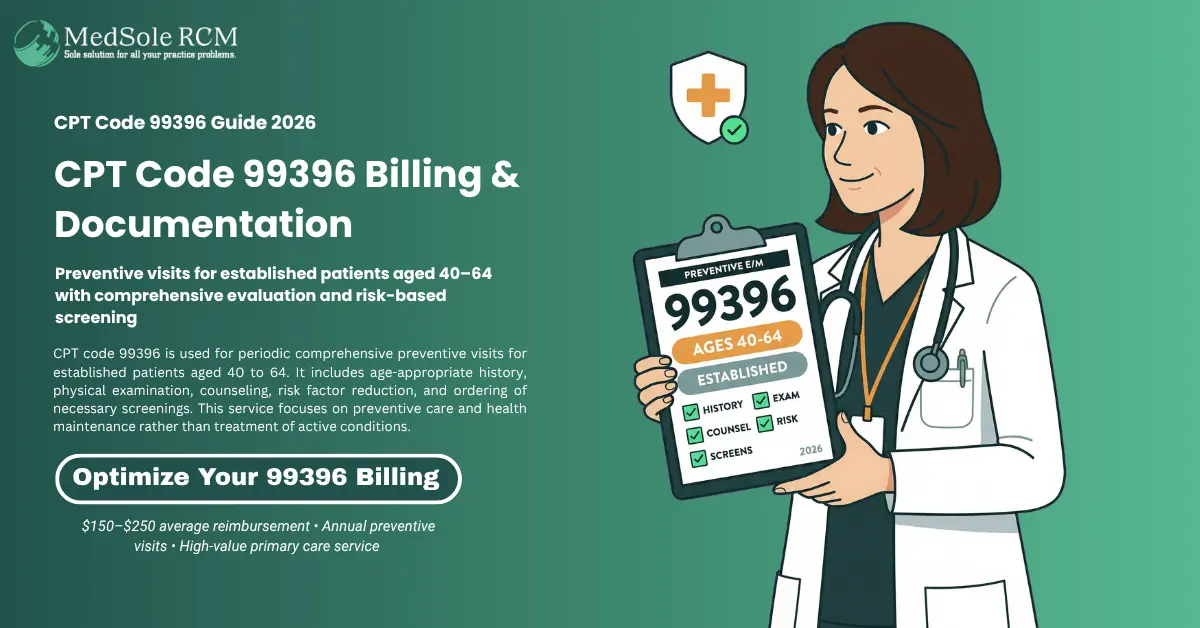




CPT code 99396 is a preventive medicine evaluation and management (E/M) code maintained by the American Medical Association (AMA) that reports a periodic, comprehensive preventive medicine visit for an established patient between 40 and 64 years of age. It covers health maintenance and disease prevention, not the diagnosis or treatment of active complaints. Billing professionals working in primary care, family medicine, and internal medicine encounter this code daily, and the margin for error is narrower than most providers realize.
Key Facts at a Glance
|
Category |
Details |
|
Code |
99396 |
|
Code Type |
Current Procedural Terminology (CPT), Preventive Medicine E/M |
|
Patient Type |
Established patient (seen within the past three years by the same physician or same specialty group) |
|
Age Range |
40 to 64 years |
|
Visit Focus |
Health maintenance and disease prevention, not acute complaint management |
|
Typical Reimbursement |
$150 to $250 (commercial payers; varies by payer and geographic location) |
|
Medicare Coverage |
Not covered under Original Medicare. Use G0438 or G0439 for Medicare patients |
|
Key Modifier |
Modifier 25 (when a separate, significant problem-oriented E/M is performed on the same day) |
|
Related Codes |
99395 (ages 18–39), 99397 (ages 65+), 99386 (new patient ages 40–64) |
|
Primary ICD-10 Codes |
Z00.00 (general adult exam, no abnormal findings), Z00.01 (general adult exam with abnormal findings) |
Preventive visit billing is one of the most denial-prone categories in primary care revenue cycle management (RCM). CPT code 99396 is frequently billed with age mismatches, missing modifiers, and documentation that doesn't hold up under payer review. These aren't edge cases. They're recurring errors that cost practices real money, and most of them are entirely preventable with the right billing framework in place.
This guide covers the official AMA descriptor language for CPT code 99396, patient eligibility rules, the documentation required to pass audit, ICD-10 diagnosis code selection, payer-specific reimbursement and frequency policies, modifier applications including Modifier 25 and Modifier 33, the Medicare exclusion and its alternatives, common denial reasons with resolution steps, and the 2026 CMS and ICD-10 updates that directly affect preventive visit billing.
If your practice is managing high denial volumes on preventive visits, MedSole RCM's outsourced medical billing services are designed to resolve exactly this, starting at 2.49% of collections with no setup fees.
What Is CPT Code 99396: Official AMA Descriptor and Patient Eligibility
The Official CPT 99396 Code Description (AMA Language)
The AMA defines CPT code 99396 in the CPT Professional Edition using this exact language:
"Periodic comprehensive preventive medicine reevaluation and management of an individual including an age and gender appropriate history, examination, counseling/anticipatory guidance/risk factor reduction interventions, and the ordering of laboratory/diagnostic procedures, established patient; 40-64 years."
American Medical Association, CPT Professional Edition
That's the official language. Here's what it actually means in practice.
"Periodic comprehensive preventive medicine reevaluation" tells you two things right away. First, this isn't a first-time visit. Second, it's not a sick visit. It's a scheduled, recurring wellness evaluation for a patient the provider already knows.
"Age and gender appropriate history" means the provider can't pull up a generic intake template and call it done. The history has to be relevant to a 40 to 64-year-old patient. That means cardiovascular risk, cancer screening history, reproductive health where applicable, and the lifestyle factors that matter at this life stage.
"Counseling/anticipatory guidance/risk factor reduction interventions" is where most documentation falls apart in audit. This is the most commonly under-documented element of a 99396 visit. "Discussed healthy diet" doesn't cut it. The note needs to reflect what was discussed, which risk factors drove the conversation, and what the patient said in response.
"Ordering of laboratory/diagnostic procedures" means the visit has to result in action. A history and physical with no screening orders weakens the claim. Age-appropriate tests need to be ordered, and the reasoning should be in the chart.
For a full overview of AMA CPT resources, visit the AMA CPT resources page.
Established Patient Definition: The 3-Year Rule for CPT 99396
Here's one of the most consistent denial triggers in preventive visit billing. A practice uses CPT code 99396 for a patient who hasn't been seen in three years and one day. The payer denies it. The correct code was CPT 99386 for a new patient. The appeal fails because it's a coding error, not a coverage dispute.
Per AMA CPT guidelines, a patient is established if they have received professional services from the physician, or from another physician of the same specialty and subspecialty in the same group practice, within the past three years.
The practical implications matter:
-
A patient who transfers from one physician to another within the same specialty group is still established.
-
A patient who hasn't been seen in three years and one day is now a new patient. Use CPT 99386.
-
A provider who's new to a practice but inherits existing patients needs to check the group's specialty billing history before assigning patient status.
That last point trips up a lot of practices, especially after physician turnover.
New or Established? Use This Rule
Has this patient received professional services from your physician, or another physician of the same specialty in your same group, within the past three years?
If YES: Use CPT 99396.
If NO: Use CPT 99386.
The CMS guidance on new vs. established patient classification provides additional context on how this distinction is applied at the payer level.
CPT 99396 Age Limit: What Happens When Patients Fall Outside 40-64
CPT code 99396 applies exclusively to established patients who are 40 through 64 years of age at the time of service. Billing this code for a patient who is 39 or 65 results in automatic claim denial at the payer level. No appeal overturns an age-based denial because it's a coding error, not a coverage dispute.
The payer's system validates patient age against the CPT code at submission. It doesn't matter what the visit looked like clinically. If the age doesn't match, the claim rejects.
Here's how the preventive medicine evaluation codes break down for established patients across all age ranges:
Preventive Visit CPT Codes for Established Patients: Age Comparison
|
CPT Code |
Patient Type |
Age Range |
Key Focus Areas |
|
99391 |
Established |
Under 1 year |
Well-infant care |
|
99392 |
Established |
1 to 4 years |
Developmental milestones |
|
99393 |
Established |
5 to 11 years |
Childhood screenings |
|
99394 |
Established |
12 to 17 years |
Adolescent health |
|
99395 |
Established |
18 to 39 years |
Early adult preventive care |
|
99396 |
Established |
40 to 64 years |
Cardiovascular, cancer, metabolic risk |
|
99397 |
Established |
65 and older |
Osteoporosis, cognitive, fall risk |
For new patients in the 40 to 64 age range, the correct code is CPT 99386. Practices that don't distinguish between new and established patient preventive codes account for a disproportionate share of age-based denials. A structured denial management workflow catches these errors before they hit the payer.
What Is Included in CPT Code 99396: Required Clinical Components
CPT code 99396 requires documentation of five core clinical components: a comprehensive, age and gender-appropriate medical history; a complete physical examination; counseling and anticipatory guidance on preventive health measures; risk factor reduction interventions; and the ordering of appropriate laboratory and diagnostic procedures. All five must be documented to support the preventive medicine service and justify reimbursement.
The five required components are:
-
A comprehensive, age and gender-appropriate medical history
-
A complete physical examination
-
Counseling and anticipatory guidance on preventive health measures
-
Risk factor reduction interventions
-
The ordering of appropriate laboratory and diagnostic procedures
Think of these five components as the floor, not the ceiling. Missing even one of them gives a payer grounds to deny or recoup payment during audit.
Component 1: Comprehensive Age and Gender-Appropriate Medical History
The medical history section is the most commonly thin part of a 99396 note. "Thin" doesn't mean short. It means generic. A history that could apply to any patient of any age isn't comprehensive. It's a liability in audit.
For a patient in the 40 to 64 age group, the history needs to cover specific ground:
-
Personal medical history: current medications, allergies, past surgeries, and hospitalizations
-
Family history: cardiovascular disease, cancer, and diabetes in first-degree relatives (this age group carries real cardiovascular and cancer risk that needs to be documented)
-
Social history: tobacco use, alcohol consumption, physical activity level, occupational hazards, and sexual health history relevant to cervical cancer screening discussions
-
Lifestyle history: diet patterns, sleep quality, and stress levels (these feed directly into the counseling component)
-
Review of systems: updated at each visit per payer expectations, not carried forward from the prior year
That last point matters a lot.
Documentation Audit Risk
If the medical history section uses copy-forward language from the previous year's visit without updating it, payers treating this as incomplete documentation during retrospective audit will consider the claim unsupported. A note that reads identically to last year's note is a red flag in audit. Reviewers notice it immediately.
The AAFP's guidance on preventive medicine documentation outlines the documentation standards that support these visits under payer review.
Component 2: Complete Physical Examination for the 40 to 64 Age Group
The physical exam for a CPT 99396 visit is preventive in nature. That distinction matters for billing. A preventive exam looks at the whole patient for risk. A problem-focused exam evaluates a specific complaint.
For patients in the 40 to 64 range, the exam should include:
-
Vital signs: blood pressure, heart rate, BMI, and weight
-
Cardiovascular system assessment (cardiovascular risk rises significantly through this age group)
-
Skin examination for melanoma screening
-
Breast examination for female patients
-
Abdominal examination
-
Musculoskeletal assessment
-
Neurological screening: reflexes, coordination, and basic cognitive orientation
Here's where a lot of practices create a billing problem without realizing it. If the provider spends the majority of the exam evaluating a specific complaint, say a painful knee in detail, that element needs to be separately documented and billed under a problem-oriented E/M code with Modifier 25. It can't be folded into the preventive exam documentation. Mixing the two without clear separation is one of the fastest ways to invite a post-payment audit.
Component 3: Counseling and Risk Factor Reduction—The Most Underdocumented Element
This is where more 99396 claims fail audit than any other component. The AMA descriptor calls for counseling, anticipatory guidance, and risk factor reduction interventions. All three. Not one. Not two.
What that looks like in practice:
-
Diet and nutrition counseling: Not "discussed healthy diet." The note needs to reflect what dietary changes were recommended, which risk factors drove the recommendation, and what the patient said in response.
-
Physical activity guidance: Specific recommendations based on the patient's current activity level and health status, not a generic prompt to "exercise more."
-
Tobacco cessation counseling: For patients who smoke, document the counseling approach used and any referrals made to cessation programs.
-
Alcohol use assessment: Reference a validated screening tool such as the AUDIT-C. A checkbox doesn't demonstrate that screening occurred.
-
Mental health screening: Document whether the PHQ-9 or PHQ-2 was administered, the score, and the clinical response to that score.
-
Sexual health discussion: Relevant for STI screening recommendations and cervical cancer screening conversations in this age group.
-
Anticipatory guidance: Brief but documented discussion of age-related health changes the patient should expect in the coming year.
Practices using EHR systems that only allow checkboxes for counseling topics are creating real audit risk. A checkbox that says "diet counseling: yes" doesn't meet documentation standards. The note has to reflect what was discussed in enough detail that a third-party reviewer could confirm the service occurred. If they can't confirm it from the note, the payer won't pay for it.
Component 4: Age-Appropriate Screenings and Preventive Orders
Ordering the right screenings for the right patient isn't just good medicine. It's a billing requirement. A 99396 visit that includes a thorough history and physical but no screening orders raises questions about whether the visit was truly comprehensive.
For established patients in the 40 to 64 age range, the U.S. Preventive Services Task Force (USPSTF) sets the standard for which screenings carry the strongest evidence base. Current USPSTF A and B recommendations for this age group include:
-
Blood pressure screening (annual)
-
Lipid panel for hyperlipidemia
-
Colorectal cancer screening, typically starting at 45 via colonoscopy or FIT test
-
Mammography annually from age 40 per the updated 2024 USPSTF guidance
-
Cervical cancer screening via Pap smear every three years, or Pap plus HPV co-testing every five years for patients ages 30 to 65
-
Diabetes screening using fasting glucose or HbA1c for patients with risk factors
-
Low-dose CT lung cancer screening for high-risk patients ages 50 to 80 with a qualifying smoking history
-
Immunizations: annual influenza vaccine, Tdap if not recent, Shingrix starting at age 50, and pneumococcal vaccine based on age and risk
Document which screenings were ordered, which the patient declined along with the patient's stated reason, and which are due at a future visit based on the last completed date. That documentation does two things: it protects the practice in audit and it demonstrates the visit was genuinely comprehensive, not a checkbox exercise.
ICD-10 Diagnosis Codes Required for CPT Code 99396 Billing
The correct primary diagnosis code for a CPT 99396 preventive visit is Z00.00 (encounter for general adult medical examination without abnormal findings) or Z00.01 (encounter for general adult medical examination with abnormal findings). Using a chronic disease code such as I10 (hypertension) or E11.9 (type 2 diabetes) as the primary diagnosis converts the claim from a preventive visit to a problem-oriented visit in the payer's system, triggering denial or reduced reimbursement.
That's not a documentation nuance. It's the difference between getting paid for a preventive visit and not getting paid at all.
Z00.00 vs Z00.01: Choosing the Right ICD-10 Code for CPT 99396
Z00.00 applies when the preventive visit reveals no new abnormal findings. The visit is entirely wellness-focused. No new conditions are identified. This is the cleaner of the two scenarios from a coding standpoint.
Z00.01 applies when the visit identifies an abnormal finding. The sequencing rule here is specific, and the FY 2026 CDC guidelines make it explicit.
2026 ICD-10-CM Update: CDC Sequencing Rule
Per CDC's ICD-10-CM Official Guidelines for FY 2026 (applicable October 1, 2025 through September 30, 2026), when a general medical examination reveals abnormal findings, providers must first code the "exam with abnormal findings" category (Z00.01) and additionally code the abnormal finding(s) identified. Claims submitted with chronic disease codes as the primary diagnosis for a preventive visit will not be reimbursed as preventive services.
The practical implication is straightforward. Say a 58-year-old established patient comes in for a CPT 99396 visit, and the provider identifies elevated blood pressure that hasn't been previously diagnosed. The primary code is Z00.01. The hypertension diagnosis (I10) is secondary. Flip that order and the payer processes the visit as a problem-oriented encounter, not a preventive one.
The CDC ICD-10-CM official page is the primary reference for FY 2026 sequencing rules.
Supporting ICD-10 Z-Codes for Preventive Screenings Ordered During 99396
Z00.00 and Z00.01 are the primary codes. Everything below supports specific screening orders placed during the visit. These aren't substitutes for the primary diagnosis. They're additional codes that document the clinical rationale for the tests ordered.
ICD-10 Z-Code Reference Table for CPT 99396 Visits
|
ICD-10 Code |
Description |
When to Use |
|
Z00.00 |
General adult exam, no abnormal findings |
Standard preventive visit, no new conditions identified |
|
Z00.01 |
General adult exam with abnormal findings |
When a new condition or abnormality is identified during the visit |
|
Z12.11 |
Screening for malignant neoplasm of the colon |
When colonoscopy or FIT test is ordered |
|
Z12.31 |
Screening for malignant neoplasm of the breast |
When mammogram is ordered |
|
Z13.1 |
Screening for diabetes mellitus |
When fasting glucose or HbA1c is ordered |
|
Z13.220 |
Screening for lipid disorders |
When cholesterol panel is ordered |
|
Z13.89 |
Screening for other specified disorders (depression) |
When PHQ-9 or PHQ-2 is administered |
|
Z82.49 |
Family history of ischemic heart disease |
Supporting cardiovascular risk counseling |
|
Z87.891 |
Personal history of nicotine dependence |
Supporting tobacco cessation counseling |
These secondary codes are not substitutes for Z00.00 or Z00.01 as the primary diagnosis. They're additional codes that document the clinical rationale for specific screening orders placed during the preventive visit billing encounter.
CPT 99396 Reimbursement Rates, Medicare Coverage Rules, and Payer Policies (2026)
CPT 99396 Reimbursement Rates: What Commercial Payers Pay in 2026
Reimbursement for CPT code 99396 under commercial insurance typically ranges from $150 to $250 per visit. The final rate depends on the payer, the provider's contracted fee schedule, the geographic location adjusted through the Geographic Practice Cost Index (GPCI), and whether the service is delivered in a facility or non-facility setting.
CPT 99396 Estimated Reimbursement Rates by Payer Type (2026)
|
Payer Type |
Estimated Rate Range |
Frequency Limit |
Notes |
|
Blue Cross Blue Shield |
$185 to $230 |
Annual (calendar year) |
Requires Z00.00 or Z00.01 as primary diagnosis |
|
Aetna |
$175 to $220 |
365 days from last service date |
Rolling interval; calendar-year reset does not apply |
|
Cigna |
$200 to $250 |
Calendar year |
Modifier 25 accepted for same-day E/M |
|
UnitedHealthcare |
$180 to $225 |
Annual (calendar year) |
Audit-prone; documentation review is common |
|
Medicaid (varies by state) |
$90 to $150 |
Annual (state-specific) |
Verify state Medicaid policy before billing |
|
Medicare (Original) |
Not covered |
Not applicable |
Use G0438 or G0439 instead |
These figures represent estimated ranges based on available payer fee schedule data. Contracted rates aren't uniform within payer networks. An in-network rate with BCBS can differ by $40 to $60 based on specialty and geographic location alone. Always verify your specific contracted rate directly with the payer before using these numbers to set expectations.
Frequency Limit: Calendar Year vs. Rolling 365 Days
The CPT 99396 frequency limit is one of the most preventable denial causes in preventive visit billing, and the confusion almost always comes from not knowing which frequency model a given payer uses.
Some payers reset on January 1 every year. Others apply a rolling 365-day interval measured from the patient's last preventive visit date. With Aetna, for example, a patient seen on February 15 of the prior year can't be billed again until February 15 of the current year. Billing on January 2 triggers an automatic denial. The appeal won't succeed because the interval hasn't elapsed.
Know which model each payer uses before scheduling the visit, not after the denial arrives.
Does Medicare Cover CPT Code 99396? The Complete Answer
Original Medicare does not cover CPT code 99396. Medicare excludes routine physical examinations under a statutory exclusion in the Social Security Act, meaning no amount of documentation or medical necessity argumentation results in reimbursement for CPT code 99396 under Original Medicare.
Per CMS Medicare Claims Processing Manual, transmittal MM13548, CMS explicitly states: "Don't bill CPT codes 99381-99397 (comprehensive preventive medicine evaluation and management services) for Medicare services covered by this guidance." That language closes the door completely. There's no workaround, no exception, and no appeal path.
The CMS Medicare Wellness Visits page is the primary reference for current Medicare AWV coverage rules. The CMS Medicare Learning Network provides additional billing guidance for providers navigating the AWV pathway.
As of February 25, 2026, CMS updated its Medicare Wellness Visits guidance to include coverage information for the Social Determinants of Health (SDOH) assessment code G0136 and clarifications on HCPCS code G2211 in the context of Annual Wellness Visits. These changes don't affect CPT code 99396 directly. They do affect how AWV visits are documented and billed for Medicare patients, which is the correct pathway for patients who would otherwise receive a CPT 99396 service under commercial insurance.
Medicare Alternative Codes: What to Use Instead of CPT 99396
|
Code |
Name |
Medicare Coverage |
Frequency |
|
G0402 |
Welcome to Medicare / IPPE |
Covered once within first 12 months of Part B enrollment |
Once per beneficiary |
|
G0438 |
Initial Annual Wellness Visit |
Covered after IPPE |
Once |
|
G0439 |
Subsequent Annual Wellness Visit |
Covered annually after G0438 |
Once per 12 months |
|
G0136 |
SDOH Assessment |
Newly expanded guidance (February 2026) |
Per CMS policy |
|
CPT 99396 |
Preventive visit, established, ages 40 to 64 |
Not covered under Original Medicare |
Not applicable |
Medicare Advantage plans are a different situation. Some Medicare Advantage plans cover CPT code 99396 as a supplemental benefit. Others follow Original Medicare guidelines exclusively. Providers can't assume coverage based on the plan type alone. Verify directly with each individual Medicare Advantage plan before billing CPT 99396 for any Medicare Advantage beneficiary.
What about the Advance Beneficiary Notice (ABN)? CMS notes that an ABN isn't technically required for services that Medicare statutorily never covers, and routine physicals fall into that category. That said, providing voluntary written notice to patients before the visit is good practice. It sets the right expectation and gives the practice a clear path to collect from the patient if the service is performed.
Keeping payer-specific coverage rules straight across Original Medicare, Medicare Advantage, and commercial plans is one of the primary drivers of preventive visit billing errors. If that's an area where your practice is losing time or revenue, MedSole RCM's revenue cycle management services are built specifically for multi-payer environments where these distinctions matter every day.
CPT 99396 Medicaid Coverage: Why State Rules Matter
Medicaid coverage for CPT 99396 isn't governed by a single federal rule. Each state sets its own policy, and managed care organizations within each state can layer additional requirements on top of that.
Most state Medicaid programs reimburse CPT 99396 at reduced rates, typically in the $90 to $150 range. Some state Medicaid managed care organizations require documentation that goes beyond what commercial payers ask for. Two recent examples from 2026 confirm active coverage in specific states: Ohio Medicaid's FY 2026 EAPG covered code list, revised February 13, 2026, explicitly lists CPT 99396 as "PREV VISIT EST AGE 40-64." Texas's Healthy Texas Women program, updated February 2026, includes CPT 99396 among its covered annual exam codes.
That's two states confirmed. The other 48 require direct verification.
Don't try to compile all 50 state policies from secondary sources. Contact your state Medicaid agency directly, review your managed care organization's (MCO) current provider manual, or use the payer's electronic provider portal to confirm coverage before billing. The CMS Medicaid benefits page is a starting point for understanding federal Medicaid structure, but state-specific rules require state-level verification.
Modifier Rules for CPT Code 99396: Modifier 25, Modifier 33, and Same-Day E/M Billing
Modifier 25 with CPT Code 99396: When and How to Use It Correctly
The AMA defines Modifier 25 as:
"Significant, Separately Identifiable Evaluation and Management Service by the Same Physician or Other Qualified Health Care Professional on the Same Day of the Procedure or Other Service."
American Medical Association, CPT Modifier 25 Definition
In the context of CPT code 99396, that definition means one specific thing. When a patient comes in for a scheduled preventive visit and the provider identifies and evaluates a separate, significant medical problem during the same encounter, both services can be billed. The preventive visit goes on CPT 99396. The problem-oriented evaluation goes on the appropriate E/M code (99212 through 99215), and Modifier 25 goes on the E/M code, not on CPT 99396.
That distinction trips up a lot of billing staff. The modifier goes on the problem-oriented service, not the preventive one. Getting that backwards results in denial.
How to Bill CPT 99396 and 99214 Together: Step-by-Step
Here's a real scenario that shows the correct workflow:
-
A 52-year-old established patient presents for her annual preventive visit under CPT 99396. The provider completes the history, physical examination, cancer screening orders, and lifestyle counseling.
-
During the visit, the patient mentions new-onset knee pain she hasn't reported before. The provider performs a separate, focused musculoskeletal examination, reviews onset and severity, and decides to order imaging.
-
The provider documents the preventive visit components under CPT 99396 with primary diagnosis code Z00.00. The knee pain evaluation is documented separately, with its own focused history, exam findings, and medical decision-making, under CPT 99214 with diagnosis code M25.361 (pain in right knee).
-
The claim goes out with CPT 99396 (Z00.00) and CPT 99214-25 (Modifier 25 appended, M25.361). Both lines are reimbursed because the documentation clearly supports two distinct, separately identifiable services.
The critical requirement is separate documentation. If the knee evaluation is embedded inside the preventive visit note without clear separation, the payer may bundle both services and reimburse only the higher-paying one. That's revenue gone on either the preventive visit or the E/M, and it's entirely avoidable.
When Modifier 25 Doesn't Apply
Modifier 25 isn't the right tool for every same-day situation. Reviewing blood pressure readings for a well-controlled hypertensive patient who has no new complaints doesn't qualify. Routine chronic disease monitoring that requires no additional significant clinical decision-making isn't a "significant, separately identifiable E/M service" under the AMA definition. Appending Modifier 25 in that scenario invites audit and eventual recoupment.
Modifier 33: When to Apply It to CPT 99396 Under ACA Plans
Modifier 33 signals that a service is a preventive care service with zero patient cost-sharing under the Affordable Care Act (ACA). When CPT 99396 is provided under an ACA-compliant plan that covers preventive services at 100%, Modifier 33 may be appended to indicate that the service falls under ACA preventive coverage requirements.
A few things to know before applying it universally:
-
Not every payer requires Modifier 33. Some ACA-compliant plans process covered preventive services correctly without it.
-
Modifier 33 applies only to the preventive service itself. It's never appended to the problem-oriented E/M code when CPT 99213 or 99214 is billed alongside CPT 99396.
-
Verify each payer's specific requirements before adding Modifier 33 to every claim. The HHS ACA overview explains the preventive services mandate, but individual payer contracts govern whether the modifier is required for processing.
Payer-Specific Modifier 25 Policies: Cigna, Aetna, UnitedHealthcare, and BCBS
Modifier 25 acceptance isn't identical across payers. Here's what the major commercial payers actually require:
Cigna accepts Modifier 25 on E/M codes billed on the same day as a preventive visit. The requirement is a separate note section that documents the problem-oriented service distinctly from the preventive visit documentation. A single blended narrative won't hold up.
Aetna accepts Modifier 25 but conducts retrospective audits on same-day claims where the problem-oriented E/M is billed at the 99214 or 99215 level. If those visits are on your radar, the documentation needs to be airtight with complete separation between the preventive and problem-oriented components.
UnitedHealthcare accepts Modifier 25 for same-day preventive plus E/M billing, but its policy language specifically requires that the problem-oriented service involve a new or worsening condition. Routine chronic disease monitoring doesn't qualify under UHC's rules.
BCBS plans vary by state, so there's no single answer for the network as a whole. Federal Employee Program (FEP) BCBS plans carry specific policies that differ from commercial BCBS plans. Reference the specific BCBS plan's current provider manual before assuming coverage or modifier acceptance.
In the Medicare AWV context, CMS confirms that a same-day problem-oriented E/M is payable alongside G0438 or G0439 when Modifier 25 is appended to the problem-oriented code. That's consistent with the commercial rules. For the full CMS guidance on AWV billing, the CMS Medicare Wellness Visits page is the authoritative source.
Modifier errors and inadequate documentation for same-day E/M billing are among the most common reasons preventive visit claims get rejected and then sit aging in AR without resolution. If that's a recurring problem in your practice, MedSole RCM's denial management and AR follow-up services are built to work through exactly these scenarios.
Top Reasons CPT Code 99396 Claims Get Denied and How to Resolve Each One
Claim denials for CPT code 99396 are among the most preventable in preventive medicine billing. Most stem from a small set of recurring errors: age mismatches, incorrect diagnosis codes, frequency violations, and missing modifiers. Understanding each denial reason and its resolution steps lets billing teams stop revenue leakage at the source rather than managing it through the appeals process.
CPT 99396 Denial Reasons, Root Causes, and Resolution Steps
|
Denial Reason |
Root Cause |
Immediate Resolution |
Prevention Strategy |
|
Age mismatch |
Patient is outside 40 to 64 range at date of service |
Recode to correct preventive code: 99395 (18–39), 99397 (65+) |
Verify date of birth before claim submission |
|
Incorrect primary diagnosis |
Problem-oriented code (e.g., I10) used as primary instead of Z00.00 or Z00.01 |
Correct and resubmit with Z00.00 or Z00.01 as primary |
Configure EHR templates to default to Z-codes for preventive visits |
|
Frequency limit exceeded |
Preventive visit billed within restricted interval |
Appeal with documentation of clinical necessity or write off |
Check last preventive visit date before scheduling |
|
Missing Modifier 25 |
Same-day E/M billed alongside 99396 without modifier |
Resubmit with Modifier 25 appended to E/M code |
Claim scrubbing software must flag preventive + E/M combinations |
|
Insufficient documentation |
Note does not reflect all required components |
Submit complete medical record with appeal |
Use preventive visit documentation templates in EHR |
|
New patient billed as established |
Patient last seen more than three years ago |
Recode to CPT 99386 and resubmit |
Include last visit date verification in eligibility workflow |
|
Medicare billed for 99396 |
CPT 99396 submitted to Original Medicare |
Resubmit with G0438 or G0439 or bill patient via ABN |
Route Medicare patients to AWV workflow before visit |
|
Telehealth not covered |
99396 billed via telehealth to non-covered payer |
Appeal with payer policy or write off if not allowed |
Verify telehealth coverage per payer before scheduling |
Practices managing high volumes of preventive visit denials across multiple payers often benefit from dedicated RCM support that includes pre-submission claim scrubbing, payer-specific rule management, and structured denial resolution. MedSole RCM's denial management service is built for exactly this.
Denial Reason 1: Age Mismatch — The Most Common CPT 99396 Denial
Age mismatch denials happen when CPT code 99396 is submitted for a patient who is outside the 40 to 64 age range at the date of service. This is an automatic, system-level rejection. The payer's claims processing system checks the patient's date of birth on file against the code and kicks it back. No documentation argument resolves it. Recoding and resubmitting is the only path forward.
Two specific scenarios catch practices off guard:
-
A patient who turns 65 in March needs CPT 99397 for any preventive visit scheduled after that birthday, even if the practice has used 99396 for that patient for years.
-
A patient who is still 64 at the time of scheduling but turns 65 before the actual visit date requires the updated code at the date of service, not the scheduling date.
Prevention: Run a date of birth verification as part of every pre-visit eligibility check. Flag any patient within six months of aging out of the 99396 range and brief scheduling staff on the correct handoff to CPT 99397.
Denial Reason 2: Frequency Limit Violations — Calendar Year vs. Rolling 365 Days
CPT code 99396 is generally payable once per year per patient. The problem is that "once per year" means different things to different payers, and billing teams often don't know which frequency model applies until after the denial arrives.
Commercial payers use one of two models:
-
Calendar-year model: The benefit resets on January 1. A patient seen in November of last year is eligible again on January 2 of the current year.
-
Rolling 365-day model: The benefit resets exactly 365 days after the last date of service. A patient seen on March 10 isn't eligible again until March 10 of the following year, not January 1.
Aetna applies a rolling 365-day interval. Billing one day early under that model triggers an automatic denial. It won't be overturned on appeal because the interval hasn't elapsed.
If a frequency denial lands in your queue, pull the patient's prior visit dates and confirm the payer's specific frequency policy. When the claim was submitted too early, the practice either writes it off or bills the patient directly with appropriate prior notification. If the prior preventive visit was with a different provider, submit documentation showing no prior claim was paid under this payer for the applicable period.
Unresolved frequency denials that sit past 60 days become significantly harder to recover. Structured AR follow-up workflows prevent that from happening.
Denial Reason 3: Documentation Insufficiency During Retrospective Audit
Documentation denials for CPT code 99396 don't usually show up at initial submission. They show up weeks or months later during a post-payment audit. Commercial payers that identify high-volume preventive visit billers will request medical records and recoup payment when the note doesn't support all five required components.
The three deficiencies cited most often in audit are:
-
Counseling and anticipatory guidance recorded as a checkbox with no specificity in the note
-
The physical examination section copied forward from the prior year's visit without any updates
-
Preventive and problem-oriented components blended into a single narrative when both services were billed on the same date
When an audit request or documentation denial arrives, submit the complete medical record for the date of service with a cover letter that identifies, section by section, where each required component is documented. If the original note is thin, the provider may append an addendum within the payer's permitted timeframe. Any addendum must be clearly dated, labeled as an addendum, and signed by the treating provider. An undated or unlabeled addendum often does more harm than good in audit.
2026 Official Updates Affecting CPT Code 99396 Billing and Preventive Visit Workflows
CMS Medicare Wellness Visits Guidance Updated February 25, 2026
On February 25, 2026, CMS updated its Medicare Wellness Visits guidance page with two additions that affect how practices manage Medicare patients in the same preventive visit workflows used for commercial patients.
The first addition covers the Social Determinants of Health (SDOH) assessment code G0136. CMS now explicitly recognizes SDOH screening as a separately billable service that can be reported alongside Annual Wellness Visits. For practices billing Medicare patients under G0438 or G0439, G0136 may be separately reportable when a standardized SDOH assessment tool is administered during the same encounter. CPT code 99396 isn't affected directly, but practices that use a shared preventive visit workflow for both Medicare and commercial patients need to account for this in their Medicare documentation process.
The second addition addresses HCPCS code G2211, the complexity add-on code for primary care and longitudinal care. CMS's February 2026 FAQ clarified questions about whether G2211 can be billed during an Annual Wellness Visit encounter that also includes a same-day E/M code. Providers should review the updated AWV guidance on the CMS Medicare Wellness Visits page directly for current policy on G2211 use.
Neither update changes the core coding rules for CPT code 99396 under commercial insurance. Practices with mixed patient populations do need to confirm that their billing workflows treat Medicare AWV patients (G0438 and G0439) and commercial preventive visit patients (CPT 99396) as completely separate coding pathways. Mixing them is one of the faster ways to generate both Medicare claim denials and compliance exposure.
Updated ABN Form Required by May 12, 2026: What Preventive Visit Billers Must Know
On March 13, 2026, CMS posted an updated Advance Beneficiary Notice of Noncoverage (ABN), Form CMS-R-131, with an expiration date of March 31, 2029. Providers may continue using the prior version through May 12, 2026. After that date, only the updated form is acceptable.
For practices that see Medicare patients who request a routine physical, this matters in two specific situations. First, when a Medicare patient asks for a comprehensive physical exam and the practice agrees to perform it, using the ABN process gives the practice a documented basis to bill the patient directly for the non-covered service. Second, when Medicare Advantage coverage for CPT 99396 can't be confirmed before the visit, the ABN process protects the practice's ability to collect from the patient if the claim is later denied.
CMS is clear that an ABN isn't technically required for services Medicare statutorily excludes, and routine physicals fall into that category. That said, providing voluntary written notice using the current form is still a sound practice. Patients are less likely to dispute a bill for a non-covered service when they received advance written notice before the visit. Using the outdated ABN form after May 12, 2026, creates a compliance gap even for voluntary notices.
The CMS ABN official page has the updated Form CMS-R-131 and the transition timeline.
ICD-10-CM FY 2026 Update: Diagnosis Sequencing Rule for Preventive Visits With Abnormal Findings
ICD-10-CM FY 2026 codes apply to services rendered from October 1, 2025 through September 30, 2026. CDC's ICD-10-CM Official Guidelines for FY 2026 include an outpatient coding rule that directly affects how preventive visit claims are coded when the provider identifies something unexpected during the exam.
The rule: when a general medical examination results in abnormal findings, the provider must sequence Z00.01 (encounter for general adult medical examination with abnormal findings) as the primary diagnosis and code the abnormal finding as a secondary diagnosis.
Here's what that looks like in practice. A 58-year-old established patient presents for a CPT code 99396 preventive visit. During the exam, the provider identifies an elevated blood pressure reading of 150/95 that the patient has never been diagnosed with before. Per ICD-10-CM FY 2026 sequencing rules, the primary diagnosis is Z00.01, and I10 (essential hypertension) is coded as a secondary diagnosis. Coding I10 as the primary diagnosis reclassifies the visit as a problem-oriented encounter in the payer's system, which triggers denial of the preventive visit benefit.
This isn't a new concept, but the FY 2026 guidelines make the sequencing requirement explicit for outpatient settings. Practices that have been defaulting to chronic disease codes as the primary diagnosis on preventive visits with incidental findings need to update their EHR templates to reflect the correct sequencing before those claims go out.
The CDC ICD-10-CM FY 2026 files page is the authoritative source for the current coding guidelines.
CPT Code 99396 vs Related Codes: When to Use Each Preventive and E/M Code
CPT code 99396 sits within a structured family of preventive medicine evaluation and management codes. Each code in the family is defined by exactly two variables: patient status (new or established) and the patient's age at the date of service. Using the wrong code from this family, even when every other billing element is correct, results in denial because payer systems validate the age-code match automatically at submission.
CPT 99395 vs 99396 vs 99397: Age-Based Code Selection for Established Patients
Established Patient Preventive Visit Codes: Age-Based Selection
|
CPT Code |
Age Range |
Key Preventive Focus Areas |
Common Screenings |
|
99395 |
18 to 39 years |
Early adult health, reproductive health, STI prevention, cervical cancer screening (from 21) |
Lipid panel, BMI, blood pressure, Pap smear (21+), STI screening |
|
99396 |
40 to 64 years |
Cardiovascular risk, cancer screenings, metabolic disease, mental health |
Mammogram (40+), colonoscopy (45+), blood pressure, HbA1c, cholesterol, lung cancer CT (high-risk 50+) |
|
99397 |
65 and older |
Osteoporosis, cognitive function, fall risk, polypharmacy |
DEXA scan, cognitive assessment, fall risk evaluation, medication reconciliation |
The age at the date of service determines which code applies, not the age at scheduling, billing, or any other point in the process. A patient who books a preventive visit at 39 but walks through the door on or after their 40th birthday is correctly billed under CPT code 99396. That single detail catches a lot of practices off guard, especially when scheduling happens weeks in advance.
CPT 99386 vs CPT 99396: New Patient vs Established Patient for Ages 40-64
CPT 99386 and CPT code 99396 both cover comprehensive preventive medicine visits for patients between 40 and 64 years of age. The sole distinction is patient status: CPT 99386 applies to new patients, and CPT 99396 applies to established patients. Both codes include identical clinical components, covering comprehensive history, physical examination, counseling, and preventive screenings.
CPT 99386 vs CPT 99396: Key Differences
|
Element |
CPT 99386 |
CPT 99396 |
|
Patient Status |
New patient (no service within past three years) |
Established patient (service within past three years) |
|
Age Range |
40 to 64 years |
40 to 64 years |
|
Clinical Components |
Identical |
Identical |
|
Average Reimbursement |
Slightly higher ($190 to $260) |
$150 to $250 |
|
Medicare Coverage |
Not covered |
Not covered |
|
Frequency |
Once per new patient encounter |
Annually |
CPT 99386 typically reimburses slightly higher than CPT 99396. New patient encounters require more comprehensive data gathering because the provider has no prior records or established relationship context to work from. That additional work is reflected in the reimbursement differential.
The coding error that generates denials here isn't always obvious. A patient who was seen three years and one month ago legally qualifies as a new patient. Billing CPT 99396 for that patient is a patient status mismatch, and the appeal won't overturn it. Pulling last visit dates as part of the eligibility check is the only reliable way to catch this before the claim goes out.
CPT 99396 vs G0439: Why These Are Not Interchangeable
This is one of the most common misunderstandings in preventive visit billing. Patients call both services their "annual physical." Providers sometimes use the terms interchangeably. The billing consequences of treating them as the same are significant.
CPT code 99396 (comprehensive preventive medicine visit, established patient, ages 40 to 64) and HCPCS code G0439 (subsequent Annual Wellness Visit, Medicare) are both used for annual preventive encounters. They are fundamentally different in coverage, clinical structure, and billing pathway.
CPT 99396 vs G0439: Critical Billing Differences
|
Element |
CPT 99396 |
G0439 (Medicare AWV) |
|
Payer |
Commercial insurance, Medicaid, Medicare Advantage (plan-specific) |
Original Medicare only |
|
Coverage |
Covered under ACA-compliant plans, often at 100% with no cost-sharing |
Covered 100% by Medicare Part B annually |
|
Clinical Focus |
Comprehensive physical exam, history, and counseling |
Health risk assessment, updated medical/family history, personalized prevention plan |
|
Physical Exam Required |
Yes, comprehensive and age-appropriate |
No, AWV does not require or include a physical exam |
|
Who Can Perform |
Physician, NP, PA |
Physician, NP, PA, and certain other health professionals per CMS |
|
Cost to Patient |
Typically $0 under ACA preventive benefit (commercial plans) |
$0 coinsurance with Medicare Part B |
The most operationally important difference is the physical exam. Medicare's Annual Wellness Visit does not require one, and it doesn't cover one as part of the AWV service. Providers who conduct a full physical during a G0439 encounter and then bill CPT 99396 alongside it to recover for that work will see the 99396 line denied every time. Medicare won't pay for it. The physical exam simply isn't a covered component of the AWV, regardless of how thoroughly it was performed.
That's a conversation worth having with your clinical staff before the visits happen, not after the denials arrive.
The CMS Medicare Wellness Visits page outlines the full AWV clinical requirements and the documentation distinctions between G0438 and G0439.
Revenue Cycle Management Best Practices for CPT Code 99396 Billing
Billing CPT code 99396 accurately at scale requires more than knowing the code. It requires coordinated workflows across scheduling, clinical documentation, coding, claim submission, and denial resolution. Practices that collect consistently on preventive visits treat each of those steps as connected, not as separate tasks handled by separate people with no visibility into each other's work.
Pre-Visit Checklist for Clean CPT 99396 Claim Submission
What happens before the visit determines whether the claim submits clean. Here's the operational checklist that prevents the most common CPT 99396 billing failures:
-
Verify patient eligibility and insurance coverage. Confirm the patient's current insurance is active and that preventive visit benefits are available. Check that the annual preventive visit benefit hasn't already been used under this payer in the current eligibility period.
-
Confirm patient age at the date of service. Check the date of birth against the scheduled visit date. Flag any patient who will turn 65 within the next six months and brief scheduling staff on the transition from CPT 99396 to CPT 99397.
-
Confirm patient status. Pull the last date of service. If more than three years have elapsed, the patient requires CPT 99386, not CPT 99396. This check belongs in the pre-visit workflow, not the billing queue.
-
Identify Medicare vs. commercial insurance. If the patient is on Original Medicare, route to the AWV workflow using G0438 or G0439 before the visit is scheduled. Don't let a CPT 99396 service reach claim submission for an Original Medicare beneficiary without a confirmed billing pathway.
-
Prepare the EHR preventive visit template. Confirm the provider is using a documentation template that prompts for all five required components: history, physical exam, counseling, risk factor reduction, and screening orders. A template that doesn't prompt for all five creates documentation gaps before the provider even enters the room.
Documentation Standards That Protect CPT 99396 Claims in Retrospective Audit
Post-payment audits for CPT code 99396 are triggered when a payer flags a provider billing preventive visits at high frequency across a patient panel. Practices with strong documentation come through those audits without recoupment. Practices with weak documentation face demands that can reach tens of thousands of dollars in a single audit cycle.
Three documentation standards separate the practices that pass audit from the ones that don't:
Standard 1: Specificity in counseling notes. "Discussed healthy diet" doesn't survive audit. The note must reflect what dietary changes were recommended, which specific risk factors drove the recommendation, and what the patient's response was. Generic entries signal that the counseling component wasn't truly performed.
Standard 2: No copy-forward without update. Every element of the history section must be reviewed and updated at each visit. A note that reads identically to the prior year's, and is identifiable as a copy-forward by the EHR's own timestamp data, will be flagged immediately in audit as potentially unsupported.
Standard 3: Separate documentation for same-day E/M. When Modifier 25 is used and a problem-oriented E/M is billed alongside CPT 99396, the two service components must appear in clearly separated sections of the note. A blended narrative that doesn't delineate between the preventive and problem-oriented work is insufficient to support dual billing, regardless of how thorough the underlying care was.
Practices that want a second set of eyes on their preventive visit documentation standards before an audit arrives can look at MedSole RCM's outsourced medical billing services, which include pre-submission claim review as part of the standard billing workflow.
Outsourcing CPT 99396 Billing: What to Look for in an RCM Partner
For practices managing preventive visit billing across multiple commercial payers, Medicaid, and Medicare Advantage plans, the operational overhead is real. Eligibility verification, payer-specific frequency rules, modifier management, claim scrubbing, and denial follow-up all require time and accuracy that in-house staff working across a full patient panel often can't sustain without errors accumulating.
When evaluating an RCM partner for CPT 99396 billing, four things matter most:
-
Payer-specific frequency knowledge. The billing team needs to know that Aetna applies a rolling 365-day interval while most BCBS plans reset on January 1. Managing that distinction at the claim level, before submission, is what keeps frequency denials out of the AR queue.
-
Modifier management accuracy. Same-day preventive plus problem-oriented E/M billing requires Modifier 25 on the correct code, documentation review before submission, and payer-specific policy awareness. A billing partner that applies this manually without a verification step creates a recurring denial pattern.
-
Denial resolution speed. Preventive visit denials that sit past 30 days in AR become progressively harder to recover. The billing partner must have a structured resolution workflow with defined timelines, not a general queue.
-
Percentage-based pricing. Rate structures tied to collections align the billing company's incentives directly with the practice's revenue. When the practice collects more, the billing company earns more. That alignment matters.
MedSole RCM provides full-service medical billing for primary care, family medicine, internal medicine, and multi-specialty practices at 2.49% of collections with no setup fees and no long-term contracts. For practices managing credentialing alongside billing, MedSole handles payer enrollment at $99 per payer, which eliminates the coordination gap between enrollment delays and revenue cycle performance. Both services under one partner means one point of contact when a new provider needs to be credentialed and billing needs to start without delays.
For a broader look at how these services fit into a complete revenue cycle management workflow, MedSole's RCM page covers the full picture.
Frequently Asked Questions About CPT Code 99396
What Is CPT Code 99396 Used For?
CPT code 99396 is used to report a comprehensive preventive medicine evaluation and management visit for an established patient between 40 and 64 years of age. The visit focuses on health maintenance, risk factor reduction, and disease prevention, not the diagnosis or treatment of a specific complaint. It includes a comprehensive history, physical examination, preventive counseling, and the ordering of age-appropriate screenings and laboratory tests.
What Is the Age Limit for CPT Code 99396?
CPT code 99396 applies to established patients who are 40 through 64 years of age at the date of service. Patients who are 39 or younger should be billed under CPT 99395, and patients who are 65 or older should be billed under CPT 99397. Billing CPT 99396 for a patient outside the 40 to 64 age range results in an automatic, system-level denial that can't be overturned through appeals because it's a coding error, not a coverage dispute.
Does Medicare Cover CPT Code 99396?
Original Medicare does not cover CPT code 99396. Medicare excludes routine physical examinations from coverage under a statutory exclusion in the Social Security Act. For Medicare beneficiaries, the correct codes for annual preventive visits are G0402 (Welcome to Medicare IPPE, covered once within the first 12 months of Part B enrollment), G0438 (Initial Annual Wellness Visit), and G0439 (Subsequent Annual Wellness Visit). Some Medicare Advantage plans may cover CPT 99396 as a supplemental benefit, but providers must verify coverage directly with the individual plan before billing.
Can CPT 99396 and 99214 Be Billed Together?
Yes, CPT code 99396 and CPT 99214 can be billed together when the provider addresses a significant, separately identifiable problem-oriented service during the same encounter as the preventive visit. CPT 99214 must receive Modifier 25, and the documentation must clearly separate the preventive visit components from the problem-oriented evaluation in the medical record. Routine chronic condition monitoring that requires no additional significant clinical work doesn't qualify as a separately identifiable E/M service under this rule.
Can CPT 99396 Be Billed With CPT 99213?
Yes, CPT code 99396 can be billed with CPT 99213 on the same date of service when a separate, significant problem-oriented evaluation occurs during the preventive visit. CPT 99213 must be appended with Modifier 25, and the medical record must document the problem-oriented service independently of the preventive visit note. The diagnosis code assigned to the 99213 service must be different from the preventive Z-code used for CPT 99396. Sharing a diagnosis code across both services is a common error that triggers bundling.
How Often Can CPT Code 99396 Be Billed for the Same Patient?
CPT code 99396 is generally billable once per year per patient, but the definition of "once per year" isn't uniform across payers. Most commercial payers apply either a calendar-year frequency limit (one claim per January 1 through December 31 cycle) or a rolling 365-day frequency limit measured from the last date of service. Billing CPT 99396 before the applicable interval has elapsed results in automatic denial. Verify each payer's specific frequency policy before scheduling, not after the claim comes back.
What Documentation Is Required for CPT Code 99396?
CPT code 99396 requires documentation of five components: a comprehensive, age and gender-appropriate medical history; a complete physical examination; counseling and anticipatory guidance on preventive health; risk factor reduction interventions; and the ordering of appropriate laboratory or diagnostic procedures. The primary diagnosis must be Z00.00 (no abnormal findings) or Z00.01 (with abnormal findings, per ICD-10-CM FY 2026 sequencing rules). All five components must be reflected in the medical record to support reimbursement and withstand retrospective audit.
Is CPT Code 99396 for New or Established Patients?
CPT code 99396 is for established patients only, not new patients. A patient is established if they have received professional services from the physician, or from a physician of the same specialty in the same group practice, within the past three years. For new patients in the 40 to 64 age range presenting for a preventive visit, the correct code is CPT 99386. Using CPT 99396 for a new patient results in denial based on incorrect patient status, and the appeal won't succeed because the error is in the coding, not the coverage.
Billing CPT Code 99396 Correctly Protects Revenue and Prevents Audit Risk
CPT code 99396 is one of the most commonly used preventive medicine codes in primary care, and one of the most frequently denied when billing fundamentals aren't followed precisely. The core rules aren't complex: the patient must be established and between 40 and 64 years of age, the visit must include all five required clinical components, the primary diagnosis must be Z00.00 or Z00.01, and Modifier 25 must be applied correctly when a same-day problem-oriented E/M is performed. Medicare doesn't cover CPT code 99396, and Medicare patients require the Annual Wellness Visit pathway using G0438 or G0439.
In 2026, billing teams also need to account for three specific official changes. CMS updated its Medicare Wellness Visits guidance on February 25, 2026, adding coverage information for SDOH assessment code G0136 and clarifying G2211 use in AWV encounters. The updated ABN form (Form CMS-R-131, effective March 13, 2026) is required after May 12, 2026. Per ICD-10-CM FY 2026 sequencing rules, Z00.01 must be sequenced as the primary code when abnormal findings are identified during a preventive visit. Each of these updates carries direct reimbursement and audit implications.
For primary care, family medicine, and multi-specialty practices managing preventive visit billing across complex multi-payer environments, the overhead of tracking payer-specific frequency rules, modifier requirements, documentation standards, and evolving CMS guidance is substantial. MedSole RCM handles outsourced medical billing for healthcare providers at 2.49% of collections with no setup fees, covering claim submission, modifier management, denial resolution, and AR follow-up. For practices also managing credentialing, MedSole provides full-service payer enrollment at $99 per payer with no hidden fees.
This guide is reviewed and maintained by the MedSole RCM coding and billing team. Content is updated when CMS, AMA, or payer policies change.