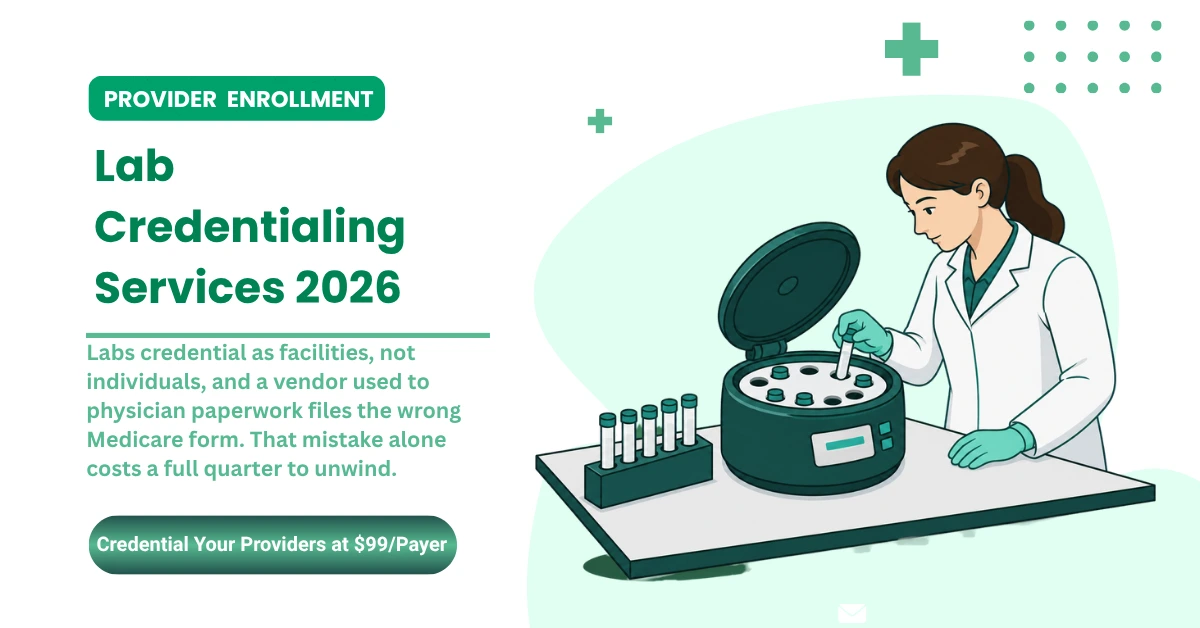




Lab credentialing services enroll and verify clinical, molecular, and pathology laboratories with government payers and commercial insurance networks. These services manage facility NPI setup, CLIA certificate alignment, state licensure, laboratory director qualifications, and payer contracts so the laboratory can bill and collect. A laboratory gets credentialed as a facility, not as an individual provider, and that changes the forms, the fees, and the timeline.
That last distinction costs labs entire quarters. An independent clinical laboratory that hands enrollment to a vendor experienced with physicians will watch that vendor file the wrong Medicare form, skip a $750 fee nobody mentioned, and restart the process in month three.
The full process runs six to nine months from a standing start, and government fees alone reach $750 before a vendor charges a dollar. CLIA also changed in March 2026, and most laboratory credentialing services content still describes the old rules.
Lab Credentialing vs Provider Credentialing: Why Labs Are Different
Credentialing splits into two categories. Individual provider credentialing verifies a person, checking education, licensure, training, and malpractice history. Organizational credentialing verifies a facility, checking its licenses, ownership structure, testing scope, and the qualifications of whoever runs it.
Your laboratory sits in the second category. Everything below follows from that.
Table 1. Provider Credentialing vs Lab Credentialing (2026)
|
Factor |
Individual provider |
Laboratory facility |
|---|---|---|
|
What gets verified |
Education, licensure, training, work history |
Facility licensure, testing scope, ownership, director qualifications |
|
Identifier used |
Individual NPI (NPI-1) |
Organizational NPI (NPI-2) plus TIN |
|
Medicare form |
CMS-855I |
CMS-855B |
|
Gating requirement |
State license |
CLIA certificate |
|
Application fee |
Usually none |
$750 institutional fee (CY 2026) |
|
Typical duration |
60 to 120 days |
90 to 180 days including CLIA |
The mechanics diverge from the physician credentialing process at almost every step. Labs that assume otherwise file a CMS-855I, skip the application fee, and wait two months for a rejection letter that sends them back to the start.
What Lab Credentialing Services Cover
Four workstreams run in parallel once a laboratory starts enrolling. Vendors who quote a single flat rate for "credentialing" are usually pricing one of them.
Facility Enrollment
Organizational NPI (NPI-2) registration, TIN alignment, CMS-855B submission for Medicare, state Medicaid applications, and commercial payer applications. Multi-site labs and specimen collection sites often need separate enrollment or explicit linkage, which is where facility enrollment services earn their fee.
Regulatory Compliance
CLIA certificate type matched to the complexity of your test menu, state laboratory licensure, proficiency testing enrollment records, and ownership disclosure. Payers check that the certificate covers the tests you run.
Laboratory Director and Personnel Verification
Laboratory director qualification review, primary-source verification of credentials, continuing education records, and technical supervisor documentation. Payers ask for director credentials during credentialing, not after.
Payer Contracting and Fee Schedules
Contract review, fee schedule negotiation, effective date confirmation, and repair of provider-to-facility linkage errors that stall claim approval even after a payer approves the application. A credentialing service for labs that stops at "approved" leaves the last problem for your biller.
What Changed for Lab Credentialing in 2026
CMS rewired how laboratories receive certificates and pay fees this year. If your compliance binder still says a paper certificate arrives in the mail, it is out of date, and the gap shows up as a billing problem rather than a paperwork one.
Table 2. 2026 CLIA and Medicare Enrollment Changes Affecting Laboratories
|
Change |
Effective date |
What it means for your lab |
|---|---|---|
|
CMS stopped mailing paper CLIA certificates and fee coupons |
March 1, 2026 |
Certificates arrive by email. A stale address on file with your State Agency means you may never receive one. |
|
Paper checks no longer accepted for CLIA fees |
March 1, 2026 |
Certification and survey fees are paid online through pay.gov. |
|
Medicare institutional application fee set at $750 |
January 1, 2026 |
Applies to initial enrollment, revalidation, and adding a practice location. It is charged per location and is not annual. |
|
COLA gained deeming authority for Clinical Cytogenetics and Radiobioassay |
January 20, 2026 |
Cytogenetics and radiobioassay labs gained an accreditation pathway that runs through January 20, 2031. |
|
CMS ended enforcement discretion for remote cytology slide review |
September 23, 2025 |
Reviewing digital cytology images away from the primary CLIA-certified lab no longer sits under the temporary allowance. |
Industry reporting through 2026 indicates commercial payers have moved toward validating CLIA data electronically against submitted claims, so records that once tolerated a small mismatch now produce automatic denials. CMS has not published a rule to that effect, and it should be treated as market behavior rather than federal policy.
One practical step protects you from most of this. Put a shared operational mailbox on file with your State Agency instead of one person's inbox, because CMS recommends an address several staff can reach.
Sources: CMS CLIA paperless notice | CMS MLN006270 | Federal Register CMS-6096-N
CLIA Certification: The Requirement That Gates Everything Else
No payer credentials a laboratory without a valid CLIA certificate. CMS states the position plainly in its own enrollment manual: a lab cannot be enrolled until it receives a CLIA number. That single line explains why the timeline works the way it does.
The Five CLIA Certificate Types
Table 3. CLIA Certificate Types for Laboratories (2026)
|
Certificate |
Short form |
Applies to |
|---|---|---|
|
Certificate of Waiver |
CoW |
Waived-complexity testing only |
|
Certificate for Provider-Performed Microscopy |
PPM |
Specified microscopy performed during a patient exam |
|
Certificate of Registration |
CoR |
Temporary, held while applying for a CoC or CoA |
|
Certificate of Compliance |
CoC |
Non-waived testing, surveyed by the State Agency |
|
Certificate of Accreditation |
CoA |
Non-waived testing, surveyed by a CMS-approved accreditor |
CLIA certificates run two years. Pick the type by the highest complexity of testing you perform, not by the majority of your volume.
How to Apply for CLIA Certification
You file Form CMS-116 with your State Agency. Send no payment with it, because CMS issues a fee coupon after the application processes. Labs performing non-waived testing must submit proof the laboratory director meets the education, training, and experience requirements in Subpart M, and applications stall when that proof is missing.
State Licensure and the Two CLIA-Exempt States
Per the current CMS list, Washington and New York are the only CLIA-exempt states, and New York's exemption covers non-physician office laboratories. Labs in those two states meet CLIA requirements through the state program instead of a separate federal certificate.
Every other state either runs no separate program or layers its own licensure on top of CLIA. Labs usually discover the layered ones after they open a second site or start accepting out-of-state specimens. If you operate in either exempt state, the Washington Medicaid enrollment and New York Medicaid enrollment rules run on their own tracks and deserve separate attention.
One deadline catches labs off guard. You must notify your State Agency within 30 days of a change to ownership affecting the EIN, the lab name, the location, or the laboratory director. Laboratory credentialing services track that window for you, because payers find out about the change whether you report it or not.
Sources: CMS: How to Apply for a CLIA Certificate | Form CMS-116 | CMS List of Exempt States | CMS Program Integrity Manual, Chapter 10
The Seven CMS-Approved CLIA Accreditation Organizations
A lab running non-waived testing picks one of two survey paths. A Certificate of Compliance puts you under State Agency survey. A Certificate of Accreditation puts you under an accreditation organization that holds deeming authority from CMS. Seven organizations currently hold it.
Table 4. CMS-Approved CLIA Accreditation Organizations (2026)
|
Organization |
Commonly used by |
|---|---|
|
AABB (Association for the Advancement of Blood & Biotherapies) |
Blood banks and transfusion services |
|
A2LA (American Association for Laboratory Accreditation) |
Testing and calibration laboratories |
|
ACHC (Accreditation Commission for Health Care) |
Diverse healthcare organizations |
|
ASHI (American Society for Histocompatibility and Immunogenetics) |
Histocompatibility and immunogenetics |
|
COLA (Commission on Laboratory Accreditation) |
Physician office labs and independent clinical laboratories |
|
CAP (College of American Pathologists) |
Hospital, reference, and anatomic pathology laboratories |
|
The Joint Commission |
Hospital-based and health system laboratories |
The list changed in January. CMS granted COLA deeming authority for Clinical Cytogenetics and Radiobioassay, applicable from January 20, 2026 through January 20, 2031, which opened an accreditation route those specialties did not previously have through COLA.
Accreditation is a path to CLIA compliance, not a substitute for payer enrollment. A CAP-accredited molecular lab credentialing file still needs a CMS-855B before Medicare pays anything.
Sources: CMS Accreditation Organizations and Exempt States | Federal Register CMS-3482-N
Laboratory Director Requirements After the 2024 CLIA Personnel Rule
CMS finalized rule CMS-3326-F on December 28, 2023, and the personnel provisions took effect December 28, 2024. It was the first substantial rewrite of CLIA personnel standards since 1992, and the proposed version drew more than 20,000 comments from the lab community.
The requirements that matter for a credentialing file:
- Moderate-complexity labs. A licensed MD, DO, or DPM needs one year of experience directing or supervising non-waived testing, or 20 continuing education credit hours covering laboratory director responsibilities.
- High-complexity labs. The experience requirement rises to two years of directing or supervising high-complexity testing.
- Enforcement discretion. At the end of June 2025, CMS issued discretion allowing physician directors of moderate-complexity labs to satisfy either the experience requirement or the CE requirement rather than both.
- Pathologist exception. Physicians board-certified in anatomic or clinical pathology by the American Board of Pathology or the American Osteopathic Board of Pathology qualify on certification.
- Grandfathering. Anyone holding an affected position before December 28, 2024 may continue in that role.
- Waived testing. CLIA sets no federal director qualifications for waived testing.
Payers request director credentials as part of the application packet. A director who no longer meets the current standard turns into a credentialing delay long before anyone calls it a compliance finding.
Sources: COLA: Laboratory Director Requirements | CAP Regulatory News and Updates
Medicare Enrollment for Laboratories: CMS-855B and the $750 Fee
Independent clinical laboratories enroll in Medicare as institutional suppliers on Form CMS-855B. CMS draws a distinction here that trips up new labs. An integrated lab, meaning one with the same ownership and physical location as another enrolled provider such as a hospital or physician office, gets listed as a practice location on the parent's existing CMS-855 with its CLIA number attached. A lab that is not integrated files its own CMS-855B.
The CY 2026 Medicare enrollment application fee is $750, effective January 1 through December 31, 2026, up from $730 the prior year. It applies to initial enrollment, revalidation, and adding a new practice location. Labs pay it per location, and it does not recur annually.
Applications get rejected for reasons that have nothing to do with your lab's quality. Taxonomy codes that do not match the enrollment type, addresses that differ from CMS records, broken reassignment links, and stale data after a move account for most of it. Your CLIA number also has to match the Medicare record, and CMS requires that number on laboratory service claims.
The wider Medicare picture, including PECOS 2.0, revalidation cycles, and deactivation rules, sits in our guide to Medicare enrollment in 2026.
Most labs do not get this wrong because the rules hide. They get it wrong because nobody on staff has filed an 855B before, and the first attempt teaches an expensive lesson. Our Medicare credentialing services team files these weekly, and we are happy to look at your situation before you submit anything.
Sources: Federal Register CMS-6096-N | CMS Medicare Provider Enrollment | CMS Program Integrity Manual, Chapter 10
Medicaid and Commercial Payer Enrollment for Labs
Medicaid Enrollment Varies by State
Medicaid is 50 separate programs with separate portals, forms, taxonomy requirements, and revalidation cycles. A lab drawing specimens across state lines files in each state. One useful detail on the fee: a provider who already paid the $750 application fee to Medicare, or to another state's Medicaid or CHIP program, has generally satisfied the requirement, but has to submit proof of payment. Our Medicaid enrollment by state guide breaks down the variance.
Commercial Payer Enrollment and Closed Panels
Each commercial payer maintains its own application, document set, and turnaround. Some of them also operate closed panels for laboratories in specific regions, which means they are not accepting new lab contracts at any quality level. Almost no published guidance admits this, and lab owners run into it constantly.
Two moves work when a panel is closed. You can submit a business-case appeal documenting a niche test menu, a turnaround advantage, or a geographic coverage gap the payer has. You can also enroll out of network, register your NPI in the payer's system so claims process, and use single case agreements for individual patients while you wait.
Third Party Payer Credentialing and Specialized Networks
Beyond the obvious payers, labs bill through Medicaid managed care organizations, workers' compensation networks, automobile insurance medical networks, third-party administrators, laboratory benefit managers, and the VA Community Care Network. Each has its own enrollment path. UMR lab credentialing and other third party administrator work often gets skipped because it sits outside the standard payer list.
How Long Does Lab Credentialing Take?
Ask three vendors and you will hear four weeks, three months, and nine months. Published timelines for lab credentialing services disagree that widely because most of them describe a single phase and call it the whole process.
The phases run in sequence, not in parallel. Your lab cannot start Medicare or commercial enrollment until the CLIA certificate is in hand, because payers require the certificate number on the application and CMS will not enroll a lab without a CLIA number.
Table 5. Lab Credentialing Timeline by Phase (2026)
|
Phase |
Typical duration |
Can it run in parallel? |
|---|---|---|
|
CLIA certification via Form CMS-116 |
60 to 90 days |
No. It gates everything after it. |
|
State laboratory licensure, where required |
30 to 120 days |
Sometimes, depending on the state |
|
Medicare enrollment via CMS-855B |
60 to 90 days |
Yes, alongside Medicaid |
|
State Medicaid enrollment |
45 to 90 days |
Yes, alongside Medicare |
|
Commercial payer credentialing, per payer |
60 to 120 days |
Yes, across payers |
A laboratory starting without CLIA certification should plan on six to nine months to reach full in-network status. A laboratory that already holds CLIA and state licensure is looking at 60 to 120 days per payer.
Payers control approval timing, and no vendor changes that. What a credentialing team controls is application completeness, response speed when a payer asks for something, and follow-up that happens on a schedule instead of when someone remembers.
How Much Do Lab Credentialing Services Cost?
Almost every published credentialing price is quoted per provider. Labs enroll as institutions, so they pay a different stack, and nobody has laid it out.
Start by separating the two categories. Government fees are mandatory and go to CMS or a state. Vendor fees are optional and go to whoever files your paperwork. Most content blends them, which is why the numbers contradict each other.
Table 6. Lab Credentialing Cost Breakdown (2026)
|
Cost |
Who charges it |
Amount |
Notes |
|---|---|---|---|
|
Medicare enrollment application fee |
CMS |
$750 |
CY 2026. Per location. Initial, revalidation, and new locations. Not annual. |
|
CLIA certificate and survey fees |
CMS |
Varies by certificate type and test volume |
Paid through pay.gov only as of March 1, 2026 |
|
State laboratory license |
State agency |
Varies by state |
Separate from CLIA and from state medical board fees |
|
Accreditation, if choosing the CoA path |
CAP, COLA, TJC, or another approved organization |
Varies by organization |
Optional. Replaces the State Agency survey. |
|
Credentialing service fees |
Your vendor |
See Table 7 |
Optional. Never includes the government fees above. |
Budget for both columns. A lab that prices only the vendor gets surprised by the $750 in month two.
Table 7. Lab Credentialing Service Pricing Comparison (2026)
|
Service component |
Commonly published industry range |
MedSole RCM |
|---|---|---|
|
Payer enrollment, per insurance |
$150 to $500 |
$99 |
|
CAQH profile setup and attestation |
$100 to $200 |
Included |
|
Weekly payer follow-up |
Often billed separately |
Included |
|
Re-credentialing deadline tracking |
$100 to $600 per cycle |
Included |
|
Full revenue cycle management |
4% to 7% of collections |
2.99% of collections |
Industry ranges above reflect commonly published vendor pricing and vary by market. Costs also differ credentialing costs by state, since state licensure and Medicaid requirements are not uniform.
If you are pricing this out, the number that matters is total cost to first clean claim, not cost per application. We are glad to model that against your payer mix before you commit to anything.
Sources: Federal Register CMS-6096-N | CMS Clinical Laboratory Fee Schedule
Documents Required for Lab Credentialing
Published document checklists describe the provider set: diploma, license, malpractice policy, work history. A laboratory packet looks different, and payers reject applications over the gaps.
Facility Documents
- Current CLIA certificate matching the complexity of testing performed
- Form CMS-116, if certification is still in process
- State laboratory license, where the state requires one
- Organizational NPI (NPI-2) confirmation
- Tax ID or EIN with a completed W-9
- Ownership and controlling interest disclosure
- Proficiency testing enrollment records
- Accreditation certificate from CAP, COLA, TJC, or another approved organization, if applicable
- Professional and general liability insurance certificates
- Test menu and scope of services mapped to CPT codes
Personnel Documents
- Laboratory director CV, state license, and board certification
- Laboratory director continuing education records
- Technical supervisor and testing personnel qualifications
- A current CAQH profile setup for the laboratory director and any rendering providers
- Bank account details for EFT and ERA enrollment
Applications rarely stall over a missing document. They stall over a document whose data disagrees with what the payer already has on file, and a credentialing service for labs earns its fee by catching that before submission. Good laboratory credentialing services reconcile the packet against payer records first.
Startup Lab, Existing Lab, or Ownership Change: Where to Begin
Three situations bring labs to laboratory credentialing services, and the right first move differs in each.
A New Laboratory Starting From Zero
CLIA first, always. State licensure second. Payer applications only after both. Budget six to nine months and the $750 Medicare fee, and hold off on referral agreements that promise in-network billing until enrollment is confirmed. Whether you build this in house or buy it comes down to in-house versus outsourced math on staff time.
An Existing Laboratory Adding Payers or States
CLIA and licensure already exist, so the clock is 60 to 120 days per payer. Confirm the certificate covers the complexity of any test you are adding. Moving into a new state usually means new state licensure and a fresh Medicaid enrollment.
A Laboratory Changing Ownership, TIN, or Location
Labs underestimate this one badly. A change of ownership affecting the EIN, a name change, a relocation, or a new laboratory director triggers the 30-day CLIA notification requirement and can force re-enrollment or revalidation with every payer you hold. Treat it as a credentialing event, not an address update.
Which Payers to Enroll With First
Start with Medicare. Many commercial contracts benchmark their fee schedules to a percentage of Medicare, and the enrollment record becomes a reference point for later negotiation. Move to state Medicaid and its managed care organizations next. Take commercial payers last, ordered by where your specimen volume comes from rather than by payer size.
Payer Approval Does Not Mean You Can Bill Yet
Approval is not the finish line. Billable is. A laboratory can hold an approval letter and still watch claims deny for weeks, and the reasons sit in fields nobody checked.
Six Reasons an Approved Lab Still Gets Denied
- Effective date gaps. The approval date and the effective date are different dates. Claims for services before the effective date deny, and retroactive dates stay at the payer's discretion.
- Provider-to-facility linkage failures. The lab is enrolled, the rendering provider is enrolled, and the payer's system never linked them.
- CLIA number missing or mismatched. CMS requires the CLIA number on laboratory service claims. On the CMS-1500 it belongs in Box 23.
- TIN or address mismatch. The enrollment record and the claim disagree, so the claim rejects before a human reviews it.
- Directory discrepancies. Incomplete or wrong payer directory listings interfere with claims processing.
- Ordering provider ineligibility. For Medicare, the ordering and certifying provider needs an individual NPI, active enrollment or a valid opt-out, and an eligible specialty type. CMS lists clinical laboratory services among the services these rules affect.
Two of these show up as a CO-16 denial code before anyone traces them back to enrollment data, and the Box 23 problem lives among the more common CMS-1500 claim errors labs make. Working them as claim problems instead of credentialing problems wastes weeks.
This gap is where a credentialing vendor and a billing vendor hand off to each other, and where the handoff usually breaks. At MedSole RCM we sit on both sides of it, which means effective dates and linkage get verified before the first claim goes out rather than after the first denial batch comes back. Persistent denials also feed straight into denial management services work that could have been avoided.
Most labs learn this after the fact, when that first batch returns. Catching it earlier costs one conversation between whoever handles your credentialing and whoever handles your billing, and our credentialing and contracting support team runs that check as standard.
Sources: CMS MLN006270
Keeping a Laboratory Credentialed After Approval
The expensive failures happen after approval. A lapsed certificate or a missed revalidation stops payment faster than a rejected application ever did, and lab credentialing services that end at the approval letter leave this part with you.
Table 8. Lab Credentialing Maintenance Requirements (2026)
|
Requirement |
Frequency |
Consequence of missing it |
|---|---|---|
|
CLIA certificate renewal |
Every two years |
Loss of authorization to test |
|
Medicare revalidation |
On the CMS revalidation cycle |
Held reimbursement or deactivation |
|
Payer re-credentialing |
Typically every two to three years |
Termination from the network |
|
CAQH re-attestation |
Every 120 days |
Payers treat the profile as stale |
|
Change notification to State Agency |
Within 30 days of the change |
Certificate and enrollment records fall out of sync |
|
OIG exclusion screening |
Monthly, as the LEIE updates |
No federal payment for affected services |
Four events trigger most of these: an ownership change affecting the EIN, a name change, a relocation, and a change of laboratory director. The 30-day CLIA notification requirement covers all four. Held reimbursement from a missed revalidation lands in A/R follow-up as aged claims nobody can appeal.
Assign one person to own expiration tracking. Lapses happen because three people each assumed another was watching the calendar.
Should You Handle Lab Credentialing In-House or Outsource It?
Can You Credential Your Lab Yourself?
Yes. Filing directly with payers is legal, and the applications themselves cost nothing. The work is gathering documents, submitting separately to each payer, and following up every one to three weeks for several months. CAQH also needs re-attestation every 120 days, and a lapsed attestation can render a lab unbillable while everything else stays valid.
What Outsourcing Replaces
Lab credentialing services buy you four things: payer-specific application knowledge, follow-up that runs on a cadence instead of on spare time, deadline tracking across two-year and 120-day cycles, and someone who has filed a CMS-855B before yours.
What to Look For in a Lab Credentialing Partner
Apply these seven standards when you compare credentialing companies. They separate vendors who enroll facilities from vendors who enroll physicians and hope the process transfers.
- Files CMS-855B for facilities, not only CMS-855I for individuals. Many vendors have never enrolled a facility.
- Handles CLIA and state licensure alongside payer enrollment rather than payer enrollment alone.
- Publishes per-payer pricing instead of requiring a sales call to learn the rate.
- Assigns a named specialist with weekly follow-up, not a shared ticket queue.
- Tracks re-credentialing, revalidation, and CAQH attestation deadlines before they expire.
- Connects credentialing to billing so effective dates and linkage get verified before claims go out.
- Works in all 50 states, including the two CLIA-exempt ones.
MedSole RCM prices payer enrollment at $99 per insurance and full revenue cycle management at 2.99% of collections. CAQH setup and attestation, weekly payer follow-up, and re-credentialing deadline tracking carry no additional charge, and enrollment is available in all 50 states. Our outsourced medical billing and credentialing teams work the same file, which is what closes the gap in standard six.
For a wider comparison of the best credentialing services across specialties, our guide to choosing a credentialing partner walks through what to ask before you sign.
Lab Credentialing FAQs
How long does lab credentialing take?
Sixty to 120 days per payer once CLIA certification and state licensure are in place. A laboratory starting from zero should plan six to nine months, because CLIA certification takes 60 to 90 days and has to finish before payer applications can be filed.
How much do lab credentialing services cost?
Vendor fees commonly run $150 to $500 per payer. MedSole RCM charges $99 per insurance. Separately, CMS charges a $750 Medicare enrollment application fee for CY 2026, plus CLIA certificate fees paid through pay.gov and any state license fees.
Is CLIA certification required before payer credentialing?
Yes. Payers require a valid CLIA certificate number on the application, and CMS states that a lab cannot be enrolled in Medicare until it receives a CLIA number. That dependency sets the entire timeline.
Can a laboratory bill insurance before credentialing is complete?
No. Claims submitted before the payer effective date deny. Some payers grant retroactive effective dates at their discretion, and out-of-network billing is sometimes possible, but neither should be assumed while you wait.
What is the difference between CLIA certification and lab credentialing?
CLIA certification is federal authorization to perform testing on human specimens. Lab credentialing is payer approval to bill for that testing. Your lab needs both, and CLIA comes first.
Do labs need separate credentialing for each location?
Often yes. Multiple locations and specimen collection sites may require separate enrollment or explicit linkage to the primary record. The $750 Medicare application fee applies per location.
How often does a laboratory need to be re-credentialed?
Payers typically re-credential every two to three years. CLIA certificates run two years. CAQH profiles need re-attestation every 120 days, and that one lapses more often than the others.
Can I credential my lab myself?
Yes. Filing directly with payers is legal and the applications are free. Plan for document gathering, separate submissions per payer, follow-up every one to three weeks, and deadline tracking across several overlapping cycles. Labs usually turn to laboratory credentialing services when the follow-up starts competing with running the bench.
Getting Your Lab Credentialed and Billable
The order never changes: CLIA certification, then payer enrollment, then verified billability before the first claim leaves your system. Skipping the third step is what turns an approved lab into an unpaid one.
We handle lab credentialing services at $99 per insurance and run the billing behind it, so the effective dates and linkage that cause most post-approval denials get checked by the same team that filed the application. That is also what our revenue cycle management work is built around.
If your lab is starting this process, or if claims are denying after what looked like a clean approval, that is worth a conversation. You can talk to a credentialing specialist or read more about our lab credentialing support.